The search for sustainable solutions in the heat treat industry is at the forefront of research for industry experts. Michael Stowe, PE, senior energy engineer at Advanced Energy, one such expert, offers some fuel for thought on the subject of how heat treaters should prioritize the reduction of their carbon emissions by following the principles of reuse, refuel, and redesign.
This Sustainability Insights article was first published in Heat Treat Today’sJanuary/February 2024 Air & Atmosphereprint edition.
Reduce
Michael Stowe PE, Senior Energy Engineer Advanced Energy
We explored why the question above has come to the forefront for industrial organizations in Part 1, released in Heat Treat Today’s December 2023 print edition. Now, let’s look at the four approaches to managing carbon in order of priority.
Click to share your Reader Feedback
The best way to manage your carbon footprint is to manage your energy consumption. Therefore, the first and best step for reducing your carbon footprint is to reduce the amount of energy you are consuming. Energy management tools like energy treasure hunts, energy assessments, implementation of energy improvement projects, the DOE 50001 Ready energy management tool, or gaining third party certification in ISO 50001 can all lead to significant reduction in energy consumption year over year. Lower energy use means a smaller carbon footprint.
Additionally, ensuring proper maintenance of combustion systems will also contribute to improved operational efficiency and energy savings. Tuning burners, changing filters, monitoring stack exhaust, controlling excess oxygen in combustion air, lubricating fans and motors, and other maintenance items can help to ensure that you are operating your combustion-based heat treating processes as efficiently as possible.
Reuse
Much of the heat of the combustion processes for heat treating goes right up the stack and heats up the surrounding neighborhood. Take just a minute and take the temperature of your exhaust stack gases. Chances are this will be around 1200–1500°F. Based on this, is there any effective way to reuse this wasted heat for other processes in your facility? One of the best things to do with waste heat is to preheat the combustion air feeding the heat treating process. Depending on your site processes, there are many possibilities for reusing waste heat, including:
Space heating
Part preheating
Hot water heating
Boiler feed water preheating
Combustion air preheating
Refuel
Once you have squeezed all you can from reducing your process energy consumption and reusing waste heat, you may now want to consider the possibility of switching the fuel source for the heat treating process. If you currently have a combustion process for a heat treat oven or furnace, is it practical or even possible to convert to electricity as the heating energy source? Electricity is NOT carbon free because the local utility must generate the electricity, but it typically does have lower carbon emissions than your existing direct combustion processes on site. Switching heating energy sources is a complex process, and you must ensure that you maintain your process parameters and product quality. Typically, some testing will be required to ensure the new electrical process will maintain the metallurgical properties and the quality standards that your customer’s specific cations demand. Also, you will need a capital investment in new equipment to make this switch. Still, this method does have significant potential for reducing carbon emissions, and you should consider this where applicable and appropriate.
Redesign
Finally, when the time is right, you can consider starting with a blank sheet of paper and completely redesigning your heat treating system to be carbon neutral. This, of course, will mean a significant process change and capital investment. This would be applicable if you are adding a brand-new process line or setting up a new manufacturing plant at a greenfield site.
In summary, heat treating requires significant energy, much of which is fueled with carbon-based fossil fuels and associated-support electrical consumption. Both combustion and electricity consumption contribute to an organization’s carbon footprint. One of the best ways to help manage your carbon footprint is to consider and manage your energy consumption.
For more information: Connect with IHEA Sustainability & Decarbonization Initiatives www.ihea.org/page/Sustainability Article provided by IHEA Sustainability
Find Heat Treating Products And Services When You Search On Heat Treat Buyers Guide.Com
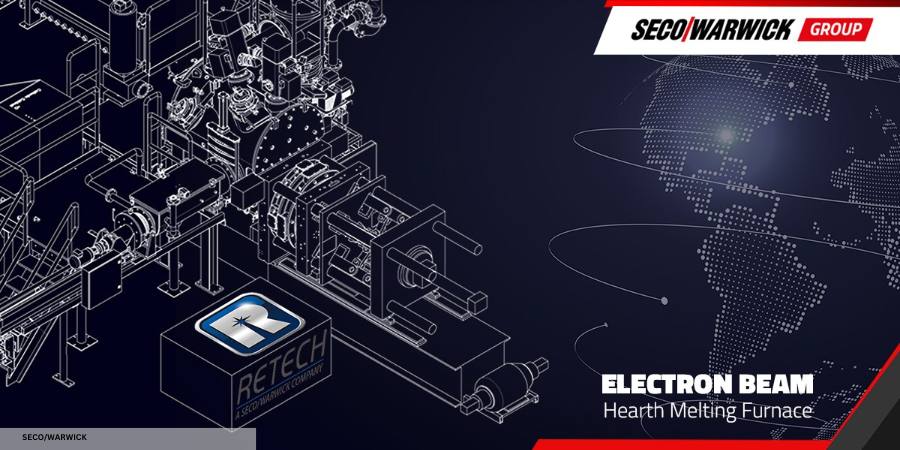
A North America-based company is set to receive a four-gun electron beam hearth melting furnace from their industry partner of 3 years.
Retech, a division of SECO/WARWICK Group, received this third contract in as many years from the returning partner after the successful planning, installation, commissioning, and subsequent operation and progress of the last two EB hearth melters. Along with that, repeat orders from a known partner reduce uncertainty and risk for the company. Put more simply, practice makes perfect.
Source: SECO/WARWICK
These EB furnaces have a throughput that is suitable for large-ingot casting of reactive/refractory metals when alloying with metals having similar vaporization temperatures, whereas plasma arc melting, although slower, would be the more suitable choice for dissimilar vaporization temperatures.
Earl Good Managing Director at Retech Systems, LLC Source: Retech
“We are thrilled to be an ongoing partner in this customer’s growth,” said Earl Good, managing director of Retech Systems. “We know they have multiple competitive options for their vacuum metallurgy equipment, so we take nothing for granted, and work hard to earn their business every step of the way. Ongoing awards like this suggest we’re doing a lot of things right.”
Retech produces and assembles vacuum melting equipment entirely in North America. Their integrated R&D, manufacturing, and assembly facility in Buffalo allows them to do that. The North American supplier also has exclusive use of electron beam guns from Von Ardenne, industry pioneers of electron beam technology.
This press release is available in its original form here.
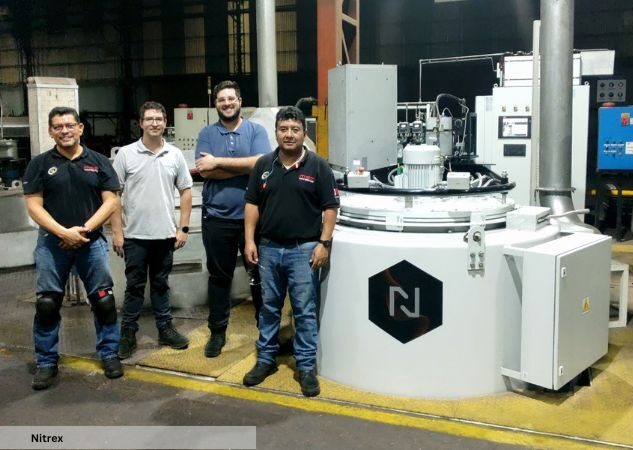
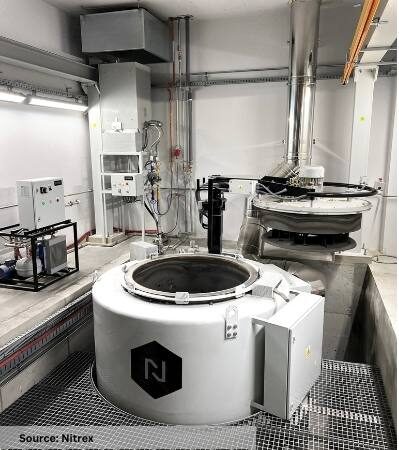
Sudosilo S.A., a commercial heat treatment service provider in South America, is bringing premier nitriding to the Argentine industrial sector with the recent commissioning of turnkey heat treat installation. This newly operational nitriding system represents a significant milestone as the first of its kind in Argentina, offering third-party heat treatment services to the region.
Source: Nitrex
The integration of this system from NITREX — a global supplier of heat treat systems with North American locations — is set to establish a new benchmark for quality and precision in nitriding treatments. Particularly, it will help Sudosilo cater to various sectors, including aluminum injection, aluminum extrusion, forging, and oil applications.
Jerónimo Alberto Colazo Production Manager Sudosilo
Jerónimo Alberto Colazo, production manager at Sudosilo, highlighted, “The competitive edge of this installation lies in its meticulous control and automation capabilities, ensuring process stability and the ability to generate specialized processes and recipes tailored to unique requirements of each application. This high level of customization and precision guarantees superior quality, meeting the intricate demands of industries served by Sudosilo.”
This press release is available in its original form here.
Needing to learn more about the fundamentals and latest developments of stop off coatings? Mark Ratliff, president of AVION Manufacturing Company, Inc., applies his background in chemical engineering to understand and create what makes the best stop-off coatings/paints for carburizing and other heat treat processes. In this episode, Mark and Heat Treat Radio host, Doug Glenn, uncover the varieties of coatings, their uses, and the future of coating solutions.
Below, you can watch the video, listen to the podcast by clicking on the audio play button, or read an edited transcript.
The following transcript has been edited for your reading enjoyment.
Chemistry in Coatings: Mark Ratliff’s Start in the Industry (00:22)
Contact us with your Reader Feedback!
Doug Glenn: I have the really great honor today of talking with Mark Ratliff from AVION Manufacturing. We’re going to do a “painting class” . . . kind of, but not really. Industrial paint — we’re going to talk about stop-off paints and things of that sort.
Mark has been working at AVION, currently located in Medina, Ohio, since 1994. He graduated with a Bachelor of Science degree in chemical engineering from the University of Cincinnati. Prior to that — I did not know this about you, Mark — he worked at Shore Metal Treating with your father, huh?
Mark Ratliff: That’s correct, yes.
Doug Glenn: How long was he there?
Mark Ratliff: Well, he started the company. I went working there and was loading baskets of parts since I was about 8 years old. He would pay me $5.00 for a basket, “under the table,” and that was a lot of money back then. I was really rich, at the time!
Mark Ratliff, President, Avion Manufacturing (Source: AVION Manufacturing)
Doug Glenn: That’s pretty cool. It is very interesting to see people’s backgrounds and how they got involved in the industry. A lot of people start young, you know? You may win the record though — 8 years old! The labor board may be calling about your childhood.
Why Use Stop-Off Paints? (01:54)
Let’s talk today. Technically, we want to talk about something that not everybody may know about, and I think you and your company are kind of experts on these things, and that’s stop-off paints. Just from a 30,000-foot view — and you don’t have to go into a lot of detail here, Mark — what are stop-off paints and why do we use them?
Mark Ratliff: Stop-off paints are protective barrier-type coatings. What they do is prevent either carburization or the nitriding process from entering into the steel. They were created probably well over 50 years ago as a replacement for copperplating these parts. In the past, a long time ago, they would copperplate the part that they did not want carburized or nitrided. That’s a time-consuming process as well as being very expensive. The stop-off coatings were developed as an economical alternative to copperplating.
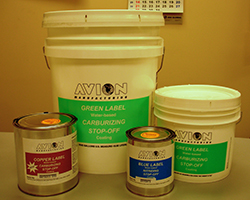
AVION Line of Stop-Offs (Source: AVION Manufacturing)
DougGlenn: When you say “copperplating,” does that mean it was actual thin sheets of copper metal?
MarkRatliff: That’s correct, yes.
Doug Glenn: And you actually had to wrap whatever you did not want nitrided or carburized in this copper and that would keep it from nitriding?
Mark Ratliff: That’s correct, yes.
Doug Glenn: Just in case people don’t know — but I would imagine that most people that are listening to this do know — nitriding and carburizing are both surface hardening technologies in which either nitrogen (in the case of nitriding) or carbon (in the case of carburizing) are infused into the surface. That, of course, gives improved wear properties, typically corrosion properties to those areas that receive the infusion of the metal.
Why do people not want the nitrogen or carbon to be infused to certain areas of the part?
MarkRatliff: When you harden a part, as with carburization or nitriding, a lot of times hardness equates to brittleness. So you may induce certain stress in various parts, in various areas.
Also, if you want to do a post-heat treatment machining on the part, it would be virtually impossible if that part were carburized or nitrided because the surface is so hard that the tool can’t cut through it to do further machining on the part.
“If you want to do a post-heat treatment machining on the part, it would
be virtually impossible if that part were carburized or nitrided because the surface is so hard that the tool can’t cut through it to do further machining on the part.”
— Mark Ratliff, AVION Manufacturing
Doug Glenn: Gotcha.
Can you give a couple examples of parts, and if you can do a description of where on those parts you might apply a stop-off coating?
Mark Ratliff: Well, a lot of times the end user (the customer) is painting an end of a shaft where he’ll heat treat the shaft and make the shaft harder, but he wants to spin a thread on the end of that shaft. That’s a prime example of why you would use a stop-off coating.
A lot of times, the parts are made with the threads already on, but you don’t want those threads to be hardened because, again, hardness equals brittleness, and those threads would crack off after heat treatment. That would be an area where you would apply a stop-off coating.
Doug Glenn: Tell us a little bit about the actual physical “properties" of these stop-off coatings. We also call them “stop-off paints.” I’m assuming a lot of times these are just painted on — it’s a liquid format.
Mark Ratliff: They are all supplied in liquid form with the viscosity ranging right around 3500–8500 centipoise (cP). For the carburizing stop-off, we have two different kinds. (This is not new in the industry; most people know the formulations of the stop-offs.)
We have boric acid-based stop-offs; we have two different kinds of that — a waterborne and a solvent borne. The idea behind the boric acid-based stop-offs is that as the boric acid thermally decomposes, it creates a boron oxide glass. This glass is actually the diffusion barrier of the carbon. What’s nice about the boric acid-based stop-offs is that they’re water washable after the heat treatment process; the coating and the residue can get washed off.
Another type of stop-off coating that we have is based on silicate chemistry. A silicate chemistry is basically like putting a glass on the part. It’s more of a ceramic-based coating. It works very, very well, but the drawback of the silicate-based stop-offs is that you have to bead-blast the parts after heat treatment; it does not wash off in water.
Doug Glenn and Mark Ratliff
Doug Glenn: So, you’ve got to brush it off.
Mark Ratliff: You’ve got to brush it off, mechanically, correct.
Doug Glenn: That’s interesting.
When I think of painting something on and then putting it into a furnace, the first thing I think of is that paint is going to get completely obliterated in the furnace. But you just kind of answered that question. Those things will either transform into a glass or a ceramic of some sort after they’ve been in high heat for a while, and that’s what creates the barrier.
Mark Ratliff: That’s correct.
You have the active ingredient in the stop-offs — you either have the silicate or you have the boric acid. Those are the active ingredients. The vehicle that the paint itself — be it the water-based latex or the solvent-borne bead — those do, indeed, get charred off. They get burned off, leaving the active ingredient behind.
Doug Glenn: Are you able to use either of those — the water-based or the solvent-based — in vacuum furnaces? Do you have any trouble with off-gassing and things of that sort?
Mark Ratliff: Yes, a little bit. We’ve got to be careful in the vacuum furnace market because you do have the off-gassing. The combination of the vacuum and the heat at once can cause the coating to boil and blister. We do recommend pre-heat treatments when doing a vacuum operation.
Doug Glenn: And the pre-heat just kind of helps it adhere to the part without the blistering, I guess?
Mark Ratliff: That’s correct. And it drives off a lot of the residual water or solvent that might be left in the coating.
Different Chemistry, Different Technology: Plasma Nitriding Stop-Off Coatings (08:32)
Doug Glenn: Okay, good.
Now I understand that there is a new product coming out on the nitriding end of things. Can you tell us a little bit about that and why you’re developing it?
Mark Ratliff: We’ve been making a nitriding stop-off coating since 1989 when we came out with our water-based version. We actually had it patented. We were the first on the market with a water-based nitriding stop-off. This particular stop-off has been used in the industry for 45 years now.
We got called by a current customer asking, “Hey, do you have a plasma or an ion-nitriding stop-off?” At the time, we did not. So, we developed a new plasma — aka, ion-nitriding — stop-off, and that’s a different chemistry, different technology. It is going to be available in the market very soon.
Doug Glenn: Interesting.
I’m curious about this: Are stop-off paints used more in carburizing or nitriding?
Mark Ratliff: By far, carburizing — it’s probably 10 to 1 carburizing to nitriding, for sure.
Doug Glenn: Okay, gotcha.
This episode of Heat TreatRadio is sponsored by AVION.
So, you’ve been doing this for 30 or some years, right?
Mark Ratliff: It will be my 30th anniversary in the month of April.
Doug Glenn: Very nice! Well, congratulations.
Mark Ratliff: I did work for my father prior to that, when he ran AVION for many years before that.
Doug Glenn: Well, congratulations, first off — that’s good. It shows longevity, which is good.
Memorable Moment of Innovation (11:11)
Doug Glenn: Has there been a memorable challenge that you had to deal with, with these stop-off paints?
Mark Ratliff: One thing I’m particularly proud of, Doug, is we always had the water-based carburizing stop-off coating — both varieties — the boric acid-based and the silicate-based. I had a few customers reach out to me and say, “Hey, we’re doing heat treatment for the aerospace industry or for the automotive industry, and they don’t like water-based coatings on their parts,” because you run into corrosion, you run into rust, and so forth and so on. So, these customers asked me to create the solvent-borne, which we did about seven or eight years ago.
One thing I’m particularly proud of is, I got called by the Fiat Chrysler plant in Michigan (they’re going by Stellantis, now), and unbeknownst to them, their current stop-off provider, at the time, changed the formulation. (That was due to the REACH regulations in Europe.) Since they changed the formulation, Stellantis started seeing all these problems. So, they reached out to me and asked, “Do you have an equivalent? We’d like a solvent-borne stop-off.” I was quick to respond, “Oh, by the way, yes, we do. And yes, our product is better,” because even though it’s solvent-borne, we created a nonflammable stop-off coating. In addition to being nonflammable, the solvent that we used in the coating is VOC exempt — VOC meaning volatile organic compounds — which are basically air pollutants that people want to avoid when using these stop-off coatings.
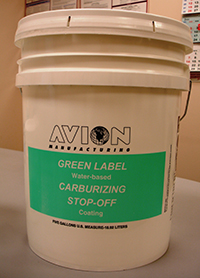
AVION Green Label pail (Source: AVION Manufacturing)
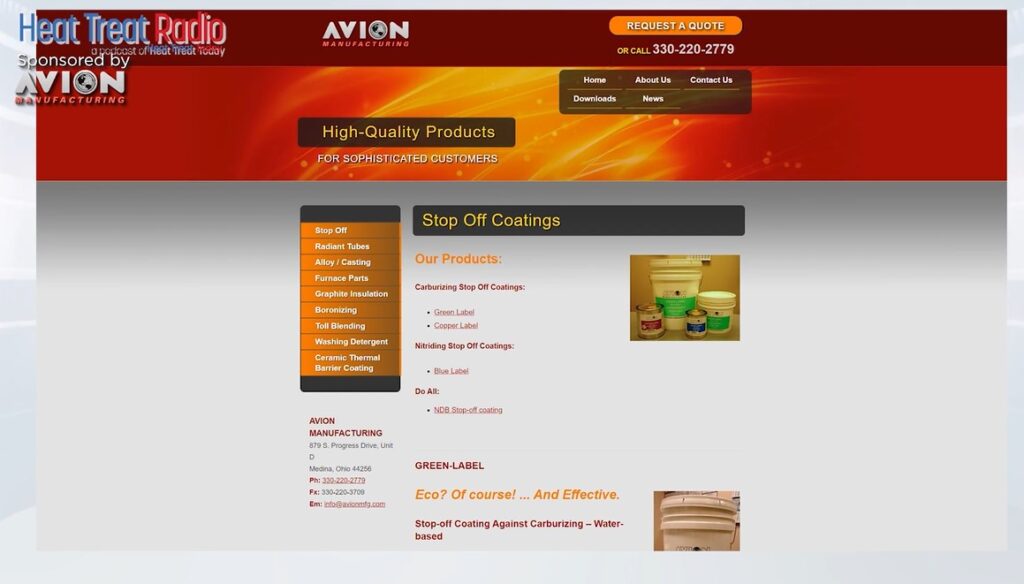
Doug Glenn: Okay, very interesting. I was going to ask you — because I saw on your website — about your green label, which you kind of hit on with the VOC part, but can you tell us a little bit about the green label products that you have and why you’re calling them “green label”?
Mark Ratliff: We called it “green label” a long time ago — that was our original stop-off which kicked off our business 50+ years ago. But I think you’re referring to our eco green label which we created about two years ago.
We’ve been getting a lot of pressure to remove VOCs from our coatings. Clients like John Deere and Caterpillar said, “Hey, we love your coating, but if you could do anything to get the VOCs out of it, we’d really appreciate it.” So, that was one of the biggest goals and one of the biggest accomplishments — to create a coating that didn’t have any of these VOC or HAP (hazardous air pollutants)-type solvents in the coating, and we have successfully done that.
Doug Glenn: That’s good. Especially in the ‘green movement’ that’s going on today, that’s obviously very important.
What coating solution should heat treaters be looking at, in the near future? Is it just VOC stuff, the lack of VOC, or what?
Mark Ratliff: Well, yes, of course. I mean, we’re proud to say that all of our coatings are virtually VOC-free. We are still making the original green label because some customers are not happy to change, so we still offer that. But every single one of our coatings right now have a less than 10 gram/liter VOC threshold, and we’re really quite proud of that.
But, you know, as you’re talking about new coatings coming to the market, we’re coming out with the plasma nitriding stop-off. But we’re also looking into a stop-off for salt bath carburizing. We’ve had a couple people reach out to us, just recently, asking, “Do you have a coating that we can use to paint on the parts that go into a salt bath carburizing operation?”
Doug Glenn: That would be interesting because there is a bit of abrasion going on there, yes?
Mark Ratliff: There is, correct.
Final Questions: Supply Chain, Technical Assistance, and Target Markets (14:51)
Doug Glenn: Now, that’s interesting.
I have two additional questions for you. One has to deal with supply chain issues. Have you guys had any issues with being able to deliver quickly or anything of that sort, ala Covid?
Mark Ratliff: Sure. Right after Covid, we had trouble getting the main ingredient for the carburizing stop-off coating which is boric acid. Currently, I have three suppliers that supply that to me, and there was a point in time where none of them could get the material because the manufacturer of this product was not delivering east of the Mississippi. So, I had to do several days of researching and scrounging around, and I found a distributor in California that said, “Yes, we can get it to you, but you have to buy a whole truckload, which we were very happy to do.”
Doug Glenn: Yes, you take what you can get, at that point.
But no issues now?
Mark Ratliff: No, everything is pretty much back to normal. I mean, gone are the days where you could pick up the phone and get material delivered to you in three days, but most of our raw materials get delivered in under two weeks, and we keep a pretty adequate inventory of all of our raw materials so that we don’t run out of anything.
Doug Glenn: So, you get the raw materials. Do you do your own formulations there? I mean, do you actually do the mixing and all that stuff?
Mark Ratliff: We do. Everything is all done here, in-house, correct.
Doug Glenn: Finally, technical assistance and competency on your guys’ part: Do you have people on your staff — yourself or others — that if a customer calls in with an issue, you can help talk them through it?
“[Look] at the copperplating method: It’s, number one, very expensive, and number two, from what I’ve been told, it’s not very environmentally friendly — you’re working with a lot of hazardous ingredients, hazardous waste."
— Mark Ratliff, AVION Manufacturing
Mark Ratliff: Absolutely. So, I’m the “go to guy” here at AVION. If anyone has any technical questions, I’m the one that’s going to be answering them. And if it’s something where I need to come out to the plant, I’ll get in my car or get on a plane and visit that customer, if the quantity of it dictates that.
Doug Glenn: Yes, sure; it’s got to be a good business opportunity, obviously. But I’m sure you can use the phone to answer questions too.
Mark Ratliff: Yes, most of the time it’s by phone.
Doug Glenn: So, Mark, in the marketplace, is there an ideal client, someone who maybe should be considering stop-off paints that isn’t currently using it? Is there someone out there that you would say, “Hey, you know, if you’re doing this, maybe you ought to think about stop-off paints, if you’re not already doing them.”
Mark Ratliff: Well, I would certainly still target those that are copperplating. Look at the copperplating method: It’s, number one, very expensive, and number two, from what I’ve been told, it’s not very environmentally friendly — you’re working with a lot of hazardous ingredients, hazardous waste. So, those are the types of people that I will continue to target for stop-off coatings.
Doug Glenn: Well, Mark, listen, that’s great. Hopefully, this has been a good primer for people who didn’t know what stop-off paints/coatings were, and hopefully they can get ahold of you if they need something. I appreciate you being with us.
Mark Ratliff: Okay, thank you very much, Doug. I appreciate it myself.
About the Expert
Mark Ratliff started at Avion Manufacturing in 1994 after earning his bachelor’s of science degree in Chemical Engineering at the University of Cincinnati. Prior to getting his degree, Mark spent many of his summer breaks working for his father at Shore Metal Treating where he gained a good deal of knowledge about the heat treating industry.
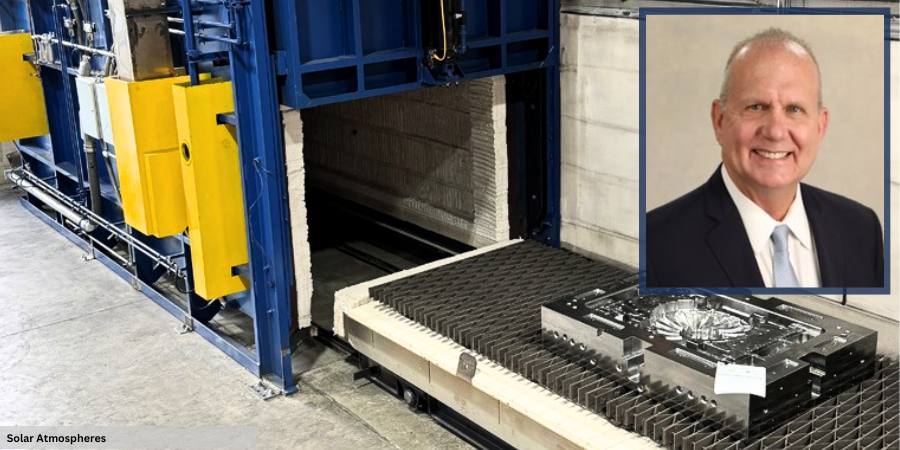
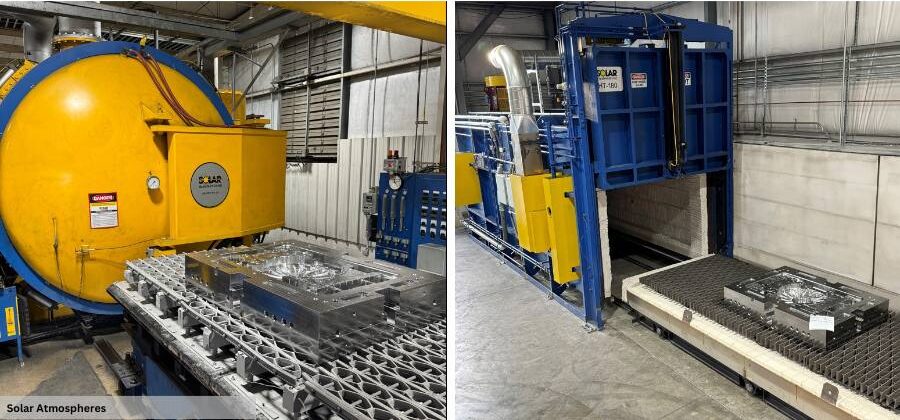
Solar Atmospheres of Western PA recently commissioned their third car bottom air furnace. This Class 2 air furnace has a maximum operating temperature of 1350°F measures 60” wide x 38” high x 168” deep.
The newly installed equipment, manufactured by Heat Treat Equipment Inc., joins two other HTE car bottom furnaces that are 14’ long and 20’ long respectively.
“After successfully hardening in vacuum at 1850°F +/- 10°F, the fully hardened die was transferred to the air car bottom furnace for the triple temper operation of 1025°F +/- 10°F.” – Bob Hill, President, Solar Atmospheres WPA and Michigan Source: Solar AtmospheresRobert (Bob) Hill, FASM President Solar Atmospheres of Western PA Source: Solar Atmospheres
Bob Hill, president of Solar Atmospheres of Western PA and Michigan, states, “the addition of this large air tempering/aging equipment compliments our five (5) state of the art vacuum car bottom furnaces very nicely. Instead of hardening and triple tempering this 6000 pound H13 die exclusively in a vacuum environment, Solar can save our customers and our company over 100 hours of valuable and expensive vacuum processing time.”
He continues, “After successfully hardening in vacuum at 1850°F +/- 10°F, the fully hardened die was transferred to the air car bottom furnace for the triple temper operation of 1025°F +/- 10°F. These large and uniform car bottom furnaces are a win/win for both the customer and for production — not exclusively for heavy parts, but also when treating long components.”
This press release is available in its original form here.
Now that a new year is in full swing, it may be time to consider that all of the heat treating equipment that’s currently in the workplace has aged along with us. Without proper maintenance in place, you may start to see signs of age, wear, and tear on the high output furnaces that this industry relies on.
This Technical Tuesday,was originally published inHeat Treat Today’sJanuary/February 2024 Air and AtmosphereHeat Treatprint edition.
Jacob Laird Mechanical Engineer Premier Furnace Specialists, Inc./BeaverMatic Source: Premier Furnace Specialists, Inc./BeaverMatic
Most companies have a “workhorse” furnace which is run exhaustively, and even new furnaces that run this way can start looking quite worn after just months of use. Yet decades-old equipment remains in regular use across the country, thanks to knowledgeable maintenance personnel. Since there is somewhat of a void in personnel for this position, here are a few ways to make sure your furnaces keep running into old age.
Contact us with your Reader Feedback!
For roller hearth or belt furnaces with rollers, there can be an extensive number of points in the drive which may facilitate misalignment. Most maintenance crews know to keep chains and sprockets in alignment and to keep bearings well-greased to avoid seizing, but these may not be enough for the high temperatures at which these furnaces typically run. Even though they are turning at slow speeds, the roller’s bearings should be filled with high-temperature grease which is designed not to break down and leak despite the heat constantly being transferred through the roller to the external trunnions (shaft ends). If the bearing already has standard grade grease, it needs to be fully pumped out of the bearing with new high-temperature grease to avoid contamination or reactions between the two which could cause leaking or seizing.
Roller hearth furnace system
For driven rollers, it’s only necessary to “lock-down” the drive side of the roller’s components using cone or dog point set screws (sometimes both) and thread locking compounds. As the furnace heats up, the rollers will expand. By leaving the idle end “free,” it allows a path of least resistance for growth, which allows for the best chance to keep drive mechanisms in-line.
An infrared (IR) thermometer can be a useful tool for diagnosing heat leaks around any furnace and avoiding burns while doing so during operation. It’s important to note that on stainless steel components and the glossy enamel coatings on some furnaces, IR temperature readings likely will not be exact. Quality IR thermometers have adjustable emissivity settings which greatly reduce the error caused by these highly reflective surfaces, but readings still should be used simply as reference points.
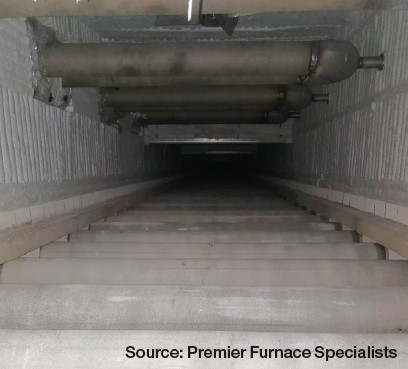
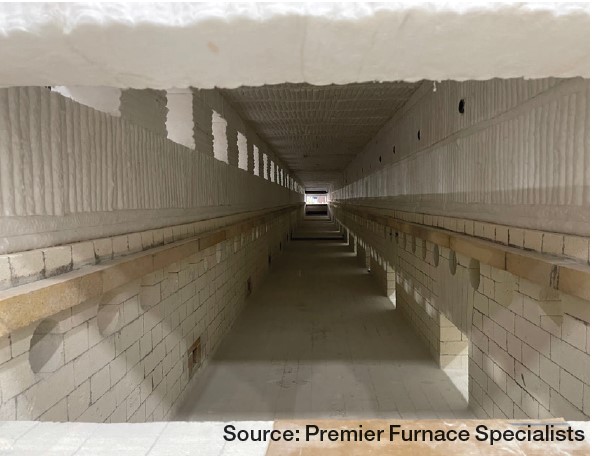
FCE insulation
It’s a good idea to occasionally check the furnace case for “hot spots,” and this tool allows it to be done without much effort. These are areas which have a higher than typical temperature compared to the rest of the furnace. This can be one of the earliest signs that insulation quality in that spot has issues. The insulation can be checked and repaired rather than waiting until the furnace’s case steel begins to turn white and burn away, leading to more costly repairs. For brick-lined furnaces in particular, one ideal time to perform this check is during the lengthy dry-out procedure to ramp up to operating temperature after a shutdown. The idle time at low temperatures helps to catch issues before high operating temperatures quickly make them worse. For roller hearth furnaces, simply checking the average temperature of each roller’s exposed trunnions and bearing housings can give insight into potential future issues if individual rollers run hotter than others.
As they say, “The best time to start was yesterday. The next best time is now.” Even a furnace that has seen better days can be maintained, repaired, or rebuilt to keep operations running smoothly and, most importantly, safely.
About the Author
Jacob Laird is a mechanical engineer at Premier Furnace Specialists. Jacob has a BS in both mechanical engineering and physics from South Dakota State University. Among many other things, Jacob is known for his skills in sizing/design of combustion systems, burner assembly, and electrical heating systems.
A supplier to the railway industry has ordered a technological line consisting of two vacuum furnaces, three tempering furnaces, and two washers. The line will be utilized for hardening processes of steel parts used in railway rolling stock.
The SECO/WARWICK line for voestalpine Fastening Systems consists of an electric chamber furnace, a washer, a cooling station, and an endothermic atmosphere generator. The hardening process will be carried out in a controlled atmosphere with temperatures up to 1742°F.
Additionally, the technological line includes an electric chamber furnace designed for the heat treatment of steel parts in a protective nitrogen atmosphere at temperatures up to 1292°F, along with a washer, cooling station and endothermic generator. The line will include a loader operating in automatic mode, a set of roller tables and a closed loop water system. The number of the supplied technological line units is selected to ensure the quality of manufactured components.
Mariusz Raszewski, Deputy Director of the Aluminum Process and CAB Furnaces Team, SECO/WARWICK (Source: SECO/WARWICK)
Mariusz Raszewski, deputy director of the Aluminum Process and CAB Furnaces Team at SECO/WARWICK said, “The line is configured in such a way that if the volume of the company products decreases, the customer can also offer commercial processing due to the wide technological spectrum of this main furnace unit.”
The whole solution will be supervised by a master system, which is used for the continuous monitoring of the heat treatment equipment operation and provides advanced data analysis for the production processes.
Mariusz Fogtman, COO, voestalpine Fastening Systems (Source: voestalpine Fastening Systems)
“The universal furnace solution will allow [us] to process details in various configurations,” Mariusz Fogtman, COO of voestalpine Fastening Systems commented. “Apart from technological parameters, it is important for us to limit the processed details’ deformations, which is possible in the ordered solution. SECO/WARWICK presented a partnership and flexible approach to the challenge of this order”
This press release is available in its original form here.
We’re celebrating getting to the “fringe” of the weekend with a Heat Treat Fringe Friday installment: a video unveiling the learning progress of Figure 01. Learn more about this startling conversational machine that may become the world’s first commercially viable autonomous humanoid robot.
While not exactly heat treat, “Fringe Friday” deals with interesting developments in one of our key markets: aerospace, automotive, medical, energy, or general manufacturing.
“So, I gave you the apple because it’s the only, uh, edible item I could provide you with from the table.” A humanoid robot called Figure 01 (read “figure one”) is making a splash as a personable, multitasking robot.
If you are someone who appreciates clear speech patterns, rapid-fire conversation, and other social ques, like facial expression and hand motions, you are out of luck. But if you are looking for a patient, accommodating, young adult male, OpenAI models-trained machine to add to your workforce, this robot may be a commercially available option for you soon.
Figure 01 is intended for “general purposes,” coming beside humans in the workforce to “create and produce so much more, address drastic labor shortages, and reduce the number of workers in unsafe jobs.” One might imagine Figure 01 loading and unloading baskets with components to heat treat or perhaps take on the task of opening the furnace door and testing the atmosphere gasses that linger. Of course, if you were to ask Figure 01 to load a basket with components to heat treat, it may take him 4 seconds before answering, “Certainly.”
Watch the video below, created by Figure, a U.S.-based AI robotics company.
Extral SP. Z o.o., a Polish company specializing in aluminum extrusions, has bolstered its manufacturing capabilities to better serve the construction, automobile, and machinery industries. Alongside acquiring a new aluminum extrusion press, the company ordered anitriding system to nitride H11 and H13 extrusion dies of various sizes.
Nitriding pit furnace from Nitrex
The Nitrex turnkey nitriding system includes an NX-1015 pit-type furnace with a 2-ton (4410-lb) load capacity and NITREG® technology, offering nitriding treatments that optimize die performance and throughput while concurrently reducing tooling costs.
This investment coincides with Extral’s expansion of its operational footprint in Poland, including the construction of a new building to house the extrusion press and furnace. This expansion enables the company to diversify its range of extruded products while maintaining a focus on sustainability and energy efficiency. The new nitriding installation will contribute to these objectives by providing more efficient use of process gases and electricity.
Marcin Stokłosa Project Manager Nitrex Poland Source: LinkedIn.com
Previously, Extral outsourced its nitriding operations to a local heat treater, due to quality issues encountered with an underperforming in-house nitriding unit. However, this latest investment enables them to bring nitriding operations back in-house, ensuring better control over the quality and consistency of their nitrided dies while also benefiting from expedited turnaround times.
Marcin Stoklosa, project manager at Nitrex, said, “Working with Extral on this project has been a pleasure. . . . Seeing customers invest in their business and achieve their goals, especially when it aligns with our values of innovation and sustainability, is always rewarding.”
This press release is available in its original form here.
Kittyhawk, Inc., backed by the Dallas-based private equity firm Trive Capital, has acquired Stack HIP, LLC from Stack Metallurgical Group (SMG). The acquisition represents a significant expansion of capacity and capabilities in hot isostatic pressing (HIP) for aerospace, space, defense, and medical applications.
Operating from its facility in Albany, OR, Stack HIP provides HIP services to aerospace, defense, and medical clients by operating the largest high-pressure HIP vessels in North America. This enables them to process large, complex castings and additively manufactured metallic parts. Post-closing, SMG will continue to operate its classical heat treatment and aluminum special processing facilities in Portland, OR, Spokane, WA, and Salt Lake City, UT.
Brandon Creason President Kittyhawk
“We’re excited to welcome Stack HIP customers, employees, and suppliers into the Kittyhawk family,” said BrandonCreason, president of Kittyhawk. “Stack HIP will allow Kittyhawk to service mission critical parts up to 63” in diameter, enabling us to process the full array of components for our customers. At Kittyhawk, we commit every day to providing the best service and quality to our customers, and we’re thrilled to now do that with the added capabilities and dedicated employees of Stack HIP.”
Doug Puerta CEO Stack Metallurgical Group
Doug Puerta, CEO of SMG commented, “We look forward to continued collaboration with Kittyhawk to deliver a differentiated level of service, quality, and value to our shared customers. This transaction will allow both companies to further drive capacity, quality, and capabilities in our respective services to best serve the PNW market.”
“This is an important step in growing the platform specialized in this highly-differentiated HIP capability. [Kittyhawk] continues to benefit from strong industry tailwinds, and we are excited to support our customers by investing in capacity,” said David Stinnett, partner at Trive.
This press release is available in its original form upon request.