What is the connection between AMS2750 specifications and furnace classifications? With tight specifications, what does the heat treater need to know to be compliant? Follow along as we take a brief look into this often-overlooked topic.
This Technical Tuesday article, written by Douglas Shuler, owner and lead auditor, Pyro Consulting LLC, was first published in Heat Treat Today's March 2023 Aerospace Heat Treating print edition.
Doug Shuler Lead Auditor Pyro Consulting
AMS2750 is the specification that covers pyrometric requirements for equipment used for the thermal processing of metallic materials. AMEC (Aerospace Metals Engineering Committee) is one of the committees which oversees the changes and revisions of AMS2750. There are five main sections in the technical requirements of the specification: sensors, instrument calibrations, thermal processing classification, SAT (system accuracy testing), and TUS (temperature uniformity surveys). Additionally, there are quality provisions that detail what happens if a calibration or test is either past due or fails.1
Contact us with your Reader Feedback!
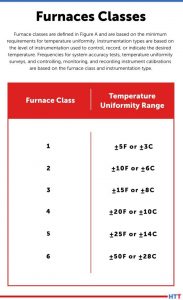
Revisions to the original requirements have occurred over the years, with the newest being Revision G. The structure of Revision G has carried over from Revision F and has remained the current structure of the AMS2750 specification. This structure includes furnace classes, which are based on the minimum requirements for temperature uniformity.
Furnace classes are defined in Figure A of Revision D Figure 1.
Figure 1. AMS2750G furnace class uniformity tolerances Source: Doug Shuler
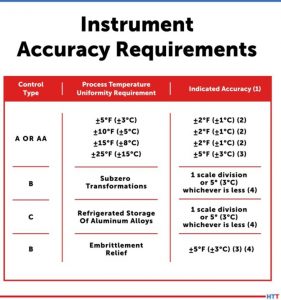
Originally, furnace classes were based on temperature uniformity, but also subzero transformation, refrigerated storage of aluminum alloys, and embrittlement relief, Figure 2.
Figure 2. Original AMS2750 instrument accuracy requirements, no class structure Source: Doug Shuler
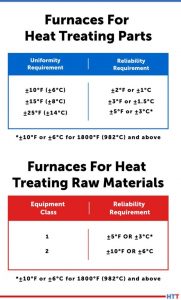
AMS2750 Revision C was released in May 1990 and started to implement the class and instrumentation type structure and differentiated between furnaces for heat treating parts versus furnaces for heat treating raw materials. Furnaces for heat treating parts were classified based on uniformity, but also on a readability requirement. Furnaces for heat treating raw materials were classified based on a readability requirement alone.
AMS2750 Revision D was released in September 2005 and continued to define equipment class (Figure A)* and instrumentation type (Section 3.3.1.1)*. It also clarified chart recorder resolution (Table 4)*, print and chart speed (Table 5)*, and testing frequencies for SAT (Tables 6, 7)* and TUS (Tables 8, 9)* for the processing of parts versus raw materials.
AMS2750 Revision E was released in July 2012 and continued to build on the clarity presented in Revision D by adding an instrumentation type table (Figure 3)* instead of a simple text description in the body of the specification.
Figure 3. AMS2750 Revision C: distinguishment between furnaces for heat treating parts versus raw materials Source: Doug Shuler
Moving to AMS2750 Revision F, the specification saw a major rewrite and restructuring where the tables were moved from the end of the document to the first area text that called out the specific table. Revision F also put into place a sunset date for analog instruments.
That brings us to the current revision of AMS2750, Revision G, which has carried forward the structure of Revision F and only sought to further clarify the intent of the requirements.
Over the years, the technology of sensor, instrument, and furnace manufacture and capability has continued to produce better and tighter controls for the process of heat treating. The evolution of AMS2750 has recognized these advancements and has kept pace with them in technology. The understanding of the origins of AMS2750 and how it has evolved is vital in understanding its application to today’s heat treat special processes.
*Specified figure, table, or section is associated with the AMS2750 revision being discussed.
About the Author: In 2009, Douglas (Doug) Shuler became the owner of Pyro Consulting LLC and also began working with Performance Review Institute (PRI), first as an instructor and course developer and later as an auditor for the Nadcap program. As a lead auditor for Nadcap, he has conducted over 380 Nadcap special process and aerospace quality management system audits on behalf of the Aerospace Primes over the past 10+ years. Doug continues to focus on instruction, training, and education for the heat treat industry, developing courses, authoring exams, and employing the PIE method: “Procedures that Include all requirements, and Evidence to show compliance.”
This sixth article in the series from the Cybersecurity Desk will give you a better understanding of how to submit your basic NIST 800-171 self-assessment score into SPRS (Supplier Performance Risk System).
Today’s read is a feature written by Joe Coleman, cybersecurity officer at Bluestreak Consulting™. This column is in Heat Treat Today’sMarch 2023 Aerospace Heat Treating print edition.
Introduction
This sixth article in the series from the Cybersecurity Desk will give you a better understanding of how to submit your basic NIST 800-171 self-assessment score into SPRS (Supplier Performance Risk System).
Why Should You Do This?
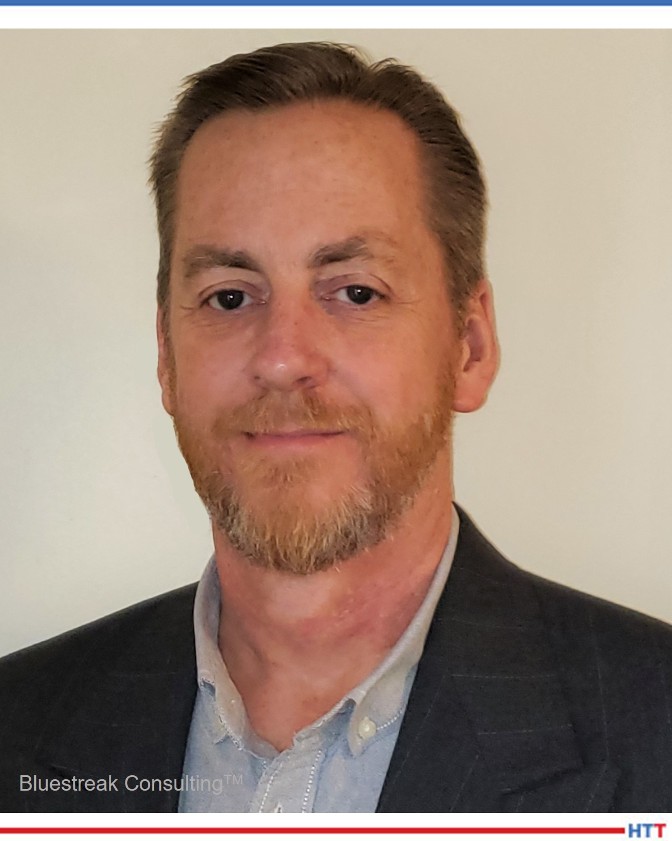
Joe Coleman Cybersecurity Officer Bluestreak Consulting™ Source: Bluestreak Consulting™
The Defense Federal Acquisition Regulation Supplement (DFARS) 252.204-7020 is one of the three newly released clauses (after the original 252.204-7012) of the DFARS 252.204-70 series (7019, 7020, 7021) in November 2020. DFARS 252.204-7019 is the “Notice of NIST 800-171 DoD Assessment Requirements”; whereas DFARS 7020 consists of the requirements alone. DFARS 7020 requires you to submit your basic NIST 800-171 self-assessment score to SPRS. Contractors and service providers are to provide the government access to its facilities, systems, and personnel any time the Department of Defense (DoD) is renewing or conducting a Medium or High assessment.
Once your self-assessment score has been submitted and accepted into SPRS, you will be eligible to be awarded contracts. Your score must remain in SPRS throughout the duration of the contract(s). You’ll need to show that you are working towards full compliance.
If a self-assessment score submitted to SPRS is required in order to win a contract, and you don’t have a self-assessment score in the system because you don’t have CUI, does that mean you will lose the contract? Maybe.
The requirement for NIST SP 800-171 DoD self-assessment is being enforced whether or not you have CUI. So, it makes sense to get started on this ASAP to position your company for additional business. Plus, having better cybersecurity controls in place is definitely a business best-practice.
How To Submit Your Basic Self-Assessment Score to SPRS
There are two ways to submit your basic self-assessment score to SPRS.
Option 1: Using email to send the information. Submitting your self-assessment score via email to SPRS includes the following steps:
Get an accurate NIST 800-171 Self-Assessment and Score. Conduct the self-assessment and obtain your score using cybersecurity professionals that carefully follow the required DoD Assessment Methodology for NIST Special Publication (SP) 800-171A.
Identify your SPRS “Scope of Assessment.” Your SPRS score submission will fall into one of three categories: Enterprise, Enclave, or Contracts.
Determine your expected completion date. The “Plan of Action Completion Date” must be determined according to your compliance project timelines.
Find your commercial and government entity CAGE codes. Your CAGE codes represent the part(s) of your organization included in the assessment and represented in the final System Security Plan (SSP) document.
Provide a brief description of the SSP format and system architecture.
Submit your self-assessment score to SPRS. To submit your score, send an email (optionally encrypted and signed) to webptsmh@navy.mil with the subject line “SPRS Self-Assessment Score Submission” in the exact format specified below:
Assessment date
Assessment score
Scope of assessment
Plan of action completion date
Included CAGE(s) codes
Name of System Security Plan (SSP) assessed
SSP version/revision
SSP date
Wait for email confirmation
Option 2: Using the PIEE (Procurement Integrated Enterprise Environment).
Register a PIEE account at https://piee.eb.mil/. Once your business is registered, choose the SPRS link and follow all instructions. You will need to provide all the same information as shown in Option 1.
Funding & Cost Sharing May Be Available for Heat Treaters
With the huge push for stricter cybersecurity practices by the government and many businesses, cost sharing and funding sources have been identified that may cover a substantial percentage of the costs associated with these critical cybersecurity projects. Every state has at least one MEP (Manufacturing Extension Partnership). Many states are more than willing to help out with the cost of implementation.
About the Author:
Joe Coleman is the cybersecurity officer at Bluestreak Consulting™, which is a division of Bluestreak | Bright AM™. Joe has over 35 years of diverse manufacturing and engineering experience. His background includes extensive training in cybersecurity, a career as a machinist, machining manager, and an early additive manufacturing (AM) pioneer. Contact Joe at joe.coleman@go-throughput.com.
Find heat treating products and services when you search on Heat Treat Buyers Guide.com
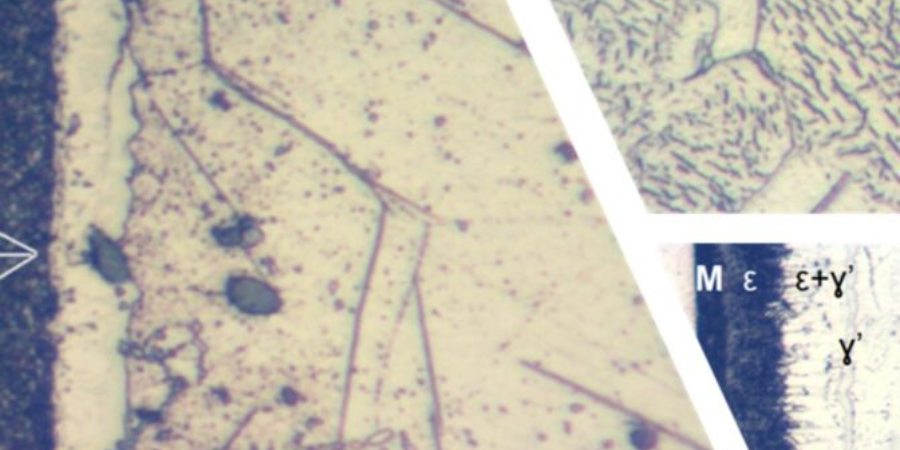
Metallography and nitriding, while two separate things, actually have a relationship. Do you know what it is? Would you be surprised to know that one enhances the other? Read this best of the web article to clearly see how metallography results help the nitriding of ferrous alloys be the best that it can be.
Find out how metallography is an essential tool in the nitriding process. Take a look at some basic definitions and peruse some microscope images that help explain what nitriding does to different materials. Dig even deeper with discussion of problems such as not enough stress relief and the presence of sulfides. Metallography helps explain, in this article, what nitriding can do for many different applications.
An excerpt:
Producing the best nitrided layers for the given application requires a good cooperation between designers of the product and the manufacturing companies making it . . . . Metallography of the parts, or samples which run together with them, is extremely important for verifying results of this thermochemical treatment and assessing the properties of the layer formed during, the data are also used for maintaining a good predictability of the process.
We have the honor to speak with another Heat Treat Legend in our industry, John L. Becker, president and founder of Heat Treat Equipment. Doug Glenn, publisher of Heat TreatToday and host of this podcast, has been chatting with the legends walking among us who’ve been involved with the North American heat treat to get a sense of where they’ve been, what they’re doing, and what advice they would share with the current generation. “Tenacious” is the word that comes to mind from this conversation.
Below, you can watch the video, listen to the podcast by clicking on the audio play button, or read an edited transcript.
The following transcript has been edited for your reading enjoyment.
A Summer at Ford Motor Company (01:20)
Doug Glenn: John, you were the founder and owner of the J.L. Becker Company which was recently purchased by Gasbarre Furnace Group. You’re no longer associated with that company, since you sold it. You are associated with Heat Treat Equipment, Inc., which you also started.
Contact us with your Reader Feedback!
How did you get started in the heat treat industry?
John Becker: It goes back to the summer of 1964 when I had been going to a junior college, and I started dating my wife. Her father was in the steel division at Ford Motor Company, and I needed a summer job in 1964. Through his contacts, I was able to get a job there. My position was very "prestigious." I had my own tool; it was called a broom! Through sweeping up, I was a first-class janitor. Then, I was able to move up to a helper’s position.
In working there for the summer, I saw a lot about the making of steel and the production processes. I used to hang around the lab, because in the summer, the lab was air conditioned; and I could pretend that I was interested in that area. By the end of the summer, they asked if I would consider going on co-op for metallurgy. I thought, “Well, that sounds easy. I can do that,” not realizing what I was in for.
"I received a BES in 1968" Source: Western Michigan University
I started in metallurgy, and worked for Ford and went to Western Michigan University where I received a BES (Bachelor of Engineering Science) in 1968. During that time of co-op, I worked and took classes. I used to take classes at Wayne State, Lawrence Tech, and other places where I could get some hours or get a class.
After I graduated, they put me in an area called the AADGO (Automotive Assembly Division General Office) where I was a fastener engineer. We were dealing with nuts, bolts, screws, and washers. I started visiting heat treat shops. At the same time, they put me on the MBA management program through the University of Michigan.
There were a lot of people in Rockford, IL, that made fasteners. One of the areas we were concerned with was heat treating. That thing called the Delta or appendix C, the Q101 (Quality 101 points) for Ford. I would go around inspecting plants, and I got to know several people in heat treating. I was a bit fascinated by it.
In 1970, Ford laid me off. I was still finishing up school, and I had a child. I actually started teaching school part time and did that for a while. I was a “the permanent substitute,” so I would work a lot of different days. That was quite enjoyable!
I started working for a company that sold high temperature materials: conveyer belts, etc. and was pretty successful. I looked at what I was getting paid. At this company, some reps were getting 10%. I was getting a salary and expenses, and I understood that it was a pretty good deal. But I still looked at reps and figured I made 10% of that value.
Starting a Business in a Basement (06:18)
I decided to really go on my own, and I started the J.L. Becker Company out of my house as a rep. I had four principals, and a few others in the industry. I didn’t represent these, but I could sell their products. Two examples were the wire mesh conveyer belt of Canada and I Squared R, which provides silicon carbide heating elements. We had a line of hearth plates, thermocouples. I became the Lockheed engineering rep. Because of that, I called on a lot of OEMs like Surface Combustion and Atmosphere Furnace and others.
"My dad gave me an old phone." Source: Unsplash.com/Nguyen Dang Hoang Nhu
We built it up. Everybody in Michigan had a basement. My dad had given me a used desk and, in those days, you had a phone that was wired to the wall. My dad had given me an old phone, so I started a company. In the basement of the house, I had a little cubby, about 4 ft by 7 ft, and that was my world headquarters.
After 6 months, I started to interview for a new job with salary and benefits, and all the things I didn’t have, because it wasn’t as great as I thought.
I had been calling on Monroe Auto Equipment in Monroe, Michigan. Monroe Auto Equipment has four plants that do powdered metallurgy; they make components for shock absorbers. I had become friends with a guy there, Fleming Pruitt. I still remember his name to this day.
He called me and asked for a particular product. I got a price for it, called him back, and he said, “I made a mistake. I didn’t want 20 pieces, I wanted 200.” I was going to make 10 bucks a piece or some number like that. All of a sudden, I was, like, “Whoa!” That started it.
Then I got another order, another order, and another order. Over time, I started thinking: “Why don’t I have some of my own products where I can control the price?” I could buy it for X and add my overhead to it.
Growing the Business (09:13)
In 1974, I moved to an office in Livonia, Michigan. It was in a multitenant-type building, and the fellow had rented two spots, and there was one empty office. I started there. I ended up hiring a gal by the name of Carol Campbell, right about then, for $90 a week and no benefits. She did an outstanding job for me. Around 1976, I hired Dave Peterson. Dave still, as you know, works with me today. I couldn’t chase him away. I tried and failed.
"I added another piece of the puzzle." Source: Unsplash.com/Nathalie Segato
From there, I added another piece of the puzzle. Each year we expanded. I got busy enough where I visited someone who I was selling different components to, and they had a piece of equipment they wanted to get rid of. I had visited someone else the day before who was looking for the same thing. I didn’t have to be that bright to understand that this guy wanted a dollar, and this guy was willing to pay two dollars. That worked out pretty well, and I did that a few times. But then the next time I did it, the person said, “You need to take it out.” So, I was able to; there was a group of guys and my office, at that time, was right behind Holcroft in Livonia. I got to know a lot of guys that worked there, and they would come and work for me on weekends. We would dismantle, move things, and ship them out.
Eventually, I got a little shop. I hired a fellow, whose name is Charlie Hatala, who now has Great Lakes Industrial Furnace. Charlie ran the shop, and then we started refurbishing equipment.
Then, in 1978 or 1979, BorgWarner Corporation in Michigan asked me if I could build a tempering furnace. I was doing maintenance for them installing components. I did a lot of brazing and sintering furnaces and some batch furnaces. They needed to do temper. I said yes, having never done it before.
Eventually, we figured it out.
I hired an engineer who worked for us part time for a while, and the shop became a busier situation. We started to build some equipment.
I hired an engineer, a fellow by the name of Don LaFore, who has now passed away. Don came in and helped shepherd us along to do design work. We started to build some belt-type furnaces for sintering and brazing. There were other people in the industry who had small operations to do refractory work or do electrical. We leaned on those individuals and started to build.
By 1980, I had two guys in engineering, Dave in sales, Carol in the office, and my wife, Eileen, was our CFO, as she still is today. It just went from there!
By 1983, we moved to another larger building.
In 1989 we moved again, and then in 2000, we moved to an even larger facility.
So, we had gone from about $700k–$800k to about $25 million in my last couple of years. In fact, we have equipment we built in the Ukraine for which my son, Matt, did the startup. We just looked at it in satellite, and it’s still standing and hasn’t blown up yet. That particular system, we duplicated twice for Russia.
Becker Goes International (14:16)
We built equipment in Israel, Dubai, Saudi Arabia, Thailand, and China. Korea was the first place, out of the country, where I sold a piece of equipment. That was right at the beginning, probably in the later part of the 1970’s, maybe very early 1980’s.
"We built equipment in Israel, Dubai, Saudi Arabia, Thailand, and China." Source: Unsplash.com/Lucas George Wendt
At Ford Motor Company, there was a research scientist; he was a Korean doctor. He had gone back to Korea to head a thing called KIMM (Korea Institute of Machinery and Materials) and he called me and ordered a furnace. We built the furnace, a research-type sintering furnace and endo generator, and I actually went to Korea and did the startup. That was one of the first international ones. We’ve shipped equipment to Canada, to Mexico, and to quite a few different places.
At 68 years old, in 2011, I sold the company to Gasbarre.
Becker’s Network in the Heat Treating Industry (16:02)
Doug Glenn: Give us a recap of some of the people with whom you’ve interacted.
John Becker: There was a startup company in around 1970/71 called Custom Electric Furnace, where Tim Mousseau worked as an engineer. Charlie Hatala was basically the president and shop manager. They had all come from a company called Alexander Engineering which goes way, way back.
I started repping them, and I sold a few furnaces for them.
Another guy that was repping around there was Jeff Smith; he worked for the which represented a company out of New York that made heat exchangers. Jeff came up with the idea of making his own heat exchangers, and that’s when they started SBS Corp.
During that same time period, I became friends with John Young. John’s father had Perfection Heat Treating Company, and his father, unexpectedly, died just before Christmas around 1976, I believe. John and I became friends. His wife’s name was Eileen, and my wife’s name was Eileen. We both had degrees in metallurgy; our backgrounds were very parallel to one another.
John and I ended up buying the heat treating company called Steel Improvement Company, and John ran that company successfully for about 10 years. Also, John and I got in on a few other companies too.
1984 and 1985 hurt the heat treat industry in Detroit, so we ended up liquidating both those companies.
Just like Jeff Smith, people from, refractory people, we interfaced with so many people here. In the metropolitan Detroit area, you have everything you can think of: Electrical supplies, wire, refractory, engineering help, machining, fabricating, steel suppliers. Everything is right at our fingertips. You have a real cornucopia of support-type people from lawyers to accountants to medical to whatever. It was a good place to nurture a company.
Like I said, we built the company up, and I was really motivated to sell.
In 2009, my oldest boy died. That hurt me personally, obviously. Then, in 2010, my younger son, Matt, who’s kind of a Mensa kid, announced he was going to leave to open a brewery. He has been extremely successful.
Then, Gasbarre approached me. My thoughts of passing the business on to my sons were trash, so I sold the company. After I sold it I consulted with them for a couple years; it was all part of the contract. I realized I really didn’t want to get out of it; I had pulled the trigger a little too quickly.
I’m 79, and I still work almost every day. I love the business, and I’ve come to know so many people in the business that I interface with. I’ve had some very, very strong supporters over the years for the equipment that we’ve built.
One guy that was probably the nicest guy — you couldn’t have asked for a better friend — was Jim Hendershot who had Carolina Commercial Heat Treat. Jim sold it to Gibraltar and on and on. Now, most of their plants are part of Bodycote.
John’s Supporters (22:32)
Doug Glenn: Are there two or three people who had a significant impact, people that encouraged you to carry on?
John Becker: You know, I really can’t point to anybody individually. Obviously, my wife was a supporter. She was burdened with the accounting side of the business.
"It was more people believing in me..." Source: Unsplash.com/Brett Jordan
I had a lot of different people. There was a buyer at Ford who was very supportive. Another guy at AC Spark Plug up in Flint; I did a lot of work for them and built several pieces of equipment. So, it was more people believing in me and believing that I could do the job and giving me the opportunity to do it.
My best friend just passed away a week ago (he was a Ford dealer). He would listen to me all the time and give me advice. He had built up a company where he was the number one Ford dealer for 1921 and 1922 in volume, worldwide, in the small little town of Livonia. It was very prestigious. He was a very well-liked individual. He gave me a lot of advice about not trying to micromanage, about giving up control and giving control to other people, hiring people and trusting them to let them do their job, and how to treat individuals. I think I learned a lot from that.
John’s Significant Accomplishments (25:20)
Doug Glenn: What are one or two your significant accomplishments?
John Becker: Dave Peterson worked with a company (and I won’t mention their name), and I joined him. This company had bought a used piece of equipment and did some converting on it to do a process. They had built one, and then we built their next one and “upgraded” it to the next phase.
We worked on the design and built and built and built it to where they had about 50 of these units. I think, between myself and Gasbarre, there may be 55 of them built. If you look at it, it’s roughly a million dollars apiece; they were very successful. They were using my son, Matt, who developed the software and automated all the controls to mass flow sensors, etc. This was early on before a lot of things that we have today. If you look back, this was all new technology at the time.
That was a “feather in our cap,” and that was a whole team. The engineering department did the engineering, the shop and the people in fabricating all had ideas and those were incorporated into it, and Matt redeveloped the software and the controls and developed all the programming. Before they had a lot of mechanical and timing issues where a bell would ring and an operator would have to do something, this was all automated. It took the operator out of what was a 30, 40, 50-hour process.
It’s very successful. That shows how the whole group pulled together and did it.
"I'm tenacious like a bulldog..." Source: Unsplash.com/MattODell
My success has been talking. Sales. I’ve been able to connect with people. I’m tenacious like a bulldog on an ankle; it’s hard to get me off. My middle initial is “L” and I tell everybody it’s for “Lucky.” I’ve been very fortunate to have a very loyal group of individuals. Like, we’re here now at Heat Treat Equipment. Bill Richardson started me in 1980 and was chief engineer and is with me now. Dave Peterson was my sales manager since 1976/77 and is with me now. The people in our shop, I did not solicit them. They came to me. When I had J.L. Becker, they were the ones that made the clock work.
I would go out, do the sales, contribute to them, and try to close the deal. I had more people — we had four or five gals, plus the CPA, plus my wife in the office, for insurance, employee benefits, payroll, paying the bills, etc. That worked very well, but that wasn’t my department. I looked at it macro work, but the micro work was done by all of them. They were very organized. The same was true for the shop and in engineering.
I really have to say they’re the ones that made the business keep moving. I would come in and say, “I’ve sold another standard piece of equipment except everything is different.”
Lessons Learned (30:43)
Doug Glenn: Over your work career, were there any disciplines that you developed? Were there any disciplines you developed you felt were beneficial for you and for your company?
John Becker: I can’t think of anything specifically. They always say, “Never quit. Never take ‘no’ for an answer.” So, I never quit. I used to tease some of the other guys because they would call on a customer for years, literally 4–10 years, and nothing would happen. Then, there was that lucky change in personnel. All of sudden, everything started to happen. We became “their guys.”
I was tenacious, and I listened. I do a lot of talking, but people don’t realize I do listen. Understanding, in sales, what does your customer want, what’s the expectation? I’m not going to pick on any other company, but some, more or less, “fell from the catalog.”
I always thought we were willing to change to try to modify or make our equipment fit our customer’s needs, not our customer needs fitting our equipment. We always went in and would change things. As I said, “Another standard piece except everything is different!”
I know when I sold the company, Gasbarre enjoyed quite a bit of repeat business from our customer base. I think our customer base was loyal; the loyalty came back from being loyal to them. We, like everyone else, had problems. My point was: We need to fix the problem, not fix blame. We didn’t worry about the cost. When it was done and resolved, then we could go back and look at it to find out if the problem arose from something we did, was it improper usage, etc.?
We never walked away from a problem and trust me, I had them over the years.
Doug Glenn: Did you ever lose any big money on them?
John Becker: Yes. More than once, and we lived to tell about it! The problem was sometimes I was quick on the draw. A guy that draws fast can shoot his foot off. The gun goes off a little too quick. Every time I would try to jam a square peg into a round hole — like I said, I was tenacious. I would fight and fight and fight for an order and get it and get creamed.
Work-Life Balance (34:55)
Doug Glenn: How did you handle work-life balance?
John Becker: It was never a struggle. I worked 6 days a week; when the kids were growing up, I coached baseball. I had a soccer team I coached in Northville for both my boys. We loved Florida because my grandparents were down there. My mother’s parents were down there, and my parents moved there. I had a brother and sister that lived there, etc.
We started going down to Florida very early in our lives in the 1970’s. We took vacations with the boys. There are plays and things they did at school; we did all that. We had a pretty good life.
Over the years, I’ve developed a lack of memory. When I walk out the door of work, my memory just falls off somewhere. I’m driving home and when I get home, I can’ remember things. Even though Eileen was involved in the business, I didn’t go home and talk about the business. I left it at work.
[blockquote author="" style="1"]One thing I’ve learned is that the work you didn’t do today will be there tomorrow. The work will be there.[/blockquote]One thing I’ve learned is that the work you didn’t do today will be there tomorrow. The work will be there. Early on, I did a few things. I missed a funeral for a friend that I still look back at, 30 years later, and say, “I could’ve cancelled or rescheduled those appointments, and I could’ve gone there.” I still think I should have gone to the funeral, and I didn’t and I’m sorry, today. The appointments that I went to never turned out to be anything.
I’ve always carried that around, that I should have been there for that person even though they had passed. You make decisions, and I think you’ve got to remember that a lot of these things will be there tomorrow that you don’t get to today.
Advice to Young Leaders in the Industry (37:48)
Doug Glenn: Were there one or two lessons you learned along the way, words of wisdom you would give?
John Becker: Send your resumes out somewhere else? Find a different career! I don’t mean that; the industry has been good to me.
I think that one of the things for younger people, especially in sales, is this: I would go work on a sale and I would think, “Boy, I’ve got this thing,” and find out I lost to a competitor, not realizing the purchasing guy’s brother-in-law was my competitor. So, understanding the politics of situations, the relationships. I’ve had people that I’ve been very, very close to and they would go out for bids, but I knew I was getting the work. Get to understand the relationship, who they’ve worked with in the past.
The other thing I think is important is technical society. I belong to ASM (ASM International, formerly known as the American Society for Metals). I used to belong to MPIF (Metal Powder Industries Foundation), the APMI (American Powder Metallurgy Institute).
I was one of the original associate members of MTI (Metal Treating Institute), but actually I was an MTI member back in the 70’s because we (John Young and I) owned the heat treat shop. John was the member, and I was the alternate. They were very, very down on a salesperson, like me, coming to those types of meetings. I did go to a couple. In fact, the very first or second meeting that Lance ever had, I met a guy who was from out in Oklahoma, by the name of John Hubbard. That was back in, probably, 1980, roughly, ’81 maybe; it was in that time.
Doug Glenn: So, for those who are listening that might not know, Lance Miller was the executive director of the Metal Treating Institute (not anymore, Tom Morrison is currently in that position). John Hubbard ended up being the CEO of Bodycote for years and years.
John Becker: I think in establishing relationships, try to be as honest as you can with your customers. There is a certain point that, I think, to maybe be a little guarded in your answers. Be as honest as you can without giving away your company secrets or whatever. Say you’ve had something in the background in your company that’s gone on and it’s affecting something. You don’t need to broadcast that, but you should maybe tell your customers you’ve had some issues that are going to delay or change things. That’s the best thing.
Just be yourself; don’t try to be somebody else. And you know what, if you don’t come home laughing and having a good time and enjoying yourself, you’re in the wrong business.
About the expert:
John Becker, president at Heat Treat Equipment: Founder and president of Heat Treat Equipment (est. 2011), has a long and distinguished career in the heat treat industry as the founder and long-time president of J. L. Becker Company, a manufacturer of new furnaces and heat treat equipment.
A Terre Haute, IN, company has completed the commissioning of a vacuum furnace system for a Mid-Atlantic manufacturer. The furnace was upgraded with an oversized vacuum pumping system, updated piping, all metallic hot zone, and control system.
Mercer Vacuum Components and Services Inc took the existing SS vessel and stripped it to the base. All of the vacuum piping was upgraded from .625" copper piping to 2.000" KF style SS piping. The hot zone utilized graphite board with moly elements that MVCS upgraded to a multiple layer metallic lined hot zone utilizing the OEM designed molybdenum elements. New inlet and outlet water headers were also supplied. The control panel was upgraded to include a new PLC and HMI. Instrument upgrade was performed by Mercer Technologies. The entire furnace system was taken apart and painted before reassembling.
Find heat treating products and services when you search on Heat Treat Buyers Guide.com
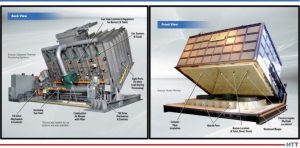
Consider the numerous systems in your heat treat operations. What makes up the anatomy of each furnace? In this "Anatomy of a Furnace" series, industry experts indicate the main features of a specific heat treatment system. For this inaugural feature, note how the schematics demonstrate how the tip-up furnace is able to process massive loads in an atmospheric sealed environment at highly controlled temperatures.
Contact us with your Reader Feedback!
Annotations for this furnace corpus were provided by Dan Herring, The Heat Treat Doctor®, The HERRING GROUP, Inc. A front view of a tip-up furnace as well as a back view of a different tip-up are provided along with the labels.
Download the full graphics by clicking the images below.
Click to download now!
This Technical Tuesday article is drawn from Heat Treat Today's February's Air & Atmosphere Furnace Systems print edition.
Heat Treat Today is partnering with two international publications: heat processing, a Vulkan-Verlag GmbH publication that serves mostly the European and Asian heat treat markets, and Furnaces International, a Quartz Business Media publication that primarily serves the English-speaking globe. Through these partnerships, we are sharing the latest news, tech tips, and cutting-edge articles that will serve our audience — manufacturers with in-house heat treat.
In this article, originally published in Heat Treat Today's March 2023 Aerospace Heat Treating print edition, we look at new tech in Japan, a low emission material in Germany, an alliance of specialists in Mexico, and an executive move in a global industrial gas company.
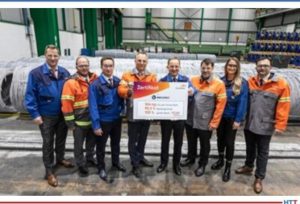
ArcelorMittal Low Carbon Emission Wire Rod for C.D. Wälzholz GmbH & Co. KG
Delivery of the first low-carbon emissions wire rod coils at Wälzholz in Hagen, Germany Source: ArcelorMittal
"As part of their business partnership, ArcelorMittal will supply C.D. Wälzholz GmbH & Co. KG with low carbon emissions wire rod from the Hamburg plant in the future. These steels are produced on the basis of scrap and renewable electricity (100 percent). The low carbon footprint of 504 kg CO2/t of steel is confirmed with an official Environmental Product Declaration (EPD). The delivery of the first 20 tons took place . . . at the cold rolling company’s site in Hagen, Germany. uses the material to manufacture heat treated profiles for industrial applications."
"Linde plc announced that its Board of Directors has elected Hugh Grant as a new director of Linde plc, effective January 23, 2023. Grant will serve on the Nomination and Governance and the Human Capital committees. Grant, a Scottish national, is a highly regarded former executive and director who brings substantial global experience to the Linde plc Board of Directors. He served as Chairman, President, and Chief Executive Officer of Monsanto Company, a global provider of technology-based solutions and agricultural products that improve farm productivity and food quality, from 2003 until 2018, when he led the sale of Monsanto to Bayer AG. "
New Tech for Shinkansai Steel Co., Ltd.'s -ton Electric Arc Furnace
New tech for Shinkansai Steel Co., Ltd. plant Source: Furnaces International
"Designed by Danieli Automation, Q-One uses the latest digital power electronics technology to maintain the EAF power-factor values close to unity. The power-feeding system that will be installed at Sakai will have a five-unit configuration with a total maximum power of 54,6 MVA."
Welcome to Heat TreatToday's This Week in Heat TreatSocial Media. You know and we know that there is too much content available on the web, so it’s next to impossible to sift through all of the articles and posts that flood our inboxes and notifications on a daily basis. Today, Heat TreatToday brings you another hot take of the latest compelling, inspiring, and entertaining heat treat chatter from the world of social media.
We're looking at microscopic images, some in-depth heat treat content, a recap of networking opportunities, plus much more!
Through heat treatment, austempered ductile iron (ADI) becomes incredibly strong. For ADI, the material has been austempered such that the matrix is transformed into ausferrite, or a mixture of acicular ferrite and austenite. The image below has been elevated to art-gallery quality with the use of selective color etching.
Images of weld metal, microstructure of coarse-grain zone, microstructure of fine-grain zone, and base material. See how the crystal orientation changes in different zones.
2. All That Chatter
Check out some of the chatter that everyone has been posting on heat treat topics over the last few months.
It's great to connect with other folks in the industry. This past week has been an amazing opportunity to forge new relationships and strengthen old ones at trade shows and expos.
Rapid + TCT
Ceramics Expo
ACT Expo
SAMPE 2023
4. The Reading (and Podcast) Corner
Time to take your afternoon coffee and read a few technical articles from around the industry. Got too many things to do? Put on an episode of Heat TreatRadio to enjoy on your commute. Maybe you'll find some "continuing education" time this weekend!
Is there room for creativity in the heat treat shop?
Listen to an interview with Gary Sharp about ion nitriding. Topics include the history of and applications for this particular kind of nitriding.
Dig in a little deeper. Read more about ion nitriding. Hone in on TMS 80 micro alloyed steel with Dr. Rolinski.
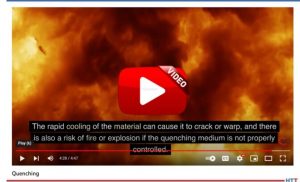
Review of quench basics. Click to watch the video below!
5. Sleep Deprived
The excitement of nitriding keeping you awake at night?!
Try some of these seven techniques our astronauts use to get better sleep in space!
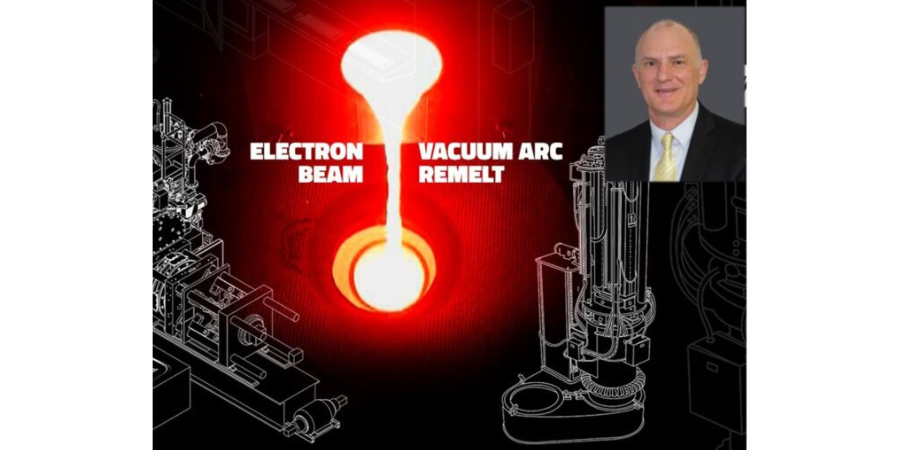
Earl Good Managing Director at Retech Systems, LLC Source: Retech
A furnace manufacturer located in Buffalo, NY will provide both an Electron Beam (EB) and Vacuum Arc Remelt (VAR) furnace to an American company. This combination should allow them to expand their production.
Retech, a SECO/WARWICK Group division, will provide these two furnaces to a longstanding repeat business partner. VAR technology operates similarly to the far older metallurgical process of stick welding, except with a much larger welding rod of several tons, and it is shielded from oxidation by a vacuum chamber instead of a flux. EB technology operates similarly to the cathode ray tube in old television sets, except instead of energizing a phosphorescent screen in a sealed vacuum tube, the electron beam heats a melt pool in a large vacuum chamber.
“[This partner] has purchased Retech furnaces previously," comments Earl Good, managing director at Retech. "The VAR furnace is a follow-up to other similar systems we sold them before, as is the EB."
Find heat treating products and services when you search on Heat Treat Buyers Guide.com
On March 22-24, 2023, the second China Heat Treatment Congress (CHTC) and first HIP Users Conference was held in Suzhou, China. The event was attended by 320+ industry professionals.
This conference is an industry event jointly established by Newsteel Media, Bodycote, ALD Heat Treatment, Aisin Heat Treatment, and Sushi Heat Treatment.
In attendance this year: SAIC General Motors, Shanghai Automotive Transmission, Double Ring Transmission, Miba Precision Parts, Sinotruk Group, Demax Dalian, Falda Shares, Schaeffler, China Ocean Shipping, Black & Decker Power Tools and other well-known user enterprises attended the meeting.
Additionally, other well-known enterprises in the field of HIP, including HIPEX, Tiangong International, Feierkang, Sakami Metal, PM Alloy, Ningbo Jiangfeng HIP, Quintus, Chuanxi Machinery, Hengding materials, Jiaye aviation technology, Nanjing SAM Additive manufacturing, Jiangsu Yonghan, Omat, etc., attended the meeting.
Watch the video below for some inspiring highlights from the event, and mark your calendars for the third CHTC and the second HIP Users Conference to be held in Suzhou on March 27-29, 2024.




 What is the connection between AMS2750 specifications and furnace classifications? With tight specifications, what does the heat treater need to know to be compliant? Follow along as we take a brief look into this often-overlooked topic.

 Find heat treating products and services when you search on Heat Treat Buyers Guide.com

 Source:
 We have the honor to speak with another












 Heat Treat