NITRIDING TECHNICAL CONTENT

Nitriding Selection Guide: Gas, Plasma, or Salt Bath?

Nitriding offers a unique combination of surface hardness, wear resistance, fatigue performance, and dimensional stability, making it a preferred thermochemical treatment for a wide range of industrial components. Readers will learn about the key benefits of nitriding, as well as the strengths and limitations of gas, plasma, and salt bath processes. In this Technical Tuesday installment, the aim of this guide by Daniel H. Herring, aka The Heat Treat Doctor®, and Dr. Edward Roliński, a senior scientist and recognized authority on plasma and ion nitriding, is to help engineers and heat treaters evaluate which nitriding technology best aligns with material requirements, case depth targets, and performance objectives.

This informative piece was first released in Heat Treat Today’s August 2026 Annual Automotive Heat Treating print edition.


Why Choose Nitriding?

Nitriding is a unique process that offers design engineers the ability to both predict and control the outcome of the heat treating process. The key advantage is that it significantly increases surface hardness, wear resistance, and fatigue life of component parts while minimizing dimensional change due to the low temperature nature of the process.

#1 Minimal Post-Processing

Nitriding can be used on a variety of component parts and metal forming tools made of steel or cast irons for applications in which wear, fatigue, or corrosion resistance is an important consideration. Steels, stainless steels, tool steels, powder metallurgy parts, and many other materials can be nitrided.

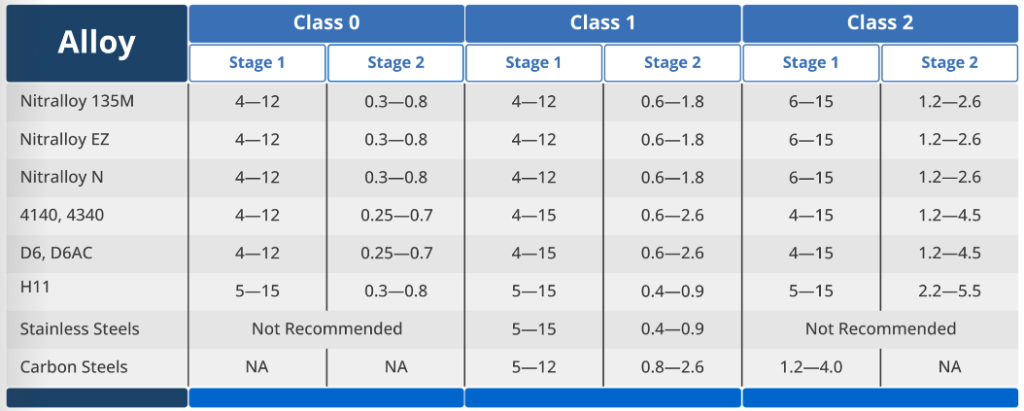
Table A. Recommended Ranges of Nitriding Potential (SAE International Aerospace Material Standard AMS 2759/10), latest revision
Notes:
1. Class 0: No white layer permitted on the surface of a nitrided part.
2. Class 1: 0.0127 mm (0.0005 inches) maximum white layer, 15% porosity or less.
3. Class 2: 0.0254 mm (0.001 inches) maximum white layer, 10%–50% porosity of the thickness of the white layer.

Dimensional change in nitriding is primarily governed by composition, tempering temperatures, time/temperature of nitriding, relative thickness of case/core, shape of the part, and areas masked off to prevent nitriding. The amount of growth is typically constant for identical parts nitrided in different batches by a fixed processing cycle. Most parts are nitrided in a two- or three-stage process and not ground after nitriding (Table A). This affords them excellent dimensional stability (Herring 2011). Once the amount of growth for a particular part has been established, allowances can be made during final machining (prior to nitriding) to ensure repeatable results.

By contrast, heat treating processes such as hardening or carburizing are performed at higher temperatures and result in dimensional and/or shape changes often requiring post-heat treat manufacturing steps (Roliński 2014). As such, the nitriding process has become an ever more popular choice.

#2 Case Depth Control

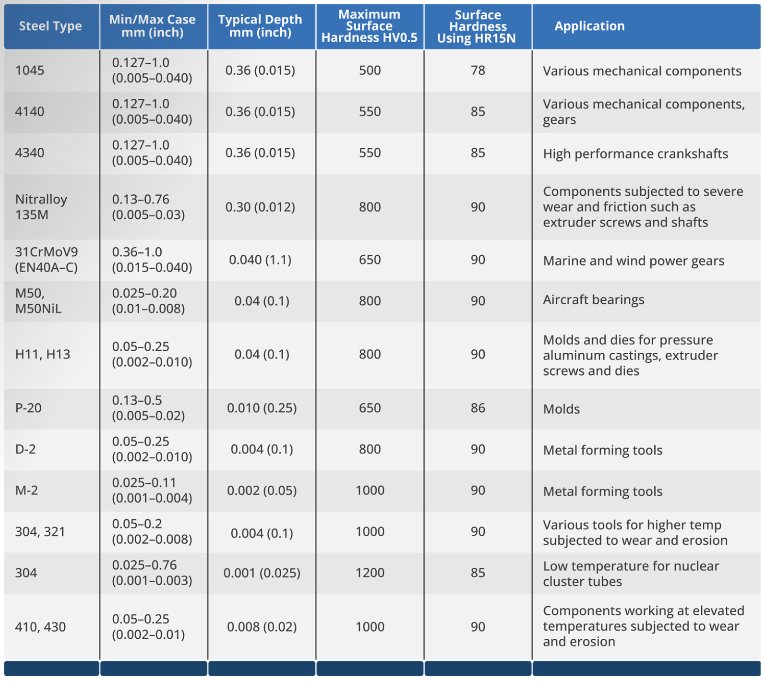
Nitriding as a thermochemical process is capable of producing a variety of case depths, an attribute affected by temperature, time, and nitriding potential (if there is not a compound zone formed). Caution should be used when stating a required case depth since a number of definitions for total case depth are in use. For this article, authors will use Table B to show how case depths are typically total case depths (core hardness + 50 HV0.5) that vary by material.

Table B. Typical Case Depths and Case Depth Ranges for Steels

For example, on an M2 tool steel, the case depth might vary between 25–100 µm (0.001”–0.004”). By contrast, 4140 or Nitralloy® can produce case depths in ranging from 100–500 µm (0.004–0.020”), with 305–380 µm (0.012–0.015”) being typical. For low/medium carbon steels and powder metal, white layer thickness may vary from 5µm–25 µm (0.0002”–0.001”) and is the overriding consideration.

#3 Enhancing Tribological Properties

Nitriding enhances various key tribological properties related to friction, wear resistance, lubrication interaction, and texture. These include improvement in sliding motion and reduced energy losses; wear characteristics involving resistance to adhesion, abrasion, fatigue, and corrosion; and lubrication, especially as it relates to load-carrying capacity, surface roughness, and surface texture/hardness.

#4 Nitriding Applications

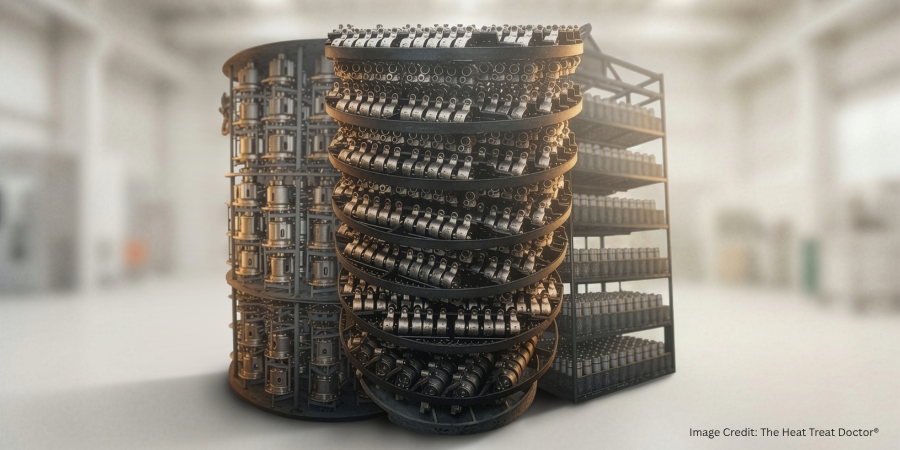
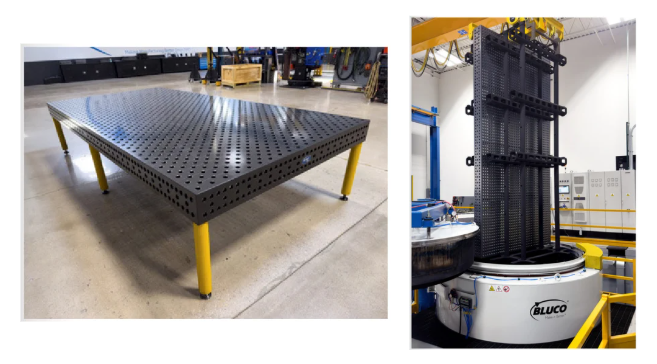
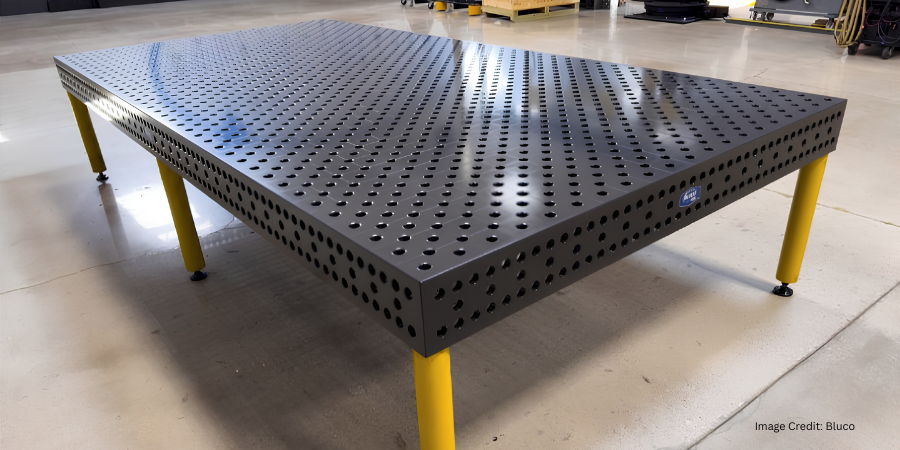
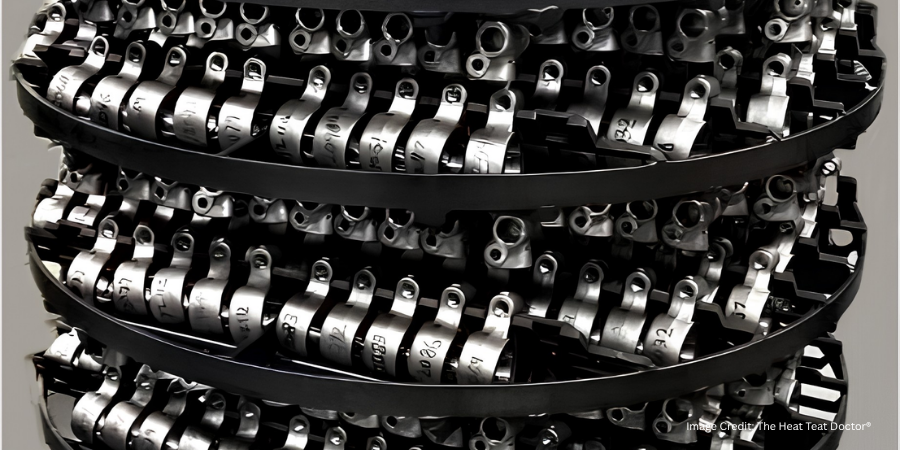
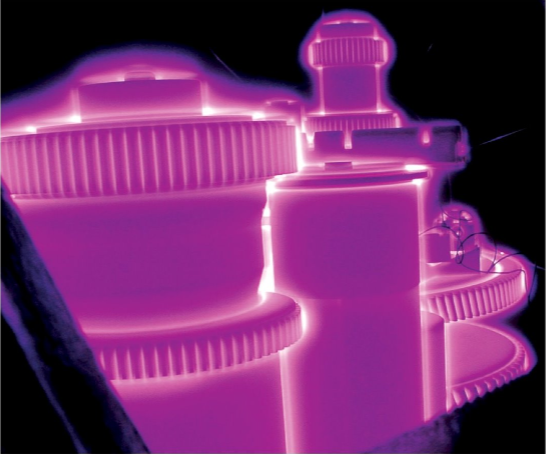
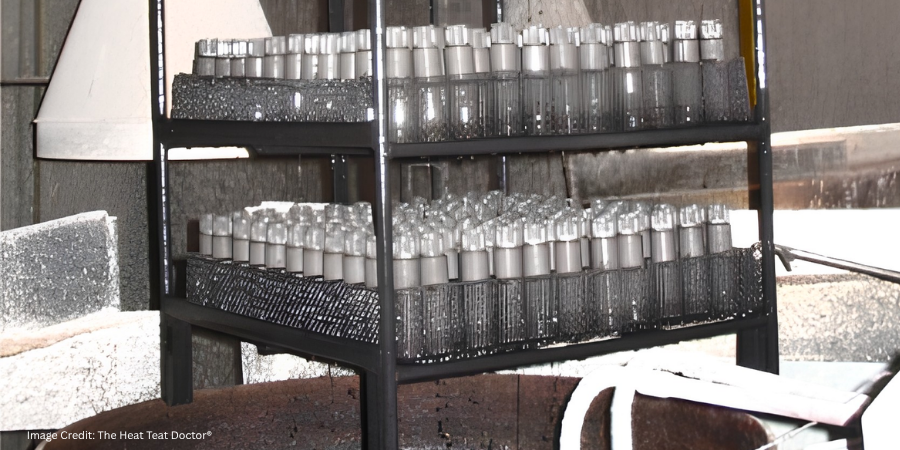
The nitriding process can be used for surface hardening of both very small and very large parts (see lead image above and Figure 1). Typical examples are gears and shafts, stamping dies, piston rods, springs, pump housings, and welding tables. Dies are typically made of cast iron or tool steels, while gears and other powertrain components are made of alloy steels. All applications require precise control of the compound zone (i.e., white layer) thickness. If selective nitriding is required, areas are masked using a stop-off paint, or in plasma processes, mechanical masking is an option.

Figure 1. (a) A Bluco DD2040 modular welding table (double density hole pattern, 2m x 4m x 0.2m) after completion of gas nitriding heat treat cycle and post-processing; (b) A Bluco HD2040 modular welding table (high density hole pattern, 2m x 4m x 0.2m) being removed fro ma pit furnace following a gas nitriding heat treat cycle | Image Credit: Bluco
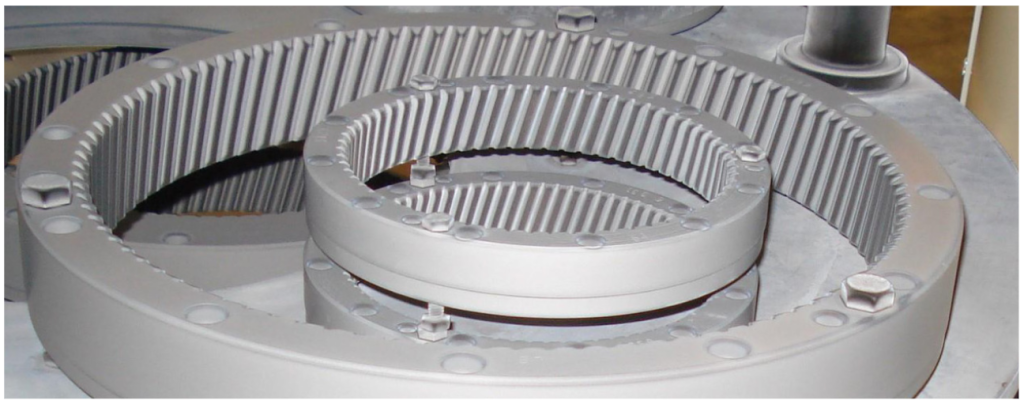
Figure 2. Typical nitrided surface appearance | Image Credit: Heat Treat Doctor®

Once finished, nitrided surfaces are typically smooth and grayish in appearance (Figure 2). If a “shiny” or “bright” surface or one of extremely low roughness is required, polishing methods can be used (e.g., superfinishing). The surface has high hardness, and is under residual compressive stress, which is critical in increasing bending fatigue and rolling contact fatigue (RCF) properties.

Gas, Plasma, Salt Bath

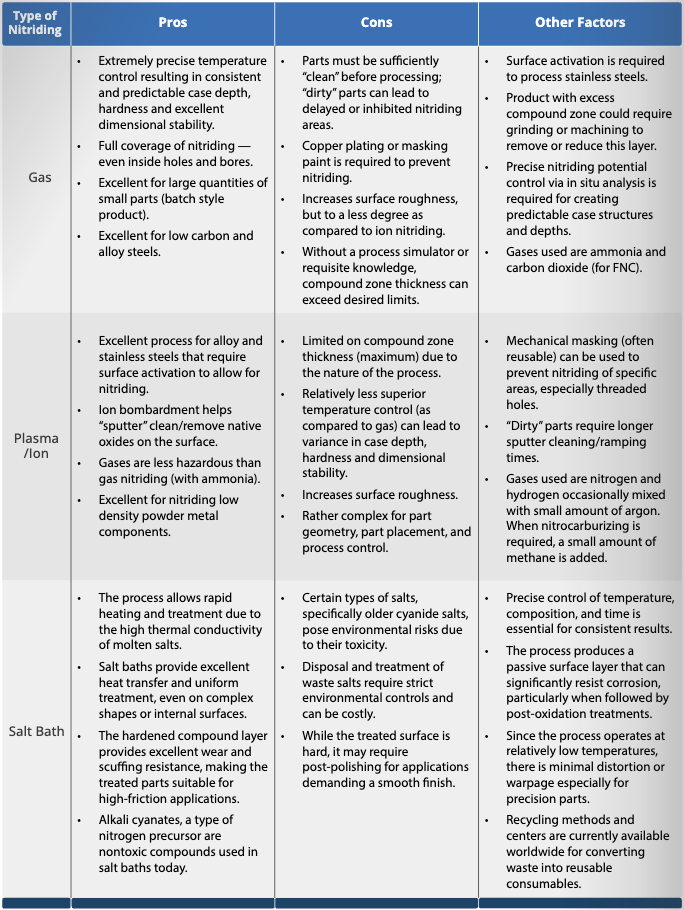
Table C. Comparison of Gas, Plasma/Ion, and Salt Bath Processes (Hemsath 2019)

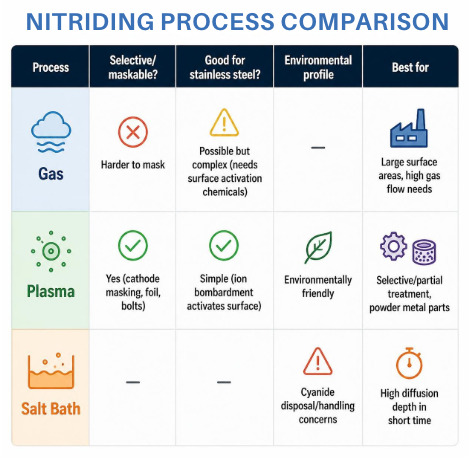
There are three types of nitriding, each with their own strengths and limitations: gas, plasma/ion, and salt bath. Table C highlights these differences for immediate comparison. For a further breakdown of each process’s strengths, the authors have written unique articles exploring the three processes in greater depth, available on www.heattreattoday.com under each of the names:

Conclusion

Nitriding is a key technology to achieve heat treated results that modern manufacturing expects. But between gas, plasma, and salt bath, there are pros and cons to whichever method is chosen. Engineers need to assess what material needs and process outcomes are most significant to the outcome in order to select the right technology.

References

Boßlet, Jochim. n.d. Melonite®/QPQ Process Brochure. HEF Durferrit.

Hemsath, Mark K., and Daniel H. Herring. 2019. “Nitriding—Growth and Tribological Benefits for Surface Engineering.” In Heat Treating Progress 2019 Conference Proceedings. Materials Park, OH: ASM International.

Herring, Daniel H. 2011. “Principles of Gas Nitriding, Parts 1–4.” Industrial Heating, April–May.

Herring, Daniel H. 2013. “Masking Techniques, Part One.” Industrial Heating, April.

Herring, Daniel H. 2020. “An Overview of Nitriding—Technology and Tribological Benefits.” Industrial Heating, March.

Mittemeijer, Eric J., and Marcel A. J. Somers, eds. 2026. Thermochemical Surface Engineering of Steels. Elsevier.

Pye, David. 2003. Practical Nitriding and Ferritic Nitrocarburizing. Materials Park, OH: ASM International.

Resnick, Michael. n.d. “Private Correspondence.” HEF Durferrit USA. https://www.hefusa.net/salt_bath_nitriding_liquid_nitriding/overview.html

Roliński, E. 1987. “Effect of Plasma Nitriding Temperature on Surface Properties of Stainless Steel.” Surface Engineering 3: 35–40.

Roliński, E. 2004. “Ion Nitriding and Nitrocarburizing of Sintered PM Parts.” Industrial Heating, October: 33–35.

Roliński, E. 2005. “When and Why Ion Nitriding/Nitrocarburizing Makes Good Sense.” Industrial Heating, August: 67–72.

Roliński, E. 2005. “Negative Effects of Reactive Sputtering in Industrial Plasma Nitriding.” Journal of Materials Engineering and Performance 14 (3): 343–350.

Roliński, E. 2006. “Plasma Nitriding Automotive Stamping Dies.” Heat Treating Progress 6 (5): 19–23.

Roliński, E. 2014. “Plasma Assisted Nitriding and Nitrocarburizing of Steel and Other Ferrous Alloys.” In Thermochemical Surface Engineering of Steels, chap. 11, edited by E. J. Mittemeijer and M. A. J. Somers, 413–449. Cambridge, UK: Woodhead Publishing.

Roliński, Edward. 2024. “Practical Aspects of Sputtering and Its Role in Industrial Plasma Nitriding.” ASM Handbook Online Update, Vol. 5: Surface Engineering. Materials Park, OH: ASM International.

Roliński, E., J. Arner, and G. Sharp. 2005. “Negative Effects of Reactive Sputtering in Industrial Plasma Nitriding.” Journal of Materials Engineering and Performance 14 (3): 343–350.

Roliński, E., G. Sharp, and A. Konieczny. 2006. “Plasma Nitriding Automotive Stamping Dies.” Heat Treating Progress 6 (5): 19–23.

Roliński, E., and G. Sharp. 2004. “Ion Nitriding and Nitrocarburizing of Sintered PM Parts.” Industrial Heating, October: 33–35.

Roliński, E., and G. Sharp. 2005. “When and Why Ion Nitriding/Nitrocarburizing Makes Good Sense.” Industrial Heating, August: 67–72.

Roliński, E., and G. Sharp. 2017. “Controlling Plasma Nitriding.” Materials Performance and Characterization 6 (4): 698–716.

Roliński, E., J. Ludeman, J. McCain, V. Popovski, and M. Woods. 2021. “Nitriding Mechanisms of Ferrous Powder Metal Products in Gas, Salt, and Plasma Methods.” In Proceedings of PowderMet2021/AMPM2021/Tungsten2021, 330–337.

SAE International. n.d. AMS 2759/10 Aerospace Material Standard (latest revision).

Senatorski, J., J. Tacikowski, E. Roliński, and S. Lampman. 2017. “Tribology of Nitrided and Nitrocarburized Steels.” In ASM Handbook, Vol. 18: Friction, Lubrication, and Wear Technology, edited by George E. Totten, 638–652. Materials Park, OH: ASM International.

Spies, H. J., and A. Dalke. 2014. “Case Structure and Properties of Nitrided Steels.” In Comprehensive Materials Processing, edited by G. Krauss, Vol. 12, 439–488. Oxford, UK: Elsevier.

Winter, K. M., and J. Kalucki. 2013. “Gas Nitriding and Gas Nitrocarburizing of Steels.” In ASM Handbook, Vol. 4A: Steel Treating—Fundamentals and Processes, edited by Jon I. Dossett and George E. Totten, 647–679. Materials Park, OH: ASM International.

About The Authors

Dan Herring
(The Heat Treat Doctor®)
The HERRING GROUP, Inc.

Dan Herring, who is most well known as The Heat Treat Doctor®, has been in the industry for over 50 years. He spent the first 25 years in heat treating prior to launching his consulting business, The HERRING GROUP in 1995. His vast experience in the field includes materials science, engineering, metallurgy, equipment design, process and application specialist, and new product research. He is the author of six books and over 1000 technical articles.

Dr. Edward Rolinski, affectionately known as “Doctor Glow,” is a distinguished senior scientist having spearheaded research on plasma/ion nitriding since the 1970s. He holds advanced degrees in manufacturing technology and metallurgy, including a PhD and Doctor of Science. His focus has been on plasma nitriding processes, especially involving titanium alloys and powder metallurgy. Over his career, Dr. Rolinski authored numerous influential technical chapters and articles, including for ASTM International and the ASM Handbook, and is a prolific contributor to industry publications. After decades of leadership and innovation in surface engineering and heat treating, he is now a consultant in the heat treating industry. 

For more information: Contact Dan at dherring@heat-treat-doctor.com.

Nitriding Selection Guide: Gas, Plasma, or Salt Bath? Read More »

Why Choose Gas Nitriding?

Among today’s nitriding technologies, gas nitriding remains the most widely used process for enhancing surface hardness, wear resistance, and fatigue performance while preserving dimensional stability. In this Technical Tuesday installment, Daniel H. Herring, aka “The Heat Treat Doctor®,” and Dr. Edward Rolinski, a senior scientist and recognized authority on plasma and ion nitriding, explain where gas nitriding excels, its process advantages and limitations, and the applications best suited for the technology.

If you’re looking for a broader introduction, watch for the upcoming print feature, “Nitriding Selection Guide: Gas, Plasma, or Salt Bath?” for an overview of nitriding, its key benefits, and a side-by-side of the three primary nitriding processes.


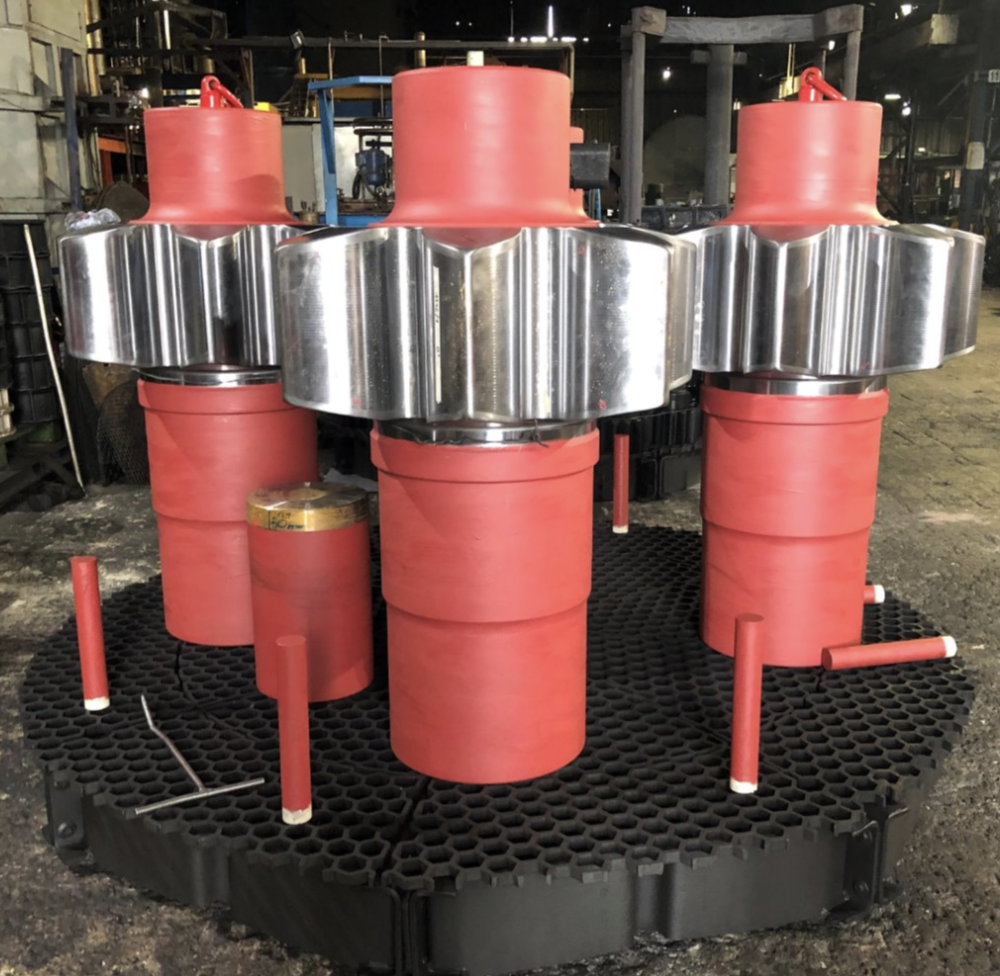
Gas nitriding represents 60–70% of all nitriding processes. The main benefit of gas nitriding, specifically when compared to plasma nitriding, is its ability to harden the entire surface of the component. Masking can be done by copper plating or painting with a nitriding-specific stop-off paint (Figure 1). Modern gas nitriding processes also allow treating of stainless steel, where PVC and other chemicals are used for surface pre-activation. Maintenance increases when these activating agents are used.

Figure 1. Large steel pinions being prepared for nitriding | Image Credit: Nitrex
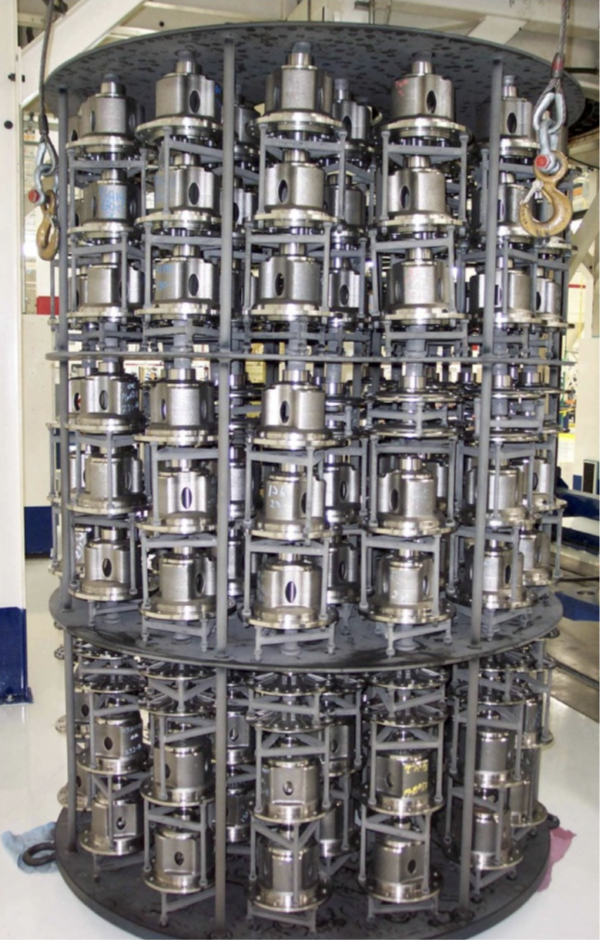
Figure 2. Typical small parts and loading arrangements for gas nitriding (Herring 2011)

Case depths are typically total case depths (core hardness + 50 HV0.5) and vary by material (see Table B in Herring et al. 2026). Caution should be used when stating a required case depth as a number of definitions for total case depth are in use.

Another benefit of using gas nitriding is its ability to form a thick compound zone up to 0.025 mm (0.001 inches). The process can enhance the corrosion resistance of steels, particularly combined with post-oxidation. Also, gas nitriding is an excellent way to improve tribological properties of the treated components (Senatorski et al. 2017). Modern controls allow for automatic process adjustment over the length of the cycle and control of the nitriding atmosphere based on nitriding potential (Kn value) or ammonia dissociation rate (Herring 2020; Winter and Kalucki 2013). This allows for precise growth of the compound zone type and thickness, tight case depth ranges, and repeatability.

Dimensional change in nitrided parts, typically very small, is governed largely by composition, tempering temperatures, time/temperature of nitriding, relative thickness of case/core, shape of the part, and areas masked off to prevent nitriding. The amount of growth is usually constant for identical parts nitrided in different batches by a fixed processing cycle. After the amount of growth for a particular part has been determined experimentally, allowance for it can be made prior to nitriding during final machining prior to nitriding.

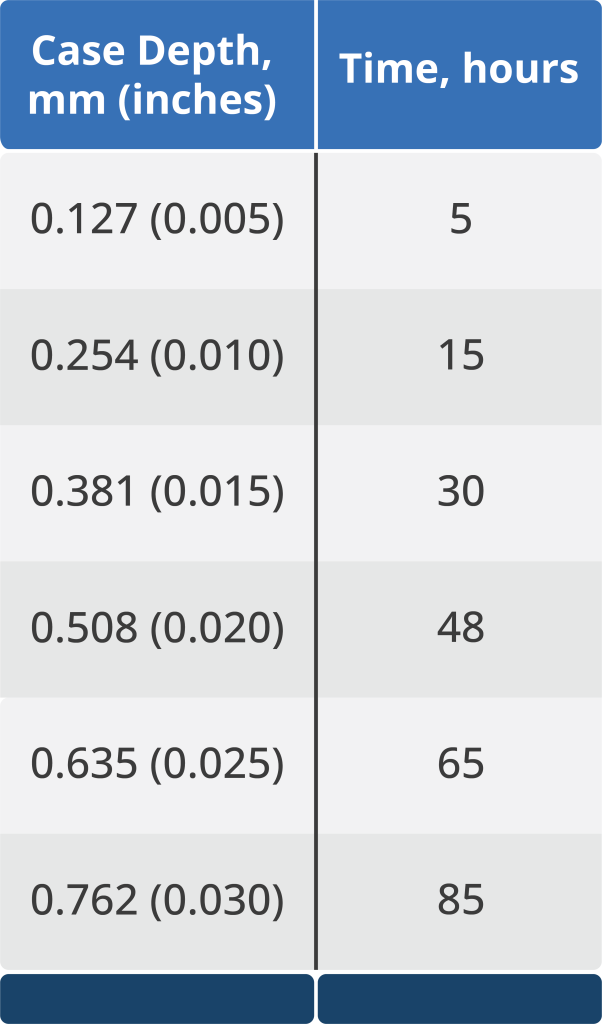
Table A. Single Stage Gas Nitriding Case Depth Time at 525°C (975°F) (Herring 2011)

Sharp corners or edges should be avoided on parts to be nitrided, because the projections formed at sharp corners receive higher nitrogen concentration and are susceptible to brittleness and chipping. These sharp edges nitride through the section and are without support from a soft ductile core.

In the single stage process, a temperature range of 500°C–540°C (925°F–1005°F) is typical, and process times range from 1 to 100 hours (Table A). The dissociation rate of ammonia is held in the range of 15% to 30%. The process produces a brittle, nitrogen-rich white layer at the surface comprised of various iron nitrides (Fe2-3N, Fe4N). One advantage of this thick white layer is that it will provide longer component service life in abrasive and adhesive wear applications.

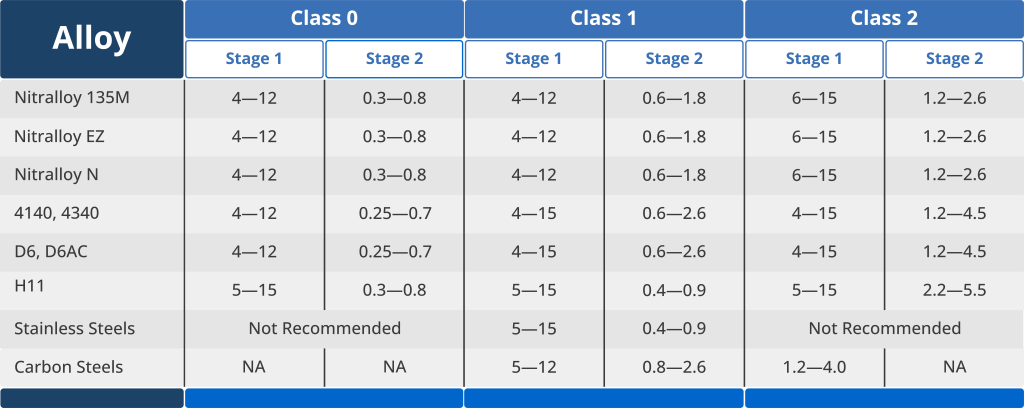
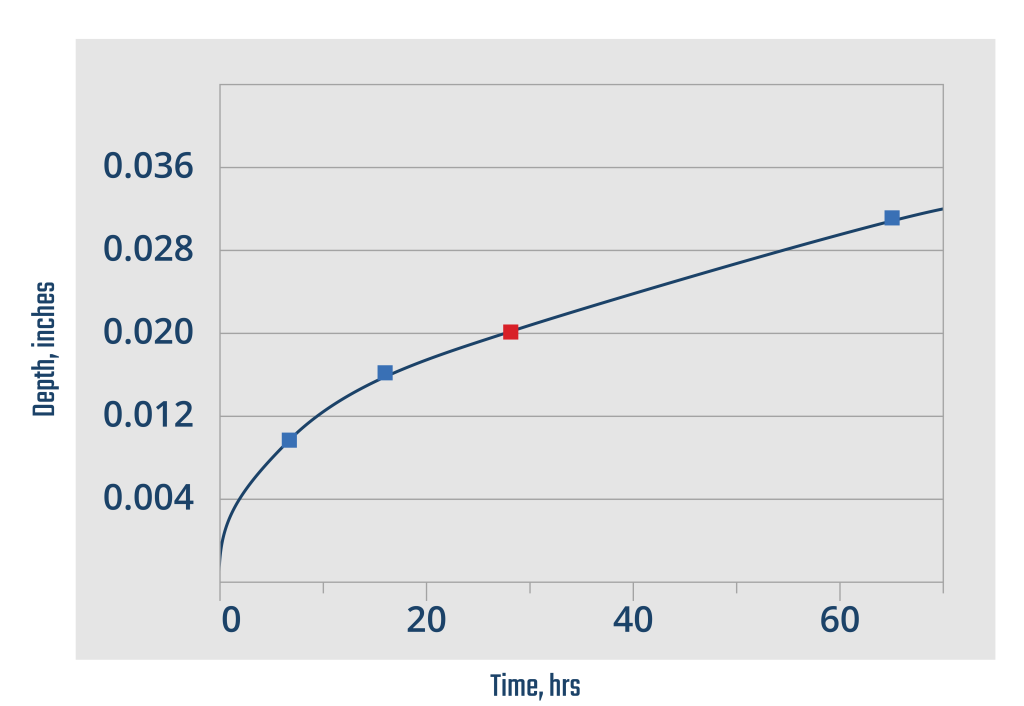
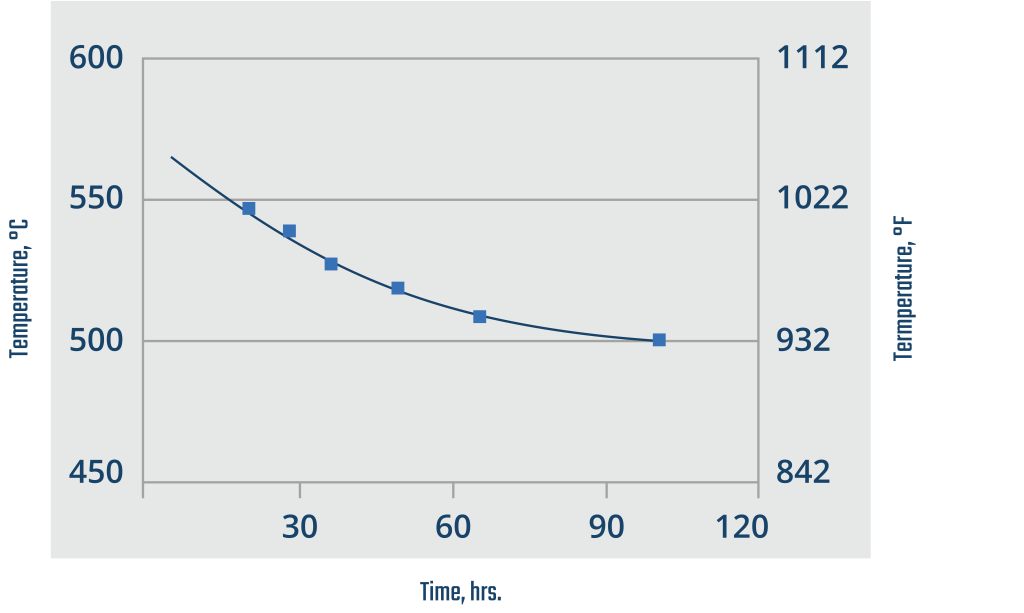
Most parts, however, are nitrided in a two- or even three-stage process and not ground after nitriding (Table C). This affords them excellent dimensional stability (Herring 2011). Case depth is affected by temperature (Figure 3), time (Figure 4), nitriding potential (if there is not a compound zone formed), and how the total case depth is defined.

Table B. Recommended Ranges of Nitriding Potential (SAE International Aerospace Material Standard AMS 2759/10)
Figure 3. Gas nitriding case depth versus time for 4140 steels at 538ºC (1000ºF) (Adapted from Stange Electronik GmbH Data) 
Figure 4. Effect of temperature on formation of 0.51 mm (0.020 inches) case depth during nitriding 4140 steel (Adapted from Stange Electronik GmbH Data) 

References

Herring, Daniel H. 2011. “Principles of Gas Nitriding, Parts 1–4.” Industrial Heating, April–May. 

Herring, Daniel H. 2020. “An Overview of Nitriding—Technology and Tribological Benefits.” Industrial Heating, March. 

Herring, Daniel H. and Edward Roliński. 2026. “Nitriding Selection Guide: Gas, Plasma, or Salt Bath?” Heat Teat Today, August.

SAE International. n.d. AMS 2759/10 Aerospace Material Standard (latest revision). 

Senatorski, J., J. Tacikowski, E. Roliński, and S. Lampman. 2017. “Tribology of Nitrided and Nitrocarburized Steels.” In ASM Handbook, Vol. 18: Friction, Lubrication, and Wear Technology, edited by George E. Totten, 638–652. Materials Park, OH: ASM International. 

Winter, K. M., and J. Kalucki. 2013. “Gas Nitriding and Gas Nitrocarburizing of Steels.” In ASM Handbook, Vol. 4A: Steel Treating—Fundamentals and Processes, edited by Jon I. Dossett and George E. Totten, 647–679. Materials Park, OH: ASM International. 

About The Authors

Dan Herring
(The Heat Treat Doctor®)
The HERRING GROUP, Inc.

Dan Herring, who is most well known as The Heat Treat Doctor®, has been in the industry for over 50 years. He spent the first 25 years in heat treating prior to launching his consulting business, The HERRING GROUP in 1995. His vast experience in the field includes materials science, engineering, metallurgy, equipment design, process and application specialist, and new product research. He is the author of six books and over 1000 technical articles.

Dr. Edward Rolinski, affectionately known as “Doctor Glow,” is a distinguished senior scientist having spearheaded research on plasma/ion nitriding since the 1970s. He holds advanced degrees in manufacturing technology and metallurgy, including a PhD and Doctor of Science. His focus has been on plasma nitriding processes, especially involving titanium alloys and powder metallurgy. Over his career, Dr. Rolinski authored numerous influential technical chapters and articles, including for ASTM International and the ASM Handbook, and is a prolific contributor to industry publications. After decades of leadership and innovation in surface engineering and heat treating, he is now a consultant in the heat treating industry. 

For more information: Contact Dan at dherring@heat-treat-doctor.com.

Why Choose Gas Nitriding? Read More »

Why Choose Plasma Nitriding?

As manufacturers look for greater control, precision, and flexibility in surface hardening, plasma nitriding has emerged as a versatile alternative to traditional nitriding methods. In this article, Daniel H. Herring, aka “The Heat Treat Doctor,” and Dr. Edward Rolinski, a senior scientist and recognized authority on plasma and ion nitriding, examine the advantages of plasma nitriding, including its ability to treat stainless steels, selectively harden complex geometries, and process powder metallurgy components.

If you’re looking for a broader introduction, watch for the upcoming print feature, “Nitriding Selection Guide: Gas, Plasma, or Salt Bath?” for an overview of nitriding, its key benefits, and a side-by-side of the three primary nitriding processes.


Plasma nitriding can be used over a broad range of heat treating temperatures and is used for all types of ferrous alloys (Figures 1 and 2). Additionally, it has the ability to activate the surfaces of oxidized stainless steels to allow them to be nitrided (Winter and Kalucki 2013; Roliński 1987).

Figure 1. Plasma nitrided A-286 Alloy Marble’s Etchant | Image Credit: The Herring Group, Inc.
Figure 2. Plasma nitrided duplex stainless steel 2205 Marble’s Etchant | Image Credit: The Herring Group, Inc.

Activation of the surface involves both ion bombardment and sputtering of the surface/cathode in the areas where the glow discharge covers the surface (Figure 3). The actual contact area of the part with the cathodic base plate or fixture does not nitride. The problem of edge effect, which is related to uneven distribution of sputtered atoms at corners and edges of a component (Roliński et al. 2005; Roliński 2024), is addressed primarily by proper adjustment of the processing gas pressure, which changes the thickness of the cathodic glow, making it more uniform around contour of the part. Masking areas that do not need to be hardened is simple. For example, a nut on a thread or a steel plate on a section with small holes is sufficient to protect those surfaces from the glow discharge and prevent nitriding.

Figure 3. Typical “glow” around component parts during plasma nitriding | Image Credit: The Herring Group, Inc.
Figure 4. Plasma/Ion nitrided powder metal component run at 565°C (1050°F) in a mixture of nitrogen/hydrogen at a ratio of 1:3 and pressure 3.5 mbar. 3% Nital. (Roliński et al, 2021)

Plasma nitriding is a unique process capable of surface hardening low-density sinter/powder metal (PM) products, even those less than 7.3 g/cm3 (Figure 4) and PM stainless steels (Roliński 2004). This is especially true when a portion of the treated component requires masking (Roliński and Sharp 2005, 2004). Active nitrogen species generated by the glow discharge penetrate only near-surface cavities/porosities, forming a nitrided layer. By contrast, ammonia in gas nitriding penetrates throughout the entire thickness of the component increasing the brittleness of the nitrided part.

Plasma nitriding is a low-nitriding potential process because the compound zone/white layer is typically very thin without extreme control accuracy of the nitriding parameters. This is a result of sputtering and a low partial pressure of nitrogen during processing (Roliński 2014). Plasma nitriding requires much less processing gases, such as nitrogen and hydrogen, than gas nitriding with ammonia. In addition, only small quantities of hydrocarbon gases are needed to dope the atmosphere and form epsilon-type compound zones at the surface (Roliński and Sharp, 2004).

Long parts, such as extruder screws and shafts, can be plasma nitrided even in “cold-wall vessels,” which do not have external heaters (Hemsath and Herring 2019).

References

Hemsath, Mark K., and Daniel H. Herring. 2019. “Nitriding—Growth and Tribological Benefits for Surface Engineering.” In Heat Treating Progress 2019 Conference Proceedings. Materials Park, OH: ASM International. 

Herring, Daniel H. and Edward Roliński. 2026. “Nitriding Selection Guide: Gas, Plasma, or Salt Bath?” Heat Teat Today, August.

Roliński, E. 1987. “Effect of Plasma Nitriding Temperature on Surface Properties of Stainless Steel.” Surface Engineering 3: 35–40. 

Roliński, E., J. Arner, and G. Sharp. 2005. “Negative Effects of Reactive Sputtering in Industrial Plasma Nitriding.” Journal of Materials Engineering and Performance 14 (3): 343–350. 

Roliński, E., and G. Sharp. 2004. “Ion Nitriding and Nitrocarburizing of Sintered PM Parts.” Industrial Heating, October: 33–35. 

Roliński, E., and G. Sharp. 2005. “When and Why Ion Nitriding/Nitrocarburizing Makes Good Sense.” Industrial Heating, August: 67–72.

Roliński, E. 2014. “Plasma Assisted Nitriding and Nitrocarburizing of Steel and Other Ferrous Alloys.” In Thermochemical Surface Engineering of Steels, edited by E. J. Mittemeijer and M. A. J. Somers, 413–449. Cambridge, UK: Woodhead Publishing.

Winter, K. M., and J. Kalucki. 2013. “Gas Nitriding and Gas Nitrocarburizing of Steels.” In ASM Handbook, Vol. 4A: Steel Treating—Fundamentals and Processes, edited by Jon I. Dossett and George E. Totten, 647–679. Materials Park, OH: ASM International. 

About The Authors

Dan Herring
(The Heat Treat Doctor®)
The HERRING GROUP, Inc.

Dan Herring, who is most well known as The Heat Treat Doctor®, has been in the industry for over 50 years. He spent the first 25 years in heat treating prior to launching his consulting business, The HERRING GROUP in 1995. His vast experience in the field includes materials science, engineering, metallurgy, equipment design, process and application specialist, and new product research. He is the author of six books and over 1000 technical articles.

Dr. Edward Rolinski, affectionately known as “Doctor Glow,” is a distinguished senior scientist having spearheaded research on plasma/ion nitriding since the 1970s. He holds advanced degrees in manufacturing technology and metallurgy, including a PhD and Doctor of Science. His focus has been on plasma nitriding processes, especially involving titanium alloys and powder metallurgy. Over his career, Dr. Rolinski authored numerous influential technical chapters and articles, including for ASTM International and the ASM Handbook, and is a prolific contributor to industry publications. After decades of leadership and innovation in surface engineering and heat treating, he is now a consultant in the heat treating industry. 

For more information: Contact Dan at dherring@heat-treat-doctor.com.

Why Choose Plasma Nitriding? Read More »

Why Choose Salt Bath Nitriding?

For applications requiring exceptional wear resistance, corrosion protection, and rapid processing, salt bath nitriding continues to be a reliable surface engineering solution. In this article, Daniel H. Herring, aka “The Heat Treat Doctor,” and Dr. Edward Rolinski, a senior scientist and recognized authority on plasma and ion nitriding, explain how salt bath nitriding can create a durable compound layer that helps parts last longer and perform better across a wide range of industrial applications.

If you’re looking for a broader introduction, watch for the upcoming print feature, “Nitriding Selection Guide: Gas, Plasma, or Salt Bath?” for an overview of nitriding, its key benefits, and a side-by-side of the three primary nitriding processes.


Salt bath nitriding, like gas nitriding, has been around for a very long time and is still in active use today. This method introduces nitrogen, and sometimes carbon, into the surface layer of steels, cast iron, and sintered powder metal by immersing the part in a molten salt bath containing nitrogen-bearing salts at elevated temperatures. The process enhances wear resistance, fatigue strength, corrosion resistance, and surface hardness without significantly affecting the core mechanical properties of the base material.

Salt bath nitriding has ability to form a thick compound zone up to 0.025 mm (0.001 inches). The process can enhance the corrosion resistance of steels, particularly when combined with post-oxidation. Also, salt bath nitriding is an excellent way to improve tribological properties of the treated components (“Melonite®/QPQ Process,” HEF USA).

A diverse range of industries and products leverage this process (e.g., automotive, aerospace, oil & gas; hydraulic and pneumatic machinery, firearms, metal forming and forging tools, material handling equipment, and tooling). Components like camshafts, gears, piston pins, hydraulic systems, and cutting tools benefit from the enhanced surface properties imparted by this process.

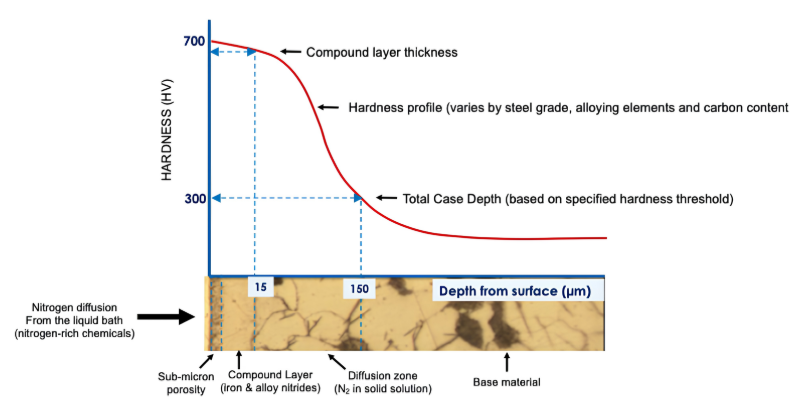
Salt bath nitriding is performed at temperatures typically ranging from 500°C to 630°C (930°F to 1165°F) to produce a controlled and highly uniform release of nitrogen at the surface of the workpiece (Figure 1). Nitrogen diffuses into, and chemically combines with, nitride-forming elements in the metal, producing a tough, ductile compound layer with exceptional mechanical properties through a catalytic reaction. This hard compound layer has wear properties that are reportedly 200% to 1000% greater than the original material, and greatly enhanced resistance to corrosion, galling, and scuffing (Pye, 2003).

Figure 1. Salt bath nitriding modifies the surface metallurgy and properties (“Salt Bath Nitriding, Controlled Liquid Nitriding (Overview),” HEF USA)

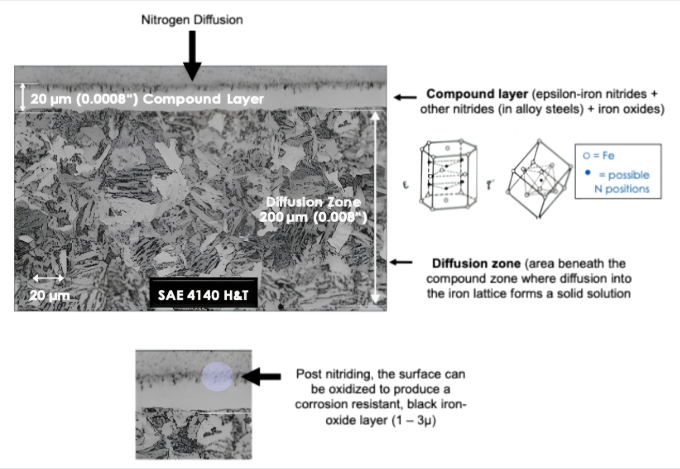
The salt reacts with the metal surface to form a hardened compound layer (primarily composed of ε-iron nitride and γ’-iron nitride) and a diffusion zone beneath it where nitrogen atoms diffuse into the metal matrix (Figure 2).

Figure 2. Microstructure of a sale bath nitrided component (“Salt Bath Nitriding, Controlled Liquid Nitriding (Overview),” HEF USA)

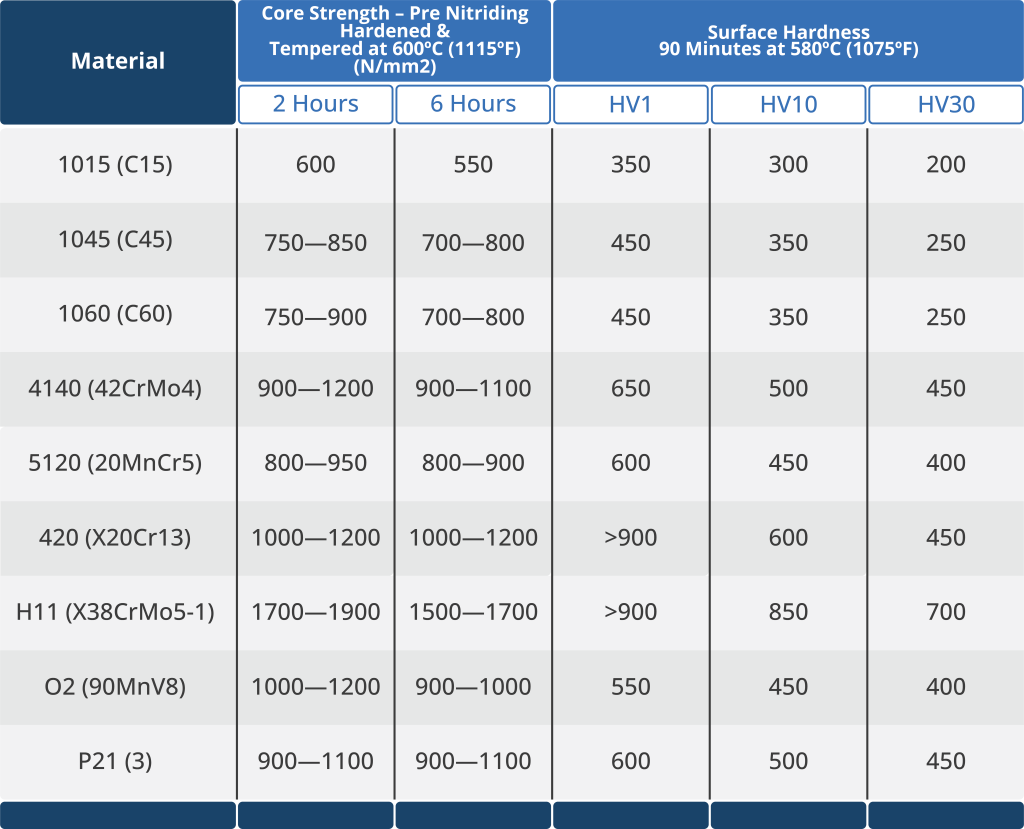
Case depth is a function of both treatment time and material. The final surface hardness is a function of the material composition. Higher percentages of nitride forming elements (Cr, Mo, Al, V, Mn, Ti, W) produce higher surface hardnesses (Table A).

Table A. Surface Hardness as a Function of Material (“Melonite®/QPQ Process,” HEF USA)

Salt bath nitriding remains a valuable surface engineering technique due to its effectiveness in enhancing durability, wear resistance, and corrosion performance. While environmental and safety concerns exist, advancements in salt chemistry and waste management continue to make this process viable for modern industrial applications.

References

Boßlet, Jochim. n.d. Melonite®/QPQ Process Brochure. HEF Durferrit. 

Herring, Daniel H. and Edward Roliński. 2026. “Nitriding Selection Guide: Gas, Plasma, or Salt Bath?” Heat Teat Today, August.

Pye, David. 2003. Practical Nitriding and Ferritic Nitrocarburizing. Materials Park, OH: ASM International. 

About The Authors

Dan Herring
(The Heat Treat Doctor®)
The HERRING GROUP, Inc.

Dan Herring, who is most well known as The Heat Treat Doctor®, has been in the industry for over 50 years. He spent the first 25 years in heat treating prior to launching his consulting business, The HERRING GROUP in 1995. His vast experience in the field includes materials science, engineering, metallurgy, equipment design, process and application specialist, and new product research. He is the author of six books and over 1000 technical articles.

Dr. Edward Rolinski, affectionately known as “Doctor Glow,” is a distinguished senior scientist having spearheaded research on plasma/ion nitriding since the 1970s. He holds advanced degrees in manufacturing technology and metallurgy, including a PhD and Doctor of Science. His focus has been on plasma nitriding processes, especially involving titanium alloys and powder metallurgy. Over his career, Dr. Rolinski authored numerous influential technical chapters and articles, including for ASTM International and the ASM Handbook, and is a prolific contributor to industry publications. After decades of leadership and innovation in surface engineering and heat treating, he is now a consultant in the heat treating industry. 

For more information: Contact Dan at dherring@heat-treat-doctor.com.

Why Choose Salt Bath Nitriding? Read More »

Ask The Heat Treat Doctor®: Why and How Do We Heat Treat Gears? Part One

Ask The Heat Treat Doctor® has returned to bring sage advice to Heat Treat Today readers, answer questions about heat treating, brazing, sintering, and other types of thermal treatments, as well as metallurgy, equipment, and process-related issues. In this installment, Dan Herring examines the essential role of heat treatment in gear performance: exploring the key material and design considerations for power transmission gears, the difference between through hardening and case hardening, and the atmosphere heat treatment processes — from carburizing and carbonitriding to nitriding and nitrocarburizing — that determine how well a gear handles load, wear, and fatigue in heavy-duty applications.

This informative piece was first released in Heat Treat Today’s February 2026 Annual Air & Atmosphere Heat Treating print edition.

Have questions or feedback? We’d love to hear from you — reach out to our editorial team at editor@heattreattoday.com.


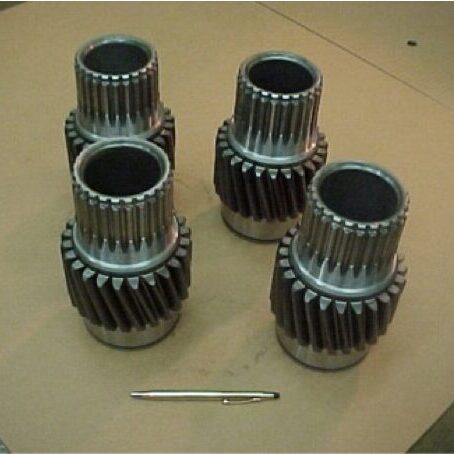
Gears play an essential role in the performance of many products that we rely on in our everyday lives. When we think about gears, we generally separate them into two categories: motion-carrying and power transmission. Motion-carrying gears are generally nonferrous alloys or plastics, while load bearing power transmission gears (Figure 1) are usually manufactured from ferrous alloys and are intended for heavy-duty service applications.

Figure 1. Typical off-highway truck power transmission gears | Image Credit: The Heat Treat Doctor®

Gear Materials & Engineering

Power transmission gears involve a wide variety of steels and cast irons. In all gears, the choice of material must be made only after careful consideration of the performance demanded by the application end-use and total manufactured cost, taking into consideration such issues as pre- and post-machining economics.

Key design considerations require an analysis of the type of applied load, whether gradual or instantaneous, and the desired mechanical properties, such as bending fatigue strength or wear resistance — all of which will define core strength and heat treating requirements.

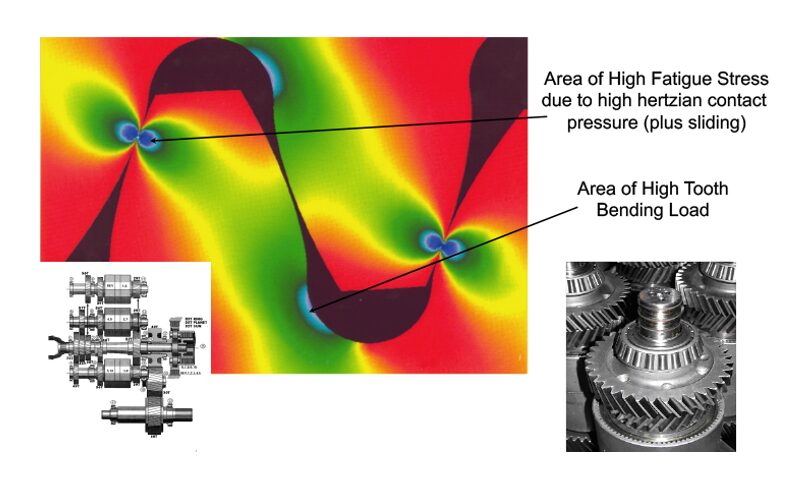
Figure 2. Stress profile in a heavy-duty transmission gear | Image Credit: The Heat Treat Doctor®

It is important for the designer to understand that each area in the gear tooth profile sees different service demands (Figure 2). Consideration must be given to the forces that will act on the gear teeth with tooth bending and contact stress, resistance to scoring and wear, and fatigue issues being paramount. For example, in the root area, good surface hardness and high residual compressive stress are desired to improve endurance or bending fatigue life. At the pitch diameter, a combination of high hardness and adequate subsurface strength are necessary to handle contract stress and wear and to prevent spalling.

Some of the factors that influence fatigue strength are:

  • Hardness distribution, a function of:
    • Case hardness
    • Case depth
    • Core hardness
  • Microstructure, a function of:
    • Retained austenite percentage
    • Grain size
    • Carbide size, type, and distribution
    • Non-martensitic phases
  • Defect control, a function of:
    • Residual compressive stress
    • Surface finish and geometry
    • Intergranular toughness

In the total manufacturing scheme, a synergistic relationship must exist between the material selection process, engineering design, and manufacturing (including heat treatment). A balance of the priorities in each discipline must be reached to achieve the optimization necessary for the ultimate performance of the gear design. This is often not an easy task.

Various atmosphere heat treatment methods are used for most types of gears including pre-hardening steps (e.g., annealing, normalizing, stress relief) and hardening processes (e.g., neutral hardening and case hardening).

Hardening

Neutral (aka through hardening) refers to heat treatment methods that do not produce a case. Examples of commonly through-hardened gear steels are AISI/SAE grades 1045, 4130, 4140, 4145, 4340, and 8640. It is important to note that hardness uniformity should not be assumed throughout the gear tooth. Since the outside of a gear is cooled faster than the inside, there will be a hardness gradient developed. The final hardness is dependent on the amount of carbon in the steel. The depth of hardness depends on the hardenability of the steel.

Through hardening can be performed either before or after the gear teeth are cut. When gear teeth will be cut after the part has been hardened, machinability becomes an important factor based on final hardness. The hardness is achieved by heating the material into the austenitic range, typically 815°C–875°C (1500°F–1600°F), followed by quenching and tempering.

Case Hardening

By contrast, case hardening is used to produce a hard, wear resistant case (surface layer) on top of a ductile, shock resistant interior (core). The idea behind case hardening is to keep the core of the gear tooth at a level under 40 HRC to avoid tooth breakage while hardening the outer surface to increase pitting resistance.

Carburizing

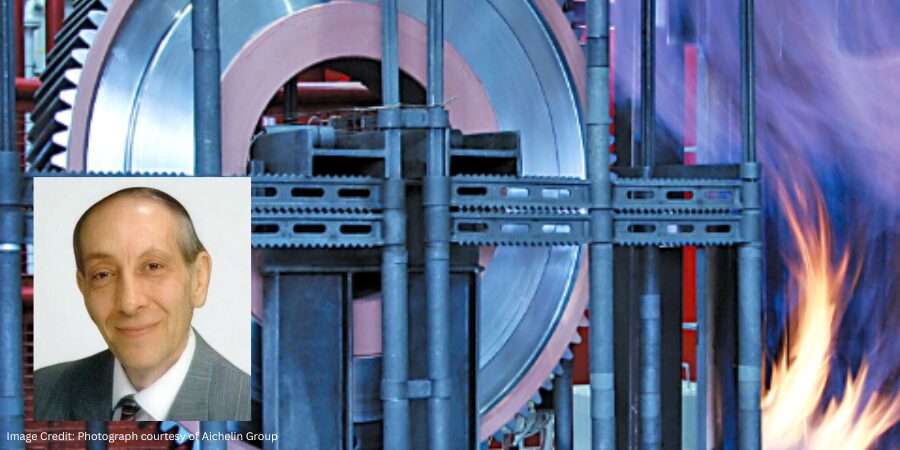
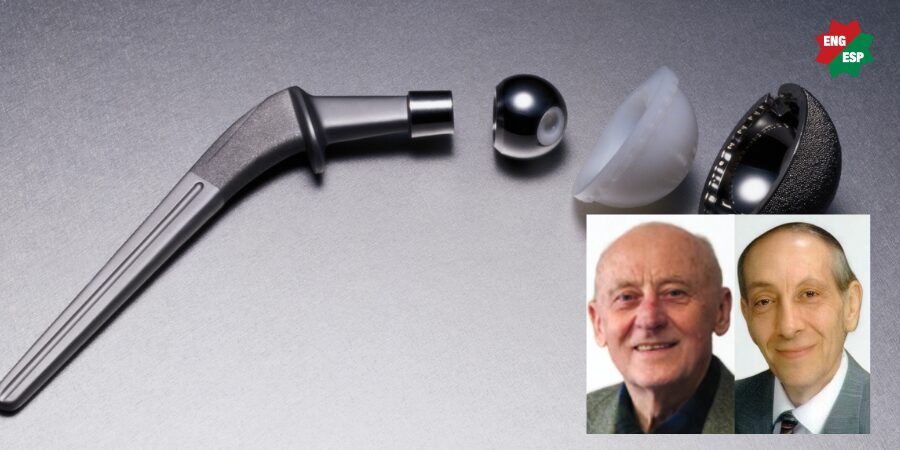
Figure 3. Atmosphere carburizing of large gears | Image Credit: Photograph courtesy of Aichelin Group

Atmosphere carburizing is the most common of the case hardening methods in use today and can handle a diverse range of part sizes and load configurations (Figure 3). In general, a properly carburized gear will be able to handle somewhere between 30–50% more load than a through-hardened gear. Examples of commonly carburized gear steels include AISI/SAE grades 1018, 4320, 5120, 8620, and 9310, as well as international grades, such as 20MnCr5, 17CrNiMo6, 18CrNiMo7-6, and 20MoCr4.

Atmosphere carburizing is typically performed in the temperature range of 870°C–955°C (1600°F–1750°F) although temperatures up to 1010°C (1800°F) are used for deep case work. Carburizing case depths can vary over a broad range, typically 0.13–8.25 mm (0.005–0.325 inches).

Carbonitriding

Carbonitriding is a modification of the carburizing process, not a form of nitriding. This modification consists of introducing ammonia into the carburizing atmosphere to add nitrogen to the carburized case as it is being produced. Examples of gear steels that are commonly carbonitrided include AISI/SAE 1018, 1117, and 12L14.

Carbonitriding is done at a lower temperature than carburizing, typically between 790°C–900°C (1450°F–1650°F), and for a shorter time. Combine this with the fact that nitrogen inhibits the diffusion of carbon, and what generally results is a shallower case than is typical for carburized parts. A carbonitrided case is usually between 0.075–0.75 mm (0.003–0.030 inches) deep.

Nitriding

Nitriding is another surface treatment process that has as its objective increasing surface hardness. One of the appeals of this process is that rapid quenching is not required, hence dimensional changes are kept to a minimum. It is not suitable for all gear applications; one of its limitations is that the extremely high surface hardness case produced has a more brittle nature than say that produced by the carburizing process. Despite this fact, in a number of applications, nitriding has proved to be a viable alternative. Examples of commonly nitrided gear steels include AISI/SAE 4140, 4150, 4340, and Nitralloy® 135M.

Nitriding is typically done in the range of 495°C–565°C (925°F–1050°F). Case depth and case hardness properties vary not only with the duration and type of nitriding being performed but also with steel composition, prior structure, and core hardness. Typically, case depths are between 0.20–0.65 mm (0.008–0.025 inches) and take from 10 to 80 hours to produce.

Nitrocarburizing (Ferritic or Austenitic)

Nitrocarburizing is a modification of nitriding, not a form of carburizing. In the process, nitrogen and carbon are simultaneously introduced into the steel while it is in a ferritic or at times an austenitic condition. A very thin “white” or “compound” layer is formed during the process, as well as an underlying “diffusion” zone. Like nitriding, rapid quenching is not required. Examples of gear steels that are commonly nitrocarburized include AISI/SAE grades 4140, 5160, 8620, and certain tool steels, such as H11 and H13.

Nitrocarburizing is normally performed at 550°C–600°C (1025°F–1110°F) and can be used to produce a 58 HRC minimum hardness, with this value increasing dependent on the base material. White layer depths range from 0.0013–0.056 mm (0.00005–0.0022 inches) with diffusion zones from 0.03–0.80 mm (0.0013–0.032 inches) being typical.

In Summary

There are many ways to heat treat gears. While atmosphere heat treatment (discussed above) is perhaps the most widely used technology today, other types of heat treatments, namely vacuum and induction hardening, are becoming more and more common methods. These will be discussed in Part Two.

About the Author

Dan Herring
“The Heat Treat Doctor”
The HERRING GROUP, Inc.

Dan Herring has been in the industry for over 50 years and has gained vast experience in fields that include materials science, engineering, metallurgy, new product research, and many other areas. He is the author of six books and over 700 technical articles.

For more information: Contact Dan at dherring@heat-treat-doctor.com.

For more information about Dan’s books: see his page at the Heat Treat Store.


Ask The Heat Treat Doctor®: Why and How Do We Heat Treat Gears? Part One Read More »
Anodic Plasma Nitriding of Titanium Alloys

In this Technical Tuesday installment, Dr. Edward Rolinski and Dan Herring, respectively known as “Doctor Glow” and The Heat Treat Doctor®, explore how anodic plasma nitriding for titanium alloys avoids the damaging effects of conventional cathodic nitriding while improving wear resistance, corrosion resistance, and component reliability for aerospace and medical applications.

This informative piece was first released in Heat Treat Today’s November 2025 Annual Vacuum Heat Treating print edition.

To read the article in Spanish, click here.


Traditional plasma/ion nitriding is a well-established technology. However, it has issues that can be overcome by the newer anodic plasma nitriding method. This article introduces the idea of using anodic plasma nitriding for titanium and titanium alloys to avoid the damaging effect of conventional (cathodic) plasma nitriding. Read how this approach could provide harder, defect-free layers that improve wear, corrosion resistance, and overall component reliability for aerospace and medical critical parts.

What Is Anodic Nitriding?

Anodic nitriding is a type of plasma nitriding process in which the component parts being treated are placed at an anodic (positive) potential instead of the usual cathodic (negative) potential. Unlike conventional plasma (cathodic glow discharge) nitriding, where the component is bombarded by high-energy positive ions, anodic nitriding involves low-energy electron bombardment of the component’s surface.

Anodic nitriding is particularly effective for materials with very high negative Standard Free Energy of nitride formation (e.g., titanium, zirconium) as it helps avoid or reduce the edge effect, a well-known problem in cathodic nitriding that leads to uneven ion bombardment and hardening on corners and edges.

Background: Plasma Nitriding Complexities

Glow-discharge plasma nitriding is applied to a wide range of materials, including cast irons, carbon steels, stainless steels, nickel, titanium alloys, and powder metal (Roliński 2014). The plasma nitriding and nitrocarburizing processes allow for the formation of surface layers known to have superior tribological properties (Roliński 2014). However, coverage of the parts with the glow discharge is not always uniform, especially when complex geometry loads are processed (see Figure 1).

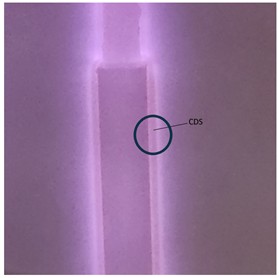
Glow-discharge plasma nitriding is a thermochemical treatment involving high-energy particles. Ions of nitrogen or other gas species accelerate and gain energy in the cathodic dark space (CDS) around the workpiece — which is the cathode in a direct current electrode setup. They activate the surface first by sputtering to remove any native oxides present. The sputtering treatment also results in the generation of a substantial quantity of solid particles, generated from the part itself, including metal atoms that levitate near the surface of the part (Merlino and Goree 2004; Roliński 2005). In processing titanium, for example, this affects both adsorption and diffusion at the surface creating conditions that degrade layer quality (Hubbard, et al. 2010). A negative impact of this “dusty” plasma on the uniformity of the nitrided layer in complex-geometry workpieces has been reported (Ossowski, et al. 2016).

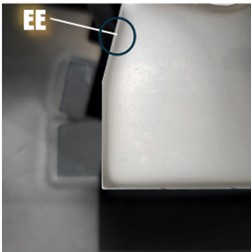
In addition, it is well known that there is a so-called corner/edge effect (EE) observed during plasma nitriding related to uneven circulation of these dust particles around the cathode (see Figure 2). In extreme situations, especially when complex geometry parts are treated, the EE caused by a non-uniform distribution of the electric field on corners, cavities, etc., results in excessive and non-uniform distribution of these plasma deposits (PD). In this way, the EE amplifies the already-present problem of redeposition, leading to the formation of various microdefects and uneven nitrided layer thickness (Merlino and Goree 2004; Roliński 2005, 2024; Ossowski, et al. 2016).

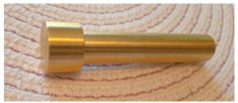
Figure 3. Titanium component after gas nitriding in ammonia | Source: Roliński and Herring

Plasma nitriding of titanium is usually performed at 680–1100°C (1256–2012°F). Negative aspects of using cathodic polarization on titanium include plasma/ion bombardment resulting in surface damage due primarily to micro arcing and contamination of the surface with the deposited compounds and their uneven distribution due to EE (Merlino and Goree 2004; Roliński 2005, 2014, 2024; Ossowski, et al. 2016). Although arcing has been eliminated by applying pulse plasma techniques, sputtering can only be controlled in a limited way, especially when complex geometry parts are nitrided. Therefore, gas nitriding in ammonia has been used occasionally for hardening titanium parts. A resulting golden appearance representing the presence of TiN nitride is produced on the surface (see Figure 3).

Anodic Nitriding of Titanium Alloys

Research has been conducted on anodic plasma nitriding of steels (Zlatanovic 1986; Michalski 1993; Kenĕz 2018). Ammonia or active nitrogen species generated in the plasma can nitride the anode just as they do the cathode. The active species causing nitriding are active nitrogen atoms and highly reactive NH radicals (NH*) formed in near plasma. NH radicals (aka imidogen radicals) are chemical species with a nitrogen-hydrogen bond along with an unpaired electron. For titanium, hydrogen must be excluded in many situations because it reacts with titanium to form stable hydrides that embrittle the product (Roliński 2015).

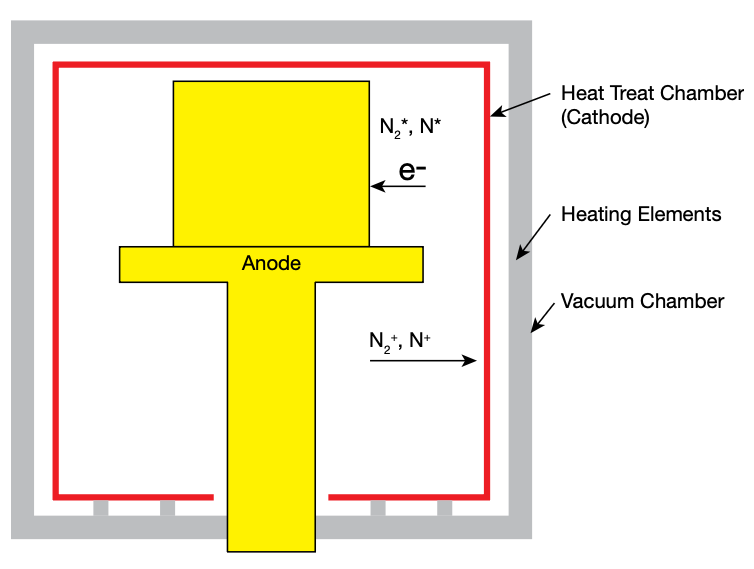
The standard free enthalpy of formation of titanium nitrides has an exceptionally large negative value, which means that titanium nitride will form in a spontaneous way when the titanium anode reacts with excited nitrogen nearby (Roliński 2015). Switching the treated components from cathodic to anodic polarization offers several notable advantages. A glow discharge in pure nitrogen or argon generates only positive ions that are accelerated toward the cathode/workpiece. Because these gas mixtures lack negative ions, only electrons from the anodic glow strike the anode/workpiece. This results in activation of the surface without negative aspects of the collisions of the heavier particles, such as N2+ (i.e., a nitrogen molecular ion with a +1 charge), causing excessive sputtering. At the same time, charge-free particles of nitrogen, such as N2* and N*, react with the anode and are chemisorbed at the surface at sufficiently high temperature, leading eventually to formation of the diffusion layer.

It is believed that the anodic-nitriding process may have positive effects in treating precision parts made of titanium and other alloys for use in both the aerospace and medical industries. This method will allow treatment at the lowest possible temperature due to activation of the surface with the electrons from anodic polarization. The texture, appearance, and defect-free surface will produce a superior part and will enhance the performance of many of those components. This will be important when corrosion or optical properties of the surface play a significant role.

Anodic nitriding of titanium can be accomplished within a conventional plasma nitriding system, provided that the central anode is appropriately designed and positioned. This anode or portion of it must be made of titanium to prevent evaporation and transfer of any impurities to the parts.

Applications

Figure 4. Schematic representation of the anodic plasma nitriding apparatus. Note the gold color characteristic for titanium nitride TiN present on the titanium fixturing and parts, all being identified as “anode.” | Source: Roliński and Herring

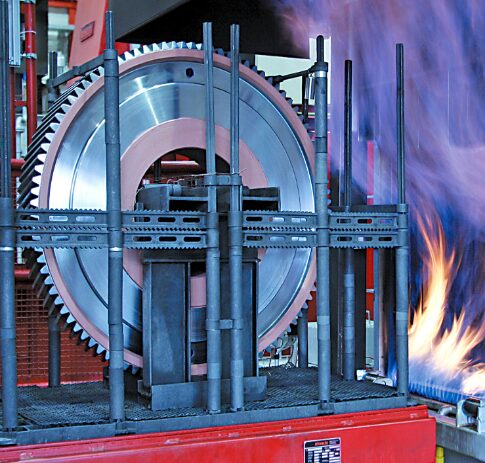
Titanium alloys are popular in orthopedics due to their bone-like elasticity, strength, and biocompatibility (Roliński 2015; Froes 2015). Surface engineering processes like anodic nitriding can play a significant role in extending the performance of orthopedic devices several times beyond their normal life expectancy.

Super elastic intermetallic materials, such as 60NiTi, are used in rolling element bearings due to their resistance to corrosion and shock (Pohrelyuk, et al. 2015; Corte, et al. 2015). They are typically prone to rolling contact fatigue (RCF) degradation. Any surface defects present in those components, such as local concentration of impurities or micro-cracks, will result in premature failure. Anodic plasma nitriding can be potentially used to harden the surfaces of bearing components made from these alloys by forming a hard, defect-free layer, which may improve their RCF properties.

It is expected that parts made of titanium or other alloys with the smooth surface subjected to the anodic nitriding will be microdefects-free, enabling their broad applications in medical field, aerospace industry, and optical and semiconductor devices.

References

Corte, Ch. Della, M. K. Stanford, and T. R. Jett. 2015. “Rolling Contact Fatigue of Superelastic Intermetallic Materials (SIM) for Use as Resilient Corrosion Resistant Bearings.” Tribology Letters 26: 1–10.

Froes, F. H., ed. 2015. Titanium: Physical Metallurgy, Processing and Applications. Materials Park, OH: ASM International.

Hubbard, P., J. G. Partridge, E. D. Doyle, D. G. McCulloch, M. B. Taylor, and S. J. Dowey. 2010. “Investigation of Mass Transfer within an Industrial Plasma Nitriding System I: The Role of Surface Deposits.” Surface and Coatings Technology 204: 1145–50.

Kenĕz, L., N. Kutasi, E. Filep, L. Jakab-Furkas, and L. Ferencz. 2018. “Anodic Plasma Nitriding in Hollow Cathode (HCAPN).” HTM Journal of Heat Treatment and Materials 73 (2): 96–105.

Merlino, R. L., and J. A. Goree. 2004. “Dusty Plasmas in the Laboratory, Industry, and Space.” Physics Today, July, 32–38.

Michalski, J. 1993. “Ion Nitriding of Armco Iron in Various Glow Discharge Regions.” Surface and Coatings Technology 59 (1–3): 321–24. https://doi.org/10.1016/0257-8972(93)90105-W.

Ossowski, Maciej, Tomasz Borowski, Michal Tarnowski, and Tadeusz Wierzon. 2016. “Cathodic Cage Plasma Nitriding of Ti6Al4V.” Materials Science (Medžiagotyra) 22 (1).

Pohrelyuk, I., V. Fedirko, O. Tkachuk, and R. Poskurnyak. 2015. “Corrosion Resistance of Ti-6Al-4V Alloy with Oxidized Nitride Coatings in Ringer’s Solution.” Inzynieria Powierzchni (Surface Engineering) 1: 38–46.

Roliński, E. 2014. “Plasma Assisted Nitriding and Nitrocarburizing of Steel and Other Ferrous Alloys.” In Thermochemical Surface Engineering of Steels, edited by E. J. Mittemeijer and M. A. J. Somers, 413–57. Woodhead Publishing Series in Metals and Surface Engineering 62. Cambridge, UK; Waltham, MA; and Kidlington, UK: Woodhead Publishing.

Roliński, E. 2015. “Nitriding of Titanium Alloys.” In ASM Handbook, Volume 4E: Heat Treating of Nonferrous Alloys, edited by G. E. Totten and D. S. McKenzie, 604–21. Materials Park, OH: ASM International.

Roliński, Edward. 2024. “Practical Aspects of Sputtering and Its Role in Industrial Plasma Nitriding.” In ASM Handbook Online, Volume 5: Surface Engineering. Materials Park, OH: ASM International. https://doi.org/10.31399/asm.hb.v5.a0007039.

Roliński, E., J. Arner, and G. Sharp. 2005. “Negative Effects of Reactive Sputtering in an Industrial Plasma Nitriding.” Journal of Materials Engineering and Performance 14 (3): 343–50.

Zlatanovic, M., A. Kunosic, and B. Tomčik. 1986. “New Development in Anode Plasma Nitriding.” In Proceedings of the International Conference on Ion Nitriding, Cleveland, OH, September 15–17, edited by T. Spalvins, 47–51. Cleveland, OH: NASA Lewis Research Center.

About The Authors:

Dr. Edward Rolinski
“Doctor Glow”

Dr. Edward Rolinski, affectionately known as “Doctor Glow,” is a distinguished senior scientist having spearheaded research on plasma/ion nitriding since the 1970s. He holds advanced degrees in manufacturing technology and metallurgy, including a PhD and Doctor of Science. His focus has been on plasma nitriding processes, especially involving titanium alloys and powder metallurgy. Over his career, Dr. Rolinski authored numerous influential technical chapters and articles, including for ASTM International and the ASM Handbook, and is a prolific contributor to industry publications. After decades of leadership and innovation in surface engineering and heat treating, he is now a consultant in the heat-treating industry.

Dan Herring
(The Heat Treat Doctor®)
The HERRING GROUP, Inc.

Dan Herring, who is most well known as The Heat Treat Doctor®, has been in the industry for over 50 years. He spent the first 25 years in heat treating prior to launching his consulting business, The HERRING GROUP, in 1995. His vast experience in the field includes materials science, engineering, metallurgy, equipment design, process and application specialist, and new product research. He is the author of six books and over 700 technical articles.

For more information: Contact Dan at dherring@heat-treat-doctor.com.

Anodic Plasma Nitriding of Titanium Alloys Read More »

Nitruración anódica por plasma de aleaciones de titanio

En esta entrega de Martes Técnico, el Dr. Edward Rolinski y Dan Herring, conocidos respectivamente como “Doctor Glow” y The Heat Treat Doctor®, exploran cómo el nitrurado por plasma anódico para aleaciones de titanio evita los efectos dañinos del nitrurado catódico convencional mientras mejora la resistencia al desgaste, la resistencia a la corrosión y la confiabilidad de los componentes para aplicaciones aeroespaciales y médicas.

Este artículo informativo se publicó por primera vez en Heat Treat Today’s November 2025 Annual Vacuum Heat Treating print edition.

Para leer el artículo en inglés, haga clic aquí.


La nitruración tradicional por plasma/iónica es una tecnología consolidada. Sin embargo, presenta problemas que pueden solucionarse con el nuevo método de nitruración anódica por plasma. Este artículo presenta la idea de utilizar la nitruración anódica por plasma para titanio y aleaciones de titanio, evitando así los efectos perjudiciales de la nitruración catódica por plasma convencional. Descubra cómo este enfoque podría proporcionar capas más duras y sin defectos que mejoran el desgaste, la resistencia a la corrosión y la fiabilidad general de los componentes para piezas críticas de la industria aeroespacial y médica.

Qué es la nitruración anódica?

La nitruración anódica es un tipo de proceso de nitruración por plasma en el que las piezas tratadas se ubican en un potencial anódico (positivo) en lugar del potencial catódico (negativo) habitual. A diferencia de la nitruración por plasma convencional (descarga catódica), donde el componente se bombardea con iones positivos de alta energía, la nitruración anódica implica el bombardeo de electrones de baja energía sobre la superficie del componente.

La nitruración anódica es particularmente efectiva para materiales con una alta energía libre estándar negativa de formación de nitruros (p. ej., titanio, circonio), ya que ayuda a evitar o reducir el efecto de borde, un problema bien conocido en la nitruración catódica que provoca un bombardeo iónico desigual y endurecimiento en esquinas y bordes.

Antecedentes: Complejidades de la nitruración por plasma

La nitruración por plasma con descarga luminiscente se aplica a una amplia gama de materiales, como fundiciones, aceros al carbono, aceros inoxidables, níquel, aleaciones de titanio y pulvimetalurgia (Roliński, 2014). Los procesos de nitruración por plasma y nitrocarburación permiten la formación de capas superficiales con propiedades tribológicas superiores (Roliński, 2014). Sin embargo, la cobertura de las piezas con la descarga luminosa no siempre es uniforme, especialmente cuando se procesan cargas de geometría compleja (véase la Figura 1).

La nitruración por plasma de baja descarga es un tratamiento termoquímico que utiliza partículas de alta energía. Los iones de nitrógeno u otras especies gaseosas se aceleran y ganan energía en el espacio oscuro de Crookes (CDS) alrededor de la pieza, que es el cátodo en una configuración de electrodos de corriente directa. Primero activan la superficie mediante pulverización catódica (sputtering) para eliminar cualquier óxido nativo presente. El tratamiento de pulverización catódica también genera una cantidad sustancial de partículas sólidas, generadas por la propia pieza, incluyendo átomos metálicos que flotan cerca de la superficie (Merlino y Goree, 2004; Roliński, 2005). En el procesamiento del titanio, por ejemplo, esto afecta tanto la adsorción como la difusión en la superficie, creando condiciones que degradan la calidad de la capa (Hubbard, et al., 2010). Se ha descrito un impacto negativo de este plasma “polvoriento” en la uniformidad de la capa nitrurada en piezas de geometría compleja (Ossowski et al., 2016).

Además, es bien sabido que durante la nitruración por plasma se observa el denominado efecto esquina/borde (EE), relacionado con la circulación desigual de estas partículas de polvo alrededor del cátodo (véase la Figura 2). En situaciones extremas, especialmente al tratar piezas de geometría compleja, el EE, causado por una distribución desigual del campo eléctrico en esquinas, cavidades, etc., da lugar a una distribución excesiva y desigual de estos depósitos de plasma (PD). De esta manera, el EE agrava el problema ya existente de la redeposición, lo que provoca la formación de diversos microdefectos y un espesor desigual de la capa nitrurada (Merlino y Goree, 2004; Roliński, 2005, 2024; Ossowski et al., 2016).

Figura 3. Componente de titanio después de nitruración gaseosa en amoníaco. Source: Roliński and Herring

La nitruración por plasma del titanio se realiza habitualmente a 680–1100 °C (1256–2012 °F). Entre los aspectos negativos del uso de la polarización catódica en titanio se incluyen el bombardeo de plasma/iónico, que provoca daños superficiales debido principalmente a micro-arcos y la contaminación de la superficie con los compuestos depositados, así como su distribución desigual debido al EE (Merlino y Goree, 2004; Roliński, 2005, 2014, 2024; Ossowski et al., 2016). Aunque el arco eléctrico se ha eliminado mediante la aplicación de técnicas de plasma pulsado, la pulverización catódica solo se puede controlar de forma limitada, especialmente cuando se nitruran piezas de geometría compleja. Por lo tanto, la nitruración gaseosa en amoníaco se ha utilizado ocasionalmente para endurecer piezas de titanio. Se produce un aspecto dorado resultante en la superficie que indica la presencia del nitruro TiN (véase la Figura 3).

Nitruración anódica de aleaciones de titanio

Se han realizado investigaciones sobre la nitruración anódica de aceros por plasma (Zlatanovic 1986; Michalski 1993; Kenĕz 2018). El amoníaco o las especies de nitrógeno activo generadas en el plasma pueden nitrurar el ánodo al igual que al cátodo. Las especies activas que causan la nitruración son átomos de nitrógeno activo y radicales NH altamente reactivos (NH*) formados en el plasma cercano. Los radicales NH (también conocidos como radicales imidógenos) son especies químicas con un enlace nitrógeno-hidrógeno junto con un electrón desapareado. En el caso del titanio, el hidrógeno debe excluirse en muchas situaciones, ya que reacciona con el titanio para formar hidruros estables que fragilizan el producto (Roliński, 2015).

La entalpía libre estándar de formación de nitruros de titanio tiene un valor negativo excepcionalmente alto, lo que significa que el nitruro de titanio se formará espontáneamente cuando el ánodo de titanio reaccione con nitrógeno excitado cercano (Roliński, 2015). Cambiar de polarización catódica a anódica de los componentes tratados ofrece varias ventajas notables. Una descarga luminosa en nitrógeno puro o argón genera únicamente iones positivos que se aceleran hacia el cátodo/pieza de trabajo. Dado que estas mezclas de gases carecen de iones negativos, solo los electrones de la luminiscencia anódica inciden en el ánodo/pieza de trabajo. Esto produce la activación de la superficie sin los efectos negativos de las colisiones de partículas más pesadas, como N₂+ (es decir, un ion molecular de nitrógeno con carga +1), lo que provoca una pulverización catódica excesiva. Al mismo tiempo, partículas de nitrógeno sin carga, como N₂* y N*, reaccionan con el ánodo por quimisorción en la superficie a una temperatura suficientemente alta, lo que finalmente conduce a la formación de la capa de difusión.

Se cree que el proceso de nitruración anódica puede tener efectos positivos en el tratamiento de piezas de precisión de titanio y otras aleaciones para su uso en las industrias aeroespacial y médica. Este método permitirá el tratamiento a la temperatura más baja posible gracias a la activación de la superficie con los electrones de la polarización anódica. La textura, la apariencia y una superficie sin defectos producirán una pieza superior y mejorarán el rendimiento de muchos de esos componentes. Esto será importante cuando la corrosión o las propiedades ópticas de la superficie sean importantes.

La nitruración anódica del titanio puede lograrse mediante un sistema convencional de nitruración por plasma, siempre que el ánodo central esté diseñado y ubicado adecuadamente. Este ánodo, o parte del mismo, debe estar hecho de titanio para evitar la evaporación y la transferencia de impurezas a las piezas.

Aplicaciones

Figura 4. Representación esquemática del aparato de nitruración por plasma anódico. Observe el color dorado característico del nitruro de titanio (TiN) presente en los accesorios y piezas de titanio, todos identificados como “ánodo”. Source: Roliński and Herring

Las aleaciones de titanio son populares en ortopedia debido a su elasticidad, resistencia y biocompatibilidad similares a las del hueso (Roliński 2015; Froes 2015). Los procesos de ingeniería de superficies, como la nitruración anódica, pueden desempeñar un papel importante a la hora de prolongar el rendimiento de los dispositivos ortopédicos varias veces más allá de su vida útil normal.

Los materiales intermetálicos superelásticos, como el 60NiTi, se utilizan en elementos de rodamientos debido a su resistencia a la corrosión y al impacto (Pohrelyuk et al., 2015; Corte et al., 2015). Suelen ser propensos a la degradación por fatiga de contacto rodante (RCF). Cualquier defecto superficial presente en estos componentes, como la concentración local de impurezas o microfisuras, provocará un fallo prematuro. La nitruración por plasma anódico puede utilizarse para endurecer las superficies de los componentes de rodamientos fabricados con estas aleaciones, formando una capa dura y sin defectos, lo que puede mejorar sus propiedades ante el RCF.

Se espera que las piezas de titanio u otras aleaciones con la superficie sometida a nitruración anódica estén libres de micro-defectos, lo que permite su amplia aplicación en el campo médico, la industria aeroespacial y los dispositivos ópticos y semiconductores.

Referencias

Corte, Ch. Della, M. K. Stanford, and T. R. Jett. 2015. “Rolling Contact Fatigue of Superelastic Intermetallic Materials (SIM) for Use as Resilient Corrosion Resistant Bearings.” Tribology Letters 26: 1–10.

Froes, F. H., ed. 2015. Titanium: Physical Metallurgy, Processing and Applications. Materials Park, OH: ASM International.

Hubbard, P., J. G. Partridge, E. D. Doyle, D. G. McCulloch, M. B. Taylor, and S. J. Dowey. 2010. “Investigation of Mass Transfer within an Industrial Plasma Nitriding System I: The Role of Surface Deposits.” Surface and Coatings Technology 204: 1145–50.

Kenĕz, L., N. Kutasi, E. Filep, L. Jakab-Furkas, and L. Ferencz. 2018. “Anodic Plasma Nitriding in Hollow Cathode (HCAPN).” HTM Journal of Heat Treatment and Materials 73 (2): 96–105.

Merlino, R. L., and J. A. Goree. 2004. “Dusty Plasmas in the Laboratory, Industry, and Space.” Physics Today, July, 32–38.

Michalski, J. 1993. “Ion Nitriding of Armco Iron in Various Glow Discharge Regions.” Surface and Coatings Technology 59 (1–3): 321–24. https://doi.org/10.1016/0257-8972(93)90105-W.

Ossowski, Maciej, Tomasz Borowski, Michal Tarnowski, and Tadeusz Wierzon. 2016. “Cathodic Cage Plasma Nitriding of Ti6Al4V.” Materials Science (Medžiagotyra) 22 (1).

Pohrelyuk, I., V. Fedirko, O. Tkachuk, and R. Poskurnyak. 2015. “Corrosion Resistance of Ti-6Al-4V Alloy with Oxidized Nitride Coatings in Ringer’s Solution.” Inzynieria Powierzchni (Surface Engineering) 1: 38–46.

Roliński, E. 2014. “Plasma Assisted Nitriding and Nitrocarburizing of Steel and Other Ferrous Alloys.” In Thermochemical Surface Engineering of Steels, edited by E. J. Mittemeijer and M. A. J. Somers, 413–57. Woodhead Publishing Series in Metals and Surface Engineering 62. Cambridge, UK; Waltham, MA; and Kidlington, UK: Woodhead Publishing.

Roliński, E. 2015. “Nitriding of Titanium Alloys.” In ASM Handbook, Volume 4E: Heat Treating of Nonferrous Alloys, edited by G. E. Totten and D. S. McKenzie, 604–21. Materials Park, OH: ASM International.

Roliński, Edward. 2024. “Practical Aspects of Sputtering and Its Role in Industrial Plasma Nitriding.” In ASM Handbook Online, Volume 5: Surface Engineering. Materials Park, OH: ASM International. https://doi.org/10.31399/asm.hb.v5.a0007039.

Roliński, E., J. Arner, and G. Sharp. 2005. “Negative Effects of Reactive Sputtering in an Industrial Plasma Nitriding.” Journal of Materials Engineering and Performance 14 (3): 343–50.

Zlatanovic, M., A. Kunosic, and B. Tomčik. 1986. “New Development in Anode Plasma Nitriding.” In Proceedings of the International Conference on Ion Nitriding, Cleveland, OH, September 15–17, edited by T. Spalvins, 47–51. Cleveland, OH: NASA Lewis Research Center.

About The Authors:

Dr. Edward Rolinski
“Doctor Glow”

El Dr. Edward Rolinski, conocido afectuosamente como “Doctor Glow”, es un distinguido científico sénior que ha liderado la investigación sobre nitruración por plasma/iones desde la década de 1970. Posee títulos avanzados en tecnología de fabricación y metalurgia, incluyendo un doctorado en Ciencias. Se ha centrado en los procesos de nitruración por plasma, especialmente en aleaciones de titanio y pulvimetalurgia. A lo largo de su carrera, el Dr. Rolinski ha sido autor de numerosos capítulos y artículos técnicos influyentes, incluyendo para ASTM International y el Manual ASM, y es un prolífico colaborador en publicaciones del sector. Tras décadas de liderazgo e innovación en ingeniería de superficies y tratamiento térmico, ahora es un consultor en la industria del tratamiento térmico.

Dan Herring
(The Heat Treat Doctor®)
The HERRING GROUP, Inc.

Dan Herring, conocido como The Heat Treat Doctor®, lleva más de 50 años en la industria. Dedicó sus primeros 25 años al tratamiento térmico antes de fundar su empresa de consultoría, The HERRING GROUP, en 1995. Su amplia experiencia en el campo abarca la ciencia de los materiales, la ingeniería, la metalurgia, el diseño de equipos, la especialización en procesos y aplicaciones, y la investigación de nuevos productos. Es autor de seis libros y más de 700 artículos técnicos.

Para más información: Contacte con Dan en dherring@heat-treat-doctor.com.

Nitruración anódica por plasma de aleaciones de titanio Read More »
Common Automotive Heat Treat Processes To Get Into Gear

How long have you been heat treating automotive gears? Which thermal processing techniques do your operations gravitate towards? In this best of the web article, uncover some of the common heat treatment functions and the properties they create in gears. Let us know what you think of this general overview of the world of heat treating gears in our Reader Feedback form!

Contact us with your Reader Feedback!

Additionally, when you read to the end of the article, future trends that we can anticipate for heat treaters in the automotive industry are offered; as one might guess, they include digital and energy-saving technologies.

An excerpt: “Automotive gear heat treatment (process) includes two aspects: firstly, conventional heat treatment such as annealing, normalizing, quenching, tempering, and quenching and tempering; secondly, surface heat treatment, which encompasses methods like surface quenching (e.g., induction quenching, laser quenching) and chemical heat treatment (e.g., carburizing, carbonitriding, nitriding, nitrocarburizing).”

Read the entire article from Beyond Gears via LinkedIn, by clicking here: “Characteristics and Development Trends in Automotive Gear Heat Treatment


Find Heat Treating Products And Services When You Search On Heat Treat Buyers Guide.Com

Common Automotive Heat Treat Processes To Get Into Gear Read More »

An Overview of Case Hardening: Which Is Best for Your Operations?

Best of the Web

Source: Advanced Heat Treat Corp.

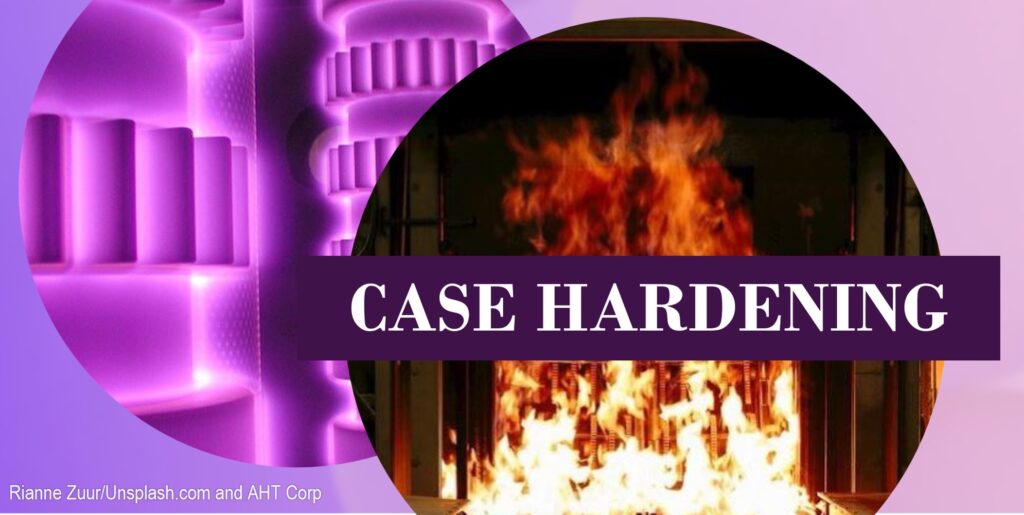
Case hardening is an essential process for many heat treating operations, but knowing the different types and functions of each is far from intuitive.

In this best of the web article, discover the differences between carburization, carbonitriding, nitriding, and nitrocarburizing, as well as what questions you should ask before considering case hardening. You will encounter technical descriptions and expert advice to guide your selection of which case hardening process will be most beneficial for your specific heat treat needs.

An excerpt:

Case hardening heat treatments, which includes nitriding, nitrocarburizing, carburizing, and carbonitriding, alter a part’s chemical composition and focus on its surface properties. These processes create hardened surface layers ranging from 0.01 to 0.25 in. deep, depending on processing times and temperatures. Making the hardened layer thicker incurs higher costs due to additional processing times, but the part’s extended wear life can quickly justify additional processing costs. Material experts can apply these processes to provide the most cost-effective parts for specific applications.

Read the entire article from Advanced Heat Treat Corp. by clicking here: "Case Hardening Heat Treatments"

An Overview of Case Hardening: Which Is Best for Your Operations? Read More »
Nitriding and Nitrocarburizing: The Benefits for Surface Treatment

Source: Advanced Heat Treat Corp.

Nitriding and nitrocarburizing may be familiar terms in the industry, but which process — ion/plasma nitriding, gas nitriding, or nitrocarburizing — is best for your heat treat operations?

In this best of the web article from Advanced Heat Treat Corp., discover the specifics of each of these surface treatments and compare their benefits for wear resistance and corrosion resistance. Explore also the innovative technologies developed by the North American heat treater for optimization of these processes. for optimization of these processes. You will encounter technical diagrams, high quality images of nitrided/nitrocarburized parts, and in-depth technical comparisons of these processes.

An excerpt:

Well-controlled nitriding significantly enhances wear resistance and lowers coefficient of friction in many applications of steel components. For certain steels, nitrided samples show even better tribological behavior than carburized samples of the same steels. 

Read more: “Wear and Corrosion Resistance: Benefits of Plasma Nitriding, Gas Nitriding and Nitrocarburizing


Find heat treating products and services when you search on Heat Treat Buyers Guide.com


Nitriding and Nitrocarburizing: The Benefits for Surface Treatment Read More »