Hazelett Strip-Casting Corporation of Colchester, VT in the US has become a member of a global heat treat furnace solution provider headquartered in Leonding, Austria. This happened via an acquisition of a majority interest in Hazelett.
Hazelett technology is used in metal manufacturing processes worldwide to cast aluminum, copper, zinc, and lead into metal strip and bar used to create a variety of products. The company has been involved in the design and manufacture of continuous casting machines for the global metal industries for over 100 years. Similarly, the acquiring group, EBNER Group, has been involved in the design and manufacture of thermal processing furnaces for over 70 years. Both have been family-owned throughout their histories and this merger preserves that legacy.
Mino S.p.A, based in Alessandria, Italy will remain a shareholder, and David Hazelett will also remain as both a shareholder and president. "As family-owned businesses," Hazelett commented, "Hazelett and EBNER have the freedom to take a longer view; one that encourages investment in research and development, building long-term relationships, and preserving our environment.”
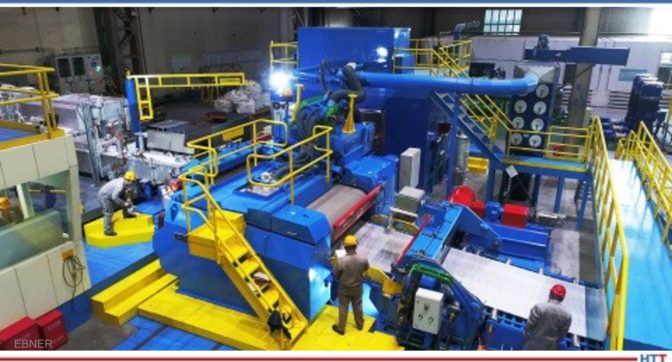
Hazelett plant Photo Credit: EBNER
EBNER Industrieofenbau is a global company and market leader in heat treatment facilities for the semi-finished metal products industry. EBNER specializes in the research, development, fabrication, installation and commissioning of heat treatment facilities for the ferrous and non-ferrous industries using the most environmentally friendly and energy efficient technologies.
Welcome to Heat TreatToday’s This Week in Heat TreatSocial Media. As you know, there is so much content available on the web that it’s next to impossible to sift through all of the articles and posts that flood our inboxes and notifications on a daily basis. So, Heat TreatToday is here to bring you the latest in compelling, inspiring, and entertaining heat treat news from the different social media venues that you’ve just got to see and read!
We’re looking at the holiday posts, origami metal, and dad jokes about aluminum this week. Check it out!
“This technique uses lasers to apply highly localized heat treatment to temper-rolled stainless steel. It focuses on softening areas where material will need to bend. Robots then form the temper-rolled sheets into complex 3D shapes. The final forming hardens the structure in order to regain the original flat sheet’s strength.” (Thomas.net)
Click the image to watch or read about the heat treatment
2. Fascinating Heat Treat Comments and Discussions
I didn’t know social media could foster such in-depth content and comments! Have you seen these posts/shares from across social media?
3Din30: The Scary Truth About Heat Treatment Innovation
.
Hyundai Heat Treat Case Study
.
Nitriding Layers, from Pro Microstructure Photographer
3. And What Did You Do for New Year’s?
We saw a lot of you hard-working heat treaters posting on LinkedIn and Twitter during the break. Tsk tsk. Take the break! But we get it: we’re excited for 2022 with you, too!
4. What to Read
Want to have a heavier read for the weekend? Well okay. . .
An Overview of Heat Treatment in the Refining, Power, and Petrochemical Industry – Part 2: The Importance of Heat Treatment to Mechanical Integrity.
.
Heat Treat Radio Special Videos
Did you watch the videos or just listen to these two podcasts? There is something different about when you watch something versus just listening. Sometimes, one is better than the other! Other times, you’re scratching your head waiting for the transcript to load. . .
Take a look at these two widely shared podcasts from 2021.
Heat Treat Tomorrow – Hydrogen Combustion: Our Future or Hot Air?: Click to –>Watch | Listen | Learn
The Future of Heat Treat, a Conversation with Piotr Zawistowski: Click to –>Watch | Listen | Learn
.
“Industry 4.0 Implementation for Small and Medium-Sized Shops”
Over the past year, we’ve seen numerous new technologies in the way of research, new partnerships, and conversations throughout the industry. So in honor of today being #NationalTechnologyDay, we’re sharing an original content article about just several of these new technologies that are changing the work of heat treaters across North America.
Research
Using HIP to Advance Oregon Manufacturing Innovation Center Programming– “‘Today’s globally competitive manufacturing industry demands rapid innovations in advanced manufacturing technologies to produce complex, high-performance products at low cost,’ observes Dr. Mostafa Saber, associate professor of Manufacturing & Mechanical Engineering Technology at Oregon Tech.”
College Students Implement a NEW Heat Treat Solution with Induction? – “‘We were in shock,’ Dennis admitted, ‘because we didn’t expect it to [work].’ The expectation, Dennis continued, was that something would go wrong, like the lid would not be able to clamp down, or the container would leak.”
The Age of Robotics with Penna Flame Industries – “The computerized robotic surface hardening systems have revolutionized the surface hardening industry. These advanced robots, coupled with programmable index tables, provide an automation system that helps decrease production time while maintaining the highest quality in precision surface hardening.”
Heat Treat Radio: Five experts (plus Doug Glenn) discuss hydrogen combustion in this episode. An easily digestible excerpt of the transcript circulated by Furnaces Internationalhere and is available to watch/listen/read in full for free here.
Heat Treat Radio: Get on-the-ground projections of what technologies Piotr Zawistowski believes will be bringing in the future. Watch/listen/read in full here
Heat Treat Radio: HIP. The Revolution of Manufacturing, that is, according to Cliff Orcutt. Watch/listen/read in full here
Heat Treat Radio: Will indentation plastometry find its way into North America? If you’ve been listening to James Dean, it seems like it already has. Watch/listen/read in full here
Heat Treat Radio: Fluxless inert atmosphere induction brazing. That’s a mouthful! But what is it? Watch/listen/read in full here
A retrofitted vacuum furnace will now produce more metal injected molded (MIM) components with considerably less downtime.
In 2021, a North American heat treater, Solar Atmospheres of Western PA, retrofitted a vacuum furnace for use in a new metal injection molding (MIM) and additive manufacturing (AM) binder removal technology application. The goal was to build a vacuum sintering furnace with a new innovative hot zone and pumping technology that would minimize and target the deposit of detrimental binders evaporating out of MIM and AM parts.
Robert (Bob) Hill, FASM President Solar Atmospheres of Western PA
The hot zone, after a month of repeated 2400°F sintering cycles, remains clean. The problematic binders coalesced at the targeted area within a separate heated pumping port while keeping the primary pump and booster uncontaminated. Most importantly, the client reported that their sintered parts processed in this new furnace never looked better. The MIM parts were extremely bright and met their critical density and dimensional requirements.
The heat treater anticipates considerable maintenance savings on this dedicated furnace versus processing sintering and AM work with binders in a traditional vacuum furnace. Working in a traditional furnace meant added labor and material costs coupled with the lost production time and degradation on the life of the hot zone, which cost the company more than $180,000 per year. The projected maintenance costs on this newly designed sintering furnace will be $10,000 per year.
"Knowing the effects," reported Bob Hill, president of Solar Atmospheres of Western PA, "of what MIM and certain AM processing had done to our equipment in the past, Bill Jones and the engineers at Solar Manufacturing developed an innovative solution for us. Having this newly designed vacuum furnace will be an asset for our future in MIM and AM processing."
This Technical Tuesday column appeared in Heat Treat Today’s December 2021 Medical and Energyprint edition.
Introduction
Dan Herring
"The Heat Treat Doctor"
The HERRING GROUP, Inc.
Medical devices (e.g., dental, and orthopedic implants, instruments) employ literally hundreds of different types of fasteners to hold their assemblies together. Even though the components in the medical devices are small or even tiny, when a fastener fails, the device will almost always fail as well.
Medical devices fall into two broad categories: surgical/non-implant devices and implantable devices. The alloys and heat treatments for the fasteners involved in both are explained below.
Surgical & Non-Implant Medical Devices
Surgical and dental instruments are examples of non-implant medical devices typically manufactured from austenitic stainless steels where good corrosion resistance and moderate strength are required. Examples include: canulae, dental impression trays, guide pins, hollowware, hypodermic needles, steam sterilizers, storage cabinets, work surfaces, and thoracic retractors, to name a few. These applications often use a variety of stainless steels that can be easily formed into complex shapes. (The heat treatment of stainless steels was covered in Heat Treatment of Fasteners for the Petrochemical Industry, Fastener Technology International, October 2013.)
Specific grades of austenitic stainless steel and high-nitrogen austenitic stainless steels are used for some surgical implants. Examples include: aneurysm clips, bone plates and screws, femoral fixation devices, intramedullary nails and pins, and joints for ankles, elbows, fingers, knees, hips, shoulders, and wrists.
However, the vast majority of orthopedic implants worldwide are manufactured from titanium (e.g., Ti-6Al-4V alloy) or cobalt-based alloys (e.g., ASTM F75, a cobalt-based alloy or cobalt-chromium-molybdenum alloys). They are manufactured from castings, forgings, or bar stock.
Medical application examples include pins, bone plates, screws, bars, rods, wires, posts, expandable rib cages, spinal fusion cages, finger and toe replacements, hip, and knee replacements, and maxillofacial prosthetics.
Figure 3. Dental implant posts
Photo Credit: Dentist in Goa via Flickr
Other Uses for Titanium Alloys
Titanium and its alloys have experienced rapid growth in the industrial (38%), commercial aerospace (29%), and military aerospace (23%) segments. The benefits of titanium include its strength, strength-to-weight ratio, corrosion resistance, non-toxicity, biocompatibility, excellent fatigue and fracture resistance, non-magnetic characteristics, life, cost, flexibility, and elasticity that rival that of human bone.
Non-medical applications include:
Manned and unmanned aircraft (e.g., commercial and military aircraft, rotorcraft)
Artillery (e.g., howitzers)
Military vehicles (e.g., tanks, hovercraft)
Naval and marine applications (e.g., surface vessels, submarines)
Turbines (e.g., power generation)
Chemical processing plants (e.g., petrochemical, oil platforms)
The heat treatment of titanium and titanium alloys is complex and demands an understanding of the end-use application, desired microstructure, and process variables.
Types of Titanium Alloys
Titanium alloys are classified in four main groups based on the types and amounts of alloying elements they contain:
Alpha (α) alloys — cannot be strengthened by heat treatment; low-to-medium strength, good notch toughness, and good creep resistance (superior to beta alloys) at somewhat elevated temperatures; formable and weldable
Near alpha phase alloys — medium strength and good creep resistance
Alpha-beta (α - β) alloys — strengthened by heat treatment; medium-to-high strength, high formability, good creep resistance (but less than most alpha alloys), alloys with beta content less than 20% are weldable; most familiar alloy in this category is Ti-6Al-4V
Beta (β) alloys — strengthened by heat treatment, high strength, and fair creep resistance
Figure 5. Load of bone reamers after heat treatment
Photo Credit: Solar Atmospheres, Inc.Figure 6. HIP repair screw after heat treatment
Photo Credit: Midwest Thermal-Vac
Standard heat treatments are typically done in vacuum style furnaces or in inert (argon) atmosphere furnaces and include:
Annealing — increases fracture toughness and ductility (at room temperature) as well as dimensional stability and improved creep resistance. Annealing may be necessary following severe cold work and to enhance fabrication and machining.
Homogenizing — for improved chemical homogeneity in castings.
Solution Treating and Age Hardening (Aging) — a process of heating into the beta or high into the alpha-beta region, quenching, and then reheating again to the alpha-beta region. A wide range of strength levels is possible, fatigue strength increases while ductility, fracture toughness, and creep resistance are enhanced.
Stress Relief — used to reduce residual stresses during fabrication or following severe forming or welding to avoid cracking or distortion and to improve fatigue resistance. Strength and ductility will not be adversely affected and cooling rate is not critical.
Tempering — When titanium is quenched from an elevated temperature, reheated to a temperature below the beta transus, held for a length of time and again quenched, it is said to have been tempered. Three variables exist in tempering: the phases present, the time held, and the tempering temperature.
Figure 4. Load of knee implants after heat treatment
Photo Credit: Solar Atmospheres, Inc.Figure 7. Typical vacuum furnace
Photo Credit: Solar Atmospheres, Inc.
Custom heat treatments include:
Beta Vacuum Annealing and Vacuum Aging — improves fatigue and yield strength as well as elongation in alloys such as Ti-5553 (Ti-5Al-5V-5Mo-3Cr).
Brazing — induction, resistance, and furnace brazing in an argon atmosphere or in vacuum; torch brazing is not applicable. Cleanliness is important to avoid contamination.
Creep Forming — takes advantage of the fact that titanium moves and takes a set-at temperature.
Degassing — involves removing of entrapped gases such as hydrogen (to under < 50 ppm) to avoid embrittlement.
Diffusion bonding — primarily in powder metallurgy where individual particles fuse together from intimate contact of their surfaces.
Hydriding/Dehydriding — the deliberate addition of hydrogen to embrittle the material followed by the removal of the hydrogen after crushing the material into powder. These are the basic steps in the production of titanium powders.
Isothermal Transformation — involves quenching an alloy from the all beta region into the alpha-beta field, holding, and then continuing to quench to room temperature. Treatment in this way causes precipitation of the alpha phase from the beta.
Sintering — typically involving hot isostatic pressing and laser sintering of powder particles to form near net share components
Practical Considerations — What’s Important
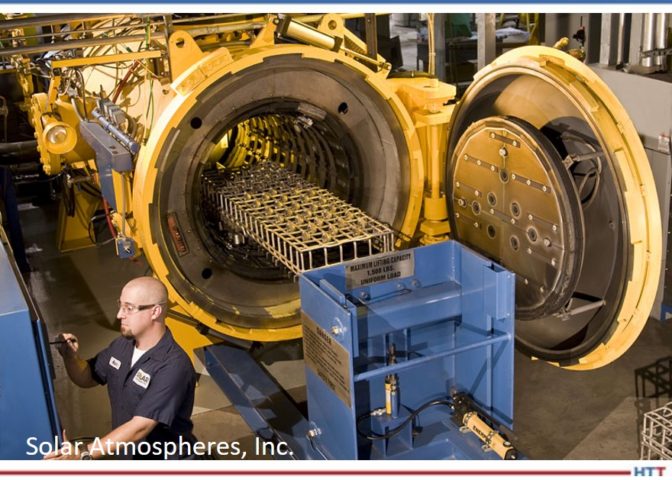
The heat treatment of titanium and titanium alloys is most often done in a vacuum furnace (Figure 7). Heat treat furnace capacity is an important consideration since many titanium parts are volume-limited rather than weight-limited. Load support is a critical issue in many applications to prevent creep or other dimensional changes, especially on intricate or complex part geometries typical in a medical fastener.
Temperature measurement and control must be exact, usually ± 10 °F (5.5°C) or better throughout the entire working zone of the furnace. Work thermocouples are needed; part temperature, not just the furnace temperature, must be known. Caution: when heating parts over 1730°F (943°C), titanium cannot be in contact with a nickel alloy or stainless steels since eutectic melting will occur.
Vacuum pumping systems must be capable of reaching high vacuum levels, 1 x 10⁻⁵ Torr or lower before starting to heat. This vacuum level must be maintained while heating (requiring very slow ramp rates) as well as when at temperature. Diffusion pumping systems must be properly maintained for maximum efficiency and to avoid backstreaming.
Since titanium is a strong getter material, vacuum furnace interiors must be pristine; ideally, all metal hot zones and dedicated furnaces are desired, but graphite lined furnaces also used for other processes are typical throughout the industry as a practical necessity. Thus, fixtures and furnaces must be “baked out” (cleaned) before use typically at 2400°F (1315°C).
In Conclusion
Fasteners are at the heart of the medical device industry and heat treatment plays a critical role in the manufacturing process. Whether made of stainless steel, titanium, tungsten carbide, or superalloys, a heat treat recipe is available to maximize both mechanical and metallurgical properties for implantable and non-implantable applications.
References
[1.] Jones, Christie L., Fastening Solutions for Medical Devices, White Paper, SPIROL International Corporation.
[2.] Herring, Daniel H., Practical Aspects Related to the Heat Treatment of Titanium and Titanium Alloys, Industrial Heating, February 2007.
Dan Herring, who is most well known as The Heat Treat Doctor®, has been in the industry for over 45 years. He spent the first 25 years in heat treating prior to launching The HERRING GROUP, Inc. in 1995. His vast experience in the field includes materials science, engineering, metallurgy, equipment design, process and application specialist, and new product research. Dan holds a patent (as a co-inventor), and his consulting services in heat treating and sintering, metallurgy, operations, business management, sales and marketing, and technology have benefitted a broad range of industries.
To jump start your heat treat knowledge this year, read this list of 22 ways you can connect with industry leaders, access new technology, review old and trusted practices, and so much more. We hope this original content article is helpful to you as you return from a much needed break!
We will be celebrating the holidays with family, so look for your next Heat Treat Dailyon January 3rd.
2021 has been a transformative year! Because we love people and 2021 saw the return of in-person, face-to-face events, seeing you in and around the trade show halls has been our #1 memory from 2021! What a joy to see and talk with so many of you.
In 2022, we’re looking forward to keeping you well informed by sharing relevant and compelling technical content, industry news, and innovative trends in the North American heat treat industry.
We are thankful for you and here’s our year-end prayer for you and yours, “May you experience the peace and hope that only Christ can give. Wishing you the joy of the Lord as we celebrate the birth of the Savior.”
Welcome to Heat Treat Today's This Week in Heat TreatSocial Media: The Christmas Edition. With so much content available on the web, especially during Christmas, it’s next to impossible to sift through all of the articles and posts that flood our inboxes and notifications on a daily basis. So before you head off to celebrate with friends and family, Heat Treat Today is sharing some great Christmas-themed heat treat news from the different social media outlets!
"Tinsel, the thin sparkling strands we drape over Christmas trees, first appeared in Germany around 1610 and was originally thin strips of material extruded from real silver. According to WiseGeek.com, silver looked good but tarnished quickly and was soon replaced by other sparkly metals. Tinsel was first placed on Christmas trees to accentuate the glow of lit candles, and only the wealthiest people could afford entire garlands.
"Advances in manufacturing eventually resulted in cheaper aluminum-based tinsel, and by the early 20th century most consumers could afford tinsel garlands, as well as individual pieces of tinsel known as icicles. By the 1950s, the use of tinsel garlands and icicles nearly overshadowed the use of Christmas lights." (Thomasnet.com)
2. Christmas Chatter
Chestnuts roasting on an open fire? Sounds like a safety hazard. Check out what people are chatting about this holiday season.
3. Light Up the Night
What do you get when you mix candles with combustion?
A North American-based manufacturer of helicopter masts, turbine shafts, engine thrust links, and nuclear components with in-house heat treating will receive a customized vacuum tempering/gas nitriding furnace. The furnace will be used for nitriding and nitrocarburizing loads up to 63" diameter x 175" deep and has a load capacity of 13,200-lb.
Peter Zawistowski Managing Director SECO/VACUUM TECHNOLOGIES, USA Source: secowarwick.com
The manufacturer ordered the custom-made pit nitriding furnace from SECO/VACUUM to increase load capacity. In addition to being able to process oversized workloads, the furnace, with an almost 80% increase in size from the standard, has a working temperature range of 300°F–1,300°F, a temperature uniformity of +/-5°, and low ammonia consumption.
"We are very pleased to collaborate with this precision manufacturer to enable new state-of-the-art nitriding and nitrocarburizing capabilities in their Canadian facility," commented PeterZawistowski, managing director of SECO/VACUUM.
As most heat treaters know, parts and fixtures often do not mix well. Diffusion bonding can cause the two to fuse together. In this case study, learn how combining thin-film coatings with specific part and fixture design can avoid diffusion bonding.
Read all about it in today's Technical Tuesday feature, written by Jeff Tomson, sale manager at Ionbond. This article was originally published in Heat TreatToday’s December 2021 Medical & Energyprint edition.
Jeff Tomson Sales Manager Ionbond
A client approached Ionbond looking for a solution to a problem: They had parts diffusion bonding to their fixtures during heat treatment. The client was using 316SS fixture spacers for heat treating 17-4 SS components at 1904°F (1040°C) in a high-vacuum heat treatment furnace and 316L SS components at 1652°F (900°C) in a high-vacuum heat treatment furnace. Due to the chemical affinity of the alloying elements of the two materials, the length of the heat treatment, and the operating temperature, atoms from both materials could intersperse. The resulting diffusion bonding caused difficulty getting the subject parts to separate from the fixtures.
The coating solution needed to be chemically inactive at the processing temperature while providing a defect-free contact surface. Ceramic materials satisfy these requirements; thus, Ionbond's CVD 29 (Al₂O₃) coating was recommended. The CVD process is a method for producing low stress coatings by means of thermally-induced chemical reactions. Typically, the substrate is exposed to one or more precursors such as TiCl₄, CH4, or AlCl₃ which react on the substrate material to produce the desired film. CVD coatings typically do not maintain their characteristics at the elevated temperatures of our client's application for long periods. However, the high-vacuum environment would allow the coating to function above its 1832°F (1000°C) service temperature. The coating has an excellent record in high temperature applications (cutting, forming, etc.) since it is chemically inert and has the ability to maintain a high hardness.
CVD equipment by Bernex
The CVD 29 coating has different variations and many applications. In the cutting tool world, its ability to resist thermal stresses makes it well suited for high-volume machining of mild and stainless steels. In resistance welding it is used heavily for locating pins and splatter guards, as its electrically insulating properties prevent arcing and its high toughness allows for a long life. For high temperature forming, chemical inertness prevents aluminum buildup on die profiles. High wear resistance makes this coating an ideal solution on ferrous and non-ferrous alloys used in hot extrusion and die casting applications. The overall coating thickness varies from 6 to 16 microns, depending on the version being applied as well as the substrate material. The coating produced is multilayered with adhesion-promoting underlayers that are needed to ensure bonding of a ceramic material to steel.
Due to the high coating temperatures, austenitic stainless steel is typically not an ideal substrate for the CVD process due to its low carbon content causing issues with adhesion. It is a better option than martensitic grades as post-coat hardening is unnecessary. Popular substrates for this coating family include carbides, D2, and H13 tool steels. Some exotic materials such as platinum and nickel content alloys are also used for specialized applications in the semiconductor and aerospace industries.
Ionbond's Cleveland team. Ionbond is a global leader in thin-film coatings, which are used to improve durability, quality, functionality, efficiency, and aesthetics of tools and components. Its portfolio includes physical vapor deposition (PVD), plasma assisted chemical vapor deposition (PACVD), chemical vapor deposition (CVD), and chemical vapor aluminizing (CVA) technologies, including a broad range of diamond-like carbon (DLC ) coatings.
Given the nature of the CVD process, typically all surfaces receive uniform coating. In the first trial, the client's spacers were coated utilizing different fixtures to ascertain whether fixturing methods would be a factor. Subsequent client trials revealed no discernable differences.
The first test by the client using the coated parts at 1904°F (1040°C) in a high-vacuum environment was considered a success, with the client stating that the coating performed “excellently.” There was no sign of coating degradation based on the visual appearance and the subject parts were easily removed from the fixtures with no signs of diffusion bonding. The second test was performed at a lower temperature of 1652°F (900°C) and had similar positive results.
Ionbond in Cleveland, OH
Given the success of the first batch, the client ordered another trial. The second set of parts, while made from the same material, were a completely new design. There were three different parts, two that had threads and the third that was a smaller washer shape. Sharp edges can present issues for the CVD process as stresses can build up at the points of the threads and cause the coating to delaminate. The small washers presented their own concerns due to the thin dimensions sparking concerns about excessive movement. Visual inspection after coating showed good adhesion with no delamination, as the threads were not sharp enough to cause issues. The smaller washers also had negligible distortion after coating. The second set of spacers were also tested in heat treatment at 1652°F (900°C) with similar results.
Inspired by these successes, the client is currently having a third set of parts manufactured to further improve the productivity of their fixtures. The geometry of the third set is completely different as our client continues to leverage the performance of the coating with the design for a more efficient fixturing.
About the Author:
Jeff Tomson is the sales manager at Ionbond’s Cleveland, Ohio site. He has been in sales and marketing roles since graduating from the University of Michigan in 1999. He has worked in automotive, aerospace, and thin-film industries.




 Hazelett Strip-Casting Corporation of Colchester, VT in the US has become a member of a global heat treat furnace solution provider headquartered in Leonding, Austria. This happened via an acquisition of a majority interest in Hazelett.