


The People of Heat Treat

Heat Treat Today publishes eight print magazines a year, and included in each is a letter from the publisher, Doug Glenn. This letter first appeared in the September 2024 People of Heat Treat print edition.

Feel free to contact Doug at doug@heattreattoday.com if you have a question or comment. 


Nearly every month, in the pages of this magazine, avid readers learn about the technologies and products of the North American heat treat industry that help them and their companies be more profitable. Rightly so. As the industry’s leading technical and trade journal, it is our mission to provide timely and helpful technical content. We believe people are happier and make better decisions when they are well informed — that’s what drives us. We like seeing people happier, so we do our little part each month to make sure our readers can make well-informed decisions.

But, as we discuss periodically at our monthly team meeting, the focus is not the technical and timely information; the focus is the people.

As with nearly every successful business in a free economy, the key to success is serving people. If we are successful at meeting the needs of the people we hope to help, they’ll continue to do business with us. We both benefit.

In this edition of Heat Treat Today, we’re going to focus in not so much on the technologies and products like we usually do; rather, we’re going to focus on a number of individuals who are rising leaders in the industry — individuals who are honing their skills so they can be more helpful to others in the industry.

This is the seventh year of Heat Treat Today’s 40 Under 40 initiative. As of this year, we will have honored and recognized 280 rising young leaders in the North American heat treat industry. Each successive year seems to be getting better and better. The quality of the candidates seeking recognition continues to rise, making the choosing of just 40 of them more and more difficult. Their stories vary widely. Some are owners of companies, some are accomplished managers or technicians, all are accomplished and have demonstrated their competence and leadership in the industry relatively early in their careers.

It is this group of people who are focusing their energies on developing the technologies and products that help the entire North American heat treat industry and those outside the industry as well. By and large, the people highlighted in this edition are “technical” people. A good and growing number of them are employed by manufacturers who have their own in-house heat treat operations (captive heat treaters). Others come from commercial heat treat facilities. And others come from industry suppliers. Nominees hale from Canada to Mexico. Both women and men are represented, which is so encouraging.

Most importantly, all these people have personal lives that are better or worse depending on how well they do their work. And how well they do their work is oftentimes dependent on how well informed they are. It’s our desire to make sure all these young people can live more enjoyable lives by staying well informed.

Being recognized as one of the top 40 rising young leaders in the North American heat treat industry has proven to be quite a boon to many past recipients of this honor. If you’d like to hear more about past recipients, please search our website for “Heat Treat NextGen” and listen to our recent interviews with several past honorees, like Brynna Keelin Kelly-McGrath.

Doug Glenn
Pubisher
Heat Treat Today

I’d like to say a special thank you to the team at Heat Treat Today who coordinates this effort each year. Headed by Bethany Leone for the past several years, herself an “under-40” person, Bethany was this year assisted by Jayna McGowan and again by Evelyn Thompson. This team of three, together with some significant help from Brandon Glenn, have worked hard on this effort and are bringing a lot of smiles to faces with the release of this edition. Great work, Heat Treat Today Team!

To all this year’s 40 Under 40 recipients, congratulations on the well-deserved recognition you are receiving.

Contact Doug Glenn at doug@heattreattoday.com.


Find Heat Treating Products And Services When You Search On Heat Treat Buyers Guide.Com

The People of Heat Treat Read More »

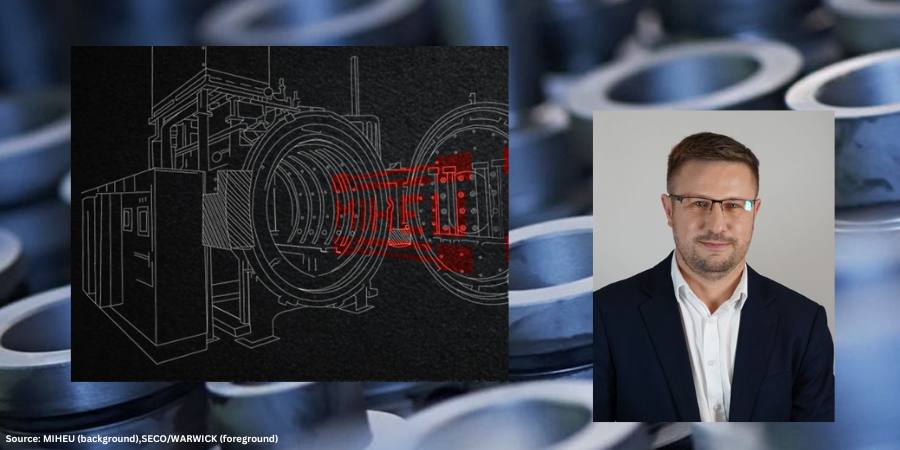
MIHEU Expands with 4th Vacuum Furnace

MIHEU, a commercial heat treater for the steel processing industry, recently expanded its vacuum furnace line for processing large dies at its hardening plant with a single-chamber vacuum furnace.

The SECO/WARWICK furnace will allow MIHEU to increase processing capacity while maintaining precision, joining three other vacuum furnaces purchased from the supplier. The vacuum furnace with high pressure gas quenching includes large load capacity and workspace with an option to make adjustments for an oversized load.

Jędrzej Malinowski
Sales Manager
SECO/WARWICK Group
Source: LinkedIn

“The Vector vacuum furnace will solve the challenge of hardening large dies, because it uses a large working space,” said Jędrzej Malinowski, sales manager of SECO/WARWICK. “The furnace is equipped with convection heating — a system which improves the heat transfer efficiency when heating at lower temperatures, as well as directional cooling, which allows for cooling problematic shape elements in various ways.”

“We wanted a solution which would shorten the heat treatment cycle time,” commented Aleš Prikeržnik, managing director at MIHEU Slovenia. “By expanding our machine park with a new vacuum furnace, we will significantly shorten the waiting times for customer orders. . . . We already have three such solutions and we are very pleased with their operation.”

MIHEU is a Slovenian commercial heat treating center with a range of additional services, including traditional hardening and tempering in oil in pit furnaces, carburizing, carbonitriding, nitrocarburizing, hardening in vacuum furnaces, and all types of nitriding, gas and plasma nitriding processes.

The press release is available in its original form here.


MIHEU Expands with 4th Vacuum Furnace Read More »
FNA Week in Heat Treat Social Media

Welcome to a special edition of Heat Treat Today’s This Week in Heat Treat Social Media. We’ve discovered a furnace-full collection of posts that document the excitement of the past week at Furnaces North America (FNA). From the arrival of booth materials to the final speech at the MTI awards ceremony, they’re all here: check out these posts and videos for a roundup of FNA and heat treat social media.

As you know, there is so much content available on the web that it’s next to impossible to sift through all of the articles and posts that flood our inboxes and notifications on a daily basis. So, Heat Treat Today is here to bring you the latest in compelling, inspiring, and entertaining heat treat news from the different social media venues that you’ve just got to see and read! If you have content that everyone has to see, please send the link to editor@heattreattoday.com.


1. Lightening the Pre-Show Heavy Lifting

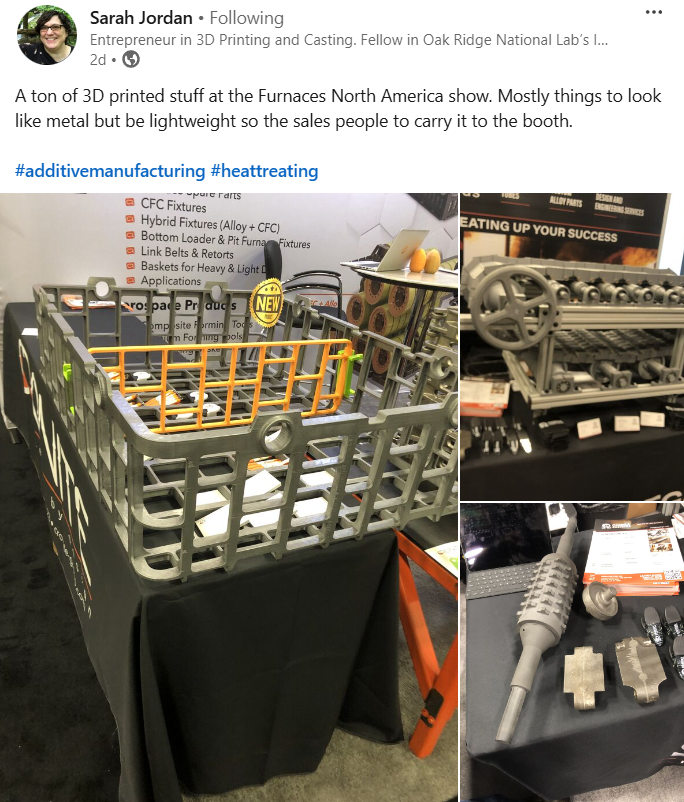
A good show is more than just what happens from curtain rise to curtain fall. Whether it’s a play on the stage or a trade show in a convention hall, there is a lot of work that goes into setting up and tearing down . . . sometimes back-breaking work. The advent of 3D printing has made that task a little easier, and ironically, at FNA 2024, that means models set out for display were processed with 3D printing to preserve the look of metal while making it easy for team to carry to the floor. Thanks to Sarah Jordan for bringing this post to the web.

2. Kudos and Awards from Beginning to End

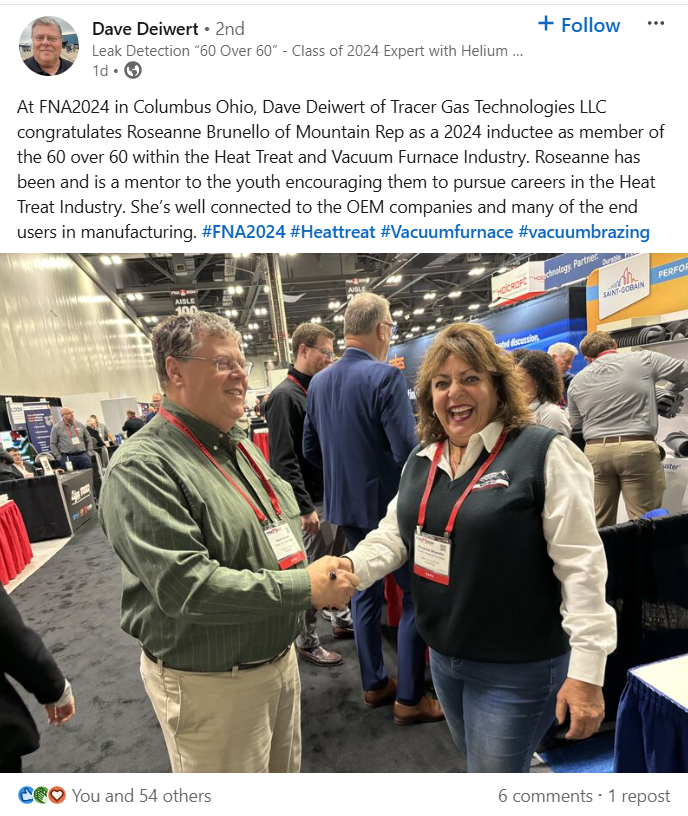
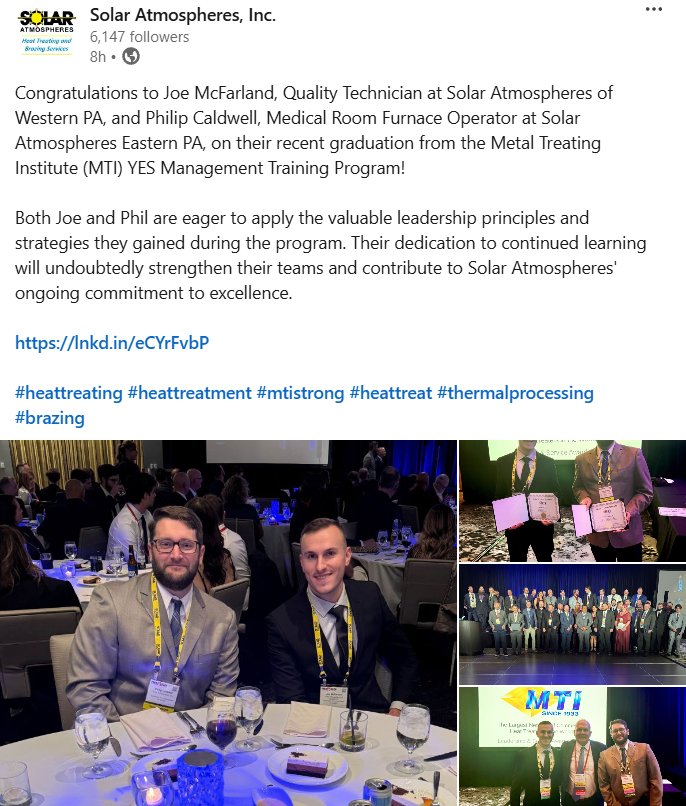
We love it when social media is full of the faces of the heat treat industry, and this week is no exception. We found individual recognition posts, the celebration of Heat Treat Today’s 40 Under 40, and the Metal Treating Institute‘s honorees at the awards ceremony on the last night of the show.

Look these posts up on LinkedIn here: Dave Deiwert; JUMO Process Control; Paulo Heat Treating; Brazing and Metal Finishing; Solar Atmospheres, Inc.; and Gasbarre Thermal Processing Systems.

3. Presenting . . .

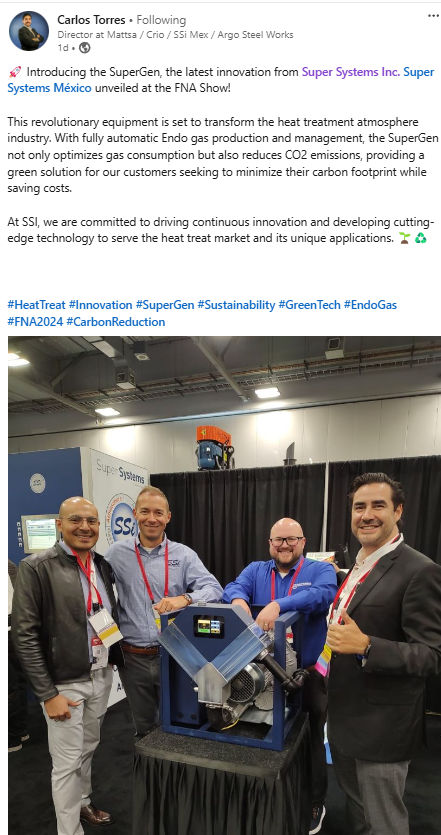
Eyes and ears were open and trained on all that’s new in heat treating presented at FNA 2024, whether in technical sessions; impromptu, on-the-floor demonstrations; or new product reveals.

Look these posts up on LinkedIn here: Carlos Torres; Solar Atmospheres, Inc.; SAFECHEM; and Nitrex.

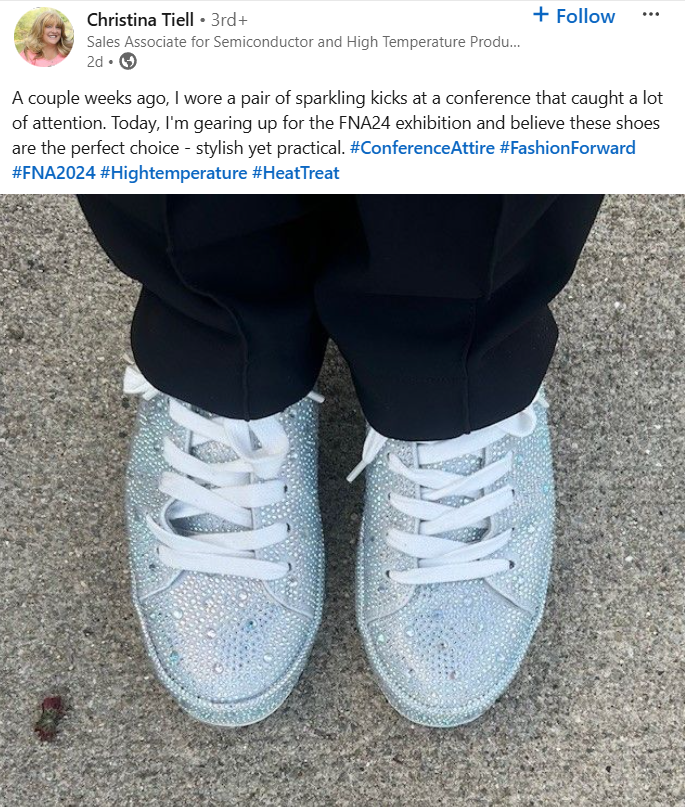
4. Sparkling Shoes and Aching Feet

‘Nuff said.

Look these posts up on LinkedIn here: Christina Tiell and Heather Falcone.

5. The Camera Turned on Us

What does Heat Treat Today do when at FNA? Here’s the link to the reel.

Look this post up on LinkedIn here.

Hope to see you next year at ASM Heat Treat Show and the year after at FNA 2026!


Find Heat Treating Products and Services When You Search on Heat Treat Buyers Guide.com

FNA Week in Heat Treat Social Media Read More »

Day 2 at FNA: Awards Abound for Heat Treaters

The final day of Furnaces North America (FNA) began for Heat Treat Today with the presentation of a plaque to Timothy Joseph Wright (T.J. Wright), who served as a Major General in the U.S. Army, as well as a critical player in the history of heat treating, specifically as a past president of Wirco.

Two of his sons, Matthew Wright, vice president of marketing at pyrometry software company C3 Data, and Nathan Wright, CEO of C3 Data, joined T.J. at their booth for the presentation, as did his nephew, Chad Wright, current president of Wirco.

  • Read the article displayed on the plaque here.
  • Listen to an interview with T.J. on Heat Treat Radio’s podcast, found here.
  • And check out a video of the presentation here.

Heat Treat Today wishes to thank T. J., for his life of service to the country and to others and to the whole Wright family for their kindness and partnerships with us.

The day ended with the Metal Treating Institute’s (MTI) final event where MTI Yes Management Training graduates were recognized, awards were given to individuals and companies who have uniquely served the industry and MTI, and the 2025 MTI officers and board of trustees were announced.

Look for upcoming articles highlighting MTI news from the event!

Main image (left to right): Matthew Wright, T.J. Wright, Nathan Wright, Chad Wright


Day 2 at FNA: Awards Abound for Heat Treaters Read More »

Best of the Web: Precise Control of Protective Atmospheres

Source: Super Systems, Inc.

Achieving the elimination of oxidation during thermal treatment has driven heat treaters for decades and resulted in a wide variety of approaches. The obvious method is to flow an inert gas such as nitrogen into the furnace in order to drive out both air and moisture. By itself, however, this technique is inadequate.

The zirconia carbon sensor has been used for nearly three decades to control the carbon potential in many carburizing applications. Today’s best of the web article examines the use of the zirconia carbon sensor in a variety of annealing and special treatment applications and considers how the sensor millivolt output is preferred because it relates directly (not empirically) to the free oxygen concentration in the surrounding environment.

An Excerpt:

“While it is desirable to avoid oxidation during thermal treatment, the achievement of adequate control using one of the ‘getter’ gases requires that the sensor millivolts achieved be established at some value higher than the vee formed by the iron reaction at temperatures below 1375ºF and the carbon reaction above that temperature. The vee will demonstrate the lower limit, but the practical level should be established by evaluation of product quality, getter cost and possible sooting. The appropriate level will be limited by such things as furnace leaks, atmosphere agitation, work porosity, time of treatment, etc.”

Read the entire article from Super Systems, Inc., by clicking here: “Precise Control of Protective Atmospheres


Find Heat Treating Products And Services When You Search On Heat Treat Buyers Guide.Com


Best of the Web: Precise Control of Protective Atmospheres Read More »

Supply of Thermal Processing Atmosphere Gases: Planning for a Safer, More Economical, and Decarbonized Future

Join us for this informative presentation as David Wolff and Mike Montesi discuss hydrogen and nitrogen generation options: Where do they fit in your facility planning and operational processes as you plan for a safer, more economical, and decarbonized future.

Featuring:

David Wolff,
Nel Hydrogen,
Industrial Sales Manager, North America

David Wolff_Q2-RGB

Brought to you by:

Nel_LDarkHydropurple-RGB

Featuring:

Mike Montesi,
On Site Gas Systems
Sales Manager

Mike-Montesi-Picture-cropped

Supply of Thermal Processing Atmosphere Gases: Planning for a Safer, More Economical, and Decarbonized Future Read More »

Choosing Power Controls for Load Configurations

In this installment of the Controls Corner, we are addressing load configurations in a furnace. An industrial furnace is made up of multiple zones for the heating of the load. These zones are strategically placed to minimize heat losses and to give the best heat profile for the application (minimize hot and cold spots in the vessel). In this Technical Tuesday installment, guest columnist Stanley Rutkowski III, senior applications engineer at RoMan Manufacturing, Inc., highlights the differences between power controls based on voltage and current.

This informative piece was first released in Heat Treat Today’s September 2024 People of Heat Treat print edition.


The utility company transmits power to the electrical grid in terms of “voltage” and “current.” Voltage is the pressure to push the current through the wires. The amount of voltage required is a function of the losses in the system (resistance, reactance, and impedance). Utility companies transmit this via the highest voltage available to minimize the current. By minimizing the current, the cross section of the conductors to transmit gets smaller and less costly to run over long distances. At an industrial facility, a step down transformer (distribution type) is used to change the high voltage from the utility company to plant voltage (and by the same ratio increase the current from low to high).

In the operations of a furnace, the term commonly used is power, which is a multiplication of two variables, voltage and current.

In the operations of a furnace, the term commonly used is power, which is a multiplication of two variables, voltage and current. The utility company transmits power in a three-phase configuration with 120 degrees difference between phases (typically labeled A-B, B-C, and C-A). Let’s take a brief look at four major load configurations.

Single-Phase Load

A single-phase load uses one of the three legs of the system in operation. This type of system is best used in three zone applications to try to balance the power of each zone to the utility. A single-phase load allows for the most control of a zone in a furnace as it is individually controlled, but potentially causes the most disturbances to the utility company.

Two-Phase Load (Scott-T)

A Scott-T system is a way to balance load a three-phase system but allow for two loads in operation. In a five zone furnace, you could configure a three-phase system for the middle three zones and a Scott-T system for the first and last zones (front and back). A Scott-T system has a single point of control for the two zones to have the least disturbances to the utility company.

Three-Phase Load

A three-phase load can be in different configurations, the most common being Delta and Wye. The differences between them are the vectors of the voltage and current. A Wye system has less voltage and more current while a Delta system has less current and higher voltage. Care needs to be taken to minimize potential circulating currents that can be created by the vectors of three-phase systems. The three-phase system is a single point of control for the loads and causes less disturbances to the utility company. Mixing of three-phase systems inside a furnace (Delta and Wye) can help further minimize disturbances to the utility company.

IGBT (Insulated-Gate Bipolar Transistor)

An IGBT (Insulated-Gate Bipolar Transistor) system is a hybrid system that uses a three-phase primary to create a single-phase load.  This allows for the highest level of control while minimizing the disturbances to the utility company. This system also allows the usage of higher frequencies to shrink the footprint of the transformers, allowing the use of rectification to minimize inductance and minimize the high current runs to the load(s).

About the Author:

Stanley F. Rutkowski III
Senior Applications Engineer
RoMan Manufacturing, Inc.

Stanley F. Rutkowski III is the senior applications engineer at RoMan Manufacturing, Inc., working on electrical energy savings in resistance heating applications. Stanley has worked at the company for 33 years with experience in welding, glass and furnace industries from R&D, design, and application standpoints. For more than 15 years, his focus has been on energy savings applications in industrial heating applications.

For more information: Contact Stanley at srutkowski@romanmfg.com.


Choosing Power Controls for Load Configurations Read More »

Automotive Radiator Manufacturer Bolsters Aluminum Brazing Capacity

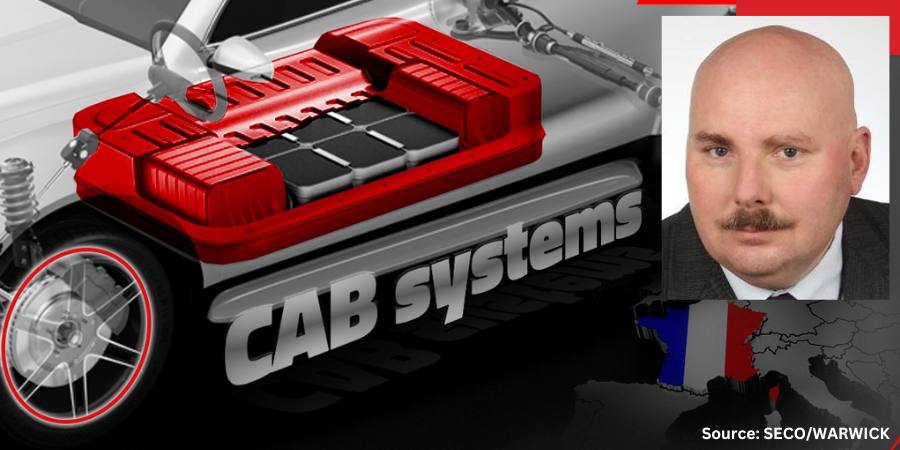
A car radiator manufacturer has expanded its heat treatment capacity with an EV/CAB line adapted for the production of oversized battery coolers. The aluminum brazing furnace facilitates the ability to make quick modifications and switch from gas to electric heating in order to meet climate change challenges.

Piotr Skarbiński
Vice President of Aluminum and CAB Products Segment
SECO/WARWICK
Source: LinkedIn

SECO/WARWICK designed the CAB line with temperature uniformity across the entire belt width in order to accommodate the size specifications of the battery coolers.

“This order is for an aluminum brazing furnace adapted to the production of oversized battery coolers,” said Piotr Skarbiński, vice president of the aluminum and CAB product segment at SECO/WARWICK. “The EV/CAB line with a belt width of 2100 mm (6.89 ft) is designed to produce oversized battery coolers. It consists of a preheating and main heating chamber, a radiation brazing furnace, an air jacket cooling chamber, a final cooling chamber and a control system.”

The press release is available in its original form here.


Automotive Radiator Manufacturer Bolsters Aluminum Brazing Capacity Read More »

Some Pre-reading Before FNA’s Technical Sessions

Furnaces North America (FNA) 2024 begins Monday, October 14, and runs through Wednesday, October 16. If you haven’t registered yet, you can still do so onsite, and one look at the technical sessions planned over the two days of training says all you need to know about the caliber of instruction at the event.

All of the sessions will be worth your time! Presenters are highly qualified to speak on the topics, which range from processes and equipment to technology to security:

  • Emerging Technologies
  • Furnace Maintenance & Equipment
  • Heat Treat Business & Digital Transformation
  • Energy & Gases
  • Operational Efficiencies
  • Quality, Compliance & Materials
  • Process Advancements

​​If you want to do a little prereading to prepare for the sessions, Heat Treat Today is pleased to direct your attention to technical session presenters who have contributed to our radio, print, and digital resources during this year:

  • On Tuesday at 8:50 a.m., Bryan Stern, product development manager at Gasbarre Thermal Processing Systems, will be speaking on “The Impact of Oil Quenching – A Look at the Carbon Footprint and Cost of Vacuum vs. Atmosphere Processing.” On June 20, 2024, Bryan was our guest on Heat Treat Radio, episode #110, “Isolated Heat, the Future of Vacuum Furnaces,” which you can listen to here.
  • Later that morning, at 9:40, Peter Sherwin, global business development manager of Heat Treatment at Watlow, will focus on “Smart Heat Treatment: Industry 4.0 Innovations for Environmental & Energy Efficiency.” Peter co-authored “Thermal Loop Solutions: A Path to a Sustainable Future in Heat Treatment,” a two-part series published in both the magazine and on our website. You can read the first part here and the second part here.
  • During that same time slot, Brian Turner, sales application engineer at RoMan Manufacturing, is scheduled to speak on “Efficient Furnace Power Solutions”. Brian joined fellow RoMan employees who have contributed technical content to an ongoing series on controls. You can read that article, “Basic Definitions: Power Pathways in Vacuum Furnaces,” originally published July 16, 2024, here.
  • On Wednesday at 8 a.m., Sefi Grossman, founder and CEO of CombustionOS, is scheduled to present a session on “Maximizing Heat Treat Operational Efficiency: Digitize Your Data for Automation.” Sefi wrote a piece for our August Automotive print edition on “A New Era: Tracking Quality Digitally,” which was later republished at the website. You can read the digital version here.
  • At 8:50, Joe Coleman, cybersecurity officer at Bluestreak Compliance, will address “CMMC’s Impending Impact On The Metal Treating Industry.” Just last month, he joined Heat Treat Radio in an interview about “NIST and CMMC: What Heat Treaters Need To Know,” which you can listen to here.
  • Chad Beamer, senior applications engineer at Quintus Technologies, will speak on “Quintus Purus: Development of Clean HIP Processing” at 9:40 on Wednesday morning. Earlier this year, he collaborated with fellow Quintus employees on an article, “HIP Innovation Maximizes AM Medical Potential,” which you can read here.

Stop by Heat Treat Today‘s booth (424/426) to let us know how the sessions went and if you did your homework beforehand!


Some Pre-reading Before FNA’s Technical Sessions Read More »

Plibrico Opens New Refractory Production Facility

Plibrico, a manufacturer and installer of superior aluminosilicate and high alumina monolithic refractories, has expanded its footprint with the grand opening and dedication of its new state-of-the-art production facility in Oak Hill, Ohio. The company’s refractories are used in a variety of heat treating applications, and the new plant will enhance technology and production capacity.

Brad Taylor
President & CEO
Plibrico

Plibrico celebrated the occasion with a two-day GO LIVE Showcase, which included in attendance Shane Wilkin, Ohio State Senator; Samuel Brady, president and CEO of Economic Development Partnership of Jackson County; and Paul McNeal, mayor of Oak Hill. In addition to the dedication ceremony and training sessions, attendees received a behind-the-scenes tour of the company’s new refractory production facility. The event also featured discussions on innovation, growth, and development in the refractory industry.

“This facility represents more than just bricks and mortar,” said Brad Taylor, president and CEO of Plibrico, in his welcome address. “It symbolizes our dedication to innovation, growth, and a higher standard of excellence that we bring to our industry every day.”

Main photo: Brad Taylor, President and CEO of Plibrico, ribbon cutting to celebrate opening of new refractory production facility in Oak Hill, Ohio / Source: Plibrico

The press release is available in its original form here.


Plibrico Opens New Refractory Production Facility Read More »