


Leone

Heat Treat Grab Bag of 10 Tips to Keep Your Costs Down

OCWant a free tip? Check out this read of some of the top 101 Heat Treat Tips that heat treating professionals submitted over the last three years. These handy technical words of wisdom will keep your furnaces in optimum operation and keep you in compliance. If you want more, search for “101 heat treat tips” on the website! This grab bag of 10 tips focuses on how to keep your heat treating costs down, either by maintenance strategies or product and process decisions.

By the way, Heat Treat Today introduced Heat Treat Resources this year; this is a feature you can use when you’re at the plant or on the road. Check out the digital edition of the September Tradeshow magazine to check it out yourself!


Oxygen Analysis as a Cost Saver

Investing in and using an oxygen analyzer on a regular basis can provide significant fuel cost savings and, at the same time, optimize uniformity and maximize capacity.

(Super Systems, Inc.)


New Diffusion Pump Technology Increases Production Output

Gain immediate positive net cash flow with a lease to own finance option by upgrading your diffusion pumps with the new immersion heater technology. The new style heater will extend oil life and reduce energy consumption. New heater technology can increase production by eliminating the need of dropping your pump every time you change oil for faster maintenance turn around. Drop in place pump design with improved performance.

(Leybold Vacuum USA)


TZM Moly Alloy for Structural Vacuum Furnace Components

For over 30 years, there has been a molybdenum alloy called TZM (Moly-0.5%Ti-0.1%Zr) which is far superior to pure molybdenum in vacuum furnace structural applications. TZM is slightly more expensive than pure moly, so OEM furnace companies use pure moly to keep their costs down for competitive reasons. But they could be offering it as an option for their buyers. Pure molybdenum metal undergoes recrystallization at temperatures as low as 2000°F. The recrystallized structure is very brittle at the grain boundaries, resulting in a structural component that also is very brittle. If you have a vacuum furnace with moly components, you have undoubtedly seen this with older parts. TZM alloy, however, does not recrystallize until around 2500°F, and even then it does not exhibit the brittle behavior of pure moly, because the recrystallized grain size is still very fine. TZM is also stronger than pure moly, as much as 3 to 4 times the strength at temperatures above 2000°F. For a 10-15% premium in cost, you can dramatically extend the life of your moly structural components in your furnaces.

(Grammer Vacuum Technologies)


How Much Lost Money Flows Through the Walls of Your Furnace

In a strict sense, heat flows through the insulating lining of your furnace wall: the lower the outside temperature in the furnace shell, the less heat is lost and, consequently, less money.

For example, an outside temperature on the oven shell of 160°F (71°C) equals a heat loss of approximately 190 BTU/hr ft2, just multiply this number by the square footage of the entire outside surface of the oven. A well-designed and well-maintained insulation can reduce the outside temperature of the shell, say 120°F (49°C), and heat losses would be close to 100 BTU/hr ft2, that’s 90% more heat lost and therefore fuel.

So, my Tip for today is: “Let’s go for the basics that don’t change, and it will always give good results.” By the way, how many furnaces are there in your plant and how many square feet do their surfaces add up to?

(Carrasco Hornos)


Never Go Cheap on These Two Things

There are 2 things in life you should never go cheap on: Toilet paper and combustion equipment! When upgrading or looking at new systems, spend the money to do it right. Designing on the cheap will only lead to operational and maintenance headaches. And trying to reuse the ancient artifacts when upgrading just to save a buck will cost you 10x that down the road. You don’t have to break your budget to do a quality job!

(Bloom Engineering Co., Inc.)


Don’t Be Cheap. Buy an IR Camera.

IR cameras have come way down in price—for a thousand dollars, you can have x-ray vision and see furnace insulation problems before they cause major problems—also a great diagnostic tool for motors, circuit breakers, etc. (And you can spot deer in the dark!)

(Combustion Innovations)


4 Reasons Not to Overlook Combustion System Maintenance

Anyone who has operated a direct fired furnace, especially one that relies on pressure balance ratio regulators for ratio control, knows that regular tuning is needed to keep the process running with the proper air to fuel ratio.

Here are 4 reasons not to skip regular combustion system tuning:

  1. It can cost you money: Operating with more air than needed will reduce your furnaces efficiency and require you to burn more fuel. Conversely, operating air deficient, unless necessary for the process, results in unburned fuel being released with the exhaust gasses. In most cases the unburned fuel going up your stack is energy that you paid for.
  2. It can decrease product quality and yield:  For many ferrous metals too much excess air will result in excess scale formation at high processing temperatures. On the contrary other materials such as titanium need to be processed with excess air to prevent Hydrogen pickup.
  3.  It can reduce your furnace’s reliability:  The burners on your direct fired furnace will have a defined range of acceptable air to fuel ratios for proper operation. If your system wanders outside of this range, which can be fairly tight with today’s ultra-low NOx burners, you could start to see flame failures that result in unplanned shutdowns.
  4. It can be a safety hazard: Apart from the possibility of causing burner instability, running with too little air will increase CO emissions. Unless your furnace is designed to safety exhaust CO you could end up exposing personnel working near your furnace to this deadly gas.

(Bloom Engineering Co., Inc.)


Inspection Mistakes That Cost

Rockwell hardness testing requires adherence to strict procedures for accurate results. Try this exercise to prove the importance of proper test procedures.

  • A certified Rc 54.3 +/- 1 test block was tested three times and the average of the readings was Rc 54 utilizing a flat anvil.  Water was put on the anvil under the test block and the next three readings averaged Rc 52.1.
  • Why is it so important that samples are clean, dry, and properly prepared?
  • If your process test samples are actually one point above the high spec limit but you are reading two points lower, you will ship hard parts that your customer can reject.
  • If your process test samples are one point above the low spec limit but you are reading two points lower, you may reprocess parts that are actually within specification.
  • It is imperative that your personnel are trained in proper sample preparation and hardness testing procedures to maximize your quality results and minimize reprocessing.

(Young Metallurgical Consulting)


Question the Spec! Save Money!

Before you specify a heat treatment, stop and consider your options. Rather than reusing an old specification, ask the design engineer to determine the stress profile, and base the hardness or case depth on real stress data. Is this complicated? Maybe. But especially for carburizing, why pay for more depth than you need, and why take the risk of inadequate strength? The 21st century is here. We have ways to help with the math. Let’s move beyond guess and test engineering methodology.

(Debbie Aliya)


The Right Furnace Atmospheres Will Pay Dividends

Save money on your furnace atmospheres by employing the driest and leanest furnace atmosphere blends possible. Furnace atmospheres are a compromise between keeping it simple and supplying exactly the atmosphere to meet the unique requirements of each material processed. Organizations have different priorities when it comes to atmospheres—heat treat specialists may want to be able to run as many different materials as possible using a limited array of atmosphere types, while captive heat treating operations often want exactly the atmosphere approach to maximize the benefits for their specific processes/products.

The dewpoint (water content) of the atmosphere in the furnace is a key factor in its performance. At high temperatures, water in the atmosphere can break down, releasing oxygen that can cause oxidation. You must maintain a high degree of reducing potential to achieve the surface finish and processing results desired. If the furnace atmosphere gas is wet, you’ll need a gas blend richer with hydrogen than you would if your atmosphere blend had a lower dewpoint (less water vapor content). Since hydrogen costs 10 times more than nitrogen, it is more economical to run a leaner atmosphere than a richer atmosphere. By running the driest atmosphere blend possible, you may find that you can lean down your atmosphere (consistent with the metallurgical needs of your product/process) by reducing the proportion of hydrogen and increasing the nitrogen. In doing so, you may recognize meaningful savings.

Check your furnace atmosphere raw materials and process and obtain the driest atmosphere possible. Control your atmosphere dewpoint by adding humidity as needed to the driest starting blend possible rather than accepting a wet atmosphere and trying to process your parts. You’ll achieve the best compromise of excellent results at the lowest cost.

(Nel Hydrogen)


Check out these magazines to see where these tips were first featured:



Heat Treat Grab Bag of 10 Tips to Keep Your Costs Down Read More »

Fringe Friday: Manufacturing for the Future

Source: IndustryWeek

Sometimes our editors find items that are not exactly "heat treat" but do deal with interesting developments in one of our key markets: aerospace, automotive, medical, energy, or general manufacturing. To celebrate getting to the "fringe" of the weekend, Heat Treat Today presents today’s Heat Treat Fringe Friday best of the web article evaluating how your jobs may look a little different as general manufacturing adopts Industry 4.0 trends.

A question this article asks -- and you should, too -- is "What talent and skills do manufacturers need in order to succeed in the factory of the future?" With interconnected digital and physical developments through internet technology, heat treaters may fear that a "robot" will replace them. Armed with this article, you'll be able to identify what skills are needed for the future of five manufacturing roles: production planner, industrial engineer, operator, line leader, and quality engineer.

An excerpt:

[blockquote author="" style="1"]The smart factory of the future will perfectly blend human capabilities with technology. Manufacturers can get ahead now by understanding how critical manufacturing roles will evolve and how to hire, train and upskill for these roles. Getting it right in talent development will ultimately separate the leaders from the laggards.[/blockquote]


Read more at "5 Manufacturing Roles that Will Soon Look Very Different"


"State of Industry 4.0 in the North American Heat Treat Market"

If you are interested in how the heat treating industry is affected by artificial intelligence (AI), the industrial internet of things (IIoT), and other subjects related to Industry 4.0, check out this article. Here's an excerpt:

"According to Aymeric Goldsteinas, project development manager at Ipsen, customers are becoming more willing to implement Ipsen’s Industry 4.0 endeavors, even cloud-based solutions, a willingness that was not present just one decade ago. So how is the heat treat market responding? We asked suppliers how they implemented Industry 4.0. . ."

Fringe Friday: Manufacturing for the Future Read More »

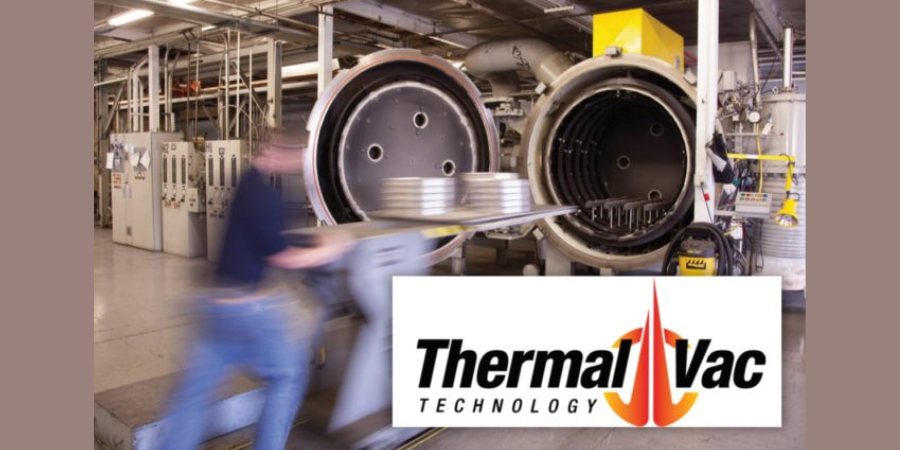
Thermal-Vac Technology

Thermal-Vac Technology, Inc, based in Orange County, CA, is a southern California brazing, heat-treating, and finishing facility offering services to a wide customer base. Founded in 1985 by Steve Driscol, the 60-employee company is family-owned with second generation family members leading the business since 2012.
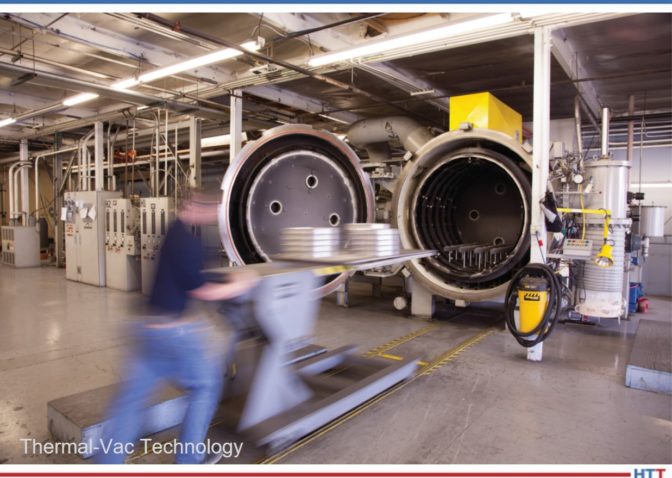

With an original facility of 5,500 square feet and 11 active customers, the company transformed into a multiple-location company across two states with over 80,000 square feet of campus footprint. By the end of the 2020 fiscal year, they had over 600 active customers with total sales of just under $12 million.

Vacuum furnace brazing is what the company was founded on, and additional services now include: aluminum dip brazing, induction and torch brazing and heat treating, atmosphere brazing and heat treating, copper and electrolytic nickel plating, specialized aluminide and silicide coatings, quench and temper, and much more.

Main industries served include aerospace, military, and medical. Thermal-Vac maintains strict quality regulations, with Nadcap and AS9100 accreditations. They specialize in highly technical, high-profile projects including missile defense, deep space exploration, medical devices, and others.

Customers have brought interesting projects over the years—everything from the space shuttle main engine to entirely new types of metal for the additive industry, to new types of coatings and oxidation resistance measures.

Partnering with NASA and aerospace leaders, the company works as a supplier on the critical SLS-Orion project to return Americans (including the first woman) to the moon and send astronauts to Mars in the early 2030s.

The company is proud of “The Thermal-Vac Advantage”: A commitment to being not only a one-stop provider of brazing, heat-treating, and finishing services, but also a fully committed and fully engaged partner.

With a focus on being straightforward, putting customers first by truly caring about them, and never giving up, they have maintained a team with less than 10 percent voluntary turnover for the past decade and was acknowledged as a 2018 Top Workplace by the Orange County Register.

Some of the company’s 2020/2021 accomplishments include being named as an Orange County Business Journal Companies That Care Nominee and an Inc. 5000 Fastest Growing Business, among others. Three Thermal-Vac employees have also been recognized in Heat Treat Today’s 40 Under 40. The company has given over $25,000 to scholarship funds and non-profits, like Chrysalis.

The company plans to grow continually through a commitment to excellence and service and include new offerings via capacity increases in all major service lines. Focus on their passion helps to keep the right priorities in mind for customers: “We build good parts here; at a profit if we can, a loss if we must, but always good parts.” In the next five to 10 years, Thermal-Vac will be ushering in a new generation of heat treaters and will remain committed to bettering the industry through education, training, and providing expertise.

Thermal-Vac Technology Read More »

Encouraging Careers in Heat Treat

OCA new resource created and run by the Metal Treating Institute (MTI) offers tools to those seeking a career in the heat treat industry. Review some of these insightful videos, resources for young professionals, and a network to further your heat treating capabilities below!


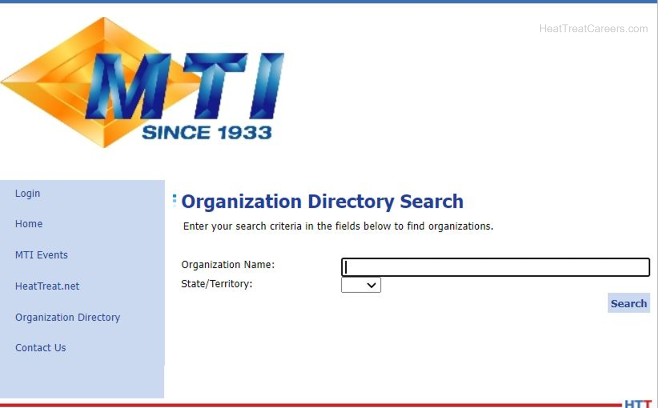
There’s a new kid on the block trying to get young people to join the heat treat “club”. A product of the Metal Treating Institute (MTI), this new website called HeatTreatCareers.com features site tours, first-hand testimonials, and orientation videos for anyone seeking to understand the world of heat treat. These handy videos and brief articles also include resources for heat treaters who are looking to outsource some of their processes or for equipment solutions as they update and expand their offerings.

Calling All Young Industry Professionals

If you know someone who is new to heat treat – maybe a potential hire, a new hire, or a colleague who is looking into joining the field – they must check out this website. For young professionals, this website provides specific direction, explains what heat treating is, and how to pursue a career in it.

Three resources that HeatTreatCareers.com offers are:

  1. “What is Heat Treating?” video (see below)
  2. Searchable directory for heat treaters in your state (or by name)
  3. MTI YES Management Training Program

There are more training opportunities available here to increase professional management and/or technical knowledge pertinent for the heat treating industry.

But perhaps the most import aspect of this website is we get to hear from real heat treaters how this industry is more than a job. Be it the relationships or the day-to-day challenges that inspire creative thinking, it can be hard to locate one specific reason why anyone would enter our obscure industry. The video below makes a great case for this.


More Resources to Increase Heat Treat Capacity

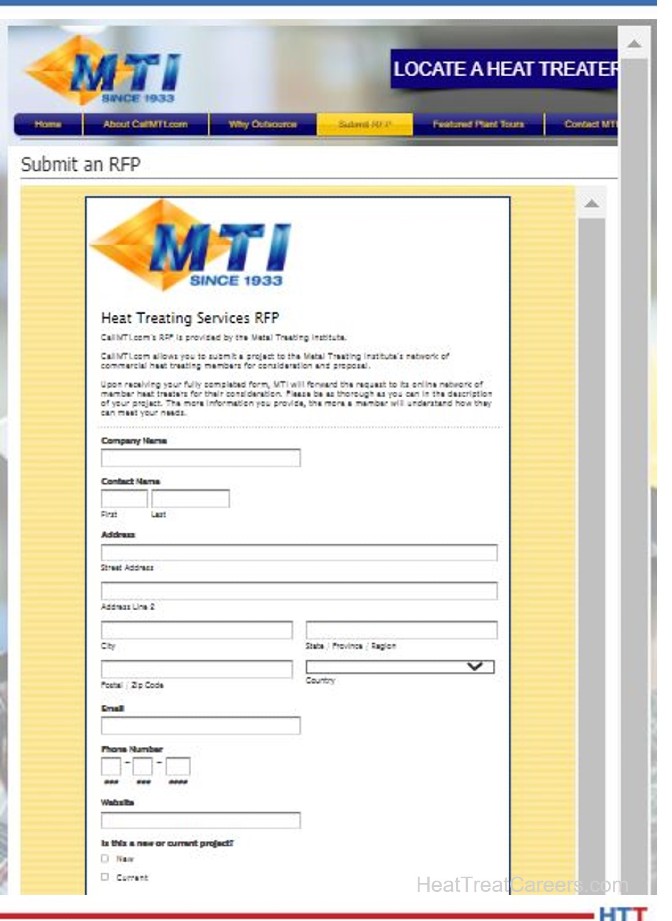
For the young-at-heart and those who are ALWAYS looking to try something new, there are several resources for you, too. The first is a RFP form that allows you to propose a wild heat treat project to a network of commercial heat treaters to help you complete the project. This feature is part of the CallMTI.com resource, which connects you with MTI members from 40 states and eight countries, who are open for consultation.

Another resource is the “Why Outsource” tab that you can navigate to after clicking the Featured Plant Tours page. This resource helps you identify which heat treating challenges you’d prefer to overcome via outsourcing. Those challenges could include:

  • finding qualified good-workers
  • meeting OSHA safety requirements
  • funding needed equipment
  • continuing on-going maintenance

Of course, feel free to use that career finder that we mentioned above. Who doesn’t like a new challenge?

Bottom line: The website has something to offer everyone, especially if you are looking for a change or a challenge. And, by the way, who can visit the site and leave feeling unimpressed. . .?

Head over to www.heattreatcareers.com to find out more for yourself?

Encouraging Careers in Heat Treat Read More »

Looking to a Future with FNC or Nitriding?

OCWhat's the future of ferritic nitrocarburizing and how does it compare to other hardening processes? When it comes to metal hardening, there are many variations on central processes, including recent innovations in how to apply hardening processes.

This Technical Tuesday brings you a quick overview of how hardness technologies differ, specifically nitriding and FNC, and how certain heat treaters have developed these specific hardness technologies.


Understanding the Various Hardening Processes

If you want to know the future, the best you can do is understand the past and present. Let’s begin with looking at the most common hardening processing methods. Here are a few excerpts from “Elevate Your Knowledge: 5 Need-to-Know Case Hardening Processes” by Mike Harrison, engineering manager of Industrial Furnace Systems Division at Gasbarre Thermal Processing Systems:

Read more about these 5 processes in Mike Harrison's article. Click to read.

Carburizing: “Gas carburizing is a process where carbon is added to the material’s surface. The process is typically performed between 1550-1750°F, with carburizing times commonly between 2-8 hours [this spec is disputed, and times may run up to 24 hours]; of course, these values can vary depending on the material, process, and equipment. The most common atmosphere used for atmosphere gas carburizing is endothermic gas with additions of either natural gas or propane to increase the carbon potential of the furnace atmosphere.”

Nitriding: “Gas nitriding is a process where nitrogen is added to the material surface. The process is typically performed between 925-1050°F; cycle times can be quite long as the diffusion of the nitrogen is slow at these temperatures, with nitriding times typically ranging from 16 – 96 hours or more depending on the material and case depth required. Nitriding can be performed in either a single or two-stage process and has the potential to produce two types of case, the first being a nitrogen-rich compound layer (or “white layer”) at the surface that is extremely hard and wear-resistant but also very brittle.”

Carbonitriding: “Despite its name, carbonitriding is more closely related to carburizing than it is to nitriding. Carbonitriding is a process where both carbon and nitrogen are added to the material surface. This process is typically performed in a range of 1450-1600°F [this spec is disputed, and temperatures may go up to 1650°F] and generally produces a shallower case depth than carburizing.”

Ferritic Nitrocarburizing (FNC): “In the author’s opinion, just like with carbonitriding, ferritic nitrocarburizing (FNC) is named incorrectly as it is more closely related to nitriding than it is with carburizing. FNC is a process that is still mostly nitrogen-based but with a slight carbon addition as well. The added carbon helps promote compound layer formation, particularly in plain carbon and low alloy steels that do not contain significant nitride-forming alloys. This process is typically performed in a range of 1025-1125°F with cycle times much shorter than nitriding, typically 1-4 hours.”

Low Pressure Carburizing (LPC): “Low-pressure carburizing (LPC), or vacuum carburizing, is a variation of carburizing performed in a vacuum furnace. Instead of the atmospheres mentioned previously, a partial pressure of hydrocarbon gas (such as acetylene or propane) is used that directly dissociates at the part surface to provide carbon for diffusion. After LPC, the workload is transferred to a quench system that could use oil or high-pressure gas, typically nitrogen.”

Nitriding

Learn more about the basics of hardening at Heat Treat Radio. Click to listen,

Gas nitriding, a process over 100 years old, is a hardening process that involves diffusing nitrogen into the surface of steel to create a hard, wear-resistant case. Among many benefits, the part will have enhanced fatigue properties, anti-galling properties under load, and a resistance to softening at elevated temperature. This makes it an excellent choice for the aerospace industry.

There is some recent history regarding problems related to the “white layer”. In a typical microstructure, the “white layer” is a nitrogen-rich surface layer and the diffusion layer exists beneath it.1 It is essential that the surface layer be controlled to avoid an overly brittle part. Mark Hemsath the vice president of Sales – Americas for Nitrex Heat Treating Services, elaborated on this in a Heat Treat Radio episode:

"Doug Glenn: I assume, with all the modern day technology and whatnot, we're able to control that white layer and/or depth of nitriding layer through your process controls and things of that sort."

"Mark Hemsath: Yes. Nitriding has been around a long time, but one of the problems that they had was controlling the white layer. Because they basically would just subject it to ammonia and you kind of got what you got. Then they learned that if you diluted it, you could control it. That's with gas nitriding. Then plasma nitriding came around and plasma nitriding is a low nitriding potential process. What that means is it does not tend to want to create white layer as much. It's much easier to control when the process itself is not prone to creating a lot of white layer, unlike gas. Now, in the last 10 – 15 years, people have gotten really good at controlling ammonia concentrations. They've really learned to understand that."

Recently, SECO/WARWICK shared their nitriding technological developments in their product, ZeroFlow.

"ZeroFlow nitriding is ammonia-based gas nitriding," commented Dr. Maciej Korecki, PhD Eng., vice president of the Vacuum Furnace Segment at SECO/WARWICK Group. "It is distinguished by the fact that the nitrogen potential is controlled by introducing the right portion of ammonia at the right time and only ammonia, instead of a continuous flow of a mixture of ammonia and diluent gas."

"Consequently, the ZeroFlow method uses the minimum amount of ammonia needed to achieve the required nitrogen potential and replenish the nitrogen in the atmosphere, taking into account the situation where no ammonia is supplied to the furnace at all, no flow, hence the suggestive name of the solution," he continued. "Using ammonia alone in the nitriding process, we are dealing with a stoichiometric reaction (as opposed to some traditional methods), that is, one that is uniquely defined and predictable based on the monitoring of a single component of the atmosphere. Therefore, the ZeroFlow process controls very precisely through the analyzer only one gas, obtaining an improvement in the quality and repeatability of the results compared to various traditional methods."

According to Dr. Korecki, the process is about going back to the basics of nitriding: "The inventor of the method is Prof. Leszek Maldzinski of the Poznan University of Technology, who developed the theoretical basis and confirmed it with research. Then, more than 10 years ago, a partnership between SECO/WARWICK and the Poznan University of Technology initiated a project to develop and build the first industrial furnace designed to perform the ZeroFlow nitriding processes. The furnace was launched at SECO/WARWICK's research and development department (SECO/LAB®), where the method has been implemented and validated on dozens of industrial-scale processes."

Ferritic Nitrocarburizing

This nitrogen-based process can produce a deeper compound layer than nitriding, which is great for industrial machinery applications where this deep layer is needed for increased wear resistance and the critical strengthening of a deep case depth is not essential.

FNC has gone through a technical evolution with different heat treaters in the industry developing their own unique applications with method in mind. We'll look at two recent examples: AHT's Super Ultra Ox and Bodycote's Corr-I-Dur.

Edward Rolinski
Senior Scientist
Advanced Heat Treat, Corp.
(Source: https://www.ahtcorp.com/)

According to experts at Advanced Heat Treat Corp. (AHT), Edward Rolinski (Dr. "Glow"), Jeff Machcinski, Vasko Popovski and Mikel Woods, "Thermochemical surface engineering of ferrous alloys has become a very important part of manufacturing. Specifically, nitriding and nitrocarburizing (FNC) processes are used since their low temperature allows for treatment of finished components. They are applied to enhance the tribological and corrosion properties of component surfaces.2 In many situations, nitriding replaces carburizing even if the nitrided layer is not as thick.3 A post-oxidizing step, applied at the end of FNC, leads to significant enhancement of corrosion properties by formation of a magnetite layer (Fe3O4).

"AHT’s newly developed process, UltraOx® Hyper, results in superior wear and corrosion resistance and allows for good control of the parts’ blackness. The latter is very important when the treatment is used for firearms. While the parts’ corrosion resistance improves with nitriding alone, the additional steps in UltraOx® Hyper significantly extend corrosion resistance. AHT is committed to achieving its customers’ desired metallurgical and cosmetic results through R&D and investing in state-of-the-art equipment. These innovations allow for flexibility in these areas."

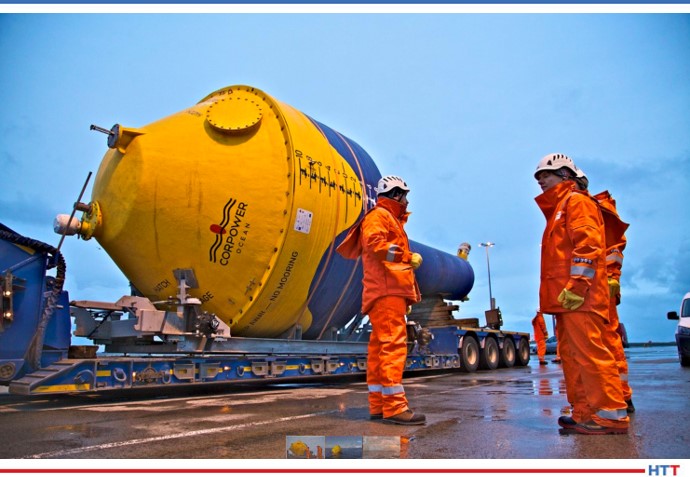
In recent news, wave energy pioneer CorPower Ocean will be using Bodycote's thermochemical treatment, Corr-I-Dur®, for CorPower’s high-efficiency WECs.
Image Source: www.waterpowermagazine.com

From Bodycote, they say that their proprietary Bodycote thermochemical treatment “Corr-I-Dur® is a combination of various low temperature thermochemical process steps, mainly gaseous nitrocarburising and oxidising.”

They explain, "In the process, a boundary layer consisting of three zones is produced. The diffusion layer forms the transition to the substrate and consists of interstitially dissolved nitrogen and nitride precipitations which increase the hardness and the fatigue strength of the component. Towards the surface it is followed by the compound layer, a carbonitride mainly of the hexagonal epsilon phase. The Fe3O4 iron oxide (magnetite) in the outer zone takes the effect of a passive layer comparable to the chromium-oxides on corrosion resistant steels.

"Due to the less metallic character of oxide and compound layer and the high hardness abrasion, adhesion and seizing wear can be distinctly reduced. Corr-I-Dur® has very little effect on distortion and dimensional changes of components compared to higher temperature case hardening processes."

How to Implement?

We’ve seen a lot of development in way of nitriding and ferritic nitrocarburizing (FNC), but for many heat treaters, you inherit specific processes and traditions of accomplishing heat treatment and do not have the chance to understand how to implement each process. Read the full 21 point comparative resource at FNC vs. Nitriding

Conclusion

The more informed you are, the better decisions you can make. For example, knowing these recent developments in metal treating and hardening is sure to help you decide whether to shift directions in how you company process parts for electric vehicles, or if you are ready to expand your offerings for your aerospace clients. It is clear that each of these processes have a future all-their-own. It’s up to you to decide whether that future should be yours, too.

For more information on the basics of hardness, listen to the what, why, and how of hardening with Mark Hemsath, an expert on metal hardness and vice president of Sales – Americas for Nitrex Heat Treating Services, on this Heat Treat Radio episode with Doug Glenn, publisher of Heat Treat Today. You can also review the resources below that were referenced in today’s article.


References

1 Daniel H. Herring, “The Heat Treat Doctor”, “Case Hardening of Steel, Part Three: Gas Nitriding,” PowerPoint Presentation, © 2004 – 2010 The HERRING GROUP, Inc.

2 “Thermochemical Surface Engineering of Steels”, Woodhead Publishing Series in Metals and Surface Engineering: Number 62, Ed. Eric J. Mittemeijer and Marcel A. J. Somers, Elsevier, 2015, pp.1-769.

3 J. Senatorski, et. al, Tribology of Nitrided and Nitrocarburized Steels”, ASM Handbook Vol 18, Friction, Lubrication and Wear Technology, ed. G. Totten ASM International, 2017, pp. 638-652.


Resources

  1. Herring, “Case Hardening of Steel, Part Three: Gas Nitriding,” PowerPoint Presentation, © 2004 – 2010 The HERRING GROUP, Inc.
  2. Harrison, “Elevate Your Knowledge: 5 Need-to-Know Case Hardening Processes,” Heat Treat Today, https://www.heattreattoday.com/processes/hardening/hardening-technical-content/comparative-study-of-5-case-hardening-processes/.
  3. Hemsath and D. Glenn, “Heat Treat Radio: Metal Hardening 101, Part 2 of 3,” Podcast and Transcript, Heat Treat Today, https://www.heattreattoday.com/media-category/heat-treat-radio/heat-treat-radio-metal-hardening-101-with-mark-hemsath-part-2-of-3/.
  4. Orosz, T. Wingens, and D. Herring, “Nitriding vs. FNC,” Heat Treat Today, https://www.heattreattoday.com/processes/nitrocarburizing/nitrocarburizing-technical-content/integrated-nitriding-and-fnc/.
  5. Senatorski, J. Tacikowski, E. Rolinski and S. Lampman, “Tribology of Nitrided and Nitrocarburized Steels”, ASM Handbook Vol 18, Friction, Lubrication and Wear Technology, ed. G. Totten ASM International, 2017.
  6. “Thermochemical Surface Engineering of Steels”, Woodhead Publishing Series in Metals and Surface Engineering: Number 62, Ed. Eric J. Mittemeijer and Marcel A. J. Somers, Elsevier, 2015, pp.1-769.

Looking to a Future with FNC or Nitriding? Read More »

AMS2750F Review: Calibration Process Instrumentation

Source: TAV Vacuum Furnaces

Heat treat specifications can be tiresome to stay up-to-date on. So it’s great when we find digestible content on AMS2750F to share with you.

In today’s best of the web article, you’ll be able to review the 4 new requirements for process instrumentation and what 18 pieces of information must always be reported in the calibration certificate.

An excerpt:

“The recording tools used on heat treatment plants should not be used to record TUS or SAT sensor temperatures unless it can be demonstrated that the recording channels of the TUS and/or SAT sensors of an integrated system are separated from the recording system of the heat treatment furnace and also meet the requirements of the field test instrument.”

Read more: “AMS2750F Pyrometric Requirements for Heat Treatments: Calibration Process Instrumentation

AMS2750F Review: Calibration Process Instrumentation Read More »

This Week in Heat Treat Social Media


Welcome to Heat Treat Today's This Week in Heat Treat Social MediaAs you know, there is so much content available on the web that it’s next to impossible to sift through all of the articles and posts that flood our inboxes and notifications on a daily basis. So, Heat Treat Today is here to bring you the latest in compelling, inspiring, and entertaining heat treat news from the different social media venues that you’ve just got to see and read!

This week, we check out what's going on in the heat treat community (in person and afar), watch a robot video (it may look familiar, but this time the robot might be at your plant), and read a not-so-heat-treat-but-certainly-funny T-shirt.

If you have content that everyone has to see, please send the link to editor@heattreattoday.com.


1. "Spot What You've Been Missing"?

Spot, the dancing robot from the previous TWIHTSM, can perform manufacturing site inspections. Using Fluke imaging technology, the robot can monitor site problem areas. What do you think? Does this change the game of manufacturing? Is it a good solution to safety concerns on the shop floor?


2. Water Cooler Talk

What have you been talking about while we were away? Online chatter "around the cooler" yields some interesting insights. Let us know about some interesting fact or episode in your world by tagging @HeatTreatToday on your next post!

Chattin' About Furnaces

.

Influences on Furnace Pumping Time?

Too Basic?


3. Heat Treat Community

In person or online, we can't get enough of the comradery. Let's show you what we're talking about. . .

@Women in Manufacturing!

To China and Beyond!

Luncheons in the Air (kind of)


4. Reading and Podcast Corner

You can't read everything, we get it. So how's about you listen/watch/read this ONE epic podcast? Yes? Perfect.


5. Outstanding 40 Under 40 Leaders of 2021

Check out some of the stellar Heat Treat Today 40 Under 40 Class of 2021 that have been popping up on the interwebs:


6. I know it's not heat treat. . . but I laughed

Have a great weekend!

This Week in Heat Treat Social Media Read More »

Letter from the Publisher: Heat Treat Help – Looking Forward to 2022

Heat Treat Today publishes eight print magazines a year, and included in each is a letter from the publisher, Doug Glenn. This letter first appeared in Heat Treat Today's September 2021 Trade Show print edition.


Doug Glenn
Publisher and Founder
Heat Treat Today

We believe people are happier and make better decisions when they are well informed. That’s the mantra that every Heat Treat Today team member knows by heart. These simple words drive pretty much every thing we do.

Be helpful. That’s it. Simple.

As we round the fourth corner and head for the finish line of 2021 – yet another pandemic year (!) – let’s set our sights on 2022 and some new and interesting things that Heat Treat Today  will be doing to help you make better decisions.

(1) Our new, big launch in 2022 will be Heat Treat Boot Camp (see the ad on page 22A). This will be a never-before-seen face-to-face event for those who want to get up to speed quickly on the commercial side of the North American heat treat industry. Ideal for new employees or for investors wanting to understand the basics of the marketplace, heat treat industry expert Thomas Wingens and I will spend a day and a half cramming 2+ years’ worth of information into the heads of the attendees. From a 30,000-foot level, we’ll cover the materials, markets, products, processes, and players that make up the North American heat treat market. When attendees leave this seminar, they’ll be way ahead of their peers who have not taken this course. They’ll be happier because they will be well informed and able to make better decisions.

The actual date(s) and location(s) have not been confirmed, but you can check the latest information at www.heattreattoday.com/bootcamp.

(2) Heat Treat Buyer's Guide is another helpful tool that will assist our readers – manufacturers with their own in-house heat treat shop especially in aerospace, automotive, medical, and energy as well as general manufacturing – make better decisions. We launched this industry-leading platform earlier this year (2021) and so far, it has been very successful. If you haven’t seen it, take a minute to visit www.heattreatbuyersguide.com. You’ll love it. And if you’re a supplier to the industry and you are not listed in this valuable resource, please contact me and we’ll get you listed ASAP.

(3) Heat Treat Radio, Heat Treat Consultants, and the ever-popular Heat Treat Daily are three other resources that are constantly helping our readers stay happy by being well informed. You can get to Heat Treat Radio at www.heattreattoday.com/radio. You can check out Heat Treat Consultants at www.heattreattoday.com/consultants. And you can subscribe to our weekday e-newsletter, Heat Treat Daily, by going to www.heattreattoday.com/subscribe. The Consultants Page is especially helpful for those in-house heat treaters who are experiencing heat treat "brain drain". Call one of the consultants listed on this page, and they’ll give you a hand.

(4) And finally, if you want more can’t-miss-resources, check out the list of 39 Top Heat Treat Resources listed in this month’s edition. We’ve gathered some super helpful information from around the industry – information that will make you happy. . . because you’ll be well informed and able to make better decisions.

The most helpful thing we can do is keep you and your people well informed, with “people” being the operative word. People (you) truly are our most valuable asset. Read Ken Gronbach’s column on page 8 for more insights into gaining and maintaining people over the next decade and enjoy learning about the 40 Heat Treat Today’s rising young leaders in the North American heat treat industry – 40 Under 40 Class of 2021 found on pages 32-55.

Here’s to you being well informed and happy. Enjoy this issue.

Letter from the Publisher: Heat Treat Help – Looking Forward to 2022 Read More »

Two Cost-Effective Applications for Intensive Quenching of Steel Parts

OCThe Intensive Quench (IQ) process is an alternative way of quenching steel. It involves a very rapid and uniform cooling of steel products in water with cooling rates several times greater than that of conventional quenching in agitated oil or polymer. Through this interesting article, explore the unique method and its use in the automotive industry.

This article first appeared in Heat Treat Today’s August 2021 Automotive print edition Edward Rylicki, vice president of Technology, and Chris Pedder, technical manager of Heat Treat Products and Services, at Ajax TOCCO Magnethermic Corp., as well as Michael Aronov, CEO of IQ Technologies, Inc.


Introduction

The Intensive Quench (IQ) process is an alternative way of quenching steel parts that originated with Dr. Nikolai Kobasko of Ukraine in 1964.1 It involves a very rapid and uniform cooling of steel products in water with cooling rates several times greater than that of conventional quenching in agitated oil or polymer. The IQ process is interrupted at an optimal time when the surface compressive stresses reach their maximum value, and the part-hardened layer reaches its optimal depth. A proprietary computer program is used for determining an optimal dwell time for steel parts of different shapes and dimensions.

Ajax TOCCO Magnethermic Corporation has recently acquired assets of IQ Technologies, Inc. of Cleveland, Ohio. Over the last 20 years, IQ Technologies has been commercializing an intensive quenching (IQ) process for steel parts in the U.S. and overseas.

Figure 1. IQ system for processing gun barrels and long shafts

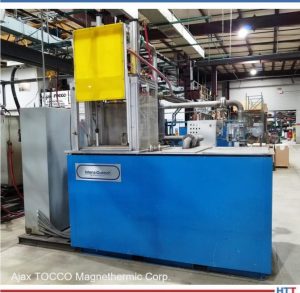
The IQ process is conducted in IQ water tanks (a batch IQ technique) and in single-part processing high-velocity water flow IQ units when parts are quenched one at a time. Steel parts are austenitized prior to intensive quenching in heat treating furnaces or using an induction through heating (ITH) method.2 As an example, Figures 1 and 2 present two production IQ systems. Each includes a single-part processing high-velocity water flow unit built by IQ Technologies. The IQ unit in Figure 1 is equipped with a single-shot low frequency ITH station built by Ajax TOCCO Magnethermic. It is designed for processing gun barrels and shafts of up to 36” long and up to 2” in diameter. The IQ unit in Figure 2 is equipped with a box atmosphere furnace and is designed for processing gear products of up to 8” in diameter and shafts of up to 15” long.

Figure 2. IQ system for processing gear products and shafts installed at Euclid Heat Treating Co.

Coupling of the single-part processing IQ technique with the ITH method (ITH + IQ) is the most effective way of IQ process implementation. It allows conducting of heat treating operations within a manufacturing cell in line with a steel parts production process. This paper focuses on two applications of the ITH + IQ process:

  1. Elimination of a costly, energy and time-consuming carburization process
  2. Substitution of a one-step ITH + IQ process for a two-step heat treatment consisting of batch quenching parts in oil or polymer for part core hardening followed by induction hardening

Elimination of Carburizing Process

The carburizing process is the most expensive and time-consuming heat treatment process. Elimination of the carburizing process by implementing the IQ method requires the use of limited hardenability (LH) steels. LH steels are medium to high carbon steels having exceptionally low content of alloy elements. When quenched intensively, LH steels provide a hard, martensitic case, tough, ductile core, and high residual surface compressive stress mimicking a carburized condition without carburization.

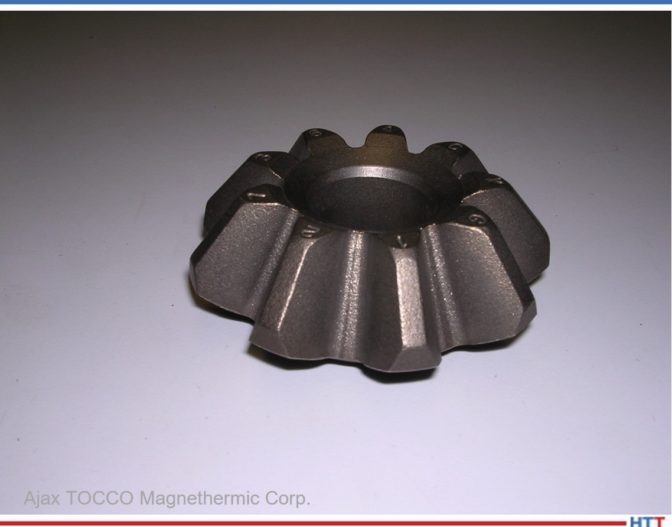
Figure 3. Side pinion

Two IQ case studies were conducted with two major U.S. automotive parts suppliers for evaluating the IQ process when applied to side pinions and drive pinions made of LH steel. Results obtained were compared to the same parts made of alloy steel, carburized and quenched in oil.

Side Pinions

Figure 3 presents a picture of the evaluated side pinion having the outside diameter (OD) of 80mm and inside diameter (ID) of 27mm. Standard pinions were made of alloy 8620 steel, carburized, quenched in oil, and shot peened. Pinions made of LH steel (acquired from Russia) were quenched intensively in the high-velocity water flow single-part processing IQ unit. The LH steel pinions were not shot peened after heat treatment. A chemical composition of the LH steel used is presented in Table 1.

To evaluate the side pinion structural and stress conditions during heat treatment, DANTE computer simulations were conducted by DANTE Solutions, Inc. of Cleveland, Ohio, for standard carburized side pinions and for intensively quenched pinions made of LH steel.3 It was shown that the microstructure of the carburized and quenched-in-oil side pinion consists of martensite formed within the part carburized case and bainite in the remaining part cross section (Figure 4).

Figure 4. Microstructure distribution

Figure 5. Minimum principal stress

A microstructure distribution in the intensively quenched side pinion made of LH steel consists of a martensitic structure in the part surface layer, a bainitic structure beneath the martensitic case, and a perlitic structure in the part core. The martensitic case is generally deeper in the intensively quenched LH steel pinion compared to that of the standard pinion.

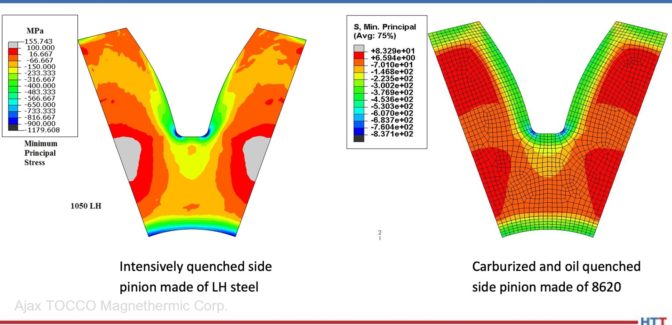
Figure 5 presents calculated values of the minimum principal stress that represent residual surface compressive stresses. As seen from the figure, the intensively quenched LH steel side pinion has residual surface compressive stresses greater than that of the carburized side pinion quenched in oil.

Figure 6. Experimental microhardness data for LH steel side pinion (PL – pitch line, RR – tooth root, TOT – tooth tip)

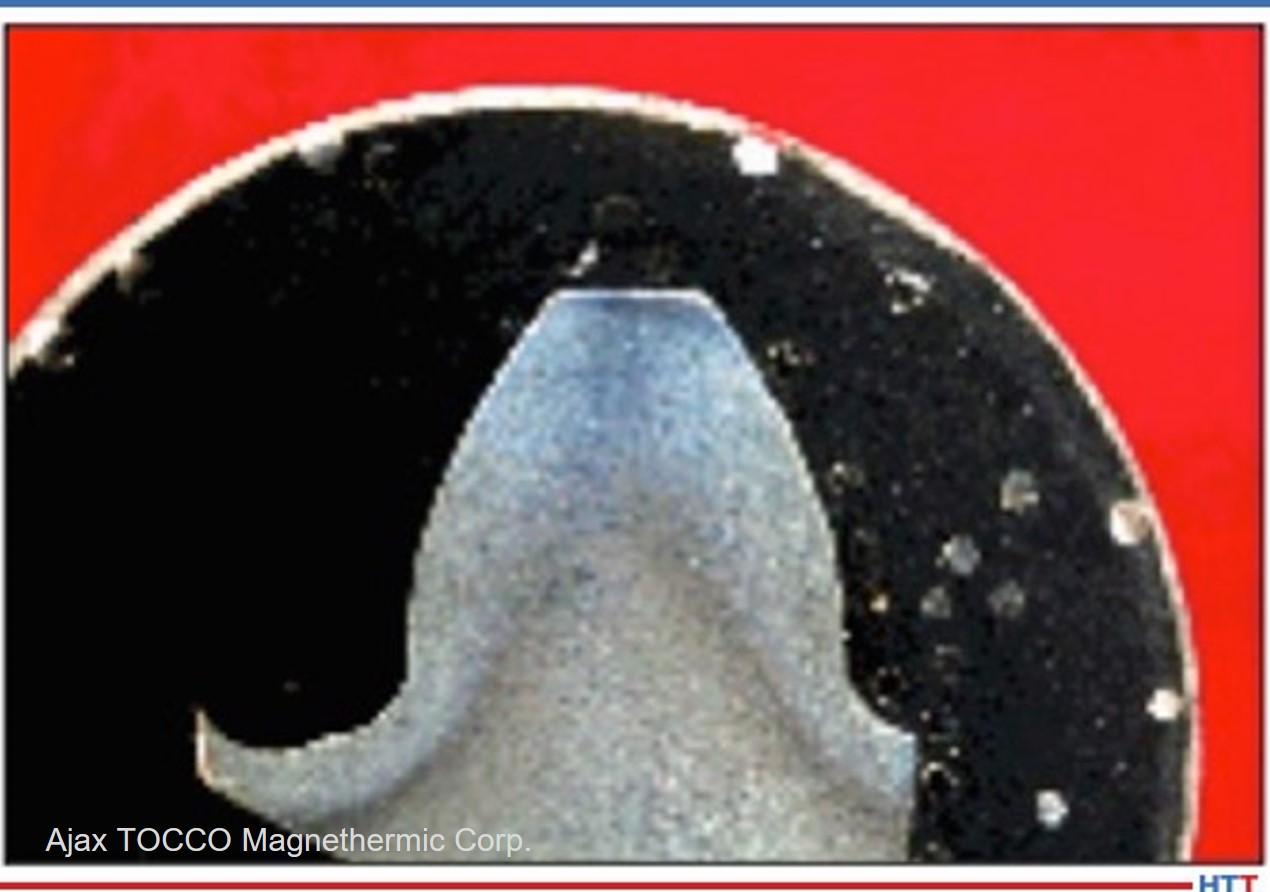
Figures 6–8 present experimental data obtained by the customer for the intensively quenched side pinions made of LH steel. Figure 6 shows hardness profiles at the pinion pitch line, tooth root, and tooth tip. Figure 7 presents an etched pinion tooth sample showing a martensitic case. As seen from the above figures, the IQ process provided the hard case and the ductile core that mimics a hardness distribution after carburizing.

Figure 7. Hardened case in intensively quenched side pinion made of LH steel

Figure 8 shows a residual surface compressive stress distribution for the LH steel side pinion root area. Residual surface compressive stresses for the intensively quenched side pinion made of LH steel were greater than that of the standard carburized and shot peened pinion. Fatigue testing has proven that intensively quenched side pinions made of LH steel have a longer service life compared to the standard pinions.

Figure 8. Residual stress distribution in intensively quenched side pinion made of LH steel

Drive Pinions

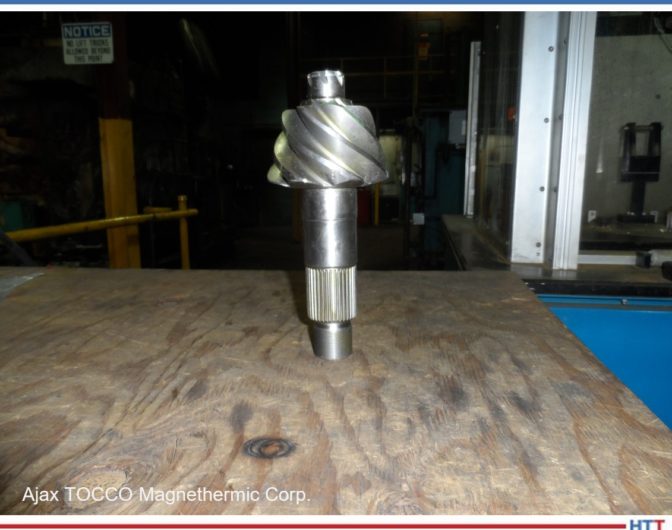
An IQ case study was conducted for drive pinions with one of the major U.S. automotive parts suppliers. Drive pinions were made of LH steel produced by a U.S. steel mill (the LH steel chemistry is proprietary information). Figure 9 presents a picture of the evaluated drive pinion. The drive pinions were quenched in the high-velocity water flow single-part processing IQ unit. Per customer evaluation, the hardness profile in the intensively quenched drive pinions made of LH steel mimics the hardness distribution in the standard carburized and oil quenched drive pinions, while the values of the residual surface compressive stresses are greater for the intensively quenched LH steel pinions compared to that of the standard drive pinions. (This information is also not presented in the paper due to its proprietary nature.)

Figure 9. Drive pinion

The intensively quenched drive pinions met all the customer’s metallurgical specifications and passed both the ultimate strength test and the fatigue test. It was shown that the part fatigue resistance improved by about 150% compared to that of standard carburized and quenched in oil drive pinions. In addition, distortion of the intensively quenched drive pinions is so low that no part straightening operations are required.

Application of the ITH + IQ process and LH steels for side pinions and drive gears will result in the following major benefits:

  • Less energy usage due to elimination of the long carburization process
  • Lower overall part costs
  • Cleaner parts and work environment due to use of water instead of quench oil or polymers
  • Lower work-in-process inventories and shortened lead times, due to possibility of running heat treat operations in part manufacturing cell

Substitution of One-Step Heat Treating Process for Two-Step Heat Treatment

A two-step heat-treating process consisting of batch quenching of parts in oil or polymer for core hardening, followed by induction hardening, is used in the industry for many steel products. This heat-treating process provides parts with a hard case and tough, ductile core that is similar to the carburizing process. A substitution of the ITH + IQ method for the two-step heat-treating process is another attractive possibility for steel part makers in reducing the part cost.

Figure 10. Typical input shaft

One of the major U.S. automotive parts suppliers applied this approach to the manufacturing of input shafts (Figure 10). The input shafts are currently made of high-alloy medium-carbon steel that requires annealing after forging. The intensively quenched input shafts were made of plain medium carbon steel that did not require annealing after forging. The shafts were quenched at the Ajax TOCCO Magnethermic Detroit Development & Support Center.

Per customer evaluation, the hardness profile in the intensively quenched input shafts was similar to that of standard shafts. Residual surface compressive stresses in the intensively quenched shafts are greater compared to that of the standard input shafts resulting in longer part fatigue life of up to 300%. (Per the customer’s request, the actual data on the part hardness profile, microstructure distribution, and values of residual surface compressive stresses are not presented in the paper.)

Figures 11 and 12 present current and improved input shaft production flow charts accordingly. As seen, an introduction of the ITH + IQ process allows elimination of the following input shaft manufacturing steps: annealing after forging, batch oil quenching, and shaft straightening. In addition, part shipping and material handling operations will be significantly reduced. In summary, the application of the ITH + IQ process provides the following major benefits in this case:

  • Less energy usage due to the elimination of two heat treating processes: annealing after forging and batch quenching in oil
  • Less material cost due to substitution of plain carbon steel for high alloy steel
  • Lower overall part costs due to the use of less expensive steel, reduction of heat treatment cost, elimination of all expenses associated with the use of quench oil, reduced cost of shipping and material handling, and elimination of part straightening operations
  • Cleaner parts and work environment due to use of water instead of quench oil or polymer
  • Lower work-in-process inventories and shortened lead times, due to possibility of running heat treat operations in part manufacturing cell

Figure 11. Drive pinion current production flow chart

Figure 12. Drive pinion improved production flow chart

Conclusion

Implementation of the ITH + IQ process and the use of LH steels will make possible the conducting of heat treat operations in a steel part manufacturing cell, reducing work-in-process inventories and shortening lead time. At the same time, tremendous energy savings, significant reduction of a carbon footprint, and overall part cost can be achieved due to eliminating the carburizing process and the use of quench oil, and due to the substitution of plain carbon steel for high alloy material. Improved work environment is also a bonus.
IQ Facility at Ajax TOCCO Magnethermic Detroit Development & Support Center

Ajax TOCCO Magnethermic has set up an IQ facility at its Detroit Development & Support Center (Figure 13). The facility includes a single-part processing IQ unit and an induction heating station. The IQ unit is capable of processing gear products, shafts, etc. of up to 8” in diameter and 15” long. The IQ unit controls monitor the following parameters: water temperature, water flow velocity, pump pressure, and dwell time. The induction heating fixture consists of a pneumatic horizontal indexing heat station used for power supply load matching and inductor positioning. The load matching station can be fed by numerous power supplies capable of various operating frequencies and power levels up to 600 kW.

The Detroit Development & Support Center also houses a large area for the manufacture and repair of induction tooling, along with engineers needed for the design of prototype and production tooling. There is also a metallurgical lab with the equipment and staff necessary to support the ITH + IQ process development. The metallurgical lab contains macro and micro hardness testers, cut-off wheels, polishing equipment and a metallograph for analyzing microstructures.


References

[1] N.I. Kobasko and N.I. Prokhorenko, “Quenching Cooling Rate Effect on Crack Formation of 45 Steel,” Metalloved. Term. Obrab., Met., No. 2, 1964, p. 53-54 (in Russian).

[2] M.A. Aronov, N.I. Kobasko, J.A. Powell, “Intensive Quenching of Steel Parts,” ASM Handbook, Volume 4A. Steel Heat Treating Fundamentals and Processes, 2013, p. 198-211.

[3] B.L. Ferguson, Zhichao Li, N.I. Kobasko, M.A. Aronov and J.A. Powell, “Limited Hardenability Steels and Intensive Quenching,” Proceedings of ASM Heat Treating Conference, Indianapolis, 2009.

About the Authors: Edward Rylicki is the vice president of Technology and Chris Pedder is the technical manager of Heat Treat Products and Services, at Ajax TOCCO Magnethermic Corp. For more information, contact info@ajaxtocco.com or 800.547.1527

Michael Aronov is the CEO at IQ Technologies, Inc. For more information, contact Michael at m.a.aronov@sbcglobal.com.

Two Cost-Effective Applications for Intensive Quenching of Steel Parts Read More »

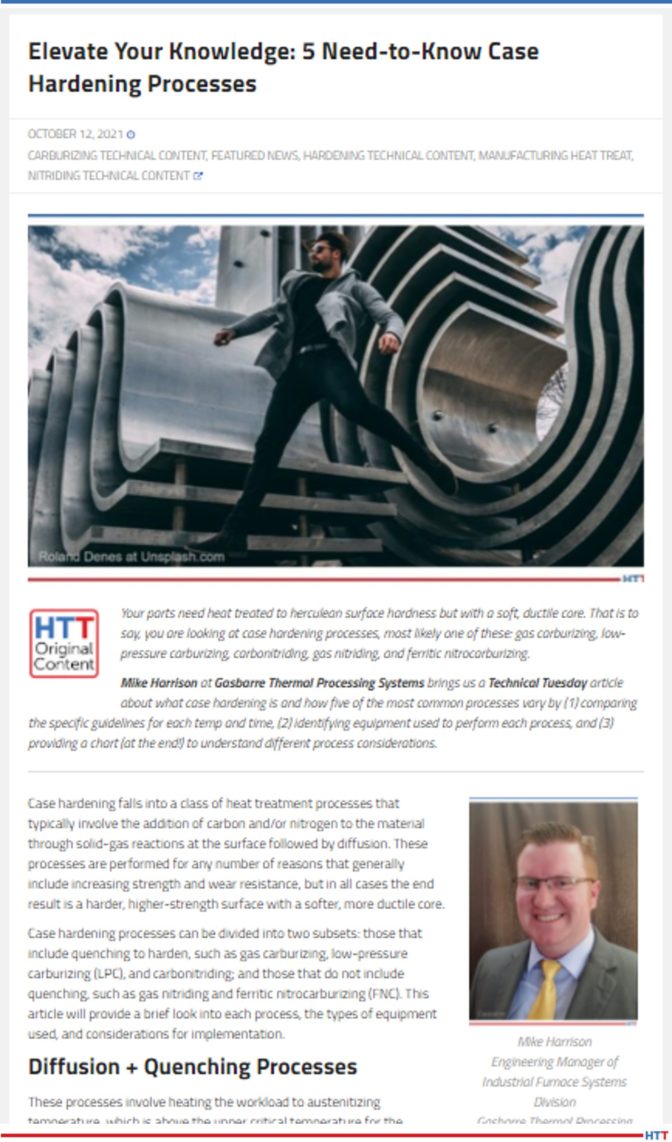
Elevate Your Knowledge: 5 Need-to-Know Case Hardening Processes

OCYour parts need heat treated to herculean surface hardness but with a soft, ductile core. That is to say, you are looking at case hardening processes, most likely one of these: gas carburizing, low-pressure carburizing, carbonitriding, gas nitriding, and ferritic nitrocarburizing.

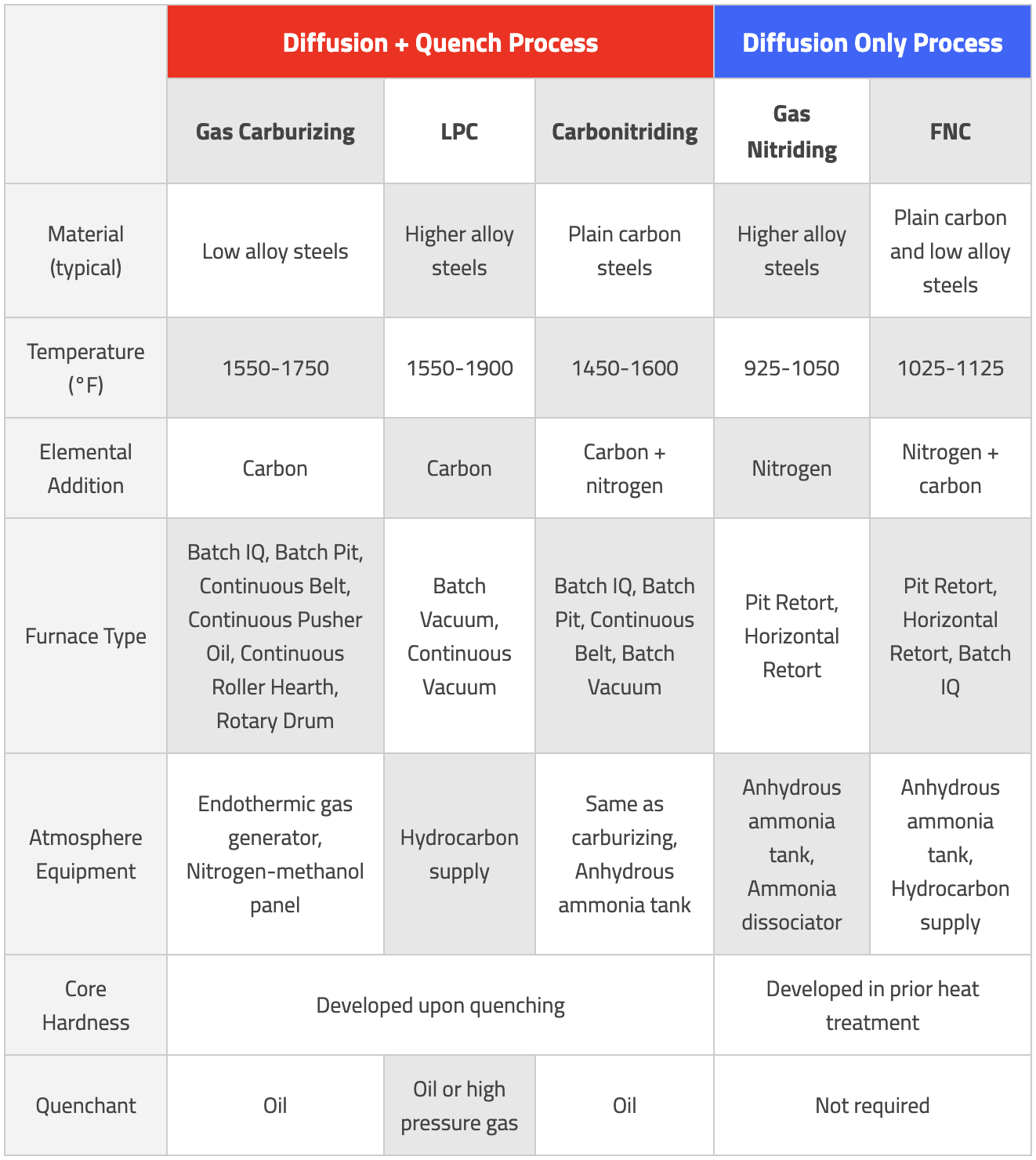
Mike Harrison at Gasbarre Thermal Processing Systems brings us a Technical Tuesday article about what case hardening is and how five of the most common processes vary by (1) comparing the specific guidelines for each temp and time, (2) identifying equipment used to perform each process, and (3) providing a chart (at the end!) to understand different process considerations.


Mike Harrison
Engineering Manager of Industrial Furnace Systems Division
Gasbarre Thermal Processing Systems

Case hardening falls into a class of heat treatment processes that typically involve the addition of carbon and/or nitrogen to the material through solid-gas reactions at the surface followed by diffusion. These processes are performed for any number of reasons that generally include increasing strength and wear resistance, but in all cases the end result is a harder, higher-strength surface with a softer, more ductile core.

Case hardening processes can be divided into two subsets: those that include quenching to harden, such as gas carburizing, low-pressure carburizing (LPC), and carbonitriding; and those that do not include quenching, such as gas nitriding and ferritic nitrocarburizing (FNC). This article will provide a brief look into each process, the types of equipment used, and considerations for implementation.

Diffusion + Quenching Processes

These processes involve heating the workload to austenitizing temperature, which is above the upper critical temperature for the material in question, then supplying and allowing the desired element(s) to diffuse into the part surface, followed by rapid cooling (quenching) to create a phase change to martensite that strengthens the material. Tempering is then performed to create a material that has the desired final strength and ductility properties. The result is a high concentration of added elements on the surface that continually decreases through diffusion until eventually matching the same concentration as the base material; this gradient similarly produces a hardness that is higher at the surface, gradually diminishing until reaching the core. Higher alloyed steels may also see a microstructural change in the core from quenching that produces a core with higher hardness than the previously untreated material, but lower than the surface hardness produced.

Atmosphere Gas Carburizing

Gas carburizing is a process where carbon is added to the material’s surface. The process is typically performed between 1550-1750°F, with carburizing times commonly between 2-8 hours; of course, these values can vary depending on the material, process, and equipment. The most common atmosphere used for atmosphere gas carburizing is endothermic gas with additions of either natural gas or propane to increase the carbon potential of the furnace atmosphere. Common case depths achieved are around 0.005-0.040”, with deeper cases possible through a combination of longer treatment times and/or higher temperatures.

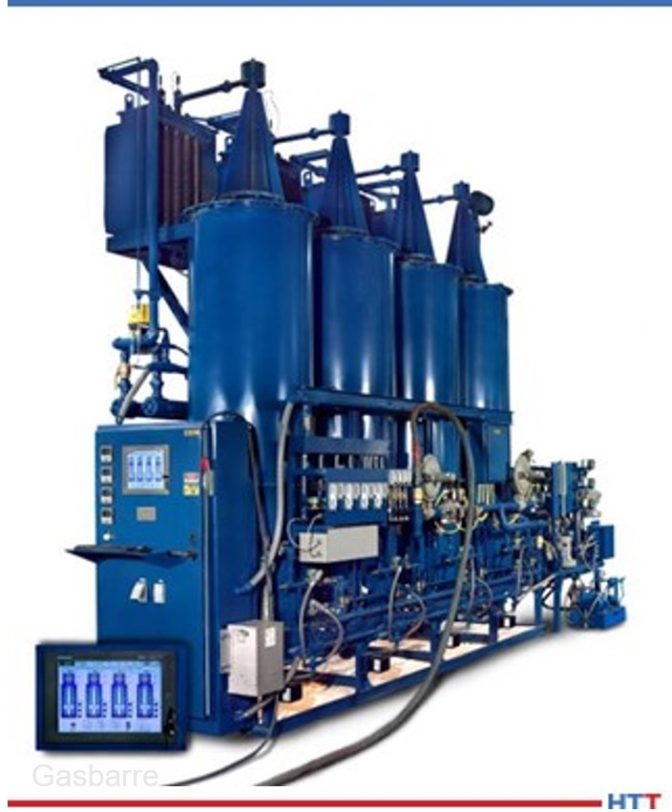
Fig. 1 – Integral quench furnace: "The atmosphere gas carburizing process can be performed both in batch and continuous equipment."

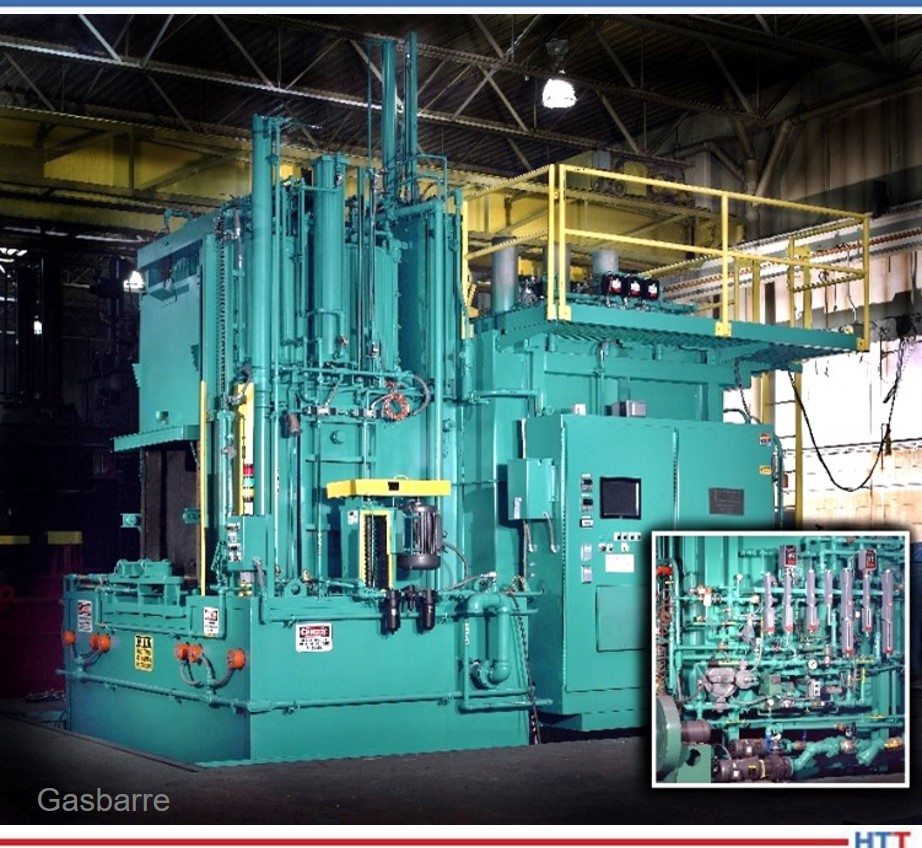
The atmosphere gas carburizing process can be performed both in batch and continuous equipment. On the batch side, traditionally an integral quench (IQ) furnace is used (Fig. 1); it consists of a heating chamber where the workload is heated and exposed to the carburizing atmosphere, then the workload is transferred to an attached quench tank for cooling. The entire furnace system is sealed and under protective atmosphere to preserve the part surface and maintain safe control of any combustible gases. For batches of large product, a pit furnace can be used for carburizing with the workload being transferred via an overhead crane into and out of the furnace to a quench tank.

For continuous processing, a belt furnace can be used. The product is placed on a belt and then progresses through the furnace at the desired temperature and atmosphere composition; the carburizing time can be varied by adjusting the belt speed through the furnace. At the end of the furnace, the parts drop off the belt into the quench tank. Then, a conveyor pulls the parts out of the tank and drops them on another belt to be washed and tempered. For continuous processing of heavier loads pusher furnaces, rotary retort, rotary hearth, and roller hearth furnaces can be used.

Fig. 2 – Endothermic gas generator: "To achieve a carburizing atmosphere endothermic gas is typically used, which is produced by an endothermic gas generator that heats a combination of natural gas and air to create a mixture that is approximately 40% hydrogen, 40% nitrogen, and 20% carbon monoxide."

To achieve a carburizing atmosphere endothermic gas is typically used, which is produced by an endothermic gas generator (Fig. 2) that heats a combination of natural gas and air to create a mixture that is approximately 40% hydrogen, 40% nitrogen, and 20% carbon monoxide. This mixture is generally considered carbon-neutral, meaning it will neither add nor deplete carbon from the surface. To increase the carbon concentration the endothermic gas needs to be enriched with a gas (typically natural gas or propane) that will help produce additional carbon monoxide, which will “boost” the carbon potential and drive carbon diffusion into the material.

A less common carburizing atmosphere comes from a nitrogen-methanol system, where nitrogen gas and liquid methanol are combined and injected into the furnace. Upon exposure to the high furnace temperature the methanol will decompose to hydrogen and carbon monoxide. Natural gas or propane additions are still required in order to provide carbon for absorption into the surface of the steel.

Low-Pressure Carburizing

Low-pressure carburizing (LPC), or vacuum carburizing, is a variation of carburizing performed in a vacuum furnace. Instead of the atmospheres mentioned previously, a partial pressure of hydrocarbon gas (such as propane or acetylene) is used that directly dissociates at the part surface to provide carbon for diffusion. After LPC, the workload is transferred to a quench system that could use oil or high-pressure gas, typically nitrogen. LPC with gas quenching can be an attractive option for distortion prone complex geometries as the cooling rates are slower than oil quenching; however, given the slower cooling rate, it becomes very important to choose a higher alloyed steel that will achieve the desired hardness.

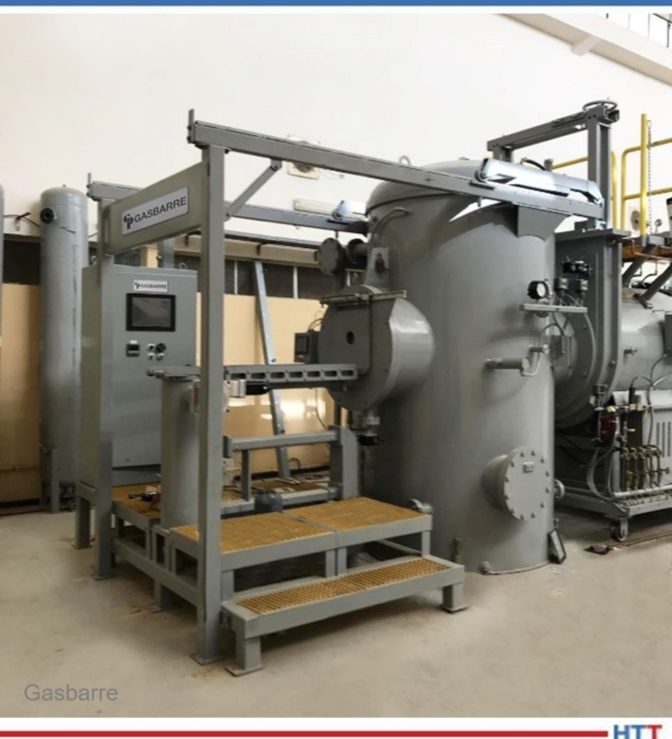
Fig. 3 – Vacuum furnace with oil quench

LPC typically provides faster carburizing times when compared to traditional gas carburizing. This can be attributed to a more efficient reaction of the hydrocarbon gas used and to the option of using higher carburizing temperatures, typically up to 1900°F. This is made possible by the type of internal furnace construction of vacuum furnace design, although care must be taken at higher temperatures to avoid undesirable grain growth in the material. LPC also has the benefit of eliminating the potential for intergranular oxidation, since it is running in a vacuum system.

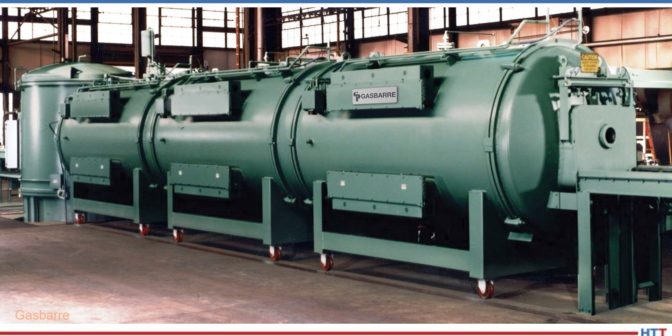
LPC is typically performed in a single-chamber vacuum furnace, with oil quenching or high-pressure gas quenching done in a separate chamber (Fig. 3). Continuous vacuum furnaces can also be used in applications that require increased throughput (Fig. 4).

Fig. 4 – Continuous vacuum furnace

Carbonitriding

Despite its name, carbonitriding is more closely related to carburizing than it is to nitriding. Carbonitriding is a process where both carbon and nitrogen are added to the material surface. This process is typically performed in a range of 1450-1600°F and generally produces a shallower case depth than carburizing. Carbonitriding is used instead of carburizing for plain carbon steels that do not contain enough alloying content to respond well to quenching, as the added nitrogen can provide a higher hardenability in the case to allow for proper hardness development.

Atmosphere carbonitriding can be performed in the same equipment as is used for carburizing. The furnace atmosphere is still typically endothermic gas-based and includes the addition of ammonia to provide the nitrogen. Vacuum carbonitriding with both hydrocarbon and ammonia additions can also be performed in the same equipment as used for vacuum hardening and low pressure carburizing.

Diffusion Only Processes

These processes involve heating the workload to a temperature below the austenitizing temperature, allowing the desired element(s) to diffuse into the part surface, then slow cooling. The increase in hardness at the material surface comes only from the addition of the diffused element(s), and not from a phase change due to quenching. As these processes are performed below the lower critical temperature (i.e., below the austenitizing range), the desired core hardness and microstructure need to be developed through a separate heat treatment prior to case hardening. Generally, the process temperature selected should be at least 50°F below any prior treatment temperatures to avoid impact to the core properties.

Gas Nitriding

Gas nitriding is a process where nitrogen is added to the material surface. The process is typically performed between 925-1050°F; cycle times can be quite long as the diffusion of the nitrogen is slow at these temperatures, with nitriding times typically ranging from 16 - 96 hours or more depending on the material and case depth required. Nitriding can be performed in either a single or two-stage process and has the potential to produce two types of case, the first being a nitrogen-rich compound layer (or “white layer”) at the surface that is extremely hard and wear-resistant but also very brittle. This compound layer depth is dependent on processing time. In the more traditional two-stage process, the case depth produces a gradient of hardness from surface to core that commonly ranges from 0.010-0.025”, with minimal white layer, typically between 0-0.0005”. Nitriding is typically performed on higher alloyed steels or steels specifically designed for the nitriding process (e.g., Nitralloy®) as it relies on the formation of nitrides to create the increased hardness, which is achieved through the use of nitride-forming alloys such as aluminum, molybdenum and chromium. Pre and post oxidation treatments can be incorporated into the cycle to achieve certain benefits. Since the process does not require quenching to harden, it has the potential of producing a product that is more dimensionally stable and may not require any post-process finishing.

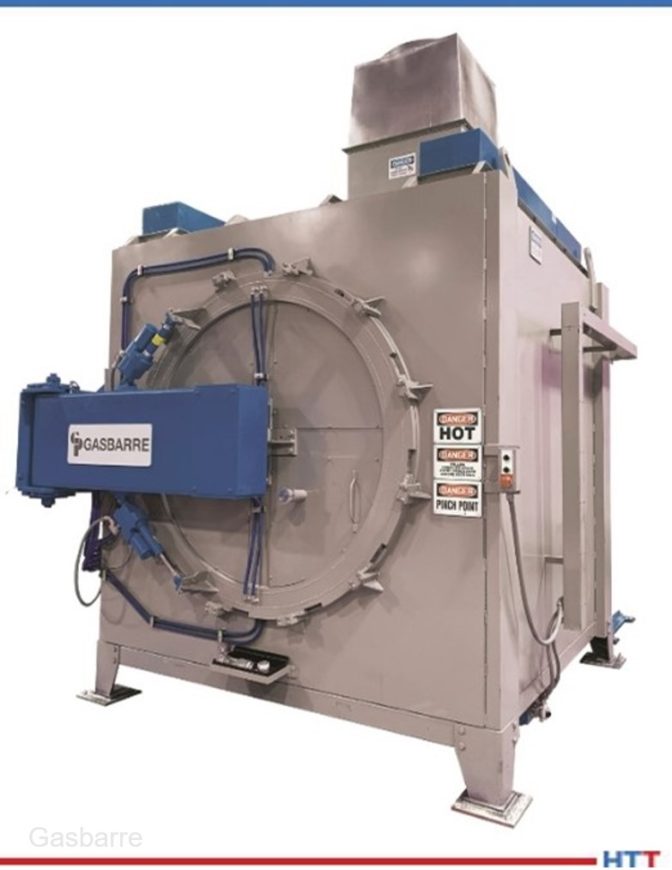
Fig. 5 – Horizontal retort nitriding furnace: "Traditionally, pit furnaces have been used for nitriding as they can accommodate larger load sizes and can be easier to seal as gravity helps keep the lid sealed; however, horizontal designs have gained in popularity in recent years."

This process is most commonly performed in batch equipment; while it is possible to use a continuous furnace, keeping the ends of furnace sealed to contain the atmosphere can be challenging. Traditionally, pit furnaces have been used for nitriding as they can accommodate larger load sizes and can be easier to seal as gravity helps keep the lid sealed; however, horizontal designs have gained in popularity in recent years (Fig. 5). In either case, the furnaces are usually a single-chamber design with the load sealed inside an Inconel or stainless steel retort.

To achieve a nitriding atmosphere, ammonia (not nitrogen) is used to supply the atomic nitrogen necessary for diffusion. At the process temperatures used, ammonia does not readily dissociate on its own; rather, it dissociates when exposed to a heated steel surface (iron acting as a catalyst) into atomic nitrogen and hydrogen. To control the amount of nitrogen available for nitriding, the dissociation rate of the ammonia can be measured with high dissociation rates (high hydrogen content) providing a lower nitriding potential and low dissociation rates (low hydrogen content) leading to more nitriding potential. The depth of the compound layer can be varied through control of the nitriding potential, with higher nitriding potentials producing a thicker compound layer.

For more precise atmosphere control, an ammonia dissociator can be used to provide gas to the furnace that has already been split to dilute the atmosphere with hydrogen to more quickly achieve a high dissociation rate in the furnace. The ammonia dissociator is a heated box with a small retort inside; the ammonia is passed through this retort that contains a catalyst to promote the dissociation of the ammonia, and the resulting gas mixture is cooled and then injected into the furnace.

Ferritic Nitrocarburizing

In the author’s opinion, just like with carbonitriding, ferritic nitrocarburizing (FNC) is named incorrectly as it is more closely related to nitriding than it is with carburizing. FNC is a process that is still mostly nitrogen-based but with a slight carbon addition as well. The added carbon helps promote compound layer formation, particularly in plain carbon and low alloy steels that do not contain significant nitride-forming alloys. This process is typically performed in a range of 1025-1125°F with cycle times much shorter than nitriding, typically 1-4 hours. The compound layer produced is usually much deeper than nitriding at 0.0005-0.0012”, with case depths reaching up to 0.025”, although in many applications a case depth may be difficult to measure. FNC is usually performed instead of nitriding in applications where the deeper compound layer is needed to increase wear resistance, but the added strength of a deep case depth is not as critical.

FNC can be performed in the same equipment used for nitriding, as long as a hydrocarbon gas is available to the furnace such as carbon dioxide or endothermic gas. FNC can also be performed in an IQ furnace using a mixture of ammonia and endothermic gas; for cooling, the parts can be oil quenched or slow cooled in a top cool chamber (if equipped).

Considerations

Case hardening processes are some of the most common heat treatments performed, but each process has its own unique needs. The table below provides a summary of the considerations that need to be made when selecting the optimum process. This list is by no means exhaustive; it is encouraged to work with a furnace manufacturer familiar with each process to help select the correct process and equipment needed.

Screenshot 2023-12-27 at 1.19.41 PM

About the Author: Mike Harrison is the engineering manager of the Industrial Furnace Systems division at Gasbarre. Mike has a materials science and engineering degree from the University of Michigan and received his M.B.A. from Walsh College. Prior to joining Gasbarre, Mike had roles in metallurgy, quality, and management at both captive and commercial heat treat facilities, gaining nearly 20 years of experience in the thermal processing industry. Gasbarre provides thermal processing equipment solutions for both atmosphere and vacuum furnace applications, as well as associated auxiliary equipment and aftermarket parts & service.

For more information: Contact Mike at mharrison@gasbarre.com

Elevate Your Knowledge: 5 Need-to-Know Case Hardening Processes Read More »

Skip to content