Brazilian commercial heat treater Tecnovacum recently received a vacuum furnace, produced in cooperation between a Polish-based furnace suppler and a Brazilian-based furnace manufacturer.
For the first time in the history of the SECO/WARWICK Group, parent company to North American SECO/VACUUM Technologies, the order was executed in a 50/50 cooperation system – Tecnovacum’s financing plan with an industry development bank stipulated that at least 50% of the equipment production would be in Brazil with Combustol Fornos Ind Com. Ltda, who was the partner for this project.
Maciej Korecki Vice President of the Vacuum Furnace Segment SECO/WARWICK (source: SECO/WARWICK)
The Vector vacuum furnace is the first product that the supplier has provided to Tecnovacum. To implement the government subsidy program, the equipment must have 50% of the production in the territory of Brazil. The furnace was developed in close cooperation with the Brazilian partner – Combustol Fornos Ind Com. Ltda. Cooperation between the two companies has been ongoing for six years in terms of sales, supplies and start-ups of furnaces in Brazil.
"This is an exceptional situation, the first one, but certainly not the last," commented Maciej Korecki, vice-president of the Vacuum Segment of the SECO/WARWICK Group. "Under our supervision and in close cooperation, the Brazilian partner made the casing and the control cabinet in Brazil, and the company was also responsible for the equipment assembly and start-up [. . .] We are glad that we have a partner who is not only able to carry out the assembly, start-up and service of our equipment on site, but also build the entire vacuum furnace in cooperation with us."
“A heat of drill rods, each piece measuring 1 1/2 O.D. x 12’ long made from H-11 air hardening tool steel. Parts were carburized, and are being forced air cooled, and then will be tempered and straightened Parts are used in the mining industry and case hardening provides the surface hardness and toughness for superior performance in the application.”
Metlab was founded by Horace Knerr in 1928 in Philadelphia to service the airplane manufacturing business. Knerr introduced the first drop bottom gantry furnace for solution treating aluminum spars. In 1936, the company expanded its heat treating activities and moved from Philadelphia to the northern suburbs into a 125,000 square foot facility. As a strong contributor to the support of American manufacturing for the war effort, they had a staff of about 350 people and heat treated numerous components for airplanes, tanks, armaments, and other parts. In 2001, Metlab acquired the John V. Potero Company in Philadelphia, an 18-person heat treat company specializing in heat treating small parts and black oxide.
Today the company offers a full complement of thermal processes, heat treating both small and large parts, and also providing a local pickup and delivery service. They have a full range of capabilities, processing parts that weigh from a few ounces to up to 50,000 pounds. With the largest atmosphere-controlled pit furnaces in North America (measuring up to 15’ in diameter by 12’ deep or the two long furnaces, 6’ in diameter by 16’ deep), Metlab offers deep case carburizing of large gears, pinion shafts, bearings, and other components.
In addition, they have a complement of atmosphere controlled integral oil quench furnaces and a vertical furnace for nitriding parts up to 20’ long. An inhouse metallurgical laboratory is used for documenting hardness, microstructure, and mechanical properties to certify heat treatments and processes.
Nitriding is a core competency, with large submarine and destroyer gears weighing up to 25,000 pounds routinely heat treated. Other processes offered are hardening, tempering, annealing, spheroidize annealing, induction/flame hardening, protective atmosphere normalizing, nitriding, vacuum heat treating, cryogenic processing, stress relieving, and black oxide finishing. Major industries served with these capabilities include:
Aerospace
Agriculture: Heavy Equipment
Medical
Military
Mining
All of the processes offered by the company are aimed at changing the mechanical properties of the parts treated. Whether increasing the hardness (either on the surface or core to make the parts functional), softening the parts to allow them to be further processed, or black oxide finishing for decorative and corrosion resistance, the thermal treatments and/or finishing treatments are critical to the performance of the treated products.
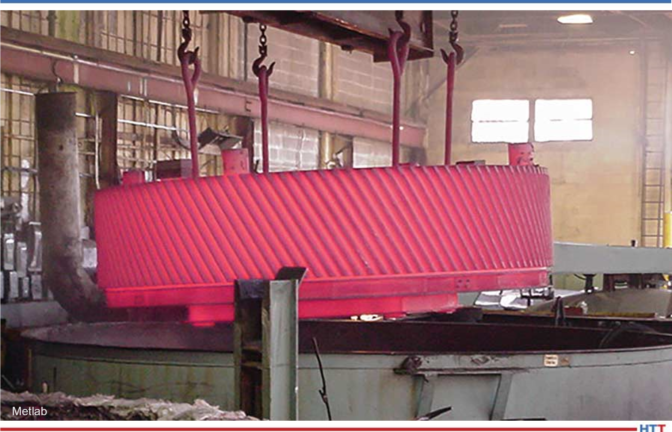
A large gear, 10’ O.D. x 3’ F.W. used on a stand in a rolling mill line. The gear, made from 18CrNiMo6-7 was carburized to 0.250” case depth and hardened to HRC 58 – 62."
Metlab is a job shop, and the parts processed as well as each application addressed is unique. As an example, the company can carburize a 40,000-pound gear to 0.200” case depth and a surface hardness of HRC 58-60 for a steel plant mill stand and not see the same gear for heat treating for another 10 years. Each day brings new challenges. With three metallurgists on staff, they partner with their customers, acting as consultative heat treaters providing the company with the best solutions for any application.
Heat treating can take some interesting turns off the expected path. A few of those projects include working with students on SAE automotive racing teams at local universities. The teams build cars for competition, and Metlab provides, at no charge to the colleges, heat treating for their projects, enabling students to economically obtain heat treat services. Another fun venture was the heat treating of antique car and airplane parts: one-off pieces needed for a restoration. And the black oxide finishing of a suit of armor for a renaissance fair “Black Knight” reenactor was another unique opportunity.
Quality, service, and competitive pricing are Metlab’s stock-in-trade. While they work in accordance with ISO and Nadcap, obtaining accreditation in the short term is a key goal. The addition of a second, larger capacity black oxide line is also underway. The company will continue to evaluate new processes and equipment and add to its arsenal of process and capabilities as markets evolve and applications demand change.
For Ovako, a centuries old manufacturer of engineering steel, innovative approaches to producing their product has taken the form of electrifying their roller hearth furnaces over the course of the past decade.
The process of converting to electric heating began in 2014, each furnace installed with up to 86 Tubothal® metallic heating elements from Kanthal. Now, 14 roller hearth furnaces are electrified. The estimated CO2 savings is around 1,400 to 2,000 tons per year per furnace.
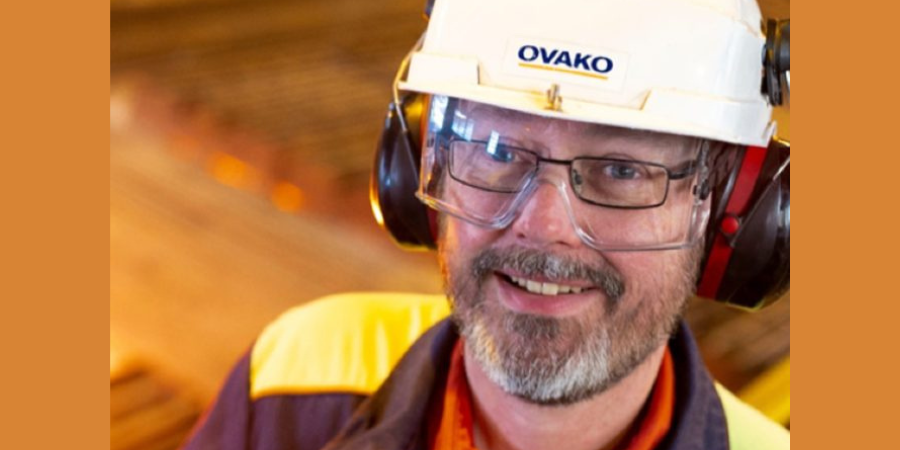
“[In] our heat treatment shop in Hofors,” shares Anders Lugnet, a furnace technology specialist at Ovako (pictured above), “we originally had around 450 gas burners, and there was always a problem somewhere in one of them. Since replacing them with 300-odd Tubothal® elements, the daily maintenance is simply not there. Occasionally, an element needs to be replaced, but it is nothing compared to the way it was.”
He continues that, previously, NOx and CO2 emissions were problematic. But with green electricity, emissions are zero, and with no flue-gas losses, total efficiency has improved significantly.
Today's shared content is provided by the global information partnership between leading European heat treat news provider heatprocessing and the team at Heat TreatToday.
It may be starting in Europe, but through "free and fair-trade", increasing aluminum use may find its way around the world. On September 28th and 29th, engineers and business advocates gathered at the ALUMINUM Business Summit to discuss mobility, digitization, sustainability, and the market development of steel. This article, written by Dr. Gerd Götz, Director General at European Aluminium, is a preview to the discussions that took place.
An excerpt:
"Aluminium is a sustainable material essential to Europe’s green transition. It is used in solar panels, wind turbines, electric vehicles, transmission cables for renewable electricity, etc. The endless recyclability of aluminium further contributes to decarbonization and the circular economy."
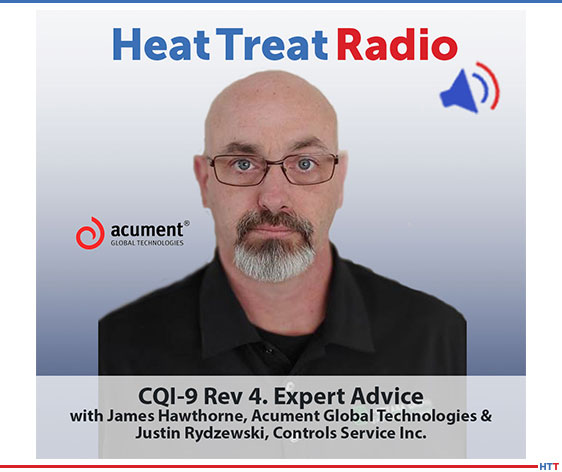
Heat TreatToday provides many different ways for you to keep current on heat treating technical content, news, trends, and specifications within the industry. Heat TreatRadio is one of those outlets. Publisher and Heat TreatRadio host, Doug Glenn, talked with James Hawthorne from Acument Global Technologies and Justin Rydzewski of Controls Service Inc., both of whom served on the committee, with Hawthorne being the chairman, of the latest revisions (Rev. 4) to CQI-9.
This column appeared in Heat TreatToday'sAugust 2021 Automotiveprint edition.
Check out this article for a summary of the topics and insights discussed during this four-part series, and then listen to the individual episodes to learn all you need to know about understanding and complying with CQI-9 Rev. 4.
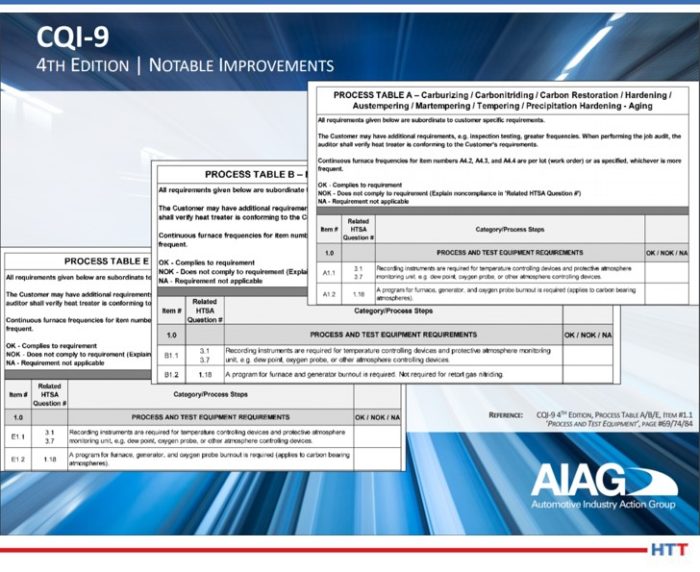
Process tables from Rollout Webinar (Source: Rollout Webinar PowerPoint)
Heat Treat Radio:
Justin Rydzewski on CQI-9 Rev. 4
(Part 1 of 4) – Pyrometry
In this first episode, Doug Glenn and Justin Rydzewski provide an overview of CQI-9 and the “why” behind the new revision as well as talking down through the pyrometry section which covers things like sensors, thermocouples, calibration, SATs, and TUS. Rydzewski was an active participant in the writing of the new revision. His company, Controls Service Inc., is an ISO/IEC 17025 accredited provider of process control systems, calibration, maintenance, and services.
Here’s an excerpt taken from the transcript of the first podcast:
Doug Glenn (DG): Give us information about CQI-9. Give us a brief history. When did it start? Who owns it? Who maintains its updates? To whom does it apply? What is its scope?
Justin Rydzewski (JR): The best way I know to describe it (because, perhaps the most widely known pyrometry specification is AMS2750) is CQI-9 is the automotive equivalent of AMS2750. There are obviously some differences between the two documents, but, in a nutshell, that’s the comparison. It is a document supported by the AIAG, the Automotive Industry Action Group. They oversee the publication of it, the drafting of it, and supervise the whole thing through that process. CQI-9 is the number. Officially, it’s called the Special Process Heat Treat System Assessment and that kind of gets the nomenclature of CQI-9 that applies to automotive heat treaters, or any performing heat treat work within the automotive industry; and several processes fall into that category. It can be from commercial heat treat to in-house heat treat, to organizations like mine that support it. It applies to anyone participating in that effort of heat treat.
DG: Let’s talk about Rev. 4. You said as soon as “3” was out, you started on “4” and it took eight to nine years to get done with “4.” What was the main reason why you needed to abandon “3”?
JR: They schedule these things out to be rewritten on a routine basis. Like most specifications, they are reviewed on some established interval of time. The biggest difference between the second edition of CQI-9 and the third edition was that the third edition removed all references to AMS2750. When 2750 was in the document, it created a world of confusion, and the guidance and errata sheets that followed were just so numerous that they made it a somewhat difficult document to adhere to.
One of the ideas we brought to the table was that maybe we should just remove all reference to it [2750] and write our own specification. So, the third edition removed the 2750 references. In doing so, it ended up being a very well written document. It was effective. The OEMs—your GMs, Fords, FCAs—were happy with the results of the document.
The prolonged active interval of that document allowed us to collect a lot of really good data about what was working, what wasn’t, what was confusing, and where additional clarity was needed. The more data we collected, the more confident we were that the fourth edition would truly make a stride toward being a more effective document.
DG: What are the major sections?
JR: It is structured very similar to the way of AMS2750 in that regard. You have four sections that divvy up a pyrometry section: thermocouples, instrumentation, system accuracy testing, and temperature uniformity survey. But, unlike AMS2750, CQI-9 is a system assessment, it is a process, it is a heat treat management system. It encompasses more than just pyrometry. Where AMS2750 is a pyrometry specification, CQI-9 is a process specification; it encompasses everything. It also includes your heat treat system assessment, which is three sections of questions regarding your heat treat operation, then you have your pyrometry which is those four sections I mentioned. Then you have your process tables. Your process tables drive all of your requirements for your particular operation, in terms of frequencies and tolerances.
To listen or read more about the CQI-9 pyrometry section, go to www.heattreattoday.com and search “Heat Treat Radio CQI-9”
Heat Treat Radio:
James Hawthorne and Justin Rydzewski on CQI-9 Rev. 4
(Part 2 of 4) – HTSAs & Job Audits
In this second installment, Doug Glenn, Justin Rydzewski, and James Hawthorne of Acument Global Technologies discuss heat treat system assessments and job audits in CQI-9 Rev. 4.
Hawthorne is a heat treat specialist in Acument’s North American facilities and handles the heat treat systems, the system’s compliance, and quality assurance for heat treat within his organization. (Acument makes fasteners—nuts, bolts, rivets, washers— for the auto industry.)
Here’s an excerpt taken from the transcript of the second podcast:
DG: James, how would you explain CQI-9 to someone who has essentially zero understanding of what it is?
James Hawthorne (JH): CQI-9 is Continuous Quality Improvement. The purpose behind it is to put together a system that will help you manage and control your process, and at the end of it, the product that you’re delivering to the end user. The intent is to give you those guidelines to help avoid potential spills or escapes or whatever else may come with that.
DG: It’s mostly heat treat related, yes? Or is there more than just heat treat there?
JH: It is the entire system of heat treat. If you look at the heat treat system assessment, the first portion of it is quality based. The second portion (Section 2) is the floor responsibilities, things that are on task that are being completed. And third, you get into the maintenance and the pyrometry portion of it, very specific to the pyrometry and very specific to atmosphere control. At the end of it, there are some very specific induction questions, because when it comes to induction, there is no real furnace at that point, so you want to focus on those key elements of induction.
DG: James, we’d like to pick your brain a bit on this. Let’s jump into some questions on the HTSAs, as we’ll refer to them, heat treat system assessments, and job audits. Let’s go right to the basics: What is an HTSA and what is its purpose?
JH: HTSA, heat treat system assessment, is a tool that has been developed to help you evaluate how you manage your heat treat system for effectiveness: effectiveness in quality management and effectiveness in the floor responsibilities. Like I mentioned earlier, understanding that through aspects of training and training effectiveness and into the final section of atmospheric control and atmosphere management and reaction to those.
The purpose here is to have one system, one document that is the rules of engagement for doing heat treat in the automotive world. What this does is allows the automotive industry to give you one spec, one thing to follow. As opposed to having, say Ford, give you ten questions where none of them are exactly the same as FCA or nine of them are the same as Ford Motor Company, where one of them has a specific question. This encompasses all of those wants and needs from the auto industry to protect themselves, to protect the end user out there in the field that may be using that heat treated component.
To listen or read more about the CQI-9 pyrometry section, go to www.heattreattoday.com and search “Heat Treat Radio CQI-9”
Heat Treat Radio:
Justin Rydzewski and James Hawthorne on CQI-9 Rev. 4
(Part 3 of 4) – Process Tables & New Resources
In this third episode, the trio talks about process tables, their importance, and key information on how to read this revision of CQI-9.
Here’s an excerpt from part 3:
JH: The heat treat system assessment (HTSA) covers the heat treat system and its assessment. There are very unique processes that are covered by CQI-9 and are captured in the process table section of the CQI-9 document.
Process Table A covers carburizing, carbonitriding, carbon restoration, austempering, and precipitation hardening or aging. Section B covers nitriding and ferritic nitrocarburizing. Process Table C covers aluminum. Process Table D covers induction. Process Table E includes annealing and normalizing the stress relief. It goes up to process Table I.
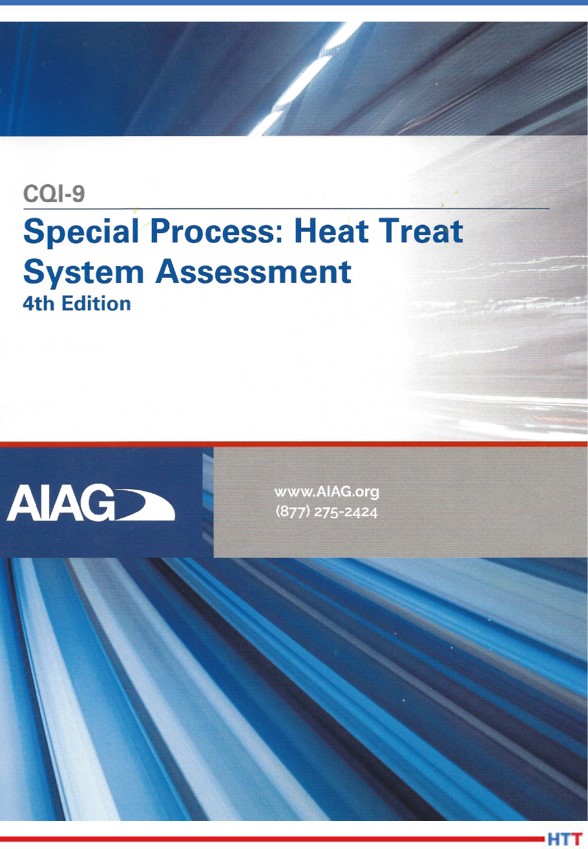
AIAG Cover CQI-9 Edition, 2020
There is a process table for each unique type of heat treat that is out there in the industry and this allows some very specific topics to be covered in those types of processes.
The first portion of it is Process and Test Equipment Requirements. What are the rules of engagement for those items? The same thing for pyrometry. There are specific call outs in the process tables. If this is part of your system, you have to play by these rules. Some of them will point you to specific sections of pyrometry. So, if you’re looking at the thermocouple and calibration of thermocouples, the process table is going to tell you that you shall conform to section P3.1 which covers all of those.
It also covers the process monitoring frequency. How often do you have to check your temperatures? What are the rules of engagement? If you have a batch style furnace that covers that process, it has certain rules for you to manage your batch process.
Then you get into things like inspection – Section 5 of the process table covers things like quenchant and solution test parameters, and the rules for checking that.
What’s really nice about the document is that it’s set up in a way where you can go to the HTSA right from the process table to see if you’re compliant to what’s listed there as the shell statement and the requirements or the frequency for checking those.
To listen or read more about the CQI-9 pyrometry section, go to www.heattreattoday.com and search “Heat Treat Radio CQI-9”
Heat Treat Radio:
Justin Rydzewski and James Hawthorne on CQI-9 Rev. 4
(Part 4 of 4) – Expert Advice
In this final installment, Doug Glenn, Justin Rydzewski, and James Hawthorne field opinion questions as well as practical implementation questions of the new CQI-9 Rev. 4.
Here’s an excerpt from the transcript:
DG: Has CQI-9 been effective in the automotive industry?
JH: I think, 100%, Doug. It’s like IATF—all of the automotive industry has to be compliant to that. Same thing with CQI-9. It provides that commonality for all heat treaters in all the different processes that are employed at their facilities, or the multiple facilities that they may have. For a company like ours, we have eight companies in North America. For the North American side of things that have heat treat furnaces in them, we have induction furnaces, we have carbonitriding furnaces, and we have stress relief furnaces. So that commonality even helps us internally with our management system and how we take steps to provide that common approach and compliance to CQI-9.
JR: I think that also bodes well up the ladder for the OEs. The more people, the more sources that you can go to in order to have work done and have it what you expect it to be, from a quality standpoint.
I think one of the things that CQI-9 has done really well is they’ve made a concerted eff ort to make that document easier to understand and to simplify things down to just its bare bone necessities, whereas some of the other specifications that exist in industry can be lacking.
The intent of CQI-9 was, to a large extent, to be something that you can do yourself and implement yourself. We’ll provide you with the guidance, put it in simple terms, and give you all the research you need to support this on your own.
To listen or read more about the CQI-9 pyrometry section, go to www.heattreattoday.com and search “Heat Treat Radio CQI-9”
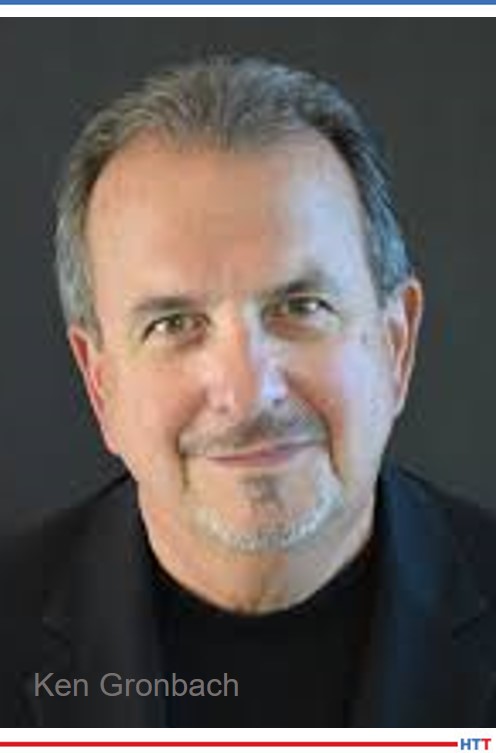
"What came first: money, in its various forms, or people? People. The idea and concept of money precipitated from people. Therefore, demographics cause economics and economics is a symptom of demographics. If you are an economist or an accountant, I realize this can be a painful, demeaning truth. But it is a truth none-the-less. Demography is destiny, and money is a byproduct of demographics." Kenneth W. Gronbach, author, expert, and futurist in the field of Demography and Generational Marketing, doesn't hold back as he writes his hot-take of what the new business model will look like!
This guest column appears in the Heat TreatToday September 2021 Trade Showprint edition. Ken typically writes for the magazine in this edition where many young heat treaters -- 40, to be exact -- are featured annually. Give it a read, and email editor@heattreattoday.com if you have an op-ed or guest column that you would like to submit to Heat TreatToday!
Kenneth Gronbach President/CEO KGC Direct LLC
Hello, 40 Under 40 Class of 2021. There are big changes ahead in corporate structures large and small. And you Millennial-types are going to lead the charge. Human Resources will finally gain the dominance and importance it deserves. Remember when Human Resources was called “Personnel” and it was manned by B players who handed out insurance forms? Those days are gone. If a corporation is not led by A-players in Human Resources, it will not survive. The Chief Human Resource Officer will be the new Chief Financial Officer. You heard it here.
Ask anyone on a corporate board of directors who their key corporate C-level players are, and they will tell you: Chief Executive Officer and Chief Financial Officer, and may even include Chief Operations Officer. The brains, the money, and the day to day. But what about the Chief Marketing Officer and the Chief Human Resource Officer? Communicating with the customer and developing the talent to serve them. What a concept!
The most important question any business must ask is one of demographics: How big is my end user market and is my end user market getting bigger or smaller? How many people are in my end user market? If my end user market is expanding, then we have opportunity to grow. If my end user market is shrinking, we have a problem that must be addressed posthaste. Why? Because the volume of my business is directly linked to the size of my end user market.
This is the essence of demographics. But wait, there’s more. So, we have determined that our end user market demographics are significantly expanding, and we have an opportunity to grow our business. But this is not going to happen by itself. We will need talent, people. Who are they? Where are they? How much training will they need? How much will they cost? How long before they ramp-up? Wait, we need an expert Chief Human Resource Officer. In fact, governed by the new normal in modern protocols, if a corporation doesn’t have a Chief Marketing Officer and a Chief Human Resource Officer, they don’t even need a CEO, COO or CFO!
Let’s examine the new normal people/talent challenges the Chief Human Resource Officer will face.
Diversity and Inclusion: Black Lives Matter. Hiring and training African Americans, Asians and Latinos. Dealing fairly with LGBT issues. Recognizing Minority majority as it becomes the norm. Managing disability issues. It’s a new ball game
Women in Leadership: Women outnumber men in college and law school. They will lead, but they will face challenges in the male dominated C-level management culture.
Three Generations in the Workplace: En masse post-Covid exiting by the huge Baby Boomer Generation. The diminutive middle-age Generation X management shortage. The influx of the giant Generation Y/Millennials.
Big challenges to be sure, but they are not insurmountable, and, if handled correctly, these challenges will be a springboard into the realm of incredible opportunity. Take Human Resources seriously. Very seriously. And challenge your Chief Marketing Offi cer to understand his/her future market for your business, not just the market you presently enjoy.
Bob Dylan sang that, “The times, they are a changin’. . .”. It’s truer now than ever before. Yes, change may be painful, but if you don’t change, time will pass you by. Be well, Kenneth W. Gronbach.
About the Author:Kenneth W. Gronbach is a gifted keynote speaker and nationally recognized author, expert, and futurist in the field of Demography and Generational Marketing. He makes the science of shifting demography come alive with real life examples which make it relevant to today’s culture, business climate, and economy. With nearly three decades experience in retail advertising and marketing, Ken saw the direct results of shifting demographics in his clients’ profits. Eventually, his passion for the subject changed the direction of his career, to the benefit of readers of his books and attendees of his keynotes and other presentations. Contact Ken at ken@kcgdirect.com.
Where is all of the action happening? In the "hot zone". More than just a catchy name, you always want to make sure this high-impact area is working the best it can.
This best of the web article will show you how to maintain your hot zone with three key tips, and then give you a 5-point run-down on how you know you it’s time to replace it.
An excerpt:
"Depending on your process and parts, hot zones can last for many years (5-8 years on average) or may need to be replaced more frequently. Several factors that affect the lifespan of a hot zone include:"
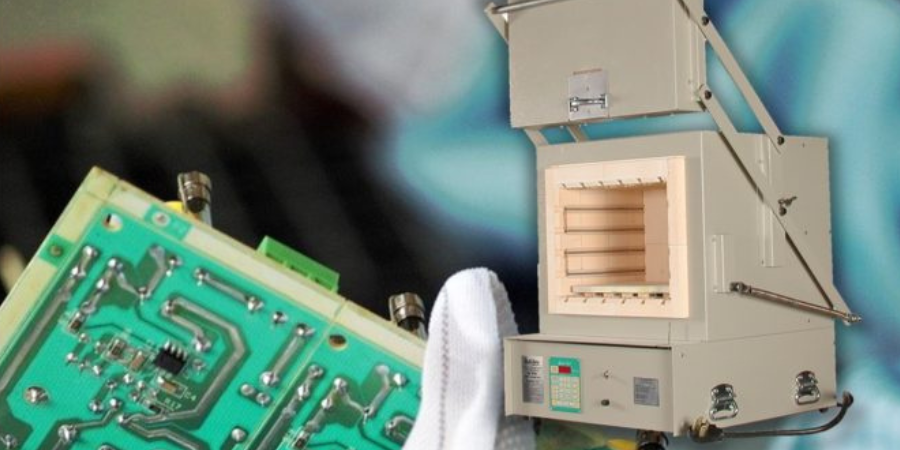
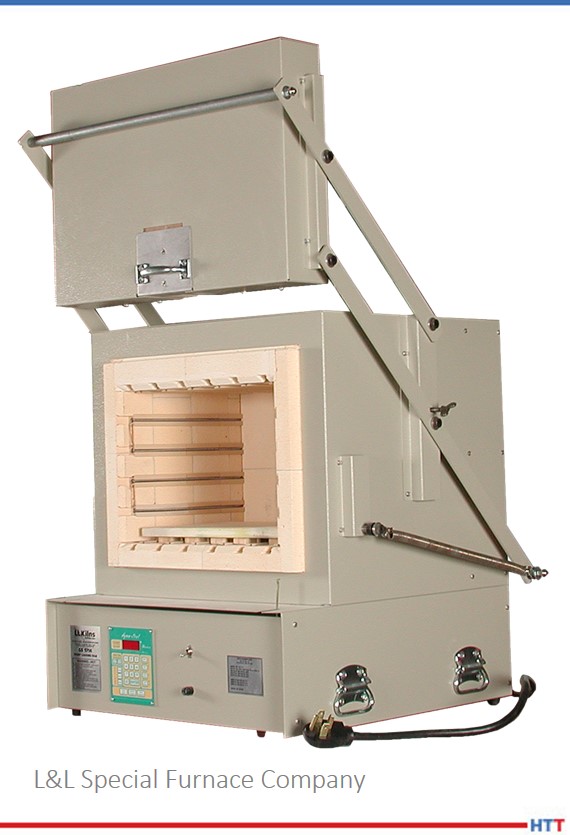
L&L Special Furnace Company ben-mounted box furnace
Worldwide manufacturer of high-purity fused silica and high-end ceramic products is set to receive another bench-mounted box furnace from North American furnace supplier. These materials are used in the semiconductor and photonics industry as well as many other ceramic and composite industries worldwide.
The L&L Special Furnace Co. furnaces are part of the research and development department and are an important component of the testing and quality control department. The Model GS1714 has internal dimensions of 17” wide by 12” high by 14-1/2” deep and the operating voltage of 208, 220, 240 volts single phase, 60 or 50 hertz. It is also equipped for adjustable PID logic and finer temperature control around setpoint.
The furnace is constructed from 3” lightweight IFB firebrick, backed up with 2” of board insulation. The elements are oriented in the furnace to have long life and easy replacement as well as deliver consistent heat distribution with a uniformity gradient of ±7.5°F.
An aeronautic motion control manufacturer invested in a low-temperature vacuum furnace. The furnace operates up to 1380°F (750°C) with work zone dimensions of 24” x 24” x 36” and a load capacity 1750 lb. The furnace works for applications with process temperatures up to 1400°F and where product surface purity is required.
Piotr Zawistowski Managing Director SECO/VACUUM TECHNOLOGIES, USA
The SECO/VACUUM Technologies furnace meets class 2 TUS requirements per AMS2750F - +/-10°F and is capable of nitrogen convection heating and cooling. The furnace can realize low-temperature processes under vacuum and in nitrogen convection. Cooling – the final stage of every heat treat cycle – is completed using an internal recirculation blower and an internal, water-cooled heat exchanger. In addition, the furnace has built-in software tools for monitoring and control.
“The type of heat treat equipment this customer has acquired from us demonstrates a significant bandwidth in our capability to meet a wide range of thermal processing needs," Piotr Zawistowski, managing director of SECO/VACUUM says. "We find this is fairly typical of aircraft OEMs and suppliers since the demands on their complex product range are not easily satisfied by a 'one-size-fits-all' solution.”
This is the fifth vacuum furnace for tempering, aging, and other processes supplied by SECO/WARWICK Group to the international aircraft controls manufacturer.
An international technology service provider and materials science startup located in Cambridge, UK has formed a new technical collaboration with Ovako, a manufacturer of engineering steel with locations in North America. The collaboration is focused on extending the startup's new metal testing technology to be able to test very hard metals, including novel grades.
Testing the steel manufacturer's Hybrid Steel® is a particular focus of the collaborative efforts with Plastometrex. The novel grade results from the first successful combination of two well-established precipitation strengthening mechanisms – i.e. simultaneous hardening by both carbides and intermetallic precipitations. It is designed to meet the demands of high-stress, elevated-temperature applications where mechanical strength is critical.
Bill Clyne Chief Scientific Officer Plastometrex
Patrik Olund, vice president and Head of Group R&D of Ovako, comments on the technology, "Their platform methodology and innovative product provide a much-needed tool for both metallurgy R&D and production activities. By extending the capability of the technology to test the hardest metals, we will be able to use the technology to rapidly characterize and optimize our products as well as the novel Hybrid Steels."
From the Ovako collaboration, Plastometrex will release a product update that will enable the device to test the vast majority of very hard engineering metals. Professor Bill Clyne, Chief Scientific Officer and leader of Plastometrex's research and development activities, commented, "[OVAKO] are a company with excellent scientific capabilities and a forward-thinking approach. Our collaborative work has been highly fruitful and directly resulted in capability improvements to our flagship product, which will soon be able to test very hard metals."
To learn more about this technology, listen or read the transcript to thisHeat Treat Radio episode.






 Brazilian commercial heat treater Tecnovacum recently received a vacuum furnace, produced in cooperation between a Polish-based furnace suppler and a Brazilian-based furnace manufacturer.








 Source: