FEATURED NEWS

Heat Treat Radio #90: CEO Slawomir Wozniak Talks North American Technologies and SECO/WARWICK Future

At the front of some major developments in heat treat technologies is Slawomir Wozniak, CEO of SECO/WARWICK. Join him and Heat Treat Radio host and Heat Treat Today publisher, Doug Glenn, as he talks about the latest trends in heat treat, especially the new technologies his company is pursuing and the effect of the War in Ukraine. Read a recent press release with information about the group here.

Below, you can watch the video, listen to the podcast by clicking on the audio play button, or read an edited transcript.



HTT · Heat Treat Radio #90: Slawomir Wozniak, CEO, SECO/WARWICK SA


The following transcript has been edited for your reading enjoyment.

Doug Glenn: The last time we spoke in an interview was in 2019. We were in Germany at Thermprocess, and you were just getting into the CEO position. We’re coming up on 4 years. How has it been? For you personally and for the company?
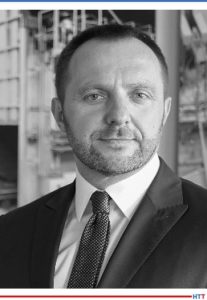
Sławomir Woźniak, SECO/WARWICK Branded
Sławomir Woźniak
CEO
SECO/WARWICK
Source: secowarwick.com

Slawomir Wozniak: A good question. Yes, it was a very nice time.

Contact us with your Reader Feedback

I was not expecting so many challenges, especially since I took over in 2019, in June. We started to work on a new strategy for the company, for the group, and then Covid came. That changed everything. We had to implement a lot of changes to the company and cope with the challenges. It was a good time, absolutely. Many positive things happened to the company, and we grew up with the business.

We reorganized our companies successfully, especially in China and in the U.S. I have had a great, supportive team ever since I started with the company for more than twenty years. I know all the people very well, and they cooperate and support me every day. It was a very good time for me, and I’m looking forward to another couple of years running the business.

Doug Glenn: Compared to 2020, will this year be a normal year?

Slawomir Wozniak: It looks like it. We still feel, however, the impact of the war in Ukraine and the supply chain deterioration caused by both COVID and the war in Europe. We also reorganized the way we do things in the company.

But you’re right, the business is good today. Although we see some recession on the horizon, this year is extremely good. It’s extremely good in the U.S. but also in Asia and Europe. Pretty much all the markets are growing.

New products were implemented on the market in the last couple of years, so we see a good future.

Doug Glenn: Tell us a little about the 60th anniversary coming up.

Slawomir Wozniak: There is an anniversary coming for RETECH. The company was established in 1963, so next year (2023) we would like to celebrate the 60th anniversary in Buffalo, NY. This is something which energizes the U.S. market.
We would also like to highlight our footprint on the U.S. market because we have three companies. We have RETECH, SECO/VACUUM Technologies, and SECO/WARWICK Corporation. We like to see the companies working together, and we see a big interest from U.S. customers to get equipment made in America. RETECH produces vacuumatological equipment (vacuum melting equipment) in the United States. We would also like to build vacuum furnaces in the U.S. SECO/WARWICK Corporation has been in business for many years, and we would like to continue with production of atmospheric furnaces and aluminum process furnaces. We are also thinking about aluminum brazing equipment we build in U.S.

Doug Glenn: I want to talk about SECO/WARWICK group and strategies. I know you manufacture equipment, but the emphasis has always been on technology.

What can our readers be looking forward to in terms of technology?

Slawomir Wozniak: We are a typical technology, an engineering company which provides technological solutions for our customers. We not only provide equipment, but we provide complete solutions for our customers.

What we see on the market is a deep interest in what we call “green technologies.” These are all the technologies that are in line with reducing the carbon footprint. Our technologies can provide solutions for our customers, like low pressure carburizing (LPC), zero-flow nitriding, and all the other technologies which also reduce the time for the process and energy consumption. We see a big boom because the carbon footprint needs to be reported by our customers.
Interest in "Green Technologies"
Source: Unsplash.com/ShubhamDhage

We have to provide a report of what the carbon footprint generated during production of our equipment was. We also must provide a report of what the equipment would produce during a process. We have some solutions which significantly reduce the emission of carbon dioxide. This is what our customers are looking for.

We see a big interest in conversion of heating systems from gas to electric. Customers can buy green electrical energy, but they cannot buy the “green gas” right?

Doug Glenn: Not unless you do hydrogen which isn’t quite ready yet.

Slawomir Wozniak: Right. All these technologies are very much in the interest of our customers. So, this is why we are forcing also, the new development of our solutions to replace all technologies like gas carburizing by low pressure carburizing. This is what we see on the horizon.

Car manufacturers are declaring that by 2035 they will not be producing any more combustion engines in cars. We have a great product for brazing of battery coolers for electrical vehicles, an aluminum brazing process. This equipment is produced in Europe and in China, and we provide the solutions for global OEMs. Also, we see booming technology. With the growth of immobility we also see a growth of our business.

Doug Glenn: Have you seen much of the growth in the green movement? Have you seen it as much in North America as you’re seeing in other regions of the world?

Slawomir Wozniak: We see some interest from the customers. It is not as big as it is in Europe. With the global supply chain, even our U.S. customers, when they produce certain components, they also need to be in line with the global strategy. The end-user is the user of the components which are heat treated in our equipment. The end-user will ask for the certification of the carbon footprint. This is why it is still not on the level as we see in Europe, but we see more and more customers/companies asking for green solutions because they need to also be in line with the trend.

Doug Glenn: It seems the North American market tends to be a little slow on the uptake on these green things.

What light can you shed on the plans for SECO group in North America over the next five/ten years?

Slawomir Wozniak: This is the right time because we are working on the strategy now for the entire group, particularly for the U.S. market. We have three companies in the U.S., and we would like to build more equipment. This is in line with the interest of our customers.

[blocktext align="left"]There is a trend of reshoring and moving business back to North America, particularly to the U.S., but also to Mexico, to better serve the market and provide quicker solutions. We would like to build more equipment in the U.S. A lot of businesses are moving their production from southeast Asia (particularly from China) back to the U.S.[/blocktext]

We can provide the solutions to help our customers to run the day-to-day productions in a cost-effective way with these green technologies, but also with technologies which can reduce the cost of the production, the cost of heat treatment processes, and metallurgical processes. This is why we would like to build more equipment here.

RETECH, our company which provides metallurgical vacuumatology solutions, is very busy with the new locations. We have a lot of projects which are fully made in the U.S. We are now analyzing how to cope with the challenge of the U.S. market to build vacuum furnaces in the U.S.

Today, we only import vacuum furnaces from Poland. In Europe, in general, the lead time of some components is growing. Energy and labor costs are also growing, so we’d like to build vacuum furnaces also in the U.S. to better serve our customers. This would be the main focus for the next few years — to reinforce our operation processes here in the U.S. and also to organize how to serve the U.S. market by local manufacturing.

Doug Glenn: I think it would be helpful to delineate the three companies that you’re talking about, the North American companies.

Slawomir Wozniak:  RETECH. We moved from California to Buffalo, NY, roughly three years ago. We have a nice facility. We are quite busy there with production and assembly of vacuumatological equipment.

Doug Glenn: Which is, basically, vacuum melting equipment.

Slawomir Wozniak: Right. Things like plasma equipment, electron beam equipment. We would like to even look for more space because we have so many projects. We still have our office in California, because we still have some good employees who contribute to the performance of the company. We would like to maintain this office in California.

With SECO/VACUUM Technologies, LLC, we would like to start building equipment for the North American market. We have a new setup, a new office, and a new facility with some floorspace where we can assemble the furnaces. We would like to start from assembly and eventually, double up the processes and completely build the equipment here in the U.S.

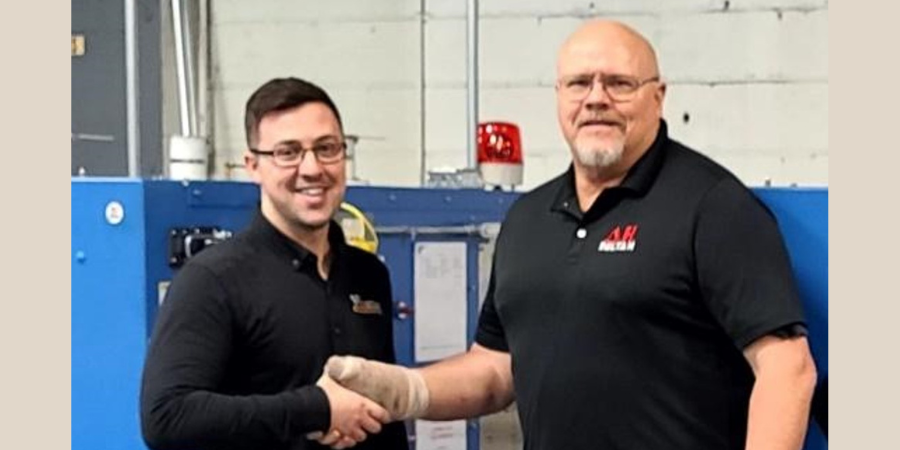
SECO/WARWICK Corporation — we just hired a new managing director in June of this year, Marcus Lord. His main focus is to grow our business in the U.S. particularly for our aluminum process equipment and also for thermal equipment.

Our goal is to build equipment in the U.S., maybe not in-house fabrication, but use our subcontractors, and then to do the assembly in the facility. We are also looking forward to set up a facility in the U.S.

Doug Glenn: RETECH has moved manufacturing to Buffalo, NY. SECO/VACUUM Technologies is still located in Meadville, Pennsylvania, but not in the previous building. They do have some manufacturing capabilities, although there is not really any manufacturing going on there except for spare parts, I assume.

Slawomir Wozniak: Spare parts and retrofits.

Doug Glenn: The last company was SECO/WARWICK Corporation, which is big in aluminum and general line thermal equipment.

Slawomir Wozniak: We would like to continue with this business and build equipment in the U.S.
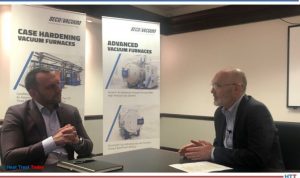
Sławomir Woźniak and Doug Glenn
Source: Heat Treat Today

Doug Glenn: That gives us a sense of the direction over the next five years or so.

Poland (your headquarters’ location) has been in the news quite a bit because of the war between Russia and Ukraine. How has that impacted your company and maybe individuals in your company. Has it impacted your ability to manufacture in Poland?

Slawomir Wozniak: It was a big shock for everyone at the end of February of 2022 when the invasion of Russia happened to Ukraine. For our company, the main heat was linked with the supply chain of some materials, especially commodities like steel, which were supplied for many, many years from either Ukraine or Russia.

Then, the prices of energy, like gas and electricity, also increased significantly. We also had some businesses in Russia; we have a SECO/WARWICK company in Russia to provide services and sales, but we stopped, pretty much, all activities there. We have just completed all the contracts, and we are not promoting our equipment there. We are not providing any quotes to Russian customers; we stopped our activities there.

It was not a big impact on our business because the volume of the business in Russia was not so big.

However, since the war started, we have realized that a lot of customers linked Poland with Ukraine as a country which is very close and, anytime, can be in the conflict.

So, many customers were worried about the situation, and they started to ask us, “Is our project safe? Can you still deliver our project?” So, we had to guarantee and confirm, “Okay, everything is fine. We can run the projects.”

There was a time, especially in the second quarter, when the delivery time of some materials were extended because of the situation. It has improved, and today we do not see much impact on it. Obviously, from the job market perspective, it was also significant, in part, because many migrants moved from Ukraine to Poland.

Doug Glenn: I think Poland was the number one country to receive immigrants.

Slawomir Wozniak: Exactly. We organized a lot of support, as a company and as individuals, with private activity to support the Ukrainian immigrants.

From our side, we have seen some shock and some impact on our from the other side. A lot of companies also started to think differently. For them, it was the first shock three years ago that impacted the global supply chain — many, many materials and then goods. This war was a second wave of impact on the businesses. We see that some companies decided to move their businesses to change their supply chain and, I can say, we even benefited from that because we see some growing business because of the situation.

In the end, I would not say the war is a good thing, obviously, but it is also positive thing for businesses.

We also have some solutions for the defense industry. We see growing interest — not only in Europe, but globally — in investment in capital equipment for increasing the production of some defense equipment.

Doug Glenn: Over your first four years in office, as the CEO, you’ve had to deal with the pandemic and you’ve had the war breaking out. I know there are some other issues, such as labor shortages and supply chain issues.

What is keeping you up at night worrying? As you’re looking forward, what are the things you’re concerned about?

Slawomir Wozniak: One, you just mentioned, about the labor market. We know that the demographic factors are very, very bad for many, many countries, including China. Today, it’s okay, but if you look long-term, the demographic doesn’t look good. We are focusing, now, on how to replace the human factor by automation, how to simplify the processes, how to implement the solutions which don’t require a lot of labor. So, automation is one thing and simplification of some processes, standardization of some solutions. We’ve focused on vacuum equipment especially. How can we reduce the manpower required to build the furnaces?

The second area is definitely the geopolitical situation, especially the tensions on the line between the U.S. and China. We have a lot of businesses in China, today. We also export from China, and to other countries. This is something which we have to look very carefully at how to recoup and handle if there were escalation from sanctions or limitations on the business and possibly to export our equipment.

[blockquote author="" style="1"]This is why we would like to focus more, in coming years, on the Indian market. We would like to set up production capacity in India to produce more equipment. Then, particularly how we can serve the Indian market which is growing. We see a lot of potential in India, but also later to use our capacity there to export some equipment to serve other markets. This is our focus for the next few years.[/blockquote]

I think the geopolitical situation is the thing which is out of our control, for everybody. Even the job market, as I said, we can cope some. How? We can attract our employees, and we can attract potential employees to join our company. With the geopolitical situation, we can do nothing.

Doug Glenn: We’re at the mercy of the leaders, which is always a scary thing.

You’ve talked a lot about green technologies. Is it safe for us to say that SECO is still in the business of the more conventional gas-fired type equipment around the globe? Or are you moving away from that?

Slawomir Wozniak: We do less and less gas-fired equipment. Gas-fired equipment was, in general, an atmospheric type of equipment. We changed the strategy for this product line. We have just narrowed our portfolio to a few types of equipment only. For some solutions, obviously, we still offer gas-fired heating systems, but we see more and more interest in using electrical heating systems. There are some developmental projects to use the combination of hydrogen and natural gas. This is the direction which we see from supplies of heating systems partners, and our customers are looking to get solutions which we call “the green solutions.”

I would say that, in the long term, we will not provide combustion systems in the equipment, but, currently, we still have them in our portfolio. I don’t really see that this will maintain for a long time, especially, as I said, since we changed our strategy for general products and for thermal product line. We do not use many of the solutions for combustion processes.

Doug Glenn: Here in the U.S., you are going to transition many non-vacuum lines from gas to electric?

Slawomir Wozniak:  Yes. But, for some solutions, you cannot. We must have combustion and we obviously offer melting equipment and also some processing products. But we are very flexible and we can offer various solutions for our customers. We always try to adjust our proposal to the customer specifications and customer expectations.

Doug Glenn: It is probably safe to say that, within the next 5–10 years, you’re still going to be doing some combustion-related stuff, especially in North America. It’s going to be demanded. As most of the rest of the world knows, we’ve got relatively cheap energy.

Slawomir Wozniak: Less definitely than Europe, especially with the current situation with the supply of natural gas.

Alan Gladish (r), Praxis Communications, Inc., and Katarzyna Sawka(c), Vice President Marketing at SECO/WARWICK, were present at the interview with Doug Glenn(l).
Source: SECO/WARWICK

Doug Glenn: Alright, last question: You’re obviously enjoying your work. You enjoy your team. The company is doing well. What excites you, personally, about the next 2, 3, 4 years at SECO/WARWICK?

Slawomir Wozniak: As I said, I have a great team which supports me every day in all of the challenges that we are facing, like every company. I love my job. I’ve bonded with the company. I grew up with the company. I would like to see the company develop and grow with new technologies, with market requests and new solutions.

We have great R&D teams — one in U.S., one in Poland — and we work on new solutions. I see that we can change a lot of industries with our solutions. This keeps me really energized every day, to discuss  new technologies, new solutions, and how we can impact the development of various industries like aerospace, the energy sector, and the automotive industry. I’m proud to see some cars with our components.

Doug Glenn: It keeps you energized!

It’s good to enjoy your work, and it’s good to have passion for the future. I think that trickles down to your organization; you certainly have.


About the expert: Slawomir Wozniak started his professional career at SECO/WARWICK in 1994 initially as a service engineer and then as a deputy manager of CAB. Later he was posted to SECO/WARWICK Retech in China before an appointment of managing director at SECO/WARWICK Allied in India and chief operating officer of SECO/WARWICK Group. Later he was appointed managing director (Asia) and member of the management board at SECO/WARWICK SA. In 2018 he became vice president of the SECO/WARWICK SA Management Board, chief operating officer of the SECO/WARWICK Group, and he is the current president of the SECO/WARWICK Group.



Doug Glenn <br> Publisher <br> Heat Treat Today

Doug Glenn
Publisher
Heat Treat Today


To find other Heat Treat Radio episodes, go to www.heattreattoday.com/radio .


Search heat treat equipment and service providers on Heat Treat Buyers Guide.com


Heat Treat Radio #90: CEO Slawomir Wozniak Talks North American Technologies and SECO/WARWICK Future Read More »

Heat Treating and Brazing Facility in PA Adds Furnace

HTD Size-PR Logo

A heat treat furnace was recently shipped and installed at commercial heat treat facility in Eastern PA. The equipment will expand the company's vacuum heat treat and gas quench capabilities.

Solar Manufacturing recently delivered a Mentor® vacuum furnace. The furnace has stainless steel chamber, a work zone of 12” x 12” x 18” deep, and a maximum operating temperature of 2400°F with a workload capacity of 250 pounds. The furnace includes a VHS 6” diffusion pump for vacuum performance in the 10-6 Torr range, a 7.5HP fan motor for internal gas quenching up to 15PSIG (2-bar), and the SolarVac® fully automated and programmable controls package with a Eurotherm digital recorder.


Find heat treating products and services when you search on Heat Treat Buyers Guide.com


Heat Treating and Brazing Facility in PA Adds Furnace Read More »

Energy Efficiency Through Combustion Monitoring

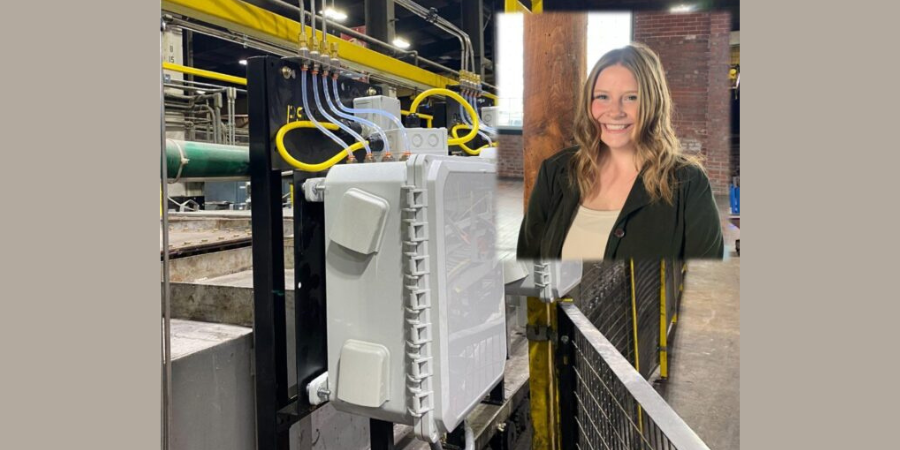
OCWith energy costs soaring and environmental commitments expanding across the industry, is it enough to just tune your industrial combustion burners, or can IIoT devices provide greater insight to achieve burner energy efficiency?

This Technical Tuesday article, written by Taylor Smith, technical sales and marketing specialist, PSNERGY, LLC, was first published in Heat Treat Today's February 2023 Air & Atmosphere Furnace Systems print edition.


Introduction

Taylor Smith
Specialist of Technical Sales and Marketing at PSNERGY
Source: PSNERGY

Industrial furnaces are inherently inefficient and constantly degrading due to high operating temperatures. In most cases, less than 50% of the energy generated through combustion goes to heating the load, while most energy is lost through the exhaust stack or is used to heat the atmosphere, fixtures, and walls of the furnace. An improperly tuned furnace loses 10-30% efficiency on top of the energy losses previously mentioned. This is why keeping industrial furnace combustion systems in tune is critical to performance. This was recently highlighted in John Clarke’s featured article, “How To Make $17,792.00 in a Couple of Hours.”

Continuous Monitoring Is Key

Contact us with your Reader Feedback!

Built on years of experience and field data, combustion engineers at PSNERGY know that only tuning combustion systems annually, or semi-annually, is a good start, but it is not enough. Customer case studies led the team to recognize the importance of frequent combustion monitoring to achieve optimal performance, and ultimately drove the design of their proprietary IIoT monitoring system: Combustion Monitoring and Alerting (CMA).

To get the most BTUs to the load per unit of natural gas purchased, tuning must be combined with continuous combustion monitoring. Tuning without continuously monitoring combustion increases the risk of losing energy to the load, decreasing efficiency, and creating excessive carbon emissions.

Case Studies: Data-Driven Furnace Efficiency

The following case studies represent two examples of data collected throughout the country on furnaces of all sizes and configurations. One thing remains consistent: simply checking combustion once or twice per year does not ensure optimal furnace performance.

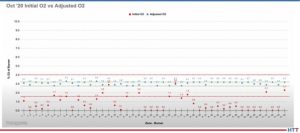
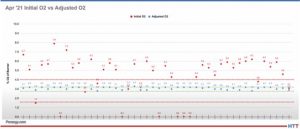
These figures show before and after measurements taken on the same forty-four burner radiant tube roller hearth furnace, six months apart. The red points on the graphs represent excess oxygen in each burner’s exhaust when the team arrived on site, while the blue points represent excess oxygen in each burner’s exhaust after tuning the furnace. A significant variance in combustion performance can be observed in the six months between tunings, which means a large portion of the natural gas purchased is being wasted out the stack and creating carbon emissions.

To ensure maximum energy is being applied to the load for every BTU burned, combustion should be tuned to the ratio of 11.5:1. This 11.5:1 ratio of air to gas results in an ideal excess oxygen measurement of 3%. When PSNERGY engineers perform combustion tuning on an industrial furnace, they set the excess oxygen at the burner between 2.8% and 3.2%. This optimal range is marked by the green dashed lines on the graphs.

You may be questioning, “Does too little or too much excess oxygen really affect combustion performance?” Yes! Burners operating above 4% or below 1.5% are considered outside of the control limit range, marked by the red dashed lines on the graphs. With less than 1.5% excess oxygen at the burner, furnaces produce carbon monoxide and soot, which can clog burners, making them even more inefficient. These carbon emissions can also create an unsafe work environment for plant employees. When operating at 5% excess oxygen, 8% of energy to the load is lost. When operating at 7% excess oxygen, 21% of energy to the load is lost. Imagine buying the same amount of natural gas and only getting 79% of the energy!

Figure 1
Source: PSNERGY

A few things to notice on these graphs: burners are rarely, if ever, found in the ideal performance zone after six months. There is no way to know when each burner drifted out, because continuous monitoring was not yet implemented. Therefore, this drift in combustion performance, which significantly decreases furnace efficiency, could have happened anytime during the six month period between combustion tunings. Tunings may be scheduled, but combustion does not operate on a fixed schedule. You cannot know when the burners drift out of tune without monitoring. Another point to note is that the burners do not always move in the same direction as they go out of tune. In Figure 1, thirty one out of the forty four burners were burning under 1.5% excess oxygen, which means they were burning rich and creating carbon emissions and soot. The PSNERGY service team tuned all of those burners back into the optimal performance range. As you can see in Figure 2 data, taken six months later, out of the same forty four burners, seven burners were burning rich, while thirty one of the burners were operating lean with over 4% excess oxygen, which significantly decreases the amount of energy to the load. These figures demonstrate why it is crucial to continuously monitor and tune your combustion system as needed based on the data, not the calendar.

Figure 2
Source: PRNERGY

Combustion Monitoring and Alerting (CMA)

Circling back to our initial question of, “Can IIoT devices provide greater insight to achieve burner energy efficiency?” the data presented here answers with a resounding YES! In fact, various companies across steel, aluminum, and heat treating industries have already successfully implemented this solution.

Not only does continuous monitoring help achieve burner efficiency, but it also helps bridge the gap in combustion knowledge and manufacturing by making combustion performance easy to see and maintain. With manufacturing leaders facing fourteen-year high natural gas prices and a generational gap in manufacturing expertise, systems like CMA are proving to be crucial to business success. Delivering 10-20% improvement in furnace efficiency, less waste, reduced carbon emissions, and ensured quality, takes your furnaces from being a necessary expense to a strategic asset.

Now the question is: Are you performing combustion maintenance on a fixed schedule or are you trusting real time data?


About the Author: Taylor Smith is a specialist of Technical Sales and Marketing at PSNERGY, located in Erie, Pennsylvania. Her tenacity and competitiveness as a Division I athlete have helped her quickly gain knowledge and hands-on experience in the heat treating industry. Taylor has a deep passion for manufacturing and works hard to build the next generation of leaders, serving on the board of directors for Women in Manufacturing WPA. For more information: contact Taylor at tsmith@psnergy.com


Find heat treating products and services when you search on Heat Treat Buyers Guide.com


Energy Efficiency Through Combustion Monitoring Read More »

IHEA Monthly Economic Report: Certain Uncertainty

The monthly Industrial Heating Equipment Association (IHEA) Executive Economic Summary released in February shows that 2023 has already been forecasted in very different ways by expert analysts. Some are claiming that 2023 is just going to be terrible with rampant recession, pointing to the Purchase Manager's Index (PMI) as the true marker for what to expect. Then, there are the more moderate studies. The automotive and aerospace industries are looking up. The split forecasts might leave one spinning in confusion.

By taking a closer look at some of the specific industries, the economic summary shows that, "We don't quite know what to do with 2023 yet." The report reiterates this balance of highs and lows, with several bright spots for heat treaters, "In the more detailed breakdowns we see some significant variations – booms in automotive and aerospace but declines in machinery. Less volatility in fabricated metal and more volatility as far as primary metal is concerned."

The 10 economic indices show the aforementioned balance with almost half showing some increase, and the other sectors have a drop. A closer look below will show that even within the indices that are dropping, heat treat related markets are holding steady. Global events continue to  impact metal prices. Indices that are down include: New Automobile and Light Truck Sales, New Home Starts, Industrial Capacity Utilization, and the Transportation Activity Index. The up indices are Steel Consumption, Metal Pricing, PMI, Capital Expenditure, and Durable Goods.

High interest rates and high new vehicle prices are driving these sales down. Heat treaters, keep in mind that older vehicles are still on the road needing parts and eventually replaced.


"There is a threat of continued low demand."
Source: IHEA

With a look at new home starts, yes the index is down. There is a bit of a surprise within this big picture. Multi-family unit construction is actually up by 11%! This means heat treating is needed for construction components as well as appliances that go into these units. There is a relationship here with the durable goods pictured a few charts further down. Demand is high for these manufactured items.

"New homes are expensive, and loans to buy them are expensive as well."
Source: IHEA

Metal pricing reflects political events around the world - places like China and Peru where industrial metals and copper are sourced. Supply chain problems are correcting, but government conflicts continue. Currently the numbers are up, but quite a bit of uncertainty swirls.

“The sense is that prices are settling into a predictable pattern — for now.”
Source: IHEA

Durable goods are things that are supposed to last years. Appliances for the multi-family housing units shown above would be something in this category.

"A bigger demand for U.S. exports and most of these are high-value manufactured goods."
Source: IHEA

Robotics industry is booming too as is the automation sector. Durable goods also includes U.S. exports, and those are in high demand.

Anne Goyer, Executive Director of IHEA

2023, it would seem, is a year to "Keep calm, and carry on". The incredible lows due to the pandemic, and then some major highs coming out of that time are in the past. With some rising indices balanced with some low economic markers means, "companies are facing a year of unknowns after a couple of years of predictability."

Check out the full report to see specific index growth and analysis which is available to IHEA member companies. For membership information, and a full copy of the 11-page report, contact Anne Goyer, executive director of IHEA. Email Anne by clicking here.


Find heat treating products and services when you search on Heat Treat Buyers Guide.com


IHEA Monthly Economic Report: Certain Uncertainty Read More »

Heat Treat Bench-Top Box Furnace Delivered to Equipment Distributor

HTD Size-PR Logo

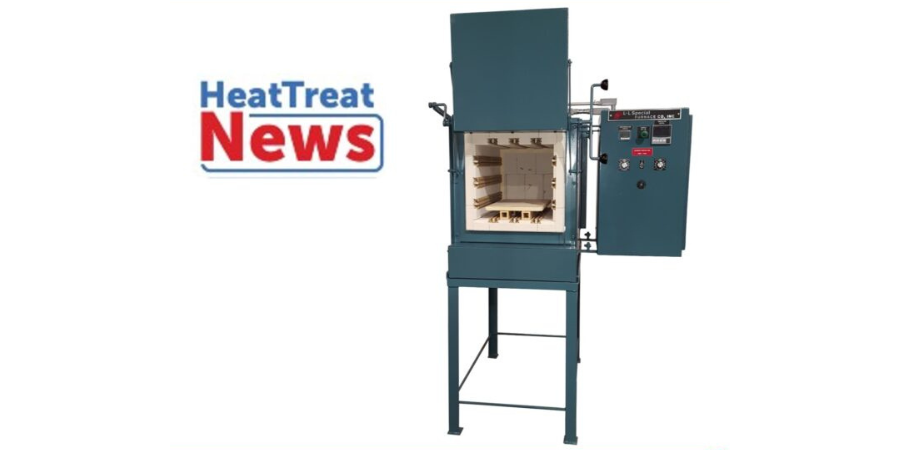
A highly uniform box furnace was sent to a distributor of equipment to maintenance repair and overhaul (MRO) facilities located throughout the world. The furnace manufacturer is based in Pennsylvania and supplies this equipment for lab samples and general manufacturing.

The L&L Special Furnace Model XLB124 has working dimensions of 11” wide by 10” high by 22” deep. The furnace is capable of heat treating and tempering. It is equipped with a sealed case for inert atmosphere capability, as well as a fully functional atmosphere control panel with pressure regulator, flowmeter and manual shut-off valve. Two-zone, long-lasting solid-state contactors control the power, and the furnace hearth is a rugged cordierite plate with ceramic support.


Find heat treating products and services when you search on Heat Treat Buyers Guide.com


Heat Treat Bench-Top Box Furnace Delivered to Equipment Distributor Read More »

2 “Heavy Duty” Furnaces Expand Tempering Capabilities for Ohio Heat Treater

HTD Size-PR Logo

Twin convection furnace systems were recently supplied to Winston Heat Treating. The furnaces replaced two older tempering systems. The new systems are for ferrous alloys and aging PH stainless steels.

David Reger
President at Winston Heat Treating
Source: LinkedIn

The SCAHT®-HD (Heavy Duty) Series furnaces, from DELTA H®, are set up with Instrumentation Type B and have two load thermocouples. The furnaces have a certified TUS volume of 2 feet wide, 1.5 feet high and 2 feet deep with a maximum continuous operating temperature of 1,200°F.  Both are designed to receive baskets of parts from many nearby heat treating operations for secondary heat treatments. Temperature control and data acquisition are provided by Super Systems and feature the SSi 9130 controller/programmer. ATP qualified them as Class 2 (+/- 10°F) from 300°F to 1200°F.

“We were looking for a partner to replace existing tempering furnaces that had become too costly to maintain and could no longer meet required pyrometry standards. Our goal was to install reliable and modern furnaces that were specialized for our small batch/job shop work," said David Reger, president at Winston Heat Treating and a Heat Treat Today's 40 Under 40 recipient.


Find heat treating products and services when you search on Heat Treat Buyers Guide.com


2 “Heavy Duty” Furnaces Expand Tempering Capabilities for Ohio Heat Treater Read More »

Castheon Expands Hypersonic Production & Research Capabilities in California

HTD Size-PR Logo

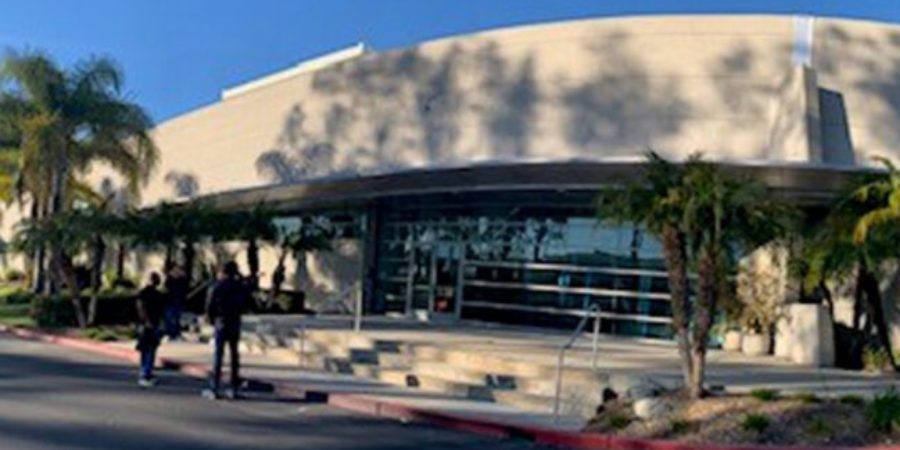
Castheon, Inc. an ADDMAN Group company, has expanded its operational and engineering infrastructure in southern California. Castheon specializes in materials for extreme environments like rocket propulsion and hypersonics, prints refractory alloys such as Niobium C103 and Super C103, and develops metallic alternatives for legacy composite hypersonic thermal protection systems.

Castheon is moving into a new facility with over 40,000 square feet of production, R&D, and engineering space. The square footage makes room for additional machines (more than 10 of them) and manufacturing processes, including large format printers, heat treatments, precision machining, and inspection for aerospace & defense applications.

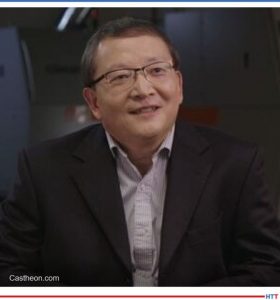
Dr. Yaoping Gao
Source: castheon.com

“When we 3D print the refractory alloys using our unique approach to metallurgy, we are seeing the intrinsic material properties that far exceed that of wrought equivalent," shares Dr. Youping Gao, an accomplished aerospace manufacturing veteran. "The magnitude improvement in strength, oxidation resistance, and creep resistance are all derived from the additive process’ ability in controlling the microscopic level of metallic grains”

The company is actively recruiting engineers, quality inspectors, and other functions. Interested parties are encouraged to visit the ADDMAN career board.

Find heat treating products and services when you search on Heat Treat Buyers Guide.com


Castheon Expands Hypersonic Production & Research Capabilities in California Read More »

Tempering or Annealing, Which Heat Treatment Works for You?

OCWhat process holds a soft spot in your heart? Tempering or annealing? For Valentine's Day, turn up the heat -- errr heat treatments -- with this look at the differences in tempering and annealing! Heat Treat Today has resources for you to spark some thought and learning on these processes.

Sentiments and strong feelings can certainly be heightened this Valentine's Day. While tempering and annealing may not lend themselves easily to the holiday, we hope you enjoy a bit of a nod to the day in our headings below. Make use of the Reader Feedback button, too, and keep us in the loop with questions and comments on what heat treatment you love.


Problem with Annealing? Get to the Heart of the Issue

An automotive parts manufacturer was running into problems with cracking parts. The variable valve timing plates were returning from heat treatment with this problem. To determine why those parts were cracking after the annealing process, an investigation was launched by metallurgists at Paulo.

The presence of nitrogen combining with the aluminum already present in the particular steel being used was forming aluminum nitrides. What could be done? Read more in the case study article below to find out a workable solution that allowed the annealing to create a crack-free product.

"Part Failure Investigation & Resolution, a Case Study"

Induction, Rapid Air, Oven and Furnace Tempering: Which One do You Love?

Contact us with your Reader Feedback!

This article gives some perspectives, from experts in the field, on what kinds of tempering are available and for what the processes are used.

Hear from Bill Stuehr of Induction Tooling, Mike Zaharof of Inductoheat, and Mike Grande of Wisconsin Oven with some basics and background information on tempering. Those reasons alone make this resource helpful with information like this: "tempering at higher temperatures results in lower hardness and increased ductility," says Mike Grande, vice president of sales at Wisconsin Oven. "Tempering at lower temperatures provides a harder steel that is less ductile."

More specific in-depth study is presented as well. The Larson-Miller equation is considered, and the importance of temperature uniformity is emphasized. Read more of the perspectives: "Tempering: 4 Perspectives — Which makes sense for you?"

Cast or Wrought Radiant Tubes in Annealing Furnaces - is Cheaper Really What to Fall For?

Marc Glasser, director of Metallurgical Services at Rolled Alloys, takes a look at radiant tubes. He particularly discusses the cast tubes and wrought tubes. For use in continuous annealing furnaces, there are several factors contributing to choice of radiant tube type.

Marc says, "Justification for the higher cost wrought alloy needs to take into consideration initial fabricated tube cost, actual tube life, AND the lost production of each anticipated downtime cycle as these downtime costs are often much more than material costs." He probes into areas that may not be considered when thinking of all the costs involved. Read more of his article "Radiant Tubes: Exploring Your Options."

Tempering Furnaces: Improvements are Thrilling

The expert behind this piece shows the importance of tempering, particularly in automotive fastener production. Tim Donofrio, vice president of sales at CAN-ENG Furnaces International Limited examines what's working in the tempering furnaces. The products are meeting and exceeding expectations.

Highly efficient, continuous soft handling mesh belt heat treatment systems are getting the job done. Read more about the advances in tempering furnaces by clicking here: "Mesh Belt Heat Treatment System Advancements for Automotive Fastener Production."

Additional Resource To Catch Your Eye

To wrap up this Technical Tuesday post on tempering and annealing, head over to this additional resource to round out the scope of each process. "What is the Difference: Tempering VS. Annealing" gives a summary perspective on the heat treatments discussed above.


Find heat treating products and services when you search on Heat Treat Buyers Guide.com


Tempering or Annealing, Which Heat Treatment Works for You? Read More »

Improving Your Use of Radiant Tubes, Part 3

op-ed

Over the last several months, the Combustion Corner series has challenged readers to spend some time researching opportunities to improve their use of radiant tubes — their performance, efficiency, and uniformity. So far, the series has explored the geometry of a tube, why radiant tubes matter, and what happens inside the tube. When it comes to radiant tube systems controls, what are your options? Read on to learn about the three modes of control.

This column is a Combustion Corner feature written by John Clarke, technical director at Helios Electric Corporation, and appeared in Heat Treat Today’s February 2023 Air & Atmosphere Furnace Systems print edition.

If you have suggestions for savings opportunities you’d like John to explore for future columns, please email Karen@heattreattoday.com.


John B. Clarke
Technical Director
Helios Electric Corporation
Source: Helios Electric Corporation

This month we will discuss the various modes of control that can be applied to radiant tube systems. We will consider three typical modes of control: on/off, high/low, and proportional control.

When a radiant tube is operated in an on/off mode, the burner is fired full on or completely off. Using this mode of control, the burner must be relit at the start of each cycle. The advantage of this mode of control is that the on firing rate can be optimized to provide optimum heat transfer, and when the burner cycle is off, the tube will idle. If the pulses are rapid enough, there is very little cyclical variation in temperature. The heat capacity (stored heat) of the radiant tube provides a flywheel effect to smooth out the temperature swings between on and off periods. The drawback of this mode of control is that the ignition system, most commonly a spark plug, is energized frequently, loading the transformer and wearing material off the spark plug and the valves that control the air and fuel are cycled frequently. If the cycle time is one minute — the burner must relight, and the valves must cycle over 500,000 times a year. Care must be taken to ensure the components used in this system are rated to survive this demand.

Another mode of control is high/low firing. With this mode of control, the burner cycles between the high firing rate and low firing rate, but instead of shutting down completely, the burners are returned to a low firing condition. In this mode of control, care must be taken to ensure the low firing rate does not overheat the firing leg of the radiant tube. Other than that, this mode of control is very similar to on/off control.

The last mode of control is fully proportional. In this mode of control, the burner fires between 0 and 100 percent of the maximum output depending on the burner demand. The air can be adjusted using a proportional valve or by varying the combustion air blower speed using a variable frequency drive, or in some cases, both. The fuel gas is regulated by a proportional valve or a regulator that matches the output pressure to an impulse or control  pressure. Using this mode, the burner fires more or less on ratio (with a consistent level of excess air), or some systems will increase the excess air at low fire to ensure clean combustion and to reduce the available heat at low fire. When a burner has higher levels of excess air, more energy is used to heat the air not used to burn the gas; therefore, less energy is available to heat the furnace chamber. This provides greater turndown (the difference between high and low firing).

Which method is best for a given furnace? That is impossible to say without considering the burner type and geometry of the radiant tube used in the furnace. All three methods can provide good uniformity and efficiency, provided it is appropriate for the equipment in question. In fact, there are applications that blend proportional with high/low firing to meet very specific needs. These systems simply alter the maximum — or high — firing rate to better meet the systems’ requirements.

Again, the control approach is a function of the burner, the radiant tube, and the application. There is really no one-size-its-all; each application must be approached with an open mind. The next column will address the role of heat recovery to efficiency in greater detail.


Find heat treating products and services when you search on Heat Treat Buyers Guide.com


Improving Your Use of Radiant Tubes, Part 3 Read More »

Endo Gas Upgrades Heat Treat for Nordic Traction

HTD Size-PR Logo

Nordic Traction Group, a manufacturer of traction chains and tracks for forestry and agricultural machinery, recently upgraded their heat treatment operations by installing a new endothermic gas generator system.

Daniel Panny
Head of Sales
UPC-Marathon in Germany
Source: LinkedIn

To carburize its traction chains, Nordic Traction Group, with manufacturing locations in Finland and Scotland, added the EndoFlex™ S system. The system, from UPC-Marathon, a Nitrex company with North American locations, replaces an outdated generator. The new system improves process reliability and product quality and requires less preventative maintenance.

“Since the EndoFlex™ S produces only the amount of gas required by the carburizing furnace, there is zero waste in endogas production. This also allows Nordic Traction to save big by maximizing energy usage and gas consumption,” said Daniel Panny, Head of Sales at UPC-Marathon.


Find heat treating products and services when you search on Heat Treat Buyers Guide.com


Endo Gas Upgrades Heat Treat for Nordic Traction Read More »