Today's original content piece comes to us from Dr.-Ing. Joachim G. Wünning, president of WS Wärmeprozesstechnik GmbH. Thinking of how dependent countries can be on one another for energy supply, he reminds us that an energy crises in one area can have far reaching effects on the rest of the world.
What, if anything, can be done? Wünning looks to the heat treating industry to show that there are efforts to source energy from chemical carriers and to use fuel flexible furnaces. He says, "Our beautiful earth is worth preserving for future generations."
Read on to find challenges and encouragements of how to source and use energy in the years to come.
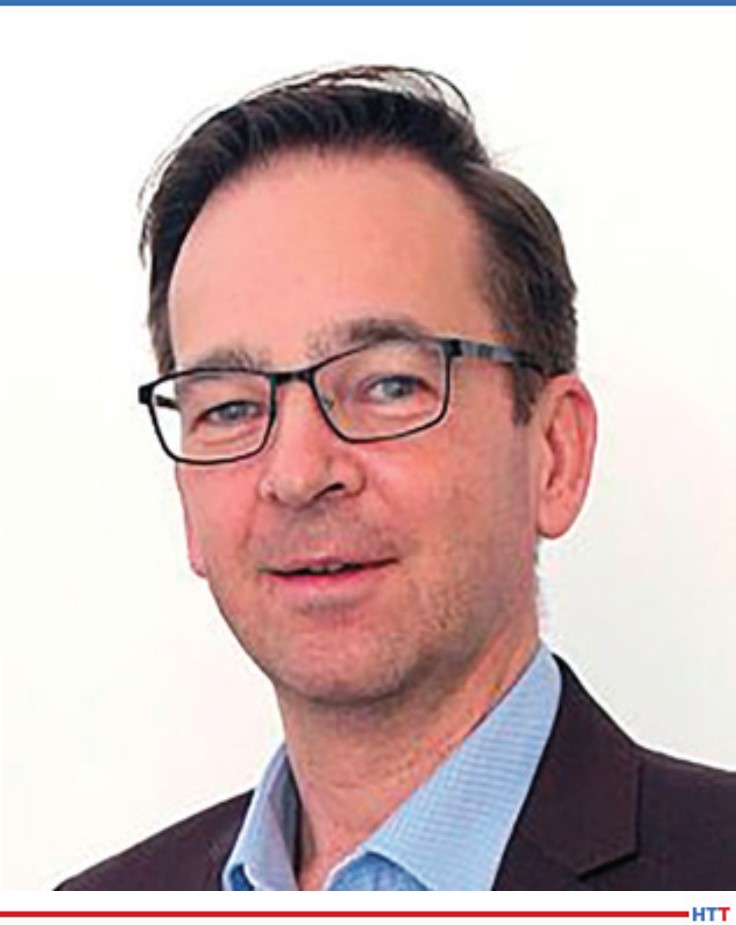
Dr.-Ing. Joachim G. Wünning, President at WS Wärmeprozesstechnik GmbH Source: the author
Europe and especially Germany recently learned the hard way what it means to largely depend on one major energy supplier. After Russia shut off a few pipelines and destroyed two others, it was not clear if industry and households would get through the winter without major shutoffs and constraints. Now spring is here, and gas storage Is still at reasonable levels, due to a mild winter. We can temporarily relax but should be aware that the next winter is coming. Energy issues will be one of the great challenges for the next decades.
Contact us with your Reader Feedback!
In addition to missing energy supply from Russia, reduced availability of French nuclear power stations is another issue. This decreased availability is a result of repair, maintenance, and reduced cooling capabilities due to low river water levels. Already scarce, natural gas was used to export electricity to electric power dependent France. Last year in Germany, shares of electricity produced in coal fired power stations were up despite the clearly expressed will from a government which includes the green party.
Some of these problems do not yet apply for the United States because there are enough resources to guarantee a stable energy supply. However unforeseen things can happen like if and when certain future markets will ask for fossil free products (eg green steel).
The transition of our energy systems, to limit climate change mainly caused by the combustion of fossil fuels, will remain a major task for the coming decades. The worldwide transition to renewable energy, provided largely by solar and wind, will require a major effort.
In the heat treating industry, direct usage of electricity and chemically stored electric energy in the form of hydrogen or ammonia will be the primary sources for heating industrial furnaces. While direct use of electricity might look like the obvious choice for the future, it might not be the case for all applications.
If you convert a furnace to electric heating, you have to rely on payable electric energy even when there is no sunshine or wind blowing. You may need to switch your furnace off when electricity is scarce. If you want a steady weather independent production, using a chemical energy carrier has advantages. In many furnaces, combustion systems are or will be available for the usage of either natural gas, hydrogen, or ammonia cracking gases.
If you invest in a fuel flexible furnace today, you can benefit from using natural gas which is far less expensive than electricity in most regions. If electricity becomes more abundant at certain times, you can generate your own hydrogen; and you will have the choice between using (natural or green) gas from the grid or your self-generated hydrogen without investing in a new furnace. This energy flexibility will present a big competitive advantage and will enable you to offer green steel when the market is asking for it.
In the future, the success of societies and industries will depend on their ability to flexibly adjust to changing conditions, energy being one of them. Our beautiful earth is worth preserving for future generations.
About the Author:
Wünning is the president, owner, and CEO of WS Thermprocess Technic Gmbh [WS Wärmeprozesstechnik GmbH] in Germany and WS Thermal Process Technology, Inc., in Elyria, Ohio.
In a special Heat Treat Radio episode, three managing directors based in SECO/WARWICK Group’s North American companies speak with Doug Glenn, host of this podcast and Heat TreatToday founder and publisher, about the working synergy amongst heat treat and metallurgical market efforts. Watch, listen, and learn about how Earl Good, managing director at Retech; Marcus Lord, managing director at SECO/WARWICK; and Peter Zawistowski, managing director at SECO/VACUUM, lead the North American market with their heat treat solutions.
Below, you can watch the video, listen to the podcast by clicking on the audio play button, or read an edited transcript.
The following transcript has been edited for your reading enjoyment.
Meet the Managing Directors (01:20)
I want to start with Peter Zawistowski, managing director at SECO/VACUUM Technologies, one of the newer companies of the SECO/WARWICK GROUP. Then, we have Marcus Lord, managing director at SECO/WARWICK Corporation. Both of those companies are currently located in Meadville, western Pennsylvania. We also have Earl Good, managing director at Retech Systems, LLC, located in the Buffalo, NY, area.
Contact us with your Reader Feedback!
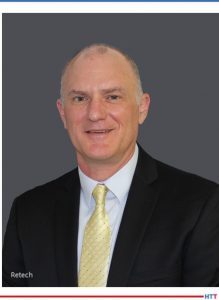
Earl Good Managing Director at Retech Systems, LLC Source: Retech
Earl Good: I’ve been with Retech 6 years in April. Time has flown by fast. There have been, certainly, some interesting developments with Retech over the years. We relocated the business from Ukiah, California to Buffalo, New York. We originally had an office on Main Street in Williamsville in 2018. We found a new facility here that allows us to do manufacturing and assembly as well as have office space. We have about 40,000 feet for manufacturing and assembly, 10,000 square feet of office space. We are actually looking for additional space because of the growth and development we’ve experienced over the last few years.
When I came into Retech, there were some issues and some challenges that the company was facing. We’ve overcome those, and we’ve certainly moved in a good direction.
Prior to Retech, I was with Metso Minerals. I worked with Metso Minerals for about 13 years. I was moved through various positions there. My last position, for the last 7 years, was the vice president of ETO (“engineer to order” group). I was responsible for four different divisions on a global basis and increased that business from about 150 million euros to about 250 million euros a year. It became the second most profitable division within Metso.
This opportunity came along, and it was a different challenge. That’s what piqued my interest here.
Marcus Lord Managing Director at SECO/WARWICK Corporation Source: SECO/WARWICK
Marcus Lord: I’ve been with SECO for 9 months now. I came on board at the end of June (2022), basically looking at reestablishing the SECO/WARWICK manufacturing footprint in Meadville. That’s a “work in process” right now, rebuilding the team. We have a considerable amount of folks that are looking at retirement and trying to pass on some of that legacy knowledge to new people to spur additional business growth.
Prior to SECO, I worked for Carpenter Technology Corporation for 3 years, metal manufacturing for specialty alloys. Prior to that, I did two greenfields, one for Oerlikon Metco and one for Wyman-Gordon PCC. Both of those were powder atomization materials, so a lot of “end use” more so than manufacturing of the equipment, which gives me a good understanding of what people want from equipment.
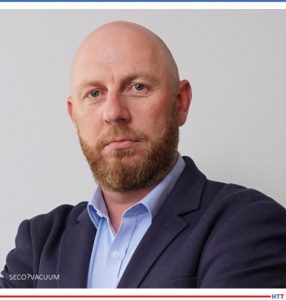
Peter Zawistowski Managing Director at SECO/VACUUM Technologies Source: SECO/VACUUM
Peter Zawistowski: I’m in Meadville, PA. It’s hard to say how long I have been with SECO/WARWICK. I’ve been there 20 years, officially, but to be honest, it’s been since as long as I can remember that I’ve been around vacuum furnaces. I was basically born inside a SECO/VACUUM furnace, so that’s how long I’ve been with the company.
I’ve gone through several different positions: service engineer, engineering, sales, and currently, managing SECO/VACUUM here in the U.S. We are responsible for our vacuum furnaces for North America.
Doug Glenn: For those who don’t know: the global headquarters for the SECO Group is in Poland. Peter actually comes from there. You agreed to relocate your family, and you’ve been in the States now for how long?
Peter Zawistowski: For quite some time; I think it’s 10 ½ years or 11.
Doug Glenn: Peter is the link back to Poland which we will talk briefly about.
Markets and Products (07:00)
Can you give a snapshot of the markets you serve and the products you supply?
Peter Zawistowski: 50% of our products are single chamber furnaces, standard from toolbar up to 25 bars of gas quench furnaces multigraphite.
The next would be vacuum oil quench furnaces in which we’ve developed a new design, I believe, 15 or 20 years ago. This is where, I think, we are leading the market. I believe the competition is 5 to 10 years behind us in this product.
We have a lot of new developments or new products like pit LPC, like 4D Quench, which is like a single piece quench. We are always looking for some custom projects. We like those; we are not afraid of those and we can do them.
Doug Glenn: In a nutshell, SECO/VACUUM Technologies is dealing primarily with vacuum heat treat furnaces and all things around that including any type of specials, customs, etc. That’s where your strengths are. Marcus, how about SECO/WARWICK Corp.?
Marcus Lord: SECO/WARWICK Corporation has a pretty big portfolio of equipment. Right now, I know a major view is on CAB lines. We’re seeing a lot of inquiries on the continuous or controlled aluminum brazing process as well as aluminum processing equipment for annealing large coils of aluminum or sheet and foil-type aluminum. Then, back to some of the roots as atmospheric-type furnaces, so roller hearths, mesh belt and things of those sort. Those are, basically, customized to the customer’s preference, so we have a huge catalog. Lately, we’ve sold some actual aluminum melting-type furnaces, so large tilt melting furnaces.
Doug Glenn: Earl, let’s go to you.
Earl Good: We supply vacuum melting equipment — melting of metals and alloys that have a high melting temperature. Our typical industry markets are aerospace, medical, defense, and energy storage. Our primary furnace types are the electron beam furnace, a PAM (plasma arc melting) furnace, and a VIM (vacuum induction melting in a bar). We also have powder atomization technology and our melt spinner technology.
R&D in melting is growing for us, because we have a couple different furnaces we can operate. We have a lot of customers who don’t have the need for an excessive amount of material. They don’t want to purchase a furnace, so they come to us asking us to melt a certain amount over the course of a month or a year.
We have a broad base of technologies that we can offer the market, which is good, because some of the aerospace work can be cyclical in nature; but the other furnaces and other options that we have make up for that.
We work with mostly titanium, nickel, and various alloys associated with aluminum and nickel.
Technological Niches (11:25)
Doug Glenn: Is there a specific technology that you feel is really your company’s strong suit? Something you really feel comfortable doing?
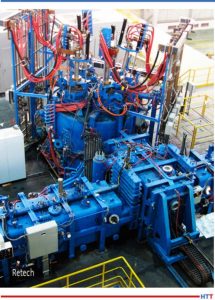
Earl Good: I’m going to highlight two different technologies: I think our PAM technology, or plasma melting technology, is the best on the market. We have more installations than anybody out there. All of our furnaces have, basically, satisfied their performance requirements.
PAM Furnace Source: Retech Systems, LLC
Another area I’d like to highlight is our powder technology. We’ve been a little bit behind some of our competitors in the market, but we’ve really developed some good things that are going to provide opportunities for us in the market. We have a number of customers coming to us to look at those opportunities now. I think those are probably the two most unique and best that we have to offer.
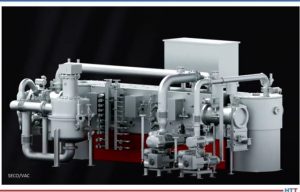
Peter Zawistowski: Our single chamber vacuum furnaces are one of the best in the world, currently. We also have some new products. We are trying to get to the market our 4D Quench furnace. It is a special system to vacuum carburize and then single piece quench. This is the unit we are implementing in the U.S. We are getting good references, and we are getting great results.
4D Quench Furnace Source: SECO/VACUUM
We are also focused on LPC, in general. All of our furnaces are equipped with LPC which, I think, the industry is moving to vacuum carburizing. That’s the big focus right now with SECO/VACUUM.
Doug Glenn: People are saying in many areas in heat treat, we ought to be focusing much more on quench than heating. Anybody can heat the thing up. The real key is, can you quench it? Especially when you’re talking about surface hardening and things of that sort.
Peter Zawistowski: Exactly. And in 4D Quench, this is where we can control the distortion to the level close to gas quenching; that’s the key to success.
Marcus Lord: I would say that our CAB (controlled atmosphere brazing) lines are probably the best in the world. We have a lot of competitors that we’re seeing pop up out of Asia, but I believe that we still hold the market share for that type of equipment. Like many of our other pieces of equipment, we are able to customize based upon what the customer really is needing to achieve.
I would say that with the big push to reduce carbon footprint of these manufacturers, SECO still has the technology for their bayonet electric heating processes. We’re not held up by somebody else supplying us with that type of product; we can build that in-house and supply a very efficient furnace when it comes to electric heating.
New Technologies (15:20)
Doug Glenn: Does SECO/WARWICK have anything to offer in the aluminum market?
Marcus Lord: In Poland, we are starting to offer the vortex 1 and 2.0, which is being developed. Those are options we are going to introduce along with predictive maintenance programs that have been developed out of Poland.
Doug Glenn: I want next ask about new technologies, things that either are currently commercialized, or soon to be, that you feel good about. Peter, why don’t we start with you? What do you think as far as vacuum technologies?
Peter Zawistowski: We have quite a few new technologies, but I think I will tell you more about LPC. As I said, all of our products are equipped with vacuum carburizing. I think that this is where the industry is going right now with the current trend of limiting the carbon footprint and sustainability. I know that in the U.S., it’s maybe not that common right now, but you are aware that most or all of the big European companies will have to report carbon footprint starting in 2024.
If any of the U.S. companies would like to do business with Europe, like with German automotive industrial airbuses of the world, you’ll have to do the same. To do that, you have to limit your carbon footprint.
"To do that [facilitate business in Europe], you have to limit your carbon footprint." Source: Unsplash.com/Matthias HeydeIn carburizing, you must switch technology. Right now, the most common carburizing technology or equipment is Integral Quench (IQ) furnaces, and you must do something with it. There is a need. It will happen that there will be a switch to low pressure carburizing; this is where we can help.Earl Good: A lot of our furnaces are customized. Through the R&D trials and toll melting we do, we are able to develop new technologies. There are two areas that I want to highlight.We put some time and effort into developing a small-scale atomizer that is more like a lab-type atomizer. Ours is a little bit more robust than our competitors’ units, and it has more capabilities. For example, you can melt different materials on it. We’re very eager to get that out into the market and make our first sale.
The second is our plasma gas atomizer. We do receive a lot of interest in this product right now. It’s different from what’s out there. Much of the market today, as far as powder and atomization, is batch process; the yields are not great. We believe that the plasma gas atomizer will increase yields. It allows ongoing melting which is going to provide a lot of options to customers who have the need for a more robust process, as far as their powder production.
We’re really excited about both of those and getting those out.
Doug Glenn: Is development of those products driven by the AM market 3D printing?
Earl Good: Yes, but you have universities and others who want to do things on a smaller scale, on the trial basis so as to not invest a significant amount of money. They want to see that the technology is going to work or see the products they’re developing. There is a real need for that, and I think there’s a need for something more robust than what’s on the market.
Marcus Lord: We have new technologies on aluminum processing.
The Vortex 2.0 is a new technology. I believe three Vortex 2.0 systems have been sold and are not yet fully commissioned. This will give us an upper hand on how we go about heating our materials on an efficiency standpoint, especially when we’re looking at the carbon footprint and how we are going about processing our materials.
Other than that, we have some technologies based on a customer preference, technologies that may not be a staple or standard on all our equipment.
Collaboration (22:53)
"Is it helpful that you’ve got the three separate companies working together?" Source: Unsplash.com/krakenimages
Doug Glenn: There are very few thermal processing technology companies that have the breadth of capabilities from everything from atomizing, arc melting, heat treating, vacuum heat treating, and air atmosphere heat treating. How do you cooperate to synergize these technologies? Do you find it beneficial, and/or is it helpful that you’ve got the three separate companies working together?
Earl Good: In my opinion, we haven’t worked great during my previous years here. We do get along. I think we have the opportunity to work together much more as we move forward. We started to do that in some different areas. We’re looking for a facility, right now, to spread our U.S. footprint for manufacturing and assembly. I think it will be a shared work facility.
Each of us brings a different set of skills and talents to the industry. We have the opportunity to leverage some of those to the benefit of the whole. Products are in demand that are made in the U.S., and I think we’re going to be in a good position to service that market. I think all of us are in positions where we’ve seen our businesses start to grow and improve, so I think it gives us a great opportunity to work together.
Marcus Lord: I think it is beneficial to have collaboration amongst all three of us and our different businesses. We’re able to support one another, especially from a technology aspect. If there are questions, you have an outreach program, and we are open to work with each other. Like Earl said, we’re all looking to expand. SECO Corp is looking at making an expansion and still retain the offices in Meadville, but we’re also looking for another location to be able to give us a little bit more bandwidth.
For my group, we’re looking at a lot of operations happening in Mexico. That’s something that we really need to look at from a support aspect. Being three businesses relatively close to one another, it is overall beneficial for all of us.
Peter Zawistowski: It’s not only beneficial for us, but I it is beneficial for our customers. For example: Earl is offering a furnace, and my equipment is like auxiliary equipment to his, so we can offer a full package to the customer. We have expertise across the three companies that we can support and provide all that is needed to customers. I think that is a big benefit.
Manufacturing in the United States: Present and Future (26:50)
Doug Glenn: How has manufacturing in the U.S. been in the past and what are the future plans?
Earl Good: I can throw a couple comments out. Our past manufacturing in the U.S. was done out in Ukiah, for Retech specifically. Ukiah is a great place for wineries and vineyards, but maybe not an industrial furnace manufacturer!
Originally, there was a desire for us to leave all manufacturing and assembly in the United States, by the past CEO, and then we found this facility here in Buffalo. The new CEO, Sławomir Woźniak, said, “Hey, could you guys do some manufacturing and assembly here?”
I said, “Yes!” I think my chin hit the floor, and I was drooling because I thought it was exactly what we needed.
We have the 40,000 square foot facility here that we’ve already filled. We have a customer base that wants more manufacturing and assembly. Having additional manufacturing and assembly, with what we have within Retech — in Poland, in some of the areas, China, and India — gives us a way to support all of our customers’ needs. Some customers are looking for low price options, some want things built here in the U.S. As we become maybe less globalized and more centralized as far as focus, I think we’re going to be able to support all of those different needs for our customers and do it well.
Peter Zawistowski: We are looking to start manufacturing and assembling vacuum furnaces here in the U.S. As Earl said, we had our facility in Ukiah; we had our facility in Meadville. We had two or three companies in the U.S., and we were doing it in different places. Now, we would like to consolidate and leverage the fact that we have three companies here in the U.S.
"It’s not only about manufacturing. We are also thinking about bringing some R&D activities here to the U.S." Source: Unsplash.com/Getty Image
It’s not only about manufacturing. We are also thinking about bringing some R&D activities here to the U.S. Currently, I think that more often we sell technology, not furnaces. We would like to be able to provide that service to our customers, as well, here in the U.S.
Marcus Lord: Manufacturing was part of the deal of me coming on to SECO. It was really to reestablish what was being done.
Whether or not it makes sense to do full-blown manufacturing (because that’s a huge capital expense upfront) is one thing, and then, of course, training people to be able to do the processes. It makes more sense for us to actually do subassemblies or manufacturing of maybe a smaller part of what we’re looking at, as far as the equipment, and being very specialized on what we do manufacture. That will leave the larger projects either internally or external. As you said, we can’t be really good at everything we do, so we’ll pick and choose what we’re really good at and just exploit it from that point and then grow.
Doug Glenn: There have been major supply chain disruptions over the last couple of years. Can you address supply chain issues for each of your businesses? Are you seeing any difficulties? How much is re-shoring driven by supply chain issues?
Marcus Lord: Part of the directive is to try to be able to control our supply chain and also have better control of when we’re able to deliver equipment — that’s key for most of the customers. They want lead time even more than price. Where we’re seeing the impact for our pieces of equipment is definitively PLC systems. Outside of that, we don’t see much of a disruption. Maybe with some high nickel product that we use in our bayonet heaters; outside of that, it’s restricted to those two items.
Peter Zawistowski: I think we can see the supply chain getting better. But it’s not only the supply chain, it’s also transport cost and time. Right now, we would like to ship the equipment from overseas; but it’s twice as much money and twice as much time. That’s another problem we would like to address.
Earl Good: I think the supply chain varies. What’s kind of unusual in the market right now is you have a project where part of the supply chain works well and the other part not so well. Then, with the next project, it’s the exact opposite. The feedback I get from a lot of suppliers and even some of our customers is that they still have a difficult time finding people, and when you don’t have the people it’s hard to deliver.
Generally, things are improving and hopefully they continue to go in that direction. In the electronic PLC control-type technology, that’s where we see the biggest delays, as Marcus has indicated. That’s an area that is not showing signs of getting better right now. I think, as some of these chip manufacturing facilities come online, you’ll see a big improvement there.
Doug Glenn: How would you categorize upper management in Poland and their vision and their support of what’s going on in North America?
Peter Zawistowski: Expansion in North America is one of the primary goals on the group level right now. All of us are getting a lot of support from the group management. [blocktext align="left"]Expansion in North America is one of the primary goals on the group level right now.[/blocktext]This is the philosophy of the company. We have companies in India; we have companies in China and in the U.S. That’s why we have companies in the local market because they understand the market the best. Our company, in my opinion, is very important.
Doug Glenn: Do you characterize the presence in Europe as being supporting but not micromanaging? They’re giving you freedom and giving some goals to hit and saying, “Go at it, team.”
Peter Zawistowski: There is a direction we all follow but, yes, we have a lot of freedom, ultimately, in the U.S.
Earl Good: I think the support has been great. I think we are given a lot of flexibility as far as how we go about our business and operating it. I think there is definitely a desire to see us grow in the U.S., and I think they’ll give us the tools, the technology, and the ability to do so.
Doug Glenn: Some people, in North America, will say that it’s going to be very difficult for SECO/WARWICK (any one of these three companies, not just SECO/WARWICK Corporation, but SECO/VACUUM or Retech), to survive in the North American market because they have a global headquarters in Europe. What do you say to people that would say that?
Marcus Lord: I would definitely tell them that’s untrue. This is actually the second company I’ve worked for that has most of their operations in Europe. Both of the companies have been very, very successful at going out and putting their footprint on the industry and the marketplace and actually providing equipment, depending on the technologies, that is far superior than what our competitors have.
As far as being able to go into North America: There are directives, there are things you have to follow, but that’s with all corporations. At that point, they might want others to believe we won’t be successful because we’re European-driven, but that’s very untrue.
As Peter has said, we have a lot of autonomy to run the business, we have objectives, we have KPIs that we have to hit. The major idealism is to be profitable and have quality product. With those, it’s easy to drive a business to be successful; it doesn’t matter where it’s managed from.
Peter Zawistowski: My competitor in vacuum heat treating has headquarters in Germany, and nobody seems to care. I think it’s normal. We have a big presence here in the U.S., and that’s all the better.
Earl Good: I think I would add that our competitors try to push that our headquarters are in Poland and maybe our products aren’t as good. I’m a firm believer that if you deliver a good product on time, if the product starts up well, and if you take care of your customer, it doesn’t matter where your headquarters are. Customers are going to find you. They’re going to enjoy the experience and come back to you. We’re seeing a lot of our customers come back to us for additional equipment. I think that our competitors can push that all they want. The reality of it is, if you deliver on your customer’s needs, you’re going to have success.
The Future of SECO/WARWICK in North America (37:53)
Doug Glenn: What are you optimistic about regarding the future of your specific company?
Earl Good: That’s a broad-based question, but we had a very good year in 2022. I think we’re headed to a very good year in 2023, and our focus is on continuing to grow, continuing to develop products that the market needs and wants. I think we have some good things that we’re working on in R&D, so I’m very optimistic about our future and about our direction. We’re on the right path and doing a lot of the right things.
Heat Treat Radio Source: Heat Treat Today
Marcus Lord: With SECO/WARWICK Corp., we closed the year out with a very large sale. That is continuing into 2023 where we have a growing backlog which is good. It shows we’re continuing to service the industry and also providing quality equipment. I don’t foresee that diminishing at all; I just see it growing. As we support one another, that’s the best way to continue our paths.
Peter Zawistowski: We will continue to grow. I see a big opportunity for us in the U.S. SECO/VACUUM is a fairly young company; it’s 5½ years old. I think we will get more market share by having satisfied customers.
Doug Glenn: What is most exciting about what you’re doing in the market right now?
Marcus Lord: I guess I’m a workaholic, so that really helps. I’m actually on vacation right now and here I am working. I’ve been doing emails and that’s just part of the business, right? For me, it’s putting the bridges back in place that should have always been there, that deteriorated just through the history of SECO Corp. along with SWSA, and really growing the label. All I’ve heard is negativity and what that negativity does to me is it actually drives me to make the business better. It’s more personal than it is a corporate thing because I like proving people wrong. That’s what drives me.
Earl Good: I think the energy comes from the fact that we’ve made tremendous progress over the last 5+ years. We’ve seen Retech change our image in the market; there were definitely issues and problems. The fact that we see customers coming back to us with repeat orders indicates that we are delivering to our customers, meeting their needs, and satisfying them.
I always say if you go above and beyond the customer’s expectations, everything else takes care of itself. That’s where I’d like to leave it. I think we’ve made great progress and I see good things in our future.
Peter Zawistowski: Personally, I like the fact that every day is different and every customer is different. One day I will talk to a heat treater because he needs a furnace to heat treat nuts and bolts. The next day we have to develop a new power train for a helicopter, or we have to set up a reactor for new fusion energy. I don’t think there is any other industry or anything else than heat treating that you can actually touch a number of different industries. That’s what I personally like and what drives me every day.
About the experts:
Earl Good, president and managing director at Retech Systems: He graduated from Penn State University, where obtained a Bachelor of Science Degree in Electrical Engineering. Eight years later, he received a Master of Business Administration Degree from Lebanon Valley College. Earl has spent a majority of his working career with three different companies, General Electric Environmental Services, Marsulex Environmental Technologies, and Metso Minerals. He has held roles of increasing responsibility throughout his career, including various management positions. Earl Good was appointed to the position of Member of the Management Board of SECO/WARWICK S.A. starting on January 2, 2019. Currently Vice President, Business Segment Vacuum Melting & Managing Director at Retech Systems LLC.
Marcus G. Lord, president and managing director at SECO/WARWICK USA: He earned his Business Administration BBA Executive Management degree at Cleary University. He has worldwide executive leadership experience in innovative manufacturing processes, operational excellence, sustainability initiatives in the supply chain, and operations management. Marcus has served in a multitude of roles, including Manager of new tooling and dies repair( at National Set Screw (PCC)), Director of operations( at Wyman-Gordon and Oerlikon – Metco), Executive Manager BMO (at Carpenter Technologies), General Manager – Manufacturing (at Carpenter Technologies). Currently President and Managing Director at SECO/WARWICK Corp.
Peter Zawistowski, Managing Director a SECO/VACUUM, USA: He graduated from Technical University of Czestochowa where he earned a Master’s Degree in Material Engineering. He also graduated from Executive Program in General Management (EPGM) from the Sloan School of Management at MIT (Massachusetts Institute of Technology) completing extensive training in a variety of business management courses. His work experience at SECO/WARWICK began in 2005 as melt team service manager. In 2009, he assumed director duties of the vacuum carburizing furnace group. In 2013, became Global Product Manager of the vacuum carburizing and vacuum oil quenching group and in 2014 ascended to the General Manager position for product management and sales at SECO/WARWICK Corp. in Meadville, Pennsylvania. Currently, he is Managing Director of SECO/VACUUM, North America’s newest vacuum furnace company.
Marcio Boragini Sales Director for Brazil at UPC-Marathon Source: LinkedIn
A gas generator was recently installed for Jomarca, one of the biggest manufacturers of fasteners, bolts, nuts, and fixing elements in Brazil. The generator will supply exothermic gas to a continuous wire annealing furnace, which is part of the manufacturer’s efforts to meet market demand efficiently and sustainably for baling wire in the construction industry.
Using exothermic gas instead of nitrogen, the company expects to reduce operating costs, increase production efficiency, and improve the wear properties and finish of its wire products.
“By providing them with our latest generator technology," commented Marcio Boragini, sales director for Brazil at UPC-Marathon, "we have helped Jomarca improve process efficiency, achieve sustainability, and exceed their customers’ expectations for high-quality wire products.”
Jomarca already owns two endothermic gas generators from UPC-Marathon, a Nitrexcompany with headquarters in North America. In March of this year, the company upgraded its wire operations with a 150 m3/h capacity ExoFlex generator to ensure consistent gas composition and prevent scale formation on the wire surface.
Find heat treating products and services when you search on Heat Treat Buyers Guide.com
You can take the aircraft apart, but can you put it back together? Reverse engineering, as anyone who has ever taken apart the TV remote will tell you, is more complicated than it first appears. It is, however, far from impossible. Learn the essential steps to reverse engineering, the role of heat treating, and the challenges the thought process presents.
For this Technical Tuesday piece, take a few minutes to read Jonathan McKay's, heat treat manager at Thomas Instrument, article drawn from Heat Treat Today's March Aerospace Heat Treating print edition. Heat Treat Today is always pleased to share pieces from one of our 40 Under 40 alumnus like Jonathan!
If you want to share ideas about the aerospace industry, our editors would be interested in featuring it online at www.heattreattoday.com. Email Bethany Leone at bethany@heattreattoday.com with your own contributions!
Contact us with your Reader Feedback!Jonathan McKay
Heat Treat Manager at Thomas Instrument
Source: Thomas Instrument
Reverse engineering (RE) is the process of taking a component or design and dissecting it all the way down to the raw material. Reverse engineering can range from a singular component such as a piston or gear, to multiple components that make up an overall assembly such as an engine or mechanical actuator. This process allows engineers to analyze and gain an understanding of a component’s overall function and design through deductive reasoning. RE can range in the type of analysis, from geometric measurements and material analysis to electrical or mechanical testing. Each analysis reveals clues of how something can be reproduced. The idea of reverse engineering is to look beyond what’s in front of you and find the unexposed clues that can show why something was designed or possibly the thought process of the original designer.
Reverse engineering typically happens through a third-party manufacturer usually not affiliated with the original equipment manufacturer (OEM). Often this is done because the original manufacturer no longer supports the product, or the original design is outdated and needs to be modernized to improve efficiency, functionality, or life expectancy. To put this in perspective, the U.S. Airforce received its first B-1 Bomber in 1984. Since then, over 100 aircrafts have been delivered. After nearly 50 years the aircraft is still flying, but many OEM manufacturers have moved on to newer programs, thus allocating their capabilities and capacity towards the present and future market demands. This creates a market for fabrication of replacement components and assemblies to support aging platforms. In most cases, the OEM’s retain proprietary data thus creating a need for RE processing.
"[T]he U.S. Airforce received its first B-1 Bomber in 1984.
Source: Unsplash.com/midkiffaries
With aerospace products in particular and specifically aging aircrafts, one will encounter obsolescence issues. The goal is to maintain the aircraft with replacement parts that conform to all form, fit, and function requirements while also assuring they have proper life expectancy with respect to maintenance cycles. With this in mind, you typically work with low volume production and invest more time into the design and planning phase of the process. When engaged in this process, it is critical that one understands and implements a fabrication plan that will yield a product that is equivalent or better than that of the OEM. Some engineers would say “Well, let’s make it bigger and better,” but with aerospace components this is not always the case. Typically, the main focus is to replicate the original design intent to the best of your ability because you have a specific footprint and weight to maintain as well as functionality. The exchangeability of the original design and RE design is key. The reverse engineered product needs to possess the same functional and physical characteristics and be equivalent in the performance, reliability, and maintainability. This allows both items to be exchanged without concern for fi t, performance, or alterations to its adjoining component(s).
Another key point in RE processing could be to limit long lead phases by minimizing the need for additional qualification testing where possible. As plating, heat treat, or materials begin to deviate from the initial design, you must consider requalification testing to prove those changes are not detrimental to the application and do not cause more harm than good. Sometimes engineers create features within a design that are meant to be a weak point; this prevents a more critical component from breaking or being destroyed. When you begin to make deviations, it may push the weak point closer to the critical component.
While there are certainly many steps to RE, the essential steps include:
Collect as much data as possible from an external standpoint without destroying or disassembling; i.e., note the overall measurements, orientation, special features, electrical or mechanical properties, etc. It is also a good idea to analyze mating components and/or the system in which the component is utilized. Mating parts are a big part of the discovery; the mating parts can help determine what alternate materials, plating, heat treat, or finishes can be used.
Start creating preliminary drawings with detailed dimensions, notes, and features that were inspected from Step 1.
Slowly disassemble the part (if an assembly) and inspect key features and create preliminary drawings for sub-assembly components. In some cases, it helps to reassemble the product to ensure an understanding of how it goes back together in order to optimize the assembly process once new components are manufactured.
Evaluate the product(s). Conduct material analysis to acquire chemical and mechanical property data. This will aid in defining the appropriate layout for machining, material conditioning (i.e., heat treatment), external finishes/coatings, etc.
While the design and planning phase may pose some challenges, the more critical challenges that occur during reverse engineering are in the execution of the manufacturing, assembly, and qualification testing. To elaborate, once you begin machining and processing components, there may be special methods of manufacturing that require discovery because standard methods may not have worked when the OEM produced it. When this happens, you go back and forth on updating and fine-tuning the process plans, fixturing, programs, etc. Sometimes this means scrapping parts and starting over or validating if parts are still usable for prototyping. Along the same lines, when the process progresses into the assembly and testing phase, engineers typically discover variability, errors, or weak points that require adjustments. In those cases, the engineer’s drawings must be revised. A large percentage of these issues can be limited through experience with similar components or assemblies, but in most cases, there is a lot of analysis and some trial-and error involved in the manufacturing, assembly, and testing phase that is not apparent upon initial RE processing.
References:
Boeing. “The Bone.” https://www. boeing.com/defense/b-1b-bomber/
DLA. “Master List of Technical and Quality Requirements Version 14.”
MIL-STD-280A. “Handbook for definitions of item levels, item exchangeability, models, and related terms.”
DOD Washington, D.C. 20301.
Special thanks to David V. Jones and Thomas R. Blackburn IV at Thomas Instrument for their input on this topic.
About the Author:
Jonathan McKay is a mechanical engineer at Thomas Instrument, a company specializing in reverse engineering critical aerospace components. At the company, he is manning the establishment of heat treat operations, has created procedures and process plans for Thomas Instrument to be an approved heat treater for an aerospace prime, and has attained Nadcap accreditation for heat treat.
The monthly Industrial Heating Equipment Association (IHEA) Executive Economic Summary released in April starts with an analogy of current world events compared to a scene from the animal kingdom. The statement, "when elephants fight it is the mice that suffer," is used to describe the "elephants", the U.S. and China. There's not a lot of good that comes when two major world economies continue to disagree all while still depending on each other for supplies and material goods.
How does this analogy include the heat treating industry? Heat treaters come under the "mice" category, and there are definite hardships that continue to plague supply chain, production, and demand; as the "elephants" battle. China is putting up all sorts of obstacles on their exports, and now the U.S. is dealing with the Biden administration's push for the automotive industry to convert electric vehicle production. "How does the U.S. manufacturer avoid becoming the mouse that gets trampled by this fight between elephants?" the IHEA report questions. "The simple assertion is that the U.S. has to find alternative sources for the materials and commodities that have been provided by China. This may be simply stated but accomplishing this will be anything but simple."
An examination of the economic indices shows how the tension between nations seems to be affecting numbers. A majority of the sectors see drops: Steel Consumption, Industrial Capacity Utilization, Metal Pricing, Capital Expenditure, Durable Goods, and Factory Orders. However, 4 indices show, if not improvement, steady progress: New Auto/Light Truck Sales, New Home Starts, Purchase Managers Index, and Transportation Activity.
Good news for heat treaters in the automotive sector is that demand for cars and light trucks is still high. This is tempered with banks that are becoming more guarded in offering car loans since large numbers of people are not keeping up with their loan payments. Another concern creeping in is the future of traditional vehicles since the push for EVs is becoming apparent. The "mice" have a lot to think about for the future of automotive sales.
"The most recent factor [for volatility in this market] is the push to force adoption of the electric vehicle through putting severe limits on traditional vehicle mileage performance." Source: IHEAThe 3-pronged influences in the steel industry - construction, vehicle manufacturing, and oil and gas pipeline - are declining overall. The report says that 2024 could be even worse than the current year.
"Oil and gas demand [one of the 3 relevant sectors] has started to improve as the daily commute resumes and that will spur more demand for pipelines." Source: IHEAThis decline in PMI seems to be common around the world, as the U.S. is only 1 of over 20 nations that are seeing a downturn. The slight uptick for the month might be due to the U.S. seeking different sources for supply chain; Mexico and India are filling the gap with available resources.
"The data is still not back to the expansion zone above 50 but it is headed in the right direction and is only slightly below that cut-off line." Source: IHEA
Heat treaters know that durable goods include things like appliances and equipment. This sector is staying strong due to demand in markets like defense, multi-family housing, and machinery.
"There was a slight dip this month but overall, the sector is still solid." Source: IHEA
"The transportation sector is often a leading indicator. . . .There is no reason to book a truck or plane or rail car unless there is something to move," states the IHEA report. Not only does this index rise when actual goods are being moved to demand, but the need for transportation comes when there is "anticipated demand." These numbers are encouraging, still staying on the positive side.
"Trucking and rail are still down from their past levels but it is worth noting that these numbers are still in positive territory." Source: IHEA
Anne Goyer, Executive Director of IHEA
The mice are depending on the elephants to make some decisions that will benefit all. While the U.S. is still dealing with China, the report encourages making decisions based more on economical reasons rather than political clout. It seems the writing is on the wall to consider alternative nations from which to source supplies and raw materials. Within the U.S., there are raw materials that can be sourced; so maybe it is time to focus on those resources.
Check out the full report to see specific index growth and analysis which is available to IHEA member companies. For membership information, and a full copy of the 11-page report, contact Anne Goyer, executive director of IHEA. Email Anne by clicking here.
Find heat treating products and services when you search on Heat Treat Buyers Guide.com
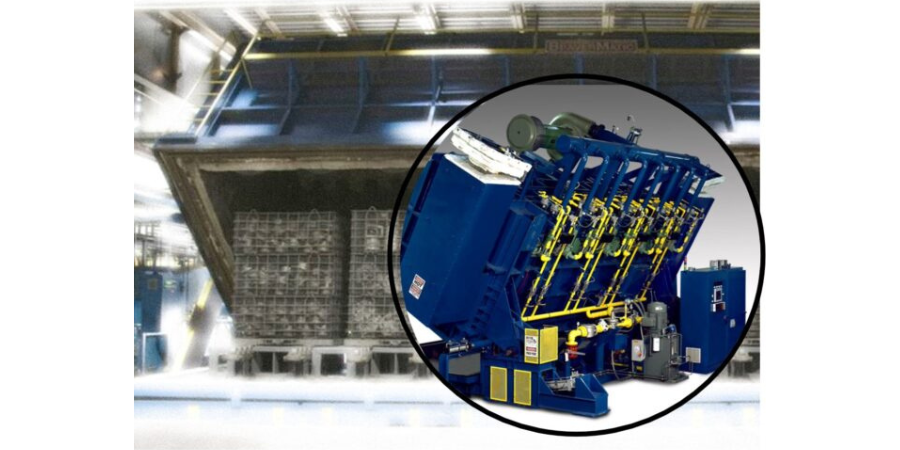
Heat Treat Today asked tip-up manufacturers to help heat treaters understand the variability of tip-up options in the market today. In this article, Gasbarre Thermal Processing Systems and Premier Furnace Specialists share unique approaches on how their own gargantuan furnaces serve heat treaters. As you read, note that customization is the critical component to operating a tip-up in your heat treat department.
This original content article is drawn from Heat Treat Today's February Air & Atmosphere Furnace Systemsprint edition. Have something to share about tip-up furnaces? Our editors would be interested in sharing it online at www.heattreattoday.com. Email Bethany Leone at bethany@heattreattoday.com with your own ideas!
Gasbarre Thermal Processing Systems
What is your system and how does it differ from historic tip-up systems?
Gasbarre has a unique offering of tip-up style furnaces. We offer systems for conventional applications such as austenitizing, solution treating, stress relieving, and tempering. In addition, we also offer atmosphere processes such as annealing and ferritic nitrocarburizing (FNC). For us, tip-up systems are not one-size-fits-all type systems. Systems are designed around our customer’s specific processing requirements. This would include thermal process requirements, load geometry and weight, temperature ranges and uniformity requirements, as well as time to quench specifications.
What are its operational advantages?
Contact us with your Reader Feedback!
When evaluating a tip-up furnace system, they are typically compared against box-style furnaces and car bottom furnaces. So, what differentiates a tip-up from these other style furnaces? First, you can achieve the main goal of large capacity batch processing, while gaining advantages over box furnaces with wider temperature ranges and tighter uniformity requirements. Box furnaces are more challenging to evenly distribute heat due to the large space requirement for the furnace door, where it is difficult to include heating elements or gas fired burners. Second, you can achieve faster time-to-quench speeds in a tip-up furnace over a car bottom furnace. Car bottom furnaces require the load to be pulled out of the furnace and then the load is typically manually moved from the furnace hearth to the quench. In a tip-up, this process can be automated and completed in 60 seconds or less. Finally, when special atmosphere processes are required, a tip-up furnace offers a superior atmosphere seal to the other furnaces mentioned. With tip-up furnaces, you can seal the furnace using its own weight. Other furnaces require additional mechanical assemblies to achieve a proper seal, which ultimately is more susceptible to leaks and requires more maintenance than a tip-up furnace seal.
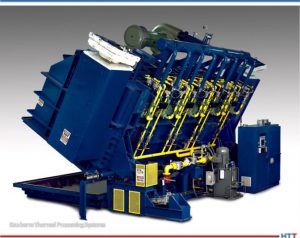
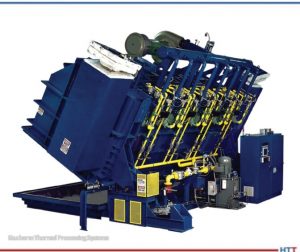
Tip-up furnace from Gasbarre Thermal Processing Systems Source: Gasbarre Thermal Processing Systems
Why should people be paying attention to what you have to offer?
Gasbarre’s broad product offering gives us the ability to evaluate your requirements objectively and offer the best solution for you and your company, whether that be box furnace, car bottom, or tip-up. Tip-up furnace systems are usually not one-off installations. These systems usually involve quenching equipment, material handling, load staging, and other integration. Gasbarre has the experience and personnel to manage such large projects and support the customer to effectively implement a system.
Premier Furnace Specialists
What is your system and how does it differ from historic tip-up systems?
The controls and automation capabilities of our furnaces set us above many older systems still in use today. On the control panel of an older system, you’re likely to see paper chart recorders, maybe a PanelView screen, and dozens of switches, pushbuttons, and pilot lights. Some of our customers prefer these control systems for their familiarity, and that’s fine because we are capable of building this style of enclosure, but most come to us for improvements or new systems entirely. Our standard panel comes with a 23.8” color touchscreen display that lets operators manage or record almost every aspect of the furnace’s operation. This package can be added to existing furnaces as well, as we have performed many control and combustion upgrades on older systems to keep them functional and reduce operating costs. We also offer tip-up furnaces that operate via jackscrews for customers who want to avoid the maintenance and flammability of hydraulics.
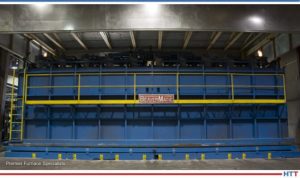
Open indirect gas-fired atmosphere furnace used to handle a variety of parts Source: Premier Furnace Specialists
Modern burner technology also offers a massive improvement over older systems. With rising energy costs for all fuel types, any increase in efficiency will quickly become a source of savings which can be redirected into other areas of your company. Improvements to burner design offer increased preheat, recuperative, and regenerative possibilities, which offer fuel savings across multiple temperature ranges and reduce emissions to keep in line with changing regulations. A standard burner can heat up and cool down faster, take less time to tune, and reduce maintenance hours and headaches compared to older models of burners with knowledgeable air and gas train design coupled with modern burners.
What are its operational advantages?
Our systems allow greater flexibility for integration with existing and future equipment as well as simplified operation. One of the largest complaints we hear in every industry is about the struggle to retain maintenance and equipment operators’ knowledge once a senior member leaves a company. For this reason, it is important to have a simplified controls interface that allows new operators to get up to speed quickly. As a service company as well as an OEM, we have extensive experience working on and upgrading many brands of equipment. This enables us to easily integrate our solutions to match what customers are familiar with while also reducing maintenance requirements.
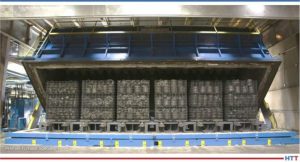
Closed furnace with work chamber of approx 31' x 9' x 9' with load capacit of 90,000 lbs. Source: Premier Furnace Specialists
Why should people be paying attention to what you have to offer?
Despite OEMs trying to convince you, sometimes a standard “cookie cutter” model just isn’t the right fit for a job. It can take years to build up a budget for a new furnace system. Don’t invest those hard earned dollars into a piece of equipment that won’t do everything you need, exactly how you need it done. We are willing to take on the jobs that require creative solutions and extensive automation. Premier’s custom engineered systems live up to our namesake. Some of our recent projects have included a 130 ft long roller hearth furnace system with automated cooling/sequencing/handling of over 40 loads simultaneously; and a car bottom furnace with a 15’ x 15’ x 15’ work chamber capable of controlled heating and cooling of 160,000-pound loads.
Find heat treating products and services when you search on Heat Treat Buyers Guide.com
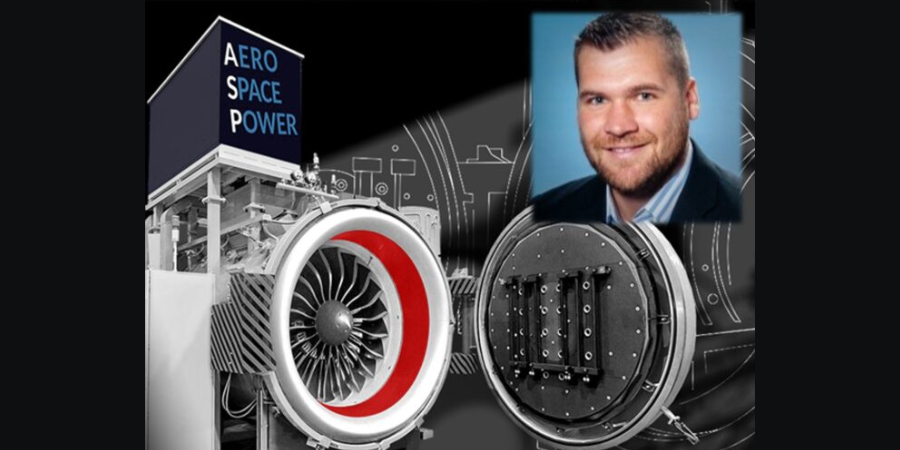
Aero Space Power, an MRO facility, has ordered a custom-made vacuum furnace tobe utilized in repair solutions for both complex aircraft engines and gas turbines in the energy industry.
Mark Peter Biro Commercial Sales Manager at Aero Space Power Source: LinkedIn
“We decided to acquire in-house heat treatment because we want to be independent in production. It will also give us much better control over the process and treated part quality," commented Mark Peter Biro, commercial sales manager, Aero Space Power. "By installing production capacity in-house and creating our own heat treatment department, we not only become independent from external suppliers, but we also significantly reduce transportation costs.”
The furnace on order from SECO/WARWICK, a company with locations in North America, is unique due to the size of the heating chamber. It has been adapted to the Aero Space Power requirements and has a working area of 51" x 39" x 59" to enable heat treatment of large components up to 55" diameter especially large aircraft parts, as well as gas turbines for the energy sector. The custom technology on order, in addition to non-standard dimensions, is designed to process work in the presence of two gases: argon (used for partial pressure) and nitrogen, which is used mainly in the cooling process. A dew point sensor for each of the gases will be included with the furnace.
Find heat treating products and services when you search on Heat Treat Buyers Guide.com
Changes are inevitable, but the world today is shifting oh so rapidly, keeping us on our toes. Two men from different parts of the world, both with significant experience within the heat treating community, reflect on the implications of these changes in the heat treat industry. With each new topic, will their views align?
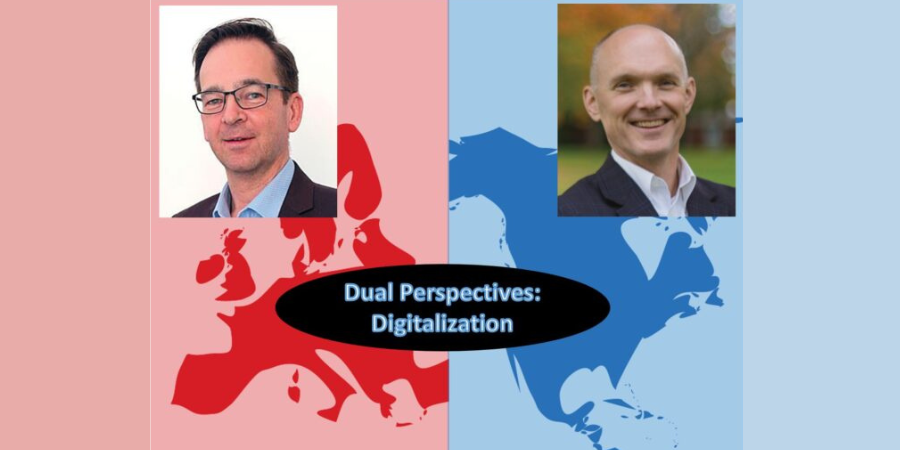
The experts are Thomas Schneidewind, editor-in-chief of heat processing magazine, and Doug Glenn, publisher and founder of Heat TreatToday. Thomas’s expertise lies in the European market while Doug’s resides in the North American market. We will feature their responses in each print magazine. Will their views run parallel or perpendicular? Time will tell. Enjoy this sixth installment of an ongoing column, first published in Heat TreatToday’s March 2023 Aerospace Heat Treatingprint edition.
Has digitalization come to heat treat operations? If so, how?
Thomas Schneidewind, Editor-in-Chief, heat processing magazine
Thomas Schneidewind Editor-in-Chief heat processing Magazine
Have you heard about the speaking furnace in the smart heat treat operations in Kleinachenbuchbach?
Contact us with your Reader Feedback!
You are right! There is no speaking furnace and no city with this name – not as far as I know. But if you think about the future of hardening shops or just have a look in the R&D departments of furnace builders, you will get an idea what the heat treat shop will look like in twenty years. Two topics will clearly shape the industry: decarbonization and digitalization. Decarbonization is the leading theme; digitalization is its enabler.
Digitalization is an important catalyst that makes decarbonization possible. It enables us to create and play out a multitude of scenarios in the shortest possible time, to exchange information globally in seconds, to free ourselves from time-consuming routine work, and to conserve, develop, and pass on knowledge gained from experience. Further, artificial intelligence (AI) has already started to augment all of our businesses, and this trend will continue to accelerate over the next years. Every company needs to think of itself as a technology company, redesign its processes, and ensure its employees have the skills needed for a world where we increasingly collaborate and work with capable and intelligent machines.
Digitalization is a key to success for small and medium sized enterprises in the heat treatment industry and a key to change the traditional heat treat shop into a smart, green, and profitable company. As the owner of a heat treat operation, you can concentrate on your business. While you talk to clients, do business, and invest in green technologies, maybe someday you will talk to your furnace and it will give you answers to much bigger questions than those connected to temperature, time, and hardness.
Doug Glenn, Publisher, Heat Treat Today
Doug Glenn Publisher and Founder Heat TreatToday
The answer to the question is a simple “yes.” Depending on what is meant by “digitalization,” it has been in heat treat operations for a number of years. The proliferation of digital chart recorders, for example, is clear evidence of that digitalization.
What digitalization will mean in the future is a mystery. One might say that digitalization is an ever-expanding final frontier, a place where we will be able to explore strange new worlds, to seek out new life and new civilizations, to boldly go where no man has gone before! (I hope you Trekkies appreciate that reference.)
To view a video, scan the code for “Cutting edge technology allows Quintus Technologies to deliver optimum technical support.”
It is, more seriously, an ever-evolving, strange new world, which currently is not widely embraced in the North American heat treat industry. Where we do see more of it is in larger companies with in-house heat treat operations. These larger companies have the IT and engineering horsepower to invest in deeper and deeper levels of digitalization.
Today, it is common for heat treat furnace manufacturers to perform computer upgrades and equipment troubleshooting remotely. It is rare, however, to see equipment servicing being performed via augmented reality (AR) where an on-site maintenance person or engineer wearing something similar to holographic glasses is helped by a “field” service technician who is hundreds or even thousands of miles away. But this type of AR-assisted field service does happen. For example, a hot isostatic press manufacturing company is promoting their ability to perform remote AR-based service. To view a video, scan the code below or do a web search for: “Cutting edge technology allows Quintus Technologies to deliver optimum technical support.” Pretty inspiring.
Find heat treating products and services when you search on Heat Treat Buyers Guide.com
Are your brake rotors heat treated? Travel back in time to discover how ferritic nitrocarburizing (FNC) became the heat treatment of choice for automakers’ brake rotors and why the tip-up furnace forever altered the production process for this part.
This Technical Tuesday article is drawn from Heat Treat Today's February Air & Atmosphere Furnace Systems print edition.If you have any information of your own about heat treating brake rotors, our editors would be interested in sharing it online at www.heattreattoday.com. Email Bethany Leone at bethany@heattreattoday.com with your own ideas!
The Problem: Brake Rotor Corrosion
Michael Mouilleseaux General Manager at Erie Steel, Ltd. Sourced from the author
In the early 2000s, corrosion was one of the top three issues that U.S. automotive manufacturers found negatively affected the perception of the quality of their cars. Brake rotors are made of cast iron. These components sit out in the elements, and in places like the U.S. Midwest where salt is often used on the roads, unprotected steel or iron will corrode or rust. Even on the coast, there is salt water in the air.
Contact us with your Reader Feedback!
What does rusting cause? The rotor rusts, and first, the cosmetics are negatively affected (i.e., rusty appearance). But more importantly, the first time you step on the brakes, it squeals like a pig, the vehicle shudders, and the driver feels pulsing in the pedal. He’ll also feel it in the steering wheel because the amount of rust coating one area is different from the amount of rust that’s on another. So, these brand new, forty- to seventy-thousand-dollar cars have orange rust over the brake rotor and a shaky drive. . . it’s not a good look!
Now, this is just a superficial coating of rust that will eventually abrade away; the rotor will look alright, the vehicle will stop better, and it won’t squeal. However, since the rust on the rotor wears off unevenly, the car may never have smooth braking.
A Move to FNC
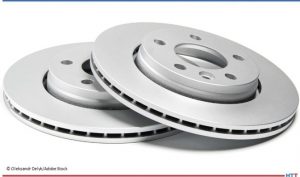
In the early 2000s, all the big players were looking to FNC (ferritic nitrocarburizing) as a solution to corrosion, including Bosch Braking Systems, Ford, General Motors, Akebono, and the truck manufacturers. FNC was becoming popular since the process adds a metallurgical layer — called the “white layer” or “compound zone” — to the part, providing corrosion resistance and the bonus of improving wear.
Source: Oleksandr Delyk/Adobe Stock
To the OEMs, the benefits were perceived as:
The corrosion issue had an answer.
The life of the rotor doubled from roughly 40,000 to 80,000 miles. Although that meant half as many aftermarket brake jobs compared to before, consumers perceived it as a real advantage.
The rotors generated less dust. Brakes generate dust particles as the result of abrasion of the pads and the rotors. This particulate dust has been identified as both an environmental and a health concern. Now, flash forward to 2022: Electric vehicles are largely displacing the need to control emissions from ICE (internal combustion engine) vehicles. So, the new European standard on vehicle emissions implemented a requirement to control this dust that is harmful to the environment and which EV and traditional brake systems can emit.
But there were certain technical and practical challenges that automotive manufacturers faced when trying to implement this process at scale.
#1 Distortion. Brake rotors may distort during FNC. Since rotors are (gray iron) castings, the process temperature for FNC may stress relieve the rotor, causing it to change shape or distort, rendering it unusable as a disc brake rotor. It was determined that if the rotor castings were stress relieved prior to machining and FNC, the distortion issue was rendered moot.
#2 Loss of Necessary Friction. FNC gives the white layer on the surface of a part with a diffusion zone underneath. The compound zone has a very low coefficient of friction, which means excellent wear properties. However, manufacturers want friction between the rotor and the brake pads to slow the car down. Reducing the friction on the rotors extends the braking distance of the car.
". . .[M]anufacturers want friction between the rotor and the brake pads to slow the car down." Source: Unsplash.com/Craig MorolfLet me illustrate this: I ferritic nitrocarburized a set of brake discs for Bosch Braking Systems, which eventually went to Germany and then on a vehicle. The customer absolutely loved the corrosion resistance, but when it was time for the downhill brake test, the car went straight through an instrument house because the brakes couldn’t stop the car! Lesson: For rotors treated with FNC, the brake pads need to be made from a different frictional material!
#3 Cost. Overcoming the technical issues is simple. Stress relieving the casting at FNC temperatures before machining it would help the parts machine better and would eliminate distortion. Modifying the FNC process could reduce the depth of the white layer and, paired with the correct friction material, the acceptable braking capabilities were restored. Yet these additional steps presented a new challenge: higher costs.
The practical constraints of FNC in conventional batch or pit furnaces strained efforts to be cost-effective. The load (size) capacity of the conventional equipment, in conjunction with the time constraints of the FNC process presented a dilemma, as the OEMs’ benchmark was about one dollar per rotor.
Here Comes the Tip-Up
With traditional furnaces for FNC, there was just no way to reach the economics that were necessary for it. A bigger pit furnace might be the way to go, but they really weren’t big enough. So, here comes the tip-up.
Traditionally, a tip-up furnace has been used for processes with just air, no atmosphere. With direct fired burners, the furnace is used for tempering, stress relieving, annealing, and normalizing. Everything loads into the box, gets fired, and unloads, similar to a car-bottom furnace. With the appropriate external handling systems parts could be retrieved from the furnace and then quenched. This additional process increased the usefulness of the equipment and allowed for the processing of tubes, bars, big castings. . . big forgings for the oil industry and the like.
The question of how to heat treat brake rotors on a large scale still needed to be answered. It required a large, tightly sealed furnace with atmospheric integrity for excellent temperature uniformity. In ferritic nitrocarburizing, the processing range is about 950°F to 1050°F. It is well known that properties vary significantly across the temperature range. And they needed to be optimized to create the appropriate frictional properties for the rotors.
So, the answer was: Let’s make a tip-up furnace that can be sealed for atmospheric integrity, has the appropriate temperature uniformity, and can circulate gas evenly. A lot of this would have to be iterative — create, test, compare, repeat.
Tip-up furnace from Gasbarre Thermal Processing Systems Source: Gasbarre Thermal Processing Systems
The development of the perfect tip-up was essentially the work of one furnace manufacturer and one heat treater who together changed the industry.
American Knowhow Makes the Perfect Tip-Up
In the early 2000s, heat treaters worked with OEMs to develop a cost-efficient process in a tip-up. Manufacturers and service providers tested different methods, including atmosphere FNC and salt bath FNC.
By 2009, the perfect atmosphere furnace was complete and high volume brake rotors began to be processed for General Motors. The furnace manufacturer was JL Becker, Co., acquired by Gasbarre in 2011. The commercial heat treater was Woodworth, Inc., located in Flint, MI. Together, they spent a lot of time and money looking into FNC and figuring out how to make it work in a tip-up furnace.
General Motors was the first one to get on board, utilizing the FNC processed rotors on their pickup trucks and big SUVs, like the Escalade and Tahoe. Ford was not far behind using it on their F150 pickup truck. I was shocked the first time I saw the commercial: a Silverado pickup truck, out in the snow, and the speaker saying, “We now have an 80,000-mile brake system because of a heat treating process called FNC!”
It’s a great story of American knowhow and a collaborative effort between someone who saw a need and someone else who saw the way. To this day, if you want to get a replacement set of brake rotors for your car, go to a place like AutoZone; they will tell you that the difference in cost between the OEM parts and an off-brand is the fact that the off-brand is not heat treated.
About the author: Michael Mouilleseaux has been at Erie Steel, Ltd. in Toledo, OH, since 2006 with previous metallurgical experience at New Process Gear in Syracuse, NY, and as the Director of Technology in Marketing at FPM Heat Treating LLC in Elk Grove, IL. Having graduated from the University of Michigan with a degree in Metallurgical Engineering, Michael has proved his expertise in the fi eld of heat treat, co-presenting at the Heat Treat 2019 show and currently serving on the Board of Trustees at the Metal Treating Institute.
Rick Bucher President and CEO at Victaulic Source: LinkedIn
On March 30, 2023, Victaulic, a manufacturer of mechanical pipe joining, fire protection and flow control solutions, acquired Horizon Metals Inc., a foundry with heat treatment capabilities, located in Nephi, Utah. The acquisition supports growth in the infrastructure and waterworks market by increasing capacity for large-diameter piping solutions made in the U.S.
Horizon Metals, Inc. has been a family-owned and operated iron and steel foundry with heat treating capabilities including: austenitizing, normalizing, water/air quench, tempering, stress relieving, and solution annealing. "Horizon Metals represents Victaulic’s fifth foundry in North America and our fourth foundry located in the United States.” commented Rick Bucher, president and chief executive officer of Victaulic.
Find heat treating products and services when you search on Heat Treat Buyers Guide.com







 Find heat treating products and services when you search on Heat Treat Buyers Guide.com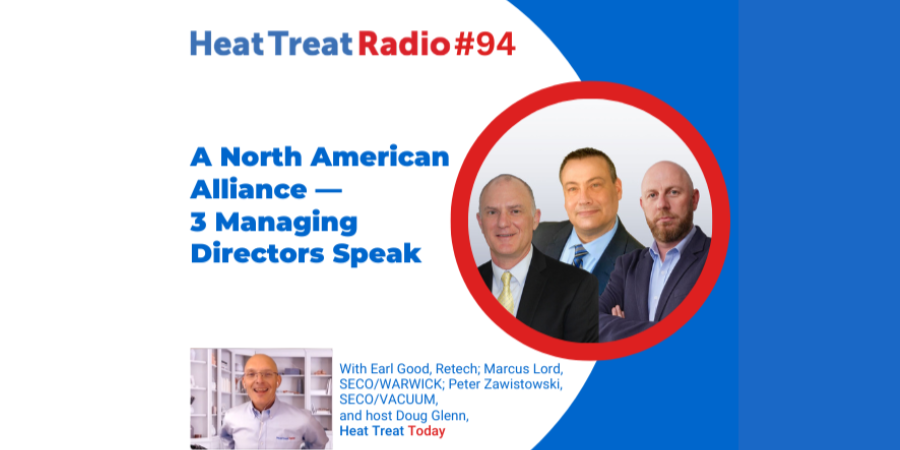
 In a special