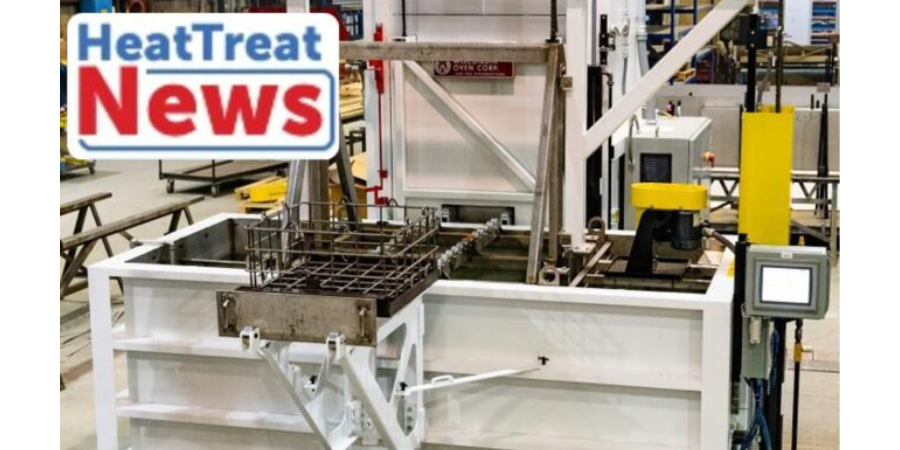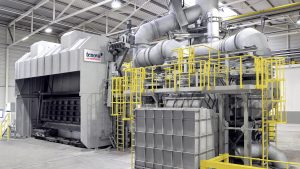
An East Troy, WI, heat treat systems manufacturer announced the shipment of an electrically heated horizontal quench system to a manufacturer of products for the automotive industry, specifically for aluminum solution treatment.
Wisconsin Oven manufactured the system with a maximum temperature of 1,200°F and interior chamber dimensions of 2' x 2' x 2'. The system has the capacity to heat 450 pounds of aluminum parts plus the steel basket within 60 minutes. Temperature uniformity of +/- 10°F at set points 850°F and 1,050°F was verified with a nine point profile test prior to shipment.
This horizontal quench system provides a 15-second quench delay from when the door begins to open until the load is fully submerged in the tank. The quench is manual, where the operator pulls the load out of the oven and onto the quench elevator using a hook. "This horizontal quench system was designed with a manual quench which is a cost-effective option and still ensures there are no improperly processed parts," commented Doug Christiansen, senior application engineer at Wisconsin Oven. "The system also features foldable unload wheel rails to save on floor space.”
Find heat treating products and services when you search on Heat Treat Buyers Guide.com
In previous months, this series has explored the geometry of a tube, why radiant tubes matter, what happens inside the tube, and radiant tube control systems. For the first three installments, check out Heat Treat Today’s digital editions in November 2022, December 2022, and February 2023. For the month of May, we will continue our discussion of different modes of control for radiant tube burners.

This column is a Combustion Corner feature written by John Clarke, technical director at Helios Electric Corporation, and appeared in Heat Treat Today’s May 2023 Sustainable Heat Treat Technologiesprint edition.
If you have suggestions for radiant tube topics you’d like John to explore for future Technical Tuesdays, please email Bethany@heattreattoday.com.
John B. Clarke Technical Director Helios Electric Corporation Source: Helios Electric Corporation
High/low and on/off controls require different control strategies from a proportional mode of control. In all cases, we assume the temperature control will be provided by a proportional-integral-derivative loop (PID loop). The function can be provided by a stand-alone instrument or a PID function in a programmable or process controller. The PID algorithm looks not only at the temperature of the process as indicated by the control element (thermocouple or RTD) and compares it to the setpoint — but it also considers the offset and rate of change as well. When properly tuned, a PID control loop can provide control accurate enough to match the process (actual) temperature to the setpoint within a degree or two.
For the lay person, another way of describing a PID loop is to consider how a driver regulates the speed of his automobile. Assume you are driving and want to catch up with and follow the car ahead of you — to do so, you need to match that car’s speed and maintain a safe distance. What you don’t do is floor the automobile until you get to the desired following distance and then hit the brakes. What you do is first accelerate to a speed faster than the target car to close the gap, then you instinctively take your foot off the accelerator when you get close, slowing gradually until your speed and position are as you desire. In this example, you have considered your speed, how close you are to the car you are attempting to follow, and the rate at which you are closing the gap. A PID loop is nothing more than a mathematical model of these actions.
The PID control loop provides an output — the format can vary, but it is in essence a percent output. It is a percent of the maximum firing rate the system needs to provide to achieve and maintain the desired furnace temperature. This percent output can be translated directly into a proportional output for proportional control — where the firing rate is proportional to the loop’s output.
On/off or high/low controls require a different approach where a time proportioning output is provided in which the burner fires on and off on a fixed time cycle. In this mode of control, the PID loop’s output is multiplied by the cycle time to determine the on or high fire period and the on or high fire time is subtracted from the cycle time to determine the off or low fire period. Cycle times can run from as little as 30 seconds to as much as a few minutes. Obviously, the shorter the cycle time, the more responsive the control, but also the more wear on the control components. The cycle time should be as long as possible but still meet the needs of the process control.
Don’t confuse these pulses with other control methods that are marketed as pulse firing. When people speak of pulse firing, they often mean a pattern with alternate burners firing to provide greater temperature uniformity and heat transfer. This is a very interesting subject and the topic for another day.
Find heat treating products and services when you search on Heat Treat Buyers Guide.com

Heat Treat Today publishes eight print magazines a year and included in each is a letter from the publisher, Doug Glenn. This letter first appeared in Heat Treat Today's March 2023 Aerospace Heat Treating print edition.
Doug Glenn Publisher and Founder Heat Treat Today
Depending on where you live, “green” started to appear outside in March.
Contact us with your Reader Feedback!
Such was the case this March with Heat Treat Today. Our efforts were “greening up” around here as well. With the push for sustainability and environmental corporate responsibility, we decided to start the industry’s first and only “green” heat treat annual magazine edition and quarterly e newsletter. The Heat Treat Today team has been working on these items for several months now, but we are officially announcing them this month and encouraging you to watch for them both in May.

Whether you’ve been mandated to make your in-house heat treat operation more sustainable, or you want to do it simply because it’s the right thing to do, we’re here to help.
NEW Green Technologies in Heat Treat Annual Print Edition
Heat Treat Today's May print magazine will be the inaugural yearly focus on Green Technologies in North American heat treat. We’ll have articles and special editorial sections focused on sustainable technologies currently or soon-to-be available in the North American heat treat industry. This highly-focused issue will give industry suppliers a chance to shout loud and far about the technologies they have that will help you make your in-house heat treat operation more sustainable and productive. We anticipate topics such as:
Induction heating equipment
Electrical furnaces and ovens, including vacuum furnaces
High-efficiency gas-fired equipment
High-efficiency burners
Efficiency-maximizing control systems
Energy-saving insulating materials
Emission control or capture
Eco-friendly quench media
Economizing cooling systems
Industrial gas economizing systems
High-efficiency radiant tubes
High-efficiency heating elements
Potentially, there will be many other topics added to this list. There should be something for everyone who is interested in making their in-house heat treat operations, or commercial heat treat shop, more sustainable. I hope you look forward to receiving your copy and enjoying the content . . . in May!
NEW Quarterly Heat TreatGreen E-Newsletter
Sustainable technologies come into the market more than once a year, so, Heat Treat Today is launching a new quarterly e-newsletter this May that focuses on sustainable heat treat technologies for the North American marketplace. This e-newsletter, aptly named Heat Treat Green, will also focus on emerging and currently available sustainable technologies and products that will help your heat treat operations reduce environmental waste in a responsible manner. We anticipate that this e-newsletter will be deployed in the months of February, May, August, and November each year.
Do You Have a Green Story To Tell?
In both the annual magazine edition and the quarterly e-newsletter, we’d be interested in publishing your in-house heat treat sustainability story if you have one to tell. Our readers benefit from hearing what other manufacturers are doing to make their heat treat operations more sustainable. Many chief compliance officers or others in your organization responsible for promoting sustainable practices are typically quite interested in telling their sustainability stories. If that’s you or your company, we’d like to help you get the word out to the North American heat treat industry. Please contact our editors at editor@heattreattoday.com, and we’ll be sure to be in touch
Finally, if you’re a supplier to the North American heat treat industry and your product has a sustainability story to tell, you also should contact our editors: editor@heattreattoday.com.
Keep your eyes peeled for Heat Treat Green!
Find heat treating products and services when you search on Heat Treat Buyers Guide.com
In 2007, an indirectly heated roller hearth furnace with energy-efficient REKUMAT® burners was put into operation at a Schaeffler plant in Germany. These burners were serviced last fall in Renningen and adapted in order to be operated with both natural gas and H2 as fuel with high efficiency and lowest emissions. The successful commissioning with natural gas has already been carried out, and once the hydrogen infrastructure has been established, commissioning with H2 as fuel gas will proceed.
With this and other conversions as well as newly built projects, Schaeffler is demonstrating its comprehensive commitment to sustainability while investing in the long-term future of the respective plants. Wienstroth Wärmeprozesstechnik GmbH in building the plant and then servicing it recently helps with the adaptation to H2 as fuel. This conversion is possible for many existing plants with reasonable effort, without having to install new burners. Until the necessary hydrogen infrastructure is available, continued operation on natural gas or mixtures of natural gas and hydrogen is possible.
Find heat treating products and services when you search on Heat Treat Buyers Guide.com
Heat Treat Todayoffers News Chatter, a feature highlighting representative moves, transactions, and kudos from around the industry. Enjoy these 39 news bites that will help you stay up to date on all things heat treat.
Equipment Chatter
The precision forging manufacturer Jiangsu Pacific Precision Forging Company has placed an order with SMS group for a fully automatic MP 3150 eccentric closed-die forging press. Pacific Precision will be able to forge aluminum chassis components on a much larger scale. This new expansion provides Pacific Precision with access to the growing automotive market segment for more lightweight designs.
A commercial heat treater in Mexico purchased a third vacuum furnace from SECO/WARWICKGroup.
Ecocat India, a catalyst manufacturer, has ordered an advanced technology vacuum gas cooling furnace from SECO/WARWICK. The system will carry out brazing and annealing processes.
Several new CAB lines have been ordered from SECO/WARWICK to be delivered to manufacturers in China. Two companies specifically chose EV/CAB lines while another manufacturer purchased a CAB line.
SECO/WARWICK delivered two CAB lines and one universal chamber furnace for aluminum brazing to an automotive manufacturer in China. The systems will braze large-size coolers for vehicle batteries.
Oetzbach Edelstahl GmbH, a hardening plant, has purchased a third furnace from SECO/WARWICK.
A Swiss commercial heat treater ordered a brazing furnace to be used for nickel and silver from SECO/WARWICK.
Tenova LOI Thermprocess has completed the production optimization of a new Twin-Chamber Melting Furnace (TCF®) at E-Max Billets in Kerkrade, the Netherlands.
An Asian thread rolling die conglomerate selected a SECO/WARWICK vacuum furnace. The Vector® will be used for vacuum hardening and tempering fastener dies.
Vacuum furnace for heat treater in Mexico
SECO/WARWICK vacuum gas cooling furnace for Ecocat India
Box furnace for a manufacturer
Brazing furnaces for automotive manufacturer in China
3rd furnace for Oetzbach Edelstahl from SECO/WARWICK
SECO/WARWICK\’s brazing furnace for Swiss heat treater
TCFR for aluminum scrap recycling
Heat treated flat thread rolling dies
Company and Personnel Chatter
Hubbard-Hall has expanded its product offering and customer resources by acquiring the assets of Torch Surface Technologies, a specialty chemical company based in Whitmore Lake, MI.
New simulation software is being launched at CENOS Simulation Software. The application portfolio expands with some new electromagnetic case software apps. The first apps will be launched in Q4 or a little later.
Solar Atmospheres of California announced it has been awarded the approval to process parts for Lockheed Martin (LMCO) owned Sikorsky. The Sikorsky approval adds to the existing LMCO process specifications held for vacuum heat treatment of titanium, nickel alloys, and stainless steel per AMS 2801, AMS 2774, AMS 2759/3, and others.
Nel Hydrogen US, a subsidiary of Nel, has entered into a joint development agreement with General Motors to help accelerate the industrialization of Nel’s proton exchange membrane (PEM) electrolyzer platform. The two companies are looking to enable more cost competitive sources of renewable hydrogen.
The Supervisory Board of thyssenkrupp AGextended the appointment of Oliver Burkhard by five years. Burkhard has been a member of the Essen-based group's Executive Board since February 2013, Thyssenkrupp AG director of Labor since April 2013, and additionally CEO of thyssenkrupp Marine Systems since May 2022.
Joe Coleman, cyber security officer of Bluestreak Consulting™, has earned his Cyber AB CMMC Certification as a Registered Practitioner (RP). CMMC is a U.S. Department of Defense (DoD) program that applies to Defense Industrial Base (DIB) contractors.
CG Thermal welcomes associate process engineer Signe Laundrup to the Process Systems Group. Laundrup is a 2021 chemical engineering graduate from the University of California, San Diego. Her background is in manufacturing and research and design.
Tata Steel signed a memorandum of understanding with SMSGroup to reduce carbon emissions at Tata’s integrated steel plants across India.
Two heat treat technology companies integrate: C3 Data’s real-time pyrometry compliance software enables digital uploading of certificate data of all TT Electronics.
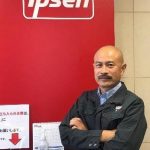
Ipsen Japan announced the addition of Mr. Masakazu Kanaka in the role of customer service director. Kanaka is responsible for the growth of all Ipsen Japan customer service business, which includes retrofits, parts, and service. He will oversee the aftermarket sales team and field service engineers.
Solar Atmospheres of California announced Honeywell approval to heat treat austenitic steels, martensitic steels, pH steels, tool steels, nickel alloys, cobalt alloys, titanium alloys, and magnetic alloys.
Aluplast – ZTG, an Altest company, recently expanded its production capacity with a second Nitrex nitriding system. The second furnace, a model N-EXT-612, is capable of processing a load of extrusion dies weighing up to 1300lbs.
Solar Atmospheres of Michigan is pleased to announce the addition of Chris Molencupp as their new sales manager.
Metal Exchange Corporation announced that Matt Rohm, current President and Chief Operating Officer (COO), will be promoted to Chief Executive Officer (CEO) of Metal Exchange Corporation effective January 1, 2023. At that time, current CEO Rick Merluzzi will assume the title of executive vice chairman, serving as an advisor to executive chairman, Mike Lefton, on key strategic initiatives for the organization, through the end of 2023.
Quintus Technologies joins the newly opened Application Center at RISE to support further development of additive manufacturing. The AM Center will also include the Quintus press model QIH 15L-2070.
Abbott Furnace Company announced that it has partnered with Obsidian Technical Group for sales and service support across much of the eastern United States.
Robert Roth announced the appointment of Nelson Sanchez as RoMan’s new president, effective January 1, 2023. Sanchez is the first non-family member to hold the office.
Hubbard-Hall hired Aaron Mambrino as chief financial officer. Her expertise lies in driving process changes to create operational synergies, developing strategic partnerships, and LEAN manufacturing.
John Savona, vice president of Americas Manufacturing and Labor Affairs, Ford Blue, will retire on March , after more than 33 years. Bryce Currie will step into the role.
AFC-Holcroft welcomed employees and their families, company retirees, and invited guests to view their newly renovated building as part of an open house.
Solar Atmospheres of California participated in the “Spark of Love” toy drive in coordination with the San Bernardino County Fire Department.
Raytheon Technologies expands Bengaluru operations with opening of Pratt & Whitney India Engineering Center. The facility is co-located with Pratt & Whitney’s India Capability Center and Collins Aerospace engineering and global operations centers.
Lucifer Furnaces in Warrington, PA, a manufacturer of heat treating furnaces and ovens for the last 80 years, has added Brett Wenger to its leadership team as vice president of sales.
Signe Laundrup, CG Thermal
Tata Steel and SMS Group to reduce carbon emissions
Mr. Masakazu Kanaka, customer service director, Ipsen Japan
Matt Rohm, CEO, Metal Exchange Corporation
Nelson Sanchez, new president of RoMan Manufacturing
Bill Disler, President & CEO of AFC-Holcroft, during the open house
Christmas toys for kids in Southern CA
Opening of Pratt & Whitney\’s India Engineering Center
Brett Wenger new vice president of sales at Lucifer Furnaces
Kudos Chatter
Global Thermal Solutions celebrates 15 years in Mexico.
Ipsen USA announced that 2023 represents a milestone anniversary. This year marks 75 years since Harold Ipsen founded the company.
Desktop Metal is sponsoring on a new season of BattleBots. The completely rebuilt robot is aided by the design freedoms and fast turnaround times of metal 3D printing.
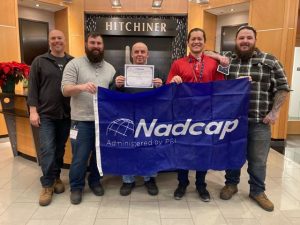
Solar Atmosphere’s Michigan and Western Pennsylvania facilities have recently been awarded Nadcap Merit status for vacuum heat treating and brazing.
In September, the Swiss Steel Group (SSG) held the 1st Hydrogen Symposium at the Henrichshütte Iron and Steel Works in Hattingen. Speakers from academia, business, and politics held lectures in four sessions.
Borikengineers, a team mentored by Pratt & Whitney employees in Puerto Rico, has advanced to the Qualifiers’ Finals Competition in the FIRST Tech Challenge DC Qualifier. The team won the Judges Choice Award.
Hitchiner Manufacturing Nadcap accredited
SawBlaze on Discovery Channel\’s TV show, \”BattleBots\”
Borikengineers, Judges Choice Award winners
Heat Treat Today is pleased to join in the announcements of growth and achievement throughout the industry by highlighting them here on our News Chatter page. Please send any information you feel may be of interest to manufacturers with in-house heat treat departments especially in the aerospace, automotive, medical, and energy sectors to sarah@heattreattoday.com.
Find heat treating products and services when you search on Heat Treat Buyers Guide.com
Heat Treat Today’s Technical Tuesday feature means that on just about any given Tuesday, there will be an article that aims to educate our heat treating readers—be it in a process, equipment, metals, analysis, critical parts, or more. Enjoy this sampling of Technical Tuesday articles from the past several months.
Case Study: Heat Treat Equipment Meets the Future Industry Today
Contact us with your Reader Feedback!
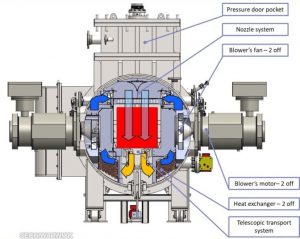
Construction and schematic furnace cross-section CMe-T6810-25 Source: SECO/WARWICK
How has one heat treat furnace supplier contended with modern challenges of manufacturing? In this case study about a shift away from traditional forms of heat treat, explorehow vacuum furnace technology has more technological horizons to bound.
Several key features discussed will be the various challenges that characterize modern industry; the differences between historical heat treat furnaces and vacuum furnaces; furnace features that can meet these obstacles; and a close look at what one equipment option from SECO/WARWICK helps. Additionally, explore the case study of a process that resulted in the following assessment: "all technological requirements have been met, obtaining the following indicators of efficiency and consumption of energy factors calculated for the entire load and per unit net weight of the load (700 kg)."
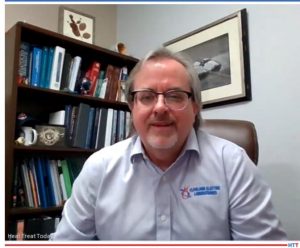
Eric Yeager of Cleveland Electric explaining the 101 of all things thermocouple Source: Heat Treat Today
How do thermocouples work? How would you tell if you had a bad one? Those ever present temperature monitors are fairly straightforward to use, but when it comes to how it works — and why — things get complicated.
This transcript Q&A article was published in the print edition last year (2022), but there was too much information to fill the pages. Online, read the full-length interview, including the final conversation about how dissimilar metals create EMF. Included in the discussion is proper care of the T/C and knowledge of when it’s time to replace.
Trends in the heat treat industry Source: Unsplash.com/getty images
What’s “hot” for heat treaters in recent months? The trends are pointing towards streamlining upgrading information systems, more efforts to reduce carbon footprint, and ensuring processes in salt quenching and electricity use are as efficient as they can be.
Each of the 6 trends included in the article demonstrates that heat treaters are making thoughtful and responsible decisions and purchases. Considerations include care for the environment and methods to help employees share and receive information needed for each job.
Read more about each of the trends to see what’s happening with equipment purchases and technology decisions and how companies are pushing to make that carbon footprint smaller.
A Quick Guide to Alloys and Their Medical Applications
Sneak peak of this medical alloys resource Source: Heat Treat Today
If you're pining for a medical heat treat quick resource in our "off-season," we have a resource for you. Whether you are a seasoned heat treater of medical application parts or not, you know that the alloy composition of a part will greatly determine the type of heat treat application that is suitable. Before you expand your heat treat capabilities of medical devices, check out this graphic to quickly pin-point what alloys are in high-demand within the medical industry and what end-product they relate to.
The alloys addressed in this graphic are: titanium, cobalt chromium, niobium, nitinol, copper, and tantalum.
Resource -- Forging, Quenching, and Integrated Heat Treat: DFIQ Final Report
Examples of DFIQ equipment Source: Joe Powell
How much time and energy does it take to bring parts through forging and heat treatment? Have you ever tried to integrating these heat intensive processes? If part design, forging method, and heat treat quenching solutions are considered together, some amazing results can occur. Check out the report findings when the Direct from Forge Intensive Quenching (DFIQTM) was studied.
Forgings were tested, in three different locations, to see if immediate quenching after forging made a difference in a variety of steel samples. The report shares, “The following material mechanical properties were evaluated: tensile strength, yield strength, elongation, reduction in area and impact strength. Data obtained on the mechanical properties of DFIQ forgings were compared to that of forgings after applying a conventional post-forging heat-treating process.”
Plot your heat treat events with Heat TreatToday's Industry Calendar. This planner is located under "Resources" on www.heattreattoday.com, and it is always updating with the latest industry events. Thinking about those summer plans? Make sure to add some heat treat trade shows and events to your schedule!
If you have an event to add -- or want to give us a heads up on an event that you and others are going to attend -- feel free to reach out to the editors at editor@heattreattoday.com.
Head on over to the "Resource" tab on the website to find the Industry Calendar located fifth down. This calendar let's you search by month in list or calendar view format so that you can visualize your season with ease.
Preview of Summer 2023 events
ThermProcess 2023
When: June 12 - June 16
"ThermProcess is the world’s most important platform for the presentation of highly innovative technology and environmental concepts for industrial thermal processing plants. It's part of the international trade fair quartet made up of: GIFA, METEC, THERMPROCESS and NEWCAST. International buyers, users, experts and decision makers from the metallurgy, heat technology and foundry industries meet here at four events, at the same time and at the same place."
Additive Manufacturing with Powder Metallurgy Conference (AMPM) 2023
When: June 18 - June 21
"Focusing on metal additive manufacturing, AMPM2023 will feature worldwide industry experts presenting the latest technology developments in this fast-growing field. 'Presenting cutting-edge R&D at AMPM conferences, one of the world's leading forums on metal additive manufacturing, provides a unique opportunity for technology transfer between peers,' commented Joseph T. Strauss, president at HJE Company, Inc."
ALUMINIUM CHINA
When: July 5 - July 7
"ALUMINIUM CHINA brings together high-quality resources from the aluminium industry and end-use applications at home and abroad to comprehensively display innovative technologies and products. We actively promote the synergistic development of the upstream and downstream of the industry, expand business opportunities, and jointly draw a new path for the sustainable development of the global aluminium industry."
There's so much more! Explore theIndustry Calendarhere.
Find heat treating products and services when you search on Heat Treat Buyers Guide.com
What is the connection between AMS2750 specifications and furnace classifications? With tight specifications, what does the heat treater need to know to be compliant? Follow along as we take a brief look into this often-overlooked topic.
This Technical Tuesday article, written by Douglas Shuler, owner and lead auditor, Pyro Consulting LLC, was first published in Heat Treat Today's March 2023 Aerospace Heat Treating print edition.
Doug Shuler Lead Auditor Pyro Consulting
AMS2750 is the specification that covers pyrometric requirements for equipment used for the thermal processing of metallic materials. AMEC (Aerospace Metals Engineering Committee) is one of the committees which oversees the changes and revisions of AMS2750. There are five main sections in the technical requirements of the specification: sensors, instrument calibrations, thermal processing classification, SAT (system accuracy testing), and TUS (temperature uniformity surveys). Additionally, there are quality provisions that detail what happens if a calibration or test is either past due or fails.1
Contact us with your Reader Feedback!
Revisions to the original requirements have occurred over the years, with the newest being Revision G. The structure of Revision G has carried over from Revision F and has remained the current structure of the AMS2750 specification. This structure includes furnace classes, which are based on the minimum requirements for temperature uniformity.
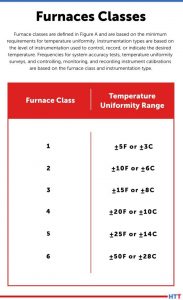
Furnace classes are defined in Figure A of Revision D Figure 1.
Figure 1. AMS2750G furnace class uniformity tolerances Source: Doug Shuler
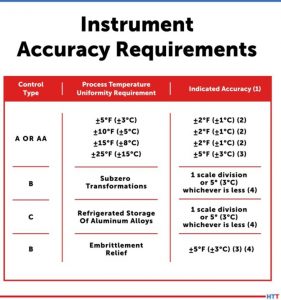
Originally, furnace classes were based on temperature uniformity, but also subzero transformation, refrigerated storage of aluminum alloys, and embrittlement relief, Figure 2.
Figure 2. Original AMS2750 instrument accuracy requirements, no class structure Source: Doug Shuler
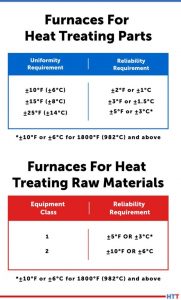
AMS2750 Revision C was released in May 1990 and started to implement the class and instrumentation type structure and differentiated between furnaces for heat treating parts versus furnaces for heat treating raw materials. Furnaces for heat treating parts were classified based on uniformity, but also on a readability requirement. Furnaces for heat treating raw materials were classified based on a readability requirement alone.
AMS2750 Revision D was released in September 2005 and continued to define equipment class (Figure A)* and instrumentation type (Section 3.3.1.1)*. It also clarified chart recorder resolution (Table 4)*, print and chart speed (Table 5)*, and testing frequencies for SAT (Tables 6, 7)* and TUS (Tables 8, 9)* for the processing of parts versus raw materials.
AMS2750 Revision E was released in July 2012 and continued to build on the clarity presented in Revision D by adding an instrumentation type table (Figure 3)* instead of a simple text description in the body of the specification.
Figure 3. AMS2750 Revision C: distinguishment between furnaces for heat treating parts versus raw materials Source: Doug Shuler
Moving to AMS2750 Revision F, the specification saw a major rewrite and restructuring where the tables were moved from the end of the document to the first area text that called out the specific table. Revision F also put into place a sunset date for analog instruments.
That brings us to the current revision of AMS2750, Revision G, which has carried forward the structure of Revision F and only sought to further clarify the intent of the requirements.
Over the years, the technology of sensor, instrument, and furnace manufacture and capability has continued to produce better and tighter controls for the process of heat treating. The evolution of AMS2750 has recognized these advancements and has kept pace with them in technology. The understanding of the origins of AMS2750 and how it has evolved is vital in understanding its application to today’s heat treat special processes.
*Specified figure, table, or section is associated with the AMS2750 revision being discussed.
About the Author: In 2009, Douglas (Doug) Shuler became the owner of Pyro Consulting LLC and also began working with Performance Review Institute (PRI), first as an instructor and course developer and later as an auditor for the Nadcap program. As a lead auditor for Nadcap, he has conducted over 380 Nadcap special process and aerospace quality management system audits on behalf of the Aerospace Primes over the past 10+ years. Doug continues to focus on instruction, training, and education for the heat treat industry, developing courses, authoring exams, and employing the PIE method: “Procedures that Include all requirements, and Evidence to show compliance.”
This sixth article in the series from the Cybersecurity Desk will give you a better understanding of how to submit your basic NIST 800-171 self-assessment score into SPRS (Supplier Performance Risk System).
Today’s read is a feature written by Joe Coleman, cybersecurity officer at Bluestreak Consulting™. This column is in Heat Treat Today’sMarch 2023 Aerospace Heat Treating print edition.
Introduction
This sixth article in the series from the Cybersecurity Desk will give you a better understanding of how to submit your basic NIST 800-171 self-assessment score into SPRS (Supplier Performance Risk System).
Why Should You Do This?
Joe Coleman Cybersecurity Officer Bluestreak Consulting™ Source: Bluestreak Consulting™
The Defense Federal Acquisition Regulation Supplement (DFARS) 252.204-7020 is one of the three newly released clauses (after the original 252.204-7012) of the DFARS 252.204-70 series (7019, 7020, 7021) in November 2020. DFARS 252.204-7019 is the “Notice of NIST 800-171 DoD Assessment Requirements”; whereas DFARS 7020 consists of the requirements alone. DFARS 7020 requires you to submit your basic NIST 800-171 self-assessment score to SPRS. Contractors and service providers are to provide the government access to its facilities, systems, and personnel any time the Department of Defense (DoD) is renewing or conducting a Medium or High assessment.
Once your self-assessment score has been submitted and accepted into SPRS, you will be eligible to be awarded contracts. Your score must remain in SPRS throughout the duration of the contract(s). You’ll need to show that you are working towards full compliance.
If a self-assessment score submitted to SPRS is required in order to win a contract, and you don’t have a self-assessment score in the system because you don’t have CUI, does that mean you will lose the contract? Maybe.
The requirement for NIST SP 800-171 DoD self-assessment is being enforced whether or not you have CUI. So, it makes sense to get started on this ASAP to position your company for additional business. Plus, having better cybersecurity controls in place is definitely a business best-practice.
How To Submit Your Basic Self-Assessment Score to SPRS
There are two ways to submit your basic self-assessment score to SPRS.
Option 1: Using email to send the information. Submitting your self-assessment score via email to SPRS includes the following steps:
Get an accurate NIST 800-171 Self-Assessment and Score. Conduct the self-assessment and obtain your score using cybersecurity professionals that carefully follow the required DoD Assessment Methodology for NIST Special Publication (SP) 800-171A.
Identify your SPRS “Scope of Assessment.” Your SPRS score submission will fall into one of three categories: Enterprise, Enclave, or Contracts.
Determine your expected completion date. The “Plan of Action Completion Date” must be determined according to your compliance project timelines.
Find your commercial and government entity CAGE codes. Your CAGE codes represent the part(s) of your organization included in the assessment and represented in the final System Security Plan (SSP) document.
Provide a brief description of the SSP format and system architecture.
Submit your self-assessment score to SPRS. To submit your score, send an email (optionally encrypted and signed) to webptsmh@navy.mil with the subject line “SPRS Self-Assessment Score Submission” in the exact format specified below:
Assessment date
Assessment score
Scope of assessment
Plan of action completion date
Included CAGE(s) codes
Name of System Security Plan (SSP) assessed
SSP version/revision
SSP date
Wait for email confirmation
Option 2: Using the PIEE (Procurement Integrated Enterprise Environment).
Register a PIEE account at https://piee.eb.mil/. Once your business is registered, choose the SPRS link and follow all instructions. You will need to provide all the same information as shown in Option 1.
Funding & Cost Sharing May Be Available for Heat Treaters
With the huge push for stricter cybersecurity practices by the government and many businesses, cost sharing and funding sources have been identified that may cover a substantial percentage of the costs associated with these critical cybersecurity projects. Every state has at least one MEP (Manufacturing Extension Partnership). Many states are more than willing to help out with the cost of implementation.
About the Author:
Joe Coleman is the cybersecurity officer at Bluestreak Consulting™, which is a division of Bluestreak | Bright AM™. Joe has over 35 years of diverse manufacturing and engineering experience. His background includes extensive training in cybersecurity, a career as a machinist, machining manager, and an early additive manufacturing (AM) pioneer. Contact Joe at joe.coleman@go-throughput.com.
Find heat treating products and services when you search on Heat Treat Buyers Guide.com
Metallography and nitriding, while two separate things, actually have a relationship. Do you know what it is? Would you be surprised to know that one enhances the other? Read this best of the web article to clearly see how metallography results help the nitriding of ferrous alloys be the best that it can be.
Find out how metallography is an essential tool in the nitriding process. Take a look at some basic definitions and peruse some microscope images that help explain what nitriding does to different materials. Dig even deeper with discussion of problems such as not enough stress relief and the presence of sulfides. Metallography helps explain, in this article, what nitriding can do for many different applications.
An excerpt:
Producing the best nitrided layers for the given application requires a good cooperation between designers of the product and the manufacturing companies making it . . . . Metallography of the parts, or samples which run together with them, is extremely important for verifying results of this thermochemical treatment and assessing the properties of the layer formed during, the data are also used for maintaining a good predictability of the process.