Mobile Maintenance Assistants for Thermal Processing Plants
This HTT Technical Tuesday feature originally appeared in heat processing, a Vulkan-Verlag GmbH publication that serves mostly the European and Asian heat treat markets and with whom we are partnering to share the latest news, tech tips, and cutting-edge articles that will serve our audience – manufacturers with in-house heat treat.

CEO
Aichelin Service GmbH
In this article, Carsten Stölting, CEO of Aichelin Service GmbH, explores bringing maintenance systems into the digital era with a digital assistance system for thermal processing plants.
"To this day, the maintenance of heat treatment plants is characterized mostly by manual work; very few digital tools exist for information display, plant support, data acquisition, or data collection. This means that, in this field, only very few of the possible advantages of digitization are being used. Mobile maintenance assistants are thus a real opportunity to support maintenance departments in their daily work. They also increase the potential for cost savings due to their better efficiency and the fact that they reduce down times. This article provides a general overview of the status quo. Moreover, #jakob\safe.sound, a novel mobile assistance system for thermal processing plants is presented."
In general, it has become clear over the course of recent years that manufacturing companies see maintenance no longer as a mere cost factor and a necessary evil, but have rather come to recognize it as a real value-adding factor for their production. Many production managers know about the relevance of a well-functioning maintenance system for the economic success of their production. And yet, maintenance as a non-direct profit earner remains under great pressure from cost savings. Saying that well-functioning maintenance guarantees efficient and successful production while at the same time being under pressure due to cost factors in fact demonstrates two diametrically opposed assumptions. This should create an ideal environment for innovative solutions and approaches. Regrettably though, especially in the heat treatment industry, this trend towards innovation has not quite been acknowledged.
Even companies with a strong maintenance strategy lack method to take their maintenance system into the digital era to increase their cost saving potential and efficiency gains. This may in part be due to the installed base of the plants, which are often 10, 15, 25 years old, sometimes even older. Production plants with such an advanced age easily suggest that there is only very little to no valid digital data such as sketches, parts lists, sensor readings, etc. Which in turn suggests that digital assistant systems cannot be used. The much-lauded digital twin seems like a distant dream in such cases.
Yet maintenance should have special significance for the heat treatment industry and should inspire the development of extensive assistance systems. There is, for instance, the factor of plant safety. Few other production plants emanate similarly high-risk potential. The constant risk of fire, deflagration, and explosion and even the leakage of poisonous gases – all are potential hazards that can occur due to false or incorrect maintenance of heat treatment plants. But also, from a purely financial point of view, maintenance of heat treatment plants is of importance. Unlike with most conventional production facilities, cases of damage of a relatively simple component can lead to considerable and unplanned down times. Depending on mounting position inside the furnace, a simple exchange that takes only two hours can lead to a down time of several days or, in larger plants, even up to a week or two, despite direct availability of the spare part. As the plant must cool down, two to three days may pass (in some cases even considerably more) until the part becomes accessible. The controlled heating, the setting of the furnace atmosphere and the retraction of the plant then takes another four to five days. Hence, the more information and support the maintenance staff can get, the better will they be able to service the plant, the more efficient will they be able to operate. Unplanned down times and production interruptions can thus be avoided or at least shortened considerably.
ASSISTANCE SYSTEMS IN GENERAL (CMMS SYSTEMS)
The market offers many so-called CMMS systems (Computerized Maintenance Management Systems). Different producers often have different industry focus. However, all systems share the fact that they come without application, meaning without being set up for one specific plant. This means that the systems do not usually have any plant-specific content and are thus empty. The user must feed the systems with plant-specific information first. But this type of information is not usually available, or if yes, it is only rudimentary. Descriptive documents and the occasional spare parts lists are often available, usually in pdf format. More in-depth, plant-specific information such as plant structures, extensive parts lists, wear data, specific maintenance instructions or maintenance plans are usually missing. Moreover, clear SPS data from the existing plant that is also relevant for maintenance is often not accessible or not integrable. Feeding these systems thus becomes a monumental, almost impossible task for the respective department. Furthermore, many of the systems on the market are often very extensive, almost like ERP systems. While this does offer multiple evaluation and controlling options, it also complicates applications during the operation of a plant. This may be because these systems are described as Computerized Maintenance Management Systems. The root and focus lie within the management of maintenance, but not primarily in its implementation. This focus has only evolved over recent years with the emergence of mobile IT.
File input is usually via PC, meaning that anything operated on the machine directly must be saved temporarily (usually the analog way with an infamous handwritten slip) and then entered into the PC afterwards. Often this means double the work, leading to very poor acceptance of the systems by the maintenance staff. Another aspect that maintenance staff often note is that the basic needs for the maintenance of the plant are not met by the systems, while numerous reporting and analysis functions do exist.
Digital Assistance System for the Industry
The challenges mentioned above have multiple causes. Providers of CMMS systems do not have the necessary knowledge and information on the plants to configure their systems accordingly. The users, too, do not have, or have only a limited amount of data such as documents, parts information or access to SPS information. Up to now, the plant manufacturer was not a necessary stakeholder in the set-up of such systems. Which is why, in June 2018, a joint project was launched, consisting of a software manufacturer (Humai Technologies GesmbH from Vienna, Austria), a plant manufacturer (Aichelin GesmbH from Mödling, Austria), an industrial maintenance and service provider for heat treatment plants (Aichelin Service GmbH from Ludwigsburg, Germany), and two production companies in the automobile industry (a Bavarian tractor manufacturer with a large pusher-type furnace and an Upper-Austrian automobile supplier with three large pusher-type furnaces). It is a collaboration between companies, supported by the Austrian Berndorf AG and brought together under one roof. The objective is to develop a mobile assistance system for the maintenance of heat treatment plants. Particular attention shall be paid to finding a solution that
- is manufacturer-independent (multiple plant manufacturers
- can be integrated into existing plants
- does not require high additional installation effort for sensors
- enables the operating maintenance staff to use existing devices (i.e. mobile phone, tablet) to run the application directly at the plant
Heat Treatment Congress 2018
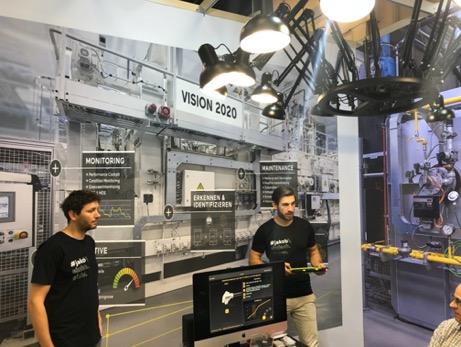
The interdisciplinary team had discussions about the technical possibilities for this endeavor. Just in time for the Heat Treatment Congress in Cologne in October 2018, we were able to deliver a live presentation of a first prototype to a selected expert audience (Fig. 1). The aim was to receive comprehensive feedback from users and experts about the focus of the project and integrate accordingly. The feedback turned out very positive and confirmed our basic assumptions and approaches. The maintenance assistant, called #jakob/safe.sound, should simply provide operative maintenance staff with a maximum of all existing information and it should be simple to handle. “All information” means the manifold data from different sources, such as: item master data and multi-level bills from ERP systems, construction data of the plants, the entire plant documentation and the most recent maintenance and set-up protocols. Moreover, edited monitoring data of relevant SPS data such as power consumption, positioning times, temperature curves, set-up parameters etc. should be made available to the maintenance staff in the simplest manner possible. The objective of maximum security/reliability means that the maintenance staff, but also the operator of the plants are guaranteed the secure knowledge of the status quo of their plant and whether there is a risk of unplanned down times.
With this requirement, #jakob was divided into the following main areas and functions. It is used to support the user in:
- Identifying components (object recognition)
- Spare parts supply/spare parts management
- Maintaining and servicing/information procurement
- Monitoring the state of the plant
- Predictive maintenance
OBJECT RECOGNITION

Moreover, data glasses require perfect data structures (i. e. 3D models of the plants and parts), which has yet to become a standard even in newly built plants in the thermal processing industry. It was decided that the approach would be to only rely on existing data and information in order to equip as many plants as possible – even older ones – with the maintenance assistant and thus be able to provide significant support for the entire hardening industry. In this respect, it can be said that the assistant supports all maintenance staff as a personal assistant and a colleague who is always available.
OBJECT AND SPARE PART RECOGNITION
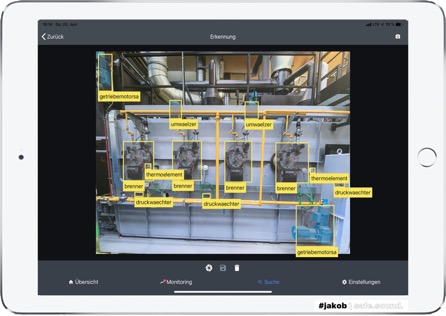
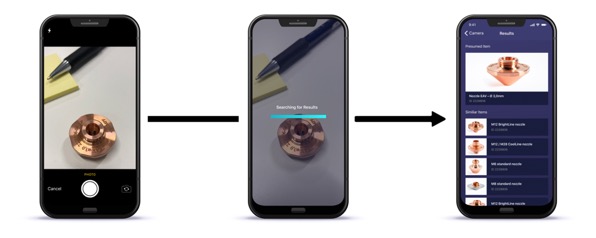
The assistant breaks new ground in the field of spare parts recognition. Via AI-App on your smart phone, parts and components can be scanned and identified within only a few seconds. The automatic recognition of spare parts saves employees a lot of time. In 2017, it was shown that it takes experts approximately 12 min to find the right spare part in the various documents and systems. The time for such a search will continue to increase in the future, as plants are growing more and more complex and employees are less experienced. The reliable identification of parts paves the way for more information on them. How many times is this specific part installed, what is its article number, how much does it cost, what is the delivery time? The connection with information from procurement history, date of installation and expected mean risk of malfunction provides every part with a résumé (Fig. 4). In a last step, the selected spare/wear part can be placed in a shopping cart for a quotation request.
MAINTENANCE PLANNING AND IMPLEMENTATION/INFORMATION PROCUREMENT
Maintenance staff receive all relevant data and settings of the detected parts and components at the tap of a screen. Questions such as: How do I service a power unit? When was it last done? How do I set up a part correctly? – are all detected by semantic search algorithms from the existing sources of information and then processed. This means that the maintenance staff have all the answers available right from the start, directly at the plant thus offering support for seasoned and experienced staff just as well as for neophytes. Moreover, step by step, the work is made available analogically with the manufacturer-specific service plans and guarantees that no relevant steps or parts are overlooked. At the same time, status assessments can be made for down time – critical parts, which enable predictions of malfunctions and their proactive prevention.
MONITORING
The permanent monitoring of critical areas of the plant is to prevent unplanned down times. Down time-critical components are, if possible, monitored with existing sensors. Component monitoring was realized in the most recent version of Focos 4.0, the process data recording system developed by Aichelin. For the past three years, this software has been installed dozens of times and relies on existing sensors in the plant, thus enabling the use of existing systems and making their data/information accessible. The clearly prepared monitoring data are then compared to expert knowledge and recommendations for action to the users can be derived from that. Moreover, the data is also saved for further use in the course of the Predictive Maintenance Module planned for the future.
PREDICTIVE MAINTENANCE
The most important objective of this development project is to offer a so-called Predictive Maintenance Solution to customers. By means of the numerous sources of information from maintenance intervals, status assessments, sensor data, and also indirect process data and the underlying algorithms, it will be possible to issue warnings and tips even before the malfunction of a part. For this purpose, we have been working with our cooperation partner, the Fraunhofer Austria Research GmbH, to develop methods to receive reliable predictive status assessments. Especially in the hardening and heat treatment industry, the key to success does not lie with the numerous sensors, which are not even built into existing, pre-installed plants, and for which the retrofitting would render any ROI approach pointless. The focus instead is placed on acquiring data indirectly, if possible, and with as few sensors as possible. In combining and integrating diverse information available on the existing plant, it will be possible to make accurate down time and status predictions and thus forecast predictive maintenance tasks.
PROFITABILITY ASSESSMENT
As mentioned above, one of the main objectives of the project is to establish a digital maintenance assistant not only for new plants, but for the much more numerous existing plants in the heat treatment industry. Aside from the mentioned challenge regarding master data, this also sets significant requirements for profitability. It goes without saying that the mentioned functions cannot be simply implemented using only a minimal effort. While it is relatively easy and comes with only low additional cost to provide and integrate all necessary data sources, it also comes with considerable effort for existing plants. To reduce this effort down to a degree, where the installation of such a system pays off within one year, is the challenge the project team is facing. The key lies in the consistent use and smart connection of all existing data sources, rather than in the creation of new data and the installation of additional hardware.
However, the first pilot applications already show clearly that the use of such a mobile assistant that is available 24/7 creates considerable added value in terms of cost and quality for both the maintenance staff and the plant operator. Specifically, this means:
- Time for spare part identification is drastically reduced
- Incorrect orders and deliveries can be avoided
- More efficient information retrieval and more concrete, immediate, and faster support through “smart” access to all available information from handbooks, lists, sketches, etc.
- Reduction of incorrect settings on the plant
- Reduction of energy consumption due to enhanced plant settings
- Significant reduction of cost of unplanned plant down times
These experiences have convinced the current project team to continue onwards with this assistant and thus be able to offer maintenance staff in the heat treatment industry important support in their daily work.
About the Author: Carsten Stölting is CEO of Aichelin Service GmbH in Ludwigsburg, Germany. He has been with Aichelin and furnace manufacturing for 8 years.
Mobile Maintenance Assistants for Thermal Processing Plants Read More »