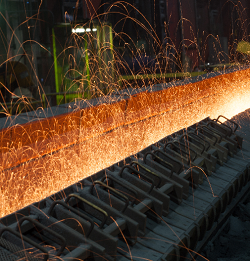
A North American steel supplier announced today that it has begun operating its continuous galvanizing line, which will produce hot-dip galvanized sheet steel for the automotive market. Nucor-JFE Steel Mexico, located in Silao, Guanajuato in central Mexico, has begun trial production and will move towards full-scale sales and production once customer approvals have been obtained.
Leon J. Topalian, president and CEO, Nucor Corporation
“We are excited to expand our presence in Mexico and to use our local sales network to increase our sales into this important automotive market,” said Leon Topalian, President and CEO of Nucor. “We are proud to partner with JFE Steel Corporation of Japan and to benefit from their experience as a premier supplier of high-quality products to the automotive industry.”
The hot-dip galvanized sheet steel production facility has a production capacity of 400,000 tons annually. It can produce sheet thickness from 0.4 mm to 2.6 mm and widths of 800 mm to 1,850 mm. Nucor and JFE will each supply an equal amount of substrate to be processed at the new facility.
The U.S. Navy has commissioned six new presidential helicopters. Sikorsky, a Lockheed Martin company, will build six production VH-92A presidential helicopters. These helicopters are part of the 23-aircraft program of record for the U.S. Marine Corps.
Sikorsky has transferred five VH-92A helicopters into government test with the sixth completing modification and entering government test Q2 2020. The VH-92A program is on track to enter Initial Operational Test and Evaluation (IOT&E) later this year.
“Now that we are ramping up production, the VH-92A program is gaining momentum,” said Dave Banquer, Sikorsky VH-92A program director. “This second contract award demonstrates the confidence the U.S. Marine Corps has in Sikorsky’s proven ability to deliver and support the next generation presidential helicopter. The men and women of Sikorsky treasure our legacy of building and providing helicopter transportation for every president and commander in chief since Dwight D. Eisenhower. We are proud to continue that legacy with the VH-92A helicopter.”
All six of the production aircraft from the first Low Rate Initial Production contract are undergoing modifications at Sikorsky’s Stratford, Connecticut, plant and are on schedule to begin deliveries in 2021. The remaining production aircraft will be delivered in 2022 and 2023.
VH-92A presidential helicopter (Source: U.S. Navy)
What is HIP? Hint: It doesn’t mean you are fashionable or trendy! In this HTT original content Technical Tuesday feature, Derek Denlinger, corporate lead metallurgist for Paulo who has recently been focusing on heat treatment for additive manufacturing and hot isostatic pressing, shares how this process can improve mechanical characteristics of high-performance additive manufactured components.
Additive manufacturing has steadily asserted itself as a viable method for producing complex components in aerospace, medical, and other high-performance applications. And if you hang out in metallurgy circles (who wouldn’t want to?), you can’t hear “additive manufacturing” without also hearing about hot isostatic pressing, or HIP. That’s because the HIP process, which applies high heat and high pressure to densify parts, has shown promise in improving the mechanical characteristics of high-performance additive manufactured components.
But while that’s the most popular use case for HIP, it’s far from the only one.
HIP Applications
HIP is recently popular thanks to the prevalence of additive manufacturing for high-performance aerospace parts or medical devices like artificial hips, but the process is over 60 years old.
HIP was initially developed as a diffusion bonding technique. In diffusion bonding, high heat and pressure work together to weld similar or dissimilar metal surfaces without filler materials. However, metallurgists observed that those process characteristics also improved mechanical performance by eliminating casting porosity — the small bubbles of gas that can form during the solidification process of cast metals — and imparting a homogenous grain structure throughout the whole part. Porous parts or parts with variable grain structures are less durable and cannot stand up to the stress of severe service.
A similar phenomenon occurs during an additive manufacturing process called powder bed fusion. Powder bed fusion naturally leaves small voids within parts. Those small voids can cause big problems if they aren’t eliminated.
In addition to use alongside additive manufacturing and diffusion bonding of parts, HIP is typically specified as a densification process complementary to powder compaction and sintering as well as metal injection molding. It’s most often specified in aerospace, medical and dental, oil and gas, power generation, firearm, and jewelry manufacturing.
Materials Ideal for HIP
A wide array of materials can be HIP’ed in the high-pressure argon environment a unit creates. Such an atmosphere is ideal for:
Carbon steel
Tool steels
Duplex, martensitic, and austenitic stainless steels
Nickel-based alloys
Cobalt-based alloys
Titanium
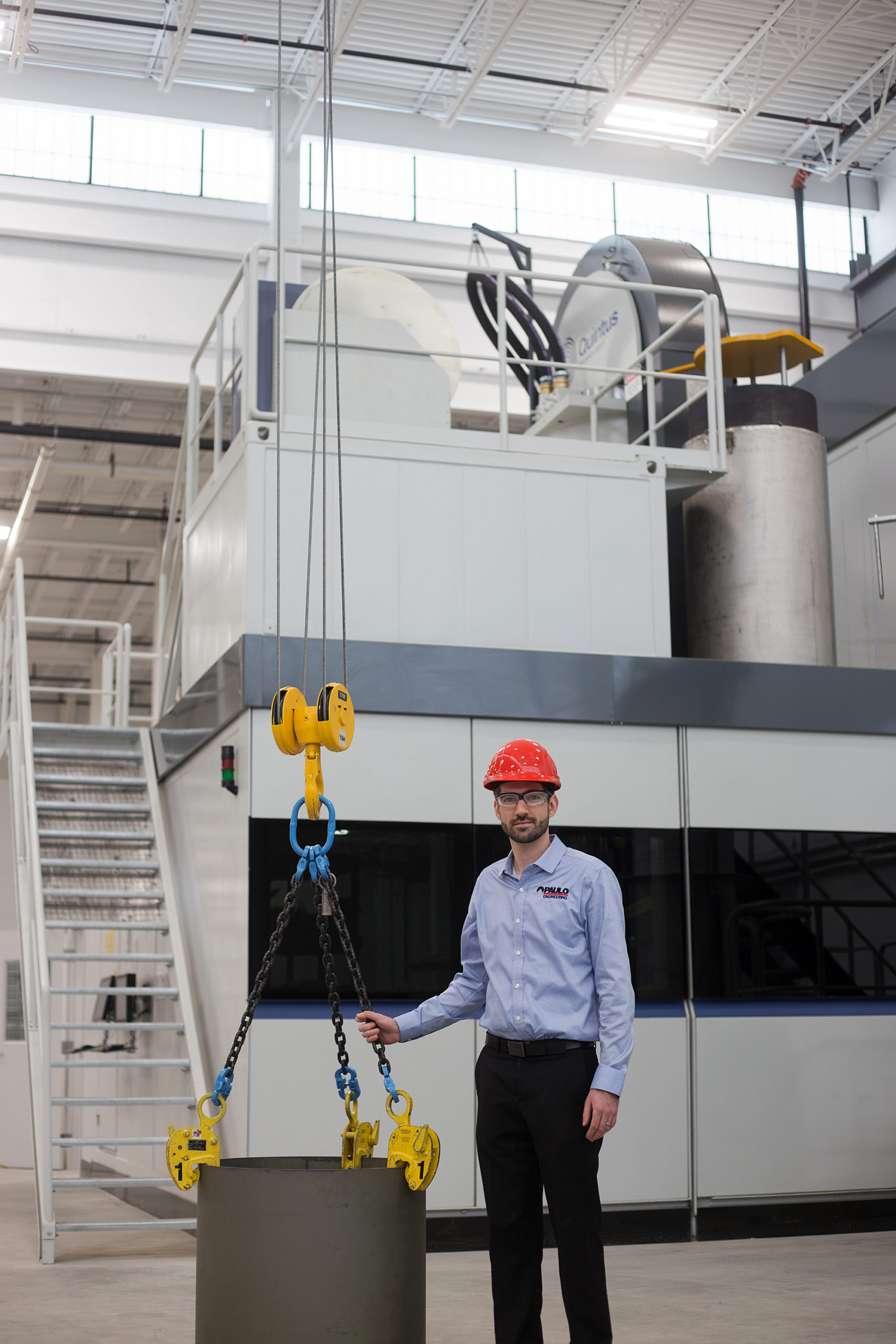
The author, Derek Denlinger, in front of the HIP vessel
HIP Advantages
A common critique of HIP among some manufacturers is that it’s a costly, unnecessary, extra step in the manufacturing process. The word “overkill” comes to mind, and it’s true that some thermal processors aggressively market the process to manufacturers who make parts for which HIP may not be a metallurgical necessity. But when it’s appropriately specified, HIP gives manufacturers several compelling advantages both upstream and downstream in their production process.
Design & Manufacturing Freedom – Some parts feature highly complex shapes that are too complicated for traditional forging or casting. In response, manufacturers have either sacrificed performance with watered-down designs or added costly processing time by designing parts in pieces and then joining them via brazing. But the pressurized gas used in HIP finds its way into internal passages and blind features of complex parts, ensuring they achieve specified metallurgical characteristics while reducing the traditional failure risks.
Mechanical Characteristics – HIP has been shown to enhance key mechanical characteristics such as ductility, toughness, yield strength, and corrosion resistance. Fatigue, impact, wear, and abrasion resistance can also improve. Metallurgists have also observed that HIP’ed parts end up with less “data scatter.” Reducing data scatter enables design engineers to more accurately understand material performance and to know more precisely where the material’s limit exists. They can then design according to that known information.
Optimized Manufacturing – Whether parts are additive manufactured, cast, or forged, integration of HIP can streamline manufacturing. First, the combination of additive plus HIP’s densifying and solution treating capabilities mean more manufacturing stages can be accomplished in fewer steps. Second, manufacturers concerned about porosity can allow it to occur knowing that HIP can correct the issue.
Simultaneous Treatment – Older hot isostatic presses were typically designed with thicker walls which impeded quick cooling. That eliminated simultaneous treatment from the equation (and led some to believe the process was unsafe). Rapid quenching is built into many modern HIP models, allowing simultaneous heat treatment and hot isostatic pressing. The resulting time savings is significant. Improved performance of parts treated in this manner has also been observed.
Reducing Scrap – There’s always variability in manufacturing; the risk of scrapping some parts is ever-present. But HIP can help reduce scrap in two ways. First, it can be incorporated into regular production of parts with tricky designs to make up for potential upstream process deficiencies. Second, it can be applied as needed if a one-off problem occurs in a single batch. In either case, the potential savings are compelling.
Hot isostatic pressing is creating new possibilities for manufacturers of high-performance parts. For example, the Quintus Technologies QIH 122 unit was installed into Paulo’s Cleveland Division. The rapid cooling capability of the HIP vessel is comparable to vacuum furnace quenching. These properties make it possible to HIP and solution treat parts simultaneously, imparting decidedly better metallurgical properties while reducing turnaround time.
Paulo recently installed this Quintus Technologies QIH 122 rapid cooling hot isostatic press in its Cleveland, Ohio facility.
Composites Universal Group (CUG), an internationally recognized composite manufacturing company specializing in the production of high-quality composite components for aerospace, drones, industrial and space applications, recently received a large walk-in oven from DELTA H.
The oven features an interior volume of 12’ wide, 10’ tall, and 32’ deep, with high volume New York Blower plug fan, PowerFlame gas burner, and rapid cooling/chamber pressure control. For vacuum composite processing, the system features multiple part temperature as well as vacuum transducers for precision monitoring of process heating. Eurotherm Nanodac is featured with cascade control that selects the coolest part and automatically adjusts air temperature to precisely maintain the desired ramp rate, soak time, and cooling rate.
Richard Conway, CTO at DELTA H
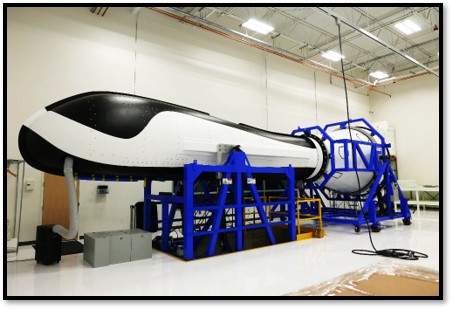
CUG has multiple projects underway, including Vahana electric VTOL aircraft, Sierra Nevada Corp Dream Chaser Pressure Vessel, and Leidos Corp. Composite Beams. DELTA H CTO Richard Conway stated, “It is truly rewarding and exciting to be among the technology providers supporting these projects and to have a role in the cutting edge of transportation.”
(Image Source: Leidos Investor Relations)
“The DELTA H Composite Oven has performed flawlessly ever since initial startup. It’s become a critical part of our equipment listing here within CUG. . . . It is critical to our operations and the curing of our high temperature parts fabrication,” states Steve Ruege, President and Director of Sales at Composite Universal Group.
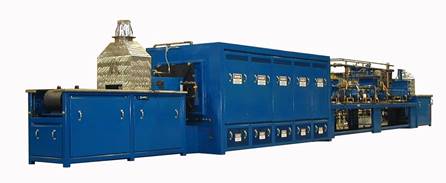
Brazing Furnace for Automotive Supplier (Image Source: Abbott Furnace Co.)
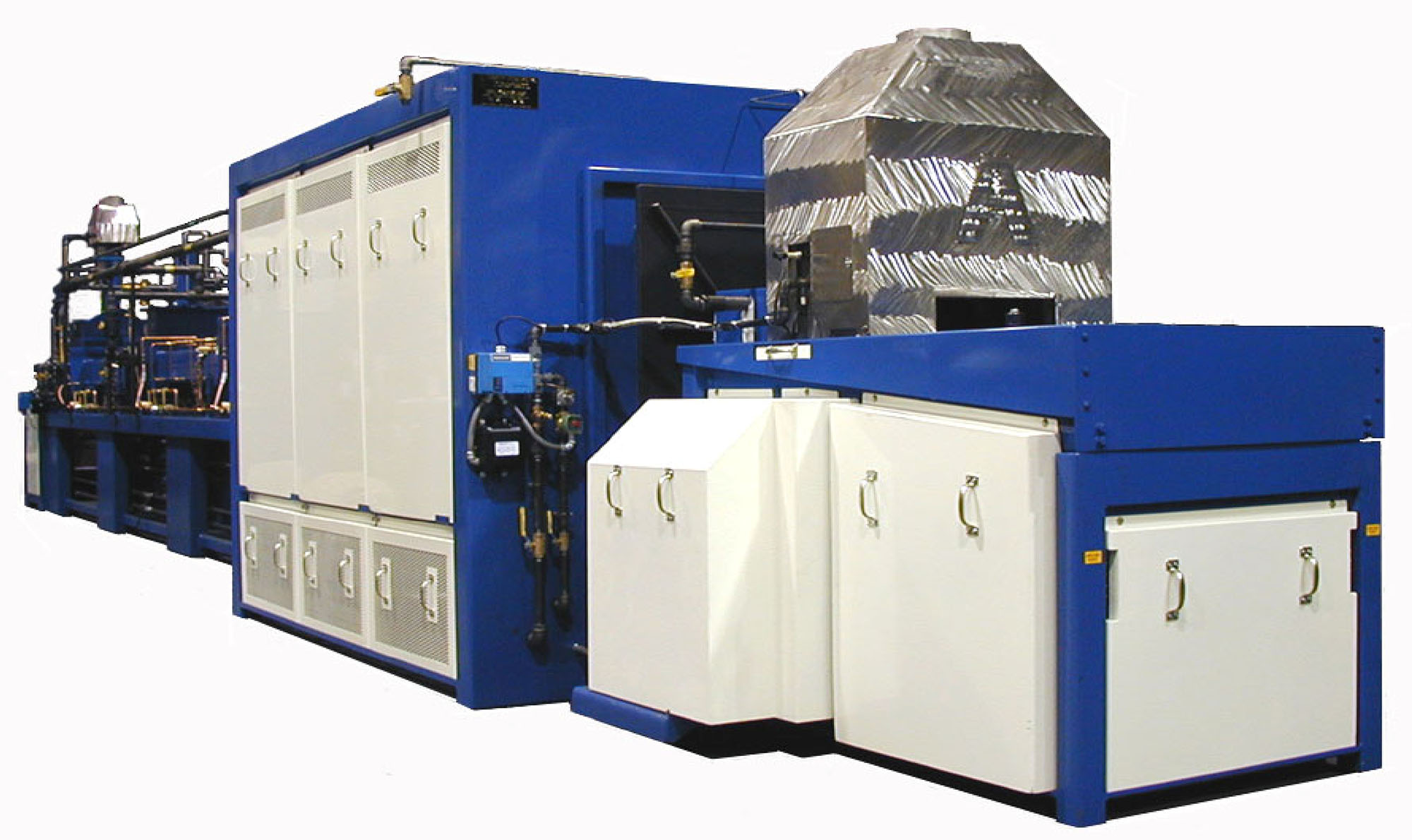
A diversified global automotive supplier, focused on metal forming, aluminum casting, fluid systems and flexible assemblies to help automakers meet their lightweight requirements, and a multinational corporation that specializes in producing chemicals and precious metals and operating in more than 30 countries worldwide, have placed orders for furnaces to be installed in the 2nd quarter of 2020. Abbott Furnace Company will design, manufacture, and install both furnaces.
The automotive supplier has placed an order for a continuous belt stainless steel brazing furnace to be installed in Mexico. They will receive a five (5) zone electrically heated industrial furnace that is rated for 2,150°F and includes a 30” wide belt, silicon carbide muffle and will feature Abbott Furnace’s Varicool convective cooling system.
The precious metals producer has placed an order for an electrically heated continuous belt calcine furnace. The industrial furnace that is rated at 1,850°F and includes an 18” wide inconel belt, silicon carbide muffle and data acquisition system.
Dan Insogna, Southeast Regional Sales Manager for Solar Manufacturing
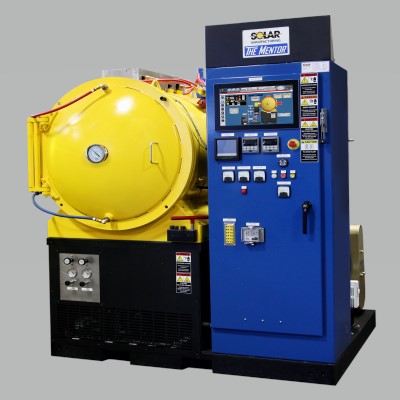
A vacuum furnace was recently shipped to a customer servicing the tool and die industry in Virginia. The Model HFL-2018-2IQ furnace features a graphite-insulated hot zone, a load weight capacity up to 250 lbs., and a maximum operating temperature of 2400°F. The furnace, called the Mentor®, is from Solar Manufacturing will be used for solution annealing, ageing, and brazing. It measures 12” wide x 12” high x 18” deep.
Model HFL-2018-2IQ furnace
“This company is a long-time customer of our sister company, Solar Atmospheres,” states Dan Insogna, Southeast Regional Sales Manager for Solar Manufacturing. “They wanted to own a Solar furnace themselves, for smaller, in-house jobs. We’re all excited they chose Solar Manufacturing for their first furnace.”
Heat Treat Todayconducted a very unscientific and highly-fluid study on the impact of COVID-19 (coronavirus) on the North American heat treat market. By the time you read this, the impact will undoubtedly be different; but what you'll see below is a snapshot in time from Friday, February 28th, which is when most of the responses came in.
Heat Treat Today surveyed 675 heat treat industry suppliers and asked them 6 very simple questions. The survey took no more than 5 minutes to complete. Of the 675 surveyed, 104 responded, all of them completing all 6 questions.
The questions were broken down into two basic categories:
The first two questions asked what impact the coronavirus was ALREADY having on their business.
The last four questions asked them to speculate about the future impact of the coronavirus on their business.
Before giving the results, let me acknowledge as truth what one respondent so politely stated:
Unfortunately any information gathered for the coronavirus will be outdated within days because the global situation changes so frequently and rapidly. A survey of this kind has very limited value for business analysis/decisions due to the ... fluidity of the situation.
Having duly disclaimed, let's get on to the results.
One final note -- click on each image below to enlarge it for easier viewing.
Current Impact
Click to enlarge.
Question 1: Has the coronavirus already directly impacted your business/supply chain?
As you can see, over half (51%) indicate that the virus has had NO EFFECT to date. Another 11% are uncertain if there has been any effect, and roughly 38% say that the virus has already had an impact on their business.
Yes: 37.50%
No: 50.96%
Uncertain: 11.54%
Click to enlarge.
Question 2: In what way(s) has the coronavirus already directly impacted your business/supply chain?
The two main options given were:
Difficulty getting materials to build product: 11.54%, and
Limitation of travel either of employees, customer, or workers: 29.81%
Other answer included:
No impact: 46.15%
Other: 12.50%
It's not surprising that nearly half (46.15%) said there was "no impact" given that nearly half of the respondents in Question 1 indicated that there was "no impact" to date of the coronavirus on their business operations.
Anticipated Future Impact
Click to enlarge
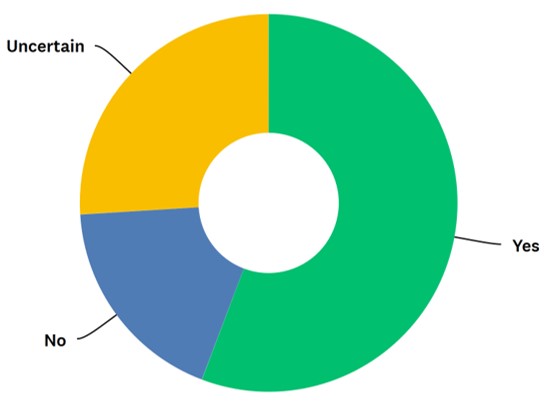
Question 3: Do you anticipate that the coronavirus will directly impact your business/supply chain?
After assessing the current impact, the next four questions focus on the future and what expected impact the coronavirus might have on business.
The results were a bit less optimistic:
Yes: 55.77%
No: 18.27%
Uncertain: 25.96%
While roughly half of the respondents indicated that the coronavirus was having no current impact, only 18% believe that it will never impact their business. The other 26% are uncertain if this global sickness will impact them or not.
Click to enlarge.
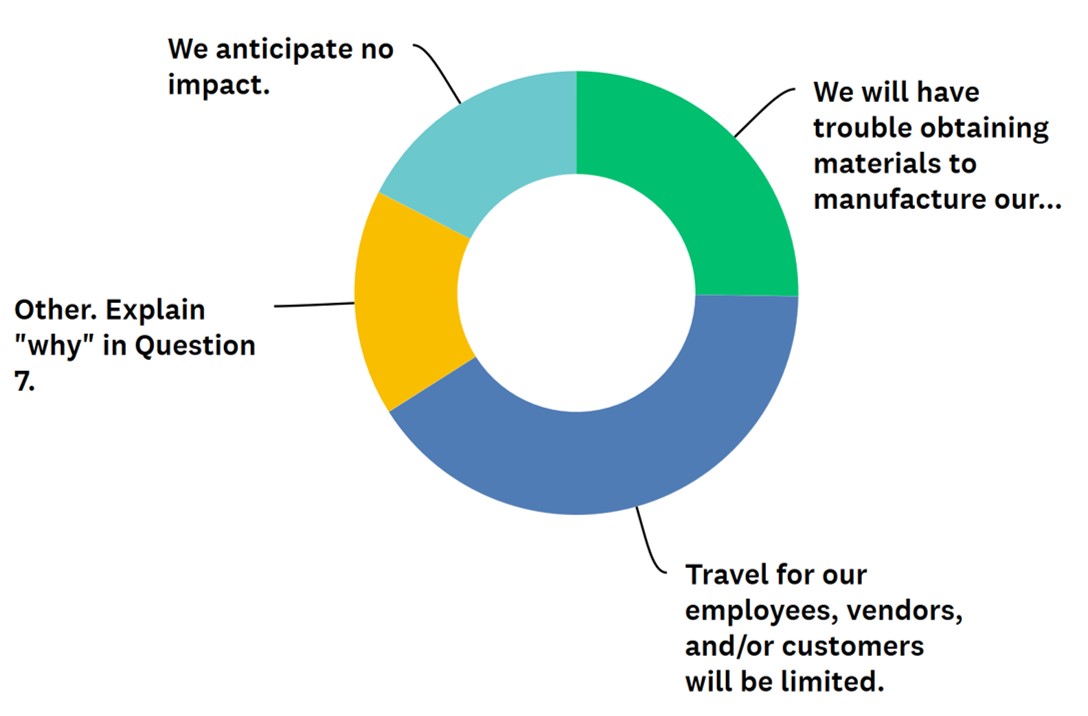
Question 4: In what way(s) do you anticipate that the coronavirus will directly impact your business/supply chain?
As with question number two, which was very similar, the answers to this question indicated that the #1 anticipated impact was restriction on travel. Coming in a close second was the ability to secure materials necessary to continue production -- supply chain issues.
Limited travel for employees, vendors, and/or customers: 40.78%
Trouble obtaining materials to manufacture our product(s): 25.24%
Other: 16.50%
No impact: 17.48%
Click to enlarge.
Question 5: How significantly do you anticipate that the coronavirus will impact your bottom line?
Assuming that there will be some impact, the question tried to get an order of magnitude of how great the impact might be. Asking respondents how they anticipated the virus will impact their bottom line seemed like a good approach. Here's what they had to say:
5% or less: 52.88%
From 6% to 10%: 30.77%
From 11% to 20%: 12.5%
More than 20%: 3.85%
It's possible that everyone in the "5% or less" category said that there would be zero impact on their bottom line; but even if that is the case, there are still 47% of the industry who believe that the coronavirus will have a 6% or greater impact on their bottom line. Only a very small percentage (4%) believe that it will have a 20% or more hit on their bottom line.
Click to enlarge.
Question 6: How long do you anticipate the coronavirus will impact your business/supply chain?
This final question tried to get a sense of how long respondents thought the virus would continue to impact their business.
Here's what they had to say:
0-2 months: 28.85%
3-6 months: 63.46%
7 months or more: 7.69%
Fortunately, it doesn't appear that the impact will be long-lived.
Question 7: Open-ended comments.
The survey was anonymous, so respondents seemed to feel comfortable giving their opinions. On two of the questions, Question 2 and Question 4, where they had the option to respond "Other," we asked them to give some explanation of their "other" response in this open-ended, final question. You can see the unedited, open-ended responses at the end of this post.
Flu vs. Coronavirus (by the numbers)
"Pandemic" is a word frequently thrown around with Coronavirus. Here are some interesting numbers from the Center for Disease Control:
CDC estimates that so far this season there have been at least 32 million flu illnesses, 310,000 hospitalizations, and 18,000 deaths from flu.
Compare that to the worldwide coronavirus numbers (as of February 28th):
Confirmed cases: 83,700
Deaths: 2,859
This is not to minimize the importance of actions against the coronavirus, but the current numbers associated with the coronavirus are a tiny fraction compared to a typical year with influenza. That's also not to minimize the great personal pain and suffering of anyone who has lost a close relative or friend to either influenza or the coronavirus.
Verbatim Comments
As promised, here are the unedited responses to Question 7 in Heat Treat Today's Coronavirus Survey. Some company names and any other identifiable information have been removed.
Being close to a porous border we anticipate migration north to find better conditions for their families. This indirect contact within the Hispanic community could impact the health of our workforce.
Contract now on hold that was signed in early January in China for [company] to supply new heat-treating equipment there.
Cost of shipping to countries hit increased 3x.
Deliveries will be late on finished products. Many parts come from China. More than we know.
Difficult getting some materials. Should improve as soon as things loosen up in China. Not killing us, but an irritation.
Economic slow down.
Facility in China had to temporarily close until the sickness peaks and wanes.
Human anticipation will be a negative factor
I am a sales rep and don't see much potential impact. Large purchases may be delayed but day-to-day needs should be OK to sell and ship.
I don’t feel it directly impacts our business unless it lasts more than a year
I have had suppliers ask about the availability to receive materials coming from Chinese suppliers, I have had questions about delivery delays from vendors/ suppliers. We are about to see in real time how good our companies are multi-sourcing critical components and not relying on conflicted materials.
I have two major concerns: 1. The virus will become Pandemic effecting world economy, 2. In the US people will overact and panic.
I think it is overblown, .1% of people die from the “normal strains” of flu, .7% from coronavirus. So if you get it, less the. 1% chance of death. Makes good news.
It appears it is directly affecting some of our upcoming travel plans, as well as we expect some parts issues to arise.
It might hurt our customers production, hence the trickle down
Little impact for us other than limiting travel. Our supply chain is stable for the moment.
Our business supply chain, business travel, product distributors have all been affected.
Shipping companies like FedEx won't ship our ordered products to China. I believe that will start to affect our other international customers.
Short term (3-6 month) impact anticipated in regard to supply of components from China and respiratory masks.
Slower sales cycle for cap-ex type projects. A wait-and-see mentality with purchases.
Some North American heat treaters have been purchasing Chinese castings sold by American based distributors. These castings are not marked with country of origin, so we encourage those who may be unaware where their castings are made to insist this information be provided. We are seeing many of our customers, who chose to go away from [company] and buy these off shore castings, unable to have their needs met. We manufacture our castings in our foundry in [location] and source our raw materials from domestic mills. So our supply chain and output is uninterrupted.
Some of our customers are global, we suffer if they suffer.
Some of the parts we are currently processing are being sourced by our customer from both China and South Korea. We have not had any delays in receiving parts but expect it to happen in the near future.
The supply chain is disrupted. But projects slated for China have been cancelled or severely delayed affecting order input.
This week I was at several customers who are screening for international travelers and not permitting anyone in their building who has traveled to China in the last 2 weeks.
Travel for our sales team may be limited. Economic concerns and supply chain issues affecting our customers could potentially slow our sales bookings. We do not expect a direct supply chain problem with our raw materials.
Travel has been altered and changed but not yet limited if required. However, we had international visitors returning home just today and they were quite concerned about the journey. We are not as much worried about the material supply yet, but thinking forward to critical items which may be impacted and considering changes to stocking programs considering our short term materials forecasts.
Unfortunately any information gathered for the coronavirus will be outdated within days because the global situation changes so frequently and rapidly. A survey of this kind has very limited value for business analysis/decisions due to the survey fluidity of the situation.
We anticipate the effects to vary; potential for some interruption to material availability and/or increases to material pricing. If China/India/Europe continue to be affected by the spread of Coronavirus, we suspect it may create a "bump" in thermal processing demand stateside. Although, if the spread of the virus becomes more prevalent stateside, a substantial shift in operational parameters may occur, which effects to our industry would be difficult to speculate.
We do not expect an impact
We export about 25% of our sales to China, South Korea and have seen some impact of about 10% on our shipments. We … sell to the oil & gas and this is also being impacted.
We had field service work lined up in China to relocate the furnace to Indonesia. We have had to abandon the project due to the logistical challenges and definitive need for Quarantine at both ends of travel. There is a significant drop in the amount of service business that we do in southeast Asia this year because of travel restrictions and Quarantine requirements.
We've experienced shortages or longer lead times from some vendors products such as our [company] controls. We also have staff and some clients that have considered driving to customer service calls, sales visits, etc. where they would normally drive, to avoid airports and large public places. There has been no significant impact yet.
When China releases restrictions, the impact will be minimal.
(Photo Source: Unsplash.com, by Free To Use Sounds)
“Optimism” may be a good description to highlight January’s Industrial Heating Equipment Association’s (IHEA) Executive Economic Summary. It states, “The US economy has started the year in better shape than had been expected. Now the attention of the economist has been focused on two questions. The first, why the headwinds that were expected to slow things down haven’t? And the second, how long can this situation be expected to last? Despite the predictions that consumers would become weary and businesses would begin layoffs at the start of 2020, “… some of the pressure was released with the ‘phase one’ deal with China and the consumer just seemed to power through their concerns.”
New home starts experienced an unexpected and encouraging rebound
The summary reports, “In looking at the index readings this month, the news is pretty good. Of the eleven, there are seven that are trending positive and four that are pointing in a more negative direction. The more important note is that the good news readings are very strong and the negative readings are not so dramatic.”
Of the seven positives indices, new housing starts experienced a dramatic rebound, and the housing sector is as strong as it has been in some time. Additionally, the reports states, “There was also some significant gain in terms of steel consumption. The automotive sector and the energy sector have helped boost demand.”
Significant growth in new orders after 5 consecutive months in decline
One other significant area of growth to note is the PMI, “There was a very impressive rebound as far as the Purchasing Managers’ Index was concerned. The overall index jumped back into expansion territory with a reading of 50.9 but an even bigger leap was noted in the New Orders index as it went from 46.8 to 52.0. Given the future orientation of the new orders data, this is good news indeed.” Other indices showing a positive growth were capital expenditures, durable goods, factory orders, and the credit manager’s index.
Those indices that weren’t as upward trending, but not “all that depressing” were new automobile/light truck sales, falling metal commodities prices due to lack of demand, and capacity utilization. The transportation index seems to be more of a concern, “The slip has been mostly in the rail and maritime sectors thus far as both have been affected by the trade wars and other interruptions in the global economy. The bottom line is that the bad news data has not been all that serious and most are likely to see some improvement in the future if the good news data keeps coming in.”
In conclusion, the news is better than expected this month with much growth. However, we can’t ignore the coronavirus and that its effect on the global economy has yet to play out completely.
The report is available to IHEA member companies. For membership information and a full copy of the 12-page report, contact Anne Goyer, Executive Director of the Industrial Heating Equipment Association (IHEA). Email Anne by clicking here.
Two all-metal hot zone furnaces were recently shipped to the medical and additive manufacturing industries. Solar Manufacturing created and shipped the Models HFL-3848-EQ and HFL-3836-EQ, both featuring metallic-insulated hot zones, a load weight capacity up to 2,000 lbs., and a maximum operating temperature of 2400° F. Measuring 24” wide x 24” high x 48” deep, and 24” wide x 24” high x 36” deep respectively, each furnace was designed with the SolarVac Polaris® Control System. The furnaces were shipped to a location in Tennessee.
Dan Insogna, Southeast Regional Sales Manager for Solar Manufacturing
“Solar Manufacturing was awarded the order because we offered the best solution for their vacuum furnace needs,” states Dan Insogna, Solar’s Southeast Regional Sales Manager. “Our knowledge and experience of the additive manufacturing market set us apart from the competition. Additionally, the customer found the premium features and benefits offered with our vacuum furnace equipment impressive. We’re pleased to have helped them select furnaces that best suit the unique requirements of the industries they serve.”
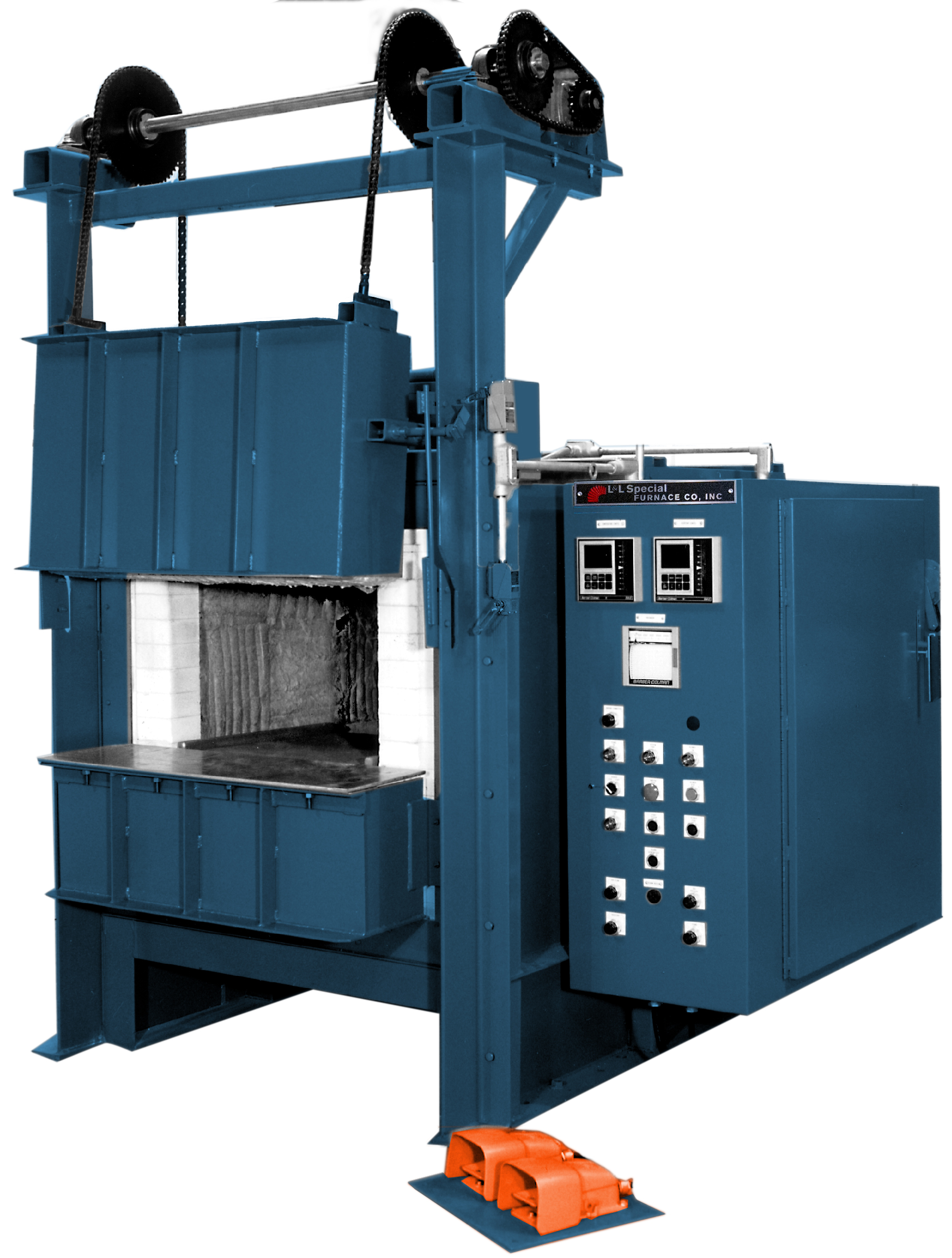
A furnace manufacturer based in Pennsylvania, USA, has shipped a floor standing forging furnace for use in hot forming of medical implant parts along with a floor standing tempering furnace to a manufacturer of medical implant components located in the Northeastern United States.
The FWE422 forging furnace
The forging furnace is a L&L Special Furnace Co., Inc. model FWE422 with working dimensions of 48” wide by 24” high by 24” deep and heats to a temperature of 1,800°F. The furnace features a vertical door with adjustable stops. These stops allow the door to be stopped at a predetermined location during the heating process for minimal heat loss.
The tempering furnace is model XLE3636 with a vertical door and 12” diameter, air-cooled convection fan and roller hearth. It has an effective work zone of 34” wide by 30” high by 32” deep. The furnace is used to temper hot formed parts and other thermal processing duties.