

FEATURED NEWS

Airbus Introduces a Whale of a Transport Aircraft

The Airbus BelugaXL transport aircraft has entered swimmingly into service. The manufacturer noted the new jet is the first of six planned BelugaXL aircraft providing 30% more transport capacity. This whale-like transport is 63 meters long and 8 meters wide and claims to have the largest cargo bay cross-section of any existing cargo aircraft in the world.

The new aircraft has a maximum payload of 51 metric tons, and a range of 4,000 km (2200 nautical miles) and made its first flight in mid-January. It is based on an A330-200 freighter and is powered by two Rolls-Royce Trent 700 engines. This internal aircraft program was awarded Type Certification by the European Aviation Safety Agency (EASA) in November 2019, following an intensive flight-test campaign.

Airbus plans to introduce five additional BelugaXL aircraft between 2020 and 2023.

Airbus Introduces a Whale of a Transport Aircraft Read More »

Lockheed Martin Agrees to Provide NASA Subsystems to Produce Orion Spacecraft

An aerospace company has made a contract with Lockheed Martin to provide critical components of NASA’s spacecraft. Collins Aerospace Systems, a unit of United Technologies Corp., has obtained a contract with Lockheed Martin to provide critical subsystems to produce NASA’s Orion spacecraft fleet for Artemis missions III through VIII. The systems Collins Aerospace is providing will play an important role in enabling NASA’s goal of boots on the moon by 2024 and establish a sustained presence on and around the moon to prepare for missions to Mars.

Kevin Raftery, VP and general manager of ISR and Space Solutions, Collins Aerospace.

“We’ve been providing life-sustaining solutions for space for 50 years, and we’re proud to be working with Lockheed Martin and NASA to enable decades of future exploration to the moon, Mars, and beyond,” said Kevin Raftery, vice president and general manager, ISR and Space Solutions for Collins Aerospace.

Work for the Orion systems will be performed at Collins Aerospace facilities in Connecticut, Texas, Illinois, and California.

Photo Credit: Lockheed Martin

Lockheed Martin Agrees to Provide NASA Subsystems to Produce Orion Spacecraft Read More »

Hauck Heat Treatment Receives High Vacuum Furnace from Parent Company of North American Furnace Manufacturer

A Hauck HT plant located in the Netherlands recently received a unique high vacuum furnace. The all-metal high vacuum furnace from SECO/WARWICK with the working chamber size of 47.2″ x 47.2″ x 78.7″ was delivered to Hauck’s newly expanded plant in Eindhoven. At the same time, it is the largest furnace of that type currently in operation in that region.

According to Marcus Wendel, Hauck Heat Treatment Executive Director, “The all-metal vacuum furnace with diffusion pump was designed to achieve high vacuum conditions and ensure the highest possible purity of the heat treated parts. Accordingly, we had some special requirements regarding used components and solutions. All have been implemented by SECO/WARWICK.”

Sławomir Woźniak CEO SECO/WARWICK

Sławomir Woźniak, SECO/WARWICK Group CEO, also commented, “From the very beginning, our company philosophy has been based on meeting the highest expectations of product and technology development for our customers, including first class organizations such as Hauck Heat Treatment Group. This partnership proves that knowledge and experience are not just empty marketing slogans, but valuable features in business.”

This was the third furnace delivered there, and the two companies are discussing next steps together.

Hauck Heat Treatment Receives High Vacuum Furnace from Parent Company of North American Furnace Manufacturer Read More »

Supplier to Fiat, Scania Purchases Nitriding Furnace for European Gas Spring Market

A Polish leader in automobile parts manufacturing recently completed the installation of a nitriding system at the manufacturing facility in its namesake city in southeastern Poland. FA Krosno is one of the largest players in the European gas springs market, supplying manufacturers of commercial vehicles and agricultural equipment such as Fiat SpA, Scania AB, MAN SE, and AGCO.

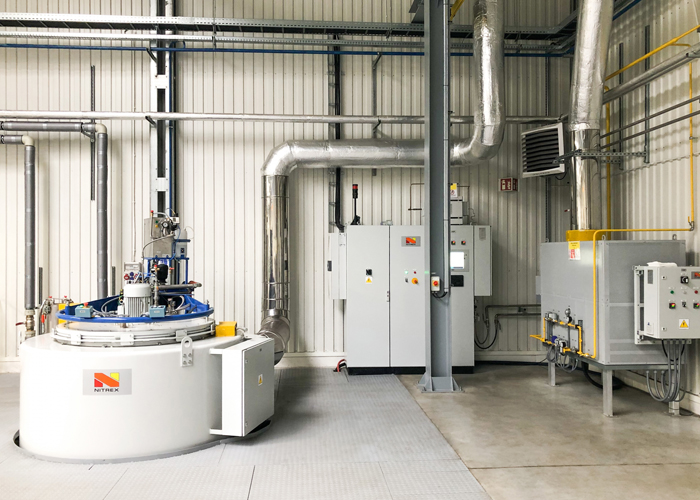
FA Krosno’s new Nitrex nitriding system

Nitrex Metal completed the installation of the nitriding system. Marcin Stoklosa, Special Projects Manager of Nitrex Metal, stated “Where collaborating suppliers are concerned, FA Krosno places strict technical, quality, process, and environmental demands on suppliers. We are extremely proud to count ourselves among the company’s preferred suppliers. Nitrex nitriding technologies were recognized as the best performing and best suited to the application’s requirements. Results from various metallurgical and mechanical tests conducted on the nitrided piston rods confirmed that the desired thickness of the white layer, the oxide thickness of the white layer, corrosion resistance, as well as the appropriate roughness were consistently obtained after Nitreg® nitriding and was maintained even after subsequent finishing operations.”

Over the last several years, FA Krosno and Nitrex have collaborated in an attempt to improve the durability of piston rods in gas spring assemblies of passenger vehicles. Production with the new system started in December 2019.

Photo Credits: Nitrex


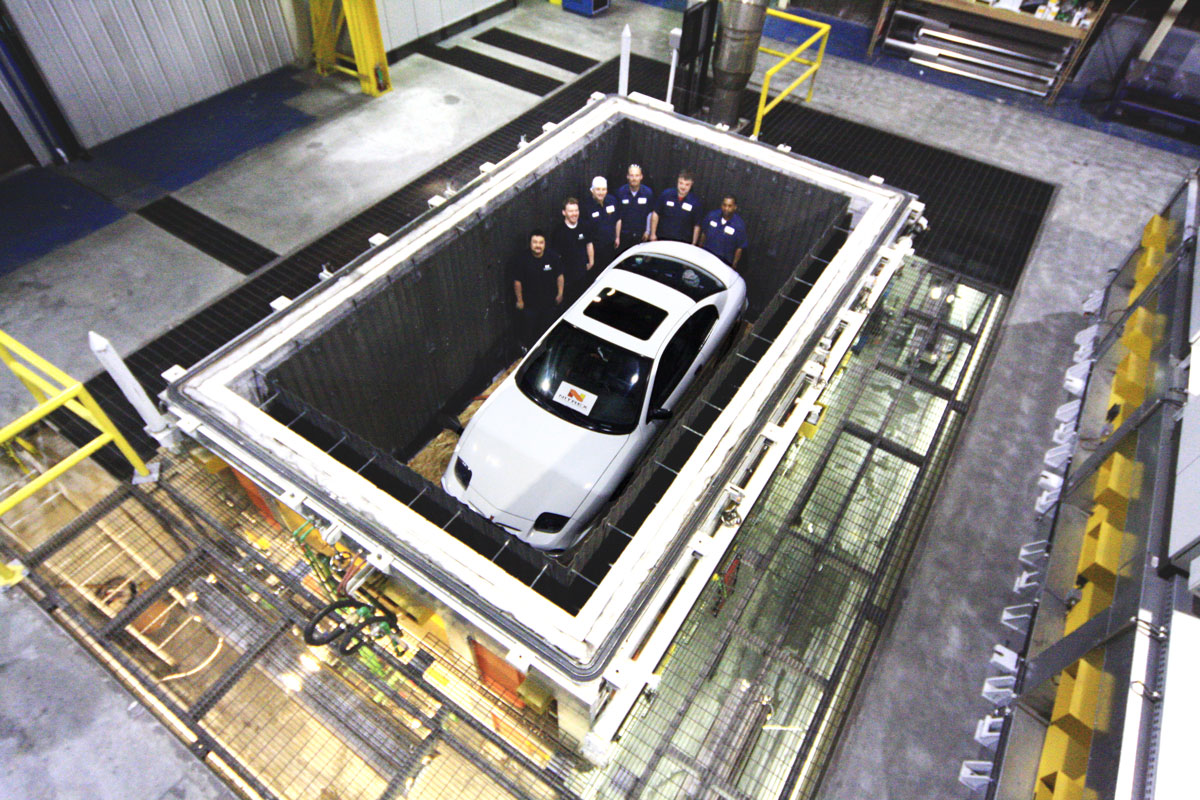
This photo of a large size gas nitriding/nitrocarburizing furnace from Nitrex was not included in the original realease of this purchase by by FA Krosno.


Supplier to Fiat, Scania Purchases Nitriding Furnace for European Gas Spring Market Read More »

Inside the Carbon Nanotube Method for Airplane Production


Source: Design and Development Today


A modern airplane’s fuselage is composed of multiple sheets of different materials, not unlike a phyllo dough pastry. Once these layers are stacked and molded into the shape of a fuselage, they are transferred into warehouse-sized ovens and autoclaves, where the layers fuse together to form a resilient, aerodynamic shell.

MIT engineers have now developed a method to produce the same high level of composites without the enormous ovens. This discovery may speed up the manufacturing of airplanes and other large, high-performance composite structures.

In this HTT Best of the Web Technical Tuesday feature, Design and Development Today introduces us to carbon nanotubes, their usefulness in potentially taking airplane manufacturing to new heights, and what the future of the research surrounding this discovery looks like.

Brian Wardle, professor of aeronautics and astronautics at MIT

An excerpt: “‘If you’re making a primary structure like a fuselage or wing, you need to build a pressure vessel, or autoclave, the size of a two- or three-story building, which itself requires time and money to pressurize,’ says Brian Wardle, professor of aeronautics and astronautics at MIT. ‘These things are massive pieces of infrastructure. Now we can make primary structure materials without autoclave pressure, so we can get rid of all that infrastructure.'”

Read More: www.designdevelopmenttoday.com/industries/aerospace/news/21110057/a-new-approach-to-making-airplane-parts?lt.usr=70118934

Photo Credit: Melanie Gonick, MIT

Inside the Carbon Nanotube Method for Airplane Production Read More »

Aluminum Alloy Powder Developed for Automotive 3D Printing

A Canadian additive manufacturing powder producer, in partnership with McGill University in Montreal, has announced the results of a research project on its aluminum alloy powders. Extensive testing undertaken by the university has revealed that the Equispheres’ powders are suitable for sintering with binder jet 3D printing technology. Equispheres claims that the combination of binder jet 3D printing with aluminum alloy powder can have a significant impact on the automotive industry. 

Dr. Mathieu Brochu, Associate Professor at McGill

“We are excited to begin work with Equispheres’ binder jet printing partners in the next phase to fully understand all aspects related to sintering of complex shape components and the fundamental relations with new specialized binder agents,” said Dr. Mathieu Brochu, Associate Professor at McGill and Canada Research Chair in Pulse Processing of Nanostructured Materials.

Equispheres has developed a method of powder atomization that creates spherical metal powders. On the strength of its proprietary technology, Equispheres has previously received a $5 million investment from American global aerospace and defense company Lockheed Martin. The company also received an $8 million investment from early stage and SME financing bank BDC Capital, due to its focus on the environmental advantages of 3D printing.

Currently, Equispheres is collaborating with key partners to develop specialized binder agents that are required for aluminum and for specific automotive applications.

Photo Credit: Equispheres

Aluminum Alloy Powder Developed for Automotive 3D Printing Read More »

15 Quick Heat Treat News Chatter Items to Keep You Current

Heat Treat Today offers News Chatter, a feature highlighting representative moves, transactions, and kudos from around the industry.

Personnel & Company Chatter

    • Mike Smith has joined Magnetic Specialties, Inc. as their new Business Development Manager.
    • Ipsen USA has announced the completion of its 2019 Corporate Academy class, which is part of an initiative to grow service capacity globally. Seven graduates will step into positions as field service engineers after several months of training and passing their final exam.
    • Tom Gundic recently joined Solar Atmospheres’ facility in Greenville, South Carolina, as their new plant manager.
    • Isostatic Toll Services Bilbao is pleased to announce the official opening of its new plant in Abanto-Zierbena, Spain, on January 29th.
Heating Furnace at Uddeholm AB, which is taking part in the electrical heating project
  • The Swedish Energy Agency has granted a new project that will explore the possibilities of electrifying heating processes. It will evaluate the potential of replacing gas-fired furnaces with electrically heated furnaces for material heating. Kanthal, part of the Sandvik Group, is taking part in the project.
  • Sean Toland has taken on the position of executive Vice President of Operations for Wire Experts Group, the parent company to Pelican Wire and Rubadue Wire, the second of which Toland is already serving as president.
  • NSA Industries, a provider of metal fabrication, machining, powder coating, and assembly operation, has acquired Vitex Extrusion, a provider of aluminum extrusions, machining, and fabrication services for solar and automobile customers.
  • Jon K. Tabor is retiring from the position of Chairman Emeritus of Allied Mineral Products effective March 31, 2020. He will remain on Allied’s Board of Directors.
  • Vincent Esteve has been promoted to Business Development Manager at the ECM USA, Inc. subsidiary in Pleasant Prairie, Wisconsin.
  • Wisconsin Oven has shipped a Natural Gas (Direct) Fired Continuous Duty Conveyor Oven to an American manufacturer to be used for stress relieving steel snap rings used in automotive parts.
  • L&L Special Furnace Co, Inc. has shipped five model GS1714 furnaces to a worldwide leading manufacturer of chemicals and chemical coating products located in the Midwestern US.
  • Tenova LOI Thermprocess recently received an order from Joint Stock Company Pervouralsk Pipe Plant in Russia for a new roller hearth continuous furnace system for bright annealing stainless steel pipes in a 100% H2 atmosphere.
  • Lindberg/MPH announced the shipment of two Electrically Heated Nitrogen Atmosphere Pit Furnaces to the automotive industry for the purpose of heat treating automotive parts.
  • Kittyhawk Products OR LLC has been awarded Nadcap® accreditation for Heat Treating/Hot Isostatic Pressing (HIP). Kittyhawk Inc has held Nadcap® accreditation since 2014.

    From Left to Right: Quality manager, AM/NS Calvert, Bobbie Hesley; GM supplier quality engineer, Mark Wu; AM/NS Calvert CEO, Jorge Oliveira and team members from the AM/NS hot dip galvanizing lines.
  • ArcelorMittal USA was recently honored with the General Motors Supplier Quality Excellence Award for three production facilities: AM/NS Calvert, Calvert, AL; Indiana Harbor; and I/N Tek and I/N Kote, New Carlisle, IN.


Heat Treat Today is pleased to join in the announcements of growth and achievement throughout the industry by highlighting them here on our News Chatter page. Please send any information you feel may be of interest to manufacturers with in-house heat treat departments especially in the aerospace, automotive, medical, and energy sectors to editor@heattreattoday.com

15 Quick Heat Treat News Chatter Items to Keep You Current Read More »

IHEA’s Monthly Report: The Close of 2019 Brings Good Tidings of Solid Job Growth and Low Unemployment

“There is a good bit of optimism regarding the 2020 economy,” this month’s Industrial Heating Equipment Association’s (IHEA) Executive Economic Summary begins. “The unemployment rate is still very low and there have been several months of solid job growth. The expected growth rate for the year remains close to 2.0%.”

The five index readings that are moving in a positive direction include new automobile/light truck sales, new home starts, industrial capacity utilization, metal pricing, credit movement as measured by the Credit Managers’ Index and the Transportation Activity Index. The report continues, “The latter two readings have a history of being ‘canaries in the coal mine’ as they react quickly to changes in economic momentum and tend to point the way for the rest of the economy later.” However, the power of the consumer is key to growth as the summary states, “The common factor, as far as growth, is anticipation of a decent short-term trend and the existence of confidence within the ranks of the consumer.”

The report also conveys that with the good news, there is some concern for what to expect later in 2020. The six indices that have trended in a more negative direction include steel consumption, the new orders index from the Purchasing Managers’ Index, industrial capacity utilization, capital expenditures, durable goods and factory goods. The summary reports, “The negative activity is almost entirely focused on production decisions.”

It appears as if Americans are feeling confident as they bring in 2020,  “The consumer is still in a good mood and has yet to start worrying about the possibility of layoffs or the arrival of inflation. That translates into wishing to buy cars and homes and these indicators are therefore trending up a little.” However, as the reports concludes, it is an election year and, “Election years always create uncertainty.”


The report is available to IHEA member companies. For membership information and a full copy of  the 12-page report, contact Anne Goyer, Executive Director of the Industrial Heating Equipment Association (IHEA). Email Anne by clicking here.

Anne Goyer, Executive Director of IHEA

IHEA’s Monthly Report: The Close of 2019 Brings Good Tidings of Solid Job Growth and Low Unemployment Read More »

Reader Feedback: Reusing Non-expendable Base Metal Thermocouples

Here is what readers are saying about recent posts on Heat Treat Today. Submit your comments to editor@heattreattoday.com.

Jason Schulze has written numerous articles for HTT about AMS2750E. Check them out by searching “Jason Schulze” at www.heattreattoday.com


Jason Schulze, Aerospace Heat Treating
Jason Schulze, Conrad Kacsik

READER QUESTION: As per AMS2750E, what is the number of reuses for nonexpendable base metal thermocouples (N type MIMS TCS) above 980°C? Our application is TUS and SAT from 700°C  to 1250°C. We would like to use N type MIMS thermocouples for both TUS and SAT. Recalibration period is specified as 3 months for N type thermocouples in AMS2750E. But no details are provided for the number of reuses above 650°C.

Jason Schulze (Conrad Kasik) for HTT: The number of permitted uses depends on the intended use of the thermocouple. For example, if the Type N thermocouples are used at 980°C (1796°F) as load thermocouple, the maximum permitted use would be 3 months or 180 uses, whichever comes first. If the thermocouple is used as a resident SAT thermocouple, it would need to be replaced every three months. In this case, the usage limit would be limited to 3 months. This will not be changing when the new version of AMS2750F is released.


We welcome your inquiries to and feedback on Heat Treat Today articles. Submit your questions/comments to editor@heattreattoday.com.

Reader Feedback: Reusing Non-expendable Base Metal Thermocouples Read More »

Refractory Anchor Design: 3 Important Things You Need to Know

Dan Szynal,
VP of Engineering and Technical Service,
the Plibrico Company

A significant number of refractory lining failures can be traced to either faulty design or improper installation of the anchor system. The tips of anchors in particular need special consideration due to their exposure to the highest temperatures.

In this Technical Tuesday feature for Heat Treat Today, Dan Szynal, Vice President of Engineering and Technical Service for the Plibrico Company, a manufacturer of monolithic refractories, gives 3 important tips for refractory engineers and managers to use in achieving an improved anchor design.


It is estimated that up to 40% of refractory lining failures can be attributed to a problem with the design of the anchor system or improper installation. This is a significant number. When designing a refractory lining for an industrial application, anchor design becomes one of the most important factors in creating an improved lining that is supported properly. In particular, the tips of the anchors experience the highest temperatures because they are closest to the hot face and thus become an important consideration.

Anchors have several functions. They hold the refractory to the wall to keep it from falling in. They also prevent wall buckling due to the internal thermal stresses created by high temperatures. And, to a lesser degree, anchors can also help support the load of the refractory weight.

To create a monolithic refractory lining that is properly supported and maximizes service life, here are three important metallic anchor tips you need to know.

Anchor Types and Service Temperatures

Figure 1.0: Recommended anchor tip temperature limits for various common alloys

For refractory linings using metallic anchor systems, refractory engineers and designers almost always use Class III austenitic stainless-steel anchors of various qualities. The typical grades of stainless steel used are AISI 304, 309, and 310. These contain chromium and nickel to provide the best corrosion resistance and ductility at high temperatures. For some applications in which temperatures are more extreme and the use of ceramic tile anchors is not practical for various reasons, AISI 330 and even Inconel 601 is sometimes used. These anchors have higher nickel content for superior oxidation resistance and tensile strength at temperatures of 2000°F or higher. Inconel 601 gives the added advantage of good resistance to both carburization and sulfidation in extreme applications.


Industry Best Anchor Practices

Anchor sizing for a refractory lining depends on the refractory thickness and number of components. Some designers use the practice of sizing the anchor height to be 75-85% through the main dense castable or gunned lining. Other rules of thumb used in the industry dictate that the anchor tip should be no more than two inches from the hot face of the refractory for thicker lining designs greater than 6-7″.

For refractory applications, it is useful to know the temperature gradient through the refractory lining–from the hot face to the cold face–to choose the proper anchor size so that one doesn’t exceed the temperature limit of the alloy being used. To help calculate the correct temperatures at different points in the refractory lining, many industry professionals will use a heat loss calculator/estimator. By using a heat loss calculator/estimator, one can choose the proper anchor height by determining the anchor tip temperature it will experience. There are numerous heat loss applications that can estimate the cold face of a furnace lining given the input conditions of a thermal unit. As part of its value-added service as a refractory solutions provider, Plibrico Company, LLC, has a web-based heat loss application that gives a good estimation of the thermal gradient of the refractory lining from hot face to cold face to maximize anchor thermal performance.

Figure 2.0: Typical refractory anchor lining configuration

For example, look at figure 2.0. You can see a 9″ side wall of refractory lining using 6″ of a typical 60% alumina low-cement castable and 3″ of 2300°F lightweight insulating castable for an application operating at 2000°F with an ambient temperature of 80°F. For this application, we would select 309 SS or 310 SS metallic anchors because the intermediate temperature at about 80% of the main lining thickness is at about 1900°F. Although 304 SS anchors would be more cost effective and are most commonly used in the industry, the anchor tips would oxidize at this temperature and would essentially burn out.


A Word on Anchor Tips

Standard practice for several years now has been to allow for expansion of the anchor tines by covering the anchor tips with plastic caps, dipping them in a wax, or putting tape on them. Metallic anchors expand at about three times the rate of alumino-silicate refractories. The expansion material affixed to the anchor tips burns out at low temperature and allows the anchor space to expand without causing cracks in the refractory.

Best practices in metallic anchor design also must include anchor spacing. Greatly a function of the specific equipment and geometry size, refractory engineers must consider the specific installation area. For example, anchor spacing patterns will be different in a flat wall or roof as compared to a section that has a transition of geometry or a less critical area of a vessel.

Anchor spacing should be based on the features of each specific project, such as mechanical properties of the anchor, and the refractory lining as a function of the temperature. Refractory engineers will use these properties in mathematical models to help create the optimal anchor spacing pattern and plan.

Often, failures commonly attributed to the refractory component can, in fact, be caused by deficiencies in the anchoring system. A strong anchoring system is key to maintaining monolithic refractory lining integrity, even when it is cracked, to prevent a total structural collapse.

To prevent vessel lining failures, increase service life, and maximize refractory performance, incorporate these metallic anchor tips. With these tips, it is possible to design and optimize an anchoring system that will work well with the demanding needs of refractory linings today.

For more information about metallic anchors and refractory anchoring systems, contact the Plibrico Company at contact@plibrico.com


Refractory Anchor Design: 3 Important Things You Need to Know Read More »