To create a durable and corrosion resistant barrel, guns in the 19th century were made with blackening, a process related to heat treat. This application also increased the general look, reduced light reflection, and increased wear resistance in general.
This best of the web will cover general blackening of ferrous metals and summarize key points about nitriding and nitrocarburizing with blackening.
An excerpt:
"There are three types of blackening in common use: Caustic Black Oxidizing, Room Temperature Blackening and Low-temperature Black Oxide."
There is an age-old adage that exists in the heat treating world. That supposition states that “the smaller the vacuum furnace, the faster it will quench.” Is this adage true? Explore Solar Atmospheres’ journey as they designed an experiment to discover if pressure or velocity most affects cooling performance.
This Technical Tuesday was written by Robert Hill, FASM, president, and Gregory Scheuring, plant metallurgist, both from Solar Atmospheres. The article originally appeared inHeat TreatToday’sMarch 2022 Aerospace Heat Treating print edition.
Introduction
Our study compared the cooling rates of two distinctly sized High Pressure Gas Quenching (HPGQ) vacuum furnaces — a large 10-bar vacuum furnace equipped with a 600 HP blower motor versus a smaller 10-bar vacuum furnace equipped with a 300 HP motor. Both furnaces, one with a 110 cubic feet hot zone, the other with a 40 cubic feet hot zone, were exclusively engineered and manufactured by Solar Manufacturing located in Sellersville, PA.
History
High Pressure Gas Quenching in the heat treatment of metals has made tremendous strides over recent years. Varying gas pressures within the chamber have been shown to be more governable than their oil and water quenching counterparts. The number one benefit of gas cooling versus liquid cooling remains the dimensional stability of the component being heat treated. In addition, using gas as a quench media dramatically mitigates the risk of crack initiation in a component. This is primarily due to the temperature differentials during cooling. Gas quenching cools strictly by convection. However, the three distinct phases of liquid quenching (vapor, vapor transport, and convection) impart undue stress into the part causing more distortion (Figure 1).
Figure 1. Three phases of liquid quenchants Source: Solar Atmospheres
There are multiple variables involved with optimizing gas cooling. These include the furnace design, blower designs, heat exchanger efficiency, gas pressure, gas velocities, cooling water temperatures, the gas species used, and the surface area of the workpieces. Whenever these variables remain constant, the relative gas cooling performance of a vacuum furnace typically increases as the volume of the furnace size decreases.
The Furnace
Solar Manufacturing has built multiple high pressure gas quenching furnaces of varying sizes over the years ranging from 2 to 20-bar pressure. We have learned that vacuum furnaces, rated at 20-bar and above, became restrictive in both cost constraints and diminishing cooling improvements. Therefore, Solar Manufacturing engineers began to study gas velocities to improve cooling rates. They determined increasing the blower fan from 300 HP to 600 HP, along with other gas flow improvements, would substantially increase metallurgical cooling rates. The technology was reviewed and determined to be sound. A 48” wide x 48” high x 96” deep HPGQ 10-bar furnace, equipped with this newest technology, was purchased by Solar Atmospheres of Western PA located in Hermitage, PA.
Image 1. HFL50 furnace (36” x 36” x 48”)
Source: Solar Atmospheres
Image 2. HFL74 furnace (48” x 48” x 96”) Source: Solar Atmospheres
The Test
Image 3. Test load with thermocouple placement Source: Solar Atmospheres
Once this new vacuum furnace was installed, a cooling test was immediately conducted. A heavy load would be quenched at 10-bar nitrogen in an existing HFL 50 sized furnace (36” x 36” x 48”). The same cycle was repeated in the newly designed vacuum furnace almost three times its size! (Images 1 and 2).
The load chosen for the experiment was 75 steel bars 3” OD x 17” OAL weighing 34 lbs each. The basket and grid system supporting the load weighed 510 lbs. The total weight of the entire load was 3060 lbs. Both test runs were identically thermocoupled at the four corners and in the center of the load. All five thermocouples were deeply inserted (6" deep) into ¼" holes at the end of the bars (Image 3). Each load also contained two 1" OD x 6" OAL metallographic test specimens of H13 hot working tool steel. These specimens were placed near the center thermocouple to ensure the “worst case” in terms of quench rate severity. All tests were heated to 1850°F for one hour and 10-bar nitrogen quenched.
Results
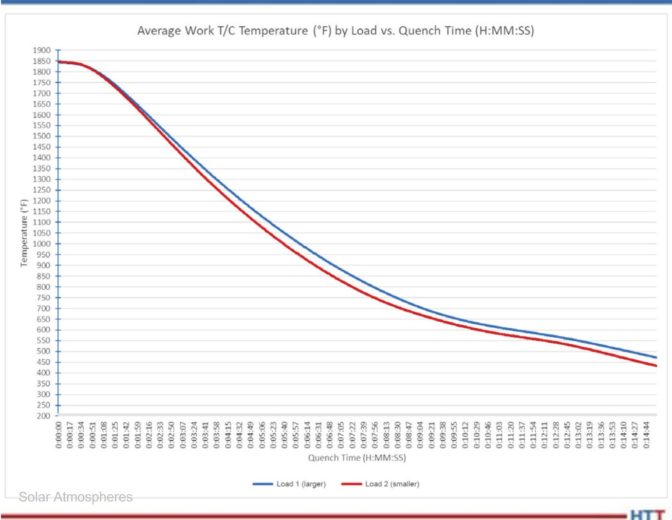
The comparative cooling curves between both HPGQ vacuum furnaces are shown in Chart 1. Table 1 reveals that in the critical span of 1850°F to 1250°F for H13 tool steel, the cooling rate in the larger furnace with more horsepower nearly matched the cooling rate of the furnace three times smaller in size.
Table 1. Critical cooling rates for H13 (1850°F –1250°F) Source: Solar Atmospheres
Chart 1. Average quench rate for five thermocouples Source: Solar Atmospheres
Micrographs of the H13 test specimens processed in each load were prepared (Images 4 and 5). The microstructure of each test specimen is characterized by a predominantly tempered martensitic microstructure with fine, undissolved carbides. The consistency of the microstructure across both trial loads further demonstrates that while the larger furnace utilized the higher horsepower, both resulted in a critical cooling rate sufficient to develop a fully martensitic microstructure.
These tests prove that the greatest impact on the cooling performance in a vacuum furnace is to increase the gas velocity within that chamber. This was achieved primarily by increasing the horsepower of the blower fan. By doing this, the ultimate cost to the customer is significantly less than manufacturing a higher pressure coded vessel. This newly designed vacuum furnace has proven to be a game changer.
Part II of this article will discuss real life case studies and how both Solar and Solar’s customers have mutually benefited from this newest technology.
About the Author:
Robert (Bob) Hill, FASM President Solar Atmospheres of Western PA Source: Solar Atmospheres
Robert Hill, FASM, president of Solar Atmospheres of Western PA, began his career with Solar Atmospheres in 1995 at the headquarters plant located in Souderton, Pennsylvania. In 2000, Mr. Hill was assigned the responsibility of starting Solar Atmospheres’ second plant, Solar Atmospheres of Western PA, in Hermitage, Pennsylvania, where he has specialized in the development of large vacuum furnace technology and titanium processing capabilities. Additionally, he was awarded the prestigious Titanium Achievement Award in 2009 by the International Titanium Association.
A Chinese company has ordered a horizontal vacuum furnace which will help in producing highly specialized cast parts used in the aerospace industry. Delivery of the furnace is scheduled for June 2022.
The Vector® horizontal vacuum furnace with a graphite chamber and a gas quenching system comes from SECO/WARWICK. This type of furnace from the international manufacturer comes with a graphite hot zone and can be used for most standard hardening, tempering, annealing, solution heat treating, brazing, and sintering.
The furnace will be installed in a facility that specializes in the production of high-temperature alloys used in the aviation, shipbuilding, and power industries, offering a wide range of products, including but not limited to, bars, wires, bands, pipes, and specialized castings.
Find vacuum furnaces for brazing when you search the Heat Treat Buyers Guide.com
Heat Treat Todayoffers News Chatter, a feature highlighting representative moves, transactions, and kudos from around the industry. Enjoy these 12 news bites that will help you stay up to date on all things heat treat.
Equipment Chatter
National Test Pty Ltd. (NDT) has been contracted by AusGroup Ltd. to provide NDT and heat treatment services on 58 stainless steel and carbon steel tanks for the covalent lithium refinery in Kwinana in Australia.
thyssenkrupp Electrical Steel supplied transformer specialist SGB-SMIT with CO2-reduced electrical steel for E.ON’s new digital stations.
Heat treat partnership between AusGroup Ltd. and National Test Pty Ltd.
SGB-SMIT Group with thyssenkrupp Electrical Steel
Personnel/Company Chatter
Braddock Metallurgical, Inc. is proud to announce the addition of a new operations manager at their Bridgewater facility. Jeff Asselta has over 15 years of experience working in the heat treating and metallurgical industry in various roles including quality and operations. They are excited to have Jeff join their team. They are also proud to announce Stanley Lopacinski as the new general manager in Bridgewater.
Advanced Heat TreatCorp. announced the promotion of Kody Kottke to plant manager at its MidPort Blvd. location in Waterloo, Iowa.
Bob Brock has transitioned to be the sales engineer at AFC-Holcroft. He will continue to serve the company as Modular Products.
Hubbard-Hall has added Jason Potts as the product manager in their Technical Department. He will be a technical resource for customers.
Friedr. Lohmann GmbH, Germany announced that Marco Möser is the new sales director of North America. Möser will be responsible for developing new business and supporting the sales team.
Thomas Pfingstler of Atlas Pressed Metals in DuBois, PA has been appointed to be the president of the Center for Powder Metallurgy Technology, succeeding Arthur (Bud) Jones, Symmco, Inc.
Douglass R. Brown, president of Inductoheat, to retire after 42 years in the induction heating industry. Doug’s contributions to the Inductotherm Group include 14 years as president/COO of Inductoheat, 2 years as president of Alpha 1, and 15 years as technology manager of Group Forging.
Thomas Pfingstler, President of the Center for Powder Metallurgy Technology
Douglass R. Brown, President, Inductoheat
Kudos Chatter
In 2021, SECO/WARWICK received six awards: “Reliable Employer of the Year,” “Innovation Leader,” “Business Leader,” an international award for the Best Economic Expansion on the North-American Market as well as “Safety Laurel,” and the title “Employer — Creator of Safe Jobs.”
Thomas Wingens of WINGENS LLC – International Industry Consultancy received ASM International’s HTS Prime Contributor Recognition award for his paper presented at the 2021 Heat Treat Show.
The Nitrex Heat Treating Services (HTS) facility in Franklin, Indiana, received the Nadcap accreditation for the following processes: heat treating for multiple alloy families, stress relieving, carburizing, nitriding, vacuum heat treating, hardness and metallography.
6 awards given to SECO/WARWICK Group
Thomas Wingens of WINGENS LLC – International Industry Consultancy with 2021 Heat Treat Show award
Nadcap certification at Nitrex HTS facility in Indiana
Heat Treat Today is pleased to join in the announcements of growth and achievement throughout the industry by highlighting them here on our News Chatter page. Please send any information you feel may be of interest to manufacturers with in-house heat treat departments especially in the aerospace, automotive, medical, and energy sectors to bethany@heattreattoday.com.
Find heat treating products and services when you search on Heat Treat Buyers Guide.com
Today, we look to our European information partner, heatprocessing, to get an update on how two huge heat treat tradeshows are gearing up: THERMPROCESS 2023 and wire and Tube 2022.
2023 Düsseldorf Update
"Till Schreiter, who contributes over 20 years of national and international experience from the electrical and metal industries to the trade fair with a symposium for thermoprocess technology, explained: 'For whoever wants to actively invest in a sustainable, future-oriented and prosperity-securing design of Europe, a visit to GIFA, METEC, THERMPROCESS and NEWCAST is an absolutely must. There is no other event in our sector that offers you this opportunity for personal exchange with the global experts and decision-makers.'"
"[Significantly] better travel conditions for trade visitors from all over the world are given. After four years without their leading trade fairs, the professional world will finally meet again live and on site in Düsseldorf. Here they will exchange information about innovations from the wire, cable and tube industries."
Time to evacuate! When it comes to evacuating atmospheric pressure from vacuum furnace chambers, the addition of a diffusion pump can help attain a lower system pressure than the typical roughing pump and vacuum booster pump allow.
This best of the web article identifies the basics of vacuum furnace pumps and then explains how diffusion pumps in particular work and identifies a few considerations to think about to determine if you need this addition or not.
An excerpt:
"For the diffusion pump to function properly, the main and foreline valves must be open, allowing the furnace to operate in high vacuum. Fluid at the bottom of the pump is heated to boiling and forced up through the center of the jet assembly."
You can’t always get what you want. With frequently changing specifications and a volatile economy, what heat treaters want is always evolving. But what they need changes, too. Steven Christopher of Super Systems, Inc. discusses how to balance what vacuum furnace operators NEED and what they WANT. Is the difference between those two things too great?
This article originally appeared inHeat TreatToday’sMarch 2022 Aerospace print edition.
Steven Christopher West Coast Operations Manager Super Systems, Inc. Photo Credit: Super Systems, Inc.
I love metaphors and think of vacuum furnaces as automobiles. As an owner, the goal is to keep our cars on the road for 100,000+ miles — and why not the same for furnaces? Accomplishing this feat requires the same in both cases: (1) routine maintenance — literally changing oil and (2) addressing warnings before they become problems — such as check engine lights or vacuum leaks.
The similarities stop there, however, with a key difference in how each is upgraded. In the near future, if you want a self-driving vehicle you will have no choice but to turn in the keys of your 10-year-old sedan and buy a shiny new Tesla, opting for the autonomous driving upgrade.
But what about your vacuum furnace? As the industry releases all these new standards and specifications, do we also need a newer furnace? Or can we retrofit what we have? That answer is complicated because so much is influenced by what we WANT versus what we NEED.
Day-to-day production shapes what we want. We learn from both experiences and failures, shaping features we want to improve operations, customer experience, and reduce rejected work. Specifications and customers drive what we need. Most recently AMS2750F (and 2769C) have been revised and place a burden on operating aging equipment while maintaining compliance. Before these, NFPA86 was modified in 2019, improving furnace design and safety “best practices."
These requirements levy real costs in terms of both hardware investment and increased labor (additional quality employees). We are expected to perform additional labor with the same workforce; however, the reality is that a worsening domestic labor shortage often means we are doing more work with even fewer people. This article navigates this delicate balance, maximizing each investment dollar’s impact while reducing our reliance on labor.
What We Need
It becomes impossible to completely address such large specifications in a short article, so let me highlight a few important considerations from AMS2769C:
Section 3.2.3.2 requires decimal precision for thermocouples (AMS2750F)
Section 3.3.1 reviews partial pressure and dew point requirements
Section 3.5.2.1 addresses permissible outgassing
Section 3.5.3 covers load thermocouples
Perhaps the most talked about change is the requirement of thermocouples to record to a tenth of a degree. It is important to distinguish the difference between a temperature controller and recorder. Section 3.2.3.2 does not require a furnace to control with decimal precision, only record to it. However, best practice lends itself to controllers supporting this ability as well.
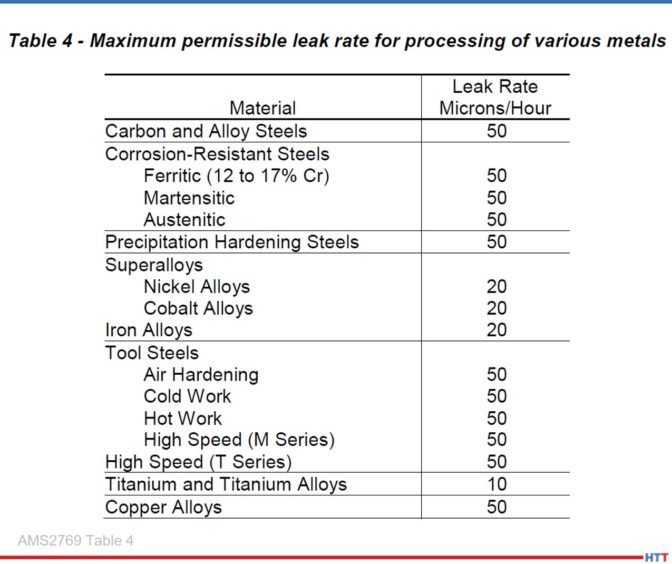
Exposure to oxygen at elevated temperatures is detrimental to part metallurgy, be it aesthetics or integrity. Leak-up rates are so important because they prove such exposure is eliminated (or significantly reduced). AMS2769C attempts to mitigate this exposure by standardizing the best practices for performing such tests. Leak-up rate tests are required weekly for (minimum) 15 minutes. Figure 1 identifies a maximum allowable leak-up rate based on the material being processed.
Historically this requires an operator to initiate a cycle, stop the evacuation (pumping), then document the beginning and ending vacuum levels by hand. While simple, this requires both time and attention, preventing any operator from performing other tasks.
AMS2769C proceeds by addressing outgassing, requiring ramp/soak controllers to either be placed on hold or to disable the heating elements if the vacuum level exceeds (1) the partial pressure target or (2) the diffusion pump operating range. Aging controllers require well-trained operators, constantly monitoring vacuum instrumentation and manually adjusting the controller. This introduces potential for operator error, again limiting their ability to perform other tasks.
Section 3.5.3 details placement and requirements for load thermocouples. Assuming load thermocouples are required, runs may be rejected should thermocouples fail below the minimum processing temperature. Disconnected control systems monitor load thermocouples using a recorder separate from the ramp/soak controller. This complicates the control system’s ability to alert operators to such failed conditions — the recorder not knowing which thermocouples are required.
AMS2769C progresses to cover partial pressure. Partial pressure has been automated for years with minimal changes to control mechanisms, though some have replaced solenoid valves with mass flow controllers (MFCs). System upgrades should strongly consider automatic gas type compensation and digital communications of vacuum levels.
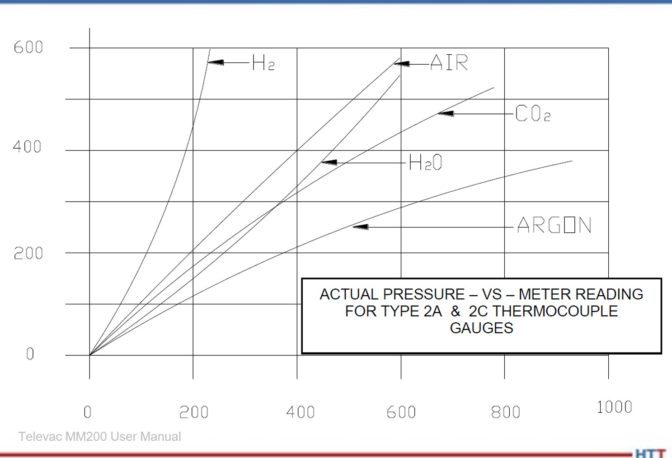
Thermocouple (or pirani) vacuum sensors estimate the heat emitted from a heating filament within the sensor. This measurement represents an exact vacuum level, though the gaseous media separating the fi lament from the measuring tip influences the reading (thermodynamics heat transfer). This phenomenon (represented in Figure 2) explains why nitrogen and argon result in very different vacuum estimates.
Figure 2. Gas compensation graph Photo Credit: Televac MM200 User Manual
NOTE: Thermocouple gauges operate in vacuum ranges where enough gas molecules remain (e.g., in excess of 1 micron) to influence this reading; unlike cold cathode sensors which operate under complete vacuum, excluding them from such compensation.
As an example, consider a vacuum furnace operating under nitrogen partial pressure. The vacuum instrument correctly displays 200 microns (refer to the AIR curve). Now consider the same cycle, only the operator introduces argon. The display now incorrectly displays (and controls to) 200 microns; however, the furnace is truly operating closer to 100 microns (refer to the ARGON curve).
Figure 3. Dew point requirements Photo Credit: AMS2769 Section 3.3.1.1
Historically vacuum signals have transmitted a 0-10vdc analog signal representing the vacuum level. As with all analog signals, error is introduced by both the accuracy of the instrument generating the signal as well the recorder interpreting it. This error is mitigated by routine calibrations — often aligned with temperature uniformity survey (TUS) schedules. Modern control systems replace such signals with vacuum instrumentation supporting digital communications, eliminating error in the process. As a bonus, the reduction in calibration points reduces time when performing calibrations. Such systems may even automatically compensate thermocouple sensors resolving the sensitivity of thermocouple sensors to multiple gas types.
AMS2769C references other specifications, namely AMS2750 and the Compressed Gas Association (CGA). CGA establishes minimum requirements ensuring inert gas quality. In addition to supplier certification, gas quality is proven by dew point. All gasses have a dew point, with outside air relatively high (e.g., +50°F) and inert gas very low (e.g., -100°F). Purchasing supplier certified gas results in a facilities bulk storage tank having a very low dew point, with any leaks in gas delivery system (pipe threads, fittings, etc.) resulting in a less negative dew point. The concept that dew point can only raise once exiting the storage tank illustrates the importance of sampling “as the gas enters the furnace” — measurements taken upstream fail to detect leaks downstream. The intensity of this increase directly correlates to the amount of air (oxygen) entering the gas supply, compromising the gas purity, which as previously discussed negatively impacts the parts being processed. Proving a dew point below -60°F proves the inert gas mostly free of oxygen. Measurements have long been a manual process; an operator samples gas using a portable sensor and records the findings in an entry log. Modern systems seamlessly integrate dedicated sensors continuously sampling gas quality which alert upon compromised gas.
What We Want
This article’s first draft opened this section listing a handful of features — that was November. Fast forward three calendar months (what feels like an entire year), it is now January, and priorities have changed. Three months ago we wanted features, now we just want parts. The growing supply chain disruption is feeling less temporary and more permanent. This final draft opens with availability. Any upgrades should factor both (1) component lead-time and (2) their flexibility. Lead-time should focus not just on immediate project delivery, but the long-term availability of the product. Is it in its infancy? Or near the end of its life? What is the current lead-time and strategies to maintain inventory? Flexibility should focus on limitations of the product. Is it limited to specific applications? Or can it be used in other equipment? Flexibility paired with planning results in standardization. Keeping with the automobile theme, standardization is what made Henry Ford’s Model T so special. Standardization reduces on-site spare parts, as the same component can be installed in many locations. Standardization should be a primary focus when purchasing programmable logic controllers (PLCs), vacuum instruments, and temperature controllers.
As if the supply chain worries are not enough, the U.S. faces a labor shortage projected to worsen over the next decade. This highlights another late addition to this article, stressing the importance that any upgrade considers the availability of the most important resource: people. New furnaces and upgrades alike (like it or not) develop a co-dependence between multiple parties. This relationship may be internal, between operations and engineering; or external, between an end user and a supplier. No matter the specific situation, all parties should discuss availability and access to information. Failure to discuss this early on is often exacerbated, especially when upgrades are performed by a supplier who is considered (1) unresponsive or slow to respond and (2) unwilling to share information. Purchase orders should document expectations in terms of deliverables (PLC logic, schematics, etc.) and support.
Figure 4. Projected US labor deficit Photo Credit: US Department of Labor
This third paragraph was that ill-fated November draft’s first. Today’s buzzword, the Internet of Things (IoT ). As we are well on our way to the quarter mark of the 21st century, we have all become accustomed to a lot of quickly accessible information. Why should vacuum furnace recorders not meet the same lofty expectations? Control system upgrades should be capable of recording information and displaying it in an easily retrievable format. Recorded data should expand beyond the required process data into the status of the furnace itself (valve position, state of limit/thermal/vacuum switches, motor status, etc.). Such data can be evaluated postmortem to troubleshoot a failed production run’s root cause of the failure. Advanced systems should be able to notify personnel of issues via email or text messaging.
Often the information gathered above is passed into a Supervisory Control and Data Acquisition (SCADA) System. This system must meet industry compliance for data integrity and security. As every new software seems to have its own system, daily operation requires most to juggle many of these systems, often sharing common data. A SCADA System should be designed to operate in this unknown environment and be capable of sharing data between itself and Enterprise Resource Planning (ERP) and other supervisory systems. The first step here is to build upon common platforms; and today the most widely accepted platform is Microsoft SQL Server. SCADA Systems should be able to “offer up” data using any number of industry standard protocols (Modbus, API, OPC, etc.).
The biggest invisible threat to our industry is internet security. For those fortunate enough to have avoided a cybersecurity attack, IT’s work seems a burden. For those unfortunate to have experienced such an event, IT’s work is beloved. This rapidly changing frontier is our reality and programs like Cybersecurity Maturity Model Certification (CMMC) become a necessary (even required) precaution. Hardware for upgrades should be vetted for compliance with these evolving precautions.
Thus far this article has focused on people, hardware, and features. I now turn the focus to the vacuum furnace itself. Furnaces routinely struggle with passing TUS at both lower (<1000°F) and elevated (>2000°F) temperatures. The issue itself varies between graphite and molybdenum hot zones but the root cause remains the same: inflexibility with rheostats to adjust across a wide temperature range or the furnace’s incapability of reaching elevated temperatures. Users manually adjust the applied power to each zone in attempt to minimize the difference between the coldest and hottest TUS thermocouples. Rheostats force the user to settle for a configuration “just good enough” for all temperatures but “not perfect for any.” Modern systems replace rheostats with individual silicon controlled rectifiers (SCRs) driving each variable reactance transformer (VRT), a feature commonly called digital trim. All furnaces are candidates for digital trim, though older VRT packages using slide wire (or “corn cob”) resistors may require the addition of direct current (DC) rectifiers in addition to SCRs. The benefit of digital trim is these settings can automatically adjust with temperature allowing for the ideal configuration at every temperature.
How Do We Get There?
Resurrecting the automobile analogy which opened this article, have you ever wondered why so many people love Jeep Wranglers (and I realize Jeep could easily have been Harley Davidson or a new home purchase)? The reason is not what they are, rather what they can become. Owners see upgrades and features in their mind long before anything is modified. The key concept here is customization. This same vision applies to vacuum furnaces, any upgrades should consider robust and powerful control systems, flexible enough to evolve with the industry.
PLCs and process instrumentation should always be sourced with room to grow. Modular designed platforms easily expand to integrate new hardware. Ask suppliers how their hardware handles additional inputs, outputs, and sensors. Instrumentation should be integration-friendly and be capable of monitoring the entire vacuum ecosystem — considering the temperature, load thermocouples, and vacuum and gas control systems. Ideally, instrumentation will communicate with each other, passing relevant information between each while simultaneously eliminating calibration points.
Control systems should be sourced with an Evolution Plan in place; compliant solutions today in no way assure compliance tomorrow. Suppliers should be asked their plan for AMS2750G, H, and I. Doing so positions you to make large investments once, then grow hand-in-hand with the industry rather than fight it every time it changes.
Summary: Have a Plan
Modern controllers consolidate a furnace’s self-contained subsystems (vacuum, load thermocouples, valve control, etc.) into a singular control system. This provides the transparency necessary for the controller to alert operators or place itself on hold when necessary. The outcome is that operators require less time monitoring the subtleties of production, meaning they focus their time on more urgent tasks. A happy byproduct becomes the natural progression of data (the recorded values from all these subsystems) into information (meaningful, document values presentable to customers, reviewable by auditors, or referenced for troubleshooting).
I was once told to either open or conclude an article with a poignant quote, so let me offer this advice: When considering upgrades for any furnace “have a plan or become part of someone else’s.” Early conversations between engineers/suppliers and quality/production ensures the delivered product shares everyone’s goals.
About the Author
Steven Christopher is a Purdue University engineering graduate and a 15-year veteran of the heat treating industry. He began his career in pharmaceutical maintenance before joining a commercial heat treat facility focusing on the automotive and aerospace industries. He now manages Super Systems' West Coast operations supporting all types of industries west of the Rocky Mountains.
For more information, contact Steven at schristopher@supersystems.com
Find heat treating products and services when you search on Heat Treat Buyers Guide.com
The “Known – Unknown,” the “Undiscovered Country,” the “Movement from cocksure ignorance to thoughtful uncertainty.” It doesn’t matter if you get your catch phrase from Donald Rumsfeld, Star-Trek, or that plaque your mother kept above the kitchen sink, the implication is the same: we really don’t know what the future holds. But, the Unknown of which I speak in this article is natural gas prices.
This column is a Combustion Corner feature written by John Clarke, technical director at Helios Electric Corporation, and appeared inHeat TreatToday’sMarch 2022 Aerospace print edition.
If you have suggestions for savings opportunities you’d like John to explore for future columns, please email Karen@heattreattoday.com.
John B. Clarke Technical Director Helios Electric Corporation Source: Helios Electrical Corporation
Does “What happens in Eastern Europe stays in Eastern Europe” hold true? Unfortunately — no.
We have learned from recent and ongoing supply chain issues just how interconnected our economy and manufacturing sector is with the rest of the world. The standoff in Ukraine has the potential to impact the world energy markets for years to come, and I suspect this impact will be felt no matter what transpires. I am certainly no expert, but I have a sinking suspicion that our country offered some American methane molecules to Germany to stiffen their resolve to cancel the Nord Stream 2 pipeline. If the EU works to reduce their dependency on Russian natural gas, a significant portion of worldwide exports are removed from the supply side of the equation. From a practical standpoint, these shifts in supply will take some years to achieve, but we have seen a new realization on the part of business and governmental leaders about the importance of robust and reliable supplies of commodities, and manufactured goods and manufacturing capacity. So, less natural gas supply with rising demand equates to higher prices. And as we have discussed previously, liquefied natural gas transportation from the U.S. to the rest of the world is connecting our natural gas market with the world market — and our natural gas price will be affected by consumption and production factors worldwide, just as the price we pay for petroleum oil today is determined in New York, London, and Riyadh — following the consumption patterns in Beijing, Sydney, and Tokyo.
Ok — let’s get back to what we can do in our own facilities to insulate ourselves, to some degree, from unpredictable world events.
Recuperation, or preheating combustion air using the waste heat exiting the furnace or oven is a time proven method to reduce fuel gas consumption. Before we quantify the effect of preheating air, we need to briefly discuss what affects this heated air has on the combustion process. Higher combustion air temperatures are associated with the following:
Peak flame temperatures are increased. As less energy is used to heat the incoming air, the energy in the natural gas can raise the products of combustion (CO2, H2O and N2) to a higher temperature than would be achieved without combustion air preheating. This can be either beneficial or problematic for a specific application. If the work being heated can accept increased radiation from these higher temperatures — heating rates are improved and throughput increased, but these higher temperatures may reduce the life of furnace components, or, in extreme cases, lead to a catastrophic failure.
Flame speeds are increased, so the combustion process concludes in less space. Again, this is a double-edged sword, benefiting some and leading to a loss on temperature uniformity in others.
Total products of combustion required for any quantity of heat input is reduced. Mass flow is especially important in systems where the operating temperature is below approximately 1200°F. If the energy saved leads to a loss in temperature uniformity, it may be a Pyrrhic victory.
NOx formation is increased. Burner technology has come a long way in recent years to allow for systems to use these higher temperatures without greatly increasing NOx emissions, but the rule of thumb is that by increasing the combustion air temperature from 70°F to 800°F, we basically double NOx formation.
Each of these drawbacks, other than NOx formation, may be a plus rather than a minus for any application. Float glass furnaces (plate glass used in windows) and ingot reheat furnaces are examples of applications where recuperation was applied a century or so ago, at a time where fuel costs where not much of a factor. In both cases, the increased flame temperatures accelerated the heat transfer to either the glass or the steel, increasing production. These applications required furnace temperatures where combustion without preheating would have been impractical — as most of the energy would have been lost in the flues, and very little heat would be available to do any useful work.
What questions should I ask? How much can I save? What is my project’s estimated payback? All are critical questions. To start with, can your existing furnace accept these higher flame temperatures, and can you capture the heat and apply a cost-effective heat exchanger? An example would be a radiant tube furnace. Applying recuperation may require an upgrade in the alloy used in the burner and radiant tube. In direct fired applications, will my uniformity suffer? In general, this is a greater concern at temperatures below 1600°F. As the operating temperatures increase, we can generally expect better uniformity. (I can hear the furnace and burner experts reading this cry “foul,” and they are right, it is not wise to rely on my generalizations — always consult an expert about your specific application.)
How much will it cost? With recuperation, it is best to take advantage of an experienced person’s mistakes, rather than making them on your own. Consult a qualified contractor, OEM, or consultant to help with the application and costs.
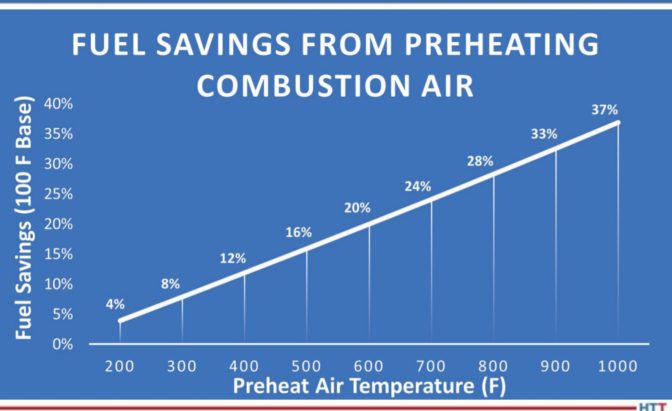
How much can be saved? To answer that question, I provide the above graph. It is not the end all be all but will provide a rough estimate of potential savings. It is for an application with an exhaust temperature of 1600°F operating with 15% excess air.
As we can see, in this application, if we apply recuperation to preheat the air to 800°F, we will save 28% of the natural gas we would otherwise consume.
Before investing your money, an individual analysis of each application is required. This article’s purpose is simply to motivate the reader to invest the time necessary to properly determine, as I mentioned last month, if they have “uncashed checks” lying around their shop.
As always, please let me know if you have any questions.
About the Author:
John Clarke, with over 30 years in the heat processing area, is currently the technical director of Helios Corporation. John’s work includes system efficiency analysis, burner design as well as burner management systems. John was a former president of the Industrial Heating Equipment Association and vice president at Maxon Corporation.
Find heat treating products and services when you search on Heat Treat Buyers Guide.com
The tragedies of war are many. In today's post, we're looking at a very small slice of the consequences of the war in the Ukraine: How might this affect the heat treat industry? What should you prepare for? We've located four insights to reflect on this Friday.
Supply Chain Bottle Necks
"Representing 200 million tons of transit potential, Ukraine is one of the foremost—yet often overlooked—components of both the European and global supply chains. Therefore, any disruption in the region can have massive knock-on effects for countries throughout the world." With that in mind, three industry considerations are energy, resilience, and capacity. (Read more)
Businesses Are Interrupting Trade with Russia
Adding to the supply chain changes, you may find businesses you work with or even your own ceasing to do business with Russian companies in an effort to show solidarity with the Ukraine. In one case, "A group of 3D printer OEMs and other companies involved in additive manufacturing have released a statement in support of Ukraine and are calling for a quick end to Russia’s war in the country." (Read more)
Heightened Cybersecurity Preparedness
It's hard to say whether cyber attacks are absolutely increased because of the conflict since there has long been a high rate of cyberattacking originating from Russia. However, cyberattacking is a known threat in modern war, and there have been increased email phishing attacks on specific targets. (Read more)
"We are seeing cybercriminals use Russia and Ukraine-centric social engineering efforts, like phishing emails, leveraging current events to solicit an emotional response to the war,” says Rosa Smothers, former CIA cyber threat analyst and technical intelligence officer, now at KnowBe4. 'In other words, people are less likely to think before they click.'" - Dennis Schima, "Does the War in Ukraine Increase the Risk of Russian Cyberattacks?"
Humanitarian Pressures
Whether near or far, we've been seeing fundraising efforts, medical support, and humanitarian aid being sent to the frontlines. Perhaps you've done business internationally and have contacts who need support, or, like SECO/WARWICK, have found a way to raise funds and send support: "With your help, we’ve sent humanitarian aid to the border and each day we support our Ukrainian colleagues."
Find heat treating products and services when you search on Heat Treat Buyers Guide.com
Heat TreatRadiohost, Doug Glenn, and several other Heat TreatToday team members sit down with long-time industry expert Dan Herring, the Heat Treat Doctor®, to discuss the difference between heat treating and thermal processing. If you’ve ever wondered about the difference – if one actually exists(!), then you’ll enjoy this highly informative Lunch & Learn with Heat TreatToday.
Below, you can watch the video, listen to the podcast by clicking on the audio play button, or read an edited transcript.
The following transcript has been edited for your reading enjoyment.
Doug Glenn (DG): So, Dan, I want to turn it over to you, but I want to give a context though of what we’re going to be talking about. As you just mentioned, before we hit the record button, we’re pretty heat treat centric in our world, but there are a lot of other thermal processes that go on that aren’t exactly heat treat. We talk about some of them in our publication, not all, so what we’d like to do is turn over to you to talk about the difference between “heat treating proper” and “thermal processing, generally speaking.”
Dan, welcome and thanks for educating us.
Dan Herring (DH): Well, thanks, Doug, and good afternoon, everybody. First of all, for everyone listening, I hope to cover the basics providing information without confusing everyone. If there are any questions as I go along, please don’t hesitate to ask them. I think it’s always better to have an interactive, back and forth discussion on things.
You are absolutely correct, Doug. we live in a heat treat centric world. I’m going to start off in familiar territory by discussing a little bit about heat treating. Then, we’re going to move into the differences between heat treating and thermal processing.
To give a simple definition of heat treating — simple yet complicated at the same time — is heat treating is the controlled application of time, temperature and atmosphere to produce a predictable change in the internal structure (that means the microstructure to metallurgists) of the material being treated. Now, the interesting part is that heat treating is (a) predictable, which is why metallurgists exists in the world and it is (b) controlled, which is why heat treaters exist in the world, and the darndable thing about heat treating is that it happens inside the metal or the material and, unfortunately, you (c) can’t see the changes that are taking place.
"Let me give you an example, if I can: I’ll hold this up; I don’t know if people can see it that well, but what this is is a helicopter transmission gear."
Let me give you an example, if I can: I’ll hold this up; I don’t know if people can see it that well, but what this is is a helicopter transmission gear. And if we were manufacturing this particular gear, one of the things we would do to measure, if we were successful or to see if we were successful, is to measure the dimensions of the gear that we were actually taking and manufacturing. But in the world of heat treating, because the changes happen inside the material, it’s very difficult to know if the part is good or not. But heat treating has the ability, as we say, to vary the mechanical properties, the physical properties and the metallurgical properties of a material. The problem is that we can change them either for the better or, as most heat treaters know, we can change them for the worst. That’s why there is something called quality control and quality assurance. But I’m drifting away from the main point.
In the world of heat treating, with that definition — the controlled application of time, temperature and atmosphere to produce the predictable change in the internal structure of a material — not only are we heat treat centric in this industry, but we are also often steel or iron and steel centric in this industry. Metallurgists tend to be either ferrous metallurgists (specializing in irons and steels) or nonferrous metallurgists, specializing in things called aluminum, or as the British and Europeans would say, “aluminium,” titanium, and some of the super alloys and things of this nature. The idea being the fact that there are a lot of different materials that can be heat treated.
We often limit ourselves, if you will. But there are parts of our industry that heat treat: for example, precious metals — the golds, the silvers, the platinums and things of this nature. There are also parts of our industry that deal with copper and brass. There are parts of our industry that deal with ceramics which deal with powder metal, if you will. So, one of the things as heat treaters we must remember is that even under just the heat treat umbrella, there are a lot of different disciplines out there. There are a lot of things that we cover, and we look at. There are a lot of different materials that are processed. And again, we think, in general, as heat treaters and probably incorrectly so, we think about what are called “semifinished goods.” What we think about are parts that are manufactured from steel, aluminum, titanium, copper or powder metal. We think of automotive parts, aerospace parts. We think of something like weapons or military equipment, ammunition, firearms. We think of agricultural products, farm implement products and things of this nature. So, one of the things we must be aware of is that there is a whole world outside of our comfort zone, and that is something that we’re going to explore today.
Before I go on, does that make sense to everyone, or does anyone have any questions about the heat treatment side of what we do?
"Heat treating is the controlled application of time, temperature and atmosphere to produce a predictable change in the internal structure (that means the microstructure to metallurgists) of the material being treated." - Dan Herring
DG: No, I think that makes sense. You mentioned on the inside of the part that things can’t be seen so much. You will probably get to this Dan, but I assume that also includes surface treatments, or would that be something different?
DH: We’ll talk a little bit about the difference between surface treatments and they fall into an area probably referred, in general, as “coatings” and things of this nature. But that is a good question, Doug- plating and coating and things of this nature.
Also, one of the things about heat treating that seems a little bit, possibly confusing is that heat treaters consider processes like brazing (which is a joining process), and they think of soldering (which is a low temperature joining process), as heat treatments. Similarly, we think of sintering, and we think of heat treatments of powder metal products, or we think of powder metallurgy as falling under the subject of heat treatment because we think so much about sintering. But sintering is a bonding or a diffusion process. So, heat treaters think of heat treatment, they think of brazing, and they think of powder metallurgy all combined into that big umbrella. For any brazers who are listening, or any powder metal people who are listening — they probably died of cardiac arrest at this moment in time — but, in general, that’s what heat treating does: it considers those separate entities as part of it.
Let’s go on and look at the fact that I can say to you — automotive components, gears, bearings, aerospace components, landing gear transmission boxes, fasteners, screws, nuts, bolts, farm implement equipment -- those are things that commonly come to mind. People don’t often think, for example though, of things like jewelry which is something that is commonly heat treated or “processed,” if you will, more on the thermal processing side. A lot of electronic materials are also thermally processed, and a lot of castings and things done in the foundry industry.
But, as I said, we think of semifinished goods where a semifinished goods-centric/heat treat-centric world; but there are other worlds out there. Let’s kind of talk about them. But mill practices, or what we call “primary metals,” are another area that’s covered, interestingly enough, under heat treating. Because in steel mills and things of this nature, you’ll find soaking pits, for example. In aluminum processing facilities or aluminum foundries, you might find solution heat treating and aging ovens and things of this nature. So, there is, in a very broad or general sense, heat treating also done on the mill or the material production side of things. Again, unless we’re in that industry, we don’t tend to think about it that much. So, we have to.
But, if I also said to you that things like cosmetics are being processed, not heat treated, but thermally treated, if you will. Or things like cement, or minerals in raw ore, ore materials and things- these all fall in the category of now “thermal processing.”
Let me try to give everybody just a feel for what the different categories of thermal processing are. The number one category, of course, is heat treatment. There is another thermal process . . . . And, by the way, thermal processes are also confused a little bit because we use heat, or we use cold — those are both thermal processes. For all the heat treaters out there, we do things like deep freezing, and we do things like cryo-treatments, cryogenic treatments. Those fall under the umbrella of heat treating. But there are other deep cooling or cooling processes that fall under this umbrella of thermal processing.
Besides heat treatment, thermal processing consists of a few areas which you are maybe familiar with and then again maybe you’re not that familiar with. One of them is calcining which I often call the drying of powders, if you will. This can be in the form of ores, it can be in the form of minerals, it can be in the form of coke (which is a coal byproduct, if you will), it can be in the form of cement. So, there are drying processes that occur under thermal treatment which is in the area of calcining.
There is also a big category called fluid heating where what we’re doing, (and by the way, air is a fluid as well as water and liquids are fluids), so we can turn around and do things like chemical processing which is done at elevated temperature. I had a client that was producing mayonnaise and the mayonnaise has held at 180 degrees Fahrenheit- it is a thermal process, if you will.
Distillation. We won’t talk about alcohol much in the world. I will only comment that all of you think this is a bottle of water, but you could be mistaken about that.
The idea is that fact that fluid heating, calcining, drying, smelting, metal heating in general, curing and forming — which is done a lot on ceramics, on paints, paint drying and things of this nature. There is, just in general, other methods of heating. I’ll give you a simple example: waste incineration. We know that our trash is burned at ultra-high temperatures to reduce emissions, if you will, but avoid going into landfills or, worse yet, dumping it in the ocean and believing that somehow it won’t return to our ecosystem. But incineration is an example of a thermal process.
There are quite a number; there are literally hundreds of thermal processes that are occurring all the time that we don’t, in general, think very much about. Heat treating is typically divided into two general categories — processes that soften a material and processes that harden a material. So, in the category of softening, we think of things like aging, we think of things like annealing, we think of things like normalizing, or even stress relieving (in other words, taking the stress out of material is a softening process).
DG: Tempering, as well, Dan? Would it be in that?
DH: Well, tempering, in a sense, could be considered a softening process. It’s a good one. I consider it more a softening process than a hardening process, but it’s typically so intimately linked with hardening that people think of it as a hardening process. But, hardening and case hardening, austempering, and then, of course, brazing which is a joining process, soldering, sintering which is a bonding process, homogenizing (when we talk about aluminum), solution treating (when we talk about aluminum). Solution treating is not a hardening process, interestingly enough- it’s the aging or the precipitation hardening process after the solution heat treatment that is actually the hardening process.
The idea of the fact is that we’re very familiar with those terms; we’re less familiar with coke ovens or waste incinerators or distilling facilities, or things of this nature. We’re not used to processing resins or composite materials, even though there are autoclaves that use a combination of high pressure and temperature to form some of the composite materials that are used in the aerospace industry.
The way I like to think about it is there is a giant umbrella which is called thermal processing. Under that umbrella is a small segment, maybe not so small, called heat treating, and then heat treating is divided into semifinished goods and raw materials (or primary goods), and then it’s subdivided into irons and steels and nonferrous alloys. Now, in my day, when you graduated university, you graduated with a degree in metallurgy. Today, you become a material scientist which means that you’re dealing with composites, ceramics, electronic materials, a whole series of materials outside the realm of just iron and steel and aluminum and titanium, if you will.
The other thing that’s very interesting about our industry, in general, is probably the aspect of energy usage. The thermal processing industry, in general, and this is a rather stunning number, uses, in round numbers, about 38% of the energy produced in the United States. Now think about that as a number. Of all the energy consumed by people in the U.S. or in Canada or in Mexico or anywhere else in the world, two-thirds of it or greater — 40% of it, almost — is used in thermal processing. About 25% is used by transportation, and another 20% or so is used by residential. Then, there’s about 15% used in, what we call, “other” category. But, in thermal processing, which is also true in heat treating, about 80% of the energy comes from natural gas. And only 15%, (round numbers), comes from electricity.
We have to realize that we’re not only, as heat treaters “heat treat-centric,” “iron and steel-centric,” “aluminum-centric,” but we’re also “natural gas-centric.” Those are staggering numbers to consider. The reason for it, the reason we’re natural gas centric, not only in the heat-treating industry but in the thermal processing industry as a whole, is simply because natural gas is the cheapest energy source available right now. And, these numbers, although they apply specifically to North America, can also apply, if you will, to the world in general. The numbers vary a little bit throughout the world, they may be different in Europe and different in Asia, but not so much that it varies so greatly.
What I’ve tried to cover — and I realize I haven’t left a lot of room for questions here and I apologize for that — but I’ve tried to give you the idea that heat treating is a very important part of a much larger industry that services the manufacturing community.
Let’s open for discussion from anybody.
Dan Herring and the Heat TreatToday team: Karen Gantzer, Bethany Leone, Doug Glenn, Dan Herring, Evelyn Thompson, and Alyssa Bootsma
DG: That sounds good. Do any of you have questions, at all?
Alyssa Bootsma: I did have one. I think it was very helpful in understanding everything and the idea that thermal processing is an umbrella and heat treatment is just a part of that really clicked for me. I was wondering if you could talk about calcining a little bit more and what that process actually is.
DH: Sure. But before I do that, I want to mention one thermal process that I forgot to mention. Because I have a number of clients that work in the baking of cookies, and because I’ve consumed a few of those in my life, I don’t want to forget the baking industry.
DG: The brewing industry?
DH: Absolutely! By the way, the brewing hall of fame is located here in Chicago, unless I’m grossly mistaken.
Before we get to far afield, let’s talk about calcining a little bit. A number of powders, whether they be ores or whether they be things like cement or various minerals, are often processed in, what we call, a slurry. They’re processed in a form in which they are either cleaned or washed with water or with different chemicals. As a result, you have a wet mixture of a mineral and, let’s say, water, or in some cases they can be different chemicals, if you will, that go to either clean the minerals or dilute the minerals or things of this nature. But to go to further processing of those minerals, you have to dry them and put them into a form that they can be used. If this makes any sense, then let’s take cement as an example. It’s no good to keep the cement in a slurry because what’s going to happen to the cement? It’s going to dry and harden. So, what you have to do to send it to the consumers is you have to dry the powder, if you will, deliver it to the end-user who will then add liquid to it to once again form it or turn it into liquid cement. Calcining, is really, in simplest terms, to answer the question directly, I always consider it, a powder-drying process.
DG: Dan, any idea why they call it “calcining?” I’ve always wondered this.
DH: Well, in the old days, I believe that limestone, (which is calcium carbonate), and so "calcining" and "calcium" from the calcium carbonate, I think that’s where the name originally came from. A good thing to look up, however- that’ll be my homework assignment.
DG: There you go. Just as another example of a thermal process, it’s certainly not heat treat, just down the road from where I live, north of Pittsburgh, they have a lot of sand and gravel places. Believe it or not, there is a large, what I would call a, horizontally-oriented “screw furnace” — it’s a cylinder and it just rotates, and inside it’s heated up and they’re just simply burning off the moisture so that they can get the materials, or whatever it is they’re harvesting out of the earth, and get it down to a certain level of moisture so that they can process it. So, sand and gravel. That’s just another area.
Here's another one — and Dan, I want you to hit on glass if you don’t mind, in a minute — but here’s another one where thermal processing is used, which you might not think of, and that’s in the manufacturing of paper production. They’ve got to actually dry the paper and you wouldn’t think of it but they’re passing paper through flame (between flames, not actually in the middle of the flames) simply to dry paper before it goes onto these huge rolls.
One last comment, Dan: We often talk about energy intensity and how much energy it actually takes to perform a certain process. One of the highest thermally intense processes that is used is not so much a heat treatment, but it is actually the manufacturing of concrete, believe it or not. There is very, very high energy intensity — it takes a lot of gas, in this case, to produce concrete.
But Dan, if you don’t mind, could you hit on glass production? We’re all looking out windows here and the manufacturer of glass is a thermal process.
DH: Absolutely it is. But before I do that, quickly, that rotary drum that you saw, the one with the screw inside it, if you will, that helps move the powder, if you will, or the sand and gravel through, is a very typical calcining furnace. Rotary drums are also used in the heat treatment industry to process screws and fasteners, nuts and bolts, small products, if you will, typically.
But yes, paper is a good example but glass furnaces, too, where the glass is actually brought up and the sand and other elements, if you will, are melted into glass. Very disconcerting. You may find this interesting but roughly the walls on a glass furnace (I’ve seen 10-20,000-pound glass furnaces) are something like 4 inches thick, holding back all that molten glass. But again, you’re taking glass that is basically silicone dioxide, its sand is a major component of it. In colored glasses, you add different chemicals. Like, for example, if you want to form a bluish colored glass, you might add a copper oxide, for example, which will change or tint the glass to a different color.
You’ve heard of leaded glasses, for example. In the old days you added lead to glass to make it, again, more formable, if you will. But yes, glass furnaces or the manufacture and production of glass is very energy intensive, as well as cement, as is the production of aluminum, by the way, which basically uses electricity, which is why all of the aluminum facilities are located either near hydroelectric or thermal energy like in Iceland, for example, where you have geothermal energy which is used to heat and produce electricity. But yes, glass is definitely an example of a thermal process, as well.
Glass is interesting because we don’t necessarily do a lot of heat treatment of glass, but you may have heard of glass-to-metal sealing, where we’re actually taking a glass and sealing it into or onto a metal component. Like, for example, the site ports of burners where we look in to see the flame — those site ports are made by glass-to-metal sealing. But, in general, yes, melting and production of glass is a thermal process.
DG: Dan, correct me if I’m wrong, and I could be wrong on this, but cellphones, right? Your glass on the front of that — the reason it is actually quite strong and won’t break is because it’s been thermally processed, a tempering process of some sort, I believe. Correct me if I’m wrong, but isn’t it the thermal process that can make a glass really, really difficult to break?
DH: It is, plus the fact that glass is a quasi-solid, as we say. It’s a solid but it’s really not; it has more characteristics of a liquid, which, again, makes it more ductile or resistant to things It makes it more shock absorbing, for example. But yes, cellphones and cellphone glass are something I’ve got to do some more research on.
DG: Right. They’ve got some stuff called “gorilla glass.”
I just want to recap a couple things for our team here and for other people that might be listening: When we talk about heat treat, which is what we’re centered on, it’s helpful for us to know what processes, materials and things that includes, and what processes and materials that doesn’t include, and that’s why this conversation on thermal processing versus heat treat is helpful for us. The way I like to describe it to our team and to most of the people who would be reading our publication or listening to this podcast, is typically Heat TreatToday is not involved with the making of steel but almost everything else after the making of steel we would deal with, almost everything. So, we don’t really do the steel making. Steel making, however, is very much a thermal process but we just don’t cover it. There are other publications that cover that. And we are very much steel-centered; we do aluminum, as well. However, in the aluminum world, we actually do deal with aluminum making. For reasons that basically have to do with the temperature range: the temperature range isn’t quite as high with aluminum making as it is with steel making. So, we do some of that. We don’t do a lot with aluminum making but a lot after aluminum is made. We do a lot of the homogenizing, annealing, solution heat treating and that type of stuff.
So, that is us. In heat treating, we define things like brazing, even though it’s a joining process, we tend to cover it. Soldering we don’t tend to cover because it tends to be a lower temperature. Dan didn’t mention it, but I’m sure he would, is welding: it’s a joining process but it’s not exactly anything we cover either. It’s not what we consider to be heat treating.
There is another joining process that we didn’t cover, and maybe we could hit on it briefly next time, and that is diffusion bonding which, to be quite honest with you, I haven’t done a lot of study on it so it would be interesting to know what that is. I know it’s done in vacuum and under high pressures, I believe, but things of that sort.
At any rate, that what’s we mean when we talk about heat treat — it’s primarily steels, aluminums, titaniums and typically not steelmaking and probably not titanium making either, but aluminum making and everything downstream from that tends to be us, and our temperature ranges tend to be, very generally speaking, 800 degrees Fahrenheit and above, or as Dan mentioned, we can also do some things in the cryogenic range which are subzero temperatures. So, that is us. Everything that falls outside of that we would consider to be a thermal process, which is a lovely thing, but just not our cup of tea.
DH: Look at this, Doug, a whole new business opportunity for you. With that, I’m extending myself beyond metallurgy, so I’ll quit there.
DG: Dan, we really appreciate it. We look forward to more of these. We are going to try to do other topics, again, what I would call heat treat 101 type topics, our Lunch & Learn series with Dan Herring, The Heat Treat Doctor®. Dan, thanks a lot, we appreciate your time.





 Source: Advanced Heat Treat Corp.
 Find heat treating products and services when you search on Heat Treat Buyers Guide.com

 There is an age-old adage that exists in the heat treating world. That supposition states that “the smaller the vacuum furnace, the faster it will quench.” Is this adage true? Explore Solar Atmospheres’ journey as they designed an experiment to discover if pressure or velocity most affects cooling performance.






 A Chinese company has ordered a horizontal vacuum furnace which will help in producing highly specialized cast parts used in the aerospace industry. Delivery of the furnace is scheduled for June 2022.
 Heat Treat





 Today, we look to our European information partner,
  2023 Düsseldorf Update
 2022 Summer wire and Tube Update





 The “Known – Unknown,” the “Undiscovered Country,” the “Movement from cocksure ignorance to thoughtful uncertainty.” It doesn’t matter if you get your catch phrase from Donald Rumsfeld, Star-Trek, or that plaque your mother kept above the kitchen sink, the implication is the same: we really don’t know what the future holds. But, the Unknown of which I speak in this article is natural gas prices.












 DG: Dan, any idea why they call it “calcining?” I’ve always wondered this.