


heat treat radio

Heat Treat Radio #92: Navigating OSHA.gov with Rick Kaletsky

To determine what safety standards are relevant in your heat treat operations and be prepared for the future, tune into this special Heat Treat Radio episode. We’ll walk through the OSHA.gov website with our guest and expert safety consultant, Rick Kaletsky. Rick will help you understand how to use the website and find relevant standards, definitions, explanations, and more to make sure your heat treat operations are in compliance. He will also bring these navigation skills together at the end with two case studies.

Below, you can watch the video, listen to the podcast by clicking on the audio play button, or read an edited transcript.



The following transcript has been edited for your reading enjoyment.

Contact us with your Reader Feedback

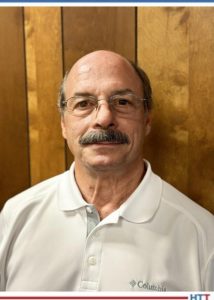
Rick Kaletsky with his book on prepping for and responding to OSHA inspections
Source: Rick Kaletsky

Bethany Leone: Welcome everyone to another episode of Heat Treat Radio. We are sitting down with Rick Kaletsky. He has a lot of experience, as a consultant, with occupational safety. Rick, can you tell our listeners and viewers a little bit more about yourself, your background, and anything else you want?

Rick Kaletsky: Thank you. I’ve been in occupational safety for 50 years. I live in Connecticut, always have. The main parts of my career were 20 years with U.S. Department of Labor (OSHA) in Connecticut. As a compliance officer, I conducted hundreds of inspections. As assistant area director, I assigned and reviewed thousands, and held informal conferences. On many days, I acted as area director for the whole state, but still through the federal office.

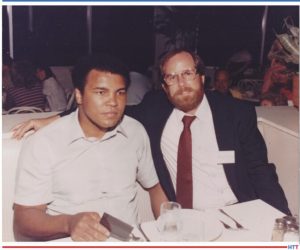
Rick is an expert on Muhammad Ali.
Source: Rick Kaletsky

I’ve been on my own as a self-employed safety consultant for 30 years. Although I’ve done a wealth of inspections in that situation, I’ve pretty much gotten into now, in almost all cases, working for attorneys. These very serious occupational injuries, and occasionally nonoccupational, like  trips and falls in a mall, etc. I testified either by deposition or in court more than 60 times, and I’ll provide information about a book I wrote (see end of transcript, or purchase book here). Sidenote, the book I wrote about Muhammad Ali is even better than the OSHA book!

Bethany Leone: We’re here with Rick to specifically navigate osha.gov.

Rick Kaletsky: It is osha.gov. It’s important for everyone to know, please do not use .com, .net, or .edu. You’ll get something else.

United States Department of Labor Occupational Safety and Health Administration
Source: OSHA

I have the screen in front of me now. This is United States Department of Labor Occupational Safety and Health Administration. You all should see a red banner across the top. It’s quite user friendly. You can use it for many, many purposes. It’s free — why not use it? You can use it to find OSHA standards. You can use it to find directives and interpretations which give you an idea of what are some special things about standards that do not appear in them:

  • For instance, an interpretation is generally when Johnny Smith from the ABC company in Nebraska writes to OSHA and wants to know, “Regarding this standard, am I in violation if . . . Or what are alternative means, etc.?” OSHA will answer. But those answers are not in the standard, so there are some special things there.
  • A directive is a similar thing that the national office of OSHA communicates to its people in the field, mainly for compliance officers who do inspections, on how to view certain situations, how to look at what might be a violation or what is not a violation.

You can also use this site for tutorials, for finding publications, downloading them, printing them, and certainly to find the records of companies. You will find, not their injury and illness record, but rather, when they were they cited by OSHA for allegations, and which particular standards.

In roughly half the states, the federal government enforces the standards. Now, there is a Nuclear Regulatory Commission; there is a railroad administration — there are a few things that aren’t covered and few people working absolutely alone.

Just figure: If you have an employer-employee relationship, barring some unusual exceptions, they’re covered by OSHA. If you figure we have a small family heat treating business of 6 people, yes, you’re in.

In about half the states, the federal government does the enforcing. In the other half, the state does the enforcing. A few states have even addressed standards and come up with rules (laws) that federal OSHA doesn’t cover, like ergonomics.

If you’re in a federal state, you are dealing with 29 CFR (Code of Federal Regulations, 1910 ). Some iterations of CFR 1910 refer to exits, some to powered industrial trucks or vehicles, some to lock out/tag out, some to personal protective equipment, some to ladders, etc.

Some of the states that do their own enforcing and use the exact same standards as OSHA. For the heat treating industry, it is going to be 1910 point. There are a few that begin with something like 1902 or 03, regulating injury/illness records and posters. Just about everything else is 1910. So, that tells you a lot about standards.

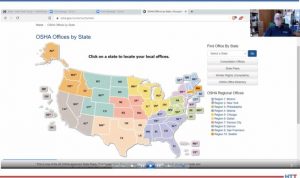
To find an OSHA office, click on “Find an OSHA office.” The offices are organized by state.

The offices are organized by state.
Source: OSHA

In Maine, there’s a federal OSHA office in Augusta, Maine and in Bangor, Maine. You might have to figure out which one covers you if you have a question.

Now, every state has a consultation program. As a relatively small company, you can get the state to come in for free as long as you’re not in the middle of an enforcement inspection. You could say, “I don’t want to pay a private consultant.” The state comes in, and they tell you what they think is wrong. If you’re concerned that they’ll run back to federal OSHA — no, no; they know that that would freeze your interest.

They will tell you what needs to be done, where you may be breaking the law, and they give you a while to deal with it. There is no penalty. Will they run back to the enforcement people, whether it be the federal people or the state people? They will not . . . unless you steadfastly refuse to correct something even with extensions of time.

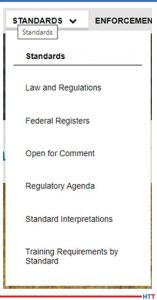
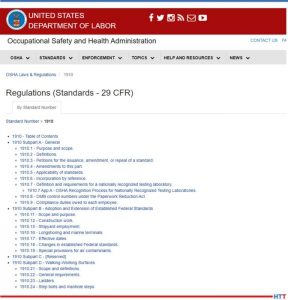
"Standards" and "Law and Regulations"
Source: OSHA

We’re going over to “Standards," and you see the arrow that points down. When you hit that, you see “Law and Regulations." For now, let’s try that.

When we hit “Law and Regulations” on the left there should be a column where it says “General Industry." These are the federal numbers for standards, but they often apply to states anyway. Here we find specific standards. I’ll try to stop on a few.

On the left, you’ll see “Ladders” and that goes back into 1910 point 20. You’ve got to know whether you’re talking about a stepladder or an extension ladder or a fixed ladder.

“Walking/working surfaces” applies to anything to do with fall protection. In your industry, that could mean you may a mezzanine that doesn’t have perimeter protection or a tie-off to a person. And sometimes you have somebody working on top of a furnace, more than four feet high. If that person isn’t protected, there is a problem.

Where in these standards do I find heat treating?
Source: OSHA

Where in these standards do I find heat treating?

Well, it’s possible those particular words are somewhere, but there is no particular section here just for heat treating. There are very, very few specific industries that have a section that is dedicated to them. But pretty much all of 1910 can apply whether you manufacture submarines or bowling balls, or you just have a store or a warehouse or an ice cream factory.

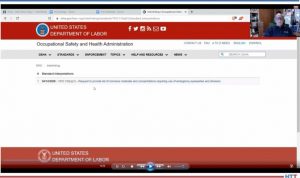
Let’s look at “133 Eye and Face Protection”. This is what I really wanted to show you. See it says “Standard Interpretations”?

"Here you're right in the standard."
Source: OSHA

Now, there are other ways you could have done that by just the general OSHA search bar “Interpretations” or “Eye protection interpretations” perhaps. But here you’re right in the standard. So, when you hit “Standard interpretations”, we see “Request to provide” list of corrosive materials and concentrations requiring use of emergency eyewashes and showers. That actually applies to another standard also, it’s not just eye protection. It’s the fountains. Let’s hit “Request to provide”.

Here someone wrote to OSHA and said, “When do I need an eye fountain or eye protection or both?” And OSHA wrote back and said, “Well, there might be some twists, this isn’t all encompassing. This is where we try to answer your questions.”

Emergency eyewash station
Source: Heat Treat Today

Many years ago, a heat treater comes to me and says their company got cited for a problem with dip tanks. Now, this standard has been changed since. Dip tanks are an example, when you read that standard, you should always see what the application and scope are.

Does this apply to me? But with dip tanks, it gets so specific that you’ve got to have this kind of substance, and this is only if dip tanks have so much volume or so much surface area, etc. Well, they got cited for a few things.

I said, “Let’s look at the standard. Not just the way it applied and is shown on the citation but the complete writeup of the standard.” Is your dip tank this size or bigger? Yes. Does it have this much stuff in it? Yes. Is it flammable? Yes. Well, they got you. You’re going to have to do what it says.

The heat treater said, “But, Rick, we’re not even concerned about this penalty, but to correct that is going to cost us well over $100,000 because of permits and  outside location.” I said, “I don’t know what I can do for you.” They said, “Do something!”

So, I found an interpretation or directive which did not get added to the standard that indicated an alternative abatement to what I said. Not even all the compliance officers get to remember these things.

It said as long as you also have a written plan, and you have redundant extinguishing automatically, even though that, in itself, is not required by a standard. If you do these special things, don’t sweat the reservoir.

I went into the office with him, in Massachusetts, and even the assistant area director said, “What are you showing me? I’ll get back to you.” And he looked it up and said, “Well, the[blocktext align="left"]And according to this company, it saved them tens and tens and tens of thousands. So, you do need to know where that kind of thing is in the whole body of the standards.[/blocktext] citation stands, but abatement will be considered complied with if you just do this other thing which is a lot easier.”

And according to this company, it saved them tens and tens and tens of thousands. So, you do need to know where that kind of thing is in the whole body of the standards.

Now, before I go too much further on the standards, when I mentioned application and scope, don’t forget to look at definitions. Sometimes, very close to a particular standard, it will literally say definitions. Other times, at the beginning of a subpart, it has sets of standards, and this is not as complicated as you might think. You’ll see this when you go in. It might have the definitions up front. So, somebody might say, “Well, aren’t most things obvious?”

Just to give you an example: In the world of OSHA, “a hole” and “an opening” are not necessarily the same. So, sometimes whether you have to do something or whether you supposedly violated a standard, it has to do with the definitions.

Definitions help you follow the standards.
Source: OSHA

You will also see exceptions sometimes. You’ve got to read carefully.

“Topics” is the next one. It has some, but not all, topics.

You can also use the “Search OSHA” option with key words. There is also an A-Z index.

“Help and Resources” and “News” are also available.

Under “News,” — on March 9, 2023 — we have an item about an auto parts seller. The point is, they got a bill for 1.2 million dollars. Are they going to argue that? Sure. I want you to know there are some serious penalties out there. The penalties went up again in January of 2022. That is the maximum allowable for OSHA to cite under different categories.

Now let’s look at the A-Z index.

A-Z Index
Source: OSHA

There are publications under “P”. You don’t have to get them sent to you, and they print less. Now they want you to download them, or they’re in English or  Spanish. They’re not all-encompassing. They might say that this is not a substitute for a standard. But there are other things under there.

There is something I really want to show everybody in the A-Z list. Look under says “Data and Statistics” and the “Establishment Search”. “Establishment Search” means a particular company and specifically where they are, where OSHA visited. It doesn’t matter if corporate was in another state.

Now look at “Search Inspections” by NAICS (North American Industry Classification System). It shows that near the bottom of this list. A SIC code is a standard industrial classification.

What does that mean?

Every company has given them a SIC number.

"What the federal government likes to use now is an NAICS number."
Source: OSHA

What the federal government likes to use now is an NAICS number.

Metal treating is generally 332811. You can find that with key words on the left.

Now, everybody who makes pillows, let’s say, could be a 35062. Everybody who is primarily a septic tank service is a 17682, and every department store is a 48605.

When the government does that, it can start to get close to figuring out in what industries there are the most problems of certain sorts. And you can find here, where is says “Frequently Cited OSHA Standards”, what is most commonly found in your industry.

Here is a major caution in your particular business. There are certain kinds of factories that are all over the place, certain kinds of warehouses and stores. OSHA is shorthanded, and in the particular coding for metal treating and heat treating, the sampling for a year isn’t that large.

So, when you see these citations, they could be skewed. OSHA might have only gone into a few places, and they may find different things at your place.

Now, let’s go to “Establishment Search”. I went ahead on this so I could give you an example. See where it says “Establishment”? I’m not picking on anybody; as a matter of fact, I found a couple companies that don’t have a lot of stuff, and nobody should be embarrassed or anything like that.

Bethany Leone: We're typing the name of a company into the search engine and reviewing what other items one ought to refine when searching the company records.

Rick Kaletsky: You see where it says 2017–2022? I would not go back more than five years for this reason: This system has a problem with large bites.

So, for this example company, you’ll see the OSHA inspection started September 13th. It was a planned inspection. So, OSHA did not go in to just look at where something bad happened, or just look at a very particular area of concentration that OSHA was doing a priority on.

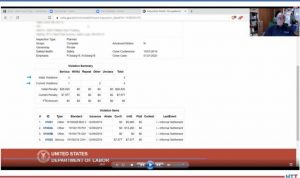
It gives that NAICS of 332811. It indicates three violations. It was mainly safety.

A safety person could find a little something with industrial hygiene or vice versa — that wasn’t their main reason why they were in. The safety person might have wondered about some hygiene stuff and did an intraoffice referral; a hygienist could come in later. There was a closing conference in October. The case closed in January of 2020.

Let’s look at the violation summary for this company. The only confusion here, is they group citations sometimes. You may wonder how can that say “3” or “1” but below it looks like you see more? I’ll explain how they group some items but overall make all that 1 item.

Originally, OSHA found what they allege to be 3 serious violations, but something happened where it was either contested or they made a deal with the OSHA office. They went in and said, “Look, we’ll be good. It’s a mistake. Here are the extra things that happened.” Or they said, “You’re wrong OSHA. Can we work it out that way? Can you fix this?” So, they had an informal settlement agreement. The initial penalty was $26,000, and it was cut to $7,000.

The way it stands now is this: OSHA doesn’t usually have that many “others”, it’s usually a lot of “serious”, but they made a deal with the company.

Violations chart
Source: OSHA

The most important thing here is you don’t have “willful”, “failure to abate”, or “repeated”. Those have a stigma to them. And those dollar amounts could be things you don’t want to get involved in.

So, in the end, here’s what the IT people in DC should fix: Under standard — you see something that looks like, “What? What is that? Is that 19 million or 1 million 900 thousand?” No, no, no  we should fix this. 1910.28(B)(3)(ii).

If a person doesn’t have experience with OSHA, they could say, “What is B03, etc.? What is 1 million 900?” It means 1910 point, not a dollar amount. It means the current penalty is nothing, even though the initial was more by informal settlement agreement, and it explains it.

They then group two things. Now what is the 28? We could look it up, but it has something to do with fall protection. 178? Two things to do with power industrial vehicles, probably meaning fork trucks or something similar. 219 has to do with power transmission equipment, belts, chains gears, etc.

That’s how this works. You can look up any company to see how your competitors are doing or to really find out what your history was with OSHA.

Bethany Leone: We are back to the “Establishment Search” and searching another company and scrolling through those results.

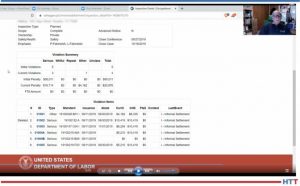
Rick Kaletsky: In this example, we’ve dates here. They had an initial penalty of $50,000 and a current penalty of $16,000 — that’s just on “Serious”. Then they had some other things change. The penalty went from $50,000 to $20,000.

I do not want to leave the impression that as you walk into an OSHA office in 2022 and you say, “We’re sorry, can you take $30,000 off?” Don’t bet on it.

You better have a darn good reason to say we really should have a break, you shouldn’t have cited us for it, or there were mitigating circumstances you didn’t know about, or we really would appreciate it if you didn’t call this a “repeat” but called this a “serious”. You’ve got to have something to say.

"OSHA completely took out that 132A."
Source: OSHA

In one case here, you see “deleted” for number 2. So, OSHA completely took out that 132A that way. They left off this personal protection one. Now, sometimes they take one out, and they add one. So, this company was cited for 1910.28 and change, that is 28B1i, something to do with fall protection. 132A, that’s not there anymore though, personal protection 147 is lockout/tagout, 215 is abrasive wheel machinery (usually meaning a grinder), and 219 is power transmission equipment.

All this was dealt with by an informal settlement agreement. The company did not contest; it was done by a deal with the office.

CTRL+ F is a great tool for the OSHA website. You may not want to read 80 pages, and with this tip, you can get to these things in a hurry.

Bethany Leone: For heat treaters, this is really important. If you know you’re being cited for something, or if you’re interested to see what type of standards might be pertinent to you. For the heat treat industry, it’s not going to be that particular, but you might find that there are things that you do repeatedly that you need to know about. For example, working on top of a big furnace, this is how you navigate this site.

Rick Kaletsky: There are two things I want to say:

It’s one thing if you call me, we’re going to go on for an hour or so. Then, somewhere along the line I would tell you what I’m going to charge.

However, as kind of special to Heat Treat Today, if any of you want to call me and say, “Rick, this isn’t going to take too long, but I don’t know where find this, I don’t know where to navigate. What did you mean about this?” No charge! Just call me and ask me. If it’s not too long, done! We’ll take care of it right up front.

Bethany Leone: Nice. Thank you!

Is there an email address or a website that they could visit?

Rick Kaletsky: In the end, the most important thing is going to be the phone. There are times when I get an email, and they’ll say something like, “When’s a good time to talk next week?” If you call me now, I’d either say, “If you can’t talk now, let’s set it up right now.” I’m not going to send you an Excel sheet and tell you what blocks I have available. I can maybe give you the answer right now or if you want to do it tomorrow, we’ll have a conversation. To have a lot of back and forth and emails, no. If we’re on the phone, we take care of it. Efficiency.

Bethany Leone: If there’s anything I’ve learned about Rick in the past time that we’ve been able to talk is you like to get things done NOW. And you’re helpful. If anyone is listening -- please take advantage. This is really great of Rick to be offering this to us. Give him a call. He’s a great explainer and great teacher, but also has a wealth of knowledge.

Rick Kaletsky: I appreciate the opportunity to do this. I hope it’s helpful.


Get your own copy!
Source: Rick Kaletsky

About the expert: Rick Kaletsky recently finished a book on how a company should prepare for an OSHA inspection and how to respond to the results of an OSHA inspection. This book addresses safety management for loss prevention and compliance. It also dives into practical and in-depth issues and examples that are geared towards maintaining a safer and more healthful work environment, and it delves into creative approaches on how to address occupational safety beyond the standard. If you found today’s episode helpful, go out and grab this third edition (published by the National Safety Council) for your heat treat operations so that you have an easy-to-access tool to mark up and bookmark. You can grab your edition here.

For more information: Rick Kaletsky at rkaletsky@gmail.com or 203-393-1233


To find other Heat Treat Radio episodes, go to www.heattreattoday.com/radio .


Search heat treat equipment and service providers on Heat Treat Buyers Guide.com


Heat Treat Radio #92: Navigating OSHA.gov with Rick Kaletsky Read More »

Heat Treat Radio #91: Understanding the ±0.1°F Requirement in AMS2750, with Andrew Bassett

Where did the ±0.1°F AMS2750 requirement come from and how should heat treaters approach this specification, an important change that entails major buy-in? Andrew Bassett, president and owner of Aerospace Testing and Pyrometry, was at the AMS2750F meeting. He shares the inside scoop on this topic with Heat Treat Today and what he expects for the future of this standard.

Heat Treat Radio podcast host and Heat Treat Today publisher, Doug Glenn, has written a column on the topic, which you can find here; read it to understand some of the background, questions, and concerns that cloud this issue.

Below, you can watch the video, listen to the podcast by clicking on the audio play button, or read an edited transcript.



The following transcript has been edited for your reading enjoyment.

Doug Glenn: Andrew Bassett, president and owner of Aerospace Testing and Pyrometry, Inc., somewhere in eastern Pennsylvania. We don’t know because you’re on the move! What is your new address, now, by the way?

Contact us with your Reader Feedback

Andrew Bassett: We are in Easton, Pennsylvania at 2020 Dayton Drive.

Doug Glenn: Andrew, we want to talk a bit about this ±0.1°F debate that is going on. It was actually precipitated by the column that I wrote that is in the February issue.

I just wanted to talk about that debate, and I know that you’ve been somewhat involved with it. So, if you don’t mind, could you give our listeners a quick background on what we are talking about, this ±0.1°F debate.

Andrew Bassett: To be honest with you, being part of the AMS2750 sub team, one of the questions came up for us during the Rev F rewrite was this 0.1°F readability — wanting to kind of fix this flaw that’s been in the standard ever since the day that AMS2750 came out. With instrumentation, for instance, you have ±2°F (the equivalent would be 1.1°C). At 1.1°C, the question became, If your instrumentation does not show this 0.1 of a degree readability, how can you show compliance to the standards?

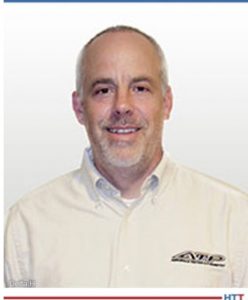
Andrew Bassett
President
Aerospace Testing and Pyrometry
Source: DELTA H

Then, it morphed into other issues that we’ve had in the previous revisions where we talk about precise temperature requirements, like for system accuracy testing: You’re allowed a hard number ±3° per Class 2 furnace or 0.3% of reading, whichever is greater. Now, we have this percentage. With anything over 1000°F, you're going to be able to use the percentage of reading to help bring your test into tolerance. In that example, 1100°F, you’re about 3.3 degrees. If your instrumentation doesn’t show this readability, how are you going to prove compliance?

That’s what it all morphed into. Originally, the first draft that we proposed in AMS2750F was that all instrumentation had to have 0.1°F readability. We got some feedback (I don’t know if I want to say “feedback” or "pitchforks and hammers") that this would be cost-prohibitive; most instrumentation doesn't have that readability, and it would be really costly to go out and try to do this. We understood that. But, at the end of the day, we said: The recording device is your permanent record, and so that’s what we’re going to lean on. But we still had a lot of pushback.

We ended up putting a poll out to AMEC and the heat treating industry to see what their opinions were. We said that with the 0.1 readability (when it came to a percentage reading), recording devices would read hard tolerances. So, for instance, an SAT read at 3° would be just that, not "or .3% of reading."

There was a third option that we had put out to the community at large, and it came back as the 0.1° readability for digital recorders, so that’s where we ran with the 0.1° readability.

When it was that big of an issue, we didn’t make the decisions ourselves; we wanted to put it out to the rest of the community. My guess is not everyone really thought the whole thing through yet. Now people are like, ok, well now I need to get this 0.1° readability.

Again, during the meetings, we heard the issues. Is 0.1° going to really make a difference to metal? If you have a load thermocouple that goes in your furnace and it reads 0.1° over the tolerance, does it fail the load? Well, no, metallurgically, we all know that’s not going to happen, but there’s got to be a line in the sand somewhere, so it was drawn at that.

"...that hard line in the sand had to be drawn somewhere..."
Source: Unsplash.com/Willian Justen de Vasconcellos

That’s a little bit of the background of the 0.1° readability.

Doug Glenn: So, basically, we’re in a situation, now, where people are, in fact (and correct me if I’m wrong here),  potentially going to fail SATs or tests on their system because of a 0.1° reading, correct? I mean, it is possible, correct?

Andrew Bassett: Yes. So, when the 0.1° readability came out in Rev F, we gave it a two-year moratorium that with that requirement, you still had two more years. Then, when Rev G came out, exactly two years to the date, we still had a lot of customers coming to us, or a lot of suppliers coming back to us, and saying, “Hey, look, there’s a supply shortage on these types of recorders. We need to buy some time on this.” It ranged from another year to 10 years, and we’re like — whoa, whoa, whoa! You told us, coming down the pike before, maybe you pushed it down the road, whatever, probably Covid put a damper on a lot of people, so we added another year.

So, as of June 30th of 2023, that requirement is going to come into full play now. Like it or not, that’s where the standard sits.

Doug Glenn: So, you’re saying June 30th, 2023?

Andrew Bassett: Yes.

Doug Glenn Alright, that’s good background.

I guess there were several issues that I raised. First off, you’ve already hit on one. I understand the ability to be precise, but in most heat treatment applications, one degree is not going to make a difference, right? So, why do we push for a 0.1° when 1° isn’t even going to make a difference?

Andrew Bassett: We know that, and it’s been discussed that way. But, again, that hard line in the sand had to be drawn somewhere, and that was the direction the community wanted to go with, so we went with that. Yes, we understand that in some metals, 10 degrees is not going to make a difference, but we need to have some sort of line in the sand and that's what was drawn.

Doug Glenn: So, a Class 1. I was thinking the lower number was a tighter furnace. So, a Class 1 (±5), and you’re saying, that’s all the furnace is classified for, right, ±5? So, if you get a reading of 1000°, it could be 1005° or it could be 995°. Then, you’re putting on top of that the whole idea that your temperature reading has got to be down to 0.1°. There just seems to be some disconnect there.

So, that was the first one. You also mentioned the instrumentation. It’s been pointed out to me, by some of the instrumentation people, that their instruments are actually only reading four digits. So up to 99.9 you actually have a point, but if it goes to 1000°, you’re out of digits; you can’t even read that. I mean, they can’t even read that down to a point.

"So, if you get a reading of 1000°, it could be 1005° or it could be 995°."
Source: Unsplash.com/Getty Images

Andrew Bassett: Correct. On the recording side of things, we went away from analog instrumentation. The old chart papers, that’s all gone, and we required the digital recorders with that 0.1° readability, as of June 30th of this year.

Again, the first draft was all instrumentation. That would be your controllers, your overtemps, and we know that limitation. But everyone does have to be aware of it. We still allow for this calibration of ±2 or 0.2%. If you’re doing a calibration, let’s say, on a temperature control on a calibration point at 1600° and the instrument only reads whole numbers, you can use the percentage, but you would have to round it inward. Let’s use 1800°, that would be an easier way to do it. So, I’m allowed ±2 or 3.6° if I’m using the percentage of reading, but if the instrument does not read in decimal points for a controller or overtemp, you would have to round that down to ±3°.

Doug Glenn: ±3, right; the 0.6° is out the window.

Andrew Bassett: Correct. I shouldn’t say we like to bury things in footnotes, but this was an afterthought. In one of the footnotes, in one of the tables, it talks about instrumentation calibration that people need to be aware of.

Doug Glenn: Let’s just do this because I think we’ve got a good sense of what the situation is, currently. Would you care to prognosticate about the future? Do you think this is going to stand? Do you think it will be changed? What do you think? I realize you’re speaking for yourself, here.

Andrew Bassett: I’m conflicted on both sides. I want to help the supply base with this issue but I’m also on the standards committee that writes the standard. I think because we’re so far down the road, right now — this requirement has been out there since June 2022 — I don’t see anything being rolled back on it, at this point. I think if we did roll it back, we have to look at it both ways.

If we did roll this back and say alright, let’s just do away with this 0.1° readability issue, we still have to worry about the people processing in Celsius. Remember, we’re pretty much the only country in the world that processes in Fahrenheit. The rest of the world has been, probably, following these lines all along. If we rolled this back, just think about all the people that made that investment and moved forward on the 0.1° readability and they come back and say, “Wait a minute. We just spent a $100,000 on upgrading our systems and now you’re rolling it back, that’s not fair to us.”

At this point, with the ball already rolling, it would be very interesting to see when Nadcap starts publishing out the audit findings when it comes to the pyrometry and this 0.1° readability to see how many suppliers are being hit on this requirement and that would give us a good indication. If there are a lot of yeses on it then, obviously, a lot of suppliers haven’t gone down this road. My guess is, for the most part, anybody that’s Nadcap accredited in heat treating — and this goes across chemical processing, coatings, and a few other commodities — I think has caught up to this.

Personally, I don’t think this is going to go away; it’s not going to disappear. It’s going to keep going down this road. Maybe, if people are still struggling with getting the types of devices that can have that 0.1° readability, then maybe another year extension on it, but I don’t know where that is right now. I haven’t gotten enough feedback from aerospace customers that say, "Hey, I can’t get the recorder." I mean,

Doug Glenn: I just don’t understand, Andrew, how it’s even physically possible that companies can record something as accurately as 0.1° if the assembly or thermocouple wire is rated at ±2°? How is that even possible that you can want somebody to be accurate down to ±0.1° when the thing is only accurate up to ±2°?

Andrew Bassett: Right, I get that. We can even go a lot further with that and start talking about budgets of uncertainty. If you look at any reputable thermocouple manufacturer or instrument calibration reports that are ISO 17025, they have to list out their measurements of uncertainty, and that gives you only the 98% competence you’re going to be within that accuracy statement.

Yes, I get the whole issue of this .1° readability. There were good intentions were to fix a flaw, and it spiraled. We’ve seen where PLCs and some of these high logic controllers now can show the .1° readability, but they automatically round up at .5°. Are you now violating the other requirements of rounding to E29? Now, I think we’ve closed out the poll in the standard, but you’re right. We were trying to do the right thing. Personally, I don’t think we gave it all that much further thought on that except hey, let’s just make recorders this way and this should be okay.

Doug Glenn: Right. No, that’s good. Let me be clear, and I think most everybody that was involved with the standards are excellent people and they’re trying to do the right thing. There is no dissing on anybody that was doing it. I’m not a furnace guy, right, I’m a publisher — but when I look at it, I’m going: okay, you’re asking somebody to be as accurate as 0.1° on equipment that can only do ±2°. That’s a 4° swing and you’re asking them to be within 0.1°, basically.

Andrew, this has been helpful. It’s been good hearing from you because you’re on the frontline here. You’ve got one foot firmly planted in both camps.

Andrew Bassett: I’m doing my best to stay neutral with it all.

Doug Glenn: Anyhow, I appreciate it, Andrew. You’re a gentleman. Thanks for taking some time with us.

Andrew Bassett: Thanks, Doug. Appreciate it.


About the expert: Andrew Bassett has more than 25 years of experience in the field of calibrations, temperature uniformity surveys, system accuracy testing, as well an expertise in pressure, humidity, and vacuum measurement calibration. Prior to founding Aerospace Testing & Pyrometry, Andrew previously held positions as Vice President of Pyrometry Services and Director of Pyrometry Services for a large commercial heat treater and Vice President and Quality Control Manager for a small family owned business.

For more information: Andrew Bassett at abassett@atp-cal.com or visit http://www.atp-cal.com/

Doug Glenn at Doug@heattreattoday.com


Doug Glenn <br> Publisher <br> Heat Treat Today

Doug Glenn
Publisher
Heat Treat Today


To find other Heat Treat Radio episodes, go to www.heattreattoday.com/radio .


Search heat treat equipment and service providers on Heat Treat Buyers Guide.com


Heat Treat Radio #91: Understanding the ±0.1°F Requirement in AMS2750, with Andrew Bassett Read More »

Heat Treat Radio #90: CEO Slawomir Wozniak Talks North American Technologies and SECO/WARWICK Future

At the front of some major developments in heat treat technologies is Slawomir Wozniak, CEO of SECO/WARWICK. Join him and Heat Treat Radio host and Heat Treat Today publisher, Doug Glenn, as he talks about the latest trends in heat treat, especially the new technologies his company is pursuing and the effect of the War in Ukraine. Read a recent press release with information about the group here.

Below, you can watch the video, listen to the podcast by clicking on the audio play button, or read an edited transcript.


HTT · Heat Treat Radio #90: Slawomir Wozniak, CEO, SECO/WARWICK SA


The following transcript has been edited for your reading enjoyment.

Doug Glenn: The last time we spoke in an interview was in 2019. We were in Germany at Thermprocess, and you were just getting into the CEO position. We’re coming up on 4 years. How has it been? For you personally and for the company?

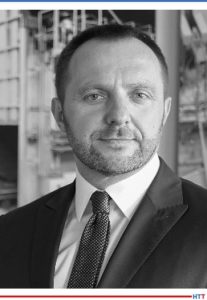
Sławomir Woźniak, SECO/WARWICK Branded
Sławomir Woźniak
CEO
SECO/WARWICK
Source: secowarwick.com

Slawomir Wozniak: A good question. Yes, it was a very nice time.

Contact us with your Reader Feedback

I was not expecting so many challenges, especially since I took over in 2019, in June. We started to work on a new strategy for the company, for the group, and then Covid came. That changed everything. We had to implement a lot of changes to the company and cope with the challenges. It was a good time, absolutely. Many positive things happened to the company, and we grew up with the business.

We reorganized our companies successfully, especially in China and in the U.S. I have had a great, supportive team ever since I started with the company for more than twenty years. I know all the people very well, and they cooperate and support me every day. It was a very good time for me, and I’m looking forward to another couple of years running the business.

Doug Glenn: Compared to 2020, will this year be a normal year?

Slawomir Wozniak: It looks like it. We still feel, however, the impact of the war in Ukraine and the supply chain deterioration caused by both COVID and the war in Europe. We also reorganized the way we do things in the company.

But you’re right, the business is good today. Although we see some recession on the horizon, this year is extremely good. It’s extremely good in the U.S. but also in Asia and Europe. Pretty much all the markets are growing.

New products were implemented on the market in the last couple of years, so we see a good future.

Doug Glenn: Tell us a little about the 60th anniversary coming up.

Slawomir Wozniak: There is an anniversary coming for RETECH. The company was established in 1963, so next year (2023) we would like to celebrate the 60th anniversary in Buffalo, NY. This is something which energizes the U.S. market.

We would also like to highlight our footprint on the U.S. market because we have three companies. We have RETECH, SECO/VACUUM Technologies, and SECO/WARWICK Corporation. We like to see the companies working together, and we see a big interest from U.S. customers to get equipment made in America. RETECH produces vacuumatological equipment (vacuum melting equipment) in the United States. We would also like to build vacuum furnaces in the U.S. SECO/WARWICK Corporation has been in business for many years, and we would like to continue with production of atmospheric furnaces and aluminum process furnaces. We are also thinking about aluminum brazing equipment we build in U.S.

Doug Glenn: I want to talk about SECO/WARWICK group and strategies. I know you manufacture equipment, but the emphasis has always been on technology.

What can our readers be looking forward to in terms of technology?

Slawomir Wozniak: We are a typical technology, an engineering company which provides technological solutions for our customers. We not only provide equipment, but we provide complete solutions for our customers.

What we see on the market is a deep interest in what we call “green technologies.” These are all the technologies that are in line with reducing the carbon footprint. Our technologies can provide solutions for our customers, like low pressure carburizing (LPC), zero-flow nitriding, and all the other technologies which also reduce the time for the process and energy consumption. We see a big boom because the carbon footprint needs to be reported by our customers.

Interest in "Green Technologies"
Source: Unsplash.com/ShubhamDhage

We have to provide a report of what the carbon footprint generated during production of our equipment was. We also must provide a report of what the equipment would produce during a process. We have some solutions which significantly reduce the emission of carbon dioxide. This is what our customers are looking for.

We see a big interest in conversion of heating systems from gas to electric. Customers can buy green electrical energy, but they cannot buy the “green gas” right?

Doug Glenn: Not unless you do hydrogen which isn’t quite ready yet.

Slawomir Wozniak: Right. All these technologies are very much in the interest of our customers. So, this is why we are forcing also, the new development of our solutions to replace all technologies like gas carburizing by low pressure carburizing. This is what we see on the horizon.

Car manufacturers are declaring that by 2035 they will not be producing any more combustion engines in cars. We have a great product for brazing of battery coolers for electrical vehicles, an aluminum brazing process. This equipment is produced in Europe and in China, and we provide the solutions for global OEMs. Also, we see booming technology. With the growth of immobility we also see a growth of our business.

Doug Glenn: Have you seen much of the growth in the green movement? Have you seen it as much in North America as you’re seeing in other regions of the world?

Slawomir Wozniak: We see some interest from the customers. It is not as big as it is in Europe. With the global supply chain, even our U.S. customers, when they produce certain components, they also need to be in line with the global strategy. The end-user is the user of the components which are heat treated in our equipment. The end-user will ask for the certification of the carbon footprint. This is why it is still not on the level as we see in Europe, but we see more and more customers/companies asking for green solutions because they need to also be in line with the trend.

Doug Glenn: It seems the North American market tends to be a little slow on the uptake on these green things.

What light can you shed on the plans for SECO group in North America over the next five/ten years?

Slawomir Wozniak: This is the right time because we are working on the strategy now for the entire group, particularly for the U.S. market. We have three companies in the U.S., and we would like to build more equipment. This is in line with the interest of our customers.

[blocktext align="left"]There is a trend of reshoring and moving business back to North America, particularly to the U.S., but also to Mexico, to better serve the market and provide quicker solutions. We would like to build more equipment in the U.S. A lot of businesses are moving their production from southeast Asia (particularly from China) back to the U.S.[/blocktext]

We can provide the solutions to help our customers to run the day-to-day productions in a cost-effective way with these green technologies, but also with technologies which can reduce the cost of the production, the cost of heat treatment processes, and metallurgical processes. This is why we would like to build more equipment here.

RETECH, our company which provides metallurgical vacuumatology solutions, is very busy with the new locations. We have a lot of projects which are fully made in the U.S. We are now analyzing how to cope with the challenge of the U.S. market to build vacuum furnaces in the U.S.

Today, we only import vacuum furnaces from Poland. In Europe, in general, the lead time of some components is growing. Energy and labor costs are also growing, so we’d like to build vacuum furnaces also in the U.S. to better serve our customers. This would be the main focus for the next few years — to reinforce our operation processes here in the U.S. and also to organize how to serve the U.S. market by local manufacturing.

Doug Glenn: I think it would be helpful to delineate the three companies that you’re talking about, the North American companies.

Slawomir Wozniak:  RETECH. We moved from California to Buffalo, NY, roughly three years ago. We have a nice facility. We are quite busy there with production and assembly of vacuumatological equipment.

Doug Glenn: Which is, basically, vacuum melting equipment.

Slawomir Wozniak: Right. Things like plasma equipment, electron beam equipment. We would like to even look for more space because we have so many projects. We still have our office in California, because we still have some good employees who contribute to the performance of the company. We would like to maintain this office in California.

With SECO/VACUUM Technologies, LLC, we would like to start building equipment for the North American market. We have a new setup, a new office, and a new facility with some floorspace where we can assemble the furnaces. We would like to start from assembly and eventually, double up the processes and completely build the equipment here in the U.S.

SECO/WARWICK Corporation — we just hired a new managing director in June of this year, Marcus Lord. His main focus is to grow our business in the U.S. particularly for our aluminum process equipment and also for thermal equipment.

Our goal is to build equipment in the U.S., maybe not in-house fabrication, but use our subcontractors, and then to do the assembly in the facility. We are also looking forward to set up a facility in the U.S.

Doug Glenn: RETECH has moved manufacturing to Buffalo, NY. SECO/VACUUM Technologies is still located in Meadville, Pennsylvania, but not in the previous building. They do have some manufacturing capabilities, although there is not really any manufacturing going on there except for spare parts, I assume.

Slawomir Wozniak: Spare parts and retrofits.

Doug Glenn: The last company was SECO/WARWICK Corporation, which is big in aluminum and general line thermal equipment.

Slawomir Wozniak: We would like to continue with this business and build equipment in the U.S.

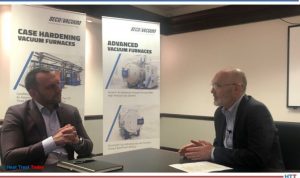
Sławomir Woźniak and Doug Glenn
Source: Heat Treat Today

Doug Glenn: That gives us a sense of the direction over the next five years or so.

Poland (your headquarters’ location) has been in the news quite a bit because of the war between Russia and Ukraine. How has that impacted your company and maybe individuals in your company. Has it impacted your ability to manufacture in Poland?

Slawomir Wozniak: It was a big shock for everyone at the end of February of 2022 when the invasion of Russia happened to Ukraine. For our company, the main heat was linked with the supply chain of some materials, especially commodities like steel, which were supplied for many, many years from either Ukraine or Russia.

Then, the prices of energy, like gas and electricity, also increased significantly. We also had some businesses in Russia; we have a SECO/WARWICK company in Russia to provide services and sales, but we stopped, pretty much, all activities there. We have just completed all the contracts, and we are not promoting our equipment there. We are not providing any quotes to Russian customers; we stopped our activities there.

It was not a big impact on our business because the volume of the business in Russia was not so big.

However, since the war started, we have realized that a lot of customers linked Poland with Ukraine as a country which is very close and, anytime, can be in the conflict.

So, many customers were worried about the situation, and they started to ask us, “Is our project safe? Can you still deliver our project?” So, we had to guarantee and confirm, “Okay, everything is fine. We can run the projects.”

There was a time, especially in the second quarter, when the delivery time of some materials were extended because of the situation. It has improved, and today we do not see much impact on it. Obviously, from the job market perspective, it was also significant, in part, because many migrants moved from Ukraine to Poland.

Doug Glenn: I think Poland was the number one country to receive immigrants.

Slawomir Wozniak: Exactly. We organized a lot of support, as a company and as individuals, with private activity to support the Ukrainian immigrants.

From our side, we have seen some shock and some impact on our from the other side. A lot of companies also started to think differently. For them, it was the first shock three years ago that impacted the global supply chain — many, many materials and then goods. This war was a second wave of impact on the businesses. We see that some companies decided to move their businesses to change their supply chain and, I can say, we even benefited from that because we see some growing business because of the situation.

In the end, I would not say the war is a good thing, obviously, but it is also positive thing for businesses.

We also have some solutions for the defense industry. We see growing interest — not only in Europe, but globally — in investment in capital equipment for increasing the production of some defense equipment.

Doug Glenn: Over your first four years in office, as the CEO, you’ve had to deal with the pandemic and you’ve had the war breaking out. I know there are some other issues, such as labor shortages and supply chain issues.

What is keeping you up at night worrying? As you’re looking forward, what are the things you’re concerned about?

Slawomir Wozniak: One, you just mentioned, about the labor market. We know that the demographic factors are very, very bad for many, many countries, including China. Today, it’s okay, but if you look long-term, the demographic doesn’t look good. We are focusing, now, on how to replace the human factor by automation, how to simplify the processes, how to implement the solutions which don’t require a lot of labor. So, automation is one thing and simplification of some processes, standardization of some solutions. We’ve focused on vacuum equipment especially. How can we reduce the manpower required to build the furnaces?

The second area is definitely the geopolitical situation, especially the tensions on the line between the U.S. and China. We have a lot of businesses in China, today. We also export from China, and to other countries. This is something which we have to look very carefully at how to recoup and handle if there were escalation from sanctions or limitations on the business and possibly to export our equipment.

[blockquote author="" style="1"]This is why we would like to focus more, in coming years, on the Indian market. We would like to set up production capacity in India to produce more equipment. Then, particularly how we can serve the Indian market which is growing. We see a lot of potential in India, but also later to use our capacity there to export some equipment to serve other markets. This is our focus for the next few years.[/blockquote]

I think the geopolitical situation is the thing which is out of our control, for everybody. Even the job market, as I said, we can cope some. How? We can attract our employees, and we can attract potential employees to join our company. With the geopolitical situation, we can do nothing.

Doug Glenn: We’re at the mercy of the leaders, which is always a scary thing.

You’ve talked a lot about green technologies. Is it safe for us to say that SECO is still in the business of the more conventional gas-fired type equipment around the globe? Or are you moving away from that?

Slawomir Wozniak: We do less and less gas-fired equipment. Gas-fired equipment was, in general, an atmospheric type of equipment. We changed the strategy for this product line. We have just narrowed our portfolio to a few types of equipment only. For some solutions, obviously, we still offer gas-fired heating systems, but we see more and more interest in using electrical heating systems. There are some developmental projects to use the combination of hydrogen and natural gas. This is the direction which we see from supplies of heating systems partners, and our customers are looking to get solutions which we call “the green solutions.”

I would say that, in the long term, we will not provide combustion systems in the equipment, but, currently, we still have them in our portfolio. I don’t really see that this will maintain for a long time, especially, as I said, since we changed our strategy for general products and for thermal product line. We do not use many of the solutions for combustion processes.

Doug Glenn: Here in the U.S., you are going to transition many non-vacuum lines from gas to electric?

Slawomir Wozniak:  Yes. But, for some solutions, you cannot. We must have combustion and we obviously offer melting equipment and also some processing products. But we are very flexible and we can offer various solutions for our customers. We always try to adjust our proposal to the customer specifications and customer expectations.

Doug Glenn: It is probably safe to say that, within the next 5–10 years, you’re still going to be doing some combustion-related stuff, especially in North America. It’s going to be demanded. As most of the rest of the world knows, we’ve got relatively cheap energy.

Slawomir Wozniak: Less definitely than Europe, especially with the current situation with the supply of natural gas.

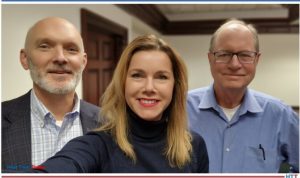
Alan Gladish (r), Praxis Communications, Inc., and Katarzyna Sawka(c), Vice President Marketing at SECO/WARWICK, were present at the interview with Doug Glenn(l).
Source: SECO/WARWICK

Doug Glenn: Alright, last question: You’re obviously enjoying your work. You enjoy your team. The company is doing well. What excites you, personally, about the next 2, 3, 4 years at SECO/WARWICK?

Slawomir Wozniak: As I said, I have a great team which supports me every day in all of the challenges that we are facing, like every company. I love my job. I’ve bonded with the company. I grew up with the company. I would like to see the company develop and grow with new technologies, with market requests and new solutions.

We have great R&D teams — one in U.S., one in Poland — and we work on new solutions. I see that we can change a lot of industries with our solutions. This keeps me really energized every day, to discuss  new technologies, new solutions, and how we can impact the development of various industries like aerospace, the energy sector, and the automotive industry. I’m proud to see some cars with our components.

Doug Glenn: It keeps you energized!

It’s good to enjoy your work, and it’s good to have passion for the future. I think that trickles down to your organization; you certainly have.


About the expert: Slawomir Wozniak started his professional career at SECO/WARWICK in 1994 initially as a service engineer and then as a deputy manager of CAB. Later he was posted to SECO/WARWICK Retech in China before an appointment of managing director at SECO/WARWICK Allied in India and chief operating officer of SECO/WARWICK Group. Later he was appointed managing director (Asia) and member of the management board at SECO/WARWICK SA. In 2018 he became vice president of the SECO/WARWICK SA Management Board, chief operating officer of the SECO/WARWICK Group, and he is the current president of the SECO/WARWICK Group.


Doug Glenn <br> Publisher <br> Heat Treat Today

Doug Glenn
Publisher
Heat Treat Today


To find other Heat Treat Radio episodes, go to www.heattreattoday.com/radio .


Search heat treat equipment and service providers on Heat Treat Buyers Guide.com


Heat Treat Radio #90: CEO Slawomir Wozniak Talks North American Technologies and SECO/WARWICK Future Read More »

Heat Treat Radio #89: Metallurgical Posterchild Aniket Maske

Aniket Maske, chief metallurgist and laboratory manager at Automatic Spring Products Corporation, brings new life to the world of heat treat and metallurgy in this special “Metallurgical Posterchild” podcast episode with Doug Glenn, publisher and founder of Heat Treat Today. Enjoy this personal interest piece about Aniket as we learn about his background, how he became a part of the metallurgical industry, and several exciting interests that fuel his days.

Below, you can watch the video, listen to the podcast by clicking on the audio play button, or read an edited transcript. 


The following transcript has been edited for your reading enjoyment.
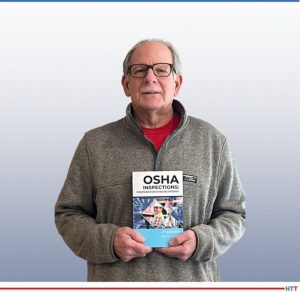
Doug Glenn: Welcome everyone, to a renewed episode series: the metallurgical poster child.

I want to introduce you all to Aniket Maske, who is a one of Heat Treat Today’s 40 Under 40 Class of 2022 award recipients. Congratulations, Aniket, on that award.

Contact us with your Reader Feedback

Aniket Maske
Source: LinkedIn

Aniket Maske: Thank you. Thank you so much. It’s a privilege and it’s an honor.

Doug Glenn: You’re welcome. It’s our privilege to do it. I actually have sitting right here beside me our magazine open to your page. I see that you have a book published by Springer Publications.

Aniket Maske: Yes!

Doug Glenn: Thermal Electrics: Fundamentals, Material Selection, Properties and Performance. There are not many people we talk to who can say they’re an author of a book. Congratulations on that too!

Aniket Maske: It’s an honor.

Source: Amazon.com

Doug Glenn: We want to get a sense of the person you are but also what attracted you into metallurgy, heat treating and that type of stuff.

Aniket Maske: I’d like to thank you and Heat Treat Today for this opportunity to share my background, work experience, and something about myself.

My name is Aniket Maske. I was born in Ratnagiri which is a coastal area in Maharashtra in India. I was raised in Aurangabad, which is a very historic city because the world-famous Ajanta Ellora caves, a replica of Taj Mahal and one of the Panchakki which is like a turning wheel with respect to the water. So, I come from that kind of background from the city where I was raised. I love that.

Doug Glenn: Interesting. You went to high school and undergraduate in India? Tell us about that, briefly.

Aniket Maske: I went to high school at Little Flower High School in Aurangabad.

I did my Bachelors in College of Engineering, Pune, which was established in 1854. It is the second oldest engineering college in India and third in Asia. A couple of renowned personalities are from that school like Mokshagundam Visvesvaraya, who is the first civil engineer in India. For his honor, September 15th is called Engineer’s Day back in India, Sri Lanka, and Tanzania. Mr. C. Kumar Patel, the inventor of CO2 laser and a National Medal of Science honoree in 1996, also comes from the same school.

Little Flower School
Source: Facebook.com

Doug Glenn:  Very interesting. How about graduate school?

Aniket Maske: I went to graduate school in 2013 at New Jersey Institute of Technology on the east coast. I did my research over there for thermal electrics and tried to understand the different characterizations.

Doug Glenn:  Before we started recording, you were mentioning to us that you had a group of guys  with whom you were in the same undergraduate school in India.

Aniket Maske: They were my very good friends: Shlok and Vishal. They are from the College of Engineering, Pune. Me and Vishal are from New Jersey Institute of Technology, so we share that bond.

Doug Glenn:  Very nice! So, you’ve got friends here. You’ve been in the States since 2013.

Aniket Maske:  Yes.

Doug Glenn:  I’m always curious about this: what it is that first attracted you to metallurgy and/or heat treating? At one point in time, you probably didn’t even know what metallurgy was, right? What was it that brought you into the industry?

Aniket Maske:  I would say curiosity.

[blockquote author="" style="2"]In the early 2000’s we went to Delhi, the capital of India, and I saw the Iron Pillar. I didn’t even know the meaning of rust at that moment in time. I only knew what my parents used to say, “If something is red on the metal, don’t touch it, because it might be itchy.”[/blockquote] We went to the Iron Pillar. It was tall, and the Iron Pillar doesn’t even rust. It was built around 480 AD, which is about 1600 years ago. It is around 13,000 pounds, roughly 24 feet by 16 inches in diameter, and it doesn’t rust! That was my first interaction with respect to metals.

Another curiosity is (and it might sound really different) but: why are cars made of metal and not with plastic? I used to call it plastic, not polymer, in that time. That was really interesting: why is everything made differently?

One of the major things I remember is 20 years ago on February 1, 2003, the Columbia space shuttle disaster occurred. And the first Indian-born astronaut, Kalpana Chawla (the first woman) was on the shuttle.

I heard about the disaster on the radio, and then I started reading: What is the thermal soaking, what is the protective layer, what is the thermal protection system, how is it 3000°F outside but the steam temperature inside should be 350°F? That curiosity got me into the metal industry.

Doug Glenn:  When was it, specifically, that you decided to go into metallurgy?

Aniket Maske:  Yes. I did my engineering specifically in metallurgical engineering.

Doug Glenn:  You’re one of the few and the proud. Way to go! That’s excellent. We’ve talked to a variety of people in the United States who say now the more common thing to study material science. There are very, very few schools that use just metallurgy.

What did your family think when you decided to study metallurgy? Did they ask, “What are you doing, Aniket?”

Aniket Maske:  We don’t want to go there because I’m the black sheep of my family.

I’ll say why: I’m the only engineer in all of my family. The rest of them are all doctors. That’s why I call myself the black sheep of the family. They really see me differently. My mom and dad are doctors. My wife is a doctor, Dr. Sonal Mandale. She also has a master’s degree and is just now graduating in public health and epidemiology.

Doug Glenn:  Epidemiology, that’s a hot topic, these days.

Aniket Maske:  Oh, yes. And she graduated right during Covid. But my family was really supportive. One of my uncles, a professor, Dr. Vilas Kharat , is a renowned mathematician. He helped me to explore my curiosity. My family helped me a lot too, “Okay, you want to do it? You give it a try.”

Doug Glenn:  A supportive family makes such a difference!

When you got to graduate school in New Jersey, what was your focus of study there?

Aniket Maske: When I came over here, I was focused on how the world is facing a major problem with respect to green energy. We needed to find an alternative source. Energy consumption was increasing, and we wanted to protect the environment at the same time.

I was working with my professor, and we talked about something called “thermal electrics.” What is thermal electrics? What is the Baker-Nathan effect, what is the Seebeck effect? This word sounds very big, but the simple definition is: if something is converting from electrical energy into temperature (or thermal energy to a temperature gradient into electricity).

You’ve got thermal electric models. It is a newer kind of concept with respect to silicon-germanium, but it is also used in radioisotope thermal generators for space. Even in the Mars Rover, it was used in the RDP. That got to me, with what I need to do with respect to the research and everything in my grad school.

Doug Glenn: Who is your current employer?

Aniket Maske: Automatic Springs Products Corp.

Source: Automatic Spring Products Corporation

Doug Glenn: What are you doing at Automatic Springs Products Corp., metallurgically-wise?

Aniket Maske:  I just want to give a brief introduction about the company: Automatic Springs Products is a tier 1 and tier 2 automotive company shipping to 33 countries on six continents. The company was founded in 1950. Automatic Springs is technology focused, high-volume manufacturing for customers for the compression, extension, and torsion spring, as the name says. But we also do wire form, flat ring stamping, Belleville washers, and washers and assembly.

We are vertically integrated and have full spectrum providers of superior quality metal products. We do assemblies, we have a tooling department, we do heat treating in-house, and we have four austemper lines which were installed in the 1980’s. We have done heat treatments since 1960, we have 52 inline stress relieving ovens, we do coating (parts coating), and all that sort of thing in-house, and we also do manual heat set. We are one of the pioneers. We have a COBOT which does a heat set on each individual part to make a Belleville washer and only we do it.

There is a lot of heat treatment going on around here, and I am a resident expert for the automotive heat treatment and coating management for CQI-9 and CQI-12. That is a key requirement for the heat treat supplier. Currently, I am the director of quality and the chief metallurgist for the company. Ironically, the president of the company is also a metallurgist.

Doug Glenn:  That is a little unusual, yes! He’ll know what you say when you mention austenite or martensite or whatever.

Aniket Maske:  That’s a relief, having that kind of experience. He was the president of Spring Manufacturing Institute, so he had tremendous knowledge about the process.

We do all the kind of different processing, and we have a lot of heat treatment in-house.

Doug Glenn:  All good. We’ve got a good sense of where you came from, why you got into the industry and what you’re doing now.

I want to ask you something that’s just a little bit more personal: When you think about your current work now and your grad work, what is the most enjoyable? What really puts a smile on your face about your work?

Aniket Maske:  Working together as a team. We say to serve and bless our customer, team members, community, and a suppliers. [blockquote author="" style="1"]The problem solving is the key for me. I love problem solving.[/blockquote] That is one of the key aspects for me. If I don’t have problem solving to do, I shouldn’t be saying this, but sometimes I’ll get bored. Problem solving is the spice in my life.

Doug Glenn:  That’s good! You’re looking for a challenge. Unfortunately, to be a problem solver, you’ve got to have problems.

Aniket Maske:  We’ve got a lot of those.

Doug Glenn: I find it fascinating, as much as we know about metallurgy and things of that sort, there is still so much we don’t know.

Aniket Maske:  I think we only know, I’ll say, a very minimum amount of metallurgy, right now. There are so many aspects which are still undefined.

Doug Glenn:  Yes. With big data, cloud computing, and things of that sort, we are going to see some amazing changes over the next decades. Right now, we’re on a kind of slow growth.

You’re out of school now, but you seem like the type of guy that’s going to keep himself well informed. Do you have any recommendations to other people in the industry about resources to keep current on metallurgy knowledge?

Aniket Maske: I definitely use ASM. Doug, I really want to thank you and Heat Treat Today for the information in the magazines. They keeps us on the edge, they give us information. Even Heat Treat Daily is really good!

I look into Industrial Heating, and I keep in touch through LinkedIn, but Heat Treat Today helps me a lot. I’ve been following it for a long time.

Doug Glenn: Thank you, I appreciate that! Consistently across the board, people also speak very highly of ASM, so I want to give them a plug, as well. They’ve got some excellent courses.

Now for the “rapid round”. Are you a MAC or a PC guy?

Aniket Maske: 100% PC.

"100% PC. . . I like to be a PC person"
Source: Pexels.com/Max DeRoin

Doug Glenn: I’m not even going to ask why on that one!

Aniket Maske: I can answer that. It’s because I like to be a PC person. MAC is too cosmetic for me and too aesthetic for me. That’s why I stuck to PC.

Doug Glenn: When you consume your media: digital or print?

Aniket Maske:  I would say I like it to be printed because I have a habit of writing notes on it, marking it all the time. But, at the same time, I like to keep an electronic copy with me. You can just glance it through and read it. It’s easily accessible. But I prefer both print and digital copies.

Doug Glenn:  It’s not an unusual answer. There are advantages to each.

I think you’re happy in your work . If you had to change jobs, would you be looking for a job that was very flexible as far as work schedule, or would you go for high pay?

Aniket Maske:  I will always go for the flexible job. Keeping that balance in life with respect to getting things done, being productive. I think a flexible work schedule is really good, because you need to balance your professional and personal life. If you have skill and you have a flexible work schedule, I think pay will follow. It’s the kind of industry and the kind of world that we’re living in. Flexible schedules work.

Doug Glenn:  Good! Three more quick questions: Dream job? I’m sure the people at Automatic Spring know that you’re happy in your work, but let’s say you didn’t have to worry about money. What would you do? What would be your dream job?

Aniket Maske:  I would like to get into innovating a better future for our next generation. And that’s something we do in our day to day lives, even with the small things like looking at the environment.

That’s what I want to do. I want to encourage people. That might be in the teaching field. I like to interact with the kids. I used to teach in the IT world. I want to ask the kids in physics: Why does the water look so blue? That’s what I love. I do the same thing in my company.

Doug Glenn:  So, you might be a teacher. I mean, maybe that’s what you’d love to do.

Aniket Maske:  Yes. An academic person with industrial experience.

Doug Glenn:  What do you do with your free time? When you’re not working, what’s your favorite thing?

Aniket Maske:  I like to spend time with my wife. We go on long drives. And my Zen moment is when I cook food. The best thing is, I like to read. And it’s not just about technical things. I can pick up any newspaper and start reading. I love reading; it’s my peace.

Doug Glenn:  What is a recent book you’ve read?

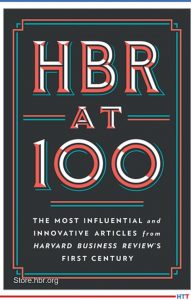
Aniket Maske:  Harvard Business School just published a book. I follow the Harvard Business Journal because I did Organizational Leadership from them. They had a book which has 100 influential articles from the last century all published there.

So, I’m reading through that to see how the goals are being achieved. A goal is one thing, and getting into the right trend is another thing.

Source: store.hbr.org

Doug Glenn: Tell me your favorite app, movie, or magazine. (And Heat Treat Today can’t be the answer!)

Aniket Maske:  Well, that was my first choice, so now I need to think!

I like movies a lot. Lakshya is one of my favorite movies. Lakshya is a movie which is very good in India. It is a motivational movie about a person that goes into the army when all his fellow friends of his feel like he is not a goal-oriented person. He’s very much focused to achieve it. He’s saying, “If you decide, you’ll achieve it.”

Source: Imbd.com

With respect to apps, I like to read the newspaper apps all the time — The Wall Street Journal and I try to stay connected with Times of India, too.

As for magazines, I glance through technical magazines or sometimes I go around at the airport and find something interesting. If it’s a gossipy kind of thing, I will read that too. I’m not that critical.

Doug Glenn:  You’re a reader, I can tell.

Doug Glenn:  Aniket, thank you so much. It was really good to get to know you a little bit.

Aniket Maske: Once again, it’s a privilege and honor to be here.


About the expert: Aniket Maske is chief metallurgist and laboratory manager at Automatic Spring Products Corporation. He previously worked as a manager running eight in-line double temper ovens for a blade manufacturing company in New Jersey. A leader with an expansive knowledge, Aniket is able to train team members to become more knowledgeable in the heat treat processes and to gain a basic understanding of machine operation.


Doug Glenn <br> Publisher <br> Heat Treat Today

Doug Glenn
Publisher
Heat Treat Today


To find other Heat Treat Radio episodes, go to www.heattreattoday.com/radio .


Search heat treat equipment and service providers on Heat Treat Buyers Guide.com


Heat Treat Radio #89: Metallurgical Posterchild Aniket Maske Read More »

Forging and Metalcasting Resources To Keep You Informed

OCWe've assembled some of Heat Treat Today's resources on forging and metalcasting. Read or listen to what the experts have to say on these important topics in the heat treat industry.

This Technical Tuesday original content piece will help you wade into an introduction of these heat treatment processes. Follow the links to dive deeper into the studies.


The span of articles, radio episodes, and TV clips below are compiled to learn more about forging and casting. Heat treating is developing and changing through the years, and it's wise to keep swimming with the current of information.

Simulating Induction Heating for Forging

What can simulation software do for you? Manufacturers are able to run the software to act upon the steel billet prior to forging. Read more about the process here. The simulation shows results in the metal to help the user best plan for desired results. One of the decisions that can be helped is, "the selection of right forging temperatures for plain carbon and alloy steels to avoid possible damage by incipient melting or overheating."

A Look at Steel and Iron

Dan Herring
"The Heat Treat Doctor"
The HERRING GROUP, Inc.

Read or listen to this episode of Heat Treat Radio with expert Dan Herring who discusses metals such as stainless steel, tool steel, cast iron, high and low carbon steels, and more. He looks at their production and their uses.

"I wanted to set the stage for it to say that it’s the end-use application by the customer that fuels the type of steel being produced and fuels the form in which the steel is produced," says Herring.

Investment Casting in Turbine Blades

Take a look at how an alumina and silica (quartz) mix are improving metal casting for support rods used in aerospace manufacturing. "LEMA™, a range of proprietary alumina-based materials that provide double the mechanical strength of quartz while providing significantly improved leaching times, compared with typical high purity alumina," provides many benefits for metal casting. Jump into this piece to find out more about this metal casting example.

Direct From the Forge Intensive Quenching

President
Akron Steel Treating Co & Integrated Heat Treating Solutions, LLC

In this discussion, expert Joe Powell says, "My thing is  to develop a robust process that can be applied and implemented using automation and new equipment with the proper pumps and material handling that is all integrated into a seamless process." He plunges in to talking about immediate quenching pieces in water after heat treating and what they are learning at the forge shop.

Heat Treat TV

Here are a few episodes to keep you afloat while moving into deeper waters.


Click on these two illustrations to watch the full episodes.


Search for heat treat services and products on Heat Treat Buyers Guide.com


Forging and Metalcasting Resources To Keep You Informed Read More »

Heat Treat Radio #88: Lunch & Learn — 3 Most Underrated Processes

Get ready to watch, listen, and learn about the three most underrated heat treat processes in today’s episode. This conversation marks the continuation of Lunch & Learn, a Heat Treat Radio podcast series where an expert in the industry breaks down a heat treat fundamental with Doug Glenn, publisher of Heat Treat Today and host of the podcast, and the Heat Treat Today team.

Below, you can watch the video, listen to the podcast by clicking on the audio play button, or read an edited transcript. 


The following transcript has been edited for your reading enjoyment.

Doug Glenn: There are some underdog heat treat processes out here. I’d like to get to three today. What do you think is number one?

Michael Mouilleseaux: Let’s start with stress relieving. All ferrous materials, all steels, during the course of manufacturing or processing, have some residual stress that is left in them. A common thought about stress relieving is you have a weldment, and you stress relieve it so that the weldment stays.

Contact us with your Reader Feedback!

There is a mechanical action in the material during any cold working operation (cold forging, stamping, fine planking, etc.) because it's done at ambient temperature. Those all impart stress on the part.

Machining, turning, grinding. . . all of those things impart stress into a part. How is that relieved? It can be done thermally, or it can also be done mechanically. Thermally is the most common of them.

What I would like to talk about is not so much stress relieving weldments, it is stress relieving manufactured components. If you’re going to have a comprehensive analysis of the heat treat operation that needs to be performed on a manufactured component, a gear, a shaft, something of that nature, they need to take into consideration what are the prior existing stresses in the part. Then what effect is that going to have on the part?

Many times during the course of my career, I’ve had a customer come to me and say, “The part I gave you was correct, and you’ve given it back to me and then fill-in-the-blank. It’s warped, it’s changed size, it’s shrunk, all of those things.” What have you done in your heat-treating process? You have to back up all the way to the beginning of how this part was manufactured and deal with all of those component steps in order to answer that question properly.

Stress relieving is one of the answers. It’s not the answer. It’s not the only answer, but it is one of them that has to be considered.

"Stress Relieving Tips from Heat Treat Today"

Doug Glenn: For those of us who might not know what a “stress” is in a part, can you simply explain? For example: a coat hanger. If I bend it, is that inducing stress? Is that what’s causing stress? What makes stress in a part?

Michael Mouilleseaux: You’ve cold-worked the part. In the cold working, you’ve passed the yield strength. You’ve bent it, and it’s not going to snap back. You’ve cold-worked it enough that you’ve actually got plastic deformation, and there is stress.

Doug Glenn: That’s one way we get stress. That’s the mechanical way of getting stress.

Michael Mouilleseaux: Right. Now, consider stamping. Even though a stamping is flat (because the die has come down in the perimeter of that and maybe internal holes and things), where you’ve sheared the material, you’ve imparted stress there.

If you harden it or case harden it or whatever you might do with that stamping, you have to take into consideration how much stress is there. If I don’t relieve it, is it going to do that at some point in the part’s future that’s going to be detrimental to the part?

Doug Glenn: When you get a stress in a part, that’s the area that’s a weak spot, right? It potentially could break before other parts?

Michael Mouilleseaux: At the absolute extreme, that could happen, yes. More often than not, what you have is an area that’s been cold worked, and it’s been deformed. When it stresses, it’s going to somewhat relieve itself. It may not relieve itself 100% all the way, but it will somewhat relieve itself. Whatever shape of form you’ve put that part into; it’s not going to hold that form forever.

Alyssa Bootsma: You mentioned that stress relieving is not the only way to alleviate the problems. What would be some alternatives to stress relieving?

Michael Mouilleseaux: Thermal stress relieving is, by far, the most common. There is a process that’s called vibratory stress relieving. In order to relieve the stresses in a part, you have to impart some energy in it. Something between 800 and 1200 Fahrenheit is typically used in stress relieving. That thermal energy goes into the part and relieves the stresses.

You could also do that mechanically by a high frequency vibration. It’s not as common. I believe that it’s actually a propriety process, if not patented. It would be for something that you did not want to subject to 800-1000 degrees Fahrenheit because that doesn’t come for free. Obviously, in a ferrous material at that temperature, you’re going to have some oxide forming on the part. You may or may not be able to utilize the part in its final function with that oxide on it.

Those are typically the two ways to do it. Can it occur naturally over time? Yes, but none of us have that kind of time.

Alyssa Bootsma: You did mention how it doesn’t necessarily mean that it’s more likely to break if that part is not relieved, but what parts would suffer the most if this process was done incorrectly?

Michael Mouilleseaux: Probably weldments. The detrimental effects of not having stress relieved of weldment would be the most significant. In welding there is a whole range of temperatures proximate to the weld — everything from room temperature to maybe 3000 degrees. That whole range of things changes the structure of the steel.

Leaving it in that condition makes it susceptible to any number of things — embrittlement, accelerated corrosion, and others. There is every reason to stress relieve something like that and almost no reason not to.

Doug Glenn: That’s weldment. Do they do a stress relieve after a braze as well, or is that not as common?

Michael Mouilleseaux: Typically not. The reason for that is, in brazing, the entire assembly is brought up to the same temperature. Then it’s cooled at the same rate.

Bethany Leone: I have two brief questions: 1. How long does stress relieving typically take? 2. Would we see the effects of incorrect stress relieving, or failure to, once something goes to quench?

Michael Mouilleseaux: The first question — would you necessarily see a failure? Those would be extremes. I’m more familiar with stress relieving fabricated components that are machined. Take a gear. They forge a blank and maybe machine out the center of the gear, machine the exterior of the gear, cut the teeth in a shaping operation (a hobbing operation or skiving or other ways of generating teeth).

"You have this part, and it needs to be heat treated. To assume that all of those machining operations would have no effect upon that whatsoever is not a good thought."

Then comes a comprehensive program of evaluating how best to heat treat a part. It doesn’t matter if it’s out of a medium carbon alloy steel or it’s a low alloy steel and we’re going to carburize it, what’s critical is that it’s going to get heated. The material is going to transform into austenite and cool rapidly or quench it. That’s what’s going to cause the hardening operation on the part.

In doing that, there are going to be changes in size. In hardening a part, you get a volumetric expansion. Thin sections are not going to expand as much as larger sections. A misnomer is, “You shrunk the hole.” You haven’t shrunk the hole! The material around the hole has expanded, the exterior portion of that area has increased, and the interior portion of that has decreased.

If you have a spline in that hole, now you’re on for something else because their teeth form in that spline. If it’s in a long section, then how uniform it’s been hardened has to do with whether or not it goes out of round or their taper. There are any number of things there. Those are all critical to the operation of this gear.

But what we have to take into consideration is the broaching operation. We drill a hole, and we put a broach bar through it and cut all of these teeth. All of that has imparted stress in the part.

One of the preliminary things that needs to be done is you stress relieve the part and give it back to the manufacturer. They measure it and say, “Oh, oh, it changed!” That change is not something the heat treater can do anything about. That’s the physics of what happens when you work-harden a part. This all has to be taken into consideration and addressed before we talk about what’s the heat treat distortion.

Bethany Leone: And the other question I had: How long does it take to stress relieve?

Michael Mouilleseaux: Typically, if it’s held at an hour or two at temperature, it’s thought that 1000 degrees for an hour at temperature will relieve most stresses.

Now, in a component part, we’re going to go higher in temperature. Although we’re not going to go high enough to austenitize the part, we’re going to go high enough in temperature that we know we’re going to relieve it.

Michael Mouilleseaux: They’re cousins. Stress relieving, the implication is that you are doing that simply to relieve prior existing stresses. In annealing, the implication is that you are going to reduce the hardness of the microstructure for the purposes of machining or forming. In annealing, there’s subcritical and supercritical and a hundred different flavors of that.

Doug Glenn: I’m trying to get a sense of what percentage of heat treating is stress relieving. Is it super popular? It seems to me it would be very common.

Michael Mouilleseaux: Interestingly enough, I’m going to say that the majority of the gearing product that we do, we incorporate a stress relief in the initial stages of heat treating. By putting the part in and raising the temperature to a stress relieving temperature and then taking it up into the austenitizing temperature, you’re not shocking the part. You’re not just taking it from room temperature to carburizing temperature or hardening temperature, and thereby you’re reducing the thermal stresses. So, you’re not imparting any more.

Doug Glenn: Stress relieving may often be done as a part of another process?

Michael Mouilleseaux: It can be, definitely.

Doug Glenn: Let’s move on to the second forgotten heat treatment.

Michael Mouilleseaux: I don’t know about forgotten. I’m going to say that it’s getting short shrift, and that is conventional atmosphere carburizing. What’s sexy in heat treating? It’s low pressure carburizing and gas quenching. It’s growing very rapidly and it’s being used in a lot of applications.

We’re subject to the same ills that Mark Twain identified years ago, and that is, “To a man with a hammer, every problem looks like a nail.” Low pressure carburizing and gas quenching, they can save every distortion issue that’s ever been known to man in heat treating, and they don’t. They are other tools in the box, applicable to a lot of application. They are great processes, very targeted and specific. You know, sometimes you need a screwdriver instead of a hammer.

Conventional carburizing: It’s been around for a hundred years. What’s different today than what it ever was? Certainly it has everything to do with the control systems that are being used to control it. It’s eminently more controllable now than it has ever been. It is a precision operation, and it has many applications. By the way, it’s far more cost effective than carburizing would be. In vacuum carburizing, the cost is multiple; is it two, three or four times more expensive? It depends on how you calculate cost of capital and all of those things. But it’s a multiple, more expensive than conventional carburizing.

Doug Glenn: To do vacuum carburizing?

Michael Mouilleseaux: To do vacuum carburizing, yes. Should it be used in every application? I’m going to say no. Are there definite applications? Definitely.

Doug Glenn: Conventional carburizing, atmosphere carburizing is another area largely forgotten. I know it’s quite popular, but it’s not getting a lot of discussion these days.

Michael Mouilleseaux: Right. Any time there is an issue with a carburized part, everyone knows to ask the question, “Why don’t you vacuum carburize it?” The answer to that is, “Let’s solve the problem before we decide what it is that we need to do.”

Karen Gantzer: Mike: At a very basic level, can you explain why do heat treaters use endothermic gas?

Michael Mouilleseaux: In atmosphere carburizing, we need a method of conveying carbon to the part so that we can enrich it; that’s what carburizing is. The carburizing portion of the atmosphere in endothermic gas is carbon monoxide. Carbon monoxide — that’s the reaction at the surface of the part — the carbon diffuses into the part. That’s how you generate a case in the part.

It’s a relatively inexpensive form of carburizing. You use natural gas and air in what we call a “generator”, and that’s how endothermic gas is generated. Then, it’s put into the furnace. There’s almost no air in a furnace. People think you’re going to look in a furnace, and you’re going to see flame. You never do because the amount of oxygen in the furnace is measured in parts per million. You put additional natural gas to boost the carburizing potential of the atmosphere, and that’s what allows you to diffuse carbon into the part. That is the case hardening process.

Doug Glenn: Conventional carburizing is done in a protective atmosphere, typically as an endothermic atmosphere which is rich in carbon monoxide.

Michael Mouilleseaux: Yes.

Doug Glenn: A lot of times we’re worried about oxygen in the process because of potential oxidation. Why is it that we use a gas that has oxygen in it to infuse carbon? I know it’s got carbon, but it’s also one C and one O, right? Don’t we run into problems of potential oxidation?

"Comparative Study of Carburizing vs. Induction Hardening of Gears"

Michael Mouilleseaux: In endothermic gas there is hydrogen, nitrogen and carbon monoxide, and there are fractional percentages of carbon dioxide and some other things. The hydrogen is what scrubs the part; that’s what kind of takes care of all of the excess oxygen. The nitrogen is just a carrier portion of it, and the carbon monoxide is what is the active ingredient, if you will, in the carburizing process.

The carbon diffuses into the part. If there is an oxygen, it’s going to combine with the hydrogen. Preferentially, you’re not going to have any free oxygen in the furnace, but you can have a little water vapor. One of the ways of measuring the carbon potential in the furnace is a dewpoint meter. The dewpoint meter is measuring the temperature at which the gas precipitates out, and that’s a monitor or a measure of the carbon potential.

Doug Glenn: A dewpoint analyzer helps you know what the carbon potential is.

Michael Mouilleseaux: Yes. It’s not as good as an oxygen analyzer.

Doug Glenn: An oxygen probe.

Michael Mouilleseaux: The oxygen probe is in the furnace, measuring constantly. You get a picture; you have continuous information. It’s not that there aren’t continuous dewpoint analyzers, but you have to take a sample from the furnace. It has to be taken to an analyzer wherein it is then tested. Best case scenario is you have both of them and you compare the two of them. That gives you a really great picture of what the atmosphere conditions are in the furnace.

Alyssa Bootsma: For a bit of background knowledge: What is the difference between endothermic gas and exothermic gas?

Michael Mouilleseaux: Endothermic gas has 40% hydrogen and 20% carbon monoxide. 60% of it is what you would call a reducing atmosphere. The way that you make endothermic atmosphere is 2.7 parts of natural gas and one part of air. You heat it up to 1900 degrees, and it’s put through a nickel catalyst. You strip off the hydrogens. The gas dissociates, and that’s what results.

Exothermic gas is six parts of air in one part of natural gas. You only have 10 or 15% hydrogen. Although it’s not an oxidizing atmosphere, it’s very mildly reducing.

It can be used in annealing, clean annealing. If you’re annealing at 12-1300 degrees or more or in that ballpark, that kind of an atmosphere is going to keep the work clean. If you did it in air, it would scale.

Bethany Leone: Is there an industry (automotive, aerospace, energy) that it would be most helpful for those parts to be typically atmosphere carburized, and/or is it just generally helpful for all types of industries?

Michael Mouilleseaux: First of all, the transportation industry is the lion’s share of heat treating — automotive, truck, aircraft. Atmosphere carburizing is extremely popular and commonplace in those industries.

If we said that we were going to have a seminar and I’m going to talk about atmosphere carburizing. Somebody else is going to talk about low pressure carburizing in a vacuum furnace. Everybody’s going to go over to the other room. Folks feel they already know what this is all about, and they know what all the problems are. They think that the vacuum carburizing is going to solve all of them.

When you work with the proper kinds of controls, the proper kinds of furnace conditions, the right way of fixturing parts and cleaning them ahead of time, you can have extremely consistent results. You can have extremely clean parts, and you can have very good performance from these things.

What the Europeans call “serial production”: we run millions of gears per year, and we have very consistent case steps in hardnesses as a result of good practice. All of these things need to be monitored and controlled and taken care of. But the results are also very consistent and very predictable.

Doug Glenn: Interesting. And it’s more cost-effective, I’m guessing. Conventional atmosphere carburizing, on a per part basis, is going to be substantially less expensive.

Michael Mouilleseaux: We’ve looked at it. Is it two times, is it three times, is it four times more expensive to vacuum carburize a part? The answer is yes. The question is, does that component justify that? There are any number of them where it does.

Doug Glenn: Where it does justify it?

Michael Mouilleseaux: Yes, absolutely.

Doug Glenn: Let’s go on to #3, the third underdog in heat treating.

Michael Mouilleseaux: Number three is marquenching. Marquenching, martempering, and hot oil quenching are in the family that describes this process.

Martempering is different than just quenching in oil, quenching in regular fast oil. Regular oil is going to be 100 vis, and it’s going to be from 90 degrees to 150 degrees. All kinds of low hardenability, or parts that don’t have a lot of adherent alloy in them, you utilize that so that they can be fully hardened. But components that are distortion-critical, quenched in that manner in regular oil, there is going to be a high degree of distortion. How is that addressed? It’s addressed in marquenching.

Let’s take an example of a carburized gear. A carburized case is heated to 16-1700 degrees and carburized. Best practice would say that I’m going to reduce the temperature before I quench it, and then I’m going to quench it in oil. Do I understand that: I have to have loading that spaces the part; and the parts need to be fixtured in such a way that, physically, they don’t impede on each other; and I get full flow of oil, and all of those things? The answer is yes, yes, and yes.

The martensite starts to form in the case at, let’s say, 450 and it’s plus or minus 25 or 30 degrees or so. Take that part and put it into the range where the martensite starts to form, and hold it at that temperature and let the entire part cool down to that 450 degrees where the martensite is starting to form. Then we remove the part from the furnace and allow it to cool in air to room temperature. At that point, the cooling rate is much lower than it it’s going to be where you’re conducting that in a liquid medium. Because of that, the stresses are going to be less, the distortion is going to be less. That is a strategy for reducing distortion.

You ask, “Why do you need to do that.?” Again, the man with the hammer: I’m going to gas quench this part because I have the opportunity to gas quench it, and the gas quenching doesn’t come for free. The shadowing effects of a gas flow has to be taken into consideration, orientation of the parts. There are a number of things that need to be taken into consideration.[blocktext align="left"]There are a number of applications where in marquenching a part, the distortion can be controlled. We process a lot of gears, and we maintain 20/30 microns of total distortion in ID bores on gears. It is a viable way of controlling distortion.[/blocktext]

Doug Glenn: We say marquenching.

Mike Mouilleseaux: Or martempering or hot oil quenching.

Doug Glenn: The “mar” part of that comes from martensite? I want have you explain what exactly martensite is. But is that where it comes from?

Mike Mouilleseaux: Yes. We’re getting right into the start of the martensite transformation.

Doug Glenn: There are different microstructures in metals. Austenite is pretty much the highest temperature, and it’s where the molecules are almost “free floating.” They’re not liquid, but they can move around. (This is very layman’s terms.) That’s austenite.

What causes distortion is when you’re cooling from austenite down to the point where that thing is, kind of, locked in; that can cause distortion in there because the molecules are still free to move. Some areas cool faster than others, and when you have that, you can get twists and turns or bulges. Once it gets down to the martensite temperature, that’s when things are, locked in. Is that fair?

Michael Mouilleseaux: The other thing that happens is you’re going from a cubic structure to a tetragonal structure. You’re asking, “Why are we there?” That’s where the expansion comes. The close-packed tetragonal structure takes up more volume than the austenitic or cubic structure. That’s where the volumetric expansion takes place.

Doug Glenn: At a higher temperature, the molecules are arranged in such a way that they take up more space; there’s more space between them.

In the cooling process with marquenching, if you bring it down just to the point where it’s, what Mike referred to as, the ‘martensite start temperature,’ that’s the temperature where things are just locking in. But it’s not so drastic that you’re dropping way down in temperature so that there are larger temperature differentials and things are really starting to get torqued out of contortion because of the difference in the cooling rates in the part.

Michael Mouilleseaux: The other part of that is that the formation of martensite is not time dependent. It’s not like you would have to hold it at 400 degrees for a longer period of time than you would at 200 degrees to get martensite. At 400 degrees, you’ve got some percentage of transformation. Say, it’s 30%. The transformation is temperature dependent. Because it’s temperature dependent, you can take it out and slow down the cooling rate. Then, as the transformation takes place, there is less stress, and if there’s less stress, then there is less distortion.

Again, it’s typically going to be distortion-sensitive parts.

The simplest geometric shape is a sphere. There aren’t any changes in section size in a sphere. It can be rotated, and you’ve got the same section size. You don’t have the kind of thing where one area is cooling more rapidly than another.

A major source of distortion is varying mass. Like a hole in a block: one portion of the block is two inches wide, and another portion is an inch wide. To think that that hole is going to stay straight all by itself, that won’t happen because there’s more mass around one end. By marquenching it and slowing down the transformation, you’re giving yourself an opportunity to reduce the amount of stress that’s generated. It’s the volumetric expansion in the thicker section than in the thinner section. Your opportunity to maintain that hole so that it stays round and it stays straight is much better. Otherwise, the thin section is going to completely transform before the thicker section does.

Doug Glenn: Transform to martensite or whatever, yes.

Michael Mouilleseaux: The extreme case in that is if that happens rapidly enough, and there’s a large enough differential in section size, the part cracks.

Doug Glenn: That’s the nightmare for the heat treater.

Guest Michael Mouilleseaux with the Heat Treat Today team

Bethany Leone: Are there any instances where it’s definite that another way to manage distortion would be better than marquenching?

Michael Mouilleseaux: Sure. Again, what’s currently sexy in this industry is gas quenching things. I’m going to say that cylindrical parts that have a thin wall, when properly gas quenched, will give you better distortion control, better size control than it would if you’d quench them in a liquid medium such as oil. We don’t want to forget that marquenching can be performed in salt, as well.

If we were going to talk about a fourth one, it might be salt quenching because that’s one of those things that’s not commonly utilized. There is some real opportunity with it.

Doug Glenn: Mike, thanks for ‘dumbing this down’ for us. We appreciate it! It’s sometimes a struggle to state things simply, but you did a great job.

Are there any closing thoughts you’d like to leave with us regarding the nearly-forgotten, popular heat treat processes, or anything else?

Michael Mouilleseaux: How about the combination of all three that I just spoke about?

Doug Glenn: Okay. Well, how about that?

Michael Mouilleseaux: I’ve got a distortion sensitive gear, and we’ve figured out that there is some stress in the part as a result of the final machining operation. We stress relieve the part, we carburize it conventionally, and then we marquench it. Those gears that I spoke about where we’ve got 20 or 30 microns of ID bore distortion — that’s exactly what’s done there.

Doug Glenn: Okay. Stress relieve first, conventional carburize, and then marquench. A combination of three.

Mike, thank you very much. This has been really helpful and it’s been good to learn a little bit on our Lunch & Learn. We’ll hope to have you back sometime to make other things understandable for us.


About the expert: Michael Mouilleseaux is general manager at Erie Steel LTD. Mike has been at Erie Steel in Toledo, OH since 2006 with previous metallurgical experience at New Process Gear in Syracuse, NY and as the Director of Technology in Marketing at FPM Heat Treating LLC in Elk Grove, IL. Having graduated from the University of Michigan with a degree in Metallurgical Engineering, Mike has proved his expertise in the field of heat treat, co-presenting at the 2019 Heat Treat show and currently serving on the Board of Trustees at the Metal Treating Institute.

Contact: mmouilleseaux@erie.com


Doug Glenn <br> Publisher <br> Heat Treat Today

Doug Glenn
Publisher
Heat Treat Today


To find other Heat Treat Radio episodes, go to www.heattreattoday.com/radio .


Search heat treat equipment and service providers on Heat Treat Buyers Guide.com


Heat Treat Radio #88: Lunch & Learn — 3 Most Underrated Processes Read More »

23 Tips for 2023: Heat Treat Knowledge for Professional Growth

OC

By this time of the year, New Year's resolutions have fallen to the wayside. Rather than feeling discouraged, treat each day as a new opportunity for learning and advancement. Heat Treat Today compiled an easy-to-access resource for you chock full of heat treat technical information. 

These 23 ways help you set goals to access new technology, connect with industry leaders, review old and trusted practices, and so much more. We hope this original content article is helpful and would love to hear from you in the Reader Feedback button below!


Contact us with your Reader Feedback!

Amp up Your New Technology Know How

1. Grow your medical expertise by seeing the use of alloys in this graphic, and taking a look at heat treatment of medical implants.

2. Quiz yourself to see if there are any gaps in your thermocouple knowledge.

3. Update your pyrometry knowledge of standards to avoid destructive testing.

4. Elevate heat treat on the floor using these heat treat resource provider.

5. Sign up for an industry-specific monthly e-newsletter to continue learning.

6. Read the latest in heat treat economic news.

7. Delve into new advancements with resisting creep in 3D printing turbine blades.

8. Learn about this multi-national science experiment and a heat treat furnace that takes 5 weeks for one component!

9. Powdered metals, additive manufacturing, the sintering process, oh my! Stay abreast of current and future happenings in these sectors.

Connect with Industry Leaders this Year

10. Find an expert heat treater to consult for your latest project/idea.

11. Think about green solutions in heat treating; what more can be done?

12. Optimize a LinkedIn networking group for your industry.

13. Recognize a colleague (under 40) who is encouraging you with their learning and efforts.

14. Listen to Heat Treat Radio here.

15. Keep up with the other side of the world in heat treat and read Dual Perspectives.

Review and Refine Old and Trusted Practices

16. Parts washers and data; do you know how to save money and time with the two?

17. Keep track of cyber security acronyms to maintain best practices.

18. Focus on furnace maintenance for optimum production and cost efficiency.

19. Take advantage heat treat industry videos to acquire stretch your brain.

20. Access and sign up for heat treat print magazine.

21. Find out thoughts on why America is leading in decarbonization.

22. Go to Heat Treat Boot Camp here.

23. Revisit and update your safety practices.


Find heat treating products and services when you search on Heat Treat Buyers Guide.com


23 Tips for 2023: Heat Treat Knowledge for Professional Growth Read More »

Heat Treat Radio #87: Advances in Work Flow Planning Software with Jeffrey Halonen

While this Heat Treat Radio episode about the advances in work flow planning software will be more interesting to our commercial heat treating friends, we think this topic is a fascinating one that speaks to Industry 4.0 and IIoT questions. The question: How are data and human machine interfacing technologies advancing to make the heat treat experience more efficient?

Watch, listen, or read about it in this Heat Treat Radio conversation between host and Heat Treat Today publisher, Doug Glenn, and Jeffrey Halonen, CEO of Steelhead Technologies.

Below, you can watch the video, listen to the podcast by clicking on the audio play button, or read an edited transcript.


The following transcript has been edited for your reading enjoyment.

Doug Glenn:  We’re looking forward to talking to you today about what is a growing interest, I think, to a lot of people in this industry, primarily because of the growing of technology and data and things of that sort. I know your company is heavily invested in job shop, plant-wide, organization-wide operating systems. That’s basically what we’re going to talk about today.

Contact us with your Reader Feedback!

The first question I wanted to ask you is, what do you think are, for job shop-type businesses, the two or three main reasons that makes them less profitable than they might otherwise be?

Jeff Halonen
Co-founder & CEO
Steelhead Technologies

Jeff Halonen:  Great question. A job shop is a unique business. They don’t have the luxury of centralized planning, or planning in advance and architecting a plant, like they might do if they are making Chevy Tahoes where an immense amount of engineering goes into build a highly efficient operation so it’s highly predictable.

A job shop, on the other hand, is the opposite of predictability. Down to what parts, what hour, what time of day, how many customers, by week, by month. . . everything changes constantly. That buys a lot of inefficiency, not because what they do is overly complicated; it’s the complexity that grows both with a high quantity of customers and a high quantity of specifications they need to build to. Then, obviously, being at the end of the end-customer’s production cycle, the lead-times are often very high pressure because you have to make up time for all of previous mistakes and missed deadlines. You’re the last step before it gets on a plane or a train or goes straight to the customer.

We’ve seen room to improve these operations from a profitability and a data standpoint. Data is not something you’re going to be able to sell out in the market. In your plant itself, it is not very valuable, but it’s the decisions you can make with that data. Specifically, this is the case when it comes to profitability. For example, if you have five to twenty different processes or lines, which one is more profitable than the other? That should be something that you understand. This is what your business does: different types of business, even different part numbers, different customers, different lead times that you offer for customers, what’s your cost versus return on that.

The other opportunity, aside from analyzing the commercial side of all of your work, is your production. If you’re a job shop, generally you are parts in and parts out, go, go, go. It’s more of a service business than a slow moving, very technical manufacture.

So, basically, every time a job comes through your shop, you should be studying — what does it take to make that job go? Anything from the quote, to closing the sale, to receiving the order, to the physical paperwork, to notifying the floor, to building a schedule, to scheduling capacity, to executing production, providing instruction information, how you collect that data, even something as simple as how do you notify customers. Are you notifying customers on the phone or an email? You do twenty to thirty orders a day, 100 orders a day — it adds up quickly.

Invoicing — how do you generate your reports? Aggregate data — that’s the other thing that we see in job shops very frequently. The actual cost of executing an order on a marginal basis can be extremely high if you have many systems; or it’s paper-based; or it’s not streamlined.

Doug Glenn:  Not just the processing of the part, in the sense of thermally processing the part, but you’re talking all the way from preparing the quote all the way through to shipping and anything at the end.

Jeff Halonen:  Absolutely, Doug. In our experience, the job shop manufacturers are pros at what they do — the actual process. They’ve been doing it for years or sometimes decades. They have it absolutely dialed. In the physical processing of the part, sometimes there is room for improvement; but a lot of times that is a fine-tuned machine. Generally, it’s the business systems that surround it.

One thing that we like to point to is the very heavy investments that the industry makes in physical, tangible goods: natural gas, land, equipment, people, automation systems  (physical automation systems). Where we see a huge opportunity is all the things you can’t actually touch and feel. It’s the digital operating system that your plant runs on, all the systems and processes that makes your business tick.

Doug Glenn: You’re talking about data in, from the very beginning of the process, all the way through. I don’t know too many companies, especially job shops, that are actually gathering that type of data. Is it possible? What are the costs involved, let’s say, of starting to gather that data from that point all the way through? It seems like that would be expensive and difficult to do.

Jeff Halonen:  Absolutely, Doug. It feels like an asymptotic target. You can try really hard, and you can make progress; but that rate at which you make progress drops off really quickly. It’s what we see as a balance of cost of data and value of the data.

It’s not that manufacturers don’t value the data; they often do make an investments to get the data. They realize quickly that, with help with the proper tools, cost ramps up really quick. They essentially hit that floor or that asymptote, if you will, really quickly. They say, “OK, we are clearly extending more effort than it’s worth; so we’re going to dial it back. We’re going to go right here. That’s where we’re setting the knob, and we’re going to run our plant.”

"They are rudimentary data systems, and the cost is very low."
Source: Unsplash

Unfortunately, with the tools available, that setting or their status quo tends to be paper, Excel, systems like that. If you have no system at all, not even paper, it’s very obvious that we need something. We write on paper, we highlight, we put it here, we do this, we do that, we have a whiteboard for scheduling, and you see a lot of yield from essentially those data systems.

They are rudimentary data systems, and the cost is very low. You spend a week or two, and you deploy it. You make it, run it, and get the value. Then you say, “Now, I want to track what part was in what oven at what exact time and exactly what went through. Now I want to see all the parts that went through this or that type of process. We’ve run that part number forty times — I want to see its performance every single time from a commercial standpoint. All of a sudden, the cost of obtaining that data — now you just have a wish list. You look out and say, “That’s going to be impossible. That’s way too much time to get that data.”

That’s really where deploying a centralized platform that  takes in everything from the business — anything from inventory, to quoting, to operator instructions, to timing each process, to part numbers, to shippers, to invoicing — it all really is intertwined. When you can track every single movement of every single part going through the entire process, the cost of that data drops precipitously. Especially if you have reporting integrated. Now you can generate reports that will passively collect data as your operations go on. Whatever you look at on a daily, weekly, monthly basis to essentially run your plant.

We like to say, “Digitize, automate, optimize.” To us, these are  three core steps to reducing the cost of data. First, digital. If you have no system, or you have paper, it’s very difficult to obtain actual data and actual insights from your plant. Even if you do digitize successfully, but you just have a mass of huge databases, that’s very low usability because now you need to be essentially a data scientist to go in and make it useful.

Next is automation. We need to automatically tailor the data to present profit margin. We need to automatically tailor the data to track reworks. That’s the next step because that gets us to actionable data information.


Then, the last is optimization. The optimization itself often actually happens at the plant level where the management team is now in, what I would say is, a luxurious position of having a lot of their systems digitized then automated as well.

They have the data. They have the time to address it. Now they’re in the position of optimizing their facility. That could mean focusing on marketing; that could mean pursuing a new industry — developing a new process, training your operators. It could mean anything in the world — getting a new permit from the city, for example. These are things that optimize your plant to provide as much value as possible to the world. You have the ability to do that because you’ve done your homework to get your plant into a position to action that data and have the time available as well.

Doug Glenn:  Right. You’re collecting the data that you need to make those types of decisions. I find it interesting some of the scope of the types of decisions you just mentioned, that job shops could make based on the data. That’s pretty interesting.

Let me ask you this, Jeff:  do you have any examples in the heat treat world? Or where, for example, in the heat treat world do you envision there being some real business efficiencies here? Let me preface this one other way, too:  a lot of the people that listen to this podcast are not necessarily job shops; they are what we call “captive heat treaters” who run high volume/low variability. But there are some who actually run high variability — a lot of different parts,  maybe not exceptionally high volumes, or at least smaller volumes than our captive heat treaters. I guess, addressing those guys, or even the guys that run low variability - what are the business efficiencies we could see?

Jeff Halonen: It’s going to be different from plant to plant as far as the value you’re going to have because everyone has different proficiencies and profiles like you just mentioned. If you’re in a situation where you have a very high degree of mix, one of the huge inefficiencies that we’ve seen is they want to keep a really tight lead time; but they don’t have the ability to quickly and easily schedule efficiently. They keep all of their equipment at maximum capacity, so they keep as much throughput in the plant as possible. The inefficiency essentially shows itself in the quantity of ovens - they just simply invested in more equipment and just keep more ovens hot. They essentially overcapacitize which is both acap efficiency and an opex efficiency because you have to heat, maintain and run that much more equipment. That’s an environment where you have a lot of complexity, and the scheduling required or the inability to schedule efficiently is leading to capital inefficiency.

If you’re in a position where you’re on the other end of that spectrum, as you mentioned, Doug, where you have lower variability by part number higher volume; some of the inefficiencies there can definitely be more on the data systems — the data processes. Again, scheduling — if it’s a very simple schedule, you can schedule it very quickly and easily and very efficiently because you don’t have a lot of change. It is tracking that information — where are all the parts, for example.

A lot of times it’s the administrative time. People are walking out, still trying to find where the parts are. Simple things like order status or we ran this part with this lot number or purchase order or shipper number or whatever identifier you have — we ran this six months ago, what happened to that part? Often times, something as simple as that can turn into a 20, 30, 40-minute exercise instead of just quickly finding that information.

Doug Glenn:  How about equipment inefficiencies? How can a system like yours that’s gathering all the data - how can it help us increase efficiency, just of the equipment that we have?

Jeff Halonen:  The first step, as they say, to addressing an issue is knowing you have a problem. The first step is measuring what actually happens in the real world. You can walk out into any shop and just open your eyes and things are happening, right? But your knowledge of what’s happening is almost just instantaneous. As soon as you go to the ball game later, you’ve forgotten all about that pile of parts or that empty oven that you saw. If you have a situation where at the end of the day, week, month, quarter, you have the raw numbers - we know it can do X amount of parts or racks or  pounds or whatever the metric is - and it did Y and that’s X percentage below that number, the numbers speak for themselves.

Jeff Halonen and Doug Glenn
Source: Heat Treat Today

As far as what the team can do to address the problem, that could be any number of things from a plant management standpoint. That’s where it really gets into the optimization side. Although one thing might be scheduling efficiency. If we find that turnovers or essentially thermal profiles or run speeds or whatever it may be, if we have an opportunity to batch production,  increase density which might be a scheduling exercise, we might explore that.

That could also come back into business strategy — it’s all very related. For example, you might offer to expedite fees — fast turnaround at a higher price — but then lower price for long turnaround time because that now gives you the privilege of organizing your work in a more efficient way and providing the same value at a lower price. If that end customer has the time in their schedule, they can say — hey, I want to save money and have my job done in a week or so instead of 24 hours where I’m ready to pay a huge premium. That cost multiple can be dramatic and for good reason.

Doug Glenn:  I have two more questions for you. One is a little bit hypothetical. I want you to kind of take a guess  about the rate at which software and digitization, of the sort that you’re talking about, is coming into job shops. That’s the first thing. The second and last thing I want to ask  is for you to just kind of take us on a walk through, to the best that you know, a heat treat business. How might a system like yours look?

A lot of people say, “Listen, I’ve got my system in hand, I’m okay the way I am.” First, is it coming? Do you think people are going to have to get to this digitalization sooner or later?

Jeff Halonen:  I believe so, yes.  I understand you can definitely run a shop on paper. You can run it on Excel. As far as macrotrends out in the world, consider first the technology available. The team at Steelhead is obviously very competent with a lot of really great software engineers, but the tools available have progressed dramatically over the last couple of years. We’ve run into heat treating shops that are using a system they may have installed in the ‘90s. It does functionally work, but we do see a lot of symptoms, essentially adverse symptoms, to the business by choosing to use a less effective system. That usually comes in less actionable data. It does facilitate the physical paperwork needed to run your plant, but it’s not a competitive advantage. It just is kind of there, and it’s just kind of barely acceptable. The employee morale is not great - people don’t love using systems where they have to reenter data. They can’t work from home. There are so many different currents that are coming in there.

The other one is the end customers often like more and more visibility and more and more traceability into plants. Transparency, visibility, traceability. I don’t think it’s a situation where it’s going to become unviable to run a shop without really advanced technology. I do think, over time, it will be a situation where the competitive profile is one where there are clear advantages to the shops that embrace the wholistic business advantages that come with that.

Think about your customers — they’re buyers just like anyone else. Everyone loves shopping on Amazon or their favorite website. They get the notifications; they can track everything. You order a pizza at Dominos, and you can see them rolling out the dough and putting on the sauce. The predictability and the visibility is something that is really important.

I think, over time, it is certainly something that the end manufacturer is really going to continue to drive (even automotive, traceability and everything like that). As the requirements of data go up, and the competitive landscape starts to adopt more and more of this technology, it’s going to be more and more of a disadvantage in the competitive landscape to be not at the cutting edge of that technology.

Doug Glenn:  Pretty soon it’s not going to be cutting edge, is my thinking. As more and more people are adopting it, it’s going to become easier to adopt. I’m assuming it’s going to be easier to install, easier to launch into any business.

Take us through that, as a job shop. Any of either our captive heat treaters that have a high variability of products or a lot of our commercial heat treat shops which have high variability of products — how would it look? Start us as early as you can in the process and walk us through it.

Jeff Halonen:  Starting at the beginning of the process, if you say, “I’m interested. I need a system. I can just feel it. I can see it. I know there is opportunity to improve our business.” Or, “We feel like we really optimized everything about our business, but we still feel like we have restrictions on growth.” This could be — it takes a lot of energy from the management team, the ownership team that are involved. One question I like to ask is: if the business going through your business or business unit doubles, do your headaches double? Do the amount of hours you work double? To me, that’s symptomatic of room for system improvement.

Early on in the process it starts with some level of interest, some level of intrigue. I think this is something we can improve on; our plant manager is complaining that they can’t work from home. Whatever all these issues are that manifest themselves; or you’re losing jobs in quoting, and you’re not sure if you’re a high price or a low price or margins might be unclear; you’re not satisfied with the level of data. Basically, that’s generally where we start our conversations with plants.

We really take an approach of both informing about what’s possible on the tool and what’s impossible on a modern platform.  Then we also do a value assessment. How do you do this? How do you do that? That kind of third party provides a great, almost, sounding board to say, “Okay, here’s an itemized list of room for improvement.”

Honestly, that’s what really makes it compelling. When we can sit down with a potential partner and identify how we can actually improve the business in very real and definitive terms, not just insights that you can use to drive your business. Also here’s how much time you spent here, how much time you spent there. It’s a combination of calculating hard costs and hard opportunities and then the upside with the actionable insights from the system.

From there are the deployments at Steelhead. [blocktext align="center"]We do direct-to-direct service, so no third parties. A Steelhead team member will essentially go through a lot of meetings and plant walks, in some cases, and essentially reverse engineer your plant.[/blocktext] Where do parts come in the building, and then what? Then they go here? Do they always go there? Sometimes. Can they be run together? We will ask a million questions to essentially reverse engineer the flow of your plant, and then we design the system to reflect your current operations. Not - here’s a software, now bend your plant over backwards to match the software. Whether it’s quoting, workflow automation, or reporting or any of the other parts of the system, we’re going to want to ask as many questions as possible to configure the system to match your plant.

Doug, you mentioned the cost is going to go down, over time, of technology. Absolutely. Because one thing we can do very quickly since our platform is essentially kind of like a build-your-own; it’s almost like Excel except it’s Excel that is highly, highly engineered to work for this specific industry. One thing  we can do is we can prove it out really quickly. So, in just a few hours or a couple of days, we can essentially build your plant, or a part of your plant, and then run your work through your plant and say, “Okay, pick up a quote and let’s write this quote. Here’s a purchase order, let’s do the purchase order. Let’s take this tablet and go out to your plant and step it through your exact operator interfaces. Let’s collect that data. Let’s track it; let’s sit down in the conference room. Let’s pull up the reports, the inventory.

That’s one thing that we really like to do early on — whether it’s in the late sale cycle or evaluation or sale cycle or early on in deployments — is prove it works. Because one of the things we’ve seen time and time again are the horror stories with plant operating software:  we’ve tried for 18 months and we put in tens or hundreds of thousands of dollars, and we pulled the plug. We went back to whatever we were using before. So, proof of concept really quick.

The other thing is the actual deployment going fast. We like to go hot and heavy, kind of rip the Band-aid off, not drag it out over months. We like to go 2-4 weeks, training the team, iterate, iterate, iterate, test, test, test, test, test, because everyone says how it should work. We build it, and we test it and then there are always a couple of tweaks.

From there, we have a customer success team, as well. Whether it’s a phone call, email, zoom call, or training, we like to have someone available to answer the phone. Our philosophy is that your digital infrastructure isn’t something that should be optimized for low cost because we feel that the service that comes along with it — including a team of experts — is critical. Like a wiring harness for your automobile, it runs your entire plant. When your plant changes and you have changing requirements, to have “pros on your bench” to make adaptations real time in your plant is highly valuable.

Our approach is full service. We kind of own the functionality of the system in your plant — anything from the deployment to ongoing support. We’re always one degree away from engineering, as well. Occasionally when there is a bog or something is not working properly, our engineers are right there on calls with customers to make sure everything is working properly.

Doug Glenn:  They can jump into the system and reprogram, as necessary.

Jeff Halonen:  Absolutely.

Doug Glenn:  Run us through this one then, if you would: Let’s say there’s a company — and you’re going to have to take a very generic-type job shop — that has your system already. It’s fully integrated and everything is working well. What does it look like? The reason I ask this is question, is I think a lot of people have trouble envisioning what it would look like and how it would be different than what I’m doing now.

So, a company that has your system, they go to do a quote for a job, and they receive an inquiry. Is the process they follow any different than what they would have done before your system was there? Let’s just take that first step, process and RFQ: how is that going to change from if they didn’t have your system?

Jeff Halonen:  Something like quoting can be a fairly dramatic change, depending on what the current system is. Current systems can be Microsoft Word and Microsoft Outlook and maybe an Excel sheet to track the quotes. A lot of time to administer them and then there is pretty limited visibility. The transaction that we’d see there with Steelhead is that you can actually build a fully automated quote so you can define the algorithm: all of your flow charts, your Excel sheets, square root functions, looking at the mass of the part, specific gravity, material, etc. We can even reference the current price of natural gas. So, you can build models to reflect how your business runs and reference the past performance of that job.

What that looks like for quoting is that you’re able to build the quote all in one system. You might have multiple people involved in the quote: one person is working with the customer to verify requirements, verify inputs, ask questions, gather more data, and then it lands in someone else’s inbox. Now, a streamlined workflow allows the owner or the plant manager or sales manager can now approve that quote and then sending it to the customer instead of sending it through email and downloading and moving things around, we can send it right out of the platform, attach a file. We can track and see when the end customer is opening the quote. Also, your sales team has a lot of tools. They can say, “Hey, what quotes have never been opened? Hey, we should probably make a phone call. We put a lot of effort into those quotes, why don’t we call them and see what’s going on?” There are a lot more analytics but also just speed.

Another thing we’ve heard a lot is that a customer calls, they send a purchase order that references a quote to go, and find that quote can be a challenge because it’s in someone’s inbox, unread. Instead, they can have one platform to grab the quote, convert it to an order, and now you’re running production! It’s all the same data, it’s your plant. You’re not going to start quoting using different laws of physics. It’s about streamlining what you do today and replicating what you do today, but improving the customer experience, improving your team’s experience, and quoting faster, which leads to more jobs.

Everyone wants the thing quickly. If you can go from two days to two hours or from five hours to five minutes, that can have a dramatic impact on winning deals. For example, I’m in Chicago on vacation, and a customer calls, asking, “Where are my parts?” or “What happened to these parts?” Option A is you’re making phone calls back to homebase, someone is rummaging around looking for the information, and it’s not very enjoyable for you, your team, or your customer. But, it could be you put that customer even on speakerphone or mute, look for 30 seconds, and just text them the file right off your phone in real time! It’s the speed of accessing data, customer service, and actual insights, but a lot of it is workplace satisfaction.

We’ve literally been in shops where people are threatening to quit saying, “Our system is so bad” right in front of the president of the company. . . “I’ve been saying for years, we need a new system. I’m at my wit’s end because what I have to do is so painful and repetitive every day just to make the plant go.” It can manifest in a lot of different ways.

Doug Glenn:  Give me a quick history on Steelhead.

Jeff Halonen:  Steelhead Technologies was founded early in 2021 by a team of software engineers, mechanical engineers and manufacturing engineers. We started with the need of a single customer who talked about their pain. This particular customer was running on paper; whether it was contacting customers, instructing operators, tracking information, finding information, even something as simple as a customer calling with a phone call asking for information on a job, all were huge disruptions in their day. It took half an hour and they had to physically go find people and paper. Everything was in a huge storage room at the end. What the Steelhead team heard was a high degree of pain and essentially a plea for a solution. So, we founded Steelhead Technologies to address that need.

Source: Steelhead Technologies

The team has grown really quickly, and we’ve raised 2.5 million dollars in investment capital here in 2022. The team went from an original team of about 6 to up to 16 now. As I mentioned, everything is kind of the direct service model. Whether it’s sales, deployments or customer success, it’s all team Steelhead across the board. Everyone is an expert in the platform, and everyone is one degree backed up by our team of engineers. We have six engineers that work fulltime on Steelhead making it the best that we can.

Our customers are amazing. Everything that we work on is driven by a customer request, someone out in the field, using the tool and saying, “Hey, what if. . . ?” or “Hey, this could be better” or “This extra effort. . .” or “We would really like to know this. We are trying to achieve this business objective, but we need that.” That’s really where the Steelhead team excels is taking essentially what we view as requirements and building a platform to meet those requirements.

It's really exciting. What we found is that [we can really help] the job shop industry, specifically, and also the high throughput — or even the high-mixed captive shops as you mentioned — where there is no build materials, no engineering team, no design release, and no supply chain. It’s go, go, go. The assumptions change by the day, hour, or minute, and everything is fast paced. We’ve seen a huge lack of automation and data in the space. With high quality, purpose-built technology for this fast-paced, almost, service type of manufacturing, with specifically built tools, we’re able to achieve minimal effort to achieve each job. To minimize all of the administrative effort, but also aggregate extremely detailed data down to operators, part numbers, and equipment, without driving up costs or sacrificing ease of use. That’s our core strategy.

Our customers are incredible, and a lot of our recent success has been just keeping up with our customers since they’re always pitching for a new tool or feature. We roll out a couple thousand lines of code to address this and they’re like, “This is good, but it needs that.” That’s the other thing — software is a service, so we’ve long accepted that we are never going to build the software and just ship it: it’s a continual living beast, whether it’s cybersecurity, speed, everything. So much of it is service because this type of software [requires] pros to extract the maximum value from it.

Doug Glenn:  All right, last question. This is your challenge question for the session here. You, personally: What do you find most interesting and exciting about it? When you look into the future, what are you excited about?

Jeff Halonen:  What excites me the most is the transition that shops can see by adopting technology and systems whether it’s impact to the bottom line — which we’ve seen in some shops, where it’s really stunning — or something else. A marginal labor cost where one customer’s job takes three minutes and another takes nine minutes. . . The manufacturer can now address that 3X marginal labor cost with the data where, before, they were just eating it. “This customer is not profitable; we’re not doing that; we are no longer accepting batch sizes below X, because we’re armed with the data.”

What really excites me personally is the journey that each of these plants are able to go on. I also get really passionate about when I’m able to see a difference between the way things are and the way they could be. That’s what every single interaction with our partners is: we see the way that they are and we work really hard to build the best one possible. So, it’s like, hey, look at this difference? Look what we can do? It’s that sense of accomplishment on a customer basis to really get as much as is possible out of their time, resources, people and their entire enterprise.

Doug Glenn:  It’s kind of nice seeing the smile on your customer’s face, I think, right? When things go well, to be able to say, “Man, that was good!”

Well, Jeff, thanks. I really appreciate it. It’s very exciting. It sounds like you guys have got a lot of interesting things going on and, hopefully, some of our readers/listeners/viewers will be able to give you a call but thanks for joining us.

Jeff Halonen:  Thank you, Doug. Thank you very much.


About the expert: Jeff Halonen is a co-founder and the CEO of Steelhead Technologies, a plant operating system provider serving job shop manufacturing plants in the USA. Jeff is a Mechanical Engineer by training and spent several years at General Motors before starting in technical sales and manufacturing software. Jeff most enjoys the personal impact that he can have on customers when they discover exciting new ways to run their business. Residing in South East Michigan, Jeff enjoys time with friends and family, being outdoors, and playing hockey.


Doug Glenn <br> Publisher <br> Heat Treat Today

Doug Glenn
Publisher
Heat Treat Today


To find other Heat Treat Radio episodes, go to www.heattreattoday.com/radio .


Search heat treat equipment and service providers on Heat Treat Buyers Guide.com


Heat Treat Radio #87: Advances in Work Flow Planning Software with Jeffrey Halonen Read More »

Heat Treat Radio #85: Salt Bath Heat Treating with Kolene Corporation

Heat Treat Radio host and Heat Treat Today publisher, Doug Glenn, is bringing us to the world of salt bath heat treating. To take on what this is and why heat treaters should consider this method, Doug is joined by three gentlemen with Kolene Corporation: Dennis McCardle, Ken Minoletti, and Jay Mistry.

Below, you can watch the video, listen to the podcast by clicking on the audio play button, or read an edited transcript.


The following transcript has been edited for your reading enjoyment.

Doug Glenn (DG): Well, welcome everyone to another episode of Heat Treat Radio. I’m really excited today to be talking about salt bath heat treating with the good people at Kolene Corporation. Let me introduce the folks and then we’ll get rolling.

Contact us with your Reader Feedback!

First off, gentlemen, welcome to Heat Treat Radio, I’m really glad to have you. The first person I would like to introduce is Ken Minoletti who is vice president of Thermal Processing at Upton Industry, now a Kolene Corporation company. Ken has 45 years of experience in all areas of the company operations relating to the design and manufacture of salt bath furnace systems and other thermal processing systems. When Kolene purchased Upton in 2021, retaining Ken was a critical part of the terms of the sale. He’s an expert in the field and well respected in the industry. I have known Ken for many, many years. Ken, it’s really good to be visiting with you today.

Kenneth Minoletti
VP of Thermal Processing
Upton Industries, Inc. - a Kolene Company

Ken Minoletti (KM):  Thank you for the invitation, Doug.

DG:  The next person is Dennis McCardle. He is the executive VP of Kolene Corporation and has 34 years of experience at Kolene in all aspects of salt bath manufacturing and operation. As executive VP, he is very well respected and considered an expert in salt bath technologies for industry, serving hundreds of customers. Dennis, welcome, it’s really good to see you. I’ve known you for many years as well.

Dennis McCardle (DM):  Thank you, Doug.

DG:  And finally, last but not least by any stretch: Jay Mistry, senior sales representative of heat-treating chemicals at Kolene and Upton. Jay came to Kolene in 2001, as well, with 33 years of experience at Park Thermal International as their former CEO. Jay is a high-energy, forward thinker, which I can attest. He cultivates and maintains strong industry relationships as the head of Kolene’s heat treat chemical sales. Jay is a wealth of important historical information and ideas.

So, there you go. Gentlemen, you sound good to me already!

We were talking before we hit the record button that when I read these bios, I said, “Boy, we sound good.” Fortunately, we can say, those are true. It’s really good to have you guys.

We want to talk about salt bath heat treat a bit. Just for the listeners, I want to lay out a bit of an outline. What we’re going to do is we’re going to talk a bit about Kolene Corporation first because there’s been some pretty significant activity at Kolene. We’re going to talk to Dennis about that for a minute. Then, we’re going to talk about the equipment -- salt bath equipment; we’re going to talk to Ken mostly about that. Then, we’re going to talk about materials.

I want to talk to you a bit about Kolene. There is a lot of activity over there.

DM:  There’s a lot of activity. We’re very excited.

DG:  Tell us a bit about the history, first, very briefly.

Dennis McCardle
Executive Vice President
Kolene Corporation

DM:   Sure, my pleasure. Kolene Corporation was founded in 1939. We’re a privately held, small business in Detroit. We’re a single-source supplier of process equipment, process chemistries, technical service and support, R & D, development, lab support services, engineering design capabilities -- I mean, we’ve got basically the whole gamut of supply chain.

Our processes are used in a wide variety of industries, Doug, so it’s really hard to go into them all. But typically, the difficult metal cleaning applications is where we’ve made our bones.

Then, when you look at it in 2021, we entered the heat treat marketplace with the acquisition of Upton Industries. It is a renowned name in the heat-treating industry, of both supplier of equipment but also technologies. We also, at the same time, took on the industry-proven chemistries of Park Thermal International. Those chemistries are really the lifeblood of what we’re going to be doing in the heat treat industry.

We’re very excited about the future and what we see coming along. When you think about it, both Ken and I were talking, and now, with the combined companies, we have 170 years of salt bath experience. It’s unbelievable synergy that we bring to our company now. It’s really exciting.

DG:  That is exciting. I want to be clear on before the acquisition of Upton and things of that sort. What were the core markets that you guys were serving? You mentioned it was metal cleaning?

DM:  Metal cleaning, yes. When you look at it traditionally, when we were initially founded, we were doing cast iron cleaning for the navy. We still do that process that was developed in the forties. When you look at it, steel, of course, to scaling, is the largest portion of our business. We also are in the engine remanufacturing sector, the aerospace sector. We’ve got a great deal of breadth, if you will, of the different industries that we supply our cleaning technologies too.

DG:  The company has been around a long time. You mentioned Upton as being a well-established name. I have been in the industry a long time; I’ve heard of Kolene for quite a long time, even in the thermal processing industry, heat treat industry, if you will. You guys have been around.

DM:  We have, yes.

DG: Before we move on to Ken and ask him some questions about the equipment, specifically, I’m curious -- and I’m sure many people out there would like to know -- What is driving this? You’ve acquired two companies, basically. What’s behind it? It sounds like you’re on a growth mode.

DM:  We are. We’re a family-held company. We’re in our fourth generation now. We have always looked at that sector, the heat treat sector, as an opportunity. Obviously, when we were doing the salt bath nitriding, we touched on it a bit, but we really didn’t get into it as we wanted to see and experience. When we looked at it, it was always in the back of our minds, should we enter that marketplace?, It was one of the owner’s sons, Tim Shoemaker, who really started making the inroads of -- Why don’t we go after this? Why don’t we look at this more seriously? He was the driving influence along with his brother, Peter, to move into this. The opportunity arose. Everything fell together just beautifully at the right time, place, and it just worked out fantastic.

DG:  Let me transition over to Ken because I want to just kind of piggyback on that. Dennis, thank you very much. I want to talk to Ken just a minute about the whole acquisition -- Upton becoming a part of Kolene. Can you give us a quick overview of how that happened?

Peter Shoemaker
Vice President of Purchasing
Kolene
Source: PRNewsWire

KM:  Sure. Obviously, everybody looks to continue the longevity of the corporation as we proceed. We’re all not getting any younger! Upton was started in 1937, so we were two years ahead of Kolene Corporation. It had always appeared, in my opinion, to be a very good fit. They are parallel lines of salt bath treatment. We actually competed against Kolene for a number of years, primarily, but we found our mainstay to be in the heat treat industry when it came to thermal processing. The passing of the president of our company opened up the potential for the merger or acquisition, and it worked out very well. We worked with the Shoemaker family and came to an agreement back in October. So, we’re really completing our first year from October of 2021. We’re one year into our leadership as a Kolene company. But they said they understand the importance of the brand name of Upton and, obviously, that will not be going away.

DM:  It is a key point. That name is really very important to us in the branding. It’s something we don’t ever want to lose.

DG:  Both those companies are very good names in the industry -- Park Thermal International and Upton.

So, Ken, Upton has been located where?

KM:  We’re in suburban Detroit in Roseville. We’re probably about a half hour drive door-to-door with the Detroit campus.

DG:  Is that location going to stay, or are you going to consolidate?

KM:  We’re going to stay, yes.

DG:  Let’s talk about the salt bath equipment. A lot of the people who listen to this are manufacturers who have their own in-house heat treat. I’m guessing a large portion of them have stuff that’s not salt bath, although I’m quite sure there are some that do. Talk to those people who don’t have salt baths at this point. Why should they be considering salt bath equipment?

KM:  Some of the big advantages, number one is temperature uniformity (+/-5 degrees Fahrenheit), being a conductive liquid, meeting the spec of AMS2750. Plus, its variables -- you can really run multiple differing grades of materials through the furnace merely buying limited by the operating temperature range of the salts. You run carbon steels, alloys. It’s a simple operation -- there are no generators, there is no carbon balancing for an atmosphere, so you don’t decarb. You rectify the bath to maintain pH, and that will prevent decarburization.

DG:  How about the different processes that can be run? In a salt bath, what are the different processes that can be run?

KM:  Our core business is neutral hardening. Austempering, marquenching and tempering, be it in salt or oil, aluminum solution treating for the aircraft industry, and also aluminum dip brazing. We’re becoming the worldwide leader in the supply of dip brazing equipment. and we have really opened up in the international markets. Again, it’s that temperature uniformity aspect of the equipment.

One sector that’s been taking off is the processing of Nitinol material for the medical industry. Again, uniformity. Molten salt heat transfer systems where the salt bath is generating, obviously, going to discharge into other equipment for heating practices.

A final one that’s unique is ion-exchange glass hardening. Cellphones. It provides for the transfer in the atomic structure of the potassium element into the glass, Gorilla Glass. We’ve talked over the years with quite a few manufacturers. It’s a little bit of a niche market, but it is beginning to expand.

Jeep® introduces Corning® Gorilla® Glass option for Wrangler and Gladiator windshields
Source: CORNING

DG:  That’s interesting! I’ve heard a lot about the processing of Gorilla Glass. I didn’t realize that some of that is done in salt.

KM:  Along with aircraft windshields and a whole myriad of glass products that can be done in a molten salt bath furnace.

That’s kind of our core industry of what thermal processes we utilize.

DG:  I want to come back to the dip braze, for a second. In dip braze, typically what type of materials are we brazing together? Is it a copper braze? How does it work?

KM:  It’s strictly aluminum. A furnace that will run within the salt range, I believe it’s about 1170-1200 Fahrenheit. It’s 61-grade of aluminum. It goes through extensive cleaning practice. You’ll preheat gradually for no distortion. You’ll have your fillermetals in place; it’s textured on the product. They’ll dip braze usually within 45 seconds. The filler metal melts. It’s removed; it’s either air-cooled, fog or immersion quenched.

DG:  Is that the type of brazing that takes place, like with clad material? Are you talking about heat exchangers and things of that sort?

KM:  I’m talking about heat exchangers. We’re talking about wave guides, antenna, any number of products, primarily into the communications, satellite, aerospace industries.

DG:  Typically, those braze processes, the temperature tolerances have got to be within 5 degrees because otherwise you start melting down either your base or your fins or whatever.

KM:  Yes. The criticality of brazing in the aerospace industry is definitely one advantage that molten salts have.

DG:  One last question for you, Ken, well actually two. The materials that you’re processing -- did we hit on that already?

KM:  In neutral hardening, it can be medium to high-grade carbon steels, alloys. Obviously, the aluminum, the Nitinol materials, stainless steels somewhat. Again, you’re really only limited by the temperature operating range of the bath. You can run tool steels to 150 degrees.

DG:  One last question I’ve got for you on this is:  In your experience, you’ve probably seen ebbs and flows as far as interest in salt bath heat treating. Where are we on that spectrum right now? Are we at the peak, are we growing, where are we?

KM:  I think we’re still growing. Again, one of the avenues is the aerospace -- aluminum dip brazing. Neutral hardening, the advantage of the conductive heating in a liquid, you can heat material up. Kind of a rule of thumb is 3-4 times faster than you can in an atmosphere furnace. If you’re able to heat up more quickly, it will reduce the size of the equipment. Plant floor spaces are always at a high commodity opposed to a potential continuous atmosphere line. It can be run by a single operator, delivering a rack of lawnmower blades every 8 minutes. You’ll offload 120 lawnmower blades.  It is very, very high-volume production.

DG:  Jay, I want to jump over to you with a few questions. Materials in salts and things of that sort, I’m probably going to ask you the most difficult questions. When we deal with salts, I know immediately most peoples’ minds go to -- “Uh oh, salts, I’ve got to be careful.” Let’s talk about that for just a little bit. Are there any types of new materials, if you will, new media out there that people should know about, new salts or things of that sort?

Jay Mistry
Senior Sales Representative - Heat Treat Chemicals
Kolene Corporation /Upton Industries, Inc.

Jay Mistry (JM):  The salt products have not really changed very much over the years. You have your standard neutral salts and the quench salts. They haven’t changed a whole lot over the decades. That is good for all the customers using the product because they want that continuity.

The most difficult sell to a customer is when you start changing salts. That seems to create some problems because the specs have already been established for what type of salts to use. When you start playing with the formulations and things like that, that discourages a lot of customers from trying new things. A lot of them are aerospace-based, automotive-based, and they need to get the approvals from those sources before they make any of those changes. So, you tend to maintain those salts with very little changes.

DG:  And I assume, the reason they’re given those specs -- let’s say they’re aerospace specs or whatever -- is because they want to be sure that the salts are cleaned off, that the salts have the same properties during the thermal process, that they’re able to be cleaned off as well, is that right? Is there anything else that is of concern?

JM:  100%. Salt maintenance in the salt bath, desludging in the case of brazing salts, sheeting -- all of those things are crucial to maintaining a good salt bath system, achieving temperature uniformity, and getting excellent results. All of those things go hand in hand, for sure.

DG:  The other question I’ve got for you is a supply chain question. We’re recording this the last day of September (2022) and supply chains are messed up, let’s just say.

ALL:  They’re challenged. They’re totally challenged.

DG:  How about on salts, Jay -- are we having any supply chain issues?

JM:  We still have challenges and so on in terms of raw materials but Pete Shoemaker and his group have done a fantastic job making sure that our needs are met. Deliveries sometimes alter based on deliveries of raw materials, but we still continue.

Costs are difficult to hold at any given time; they are everchanging. We spend a lot of time with our customers to try and explain the changes in costs. Salt products have generally been very stable, but today’s world has changed everything. As opposed to holding pricing for 3 months to 6 months, now you’re literally changing from an order to an order, and that’s difficult for a lot of our customers.

DG:  You and I were talking, about customers who might want to change suppliers. Let’s say somebody is having a supply chain issue with their current supplier and they want to come over and talk to Jay Mistry about buying salts from Kolene/Park Thermal International.

We discussed a little bit about the concern about mixing salts. Can you address that a little bit? Are there any concerns there we need to worry about?

JM:  Going back earlier when I mentioned that not much has changed in the salt products, per se, and that’s in line with in keeping with the salt supplies that we have with the current customers.

To answer your question, the formulations are essentially the same from one product to the other, and so customers really have nothing to worry about blending one salt to the other. In fact, it’s to their advantage to have a secondary source or alternate sources because of supply chain issues. But a lot of them have concerns. They don’t have a chemical background, so there is always the hesitation changing formulations and so on. But we can match any salt product that’s out there, and our clients would be able to use it without any interruption.

DG:  Even if there was a question and they’d like validation, I assume you guys could probably do some sort of chemical analysis of their salts and verify that there’s going to be no problem, if necessary.

JM:  Absolutely. We have a full lab here that we could do salt analysis. In fact, we provide a service for quarterly analysis and maintenance and so on.

DG:  Salts are hazardous, Jay. How do you address that? When I hear of salts, I automatically think, “Oh, boy, the EPA is going to be knocking at my door.”

JM:  There is no doubt -- they are a hazardous product. One has to be aware of proper handling, disposal issues, and so on. But I think with Ken’s group, our group at Kolene, we can educate the customer and help them through all of the regulatory processes and make them aware.


Handling the products, as Ken mentioned, is not very labor-intensive. Typically, one guy can run a salt line, type of thing. From a worker exposure, it’s minimized. The continuous lines that Ken’s facility provides, it’s always an enclosed system with the proper exhaust system. So, all of those effluents and emissions are taken care of and handled. We just spend extra time with new customers to make them feel comfortable with using salt products. Once they get the hang of it, I think most of them would say that their worries were unfounded.

DG:  Ken, do you agree? I mean, this is the handling of salts. Does the cost/benefit analysis of going to a salt line far outweigh the downside?

KM:  I think so. As Jay was talking about the discretional areas (maybe east coast/west coast as far as remediation), strict remediation is going to vary from locale to locale what your discharge requirements are. Out of the automated systems, we build strictly vent to atmosphere; there is no wet scrubber or any type of remediation on the fume. You will have metallic oxides in the disposal media from the bottom of the high heat pot; that always needs to be analyzed to determine what is the proper disposal method. Nitrate salts, any thermal process equipment company is going to be quenching in nitrates. We’re austempering, they’re austempering. It’s the common challenge of the industry, because it is the same equipment, same process.

DG:  Dennis, how about you? Any comments on this whole concept of the hazards of salts? I mean, you guys have been doing this for decades, right?

DM:  We’ve been doing it for decades, Doug, and we’ve, over time, optimized our systems and our processes to minimize any hazards or any potential risk. I mean, we take a great deal of pride in building a properly designed system that minimizes exposure, minimizes anything that could come along in the way of hazard. So, we’ve learned through the years how to do it, and we’ve gotten very good at doing it.

KM:  This also opens up an avenue for our Roseville campus -- we can rely on Detroit on given situations where we need to take a more critical look at remediation.

DG:  Focusing more on the heat treat side of things -- any interesting case studies that you can tell us about where somebody has either purchased equipment, purchased salts or whatever, that has just really been helpful to them?

KM:  With regard to processing salt -- repeatability. Your quench transfer, quench delay -- that is all PLC controlled. We use encoders, variable speed drives. Our Dan Murphy has done an excellent job in that capacity over the years. Again, it’s just everything can program into a PLC, everything is brought in by ethernet communication. We actually have a module that Dan uses which allows him onto their plant floor from our engineering department in Roseville. He can debug issues if programs are a problem.

DG:  A little Industry 4.0 or whatever we’re calling it.

JM:  One of the things to remember in the salt, when we talk about heat treat, and Ken mentioned Nitinol medical sources, we, at Park, went through a scenario with a customer that was having issues with his salt bath. We managed to help him clean the bath out and recharge it. But the interesting point with this customer was that he was producing the glass capsules that go into an EpiPen which is crucial for a lot of people out there. With the recent pandemic, all of the syringes, the billions of syringes used, that’s all heat treated in connection with what Ken was saying with glass tempering. And that’s a salt process that’s actually right out there for everybody to experience. Without the heat treating, the glass tempering, we wouldn’t be able to produce needles, EpiPens and things of that nature.

DG:  One last question:  You guys know your customers very well, much better than I do. If there was a single message you would want to throw out there to your customers/potential customers, what would it be? Dennis, if you don’t mind, we’ll start with you. What’s the message you want to leave with them here about salt bath?

DM:  I think salt baths, as you said, they can oftentimes bring a bit of trepidation in regards to whether I want to put a salt bath into my facility. But I think when you really set foot and talk with us about what we’re doing today, about the systems that we design today, I think you are really going to be put in a comfort zone when you see the efforts that we go through from a design and engineering standpoint, and all aspects of it. I mean, we take a great deal of pride in bringing not only the best system as is available, technology wise, but also in keeping people’s comfort levels at a good position through training. When we go and put a system in, we train people on how to operate it, how to work it safely. We take it very seriously when we put a system in making sure everyone fully understands the operation and fully understands that they can come to us at any time. We’re there 24/7 to take their questions and to help them and provide assistance. We try to be a one stop source for all of that.

DG:  I assume, also, Dennis, that if anyone out there has a question and just isn’t quite sure if they want to do salt, I assume there are probably places you can take them to show them some installed lines.

DM:  Absolutely. And that’s the sort of relationship that we have with our customers. Depending on the process, we can almost always get them to see a facility that’s operating a system today.

DG:  It’s always good when your customers let you back into the plant -- that’s a good sign!

Jay, how about you? Any last message? Then, Ken, we’ll finish up with you.

JM:  Just to follow-up on what Dennis said:  I think the biggest advantage all of our customers, or potential customers, would have is that we are the single source for anything related to equipment to process to operation to pump outs -- from start to finish. You make one phone call and we’re here to answer all of it. You don’t need to go to many various people. So, it truly is a one stop shop where you can get all your answers with one phone call.

DG:  Ken, how about you?

KM:  I agree 100% with Dennis and Jay. The only thing I would add is being allowed the opportunity to communicate with customers. Don’t dismiss something at face value just because the rumor mill is saying it’s nasty, you’re going to have hazardous waste and everything else. Allow us to present the advantages of the equipment. I think a lot of times that opens a lot of eyes. Everybody thinks of the old salt pot furnace with salt over the floor. That’s not the issue anymore. They’re automated, enclosed, they’re ventilated, and limited operator access. There are advantages.

DG:  Gotcha. So, basically don’t believe the questions I was asking about the nastiness of salts. I threw that out there just as devil’s advocate. I do think that’s probably a great point to conclude on is that, listen, if you have thoughts from the past, ideas and perceptions from the past of salt bath, let’s not limit to that. At least give it a shot.

DM:  Come and see us. Come and ask us. Let us show you what we’re doing today. It’s a remarkable advancement from what we had 80 years ago.

KM:  As Dennis said, we can use a referral to a customer, we can do site visits. Upton Roseville has always been the advantage we have a very good customer base. We always had the dialogue to be able to bring potential Upton customers in to take a look.

DG:  Well, it sounds to me, gentlemen, like Kolene/Upton/Park Thermal is on the upswing. I congratulate you. I congratulate you guys and look forward to talking with you again. Thanks for your time, today, I really appreciate it.

Doug Glenn <br> Publisher <br> Heat Treat Today

Doug Glenn
Publisher
Heat Treat Today


To find other Heat Treat Radio episodes, go to www.heattreattoday.com/radio .


.

Search heat treat equipment and service providers on Heat Treat Buyers Guide.com


Heat Treat Radio #85: Salt Bath Heat Treating with Kolene Corporation Read More »

Letter from the Publisher: Top 10 Energy Truths Worth Remembering

Heat Treat Today publishes eight print magazines a year and included in each is a letter from the publisher, Doug Glenn. This letter first appeared in Heat Treat Today's November 2022 Vacuum Heat Treat Systems print edition.


Doug Glenn
Publisher and Founder
Heat Treat Today

Immediate credit for the content of this column goes to Mark Mills, author of The Cloud Revolution: How the Convergence of New Technologies Will Unleash the Next Economic Boom and a Roaring 2020s, and podcast host of The Last Optimist, the source for most of the below content — see episode #20, “Congress & the ‘Groundbreaking’ Energy Spending Act: Top 10 Truths to Keep in Mind.”

Contact us with your Reader Feedback!

Heat Treat Today interviewed Mr. Mills not long ago. If you’d like to listen to, watch, or read that interview, go to our website and search for “Mark Mills” or Bing/Google search for “Heat Treat Radio #73 Mark Mills.”

Here are some interesting thoughts from The Last Optimist podcast, episode #20.

  1. Energy transformations are slow. In the last 20 years, the Western world has spent over $5 trillion to avoid using hydrocarbons, but reduced the percentage share by only 2%, from 86% to 84%. Remarkably, the burning of wood, today, provides 500% more energy to the world than all the world’s solar panels combined. Burning wood will most likely not change in the near future; in fact, more wood is burned today than 20 years ago.
  2. Economic growth always produces more demand for energy. Wealthy economies use 500–5,000% more energy per capita than poor economies. Ironically, wealthy economies use energy more efficiently than poor economies but consume vastly more. Implication: the wealthier we become the MORE energy we will consume.
  3. The shale revolution (mostly happening in America) is the world’s biggest energy revolution. From 2005-2020, the amount of energy provided from shale was TWICE the amount of energy produced from wind and solar arrays combined. This is the largest increase in energy supply in the history of the world, anytime, anywhere. The next closest “revolution” was the Saudi oil fields, but the shale fields have produced nearly DOUBLE the amount of energy.
  4. Green energy is NOT carbon free. According to a study done by Volkswagen, the first 60,000 to 70,000 miles of driving a diesel-powered Volkswagen emits less CO2 than driving an electric vehicle. Its only AFTER that many miles that the vehicle is a net saver of CO2.
  5. Energy tech cannot emulate the digital tech performance curve. The exceptionally high reductions in cost of computers and other digital technologies have been unprecedented in world history. Unfortunately, those who claim that green energy developments will see the same drastic reduction in costs are misled and ignore, at their own peril, the physics of energy conversion and transmission. That’s not to say there won’t be significant improvements in energy technology – in fact, there have already been and will continue to be vast improvements, but not to the scale of information/digital technology.
  6. The energy transition hardware radically increases the demand for physical minerals and thus mining. The need for green energy minerals, the materials needed to build green energy materials like solar panels, electric vehicles, and wind farms, is 1,000% higher than building similar hydrocarbon-based hardware. In other words, the push for green energy will require a drastic increase in the need for minerals, requiring mining, which is currently a carbon intensive .
  7. Energy transition policies — as currently presented — will cause prices to rise. This point ties in directly to point #6. If you increase the demand for materials, such as copper, cobalt, nickel, silicon, aluminum, and lithium, the price of these materials will increase precipitously and will therefore impact the price of all goods that use those materials. The energy sector is a minor user of these materials now, but if demand increase hundredfold, the energy sector will become a major user and will invariably push prices northward.
  8. Scan QR code to listen to The Last Optimist podcast.

    Green energy isn’t cheap. Every country who has thus far embraced, even in part, some sort of green energy has experienced a 200%–500% increase in consumer energy costs.

  9. China is the OPEC of green energy minerals. It’s not so much that the mining of these minerals and rare-earth materials is done in China (some is but not all), but a huge majority of these minerals are refined in China. They are truly dominant. China’s share of mineral refining is more than double OPEC’s share of the world’s petroleum market.
  10. Markets and consumer want reliable AND cheap energy. The most radical transition in society over the past century has been the percentage of time that mankind has had to invest in acquiring food and fuel. For most of human history, roughly 60-80% of all human exertion was spent acquiring food and fuel for existence. Today, thanks primarily to the discovery and utilization of hydrocarbons, that number is more in the range of 15%. One measure of an economy’s prosperity is the amount of time designated to getting food and fuel. The lower that percentage, the more prosperous a society. It has never been lower than today.

The 30-minute podcast from which this information comes is well worth a listen.


Find heat treating products and services when you search on Heat Treat Buyers Guide.com


Letter from the Publisher: Top 10 Energy Truths Worth Remembering Read More »