

A Dozen Quick Heat Treat News Items To Keep You Current


A Dozen Quick Heat Treat News Items To Keep You Current

The heat treat industry is one of people transitioning and companies executing business, achieving goals, and receiving acknowledgments. Heat Treat Today offers News Chatter, a feature highlighting representative moves, transactions, and kudos from around the industry.

Personnel and Company Changes and Moves

D. Scott MacKenzie, PhD., vice-president, IFHTSE

    • At the Executive Council meeting of the International Federation of Heat Treating and Surface Engineering (IFHTSE), D. Scott MacKenzie, PhD., was elected to serve as vice-president for a two-year term (January 1, 2018, to January 1, 2020). MacKenzie, a research scientist in metallurgy with Houghton International, Inc., in Valley Forge, Pennsylvania, has been the ASM representative to IFHTSE since 2015.

      New team members at Paulo: (left) Mike Neumann, plant manager, Kansas City facility; (right) Kathy Neumann, director of corporate safety
    • Paulo has announced two additions to their Kansas City team. Mike Neumann, who brings 20 years of progressive experience in the heat treating industry, joins Paulo as the plant manager for the Kansas City location, which serves the automotive/heavy truck, aerospace, and railway industries and has a diverse offering of heat treating equipment. Kathy Neumann, who has extensive experience managing multi-plant safety programs for commercial heat treatment and traditional manufacturing companies, joins Paulo as the Director of Corporate Safety based at the Kansas City facility.
    • The Metal Powder Industries Federation (MPIF) has announced that Arthur (Bud) Jones, of Symmco, Inc., Sykesville, Pennsylvania, has been appointed president of the Center for Powder Metallurgy Technology. Jones succeeds Jeff Hamilton of American Axle & Manufacturing, Inc (AAM) – Powertrain, who had completed two terms.

      William Jones, owner of Solar Manufacturing, Inc.

      Solar Manufacturing Incorporated, an industry leader in manufacturing advanced industrial vacuum furnaces, is relocating its headquarters to Sellersville, Pennsylvania. The Sellersville Borough Council recently granted unanimous preliminary and final approval for the new building located on a combined 8.5 acres; the manufacturing area will occupy 40,000 square feet of the facility with an additional 17,500 square feet of office space. There is the option of an extra 22,500 square foot addition to the manufacturing building in the future. "I am thrilled to see this project moving forward for our new headquarters.  This new facility will provide us the space we need to grow and consolidate all our staff in one facility," said William Jones, who along with his wife, Myrtle Jones, owns Solar Manufacturing, Inc.  Gorski Engineering is scheduled to begin breaking ground for the new eight million dollar facility in the spring of 2018, with completion and occupancy later that fall.


       Equipment Transactions

    • Advanced Heat Treat Corp. (AHT) has purchased a gas nitride unit to expand its capacity for UltraGlow® Gas Nitriding and UltraOx® surface treatment solutions at its facility in Waterloo, Iowa. This new, large, state-of-the-art gas nitride/high temperature unit will also allow increased capacity of currently offered services including gas ferritic nitrocarburizing (FNC) and stress relief.
    • Aerospace heat treating manufacturer Delta H Technologies LLC of Columbus, Ohio, recently supplied a high-temperature heat treating furnace to a major aircraft MRO. The thermal equipment is capable of heat treating titanium, A286, PH stainless steel, and tool steels in an air or argon atmosphere. "This system complements our popular dual chamber aerospace heat treat (DCAHT serie) furnaces for aircraft aluminum," said Ellen Conway Merrill, vice president of Delta H. "Specifically, it provides a complete heat treating furnace system designed exclusively for aircraft MRO back shops, military, aircraft OEMs, and parts manufacturers."

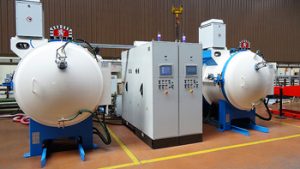
Twin ovens developed by Ramada Aços and BMI

  • Ramada Aços has developed "Twin Ovens" in partnership with BMI Fours Industriels, with the first copies already operating at their facilities in Portugal. The furnaces work in an integrated energy management system with only one vacuum pump for both ovens. This solution allows a reduction of the consumption of electrical energy, as well as of the costs of maintenance. The designers plan to integrate a third furnace. The twin ovens have a capacity of over 1,750 lbs. each, increased by 14%, and a temperature of up to 1400ºF.

    Ipsen USA's MetalMaster® vacuum furnace
  • Ipsen USA recently shipped 15 furnaces to eight states in the United States, as well as Asia and Europe, to support customers in additive manufacturing, aerospace, commercial heat treating, medical and MIM industries. The shipments included: 1) nine TITAN® vacuum furnaces, including three TITAN DS (debinding and sintering) unites, two TITAN LT (low temperature) unitls and several H2- and H6-sized furnaces, all equipped with PdMetrics® predictive maintenance software; 2) three horizontal MetalMaster® vacuum furnaces, each with a work zone of 36" x 30" x 48" and load capacity of 2,000 lbs; 3) two horizontal TurboTreater® furnaces; and 4) one vacuum aluminum brazing furnace with a 1,500-pound load capacity and an all-metal, radiation-shielded hot zone for the aerospace industry.
Accreditations, Certifications, Patents, and More

  • Houston Heat Treat, a heat treat service provider located in the Houston, Texas, area, was granted the ABS Certificate of Heat Treatment Facility and Process Approval through the American Bureau of Shipping (ABS), January 12, 2018. ABS Approved Quality Assurance Plan includes process and test requirements for ABS and non-ABS grades: carbon and low alloy steels. Processes include annealing, normalizing, quenching and tempering.
  • SIFCO Industries Inc’s Cleveland location became the first United States forging manufacturer to obtain NADCAP Metallic Materials Manufacturing certification. The scope of the audit undertaken to obtain this certification included forging equipment and processes to ensure consistency of manufacture. Other processes audited covered billet cutting, preparation, and heating, as well as post-forging operations. With mandates on the horizon from aerospace industry leaders, SIFCO proactively obtained the accreditation to ensure alignment with customers’ supplier quality requirements.

    Far left RJ Sciortino (BAE Systems), 3rd from left Dr. Bryan Cheeseman (ARL), 2nd from right Ken Blake (accepting the award for Constellium)
  • Constellium N.V. was awarded the 2017 Defense Manufacturing Technology (ManTech) Achievement Award in the category of Enhancing Military Capability for its contributions as part of the U.S. Army’s Affordable Protection from Objective Threats (APOT) ManTech program. This prestigious award recognizes individuals from government and the private sector whose ManTech projects result in system enhancements to improve military performance. Constellium was nominated for its efforts in development and maturation of the industrial scale processing of aluminum armor plate for forming single piece combat vehicle hulls.  A collaborative team consisting of BAE Systems Land & Armaments, ARL and Constellium developed, fabricated and demonstrated enhanced hull solutions applicable to tracked combat vehicles (military tanks).

Guill Tool & Engineering certified for defense and aerospace industries.

  • Guill Tool & Engineering, a tool and die and precision machining company for the extrusion and defense industries based in West Warwick, Rhode Island, announced it has been certified by NQA for AS9100:2016 and ISO 9001:2015.  AS9100:2016 is the quality management standard specific to the aerospace industry.


Heat Treat Today is pleased to join in the announcements of growth and achievement throughout the industry by highlighting them here on our News Chatter page. Please send any information you feel may be of interest to manufacturers with in-house heat treat departments especially in the aerospace, automotive, medical, and energy sectors to the editor at editor@heattreattoday.com.

A Dozen Quick Heat Treat News Items To Keep You Current Read More »

IHEA Report Shows Industrial Capacity Utilization at Peak Levels

The monthly heat treat industry report released by the Industrial Heating Equipment Association (IHEA) showed year-high industrial capacity utilization coming in with a 77.1% figure, the highest number seen in recent history.

Industrial Capacity Utilization is at a 12-month high.

The report covers roughly a dozen other key indicators important to many in the heat treating industry. The January report also showed increases in auto production, new home starts, and a handful of other regularly-reported indices. There were some falling numbers: steel consumption and capital expenditures both dipped in December.

Other indices in the report include: metal prices (aluminum, copper, steel, nickel), the purchasing managers index, durable goods shipments, and factory orders to mention a few.

The report does not only report on indices, it also includes commentary from IHEA’s economic consultant who is keenly involved in the heat treating industry.

To receive these monthly reports, contact Anne Goyer, Executive Director at IHEA.

IHEA Report Shows Industrial Capacity Utilization at Peak Levels Read More »

Advanced Heat Treating SP-700 Techniques Result in Better Hit Performance


Source: Golf Digest


David Llewellyn, Mizuno’s director of research and development for golf

In the quest for more opportunities for off-center hit performance, the research and development team at Japanese sports equipment and sportswear company utilized advanced forging and heat treating techniques in the design of the recently debuted Mizuno GT180 lineup of woods, “with an obvious emphasis on precision adjustability . . . [and] a fresh commitment to speed.”

Club designers have been using high-strength titanium alloy SP-700 for a while, but precision processing increases design possibilities, says David Llewellyn, Mizuno’s director of research and development for golf. The new driver boasts multiple weights and three tracks to control flight and spin.

Read more: “Mizuno GT180 Driver, Fairway Wood Mix Hot Face Material With Movable Weight”

Advanced Heat Treating SP-700 Techniques Result in Better Hit Performance Read More »

Tubing Manufacturer Purchases Annealing Line for Stainless Steel, Nickel Alloy Tubes


Source: ExpoMetals.net


A supplier of plasma-based heat and surface treatment solutions to the metals industry has delivered a high-speed annealing line for precision stainless steel and nickel alloy tubes for a producer of small size precision tubing.


Read more: “Plaismait Delivers High-Speed Annealing Lines for Stainless Steel Tubes”

Tubing Manufacturer Purchases Annealing Line for Stainless Steel, Nickel Alloy Tubes Read More »

Matching Gases with Vacuum Heat Treatment Operations


Source: VAC AERO International


Relative Gas Supply Cost Notes: [a] Based on a minimum usage of 2830 cubic meters (100,000 cubic feet) per month. [b] All gases compared to nitrogen whose relative cost is unity. [c] Based on liquid supply.
Heat treaters use a variety of gases with vacuum furnaces during the processing cycle in partial pressure operation, for backfilling to atmospheric pressure at the end of the processing cycle, and for cooling/quenching. In this article, VAC AERO describes the most common of these gases — (in order of frequency of use) nitrogen, argon, hydrogen and helium — as well as other common gases such as various hydrocarbons and ammonia (for vacuum carburizing/carbonitriding) and specialty gases such as neon (for certain electronics applications), and analyzes their uses and value in various vacuum heat treating processes. In addition, their relative cost per 100,000 cubic feet, the liquid properties and physical properties of common backfill gases, and the conversion between common pressure and vacuum units are explored.

Read more: “Types of Backfill, Partial Pressure, and Cooling Gases for Vacuum Heat Treatment”


Matching Gases with Vacuum Heat Treatment Operations Read More »

Researchers Develop Bacteria-Unfriendly Stainless Steel for Medical Devices


Source: Phys.org


Antonio Nanci, study supervisor and anatomist in cell biology who runs the Laboratory for the Study of Calcified Tissues and Biomaterials

Surgical medicine has for years depended upon stainless steel for medical devices such coronary stents, hip-implant stems, and spinal-disc replacements, for a variety of surgical tools such as scalpels and forceps, and for operating tables. However, allergic and toxic reactions that trigger rejection by the body have driven researchers to develop a stainless steel component that will resist the buildup of harmful bacteria, among other flaws.

Scientists at Université de Montréal’s Faculty of Dental Medicine, along with a colleague from the Department of Chemistry, have discovered a way to improve the efficacy of stainless steel by changing its surface through the creation of a nanoscale network of pores — a process called nanocavitation.

“The beauty of it is its simplicity and capacity to simultaneously improve cellular response and limit bacterial expansion,” said the study’s supervisor, Antonio Nanci, an anatomist in cell biology who runs the Laboratory for the Study of Calcified Tissues and Biomaterials, adding, “Basically, we took the simple methods we developed for titanium in dental implants and adapted them to stainless steel, and it works very well. Stainless steel is very resistant to chemical treatment, and a lot of people have tried over the years to make the surface functional. It’s a tough material to deal with. But we’ve pierced the problem.”

Read more: “Solving the Problem of Surgical Stainless Steel”

Researchers Develop Bacteria-Unfriendly Stainless Steel for Medical Devices Read More »

Heat Treating Grows in Kentucky with $300M Auto Aluminum Investment

A global leader in aluminum rolling and recycling recently announced plans to build an approximately $330M automotive aluminum sheet manufacturing facility in Guthrie, Kentucky, that will include heat treatment and pre-treatment lines.

Novelis Inc., a subsidiary of Hindalco Industries Limited, reports that the greenfield facility, which will prepare aluminum for use in vehicle parts such as body-in-white, hoods, doors, lift gates, and fenders, will have an annual capacity of 200,000 metric tons. The company expects to break ground in early spring, 2018, near Logan Aluminum Inc, a Novelis joint venture in Russellville, Kentucky, and create approximately 125 new jobs when it opens in 2020.

Steve Fisher, president and CEO, Novelis, Inc.

“Aluminum is a growing material of choice for the automotive industry worldwide as auto manufacturers continue to demand more and more aluminum to produce lighter, safer and stronger cars, trucks and SUVs,” said Steve Fisher, president and CEO, Novelis, Inc.

Just days following this announcement, Novelis reported that it signed a binding agreement to acquire operating facilities and manufacturing assets at its Sierre plant in Switzerland that has historically been leased. The nearly $250M acquisition from Constellium, which is co-located on the site, will allow Novelis to establish a joint venture with Constellium to administer shared infrastructure activities; Novelis’s fully integrated system covers the entire process from casting to finishing, including hot and cold rolling mills and a state-of-the-art continuous annealing line for automotive sheet.


Heat Treating Grows in Kentucky with $300M Auto Aluminum Investment Read More »

Will Heat Treat Move from Mexico to Michigan with Ram Heavy Duty Truck?


Source: Fox Business News


Italian-U.S. automaker Fiat Chrysler Automobiles NV recently announced plans to shift production of select truck models from Saltillo, Mexico, to Warren, Michigan, where the company already maintains a manufacturing facility. The added production will lead to 2,500 new jobs. FCA has committed to an investment of $1 billion to execute the relocation, which will bring all phases of production for consumer favorite, the Ram Heavy Duty truck, to the Michigan plant.

Read more: “Fiat Chrysler to Move Some Truck Production to Michigan from Mexico”

Will Heat Treat Move from Mexico to Michigan with Ram Heavy Duty Truck? Read More »

Ptera’s Wings Fold In-Flight with Shape-Memory Alloy

From the wheels of the Mars Curiosity robot to aircraft wings that can fold to different angles while in the air, NASA's Glenn Research Center in Cleveland is expanding the applications for a newly developed alloy that can "remember" and return to its original shape.

In December, Heat Treat Today reported on tires made from heat-treated, shape-memory alloy that results in a woven-mesh metal to provide NASA’s Curiosity robot an easier ride across the rough terrain of Mars. Earlier in January, NASA announced the recent flight series of Ptera, an aircraft with specially made wings meant to improve aerodynamics. The test maneuvers, which took place at NASA’s Armstrong Flight Research Center in California, were part of the Spanwise Adaptive Wing project, or SAW, which aims to validate the use of a cutting-edge, lightweight material to be able to fold the outer portions of aircraft wings and their control surfaces to optimal angles in flight, resulting in multiple in-flight benefits to to aircraft in the future, both subsonic and supersonic -- flying faster than the speed of sound.

SAW, which is a joint effort between Armstrong, NASA’s Glenn Research Center in Cleveland, or GRC, Langley Research Center in Virginia, Boeing Research & Technology in St. Louis and Seattle, and Area-I Inc. in Kennesaw, Georgia, intends to obtain a wide spectrum of aerodynamic benefits in flight by folding wings through the use of an innovative, lightweight material called shape memory alloy. This material is built into an actuator on the aircraft, where it has the ability to fold the outer portion of an aircraft’s wings in flight without the strain of a heavy hydraulic system. Systems with this new technology may weigh up to 80 percent less than traditional systems.

The Spanwise Adaptive Wing concept seeks to enhance aircraft performance through allowing the outboard portions of wings to adapt, or fold, according to different flight condition demands. NASA engineers believe this could create lateral-directional stability and reduce drag. Credits: NASA

The recent series of flight tests at Armstrong successfully demonstrated the material’s application and use by folding the wings between zero and 70 degrees up and down in flight. The shape memory alloy is triggered by temperature and works by using thermal memory in a tube to move and function as an actuator. Upon being heated, the alloy would activate a twisting motion in the tubes, which ultimately moves the wing’s outer portion up or down.

During the SAW test flights, which included long legs of flight in which the necessary maneuvers for the research could be done, onboard controllers heated and cooled the SAW actuators, folding the wing panels to different angles between zero and 70 degrees.

"We put the SAW technology through a real flight environment, and these flights not only proved that we can fly with this technology, but they validated how we went about integrating it," said SAW Principal Investigator Matt Moholt. "We will use the data from these flights to continue to improve upon the actuation system, including speed and smoothness of actually folding the wings, and we’ll apply them as we get ready to fly again in 2018."


Does anyone know the alloy being used in this application? If so, please email editor@HeatTreatToday.com, and we’ll repeat your answer to our entire audience once we receive it.

Heat Treat Today's report on memory shape tires: "NASA Reinvents Wheel: Heat Treated, Shape-Memory Tires"

NASA’s news release and related videos: "NASA Tests New Alloy to Fold Wings in Flight"

The NASA flight test, posted at NASA Armstrong Flight Research YouTube channel:


Ptera’s Wings Fold In-Flight with Shape-Memory Alloy Read More »

PA Aircraft Group Contracts with Boeing for 737, 767, 787 Applications

A manufacturing group headquartered in Berwyn, Pennsylvania, was recently selected by Boeing to supply components for applications on the 787 Dreamliner and 737 MAX programs.

The Triumph Group’s multiyear contract extends existing work Triumph Mechanical Solutions provides on the 787 program, as well as adds new 737 MAX content. Triumph Mechanical Solutions is an operating company of Triumph Integrated Systems, which services a broad portfolio of aircraft structures, components, accessories, and systems. This announcement follows a recent agreement with Boeing to provide major structural assemblies for the 767 program, including the production of horizontal stabilizers, doors, aft fuselage and center wing sections for both the 767 freighter and KC-46A Tanker variants.

Triumph’s subassemblies incorporate engineered products with build-to-model components and will be manufactured at the Triumph Mechanical Solutions facility in Windsor, Connecticut. Triumph Mechanical Solutions designs, develops, manufactures and supports highly engineered mechanical controls, actuation, and components.


PA Aircraft Group Contracts with Boeing for 737, 767, 787 Applications Read More »