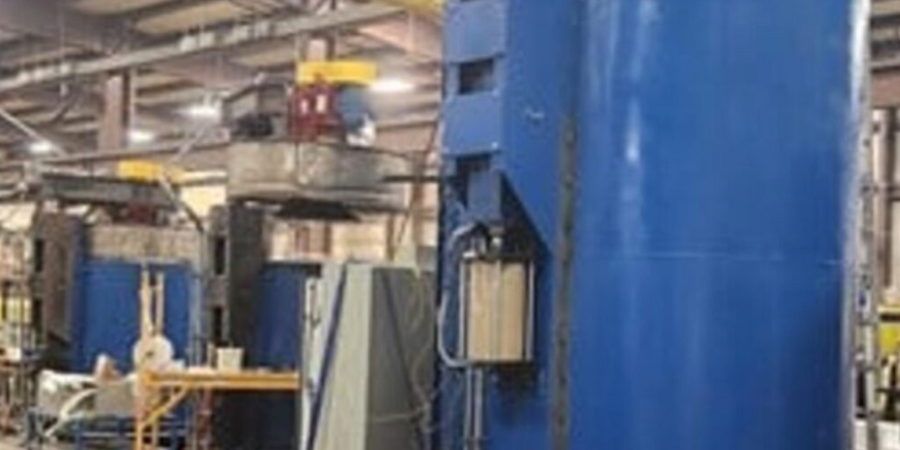
An aerospace fastener manufacturer, operating since the mid-1900s, ordered a vacuum furnace. The equipment will process self-locking nuts, nut plates, barrel nuts, stud nuts, spline nuts, clamp nuts, as well as a wide range of washers and flanges.
The furnace from SECO/WARWICK Group, a global furnace technologies company that has locations in North America, will meet the AMS2750G standard in the second class (II) including B-type instrumentation for the aviation industry. The addition will become part of a modern production plant, in Italy, and will perform at high operating temperatures, up to 23720F.
“The heating process for these materials [fasteners] require extraordinary purity, which is why the presence of two gases is important: argon – used for partial pressure, and nitrogen – used mainly in the cooling process,” commented Maciej Korecki, vice president of the Vacuum Segment at SECO/WARWICK Group. “The customer required a very short cooling cycle, which is achieved with a 15 bar abs gas blower.”
Find heat treating products and services when you search on Heat Treat Buyers Guide.com
This article first appeared inJune 2023’s Heat Treat Buyers Guideprint edition. Feel free to contact Bethany Leone at bethany@heattreattoday.com if you have a question, comment, or any editorial contribution you’d like to submit.
Bethany Leone Managing Editor/Heat Treat Radio Editor Heat Treat Today
A bike frame caught my eye the other day. It has a lot going for it: athletic (not me), hardcore (not me), and outdoorsy (not me). But the most important feature? “The Soma Jawbone is built on a Tange Prestige heat-treated double-butted CrMo steel frame with clearance for up to 29” x 2.25” and 27.5 x 2.6” tires (with good mud clearance)”; now, I have a pressing desire to analyze the quality of my bike shuffled back in the shed.
Contact us with your Reader Feedback!
There is something essential about the experience of biking which forces the rider to accept silence. Take different modes of travel: I can busy myself while driving along highways by calling my Maryland tribe, listen to a podcast while walking, and fill any moment of silence at home with squirrel feeder obstacle course videos. But on a bike, the continuous physical and mental engagement distances me from riding companions and focuses my mind on the scenery or a lingering thought in my mind.
These opportunities to transition and think, these “bike breaks” — real bike or not — are necessary to allow thoughts to reside, untangle, and spring forth with clarity. One time as a tree-watching car passenger, I started thinking about prime numbers: Was there a method to find them? Surely. With all being odd numbers, let’s start with a relevant, small, odd number 3. . . well, any number that is a multiple of three and not divisible by 2. Ok, but let’s get rid of the divisibility by “3” . . . add or subtract 2 to any multiple of three . . . 21+2 is 23, yes! 21-2 is 19, yes! 27-2 is 25, no!! Well . . . how about: “To find a prime number, add or subtract ‘2’ to any odd number which is a multiple of three. If the number does not end in a ‘5,’ that is (very likely) a prime number!” Based on some wandering thoughts on a car drive, I was able to create a “prime number finder” method. (And, no, this is not completely accurate. It doesn’t account for most 7s and higher primes.)
The advertisement of the Soma Jawbone notes heat treated steel frame as key to its design Source: Bikepacking.com
But beyond the joys of mental gymnastics, bike breaks should be taken in the midst of mundane or mega work concerns. Rather than getting sucked into the course of work, when have you taken a bike break to consider any of these questions freely: What preventative maintenance plan should have been installed yesterday? Where can safety be improved for furnace operators? Do we have the right people, and how are we bringing newcomers — future leaders in North American heat treat — into the fold? Should we incorporate laser heating or leverage plasma nitriding processing?
There is such joy to work and to being alive, as well as hardships. Accessing the joys and unravelling the hardships may be just a bike break away.
Find heat treating products and services when you search on Heat Treat Buyers Guide.com
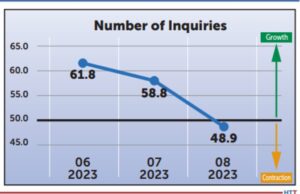
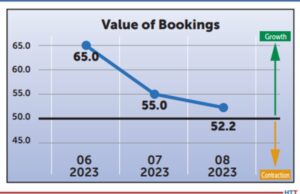
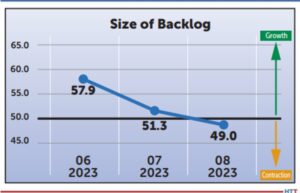
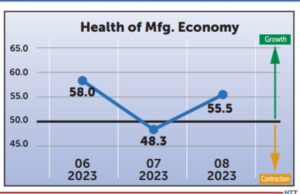
The four heat treat industry-specific economic indicators gathered by Heat Treat Today each month — starting in June of this year — are predicting continued growth along with some economic contraction in the month of August.
The numbers, which were compiled the first week of August, show that responding parties anticipate that inquiry levels will be down for August compared to July, but that the value of August bookings will still be more than July. Backlogs are anticipated to shrink where as the overall health of the manufacturing economy is anticipated to accelerate. Please keep in mind that this is only the 3rd month that these numbers have been collected, so it would be unwise to base business decisions on this small selection of data.
The results from this month’s survey (August) are as follows; numbers above 50 indicate growth, numbers below 50 indicate contraction, and the number 50 indicates no change:
Anticipated change in the Number of Inquiries from July to August: 48.9
Anticipated change in Value of Bookings from July to August: 52.2
Anticipated change in Backlog Size from July to August: 49.0
Anticipated change in the Health of the Manufacturing Economy from July to August: 55.5
Data For August 2023
The four index numbers are reported monthly by Heat Treat Today and made available on the website.
Heat Treat Today’s Economic Indicatorsmeasure and report on four, heat treat industry indices. Each month, approximately 800 individuals who classify themselves as suppliers to the North American heat treat industry receive the survey. Below are the results. Data started being collected in June 2023. If you would like to participate in the monthly survey, please click here to subscribe.
What makes the geometry of a part “complex”? With the increasing use of AM and 3D printing for parts along with typically complex parts, heat treaters in many industries must acquire the equipment and technical know-how for precise applications.
This Technical Tuesday article is compiled from Heat TreatTodayarticles and industry news releases. Email Bethany Leone at bethany@heattreattoday.com or click the Reader Feedback button below to chime in on the topic.
What Are Complex Geometries?
Contact us with your Reader Feedback!
Complex geometries in industrial parts are often defined by their intricate patterns and structures, which entail specialized heat treat processing. As Inductoheat describes in a case study with Stellantis, “Many times, complex geometries of components are linked to intricate hardness patterns and specific requirements for magnitude and distribution of residual stresses.”
Heat Treat Equipment for Processing Parts with Complex Geometries
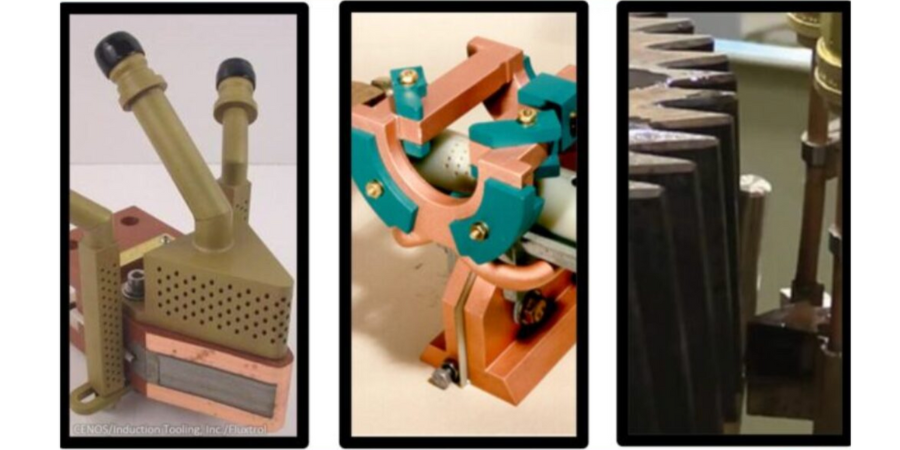
Be it for highly customized medical implants or for engine components in the burgeoning electric vehicle industry, complex geometries need to heat treated carefully. Fasteners in the medical device industry can be quite intricate and susceptible to creep or other dimensional changes; one method heat treating these parts — particularly titanium alloy parts — would be in a vacuum furnace. In vacuum and in hot isostatic presses, the environment allows for complex geometries that are 3D printed to be made into a unified whole piece. “Heat conduction can be carefully monitored [in induction heating coils] to confirm that an overheat condition does not occur at the target temper areas,” making induction a key candidate for heat treating your parts with complex geometries (“Tempering: 4 Perspectives — Which makes sense for you?“). To accommodate the complexities of certain parts, designing an induction coil for the desired case hardening may entail simulation to “[predict] coil heating, which altogether results in a longer coil lifetime,” (“Simulation Software and 3D Printers Improve Copper Coils”). For more on induction coils, check out this article by Dr. Valery Rudnev.
Suffice it to say, there is a great diversity of heat treatment options to explore when it comes to identifying the appropriate equipment for your application.
What Processes Are Used in Heat Treating Complex Geometries?
Perhaps you have all of your equipment needs necessary for heat treating your parts with complex geometries. Are you completing your heat treat processing in the most technically sound manner? Check out the following excerpts that speak to processing complex geometries.
“[Forging] at elevated temperatures enables reaching high strains and forming complex geometries in a single stroke. Additionally, thermal and mechanical influence during the forging can lead to improving local mechanical properties and the quality of the resulting joining zone.” (“Thermomechanical Processing for Creating Bi-Metal Bearing Bushings“)
“In some cases, such attempts result in a component’s geometries that might be prone to cracking during heat treating or might be associated with excessive distortion . . . . The subject of induction hardening of complex geometry parts (including but not limited to gears, gear-like and shaft-like parts, raceways, camshafts, and other critical components) is also thoroughly discussed, describing inventions and innovations that have occurred in the last three to five years.” (“Heat Treat Training Benefits Stellantis“)
“LPC [low pressure carburizing] with gas quenching can be an attractive option for distortion prone complex geometries as the cooling rates are slower than oil quenching; however, given the slower cooling rate, it becomes very important to choose a higher alloyed steel that will achieve the desired hardness.” (“Elevate Your Knowledge: 5 Need-to-Know Case Hardening Processes“)
Complex Geometries In the News
See how your peers are solving complex geometries needs in these real-life partnerships with industry suppliers. From additive manufacturing (AM) and precision manufacturing parts to heat treat technology, maybe your company is next to leverage manufacturing equipment to “wow” the industry.
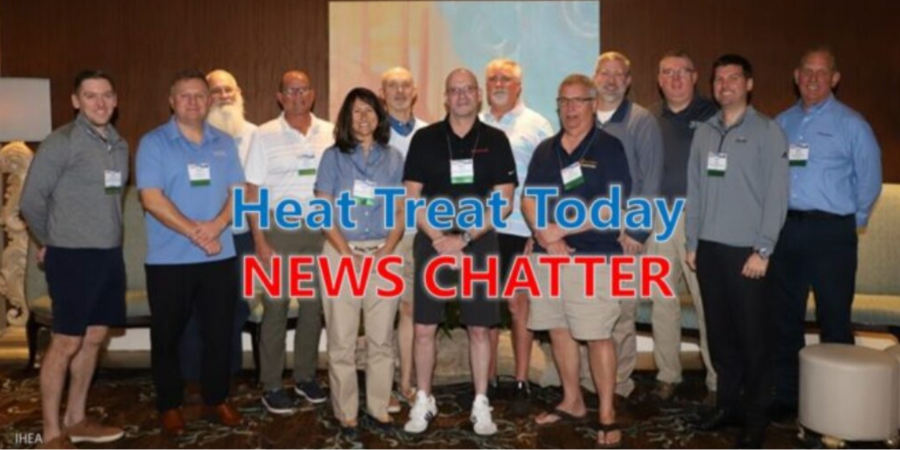
Heat Treat Today offers News Chatter, a feature highlighting representative moves, transactions, and kudos from around the industry. Enjoy these 36 news bites that will help you stay up to date on all things heat treat.
Equipment Chatter
voestalpine High Performance Metals del Perú recently added a pit-type furnace for nitriding and nitrocarburizing a wide range of components made from high-performance steels.
YK Steel in Korea has commissioned SMS group to supply a new minimill with integrated melting, casting, and rolling and including all electrical and automation systems.
Company and Personnel Chatter
Víctor Zacarías from hosted a webinar in Spanish in February on “CQI? Sección 3: Pirometría.” He is one of 40 Under 40 Class of 2022 honorees.
AMETEK Newage Testing Instruments, an established manufacturer and worldwide supplier of hardness testers and accessories, announced the launch of its improved Brinell Optical Scanning System, B.O
Solar Atmospheres of Western PA announced the approval of a critical Boeing specification for the oil quenching of alloy steels in accordance with Boeing’s specification BAC 5617.
Advanced Heat Treat Corp., a provider of heat treat services and metallurgical solutions, announced the promotion of John Ludeman to vice president of Operations.
Wisconsin Oven Corporation, a manufacturer of industrial ovens, has appointed Jeff Kent to the position of general manager.
Centorr Vacuum Industries announced that it has promoted Randy Fellbaum to the position of chief operating officer.
Edgewater Capital Partners, a private equity firm, has acquired NeoGraf Solutions, LLC. NeoGraf is a designer, formulator, and manufacturer of specialty natural graphite products for a diverse set of end markets, headquartered in Lakewood, Ohio.
Ipsen USA announced the return of Pete Kerbel in the role of sales representative/Midwest regional sales owner.
NUTEC Group has announced effective February 1, 2023, Genaro F. Cueva will step down from the position of CEO, remaining in his position as Chairman of the Board. He will be replaced as CEO by Daniel Llaguno, currently president of Nutec Fibers Division.
Bastian Barthel has joined the AMPOWER team as the new lead consultant of sinter-based additive manufacturing technologies.
Hubbard-Hall welcomes David Keller as senior chemist.
The Plibrico Company has launched an industry first: a QR code platform. These field enabling QR codes provide information that extends well beyond what might be printed on the refractory packaging or labels.
Pfeiffer Vacuum celebrated the groundbreaking of a new state-of-the-art industrial complex at Berliner Strasse in in Germany.
DANTE Solutions welcomes the newest members to the team.
Hubbard-Hall welcomes Noel Rutherford as supply chain manager to work out of the Waterbury, CT, facility.
Ipsen in Pecatonica, Illinois (formerly Ipsen Ceramics) is being repurposed for vacuum furnace hot zone assembly.
William Disler, president and CEO at AFC-Holcroft, has announced that he is stepping down from the company after more than 35 years, effective March 30, 2023. Tracy Dougherty and Ronald Waligora will share senior leadership with Dougherty named chief operating officer for Sales, Applications, Marketing, and Aftermarket Sales and Waligora named chief operating officer for Project Management, Engineering, Manufacturing, and Field Services.
John Terman was welcomed to the JUMO Process Control team as part of the Technical Consultant group located in New York and serving throughout the Northeast.
Jay Cole started a new position as inside sales/customer service lead at Nitrex.
Thierry Allirot was welcomed as chief financial officer for the Atmosphere Group and its subsidiaries, including AFC-Holcroft.
Bjorn Eldar Petersen is starting a new position as chief executive officer at ENRX Group.
Lucifer Furnaces in Warrington, PA, a manufacturer of heat treating furnaces and ovens for the last 80 years, has added Brett Wenger to its leadership team as vice president of sales.
Retech, a SECO/WARWICK Group company, is set to expand into new building in Buffalo, NY, that will house their fabrication, welding, small assemblies, and other manufacturing machinery.
IHEA recently announced its 2023–2024 Board of Directors and Executive Officers: President is Brian Kelly of Honeywell Thermal Solutions; Vice-President is Jeff Rafter of Selas Heat Technology Co. LLC.; Treasurer is Gary Berwick of Dry Coolers, Inc.; and Jeff Valuck of Surface Combustion, Inc. assumes the Past President position.
Kudos Chatter
Fluke celebrates 75 years of continuous innovation, putting its customers first, and supporting its communities. The company honors John Fluke’s legacy.
Gasbarre Products, Inc. recently marked its fiftieth anniversary. The company was founded in 1973 by George Gasbarre Sr., in Falls Creek, PA, U.S.A.
Congratulations to five additive manufacturing scholarship recipients as part of the Women in 3D Printing TIPE Conference! Andrew Duffield, Shivani A, Raveeshankar Sambathkumar,Liza Allison, and Shayla Anthony.
The Plibrico Company’s employees came together from Ohio to Washington (including New York, Indiana, and Florida) to volunteer their time and creativity to make handmade cards for Cards for Hospitalized Kids.
IHEA welcomes a new face to the Board of Directors, Helen Tuttle, who is the first woman to serve on the board.
Bodycote’s Hebron facility recently underwent its AS9100 audit and passed with zero findings.
After 48 years with Cincinnati Steel Treating Co., Mike Reichling has retired.
Trevor Jones, president of Solar Manufacturing has been named Delaware Valley Materials Person of the Year by the ASM Philadelphia Liberty Bell Chapter.
The Solar Atmospheres Greenville, SC, facility announced that it has been awarded Northrop Grumman.
Paulo Cleveland Division has received Pratt & Whitney approval for Hot Isostatic Pressing .
Heat Treat Today is pleased to join in the announcements of growth and achievement throughout the industry by highlighting them here on our News Chatter page. Please send any information you feel may be of interest to manufacturers with in-house heat treat departments especially in the aerospace, automotive, medical, and energy sectors to sarah@heattreattoday.com.
Find heat treating products and services when you search on Heat Treat Buyers Guide.com
Three electrically heated RO pit furnaces with air-cooled fans have been shipped from Riverside, MI. The furnaces will be used for heat treating various steel components.
“These pit furnaces are designed for a nitrogen atmosphere,” commented Kelley Shreve, general manager at Lindberg/MPH. “They have been designed to utilize three independent heating zones for optimal temperature uniformity and meet AMS 2750G Class 3.”
These heat treating pit furnaces from have a maximum temperature rating of 2,000°F and are designed to handle a wide range of part sizes. Two of the units have work chamber dimensions of 28″ x 36” and a maximum gross workload of 2,000 lbs. each. The third furnace has work chamber dimensions of 60” x 109” and a maximum gross workload of 20,000 lbs.
All of the pit furnaces have pneumatically operated lids with three-way hand control valves and limit switches that disconnect power to the heating elements when the covers are open. The pit furnaces are electrically heated with heavy duty rod overbend heating elements.
Find heat treating products and services when you search on Heat Treat Buyers Guide.com
Heat Treat Today is partnering with two international publications: heat processing, a Vulkan-Verlag GmbH publication that serves mostly the European and Asian heat treat markets, and Furnaces International, a Quartz Business Media publication that primarily serves the English-speaking globe. Through these partnerships, we are sharing the latest news, tech tips, and cutting-edge articles that will serve our audience — manufacturers with in-house heat treat.
In this article, we look at annealing equipment, innovation in waste management, and thermal processes in Li-ion batteries.
Investing in production of high-performance electrical steel in Shanghai
Source: Baowa
New Electrical Steel Lines for EV Motors
“Fives, a leading engineering group with broad expertise in steel processing and technology, has designed and delivered thermal sections for a new annealing and pickling line (APL) and two new annealing and coating lines (ACL). The lines, designed to produce high quality non-grain oriented (NGO) grades for electric vehicle motors, delivered their first coil between December 2022 and February 2023.”
Addressing the issue of plastic waste mgmt.
Source: worldsteel
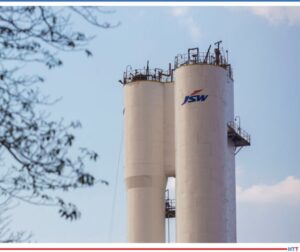
Successful Trials Will Help Manufacturer Reduce Carbon Footprint
“Integrated steel manufacturer JSW Steel has accomplished a ‘significant breakthrough in environmental sustainability’ by successfully injecting waste plastic into Blast Furnace 3 at its Vijayanagar steel plant following extensive trials.”
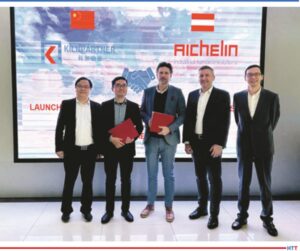
Left to right: Huang Ligang, general manager, Kilnpartner; Zhang Yuejin,
Chairman of the board, Kilnpartner; Michael Reisner, CEO, Aichelin Ges.m.b.H.;
Christian Grosspointner, CEO, Aichelin Holding; and Fan Xiaochun, CEO,
Kilnpartner, after signing the contract.
Source: Aichelin
AICHELIN Cooperation Agreement
“The thermal processes used to treat the essential components of Li-ion batteries represent a key technology in this process. These include the cathode as LFP (lithium iron phosphate) or NMC (nickel manganese cobalt) and the active anode material. Only through a highly accurate heat treatment can the crystal structure and morphology of the material be trimmed to ‘peak performance.’ In order to achieve this goal, each manufacturer has its own processes. The common basic requirement is flexible and reliable plant technology, the so-called ‘kilns.’”
Discover expert tips, tricks, and resources for sustainable heat treating methods Heat Treat Today’s recent series. Part 3, today’s tips, covers some combustion content. We’ve added further resources towards the end of today’s post to further enrich your combustion knowledge.
This Technical Tuesday article is compiled from tips in Heat Treat Today’sMay Focus on Sustainable Heat Treat Technologies print edition. If you have any tips of your own about combustion, our editors would be interested in sharing them online at www.heattreattoday.com. Email Bethany Leone at bethany@heattreattoday.com with your own ideas!
1. Combustion Efficiency: Do You THINK or Do You KNOW?
Minimize emission with data Source: PSNERGY
Contact us with your Reader Feedback!
Installing retrofittable monitoring equipment provides real time and historical combustion data.
Combustion is a chemical reaction. With the right mix of fuel and air, emissions are minimized while heat output is maximized.
The question is: “Do you think it is right or do you know it is right?” With today’s technology, knowing combustion is running efficiently by maintaining proper ratios at each burner is not only possible, it is necessary.
Minimize emissions, improve quality, and maximize heat output per BTU with data!
Source: Taylor Smith, Specialist of Technical Sales and Marketing, PSNERGY
#combustion #emissions #energy #efficiency
2. NOx and High Efficiency Burners
Nitrogen oxides, or NOx emissions, are generated in high temperature combustion systems. Nitrogen and oxygen are present in combustion air and react in the high-temperature region of the flame to produce various oxides of nitrogen. NOx is a generic term combining NO (nitric oxide) and NO2 (nitrogen dioxide).
Modern high-efficiency burners with a high pre-heat of combustion air through known means of recuperative or regenerative systems increase the temperature of the oxygen and nitrogen within the combustion air and the potential for high NOx levels. Therefore, NOx reduction methods become even more important with high pre-heat burners.
Typical reduction methods of NOx in high efficiency burner systems include:
Recirculation of combustion products or flue gases is very effective to reduce temperature peaks and therefore reduce nitric oxide formation.
Lowering the temperature of the flame by air staging at the point of combustion.
Flameless oxidation (Flox) reduces NOx using the previously mentioned principles by lowering the peak flame temperature. Flameless oxidation works by injecting gas and preheated air directly into the system, and above the autoignition temperature.
Oxygen combustion can theoretically reduce NOx formation by taking away nitrogen in the combustion process. In this case, pure oxygen is introduced instead of combustion air, but this application is typically limited by process and costs associated in producing pure oxygen.
3. Burner Tuning & Calibration — It’s Not Your BBQ Grill!
Burner tuning and calibration Source: WS Thermal
Burner adjustment to nominal gas and air ratios is a typical component of your combustion equipment maintenance. However, this process cannot be minimized in importance as any adjustment can affect operation, efficiency, exhaust emissions, and equipment life. Factors to consider and address during any burner adjustment include:
Burner adjustment should always be done (when possible) at normal furnace operating temperature under typical production to maintain best conditions for final calibration
Provide clean combustion air: maintain blower filter and consider source of any plant air
An increase of gas may not increase power to system due to heat transfer or throughput issues
A decrease in combustion air will not create a hotter flame or add power to the system as this may only create a gas-rich operation resulting in reduced power and CO in exhaust
Verify gas and combustion supply pressures and consider creating a monthly log of incoming pressures
While a visual inspection of flame can help to verify operation or proper combustion, burner gas/air adjustment cannot accurately be performed by simply looking at color or size of flame
A working understanding of the burner system is important to determine and verify values to gas/air and excess O2 to specific application
Work-from-home benefits and challenges extend to work-from-travel occasions! Access corporate networks and systems with 8 cybersecurity best practices.
Today’s read is a feature written by Joe Coleman, cybersecurity officer at Bluestreak Consulting™. This column is in Heat Treat Today’sJune 2023 Heat Treat Buyers Guide print edition.
Introduction
In this eighth Cybersecurity Desk installment, understand the benefits and challenges associated with working from home or accessing corporate networks and systems while traveling.
Why Are So Many People Working from Home?
The COVID pandemic forced many companies to adapt to remote working and work-from-home (WFH)
Joe Coleman Cybersecurity Officer Bluestreak Consulting Source: Bluestreak Consulting
policies. Even though these policies have provided employees with more flexibility, they have also highlighted cyber risks that companies must consider. As of March 2022, work-from-home and working remotely have increased by 238% compared to pre-pandemic numbers. Although that number has reduced somewhat recently, it has changed the way companies operate and view WFH.
Several benefits of WFH include:
Increased employee retention and productivity
Reduced distractions and interruptions by coworkers
Reduced company overhead costs
Increased family time by eliminating commute
One of the first challenges most companies face when shifting to a WFH model is ensuring every employee has high-speed internet access. Most employees will use home Wi-Fi network or cell phone/wireless carrier as an internet “hot spot.” The first common sense rule of thumb is always try to avoid public Wi-Fi and public charging stations. Any way you choose to access high-speed internet, it must be secure. By now, most companies should have WFH or remote work policies and procedures in place, with employee awareness and training, because they MUST be followed to reduce cybersecurity risks.
Cybersecurity Best-Practices for Securing Remote Workers
If your company has employees that work from home and you’re wondering what cybersecurity measures you should put in place, here are some best practices to help you:
Secure your work sessions: Using a single room that has a door that can lock is the ideal situation when possible. Many WFH employees are either sitting at their kitchen table or in the living room. In those cases, make sure to have your monitor facing a wall to prevent family or guests from viewing your work session and lock your computer when you’re away.
Separate your home and business networks: Separate your Wi-Fi network so company-approved devices will be separate. Even better, use a secure network and a company-issued Virtual Private Network (VPN) to access your business accounts. You can also use BeyondTrust for secure remote access. Home routers should always be updated to the current software version when it becomes available.
Separate work and personal devices: When accessing your corporate network, only use company-approved devices. Unless your company allows Bring-Your-Own-Device (BYOD), never use an unapproved device to access your company network.
Think before you click: Hackers use phishing and other social engineering methods to target employees with legitimate-looking emails and social media messages. These can trick users into providing confidential data, such as usernames, passwords, credit card numbers, social security numbers, account numbers, etc. SLOW DOWN.
Don’t click on links sent from an unknown or untrusted source. Resist the urge to click links in a suspicious email. You can hold your cursor over a link, and it will show you (in the bottom left corner of your screen) the website that it will go to if you click on it. If it’s an unknown or suspicious site, DO NOT click on it.
Click the Image TO Download More Than 350 Cybersecurity AcronymsAntivirus with real-time scanning: Antivirus software detects the presence of malware on your computer. A dynamic scanning feature repeatedly checks for computer infiltration by a malicious threat. Always keep your antivirus up to date and active.
Update programs, applications, and operating systems: Vulnerabilities in applications and operating systems are continually being found and exploited. Cybercriminals often use these vulnerabilities to exploit data and infiltrate devices and networks. Application vulnerabilities are a cybersecurity challenge of remote working. Make sure you are regularly performing updates as they are released.
Use 2-Factor Authentication (2FA) or Multi-Factor Authentication (MFA): If you’re not using 2FA or MFA, you are NOT secure. You should use 2FA or MFA wherever it’s available. Your company should have this requirement in its policies and procedures.
Use strong PINs/passwords on your devices: Strong passwords should contain a good mixture of upper/ lowercase letters, numbers, and symbols (or special characters). Passwords should also not be based on dictionary words and should contain at least twelve characters (the longer the better). Never use the same password for multiple accounts and use a password generator and a password manager.
About the Author:
Joe Coleman is the cybersecurity officer at Bluestreak Consulting™, which is a division of Bluestreak | Bright AM™. Joe has over 35 years of diverse manufacturing and engineering experience. His background includes extensive training in cybersecurity, a career as a machinist, machining manager, and an early additive manufacturing (AM) pioneer. Contact Joe at joe.coleman@go-throughput.com.
Find heat treating products and services when you search on Heat Treat Buyers Guide.com