ANNEALING

WH Kay Marks 90 Years by Staying in the Flow

Ninety years is a remarkable milestone for any company. In the heat treating industry, where technologies, markets, and client expectations have continually evolved, reaching that anniversary requires more than longevity — it requires adaptability.

For W.H. Kay Company, that adaptability has been the defining characteristic since William Henry Kay founded the company in 1936, during the final years of the Great Depression. What began as a Cleveland-based manufacturer’s representative for Eclipse Combustion Equipment has grown into a company recognized throughout North America for combustion systems, used heat treating equipment, and practical process solutions.

Along the way, W.H. Kay has come to describe itself as “The Elder Statesman of Used Ovens and Treating Furnaces” — a moniker that reflects both the longevity of the business and the used-equipment specialty it developed over decades.
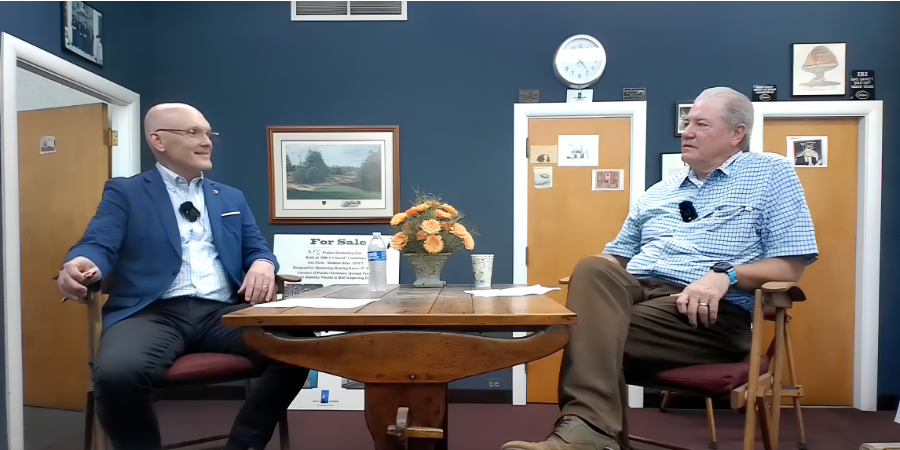
Doug Glenn, publisher of Heat Treat Today (left), sat down with Michael Kay, president of W.H. Kay (right), about the company’s 90-year journey — from its beginnings as a combustion equipment representative to becoming a trusted resource for industrial thermal processing solutions. | Image Credit: Heat Treat Today

Today, under the leadership of third-generation owner Michael Kay, the company continues to serve commercial heat treaters and manufacturers while maintaining a relationship with Eclipse — now part of Honeywell — that has lasted since the day the company opened its doors.

“It’s amazing,” Kay said. “We’ve represented Eclipse since 1936.”

From Representation to Reinvention

W.H. Kay’s history reflects many of the changes that have shaped industrial thermal processing over the past nine decades.

William Henry Kay, Michael Kay’s grandfather, represented Eclipse Burners and Furnaces throughout northern Ohio. When Eclipse phased out of furnace manufacturing, Michael Kay’s father, Frank, and uncle, Bill, continued serving longtime clients who wanted additional furnaces like the Eclipse equipment they already operated. Using existing furnace prints, W.H. Kay had units fabricated to meet those clients’ needs.

That work eventually opened another avenue for the company as clients purchasing new equipment began asking what to do with their existing furnaces. W.H. Kay started accepting equipment on trade and finding new buyers for it, gradually establishing the used-equipment business that remains a significant part of the company today.
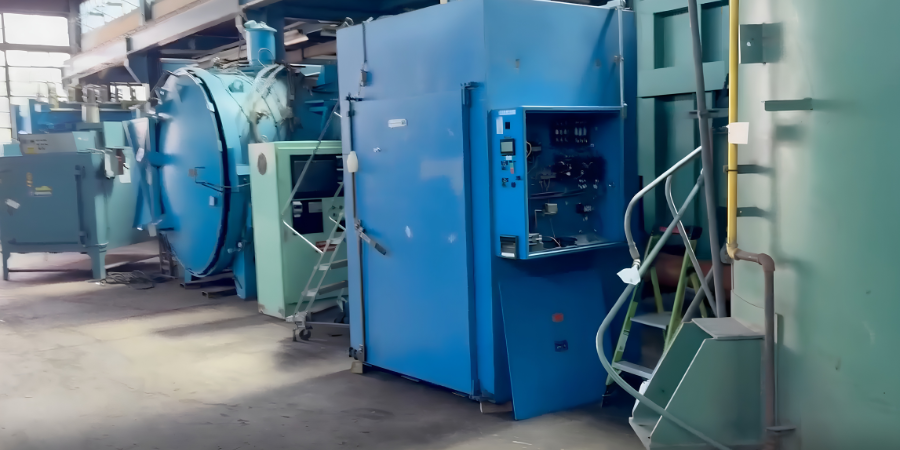
A variety of equipment at the W.H. Kay facility | Image Credit: Heat Treat Today

Today, the company’s Solon, Ohio, warehouse houses hundreds of pieces of equipment ranging from tempering ovens and pit furnaces to vacuum furnaces, integral quench systems, atmosphere generators, and ancillary processing equipment.

The Value of Staying Close to the Client

Although W.H. Kay still supplies combustion products and represents JPW Industrial Ovens & Furnaces, Kay believes the company’s success has never been about simply selling products. “If you’re just taking orders, you’re kind of in trouble,” he said. “You’ve got to be proactive.”

That approach extends to how the company works with clients, beginning with an understanding of the application rather than simply supplying the equipment initially requested. A client inquiring about a 1600°F furnace, for example, may actually be operating at only 900°F — a distinction that can point to an entirely different equipment solution. “You’ve got to listen,” he said. “What they’re asking for might not be what they actually need.”

The willingness to listen can remain valuable long after the initial sale. Kay recalled a recent call from a client who had purchased a furnace seven years earlier, and, no longer needing it, approached the company about buying it back. Other clients contact the company when they need something larger or have equipment they no longer use. For W.H. Kay, responding to those changing needs has made used equipment more than an inventory business; it has become another way to provide clients with options.

Providing a used-equipment option does not, in Kay’s experience, come at the expense of new furnace sales. Over his four decades in the industry, he said, clients who intend to purchase new equipment generally do so, while those considering used equipment often have a different set of requirements. “In the course of 40 years, I’ve never seen a used [furnace] take over a new account,” he said. “If people are buying new, they’re buying new. If they’re buying used, they’re buying used.” Instead, he sees used equipment as another way to help clients solve a problem.

If a manufacturer needs an oven immediately rather than waiting several months for a new build, used equipment can provide an option that better fits the client’s timeline. “We could quote him a new one in 16 weeks,” Kay said. “Or we could have one in four days.” With hundreds of pieces of equipment in its Solon warehouse, the company can sometimes match a client’s requirements with a unit already in inventory, providing an alternative when lead time is as important as the equipment itself.

Understanding those circumstances requires more than waiting for an inquiry. It also means getting out of the office and spending time with clients. “You’ve got to get in the flow,” he said.

Whether checking on a furnace sold years earlier or simply stopping in to ask how things are going, those visits help the company stay aware of how clients’ operations and equipment needs are changing. A conversation might reveal a furnace the client no longer uses, a need for something larger, or anther equipment requirement that W.H. Kay can help address.

“My father used to say you can waste a lot of time coming into the office every day,” Kay recalled. “You need to be out with [clients].”

The practice has endured even as industrial sales have changed around it. Kay remembers beginning his career in 1985 carrying a substantial Eclipse product catalog on sales calls, followed by the arrival of fax machines that dramatically shortened the time required to submit and acknowledge orders. Email and the internet have transformed the process again, while the number of salespeople regularly making in-person calls has declined. “In some cases,” he said, “people tell me they haven’t seen a salesperson in six months.”

For W.H. Kay, continuing to make those visits is less about maintaining an old-fashioned sales practice than staying close to the client. The tools of industrial sales may have changed considerably over 90 years, but the company still sees listening, understanding the operation, and building rapport as essential to finding the right solution.

Listening before selling, understanding the application, and building long-term relationships have remained central to the company as the business has weathered changing technologies, shifting markets, and multiple generations of industrial manufacturing.

Creating Your Own Good Luck

W.H. Kay’s nine decades have included more than changes in how equipment is bought and sold. The applications themselves continue to evolve.

Kay has seen growing activity around aluminum heat treatment, including aging and drop-bottom furnace applications, as manufacturers pursue lighter materials. The company has also supplied ovens for composite curing and other lower-temperature processes. Additive manufacturing presents another evolving area; even when parts are produced through 3D printing, Kay noted, thermal processes such as stress relieving can remain necessary.

Through those changes, Kay expects industrial heating and thermal processing to continue finding applications in emerging manufacturing technologies. The greater lesson he draws from more than four decades in the business, however, is less about predicting which technology or market will come next than about remaining engaged enough to respond when it does.

Kay returned to one idea again and again: success isn’t about waiting for opportunities to arrive — it’s about putting yourself where they can happen. Whether checking in on clients, making sales calls, or simply staying engaged with the industry, he believes consistent effort creates its own momentum. The advice he offers today is the same philosophy that has guided his career for more than four decades.

“Create your own good luck,” Kay said. “Keep at it. Get out of the office.”

Ninety years after William Henry Kay founded the company, the equipment, technologies, and methods of doing business have changed considerably, but the philosophy remains much the same: listen to clients, stay engaged, and keep showing up. It continues to guide his company — one client visit, one solution, and one furnace at a time.

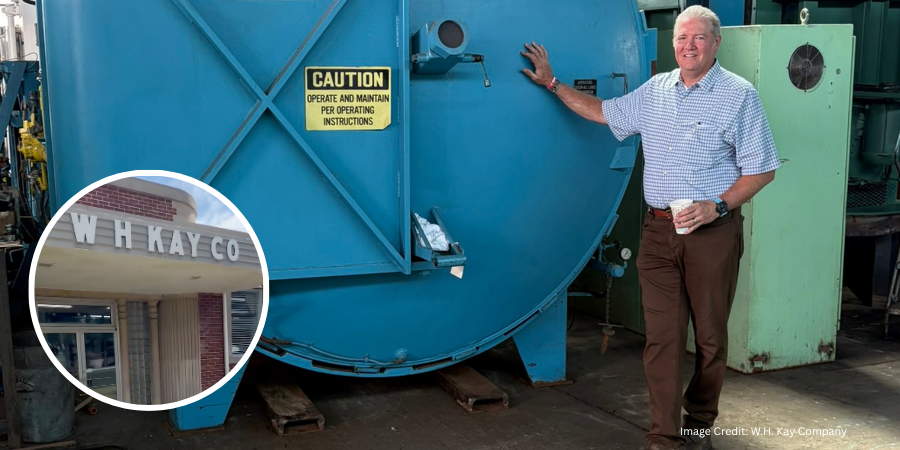
Main image shows Michael Kay posing with a vacuum furnace with a photo inset of the entrance to the W.H. Kay facility. | Image credit: W.H. Kay Company
If you have any comments or queries on this article, let us know at editor@heattreattoday.com.

WH Kay Marks 90 Years by Staying in the Flow Read More »

Best of the Web: Precise Control of Protective Atmospheres

Source: Super Systems, Inc.

Achieving the elimination of oxidation during thermal treatment has driven heat treaters for decades and resulted in a wide variety of approaches. The obvious method is to flow an inert gas such as nitrogen into the furnace in order to drive out both air and moisture. By itself, however, this technique is inadequate.

The zirconia carbon sensor has been used for nearly three decades to control the carbon potential in many carburizing applications. Today’s best of the web article examines the use of the zirconia carbon sensor in a variety of annealing and special treatment applications and considers how the sensor millivolt output is preferred because it relates directly (not empirically) to the free oxygen concentration in the surrounding environment.

An Excerpt:

“While it is desirable to avoid oxidation during thermal treatment, the achievement of adequate control using one of the ‘getter’ gases requires that the sensor millivolts achieved be established at some value higher than the vee formed by the iron reaction at temperatures below 1375ºF and the carbon reaction above that temperature. The vee will demonstrate the lower limit, but the practical level should be established by evaluation of product quality, getter cost and possible sooting. The appropriate level will be limited by such things as furnace leaks, atmosphere agitation, work porosity, time of treatment, etc.”

Read the entire article from Super Systems, Inc., by clicking here: “Precise Control of Protective Atmospheres


Find Heat Treating Products And Services When You Search On Heat Treat Buyers Guide.Com


Best of the Web: Precise Control of Protective Atmospheres Read More »

News from Abroad: New Equipment, Waste Management, and Thermal Processes

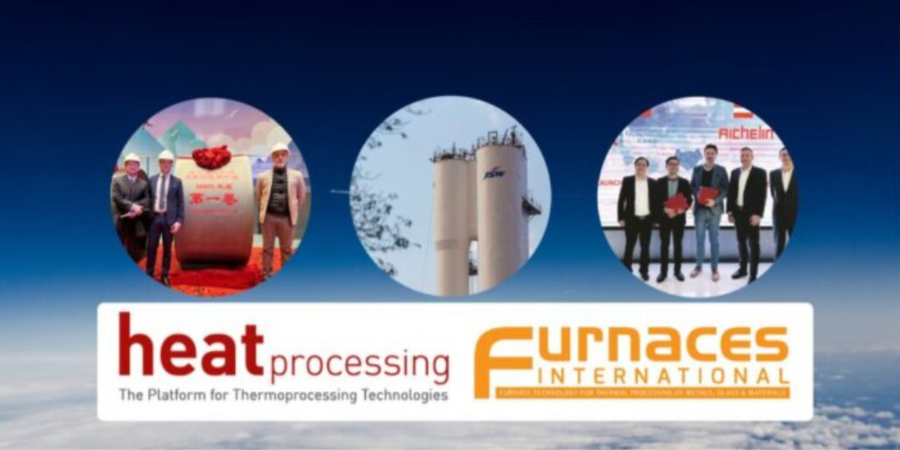
Heat Treat Today is partnering with two international publications: heat processing, a Vulkan-Verlag GmbH publication that serves mostly the European and Asian heat treat markets, and Furnaces International, a Quartz Business Media publication that primarily serves the English-speaking globe. Through these partnerships, we are sharing the latest news, tech tips, and cutting-edge articles that will serve our audience — manufacturers with in-house heat treat.

In this article, we look at annealing equipment, innovation in waste management, and thermal processes in Li-ion batteries.


Investing in production of high-performance electrical steel in Shanghai
Source: Baowa

New Electrical Steel Lines for EV Motors

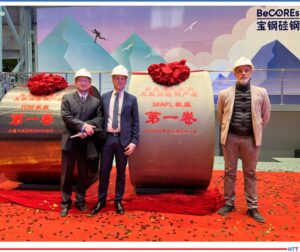
“Fives, a leading engineering group with broad expertise in steel processing and technology, has designed and delivered thermal sections for a new annealing and pickling line (APL) and two new annealing and coating lines (ACL). The lines, designed to produce high quality non-grain oriented (NGO) grades for electric vehicle motors, delivered their first coil between December 2022 and February 2023.”

Read More: “Fives and Baowu launch new electrical steel lines” at heat-processing.com

Addressing the issue of plastic waste mgmt.
Source: worldsteel

Successful Trials Will Help Manufacturer Reduce Carbon Footprint

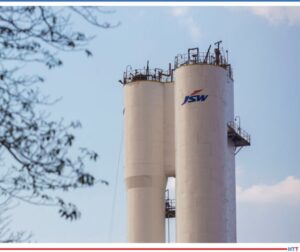
“Integrated steel manufacturer JSW Steel has accomplished a ‘significant breakthrough in environmental sustainability’ by successfully injecting waste plastic into Blast Furnace 3 at its Vijayanagar steel plant following extensive trials.”

Read More: “JSW Steel successfully completes waste plastic injection trial” at furnaces-international.com

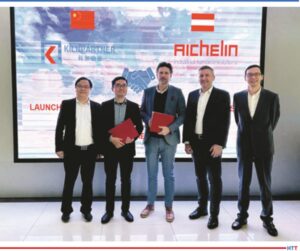
Left to right: Huang Ligang, general manager, Kilnpartner; Zhang Yuejin,
Chairman of the board, Kilnpartner; Michael Reisner, CEO, Aichelin Ges.m.b.H.;
Christian Grosspointner, CEO, Aichelin Holding; and Fan Xiaochun, CEO,
Kilnpartner, after signing the contract.
Source: Aichelin

AICHELIN Cooperation Agreement

“The thermal processes used to treat the essential components of Li-ion batteries represent a key technology in this process. These include the cathode as LFP (lithium iron phosphate) or NMC (nickel manganese cobalt) and the active anode material. Only through a highly accurate heat treatment can the crystal structure and morphology of the material be trimmed to ‘peak performance.’ In order to achieve this goal, each manufacturer has its own processes. The common basic requirement is flexible and reliable plant technology, the so-called ‘kilns.’”

Read More: “New heat treatment cooperation for battery materials” at heat-processing.com


Search for heat treat solution providers and suppliers on Heat Treat Buyers Guide.com


News from Abroad: New Equipment, Waste Management, and Thermal Processes Read More »

New Material Retains High Transmissivity After Heat Treatment, Applied to Optical Devices


Source: Phys.Org


Researchers at Toyohashi University of Technology have collaborated with their counterparts at Massachusetts Institute of Technology (MIT) to develop a new material capable of retaining high transmissivity after annealing at 850°C (1562°F). The results address the challenge manufacturers face when combining different materials that react differently to heat treatment at certain temperatures.

Read more: “High-Refractive-Index Material Retains High Transmissivity After Annealing at 850 Degrees C”

New Material Retains High Transmissivity After Heat Treatment, Applied to Optical Devices Read More »

Novelis, Kobe Steel Join Forces with South Korea Heat-Treat Facility

Novelis Inc. announced in May that it has entered into a joint venture agreement with Kobe Steel, Ltd., a producer of aluminum rolled products in Japan. The joint venture, to be named Ulsan Aluminum, Ltd., will be formed by Novelis selling Kobe Steel 50 percent of its ownership interest in its Ulsan, South Korea facility for US $315 million. Through the venture, Novelis and Kobe Steel will jointly own and operate the Ulsan facility, with each company remaining responsible for its metal supply and commercial relationships.

Located in the industrial hub of Korea, Novelis’ Ulsan facility currently focuses on the production of rolled aluminum sheet for a variety of markets in Asia. The plant recently completed a major expansion, adding a new three-stand hot finishing mill as well as a pusher furnace and annealing furnaces.

Novelis, Kobe Steel Join Forces with South Korea Heat-Treat Facility Read More »

Heat Treating of Jaw Fixation Plates Provides Superelasticity

  Source:  Bioengineering

Process parameters and post-processing heat treatment techniques have been developed to produce both shape memory and superelastic NiTi using additive manufacturing. By introducing engineered porosity, the stiffness of NiTi can be tuned to the level closely matching cortical bone. Using additively manufactured porous superelastic NiTi, we have proposed the use of patient-specific, stiffness-matched fixation hardware, for mandible skeletal reconstructive surgery.

Heat Treating of Jaw Fixation Plates Provides Superelasticity Read More »

Majority of Heat Treatment Done In-House at SKF — New Equipment Purchased

Ipsen recently installed both atmosphere and vacuum heat-treating systems at SKF’s state-of-the-art manufacturing facility in St. Louis, Missouri. With the relocation of their existing facility to a new location, SKF continues to focus on enhancing the quality, efficiency and overall effectiveness of their heat-treating equipment. Among this new Ipsen equipment was a complete ATLAS atmosphere heat-treating system, including two ATLAS integral quench batch furnaces and ancillary equipment – washer, temper, endo generator, loader/unloader and a feed-in/feed-out station. SKF also purchased a TITAN® vacuum heat-treating system to round out their production capabilities.

Heat-treating is considered a core competency at SKF, and this new equipment will allow them to bring the majority of heat treatment in-house and efficiently handle the increase they’ve seen in production demands and volume of parts. Reflecting on the equipment purchased and what appealed to SKF, Bryan Stanford said, “Initially, I would say it was the general purposefulness of these Ipsen products that appealed to us. We run a very large variety of parts and batch quantities here. A custom solution designed to run tens of thousands of the same parts was not going to work for us. We wanted a low-cost, off-the-shelf-type solution that would allow us the flexibility we required – which is what the ATLAS and TITAN delivered. Now after having performed some pre-training, I would say what stands out the most is the ease of use and control of the equipment.”

The ATLAS batch furnaces feature a 24″ W x 36″ D x 30″ H (610 mm x 910 mm x 760 mm) load size with an 1,100-pound (500 kg) load capacity. They also operate at temperatures of 1,400 °F to 1,800 °F (750 °C to 980 °C) and have a quench oil capacity of 1,030 gallons (3,900 L). The TITAN vacuum furnace features an 18″ W x 24″ D x 18″ H (455 mm x 610 mm x 455 mm) load size with a 1,000-pound (454 kg) load capacity. It operates at temperatures of 1,000 °F to 2,400 °F (538 °C to 1,316 °C). Overall, this Ipsen equipment will be used for carburizing, carbonitriding, brazing and annealing and will process a wide variety of parts that support SKF’s Lubrication Business Unit.

Majority of Heat Treatment Done In-House at SKF — New Equipment Purchased Read More »

Heat Treat TV: 48′ Vacuum Furnace Installed in Western Pennsylvania

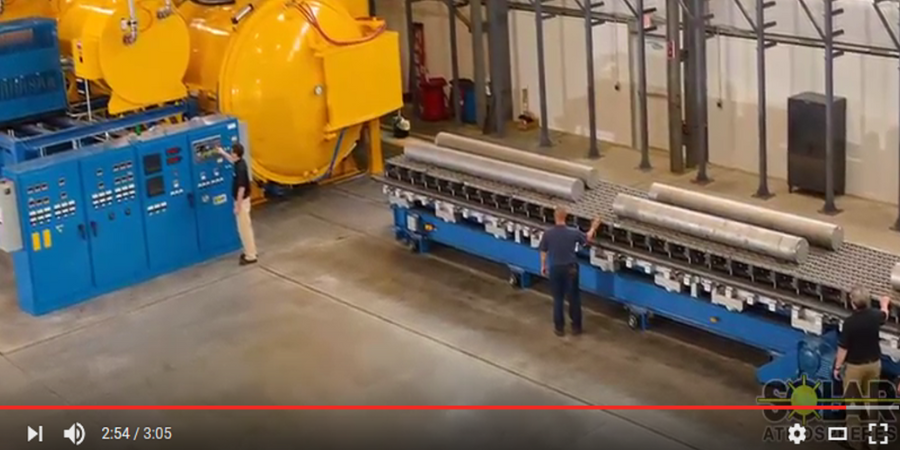
Take a look at this fascinating time-lapse video of a 48 foot vacuum furnace being installed at a leading commercial heat treat shop in western Pennsylvania. The furnace was manufactured by Solar Manufacturing and will be used for vacuum processing very large, long, and/or heavy aerospace, automotive and energy sector parts. Watch it now by clicking here or on the image below.

Solar Atmospheres' 48' Vacuum Furnace 2

Heat Treat TV: 48′ Vacuum Furnace Installed in Western Pennsylvania Read More »