

Leone

Nuts and Bolts of Combustion Systems – Safety Shutoff Valve

op-edSafety shutoff valves are the last line of defense against a potentially catastrophic incident. When conditions require, they interrupt the flow of fuel to the burner(s) and oven. There are many options when selecting fuel safety shutoff valves for your application. The construction and application of these devices is highly regulated by interlocking standards created by many different organizations. The goal of this article is to clarify how to comply with the most common standard affecting the reader: NFPA 86.

This column appeared in Heat Treat Today’s 2021 Trade Show September print editionJohn Clarke is the technical director at  Helios Electric Corporation and is writing about combustion related topics throughout 2021 for Heat Treat Today.


John B. Clarke
Technical Director
Helios Electric Corporation
Source: Helios Electric Corporation

To start, we must define our terms. The 2019 edition of NFPA 86* defines a safety shutoff valve as a “normally closed valve installed in the piping that closes automatically to shut off the fuel, atmosphere gas, or oxygen in the event of abnormal conditions or during shutdown.”1 A valve is “normally closed” (NC) if it closes automatically when power is removed. A furnace or oven typically has as few as two or more safety shutoff valves. [Author’s note: If the system uses radiant tubes for heating, and all the criteria are met, it may be acceptable to use only one valve in series, but this exception is not recommended by the author and will not be covered in this article.] There are two common arrangements for safety shutoff valve arrays—the Simple Double Block (Illustration 1) and the Double Block and Vent (Illustration 2). While both arrangements are compliant with the current version of NFPA 86, the vent is NOT required. In other words, Illustration 1 and Illustration 2 below are both acceptable.

The simple double block arrangement consists of two automatic, normally closed (NC) valves piped in series. It provides redundancy—both valves must leak for fuel gas to pass to the burner system. A double block and vent has two automatic, NC valves piped in series with a third automatic normally open (NO) valve installed between the NC valves. The purpose of the NO valve is to provide a path for any fuel gas leaking past the first NC valve to move to a safe location. Whether one should deploy a double block and vent approach depends on several considerations: Is the NO valve supervised? Is the selected vent location safe? And how will the system be inspected?
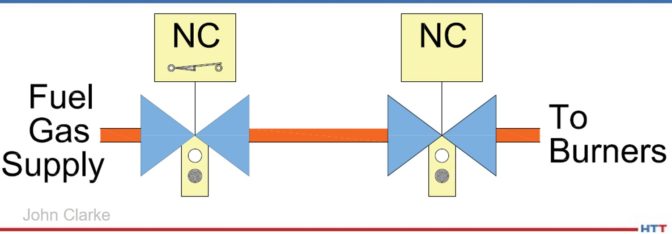
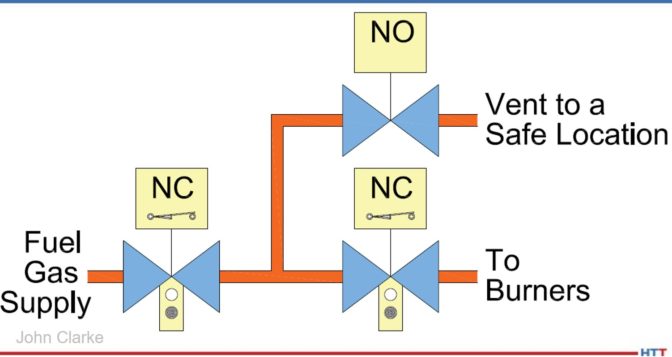
Illustration 1

Illustration 2

To start with, if the NO vent valve’s coil or wiring fails, it will remain open even when the system is operating—venting fuel gas. This is not only expensive, but high concentrations of vented fuel gas are an environmental and safety hazard. The solution to this concern is installing a monitored vent valve that only opens the NC valves after the vent valve is proven to be closed. This is typically accomplished with a proof-of-closure position switch that only closes after the vent valve is fully closed.

The next concern is the location and maintenance of the vent. The vent must terminate at a safe location that can accept the entire flow of fuel gas in the event of a failure. Therefore, hazards such as fresh air intakes and sources of ignition must be avoided at all costs. It is also important to periodically inspect the vent piping to ensure it remains unobstructed—insects and rodents may find the vent line a comfortable place to nest and bring up their young.

The last challenge is the periodic inspection of the vent valve and the vent piping—it is generally a challenge to test whether a vent line meets the design criteria, and leaking fuel gas can be vented without excessive backpressure.

A simple double block provides redundancy without the complexity of the vent. Good design practice, with proper valve selection, combined with proper fuel filtration greatly improves the reliability and longevity of both systems.

Valves used for safety shutoff valve applications must be listed by an approval agency for the service intended.2 Furthermore, depending on the flow rate, the valves must be equipped with either a local indicator showing the valve position and a means to prove the valve is closed.

For fuel gas flows below or equal to 150,000 BTU/hour, two safety shutoff valves in series will suffice. See Illustration 3 below. This is very typical for pilot lines.
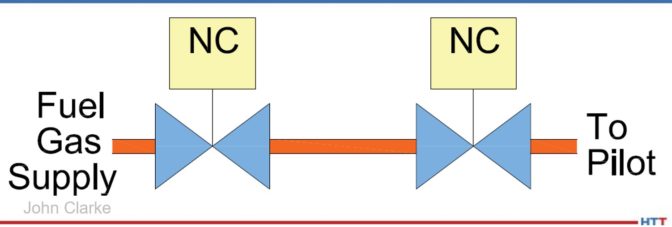
Illustration 3

For fuel gas flows greater than 150,000 BTU/hour and less than or equal to 400,000 BTU/hour, two safety shutoff valves in series with local position indication are required. Local indication is generally a window where an operator can see the actual position of the valve—open or closed—without relying on any electrical circuit or pilot light. See Illustration 4 below.
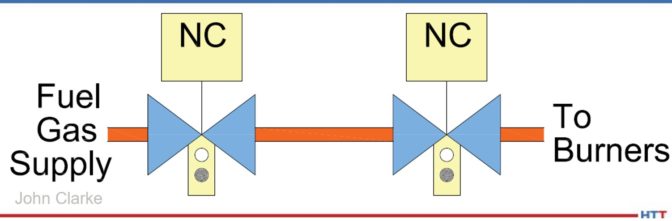
Illustration 4

For fuel gas flows greater than 400,000 BTU/hour, NFPA 86 requires two safety shutoff valves in series with local position indication. One valve must be equipped with a valve closed switch (VCS) that closes after the valve is fully closed, or a valve proving system (VPS) that runs a tightness check which must be utilized. The signal from either this VCS or VPS must be included in the burner management system’s (BMS) purge permissive string to ensure no fuel gas is flowing during the system preignition purge. The VCS must not actuate before the valve is fully closed. This is typically accomplished by using valve overtravel, where the valve closes first, then the mechanism continues to move until the VCS is actuated. This arrangement is depicted in Illustration 5 below.
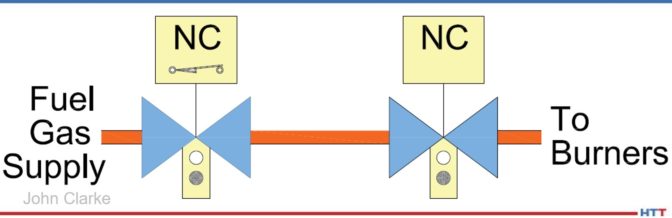
Illustration 5

For the arrangement depicted in Illustration 5, NFPA only requires one valve be supervised with a VCS—the additional costs of supervising both valves are very low and will enhance safety.

Whatever the method used to shut off the fuel to burners or pilots, the array of valves must be inspected and tested annually or per the manufacturer’s recommendations, whichever period is the shortest. All systems must be designed to be tested—with provision provided to cycle valves in test mode and the ability to measure any potential leakage. We will explore how a fuel train should be “designed to be tested” in an upcoming article.

The one thing to always remember—safety shutoff valves are always deployed to provide redundancy, so that any one component failure will not prevent a safe interruption of fuel gas; but, as with all systems, there may be unforeseen events that can lead to complete failure. Only qualified people should design, operate, and maintain combustion systems.


References

[1] National Fire Protection Association – NFPA 86 Standard for Ovens and Furnaces 2019 Edition (NFPA, Quincy, Massachusetts, May 24, 2018) 3.3.82.2 pp 86-14.

[2] National Fire Protection Association – NFPA 86 Standard for Ovens and Furnaces 2019 Edition (NFPA, Quincy, Massachusetts, May 24, 2018) 13.5.11.1 pp 86-49.

About the Author:

John Clarke, with over 30 years in the heat processing area, is currently the technical director of Helios Electric Corporation. John’s work includes system efficiency analysis, burner design as well as burner management systems. John was a former president of the Industrial Heating Equipment Association and vice president at Maxon Corporation.

Nuts and Bolts of Combustion Systems – Safety Shutoff Valve Read More »
Vacuum Furnace Retrofit with New Binder Consolidation Technology

William (Bill) Jones
Owner and CEO
Solar Manufacturing

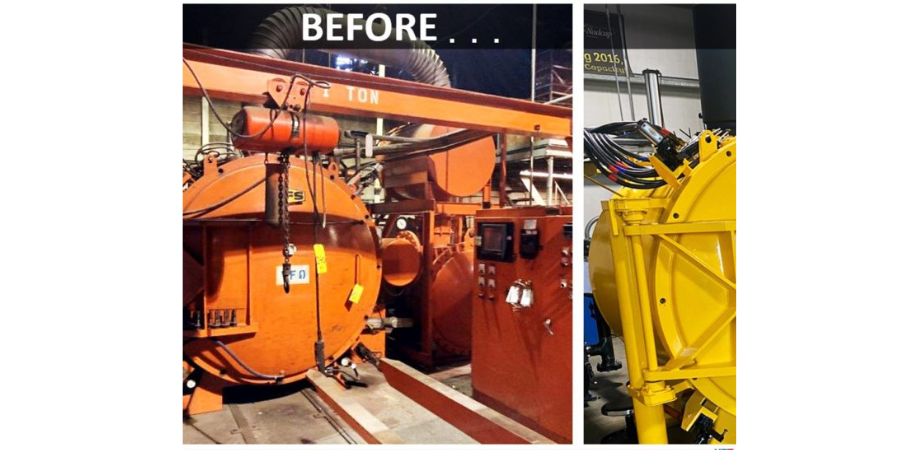
HTD Size-PR LogoRecently, a North American heat treater acquired a used VFS HL50 external quench vacuum furnace at an auction in the Philadelphia area. The main objective of this purchase was to retrofit this older furnace with a newer hot zone and pumping technology that will help minimize and target the condensation of detrimental binders evaporating out of MIM injection molded parts.

Solar Atmospheres of Western PA's maintenance team was responsible for refurbishing the furnace to its current standard. Solar Manufacturing, led by owner and CEO William Jones, designed the technology and the apparatus needed to consolidate the binders into one central location, thus minimizing the cleaning downtime the staff was experiencing. This includes a completely new hot zone, a binder pumping port, and a second vacuum pump. The collaborative effort ensured both projects came together seamlessly.

By mid-October, the high production MIM sinter job will be fully transferred from current Solar vacuum furnaces to this dedicated and refurbished vacuum furnace. After multiple sintering runs, the company will then have the data to compare the downtime of a traditional vacuum furnace versus the newly designed debind/sinter furnace. Solar looks forward to providing the MIM world with this new, critical processing information.

Vacuum Furnace Retrofit with New Binder Consolidation Technology Read More »

“New Family” for Premier Thermal Solutions LLC

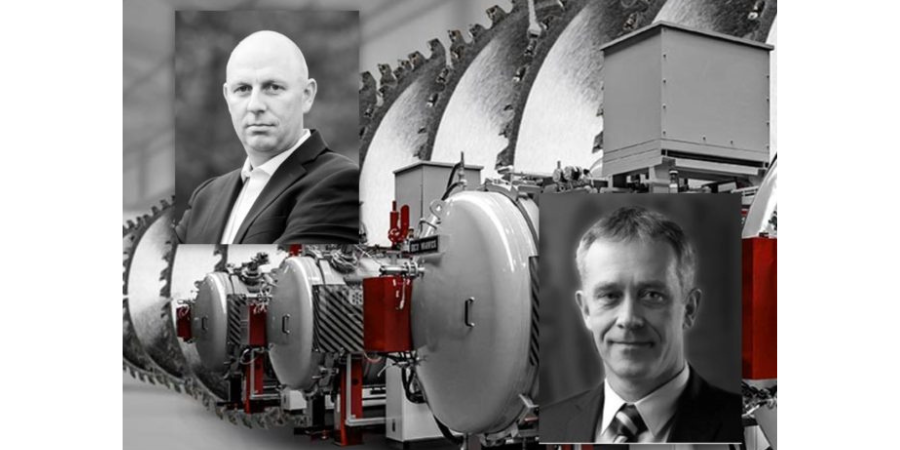
HTD Size-PR LogoA Dutch manufacturer and global heat treater has reached a definitive agreement to acquire 100% of the shares of Premier Thermal Solutions LLC (PT), based in Lansing (Michigan, USA). PT operates nine locations across the industrial Midwest in Michigan, Wisconsin, Indiana and Ohio, and provides surface technologies and related services to achieve metallurgical specifications for its various industrial clients.

Their specialized technology portfolio in the industrial Midwest region of the U.S. will complement Aalberts N.V. surface technologies, which has core activities in the Northeast and Southeast region. PT is serving the light and heavy truck, electrical vehicles, agriculture, defense and aerospace end markets.

PT has a project funnel that includes work in electrical vehicles, light and heavy truck, agriculture and industrial end markets. NADCAP and OEM certifications allow Aalberts surface technologies to progress work in the defense and aerospace markets in North America.

The management team of PT, under the leadership of Steven Wyatt, will continue to develop the business and drive business opportunities.


“New Family” for Premier Thermal Solutions LLC Read More »

International Cutting Tool Manufacturer Increases Capabilities with Vacuum Tempering Furnace

Piotr Zawistowski
Managing Director
SECO/VACUUM TECHNOLOGIES, USA
Source: secowarwick.com

HTD Size-PR LogoAn international manufacturer of cutting tools purchased a vacuum tempering furnace. This North American-made, horizontal, front-loading furnace is purpose-built to accommodate the client's needs with an all-metal hot zone for clean vacuum processing. As with the earlier furnaces from the same supplier, one of which was installed at a different facility, the new furnace includes a convection fan and a pressurized gas quench for quick cooling.

This is the fourth Vector furnace solution provided to the client. "There is no stronger statement," states Piotr Zawistowski, president of SECO/VACUUM, "[. . . ] than the customer who continues to order more of the same technology from us year after year as they expand. We are privileged to be a part of their growth."

Maciej Korecki
Vice President of the Vacuum Furnace Segment
SECO/WARWICK
(source: SECO/WARWICK)

"This customer demands – and has come to expect from us – a complete range of benefits, including precision heat treat uniformity, consistency from one workload to the next, and fast processing speeds along with low energy consumption," noted Maciej Korecki, vice president of the Vacuum Furnace Segment at SECO/WARWICK Group.

This single-chamber vacuum heat treating furnace is a good solution for machine tool manufacturers and is available with curved graphite elements or an all-metal hot zone. Additionally, it can be used for most standard hardening, tempering, annealing, solution heat treating, brazing and sintering applications.

International Cutting Tool Manufacturer Increases Capabilities with Vacuum Tempering Furnace Read More »

Navigating the 39 Top Heat Treat Resources

OCWelcome to another Technical Tuesday with Heat Treat Today! Heat Treat Today is always on the hunt for cutting-edge heat treat technology, trends, and resources that will help our audience become better informed to make wiser decisions.

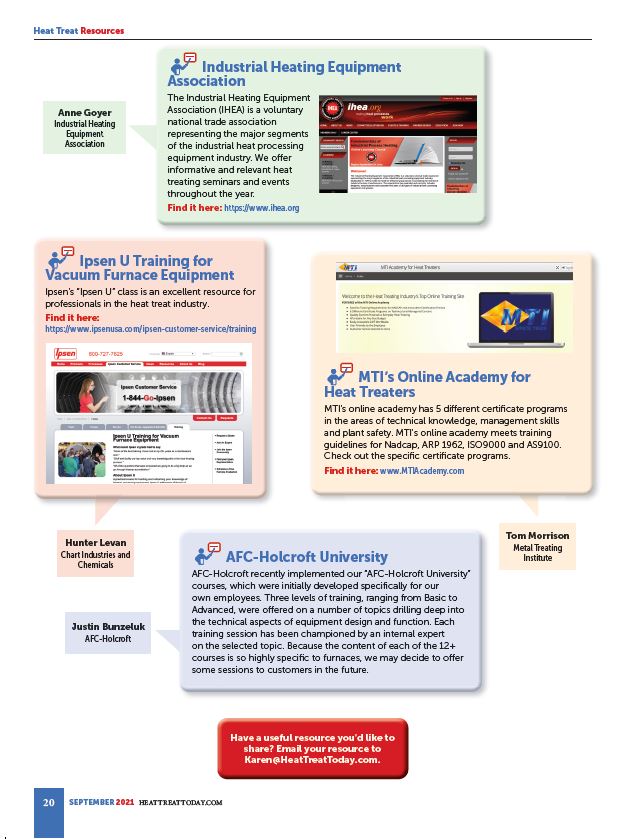
To find the top resources being used in the industry, we asked your colleagues. But how to navigate the thirty-nine resources? In this quick guide, we'll show you how to navigate the resources provided by your colleagues in Heat Treat Today's 2021 Trade Show September print edition. And, after you've browsed these resources, you may want to send your own top picks to Karen@HeatTreatToday.com for next year!


Resource Categories

You'll notice an icon in each resource bubble that indicates which of the five sections you are reading about. The resources appear in this order:

  1. Apps & Tools
  2. Teaching/Learning
  3. Networking
  4. At-Your-Fingertips
  5. Unconventional Ideas and Resources

Who Contributed?

Heat treating vice presidents of sales and operations, authors, and in-house experts at heat treat facilities all contributed. Some offered more than one resource, so be on the look-out for those overachievers! Several contributors were:

  • Tom Morrison at the Metal Treating Institute
  • Dan Herring, The Heat Treat Doctor at The HERRING Group, Inc.
  • Mike Coburn at AFC-Holcroft
  • Mark Rhoa, Jr at Chiz Bros

Sneak Peak?

Since you asked, here are a few pages from the digital edition of the September 2021 magazine. To see all of the resources, click here.

Navigating the 39 Top Heat Treat Resources Read More »

U.S. Automotive OEM Receives Furnace for Heat Treat

HTD Size-PR LogoA U.S. manufacturer is set to receive a dual chamber furnace to heat treat automotive parts. This heavy duty furnace-over-oven features 12-gauge sheet steel construction with reinforced members for a solid framework and each chamber is 24” H x 24” W x 36” L.

This is the 7th large Dual Chamber 8000 Series Furnace from Lucifer Furnaces, Inc. that it has shipped to the U.S. auto manufacturer. The upper hardening chamber heats with 45 KW power to banks of elements on sides, door and back. The heating elements are designed with heavy gauge wire mounted in removable holders.

The upper chamber cast hearth plates support the workload and can be easily replaced without disturbing the heating elements. The lower tempering oven with 20 KW power features a stainless-steel liner shielding heating elements from the workload. This liner was designed as a 3-sided liner with a cast hearth plate for durability. A high cfm, ½ hp fan recirculates air past the elements and back through the chamber in a uniform pattern.

This unit was customized with a free-standing control panel providing the ability to separate control operation from the furnace environment. Each chamber has been outfitted with Honeywell Multi Program Controllers with a High Limit Backup Controller to prevent temperature excursion events.


U.S. Automotive OEM Receives Furnace for Heat Treat Read More »

Division of Global Manufacturer of Steel Acquired by Italian Company

HTD Size-PR Logo

Martina Merz
CEO
thyssenkrupp AG

Global manufacturer in steel products announced the sale of Acciai Speciali Terni (AST), including the associated sales organization in Germany, Italy and Turkey, to the Italian company Arvedi. The parties have agreed not to disclose the purchase price.

The transaction is subject to approval by the supervisory board of thyssenkrupp AG and merger control clearance. The closing of the transaction is expected in the first half of 2022. thyssenkrupp is also examining a possible minority shareholding in the AST group. Details of this will be negotiated up to the closing.

"This fourth transaction shows once again clearly that we are working through our priorities and making decisive progress in the transformation of thyssenkrupp," Martina Merz, CEO of thyssenkrupp AG commented. “Speed in focusing the portfolio is crucial for a successful change process. At the same time, improving performance remains our most urgent task. Here too we are well on track and will not let up."

Cavaliere Giovanni Arvedi
Founder and President
Arvedi,

"[This] transaction has a compelling industrial rationale for Arvedi Group," said Cavaliere Giovanni Arvedi, founder and president of Arvedi, "which becomes stronger by successfully completing its product mix. Furthermore, this transaction is strategic for the whole Italian economy and represents an initial step towards new exciting developments. We are very pleased that [thyssenkrupp] is considering a potential minority shareholding in AST, guaranteeing continuity and showing trust in the know-how and capabilities of our Group."

"We are pleased to have found a new owner for AST in the Arvedi Group," adds Volkmar Dinstuhl, CEO of the Multi Tracks segment and Chairman of AST, "who will drive the development of the company with investments and innovations."

Progress has also been made with other portfolio companies in the Multi Tracks segment: The contract for the sale of the Mining business to the Danish company FLSmidth was signed at the end of July 2021, followed shortly afterwards by the signing of the contract for the sale of the Infrastructure business to FMC Beteiligungs KG. The sale of thyssenkrupp Carbon Components to Austrian Action Composites GmbH was completed on August 31. In addition, the closure of the heavy plate mill in Duisburg will be completed by the end of this month.

Division of Global Manufacturer of Steel Acquired by Italian Company Read More »

ASM Heat Treat Show 2021 – September 16th

OCVisiting with heat treaters has been a blast. It’s an exciting sight to see. Today’s update from the show gives you a snippet of what’s happening tomorrow, a review of what was said today, and a picture of what Heat Treat Today was up to on Wednesday, September 15th

Stop by our booth if you can!


See what happened!


Word Gets Around . . .

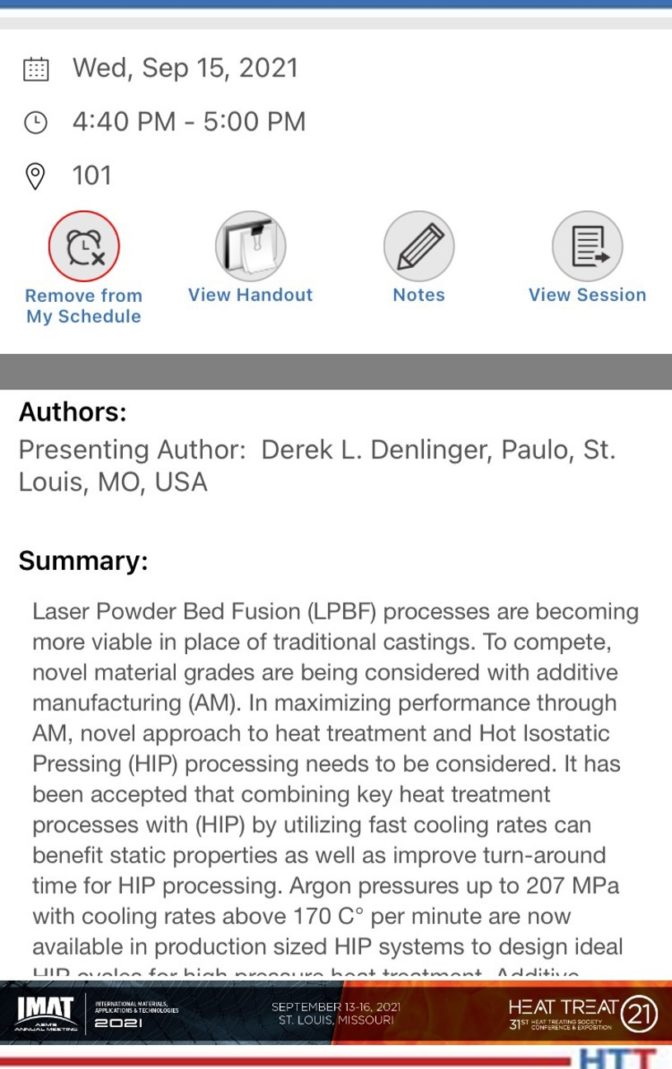
Cory Husemann and Derek Denlinger of Paulo. Both are leaders in the North American heat treat industry and winners of the Heat Treat Today 40 Under 40 Class of 2021.

Derek presented a technical session twice at the Heat Treat Show on Wednesday, September 15, 2021.


What to Look for Thursday Sept. 16th

8:30 AM-9:10 AM

Materials Durability / Mechanical Testing I
Session Chair: Dr. Mohammed Maniruzzaman
Session Chair: Mr. Andrew L. Banka, P.E.

9:30 AM-10:30 AM

Materials Durability / Mechanical Testing II
Session Chair: Ms. Trisha Rouse

9:30 AM-11:10 AM

Applied Technology III
Session Chair: Dr. D. Scott MacKenzie


Read about all Technical Sessions and what you can expect from the speakers!

Resources to Keep You Sharp

It’s a click away. Hope these quick links help you navigate the final morning at the Heat Treat Show 2021!


original content

ASM Heat Treat Show 2021 – September 16th Read More »

6 Vacuum Furnaces to Amp Up Precision Processing

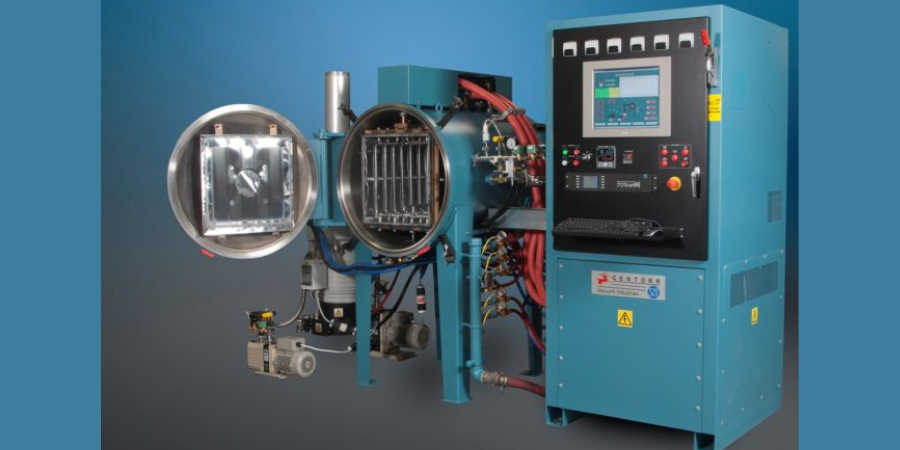
HTD Size-PR LogoVacuum furnace manufacturer announced it is building six furnaces for various applications in the precision processing of metals in heat treating, brazing, and annealing applications.

The product line from which these furnaces will come from, Centorr Vacuum Industries Workhorse®, was introduced in the 1960’s and has been one of the company’s best-selling furnaces over the past six decades. Available in sizes from 1 cubic ft to over 100 cubic ft, this versatile furnace design has a refractory metal hot zone and high-vacuum pumping system for the processing of advanced materials requiring an extremely clean high-vacuum environment.

The furnace can also handle a variety of customer loads in either high-vacuum or partials pressures of inert gas, when necessary to protect the customer’s load.

6 Vacuum Furnaces to Amp Up Precision Processing Read More »

Thermcraft Acquired By Ohio-Based Fabricator

Lee Watson
President & CEO
Alloy Engineering

HTD Size-PR LogoThermcraft, Inc., a manufacturing company of thermal processing equipment, has recently been acquired. Nancy Crafton, widow of Thomas Crafton, the former president & CEO, shared details with the company family and introduced them to the new owner, saying, "Tom would be happy to know there is a bright future for Thermcraft."

Alloy Engineering, a diverse fabricator specializing in high-temperature & corrosion-resistant alloys, notes that the acquisition fits in the company's strategy to expand their high temperature product offering. Through the purchase, the company will be able to leverage their expertise in high temperature alloys along with Thermcraft's expertise in ceramics and heaters to deliver some innovative products to both existing and new customers and markets.

"I am excited and eager," said Lee Watson, president & CEO of Alloy Engineering, "to take the reputation built by the Crafton family along with the Thermcraft employees and grow it to the next level. By merging the core competencies of both companies and taking innovative solutions to market, we will provide a solid future for both of our companies."

Thermcraft Acquired By Ohio-Based Fabricator Read More »

Skip to content