


Doug Glenn

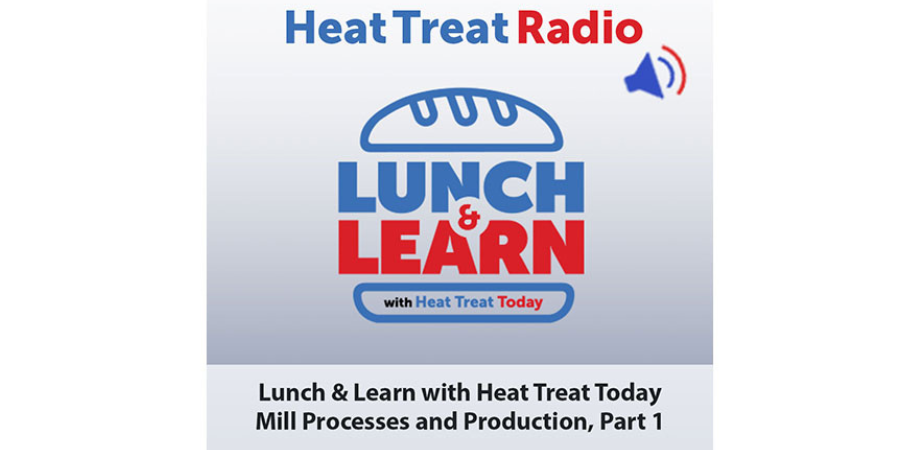
Heat Treat Radio #76: Lunch & Learn with Heat Treat Today – Mill Processes and Production, Part 1

Heat Treat Radio host, Doug Glenn, and several other Heat Treat Today team members sit down with long-time industry expert Dan Herring, The Heat Treat Doctor®, to talk about simplified mill practices and processes as they relate to aluminum and steel. Enjoy this second informative Lunch & Learn with the Heat Treat Today team. 

Below, you can watch the video, listen to the podcast by clicking on the audio play button, or read an edited transcript.



The following transcript has been edited for your reading enjoyment.

Dan Herring (DH):  It’s my pleasure to be here and what I’m going to attempt to do in about the next 30-40 minutes is take about 3 or 4,000 pages of literature and condense it down into some simple English and some common sense, if you will.

We will talk about mill practices, production methods, and what I like to call the forms produced. We might call this whole thing “simplified” for lack of a better terminology, if that makes sense. I’ve selected two very common materials to talk about. The first one is aluminum and the second is steel. But I’m going to disguise that a little bit and talk a  little about aluminum and iron. Just to recall, maybe our high school chemistry, aluminum (or aluminium as it’s called by the rest of the world), has chemical symbol Al and iron has chemical symbol Fe. You might wonder how we got Fe from iron: it’s from the Latin word ferrum. Aluminium is another story which I’ll leave for another time, but it is quite interesting.

If we’re going to talk about aluminum and if we’re going to talk about iron, why isn’t steel an element? That’s a question I get very often. Steel is actually an alloy. That’s a combination of different elements. The way I like to think about steel is it’s iron and manganese and carbon and some other alloying elements put in that make specific types of steel that are used for specific applications and application purposes.

Watch or listen to the first episode in this series

The other common question I get is you’ve heard of terms in history like “the stone age” where all the tools and, by the way, the weapons were made of stone. Similarly, the stone age gave way to something called “the bronze age.” That’s where an alloy of copper and tin came on. Again, it made better tools and, by the way, better weapons than the stone tools were. Then, later, you probably heard that there was something called “the iron age”, and we all commonly have heard these terms, but why haven’t we heard about “the steel age”? That’s a common question. What is the steel age? Why isn’t it an age, if you will? That’s because we came up with a very fancy term: The Industrial Revolution, where we started to use steel as an engineering material. I don’t want to get too off subject here, but thought I’d mention that.

So, we begin with raw material, and we call that within the industry an ore. Now, most raw material is in the form of ore or minerals that are found in nature, and they’re typically the element of interest (aluminum or iron in this case) combined with possibly some undesirable elements. The ore that we get from the raw material that we get from the earth has to be refined to make it into a metal. And there are certain raw materials (gold is a good example), that are found in its pure state. I which I could have found more of it in my career, then I wouldn’t be talking to you, but that’s a different story! The idea here is the fact that most ores come in the form of, or most minerals are found in nature and have to be refined.

[blockquote author="Dan Herring, The Heat Treat Doctor®" style="1"][The] chemical bond between aluminum and oxygen is very strong. As a result of that, we need a lot of energy to break that bond apart, to produce aluminum the metal and oxygen the byproduct. A lot of energy is required for that[/blockquote]

The principal ore containing aluminum is something we call bauxite. Bauxite is aluminum oxide, chemical symbol Al203. The way I like to think of bauxite is bauxite is dirt. We can put a dress on it, but it’s still dirt at the end of the day. It’s a special type of dirt. It’s a dirt that has 40-60% aluminum oxide in it. And there are certain areas in the world where bauxite is more common than others. Interestingly enough, Australia is a tremendous source of bauxite as is Africa. That’s why you find the majority of bauxite mines in either Australia or Africa or other places in the world.

When you get into iron, there are two principal ores — there are hematite and magnetite. They are iron oxides and they’re obviously rich in iron.

But to begin, let’s deal with aluminum and what the mill has to do, or what the aluminum manufacturing process really is. We start off, as I said, with dirt, with the raw ore. We then get fancy, and we crush it into a very coarse powder and then after we’ve crushed it, we want to refine it — we want to take and remove some of the impurities. So, we mix it with a little of what we call caustic soda, which is sodium hydroxide, and lime, which is calcium oxide or calcium carbonate, and we use that refining method to purify the raw ore. What we wind up with, interestingly enough, is a very fine white powder which is called alumina or aluminum oxide.

We start out the manufacturing process with a raw material that is a very, very fine powder that is almost all (principally 99%) aluminum oxide. We take it and we put it into a furnace, and we heat it. We do that process with electricity because we’re using carbon anodes, if you will, placed into the bath that we pass current through to melt the aluminum. The process therefore is extremely energy intensive. That’s why you find aluminum production plants in areas like the Tennessee valley, where we have a lot of hydroelectric power. You find them in Iceland, where you have a lot of geothermal energy to help produce electricity. But they’re very electrically intensive operations.

The scientific reason for that is that the chemical bond between aluminum and oxygen is very strong. As a result of that, we need a lot of energy to break that bond apart, to produce aluminum the metal and oxygen the byproduct. A lot of energy is required for that.

You might also find it interesting that when the process was first developed back in the 1880s, and it took that long to produce pure aluminum — if I remember right, the year was 1883 — but the price of an ounce of aluminum was more expensive than the price of an ounce of gold just because of the manufacturing of it.

But anyway, we’ve taken this aluminum powder, which is a white powder, we’ve melted it into a silvery-colored metal, and we do that inside a furnace. Then we tap the furnace — in other words, we pour out the molten aluminum and we either produce cast products from the aluminum or we produce what are called ingots for subsequent working. We either make castings directly or we make ingots.

Cast products, examples of them, might be engine blocks, wheel rims for automobiles, even some small appliances (there are toasters that are cast), patio furniture, tools, cookware — a lot of things wind up just as cast products.

But if we’ve produced an ingot, now we have various methods that we take to produce an engineered product, if you will. We can extrude the aluminum — in other words, we can take an aluminum ingot and we can put it in a press and press it into a form and we can make things like aluminum ladders, bicycle frames, even certain airframe components, out of extruded material. We can take these ingots and we can roll them — we can roll them hot, or we can roll them cold — this is called hot rolling and cold rolling.

But we can turn around and when we roll it, we can make sheet, we can make plate, we can make something that we’re all very familiar with which is aluminum foil. We can make wire, heat exchangers, panels for automobiles, and battery components. Again, in the transportation industry, we can make a lot of things for automobiles or airplanes.

Similarly, we can also forge the material. We hot forge it in this particular case, but we can make various rings and blocks and cylinders and sleeves and components that we can then take and machine.

The process of manufacturing aluminum is relatively straightforward, and it winds up, as I said, with an ingot of some type that is then manufactured into a product.

Doug Glenn (DG): I want to jump in with two thoughts:

You’re talking about that the manufacturing of aluminum from raw materials is highly energy intense. Two points on that: One, it’s much more energy intense than steel production, for one thing, and secondly, that makes some sense of why it is we do so much recycling (or at least try to) of aluminum, because it’s a lot cheaper to take already formed aluminum (an aluminum can or an aluminum wheel off a car) and melt it down. The amount of energy to do that is a lot less than it is to create aluminum from scratch. That was one thing, Dan, if you want to comment on that.

The second thing is you were talking about extruding. I imagine that most everyone knows what that is. You were talking about pressing it into a form. You’ve got to remember that with an extrusion, you’re pressing it through a dye. It’s kind of like your playdough that you push in that form, and you get a shape coming out the other end — that’s extrusion, and not to be confused with forging where you’re putting it into a closed thing and pressing it into a form.

DH:  Those are both very, very good comments. Interestingly enough, when you get into iron and steel making, the minerals, the iron oxides if you will, are far easier to break the bond between iron and oxygen than it is between aluminum and oxygen. That’s why the aluminum is such an energy intensive process.

And absolutely correct — recycling saves a tremendous amount of cost and is something that is vital to the long-term success of aluminum because an aluminum product, in general, is more expensive than a steel product.

You are correct — when you extrude something, you basically squeeze it through a dye, if you will. We’ll talk about that a little bit more in forging.

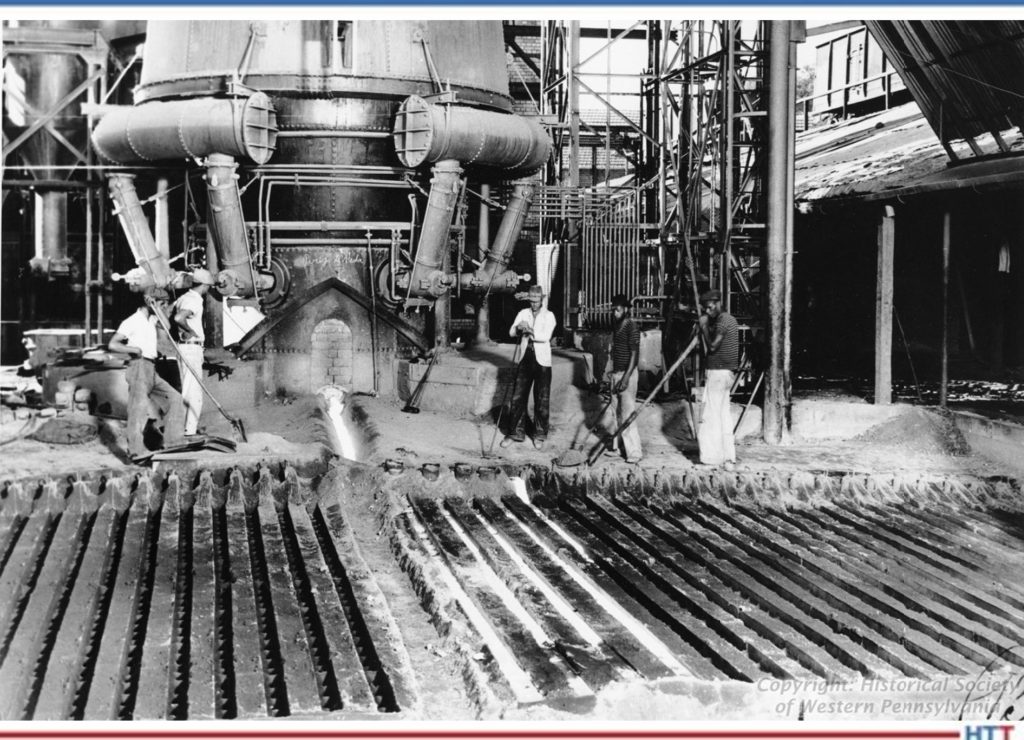
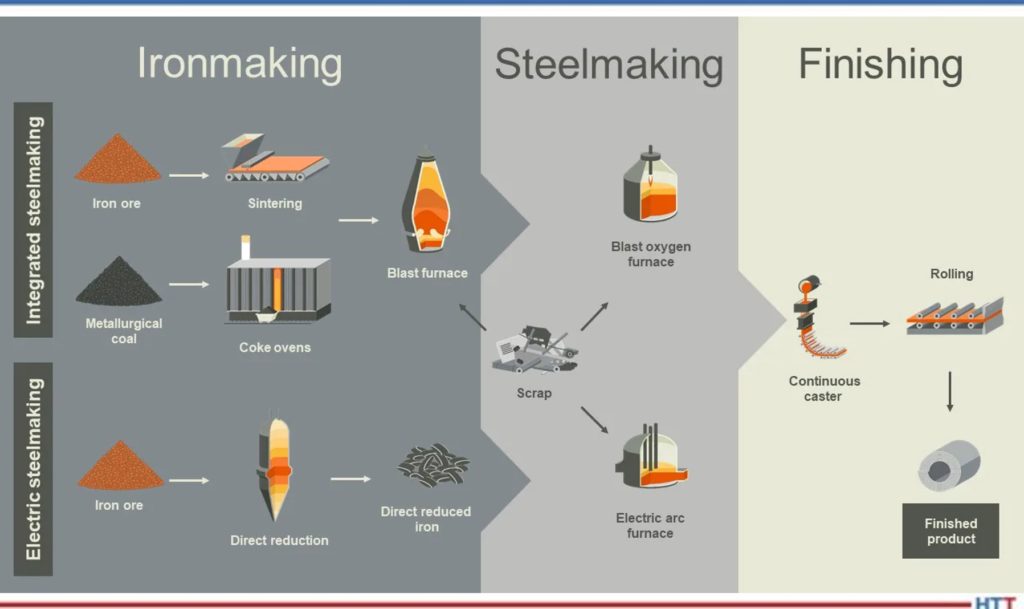
I want everyone to understand that when we start to talk about iron and steel making, because the process has been around for such a long time, there are certain terms that are used in the manufacturing process that have become synonymous with the process itself. Once again, we start out with an iron oxide, a mineral in the form of magnetite or hematite. We take that raw ore and we put it into something called a blast furnace. This is where we do a process called “smelting” of the material. We form a metal by taking and reducing the ore in the presence of air under pressure.

Source: Historic Pittsburgh

Coming out of the blast furnace is molten metal, molten iron, if you will. Now, historically, it’s called “pig iron.” The reason for that is when they originally cast different molds with shapes, the resulting structure looked like a litter of piglets that were actually suckling on their mother. So, the term “pig iron” came about. These little “pigs,” if you will, were broken off from the main casting. As I said, there are a lot of historical things going on.

In the old days, you then took the pig iron and you put it into what is called either a BOF (basic oxygen furnace) or an EAF (electric arc furnace) and then you remelted the pigs, if you will. But today, in most of the BOF and EAF processes, you wind up charging a hot liquid iron into those furnaces. They heated up, or continued to heat up, and then you turn around after you’ve converted the pig iron (which is about 94% iron and 6% impurities, so it’s still very impure) and with processing in a BOF or EAF furnace, you get the impurity levels down to less than 1%.

You might say to yourself, “Why is that important?” The idea in steel making is to take the raw material — the iron — and take everything out of it, so we can precisely add back in just those chemical elements that we want to make a particular type of steel. That’s essentially what the BOF or EOF is doing it; it’s converting the molten metal (or the pig iron) into a very, very pure material.

We then do a process which is called “tapping.” We transfer the raw material into a ladle furnace and inside the ladle is where we do the remainder of the refining process. What we wind up doing is we purify the material — we get rid of the additional impurities that are present, anything from hydrogen and oxygen and excess nitrogen to tramp elements and things of this nature. So, in the ladle, we do the refining. This can be done in a vacuum process, a vacuum degassing process, it can be done with an argon process, if you will. But we go from the blast furnace to the refining furnace (the BOF or the EAF), we then go into the ladle and what we’re doing is we’re taking the raw material and we’re making a purer and purer and purer form of, first of all, iron, and then we’re starting to add in elements that we want to make a particular grade of steel or type of steel. Then we’re going to do a process called “teeming” and “casting.” Teeming is basically pouring the molten metal into molds.

Source: BHP

What we wind up with is we have a process where we have liquid steel and we’re going to send it into either something called a continuous caster, we’re going to make ingots out of it, or we’re going to take and atomize the steel. I want to talk about atomizing the liquid steel first. The process is done by adding a gas such as nitrogen or argon or even air, or by using water, but the idea here is that what you wind up with is a powder metal.

By the way, it’s called “powder” metallurgy not “powdered” metallurgy. Powdered is cookies, but powder is what we produce from the atomizing process. The powder can either be spherical in nature or it can be rounded or even irregular-shaped, depending on the type of atomization process. But we take this liquid stream of metal, and we impinge it with either water or gas and burst it or break it apart into particles. Then we do a simple process which is called screening of those particles — it’s basically taking and getting finer and finer, or dividing the powder into finer and finer powders.

Depending on the purification of the powder, how fine the powder is, we use it for what we call conventional powder metallurgy, so we take and use it for basic sintering operations, for example. You’re all familiar with the rearview mirror on your automobile. Interestingly enough, the rearview mirror fits into something called a mirror mount, and that mirror mount is a powder metal part. It happens to be a stainless steel, but it’s a powder metal part.

The idea is the fact that we can have a conventional powder metal. We can have (if we use finer powder) a metal that is suitable for metal injection molding for making things like firearm components, orthodontic braces and things of this nature, or other medical-type devices. Or, if we get a superfine powder, we can turn around and we can use it for something called additive manufacturing.

We’ll talk a little bit more about these later, but from the casting process, we can either go into a continuous caster, we can make ingots, or we can atomize the liquid steel.

If we go into a continuous caster, we’re cooling down the steel and we’re producing three products — they’re called blooms, billets, and bars. Basically, the difference between them is their physical shape. A billet might only be 10 inches square or something of this size (10 x 10 x 10 inches). A bloom is defined as something that is less than one hundred square inches, typically, except if it’s a jumbo bloom caster which makes bigger blooms, but we’ll ignore that as it gets complicated quickly.

The idea here is the fact that we’re either going to take the liquid steel, we’re going to cool it down in some continuous fashion or we’re going to put it into a mold to make an ingot or we’re going to atomize it using water or a gas to make a powder. Those are the three forms that come out of this whole process.

DG:  Dan, I’ve got a quick question for you on that:  With the aluminum, you mentioned that you can melt it and then cast it directly into a finished product (a cast product). Do we do that much with steel? Do we often take steel and actually take it directly into an alternator casing or some other finished part?

DH:  Absolutely. There is a lot of cast steel that is used. The example that comes quickly to mind are probably valve bodies that are used in the petrochemical industry and things. If you think about the iron side, you’re very familiar with cast iron skillets and cast iron cookware. You can also have steel castings as cookware, but you typically don’t as it’s more expensive. But yes, you can make a variety of products directly as a casting.

As I said, you can make powder metallurgy products, and you can also make a family of products that we then call wrought products. What we do is we take those billets, blooms, and bars and then we either hot work them or cold work them to make various types of materials. We can roll them, we can pierce them, we can forge them. We can make sheet, we can make plate, we can make bar and tubular products, we can make wire, we can make strip. A good example is the fact that if you’re a razor blade manufacturer, you want to order material from the mill that’s in the form of strip, thin strip actually.

If, on the other hand, you’re in the oil and gas industry, and if you’re ordering pipe or tubing for use, as we call it, “down hole”, obviously it does no good to have delivered a strip of steel or a sheet of steel or a plate of steel, you want something obviously in the form a tube or a pipe that can then be used.

For more information:

www.heat-treat-doctor.com

dherring@heat-treat-doctor.com

Doug Glenn <br> Publisher <br> Heat Treat Today

Doug Glenn
Publisher
Heat Treat Today


To find other Heat Treat Radio episodes, go to www.heattreattoday.com/radio and look in the list of Heat Treat Radio episodes listed.


Find heat treating products and services when you search on Heat Treat Buyers Guide.com


Heat Treat Radio #76: Lunch & Learn with Heat Treat Today – Mill Processes and Production, Part 1 Read More »

Heat Treat Radio Review

OCTwice a month, Heat Treat Today publishes an episode of Heat Treat Radio, a unique-to-the-industry podcast that covers topics in the aerospace, automotive, medical, energy, and general manufacturing industries. Each episode features an interview with an industry leader and is full of in-depth descriptions of technical content as well as heart-felt stories from industry legends. In today's Technical Tuesday, enjoy this snapshot of four episodes from Heat Treat Today's May 2022 Induction Heating print edition.


Heat Treat Radio: Lunch & Learn with Heat Treat Today – Heat Treatment vs. Thermal Processing

Dan Herring
"The Heat Treat Doctor"
The HERRING GROUP, Inc.

There is a world outside the heat treating comfort zone! The heat treating world can be steel-centric, iron-centric, aluminum-centric, and natural-gas centric. What may come as a surprise to most heat treaters is heat treating is a part of a much larger industry: thermal processing. In the thermal processing industry, steel, iron, aluminum, and natural gas are less the star of the show — although they are still important. The thermal processing industry deals more with finished goods like jewelry, while the heat treating industry deals with semi-finished goods like gears and other unassembled components.

In this episode of Heat Treat Radio, Dan Herring, The Heat Treat Doctor®, takes the heat treating world out of its comfort zone and into the world of thermal processing. Learn the difference between the two terms and some surprising ways thermal processing is used — including producing mayonnaise! Also included in this episode are some interesting statistics about natural gas consumption in the U.S. and a description of calcining, an area of thermal processing.

Read the transcript, and listen to or watch the podcast here.

Heat Treat Radio: All About Heat Treat Boot Camp with Doug Glenn

Bethany Leone, Heat Treat Radio editor, and Doug Glenn, publisher of Heat Treat Today, sit down to discuss Heat Treat Today's newest undertaking: Heat Treat Boot Camp. Heat Treat Boot Camp will cram 3 to 5 to 7 years of information into just a day and a half of classes. Settle into the Double Tree by Hilton Hotel & Suites in Pittsburgh Downtown the evening of Monday, October 31st for a good night’s sleep. Lectures begin the morning of November 1st and will end the afternoon of Tuesday, November 2nd. It won’t be all lectures though; there will also be soon-to-be-announced events in the Pittsburgh area.

What is the content of the lectures? Doug Glenn and Thomas Wingens of WINGENS LLC International Industry Consultancy will provide information on the heat treating industry players, products, processes, markets, and materials. If you are an industry-insider, an industry-outsider, a new employee in the industry, or an investor interested in mergers/acquisitions and feel like you need to know more about the heat treating industry, this event is for you. There is no other seminar or webinar like Heat Treat Boot Camp.

Read the transcript, and listen to or watch the podcast here.

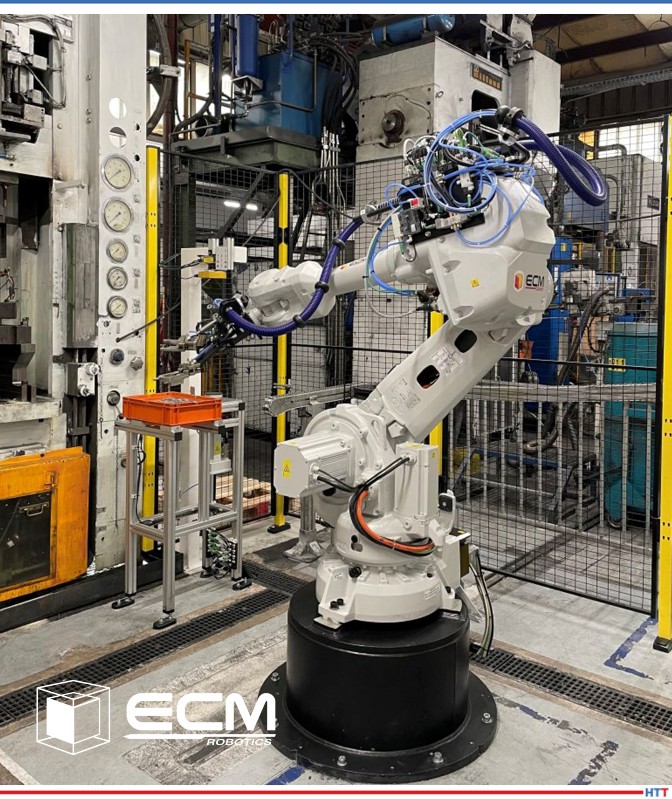
Heat Treat Radio: Robotics in Heat Treat, a Conversation With Dennis Beauchense, ECM-USA

Dennis Beauchesne,
Managing Director,
ECM-USA, Inc.
Source: ECM-USA, Inc.

Labor availability is a crucial issue in today’s heat treating shops. Are robots the solution to the ever-growing labor shortage? Dennis Beauchesne, managing director at ECM-USA, Inc. thinks mechanical arms may indeed be the solution to the lack of human arms. And robots are not replacing humans or taking away their jobs — they’re actually helping workers by doing the dull, repetitive jobs no one wants to do.

Listen to this episode of Heat Treat Radio to get up to speed on developments in robotics in heat treat. Vision recognition is a key factor in improving robots. Some heat treaters are even using robot cameras to measure distortion control on finished parts. Traceability with robots enables heat treaters to track exactly where a part was in a bin throughout the entire heat treating process. And, as Dennis puts it, robots are not just for heat treaters with a high-volume of the exact same part, because with new developments, robots can be programmed on the floor to deal with many different part shapes and sizes.

Read the transcript, and listen to or watch the podcast here.

Heat Treat Radio: Heat Treat Legends: Dan Herring, The Heat Treat Doctor®

“. . .I don’t view work as work, I view it as just a true labor of love.” In this episode of Heat Treat Radio, Doug Glenn interviews a Heat Treat Legend: Dan Herring, The Heat Treat Doctor®. Dan describes how he got his start in heat treating and manufacturing as early as six years old. Now, with six books published in the heat treating industry as well as many technical articles, Dan Herring is an easily-recognizable name. Dan is known throughout the industry as an expert problem solver who truly loves his work.

Learn advice from The Heat Treat Doctor® on how to succeed as a young person in the industry, how to contribute to science, and the first lesson of business: Be honest. Tune in to hear more words of wisdom from Dan about work-life balance, living in the moment, and having infinite patience.

Read the transcript, and listen to or watch the podcast here.


.

Search for heat treat solution providers and suppliers on Heat Treat Buyers Guide.com


Heat Treat Radio Review Read More »

Heat Treat Radio #75: Reimagining Furnace Compliance with C3 Data’s Matt Wright

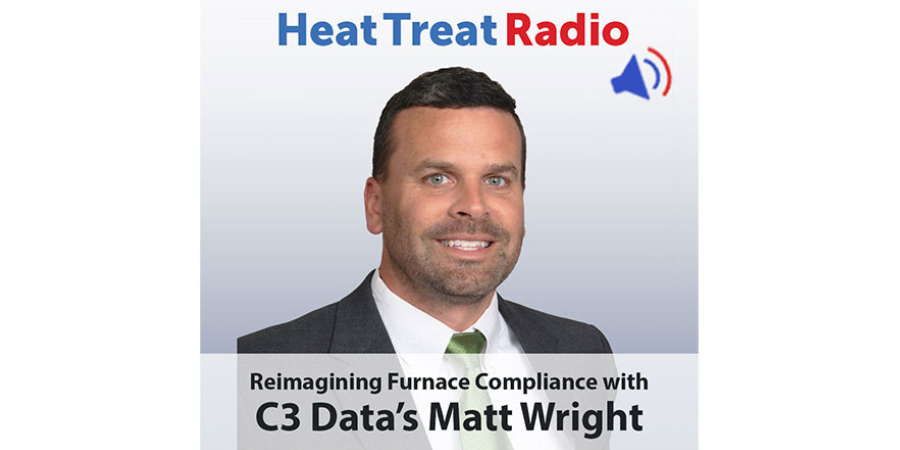
Heat Treat Radio host and Heat Treat Today publisher, Doug Glenn, talks with Matt Wright, the chief marketing officer at C3 Data, to hear how the company has reimagined furnace compliance to fit in your pocket.

Below, you can watch the video, listen to the podcast by clicking on the audio play button, or read an edited transcript.


The following transcript has been edited for your reading enjoyment.

Doug Glenn:  Matt, Welcome to Heat Treat Radio. This is your first time on.

Matt Wright:  It’s good to be with you.

DG:  I do want you to spend a little bit of time giving our listeners a little bit about your background and then, also, if you don’t mind, a quick summary of what C3 Data does, just so our listeners have a concept.

MW:  I’ve been in the heat treat industry now for about 15 years. My brother, Nathan, and I together, we own a few — twenty-five — accredited pyrometry labs. C3 Data really comes as an outgrowth of that. Looking for an opportunity or way to reduce errors,  a human element, and to save time with all of our technicians doing all the work that they’re doing. And so, it really became something that we did for ourselves and realized that it could be something that the industry as a whole could use.

When you look at our industry, there are two ways that you can comply with the AMS2750 CQI-9 specifications. One is what I would call the “roll your own method” which is what everyone has been doing from the beginning: that is using a whole panoply of different technologies, whether that’s an Excel spreadsheet, a clipboard, post-it notes, or what have you — anything and everything that you can do to try to remember to do all the things that need to be done, and then you go to the audit and hope that nothing fell through the cracks. What C3 Data does is takes all of those requirements and starts with the spec and encapsulates everything in one platform, one system, so you don’t have to think about and remember to do those things, you just follow what we have you do, and you come out and you’re ready for your audit.

DG:  I want to jump back onto the labs you were talking about. Very briefly, how many where are they?

MW:  We’ve got one in Ohio and one in Mexico that has three different offices in Mexico.

DG:  And these are metallurgical labs, or did you say testing labs?

MW:  They are labs that go on site to perform temperature uniformity surveys, system accuracy tests, instrument calibrations and those types of things.

DG:  Let’s talk about compliance. Compliance with AMS2750 CQI-9 NADCAP is really an issue that is important to a lot of our listeners and readers, primarily those manufacturers who have their own in-house heat treat and have their own furnaces. Let’s talk about some of the latest developments, the latest technologies in that field. What are you seeing out there, Matt?

MW:  When I look at our industry, one of the things that is the biggest challenge is the flow of information — getting information from where it resides to where it needs to be in the format that it needs to be. I think the technologies that have been successful in our industry are technologies that help lubricate that flow, if you will.  A good example, I think you had mentioned some of the specs, but one of them is ITAR, the International Traffic in Arms Regulations specifications. In that case, you’re trying to prevent information from going to malign influence and so they’re going to use things like the Cloud and mobile technology. And those are the platforms that we’ve been built on, as well. But we’re kind of using it in reverse; we’re trying to disseminate information and getting it there as quickly as possible. So, the Cloud and mobile technology, I think, are the two biggest forms of technology that have been really helpful.

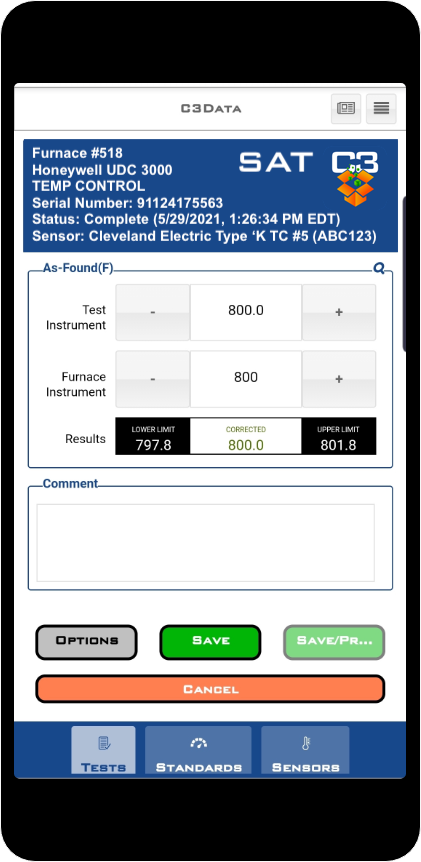
A couple other ones that we’re actually using that we’re seeing a little bit more and more of is OCR- optical character recognition. This is the ability to take a static document that has information on it and digitize it and get it to where it needs to be. We’re using that to be able to scan, for example, thermocouple cert, so that our customers, irrespective of who they’re buying their certs from, can just take a cert, scan it and build it right into their platform so they can use it to do an SAT in real-time.

Another one is the QR code. You know, with the things that are going on, it’s kind of made a comeback in recent days. Now you can get your wine list by scanning a QR code at the restaurant. Well, we’ve been using it since before it was cool to do that; we’ve been using to scan your thermocouples or your field test instrumentation, so you don’t have to go and look up something in a database or a table, you can just scan it in and, boom, you’re ready to go.

DG:  This OCR is interesting regarding the certifications on the thermocouples. So, a thermocouple comes in, it’s got its stats and whatever you’re scanning, that becomes part of your data, if you will, correct? And are they using it for anything else? For example, I’m thinking in my mind, a company who wants to transition over to using a system like yours, perhaps they’ve got a lot of historical documents that, at least, would be helpful. Is that also an application?

MW:  Certainly, a potential application could exist for that. We’ve got other tools with forms and things that we’ve put in place to make that transition from going from, what I call the “roll your own” in the static thing and pulling all of that information in. We’ve really made it, and strive to make it, more and more seamless every time.

DG:  And the QR codes? Are you using those on furnaces, on thermocouples, or where are you using those?

MW:  Any equipment that you use, whether it’s a thermocouple, a field test instrument, a data logger, any certification data that is associated with that, you can print a QR code and affix it to that. You’re not having to go and enter that in manually, you’re just scanning it in using our mobile app that has a QR code scanner built right in — it’s pulling that directly in. The whole idea is to reduce that bottle neck, if you will, and to get that information flow in so that these guys can do more value at a time out on the plant floor.

DG:  I also wanted to ask you, because you mentioned about Cloud-based and mobile apps and things of that sort — let’s talk about security for just a second. I just got done doing an interview with a guy by the name of Mark Mills that hasn’t been released yet. He’s a fascinating guy and I’m going to give that one a plug right here- you need to listen to that when it comes out. But he was talking about cybersecurity- he wrote a book called The Cloud Revolution. I’ve also heard at some of the industry meetings that there have been real concerns where some of the larger companies are not wanting their data to go “outside,” if you will- they don’t want to break the ceiling and get into the Cloud, they want it on site. Are you guys seeing much of that? If so, how are you handling that?

MW:  It’s a mix. We do see that. Every corporation has their own policies and procedures and what they’ve determined is a safe way to operate. So, on one side of the spectrum, we’ll get people that will be concerned and say, “Nothing in the Cloud,” and we have to have that conversation. Usually, the conversation revolves around what is the purpose of this information? And really, when you peel back and look at it, if someone were able to access the information in our system (which we have very tight security around), the only thing they’re going to find out is the very thing that those same preparations are bragging about on their website, and that is that they’re NADCAP compliant. There is no process-related data, there is no secret sauce involved in anything that we’re doing and so, it’s not something that we believe, and most people do end up seeing it our way that needs to be curtailed from a Cloud perspective.

DG:  I know a lot of companies’ concerns are not so much that something will get out about them as it is this Cloud connection is a gateway for the nefarious amongst us to break in and get it. I’m sure you’re seeing that, right? Let me ask you it this way:  What percentage of your clients are actually saying to you, “Listen, we want this to not be Cloud-based, we want it to be just on-site.”

MW:  If I could swag, I would say maybe 5–10% ask the question, “Hey, is this something that we can just have locally because we would just like to have it for ourselves?” And the answer is, it’s not; it’s not something that we can have locally, just by nature of what it is — it’s an ongoing, continually improving and updated thing.

DG:  Let’s talk about another hot point that we have here besides internet security. I don’t know if you guys have been affected by this, but it has to do with supply chain issues. We’ve got Covid to blame, we’ve got Russia to blame, we’ve got all kinds of things as far as supply chain. Are you experiencing any of that yourself for your business or are you seeing it from any of your customers?

MW:  I think we are fairly isolated from that in that we’re not producing a tangible product; we’re a software company. Happily, we’re not experiencing that so much. I will say that, from our customers’ perspective, the big catchphrase now is “flexibility.” With those things that you mentioned, the ability to be able to adapt to not knowing from one day to the next if the guy that was supposed to do your SATs or TUSs today is even going to show up because he might test positive for Covid, or something else, really drives home the need to be flexible — to not put all your eggs in one proverbial basket. We’re striving asymptotically, if you will, to get closer and closer to that point where someone who’s never done a calibration before, can pick up an app and literally, the same day, start doing calibrations. There are a lot of hills to climb and obstacles to overcome, but we’re pretty close and we’re going to strive to keep doing that so that people don’t have to worry about what if this guy quits, or what if this guy gets a promotion? The system is going to run, and they can pick up and run with it with the next guy.

DG:  When we talk supply chain, I start to think to myself, to a certain extent, I start to think internationally a little bit because a lot of the issues are bottlenecks at the border and things of that sort. But it makes me wonder — how about you guys, C3 Data, are you just North America or are you seeing business outside?

MW:  Being a software company, one of the benefits of it is that you don’t have to ship anything anywhere. Being a U.S.-based company, we started out here and most of customers are here. We have a fair number of customers in Mexico, we have a few in the United Kingdom and we’re expanding currently, bringing on customers in France. Right now, we’ve got about four or five different languages that the website and the app is translated into, and we’re interested in expanding. It’s a great question and one that we’re really excited about — being able to not just be so parochial in the United States, but to expand into Europe.

DG:  Tell me a bit about the mobile app. Let’s say you’re a manufacturer and you’ve got an in-house heat treat department. How often are you going to be using that mobile app as opposed to how often are you going to be using a desktop application, and how is the mobile app used?

MW:  The decision to go with the mobile app came from our experience as a heat treat lab. Having to schlep around a laptop in a laptop bag or a cart with a computer on it, it’s really kind of a pain, quite frankly. Virtually everyone owns a cellphone. So, if we can put this into the power of a cellphone and enable that person to carry one less thing and to have the flexibility to not need to have to have that to do an SAT, to do a calibration, to change a sensor and those types of things, that’s what we wanted to do. You can use the app, you can run it on a laptop if you wish, and we have a few customers that just do that, but most of our customers (I would say over 90%), use the app, and depending on how fat their fingers are, they might go to a tablet.

DG:  On a typical day when they’re using the app, they’re using it to do what? Run us through what would be a typical application.

MW:  The mobile is primarily just used to do instrument calibrations and system accuracy tests. When you go out to do these tests, there is a whole lot of information that you need to have, and you need to be able to record information. Everything that you need is on the app, whether it’s defining what test sensor you’re using, what field test instrument you’re using, what furnace class the furnace is — everything is there. So, they’re using it just to record information. As they’re using that app and putting that information in, their reports are literally being generated in real-time and waiting for the quality manager to review whenever he or she wants to.

DG:  I wanted to ask you about the different standards that you guys are covering. The three biggies we always think about are NADCAP, AMS2750, and CQI-9, and I’m sure you’ve got compliance with all of those. Are there any other major ones that you think any of our captive heat treaters might be interested in? I know the commercials will be interested in all of them, but any our captives might be interested in?

MW:  Yes. Those two are the big ones — the AMS2750 spec and CQI-9 — that’s going to cover your aerospace and your automotive specification. We have the ability to give our customers, and a lot of our users do take advantage of it to create their own custom specs. They can just define their custom specs, their criteria, their frequencies, and then use the same platform that we built for these two specs, out of the box, to drive the compliance to whatever spec they want. So, it’s very open — it’s kind of agnostic in that regard. But we just built in those two AMS2750 and CQI-9 specs because that’s going to hit over 90% of what everybody wants.

Just a thing about those specs: Whenever those specs revise, like when CQI-9 went from rev 3 to 4 and when AMS2750 revision from E to F, and now, coming up in June when it revises to G, one of the benefits of having a Cloud-based solution is that all of our customers, when it went to F, all they had to do was log into the portal, find their furnace and go from E and select F and they’re off and running. That’s all they had to do. No training is required. It saves a lot on time of training, and you don’t have to redo the paperwork. The reports and all those things are now current revision.

DG: And Rev G of AMS2750 is probably out. I was just at some industry meetings and the big stink about the AMS2750 is going to a tenth of a degree on some measuring tools and things of that sort. Are you guys are able to handle that? I assume, being the software guys, it probably doesn’t really matter to you whether it’s a tenth or a hundredth or whatever. But you can cover that?

MW:  Yes, absolutely. Now the tenth of a degree thing, I believe, is going to be extended for another year so that users are going to have one more year for that. The date we’re hearing and looking at is the end of June, so I think June 29th, which I think is the two-year anniversary of Rev E to F, so it will be coming out then, if nothing else changes.

DG:  The fellows I was hearing from were saying basically there is talk of the extension, but they’ve got to get it passed to actually get the extension, otherwise end of June is the date that most people are going to have to nail that with.

Your C3 Data tool is basically Cloud-based, portable, whether it’s website, phone, tablet or whatever, to help people comply. When the auditor walks in to get the information they want, how easy is it for your clients? What do they need to do? I assume this is where the real time and money-savings come in, correct?

MW:  Correct. What we like to tell people is, in a nutshell, C3 Data is going to save you time and help you pass your audits. The time saving is happening all during the year. Every SAT you do, you’re saving an enormous amount of time because you’re not writing in your reports, you’re not doing any calculations — you’re aggregating and gaining time throughout the year.

You’re also going to gain time in your audit preparation because, as you mentioned, when you log into your portal, your ability to find all of your documentation, along with our furnace dashboard which shows you, furnace by furnace, the compliance status of each one of them. You can see, in real-time, the compliance status is a huge timesaver and a real peace of mind that you can walk in with your hand on your heart and know from the auditor’s perspective, you’re going to have a good experience, because if he wants to see something, it’s very easy to find and you’re well prepared.

DG:  Timesaving has got to be enormous. I know there are a lot of companies investing a lot of time in these audits and in compliance-related things.

You guys do a lot of work in this area. Are there any good tools out there for any of our viewers/readers if they want to go and find out more information, whether it’s dealing with compliance, what is AMS2750, what is CQI-9, any of that kind of thing? Any suggestions from you on where people might want to go?

MW:  On our website, c3data.com, we’ve got a portion there that you can look up for training. We have a curriculum of training courses where they can come and educate themselves, whether it’s, like you say, to learn about what the spec is or maybe take a deeper dive into some of those fields — we have those available. We love talking to our customers and our prospects, too.

One of the things I will mention: In going back to the web as a software service model, one of the things that’s ongoing is the ability to support. We’ve been through so many of these audits and we know the spec probably more than the next guy and when you look at some of the testimonials on our website, you’ll see that they obviously love the product, but they love the ability to call one of us, and if we don’t know the answer, we’ll find out the answer and get them plugged into what they need. We enjoy talking about it.

This year, we’re going to be at the Furnace North America show in Indianapolis which is my hometown which will make it quite easy for me to get there. But we’re going to have a special guest, Doug Shuler, who’s going to be joining us at our booth. So come on by the booth and get all your questions answered by Doug.

DG:  If his name is Doug, he can’t be all bad.

Matt, thanks a lot. I really appreciate your time. I’m looking forward to seeing you guys continue to grow and you’re offering a great service to heat treaters, so best of luck to you.

MW:  I enjoyed it, Doug, thank you.

DG:  You bet.

For more information:

Matt's email: mwright@c3data.com

C3 Data website: www.c3data.com.

Doug Glenn <br> Publisher <br> Heat Treat Today

Doug Glenn
Publisher
Heat Treat Today


To find other Heat Treat Radio episodes, go to www.heattreattoday.com/radio and look in the list of Heat Treat Radio episodes listed.


Find heat treating products and services when you search on Heat Treat Buyers Guide.com


Heat Treat Radio #75: Reimagining Furnace Compliance with C3 Data’s Matt Wright Read More »

DUAL PERSPECTIVES: Europe vs. North America

op-ed

Changes are inevitable, but the world today is changing so rapidly that it’s constantly keeping us on our toes. Do two men from different parts of the world and lots of experience within the heat treating community have vastly different perspectives on the happenings in the heat treat industry?

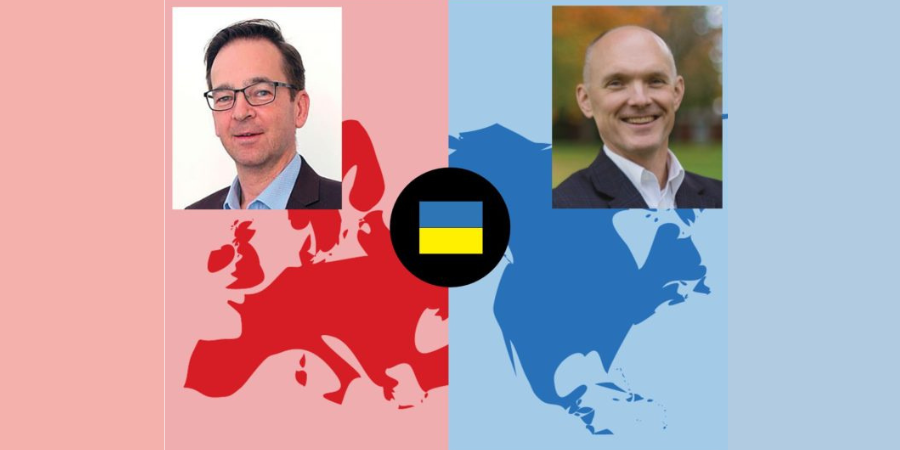
We want to find out, so we asked a question that focuses on the world of heat treating to Thomas Schneidewind, the editor-in-chief of heat processing magazine, and Doug Glenn, the publisher and founder of Heat Treat TodayThe question: Will the war in Ukraine impact the heat treat industry?

Thomas’s expertise lies in the European market while Doug’s resides in the North American market. We will feature their responses in each print magazine. Will their views align? Time will tell. Enjoy this first installment of an ongoing column. This column was first published in Heat Treat Today’s May 2022 Induction Heating print edition.


Will the War in Ukraine Impact the Heat Treat Industry?

Will, or how will, the war between Russia and Ukraine directly or indirectly impact the industry? What immediately comes to mind?

Thomas Schneidewind, Editor-in-Chief, heat processing magazine

Thomas Schneidewind
Editor-in-Chief
heat processing Magazine

First of all, the war in Ukraine is a humanitarian catastrophe. And the first war in Europe since 1945 marks a turning point in history. It has a strong impact on the global economy and hits the thermprocess industry in particular. The exploding energy prices lead to shutdowns of sites in the steel industry. That means that some investments will be frozen.

Europe’s Turning Point

Due to the economic downturn more and more companies are facing another difficult year. Machine and plant builders are affected by the imposed sanctions. Most of the companies are engaged in Russia and in Ukraine as well. One example: Against the background of the war in Ukraine and the human suffering associated with it, SMS group has ceased its main business activities in Russia and Belarus, with the exception of safety-critical maintenance work. New orders will not be accepted. All companies who have strong relationships with clients in Russia and Ukraine are taking care of refugees. SMS will be taking in one hundred families from Ukraine at its German locations in Hilchenbach and Mönchengladbach.

In Europe we see a completely new set up of the political agenda. Specifically, the German so called Energiewende (the country’s planned transition to a low-carbon, nuclear-free economy) will be pushed by the decision makers. The German economy has a long way to go to be independent from Russian gas and oil. The war will affect people and businesses all over the world – we see a historical turning point. For Europe and for the whole world.

Doug Glenn, Publisher, Heat Treat Today

Doug Glenn
Publisher and Founder
Heat Treat Today

The first thing that needs to be clearly communicated is that our thoughts and prayers are with all of those being adversely affected by this war. The loss of human life, personal freedom, and property are the most important impacts of this crisis. Everything else – including what follows in this short column – is somewhat insignificant.

Energy Shortages

Higher energy prices caused by supply shortages are and will continue to happen. More so today than any time in history, markets are global and what happens halfway around the world will have an impact everywhere. The U.S. has imported nearly 20% of its energy from Russia, and with that supply being cut off, we are and will continue to see rising gas, natural gas, and oil prices.

The U.S. could do more to help ourselves and the world through this crisis, however. Mark Mills from the Manhattan Institute asserts that today, with oil prices at $120 per barrel, the U.S. is producing 1.5 million FEWER barrels of oil than we were last year when oil prices were only $60 per barrel. The energy problem in the U.S. is not fundamentally a lack of energy and it is not a market problem. It is a political problem caused by those who have pushed for “green” at all costs.

Supply Chain

Supply chains are and will continue to be disrupted. Being the largest economy in the world and geographically removed from the crisis, I anticipate that U.S. supply chains may not be as badly hurt as those in Europe, but the disruptions will continue. As we all know, if a manufacturer is missing just ONE PART, the entire end-product is on hold. It is completely unpredictable how and when this will impact the North American heat treat industry, but it is safe to say that it is and will continue taking a toll.

Increased National Debt

Probably the most significant long-term impact of the crisis is the continued irresponsible growth in national debt. Now exceeding $30 trillion, our country does not need a war to incur more debt. But as we all know, there is nothing like war to drive national debt through the roof.


Find heat treating products and services when you search on Heat Treat Buyers Guide.com


DUAL PERSPECTIVES: Europe vs. North America Read More »

Paging Through Heat Treat Today’s Technical Files

OCWe're flipping through Heat Treat Today's technical articles today to highlight four heat treat-related processes: hardening, ferritic nitrocarburizing, titanium processing, and stress relieving. Read our top picks of technical articles from these categories that include a back pocket resource, a podcast episode, and a review of past and future innovations.


HARDENING: Heat Treat Radio: Metal Hardening 101 with Mark Hemsath, Part 1 of 3

Sometimes, the best technical advice comes out in a conversation. Mark Hemsath and Doug Glenn took three Heat Treat Radio episodes to talk about the basics of metal hardening. Listen to or read the transcript of the first episode in this series to get a leg up on metal hardness.

"I think the most important thing is that with metals, you’re trying to get certain features that allow it not to wear over time.  At the same time, you want the part to last.  You don’t want it to break, you don’t want it to chip, you don’t want it to seize up, so there are a lot of different things you can do with the parts to give them certain wear characteristics and hardness."


FERRITIC NITROCARBURIZING: Nitriding vs. FNC

How is nitriding different from ferritic nitrocarburizing? Temperature? Materials processed? Costs? Industries? This article is a resource: a table that compares these two processes against the other.

"Skim this straight forward data that has been assembled from information provided by four heat treat experts: Jason Orosz and Mark Hemsath at Nitrex, Thomas Wingens at WINGENS LLC – International Industry Consultancy, and Dan Herring, The Heat Treat Doctor at The HERRING GROUP, Inc."


TITANIUM PROCESSING: Titanium: A Fascinating History & Future

Titanium is its own animal, so its sometimes helpful to take a moment to identify what it is and how processing this metal might change in the future. Check out this article to learn more.

"The recycling of titanium is of a different magnitude than other metals due to its value. It took a shortage of titanium in the 1980s–and some innovative metallurgy–to transform valuable titanium scrap back into a qualified ingot. To do this, metallurgists used the reactivity of the metal to their advantage."


STRESS RELIEVING: Indentation Plastometry

It's not as flashy as a huge furnace, but understanding stress relieving is key to heat treat parts correctly. Plastometrex is a new technology to advance what we know and how we test stress on projects. Read all about.

"The oxidized layer was then removed and the Hardox steel samples were indented in the locations that are shown in Figure 5a. The indentation data were analyzed and converted into stress-strain curves using the SEMPID software. Two are shown in Figure 5b, where it is apparent that the high temperature brazing process has affected the strength characteristics of the material in that location."


.

Search for heat treat solution providers and suppliers on Heat Treat Buyers Guide.com


Paging Through Heat Treat Today’s Technical Files Read More »

Letter from the Publisher: Cryptocurrency In Your Future

Heat Treat Today publishes eight print magazines a year and included in each is a letter from the publisher, Doug Glenn. This letter first appeared in Heat Treat Today's March 2022 Aerospace Heat Treating print edition.


Doug Glenn
Publisher and Founder
Heat Treat Today

What does cryptocurrency (crypto) have to do with the heat treating industry? Within the past two weeks, I spoke with two suppliers in our industry who are making equipment to help cool crypto mining equipment, both of whom are diverting a portion of their manufacturing capacity to fulfill crypto demand. To that extent, the crypto craze is affecting the North American heat treat market in some capacity. So, let’s talk about cryptocurrencies because it’s a hot topic — and we deal with heat in this industry!

The question I’d like to mull over publicly is whether crypto has what it takes to be legitimate money.

Money — a widely accepted medium of exchange — has the following characteristics:

  • It is relatively scarce.
  • It is easily divisible.
  • It is easily portable.
  • It is durable.
  • It is uniform/fungible.
  • It is widely recognized/accepted.

I suggest we add one more characteristic to this list: It needs to be understandable.

Crypto’s Success or Failure

Something becomes money when people come to recognize it as a commonly accepted item which maintains its value over time. It is something widely and commonly valued and nearly everyone will accept it in exchange for another item or service. There must be a “perceived value” — both today and in the future.

This is where crypto has a few hurdles to clear before it can become real money. While there is a relatively small (but growing) number of people currently using cryptocurrencies, it is certainly far from being widely accepted, primarily because it is not widely understood — and some would say it is not understandable.

Source: Aliaksandr Marko/Adobe Stock

For example: Where does it come from? How is it made? Who makes it? Where is it kept? How do I trade it for other goods and services? What am I trading? Why is it valuable? Where do I keep it? What does it look like? Can I withdraw it and keep some at home? Can I carry it around? Can I see, touch, and feel it? Does it still exist if the electricity goes out? If it fell in the woods when no one was around, would it make a noise?

If cryptocurrencies are going to succeed in becoming money, they are going to have to be understandable to the common man. The common man is going to have to “believe” in it. They’re going to have to understand what it is, where it comes from, why it is valuable, and why it will continue to be valuable into his/her retirement years and beyond.

The Good of Crypto — Limited Supply

Cryptocurrencies do have (purportedly!) one thing going for them that our current currency lacks — limited supply. If the claim is true that there is a limited supply of cryptocurrency, then that is a clear and very important advantage it has over the U.S. dollar, because it can be endlessly printed if those in charge so desire. There is nothing physically stopping the Federal Reserve Banking System — those in charge of the currency — from printing and printing and printing. Cryptocurrencies, on the other hand, if we are to believe those in charge of their creation, have a limited supply (at least some of them). At least that’s what we’ve been told.

The reason the U.S. dollar is in such trouble now is because those in charge of the currency in the past have created way too many dollars. It’s just paper (or credit) and there is essentially NO LIMIT to how many dollars can be created. When too many dollars are created, the value of each dollar shrinks and the money itself becomes less and less valuable because it can buy fewer and fewer items. If crypto is going to succeed, the supply is going to have to be understandably and believably finite. Unfortunately, it’s not obvious to the common man that this is the case.

Beyond Governments

Money will come into existence without the help of government. Cryptocurrencies are a great reminder of that economic fact! Individuals, acting freely, will sooner or later settle on a widely accepted medium of exchange which is relatively scarce, divisible, portable, durable, uniform/fungible, widely recognizable/accepted, and understandable. If governments step in and make any currency, crypto or otherwise, “legal tender” or insist that only they can create money (what has historically been called “monopoly of the mint”), then I suggest we run from that money. Free people acting freely will settle on the best medium of exchange without government help. Whether or  not crypto will be that next medium of exchange remains to be seen.


Find heat treating products and services when you search on Heat Treat Buyers Guide.com


Letter from the Publisher: Cryptocurrency In Your Future Read More »

Heat Treat Radio #69: Robotics in Heat Treat, a Conversation With Dennis Beauchesne, ECM-USA

Heat Treat Radio host, Doug Glenn, discusses the current state of robotics in the North American (and European) heat treat markets with ECM-USA, Inc. managing director, Dennis Beauchesne. Find out where robotics is currently being used as well as some future applications.

Below, you can watch the video, listen to the podcast by clicking on the audio play button, or read an edited transcript.


The following transcript has been edited for your reading enjoyment.

Doug Glenn (DG):  Dennis, thanks for joining us. It’s been a long time since we’ve talked about finally getting together on Heat Treat Radio to have a conversation about some interesting things. Today, we’re going to talk to Dennis Beauchesne of ECM USA about robotics. Dennis, welcome. I appreciate you joining us.

Dennis Beauchesne (DB):  Well, Doug, thank you very much for having me on. We’ve been talking about it for quite a while and I’m really glad we could finally get our schedules together to make this happen.

Photo Credit: ECM-USA

DG:  We’re recording just after the holidays. Both of us are sobered up and back to be able to think clearly. We do want to talk about robotics, but just to give the listeners and/or viewers a sense of Dennis Beauchesne, your background, just briefly, tell us where you’ve come from and how long you’ve been working in the North American heat treat market.

DB:  My name is Dennis Beauchesne. I am the general manager of ECM USA which is the U.S. subsidiary of ECM Technologies working out of France. I’ve been with ECM Technologies for almost 21 years. About 10 years before that I also worked with other furnace companies and some in the heat treat business as well as selling alloy baskets, fans, and those kinds of things. I also had a rep organization for 3 years where I sold probes and a number of other heat treat-related items. I’ve had my share of crawling around furnace and heat treats and getting to know the applications, loading mechanisms and all or most of the processes. I’m certainly not an expert on a lot of the heat treat processes, but one, in particular (low pressure vacuum carburizing and especially with gas quenching) is something that I’ve been working with for over 20 years, but certainly hardening and other applications, as well, and vacuum furnaces is our forte.

DG:  Based on conversations you and I have had in the past, we started talking about robotics. It’s almost an element of Industry 4.0 to a certain extent- augmented reality, virtual reality, and things of that sort. Robotics definitely fits into that some, let’s talk about that a little bit.

From your perspective, what is ECM seeing as far as the use of robotics. I’m curious about industry in general, but if you want to narrow it down also and talk a little bit about where are you currently seeing robotics used in heat treat, that would be great.

DB:  Robotics, in general, and automation. Automation has always been a leading technology for ECM USA and ECM Technologies, worldwide. A lot of our vacuum furnaces, as you know, are large scale, high production equipment as well as single chamber systems. But automation usually plays a part in our offering, and that, before, was conveyers, walking beam tables, rolling tables and those kinds of things, where we automated the process so that you would have, obviously, time control over the process, when the parts went to temper, etc.

What we’re seeing more and more, and the reason that I’m here today, is that ECM is very much involved with the robotics handling of parts before and after heat treatment as well. We’ve come across quite a few applications in the industry where these are required. You and I were just at some recent fall meetings, and labor availability is the number one issue in the world today, as we know. I really feel that robotics can do a lot to help in that area. Where we’ve seen robotics work is loading/unloading alloy fixtures, loading/unloading CFC fixtures, taking parts out of bins and putting them in heat treat fixtures, and then you have either operators move them to the furnaces or load them automatically through the automation system (conveyers, walking beams, etc.). We’ve done those systems, especially in Europe, we’ve done a number of systems there.

We are installing a system here, this summer, in North America, and it will be fully robotic-integrated. So, the customer brings us parts that will be in particular totes and we would be loading them into CFC fixtures. The fixtures will be retained in the heat treat area and then the parts will be unloaded after heat treat and then loaded back into their bins, totes, or containers.

This is a fully, completely automated process. It’s not that it’s the same part every time; there are actually 175 different parts. I think that’s a really important piece of information. And they’re not all gears, they’re not all shafts; there is a mixture of a bunch of different parts. It’s a very challenging application but also one that, with today’s technology in robotic vision systems, is a doable situation. We’re looking forward to showing off more of that.

DG:  And that was one of my questions, especially when you mentioned 175 different types of parts. Is the system that you’re speaking about or are the systems that can be made by ECM or others, I assume they are going to use vision recognition, right? They’re not just going to say, “Well, I’m going to take my robotic arm and I’m going to this position where they tell me there is this type of part,” or is that arm actually going to be able to say, “That’s that type of part, therefore I treat it thusly.”

DB:  I would say in this application, if people saw the loading/unloading, they would say, “Well, of course, the part’s going to be in the same location, it’s going to be in the same tote, it’s going to be in the same plastic locking device that it’s going to be every time.” This is true and it is very true in this application.

I think that’s one of the things that’s a challenge in the heat treat business, especially for heat treaters, not the captive operations but even in captive operations, is that parts come in in different forms- they’re in bins, they’re in tins, they’re in bins with plywood covers or plywood covers with cardboard covers, with bubble wrap, and all the things that you see across the marketplace.


As you mentioned, vision is a big, big part of robotics. Actually has some eyes for the robot to know there’s no part there, I’m not going to go get it, I change my program, I go here, or I twist the wrist of the robot a different way to pick up that part, whether it’s flat or round or whatever. Vision plays a big part. The advancements in vision and the robotics are huge, and have been huge, as they have been in vacuum furnace technology, as well, and gas quenching. Those things, moving forward, are a lot of the part of research and development at ECM and ECM USA. Things are moving forward.

DG:  Before we get too deep into what, exactly, these robots are and how they work, I want to question you about the motivation for why people are using them. You mentioned about labor shortage being one of the main reasons. I’m assuming that there are some benefits there. Are these robots replacing people or are they assisting people? What do you see?

DB:  I think it’s across the board for both. You are replacing people but not really replacing people that aren’t present. That’s part of the labor shortage is you don’t have people to replace. That’s part of the situation. We’re really adding to the capability, or the versatility, of that heat treat shop or captive heat treat by adding a robot or adding a person, if you want to look at it that way. But they’re also working together with the people, on the line or in the heat treat, to assist them.

You could have a robot that merely lifts a bin and moves it to another location where you’re helping a person not having to pick up such a heavy load. You also have robots that are placing parts precisely in a fixture or placing parts precisely in a bin, whereas the quality of that part is not impaired: you’re not dropping it or you’re not scratching it along with another part, you’re moving it very carefully like a customer would want to handle that particular part with higher quality.

I think, what was best taken from one of our fall sessions was that one of the presenters, [who] indicated they were using robots, said that in their process they were using this robot to do some of the heat treat and they said that they really no longer can do that heat treat process any more with a human because the robot was so precise at getting them heat correctly on that part for what they were doing. In that way, you are increasing the quality and the value of your heat treat and the robot integration.

DG:  Right. The repeatability is the issue and the real advantage there: precise placement and processing of that item which even the best of us humans can’t do.

Realistically speaking, from ECM’s perspective, can you give us a sense of what the growth in interest in robotics has been? Let’s take a snapshot: 10 years ago, what was it like? What was it like 5 years ago? What is it today? What kind of growth are we seeing? What percentage of your RFPs/RFQs are actually asking for it?

DB:  That’s a great question. I would say that 10 years ago there were very few opportunities or very few discussions about robotics. We would have robotics discussions with, let’s say, large automotive companies that were doing thousands of parts a week or year, and they would, mostly, at that time talk to outside robotics companies and try to integrate robotics into a heat treat market, where a lot of robotics companies would say, “You mean this surface is going to be warped? It’s going to be changed the next time I go to put that same part in that same location?”

I can tell you that it caused a lot of havoc in the heat treat business. Also, with just handling parts in and out of the heat treat load, whether it was a new heat load that was green, or a heat treat load that was already hard — handling those parts differently, especially in a gas quench situation, knowing that they’ve been processed or not — that was also a new development in robotics.

So, 5 years ago, I would say, you started seeing more people where there were several robotic companies that were out there that were starting to say, “Hey, we can handle this.” Vision was coming along a lot faster and there was more presence of vision with the robotics.

Today, I would say in the last 18 months to 2 years, we’ve seen a real uptick in RFPs and RFQs coming in where they’re looking to a company like ECM where we have a lot of experience in automation to further that arm to get robotics involved with not only just processing a load of parts, but taking the parts single piece, building a load and then processing that, and then giving the piece part back to the operations. That’s been increasing quite a bit.

In an effort to take care of that, about 5 years ago we had purchased a company that was doing a lot of robotics internally with their furnace systems in the semiconductor industry. We had a lot of robotic technical expertise in that. If you know that industry, you’re handling a lot of thin parts and a lot of movement, very high volume, and also there is a lot of vision that’s being used in that and also vision in the quality control afterwards, as well.

So, we’re seeing requests for robots loading and unloading. We’re seeing requests for robots picking up parts, putting them in front of the camera, and actually measuring the part for distortion control. We’re also seeing parts that are being automatically hardness tested before they’re put into the finish part bins or totes, or wherever the next stage of processing is.

DG:  I assume, at that point in time, they’re able to separate the sheep from the goats, so to speak. Well hardened, not well hardened, and that type of thing.

DB:  Exactly. There are a lot more automated systems for process quality control, as well, as the parts come out of the furnace.

DG:  Let me ask you this question:  When some people think of robots, we start thinking of the Jetson’s or something like that, but I think most people with their feet on the ground and their head’s not in the clouds too much, when we think of robots, I tend to think of that robotic arm, that type of thing, right? Where it’s a stationary robot, if you will, with functions within its reach. Is this the type of robot we’re talking about now, is that what is most common, or do you anticipate that there’s going to be those, let’s say, “mobile” robots that are roaming around doing things, helping workers, or are they exoskeleton-type robots that are on the backs of people? I’m curious what your prognosticating is on that point.

DB:  A very good question, again. When we look at robotics moving parts around the plant, we usually call those AGVs, or automatic guided vehicles. We’re working on a number of projects with those types of facilities and that reduces a lot of traffic, internally, for people moving forklifts arounds and it becomes a much safer facility.

DG:  And these are not on tracks, right? They’re not on monorails or railroad tracks, it’s just free moving?

DB:  Tracks are a thing of the past, now, with AGVs. There are a number of different ways of doing it. I’m not an AGV specialist, or a robotics specialist for that matter, but they do have AGVs now that are controlled by cameras up in the plant so that the cameras know exactly where the AGV is and is located.

Photo Credit: ECM-USA

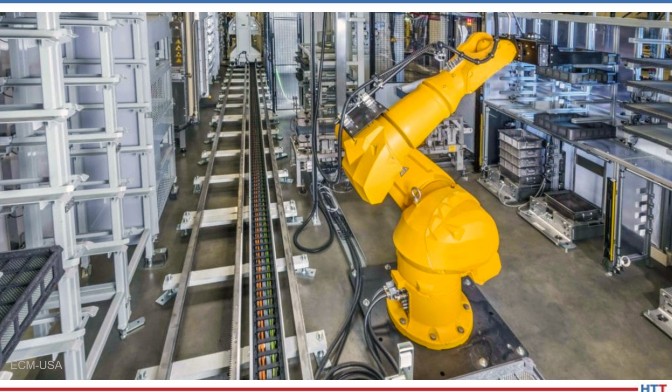
There are also ways of putting tape down or some other line in the concrete where the AGV can follow. Those methods are out there for AGVs. Usually, the AGVs are used in some of the situations we’re into right now. They’re used to promote the accurate takt time through the plant. Whether they need a part every 20 minutes or every 10 minutes, it’s well designed in that fashion. There are usually tracks or pallets that are on these AGVs that move from machining center to heat treat center to post-machining heat treat center. Those things are very much out there. AGVs have, also, grown leaps and bounds, as well, in their own right.

As far as the robot being stationary or, as you spoke about, working together with other operators in a collaborative fashion, both of these methods are being used, of course. But we still see that the larger, single-arm robot, let’s say, can be multifaceted.

In other words, we can have 3 or 4 handling devices or grippers, as we would say, on the end of this robot. It could be picking up a part, then picking up a tray, then picking up a full load, with the same gripper or same handset that’s on the gripper. These are multifaceted robots. You’re not really looking at every time you need to pick up a different part you need to have a different tool. That’s what’s being done with those, as well as trying to reduce the footprint and making a much safer robot system with the collaborative design where, if you touch it, it stops. In addition, robot programming, also, has become far less tedious, let’s say, or far less required from a specific person to do the programming.

"In other words, we can have 3 or 4 handling devices or grippers, as we would say, on the end of this robot. It could be picking up a part, then picking up a tray, then picking up a full load, with the same gripper or same handset that’s on the gripper. These are multifaceted robots."

DG:  And you mentioned the word I wanted to ask you about which is probably the hot topic, and we’ll have to make sure the lawyers get involved here. What about safety? It’s not just the mobile AGVs, I think you said, that are afraid of running somebody over or hitting somebody, but it’s also these stationary ones that have moving parts. Are there any safety concerns? What can you tell us about the safety and the advances in safety?

DB:  Well, of course, safety is always a very, very important part. We’re trying to eliminate workers by not having to pick these parts, but we still need to be safe in that environment. There are a number of ways. A lot of people are trying to get away from the full cages with light curtains and those kinds of things. Using the collaborative robots, where they’re touch-sensitive and can be shut off instantaneously, are probably the best way to go. With the AGVs running through the plant, there are a number of sensor systems on those AGVs that would stop them, as well as they move at a very slow pace, as well, throughout the plant.

There are a number of safety devices depending on the installation. Whether it’s a stand-alone system or it’s something working collaboratively with a person, safety is always important and can be working, l would say, much more advantageous these days with other workers.

DG:  In one sense, there are people who resist robotics because they may be afraid of it replacing people or hurting people and things of that sort, but in a sense, the whole advantage here is that ultimately it is better for the human worker to have these machines doing it. Typically, the robotics are taking away some of the redundant, tedious work. Would you agree with that?

DB:  I agree and that’s typically what we discuss with the customers. It’s where in your plan do you have difficulty hiring people to work? I would say 90% of those customers answer: I can’t hire anybody for a long period of time when they’re taking the part from a bin and putting it in a fixture or taking a part out of the fixture and replacing it in the bin properly. They say that those people last a few months, and they move on. The worst case is if you have someone that’s been there a long time and you put them in that position, it’s a negative for them. They finally feel like, “okay, they’ve got something on me and I have to go down and build loads.”

Like you said, people are thinking about robots and they’re a little bit hesitant, but I would say that, and maybe you’ll get to this question but, it’s more the possibilities and the way people think about robots. I would have to say the most that I’ve heard, especially from heat treaters, is, “Well, it’s not going to do what I need it to do.” “I can’t use a robot because I don’t have that many of the same part every year.” Really, that is changing. What we’re planning on doing is having a demo site here, hopefully before the end of this year, where we could have certain bins of parts and show how, with vision, we can pick up different parts and put them in heat treat loads and move them around.

DG:  Let’s go there because that actually was a question I wanted to ask: To a certain extent, we’re limited in our willingness to use robotics because we’re probably limited in our understanding of what they can do. I’m quite sure, as much as ECM has dedicated resources to developing current capabilities, there are some dreamers in your group that say, “You know, we could get robots to this if only someone would say ‘okay’.” Can you share with us maybe some of the things that you are currently doing that are a little "cutting edge" or at least useful to our captive heat treaters? And also, some of those things that could be done? I’m curious as to the extent of where we might be able to go in the next 10 years.

DB:  I am, even myself, learning as we go along, as well, of the technologies that are out there. What I’m impressed with robotics is they not only help once they’re installed, but before the concept is even put together. I’ve put on VR glasses and walked through a heat treat and you can understand exactly what the robot’s function is, what it sees, where it goes. We can actually also walk through a furnace installation and see what the height of everything is, what the level of everything is, how it moves around. Those are some of the applications even before you get the robot installed.

The other possibilities that people do think that “Oh, this is going to be expensive, first of all." They think it’s not going to work on my parts in my situation. There will be some concessions that everybody is going to need to make. For instance, the heat treat fixtures, maybe the ones that are really warped, you’re going to have to not use those as much anymore. Or, you may have to a more standard basket or a more standard fixture for all the parts. You may not get your million parts in one load (like everybody wants to get), but you would get them done more efficiently and faster.

Some of the applications we’ve done where we’ve taken very thin ceramic material and put it on setters and put them in some brazing furnaces and sintering furnaces, and then move the loads around, unstack the load, stack the load, restack the load, and done that all completely in a robotic cell, without touching the parts, ever. And then, as the parts come out, they’re electrically tested to make sure they’re good.

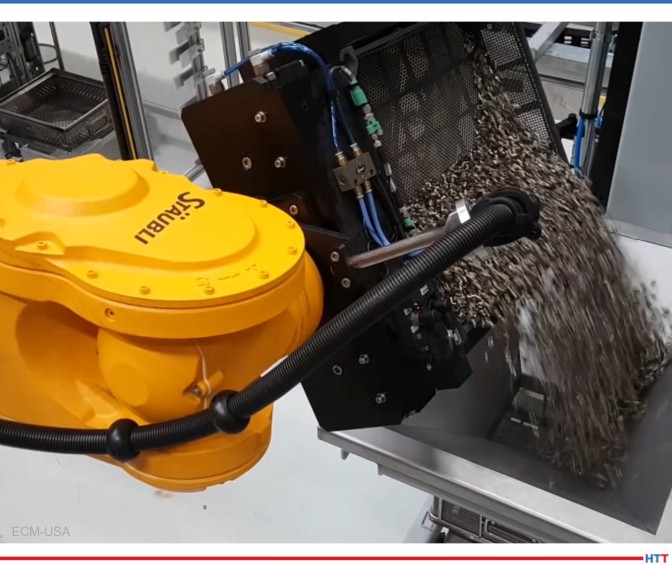
Like I said, in this other application or several other applications, we’ve also done bulk filling of CFC fixtures. You would have a CFC fixture that needed to be bulk loaded with small pieces, we actually have them go through a vibrating machine, fill the CFC fixture to a certain level, the robot comes over and puts a screen on top, moves the CFC fixture onto a heat treat load and does that continuously.

DG:  Is that done by weight or by vision?

DB:  Both. Because you can have the weight, but you may not have it even.

DG:  Right, the distribution -- it would vibrate it out until it’s acceptable and then the screen would come in.

DB:  Exactly. And, like I said, the possibilities of heat treat robotics is what it’s coming down to. Heat treat robotics, today, is to educate and have everybody understand that it is and could be capable of taking flat parts out of bins and putting them in fixtures properly and removing them and doing the reverse action. We need to educate people that these things are available out there. And it doesn’t have to be any particular type of furnace or any particular type of size of load of the furnace, it is a matter of setting up a station, maybe a loading/unloading station that you might have an area in your plant, to do the robotic handling of it, with our expertise in heat treating, understanding the facets of what happens to the parts and the fixtures during the heat treat process.

Those are the kinds of things that we see. Like I said, right from the design of the system and the layout, understanding how everything is going to work on a VR standpoint, all the way to implementation in a facility that takes in many different parts on a daily basis and processes them. I think that’s true to form in what’s moving forward in robotics today.

DG:  I want to throw this one at you and see what your input is on this:  Let’s think about robotics for the whole way through a process. I want to think, just for a minute, about a mesh belt furnace, let’s say. I know you guys do a lot in vacuum and things of that sort, but it could be the same type of thing.

Could we use, on the frontend, robotics to do, not only placement of the product, but product inspection, let’s say, making sure it’s a clean surface (with nitriding, for example), making sure impurities are off and things of that sort? I assume we could us robotics on that end to inspect the product, making sure it’s good to go in the basket, then we put it in the basket or in the fixture, goes through the furnace, comes out the other end, is picked up and inspected at that time for whether it be hardness or distortion or whatever, and then placed on where it needs to go. I assume all that’s possible, correct?

DB:  You assume and yes, it is possible. I, personally, haven’t seen anybody install that particular system, but I would love to be part of it. We have designed a system and quoted on a system that was using a mesh belt where the customer of the heat treat department felt that the parts (these were coin-shaped type parts) and it felt better that the parts were processed better vertically rather than just in a pile on the belt.

So, these parts were put in small fixtures on the belt (and this fixture was maybe 6" x 6" and took up a 4'-wide belt) and those were loaded in place very properly and then also on the outside on the outlet of the furnace belt were also unloaded. Then, of course, the design was for them to inspect them by coloration and then also by hardness. And I didn’t share that with you before this meeting, but that was one application that we quoted on and it’s something that is very doable.

DG:  A couple final questions for you: We talked earlier about the companies who, for example, if they high diversity of product and not high quantity of those products, I assume, and you’ve mentioned it, that robotics probably is not as likely to be helpful to them as to a company who has low variability of products but high volume of those products. Do you have any comments on that? For example, a commercial heat treater who does all kinds of crazy things and doesn’t have a lot of any one thing, is it safe to say robotics probably would not be as useful to them?

DB: I would have to say that that is the thought that we’re trying to change. We’re trying to change that thought because I’ve sat at a number of tables during the lunches and dinners at some of these presentations and that’s exactly what I hear from the heat treaters: “Robotics isn’t for me; I don’t do enough of the same part.” In reality, a lot of these robotics systems now are easily programmable by grabbing the gripper and moving it to where you want it to go. And if you have repeatable parts (maybe you don’t have a hundred million of these parts in the same month, but maybe you have ten thousand of them over 12 months) once that’s programmed in the robot, then you have that program for the next time. There may be some initial programming time that you have to apply to it. We don’t see that that is a big downside because the vision system will understand what the part looks like before the robot picks it up. The programming has become much easier and simpler for everybody so that you don’t have to have a big staff just to take care of the robots.

I think that’s the other misnomer that companies have is that if I get a robot, I not only have to pay for the robot, but I must have the five support-staff for that robot, when, in fact, that is not something that’s becoming a thing. In one of the cases, the same person that was talking about the quality of the robot was also talking about the excitement of his team to work with the robot and to be able to learn to program that robot, and that being their job rather than loading and unloading the fixtures. To them, that was more exciting and made them come to work, wanting to come to work every day, and was also a lead-in for them to hire more people, to say, “Hey, we’re implementing robotics in the plant and as an opportunity to work in that department eventually or eventually we’ll bring robotics into your department.” There are those incentives, as well, with some of the employees.

DG:  You may have hinted at this before: You’re saying that programming of the robots, sometimes, can be as easy as showing it what to do by moving it, saying, “Here’s what you do: Grab this, put this here, grab this, put this here." That’s as easy as it can be?

DB:  It’s becoming that way, yes. I’m not a programmer, but I’ve seen a lot of demos, as a lot of other people have, but yes, those things are possible. Get it in a general location and then you tweak it a little bit here and there- yes, those things are much easier to do.

DG:  Probably, to say to those who are "robotic doubters," let’s say, it would be good to not assume it’s as difficult as what you might think and to keep an open mind.

Let me ask you this:  You could be a commercial heat treater, but most of our audience or a lot of our audience are the manufacturers with their own in-house heat treat or what we call captive heat treaters. What questions should they be asking themselves about robotics, whether or not it makes sense for them? Is there a list of questions they ought to be asking or considering before they even consider robotics?

DB:  I think that when you’re doing repetitive operations in your facilities, whether it’s captive or heat treat shop, that’s where you get the most benefit from a robotic system, obviously. That’s one thing. The other one is: Are you doing similar operations in that repetitiveness? Are you always building the same type of fixture? Are you always building it for the same furnace load? Those things.

"The more similarities you can get that robot to work with, the more cost effective it becomes. But there are also a lot of benefits to having that robot be very versatile in working with a number of different size furnace loads as well as part dimensions."

The more similarities you can get that robot to work with, the more cost effective it becomes. But there are also a lot of benefits to having that robot be very versatile in working with a number of different size furnace loads as well as part dimensions. I can’t say that there’s a specific set of questions, but certainly would love to work with any customer that has even a thought that maybe they should look into this.

DG:  I think the high repeatability is critical. I would imagine, Dennis, that if they’re dealing with high-value parts, even if there’s not a huge number of them, and they’re looking to eliminate the potential for human error, even if it’s simply in the placement of that product or if they’re looking for single-part traceability, perhaps, robotic systems, definitely, it seems to me, would be also something that would be of interest.

DB:  Absolutely. In-process defects is something that it would be very good at eliminating. Also, as you said, if you were looking for traceability, I can tell you that we can build a robot system that can trace, even if you have 500 parts in a heat treat load, it can tell you exactly where that part came from in the load, where you put it in the load, where it came from and where it went after it came off of the heat treat rack.

Traceability is a good point that I didn’t bring up, thank you for that, Doug. Traceability is really important, as well- we can do that with the furnaces. And that’s for a single-piece part flow whereas a lot of people are going to that method. A single piece gets to the heat treat furnace, not a bin of parts. Then, you can trace every part through the heat treat load and back out of it.

DG:  The other thought I was having while you were talking was, and this may be only in a number of very minor cases, but a lot of times there are situations where a part has got to come out of a hot furnace, it’s got to cool off in order to be moved to the next process — it seems to me with any type of automation, robotics included, you could eliminate the amount of heat loss between furnace one and temper furnace or the next process.

DB:  I think another application is operating press quenches where you’re moving a hot part over the end of a furnace and moving it over to a quench, it’s an extremely hot part that you don’t want to touch. Obviously, there are gantry systems for that and there are a number of robot systems that can be installed to get those people out of those hazardous jobs. Also, in terms of quality because timing is very important, as well.

Photo Credit: ECM-USA

DG:  You mentioned about maintenance of these systems a little bit, or at least the programming of them. I’m assuming maintenance is somewhat of an issue. If there are moving parts and things of that sort, there is probably going to be some maintenance on it, whether it be hardware maintenance and/or software maintenance. Any comments on the amount of money or time that a person would spend maintaining these systems as opposed to maintaining a human being doing those systems?

DB:  That’s a very good question, again, and it should be something that’s part of your machine maintenance. It is a machine tool; it is going to need some maintenance, so it’s part of your maintenance requirements. If people use this same maintenance priority that they do for the heat treat furnaces, thank goodness robots work really well, as well, in hazardous environments. I would say that they hold up very well. Robots have been around a number of years and they’re very industrialized. Maintenance is not as critical as it used to be, but it is, obviously, still required.

DG:  And I’m sure they can handle the environments, too. Hopefully, the environments in the heat treat shops are getting better and not so smokey and oily and that type of thing. I’m assuming that any robots you put in would be able to handle whatever environment it’s in.

DB:  That would be part of the requirements, as well.

DG:  Any concluding thoughts? Anything I’ve missed that you want to hit on, Dennis?

DB:  When you think, “Robotics isn’t for me,” spend a little time and look into it. I’ve been blown away with the technology of today. Look at our cellphones — they aren’t even phones anymore. We use them for many, many more things than just a phone. Robotics have come to be that way, as well. There are so many more things that can be used in conjunction with the robotics to help you get your job done and service your customer appropriately and with good quality parts.

DG:  I’ve got one other question I just thought of: I perceive that a lot of times companies in Europe are a bit ahead of us on technology or at least the adoption of some of these technologies. With ECM, the mothership of which being in France, are you seeing that there is a wider acceptance of robotics from companies in Europe than here in the States?

DB:  I wouldn’t call it acceptance, but there are many more applications and customers looking into it in Europe than there are here, yes. I think that, maybe, we haven’t realized that the people aren’t there we’re not going to find them. Then, I think in Europe, where they realized, even just a few years ago, that they’re just not going to find these people and they need to automate. Or the operators that they can find are not going to get the job done the way they need it to get it done because technology has grown so fast with the quality of the parts necessary, especially with EV products today, dropping a part or having a part nicked by something, or even continuous productivity is important.

So, yes, we’ve seen more in Europe, and that’s another reason we’ve been on the leading edge of this technology and now bringing it to the U.S. in North America in a more simpler fashion with the same people having this inexperience as over in Europe.

DG:  Being somewhat facetious, the other things robots give you that humans don’t is they don’t have to pass drug tests. I’m pretty sure that the robots are okay.

DB:  They don’t have to pass drug tests and they don’t have to get COVID tests either!

DG:  And they don’t miss many days of work!

For more information, contact:

ECM-USA.com

DB@ECM-USA.com (Dennis' email)

336-210-5316 (Dennis' cell)


Doug Glenn <br> Publisher <br> Heat Treat Today

Doug Glenn
Publisher
Heat Treat Today


To find other Heat Treat Radio episodes, go to www.heattreattoday.com/radio .


.

See ECM-USA's listing on Heat Treat Buyers Guide.com


Heat Treat Radio #69: Robotics in Heat Treat, a Conversation With Dennis Beauchesne, ECM-USA Read More »

Heat Treat Radio Reminisces

OCWhether you're a long-time follower or a recent listener, Heat Treat Radio has a history of hits that we're highlighting in today's original content article. Read below to see how this resource for heat treaters developed and check out one of the "Top 5 Most Listened to Episodes" or “Top 5 Short Technical Episodes."


Quick History of Heat Treat Radio

Began in April 2016 by Doug Glenn, publisher of Heat Treat Today announcing the first ever episode: "Metallurgical Posterchildren: Hayley Sandgren." To date, there is a total of 70 episodes that have been released on the podcast.

Over the years, several changes in how Heat Treat Radio presented these interviews occurred. If you've been following the podcast for awhile, you've probably seen the change in images that are used to promote the episode:


Additionally, beginning in July 2018, each episode was published with a transcript: "John Vanas on SX Oil Lifters."

The podcast has also changed in terms of delivery. Heat Treat Radio began with asking guests questions and delivering concise, clear answers. This helped the podcast deliver information to listeners, and you can listen to this yourself if you click almost any episode released before 2020. However, a shift to more conversational content happened over the years so that by 2020, you could tune in and listen to heat treating experts chat back-and-forth with Heat Treat Radio host, Doug Glenn, as if you were taking a walk around the plant with them. Now, the podcast is moving to deliver content in a fully visual form to give you the opportunity to watch and "sit in" to the conversation with them.

A quick run down of some interesting HTR facts (only according to SoundCloud listens) include what types of guests have been featured, how many episodes have been run, and who has been listening:

As a final interesting note, we found that you like to listen to Heat Treat Radio episodes the day or day after they come out; but if there is an episode that is particularly pertinent/relevant to heat treaters -- like "Heat Treat’s Tight Labor Market: Gaining and Maintaining Works with Josh Hale" -- listeners tune in on the weekends and in the afternoons during the week. Sound familiar??

Below, we compiled a series of statistics that may help you select the next episode for your Thursday, Tuesday 2:00pm, or weekend listening session.

TOP 5 MOST POPULAR EPISODES OF ALL TIME

TOP 5 SHORT TECHNICAL EPISODES

  1. Heat Treat Radio: Heat Treat Radio: Thermocouples 101 with Ed Valykeo, Pelican Wire (Part 1 of 3)
  2. Heat Treat Radio: Metal Hardening 101, Part 1 of 3
  3. Heat Treat Radio: A Discussion with David Wolff, Nel Hydrogen, COVID-19 Update
  4. Heat Treat Radio: James Jan & Andrew Martin on Development of Modeling Software
  5. Heat Treat Radio: Ben Gasbarre on Nitriding

Heat Treat Radio Reminisces Read More »

Letter from the Publisher: Supply Chain of Thankfulness — No Shortages Here

Heat Treat Today publishes eight print magazines a year and included in each is a letter from the publisher, Doug Glenn. This letter first appeared in Heat Treat Today's December 2021 Medical and Energy print edition.


Doug Glenn
Publisher and Founder
Heat Treat Today

It’s December. Another year is mostly in the rearview mirror — unbelievable! Second only to COVID-19, America’s embattled supply chain has been top-of-mind for pretty much everyone in the North American heat treat industry. Just yesterday, a frantic heat treater called me asking where he could get a certain type of quench fluid necessary for aluminum processing. His go-to supplier ran out and he was in dire need of enough fluid to completely refill his rather large quench tank. It’s not good when the shelves are bare at the industrial grocery store.

The supply chain troubles will most likely not end soon. After shuttering the economy for nearly a year, we should not be surprised.

Nevertheless, as 2021 winds down, there is MUCH for which we should be thankful.

Thankful for Ancestors Who Fought to Defend Freedom

You’re reading this in December; I’m writing in mid-November, just prior to the oft-forgotten holiday of Thanksgiving. In fact, just yesterday was Veterans Day here in the United States and Remembrance Day in Canada — a time to remember and give thanks for the sacrifices made by men and women who fought to defend their and our freedom. When we stop and think about all the freedoms that we continue to have because of their sacrifice, we should be immensely thankful. Beyond being thankful, I hope many of us will be as brave as them and continue the fight to keep us free from internal and external enemies . . . of which there are many.

Most of the time, defending freedom doesn’t look like war or armed combat. Most of the time, it simply involves saying “no” to the little intrusions that well-intended civil authorities attempt to press on us. It’s not a popular position to hold in 21st century America, but our Founding Fathers, who had a much better sense of the latent evil in ALL men, had a healthy skepticism about those in authority. Get this… they understood that ALL men were sinners (evil by nature) and would tend to use any power granted to them for their own good and at the expense of others. I’m thankful for people who still think like our ancestors and are willing to sacrifice so much for our freedoms.

Thankful for Colleagues and Industry Friends

I’m also very thankful for colleagues and friends in the North American heat treat industry who make being in this industry so enjoyable. There are a lot of very good people in this industry. As I tell many newbies, “There are just a lot of very nice people in this industry. You’ll fit right in!” There are countless numbers of you who invest time and energy into helping others. One of my favorites is Mike Shay. Mike is no longer active in the industry, but for years, he worked for Hauck Manufacturing and was also a fully invested Scout leader. Mike spent untold hours helping young boys mature into thoughtful, freedom-loving men. Mike is just ONE example. There are MANY more.

Although supply chain issues will undoubtedly continue, the one supply chain that will never run dry is the supply chain of thankfulness. Thank you for being a Heat Treat Today reader. And thank you for the time you invest helping others enjoy their time in this great industry. Happy Thanksgiving, Merry Christmas, and Happy New Year! The Heat Treat Today team wishes (and prays) for a good and prosperous 2022 for each of you.


Letter from the Publisher: Supply Chain of Thankfulness — No Shortages Here Read More »

Celebrate January 6th: National Technology Day!

OCWhat’s new in heat treat? A LOT.

Over the past year, we’ve seen numerous new technologies in the way of research, new partnerships, and conversations throughout the industry. So in honor of today being #NationalTechnologyDay, we’re sharing an original content article about just several of these new technologies that are changing the work of heat treaters across North America.


Research

Using HIP to Advance Oregon Manufacturing Innovation Center Programming “‘Today’s globally competitive manufacturing industry demands rapid innovations in advanced manufacturing technologies to produce complex, high-performance products at low cost,’ observes Dr. Mostafa Saber, associate professor of Manufacturing & Mechanical Engineering Technology at Oregon Tech.”

College Students Implement a NEW Heat Treat Solution with Induction? “‘We were in shock,’ Dennis admitted, ‘because we didn’t expect it to [work].’ The expectation, Dennis continued, was that something would go wrong, like the lid would not be able to clamp down, or the container would leak.”

The Age of Robotics with Penna Flame Industries“The computerized robotic surface hardening systems have revolutionized the surface hardening industry. These advanced robots, coupled with programmable index tables, provide an automation system that helps decrease production time while maintaining the highest quality in precision surface hardening.”

New Partnerships

Captive Extrusion Die Maker Levels Up With 11 New Furnaces Heat treaters are leaning into the benefits of nitriding and vacuum technology.

Auto Partner Enters Agreement for New Nitriding Technology As nitriding technology becomes more popular, heat treaters are brushing up on their understanding of case hardening processes across the board. (Read this article comparing 5 common case hardening processes.)

Vacuum Heat Treat Supplier Partners with Neota to Advance MIM Technology Learn how this partnership produced solid and strong metallic parts with near 100% density.

Conversations in the Industry

Heat Treat Radio: Five experts (plus Doug Glenn) discuss hydrogen combustion in this episode. An easily digestible excerpt of the transcript circulated by Furnaces International here and is available to watch/listen/read in full for free here.

Heat Treat Radio: Get on-the-ground projections of what technologies Piotr Zawistowski believes will be bringing in the future. Watch/listen/read in full here

Heat Treat Radio: HIP. The Revolution of Manufacturing, that is, according to Cliff Orcutt. Watch/listen/read in full here

Heat Treat Radio: Will indentation plastometry find its way into North America? If you’ve been listening to James Dean, it seems like it already has. Watch/listen/read in full here

Heat Treat Radio: Fluxless inert atmosphere induction brazing. That’s a mouthful! But what is it? Watch/listen/read in full here

Learn More About New Tech!

Everything You Need to Know About HIPing eBook

Metal Hardening with Mark Hemsath Podcast

Stories About Heat Treaters Implementing New Hardening Methods Article


Celebrate January 6th: National Technology Day! Read More »

Skip to content