As the demand for heat treatment technologies continues to grow, an auto and hydraulics components maker expands heat treating capabilities with HTC Group purchase.
Tenova, of the Techint Group, recently sold its HTC Group, which includes four companies specializing in advanced technologies for heat treatment processes for components. They are: IVA Schmetz (Germany), Mahler (Germany), Fours Industriels B.M.I. (France) and IVA Schmetz Industrial Furnaces (Shanghai) (China).
The purchasers are Qizhi GmbH and Shanghai Qizhi Information Technologies Co., Ltd., both members of Ningbo Qijing Holding Co. Ltd. Ningbo Qijing is also the parent company of Qijing Machinery Co. Ltd., which is involved in the research, development, manufacturing, and assembling of mechanic systems and precision parts mainly operating in home electric appliances and industrial applications, specifically in automotive, power tools, and hydraulics.
“As an experienced company in supplying precision parts for different industries, we recognize in the heat treatment one of the most critical process for precision machined parts. We believe that HTC group, with its expertise and product range, has the potentials to gain space and relevance in growing sectors, especially in the Chinese market,” affirmed Wang Yongqi, Chairman of Ningbo Qijing Holding.
During the day-to-day operation of heat treat departments, many habits are formed and procedures followed that sometimes are done simply because that’s the way they’ve always been done. One of the great benefits of having a community of heat treaters is to challenge those habits and look at new ways of doing things. Heat TreatToday’s101 Heat TreatTips, tips and tricks that come from some of the industry’s foremost experts, were initially published in the FNA 2018 Special Print Edition, as a way to make the benefits of that community available to as many people as possible. This special edition is available in a digital format here.
Today we continue an intermittent series of posts drawn from the 101 tips. The tips for this post can be found in the FNA edition under Hardness Testing, CQI-9 Compliance, and Hardening/Tempering.
Heat TreatTip #22
Properly preparing a hardness sample can save time and money.
Inspection Mistakes That Cost
Rockwell hardness testing requires adherence to strict procedures for accurate results. Try this exercise to prove the importance of proper test procedures.
A certified Rc 54.3 +/- 1 test block was tested three times and the average of the readings was Rc 54 utilizing a flat anvil. Water was put on the anvil under the test block and the next three readings averaged Rc 52.1.
Why is it so important that samples are clean, dry, and properly prepared?
If your process test samples are actually one point above the high spec limit but you are reading two points lower, you will ship hard parts that your customer can reject.
If your process test samples are one point above the low spec limit but you are reading two points lower, you may reprocess parts that are actually within specification.
It is imperative that your personnel are trained in proper sample preparation and hardness testing procedures to maximize your quality results and minimize reprocessing.
Whether you need to meet rigid CQI-9 standards or not, what are the top 3, nay 4 best practices that nearly every in-house heat treat department ought to follow to make sure their pyrometer stuff is together?
Daily furnace atmosphere checks. Use an alternative method to verify your controls and sensors are operating properly and that there are no issue with your furnace or furnace gases.
Daily endothermic generator checks. Using an alternate method to verify your control parameter (dew point typically) or the gas composition is accurate will alleviate furnace control issues caused by bad endothermic gas.
Verify/validate your heat treat process every 2 hours OR make sure process deviations are automatically alarmed. this is a solid practice to ensure your controls and processes are running properly. This practice can help ensure that parts are being heat treated to the proper specification intended.
Conduct periodic system accuracy tests (SATs) per pre-defined timelines in CQI-9. Good pyrometry practices are an essential part of heat treatment. Because of the importance of temperature in heat treatment, ensure timeliness of all pyrometry practices addressing thermocouple usages, system accuracy tests, calibrations, and temperature uniformity surveys.
Control of Back Tempering With Induction Heat Treating
Induction heat treating is a selective hardening process. When hardening an induction path close to an area that had previously hardened, the heat from the hardening the second path tempers back the area that was previously hardened. This is a particularly common issue when tooth by tooth hardening of small gear teeth. Back tempering will reduce the hardness on the adjacent area and this effect may range from a few to over 10 HRC points.
Factors to Minimize Back Tempering
Process Issue
Questions to ask
Correct & repeatable placement of quenches
Can quench position be verified and set up repeatedly in the same position?
Verification of quench flow
Is the quench flowing freely through the quench system? Are the quench holes blocked? Are the flowmeters reading accurately?
Integrity of the quench
Was the percentage polymer measured? Is the quench quality okay? Is the quench contaminated?
Inductor design
Is the inductor designed to minimize heat on the tip? Is the quench effectively cooling the part?
Retained heat
Is a skip tooth hardening pattern being used to minimize residual heat in the induction hardening zone? Is the scan speed appropriate?
Welcome to another episode of Heat Treat Radio, a periodic podcast where Heat Treat Radio host, Doug Glenn, discusses cutting-edge topics with industry-leading personalities. Below, you can either listen to the podcast by clicking on the audio play button, or you can read an edited version of the transcript. To see a complete list of other Heat Treat Radio episodes, click here.
Audio: Mark Hemsath on Nitriding & FNC
In this conversation, Heat Treat Radio host, Doug Glenn, an interview that Doug Glenn, publisher ofHeat Treat Today and host of Heat Treat Radio, conducted with Mark Hemsath, director of nitriding and special vacuum furnaces with SECO/Vacuum Technologies, which is a SECO/WARWICK group company, located in Meadville, Pennsylvania, where he oversees nitriding, including ferritic nitrocarburizing (FNC), and also other surface engineering such as carburizing. Doug talks with Mark about nitriding and FNC.
Mark recently completed his paper for the ASM Heat Treat Show 2019, titled “Nitriding, Its Growth and the Technologies That Have Cemented Its Broad Use in Surface Engineering”, to be presented at the ASM Heat Treat Show in October 2019. In this podcast, Doug and Mark discuss why nitriding has become popular, what is nitriding and what processes does it entail, the new technologies affecting the industry, and major players in processing and supply.
Click the play button below to listen.
Transcript: Mark Hemsath on Nitriding & FNC
The following transcript has been edited for your reading enjoyment.
Mark Hemsath, director of nitriding and special vacuum furnaces, SECO/Vacuum Technologies
Are you a hard case or a case hardener? If you’re a case hardener, you might be interested in today’s episode. If you’re a hard case, well, there are other self-help podcasts you might want to consider. On today’s episode, we’re going to talk about nitride, and we’re going to talk with one of the most qualified individuals in the North American heat treat marketplace. This guy has nitriding and heat treating running in his blood.
Mark Hemsath (MH): My father was involved with a furnace manufacturer in Toledo, Ohio, and he actually brought ionitriding to the United States from Kluckner in Germany. I think, at last count, we think he had 65 patents under his name.
Doug Glenn (DG): Hi, and thank you for joining us. I’m your Heat TreatRadio host and Heat TreatToday publisher, Doug Glenn. Today on Heat TreatRadio, we’re talking nitriding with Mark Hemsath.
MH: Hi, I am Mark Hemsath with SECO/Vacuum Technologies, which is a SECO/WARWICK group company, and I am the director of nitriding and special vacuum furnaces. I am involved with everything to do with nitriding, including ferritic nitrocarburizing, and also other surface engineering such as carburized.
DG: If you have an interest in surface hardening, such as nitriding, ferritic nitrocarburizing or carburizing, you might want to take a quick cybertrip to www.heattreattoday.com where we have a substantial and growing list of resources that might be helpful to you. Heat TreatToday is one of the industry’s leading information sources for all things heat treat-related. Every Tuesday, we post a new technical article. We call it Technical Tuesday. And Heat TreatToday is the only North American-based heat treating publication offering a comprehensive list of heat treat consultants. So, if you’re a manufacturer with in-house heat treating, especially in aerospace, automotive, medical, or energy, or even general manufacturing, and you’ve lost a good bit of your organizational heat treating brains, take a look under resources on Heat TreatToday’s website, or simply Google “heat treating consultants”, and you’ll find a comprehensive list of heat treat industry consultants that can help you solve your pressing heat treating problems. Look us up on the web at www.heattreattoday.com.
Let’s get back to Mark Hemsath and our discussion on nitriding.
DG: Mark, we’ve been trying to connect for quite a while. I’m really glad we were finally able to connect.
MH: This is a perfectly opportune time to do this because I just finished my paper for the ASM Heat Treat Show, so it is all fresh in my mind.
DG: Interesting! What is the paper?
MH: My paper is “Nitriding, Its Growth and the Technologies That Have Cemented Its Broad Use in Surface Engineering”. It will be presented at the ASM Heat Treat Show in October.
DG: Hey, heat treat readers, the show Mark is referring to is being held on October 15 – 17 in Detroit. You can find out more about that show by Googling “2019 Heat Treat Show Detroit”, or by going to www.asminternational.org and searching for it there. Now, back to Mark.
Why Nitriding?
Let’s jump into the nitriding market. What are you seeing? I’ve been hearing more and more about nitriding. How about you?
MH: I think the main thing is that nitriding is growing, and it is still growing rapidly. It has grown in the past number of years, and that is one of the reasons I just wrote a paper, which is very opportune to discussing why it’s growing and why it has gone up in use in the market.
There are a number of points that I probably should point out as to why nitriding is growing: I think more and more people are discovering the positive effects of nitriding. This would include the very high surface hardness that you can get. The higher temperature hardness—in other words, it resists tempering—a carburized-type surface or an induction-hardened surface if it’s used at temperatures above the tempering temperature, it would start to reduce its hardness, whereas nitriding is done at a higher temperature (it’s done above 900° or 1000° or so F), so you would resist the decrease in hardness up to those temperatures, which is pretty nice. Also, it gives you the ability to have a high fatigue strength. The nitrided layer actually will change the fatigue properties of the metal part. Another thing that everybody usually talks about is the improved corrosion resistance. This is something unique to nitriding. It is used a lot, especially ferritic nitrocarburizing, for corrosion resistance. And the final thing I wanted to talk about is the minimal process distortion. If you compare this to carburizing where you are quenching the part, because you’re coming from the austenitic region going into the quench bath and it’s cooling very rapidly, there is a chance for your part to distort, which means you may have to follow on process it to get it back into dimension. Nitriding has a lot of benefits to it.
DG: Interesting, Mark. These seem like some pretty compelling reasons to nitride, but one of the objections I hear is that nitriding is a more expensive process. Your thoughts?
MH: It is not really as expensive as you think, because you have to take into account certain things. Let’s take carburizing, for example, or just thru hardening, for instance. You’ve got to quench it, you’ve got to wash it, and you’ve got to temper it. If anything goes wrong in that process, you’ve got to do some sort of follow on processing. You probably won’t need to do any of that after nitriding. Now, you will need to change probably some of the material and the alloying properties, but we can get into that later.
DG: Yes, fine, but perhaps a little clarification is in order. We’re talking about nitriding, but we often hear the phrase “ferritic nitrocarburizing.” Can you help us understand the difference?
MH: Yes. It is a nitriding process, but it is typically done with lower carbon materials and that is why they put carbon in there, too, so that is where they get the nitrocarburizing into the process. It is typically done at a little bit higher temperature because you’re not as much worried about the thru hardness property or the tempering properties. What you’re trying to do is to take a less expensive material, whether it’s a cast iron or inexpensive steel, and you’re trying to get a nice white layer around there, or a combination of white layer, commonly known as a compound zone. It’s a combination of epsilon and gamma prime. You can create different layers, and the carbon is going to help you with that by creating it faster and creating it a little bit harder. What that’s going to do for you on that part is give you lubricity; because of the nature of the white layer, the compound zone has a lubricious nature to it. It will give you corrosion resistance and give you that wear resistance that everybody wants in those parts.
Where Is Nitriding Being Done?
DG: So where are nitriding and FNC being used today?
MH: Today nitriding thankfully is being used everywhere. It is actually being used where chrome used to be used, such as rods for hydraulic systems. This is a post-oxidized FNC that comes out black, and it is a very nice replacement for chrome. In the automotive industry, FNC is very popular because they use cheaper materials, and it prevents not only wear and denting, but it also offers corrosion resistance for a lot of the parts, which is nice on cars. This is actually how FNC got involved with the brake rotors. On brake rotors for cars, they used to paint them. The problem was, as soon as the car got moved from the truck onto the lot and the brakes were stepped on, it would wear the paint off and start rusting. People would complain there was rust on the brakes and they hadn’t even bought the car yet. What they discovered was that if they ferritic nitrocarburized the cars, they would not get that kind of rust on their brake rotors. So that was helpful. It also provides incredible wear resistance against your brake pads.
Nitriding is also used in gears. I mention that because you have minimal or no post grinding. In aerospace, it’s used all over. They like the wear properties and corrosion. A lot of parts stay in planes for years and years and years, so they don’t want the corrosion.
Something I learned recently in the last few years in regards to the oil and gas industry, is that oil and gas are pumping a lot of stuff. They are fracking, they are pumping water and brine, and they have a lot of slurries that cause a lot of wear in pumps and pipes. It is very caustic. Nitriding works very well to extend the life of those parts.
In a lot of large parts, they plasma nitride a lot of stamping dyes—again, because it gives you dent resistance, and it’s going to give you more life on that dye because you’re stamping metals or your hot stamping forgings, etc. There are a lot of reasons to use nitriding.
DG: Are you hearing of companies converting some of their carburizing processes to nitriding or FNC?
MH: There is a lot of effort in that area. A lot of engineers don’t know about it, but they’re starting to become more aware of it. Of course, a lot of materials and components out there are already pre-engineered, and they’re already done, and now we’ve got to thru harden it, and we’ve got to carburize it. It takes a good engineering group to understand the differences and that is part of the education process. That’s why I’m happy to do this with you today. It’s an effort to try to get more people up to speed and for the engineers and component people to say, “Yes, I can do this with nitriding,” and can understand what can be done.
You can do this with gears, for instance. We’ve done it many times, and people are starting to specify it. You can do FNC of gears, and you can do nitriding of gears, too.
DG: So, it can be done. Understood. But are you hearing of any examples of where it is actually being done?
MH: It is being done more and more in motor transmissions; [that’s] where I got word of the fact that one automaker with a ten-speed transmission was going to have three or four of the gear sets be ferritic nitrocarburized versus carburized. An offshoot of carburizing is carbonitriding. Carbonitriding is basically the same thing as carburizing except that it is usually a shallower case and they use a little ammonia in there to get a little bit harder surface. However, you’re going to get distortion on that. There are a number of parts that you can change the chemistry of the steel. Although you’re paying more for the steel, you can ferritic nitrocarburize it and get the similar properties that you’re looking for for that wear component.
DG: So you’re paying more for the base steel, but you’re paying less for the post-processing of it?
MH: Yes, potentially, because you don’t need to rework it because of distortion. A lot of parts are hard to quench and not get them to move, especially small parts or flat parts. At SECO/WARWICK, we also make rotary retort furnaces. You can do washers in there, but when that washer goes into the quench, it’s going to enter at different angles. But nobody wants to take washers and individually line them up so that the edge goes into a quench. It’s just too expensive to do that. So you’re going to put up with a certain amount of distortion on that material that you’re quenching, and then have to figure out how to deal with it afterward. With ferritic nitrocarburizing, you wouldn’t have to worry about that, because there is no quench and there is no distortion.
DG: Carburizing and carbonitriding both have quenches, whereas nitriding and FNC do not require quench.
MH: Correct. Nitriding and FNC are all done typically below 1100°F, and there is no quenching. It is always a slow cool.
DG: And, therefore, we are avoiding distortion.
MH: You’re not putting it into a liquid, whether it’s a hot oil or what have you, you’re not putting it into a liquid to cause that rapid cooling, correct.
DG: And it’s a slow cool for nitriding and FNC.
MH: Yes. Nitriding will give you some growth. We typically predict, let’s say a white layer which can be all the way up to 25 microns, usually running in 10 – 25 micron range. About 60% of that will result in growth, but it is very predictable. If the engineer is worried about the size, they can put that into their stack up in how they machine it initially. You’ll get a very small growth of the material from nitriding. I think it’s in the 10,000th range, absent the white layer.
Nitriding: Gas or Plasma
DG: When I think of nitriding, I think of several approaches such as gas or plasma nitriding. Would you explain the differences?
MH: There are four major different types of nitriding. There is gas nitriding, which is an area that I play in very heavily. There is plasma nitriding, also know as ion nitriding. There is liquid or salt bath nitriding, and there is even nitriding done with fluidized beds.
Let’s go through them quickly. I’m not going to talk much about liquid that is done in salts. It is a very old process, but not a bad process. The problem that I have always found is that people don’t want to own this equipment because of all the hazards with salts, the disposal, and everything else. It is not a bad process if you’re willing to own it and run it; you can do some great things with it.
Fluidized bed is an older technology. It’s a little different. You’ve basically got particles that are being fluidized which allow heat transfer. There is an art to running and using it, but it is certainly a process that can have very good results. A long time ago, I was involved with a company where we helped them create a new fluidized bed technology. It is still being used; it just never really has taken hold that well in this country. There are some old systems out there, however.
I actually started out my career in ion and plasma. When I was in college a long time ago, in the early 1980s, I translated German to English from the German technology which was created by Kluckner. This came to the US, and I was helping the engineers to translate what they were talking about. My paper, that I was just in the process of writing, talks about some of this, and I plan on doing a webinar in the near future and talking more about this. There are some really nice benefits to plasma. This is well-documented in the literature, but there are ones that I point out that are different than some of the other processes. You have what they call sputtering. The effect of the plasma can help clean up the surface of the material. If you have some oxides, this is very beneficial if you’re doing some type of stainless which can have some problems.
Another thing that plasma is very good at is masking. A lot of times, there are parts that have a lot of threaded holes or areas where they don’t want nitriding. They might weld on it. It is very easy to mask with plasma nitriding because you can mechanically mask it. What that means is that if you have threads, you can just put a little bolt in there and they won’t get nitrided. If you have a surface, let’s say a piece of pipe, you can take some shim stalk of metal, wrap it around there, and you won’t get any nitriding where that metal is. It will nitride the metal piece that you put on there, but it won’t nitride what’s below there. So it is excellent for masking.
The other thing with ion nitriding [is] why it was popular. It’s still popular, but gas nitriding has overcome some of the negatives that it had in the past. But ion nitriding is what’s known as a low potential process, so by nature, it has a low nitriding potential. What that means is, it is difficult to get thick compound zones or white layers because the potential is fairly low. So people that wanted to nitride parts would use ion nitriding if they didn’t want the white layer to come with it. At the same time, FNC is harder in the plasma and post oxidation is a little more difficult. The equipment is not really designed to do those processes. The other thing is that the parts need to be individually placed and very nicely placed within the furnace proper, so there is more set-up work involved. But, in general, it does a wonderful job. One thing I say in my paper is once you own the equipment and you have some loads that you’re doing, you can get very repeatable results if you do the same thing every time.
The last one is gas nitriding. We actually have a process called zero flow, but it is just ammonia. Like any other process, it is a control method. What is happening with the gas nitriding today is that the advance of controls has allowed you to do a lot more with nitriding to get you similar properties than what you can get in ion. Plasma has come a long way, too, because the controls took forever to catch up with the technology. There were a lot of issues, which I discussed in my paper. Gas nitriding has seen the same type of issues. When I was in college, the computer chip was called an 8080/8086. They weren’t very advanced and they were just getting microprocessor technology and it took decades before all of this stuff got into the industrial equipment where it needs to be.
Fast-forward to this decade, 2010 to 2019, there have been tremendous advancements in the microprocessor and in electronics. For gas nitriding, we need to measure hydrogen because it’s a way for us to estimate nitriding potential. Today, that is very reliable and you can do it in situ, which means you can do it right in the furnace and get very accurate readings and you know where your nitriding potential is. The trick to gas nitriding and to doing precision gas nitriding [is] being able to craft a layer that you want. The layers are a combination of epsilon, gamma prime, and alpha. In order to get the layer that you want, first of all, you have to look at the literature and know what you’re doing. But you have to have equipment that can get you there. Today’s control systems can get you there and craft the layer that you want.
Quite frankly, the nice thing about gas nitriding is the loading can be ugly. In other words, it doesn’t have to be prim and proper like it is with ion nitriding. You can put a bunch of things into a basket, then put another basket on top of that and another one on top of that, put a lot of weight in it, and you don’t have to worry about the parts necessarily touching each other or the wire mesh that they’re sitting on or the basket. It’s going to get very well nitrided. That is not the case with ion. It’s much easier to own the equipment once you have it. Obviously the negative is that you’re using a gas (ammonia), it costs money and you have to store it and use it.
New Tech in Nitriding
DG: I want to cover two other major areas. The first one is new technologies in this field, and the second is a brief conversation of the major players. What can you tell us about the new and/or interesting technologies in this field?
MH: With plasma nitriding, they’ve been able to do a few things there. Mainly, they’ve been able to get better power supplies, pulse plasma, and they also obviously have gone to hot wall heating. That means they don’t have to heat with the plasma anymore. On the power supplies, they always had problems with arcing and a chance to burn some holes in it or pit some surfaces if you didn’t have the right power. And again, the microprocessor control that I talked about before had gotten so good, that they now have DC pulse plasma that is very fast-acting and can sense any problems within the process, and you can control it very closely. I think most people in the plasma arena have found that technology and are using it.
Gas is a little bit different. There are a lot of things going on in gas. Many, many years ago there was a process of controlling nitriding potential only by diluting with nitrogen and that was done by one of our competitors. We have a process called “zero flow” where we don’t use nitrogen. Other people will dilute with disassociated ammonia. The problem with that is that you have to buy an ammonia disassociator in order to introduce the disassociated ammonia. The reason you introduce disassociated ammonia instead of nitrogen is you’re able to much better calculate and measure nitriding potential. With a nitrogen dilution, the calculations are different, they are much more complex, and you need a lot of experience to get similar or same results that you would get with either zero flow process or with disassociated ammonia dilution.
There is some other neat stuff going on out there that I’ve gotten involved in and that we’re trying to get moving at our company, and there is a lot of stuff out there in the literature; it’s called oxi-nitriding. I’ve heard it used both for post-oxidation and for a part of the nitriding process. Oxi-nitriding to me is not post-oxidation. Oxi-nitriding is the injection of some sort of oxygen source early in the nitriding process with ammonia so that you can do some things to the surface of the steels. Let’s say with a 300 series stainless, what you’re trying to do is break apart oxygen bonds. That is pretty well proven in the literature that you can do that. It’s probably a little cleaner way of doing it than what other people do for those stainlesses and which we also do is put some sort of a chloride in there to break the bond so that you can nitride some of those more difficult stainless steels.
The other thing that people are doing and they’re doing it differently is-post oxidation. This is giving that black color. You can do that with water or you can do it with nitrous oxide which is laughing gas. And there are different temperatures you can do it at and different depths of it. We talked before about having the effect of a white layer compound zone and that helps with corrosion resistance, but we’ve also found out that putting a post oxide on it not only gives it a nice color, being a darker, near-black color, but it also helps with the corrosion resistance. On top of that, you can develop a layer that has a certain amount of porosity, and you can impregnate that with oils and that will give it even more corrosion resistance. In industries where this is very common is hydrolic cylinders, a typical front-end loader, agriculture equipment, snow plows, etc. These are usually chromed. But a lot of manufacturers are finding that a black ferritic nitrocarburized surface with post oxidation—and then they’re using oils in the cylinders anyway—will give you better wear property from the chrome and will give you very nice corrosion resistant properties. And I think it is probably a little less expensive. A lot of people are moving to that. If you see cylinders with black instead of chrome, that’s what’s happening.
Players: Processors and Suppliers
DG: Let’s move on to major players in the industry. First, who are the major players that are actually doing the nitriding?
MH: I probably can’t list them all, but as you mentioned I used to work for Advanced Heat Treat Corp. They are a very large commercial nitridor in the Midwest, and they get work from all over the country. Obviously, another big heat treater out there is Bodycote. By definition, they do quite a bit of nitriding. Nitrex Inc. makes competing furnaces against us, but they’re actually a very big nitriding house out there, and they’re probably much bigger in the nitriding than they are in the equipment business, so they’re very well versed in doing the nitriding. There is another company in Indiana that’s been growing greatly, and it’s called Advanced Nitriding Solutions. There is Ionic Technologies Inc. in South Carolina that do quite a bit of nitriding that would also be ion and gas. What we’re seeing a lot more of is that people that really are in nitriding are doing gas nitriding and they’re doing ion nitriding. They understand that nitriding is a great process and they’re trying to offer that to everybody.
The other thing is a lot of heat treat shops do just ferritic nitrocarburizing, which I call the “poor man’s nitriding.” It’s hard to screw up ferritic nitrocarburizing. If you get enough ammonia in there and you put some carbon in there, you’re going to get some sort of a layer.
DG: And how about the nitriding equipment suppliers?
MH: There are a number. There is Ion Heat. I know those guys pretty well and they are a nice little company and have some new technology. There is RUBIG, which is a big company. I’m sure there are other ones out there, but those are the main ones right now playing in the US market for plasma nitriding. RUBIG has gotten into gas nitriding, so they do offer some designs there. I think what they do is mostly pit nitriders. I break the gas nitriders into guys doing front-loading (which looks more like a regular batch furnace) versus pit. There is nothing wrong with doing pit furnaces. Both furnaces, front-loading or pit, work very much the same. They have a fan, they’ve got a retort typically, and they try to keep the parts uniform that they put the gases in. The thing with the pit is, you’ve got to have a pit. What’s nice with the pit is you can usually load it heavier. So for people who really want to have high production, like when I was at the commercial heat treater where I was, they liked the pit design because you could load them up a lot heavier. Guys doing more precision nitriding typically want the front load. It’s more like a vacuum furnace or a batch furnace within the building, etc. Companies out there for this, as I mentioned before, are Nitrex—long ago we actually used to build their equipment, so our equipment looks very similar to theirs because we designed it; SECO/WARWICK, as I mentioned makes zero flow; Lindberg/MPH makes a pit design. I think they have not gone too much into the advanced controls. They do a lot of single-stage nitriding. Other companies out there like ALD Thermal Treatment Inc. have come out with a front load. There is KGO which has a front load. And there are a lot of new entrants in the market. It’s getting kind of crowded out there. A lot of people with not a lot of experience, but I guess they have a hammer, a welding wire, and some duct tape and they’re making furnaces.
DG: Hey readers, you can hardly blame Mark for that answer. It really wasn’t a very fair question to ask him to list all of his competitors, but he did a pretty good job. But since a good solid list of suppliers might really be helpful to you, we’re going to do two things. First, I’m going to briefly round out the list here and now. I’m sure I won’t get everyone, but we do know for sure that companies like Surface Combustion, Gasbarre, and Tenova are also making nitriding furnaces.
And since I’m sure there are others, we’ll provide a more complete list of nitriding furnace manufacturers in the transcript of this episode. You can find that transcript by Googling “heat treat radio mark hemsath”, and we’ll keep an updated list of manufacturers listed there.
DG: Final question, Mark. If someone wants to learn more about nitriding, what resources would you recommend?
MH: There are a lot of good resources online. There are a few people in the industry that are extremely well versed. A good friend and associate, Daniel Herring, is called “The Heat Treat Doctor®,” and he knows all about heat treating. There is also my friend, Edward Rolinski, who is still at Advanced Heat Treat who’s very well published and you can look for his papers. A general flow developer and also fairly well published is Leszek Maldzinski.
Daniel Herring,“The Heat Treat Doctor®
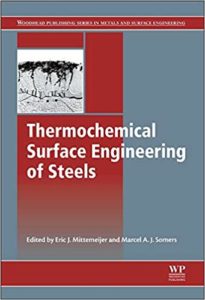
There are a couple of guys that have been working in nitriding their whole lives and they are prolific writers, and that would be Marcel Somers and E.J. Mittenmeijer. There is actually a book that they put out in 2014 called Thermochemical Surface Engineering of Steels. That book contains articles by Maldzinski, Rolinski, and other people that I mentioned, but it talks about carburizing, ferritic nitrocarburizing, plasma, and gas. It’s a really great resource. It cost a few dollars, but you can also get it electronically. It is highly technical.
You can go to some of the magazines out there—Heat Treat Today, Industrial Heating continually does some small articles, and the gear guys out there publish some articles. There is a lot of stuff out there and you can find most of it on the internet.
Doug Glenn, Heat Treat Today publisher and Heat Treat Radiohost.
To find other Heat Treat Radio episodes, go to www.heattreattoday.com/radio and look in the list of Heat Treat Radio episodes listed.
Heat treatment is a common manufacturing process to produce high-performance components. Although heat treatment incorporating a quenching process can produce parts with durable mechanical properties, an unwanted effect of intense quenching is the induced thermal residual stress, which often is a leading cause for quality issues associated with high cycle fatigues. During the product development cycle, it is not uncommon to switch between air and water quenching and change quench orientation in order to minimize residual stress. However, the choice of quench media and quench orientation is often determined by intuitive engineering judgment at best and trial-and-error iterative method at worst.
In recent years, digital verification using finite element analysis (FEA) is gaining popularity because of its efficiency. The computational method to predict the residual stress involves two calculations. The first step is to calculate the temperature history; then the temperature data is used as thermal-load-to-structure analysis for stress and deformation calculation.
A popular method for temperature calculation is the heat transfer coefficient (HTC) method, however, the biggest drawback of HTC method is that the method relies on thermocouple measurement for calibration and the calibrated HTC may not be applicable to different design and quenching process. With the advancement in computation fluid dynamics CFD technologies, the temperature history in quenching now can be accurately calculated. Since thermal residual stress is directly linked to non-uniform temperature distribution in the metal, spatial temperature gradient is evaluated to study the performance of different quench media and configuration.
Figure 1: Heat treatment process for aluminum cylinder heads and quality concern associated with quenching process.
Air Quench Process for Cylinder Heads
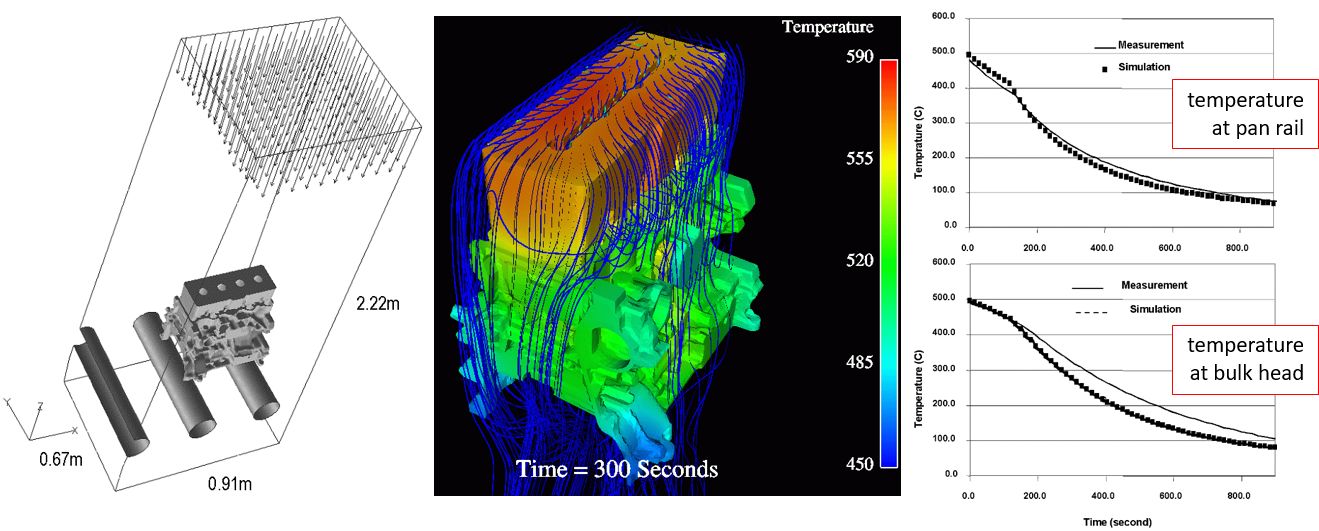
The main heat extraction mechanism in air quenching is forced convection. In our CFD model, it is assumed that the buoyancy effect and radiation heat transfer have a negligible impact on the accuracy. The CFD simulation results are compared with thermocouple readings, and the overlapping curves illustrate an excellent agreement and validate our model.
Figure 2: CFD model and comparison to thermocouple measurement for air quenching a cylinder block with riser attached.
We use CFD to study and compare four different air quenching configurations. One unique advantage of CFD simulation over physical testing is its capability to visualize flow patterns and to identify low heat transfer regions under stagnant air pockets. The quenching configuration (a), (b) and (c) represent a conveyer style quenching environment, (d) represents a basket style quenching environment. See Figure 3.
Figure 3: Air flow and air pockets surrounding cylinder head for all air quenching configurations, 60 seconds into quenching.
The cooling curve plot shows that the cylinder head quenched in a basket (d) cools faster compared to those quenched on a conveyer (a), (b), and (c). According to the temperature gradients plot, basket quenching (d) cools faster at a higher temperature gradient than conveyer quenching (a) and (c). The only exception is (b). In-depth investigation of the location of high-temperature gradient indicates that the regions between the water jacket and intake port are susceptible to high residual stress.
Figure 4: Cooling curve and temperature gradient for all air quenching configurations.Figure 5: High-temperature gradient locations for conveyer quenching (a) and basket quenching (d), 60 seconds into quenching.
Water Quench Process for Cylinder Heads
The physics of water quenching is much more involved than air quenching. Ford Motor Company adapted the quench model framework by AVL FIRE™, which is based on the Eulerian-Eulerian multiphase model, and developed our own proprietary database to simulate the water boiling process. Extensive work has been done on computation and experiments to validate the numerical methods. The CFD simulations compared to lab experiment on cooling curves provide strong evidence that our CFD model is accurate and that it can predict temperature profile on every quenching orientation without calibration.
Figure 6: Experimental and CFD simulation for cylinder block; cooling curves from CFD and thermocouple are plotted together for comparison.
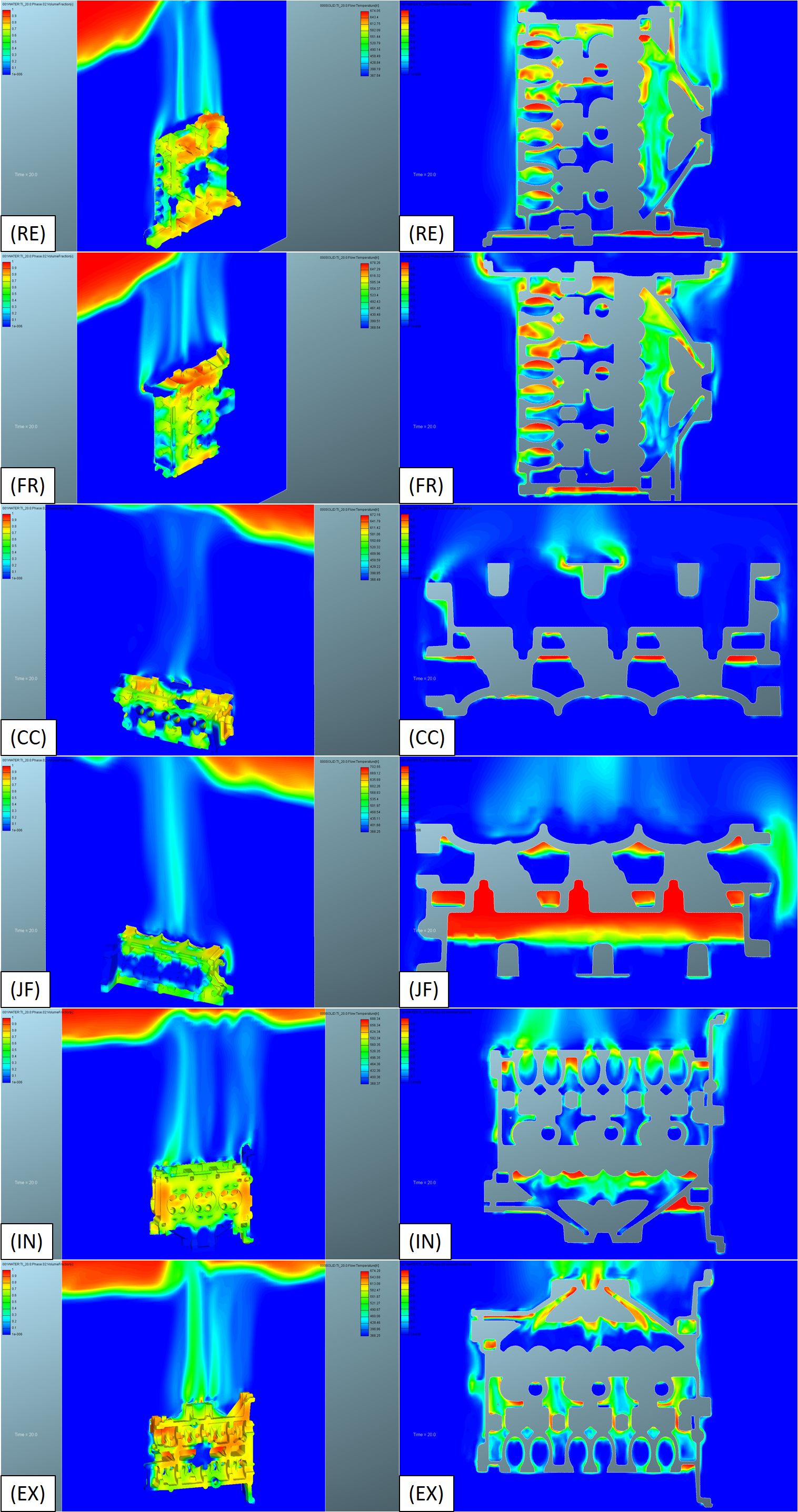
Six different quench orientations are studied, and the vapor patterns and vapor pockets are plotted for in-depth investigation. The cooling curve and temperature gradient plot illustrate that orientation has little impact on overall cooling characteristics, and maximum temperature gradient is similar except that they occur at different time, even though the vapor pattern and locations of vapor pockets are drastically different in each quenching orientations.
Figure 7: Vapor Pattern and Vapor Pocket Entrapped inside Cylinder Heads, 20 seconds into quenching.Figure 8: Cooling curve and maximum temperature gradient for all water quenching configurations.
Observing the location of the high-temperature gradient, for rear face up (RE) and cam cover face up (CC) quenching, high-temperature gradient appears in the intake port area, similar to the air quenching cases. Since the high-temperature gradient is observed near the intake port for all quenching cases, both air quenching and water quenching, very likely it is a design-related issue.
Figure 9: High-Temperature Gradient Locations for Rear Face up (RE) and Cam Cover Face up Quenching (CC), 20 seconds into Quenching.
Comparison of Air and Water Quenching Process
The underlying heat extraction for air and water quenching is very different. While air quenching relies on convection heat transfer to cool the metal, water quenching relies on water to vapor phase change to take the heat away. Therefore, metal cools significantly faster in water quenching than in air quenching. The maximum temperature gradient for water quenching is also much larger than air quenching. Since water only vaporizes in areas in contact with a hot surface, the heat loss is a local phenomenon subject to vapor escape route and the supply of fresh water. In other words, the heat transfer may not be as smooth as air quenching and it is reflected in the fluctuation of high-temperature gradient plot.
A much higher temperature gradient in water quenching does not necessarily generate much higher residual stress. We can also see in the plot that the duration of peak temperature gradient only lasts about 15 seconds. In this duration, the metal may exceed yielding stress and plastic deformation starts. However, the final deformation also depends on how long the state of stress stays in plastic deformation zone.
Figure 10: Cooling curve and maximum temperature gradient for selected air and water quenching configurations.
Conclusions
The rapid, large temperature drop in the quenching process has two opposite effects on the eventual outcome. On one hand, the large cooling rate produces metals with better quality, but it also induces residual stress. Thanks to the advancement of 3D CFD methodology, now the metal cooling in the quenching process can be much better understood using computer simulations. By using validated air and water quench modeling method, we compared the cooling curves and temperature gradient to evaluate quenching performance for various quenching configurations.
For air quenching processes, the study finds that cylinder heads cool faster in basket quenching than in conveyer quenching environment. The explanation is that airflow is accelerated when passing through the narrow gaps between cylinder heads in basket quenching. For water quenching processes, the study finds the orientation has little effect on the overall cooling rate as well as maximum temperature gradient except for a time shift in the maximum gradient. The results also show that the temperature gradient in water quenching is significantly larger than air quenching but last a much shorter period of time. Studying the temperature gradient for all air and water quenching case reveals a weak spot between the intake port and water jacket. Since this spot appears in all quenching cases, it should be remedied by a design change rather than changing the manufacturing process alone.
References
Koc, M., Culp, J., Altan, T. “Prediction of Residual Stresses in Quenched Aluminum Blocks and Their Reduction through Cold Working Processes,” Journal of materials processing technology, 174.1 (2006), pp342-354.
Wang, D.M., Alajbegovic, A., Su, X.M., Jan, J., “Numerical Modelling of Quench Cooling Using Eulerian Two-Fluid Method”, Proceedings of IMECE 2002, ASME-33499 Heat Transfer, vol. 3, 2003, pp. 179-185. LA, USA.
Srinivasan, V., Moon, K., Greif, D., Wang, D.M., Kim, M., “Numerical Simulation of Immersion Quench Cooling Process”: Part I, Proceedings in the International Mechanical Engineering Congress and Exposition, IMECE2008, Paper no: IMECE2008-69280, Boston, Massachusetts, USA, 2008.
Srinivasan, V., Moon, K., Greif, D., Wang, D.M., Kim, M., “Numerical Simulation of Immersion Quench Cooling Process”: Part II, Proceedings in the International Mechanical Engineering Congress and Exposition, IMECE2008, Paper no: IMECE2008-69281, Boston, Massachusetts, USA, 2008.
Kopun, R., Škerget, L., Hriberšek, M., Zhang, D., Stauder, B., Greif, D., “Numerical simulation of immersion quenching process for cast aluminium part at different pool temperatures”, Applied Thermal Engineering 65, pp. 74-84, 2014
Jan, J., Prabhu, E., Lasecki, J., Weiss, U, “Development and Validation of CFD Methodology to Simulate Water Quenching Process,” Proceedings of the ASME 2014 International Manufacturing Science and Engineering Conference, Detroit Michigan, 2014.
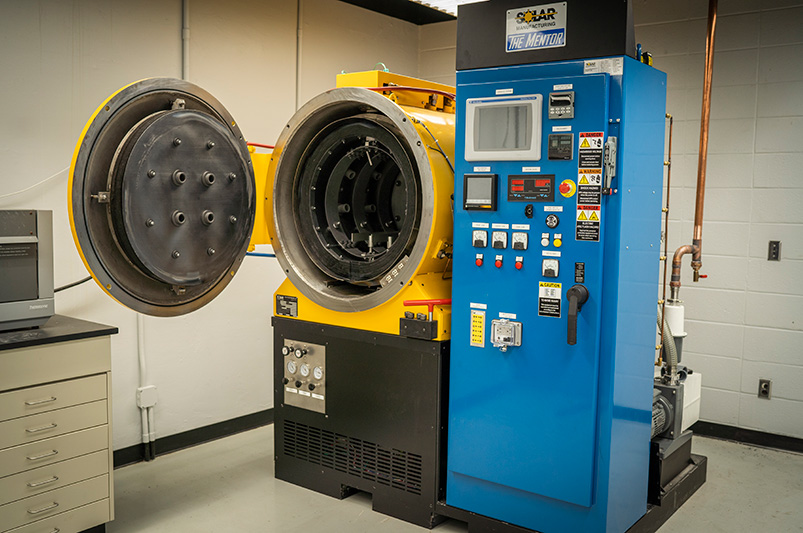
A thermal processing company donated a $300,000 commercial-grade vacuum heat treating and brazing furnace to Lehigh University’s materials science program to help increase opportunities for its students in the field.
The new addition, known as The Mentor®, was donated to Lehigh University by thermal processing company Solar Atmospheres and its CEO and founder, William R. Jones. Its sister company, Solar Manufacturing, designs and builds vacuum furnaces at its location in Souderton, Pennsylvania, just 23 miles from Lehigh’s campus.
Additionally, Solar Atmospheres built and donated a transformer and water-cooling system that was specifically designed for the application.
Wojciech Misiolek, professor and cha ir of the Department of Materials Science and Engineering at the P.C. Rossin College of Engineering and Applied Science
“This is a very powerful, advanced piece of equipment that will allow us to conduct important experiments in our metallurgy teaching and research, especially around additive manufacturing, which is a hot topic these days,” explains Wojciech Misiolek, professor and chair of the Department of Materials Science and Engineering at the P.C. Rossin College of Engineering and Applied Science. “And we will challenge ourselves to use it up to its full capabilities for heat treatment of metals.”
“With this donation,” adds Misiolek, “suddenly you have the industry-grade equipment. It’s not a miniature version, it’s what you will see out in the field. Our educational system at Lehigh is very hands on, and we have a reputation for that. This furnace will increase opportunities for our undergraduate and graduate students and help them hit the ground running when they go into industry.”
A Baker’s Dozen Quick Heat TreatNews Items to Keep You Current
Heat TreatToday offers News Chatter, a feature highlighting representative moves, transactions, and kudos from around the industry.
Personnel and Company Chatter
James Herald has been appointed the president and CEO of EVRAZ North America, Chicago. He will replace Conrad Winkler, who is leaving the group to pursue other opportunities. Herald joins EVRAZ from AXIP Energy, where he served as CEO. He has more than 35 years of experience in the oil and gas and energy pipe industries.
Advanced Heat Treat Corp. (AHT) recently announced the addition of three new sales and metallurgy employees: Tim Zemaitis, Shane Seevell, and Katie Herron. Zemaitis, regional sales manager for AHT’s Michigan facility, joins the team with over 30 years of experience in heat treatment, metallurgy, and engineering. Seevell, regional sales manager in the corporate office located in Iowa, brings over 15 years of sales experience plus past heat treat experience working at AHT; and Herron, materials engineer & quality specialist in Alabama, rounds out the growing AHT team. Herron is a recent materials engineering graduate from the University of Alabama – Birmingham.
Meggitt, which specializes in high-performance components and subsystems for the aerospace, defense, and selected energy markets, has opened its newly expanded aerospace services and support center of excellence in Miami, Florida.
Virginia-based aluminum extruder Service Center Metals has been acquired by The Riverstone Group through its investment entity SCM Industries, LLC in Richmond.
L&T Technology Services, a leading global pure-play engineering services company has been selected as a strategic partner by United Technologies Corporation (UTC) for Collins Aerospace, a subsidiary of UTC. Collins Aerospace comprises of the former UTC Aerospace Systems, Rockwell Collins, and BE Aerospace, and is one of the leading providers of intelligent solutions for the global aerospace and defense industries.
Equipment Chatter
A 2000°F (1093°C), gas-fired heavy-duty furnace from Grieve (No. 1042), is currently being used for heat treating at a customer’s facility. In addition, the No. 1047, a 350°F (177°C), bench oven, has been purchased from Grieve for curing plugs on the ends of cords at the customer’s facility.
A factory with multiple lines of (fixed) heat treating ovens recently purchased a temperature data logging solution from CAS DataLoggers for the purpose of automatically monitoring the oven temperatures with precise accuracy while also handling data transmission and enabling remote access.
A manufacturer of electronic components purchased a Blue M inert gas batch oven, with a temperature range of 59°F (15°C) above ambient to 1099°F (593°C), from Thermal Product Solutions.
A manufacturer in the oil and gas industry recently received a shipment of an electrically heated four-zone conveyor oven from Wisconsin Oven Corporation. Each chamber in this oven has a maximum temperature rating of 752°F (400°C). The oven has a guaranteed oven temperature uniformity of ±10.8°F at 590°F (±6°C at 310°C)) for a minimum of 6 minutes per heating chamber. In addition, Wisconsin Oven Corporation announced the shipment of an indirect natural gas-fired batch oven to a leading manufacturer in the aerospace industry. The batch oven will be used to cure composite materials and has a maximum oven operating temperature of 500°F.
Kudos Chatter
Onex, Inc., recently received the 2018 Pinnacle Award from Vesuvius. Only two contractor installer distributors were presented this award in 2018.
AK Steel has accepted an award from the U.S. Department of Energy (DOE) High-Performance Computing for Materials (HPC4Mtls) Program. Researchers from AK Steel plan to work in collaboration with DOE’s Oak Ridge National Laboratory to develop microstructure-based transformation models to predict austenite stability in high strength steels in a project titled “Thermo-Mechanical Forming Process Development to Produce Tailored Strength Automotive Structural Components.”
Specitubes has received Nadcap accreditation for demonstrating its ongoing commitment to quality by satisfying customer requirements and industry specifications. The scope of this accreditation covers the heat-treating of seamless precision metallic tubes made in Samer (northern France) of Nickel and Cobalt Alloys, Austenitic Stainless Steels and Titanium Alloys. Typical applications include hydraulic and pneumatic ducting systems for aircraft.
thyssenkrupp has announced plans to build the world’s most advanced forging line in Homburg/Saarland, a new facility to produce forged front axles for trucks. This production expansion represents the biggest single investment ever made at thyssenkrupp’s Homburg site.
Heat Treat Today is pleased to join in the announcements of growth and achievement throughout the industry by highlighting them here on our News Chatter page. Please send any information you feel may be of interest to manufacturers with in-house heat treat departments especially in the aerospace, automotive, medical, and energy sectors to the editor at editor@heattreattoday.com
Onex is proud to receive the 2018 Pinnacle Award from Vesuvius. Only two contractor installer distributors were presented this award.
Ford Motor Company and Volkswagen AG announced they are expanding their global alliance to include electric vehicles and will collaborate with Argo AI to introduce autonomous vehicle technology in the U.S. and Europe. Volkswagen and Ford independently will integrate Argo AI’s SDS into vehicles.
Ford will also become the first additional automaker to use Volkswagen’s electric vehicle architecture and Modular Electric Toolkit – or MEB – to deliver a high-volume zero-emission vehicle in Europe starting in 2023. For Ford, using Volkswagen’s MEB architecture is part of its more than $11.5 billion investment in electric vehicles worldwide.Both companies will continue to target additional areas where they can work together on electric vehicles because of their goal to accelerate the transition to sustainable and affordable mobility.
“Looking ahead, even more customers and the environment will benefit from Volkswagen’s industry-leading EV architecture. Our global alliance is beginning to demonstrate even greater promise, and we are continuing to look at other areas on which we might collaborate,” Volkswagen CEO Dr. Herbert Diess, said. “Scaling our MEB drives down development costs for zero-emissions vehicles, allowing for a broader and faster global adoption of electric vehicles.”
The alliance, which covers collaborations outside of Volkswagen and Ford’s joint investments in Argo AI, does not entail cross-ownership between the two companies and is independent from the investment into Argo AI.
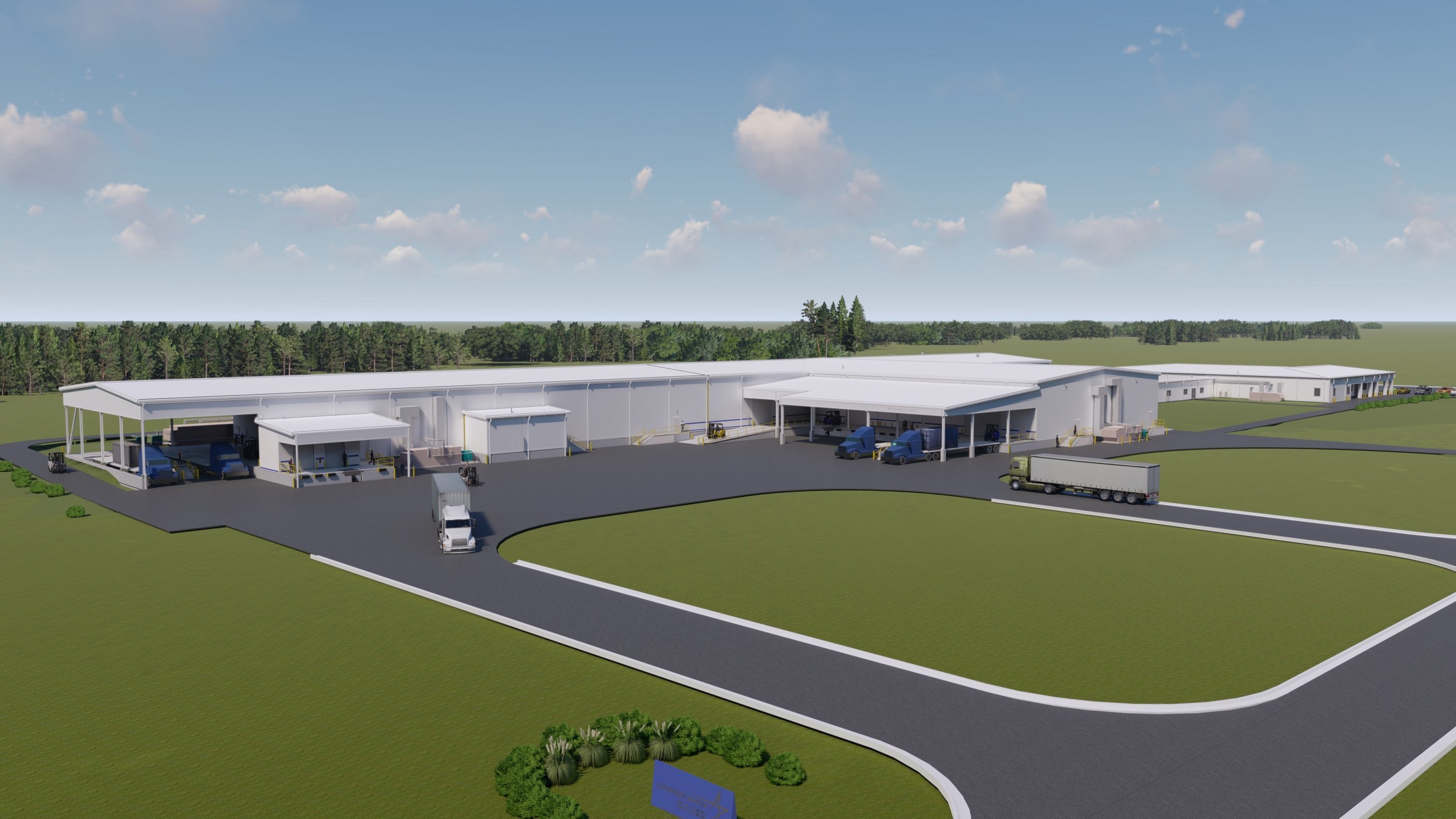
Aerospace giant Lockheed Martin, headquartered in Bethesda, Maryland, recently announced plans to invest $142 million in its Camden facility in Arkansas, supporting new construction and improving on existing facilities for products, new machinery, and equipment important to the defense of the United States and allies.
Lockheed Martin will expand its Camden, Arkansas, facility to include two new production buildings which will support manufacturing long range fires and PAC-3 missile defense capabilities, plus expanding current facilities, and hire more than 300 new people (artist rendering). (PRNewsfoto/Lockheed Martin)
Lockheed Martin unveiled the plan at the Paris Air Show where company executives were joined by Arkansas Gov. Asa Hutchinson to celebrate the prospect of adding 326 new jobs by 2024.
“Lockheed Martin is a leading technology firm with facilities and clients around the world,” said Hutchinson. “Lockheed’s investment illustrates the fact that Arkansas continues to be a global player in the aero-defense industry.”
Frank St. John, executive vice president of Lockheed Martin Missiles and Fire Control
“Our facility in Camden is a highly efficient, high-quality center of excellence that contributes components and performs final assembly for products that are important to the defense of the United States and a growing number of allied nations,” said Frank St. John, executive vice president of Lockheed Martin Missiles and Fire Control. “The facility has a long record of precision manufacturing and on-time deliveries, which is the reason we continue to invest in and expand our Camden Operations. This expansion will help ensure the availability, affordability, and quality of systems we build for our customers around the world.”
Camden Operations is Lockheed Martin’s Precision Fires operations center of excellence.
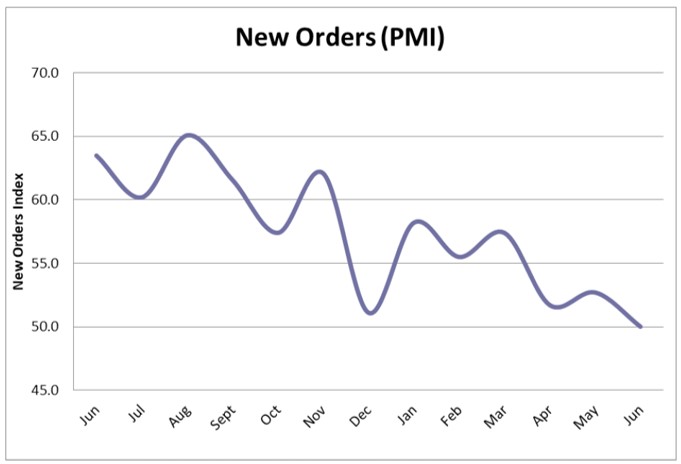
Seven of the eleven economic indicators reported monthly by the Industrial Heating Equipment Association’s Executive Economic Summary trended upward while only four softened. Overall industry growth continues to be solid with only a few signs of slowing.
Among the upward movers are vehicle sales, new home starts, steel consumption, capacity utilization, and durable goods orders. These five and two others lead the way with positive growth albeit small movements upward.
The four indices that slumped were PMI, transportation, metal prices, and factory orders.
IHEA PMI July 2019
According to IHEA’s economist, the economy continues to be strong even though many had assumed there would be a more significant softening by this time. Although the southward moving indices are worrisome, the number and persistence of the positive indices lend confidence that the heat treat economy will continue strong in the months ahead.
The full report from IHEA is 12 pages in length and available to IHEA member companies. To see the full report, contact Anne Goyer at IHEA for details on membership in IHEA. Anne Goyer can be reached by email by clicking here. More information about IHEA can be found on the web at www.ihea.org.
A clash of generations may be inevitable at family gatherings, but in the heat treat shop, everybody is on board with the changes that have developed over the last few decades: technological advances in equipment and processes, enhanced quality control, greater awareness for safety issues and green operations, among others. Peter Sherwin of Eurotherm by Schneider Electric traces the course the industry has taken out of the past and into the future. This article first appeared in Heat Treat Today’sMarch 2019 Aerospace print edition.
My first experience in a heat treat shop could be described as your grandfather’s shop—it was dirty and dusty, and you had to be alert to avoid danger. A handful of paper chart recorders were present, and tempering ovens were controlled by a dial indication of temperature, adjusted up and down to find out the current temperature. Only manual flow controls existed. Process temperature, times, and flow-rates were handwritten on small paper cards and stored in a filing cabinet.
Fast forward 15 years and the shop has clean processes, mostly vacuum-based equipment, and all automatically controlled process cycles. Shop floor instructions moved from paper to entirely computer-generated, an industrial transformation to the digital-age that took place in the 1990s and 2000s.
How We Got Here
So, what have the last couple of decades brought? Shakespeare’s Much Ado About Nothing springs to mind. First, we had the painful hangover from the global recession in 2008-09 which, for the next half-decade, had everyone consumed with operating as lean as possible with only a slow trickle of investment. The last few years brought a healthy rebound in manufacturing and increased heat treat production requirements. However, this surge in activity and a continued make-do attitude did not allow the time or motivation to refurbish or replace aging equipment. Add to this the promise and “soon-to-be-fulfilled” prophecies of IoT and Industry 4.0, the coming of age of the electric car, and the resultant effects on heat treatment requirements, and all of these factors conspire to make the heat treater think twice about rushing into investing in new furnaces or upgrading the existing plant.
Your Grandfather’s Heat Treat Shop
The curse of this is watching the average life of equipment catch up with the average age of operators, and we are transported back to the dark ages of your grandfather’s shop.
Admittedly, this is an over-simplification of the current situation—not all plants are stuck in this rut. Contrary to the above, AMS2750D (released 2005) was a boon to European furnace OEMs and associated suppliers, and yet this was not a worldwide phenomenon because the U.S. received a “grandfathered” pass due to the heavy involvement and prior investment in meeting AMS2750C requirements.
Over this same recent period, the final aerospace customers (aerospace primes and engine manufacturers) have not rested on their laurels. A rise in the middle class in Asia has fueled a healthy increase in demand for passenger aircraft and allowed best-in-class suppliers to invest, innovate, and develop more energy-efficient aircraft. Younger airline brands in the Asian continent have been able to rapidly take market share by leveraging a lower cost base created mainly by engine technology improvements.
Engine Developments and Quality Control
The A320neo, available since 2015, incorporates new, more efficient engines and large wing tip devices called “Sharklets” delivering significant fuel savings of 15 percent, which is equivalent to 1.4 million liters of fuel per aircraft per year, or the consumption of 1,000 mid-sized cars. In addition, the A320neo provides a double-digit reduction in NOx emissions and reduced engine noise. [1]
The 737 MAX 8 reduces fuel use and CO2 emissions by 14 percent over the newest Next-Generation 737 and 20 percent better than the first Next-Generation 737s. Also, the 737 MAX 8 uses 8 percent less fuel per seat than the A320neo. [2, 3]
The GTF engine has met all performance specifications since entry into service. For example, the GTF-powered A320neo has achieved a 16% reduction in fuel consumption, a 75% reduction in noise footprint and a 50% reduction in nitrogen oxide emissions. [4]
Today’s Modern Heat Treat Shop
These significant recent engine innovations have been possible through the use of modeling software to aid fast development (versus slow in-field trials) and by maximizing the overall performance via a mix of standard and exotic materials. Future developments include evaluating the use of actual component properties (e.g., tensile test, hardness profiles, other material, etc.) rather than relying on industry averaged properties. These advancements could lead to substantial changes in shape design and associated weight reduction but would require more stringent processing control.
Nadcap accreditation and the SAE AMS2750 standard have been used to manage a specific quality output from the heat treat supply chain. Even with the expected release of AMS2750F, control tolerances are not anticipated to change dramatically. This situation could create tension between the ongoing innovation on the design-side and the slower-development in process equipment capability. Let’s hope this doesn’t result in a path back to individual prime requirements over-shadowing the unified AMS standard.
Heat Treating 101 for the Shop of the Future
So, it’s back to the heat treat shop and the conundrum of upgrading/updating equipment due to age, performance, capability, and now the added twist of potential changes in future customer requirements. What strategy should a heat treater undertake?
Refurbishment of existing equipment to help lower running costs and improve capability can usually occur with updating the control and automation system. By looking at the Total Cost of Ownership (TCO) rather than just the “ticket” price of the upgrade, the payback for the investment can be in months rather than years. Control systems can improve the uptime of the equipment and precision control can positively impact quality results and even shorten process times in some instances. The relatively low payback time can ease the decision to invest.
Investment in new equipment requires a more detailed look at the customer base and changes within the external environment. To help with this uncertainty, some OEMs are starting to provide flexible financing solutions, including leasing. Control and automation suppliers are also doing their bit by designing control and recording instruments that can be enhanced by secure over-the-air software updates rather than requiring a complete change of hardware.
Conclusion
The shops of the past are looking less and less like the shops in most plants today, but it’s more than just physical changes that reflect a forward-looking operation. Today’s shop can leverage innovative thinking about cost of operations, improve the quality of communication with customers and suppliers, effectively use control systems, and be creative about equipment upgrades. These are changes that begin with an attitude adjustment—having the right view of the past and a broad vision for the future.
References:
[1] “Airbus, Indigo places order for 130 A320 neo”, https://www.airbus.com/newsroom/press-releases/en/2011/06/indigo-firms-up-order-for-150-a320neo-and-30-a320s.html
About the Author: Peter Sherwin, a Chartered Engineer, is business development leader with Eurotherm by Schneider Electric, recognized for his expertise in heat treat systems technology, IIoT, Industry 4.0, and SaaS/digital solutions. This article, which originally appeared in Heat Treat Today’sMarch 2019 Aerospace print edition and is published here with the author’s permission.