Right click and save the image to use for the discount
The Industrial Heating Equipment Association (IHEA) recently announced the opening of registration for its annual fall seminar series, and as a reader of Heat Treat Today, you can take advantage of a 5% discount off of any of the seminar registration fees. Just click here to download the pass, or right click and save the image to the right.
The IHEA Fall Seminar Series will be held from September 24-25, 2019, in Cleveland, Ohio.
IHEA Fall Seminar 1: Attendees receive valuable technical information at IHEA’s Fall Seminar Series.
This annual series will be comprised of three seminars addressing combustion, safety standards and codes, and process heating, respectively. Attendees from all three seminars may also attend IHEA’s Tabletop Exhibition & Reception on Tuesday, September 24, to network with suppliers of thermal processing products and services.
The Combustion and Safety Standards and Codes Seminars, as well as the Tabletop Exhibition & Reception, will be held at the InterContinental Hotel Cleveland, while the Process Heating Seminar will be held at Selas Heat Technology.
IHEA’s 50th Combustion Seminar will span two full days, featuring 16 sessions designed to give round exposure to combustion technology and led by industry professionals in a non-commercial environment.
IHEA Fall Seminar 2: IHEA Fall Seminar attendee takes advantage of visiting with tabletop exhibitors during the networking reception.
The Safety Standards and Codes Seminar will also follow the two-day format. This class will be led by instructors involved with the 2019 revision of NFPA 86 – Standards for Ovens & Furnaces. The agenda will include discussion of these recent updates as well as several safety topics.
New this year, the one-day Process Heating Seminar will be held at Selas Heat Technology, a member company of IHEA. Besides live demonstrations and a facility tour, this seminar will present information about infrared and induction technologies and the industrial applications that use these heating processes.
Heat treat safety is relevant to all of us. Check out these dos and don’ts to maintain a safe heat treat shop. Content is provided by Plibrico Company, LLC.
Use Fall Protection Systems to Reduce Construction-Related Falls
Most equipment used for thermal processing stands well over 10 feet tall and has the capacity to hold or process over 60 tons of molten metal. During refractory installation, repair and maintenance of this large equipment, refractory professionals often find themselves raised atop platforms, scaffolding, decking and work stations. Due to the fact that refractory employees regularly work at elevated heights, it is crucial to keep them safe from fall-related injuries, as well as to ensure the job site is free of safety violations. To accomplish this goal, it is essential to understand the hazards of falls and know the Occupational Safety and Health Administration (OSHA) rules.
According to OSHA, in 2017, almost 42% of all construction worker related deaths were attributed to falls. Thousands more were injured. Fall Protection infractions (OSHA 29 CFR 1926.501) also topped OSHA’s 2018 list of the Top 10 Safety Violations for the eighth consecutive year.
Incidents involving falls frequently involve a variety of factors, however, a common thread running through most is the absence of fall protection equipment. Even if you’re Nik Wallenda, the high wire aerialist of the famed Flying Wallendas family, OSHA requires protection when working on refractories at heights of six feet above a lower level:
Handrails, Guardrails and Toe-boards: serve as barriers between the employee and an open edge. Midrails or screens need to be installed between the top of the guardrail and the walking or working surface to prevent falls.
Personal Fall Arrest Systems: provide employees with an individual form of fall protection. For example, a body harness connected to a lanyard or retractable line secured to a fixed anchor. These types of systems are designed to go into action before contact with any lower level.
Personal Fall Restraint Systems: prevent employees from reaching the edge where a fall hazard is likely to occur. It tethers a worker in a manner that will not allow a fall of any distance. This system is comprised of a body belt or body harness, an anchorage, connectors, and other necessary equipment.
As a second line of defense or where fall prevention systems are not practical, for instance roof work, a warning line system consisting of ropes, wires, or chains is an approved solution if it is at least 6 feet from open edges around all sides of the work area. Fixed barriers can also be installed to prevent employee access to dangerous areas.
To address any hazardous areas that may have floor openings, color-coded covers should be used and marked with the word “Hole”. Covers should be secured tight to prevent workers from falling through floors or elevated areas.
OSHA clearly states employer requirements. OSHA mandates employers train workers on how to use personal fall protection equipment and how to work in hazardous situations. Employers must also assess the workplace to determine if walking or working surfaces have the necessary strength and structural integrity to safely support workers.
Before any work begins, conduct a hazard assessment to develop a comprehensive fall protection plan, to manage hazards and focus employee attention on prevention. Falls cause deaths and numerous serious injuries each year, many of which are preventable. Maintain the highest safety standards on your job site by installing or using fall protection systems – not all of us can be as sure footed as Nik Wallenda.
A manufacturer of induction furnaces and heating systems is scheduled to be acquired by two global corporations from a Chicago-based private equity firm.
Mitsubishi Heavy Industries (MHI) and Primetals Technologies will acquire ABP Induction Systems (ABP), which offers a variety of products and services to automotive OEMs and suppliers, industrial manufacturers, independent foundries as well as steel plant manufacturers and steel producers.
Satoru Iijima Chairman of the Board and CEO of Primetals Technologies
“ABP’s induction heaters are one of the most crucial elements for endless strip production, a flagship process for Primetals Technologies. With ABP becoming one of MHI’s group companies and the further close ties that will bring, we can develop and provide customers with even more advanced technologies,” said Satoru Iijima, Chairman of the Board and CEO of Primetals Technologies.
ABP will be a group company of MHI under the ownership of Mitsubishi Heavy Industries America, Inc., headquartered in Houston, Texas, and Primetals Technologies USA LLC, of Alpharetta, Georgia. The acquisition is planned to close around the end of August 2019.
Less than one week remains in the nomination period for Heat TreatToday’s Class of 2019 40 Under 40! The nomination process closes at midnight (EDT) on Wednesday, July 31, 2019, so if you have been considering submitting the name of a colleague, a client, or an employee but just haven’t gotten around to it, now is the time!
What you may not realize is that the benefits to being selected as a member of Heat Treat Today’s40 Under 40 are more than just a “one and done” recognition in the Heat Treat Show issue of Heat TreatToday’s print magazine. We will continue to point our audience to the 40 Under 40 landing page at our website, which will always feature the most current class of recipients. In addition, we request and publish interviews with 40 Under 40 members, highlighting their entry into the industry, what sparked their interest in heat treating, how their interest has grown, the remarkable projects they’ve enjoyed working on, and what words of wisdom they would share with other young professionals in the industry.
Michael Elmore, Heat Treat Engineer, with GKN Driveline
For example, Michael Elmore, Heat Treat Engineer, with GKN Driveline, remembered his early days in the industry this way: “When I came to GKN, I fell in love with heat treating,” said Elmore. “I expected this to be a puddle and it turned out to be more like jumping into an ocean. There’s so much more to it than I expected. . . . [Four years later,] I’m still finding out things I didn’t know. It goes deeper and deeper the longer I’m here, never hitting the bottom of what can be learned, done, or explored.”
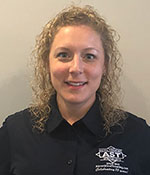
Christina Somogye, Akron Steel Treating Company’s VP of Administration and Operations
Christina Somogye, Akron Steel Treating Company’s VP of Administration and Operations, grew up in the environment of metallurgy, steel treatment and manufacturing, and heat treating operations, so her thoughts on how companies can stay relevant in an industry that is changing rapidly due to technology, new materials, etc., are unique, and she offers this perspective: “There are many opportunities in large and small heat treating companies (commercial and captive) as well as the equipment, alloy, material suppliers and service industries that serve the heat treating companies. The knowledge of senior industry members is ready to be passed on to the next generation with tremendous opportunities for growth and technical expertise. Small, privately held businesses and large, multi-facility companies have the need to pass down this tribal knowledge for their continued success.”
Wei Guo, Principal Materials Engineer for The Timken Company
Wei Guo, Principal Materials Engineer for The Timken Company, reflected on his passion for this industry by drawing a parallel between a metallurgist crafting a heat treat recipe and “a famous cook developing a recipe for new cuisine.”
“One needs to control the ingredients, mixing sequence, baking time and cooking temperature combined with skill and expertise to obtain an optimized flavor and palate. The development of heat-treating process recipes is similar, relying on the metallurgist’s fundamental knowledge and experience of physical metallurgy. The most exciting aspect of thermal processing is the application of the knowledge and experience to create a heat treat process that produces the desired result and creates value to the company.”
How should a young professional find his or her way into the right niche in the industry? Wei gives this advice:
“Gain hands-on experience with practical heat treatment processes when trying to identify problems and challenges. . . . Determine an area of interest and drive . . . to learn/practice thermal processing skills. . . . Find a mentor; learning from a senior experienced metallurgist is always helpful. Many aspects of heat treatments cannot be learned from the textbook and might take a long time to figure them out on your own.”
“Heat treatment processing is a very dynamic world because many novel metallic materials are emerging every day,” says Wei. “We, not only young professionals, but everyone in this field need to keep abreast of the latest materials development and make ourselves ready for the new challenges.”
Georgia Southern University (GSU) in Statesboro, Georgia, recently purchased a horizontal front-loading vacuum furnace from a Pennsylvania based heat treat furnace manufacturer.
GSU plans to use Solar Manufacturing’s Mentor® furnace primarily for vacuum thermal processing research and development of various iron-based alloys, including additive manufactured parts.
The Mentor® includes a graphite shielded hot zone and heating elements, with a work zone size of 12″ wide x 12″ high x 18″ deep, and a weight capacity of 250 pounds. Solar Manufacturing reports that this furnace complies with aerospace specification AMS2750E to process in an argon or nitrogen atmosphere or in high vacuum in the 10-6 Torr range with a 6” Varian diffusion pump. The furnace incorporates a control system package with a large graphic touchscreen overview and can be programmed to control gas quench rate up to two bar pressure and achieve temperature uniformity up to 2400° F.
Dan Insogna, Solar Manufacturing
“We are pleased to provide a solution to GSU’s growing research and development efforts, and we know the Mentor® vacuum furnace will benefit the university with this research,” said Dan Insogna, Solar Manufacturing’s Southeast Sales Manager.
Induction heat treaters know that proper coil design is crucial to increasing longevity, improving production quality, and cutting costs. Among the topics addressed in this paper about induction heat treat coil design and fabrication (presented by R. Goldstein, W. Stuehr, and M. Blackby at ASM International) are these:
The design and fabrication of induction heating coils over the years
The Variable of Flow and the Influence of Frequency
Control and Presentation
Structure, Quenching, and Cooling
The paper closes out with a case study using computer simulation to show typical temperature distributions in a single-shot induction hardening coil.
A good place to start whenever preparing parts for induction heat treating is the consideration of inductor design. The authors provide this list (an excerpt):
[spacer color="264C84" icon="Select a Icon"]
Considerations for Inductor Design
Induction heat treating coils are available in many shapes and sizes and must perform a variety of tasks in a given induction heat treating application. Depending on the application, the induction coil design requirements include:
Meet heat treatment specifications in desired production rates
Be robust enough to tolerate manufacturing variations
Mount into the induction machine
Have electrical parameters that match the induction power supply
Deliver quench
Have a satisfactory lifetime
Have satisfactory efficiency
Be repeatable from inductor to inductor
In developing a new induction heat treating coil and process, the first question is whether the component will be produced on an existing system or if a new machine must be built. In many cases, the part producer’s desire is to develop new tooling for an existing machine with spare capacity. This reduces the degree of freedom and can make the induction coil design procedure more complicated because a less-than-optimal frequency or coil style will be necessitated to fit the existing machine (Ref 16).
To determine the ability to use existing equipment, it is necessary to make an analysis of the part to be heat treated. Part material, prior processing, geometry, production rate, and heat treatment specifications all play roles. The part material and prior processing determine what the minimum heat treatment temperature should be, along with how much time is allowed for cooling. The part geometry and heat treatment specifications indicate how much energy is required, what the preferred frequency ranges are, and what type of induction method (i.e., single shot, scanning) is best suited for the application. Finally, the production rate determines how much power and/or how many spindles or stations are required.
A vacuum brazing and heat treating company recently announced plans to expand its Greenville County, SC, operations to accommodate a new hot isostatic press. This equipment is designed to improve ductility and stress resistance of critical, high-performance manufactured materials.
Accurate Brazing, a division of Aalberts N.V., one of the largest heat treating and brazing companies in the world, is upgrading approximately 20,000 square feet of an existing facility in Greenville County to install the HIP. Since 1989, Accurate Brazing has provided heat treating and brazing applications to support aircraft, ground turbine and power generation markets. The company heat treats materials that include stainless steel, super alloys, copper and refractory materials.
Aalberts N.V. employs approximately 16,500 people at more than 150 locations in 50 countries around the globe. The $13 million expansion project is expected to create at least eight additional jobs and be complete in the second quarter of 2020.
"Accurate Brazing is a very important member of our business community and we are proud of their growth and success," said Greenville County Council Chairman and Board Member of the Greenville Area Development Corporation H.G. "Butch" Kirven.
A Baker’s Dozen Quick Heat TreatNews Items to Keep You Current
Heat TreatToday offers News Chatter, a feature highlighting representative moves, transactions, and kudos from around the industry.
Personnel and Company Chatter
Tom Spicer recently joined Gasbarre Industrial Furnace Systems (OEM of J.L. Becker brand equipment) as a Field Service Technician. Tom brings over 20 years of industry experience to the Plymouth, Michigan, company, having previously worked with OEMs assembling and servicing equipment and in maintenance at a commercial heat treat facility.
Changes at DANTE: The month of May saw the transition of Dan Londrico and Stefan Habean from intern to staff engineer. Charlie Li moved from Vice President to President of the company, and Lynn Ferguson became Emeritus. Edward Lee, a mechanical engineering student at The Ohio State University, joined the DANTE team as an intern.
Sławomir Woźniak has been appointed by the Supervisory Board at the SECO/WARWICK Group to the role of President of the Management Board. The new President has been appointed for the same period as the joint term of the new Management Board, which spans the next three full financial years.
Ajax TOCCO Magnethermic / Emmedi would like to congratulate Don Gibeaut on his election to Chairman of the North American Management Board of Directors (NAMB) for the International Tube Association (ITA). Don is the product manager for ATM’s Tubular Products Division.
A materials technology engineering group recently completed a partial acquisition of a provider of metal additive manufacturing (AM) services and advanced end-use components. Sandvik acquired a 30% stake in privately owned Beam IT, which supplies metal AM end components to demanding industries, including automotive, energy and aerospace, and holds several relevant quality certifications to serve these industries.
A new hot isostatic press (HIP) has been delivered and installed at Paulo’s Cleveland Division. The furnace was built by Quintus Technologies. The 30,000-sqft expansion to house the HIP vessel is complete and will provide the Cleveland Division room for additional expansion to support customer needs.
GE Additive recently announced that the company has made a significant investment in its electron beam melting (EBM) technology, with the purchase of an additional 17 A2X systems and 10 Spectra H systems. Avio Aero, a GE Aviation company, currently operates a fleet of 35 Arcam machines at its recently expanded site in Cameri, Italy. The additional EBM systems will be installed at GE Aviation and Avio Aero facilities in the US and Europe and will be used primarily for the production of titanium aluminide (TiAl) blades on the low-pressure turbine for the GE9X engine.
Metal Exchange Corporation (MEC), headquartered in St. Louis, MO, is forming a new joint venture with Novellini Industries Srl in Mantova, Italy. Called novALmec, the newly formed company will supply aluminum billet capacity to the European market.
Charlie Li, DANTE
Lynn Ferguson, DANTE
Equipment Chatter
An automotive supplier recently ordered a nitrocarburizing furnace for a new component line for a major carmaker. SECO/WARWICK commissioned the high-volume, horizontal retort furnaces, which will allow the customer to produce parts for North American suppliers. In addition to ferritic nitrocarburizing, the furnaces can provide clean, stress relief processing.
Four atmosphere controlled, aluminum coil annealing furnaces, which will be used to anneal automotive body stock and common alloy sheet coils, have been ordered by a leading U.S. aluminum producer from Consolidated Engineering Company.
A quench tank has been installed by Baker Furnace, a division of Thermal Product Solutions, for a supplier in the heat treatment industry. The customer had two quench tanks and three drop bottom furnaces and needed the third quench tank in order to optimize quench loads per day.
Kudos Chatter
During the 2019 CCAI Annual Meeting in Hilton Head, South Carolina, the Chemical Coaters Association International held their annual awards ceremony to recognize the CCAI Chapter Users and Suppliers of the Year and announce the 2019 James F. & David J. Wright Lifetime Achievement Award recipient. The 2018-19 Chapter Award winners are: Central States Chapter – Frank Laster, A-1 Paint Powder and Sandblasting LLC and Ron Cudzilo, George Koch Sons LLC; Georgia Chapter – Wayne Pettyjohn, Georgia Power Company; Las Vegas Chapter – Tony Sclafani, AR Iron, LLC and Sercy Spears, TIGER Drylac, Inc. USA; Northern Illinois Chapter – Matt Ambrose, Henkel Corporation; Salt Lake City Chapter – Ginny Phommavongsay, Martin Door Mfg.; Southern California Chapter – Shivie Dhillon, Sundial Powder Coating, Tony Sclafani, AR Iron, LLC and Luis Hernandez, Coral Chemical Co.; Twin Cities Chapter – Mark Walsworth, Retired and Jim Henningsen, Troy Chemical; West Michigan Chapter – In memory of Herb Knape, Knape Industries Inc., and Jason Meekof, Industrial Metal Cleaning; and Wisconsin Chapter – Justin Jarmuz, Wacker Neuson Corp. and Matt Roeser, DuBois Chemical Co.
During the July 9th Collier County Board of County Commissioners meeting, Pelican Wire was named the Collier County ‘Business of the Month’ and was recognized by the Board for being a manufacturing leader in Collier County for over forty years.
On July 11th, Solar Atmospheres hosted 28 high school students enrolled in the Summer Engineering Institute (SEI) at Lehigh University. The group also included a few members of Lehigh University undergraduate students and staff. The SEI program, under the guidance of Director Dr. Laura Moyer, is a two-week residential program, running two sessions back to back. Students are nominated by faculty of local high schools, and the program specifically targets under-represented groups including girls, first-generation students, and students who might otherwise have limited opportunities to study in the fields of science, technology, engineering, and math (STEM).
Heat TreatToday is pleased to join in the announcements of growth and achievement throughout the industry by highlighting them here on our News Chatter page. Please send any information you feel may be of interest to manufacturers with in-house heat treat departments especially in the aerospace, automotive, medical, and energy sectors to the editor at editor@heattreattoday.com
Heat Treat Consultants is a comprehensive listing of heat treat industry consultants offered as part of Heat TreatToday’s efforts to help minimize the effects of heat treat “brain drain.” In this occasional feature, “Meet the Consultants”, we will introduce you to the experts listed in this growing directory. Today, learn more about George Vander Voort of Vander Voort Consulting LLC, and then click through to the page to read more details about each consultant. We are adding more regularly. Contact them directly, or call us and we’ll introduce you to them. Whether it’s a technical process question, a safety concern, a compliance issue, or a business-related question, one of our heat treat consultants will be able to help. If you are a consultant and would like to be listed, please contact Doug Glenn.
Name: George F. Vander Voort Company Name: Struers Inc./Vander Voort Consulting LLC Location: Chicago, Illinois Years In Industry: 50+ Consulting Specialties:
George Vander Voort, principal of Vander Voort Consulting and consultant to Struers Inc., is a graduate of Drexel and Lehigh Universities. Drexel presented George with the Distinguished Alumnus Award in 2005 and the Service to the Profession Award in 2016. He had 29 years’ experience in the steel industry. A past president of the International Metallographic Society and past chairman of ASTM Committee E-4 on Metallography, George has over 438 publications, 6 patents, 445 lectures in 42 countries, a video course, and 7 ASTM standards. Dedicated to technical education to improve the industry, he has taught 269 seminars and courses and has received 36 awards in metallography contests. He was a trustee for ASM International and is on the editorial boards of Praktische Metallographie/Practical Metallography; Metallography, Microstructure and Analysis; Image Analysis and Stereology; and, the International Journal of Microstructure and Materials Properties. He is a Fellow of ASTM International, ASM International and the International Federation of Heat Treatment and Surface Engineers. As a consultant, George specializes in metallography, failure analysis, and archeometallurgy. He is also a court-certified expert witness in litigations involving failures of metallic components. He is a Fellow and Honorary Life Member of Alpha Sigma Mu metallurgy and materials science honorary society and an honorary member of the Polish Society for Stereology.
Publications or Significant Accomplishments:
Member of the American Society for Testing and Materials, ASTM (now ASTM International), including a member of committees E-4 on Metallography and E-28 on Mechanical Testing. He served as second and first vice-chairman of E-4 and a four-year term as chairman of E-4 and chaired two international symposia for ASTM E-4. He is a fellow of ASTM. (1966 to present)
Instructor, “Ferrous Physical Metallurgy”, Pennsylvania State University (Allentown campus). (1969-1977)
Active with International Metallographic Society (IMS), including serving as president form 1981 to 1983. (1973 to present)
Adjunct Faculty Member, ASM Metals Engineering Institute/Materials Engineering Institute. (1977 to present)
Series editor of Microstructural Science and chair or co-chair of 10 symposia. (1983-1989)
Chairman of E.04.14 on Quantitative Metallography where he developed and wrote 9 standards for both manual and automated quantitative metallographic measurements. (1982-1998)
Instructor of several courses, workshops, seminars and presentations, including “Metallography and Failure Analysis,” United Technologies Research Center, E. Hartford, CT (December 4-8, 1989); “DST-TAP Foundry Course on Metallography, Interpretation and Measurement of Microstructure and Fractures,” Mintek, Randburg, South Africa (June 6-10, 2011); and “Post Conference Metallography Workshop,” Ferrous 2012 – Ferrous and base Metals Development Network Conference, 5 lectures (October 18, 2012), South African Institute of Mining and Metallurgy, Mount Grace Country House & Spa, Magaliesburg, South Africa (October 18, 2012); and 87 one-week courses for ASM’s Metals Engineering Institute (MEI), 117 courses for Buehler, and 65 for other societies, companies and universities. (445 lectures in 42 countries; spoken 84 times at 52 ASM chapters)
Principle author of 438 publications, including Metallography: Principles and Practice (orig. pub. date, 1989; ASM Int’l pub date, 1999), Buehler’s Guide to Material’s Preparation; editor of 18 books; author of 29 articles in various editions of ASM Metals Handbook series.Produced 11 of the 14 videotapes in the ASM video course, Principles of Metallography.
Author of 7 ASTM standards.
Holds 6 patents.
Developed micrographs used within or on the covers of over 180 books, magazines, newsletters, brochures or calendars.
U.S. representative to the International Standards Organization, ISO, sub-committee on tests other than chemical and mechanical (SC 7 of TC 17). He revised two ISO standards and wrote one new standard. (1989 – 2014)
Received IMS President’s Award. (1987)
Received the ASTM Award of Merit. (1987)
Founded Vander Voort Consulting LLC (now principal and president). (1990)
Received the Anthony DeBellis Memorial Award from ASTM E-28 for his work on microindentation hardness testing. (1990)
Hired by Nuclear Regulatory Commission to assess the metallographic study performed at Argonne National Laboratory and Idaho Falls National Engineering Laboratory on the lower head of Unit 3 nuclear reactor at the Three Mile Island site that failed in 1979. (1993)
Received the Bradley Stoughton Award of the Lehigh Valley Chapter of ASM. (1993)
Associate editor of Materials Characterization. (1994-2004)
Member of the editorial boards of La Metallurgia Italiana, Praktische Metallographie/Practical Metallography, and the Int’l Journal of Microstructure and Materials Properties.
Received 36 awards for work in metallography contests, including the Jacquet-Lucas Grand Prize. (1992)
Received the L.L. Wyman Memorial Award from E-4. (1994)
Examined heavily eroded structural steel from the World Trade Center for FEMA after the 9/11 attack to determine the reasons for the severe deterioration, particularly for Building 7 which was not impacted by the terrorists. (2001)
Worked on several cases such as semi-submersible and fixed oil drilling platforms in the Gulf of Mexico, locomotive axles that broke and caused derailments, collapsed Loran Towers, and others. He is a court-certified expert witness in microstructural aspects of failures.
Received Henry Clifton Sorby Award. (2004)
Received the Distinguished Alumnus Award from Drexel University. (2005)
Received the Roland Mitsche prize of the Montanuniversitat Leoben (Austria) for his contributions to metallography. (2006)
Honors received: Distinguished Life Member and Fellow of Alpha Sigma Mu honorary scholastic society for materials science majors (2008); elected to the board in 2009 and became vice president in 2011; September 2009 issue of Practical Metallography was dedicated to George’s 65th birthday.
Received the J.R. Vilella Award for his revision of Vol. 9 of the ASM Handbook, Metallography and Microstructures (2004 edition). (2006)
Materials Scientist, Struer, Inc.. (2010 to present)
Received the Service to Our Profession Award from Drexel University. (2016)
A leading Tier One metal additive manufacturers for the aerospace and defense industry that produces multiple furnaces has officially opened the doors to its new 55,000 square foot advanced manufacturing facility, located in Hollywood, Florida. The new plant, which also serves as the company’s headquarters, recently celebrated its grand opening.
Sintavia LLC’s facility houses over $25 million of advanced manufacturing equipment including multiple furnaces, medium and large scale metal printers, EDMs, post-processing machines, and wet-booths. Some of the industrial engineering improvements of the building include separate manufacturing rooms segregated by alloy, a large-scale powder management system, an uninterruptible power supply, an inert gas farm, and a final production acceptance quality control room.
The new facility is capable of producing tens of thousands of parts representing in excess of $100mm of AM revenue annually. The expansion is anticipated to bring more than 130 new jobs for skilled employees and support staff to South Florida.
“This new facility is the first of its kind in North America to offer large-scale AM production coupled with a robust aerospace quality management system,” said Brian Neff, Sintavia’s Chairman and Chief Executive Officer. “As we grow, it will serve as a template for future vertically-aligned advanced manufacturing facilities around the U.S. and the world.” Over 150 customers, industry partners, and government officials attended the opening.
Photo: (Business Wire) Multimedia Gallery URL and thefabricator.com







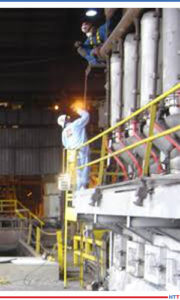 Most equipment used for thermal processing stands well over 10 feet tall and has the capacity to hold or process over 60 tons of molten metal. During refractory installation, repair and maintenance of this large equipment, refractory professionals often find themselves raised atop platforms, scaffolding, decking and work stations. Due to the fact that refractory employees regularly work at elevated heights, it is crucial to keep them safe from fall-related injuries, as well as to ensure the job site is free of safety violations. To accomplish this goal, it is essential to understand the hazards of falls and know the Occupational Safety and Health Administration (OSHA) rules.