"There is one positive aspect when it comes to a dramatic drop as experienced in March and April of this year. When one has fallen that far there is nowhere to go but up! Since then there has been a steady improvement in almost every category." When one considers the challenging year 2020 has been thus far, and the dramatic hit the U.S. economy has taken due to the pandemic, this encouraging opening from the Industrial Heating Equipment Association’s (IHEA) Executive Economic Summary for the month of July is the bolstering news we all need to hear.
The report states, "The progress that has been made thus far has been contingent on several factors. The first is that many businesses have engaged in rebuilding their inventories in anticipation of an eventual economic recovery...hopes lie in a rebound by the fourth quarter. The second major motivator for recovery has been the willingness of the consumer to return to old habits as far as consumption. This has been a mixed experience as there has been some return to those old habits, but there have also been many new habits formed and these have all had their impact on business."
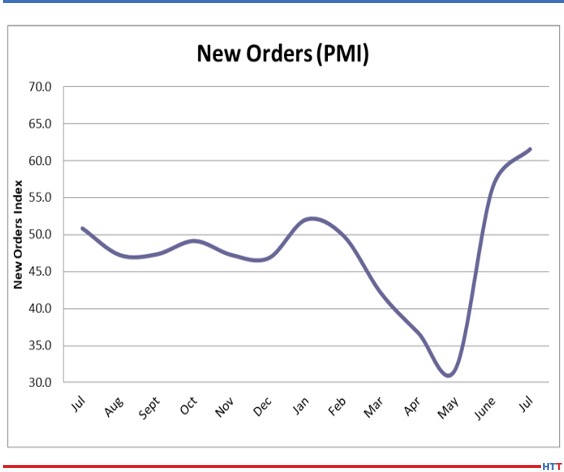
An uptick is evidenced in all but one of the measures and "even this showed only a very slight decline from the month prior." The summary also reports that "Of the twelve index readings tracked, all but one trended positively and in some cases the numbers registered this month were better than they have been in over a year."
The numbers have not been this high in well over a year and suggests that there is considerable optimism for the future. (Photo source: IHEA)
The summary shared, "The more interesting data was found in those categories that seemed to have fully recovered and even exceeded levels seen earlier this year and at the end of 2019. The New Orders Index from the Purchasing Managers’ Index was back to the 60s and that is a level that has not been seen in over a year. Given that the new orders sub-index is the forward looking part of the overall PMI, it bodes well for the recovery at the end of the year." Other areas that showed a jump was in transportation that always "provides some confidence about the future," the parcel delivery sector (not those tied to imports or exports, however), and the metals market, especially copper and aluminum. Lastly, "The production indicators such as durable goods and factory orders have shown progress as business tries to rebuild inventory levels but there is ongoing concern regarding new demand."
The price of metal commodities have been rising. (Photo source: IHEA)
Of those indices that trended positively, "the majority remain distant from the readings that dominated at the start of last year." However, the data shows "a solid recovery in many areas." Albeit, it will take time before you can describe it as robust.
Steel consumption was the only reading that did not trend upward, however, it still was stable and looked similar to the previous few months.
The summary concludes, "The bottom line is that there is resilience in the economy despite the trials of the last few months. It now all depends on whether the pandemic necessitates a wider crackdown and a resumption of the conditions that collapsed the economy in the first place."
The report is available to IHEA member companies. For membership information, and a full copy of the 12-page report, contact Anne Goyer, Executive Director of the Industrial Heating Equipment Association (IHEA). Email Anne by clicking here.
Nine furnaces were shipped to six states in America, Canada, and the United Kingdom this past July from an international supplier of heat treat equipment. This same supplier will be providing five vacuum furnaces to four customers within the aerospace, defense, and commercial heat-treating industries. The products are all uniquely designed to meet the customers' specific heat treating requirements.
The ability for the international supplier, Ipsen USA, to deliver these products reinforces their transition into the Vacuum Center of Excellence within Ipsen.
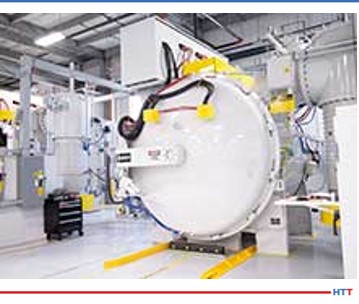
Ipsen Vacuum Furnace (photo source: ipsenusa.com)
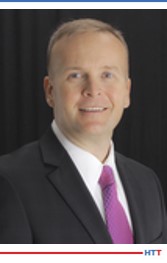
"Ipsen has worked with international operations teams for decades," said Patrick McKenna, president and CEO of Ipsen USA, "shipping equipment from the US to countries all over the world[...] With the identification of Ipsen USA as the Vacuum Center of Excellence, we can continue servicing those companies with the level of quality they expect and deserve."
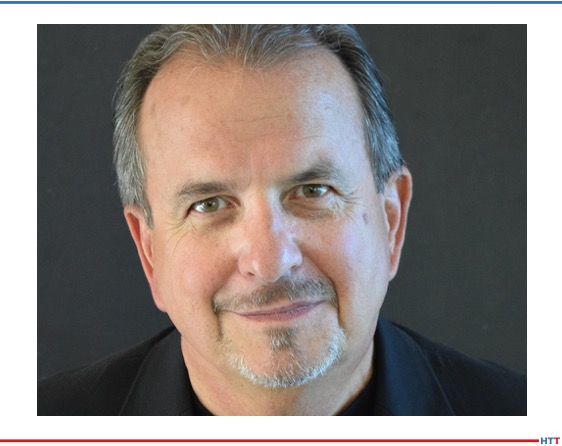
Kenneth W. Gronbach, President/CEO, KGC Direct LLC
“The United States is about to experience a monumental cultural shift, and Gen Y Millennials are the catalyst,” says Kenneth W. Gronbach, expert in the field of demography and generational marketing. Read his encouragement to Heat Treat Today’s 40 Under 40 Class of 2020 as he highlights significant demographic trends and life realities to help them determine their strategy for embarking on this next wave of opportunity.
So, you are approaching forty, big deal. Most of you could easily live into your nineties, so you are not even halfway through this life. My advice to you? Make the most of it. How? Get a handle on what is next and prepare. Demographics is a wonderful common-sense forecasting tool that precipitates accurate revelations. Really. So, let’s have a look into the demographic crystal ball as it relates to you. For the sake of this writing, I am going to consider you all part of the 88 million Generation Y Millennials born 1985 to 2004. Gen Y is the largest generation ever born in the United States. A few of you are actually Generation X born 1965 to 1984, but hey, close enough.
The United States is about to experience a monumental cultural shift, and Gen Y Millennials are the catalyst. Yeah, you. I have been warning my audiences and readers to stop living in a white bubble and to lose the bigotry. It is 2020. By 2045, white non-Latinos will be a minority in the U.S. How do we know? Simple, the young people who will shape the United States fifty years from now are already born. And they are very diverse. Much more diverse than the white non-Latino adults that dominate our demography today.
So why are you millennials the catalyst? You don’t see race, religion, or color. You see people. It’s how you were raised and taught in school. In addition, you take the anti-bullying issue very seriously. You marry outside your race, religion, and color routinely. As a result, the skin tone of the average American will be slightly darker 25 years from now and red heads will be almost extinct. (If you have redheads in your family, hang on to them because they could be worth serious money.) Black Lives Matter is an idea whose time has finally come. Don’t believe me? Take a look at the diversity of the BLM protesters and demonstrators. What do you see? They are complimented by young whites, Latinos, and Asians in significant proportions. Eighty-eight million diverse Millennials will lead America to the place we were meant to be: One Nation Under God.
Average American 2050 (Photo source: National Geographic)
Most of you 40 Under 40 are entrepreneurs: risk takers who enjoy a challenge. So, let me offer up a significant human resources challenge that you must address as you embark on your tenure as leaders. In Dr. Nicholas Eberstadt’s recent book, Men Without Work, he reveals that the United States currently has 20 million men between the ages of 25 to 55 who do not work because they are felons and cannot be bonded/insured. They are the product of the war on drugs in a nation that incarcerates more people than any other nation on earth. Did we solve the drug problem? No, we created a new one.
One-third of our labor force between 25 to 55 is idle. Let’s look at the numbers. There are about 60 million men in the United States between 25 to 55 years old. One third of them cannot work. Of the 20 million felons who cannot work, 5 million are white, 5 million are Latino, and 10 million are African American. How many African American men are there in the U.S. between 25 to 55 years old? About 10 million. No, that is not a misprint. We have crippled the African American culture by locking up their males. We have dealt with symptoms of racism rather than addressing the causes. I pray that the Black Lives Matter movement will be the beginning of the end of this gross injustice. So, what is the big challenge? We need, as a nation, to put felons back to work. You need to figure out how to hire them, to train them, to restore their dignity, and to return them to their role as contributing members of society. You can do it. You have to do it.
When the pandemic exits the United States, it will be a different place. Just look back at the changes that took place after 9/11 and 2008. Let me just give you a list of some of the sea changes we can expect in the next ten years:
Manufacturing will return to the United States because China decimated its labor force with 37 years of the One-Child Policy. China will also fall out of favor with the world in general because of its role with COVID-19.
High net worth Westerners from the European Union will immigrate to the Americas in force because of cultural issues with their principal immigrants: Muslims.
Eighty million Baby Boomers, now 57 to 76 years old, will exit the labor force of the U.S. by the millions creating a talent vacuum that will suck in skilled, cyber, multi-tasking Millennials by the millions. This will cause the United States to flourish.
The E.U., Eastern Europe, Russia, Japan, and South Korea will diminish in power and influence because of their extremely low fertility rate. No kids and eventually no adults/taxpayers.
Mexico has perfect demographics but will be considered a failed state because of the absence of a working government replaced by criminal cartels. It could well be annexed by the United States.
India could blossom economically if it could get a handle on its disastrous distribution of wealth.
The population of the world is currently at about 7 billion and will increase to about 10 billion by 2060 before it begins to recede.
The population of the continent of Africa could double to two billion because of Africa’s extremely high fertility rate and the introduction of modern healthcare, technology, and education by Africa’s new friend, China.
So, my 40 Under 40 friends, it is a new world. There will be no lack of opportunity. Make the world a better place and remember, “Wait and see” is not a plan. What is your strategy?Be well,Kenneth W. Gronbach
About the Author:Kenneth W. Gronbach is a gifted keynote speaker and nationally recognized author, expert, and futurist in the field of Demography and Generational Marketing. He makes the science of shifting demography come alive with real life examples which make it relevant to today’s culture, business climate, and economy. With nearly three decades experience in retail advertising and marketing, Ken saw the direct results of shifting demographics in his clients’ profits. Eventually, his passion for the subject changed the direction of his career, to the benefit of readers of his books and attendees of his keynotes and other presentations.
Welcome to another episode of Heat Treat Radio, a periodic podcast where Heat Treat Radio host, Doug Glenn, discusses cutting-edge topics with industry-leading personalities. Below, you can either listen to the podcast by clicking on the audio play button, or you can read an edited version of the transcript. To see a complete list of other Heat Treat Radio episodes, click here.
In this conversation, Heat Treat Radio host, Doug Glenn, interviews Mr. Harb Nayar, president and founderof TAT Technologies LLC. Harb is both an inquisitive learner and dynamic entrepreneur who will share his current interests in the powder metal industry, and what he anticipates for the future of the industry, especially where it bisects with heat treating.
The following transcript has been edited for your reading enjoyment.
Harb Nayar (HN): My name is Harb Nayar. I am the president of TAT Technologies, LLC. It is a very small 10 year old company that focuses on powdered materials and processes, especially sintering.
Doug Glenn (DG): This experience you've had with powder metals stretches over 50 years. I understand that people recognize you as “the sintering guru” for the value that you've brought to the industry. Can you share what intrigued you about the powder metal process and the powder metal industry that began your lifelong interest?
Harb Nayar at TAT Technologies (photo source: tat-tech.com)
HN: There is no doubt that PM (powder metallurgy) is a very, very unique manufacturing process to make metallic products. If I have to pick one thing that I would say which is almost becoming a destructive technology in the manufacturing of complex shapes (metallic products), that would be additive manufacturing using metal powders to start with. And you may ask why it's destructive. The answer is relatively short and simple. That it takes a totally different way of manufacturing. You are adding layer by layer to build a 3-dimensional component and therefore you can make unusual designs and unusual complex shapes out of it. The PM is used to make 2-dimensional and 3-dimensional parts for a very long time, but this one can make 4 dimensions. Now you may say there are only 3 dimensions, where are you coming up with the fourth one? Well, in my opinion, the fourth one in this case is emptiness. In other words, it can create design. Within the solid, you have empty spaces, so to speak, and that is what I call the fourth dimension. This is where the major benefit will be to reduce weight.
Now, to really give you how much design flexibility there is, I'll give a very simple example. Suppose you are trying to make this one piece, or many pieces, of a globe of the whole world, but you want it to be stainless steel. And you want to make it in one piece with no welding, but you want to show the hills and the valleys and the ocean and everything else, and you want to keep the interior of this globe empty to keep the weight light. You can only do this by additive manufacturing and to the best of my knowledge, there is no other way to make it. That is where I'm emphasizing the fourth dimension – the emptiness.
DG: Yes. And now this would have a pretty significant influence on both the aerospace and the automotive industries where lightweighting plays a key role.
HN: I think lightness, just as in the cellphone business or the semiconductor business where things became smaller and smaller, in the product line it's going to be, can we make it lighter and lighter, if for no other reason than to use less material to begin with. The other one I think that's going to emerge is most probably making more and more parts by powder metallurgy from metal powder which are 100% free alloyed. In other words, all the elements are in each metal powdered particle. In other words, you're starting with a micro ingot as opposed to a big ingot that you normally use to make bars, and then from bars you cut pieces, and then from those pieces you do hard forging or machining. But here, you will be starting from the other end where each powdered particle now is a micro ingot and the challenge is how you take billions of these micro ingots and make a 20 lb. part out of it. That’s the other thing that most probably is going to start picking up.
Students taking a hands-on course with TAT Training Center (photo source: tat-tech.com)
Especially the low alloy steel parts. My personal feeling is that a lot of technology, although it has already been developing, but, it will develop much more rapidly in the next 10 years. That is where the role of the heat treat people will be actually much bigger, because by doing a heat treat, you can always make an alloy or a material more strong, so to speak, as that's the main function of heat treat. But in the low alloy steels, the reason you are adding alloy is so that it's more conducive to heat treatment. Certain alloying elements help you to strengthen the material more than certain other elements. I think the powder metallurgy technique, each micro ingot is uniformly alloy, where when you start with a big billet, it's not uniformly alloyed. I think that the role of the PM would be to reduce those dimensional, (like mechanical properties in 3 dimensions are different if you're making something that originally was cast as a billet), where in the metal powder particle, because the distance is so small in each particle, each element is much, much more uniformly dispersed. And also, there are no stringers that you normally get when you're casting, let’s say, a 7” diameter bar or a 15” square bar, out of which you then make other things. Not only will the alloys be more uniformly distributed in the micro ingot, but there will be no stringer type of impurities.
DG: So then, Harb, what is your prognosis for the future of the industry looking forward?
HN: That is an unusually good question, and also a very complicated question. But I can make three or four general statements. One is that powder metallurgy is going to continue to grow. A lot of people will take issue with me, but in my opinion, with additive manufacturing coming in and with these other developments that I mentioned, in the last 2 – 3 years it has been below 6% growth rate. It used to be 7 -8% and it began to flatten out a little bit. I think that AM and this other micro ingot approach, I think that it will swing back to 7, 8 or 9% growth by the middle or latter part of this decade. And all these changes that are coming will affect heat treat. The way I see it, in heat treat, the changes will be based on two things: what are they heat treating right now? For example, if they're heat treating almost exclusively from macro ingots and now they have to worry about the micro ingot type of products, obviously heat treat has to shift somehow. The second one: how is being heat treated right now? That's where I feel that oil will be going down and other quenching techniques most probably will be coming up. Part of that will be influenced by as the PM makes inroads into machine parts or hard forged parts using macro ingots. The micro ingot will somehow affect the heat treat.
DG: So those will be the main things: that PM will continue to grow and elimination of oil.
HN: Well, the PM will continue to grow, but that will then affect the heat treat industry, yes.
DG: Harb, could you tell us how you got interested in powder metallurgy, and also how you came to be known as the 'sintering guru' in the United States?
The Delhi Iron Pillar (photo source: Harb Nayar)
HN: Well, it all started when I watched an American movie at 17 years old, in India, in English of course. At the age of 18, I came to study at Rensselaer Polytechnic Institute in Troy, NY in mechanical engineering. When I went back to India, I happened to see a monument that's called Delhi Iron Pillar. I was born in Delhi, I had seen it, but it never impressed me that much. But when I read the story behind it, that it was made by starting with iron oxide powders, and that got converted into a sponge iron and then sponge iron was hot forged into this 14 ton structure. It is the largest part known to be made by powder metallurgy and was made around 14 centuries ago and it still has not rusted. So with all the story behind it, there are still some mysteries behind it, but the main thing is that powder metallurgy impressed me. It changed my course.
DG: In fact, seeing the Delhi iron pillar did change Harb's life course. He went back to school and studied sintering and earned a master's degree in metallurgy at Notre Dame University. Then he poured himself into the practical, returning to Rensselaer Polytechnic Institute, where he earned his PhD. Shortly thereafter, Harb worked in a research lab for Copper Range Company where he researched the possibility of making copper strip directly from powder, as opposed to casting it from molten copper. Unfortunately, that research project never grew legs. His next employment, however, did bear fruit. After Copper Range, Harb moved to New Jersey, and here's what happened.
HN: So after working for Copper Range, I went to New Jersey and worked for an industrial gas company. It was called Airco Industrial. It was well known for making nitrogen, oxygen, hydrogen and many, many other gases. When I was hired, they had no powder metallurgy activity of any kind. So my first assignment was, can the powder metallurgy be used to be make electrodes, welding rods, etc, because Airco also had a welding products division. I then did make hardfacing rods and welding rods by powders.
DG: Although the welding products division was sold, Harb found a new home at Airco researching and developing synthetic gases. Remember, in the early 70's, there was the energy crisis and a concern that there would be a shortage of industrial gases. During his time at Airco, Harb was one of the early developers of synthetic gases, or what might be more commonly known today as mixed gases. After Airco, Harb took some extended time off to raise his young daughters after the untimely passing of their mother. After the daughters were out of the house, Harb wondered what he should do with himself. TAT Technologies, the company he currently owns and operates, was just the answer.
Harb, tell us a little about what you're currently doing with TAT Technologies.
HN: TAT stands for Temperature Atmosphere Time Technology. Whatever my thermal processing background was, I decided to work on that, but focus only on powder metallurgy to start with, not all the other thermal processes. In other words, start with sintering to begin with.
I opened a school to teach sintering, just like I learned when I left and came from India. I started teaching sintering but did it hands-on; not just lectures, but hands-on. So, I bought a sintering furnace for testing equipment and opened my own lab in 2012. We started with education and training, then added some R&D to it, then developed equipment that can help to increase the production rate in sintering furnaces by as much as 30 – 40% in existing furnaces. Slowly, we would begin to work with a very small number of people and that's what we've been doing until 2019. Then, of course, in 2020, COVID-19 came along. Just like in the 70's, the bad time, at least it appeared to be a bad time anyway, that there was a natural gas shortage, that gave the birth to Synthetic Atmospheres. That was my silver lining then. My silver lining this time is that it forced me to look into other projects which may be even more interesting. And I decided to build by intellectual property. So since then, I've received one patent, two are already applied for, two are in the process, and another four or five are waiting in line.
Students engaged in hands-on learning at TAT Training Center (photo source: tat-tech.com)
My future now is in two directions: One is to continue with what we became very good at until 2019 and make it go further, and the other is to, hopefully, develop this new project and figure out a way of commercializing them. I believe in the old theory “that one in hand is better than two in the bush,” I change it to “keep the one you have in the hand the best you can, and still go after the two in the bush.” This is what has evolved because of COVID-19.
DG: Let's stick with TAT for just a moment. Where do you see it going in the future?
HN: There are three activities that we plan to pursue based on the patents that are issued or are being issued. One is a project which promotes production of low alloy steels by powder metallurgy. I believe there is a very big future in that. In other words, how to bring out the better properties of a micro ingot compared to a big ingot and how to translate that into better products which require less energy and will cost less to manufacture. Right now they are being manufactured in one way or another by either machining or by taking a billet, chopping it down to small pieces and then doing hard forging. I plan to make the starting material, from my hard forging using low alloy steel, would be powders as opposed to a preform that originally was cast somehow somewhere. That's my one project. And that will affect heat treat quite a bit. Presently, most of the heat treat is done on parts which are really made by the big casting approach, ingot casting; these bring all the imperfection from the casting into the final product which is then heat treated. My question is that if the product was much more uniform, then it may develop somewhat different heat treat approaches and it most probably will reduce, if not eliminate, oil quenching.
DG: So, why the elimination of oil quenching?
HN: There are two reasons. One obviously is just safety as oil tends to catch fire, but the main reason is that if you can distribute the alloys more evenly, there is a high probability you need less total amount of alloying element, which will give you a similar mechanical property because it doesn't have some of these irregularities. Now that “most probability low alloy steel” with even a lower amount of alloying is going to be more conducive to faster quenching. In powder metallurgy – gas quenching is already used after sintering – they call it sinter hardening. In my opinion, heat treat will have to somehow modify its practices to deal with if the same forged product is really made from micro ingots as opposed to a macro ingot.
DG: Very interesting. So that is one prospect of three. What is another one?
Student learning at TAT Training Center (photo source: tat-tech.com)
HN: In the additive manufacturing, there are two weak points there, that's why it's not taking up as quickly, commercially, I'm talking, R&D, the money, the research, is going at a very high rate, but the actual production where you can see a part going in the automotive is not there yet. The reason is the shaping process – layer by layer – is somewhat slower. They have to speed it up quite a bit in order to make it what I call mass production. That's one, at the moment, still a bottleneck.
The second one is a bottleneck that they are not addressing yet because they feel they have to take care of the other bottleneck first, and that is because wherever there will be high volume of additive manufacturing, there the green part will have some binder in it. That binder has to be removed prior to sintering. Therefore, I am going to be focusing on binder, and start getting ready within a couple of years, for mass debinding.
Right now, the debinding is done in small batches only. I'm going to be ready for production on a mass scale when the shaping people start making the green parts faster. And it's much more challenging than the debinding in the conventional powder metallurgy because there the amount of binder, or what they call lubricant, by volume is less than 10%, whereas in the additive manufacturing, wherever they use the binder, is always much more than 10%. That makes it a bigger challenge to get rid of it. I already have an expertise in how to get rid of the binder in the conventional part of metallurgy, so I will use my dad’s know-how as a stepping stone to develop, what I call mass production, debinding operation. That's my second project.
The third one came directly out of COVID-19. I cannot get into it because there are still some patent issues involved here, but I want to replace N95, which is made from what's called unwoven polymer, and I want the filtering portion to be metallic. That would be my dream project.
DG: Any last messages for our listeners?
HN: We are not doing it, but we are open to it, and that is because your main listeners are heat treaters, so I'm open to them – that my background is furnaces and atmospheres and temperature – to anyone if they have problems to reduce the atmosphere cost, let's say. Or they want to increase the productivity of their furnaces, they could reach me and once I understand their need, I will be willing to work with them on how to accomplish those two goals: cost reduction, atmosphere reduction and the third will be energy production. I have a pretty good background in all of those three areas when it comes to thermal processes in general. Even though my focus right now is on sintering, that does not mean I cannot get into annealing or brazing or heat treating or tempering, and so on.
DG: Thanks for taking the time to talk to us, Harb.
Super IQ® Gas Carburizing furnace from SECO/WARWICK Group
REX Heat Treat, a commercial heat treater specializing in the aerospace market, has bought and installed a hybrid model -- conventional and vacuum -- furnace system from a European supplier. This technology will allow the company to improve their through-hardening and carburizing capabilities alongside their legacy harden and temper furnaces, while using their existing loader, baskets and washing system.
REX Heat Treat has become the first company to install and commission this hybrid model called Super IQ® Gas Carburizing furnace from SECO/WARWICK Group. Designed to eliminate endogas, the furnace allows clean processing and can even achieve higher temperature carburizing to speed cycles and improve yields in certain steels in a clean and cool manner.
Jonathan Rex, General Manager, Rex Heat Treat (photo source: LinkedIn)
“The technological advances," says Johnathan Rex, general manager at REX Heat Treat, "allow us to run at higher temperatures, vacuum carburize, and clean harden with no decarburizing effects. The fact that our existing systems fit perfectly with this new addition helps to minimize the overall investment and accelerate successful integration. We expect the Super IQ to reduce operating costs, improve safety, and enable more environmentally friendly processing."
One of the great benefits of a community of heat treaters is the opportunity to challenge old habits and look at new ways of doing things. Heat TreatToday’s101 Heat TreatTipsis another opportunity to learn the tips, tricks, and hacks shared by some of the industry’s foremost experts.
Today’s offering includes tips from Quaker Houghton to help you select aqueous quenchant, Pyro Consulting LLC to check your flow, and Nel Hydrogen on how to solve certain compliance issues.
Heat TreatTip #9
Aqueous Quenchant Selection Tips
Aqueous Quenching
1. Determine your quench: Induction or Immersion? Different aqueous quenchants will provide either faster or slower cooling depending upon induction or immersion quenching applications. It is important to select the proper quenchant to meet required metallurgical properties for the application.
2. Part material: Chemistry and hardenability are important for the critical cooling rate for the application.
3. Part material: Minimum and maximum section thickness is required to select the proper aqueous quenchant and concentration.
4. Select the correct aqueous quenchant for the application as there are different chemistries. Choosing the correct aqueous quenchant will provide the required metallurgical properties.
Greenlight Unit
5. Review selected aqueous quenchant for physical characteristics and cooling curve data at respective concentrations.
6. Filtration is important for aqueous quenchants to keep the solution as clean as possible.
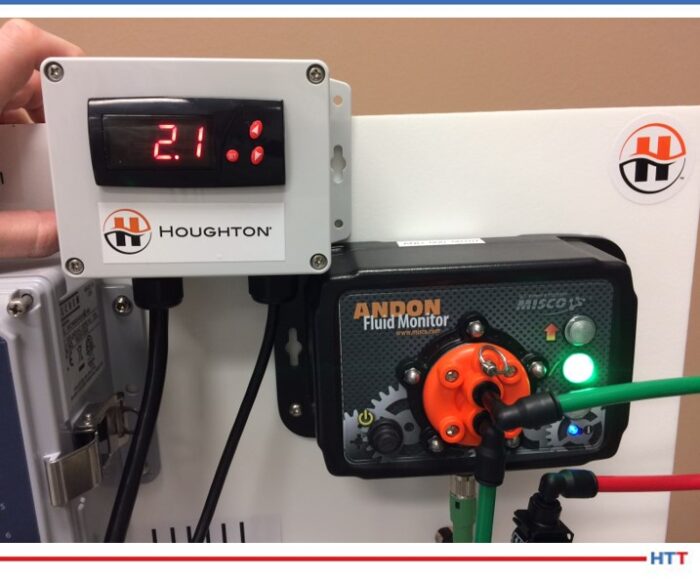
7. Check concentration of aqueous quenchant via kinematic viscosity, refractometer, or Greenlight Unit. [Image: Hougton Intn'l Greenlight Unit and/or Houghton Int'l GL Display B] Concentration should be monitored on a regular basis to ensure the quenchant's heat extraction capabilities.
8. Check for contamination (hydraulic oil, etc) which can have an adverse effect on the products cooling curves and possibly affect metallurgical properties.
Greenlight Display
9. Check pH to ensure proper corrosion protection on parts and equipment.
10. Check microbiologicals which can foul the aqueous quenchant causing unpleasant odors in the quench tank and working environment. If necessary utilize a biostable aqueous quenchant.
11. Implement a proactive maintenance program from your supplier. (Quaker Houghton)
Heat TreatTip #10
Go with the Flow!
In the absence of specific calibration requirements, how do you know your flow meters are working properly? Certainly, AS9100D requires gauges that can affect fit, form, or function to be calibrated, and Nadcap requires the meters to be correct for the gas used and checked for proper function as part of the PM schedule. Often generator issues can reveal problems with flow meters. Check the meter when the furnace gas is off. If the float does not drop to the -0- mark, it’s an indication that carbon soot has built up inside the chamber of the meter. This condition can be detected early by looking for tiny black carbon particles floating around in the flowmeter oil. Proper PM should include removing the float for cleaning and replacing the float oil regularly. (Pyro Consulting LLC)
Heat TreatTip #11
Compliance Issues? Try On-Site Gas Generation
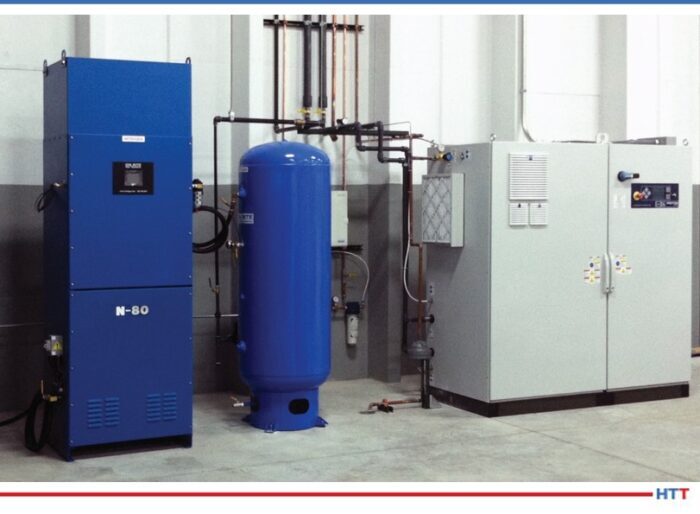
On-site gas generation may help resolve compliance issues. Growth and success in thermal processing may have resulted in you expanding your inventory of reducing atmosphere gases. If you are storing hydrogen or ammonia for Dissociated Ammonia (DA), both of which are classed by the EPA as Highly Hazardous Materials, expanding gas inventory can create compliance issues. It is now possible to create reducing gas atmospheres on a make-it-as-you-use-it basis, minimizing site inventory of hazardous materials and facilitating growth while ensuring HazMat compliance. Modern hydrogen generators can serve small and large flow rates, can load follow, and can make unlimited hydrogen volumes with virtually zero stored HazMat inventory. Hydrogen is the key reducing constituent in both blended hydrogen-nitrogen and DA atmospheres—hydrogen generation (and optionally, nitrogen generation) can be used to provide exactly the atmosphere required but with zero hazardous material storage and at a predictable, economical cost. (Nel Hydrogen)
Generate H2 and N2 on-site – saving money, improving safety, and reducing carbon footprint.
Discover how to keep your furnace in prime working order as Fred Hamizadeh, director of Global Manufacturing Services- Heat Treat & Facilities Equipment, of American Axle & Manufacturing and keynote speaker at Furnaces North America 2020 (Virtual) Trade Show, outlines the essential attributes of effective maintenance practices for industrial heat treating equipment.
This article will be featured in Heat Treat Today’s upcoming FNA Trade Show issue in early September.
Fred Hamizadeh, Director of Global Manufacturing Services- Heat Treat & Facilities Equipment, American Axle & Manufacturing
I recall great advice from my first boss, Bob Williams, of Williams Industrial Service: He said to me early on that if the maintenance people are happy with your equipment, you’ve designed a good furnace. Combining many years of my OEM furnace manufacturing experience with my current position allows for a perspective that is useful to both American Axle & Manufacturing (AAM) and our OEM suppliers.
American Axle & Manufacturing can trace its history to the early 20th century and was comprised of the five General Motors plants, purchased by an investment team led by our co-founder, Richard E. Dauch, in 1994. Heat treating has been a core competency of the AAM manufacturing system since the inception of the company. AAM uses conventional gas carburizing and tempering as well as various induction processes in the manufacturing of all drive-train components. These components include: case hardening of gears and pinions; induction hardening of shafts, CV joint and balance shafts; and sintering of powder metal. Our metal-forming product business unit uses induction heating to forge and manufacture a large variety of automotive components. As one of the largest captive global heat treaters, AAM’s carburizing equipment varies in size and style, from batch to single and multirow pushers. Induction equipment cells also vary from single spindle to multi spindle, fully automated hardening and tempering lines.
“While we remain open to all new developments and advances in technology, it does not provide suppliers with an open checkbook. We must maintain a balance between high technology, reasonable CPU, component performance improvement, and reliability. “
(Photo source: American Axle and Manufacturing)
An integral part of AAM’s quality process is the maintenance and reliability of production equipment including the heat treat equipment. To remain current with latest CQI-9 requirements, all maintenance intervals are scheduled, followed, and monitored by the company leadership. All AAM facilities have an advanced maintenance team that performs most of the day-to-day requirements and responds to all emergency cases.
Maintenance requirements must be considered early on during equipment selection, procurement, design, and manufacturing. AAM has specifications that heat treat manufacturers must follow to allow safe and fast maintenance to occur regularly without requiring equipment to be removed from production. As a minimum, sufficient access points within the equipment are essential. A preferred location would be to have access from the plant floor; otherwise, safe platforms must be provided. All hazards such as heat, electricity, and stored energy must be eliminated or locked out. A detailed LockOut TagOut (LOTO) system diagram allows maintenance to be performed safely. Use of our recommended parts list ensures that we have common components for speedy repairs within our stores.
(Photo source: American Axle and Manufacturing)
Today, we look for equipment that has the following features to allow extended mean time between failures (MTBF), provided regular scheduled maintenance is completed:
Equipment built to AAM’s specifications for heat treat equipment. These specifications are designed based on our needs and best practices as well as supplier capabilities and regional presence.
Use of common components within company provided parts list
Use of domestically available and reliable material and components for equipment built in various regions of the world for ease of replacement. Otherwise, the use of U.S. or European brands with global presence is preferred.
Use of standard equipment design to allow common spare parts that can be shared between plants. This standard design will also provide equipment interchangeability and allow maximized equipment utilization based on plant loading.
Use of common control equipment and sensors. We utilize two brands of process controls. Our electrical systems use AAM Controls Architecture specifications that allow all plant control engineers the ability to troubleshoot, repair, and place equipment back into production rapidly.
Use of highest-grade cast or wrought nickel-chromium grade components to insure long MTBF. This is one area that must be observed closely during the bidding process.
Use of brick lining for all carburizing zones. This eliminates the carbon burnout issues associated with ceramic fiber lining.
Use of reliable, dependable, and global suppliers. Our need to maintain interchangeability and versatility to maintain high utilization rates require suppliers to have presence in North and South America, Europe, and Asia. Same is true for component suppliers. Rapid response to issues is critical for our operations and most of our suppliers have met this requirement.
Enforcing a maintenance schedule that allows for maximized production while allowing time for burnouts and maintenance. Maintenance and burnout schedules are established a year in advance. These schedules are communicated and balanced with production requirements. This period is not only required for performing needed maintenance but should be used to plan the next maintenance activities.
Detailed LOTO tags to pinpoint all sources of energy that need to be locked out to perform safe maintenance.
Detailed inspection of equipment for safety, maintenance, and function prior to shipment from supplier.
Provide training for engineers, technicians, and operators in safety operation and maintenance of the equipment by the manufacturer.
For large and complex equipment, monitor force and cycle time historically as early indicators of maintenance requirement.
While there are some new developments and advancements in the maintainability of equipment using the latest digital technologies such as Mobile Maintenance Assistance by Aichelin, more development needs to occur to allow integrated maintenance, record keeping, spare parts ordering, and monitoring. Digital archives of system drawings and manuals must be available for a maintenance technician at point of use. Additionally, video recordings of training sessions can be maintained at the equipment for training new associates.
(Photo source: American Axle and Manufacturing)
The future of heat treat will include more advances in induction processing, austempering, and further development of liquid quench capable LPC equipment. Over the last 30 years, many new processes have been introduced into the market but were unable to justify eliminating conventional gas carburizing and induction hardening. While we remain open to all new developments and advances in technology, it does not provide suppliers with an open checkbook. We must maintain a balance between high technology, reasonable CPU, component performance improvement, and reliability.
About the Author:
Fred Hamizadeh, a mechanical engineer and 32-year veteran of the heat treat industry, is the director of Global Manufacturing Services-Heat Treat & Facilities Equipment, at American Axle & Manufacturing. The majority of his experience has been focused on the OEM side of heat treating with Surface Combustion and Williams Industrial. For the last 14 years, Fred has worked on the consumer side of heat treating with AAM.
For more information, contact Fred at Fred.Hamizadeh@aam.com
This Heat Treat Today Original Content piece offers a closer look at a resource for metallurgists: Al-Si Alloy: Automotive, Aeronautical, and Aerospace Applications.The authors of the book, Dr. Francisco Robles-Hernandez, Dr. Jose Martin Herrera Ramírez, and Dr. Robert Ian Mackay, collaborated in the making of this reference text for students and practicing heat treaters. The information below has been provided by Dr. Mackay and was composed by Heat Treat Today editors.
Dr. Robert Ian Mackay, M.Sc., M.Eng., Ph.D., P.Eng., at Nemak
Dr. Robert Ian Mackay, M.Sc., M.Eng., Ph.D., P.Eng., at Nemak has spent nearly 25 years in industry, but also can lay claim to a history in academia. He joined in the authoring of Al-Si Alloy: Automotive, Aeronautical, and Aerospace Applications with Dr. Francisco Robles-Hernandez and Dr. Jose Martin Herrera Ramírez to lend his expertise to “[bridge] the gap between fundamental science and its application to industrial metal casting and heat treatment.” Aluminum silicon (Al-Si) is one of the most prolific alloys, as this book notes, and thus describes major characteristics of the alloy as well as its application in the key fields of automotive, aeronautical, and aerospace.
Covering aluminum metal casting science, the book explores content such as thermal analysis methods, mechanical testing, casting processes. Of the nine chapters, Dr. Mackay emphasizes chapters 3 and 6 as being particularly helpful to heat treaters. Chapter 3 details the important casting processes used in Al-Si alloy metal casting, and further highlights “the heat treat process and their specific temper designation as specified by the Aluminum Association (e.g. T5, T6 and T7 for metal casting),” Dr. Mackay notes. He comments that the way one heat treats an aerospace precision sand casting differs from an automotive high pressure die casting (HPDC), making this section particularly valuable.
In the second heat treat noteworthy chapter, the authors examine mechanical properties of the alloy. “This is the part of the textbook,” comments Dr. Mackay, “that is specifically controlled by the heat treat process. Throughout this chapter references to T5, T6 and T7 tempers are made as they do influence not only the type of mechanical testing that is performed, but also the casting properties that are achieved.”
Al-Si Alloys will be a helpful reference guide to heat treaters; while the use of the text is primarily academic, the book was designed to enable people to access information without studying the entirety of the book. Other features that one could reference in the book are the historical discovery that mechanical strength could be improved by processing aluminum castings, the implementation of this improved structural component in WWII military aircraft, and Dr. Mackay’s deliberate contribution of a “detailed description of testing methods used and their interpretation for metal casting quality.”
The book is available in hardcover, softcover, and e-book formats. To access the e-book , or to download select chapters, one can visit the website of the publisher, Springer Nature. See here.
To contact Dr. Robert Mackay, you can reach him via his LinkedIn profile here.
At the end of the week, we like to keep it light at Heat Treat Today. This Fringe Friday article explores the frontier of manufacturing: 4D printing. This approach uses printable materials, which can be manipulated by high temperature, electric current, or pressure, taking on different forms.
The shape-shifting material has the potential for multiple applications. The excitement for future applications is further explored in this the Thomasnet.com article, “4D Printing Makes Shape-shifting a Reality.” Take a look at the video on their website to listen and watch these 4D finds.
An excerpt: “These characteristics allow for bonding to the non-transforming substances in helping to simultaneously support the composition of the initial object, as well as embedding the ability to change the object’s shape based on need or environmental factors.”
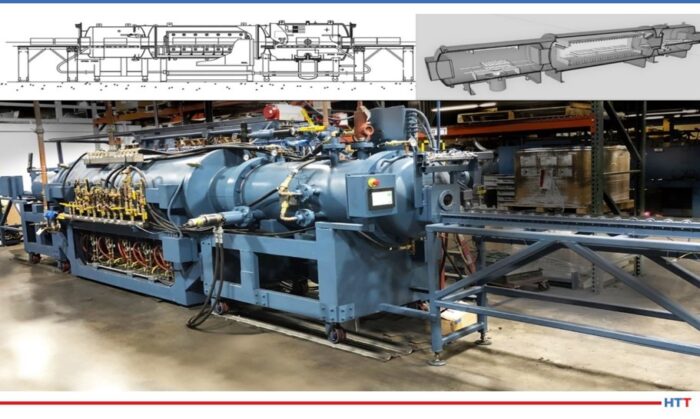
A North American based aerospace manufacturer will receive a continuous vacuum (CV) furnace with 10 bar pressure quench capabilities. The 4 position, 4 zone furnace is rated to 2400°F, and will work well in processing medium to high volume parts.
The supplier, Gasbarre Thermal Processing, shares that the independent load and quench modules allow the heat module to hold temperature and vacuum, creating a pure environment. The extended heating element coverage is conducive for thorough temperature uniformity, and then only the workload is cooled in the isolated cooling chamber. Quick transference from the heat module to the cool module as well as fast quench capabilities will aid processing of medium to high volume parts.