Many of you are likely to have heard Harb Nayar, president of TAT Technologies, LLC, expert in all things sintering, explain innovative ways to produce heat treated products. But perhaps you are wondering, how would “atomised prealloyed steel particles,” that is micro-ingots, work within the realm of heat treat?
This Heat TreatTodayBest of the Web feature is pulled from a powder metallurgy (PM) whitepaper in which Harb Nayar describes the PM background, processes, and application in more detail. Read his detailed whitepaper, “The micro-ingot route: A variant of the PM process that could offer new opportunities for the PM industry,” on the web, or download the free PDF.
An excerpt: “This micro-ingot approach, when combined with newer heat treatment technologies, can lead to a redesign of the current macro-ingot products that can potentially help to reduce the weight of the finished product resulting in a longer product life span.”
Heat Treat Radio host Doug Glenn continues his conversation with AMS2750F expert Andrew Bassett. This time the pair discusses Revision F changes to System Accuracy Tests (SATs).
Below, you can either listen to the podcast by clicking on the audio play button, or you can read an edited version of the transcript.
The following transcript has been edited for your reading enjoyment.
DG: We are back today for our second episode of a three-part series with Andrew Bassett. Andrew is the president and CEO of Aerospace Testing and Pyrometry, headquartered out of Bethlehem, PA, with offices across the county. They do a lot in pyrometry services and related things. Andrew also had a seat on the committee that was responsible for – that owned – the AMS2750 revision F, so he can speak with firsthand knowledge of some of these changes.
If you are interested, you can listen to the first part, which dealt with the major changes in thermocouples and sensors, major changes in instruments, major changes in calibration, and then we also spent a little bit of time right at the end of the last episode talking about offsets.
AB: Yes, and the offsets were one of major changes that we, as a team, did a very good job of spelling out the new requirements for the two different offsets: modification offsets and correction offsets. So that’s a valuable tool to go back and take a look at.
Episode 1 of 3 of AMS2750 series
DG: If you didn’t catch that first episode, you can certainly do that. You can go to www.heattreattoday.com, jump back into the radio section which is under heat treat media on our main navigation tab, and check that out. It would be very worthwhile.
Before we jump into the topic for today, which is the system accuracy tests (SATs), I wanted to ask you a question about this revision. Often, the AMS folks will come out with a minor modification, or not a huge modification, let’s say; other times, it’s pretty much a re-write, end to end. How would you classify this revision F? Where does it fall on that scale?
AB: It leans towards the side of a complete re-write. I think one of the big things that changed was obviously the number of pages of the document; it jumped from roughly 43 pages up to 54 pages. We expanded the number of tables that were from revision E, which had 11 tables, into 25. This was to do some more clarifications of the requirements, or to spell things out a little bit more. I would be leaning on the side of this as being more of a complete re-write. There’s going to be quite a bit in there that is the same old stuff from the previous revisions, but there is quite a bunch of new stuff.
I would lean towards saying that this was a complete re-write and that’s why there were no change bars associated with the spec. Typically, when these specs get revised, the change bars show you where the changes are, but since this was more of a re-write, we left out the change bars this time around.
DG: Instead of having someone go in and “cheat” and just look at the change bars, you’ve got to pretty much start from the beginning and go straight through.
Where do you see some of the major changes in rev F on the overall or the resident SAT?
(source: Andrew Bassett, ATP)
AB: Not a whole lot completely changed on the resident sensors. We still allowed for the same sensors as we did in the previous revisions, where you are limited to different types of sensors based on the temperature ranges, that they were going to be seeing. For instance, if you’re above 500 degrees Fahrenheit, then you’re going to be limited to type N, S, R or B thermocouples, and if you’re above 1,000 degrees, they would have to be what’s called a nonexpendable thermocouple, the metal sheathed type thermocouples. We left that stuff alone. But one of the things we did allow for with the new resident sensors, which I believe is a benefit to the supplies that are using the resident sensors, is that we’re going to allow for some things. Let’s say you have an over temperature sensor, and you also want to use that as your resident sensor. Now you’re allowed to do that as long as you follow the guidelines that say a resident sensor has to be replaced. If it’s a base metal thermocouple it has to be replaced every 90 days, or on a quarterly basis. If it is a noble metal, one of the type R, S, or Bs, it would have to be replaced or recalibrated every six months. We did allow for cases where you have an extra sensor that is being used in dual roles (that is, a resident sensor that also functions as a high limit protection), then you can go ahead and do that. I think that that is something that is beneficial to the suppliers, in that we don’t have to go out and put a third sensor into a furnace or drill a hole to put our resident sensor in.
The one thing that we really want to emphasize with these resident sensors is that their position is to be verified during the installation process and when it’s replaced. When a resident sensor is in a fixed position, we want to make sure it is not moving. Typically, you see a compression fitting that is going to tie the thermocouple down and lock it into place. We want to make sure it is not moving between tests. So, now when you replace these things, you must verify the positioning when you put it in on a replacement basis.
Also, it’s always been the requirement to put the thermocouple in for the 90 days or 180 days, and leave it in there. We’re going to allow you to take it out between the tests, but only as long as it is verified after every single time it’s replaced. I’m not a big believer in that; just because someone from Quality doesn’t come out and verify it doesn’t mean that it could be in the wrong position. But we are allowing you to independently move this thing in and out between the test if you want; that is acceptable. You still have the same replacement periods as quarterly and 180 days depending on the sensor type. We did give a little leeway on that from the resident sensor standpoint. Again, we didn’t make a whole lot of changes on it. We just wanted to spell out the little bit of differences allowing for other types of sensors to be used, or have a dual purpose, I should say.
DG: Let’s move on to the second issue, and that is the alternate SAT process, which I know has sparked a lot of questions with the articles we’ve had on our website. We’ve always had people asking about what they can do, what they can’t do. Let’s talk about that.
AB: Sure. The previous revision in rev E was kind of this dark black hole of what the alternate SAT process was all about. Finally, it was more spelled out in what’s called the “PyrometryReference Guide.” That’s the document that NADCAP puts out, the “pyrometry for dummies,” so to speak. This is basically their interpretation of AMS2750. And then kind of evolved that into what’s called a “heat treat audit advisory.” There were different interpretations of this alternate SAT which were too conflicting to the suppliers. We said, “Let’s make it more clear-cut of what the expectation of this alternate SAT process is.”
First off, the process applies to load sensors that are used once, or for any other type of sensor control or recording sensors that are replaced at the same, or less frequent than the normal, SAT intervals. One of the things that was in the previous version, which we kept, is that the calibration must be performed from where you connect the sensor. Then, once you do that calibration, one of the following three options have to be met. Option 1 is that we take the sum of the sensor calibration error. That’s when you first complete calibration from the point of connection and run through the whole system, including the connections, the lead wire, and the instruments. Then, you document those results and algebraically add that to the correction factors or the errors of the wire either being used or replaced more frequently, and if the sum of those two correction factors are within the allowable SAT tolerance of AMS2750, you would have to document that. And that’s the first option; it’s basically a math function; it’s sitting at your desk and taking the calibration report of your process instrumentation, typically from the recording, and adding it to the wire that’s being used. If you fall within that certain table of AMS2750 for SAT tolerances, you’re good to go. It’s kind of a “desk SAT,” as they call it.
The other way of doing this is to use the appropriate sensor and instrument calibration correction factors. You can either program them into the system or apply it manually as allowed by the limits in AMS2750. Basically, you’re taking the correction factors for the instrumentation that you have calibrated and the sensors that you have calibration “certs” on, and programming that into your system. Again, as long as that meets within the applicable table of AMS2750, that is the second option that is allowed. Because you’re basically using the correction values from the calibration reports for your instruments and your thermocouples, you will always be within your SAT requirements.
The third option allows you to do a couple of things. For one, you can limit your instrumentation calibration error. A company comes in and does your calibrations, and the supplier says they don’t want any of their channels to be more than one degree out of calibration, so, you adjust the instrument calibration to be within that limit. Or, you can specify when you purchase thermocouples wire that you won’t take any thermocouple wire that is no more than two degrees out throughout the whole range you need them calibrated. In that instance, you will always be compliant to the requirements of the SAT tolerances. So, if you restrict the calibrations and you restrict the error on the thermocouples, then you will always meet that requirement. All you would have to do is show, for documentation purposes, the instrument calibration reports that say it is all within 1 degree and all of the wire certifications are within two degrees, and that will always meet the most stringent requirement for SAT tolerances. As long as that documentation is there, you will be able to show compliance to the requirement.
[blockquote author=”Andrew Bassett” style=”2″]“Before, there was no requirement of how to document all this, so we actually put in some hard requirements down on how to document the alternate SAT requirements.”[/blockquote]
Those are the more defined options you have. Before, if you gave it to 100 different people to read, and they said, “I don’t know what to do with this information.” Well, now we’ve put out what we actually meant and defined it a little further now.
DG: Great, so that covers the first two that we wanted to talk about – the overall of the resident SAT and now the alternate SAT – so let’s wrap up with this SAT waiver, which is obviously of interest.
AB: First, I want to jump back real quick into the alternate SAT. We finally added some documentation requirements. Before, there was no requirement of how to document all this, so we actually put in some hard requirements down on how to document the alternate SAT requirements. You have to list out the thermal processing equipment (you have to identify which furnace you’re doing this on), what is the sensor system that’s being tested, and what sensor or roll of wire that’s being replaced. You also have to identify the reason why you’re doing the SAT; for example, because you replaced the thermocouple after every run, something simple like that. If you’re doing the full calculation method, then you’d have to show all your calculated methods. We did finally put some teeth in to help you document this well.
DG: Now, the SAT waiver. Tell us about it.
AB: In all my years out in the field of pyrometry, I rarely found many suppliers that did this SAT waiver correctly. We didn’t change a lot of the basics of the requirements, but we did change some new requirements regarding how to gather your data to make sure that you do this correctly. We still require that if you’re using noble metal load thermocouples, which are the platinum based thermocouples, you replace and recalibrate them on a quarterly basis. If you have base metal load thermocouples, if they are expendable, they should still be just a single use. If they’re nonexpendable, sheath type thermocouples, they shall meet the requirements of Table 6 in AMS2750F, and that gives you guidelines of how often those need to be replaced.
If you have any kind of observations that are made and recorded on at least a weekly basis and which reveal any unexplainable difference between observable readings and readings of two recording sensors, this is where the change really occurred on those two additional sensors. We spelled out that these weekly readings have to be conducted at one production setpoint and measured within the five minutes at the end of the production soak period. What this weekly log is supposed to be doing is to compare one sensor against another sensor that you’ve identified.
Some people have used the control sensor as the one sensor and, let’s say, the high limit thermocouple as the second sensor. These have to stay within a two-degree relationship from the last successful survey, and so people were wondering when they were to take the weekly reading. We decided to spell this out a little bit further: this weekly reading must be done at production setpoint and measured within the minutes of the production soak period. In other words, you can let your thermocouples soak out for a period of time, during which you can complete your comparison check. These have to be within two degrees of the relationship determined at the most recent TUS temperature and at the nearest temperature tested during the most recent TUS.
For example, let’s say we do a survey at 1600 degrees and the control is reading 1600 degrees and my over temp is reading 1602. Next week, we come along and we’re running a job here at 1500 degrees and my control is reading 1500 degrees and my over temp is reading 1501, you’re good. You’re within that two-degree relationship. That’s where this two-degree relationship needs to occur.
But the one thing that we’ve done now is we’ve asserted that the two sensors have to be different types. Before, you’d have, let say, two type S thermocouples in your furnace; you can’t have two type S thermocouples now. You have to make a different thermocouple type for the relationship. This is more to catch any drifting of your thermocouples over time. For instance, if you had a type S thermocouple in your furnace as your control, you’re going to have to be limited to either a type B or type N thermocouple as that secondary sensor that you’re doing your relationship check with.
That’s what a big change is. Before people just used the two same sensors. What we were concerned about is – and let’s say those two thermocouples were made from the same lot of material – that there is a good chance that when the thermocouples start to drift, they’re going to drift in the same direction.
Again, we did put some similar restrictions on resident thermocouples. For the example I used, if you had type S control thermocouple, you’d be limited to type B or N, but we also allow for R as that extra thermocouple. But R and S are very similar in the chemical composition makeup, so we don’t allow an S to go against an R and vice versa, in that case. If you had a control thermocouple that was K, then really any other thermocouple that is allowed once you’re above 500 degrees you’re limited to the B, R, S, and N. Actually, these requirements are exactly the resident sensor requirements as well.
DG: Anything else on that SAT waiver?
(source: Andrew Bassett, ATP)
AB: We do now have some documentation requirements, too. Again, before there were no requirements there. Now you have to list the equipment that you’re doing the waiver on, you have to identify the control sensor, what type of sensor it is, plus what the additional sensor is used for the sensor relationship test. You have to list out the date of when the control and the additional sensor to be used, when they were installed, and when they were replaced or recalibrated. You have to list out the run number and date, so that when you are completing the production cycle on a weekly, you have some kind of easy identifier to tell you that it was done on run #ABC123, and the date was 9/8/20, so we can go back to the records and verify it. Date and temperature of the recent TUS and the documentation, that weekly log, are necessary; we need to see that weekly log as well.
We finally put some teeth into the requirements of the SAT waiver. I don’t think it’s going to be a big change for a lot of the suppliers out there. They will have to change over that one sensor, but, for the most part, I think we tweaked it enough where we felt more comfortable, especially changing those two different sensors so that we didn’t have drift occurring at the same time. That was our biggest concern as a committee.
DG: So, you’re basically trying to ensure reliability and you’re going to actually test for what you’re testing for. That makes sense.
We talked briefly about the overall or resident SAT, the alternate SAT, and the waiver. If you, the listeners, have questions, be sure to email them into us and we can potentially get Andrew to respond to them. Send those to htt@heattreattoday.com. We’ll leave Andrew’s information at the end of each of these podcasts.
Andrew, I’ve got a final question for you, not dealing with any specific aspect of the revision, but just to give people a sense of the amount of time that folks in your shoes, people that have invested time or actually on the committee: How much time do you think you’ve invested in the rev F portion of AMS2750?
AB: It was a long process. To put it in perspective, we developed our sub team and had our first meeting back in October of 2017, during one of the NADCAP meetings. We were kind of on a fast-track to get this spec revised and put out there. It wasn’t actually released until June of 2020; so three year plus is a fast-track in the eyes of the AMS world. We did meet at least six or seven times a year, either during an AMEC meeting or during one of the NADCAP meetings, and we had numerous Webex calls. When we actually met face to face, they were good 8 – 10 hour sessions of hammering out the spec. Then, we would take it back to our own groups and muddle through what we discussed. It was a long period of time. I would hate to put an hour on it. I wish we’d gotten paid for that! Taking into account what our company is and what we do, we have to live, breathe and eat this spec, day in and day out, for our customers. I just wanted to be a part of the process of getting this documentation, so the world can understand the issues in pyrometry.
DG: I actually have one other question for you. You told us in the first episode how you got onto the committee. Are they always looking for people to participate on the committee, or do they carefully fence that and only invite in certain types?
AB: Anybody can be a member of AMEC. So anybody that wants to get involved with the revisions of any of these specifications, including the AMS2750, they’re more than welcome to show up at an AMEC meeting, get involved, and volunteer to get involved with the specifications. I remember my first meeting where the chairman said, “You’ve got to get on this 2750 team. And, oh by the way, we’re thinking about writing some other specs that we’re going to throw you under the bus for.” They’re looking for young blood to get involved with these specifications and be a part of it, so yes, anybody can get involved with these specifications.
DG: If you are listening and you’re one of those people that might be interested in participating in that, you can certainly get a hold of Andrew.
This was our second part in a three part series. Our last episode will be on temperature uniformity surveys, the issue of rounding, and quality assurance provisions. If you’d like to learn more or reach out to Andrew, you can go to www.atp-cal.com and look at their ‘about our team’ section in the main navigation bar. I’d also be happy to receive emails on behalf of Andrew. My email is doug@heattreattoday.com. Thanks for listening.
Doug Glenn,Heat Treat Today publisher and Heat Treat Radio host.
To find other Heat Treat Radio episodes, go to www.heattreattoday.com/radio and look in the list of Heat Treat Radio episodes listed.
One of the great benefits of a community of heat treaters is the opportunity to challenge old habits and look at new ways of doing things. Heat TreatToday’s101 Heat TreatTipsis another opportunity to learn the tips, tricks, and hacks shared by some of the industry’s foremost experts.
Today’s selection includes tips from Nutec Bickley on how to meet temperature uniformity requirements, and PhoenixTM on how to use “dash cam” tech in your furnace and address the technical challenges in thru-process temperature monitoring.
Heat TreatTip #6
A Products Eye View in the CAB Furnace Using Optical Profiling
PhoenixTM Optic System designed to perform optical profiling in a CAB furnace. A high resolution 4K video camera is protected by an innovative thermal barrier during its journey through the furnace.
Ever wished you could see what truly happens to your product as it travels through your conveyorized CAB furnace? Well now you can! Thru-process Optical profiling is similar to temperature profiling but instead of measuring the temperature of the product the system records a high-resolution video of the products journey through the furnace. It’s like running your car “Dash Cam” but through the furnace at over 1000°F. The resulting video “Optical Furnace Profile” shows process engineers so much more about how their process is operating without any need to stop, cool and dismantle the furnace. This allows safe routine furnace inspection without any of the problems of costly lost production and days of furnace down time. From the video evidence, the root cause of process problems, possibly already highlighted by running the temperature profile system, can be identified accurately and efficiently. Furnace structural damage or faulty furniture such as recirculating fans, control thermocouples or heater elements can be detected. Buildup of unwanted flux within the furnace can be monitored allowing accurate service and clean down schedules to be planned preventing future unplanned costly line stoppages. Damage or distortion of the conveyor belt compromising the safe smooth transfer of product through the furnace can be isolated with accuracy helping reduce corrective action turnaround times.
(PhoenixTM)
Heat TreatTip #7
3 Tips to Meet Temperature Uniformity Surveys
Adjust the burners with some excess air to improve convection.
Make sure that the low fire adjustment is as small as possible. Since low fire will provide very little energy, it will make the furnace pulse more frequently and this will improve heat transfer by convection and radiation.
Increase internal pressure. This will “push” heat to dead zones allowing you to increase your coldest thermocouples (typically near the floor and in the corners of the furnace).
(Nutec Bickley)
Heat TreatTip #12
Temperature Monitoring When the Pressure is On!
PhoenixTM Thermal Barrier used for Low Pressure Carburizing furnace monitoring. Shown fitted with a unique high-performance gas quench deflector.
Increasing in popularity in the carburizing market is the use of batch or semi-continuous batch low pressure carburizing furnaces. Following the diffusion, the product is transferred to a high-pressure gas quench chamber where the product is rapidly gas cooled using typically N2 or Helium at up to 20 bar pressure.
In such processes, the technical challenge for thru-process temperature monitoring is twofold. The thermal barrier must be capable of protecting against not only heat during the carburizing but very rapid pressure and temperature changes inflicted by the gas quench. From a data collection perspective to efficiently perform temperature uniformity surveys at different temperature levels in the furnace it is important that temperature readings can be reviewed live from the process but without need for trailing thermocouples.
During the gas quench, the barrier needs to be protected from Nitrogen N2(g) or Helium He(g) gas pressures up to 20 bar. Such pressures on the flat top of the barrier would create excessive stress to the metal work and internal insulation / logger. To protect the barrier therefore a separate gas quench deflector is used. The tapered top plate deflects the gas away from the barrier. The unique Phoenix design means the plate is supported on either four or six support legs. As it is not in contact with the barrier no force is applied directly to the barrier and the force is shared between the support legs. The quench shield in addition to protecting against pressure, also acts as an additional reflective IR shield reducing the rate if IR absorption by the barrier in the vacuum heating chamber.
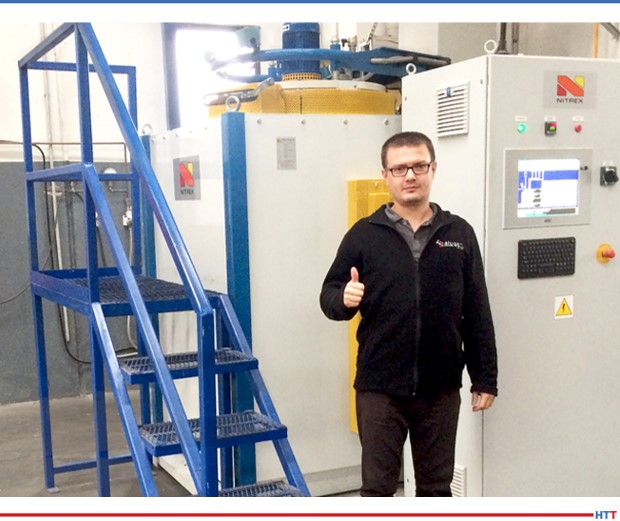
Alugen Aluminium, a Turkish aluminum extrusion company, recently expanded their production capabilities with a high-performance compact nitriding/nitrocarburizing system. This system will allow the company to bring all manufacturing operations in-house for more optimal work-planning and quality control.
"In partnering with Nitrex," says Özcan Sürücü, die shop manager at Alugen Aluminium, "we [Alugen] have become self-sufficient from an operational point of view, no longer relying on external contractors to fill this work gap. This allows for more effective planning and ensures that all projects, whether big or small, are done on time and on budget."
Özcan Sürücü, Die Shop Manager, Alugen Aluminium (Source: Nitrex.com)
The decision to bring nitriding operations in-house with Nitrex's multipurpose batch-type furnace was based on improved quality consistency and cost-effectiveness of Alugen's gas nitriding processes. With the company expanding over the years in order to meet demand, this recent addition to Alugen's manufacturing process has enabled them to meet customer requests to "mix special dies with regular production dies for a faster turnaround of product-specific production plan," according to Marcin Stoklosa, project manager at Nitrex Poland.
Don't you just wish there was direct, consolidatedinformation that clearly identified the keycharacteristics of new technologies? All too often, there is a dissonance between scholarly discoveries and jargon and the work on the ground (or the shop floor, as it were). But today's resource is different.
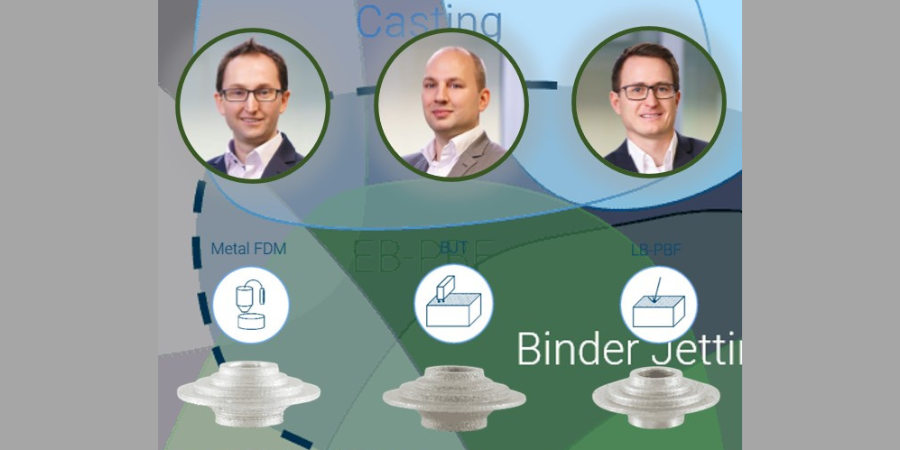
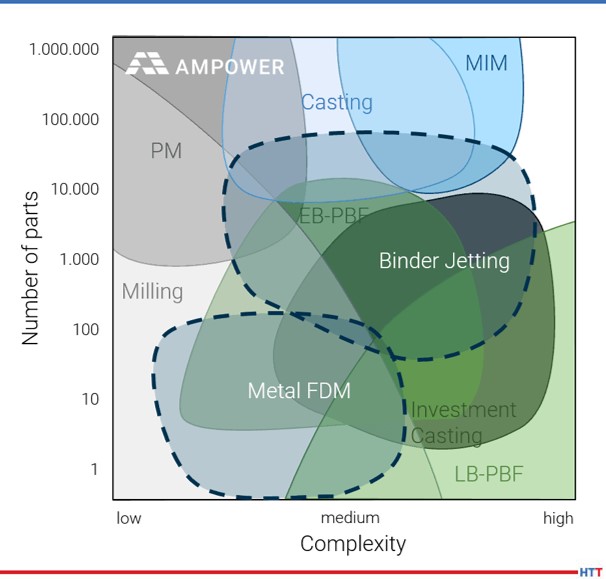
In this Heat Treat Today Best of the Web feature, Ampower presents analytical evaluations of sinter-based additive manufacturing (AM) technologies compared against laser beam powder bed fusion (LB-PBF) and metal injection molding (MIM). The analysis covers over 50 specimens from 9 different system suppliers. The authors are Dr.-Ing. Maximilian Munsch, Matthias Schmidt-Lehr, and Dr.-Ing. Eric Wycisk (pictured above left to right).
An excerpt: "For automotive and machine industry, binder jetting technology and metal fused deposition modeling offer great future potential. They will cover the gap between casting and LB-PBF regarding cost and productivity."
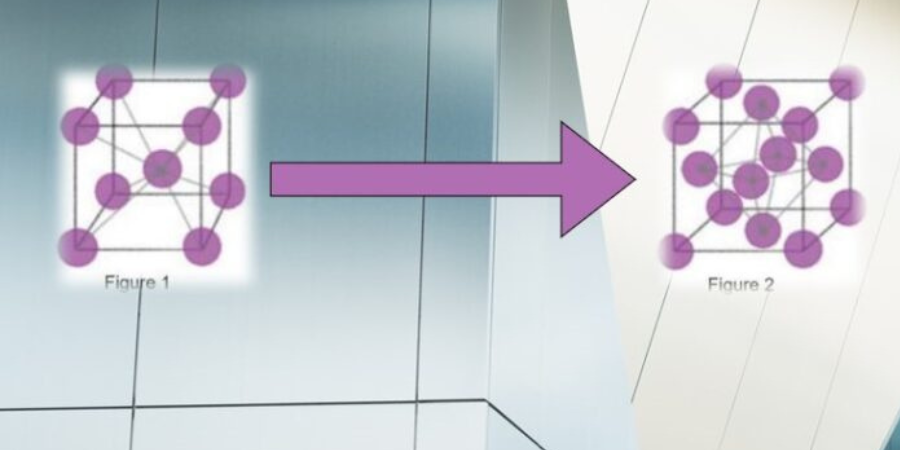
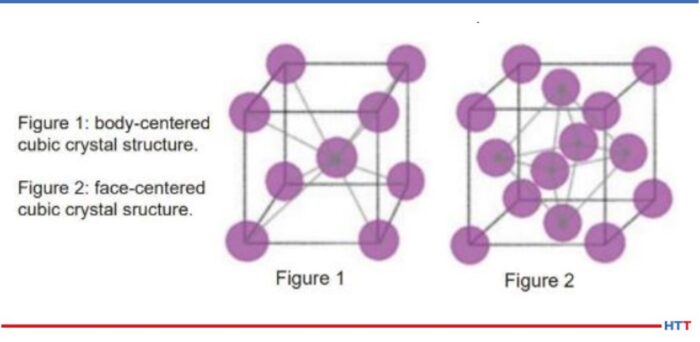
Graphic of Atomic Structures (Photo Source: AHT Blog post “What’s Happening to Metals During Heat Treatment”)
For this Heat TreatToday Technical Tuesday, check out this Best of the Web primer if you are looking to share a few basic pieces of heat treat info with your trainees. These heat treat fundamentals are about what happens to metals in the heat treatment process, tracing steel heat treating back to the ancient Romans in 223 B.C. — though, Encyclopedia Britannica currently places the origins in Egypt by 900 BC. Heat treatment benefits, atomic structural transformation, and hardenability are all covered here.
An excerpt: “Not every steel reacts the same. Chemical composition can vary greatly between the different grades of steel. Certain alloying elements can greatly increase the hardenability of steels such as nickel (Ni), chromium (Cr) and molybdenum (Mo). Hardenability is not how hard a material is. Hardenability directly relates to the ability of a metal to form martensite and martensistic [sic.] structure upon quenching, which points to…”
A leading, global manufacturer of metal injection molding (MIM) products is bolstering its manufacturing capacity with the addition of two large-size horizontal vacuum furnaces for sintering and debinding MIM products and components. The first of the two furnaces will be delivered this year and the second is scheduled for commissioning in March 2021.
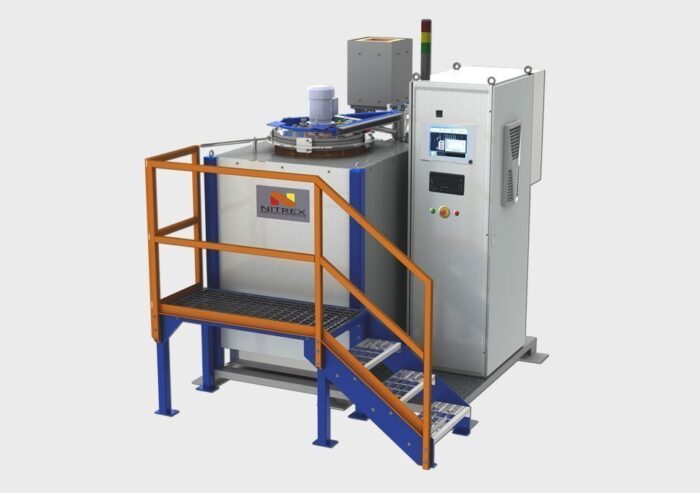
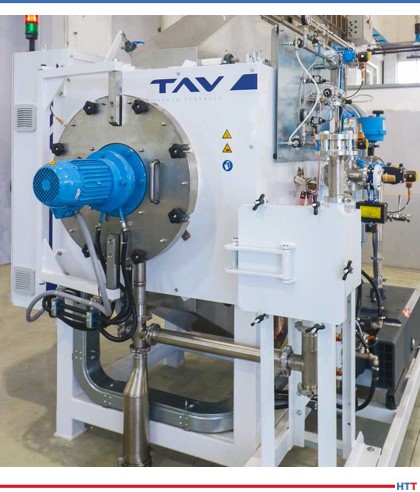
The multimillion-dollar order from the global manufacturer was awarded to G-M Enterprises, a Nitrexcompany. The 2-Bar vacuum sintering furnaces will feature a work area of 36” wide x 30” high x 84” long (900 x 762 x 2100 mm), 4400 lb. weight capacity, a maximum operating temperature of 2600°F (1430°C), and uniformity of +/-10°F (+/-5.5°C).
Vacuum Furnace (Source: Nitrex.com)
Michel Frison, VP Global Sales, Nitrex and G-M Enterprises (Source: Nitrex.com)
Integral to the vacuum system configuration is a multistage debinder trap system designed to thermally extract binder from the parts. Sintering and debinding occur in a single cycle using a robust and unique system design that is optimized to handle the maximum load capacity the furnace is designed for. Consequently, there is never a need to operate below the rated load capacity to achieve the required part quality. The high-temperature sintering process also ensures a high-quality finished part surface in terms of density, porosity, mechanical resistance, and aesthetics.
“This latest order comes from a customer we have had a strong cooperation with," said Michel Frison, VP Global Sales, Nitrex and G-M Enterprise, "and which will be part of a series of multiple furnaces provided by G-M Enterprises over the past decades."
What is debinding in metal additive manufacturing (AM)? How do you debind after 3D printing? How do you avoid contamination during metal debinding? Heat Treat Today’s Technical Tuesday article features this Best of the Web piece to answer your questions.
There are several changes that have made new technologies of AM and 3D printing increasingly implemented in the heat treating process. Some of these reasons include: falling costs of 3D printers; increasing geometric abilities; constant rate of the costs of production; and a “drastic reduction” in process waste. Read on to learn how to properly “debind” as you implement these new technologies in the heat treatment process.
An excerpt: “The working temperatures in the debinding phase are in the range between 70 °C (158 °F) and the 450 °C (842 °F), corresponding to the melting temperatures of the various organic compounds.”
“In the near term, the thermal processing industry faces landmark decisions and the most commonly postulated future, based entirely on electricity is only one of many possible outcomes. This option, however, is not realistically implementable… there is insufficient green energy surplus to meet expected demand in its entirety.”
Everyone is talking about the future of heat treat and how to process parts for the future. Technology, such as systems related to IoT and 4D, is seen as the solutions. So what about the future of combustion? The color is green.
Read this guest column from WS Thermalwhich summarizes a few key caveats which stand in the way of transforming energy sources. Give it a read, and email editor@heattreattoday.com if you have an op-ed or guest column that you would like to submit to Heat Treat Today!
WS is well known when it comes to low NOx combustion of natural gas in industrial furnaces. By means of the patented FLOX® technology, WS burners can achieve NOx emissions lower than 0.07 #/MMBTU in most operating scenarios, which sets the benchmark for modern gas heated furnaces around the globe. The future, however, belongs to renewable energy sources. Aside from their ecological advantages, it is foreseeable that the economic benefits will become reality far sooner than previously predicted. Even more so, if external effects such as an adequate carbon tax are considered.
In the [short] term, the thermal processing industry faces landmark decisions and the most commonly postulated future, based entirely on electricity is only one of many possible outcomes. This option, however, is not realistically implementable. At this point in time, there is insufficient green energy surplus to meet expected demand in its entirety: heating of thermal process applications, electrolytically generated hydrogen for direct reduction of iron ore, or for fueling long-haul transportation, battery electric mobility, space heating and cooling via heat pumps and many additional applications. Renewable electricity faces demand many times greater than its short or medium-term generation capacity. All this does not even take into consideration the necessity of simultaneous demand and generation in the electric network.
Using a broad spectrum of green energy sources, likely generated in a decentralized manner, and with regional focus on infrastructure capabilities such as transportation and storage of energy carriers, seems more plausible than focusing purely on an electricity-based energy system. However, at this point in time it is impossible to foresee which energy carrier will play the dominant role, or which market shares the various options will garner over time. Hydrogen from electrolysis or from reforming biogas, bio propane, synthetic fuel like ammonia synthesized in sunny regions, or synthetic CH4 which could utilize the existing global transportation infrastructure and current end user devices. The only thing that seems certain is that chemical energy carriers will continue to play a large role in the future. Only they offer the unique advantages such as high availability, high energy density and storage capability, which ultimately enable an airplane to fly, or make it possible to supply thermal processing applications with enough green energy to reliably maintain process temperature for long periods. Therefore, at WS we are committed to our core message: We are …
Regardless of which renewable chemical energy carrier you will ultimately be using in the future, it is already in our focus. Even now, we are implementing technologies aiming at our green future in WS combustion systems. For example, we are exploring technologies that minimize NOx emissions even when combusting ammonia or hydrogen. On a case-by-case basis, we can determine if your WS burners are suitable for use with a given new energy carrier or if a retrofit kit is needed. In any case, due to the long service life of your equipment, what is essential for you to know today is: WS will provide you a state-of-the-art combustion system solution – even if the future comes faster than anticipated.
Welcome toHeat Treat Today'sThis Week in Heat TreatSocial Media. As you know, there is so much content available on the web that it’s next to impossible to sift through all of the articles and posts that flood our inboxes and notifications on a daily basis. So, Heat Treat Todayis here to bring you the latest in compelling, inspiring, and entertaining heat treat news from the different social media venues that you’ve just got to see and read!
In this short video, an innovative team of project engineers designed a new part for a sailboat, increasing the performance of the boat in its application. The part was created through additive manufacturing (AM) techniques in order to optimize structural properties and decrease costs. Check it out!
2. Show Me: Charts, Figures, Videos
Hey. Let's cut to the chase. You want quick, visual info? See what we found for you.
The Nitriding Process
Shout out to Rosanne Brunello at Mountain Rep for sharing this video on LinkedIn. Follow #WomenInHeatTreat for more!
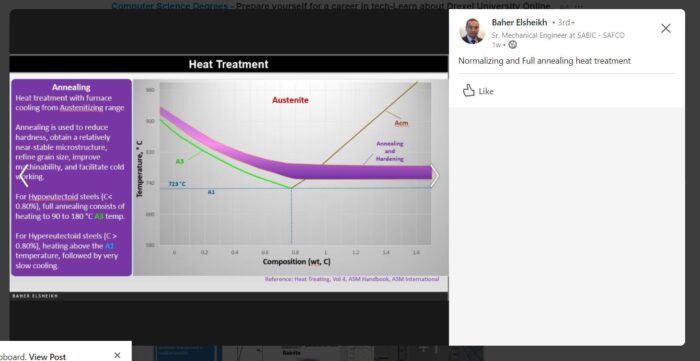
Normalizing and Full Annealing Heat Treatment
Click the image to see the other charts and graphs in the series posted by Baher Elsheikh on LinkedIn.
(photo source: Baher Elsheikh on LinkedIn)
Eight Reasons - Vacuum Brazing
What do you think of Alessia Paraviso's 8 reasons? Are there other reasons you would add?
Steel vs. CFC -- The 10 Advantages of CFC
Click the image to see the full LinkedIn post. There are a lot of colors going on, but share what you think about these differences. Do you agree?
3. Social Celebrations
There are three heat treating-related celebrations from on social media that you may have missed: Nutec Bickley celebrating Mexico's Independence Day, SECO/WARWICK celebrates their e-Seminar event, and companies and individuals celebrate the Heat Treat Today 40 Under 40 Class of 2020.
Nutec Bickley Celebrates Mexico's Independence Day
SECO/WARWICK Celebrates Completion of their e-Seminar
A week ago, the e-Seminar 4.0 took place. If you weren't there…you missed a lot❗
?See for yourself how we did it. ?Making of video special for you from the backstage!
In addition to the posts from Bodycote and CeraMaterials, other messages to honor the 40 Under 40 Class of 2020 have been trending on LinkedIn, such as the ones below.
4. Podcast Corner
Harb Nayar, the Sintering Expert
Harb Nayar is both an inquisitive learner and dynamic entrepreneur who will share his current interests in the powder metal industry, and what he anticipates for the future of the industry, especially where it bisects with heat treating.
Joe Powell of Integrated Heat Treating Solutions
According to Joe Powell, heat treaters' focus should be on the quenching portion of the process where distortion often happens. In many instances, distortion is able to be eliminated.
Andrew Bassett, president of Aerospace Testing & Pyrometry, on AMS2750F
Andrew Bassett discusses the significant changes of AMS2750F in the specification areas of thermocouples and calibrations.
5. Metal Gear
Ah yes. "Safety first," but what about aesthetic? These metal t-shirts should do the trick.





 Source: Powder Metallurgy Review