

AUTOMOTIVE HEAT TREAT TECHNICAL CONTENT

Brinell Hardness Testing 101

What are the most desirable attributes of a Brinell hardness tester? Does it belong in your heat treat department? Read this equipment overview to decide. 

Read the English translation of this article in the version below or read the Spanish translation when you click the flag to the right. Both the Spanish and the English versions were originally published in Heat Treat Today's August 2023 Automotive Heat Treat print edition.


Alex Austin
Managing Director
Foundrax Engineering Products Ltd
Source: Foundrax

All heat treatment companies must test hardness; many with a Brinell tester. Existing since 1900, a review of this time-tested method is in order.

Contact us with your Reader Feedback!

The Brinell test requires a tungsten carbide ball indenter to be forced vertically into the surface of the test material, placed on a rigid anvil. The diameter of the indentation made by the ball is then measured across both its x and y axes as a minimum, and the average of these measurements is taken as the working figure. The technician can then either feed that figure into an equation to determine the hardness or read from a “diameter-to-hardness” chart.

There are various forces and indenter diameters available for Brinell testing reflecting the very wide range of metals that need to be assessed, but most tests involve a 10 mm ball under a 3,000 kg load. In large, floor standing machines, the indenter is usually motor-driven, but some machines use levers and weights, while others are hydraulic or pneumatic. The Brinell test remains the default method for hardness measurement in many heat treatment facilities, for three primary reasons.

1.  Surface Preparation

Preparing the surface of a sample for Brinell testing takes just a few seconds with a grinder. Provided the sample is sitting steadily on the anvil and the top face of the sample is perpendicular to the direction of force of the indenter — as mandated by the standards — the surface does not need to be particularly smooth.
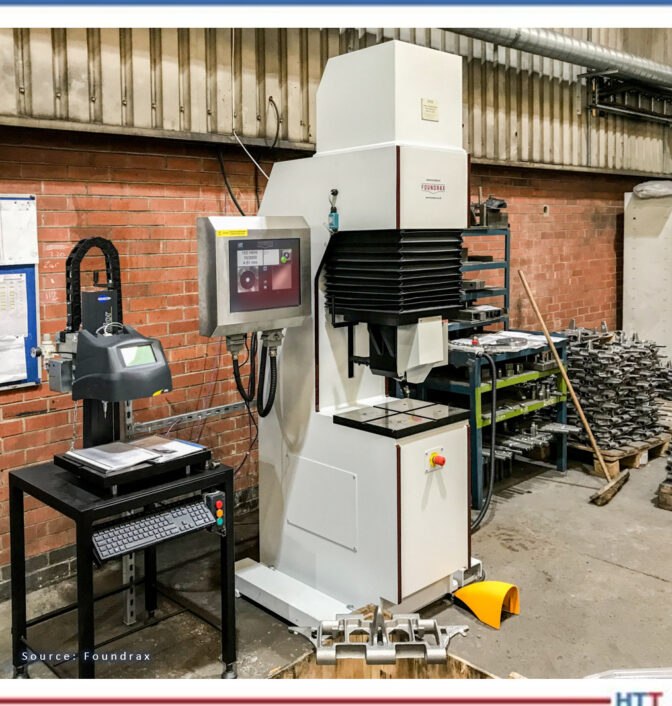
Figure 1. Heavy-duty Brinell tester in situ

2. Surface Contamination

Minute surface contaminants under a Brinell indenter are unlikely to cause a “mis-test.” By comparison, during Rockwell testing, the most widely used method across all industries, a tiny diamond indenter penetrates the surface by less than one hundredth of an inch, and any contaminants or surface abnormalities (including parallelism) that could impede or assist the progress of the indenter are a problem, which means that Rockwell samples must be carefully prepared before testing.

3. Portable

Perhaps most significant, rugged, hand-held portable Brinell testers with hydraulic test heads enable large, heavy, and awkwardly shaped components of rough surface finish to be tested in situ. This feature is of such utility in industry that the international standards authorities give a dispensation — a special designation — to portable machines, although their performance cannot be directly verified like their floor-standing cousins.

With forces ranging from 3000 kg down to 1 kg and indenter balls as small as 1 mm, Brinell testing can be used on a vast range of metal, but forges, foundries, heat treatment plants, quality control areas, and laboratories are the places one would most likely find a test machine working at 10 mm/3000 kg. It was mentioned earlier that the surface of test samples doesn’t need to be particularly smooth, in fact roughly- ground surfaces on materials with a coarse grain structure can be measured quite safely because the diameter of the indentation is so large relative to any irregularities on the surface.
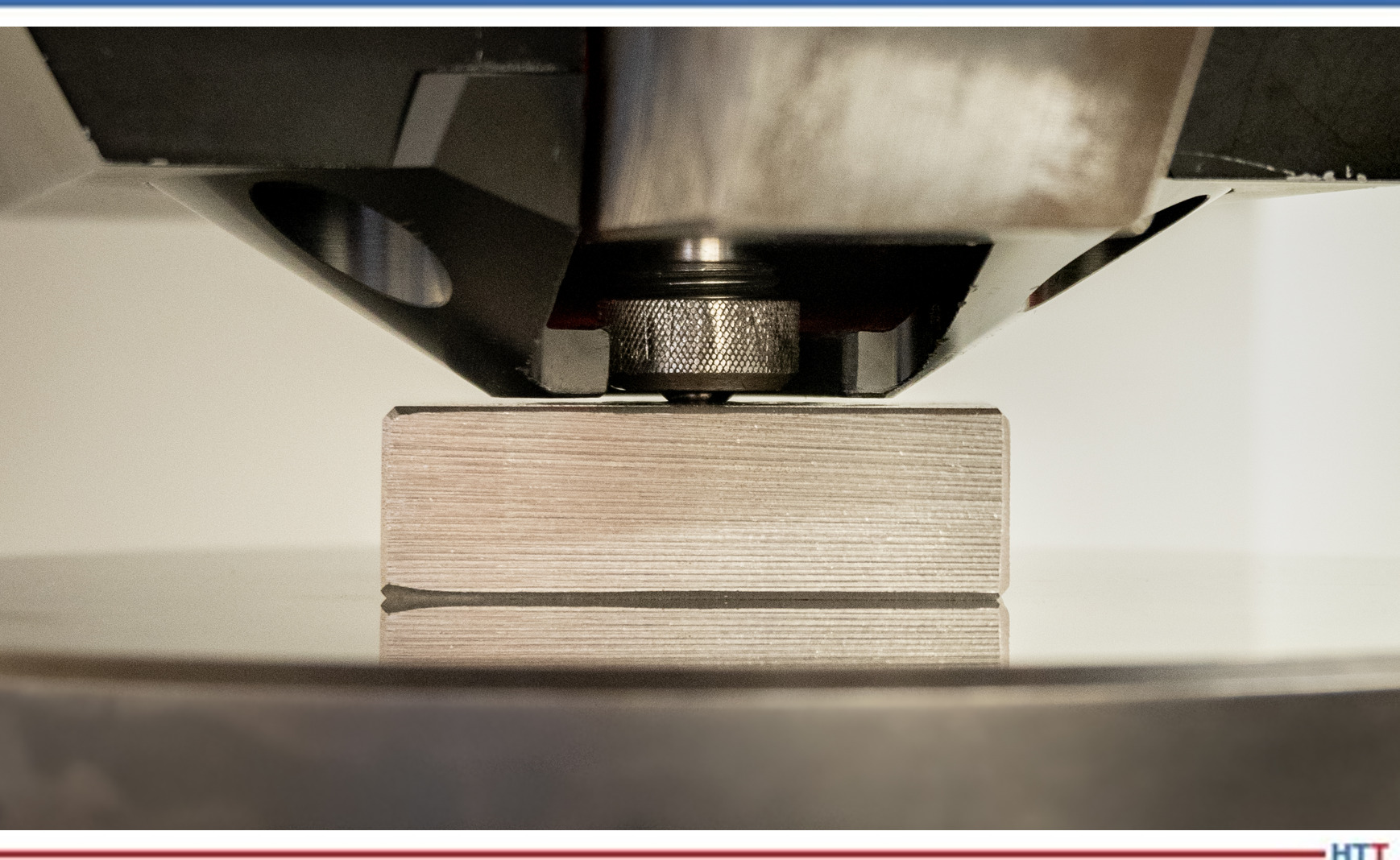
Figure 2. Close-up of a calibration-grade Brinell tester

In Figure 2, a calibration-grade Brinell tester drives the tungsten carbide ball into the test sample. The ball is being held in position to stabilize plastic deformation. ASTM E-10 and ISO 6506 — the authoritative documents for Brinell testing — lay out standards in detail, but the practical procedure for workshop technicians is very straightforward; training should not take longer than an hour. When testing forgings, billets, and other samples, one indentation should suffice but in certain critical applications more than one indentation may be used for assurance.

The question of whether to test every sample in a batch will depend on how inconsistent those samples might be; it has nothing to do with any issues with Brinell testing itself. In certain industries, every single product is tested because the risk of failure is too high. A good example of this is the production of links for the tracks used on tanks and other armored vehicles. Every link in every tank track in use by the British Army has been Brinell tested on a high-speed, fully automatic machine that features a powerful integral clamp to keep the component rigid during the test. You can view the machine in Figure 1 on page 44. Subject to reasonable care, a heavy-duty Brinell tester will perform many hundreds of thousands of tests. The machine in Figure 1 has performed several million.

Tests take approximately fifteen seconds. The indenter must be driven uniformly into the material with no possibility of either a rebound or a speed that would “punch” the indenter into the material. Also, the metal must be loaded for a sufficient length of time to ensure the indentation is properly (plasticly) deformed, that is, the risk of an indentation shrinking very, very slightly after the indenter is withdrawn is kept to a minimum.
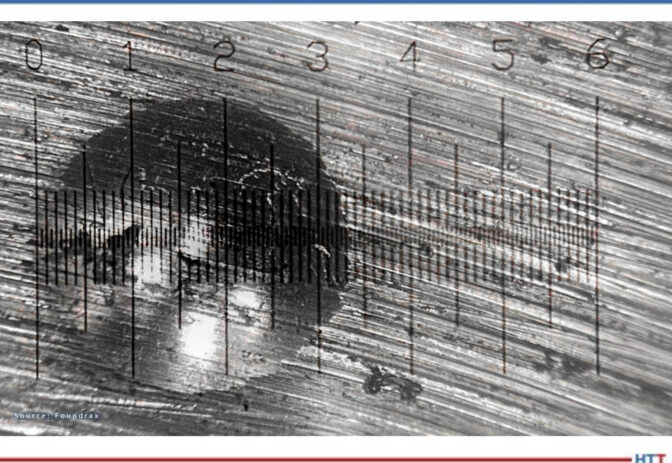
Figure 3. Measurement of Brinell hardness test indentation

Measuring the indentation is more challenging. After carefully making the indentation and withdrawing the test sample from the “jaws” of the test machine, one must measure the indentation across at least two diameters. Given that Brinell indentations are at most 6 mm across and that 0.2 mm difference in diameter might equal 20 hardness points, getting the measurement right is critical — and tricky. Most technicians will use an illuminated microscope to do this, but even then it can be a challenge. Consider Figure 3 on the next page.

Making an indentation leaves a “ridge” at the indentation perimeter because metal is not just pushed downwards, but also sideways. This ridge can obscure where the real indentation begins, and three different technicians can easily make three different estimates of where that is. And this variation in operators’ interpretation of results is why, for over 80 years, the Brinell test was seen as a little “rough and ready,” for the workshop machinist, perhaps, but probably not for the laboratory scientist.

Manual measurement microscopes have improved over the years, and a relatively “clean edged” indentation with a crisply illuminated graticule can be less challenging for the experienced technician to make an accurate measurement. Figure 4 is a less difficult scenario than the one above. Even so, how can we know if we have really judged the position of the edge precisely?
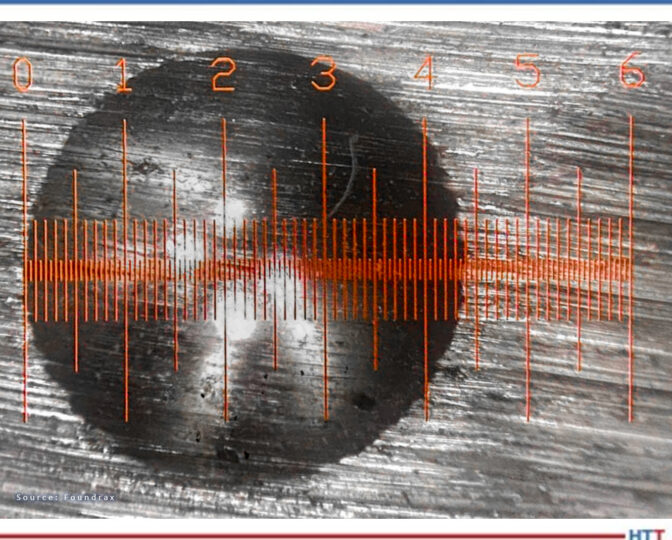
Figure 4. Measurement with improved microscope and well-illuminated graticule

In 1982, the first automatic reader hit the markets. This was the culmination of years of research and used proprietary software that pushed the computers of the day to their limits. The equipment could make hundreds of measurements across the indentation and calculate the mean diameter in a split second. Not long afterwards, it was available as an integral part of a Brinell test machine. Word of this equipment soon reached critical users in the oil tool industry, and they mandated its use to their suppliers. Within 15 years, the use of this technology was widespread and the perception of the Brinell test’s accuracy had been transformed. The Brinell test, in a sense, had come of age. See Figure 5 for the latest version of that automatic microscope in action.

Finally, like any important measuring equipment, regular calibration and servicing is desirable, if not compulsory. Manufacturers typically stipulate a service schedule which must be considered alongside the calibration rules dictated by international agencies.

When considering options for hardness testing of heat treated samples, there are ultimately three test methods: Brinell, Rockwell, and Microhardness (Vickers or Knoop).
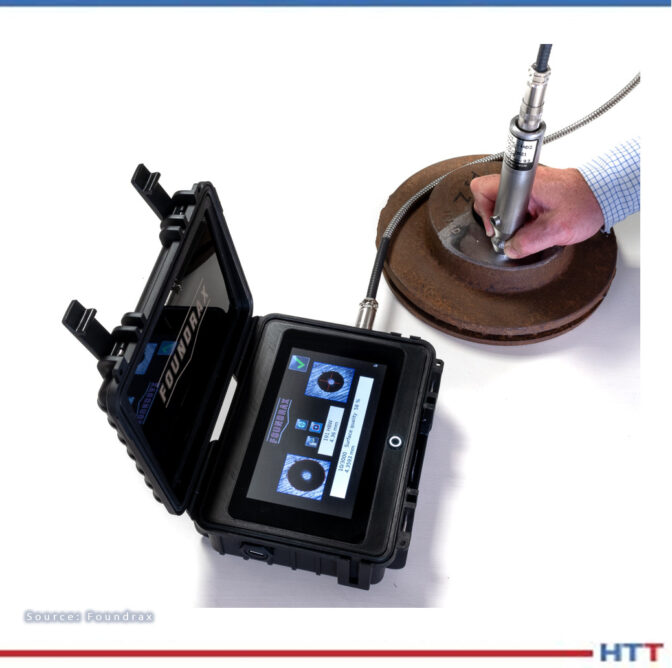
Figure 5. Latest version of the automatic microscope in action

While Brinell testing isn’t suited to very small or very thin samples, it is relatively “immune” to small contaminants, the indenters are not expensive, and the width of the indentation means that testing of coarse grained and roughly finished surfaces is not problematic. With the development of reliable automatic indentation measurement, the one serious deficiency of the Brinell test was overcome, providing the assurance that was vital to critical components suppliers in all types of industries such as oil and gas, aerospace, defense, and transportation.

About the Author:

Alex Austin has been the managing director of Foundrax Engineering Products Ltd. since 2002. Foundrax has supplied Brinell hardness testing equipment since 1948 and is the only company in the world to truly specialize in this field. Alex sits on the ISE/101/05 Indentation Hardness Testing Committee at the British Standards Institution. He has been part of the British delegation to the International Standards Organization advising on the development of the standard ISO 6506 “Metallic materials – Brinell hardness test” and is the chairman and convenor for the current ISO revision of the standard.

For more information:
Contact www.foundrax.co/uk.


Find heat treating products and services when you search on Heat Treat Buyers Guide.com


Brinell Hardness Testing 101 Read More »
How Tip-Ups Forever Transformed Brake Rotor Manufacturing

OC

Are your brake rotors heat treated? Travel back in time to discover how ferritic nitrocarburizing (FNC) became the heat treatment of choice for automakers’ brake rotors and why the tip-up furnace forever altered the production process for this part.

This Technical Tuesday article is drawn from Heat Treat Today's February Air & Atmosphere Furnace Systems print edition. If you have any information of your own about heat treating brake rotors, our editors would be interested in sharing it online at www.heattreattoday.com. Email Bethany Leone at bethany@heattreattoday.com with your own ideas!


The Problem: Brake Rotor Corrosion

Michael Mouilleseaux
General Manager at Erie Steel, Ltd.
Sourced from the author

In the early 2000s, corrosion was one of the top three issues that U.S. automotive manufacturers found negatively affected the perception of the quality of their cars. Brake rotors are made of cast iron. These components sit out in the elements, and in places like the U.S. Midwest where salt is often used on the roads, unprotected steel or iron will corrode or rust. Even on the coast, there is salt water in the air.

Contact us with your Reader Feedback!

What does rusting cause? The rotor rusts, and first, the cosmetics are negatively affected (i.e., rusty appearance). But more importantly, the first time you step on the brakes, it squeals like a pig, the vehicle shudders, and the driver feels pulsing in the pedal. He’ll also feel it in the steering wheel because the amount of rust coating one area is different from the amount of rust that’s on another. So, these brand new, forty- to seventy-thousand-dollar cars have orange rust over the brake rotor and a shaky drive. . . it’s not a good look!

Now, this is just a superficial coating of rust that will eventually abrade away; the rotor will look alright, the vehicle will stop better, and it won’t squeal. However, since the rust on the rotor wears off unevenly, the car may never have smooth braking.

A Move to FNC

In the early 2000s, all the big players were looking to FNC (ferritic nitrocarburizing) as a solution to corrosion, including Bosch Braking Systems, Ford, General Motors, Akebono, and the truck manufacturers. FNC was becoming popular since the process adds a metallurgical layer — called the “white layer” or “compound zone” — to the part, providing corrosion resistance and the bonus of improving wear.

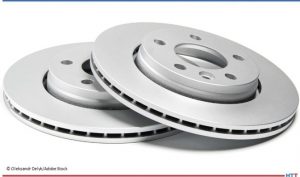
Source: Oleksandr Delyk/Adobe Stock

To the OEMs, the benefits were perceived as:

  1. The corrosion issue had an answer.
  2. The life of the rotor doubled from roughly 40,000 to 80,000 miles. Although that meant half as many aftermarket brake jobs compared to before, consumers perceived it as a real advantage.
  3. The rotors generated less dust. Brakes generate dust particles as the result of abrasion of the pads and the rotors. This particulate dust has been identified as both an environmental and a health concern. Now, flash forward to 2022: Electric vehicles are largely displacing the need to control emissions from ICE (internal combustion engine) vehicles. So, the new European standard on vehicle emissions implemented a requirement to control this dust that is harmful to the environment and which EV and traditional brake systems can emit.

But there were certain technical and practical challenges that automotive manufacturers faced when trying to implement this process at scale.

#1 Distortion. Brake rotors may distort during FNC. Since rotors are (gray iron) castings, the process temperature for FNC may stress relieve the rotor, causing it to change shape or distort, rendering it unusable as a disc brake rotor. It was determined that if the rotor castings were stress relieved prior to machining and FNC, the distortion issue was rendered moot.

#2 Loss of Necessary Friction. FNC gives the white layer on the surface of a part with a diffusion zone underneath. The compound zone has a very low coefficient of friction, which means excellent wear properties. However, manufacturers want friction between the rotor and the brake pads to slow the car down. Reducing the friction on the rotors extends the braking distance of the car.

". . .[M]anufacturers want friction between the rotor and the brake pads to slow the car down."
Source: Unsplash.com/Craig Morolf
Let me illustrate this: I ferritic nitrocarburized a set of brake discs for Bosch Braking Systems, which eventually went to Germany and then on a vehicle. The customer absolutely loved the corrosion resistance, but when it was time for the downhill brake test, the car went straight through an instrument house because the brakes couldn’t stop the car! Lesson: For rotors treated with FNC, the brake pads need to be made from a different frictional material!

#3 Cost. Overcoming the technical issues is simple. Stress relieving the casting at FNC temperatures before machining it would help the parts machine better and would eliminate distortion. Modifying the FNC process could reduce the depth of the white layer and, paired with the correct friction material, the acceptable braking capabilities were restored. Yet these additional steps presented a new challenge: higher costs.

The practical constraints of FNC in conventional batch or pit furnaces strained efforts to be cost-effective. The load (size) capacity of the conventional equipment, in conjunction with the time constraints of the FNC process presented a dilemma, as the OEMs’ benchmark was about one dollar per rotor.

Here Comes the Tip-Up

With traditional furnaces for FNC, there was just no way to reach the economics that were necessary for it. A bigger pit furnace might be the way to go, but they really weren’t big enough. So, here comes the tip-up.

Traditionally, a tip-up furnace has been used for processes with just air, no atmosphere. With direct fired burners, the furnace is used for tempering, stress relieving, annealing, and normalizing. Everything loads into the box, gets fired, and unloads, similar to a car-bottom furnace. With the appropriate external handling systems parts could be retrieved from the furnace and then quenched. This additional process increased the usefulness of the equipment and allowed for the processing of tubes, bars, big castings. . . big forgings for the oil industry and the like.

The question of how to heat treat brake rotors on a large scale still needed to be answered. It required a large, tightly sealed furnace with atmospheric integrity for excellent temperature uniformity. In ferritic nitrocarburizing, the processing range is about 950°F to 1050°F. It is well known that properties vary significantly across the temperature range. And they needed to be optimized to create the appropriate frictional properties for the rotors.

So, the answer was: Let’s make a tip-up furnace that can be sealed for atmospheric integrity, has the appropriate temperature uniformity, and can circulate gas evenly. A lot of this would have to be iterative — create, test, compare, repeat.

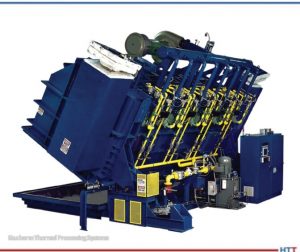
Tip-up furnace from Gasbarre Thermal Processing Systems
Source: Gasbarre Thermal Processing Systems

The development of the perfect tip-up was essentially the work of one furnace manufacturer and one heat treater who together changed the industry.

American Knowhow Makes the Perfect Tip-Up

In the early 2000s, heat treaters worked with OEMs to develop a cost-efficient process in a tip-up. Manufacturers and service providers tested different methods, including atmosphere FNC and salt bath FNC.

By 2009, the perfect atmosphere furnace was complete and high volume brake rotors began to be processed for General Motors. The furnace manufacturer was JL Becker, Co., acquired by Gasbarre in 2011. The commercial heat treater was Woodworth, Inc., located in Flint, MI. Together, they spent a lot of time and money looking into FNC and figuring out how to make it work in a tip-up furnace.

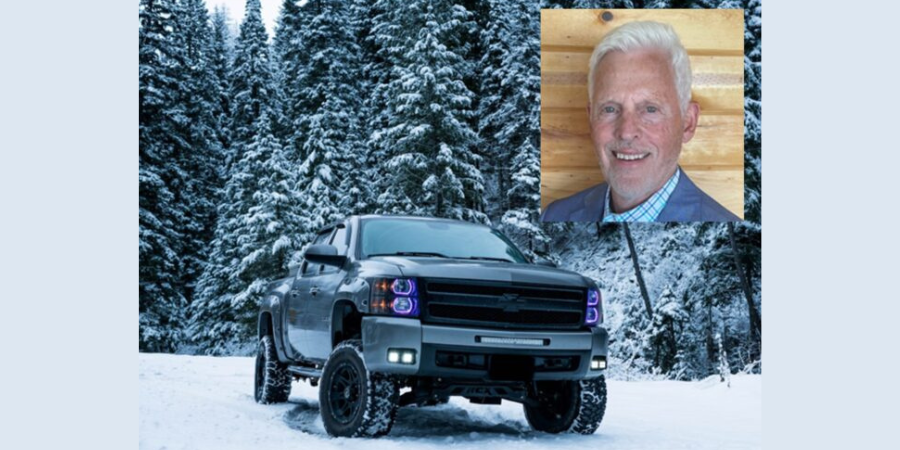
General Motors was the first one to get on board, utilizing the FNC processed rotors on their pickup trucks and big SUVs, like the Escalade and Tahoe. Ford was not far behind using it on their F150 pickup truck. I was shocked the first time I saw the commercial: a Silverado pickup truck, out in the snow, and the speaker saying, “We now have an 80,000-mile brake system because of a heat treating process called FNC!”

It’s a great story of American knowhow and a collaborative effort between someone who saw a need and someone else who saw the way. To this day, if you want to get a replacement set of brake rotors for your car, go to a place like AutoZone; they will tell you that the difference in cost between the OEM parts and an off-brand is the fact that the off-brand is not heat treated.

About the author: Michael Mouilleseaux has been at Erie Steel, Ltd. in Toledo, OH, since 2006 with previous metallurgical experience at New Process Gear in Syracuse, NY, and as the Director of Technology in Marketing at FPM Heat Treating LLC in Elk Grove, IL. Having graduated from the University of Michigan with a degree in Metallurgical Engineering, Michael has proved his expertise in the fi eld of heat treat, co-presenting at the Heat Treat 2019 show and currently serving on the Board of Trustees at the Metal Treating Institute.

Contact Michael at MMouilleseaux@erie.com


Find heat treating products and services when you search on Heat Treat Buyers Guide.com


How Tip-Ups Forever Transformed Brake Rotor Manufacturing Read More »

Vacuum Furnaces: Origin, Theory, and Parts

OC

Vacuum furnaces are widely used in the aerospace and automotive industries. These furnaces are used for multiple processes including brazing, aging, and solution heat treating for countless materials. Typically, vacuum furnaces are utilized to ensure a lack of oxidation/contamination during heat treatment. This article will talk about the origins, theory, and main parts of vacuum technology and how it is used in both aerospace and automotive industries.

This Technical Tuesday feature was written by Jason Schulze, director of technical services at Conrad Kacsik Instrument Systems, Inc., and was first published in Heat Treat Today's December 2022 print edition.


A Brief History

Vacuum furnaces began to be used in the 1930s for annealing and melting titanium sponge materials. Early vacuum furnaces were hot wall vacuum furnaces, not cold wall vacuum furnaces like we use today. Additionally, most early vacuum furnaces did not utilize diffusion pumps.

Vacuum Heat Treat Theory

Jason Schulze Director of Technical Services Conrad Kacsik Instrument Systems, Inc.

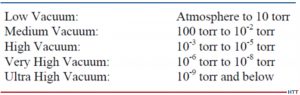
Vacuum technology includes vacuum pumping systems which enable the vessel to be pulled down to different stages through the process. Degrees of vacuum level are expressed opposite of pressure levels: high vacuum means low pressure. In common usage, the levels shown below in Figure 1 correspond to the recommendations of the American Vacuum Society Standards Committee.

Vacuum level will modify vapor pressure in a given material. The vapor pressure of a material is that pressure exerted at a given temperature when a material is in equilibrium with its own vapor. Vapor pressure is a function of both the material and the temperature. Chromium, at 760 torr, has a vapor pressure of ~4,031°F. At 10¯5, the vapor pressure is ~2,201°F. This may cause potential process challenges when processing certain materials in the furnace. As an example, consider a 4-point temperature uniformity survey processed at 1000°F, 1500°F, 1800°F, and 2250°F. This type of TUS will typically take 6-8 hours and, as the furnace heats up through the test temperatures, vacuum readings will most likely increase to a greater vacuum level. If expendable Type K thermocouples are used, there is a fair chance that, at high readings, you may begin to have test thermocouple failure due to vapor pressure.

Figure 1. Vacuum levels corresponding to the recommendations of the American Vacuum Society Standards Committee
Source: Jason Schulze, Conrad Kacsik Instrument Systems, Inc.

Vacuum Furnace Pumping System

Vacuum heat treating is designed to eliminate contact between the product being heat treated and oxidizing elements. This is achieved through the elimination of an atmosphere as the vacuum pumps engage and pulls a vacuum on the vessel. Vacuum furnaces have several stages to the pumping system that must work in sequence to achieve the desired vacuum level. In this section we will examine those states as well as potential troubleshooting methods to identify when one or more of those stages contributes to failure in the system.

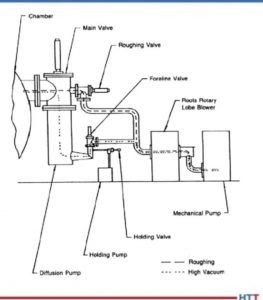
Vacuum furnaces have several stages to the pumping system that must work in sequence to achieve the desired vacuum level. Each pump within the system has the capability to pull different vacuum levels. These pumps work in conjunction with each other (see Figure 2).

Figure 2. Vacuum pumps work in conjunction with one another
Source: Jason Schulze, Conrad Kacsik Instrument Systems, Inc.

The mechanical pump is the initial stage of vacuum. This pump may pull from 105 to 10. At pressures below 20 torr the efficiency of a mechanical pump begins to decline. This is when the booster pump is initiated.

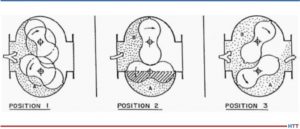
The booster pump has two double-lobe impellers mounted on parallel shafts which rotate in opposite directions (see Figure 3).

Figure 3. Booster pump positions
Source: Jason Schulze, Conrad Kacsik Instrument Systems, Inc.

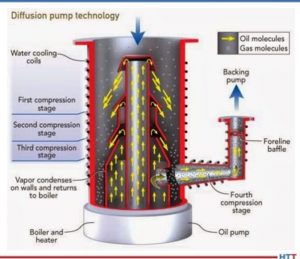
The diffusion pump (Figure 4) is activated into the pumping system between 10 and 1 microns. The diffusion pump allows the system to pump down to high vacuum and lower. The diffusion pump has no moving parts.

Figure 4. Diffusion Pump
Source: Jason Schulze, Conrad Kacsik Instrument Systems, Inc.

The pump works based on the vaporization of the oil, condensation as it falls, and the trapping and extraction of gas molecules through the pumping system.

Image 1. Holding Pump
Source: Jason Schulze, Conrad Kacsik Instrument Systems, Inc.

The holding pump (Image 1) creates greater pressure within the fore-line to ensure that, when the crossover valve between the mechanical and diffusion pump is activated, the oil within the diffusion pump will not escape into the vessel.

Vacuum Furnace Hot Zone Design

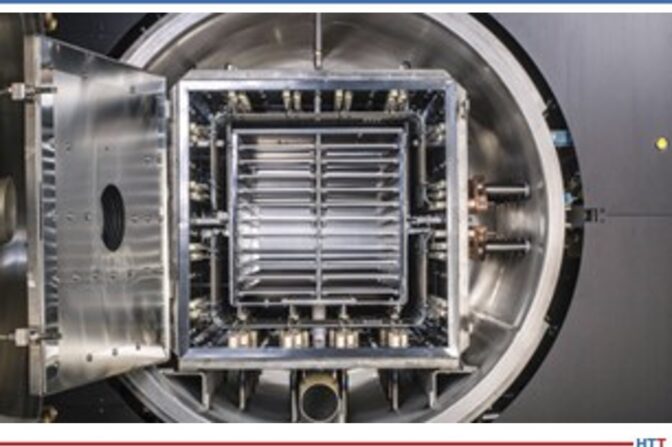
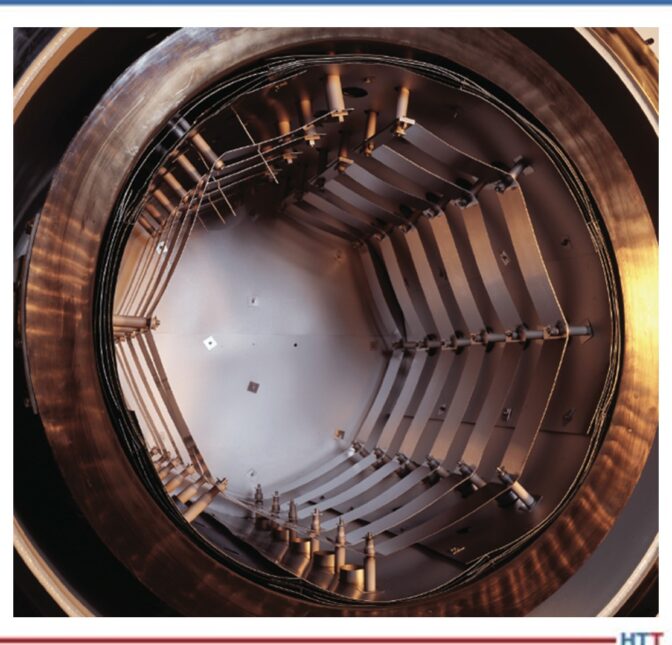
The hot zone within a vacuum furnace is where the heating takes place. The hot zone is simply an insulated chamber that is suspended away from the inner cold wall. Vacuum itself is a good insulator so the space between the cold wall and hot zone ensures the flow of heat from the inside to the outside of the furnace can be reduced. There are two types of vacuum furnace hot zones used: insulated (Image 2) and radiation style (Image 3).

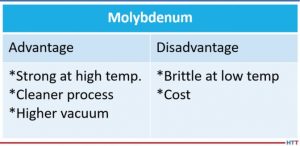
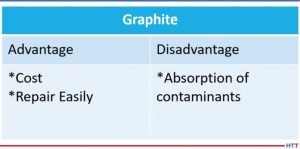
The two most common heat shielding materials are molybdenum and graphite. Both have advantages and disadvantages. Below is a comparison (Tables 1 and 2).

Table 1
Source: Jason Schulze, Conrad Kacsik Instrument Systems, Inc.
Table 2
Source: Jason Schulze, Conrad Kacsik Instrument Systems, Inc.

Vacuum Furnace Quenching System

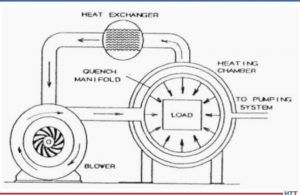
Quenching is defined as the rapid cooling of a metal to obtain desired properties. Different alloys may require different quenching rates to achieve the properties required. Vacuum furnaces use inert gas to quench when quenching is required. As the gas passes over the load, it absorbs the heat which then exits the chamber and travels through quenching piping which cools the gas. The cooled gas is then drawn back into the chamber to repeat the process (see Figure 5).

Figure 5.Diagram of gas quenching
Source: Jason Schulze, Conrad Kacsik Instrument Systems, Inc.

Vacuum Furnace Trouble Shooting

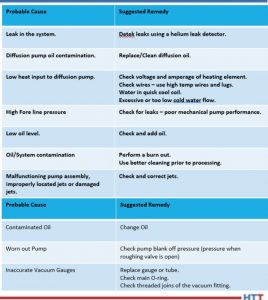
In Table 3 are some helpful suggestions with regard to problems processors may have.

Table 3
Source: Jason Schulze, Conrad Kacsik Instrument Systems, Inc.

Summary

Vacuum furnaces are an essential piece of equipment when materials need to be kept free of contamination. However, there are times when this equipment may not be necessary, and is therefore considered cost prohibitive, although this is something each processor must research. This article is meant to merely touch on vacuum technology and its uses. For additional and more in-depth information regarding vacuum furnaces, I recommend a technical book called Steel Heat Treatment, edited by George E. Totten.

About the Author: Jason Schulze is the director of technical services at Conrad Kacsik Instrument Systems, Inc. As a metallurgical engineer with over 20 years in aerospace, he assists potential and existing Nadcap suppliers in conformance as well as metallurgical consulting. He is contracted by eQuaLearn to teach multiple PRI courses, including pyrometry, RCCA, and Checklists Review for heat treat.

Contact Jason at jschulze@kacsik.com
website: www.kacsik.com


Find heat treating products and services when you search on Heat Treat Buyers Guide.com


Vacuum Furnaces: Origin, Theory, and Parts Read More »

Heat Treat Quench Questions Answered with Radio Review

OCTwice a month, Heat Treat Today publishes an episode of Heat Treat Radio, an industry-specific podcast that covers topics in the aerospace, automotive, medical, energy, and general manufacturing realms. Each episode provides industry knowledge straight from the experts.

Stay abreast of quenching tips, techniques, and training --- especially in the auto industry --- with this original content piece that draws from three video/audio episodes.


Heat Treat Radio: The Greenness and Goodness of Salt Quenching with Bill Disler

Bill Disler
President, CEO
AFC-Holcroft
Source: AFC-Holcroft

Sure, salt quenching has been around for quite some time, but this method is coming more to the forefront when we consider some of the concerns and costs of oil quenching. In this Heat Treat Radio episode, listen in to Bill Disler of AFC-Holcroft discuss the pros and cons of salt quenching. His brief overview and then salt versus other quench options will leave you ready to embrace quenching at your heat treat shop.

Contact us with your Reader Feedback!

"I’d say, in general, the most common thoughts with salt are to use it for bainitic quenching. If you’re quenching into a bainitic structure, salt has always been the only way to do this," comments Bill. "But what we’re seeing the growth into, and much more activity, is martensitic quench." As you listen, key into the point of salt quenching offering a "green-minded" solution due to recyclability.

Get the complete episode here.

Heat Treat Radio: Water in Your Quench with Greg Steiger, Idemitsu

Greg Steiger
Senior Key Account Manager
Idemitsu Lubricants America

Water in the quench tank? How much is too much? What do you do to get rid of it? Is it possible to prevent water from getting into the tank? Greg Steiger of Idemitsu answers these questions and more in this essential episode.

"Our research has shown that basically about 200-250 ppm water, you start to get uneven cooling," Greg Steiger cautions. "When you start getting up to large amounts of water, somewhere around 750 ppm to over 1000 ppm, it becomes a safety issue."

The entire episode gives answers to how to identify, prevent, and remove water in the quench.

Heat Treat Radio: All Things Auto Industry Quenching with Scott MacKenzie

D. Scott MacKenzie, Ph.D
Senior Research -- Metallurgy
Quaker Houghton, Inc.

This interview gets to some nitty gritty details regarding quenching and the shift to electric vehicles. What does the future of heat treating look like for electric vehicles (EVs)? Where is aluminum heat treat fitting in? Listen in to get industry insight on these answers. Scott MacKenzie of Quaker Houghton also explores simulation and modeling, the need for trained metallurgists in our industry, and more broad heat treat considerations.

"The next thing you have to understand is the quenchant itself," Scott MacKenzie advises. "You have to understand the physical properties."

Take in the full episode here.


.

Search for heat treat solution providers and suppliers on Heat Treat Buyers Guide.com


Heat Treat Quench Questions Answered with Radio Review Read More »

Dig into the Archives: 5 Technical Articles for Fresh Heat Treaters in Auto

OCAre you a relatively new reader in automotive heat treat? Welcome. Enjoy this archive of articles from the automotive industry, which provides years of technical knowledge to fill any information gaps. Even the "OG" readers with Heat Treat Today will want to investigate this Technical Tuesday original content compilation that plumbs the depths of the archives.


1. What Heat Treatment To Use for Truck Gear Boxes?

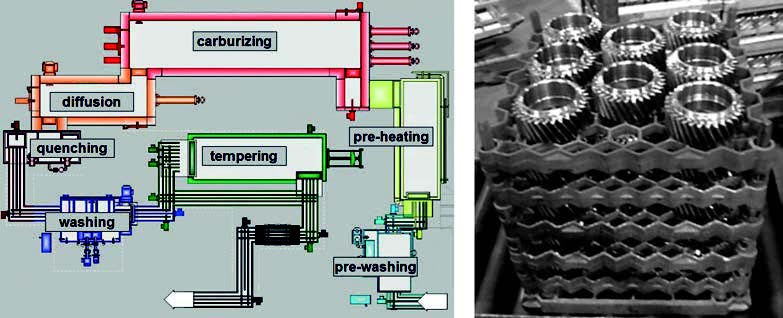
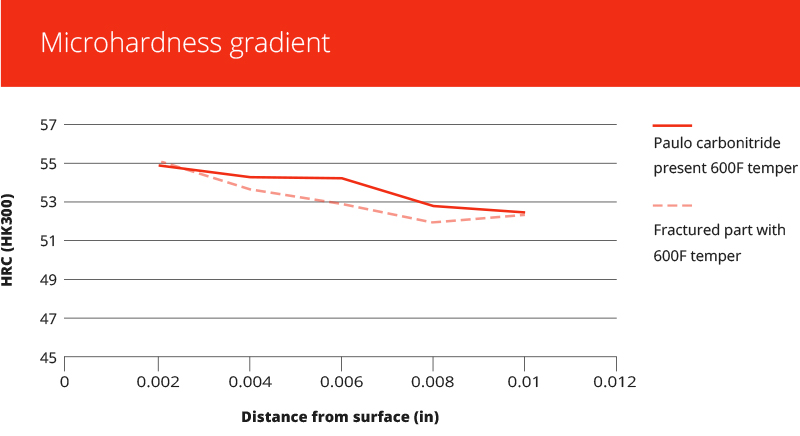
Fig. 2. Schematic depiction of pusher furnace (l.) and 3D batch of helical gears (r.)This paper reveals the investigation and conclusions of distortion potentials for case hardening processes. Mainly, the focus was on how the SyncroTherm® concept method compared to conventional case-hardening processes for gears and sliding sleeves.
Contact us with your Reader Feedback!

Read about how the results effected the bottom line: reduced costs, quicker processes, and less distortion. Also, be sure to examine each of the charts and figures for further understanding of each test.

This article entered the Automotive Heat Treat archive in 2016, and was written by Andreas Schüler, Dr.-Ing. Jörg Kleff, Dr. Volker Heuer, Gunther Schmitt, and Dr. Thorsten Leist.

Read about here: "Distortion of Gears and Sliding Sleeves for Truck Gear Boxes – a Systematical Analysis of Different Heat Treatment Concepts"


2. Cracking the Case

Problems in heat treating result in the loss of valuable time and money. Getting to the bottom of those problems also usually takes time and money to investigate what's happening and how to fix it. What is a heat treater to do?
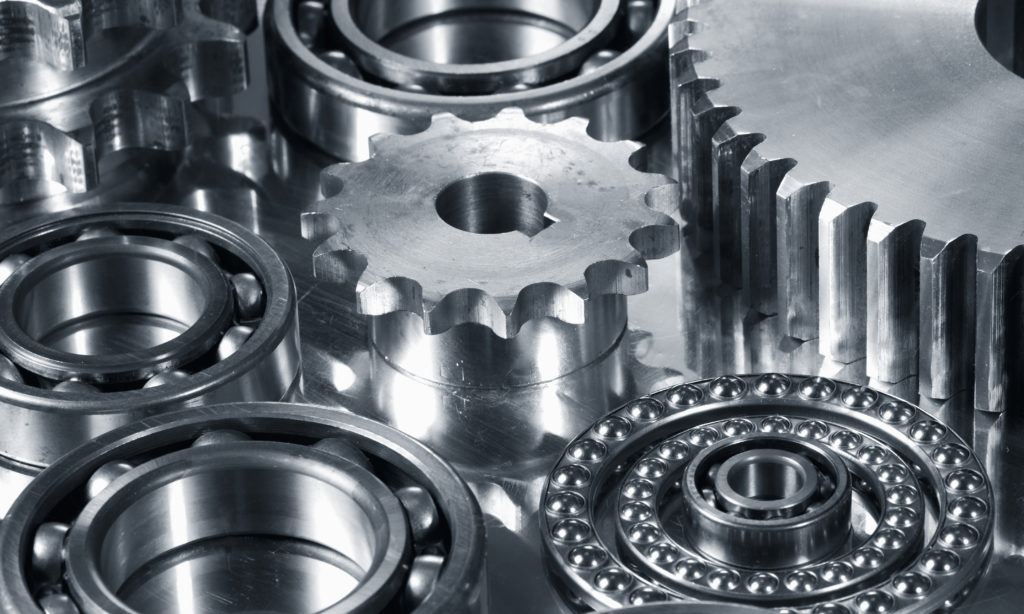
In this article, we follow a case study from the automotive industry to understand how to pinpoint a heat treating problem. This article specifically looks at what was causing cracking in variable valve timing (VVT) plates.

Read the 2018 article, "Part Failure Investigation & Resolution — A Case Study," by Rob Simons.


3. Carburizing: The Importance of Temperature Monitoring and Surveying

Temperature Monitoring and Surveying Solutions for Carburizing Auto Components: IntroductionLow pressure carburizing (LPC) furnaces play an important role in the automotive heat treating industry. During LPC, it is essential that processing temperature stays consistent and critical that the processing time frame is monitored.
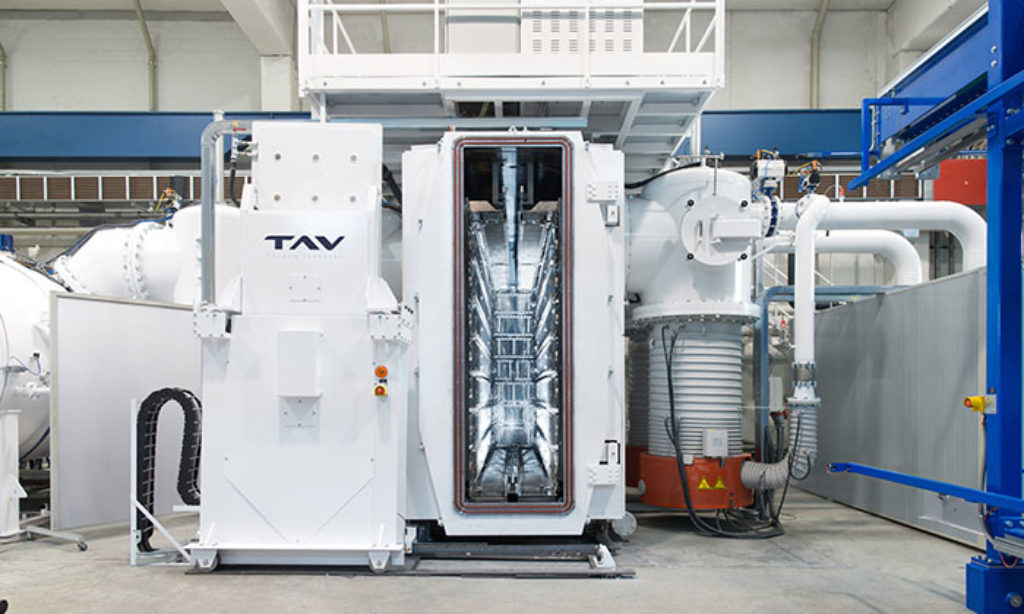
This article discusses the importance of collecting temperature data and what to do with the data when it's been collected.

Throughout 2019, Dr. Steve Offley wrote for this series, beginning with this part 1, "Temperature Monitoring and Surveying Solutions for Carburizing Auto Components: Introduction." When you're through, enjoy part 2, part 3, and part 4.


4. Vacuum Brazing --- Back to the (Automotive) Basics

Vacuum Brazing for Automotive ApplicationsTime to brush up on a vacuum brazing furnace, but automotive industry style. Review the terms, parts, function, and more that are involved in a successful vacuum braze for automotive parts.
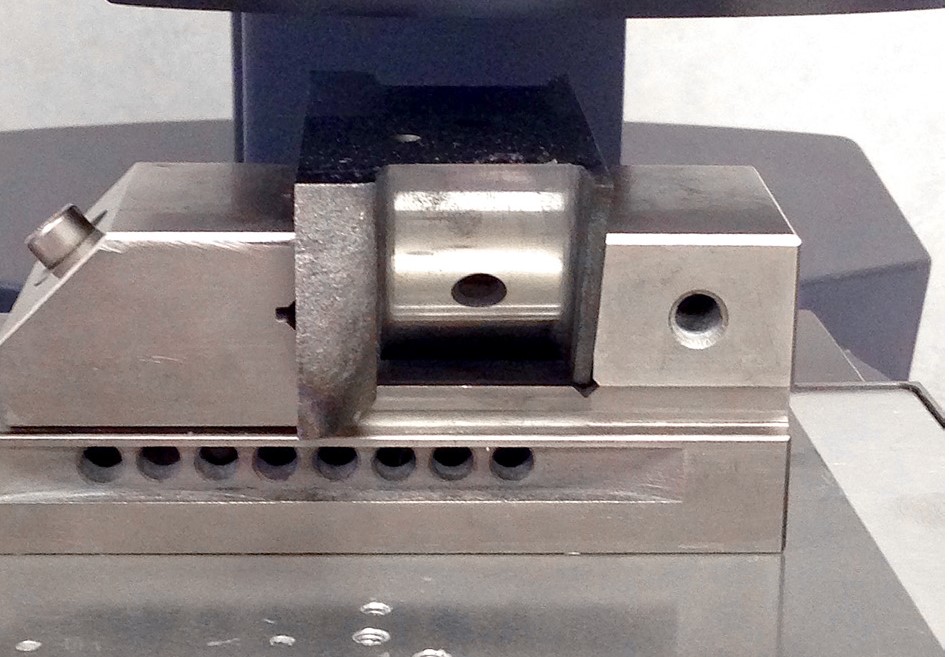
This study covers a semi-automatic TAV vacuum brazing furnaces, details the makeup of the furnace, and gives an idea of what happens with a load from start to finish.

Read this 2019 article by Alessandro Fiorese here: "Vacuum Brazing for Automotive Applications."


5. Saving Time --- Automation Versus Manual Hardness Tests

If you've ever heat treated automotive crank pins, you're probably familiar with at least one type of hardness test that case hardened crank pins are tested against. The big question is, which hardness testing method is better: automated or manual? This article compares these two methods to make and measure Vickers indentations.
Evaluate for yourself the comparisons between an experienced operator manually entering data to Wilson VH3100 series Vickers Microhardness Tester and a DiaMet software entry. Some additional findings show that the crank pins could be examined by the Wilson tester with far less manipulation in the vice as well as reduction in data recording mistakes.

When you read this 2020 article by Buehler, "Manual Versus Automated Hardness Testing", learn exactly how much time, exactly, is saved with automation.


Find heat treating products and services when you search on Heat Treat Buyers Guide.com


Dig into the Archives: 5 Technical Articles for Fresh Heat Treaters in Auto Read More »

Top 3 Heat Treat Grab and Go Visuals

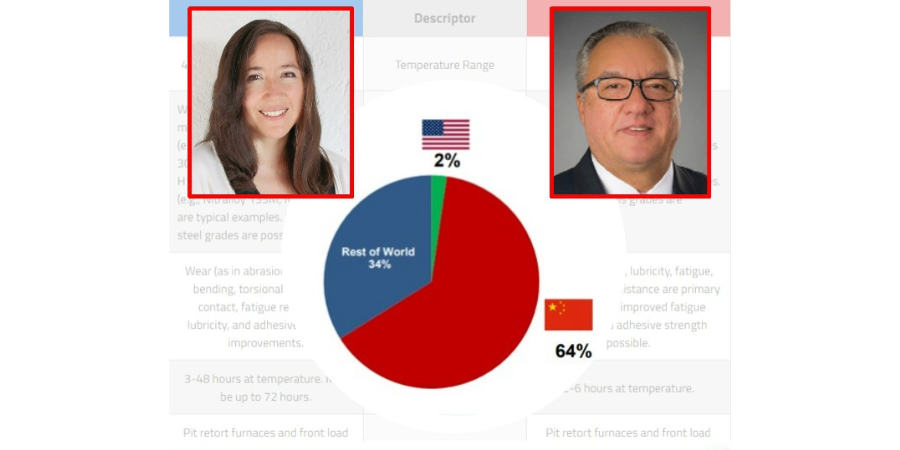
OCWe get it. You read all day: emails, memos, furnace monitoring screens. To give your eyes a break, Heat Treat Today wanted to provide some grab and go visual resources. In this original content piece, check out some visuals to help you learn about the difference between Nitriding and FNC; discover how the U.S. is doing in the race to green steel production; and get an example of the type of numbers that are normal for a CQI-9 probe method A test.


The Numbers Don't Lie: Green American Steel Is Better than You Think

Contact us with your Reader Feedback!

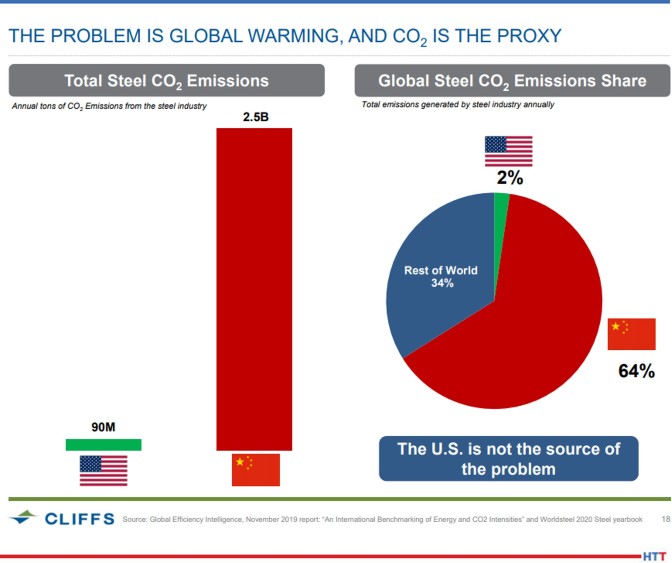
In Heat Treat Today's August 2021 Automotive print edition, Lourenco Goncalves, chairman, president, and CEO of Cleveland-Cliffs, Inc. made a big statement: "The United States is the benchmark of the world in all things steel. Amongst all major steelmaking nations, we have by far the greenest emissions profile."

In a climate where the United States often gets a bad rap when it comes to environmental concerns, Lourenco's statement is hard to believe. But, the data below contradicts this bad reputation. Check out the graphic below to learn how the United States stacks up to other countries in steel production.

CQI-9: Understanding Probe Method A

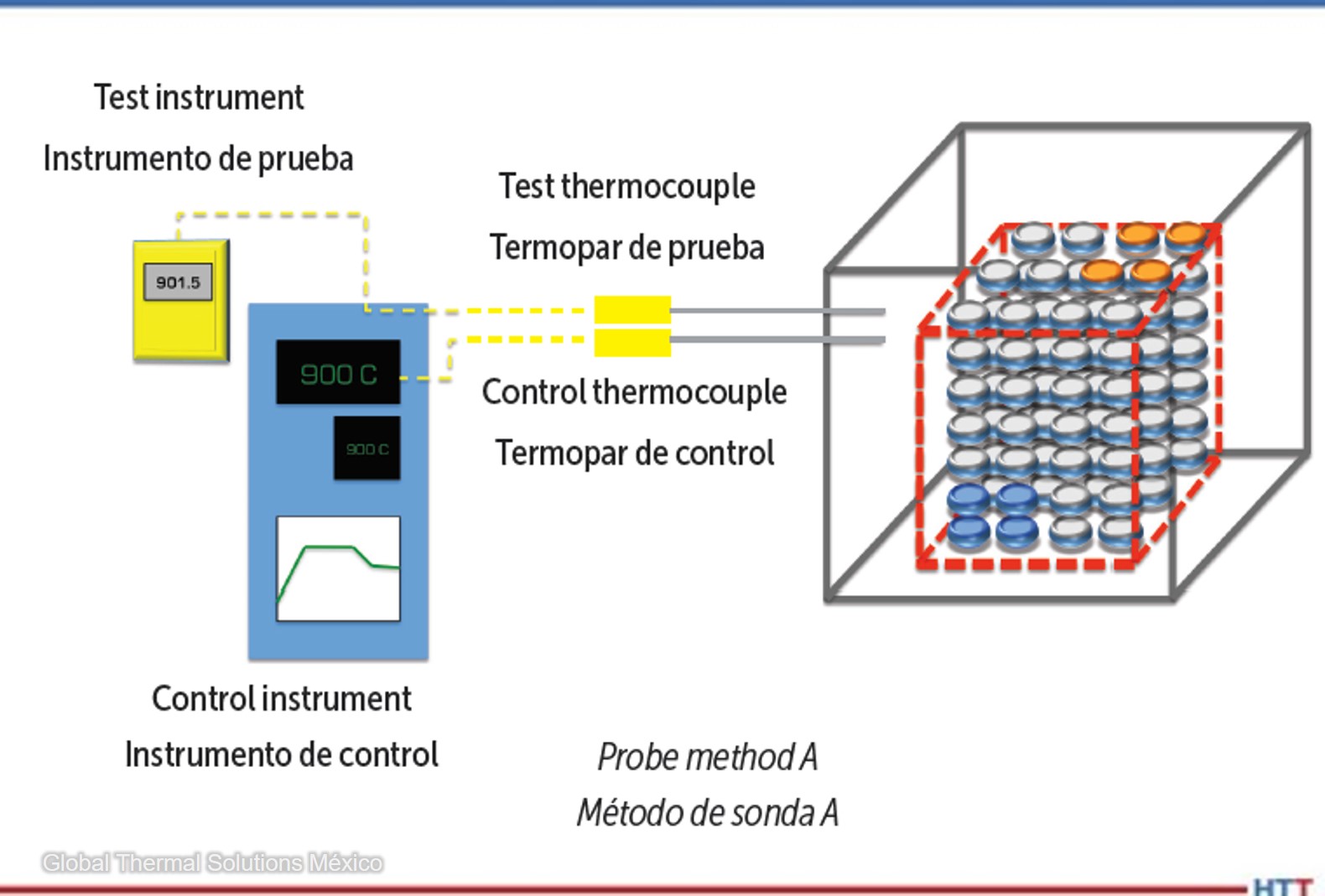
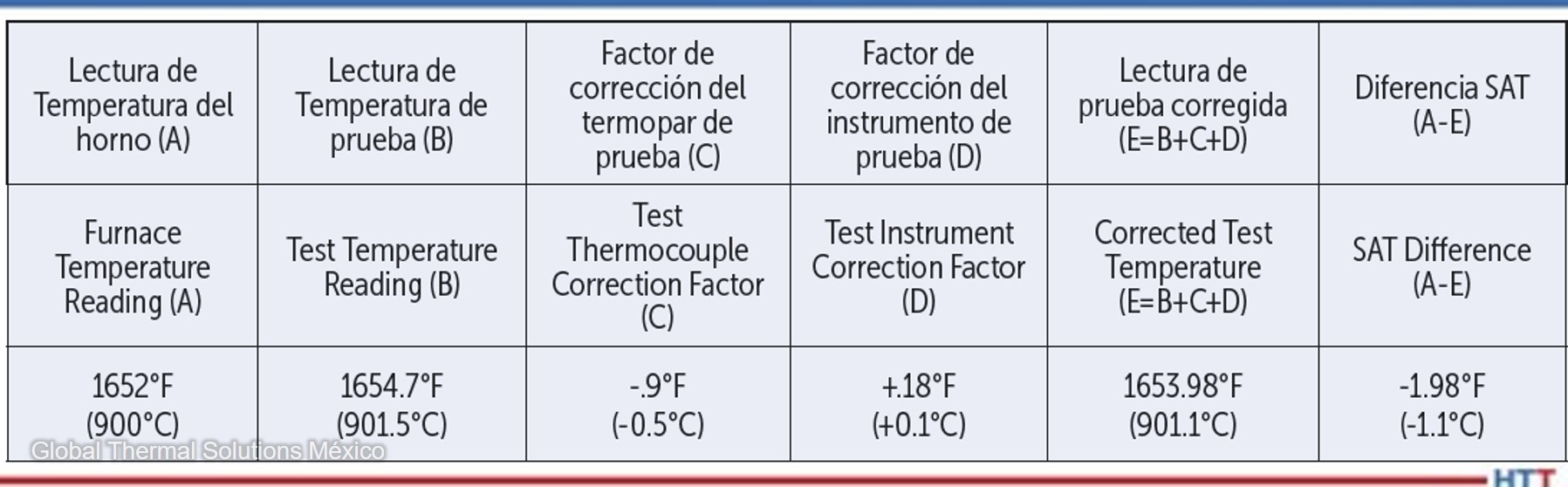
Ensuring heat treating equipment falls within CQI-9 standards can be tricky. According to Erika Zarazúa, regional purchasing manager at Global Thermal Solutions, probe method A may be the best way to identify variations in control systems.


If you're curious about how probe method A works, view the chart below (in both English and Spanish) for an example of the kind of numbers that are typical for this test method.

Table 1. Probe method A
Tabla 1. Método de sonda A


Nitriding vs. FNC . . . What's the Difference?

These days, it seems like most heat treat shops are updating equipment or changing procedures to accommodate demands for ferritic nitrocarburizing. But how different are the two processes, really? When it comes to materials commonly processed, time cycles involved, and atmospheres required, where does the difference between nitriding and FNC begin? The chart below is a quick and easy guide to distinguishing the difference between these two hardening processes. Skim away or take a deep dive into the technicalities!

About the Authors:

Lourenco Goncalves is chairman, president, and CEO of Cleveland-Cliffs, Inc

Erika Zarazúa, a 40 Under 40 Class of 2021 member, is a metallurgical engineer with over 18 years of experience in heat treatment operations and temperature measurement and has worked in multiple engineering, quality, and project roles in the automotive and aerospace industries. Erika currently holds the position of regional purchasing manager at Global Thermal Solutions.

 Jason Orosz and Mark Hemsath at Nitrex, Thomas Wingens at WINGENS LLC – International Industry Consultancy, and Dan Herring, The Heat Treat Doctor at The HERRING GROUP, Inc., provided expert input for the Nitriding vs. FNC table.


Find heat treating products and services when you search on Heat Treat Buyers Guide.com


Top 3 Heat Treat Grab and Go Visuals Read More »

Guide To Conducting SATs According to CQI-9 4th Edition

OCThe AIAG CQI-9 (Heat Treat System Assessment) is the most accepted standard in the automotive industry for the validation of heat treatment operations. This article summarizes the evaluation requirements and illustrates the benefits of conducting this test to identify variations in control systems using the probe method A.

Read the English translation of this Technical Tuesday article by Erika Zarazúa, regional purchasing manager at Global Thermal Solutions, in the version below, or read both the Spanish and the English translation of the article where it was originally published: Heat Treat Today's August 2022 Automotive print edition.

"La evaluación CQI-9 (Heat Treat System Assessment) de AIAG es el estándar mas aceptado en la industria automotriz. . . ."


Erika Zarazúa
Regional Purchasing Manager 
Global Thermal Solutions México
Source: Global Thermal Solutions México

1. Application

System Accuracy Tests (SATs) must be performed on all control, monitoring, and recording systems of thermal processing equipment. This does not apply to “high limit” systems, whose sole function is to protect the furnace from overheating.

Contact us with your Reader Feedback!

The test thermocouple used for the SAT must meet the accuracy requirements defined by CQI-9 in table P3.1.3 (±1.1°C or ±2°F maximum error). Similarly, table P3.2.1 of the same section defines the requirements for the field test instrument (±0.6°C or ±1°F maximum error).

SATs conducted by “probe method” should be performed quarterly or after any maintenance that could affect the accuracy of the measurement system such as:

  • Replacement of lead wire
  • Replacement of the control thermocouple
  • Replacement of the control/recording instrument

2. Procedure (Probe Method A)

Probe method A is a comparison between the furnace temperature reading and a corrected test temperature reading.

Table 1. Probe method A
Tabla 1. Método de sonda A

When inserting the test thermocouple, ensure that the tip of the probe is placed as close as possible to the tip of the thermocouple to be tested, and no further than 50mm. Once placed in the test position, it is recommended to allow some time for both systems to reach equilibrium before conducting the test.

If the difference between the furnace temperature reading and corrected reading of the test system exceeds ±10°F (±5°C), then corrective actions must be conducted before processing a product. The most common corrective actions are to replace the control thermocouple, calibrate and adjust the control/recording instrument, or to combine both methods. According to CQI-9, these actions must be documented.

3. Records

CQI-9 revision 4 specifies that the SAT must be documented, and the records must include, at a minimum, the following information:

a. Furnace thermocouple identification
b. Test thermocouple identification
c. Identification of the test instrument
d. Date and time of the test
e. Setpoint value
f. Reading observed in the control system
g. Observed reading on test system
h. Thermocouple and test instrument correction factors
i. Test system corrected reading
j. Difference calculated from the SAT
k. Name and signature of the technician performing the test
l. Company performing the test (if external)
m. ISO/IEC 17025 accreditation of the company (if external)
n. Approval of the person responsible for heat treatment

4. Conclusion

The pyrometry section of CQI-9 lists the requirements and procedures for conducting system accuracy tests (Section P3.3). Within CQI-9, there are two important requirements heat treaters must be aware of. First, the furnace temperature measurement system must not deviate more than ±10°F (±5°C) from the test system. If this is the case, the equipment must not be used for thermal processing and corrective actions must be taken. Second, the SAT report must contain each time this test is conducted. With probe method A, variations in controls systems are easily identifiable.


References

[1] CQI-9 Special Process: Heat Treat System Assessment, 4th Edition. Automotive Industry Action Group, 2020.

[2] International Organization for Standardization; ISO/IEC 17025, General requirements for the competence of testing and calibration laboratories, 3rd Edition. International Organization for Standardization, 2017.

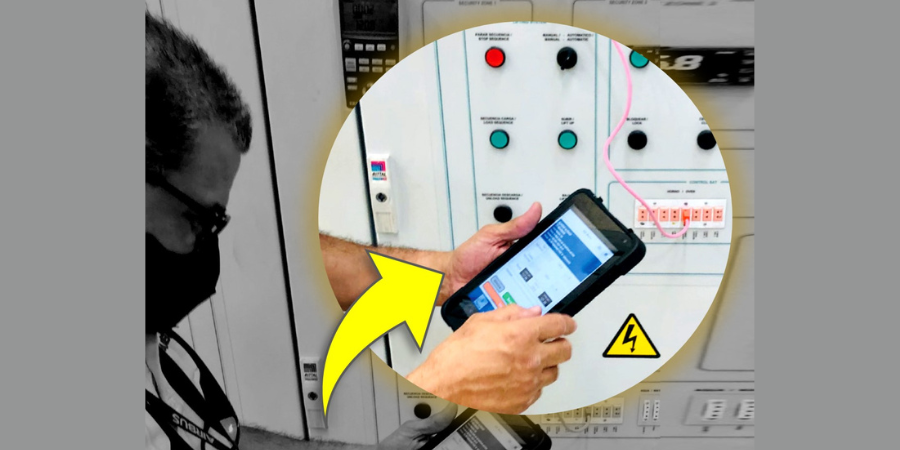
(Photo source: Global Thermal Solutions)


About the Author: Erika Zarazúa, a 40 Under 40 Class of 2021 member, is a metallurgical engineer with over 18 years of experience in heat treatment operations and temperature measurement and has worked in multiple engineering, quality, and project roles in the automotive and aerospace industries. Erika currently holds the position of regional purchasing manager at Global Thermal Solutions.

Contact Erika: erika@globalthermalsolutions.com


Find heat treating products and services when you search on Heat Treat Buyers Guide.com


Guide To Conducting SATs According to CQI-9 4th Edition Read More »

Guía para conducir pruebas System Accuracy Tests conforme a CQI-9 4ta. Edición

OCThe AIAG CQI-9 (Heat Treat System Assessment) is the most accepted standard in the automotive industry for the validation of heat treatment operations. This article summarizes the evaluation requirements and illustrates the benefits of conducting this test to identify variations in control systems using the probe method A.

Read the Spanish translation of this article by Erika Zarazúa, gerente regional de compras de Global Thermal Solutions México, in the version below, or read both the Spanish and the English translation of the article where it was originally published: Heat Treat Today's August 2022 Automotive print edition.

La evaluación CQI-9 (Heat Treat System Assessment) de AIAG es el estándar mas aceptado en la industria automotriz para la validación de operaciones de tratamiento térmico y, entre muchas cosas, describe los requisitos generales y el procedimiento para conducir las pruebas SAT (System Accuracy Test) a los sistemas medición de temperatura de los equipos de procesamiento térmico. Este artículo sintetiza los requerimientos de la evaluación e ilustra los beneficios de conducir esta prueba para identificar variaciones en los sistemas de control mediante el método de sonda “A”.


Erika Zarazúa
Gerente Regional de Compras 
Global Thermal Solutions México
Source: Global Thermal Solutions México

1. Aplicación

Las pruebas SAT deben realizarse a todos los sistemas de control, monitoreo y registro de los equipos de procesamiento térmico. Esto no aplica para los sistemas de ‘alto-límite” cuya única función es la de proteger al horno de un sobre calentamiento.

Contact us with your Reader Feedback!

El termopar de prueba empleado para la prueba SAT debe cumplir con los requisitos de precisión que define CQI-9 en la tabla P3.1.3 de la sección de Pirometría (±1.1°C o ±2°F máximo de error). De igual manera, la tabla P3.2.1 de la misma sección define los requisitos para el instrumento de prueba - field test instrument (±0.6°C o ±1°F máximo de error).

Las pruebas SAT por el método de sonda deben realizarse trimestralmente o después de algún mantenimiento que pudiera afectar la precisión del sistema de medición como:

  • Reemplazo del cable de extensión
  • Reemplazo del termopar de control
  • Reemplazo del instrumento de control/registro

2. Procedimiento (Método de sonda A)

El método de sonda A es una comparación entre la lectura del sistema de medición del horno y un sistema de medición de prueba corregido:

Table 1. Probe method A
Tabla 1. Método de sonda A

Al insertar el termopar de prueba, se debe asegurar que la punta se coloque lo mas cerca de la punta del termopar a ser probado, y no mas lejos de 50mm. Una vez colocado en la posición de prueba, se recomienda permitir cierto tiempo para que ambos sistemas alcancen un equilibrio antes de conducir la prueba.

Si la diferencia entre el sistema de medición del horno y sistema de prueba corregido excede de ±5°C (±10°F) entonces se deben conducir acciones correctivas antes de procesar producto. Las acciones correctivas mas comunes consisten en reemplazar el termopar de control, calibrar y ajustar el instrumento de control/registro o una combinación de ambas. De acuerdo a CQI-9, estas acciones deben ser documentadas.

3. Registros

CQI-9 revisión 4 especifica que la prueba SAT debe documentarse y los registros deben incluir como mínimo la siguiente información

a. Identificación del termopar del horno
b. Identificación del termopar de prueba
c. Identificación del instrumento de prueba
d. Fecha y hora de la prueba
e. Valor del setpoint
f. Lectura observada en el sistema de control
g. Lectura observada en el sistema de prueba
h. Factores de corrección del termopar e instrumento de prueba
i. Lectura corregida del sistema de prueba
j. Diferencia calculada del SAT
k. Nombre y firma del técnico que realiza la prueba
l. Compañía que realiza la prueba (si es externa)
m. Acreditación en ISO/IEC 17025 de la compañía (si es externa)
n. Aprobación del responsable de tratamiento térmico

4. En resumen

La sección de Pirometría de CQI-9 revisión 4 indica los requerimientos y el procedimiento para la realización de la prueba SAT (Sección P3.3).

El sistema de medición de temperatura del horno no debe presentar una desviación mayor a los ±5°C (±10°F) respecto al sistema de prueba. Si este fuera el caso, el equipo no debe usarse para procesamiento térmico y deben aplicarse acciones correctivas.

CQI-9 especifi ca la información que debe contener el informe de SAT cada vez que se conduce esta prueba.


Referencias

[1] Automotive Industry Action Group; CQI-9 Special Process: Heat Treat System Assessment, 4rd Edition, June 2020.

[2] International Organization for Standardization; ISO/IEC 17025, General requirements for the competence of testing and calibration laboratories. 3rd Edition, 2017.

(Fuente de la foto: Global Thermal Solutions)

Sobre el autor: Erika Zarazúa es Ingeniera Química Metalúrgica por parte de la Universidad Autónoma de Querétaro. Con más de 18 años de experiencia en operaciones de tratamiento térmico y medición de temperatura, ha trabajado en múltiples roles de ingeniería, calidad y proyectos en las industrias automotriz y aeroespacial. Actualmente ocupa el cargo de Gerente Regional de Compras de Global Thermal Solutions.

Contacto Erika: erika@globalthermalsolutions.com


Find heat treating products and services when you search on Heat Treat Buyers Guide.com


Guía para conducir pruebas System Accuracy Tests conforme a CQI-9 4ta. Edición Read More »

Green American Steel: The Envy of the World with CEO Lourenco Goncalves

op-edHow can steel production be "green"? Where does the United States stand in steel production when compared to the rest of the world?

Lourenco Goncalves, chairman, president, and CEO of Cleveland-Cliffs, Inc. answers these questions and more in this article, originally published in Heat Treat Today's August 2021 Automotive print edition.


Lourenco Goncalves
Chairman, President, CEO
Cleveland-Cliffs, Inc.

The United States is the benchmark of the world in all things steel. Amongst all major steelmaking nations, we have by far the greenest emissions profile. On average, each ton of steel produced in the United States generates 1.0 tons of CO2 emissions, compared to a ton of steel produced by China which generates 2.5 tons of CO2 emissions. The U.S. generates only 2% of all the greenhouse gas emissions from global steel production, while China contributes 64%.

The attributes that make our industry so green are the use of scrap, natural gas as both a reductant and energy source, and green iron ore pellets in blast furnaces. Because scrap cannot be used in a closed loop, natural gas and pellets allow for a healthy participation of low-carbon intensity virgin iron and steel units in a well-balanced ecosystem.

Steel’s emissions profile also makes it the lowest-carbon option compared to other materials perceived to be green, such as aluminum and carbon fiber. Adjusting for part weight, production of the equivalent volume of these competing materials generates 5 to 10 times more CO2 emissions than steel made in the United States.

This emissions profile is just one of many attributes that will support steel’s continued position as the material of choice in automotive light vehicle bodies. On top of being the greenest material and having a 100-year incumbency advantage, steel is more affordable than aluminum and is easier to weld, form, and repair or replace. Our continued innovation in advanced high strength steels (AHSS) has allowed us to produce thinner, lighter-weight, yet stronger materials, and closed the gap on the perceived density advantages that the aluminum industry has touted.

Even though we boast a low emissions profile, our work is not done. At Cleveland-Cliffs, we have made public our target to reduce greenhouse gas emissions by 25% by 2030. In our global discussion about decarbonization, the use of hydrogen (H2) as an iron-reducing agent has emerged as playing a key role in a carbon neutral future. While clean and leaving only steam (H2O) as its byproduct, large scale H2 use in steelmaking is an unproven technology that comes with enormous practical challenges, including safety and prohibitive costs. Knowing what we know today, we are probably decades away from H2 becoming part of any affordable and easily available technology.

At Cliffs, we don’t want to rely on breakthrough technologies, but rather deal with practical decarbonization options. Our efforts involve the use of the hydrogen contained in natural gas, which is actually a mix of 95% CH4 and 4% C2H6. Natural gas is used as the reducing agent at our new, state-of-the-art DRI facility in Toledo, OH, as well as a meaningful supplemental reductant in all eight of our blast furnaces. The abundance of cheap natural gas in the United States will continue to provide us ample opportunity to decarbonize.

Steel is the inevitable material of choice in a modern, greener world. As the largest flat-rolled steel producer in North America, Cleveland-Cliffs will remain on the cutting edge in shaping the future and further cementing our industry as the envy of the world.

About the Author: Lourenco Goncalves is chairman, president, and CEO of Cleveland-Cliffs, Inc

Green American Steel: The Envy of the World with CEO Lourenco Goncalves Read More »