


AEROSPACE HEAT TREAT

Reverse Engineering Aerospace Components: The Thought Process and Challenges

op-ed

You can take the aircraft apart, but can you put it back together? Reverse engineering, as anyone who has ever taken apart the TV remote will tell you, is more complicated than it first appears. It is, however, far from impossible. Learn the essential steps to reverse engineering, the role of heat treating, and the challenges the thought process presents.

For this Technical Tuesday piece, take a few minutes to read Jonathan McKay's, heat treat manager at Thomas Instrument, article drawn from Heat Treat Today's March Aerospace Heat Treating print edition. Heat Treat Today is always pleased to share pieces from one of our 40 Under 40 alumnus like Jonathan!

If you want to share ideas about the aerospace industry, our editors would be interested in featuring it online at www.heattreattoday.com. Email Bethany Leone at bethany@heattreattoday.com with your own contributions!


Contact us with your Reader Feedback!
Jonathan McKay
Heat Treat Manager at Thomas Instrument
Source: Thomas Instrument

Reverse engineering (RE) is the process of taking a component or design and dissecting it all the way down to the raw material. Reverse engineering can range from a singular component such as a piston or gear, to multiple components that make up an overall assembly such as an engine or mechanical actuator. This process allows engineers to analyze and gain an understanding of a component’s overall function and design through deductive reasoning. RE can range in the type of analysis, from geometric measurements and material analysis to electrical or mechanical testing. Each analysis reveals clues of how something can be reproduced. The idea of reverse engineering is to look beyond what’s in front of you and find the unexposed clues that can show why something was designed or possibly the thought process of the original designer.

Reverse engineering typically happens through a third-party manufacturer usually not affiliated with the original equipment manufacturer (OEM). Often this is done because the original manufacturer no longer supports the product, or the original design is outdated and needs to be modernized to improve efficiency, functionality, or life expectancy. To put this in perspective, the U.S. Airforce received its first B-1 Bomber in 1984. Since then, over 100 aircrafts have been delivered. After nearly 50 years the aircraft is still flying, but many OEM manufacturers have moved on to newer programs, thus allocating their capabilities and capacity towards the present and future market demands. This creates a market for fabrication of replacement components and assemblies to support aging platforms. In most cases, the OEM’s retain proprietary data thus creating a need for RE processing.

"[T]he U.S. Airforce received its first B-1 Bomber in 1984.
Source: Unsplash.com/midkiffaries

With aerospace products in particular and specifically aging aircrafts, one will encounter obsolescence issues. The goal is to maintain the aircraft with replacement parts that conform to all form, fit, and function requirements while also assuring they have proper life expectancy with respect to maintenance cycles. With this in mind, you typically work with low volume production and invest more time into the design and planning phase of the process. When engaged in this process, it is critical that one understands and implements a fabrication plan that will yield a product that is equivalent or better than that of the OEM. Some engineers would say “Well, let’s make it bigger and better,” but with aerospace components this is not always the case. Typically, the main focus is to replicate the original design intent to the best of your ability because you have a specific footprint and weight to maintain as well as functionality. The exchangeability of the original design and RE design is key. The reverse engineered product needs to possess the same functional and physical characteristics and be equivalent in the performance, reliability, and maintainability. This allows both items to be exchanged without concern for fi t, performance, or alterations to its adjoining component(s).

Another key point in RE processing could be to limit long lead phases by minimizing the need for additional qualification testing where possible. As plating, heat treat, or materials begin to deviate from the initial design, you must consider requalification testing to prove those changes are not detrimental to the application and do not cause more harm than good. Sometimes engineers create features within a design that are meant to be a weak point; this prevents a more critical component from breaking or being destroyed. When you begin to make deviations, it may push the weak point closer to the critical component.

While there are certainly many steps to RE, the essential steps include:

  1. Collect as much data as possible from an external standpoint without destroying or disassembling; i.e., note the overall measurements, orientation, special features, electrical or mechanical properties, etc. It is also a good idea to analyze mating components and/or the system in which the component is utilized. Mating parts are a big part of the discovery; the mating parts can help determine what alternate materials, plating, heat treat, or finishes can be used.
  2. Start creating preliminary drawings with detailed dimensions, notes, and features that were inspected from Step 1.
  3. Slowly disassemble the part (if an assembly) and inspect key features and create preliminary drawings for sub-assembly components. In some cases, it helps to reassemble the product to ensure an understanding of how it goes back together in order to optimize the assembly process once new components are manufactured.
  4. Evaluate the product(s). Conduct material analysis to acquire chemical and mechanical property data. This will aid in defining the appropriate layout for machining, material conditioning (i.e., heat treatment), external finishes/coatings, etc.

While the design and planning phase may pose some challenges, the more critical challenges that occur during reverse engineering are in the execution of the manufacturing, assembly, and qualification testing. To elaborate, once you begin machining and processing components, there may be special methods of manufacturing that require discovery because standard methods may not have worked when the OEM produced it. When this happens, you go back and forth on updating and fine-tuning the process plans, fixturing, programs, etc. Sometimes this means scrapping parts and starting over or validating if parts are still usable for prototyping. Along the same lines, when the process progresses into the assembly and testing phase, engineers typically discover variability, errors, or weak points that require adjustments. In those cases, the engineer’s drawings must be revised. A large percentage of these issues can be limited through experience with similar components or assemblies, but in most cases, there is a lot of analysis and some trial-and error involved in the manufacturing, assembly, and testing phase that is not apparent upon initial RE processing.

References:

  1. Boeing. “The Bone.” https://www. boeing.com/defense/b-1b-bomber/
  2. DLA. “Master List of Technical and Quality Requirements Version 14.”
  3. MIL-STD-280A. “Handbook for definitions of item levels, item exchangeability, models, and related terms.”
  4. DOD Washington, D.C. 20301.

Special thanks to David V. Jones and Thomas R. Blackburn IV at Thomas Instrument for their input on this topic.

About the Author:

Jonathan McKay is a mechanical engineer at Thomas Instrument, a company specializing in reverse engineering critical aerospace components. At the company, he is manning the establishment of heat treat operations, has created procedures and process plans for Thomas Instrument to be an approved heat treater for an aerospace prime, and has attained Nadcap accreditation for heat treat.

Contact him at Jonathan.mckay@thomasinstrument.com


Find heat treating products and services when you search on Heat Treat Buyers Guide.com


Reverse Engineering Aerospace Components: The Thought Process and Challenges Read More »
Vacuum Furnace Designed Specifically for MRO Industry

HTD Size-PR Logo

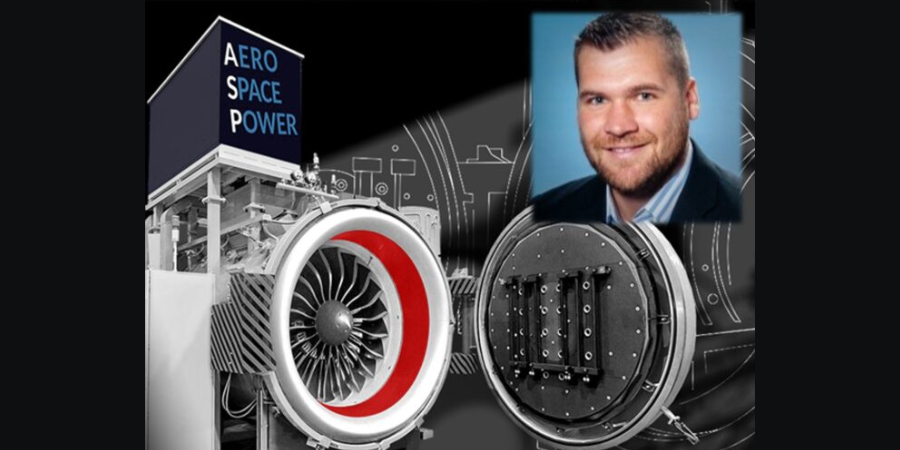
Aero Space Power, an MRO facility, has ordered a custom-made vacuum furnace to be utilized in repair solutions for both complex aircraft engines and gas turbines in the energy industry. 

Mark Peter Biro
Commercial Sales Manager at Aero Space Power
Source: LinkedIn

We decided to acquire in-house heat treatment because we want to be independent in production. It will also give us much better control over the process and treated part quality," commented Mark Peter Biro, commercial sales manager, Aero Space Power. "By installing production capacity in-house and creating our own heat treatment department, we not only become independent from external suppliers, but we also significantly reduce transportation costs.” 

The furnace on order from SECO/WARWICK, a company with locations in North America, is unique due to the size of the heating chamber. It has been adapted to the Aero Space Power requirements and has a working area of 51" x 39" x 59" to enable heat treatment of large components up to 55" diameter especially large aircraft parts, as well as gas turbines for the energy sector. The custom technology on order, in addition to non-standard dimensions, is designed to process work in the presence of two gases: argon (used for partial pressure) and nitrogen, which is used mainly in the cooling process. A dew point sensor for each of the gases will be included with the furnace.


Find heat treating products and services when you search on Heat Treat Buyers Guide.com


Vacuum Furnace Designed Specifically for MRO Industry Read More »

New Vacuum Furnace for Michigan Heat Treater

HTD Size-PR Logo

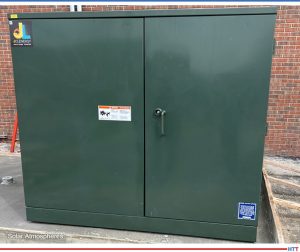
The new transformer
Source: Solar Atmospheres

Solar Atmospheres of Michigan took delivery of a new vacuum furnace this week, which will be used primarily for aerospace applications. The Chesterfield, MI, location is set to begin heat treating later this year.

The furnace has a working hot zone of 36” wide x 36” high x 48” deep and can handle workloads up to 5,000 lbs. To power this furnace along with nine other vacuum furnaces, a new 2600kVA transformer was installed. The new facility anticipates being fully operational by the fall of 2023 and will gather all of Solar Atmosphere's Michigan heat treating under one roof.


Find heat treating products and services when you search on Heat Treat Buyers Guide.com


New Vacuum Furnace for Michigan Heat Treater Read More »

FAC Awarded for Aerospace Applications Forging Line

HTD Size-PR Logo

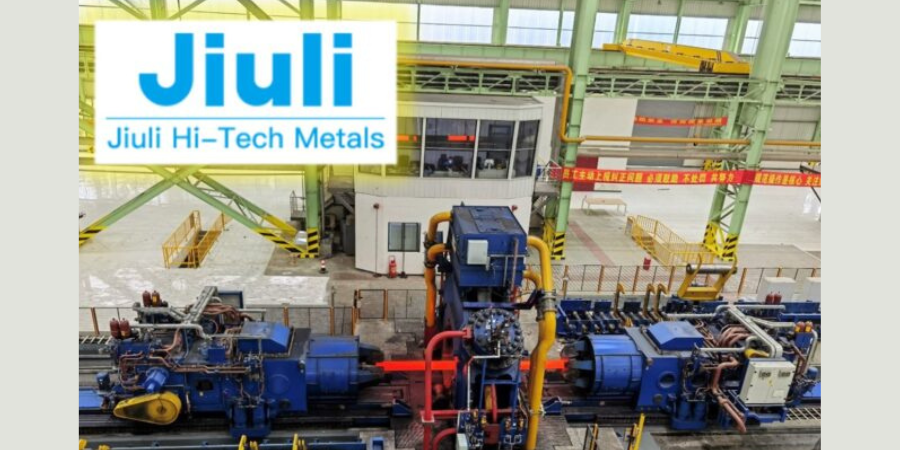
Jiuli has awarded the final acceptance certificate (FAC) for a hydraulic radial forging line to a metals industry technology supplier with North American locations. The plant has a press force of 18 MN for each of the four press cylinders, which will allow sophisticated materials for the aerospace industry to be forged.

"The new SMX forging line enables us to manufacture our products in a highly cost-efficient way. The high productivity and the wide range of products give us the necessary flexibility to respond quickly to changing demands," commented Luo Tongwei, project manager at Jiuli.

In addition to the SMX 900 / 18 MN as the core machine, the plant comprises two fully synchronized eight-ton forging manipulators and equipment for loading and unloading as well as for cutting, marking and cooling of forged bars. SMS group manufactured the plant to provide a forging strategy that is calculated on the basis of a comprehensive material database as well as the preset machine, material, geometry, and product-related parameters.

“SMS group has enjoyed a close working relationship with Jiuli for over ten years and has supplied them with different types of equipment during this period. We are looking forward to the further fruitful cooperation”, says Jia Hui, senior sales manager at SMS group.


Find heat treating products and services when you search on Heat Treat Buyers Guide.com


FAC Awarded for Aerospace Applications Forging Line Read More »

Car Bottom Heat Treat Furnace Installed in CA

HTD Size-PR Logo

Derek Dennis
President
Solar Atmospheres California

Solar Atmospheres of California (SCA) installed a new 14 foot long car bottom air furnace. With a maximum operating temperature of 1450°F, this furnace tempers large tool steel components, age hardens 15-5 PH, 17-4 PH, 13-8PH and nickel-based alloys, and anneals titanium forgings.

SCA is typically known around the world as a “vacuum only” heat treater. However, there is a great need for heat treating non finished parts and materials in accordance with the same specifications (AMS, MIL, Boeing, and Airbus) within different atmospheres where surface oxidation is permissible. This furnace allows for a “raw material” option.

“Solar Atmospheres of California is excited to be adding this new furnace and the added capability/capacity," stated Derek Dennis, president of SCA. The furnace has a working zone that is 60" square by 168" long with a total load capacity of up to 30,000 pounds.


Find heat treating products and services when you search on Heat Treat Buyers Guide.com


Car Bottom Heat Treat Furnace Installed in CA Read More »

2 “Heavy Duty” Furnaces Expand Tempering Capabilities for Ohio Heat Treater

HTD Size-PR Logo

Twin convection furnace systems were recently supplied to Winston Heat Treating. The furnaces replaced two older tempering systems. The new systems are for ferrous alloys and aging PH stainless steels.

David Reger
President at Winston Heat Treating
Source: LinkedIn

The SCAHT®-HD (Heavy Duty) Series furnaces, from DELTA H®, are set up with Instrumentation Type B and have two load thermocouples. The furnaces have a certified TUS volume of 2 feet wide, 1.5 feet high and 2 feet deep with a maximum continuous operating temperature of 1,200°F.  Both are designed to receive baskets of parts from many nearby heat treating operations for secondary heat treatments. Temperature control and data acquisition are provided by Super Systems and feature the SSi 9130 controller/programmer. ATP qualified them as Class 2 (+/- 10°F) from 300°F to 1200°F.

“We were looking for a partner to replace existing tempering furnaces that had become too costly to maintain and could no longer meet required pyrometry standards. Our goal was to install reliable and modern furnaces that were specialized for our small batch/job shop work," said David Reger, president at Winston Heat Treating and a Heat Treat Today's 40 Under 40 recipient.


Find heat treating products and services when you search on Heat Treat Buyers Guide.com


2 “Heavy Duty” Furnaces Expand Tempering Capabilities for Ohio Heat Treater Read More »

Castheon Expands Hypersonic Production & Research Capabilities in California

HTD Size-PR Logo

Castheon, Inc. an ADDMAN Group company, has expanded its operational and engineering infrastructure in southern California. Castheon specializes in materials for extreme environments like rocket propulsion and hypersonics, prints refractory alloys such as Niobium C103 and Super C103, and develops metallic alternatives for legacy composite hypersonic thermal protection systems.

Castheon is moving into a new facility with over 40,000 square feet of production, R&D, and engineering space. The square footage makes room for additional machines (more than 10 of them) and manufacturing processes, including large format printers, heat treatments, precision machining, and inspection for aerospace & defense applications.

Dr. Yaoping Gao
Source: castheon.com

“When we 3D print the refractory alloys using our unique approach to metallurgy, we are seeing the intrinsic material properties that far exceed that of wrought equivalent," shares Dr. Youping Gao, an accomplished aerospace manufacturing veteran. "The magnitude improvement in strength, oxidation resistance, and creep resistance are all derived from the additive process’ ability in controlling the microscopic level of metallic grains”

The company is actively recruiting engineers, quality inspectors, and other functions. Interested parties are encouraged to visit the ADDMAN career board.

Find heat treating products and services when you search on Heat Treat Buyers Guide.com


Castheon Expands Hypersonic Production & Research Capabilities in California Read More »

Canadian Gov’t Provides $9 Million to Aerospace Manufacturer

Over $9 million FedDev Ontario investment is helping Cyclone Manufacturing Incorporated (Cyclone) to add a heat treatment oven at its Milton facility, commercialize 1,500 parts, and support 110 jobs at Milton and Mississauga locations.

This investment through the Aerospace Regional Recovery Initiative, will help Cyclone expand its facilities in all its four locations. The expansions will also include commercialization of 1,500 parts, a temperature-controlled production area at one of its Mississauga facilities, increase the company’s ability to create new and larger aircraft metal parts, and continue to perform sub-assemblies for major OEMs like Bombardier, Boeing, Airbus and Embraer.

MP Adam van Koeverden and MP Rechie Valdez visited Cyclone Manufacturing Incorporated’s (Cyclone) Milton location
Source: Cyclone Manufacturing Inc.

Adam van Koeverden, the Member of Parliament for Milton, along with Rechie Valdez, the Member of Parliament for Mississauga–Streetsville, visited Cyclone at its Milton facility.  “This project will help Cyclone expand in a green way," commented van Koeverden, "supporting 110 local jobs while contributing to the growth of the aerospace sector here in southern Ontario.” 

“Today’s investment will help the company emerge from the pandemic as a key player within the global aerospace supply chain," added Valdez.


Find heat treating products and services when you search on Heat Treat Buyers Guide.com


Canadian Gov’t Provides $9 Million to Aerospace Manufacturer Read More »

Vacuum Furnaces: Origin, Theory, and Parts

OC

Vacuum furnaces are widely used in the aerospace and automotive industries. These furnaces are used for multiple processes including brazing, aging, and solution heat treating for countless materials. Typically, vacuum furnaces are utilized to ensure a lack of oxidation/contamination during heat treatment. This article will talk about the origins, theory, and main parts of vacuum technology and how it is used in both aerospace and automotive industries.

This Technical Tuesday feature was written by Jason Schulze, director of technical services at Conrad Kacsik Instrument Systems, Inc., and was first published in Heat Treat Today's December 2022 print edition.


A Brief History

Vacuum furnaces began to be used in the 1930s for annealing and melting titanium sponge materials. Early vacuum furnaces were hot wall vacuum furnaces, not cold wall vacuum furnaces like we use today. Additionally, most early vacuum furnaces did not utilize diffusion pumps.

Vacuum Heat Treat Theory

Jason Schulze Director of Technical Services Conrad Kacsik Instrument Systems, Inc.

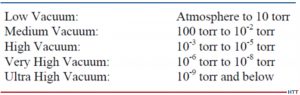
Vacuum technology includes vacuum pumping systems which enable the vessel to be pulled down to different stages through the process. Degrees of vacuum level are expressed opposite of pressure levels: high vacuum means low pressure. In common usage, the levels shown below in Figure 1 correspond to the recommendations of the American Vacuum Society Standards Committee.

Vacuum level will modify vapor pressure in a given material. The vapor pressure of a material is that pressure exerted at a given temperature when a material is in equilibrium with its own vapor. Vapor pressure is a function of both the material and the temperature. Chromium, at 760 torr, has a vapor pressure of ~4,031°F. At 10¯5, the vapor pressure is ~2,201°F. This may cause potential process challenges when processing certain materials in the furnace. As an example, consider a 4-point temperature uniformity survey processed at 1000°F, 1500°F, 1800°F, and 2250°F. This type of TUS will typically take 6-8 hours and, as the furnace heats up through the test temperatures, vacuum readings will most likely increase to a greater vacuum level. If expendable Type K thermocouples are used, there is a fair chance that, at high readings, you may begin to have test thermocouple failure due to vapor pressure.

Figure 1. Vacuum levels corresponding to the recommendations of the American Vacuum Society Standards Committee
Source: Jason Schulze, Conrad Kacsik Instrument Systems, Inc.

Vacuum Furnace Pumping System

Vacuum heat treating is designed to eliminate contact between the product being heat treated and oxidizing elements. This is achieved through the elimination of an atmosphere as the vacuum pumps engage and pulls a vacuum on the vessel. Vacuum furnaces have several stages to the pumping system that must work in sequence to achieve the desired vacuum level. In this section we will examine those states as well as potential troubleshooting methods to identify when one or more of those stages contributes to failure in the system.

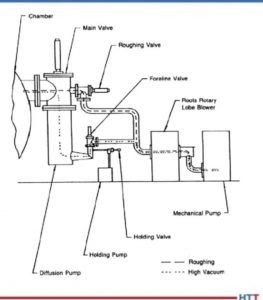
Vacuum furnaces have several stages to the pumping system that must work in sequence to achieve the desired vacuum level. Each pump within the system has the capability to pull different vacuum levels. These pumps work in conjunction with each other (see Figure 2).

Figure 2. Vacuum pumps work in conjunction with one another
Source: Jason Schulze, Conrad Kacsik Instrument Systems, Inc.

The mechanical pump is the initial stage of vacuum. This pump may pull from 105 to 10. At pressures below 20 torr the efficiency of a mechanical pump begins to decline. This is when the booster pump is initiated.

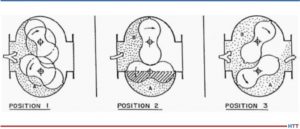
The booster pump has two double-lobe impellers mounted on parallel shafts which rotate in opposite directions (see Figure 3).

Figure 3. Booster pump positions
Source: Jason Schulze, Conrad Kacsik Instrument Systems, Inc.

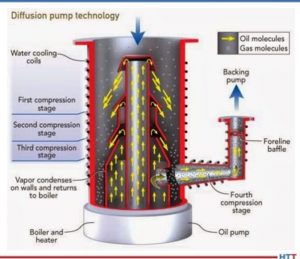
The diffusion pump (Figure 4) is activated into the pumping system between 10 and 1 microns. The diffusion pump allows the system to pump down to high vacuum and lower. The diffusion pump has no moving parts.

Figure 4. Diffusion Pump
Source: Jason Schulze, Conrad Kacsik Instrument Systems, Inc.

The pump works based on the vaporization of the oil, condensation as it falls, and the trapping and extraction of gas molecules through the pumping system.

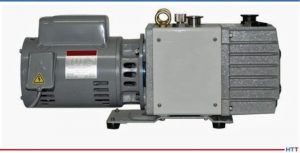
Image 1. Holding Pump
Source: Jason Schulze, Conrad Kacsik Instrument Systems, Inc.

The holding pump (Image 1) creates greater pressure within the fore-line to ensure that, when the crossover valve between the mechanical and diffusion pump is activated, the oil within the diffusion pump will not escape into the vessel.

Vacuum Furnace Hot Zone Design

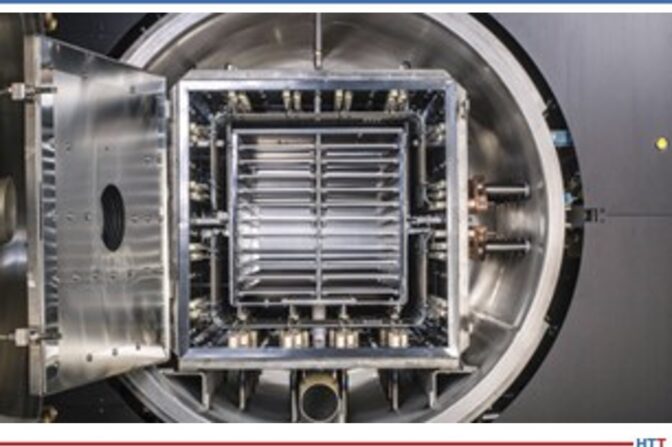
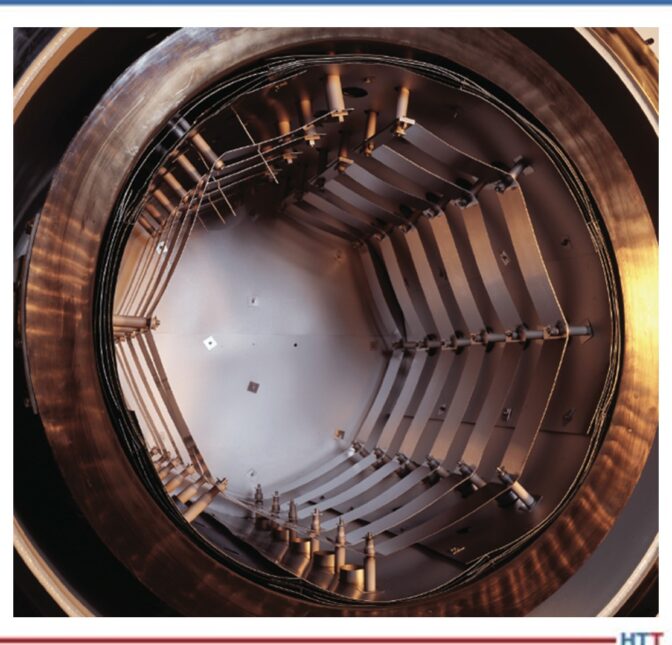
The hot zone within a vacuum furnace is where the heating takes place. The hot zone is simply an insulated chamber that is suspended away from the inner cold wall. Vacuum itself is a good insulator so the space between the cold wall and hot zone ensures the flow of heat from the inside to the outside of the furnace can be reduced. There are two types of vacuum furnace hot zones used: insulated (Image 2) and radiation style (Image 3).

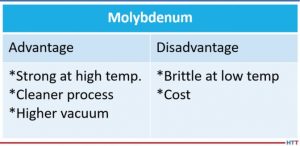
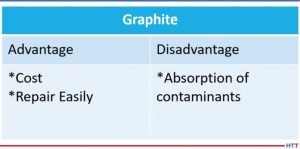
The two most common heat shielding materials are molybdenum and graphite. Both have advantages and disadvantages. Below is a comparison (Tables 1 and 2).

Table 1
Source: Jason Schulze, Conrad Kacsik Instrument Systems, Inc.
Table 2
Source: Jason Schulze, Conrad Kacsik Instrument Systems, Inc.

Vacuum Furnace Quenching System

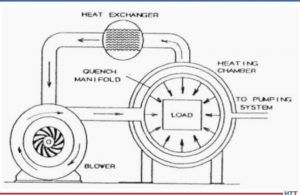
Quenching is defined as the rapid cooling of a metal to obtain desired properties. Different alloys may require different quenching rates to achieve the properties required. Vacuum furnaces use inert gas to quench when quenching is required. As the gas passes over the load, it absorbs the heat which then exits the chamber and travels through quenching piping which cools the gas. The cooled gas is then drawn back into the chamber to repeat the process (see Figure 5).

Figure 5.Diagram of gas quenching
Source: Jason Schulze, Conrad Kacsik Instrument Systems, Inc.

Vacuum Furnace Trouble Shooting

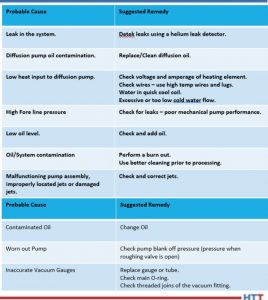
In Table 3 are some helpful suggestions with regard to problems processors may have.

Table 3
Source: Jason Schulze, Conrad Kacsik Instrument Systems, Inc.

Summary

Vacuum furnaces are an essential piece of equipment when materials need to be kept free of contamination. However, there are times when this equipment may not be necessary, and is therefore considered cost prohibitive, although this is something each processor must research. This article is meant to merely touch on vacuum technology and its uses. For additional and more in-depth information regarding vacuum furnaces, I recommend a technical book called Steel Heat Treatment, edited by George E. Totten.

About the Author: Jason Schulze is the director of technical services at Conrad Kacsik Instrument Systems, Inc. As a metallurgical engineer with over 20 years in aerospace, he assists potential and existing Nadcap suppliers in conformance as well as metallurgical consulting. He is contracted by eQuaLearn to teach multiple PRI courses, including pyrometry, RCCA, and Checklists Review for heat treat.

Contact Jason at jschulze@kacsik.com
website: www.kacsik.com


Find heat treating products and services when you search on Heat Treat Buyers Guide.com


Vacuum Furnaces: Origin, Theory, and Parts Read More »
Canadian Government To Secure 88 Lockheed Martin F-35 Lightning II Aircrafts

The Government of Canada announced it is to receive Lockheed Martin’s 5th Generation F-35 Lightning II aircrafts as a result of the Future Fighter Capability Project competition.

The Royal Canadian Air Force will add 88 of the F-35A multirole stealth fighters. The aerospace and defense industries will benefit with high value jobs in the production of these aircraft.

“Canada is our friend and a close ally. Their decision to procure almost 90 jets underscores the value of the incredible F-35 Lightning II,” said Lt. Gen. Mike Schmidt, program executive officer at F-35 Joint Program Office United States Air Force. The F-35 strengthens Canada’s operational capability with its allies as a cornerstone for interoperability with NORAD and NATO.

“Together with our Canadian industry partners, we are honored by this selection and the sustainment of critical jobs that will continue to equip Canadian workforces with advanced skills,” said Lorraine Ben, chief executive at Lockheed Martin Canada. “The F-35 program yields tremendous economic benefits for Canada’s aerospace and defense industry."


Find heat treating products and services when you search on Heat Treat Buyers Guide.com


Canadian Government To Secure 88 Lockheed Martin F-35 Lightning II Aircrafts Read More »
Skip to content