A metals and industrial group was recently approved to add seven steel plants to their planned merger, combining steel, engineering, and mining businesses into a single international presence.
Following recent EU approval for Liberty to acquire seven major European steel plants from global steel and mining company, ArcelorMittal, the GFG Alliance has announced intentions to integrate most of its Liberty steel, engineering and mining businesses into a single global entity, spanning assets across the UK, Europe and Australia.
Liberty Engineering
The consolidated business will include all of the UK steel and engineering assets, the integrated Australian Liberty primary steelworks in Whyalla, a number of high-quality Australian iron ore and metallurgical coal mines, and, once completed, the seven European steel plants being acquired from ArcelorMittal. This merged new group would exclude GFG’s recycling and building products businesses in Australia and the U.S.
Currently these businesses exist separately within the GFG Alliance but they hope the planned merger and integration will allow Liberty to gain a more prominent position in the international market.
Sanjeev Gupta, Executive Chairman of the GFG Alliance
“We look forward to leveraging Liberty steel and mining’s integrated supply chain to create further value,” said Sanjeev Gupta, Executive Chairman of the GFG Alliance. “The business will combine Liberty’s integrated steelworks in Whyalla and its ambitious Australian iron ore and coking coal mining businesses, with Liberty House Group assets in the UK and the planned acquisition of the ArcelorMittal European manufacturing facilities.”
The business plans to internationally ship iron ore, coking coal, and semi-finished product from Australia to its manufacturing plants and mills.
Liberty is known in the UK as a steel producer and an engineering components supplier to the automotive, aviation, defense and renewable energy sectors, while Liberty Primary Steel in Australia produces rail and structural steel for the growing infrastructure and building industries.
Dan Szynal, VP of Engineering & Technical Services, Plibrico
Aluminum processors face constant challenges to their aluminum melt operations. Due to robust demand, processors often operate these furnaces at higher temperatures to maximize production rates. As a result, one of the costliest operational challenges is the aggressive formation of corundum deposits in their furnaces.
In this article, Dan Szynal, VP of Engineering & Technical Services, Plibrico, discusses the causes and concerns of corundum growth and outlines excessive, damaging, and costly corundum growth can be mitigated with the right refractory materials, coupled with the correct maintenance and watchful operation.
Root Causes of Corundum Growth
Corundum growth in a refractory lining of an aluminum furnace occurs due to a reaction between the alumina-silicate refractory and molten aluminum. Corundum formation can occur both externally and internally in the refractory lining.
There are four identifiable root causes that promote corundum growth:
High temperature
Presence of oxygen
Alloy composition
Use of fluxes and fluoride salts
Corundum Formation Illustration
High temperatures accelerate the reduction of oxides in the refractory. The higher the temperatures, the more quickly non-wetting agents lose their effectiveness. Aluminum begins to penetrate the refractory matrix because of decreases in aluminum viscosity and surface tension. Excessive furnace temperature can be the result of several causes: overfiring, improper furnace control, or inaccurate thermocouple placement. For example, a thermocouple that is recessed into the refractory lining by 2 inches may underreport temperatures by several hundred degrees.
Oxygen drives the reaction process in two ways: as an atmospheric gas, and as a reducible oxide in the refractory. Minimizing oxygen by controlling negative pressure sources such as doors, windows, and well openings reduces the potential for reaction. Proper flue sizing and burner stoichiometry also reduce excess oxygen and improve furnace energy efficiency.
Alloy composition can be a factor. Some aluminum alloys contain elements that reduce the silica as well as iron oxide, zinc oxide, and other oxides in refractories. Careful attention is necessary when choosing an appropriate refractory for more aggressive aluminum alloys to reduce the potential for reaction.
The use of fluxes and fluoride salts like cryolite Na3AlF6 in aluminum melting accelerate the reduction of oxides in the refractory. Their alkaline properties also reduce the local melt temperature of the refractory at the bellyband and then infiltrate the furnace lining. Over time, with a lack of regular maintenance, the corundum buildup will reduce furnace performance and increase aluminum loss.
Trouble Spots
The spread of corundum growth occurs most commonly in areas where its formation mechanisms of heat and oxygen are present. Typical problem areas include doors, openings, flue areas, and burner cones due to the potential for excess oxygen. Negative furnace pressure can also lead to leakage from the outside. Other common areas of formation include rear walls and bellyband areas where regular cleaning and maintenance are more difficult.
Control and Avoidance
The key to fighting corundum starts with choosing the proper refractory material for molten aluminum contact. The development of effective refractory additives that combat corundum, including non-wetting additives, dense oxide barrier formers, and pore-size reducers was pioneered by Plibrico, which includes these additives in products aimed at:
increasing wetting resistance and reducing the potential for oxidation-reduction of the refractory (The Plicast Al-Tuff® system)
forming a reactive layer to resist molten aluminum penetration up to 2000°F (Plibrico’s Al-Shield™ refractories)
offering good resistance to metal slag penetration, especially in higher temperatures, and adhering well to the existing refractory for repairs (Phos-bonded castables like Plibrico’s Exo-set Uno™)
In general, PliPartner refractory contractors tell us that they find phos-bonded plastic refractories to be excellent repair materials for aluminum processors. They are usually low in free silica and nonwetting. The material bonds chemically to existing refractory, making them easier to install, and phos-bonded plastic refractories are an excellent solution for corundum growth at the bellyband.
Best Practices That Will Help
A regular maintenance plan can go a long way to increasing refractory life; a schedule is essential. A knowledgeable refractory expert with genuine experience in aluminum heat processes can help with ideal schedules and checklists.
Corundum buildup is a common concern among aluminum furnace end users. Optimally, the longevity of a furnace lining depends on best practices in refractory materials and installation methods, knowing the past refractory performance history to evaluate future performance, managing expectations of furnace production output, and monitoring regular maintenance and operation of the furnace.
These factors are measurable key performance indicators that will help decision makers design and build good refractory linings for the demanding needs of aluminum producers today. Considering these factors and balancing them according to the producers’ needs can deliver a higher-quality product for longer life.
A large aluminum producer recently announced a large investment in a new rolling plant in Ashland, Kentucky.
Braidy Industries, Inc. (Braidy) and Rusal jointly announced the approval by their respective Boards of Directors for Rusal to invest $200 million in Braidy Atlas mill. The companies estimate that it has been more than three decades since a greenfield aluminum rolling mill like Braidy was built in the U.S. The deal is expected to close in the second quarter of 2019.
Craig Bouchard, Braidy Industries Chairman and CEO
“This is a sustainability match made in heaven for the global aluminum industry,” said Craig Bouchard, Braidy Industries Chairman and CEO.
Rusal intends to supply 200,000 tons of certified low-carbon prime aluminum ingot and slabs each year for a 10-year period, allowing Braidy to target lower carbon emissions.
Braidy is dependent on long-term supplies of high-quality, low-carbon aluminum, which is rarely supplied in the high quantity required for their production. If met, this order would be one of the world’s largest for one mill of high-quality, pre-alloyed and low-carbon primary aluminum slabs.
Heat Treat Today publishes four print magazines a year, and included in each is a letter from the publisher, Doug Glenn. This letter first appeared in Heat Treat Today‘s Automotive Heat Treating magazine, June 2019
Doug Glenn, Publisher, Heat Treat Today
If you believe YouTube, the very first car was a Benz Motorwagen (1885). It was petro-powered. For the last 134 years, there have been only petro-powered vehicles.
Cars aren’t going away (drivers might be going away, but not cars!), but evidence seems to point to the soon extinction of the petro-powered vehicle. Every major automobile manufacturing company has a horse in the game. Volvo, the Chinese-owned Swedish car company, has committed to building ONLY all electric or hybrid cars starting in 2019. It plans to introduce five new, all electric models between 2019 and 2021.
What of the heat treat supply chain? Will automotive heat treating dry up to a paltry percentage of what it is now? Will automotive electrification usher in new heat treat opportunities?
Without a doubt, electrification will bring in a brave new world to heat treating, but I’ve not seen anyone present a good, in-depth analysis of how the heat treat world will be impacted. If you’ve seen such a presentation, I’d like to know.
What Will Go Away
What can be said is pretty straightforward. Assuming the current trajectory continues, the petro-powered engines that have propelled our vehicles for that last century and a half will slowly start to disappear. In their place will be electric motors and battery power. Specifically, gears and transmissions will take a significant hit. Currently, the heat treatment of gears is one of the largest segments of heat treating with all the carburizing, nitriding, carbonitriding, ferritic nitrocarburizing, and a seemingly endless number of other surface or through heat treat processes. Per car, there are more gears heat treated than any other single component. Pistons, fuel injectors, cylinders, rings, and anything else related to the internal combustion engine will wane as the popularity of EVs waxes.
As one of our heat treat consultants says in this issue’s article, “Heat Treat Brain Trust on Industry Innovations That Have Enhanced Automotive Heat Treating in Recent Years,” we have to also consider the upstream supply chain that will be affected by the displacement of the internal combustion engine. What about tooling and toolmakers and the heat treating they currently do? What about the heat treating that is required after soft machining and then again after hard machining? Keep looking further and further back the supply chain to discover who else will be impacted by electrification.
It will be a paradigm shift, a mega-trend, a tsunami of epic proportion . . . maybe even a train wreck in slow motion.
But that is the saving grace. None of this is going to happen overnight. So if your horse is hitched to the internal combustion engine, the 2020s is a good time to start looking for another ride home from the dance.
“Without a doubt, electrification will bring in a brave new world to heat treating, but I’ve not seen anyone present a good, in-depth analysis of how the heat treat world will be impacted.”
What Won’t Go Away
On the other hand, there’s plenty that will not be going away. Body panels and structural components/frames, suspension parts (although they may change due to the vehicles having a motor on each of their four wheels), and non-engine related stampings and forgings will all make the cut. But even these parts are not completely safe. The push for lighter, stronger vehicles will continue to push designers to consider lighter materials with equivalent or superior functionality. Take wheels for example. Carbon fiber is superior but too expensive for the average pocketbook, but high-end vehicles are already sporting these high-tech wheels. The days of aluminum wheels may be limited. Auto manufacturers will continue to push for less expensive, higher performing materials which, in some cases, will include non-metallic, non-heat treatable composite materials.
(Photo source: Wolfgang Eckert from pixabay.com)
What’s Coming
On May 8 of this year, our publication ran the following article: “First Aluminum Sheet Battery Enclosure Helps Electric Vehicles Go Farther on a Single Charge.” In that article, Novelis Inc.’s Pierre Labat, VP of Global Automotive, announced the first aluminum sheet battery enclosure for “the rapidly growing electric vehicle and battery sectors.” Batteries. Hitch your wagon to anything battery related!
Additionally, electric motor production and anything upstream in that supply chain would be a safe bet to investigate.
No one has ever accused me of lacking imagination, but I’m having a difficult time seeing a net gain for heat treaters in the coming EV swell. Then again, the free market and human innovation – which is especially strong in these United States – is a wonderful thing. We will adapt. Fortunately, we have some time – probably two decades of slow change. Embrace the change. Prepare for the future.
A British steel company recently acquired a large Pennsylvania producer of value-added carbon and alloy wire.
Liberty Steel, part of the global GFG Alliance, purchased Johnstown Wire Technologies (JWT) in Johnstown, Pennsylvania, a large producer of value-added carbon and alloy wire in North America.
The acquisition allows Liberty the opportunity to manufacture a range of high-value carbon and alloy wire products for multiple end markets including the infrastructure, automotive, utility, and consumer sectors.
The advanced manufacturing facility at Johnstown will complement Liberty’s melting and rolling operations at Georgetown, South Carolina, and Peoria, Illinois, and, combined with its scrap processing plant in Tampa, Florida, will have a wide presence in the U.S. steel market.
The 638,000-square-foot Johnstown site has been a high-profile steel manufacturing facility for over 100 years and is one of the few U.S. producers of CHQ, electro-galvanized, aluminized and spring wire. JWT currently holds a high market position in the electro-galvanized and aluminized sectors.
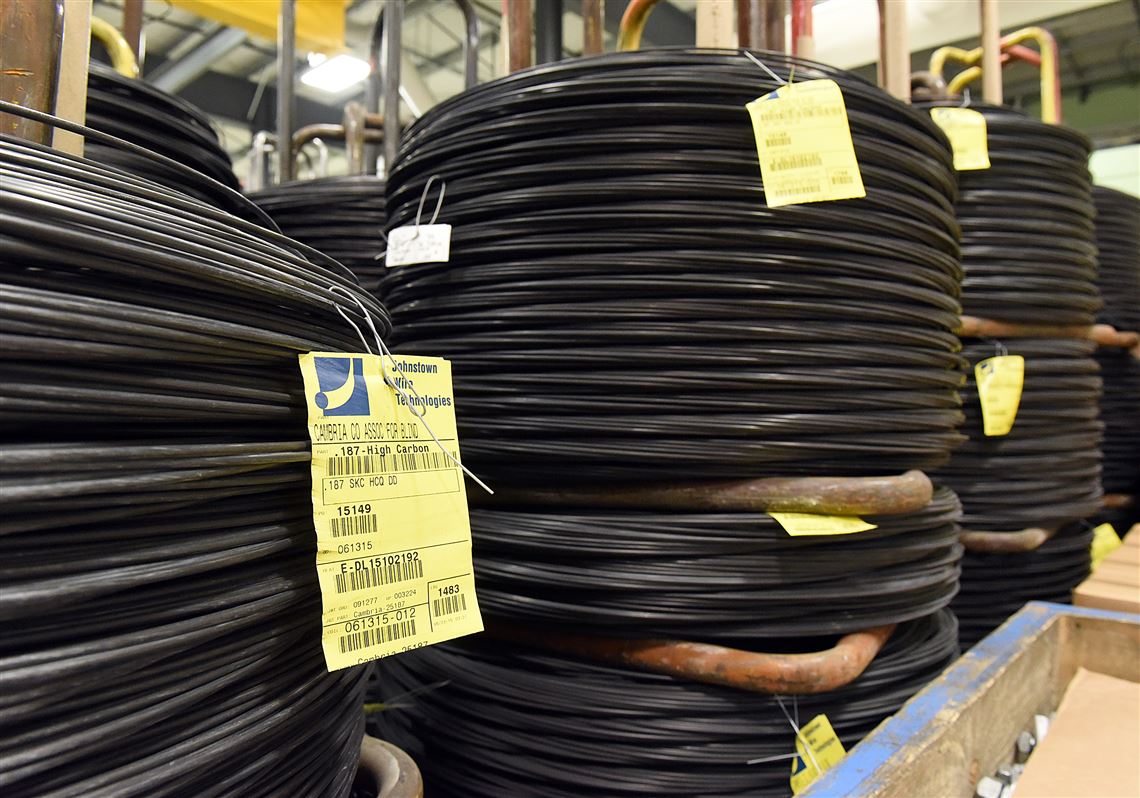
Source: Pittsburgh Post Gazette
With more than half of JWT’s output sold into the transportation market, Liberty is also aiming to capitalize on continued growth in U.S. vehicle production. It is one of the largest producers in the U.S. of CHQ wire, which is used in automotive products such as engine block bolts and brake pad rivets.
Liberty hopes that the acquisition will increase its capability to meet the “Made in America” specifications required for public infrastructure and utility contracts.
Grant Quasha, Chief Investment Officer for GFG in North America
“This is another very significant step towards our ambitious U.S. goals,” said Grant Quasha, Chief Investment Officer for GFG in North America. “JWT is a profitable business with a skilled workforce and tremendous pedigree in the industry, so we look forward to welcoming it into the GFG USA family and helping it build an even stronger future.”
“We are excited to be joining the GFG family of global businesses and see this as a tremendous opportunity to further our position as a leading manufacturer of steel wire in North America,” said Jack Miller, President and CEO of Johnstown Wire Technologies.
Sanjeev Gupta, GFG Group executive chairman
“It’s a great pleasure to welcome 250 highly-skilled new members to our family,” said Sanjeev Gupta, GFG Group executive chairman. “Integration upstream and downstream with value-added product manufacturing is an absolute core to our U.S. steel strategy. The addition of high-quality specialized facilities at Johnstown further strengthens our existing facilities at Georgetown and Peoria.”
Liberty entered the U.S. market in 2017 by acquiring ArcelorMittal’s Georgetown mill and followed up with the purchase of Keystone Consolidated Industries, including its flagship Peoria mill, in 2018.
One of the winners of Heat Treat Today’s recent drawing requested that his prize be donated to a charity benefiting children.
As a special welcome to founding members of the Leaders in Aerospace Heat Treat LinkedIn Group, Heat TreatToday conducted a drawing in which three winners would receive a $100 Amazon gift card. Anyone who joined the group AND commented on any of the posts during the month of April was entered into the drawing.
Dr. Steve Offley, Product Marketing Manager at Phoenix Temperature Measurement (PhoenixTM), was selected at random as one of the three winners, but instead of claiming his Amazon gift card, he asked Heat Treat Today to make a donation to a charity that would benefit children.
A “keen reader of daily industrial news and social media posts” from Heat Treat Today, Dr. Offley, aka Dr. O, also occasionally contributes editorial material, drawing from his more than 20 years of industry involvement.
“PhoenixTM designs and manufactures innovative ‘Thru-process’ temperature monitoring systems used in the Heat Treatment Industry for a wide range of different applications,” explained Dr. O. “The company also provides solutions to either product temperature profiling or TUS challenges faced as part of CQI-9 or AMS2750E.”
Dr. O grills for neighbors at his church’s community day.
Because Dr. O lives in Newmarket, UK, Heat Treat Today decided to contribute in his name to a charity that would be personal to him or his community.
“Christian Aid is a charity I have supported for most of my life as part of my local Church ‘All Saints’ Newmarket,” said Dr. O. “Each year I will be found collecting on my local town high street during Christian Aid week.”
Christian Aid, according to its website, is a UK charity that works in 37 countries “to expose poverty throughout the world, to help in practical ways to end it, to highlight, challenge and change the structures and systems that favor the rich and powerful over the poor and marginalized.”
Burkina Faso is one of the 37 countries Christian Aid supports (Source: Christian Aid).
“As I get older and hopefully wiser I realize that in today’s world I have so much to be thankful for,” reflected Dr. O. “In a world where many are far worse off than I, I feel anything I can do, however small, must make some difference. As I am sure others do, I now appear to find more pleasure in giving than receiving.”
Doug Glenn, publisher of Heat Treat Today, commented, “It is a blessing to have people like Dr. O in our audience and we sincerely appreciate his desire to donate his winnings to a charitable organization benefiting children. Dr. O’s kindness is a real encouragement to the Heat Treat Today team and we hope our small donation will be a blessing to the children helped by Christian Aid.”
Leaders in Aerospace Heat Treat LinkedIn Group (click here) provides a professional-level space where heat treaters from the aerospace industry can discuss issues and ideas. Heat TreatToday regularly provides content related to the group, keeping members current on the latest technologies, products, processes, and discussions. If you’re a heat treat leader in the aerospace industry, you should be in this group.
Welcome to another episode of Heat Treat Radio, a periodic podcast where Heat Treat Radio host, Doug Glenn, discusses cutting-edge topics with industry-leading personalities. Below, you can either listen to the podcast by clicking on the audio play button, or you can read an edited version of the transcript. To see a complete list of other Heat Treat Radio episodes, click here.
Audio: Heat Treat Radio: Heat Treat Megatrends with Gary Doyon
In this conversation, Heat Treat Radio host, Doug Glenn, interviews Gary Doyon, president and CEO of the Inductotherm Group, based in Rancocas, New Jersey on megatrends in heat treating. Inductotherm Group develops and manufactures advanced technologies, products, and systems for the heat-driven transformation of metals and specialty materials, providing localized manufacturing, engineering, service, and support in every region of the world through 40 full-service companies providing 50 individual product lines organized into 10 global brands. In addition, Doug asks Gary talk about a broad range of heat-treat related topics, including design change, electric vehicles, recycling materials, Brexit, immigration’s impact on U.S. manufacturing, a younger workforce, USMCA, and cybersecurity.
Click the play button below to listen.
Transcript: Heat Treat Radio: Heat Treat Megatrends with Gary Doyon
The following transcript has been edited for your reading enjoyment.
Extra support for this episode of Heat Treat Radio is provided by the Industrial Heating Equipment Association, IHEA, where leading companies in the thermal processing industry meet to discuss ways of advancing the industry. IHEA, on the web at www.ihea.org.
THERMPROCESS, the largest heat treating trade show in the world is just around the corner, as of the original airing of this Heat Treat Radio episode in mid-June 2019, and there is no better way to prepare for that event than to spend some time talking with someone in the heat treat industry who has a uniquely global perspective.
Hi, and thank you for joining us. I’m your Heat Treat Radio host and publisher of Heat Treat Today, Doug Glenn, and the gentleman we are talking to today has been in the industry for over 30 years and is CEO of over thirty metals-related companies around the globe, many involved directly in the North American heat treat market. You’d recognize many of the company names. Take, for example, Inductoheat, Radyne, Thermatool, Banyard, as well as Consarc and PVT. Today we’ll talk about international heat treating megatrends with our guest, Gary Doyon, president and CEO of the Inductotherm Group.
Before we get to Gary, let me remind you that you can keep current with all things heat treating by visiting Heat Treat Today’s website: www.heattreattoday.com or by receiving one of our many E-newsletters. You can subscribe by visiting our website. And, if you’d like more information on THERMPROCESS, that huge heat treat show I mentioned above, jump on your browser and go to www.thermprocess-online.com. You can also Google “Heat Treat Radio THERMPROCESS” and be taken directly to a previous episode of Heat Treat Radio where we interviewed Eva Rowe from Thermprocess.
DG: On today’s episode, in anticipation of THERMPROCESS, which is being held in Dusseldorf, Germany, on June 25–29, we’re going to talk with Gary Doyon, one of the most qualified individuals in the heat treat industry to discuss international megatrends. Our conversation is fast-paced and wide-ranging, covering topics as diverse as cybersecurity, immigration, the impact of electric vehicles on the heat treat supply train, and Brexit.
First, let’s learn a bit more about the man, Gary Doyon.
GD: My name is Gary Doyon. I’ve been with Inductotherm Group for 33 years. I started off in sales in Connecticut at a company called Thermatool and progressed up through operations. I took over a Thermatool group which was a number of companies and then eventually got into the management of the Inductotherm group which is some 40 companies around the world, and today my title is president and CEO of that group.
Global Growth of Heat Treat Industry
DG: First question for Gary: Geographically, where do you anticipate higher than average and lower than average growth in the heat treat world over the next 5 to 10 years?
GD: Geographically, I think the above average is going to be seen in the next 5 to 10 years in North America for sure, Asia—India especially, and Brazil if it can get its political identity issues under its belt. Not above average are Europe, Middle East, and Africa.
DG: In the above average group, you said, “especially India.” Why is that?
GD: India right now is a 6% GDP growth, year-on-year, and it’s going to grow up from there. If you visit India, you’ll see the infrastructure is poor and they are investing a lot in it. They are making a ton of cars. They are getting into the possibility of aerospace manufacturing of parts, land-based turbines, and things of that nature. They want to become more self-sufficient on all the infrastructure needs which means metal production of the utmost volume, and their foundry and steel-making businesses are rising incredibly fast.
Technology Trends in Heat Treating
DG: Let’s move from geography to technology. Where do you see above-average activity? And where below average activity?
GD: Technically, powder metallurgy and 3D printing probably have the largest potential impact on thermal processors from a disruption standpoint. The composition of the steels and metals used in 3D or powders affect the heat treating practices because what’s good for part making may not be good for heat treating. Today the regular methods of part making like forging or casting are cheaper in volume, but they are not as flexible in the design change of parts. I see that the pace of design change is slowing down, especially in automotive, because the automotive producers seem to be actually practicing standardization in power train and frame and engine programs, so this may mean that the flexibility of 3D powders is less valuable while volume producing by traditional methods will stay more economical. We’ll have to see what happens about that.
DG: Interesting. You say the pace of design change is slowing down, especially in the automotive industry?
GD: I believe that, yes. I believe that the carmakers internationally have decided to standardize and do less design changes which means it will increase the volume of parts per their vehicle spectrum. That’s good for thermal processors today because they may be able to use the same processes they have in place for years to come.
Environmental Concerns
DG: How about the evolution of electric vehicles?
GD: The evolution of electric vehicles I think will cause a shift in the types of metal parts that are heat treated. You will go to much more gears versus crankshafts, camshafts, and things like that. But it seems to me that the EV progress is going to be dictated more by the two larger issues. One is the ability to produce better battery technology for longer trips and for faster charges, and what comes with that is the faster you charge, the larger the electrical peak load is needed. The whole issue of the electrical grid sizing for peak load or how to charge for the higher demand charge that comes with rapid charging—this all remains to be seen. If they can’t get over those subjects, then I think EV evolution is going to be stagnated. Then there is the big one which is recycling of the batteries. As far as thermal processors getting into gear heat treating, etc, that may or may not elevate as fast as they may think, depending on these issues, in my opinion.
I think another technical/situational event that is happening is the worries of legislation on climate change. I think it may have an impact on the thermal processors, especially the gas-fired or the flame-type systems people. Despite the science that they’ve put in for minimizing any sort of output from those kinds of processes, perception is reality on furnaces. So, again, on that we will see what happens.
The other issue I think we should bring up is composites. I think composites will always have a place, but the recycling ability of these also flies in the face of climate change worries. The ability to recycle metals easily, in my opinion, will always be a natural positive for metals, which then affects metal processors.
DG: It sounds like environmental concerns will act more as a restraint than a stimulant on the growth of electric vehicles in the next decade, due primarily to the recyclability issue?
GD: I believe so. I think the excitement about getting into electric vehicles and composites causes a lot of upfront research and development, but then it hits into the face of the reality of the electrical grid, environmental considerations—the realities of living in America especially, where no one wants more power lines in their backyard, etc. In a lot of ways, it’s the same as renewable energies and how that stagnated a bit when people don’t want to have windmills in their backyard. I think these are real situations that could cause stagnation of these technologies for the next 5 or 10 years.
DG: Beyond 5 to 10 years, do you see us ultimately moving to electric vehicles?
GD: Yes, it’s inevitable. I think the race is going to be between creating good hydrogen or another fuel type of engine, and if they can’t do that economically, they’ll have to go to electric vehicles, no question.
Growth in North America Heat Treat Industry
DG: Let’s focus in on North America for a moment. Where do you see North America excelling throughout the next decade or two?
GD: If you want to talk about America, I think the real growth is in aerospace. The design changes in aerospace, especially in the jet engine, the turbines, the gearing components, and how these metals are made to get the weight out and how they’re heat treated to give the fatigue strength and the strength that it wants for that application. I think automotive trends will still likely be led by American companies, both the traditional companies and others like Tesla and Rivian. I think that’s another important consideration going forward. As far as America goes, leadership, medical devices, medical procedures using electron beam laser therapies, induction—these are technologies used by heat treat processors. These will be led by Americans and this is a new business for some of these companies to get into at the end of the day. I believe firmly that manufacturing will keep returning to the U.S. as the trend towards these fair trade raises the want to invest in America in manufacturing. The renewed interest in good jobs that you hear from politicians also bodes well for America’s growth.
DG: Which driver do you think is more important for America’s growth: low energy costs or the political trade climate?
GD: I think the political trade climate is absolutely the most important thing. If you take China, for instance. I look at the China trade war as not really a war, but it’s finally heightened public discussion on what should have always been happening and that a continued robust negotiation between the U.S. and China on specific trade items should have been happening and is happening now. I think the U.S. is putting their foot down harder than we have before. Once that settles down, I think a better trade situation benefiting both countries can become a reality.
As we continue below, we’ll talk about some really interesting topics such as Industry 4.0 and the big warning that Gary has for companies getting involved, as well as cybersecurity and working with the younger generation. But first, a special thanks goes out to Anne Goyer and all of the good people over at the Industrial Heating Equipment Association (IHEA) for their support of Heat Treat Radio. In case you didn’t know it, IHEA provides top caliber training for many of your heat treating needs. In fact, on September 24th and 25th, IHEA is bringing three of their most popular training courses to the home of the rock and roll hall of fame, Cleveland, Ohio. Whether it’s their combustion seminar, their safety standard seminar or their process heating seminar, someone on your heat treating team will find one or more of these seminars valuable. You can find out more about these seminars by visiting IHEA’s website at www.ihea.org.
DG: I next asked Gary about how the heat treat business world has changed over the past decade. Here’s what he had to say:
A Decade of Changes in Heat Treating
GD: One, I think customers have far less technical staff than they had 10 years ago and that pushes companies like ours to offer much more services and technical support and maintenance throughout the life of the machinery that we sell.
I think that a huge issue is the legal issues forcing companies to pay more attention to terms and conditions and safety and contractual issues. I think that has become much more prominent over what, when I was younger, the handshake type climate of 20 years ago.
Industry 4.0—and Over-Digitization?
I think that the push towards Industry 4.0 has companies approaching us wanting a lot more automation connectivity while simultaneously, they want to increase the digitization of data. This trend towards smart factories could provide a rush to provide a lot of data without understanding if it is productive or not, and that could lead to a very costly system and mass amounts of nonproductive data. This happened in the early days of ERP and ISO implementation, and I see it happening again.
DG: Perhaps we are swinging too far with data collection and collecting data just because we can.
GD: Yes, usually what happens, I think, is that companies that are not used to data collection will hire people that are used to data collection and so they won’t be as concerned about getting the key points of their process to make sure the process is robust, but they want to just capture every piece of data. That is a very costly thing for people to both implement on the machinery and implement on their factory floor. I think people should measure twice and cut once, and you should really think hard about what your goals are before you lay out that smart factory.
The Industry 4.0 was driven by the Germans back in the mid-2000s, and in a lot of ways, it was driven to give a competitive edge to European companies over low-cost countries like China or India. The thought there was that their advantage in science and computerization would give them the ability to have a factory with far fewer people or more knowledge. It’s been a top-down approach pushing different manufacturers into the Industry 4.0 so they can get this production data. I would believe that heat treaters would be very concerned about people coming in and telling them they need 30 data points on every part that they make when only 15 are relevant to the quality of that part. I think that is tantamount in what the heat treaters need to push back on, which is information that is useful and productive versus information for just information sake.
They will say to us, “Okay, on this crankshaft, we need these 40 data points,” and they will force people to do that. Then we will say, “In order to do that, we have to destructively cut every fifth piece, we have to do this, we have to do that.” And then they will say, “No, no no, this is what our R&D people want, so you have to do this.” Then we’ll say, “OK. This is the cost to do this. What do you want for maintenance?” And they will say, “Well, for maintenance, we don’t want to have anybody that knows about the machine, so we want you to prepackage all of the power supply in three boxes so if there is a problem with part of the power supply, you’ll take this part out and just slip a new part in—without having maintenance intelligence.” And we will say to them, “Well, okay, we get that, so instead of a $500 capacitor, now you give us 30K to redo the inside of the power supply.” That’s where their engineering and production people want to push you. Then you get with purchasing and the purchasing person says, “What are you talking about? We aren’t doing any of that. We want the lowest cost equipment and a $500 capacitor; we don’t want to have ‘the works in the drawer.’”
I believe we are at this cross point. In Germany, because they invented Industry 4.0, they put a lot more muscle into this, and I think that’s why some of their competitive disadvantage is happening. If you come into America, they are asking for it, but they’re not killing you yet, but they’re going to.
Remember when ISO came in and everybody made the same mistake with ISO. They let the ISO auditors tell them that they needed to document every little thing they did in their entire company, and most people’s companies got brought to a standstill. Over time, they developed it down to just the most important things you needed for processes, and then your plant ran better. That is where we are right now in some of this Industry 4.0. I don’t want to sound too negative because it has a lot of positives to it, but the implementation of it will make it or break it, for sure.
DG: But that is the way new technologies are adopted. It’s like when a child gets a new toy for Christmas, the first several days they spend 100% of their time with it because it is shiny and new, but later on they either forget about it completely or strike a more sensible balance of when to play with that new toy.
GD: That is 100% correct. But if you’re setting up a $100 million factory, and you get it wrong, that’s a big problem.
Lower Costs and Customer Support
DG: Let’s jump back to the question about how the heat treat business world has changed over the past decade. You mentioned customers have far less technical expertise. You mentioned the more litigious environment that we live in and the importance of those terms and conditions. And then the demand for data and the emergence of Industry 4.0 and perhaps our somewhat mindless collecting of data. Does anything else jump to mind?
GD: I think the difference between companies that are so-called full-service companies and ones that aren’t is a huge issue for heat treaters to be selecting equipment from. One of the negative trends has been a huge separation between engineering and production departments and purchasing departments, especially in the larger companies. That puts more emphasis on price than the real needs of what that company looked for, and in the short-term, that can favor the price-leading suppliers—on the short run, the people that give it a lower price. But in the longer run, these customers need support. They just don’t have the people in there, and it cannot serve them well if they don’t work with the right company.
Geopolitics and Trade
DG: Let me throw out some geopolitical names and tell us what pops to mind. Brexit—
GD: I don’t think Brexit has very much effect. It certainly is not going to affect the way the media says, because at the end of the day, I believe European Union regulations have added costs and dissuaded innovation in Europe, therefore I believe Brexit is good for the British because it possibly leads to more pressure for other people to leave the union, and they’re going to open up to have less regulation and cost. It is very costly to do business in Europe.
DG: China. Any additional thoughts on China?
GD: I think China is a huge trading partner for us today, but I think it’s going to be a much more equitable one in the future, once we get over this short-term tension between them and once we get our “win-win” attitudes in line with each other, I think it’s going to be a phenomenal trading partner going forward.
DG: North Korea.
GD: I don’t think they have any effect on us today economically. It could become a new market in the future, but today they have no effect on us economically whatsoever.
DG: How about Venezuela?
GD: When I was younger, Venezuela was a serious energy player. We sold a lot of equipment in Venezuela and Venezuela was obviously one of the major energy exporters in the world, so reviving their economy and becoming a market, if they can do that, I think would be good for especially the South American hemisphere area. But, unless they get their political stances straight, they’re just going to remain where they are.
DG: Brazil?
GD: Brazil sort of lost its way in the last couple of years from a manufacturing standpoint and a socialist trend in Brazil took away a lot of the desire to invest in Brazil. They had lots of union issues, a tremendous amount of union issues, especially with things like pensions and extra costs like that. And then secondarily, their stance on imports and how they stop other countries from exporting to Brazil has turned off a lot of people from investing in Brazil. The new president there says he’s going to bring back fair trade, and if he does that, I think Brazil could become a world player again.
Immigration, Labor, and Retaining Younger Employees
DG: Let’s talk for a minute about U.S. immigration and how it’s impacting your business and the heat treating economy generally.
GD: U.S. immigration is mostly a southern border issue, in my opinion, and it is mostly an issue with people from South America, not really people from Mexico. I think this has to be worked out by Congress, and Congress is just being silly in the view that it isn’t an issue. It’s been an issue for 40 years, and they have no answers for it. I think we have to have a system in place, as we have for years and years and years, and outside of asylum, anybody that wants to come in should enter through this system.
DG: How about the U.S. labor market for you? And what are you hearing from your customers regarding their ability to find qualified workers?
GD: For my customers, I hear that all the time. I have been with this company for 33 years and many of the people that are in our group have more years than I do. I think we have 3200 in our group and I would say half of those employees have over 12 or 15 years with the company. One way we’ve been able to hang onto people is, by having 40 companies globally, we give the people the opportunity to travel to these companies or relocate to another area of the U.S. or to another part of the world. I think if you can keep the younger people challenged, give them this ability to try another area of their life, pay them fairly, and most importantly, if you can show them a future through a well-developed succession planning effort so that they think they have a chance to get promoted in the future, I think they’ll stay with you for a long time.
United States-Mexico-Canada Agreement (USMCA)
DG: Let’s talk about two more topics. The new North America trade agreement—USMCA—and then cybersecurity. What are your thoughts on USMCA?
GD: I think the USMCA, the way I understand the legislation, is that a big part of it is raising wages in the lower cost areas of Mexico, and I think evening the wages out will even out the flow of trade between the three countries versus just flowing to the lowest cost country because of the low wages. Personally, I think that wage increase is a good thing. Henry Ford proved that out a long time ago when he gave his workers unheard of type wages. I think that at the end of the day, it will create a better middle class and that feeds into the economy like a gas pedal and becomes self-sustaining, even if inflation rises a few percentage points. I think people shouldn’t buy the media hype about things like robots doing away with a lot of jobs in the United States. To me, all this talk stems from academics and politicians who haven’t spent much time of their life in the business. We have a situation right now where our unemployment is below 4%, so that means that most people that want to work are working. How do you grow that economy? I think you grow that economy by paying people more money and then they can use that money to buy what they want and it becomes a self-fulfilling prophecy.
Cybersecurity
DG: Last question: Cybersecurity—What are you seeing?
GD: We’ve seen a tremendous increase in email intrusions with people tricking our customers into remitting payments to scammed accounts. This is especially bad because it strains our relationships with our customers. At the end of the day, there is no clear person to blame: it is this unknown person on the internet. As an example, we had a customer recently that gave us a $900,000 down payment, and he remitted it to a bank account that he had received on a scammed email where they had taken our invoice that we had put into the email, and they had changed it to their bank number, and so the $900,000 was put into that scammer’s bank account, and they withdrew about $120,000 of it before the proper government officials could shut it down. We have got that back now and there have been some arrests made, but I can think of 20 or 30 of these situations happening just in the last 5 or 6 months.
DG: Have you changed the way you do business because of it?
GD: Yes, what we’ve done is we’ve gone out to try to tell our customers that we will no longer put any sort of remittance information in email form anymore. We will only do that in an encoded or encrypted manner which we will send directly to their accounts payable people. We will also duplicate a message to them of what the bank they should be using is, not the account number and what have you, and so when things line up correctly, they should remit the payment. Otherwise, they should treat everyone that has some skeptical information, and not pay us. We’d rather not get paid than give it to a scammer.
The other problem I see on cybersecurity is again going back to Industry 4.0. I think the people that are trying to implement this smart factory, or what people like to call “the internet of things.” It is a highly digitized handshake between machinery and then up and down to management, from shop floor management all the way through upper management of the company. These are easy targets for pirates. I think that’s an important thing to think about. Most companies do not have the capabilities of really protecting themselves from these kinds of threats, so I think simpler is better in any of these areas.
Just as a little bit of color, I am an autonomous vehicle skeptic and I am this way for two reasons: One is that the sensors needed for these truly autonomous vehicles and roads being all autonomous and transportation being autonomous, they’re definitely not good enough yet in all weather conditions. But I think the most important thing, unlike airplanes where you can afford to have multiple systems, people are never going to be able to afford a vehicle that has multiple computer systems. I think the potential for hacking, for economic reasons, political reasons, and terrorism reasons are just because some bad behavior on some kid in his back yard can affect this autonomous vehicle information grid. I have my doubts about autonomous vehicles because of cybersecurity.
DG: Gary was very gracious with his time and answered a boatload of questions, many of which were able to include in this podcast. You’ll notice that I asked Gary to keep this noncommercial, so he hardly ever mentioned any of his company names or any specific products. We would, however, like for you to know, that Inductotherm Group is exhibiting at THERMPROCESS and GIFA in Hall 10 Stand B42 which perfectly straddles both of those shows. If you’re headed to Dusseldorf this year, I’d strongly encourage you to stop by and meet Gary and take a look at all the products he so politely refrained from mentioning in this podcast.
If you’d like to get in touch with Gary Doyon, feel free to email me directly at doug@heattreattoday.com and I’ll put you in touch with him.
If you’d like more Heat Treat Radio, you can simply Google “Heat Treat Radio”. Believe it or not, we are the first thing that comes up. Apparently, no one else is using those three words. From there, you’ll be able to link over to our website where you’ll find 18 other Heat Treat Radio episodes, including one on Inductotherm founder, Hank Rowan. Also, if you have a topic you’d like to see covered on Heat Treat Radio, please contact me directly by email. Again, that’s doug@heattreattoday.com.
Don’t forget that additional support for Heat Treat Radio is provided by the Industrial Heating Equipment Association (IHEA), where technical training is on the schedule for this September 24th and 25th in Cleveland, Ohio. Check out their website: www.ihea.org and learn more about the combustion seminars, safety and standard seminar, and their process heating seminar.
This and every other episode of Heat Treat Radiois the sole property ofHeat Treat Today and may not be reproduced in part or in full without prior written approval from Heat Treat Today.
Jonathan Lloyd from Butler, Pennsylvania, produced and mixed this episode. I am your host, Doug Glenn. Thanks for listening.
Doug Glenn, Heat Treat Today publisher and Heat Treat Radio host.
To find other Heat Treat Radio episodes, go to www.heattreattoday.com/radio and look in the list of Heat Treat Radio episodes listed.
A North American steel manufacturer recently made an investment with intent to expand its services at its South Carolina bar mill.
Nucor Corporation announced plans to add vacuum degassing to its engineered bar services at its bar mill in Darlington, South Carolina. Nucor hopes that by providing this service the mill will be better equipped to produce engineered bar products according to high-quality specifications in the industry. The vacuum degassing system is expected to begin operating in late 2020.
John Ferriola, Chairman, CEO, and President of Nucor Corporation
“This strategic investment complements our existing bar mills that primarily produce engineered bar products in Norfolk, Nebraska, Memphis, Tennessee, and Wallingford, Connecticut. It will position us to better serve our customers in the Southeastern United States and support the growing demand in the region for higher quality automotive and other specialty steel applications,” said John Ferriola, Chairman, CEO, and President of Nucor.
Nucor Steel South Carolina, the first steel mill Nucor built, now employs more than 450 teammates and will recognize its 50th anniversary this summer at the Darlington facility.
Producing steel by means of melting recycled scrap in an electric arc furnace (“EAF”), the mill influenced the way steel is now made in the United States. Today, Nucor estimates that approximately 70 percent of the steel made in this country is produced using EAFs.
In the modern automotive manufacturing industry, CQI-9 HTSA (AIAG) has become a key part of driving process and product quality in heat treatment applications. The standard has a broad scope and covers many different aspects of common heat treatment processes (see Process Tables A-H in the standard) and monitoring requirements used. A critical part of the standard is the requirement to perform a temperature uniformity surveys (TUS) in order to validate the temperature uniformity of the qualified work zones and operating temperature ranges of furnaces or ovens used. In this Heat TreatProduct Spotlight, Dr. Steve Offley, a.k.a. “Dr. O”, Product Marketing Manager with PhoenixTM, discusses the challenges of performing a TUS on continuous furnace types and one possible solution his company offers.
CQI-9 Heat Treat System Assessment
A critical part of the CQI-9 HTSA (AIAG) standard is the requirement to perform temperature uniformity surveys (TUSs). The TUS is performed to validate the temperature uniformity characteristics of the qualified work zones and operating temperature ranges of furnaces or ovens used. (See Figure 1.)
Fig 1: Schematic showing TUS principle. Thermocouple measurement from the field test instrument, of the furnace’s actual operational temperature, against a setpoint to check that it is within tolerance. Setpoints and tolerances are defined in CQI-9 Process Tables A-H to match each heat treat process.
The “Thru-Process” TUS Principle
Traditionally, TUSs are performed by using a field test instrument (chart recorder or static data logger) external to the furnace with thermocouples trailing into the furnace heating chamber. This technique has many limitations, especially when the product transfer is continuous such as in a pusher or conveyor-type furnace. The trailing thermocouple method is often labor-intensive, potentially unsafe, and can create compromises to the TUS data being collected (e.g., number of measurement points possible, thermocouple damage, and physical snagging of the thermocouple in the furnace).
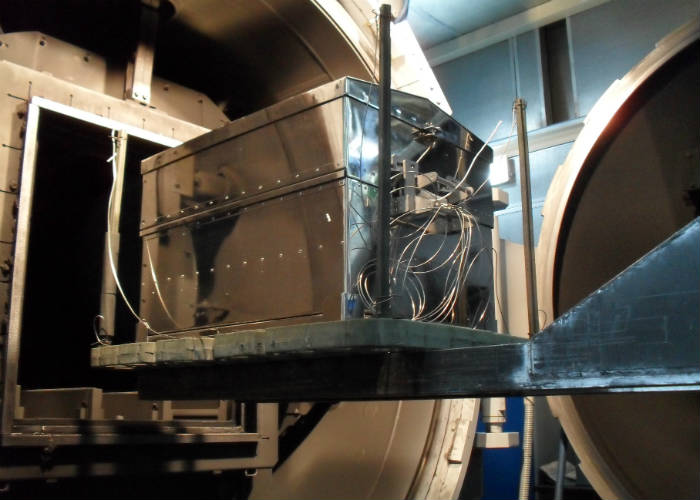
Fig 2: PhoenixTM thermal barrier being loaded into a batch furnace with a survey frame as part of the TUS process.
The “Thru-Process” TUS principle overcomes the problems of trailing thermocouples as the multi-channel data logger (field test instrument) travels into and through the heat treat process protected by a thermal barrier (Figure 2). The short thermocouples are fixed to the TUS frame. Temperature data is then transmitted live to a monitoring PC running TUS analysis software, via a 2-way RF telemetry link.
Data Logger Options
To comply with CQI-9, field test equipment needs to be calibrated every 12 months minimum, against a primary or secondary standard. The data logger accuracy needs to be a minimum +/-0.6 °C (+/-1.0 °F) or +/-0.1% (TABLE 3.2.1).
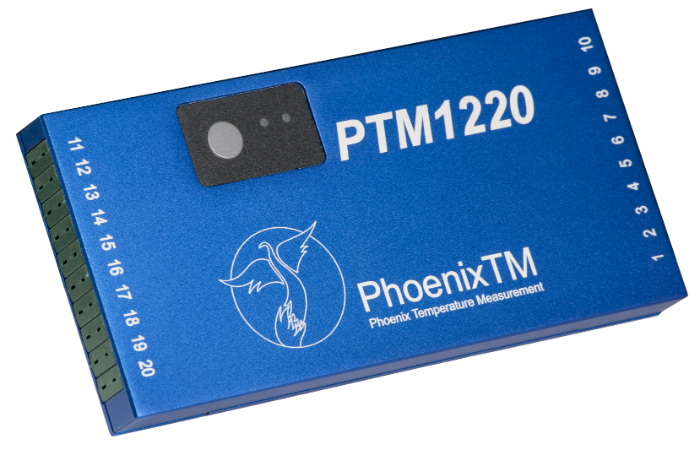
Fig 3: PhoenixTM PTM1220 20 Channel IP67 data logger comes calibrated to UKAS ISO/IEC17025 as an option with an onboard calibration data file allowing direct data logger correction factors to be applied automatically to TUS data.
The data logger shown in Figure 3 has been designed specifically to meet the CQI-9 TUS requirements offering a +/- (0.5°F (0.3°C) accuracy (K & N). Models ranging from 6 to 20 channels can be provided with a variety of noble and base metal thermocouple options (types K, N, R, S, B) to suit measurement temperature and accuracy demands (AMS2750E and CQI-9).
Mixed thermocouple inputs can be provided to support the process specific requirements and also allow the use of the data logger to perform system accuracy testing (SAT) to complement the TUS.
Innovative Thermal Barrier Design
Fig 4: “Octagonal” thermal barrier fitted to product/survey tray.
CQI-9 covers a wide range of thermal heat treatment processes and as such the thermal protection for the data logger will vary significantly. A comprehensive range of thermal barrier solutions can be provided to meet specific process temperature requirements and space limitations. Figure 4 shows a unique octagonal thermal barrier designed to fit within the boundaries of the product tray/survey frame used to perform a TUS using the “plane method” (See “Thermocouple Measurement Positions (TUS)” below in this article.). The design ensures maximum thermal performance within the confines of a restricted product tray/basket.
Live Radio TUS Communication
Fig 5: Schematic of LwMesh 2-way RF Telemetry communication link from data logger TUS measurement back to an external computer.
The data logger is available with a unique 2-way wireless RF system option allowing live monitoring of temperatures as the system travels through the furnace. Analysis of process data at each TUS level can be done live allowing full efficient control of the TUS process. Furthermore, if necessary, by using the RF system, it is possible to communicate with the logger installed in the barrier to reset/download at any point pre-, during, and post-TUS. In many processes, there will be locations where it is physically impossible to transmit a strong RF signal. With conventional systems, this results in process data gaps. For the system shown in Figure 2, this is prevented using a unique fully automatic “catch up” feature.
Any data that is missed will be sent when the RF signal is re-established, guaranteeing 100% data transfer.
Thermocouple Options (TUS)
In accordance with the CQI-9 standard (Tables 3.1.3 / 3.1.5), thermocouples supplied with the data logger, whether expendable or nonexpendable, meet the specification requirements of accuracy +/-2.0°F (+/-1.1°C) or 0.4%. Calibration certificates can be offered to allow the creation of thermocouple correction factor files to be generated and automatically applied to the TUS data within the PhoenixTM Thermal View Survey Software. Care must be taken by the operator to ensure that usage of thermocouples complies with the recommended TUS life expectancies and repeat calibration frequencies. Before first use, thermocouples must be calibrated with a working temperature range interval not greater than 250°F (150°C). Replacement or recalibration of noble metal (B, R or S) thermocouples is required every 2 years. For non-expendable base metal (K, N, J, E), thermocouples replacement should be after 180 uses <1796°F (980°C) or 90 uses >1796°F (980°C). For expendable base metal (K, N, J, E), thermocouples replacement should be after 15 uses <1796°F (980°C) or 1 use >1796°F (980°C). Note that base metal thermocouples should not be recalibrated.
Thermocouple Measurement Positions (TUS)
To perform the TUS survey, a TUS frame needs to be constructed to locate the thermocouples over the standard work zone to match the form of the furnace. The TUS may be performed in either an empty furnace in which case thermocouples should be securely fixed as shown in Figure 6. A heat sink (thermal mass fixed to thermocouple tip) can be used to create a thermal load to match the normal product heating characteristics. Alternatively, the thermocouples should be buried in the load/filled product basket. See Figure 6 to see schematics of TUS Frames for a box and cylindrical batch furnace with CQI-9-quoted number of thermocouples required to match void volume (Volumetric Method Table 3.4.1).
Fig 6: TUS Thermocouple Test Rigs. Required number of thermocouples: 1) Work Volume < 0.1 m³ (3 ft³) = 5; 2) Work Volume 0.1 to 8.5 m³ (3 to 300 ft³) = 9; 3) Work Volume > 8.5 m³ one thermocouple for every 3 m³ (105 ft³). (Click on the images for larger display.)
Fig. 7.1, 7.2. PhoenixTM system showing 9 Point TUS survey rig and Thermal View Software TUS frame library file showing as part of TUS report exactly where thermocouples are positioned. (Click on the images for larger display.)
For continuous conveyorized furnaces, it is recommended that an alternative thermocouple test rig is employed called the “plane method”. Since the system travels through the furnace it is only necessary to monitor the temperature uniformity over a 2-dimensional plane/slice of the furnace (Figure 8). The required number and location of thermocouples are shown in Table 1 (CQI-9 Table 3.4.2).
(Click on the images for larger display.)
Table 1: Required thermocouples and locations for differing work zones (Plane Method)
(1) 2 Thermocouples within 50 mm work zone corners 1 Thermocouple center. (2) 4 Thermocouples within 50 mm work zone corners. Rest symmetrically distributed.
“Thru-Process” Temperature Uniformity Survey (TUS) Data Analysis and Reporting
Operating the PhoenixTM System with RF Telemetry, TUS data is transferred from the furnace directly back to the monitoring PC where, at each survey level, temperature stabilization and temperature overshoot can be monitored live, with thermocouple and logger correction factors applied. The Thermal View Survey software generates TUS reports which comply with the requirements of AMS2750E/CQI-9 standards.
As defined in CQI-9 (Section 3.4) for furnace with an operating temperature range ≤ 305°F (170°C), one setpoint temperature (TUS level) within the operating temperature range is required. If the operating temperature of the qualified work zone is greater than 305°F (170°C), then the minimum and maximum temperatures of the operating temperatures range shall be tested.
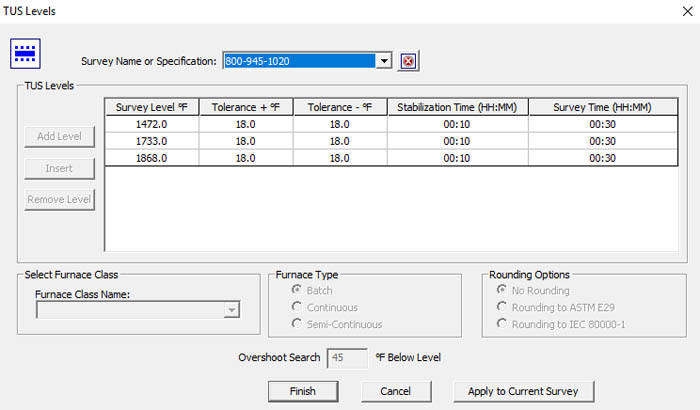
The TUS levels can be automatically set up in the TUS analysis software. Figure 9 shows both the TUS level file and TUS levels applied against the TUS survey trace.
Fig. 9.1Fig. 9.2
Fig 9.1, 9.2 PhoenixTM Thermal View Survey Software showing TUS Level set-up and application to TUS trace.
Within CQI-9, there is a very prescriptive list of what should be contained in the TUS report (Section 3.4.9).
To comply with all said requirements, the software package provides a comprehensive reporting package as shown below.
Fig 10.1, 10.2, 10.3. TUS Report showing a TUS profile at three set survey temperatures (graphical and numerical data). The probe map shows exactly where each thermocouple is located and easy trace identification. A detailed TUS report is generated, meeting full CQI-9 reporting requirements. (Click on the images for larger display.)
Overview
The PhoenixTM Thru-Process TUS System provides a versatile solution for performing product temperature profiling and furnace surveying in industrial heat treatment meeting all TUS requirements of CQI-9 within the automotive manufacturing industry, providing the means to understand, control, optimize and certify the heat treat process.
The parent company of a U.S.-based induction heating equipment manufacturer was selected to supply an induction heating system to an international fan manufacturer, replacing their aging heating system with a UNI HEAT system.
Elektror, headquartered in Ostfildern, Germany, purchased the induction heating system from EMAG eldec, the parent company of eldec LLC, a heating equipment supplier in Auburn Hills, Michigan. Elektror has two production sites in Waghäusel, Germany, and Chorzów, Poland, and creates industrial fans and side channel compressors. The Waghäusel site, which manufactures nearly 250 devices a day, purchased the UNI HEAT from EMAG eldec in hopes of achieving precise induction heating of motors for their fans.
Induction heating is used to manufacture the electric motors that drive Elektror’s fans and side channel compressors by combining the empty stator housing and the motor winding. To achieve this, the housing is first heated to a temperature of 280 to 300 degrees Celsius. This causes it to expand and allows for the motor winding to be inserted. Once they have cooled down, both components establish a form-fitting and solid bond. Although Elektror used the joining process previously, their former induction heating system was in need of improvement. For instance, it did not indicate the component’s actual temperature after heating, which led to extended throughput times when joining the empty stator housing and the motor winding. The company hoped to improve this process and make it more reliable.
Roland Sand, head of the production team at Elektror, found Emag Eldec with an Internet search for potential suppliers that would have the required expertise and proximity to Waghäusel to deliver timely service. His company then visited the EMAG eldec site in Dornstetten and discussed the project. “In the end,” he said, “it was EMAG eldec’s extensive experience with induction turn-key solutions that convinced us.”
Roland Sand (2nd from left) with colleagues at Elektror and a representative from EMAG eldec (Source: EMAG eldec).
The two companies collaborated on subsequent development of the UNI HEAT system. They worked out details regarding the control unit, safety, and the design of the new comprehensive solution, including a modified induction heating process. To ensure precise heating results, they set an induction rod to plunge into the hollow component rather than using a ring inductor, which enclosed the component from outside.
They implemented several steps to develop process reliability. First, the operator places the empty housing in the custom-fit workpiece carrier and pushes it inside the UNI HEAT. As soon as he closes the front door, the first mechanical processes are initiated in the machine; the component is lifted and encompasses the inductor when it reaches its processing position. The actual induction heating then only lasts 30 to 120 seconds depending on the size of the housing. When complete, a warning light signals to the operator that the component can be removed. The actual component temperature is continuously shown on the operator panel.
The operator then places the hot housing on a mold, which is ready at the cooling location. He pushes the motor winding from the top into the housing. The component is cool in approximately two minutes and then placed on a conveyor belt.
The machine undergoes many retooling processes, because Elektror produces a variety of motor sizes, and sometimes the batches change several times a day. The process is brief; the operator loosens two screws on the inductor mount, removes the inductor and attaches one of six different inductors for the various empty housings. The workpiece carrier is simply set down and can be changed easily in a few seconds. The program on the operator panel can be set in just a few clicks, which completes the process.










 Heat Treat