Lockheed Martin is developing a ground-launched, mobile, hypersonic missile system thanks to a US$31.9 million award by DARPA. The contract will allow them to begin the Operational Fires (OpFires) Phase 3 Weapon System Integration program for the boost-to-glide weapon system.
Hady Mourad, director of Tactical and Strike Missiles Advanced Programs at Lockheed Martin Missiles and Fire Control
“The OpFires missile is critical to providing the US Army with a highly maneuverable and rapid response solution capable of operating from unpredictable land-launch positions to suppress hostile threats,” says Hady Mourad, director of Tactical and Strike Missiles Advanced Programs at Lockheed Martin Missiles and Fire Control. “Lockheed Martin will deliver the prototype missiles utilizing the experienced production teams that currently produce the ATACMS, GMLRS and PAC-3 missile systems.”
The new contract, which involves Lockheed, DARPA, and the US Army, will draw on Lockheed’s three decades of hypersonic missile development, combined with DARPA’s work on new hypersonic propulsion systems and boost-glide technologies. Lockheed is tasked with taking the present design based on initial requirements and taking it through the Critical Design Review (CDR) in late 2021. This will be followed by component and subsystem tests in the same year and integrated flight tests in 2022.
Heat Treat Todayinvites you to subscribe to its monthly industry focused e-newsletters! If you’re looking find industry specific news and technical articles, we have four e-newsletters that will be of interest. Choose from any or all of four specialized groups:
Each issue includes several news items as well as technical tips and articles that will build upon your knowledge base. Don’t miss out on current industry-related news and heat treat technology. Choose one or more, and subscribe today!
The Hubei province of China has now been shut down for three weeks due to the Coronavirus outbreak, and industries around the world–including automotive and aerospace–face continued uncertainty about the future while an industrial powerhouse roughly the size of Sweden sits quiet. Despite more than 900 lives having been claimed by the virus in China thus far, some companies, including Tesla and Airbus, have cautiously reopened and gone back to work with the government’s blessing while others remain shut.
Airbus’ Chinese division has been given permission by Beijing to “gradually increase production, whilst implementing all required health and safety measures for Airbus employees, which remains the top priority.” Their final assembly line in Tianjin has restarted operations. In response to the Chinese government’s statement, the company stated, “[We are] constantly evaluating the situation and monitoring any potential knock-on effects to production and deliveries and will try to mitigate via alternative plans where necessary.”
Meanwhile, the automotive industry continues to be plagued by shutdowns that are starting to impact global manufacturing. Hyundai Motor, General Motors, Volkswagen, Renault, and Toyota Motor have extended their suspension of operations. Factories in the Hubei province expected to open on February 13 have had that deadline extended, and some provinces and districts have instructed companies not to reopen until March 1. The province of Hubei accounts for 9% of all Chinese automotive production.
Razat Gaurav, CEO Llamasoft
The impact of the shutdown is expected to extend beyond auto companies to manufacturers of auto parts as well. According to Razat Gaurav, CEO of Llamasoft, an AI-driven software development company that works with several automakers including Ford and General Motors, “Most OEMs single source components for new vehicles and China is a large supplier of those. Thus, there is exposed risk. The automotive industry has been going through a ‘regionalization’ trend for the last 5 to 8 years . . . Even so, there is a ripple effect in other parts of the world. For example, Hyundai is one of the first automotive companies announcing closures outside of China, at its South Korean factories; France’s Renault also announced a shutdown in its South Korea facilities. Fiat Chrysler warned it may need to halt production in one of its European plants due to a shortage of parts. While we have talked a lot about the manufacturers themselves, the impact on the supplier base is significant as well.”
Welcome to another episode of Heat Treat Radio, a periodic podcast where Heat Treat Radio host, Doug Glenn, discusses cutting-edge topics with industry-leading personalities. Below, you can either listen to the podcast by clicking on the audio play button, or you can read an edited version of the transcript. To see a complete list of other Heat Treat Radio episodes, click here.
Audio: A Discussion with David Wolff, Nel Hydrogen, Part 2
In this episode, Heat Treat Radio host, Doug Glenn, continues his conversation with Nel Hydrogen Heat Treat Manager David Wolff about the use of hydrogen in heat treat processes. Listen to this second part of a two part conversation to find out more about the various delivery systems available, the economics of using hydrogen, and whether using hydrogen might make sense for your specific heat treat application. If you missed Part 1 of the series, click here.
Click the play button below to listen.
Transcript: A Discussion with David Wolff, Nel Hydrogen, Part 2
The following transcript has been edited for your reading enjoyment.
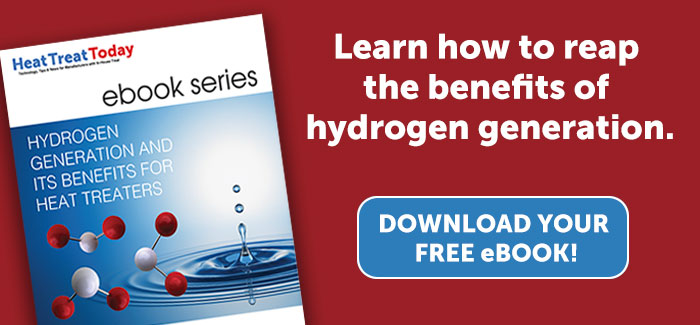
This Heat Treat Radioepisode/transcript is based on the e-book shown above. Click on the image above if you'd like to get your own download of this 18-page e-book.
Doug Glenn (DG): Welcome to part two of this 2-part series on the use of hydrogen in heat treat processes. Today we are wrapping up a conversation we started last time with David Wolff of Nel Hydrogen. This 2-part series is based on the content of an eBook recently published by Heat Treat Today in cooperation with Nel Hydrogen entitled “Hydrogen Generation and its Benefits for Heat Treaters.”
In part one, we discussed some hydrogen fundamentals. Things like what purpose hydrogen plays in the heat treat process. We hit on safety issues, the processes where hydrogen is typically used, and other atmosphere generation systems and how they compare to hydrogen, as well as several other hydrogen basics. In this episode we're going to dig deeper into several topics, including the various delivery systems available, the economics of using hydrogen, and whether or not using hydrogen might make sense for your specific heat treat application.
We're going to get back to our discussion with David Wolff of Nel Hydrogen. Remember, this is part 2. If you'd like to read the transcript or listen to part 1, click here. Now back to the interview.
DG: Let's talk about typical modes of delivery for hydrogen. My understanding is we're talking about bulk delivery from some of your gas companies, generated hydrogen, which, as you mentioned, could be endo or exo, that does produce some percentage of hydrogen, but then also we've got a product that you guys are offering, which is a hydrogen generator. Let's talk about those delivery methods just briefly, maybe summarize them, their advantages/disadvantages, etc.
Delivered atmosphere options
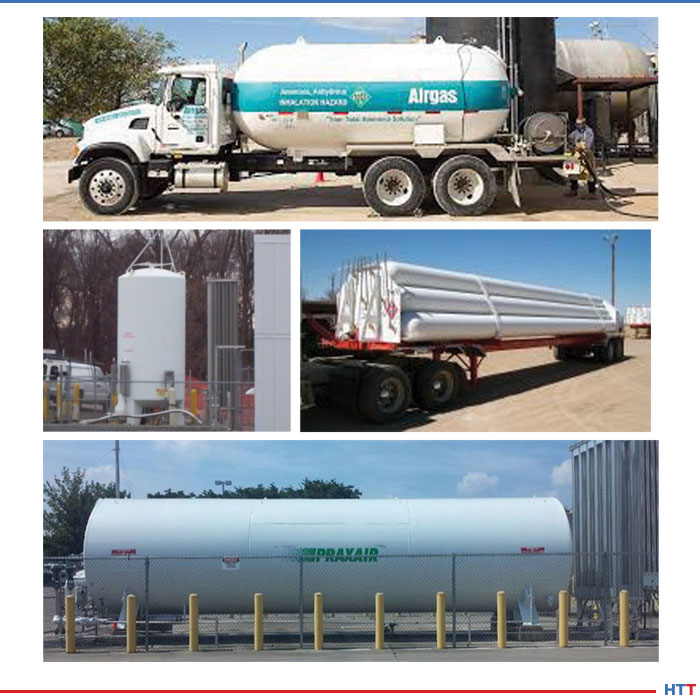
David Wolff (DW): While nitrogen and argon, the diluent gases are available anywhere on earth because they are components in the air, hydrogen is only available by generating it from a hydrogen containing material, such as methane or from water. Delivered hydrogen needs to come from a hydrogen plant that may be hundreds of miles away from any particular customer. In most cases, if you're buying hydrogen, say from an industrial gas provider, that hydrogen has come from a plant where it's made, cleaned, and then packaged or processed in a way for efficient delivery. It might be liquefied or it might be compressed and then it's trucked to thermal processing customers for storage and subsequent use. Your delivered hydrogen is coming from some chemical or other facility, which may be quite far away.
As you mentioned, Doug, the two historically significant sources of generated, what I will call “blended atmospheres,” typically fall under the name "generated atmospheres," and I'll group endo and exo together because they're really made in a very similar way, and then dissociated ammonia. Endo and exo are made by thermally cracking natural gas, which is primarily methane, and endo and exo describe two very similar processes for making an atmosphere which consists of hydrogen, water, carbon monoxide, and carbon dioxide. The ratios of those gases differ whether you're using endo or exo gas, but both gases contain all four-hydrogen, water, CO2, and CO. As long as your process can utilize all four of those gases, then endo and exo are quite economical, particularly today when methane or natural gas is so cheap. You don't have to be that old to remember that natural gas at one time was not so cheap. I remember not so long ago where natural gas was about five times what it costs today. There was a period of time when endo and exo were not attractive in industry because of the cost.
Now ammonia dissociation or DA (dissociated ammonia) has a popular and cost-effective technique for generating a kind of general use furnace atmosphere where you store ammonia and then you use a heated catalytic reactor to crack that ammonia into a gas which is 75% hydrogen balance nitrogen. DA has been used for many, many decades, and in fact there are many methods which have standardized on DA. It is still popular. The challenge with DA is it requires the storage of ammonia, and ammonia is ever more unwelcome in communities because if it leaks, it creates a hazardous material response incident.
DG: You've got storage issues there. It's very obvious when ammonia leaks, you can tell with your nose, it is a harmful gas, so you've got to be very careful with the storage of it. That is the point.
DW: And there is one other issue, and that is if you're using DA, you can't get pure hydrogen. Because you're starting with a gas which is 25% nitrogen, so no matter how much you dilute it by adding pure hydrogen, it is still going to have nitrogen in it. If you want pure hydrogen for the ultimate in flexibility, it can be helpful to generate pure hydrogen.
The final thing you asked me to talk about was the equipment that Nel Hydrogen provides, which is electrolytic on-site generation of pure hydrogen. That has become newly attractive because we've managed to reduce the capital cost of electrolysis equipment and we've managed to improve the energy efficiency, the hydrogen production versus the electricity used. And in an environment where it is harder and harder to store hazardous materials like ammonia or pure hydrogen, it is interesting and attractive to be able to make cost-effective, process pressure, dry, pure hydrogen which you can then custom blend into whatever diluent gas you want, whether it's nitrogen or argon, in the exact ratio needed for your parts.
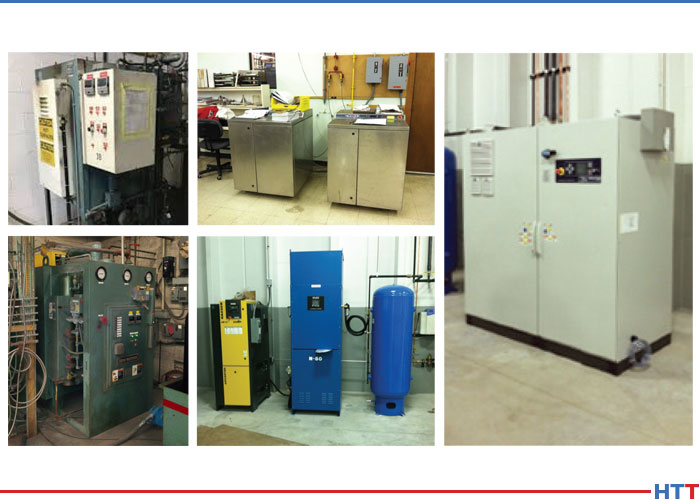
Atmosphere generation systems
DG: Exactly, because you're talking about the endo or exo, you've got a range there of how much hydrogen, or what percentage of hydrogen you can have, whether you run it rich or lean, and things of that sort. With DA (dissociated ammonia), your looking at 75% hydrogen/25% nitrogen, basically very little deviation from that. With a system where you are on-site hydrogen generating, you can dilute it at whatever percentage tickles your fancy.
DW: Exactly. And by definition, the metallurgist will assist you to run the most dilute mixture that meets your metallurgical needs. Because that's how you save the most money, by diluting the hydrogen as much as the metallurgy will allow.
DG: Very briefly, for those who might not know, tell us about the technology inside of your equipment, the proton exchange membrane and things of that sort. Explain how it works, and then I'd like to ask you what kind of capacities can these systems that you supply, how many CFH or however you measure it, how much can you produce for a process.
DW: It is easy to explain because we've all done it in high school chemistry. Virtually every person among us, in high school chemistry, has used a direct current from a battery and two electrodes to crack water with an acid or base in it to make hydrogen and oxygen bubbles. We're doing exactly the same thing, but we're doing it on an industrial level. Our equipment uses an electrolyte, which is made by Dupont, to enable us to crack water into hydrogen and oxygen and maintain the two gases on two different sides of a solid membrane. That has important safety advantages because the hydrogen and oxygen can never mix. We make very pure hydrogen. The only impurity in that hydrogen is water. As manufactured in our equipment, the hydrogen is wet with water. The only purification that we do to that hydrogen is we dry it. And we dry it to the specification for industrial grade either gas or liquid hydrogen. In essence, it is a replacement for gaseous compressed, or liquefied hydrogen, that you might have delivered to your facility.
The raw materials that we require are simply electricity and de-ionized water, and we require also cooling water for some of our larger scale equipment.
DG: The contention is that there are some real potential benefits to some heat treaters by having on-site hydrogen generation. What are the advantages and then, are there some heat treaters who shouldn't even consider using hydrogen?
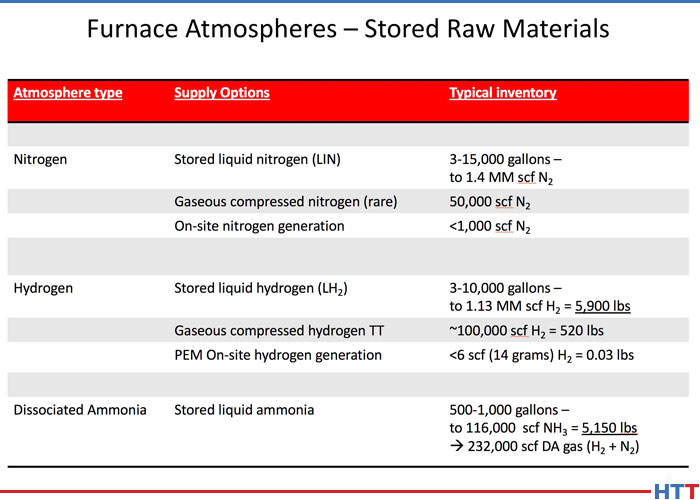
Stored atmosphere raw materials by the numbers
DW: Getting rid of the need for on-site hazardous material storage is a huge benefit. That is a major benefit- zero hazardous materials inventory. Cost predictability is often even more important than having the lowest absolute cost at any point in time. With hydrogen generation, most of the cost is in the capital and in the electricity that you use to drive the equipment. So cost predictability is much better, for example, than with ammonia, natural gas, or with delivered hydrogen.
On-site electrolytic hydrogen generation makes pure hydrogen as compared with exo, endo, or DA. And the hydrogen that you're using is very, very pure. It is 99.9995% or better, so it's the equivalent of very, very pure delivered hydrogen. We provide very dry hydrogen. One of the drawbacks to the generated hydrogen in exo, endo, and DA is that those gases are not as dry, so you often need a higher hydrogen level in order to achieve similar scavenging of oxygen. People find, for example, when they replace DA with generated hydrogen and nitrogen, they can often use a more dilute blend. So rather than having to use 75/25, they might be able to use 50/50, saving money.
Finally, the generated hydrogen from Nel equipment is available at considerable pressure, 200 to as high as 435 Psi. That makes it easier to use a pressure-based blender to selectively blend hydrogen and nitrogen to your desired furnace atmosphere blend.
DG: How big are these systems?
DW: We have equipment anywhere from 4 cubic feet an hour of pure hydrogen up to 19,000 cubic feet/hour of pure hydrogen. The cost of the equipment goes up as you get bigger. I think the 'sweet spot' for generated hydrogen is probably not to try to compete with the largest endo and exo facilities. I think a thermal processor might choose to utilize a generated hydrogen for those materials and processes that require pure hydrogen or a purity of atmosphere unattainable with endo or exo.
Endo and exo are really good technologies and especially today with inexpensive natural gas. If you can use those, God bless you, use them. But if today you're using DA or you're using delivered hydrogen, then I think you might find it very worthwhile to choose a hydrogen generator which might have a capacity of 200 or 400 or 1000 cubic feet an hour for your process. And, in doing so, you might find that, as compared with certainly DA, you can use a leaner blend and save money as well as get better process results.
DG: What are the maintenance issues that we're seeing with on-site generation equipment?
DW: There are two types of normal maintenance required. All of our equipment is designed with internal flammable gas detectors. That's important from a safety point of view. That protects you from any leaks within the equipment, it also protects the facility if there was any flammable gas in the facility atmosphere, the hydrogen generator would shut down. Those internal flammable gas detectors need to be calibrated once every 3 months. The nice thing is that it only takes 15 minutes, but it is a planned, required maintenance operation that must take place every 3 months and takes 15 minutes. And of course, we train you how to do that.
In terms of schedule maintenance of a more involved type, our equipment is designed to be maintained once per year. Again, we train our customers to do that, or we can offer to come in and do it ourselves. It is a kind of maintenance that is very straightforward and can be done by a mechanical or electrical technician. It includes replacing parts, such as the water pump, that have a defined life-time. And we recommend that those parts be replaced on a proactive point of view in order to eliminate nuisance failures. For example, a water pump might last 3 years or 25,000 hours, for example. And really, that's it. Like any process equipment, you can have failures and we have set up a robust service capability so that we can diagnose and get people parts as quickly as possible so that they can keep their equipment running with the highest on-stream time possible. Especially for customers in other countries, we often recommend that they have on-hand a kit of parts that we call 'recommended spares kit', which is a very cost-effective way to have the parts available that we have seen fail in the field, so that they don't have to wait for shipped parts to show up. As soon as a failure is diagnosed, they can put in the parts and they can be right back on-stream and then we can replace any parts that were taken from the recommended spares kit.
DG: I next asked Dave to address the economics of the system. How does on-site hydrogen generation compare to other gas delivery systems?
DW: In terms of economics, the cost of on-site generated hydrogen is really very straightforward. It is the capital cost of the equipment, the cost of the electricity and water inputs and the cost of annual maintenance. The equipment can be a purchase or a lease. And because you're acquiring the equipment, of course there is an economy of scale to consider. Small volumes of hydrogen is smaller equipment. And then, in that case, we find that most people find the generator capital cost for smaller users might be around $2.00/hundred cubic feet. That is the capital cost of the equipment depreciation. As the size of the hydrogen generator increases (that would be tube trailer users or liquid hydrogen users), the capital cost of the equipment drops below $1.00/hundred cubic feet. So as equipment gets bigger, the capital cost per unit of production falls. Our largest capacity equipment, intended for very large scale manufacturing, which might be used, but might be too large for most thermal processors, has a fixed cost as low as 20 cents/hundred cubic feet. So you can see there is economy of scale.
Now the energy cost of the hydrogen is most of the variable cost. Water is almost nothing. Depending on the specific model of the system chosen, it requires between 15 and 19 kilowatt hours of electricity to make a hundred cubic feet of hydrogen. Here in the US, in 2018, the US industrial electrical rate was about .07/kilowatt hour average. So the average in the US in 2018 was 7 cents. If you multiply that by 15 – 19 kilowatt hours/hundred cubic feet, then you get an electric variable cost of between $1.05 and $1.53/hundred cubic feet. So you add that variable cost to the fixed.
Your annual maintenance is somewhere between $2,000 and $5,000. Obviously, that is a bigger hit for the smaller users than your larger users. Altogether, the cost of hydrogen for on-site water electrolysis in the medium volume range of interest to the thermal processing industry ranges from a high, at the low end of the use, of about $4/hundred to as little as $2/hundred for users of larger volumes, say your liquid hydrogen users.
DG: Best candidates for on-site generation and then, are there some people who shouldn't?
DW: The best candidates for on-site hydrogen generation are those for whom the technique, equipment, and product quality, the hydrogen quality, provide competitive advantage. So very compact equipment, zero hydrogen inventory, very pure hydrogen with relatively low maintenance, highly predictable costs and the ability to blend any hydrogen atmosphere to pure hydrogen down to forming gas, are all advantages of on-site electrolysis hydrogen.
We observe that captive heat treating operations often prioritize the characteristics of on-site hydrogen generation because they see a direct effect on product quality and ease of integrating heat treating processes into their facility. So they are more interested in- is it safe, is it pure, is it easy to operate than is it the cheapest possible hydrogen. Because of the capital cost (this equipment is not cheap), the best candidates for on-site hydrogen are going to use the equipment hard. The closer to 24/7, the less expensive, the capital cost contribution to your cost structure. So use it hard.
There are a few usage characteristics that argue against on-site hydrogen and similarly would make endo, exo, or DA less attractive. If you've got a temporary requirement for hydrogen, or a batch process that occurs irregularly or with long time gaps between batches, or you have a portable requirement, or where your actual atmosphere required might still be under development. In all of those cases, frankly, you'd be better to start out with delivered gases, at least until you understand the requirements of the process and the scheduling for the gas use until you establish a predictable pattern.
Finally, endo, exo, and DA are really good technologies to make a hydrogen containing atmosphere. If the cost of the atmosphere is the most important factor and the safety issues of ammonia storage and CO containing atmospheres are acceptable, and the characteristics of the exo, endo, or DA atmosphere are acceptable to your processes, then those may be a good choice.
Doug Glenn, Heat Treat Today publisher and Heat Treat Radiohost.
End of Part 2.
Part 1 of this two-part series aired on January 30, 2020. To find that episode, click here. To find other episodes, go to www.heattreattoday.com/radio and look in the list of Heat Treat Radio episodes listed.
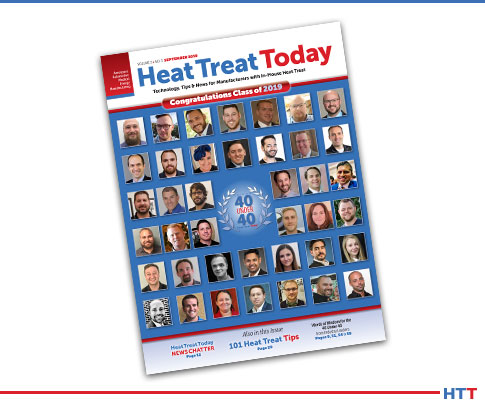
Heat Treat Today is privileged to oversee the 40 Under 40 recognition awards highlighting a group of young, up-and-coming talent in the North American heat treat industry every year. This year’s Class of 2019 is no disappointment–a group of industry elite, significant contributors to the heat treat market.
Every couple of weeks we highlight two of the current class of recipients. This week we introduce Ben Gasbarre of Gasbarre Thermal Processing Systems and Brinson White of Pelican Wire.
Name: Ben Gasbarre Company: Gasbarre Thermal Processing Systems Position: President
Ben has worked his way up through his family’s company which was founded by his grandfather and father. He earned a Bachelor of Science in Operational Management and Supervision from Penn State University and is currently working toward an MBA from the University of Michigan which he expects to finish by the end of this year. Ben is currently on the Industrial Heating Executive Committee and is a graduate of MTI’s YES Management Training Program. His roles at the company included Manufacturing Manager at Sinterite and C. I. Hayes. Soon after the acquisition of J. L. Becker, he moved to Plymouth, Michigan, where he was initially Manufacturing Manager, promoted to General Manager, and is currently the President of what is now Industrial Furnace Systems, a Division of Gasbarre Thermal Processing Systems, which continues to service and support J. L. Becker brand equipment. Ben has been instrumental in hiring personnel, managing the company (sales, engineering, manufacturing and service), improving project management, and enabling product development including IFS’s new vacuum purge nitriding furnace.
Nominated by: Gasbarre Thermal Processing Systems
Name: Brinson White Company: Pelican Wire Position: Director of Engineering
Brinson is responsible for the custom design and development and installation of custom manufacturing equipment, processes, and software which benefit the entire heat treat industry through improved products and performance. Brinson’s expertise in developing the tools necessary for these fine-gauge, high-temp solutions has served over 250 customers and end-users with improved products and technical expertise.
Nominated by: Pelican Wire
Read more about the feature at Heat Treat Today’s 40 Under 40 resource page and find out more about each of this year’s winners by clicking on their image. To nominate someone for the Class of 2020 40 Under 40, please click here.
A small magnetic rose sitting between two copper coils in an Ohio State laboratory gives a demonstration of a new shape-shifting magnetic material developed by Ohio State researchers that will be used in biomedical devices, antennas, artificial muscles and robotics. The material can squeeze and grab objects and change its shape and temperature when electromagnetic fields are applied, according to the research paper published in December in the journal Advanced Materials.
Ruike Zhao, an author of the paper and assistant professor in the mechanical and aerospace engineering department, said the researchers embedded two types of magnetic particles into a soft material called a shape-memory polymer. At room temperature, the soft material is rigid, like acrylic. But when it comes within a magnetic field, the iron oxide particles heat up, softening the material so it’s like rubber, through a process called induction heating — the same technology used in some home cooktops.
Riuke Zhao, Assistant Professor in Dept. of Mechanical and Aerospace Engineering, The Ohio State University
Previous generations of soft materials needed a constant supply of energy, Zhao said.
“Once we deformed the [earlier] material, if we wanted to lock its deformed shape, we have to keep the external stimulation, which is not energy efficient.” She added that Ohio State’s new material is more efficient and can lift an object 1,000 times its own weight.
Liang Guo, Assistant Professor in the Electrical and Computer Engineering Department, The Ohio State University
According to Liang Guo, an assistant professor in the electrical and computer engineering department, soft materials have existed for several decades. However, this new type of soft material with embedded magnetic particles is the first to be controlled wirelessly by magnetic fields. Guo stated that soft devices cause less stress on the surrounding skin and muscle tissues than similar mechanical devices. They also require less energy than similar mechanical devices.
Guo and Zhao previously worked together to create an insulin pump using soft materials that is one-third the size of current battery-powered pumps. The Ohio State team worked with researchers at the Georgia Institute of Technology to develop the polymer material.
Titanium is a crucial component in aerospace and defense applications as well as in the biomedical field. The high ratio of strength to density of titanium and its alloys mean that it is as strong as some steels, but with a fraction of the density. However, titanium is more difficult than steel to prepare as a metallographic sample due to its ductile nature that renders it easily susceptible to damage.
In this HTTBest of the Web Technical Tuesday feature, Buehler’s Tech Notes explores efficient preparation of titanium grade 2 samples.
An excerpt: “Titanium and its alloys’ high strength to density ratio and good corrosion resistance make them invaluable in aerospace, defense, and marine applications. Good biocompatibility also makes it quite useful in biomedical applications. It is as strong as some steels but a fraction of steel’s density. When preparing metallographic samples, one quickly learns, titanium is more difficult to prepare than steel as it ductile and readily damaged, but also has a relatively slow material removal or recovery rate, which poses a challenge to sample preparation.”
Buehler takes readers through the methods of sectioning, mounting, grinding and polishing, and etching when preparing grade 2 titanium for a sample.
One of the great benefits of a community of heat treaters is the opportunity to challenge old habits and look at new ways of doing things. Heat Treat Today’s101 Heat TreatTipsis another opportunity to learn the tips, tricks, and hacks shared by some of the industry’s foremost experts.
Today’s tips come to us from Safety Consultant Rick Kaletsky, covering Shop Safety. These include advice on accurately labeling containers to match what is listed on safety data sheets, equipping eye fountains and deluge showers with audio and visual alarms, and updating missing or damaged bezels on gauges.
Unclear labeling of chemical materials creates a hazardous situation.
Container Clarity Counts!
Assure that container label wording (specifically for identifying chemical contents) matches the corresponding safety data sheets (SDS). Obvious? I have seen situations where the label wording was legible and accurate and there was a matching safety data sheet for the contents, but there was still a problem. The SDS could not be readily located, as it was filed under a chemical synonym, or it was filed under a chemical name, whereas the container displayed a brand name. A few companies label each container with (for instance) a bold number that is set within a large, colored dot. The number refers to the exact corresponding SDS.
Heat Treat Tip #60
Emergency eye fountains are critical, but human assistance goes far.
Alarm Your Eye Fountains & Deluge Showers
For emergency eye fountains and deluge showers, I recommend that each plumbed unit be equipped with an audio and visual alarm on a spring-loaded bypass. The purpose of the alarm is to alert others of the emergency. It is important that employees promptly respond to assist the employee who has been sprayed, splashed, or otherwise contacted by the dangerous substances. The bypass allows employees to easily test the units without setting off the alarm. If there is no bypass, employees might be reluctant to conduct the test, feeling it takes too much effort to alert all relevant persons that there is a test. As a result, an inadequacy of the flushing system could go undetected. With the bypass on a spring-loaded system, the person who conducts the test cannot fail to reset the alarm; it is reset automatically.
Heat Treat Tip #81
Gauge Those Gauges
It is quite common, in my experience during inspections, to find gauges that are missing bezels or have severely broken bezels. This can be a hazard if the stylus or general mechanism is damaged. I have found stuck styluses. A false reading may be given. Such a reading may result (for example) in an employee boosting air pressure, or the level of liquid in a tank or a temperature, far beyond the safe limit. I have also noted gauges where the stylus had been broken-off, and an employee merely made an assumption of what the proper “numbers” were. When conducting preventive maintenance tasks, check those gauges and replace missing or damaged bezels.
NASA Glenn Research Laboratory in Cleveland, Ohio, has partnered with Boeing to test how shape-memory alloys can be used in deployable vortex generators (VGs), the tiny fins on airplane wings that help control airflow during flight. Currently most VGs on airplanes are static. They are fixed devices always present to improve performance during takeoff, landing, and irregular conditions.
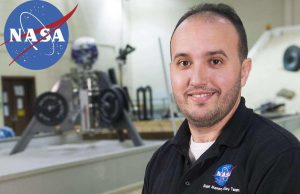
Materials Research Engineer and ASM International’s SMST Society President Dr. Othmane Benafan is part of the team at Glenn developing the shape-memory alloy parts. The alloy pieces are small metal rods that are inserted along the hinge line of a VG where it connects to the aircraft wing. The shape-memory alloy twists as it cools off, which pulls the fin down to lie flat against the wing. Then as the aircraft moves into warmer conditions, the alloy retracts to its original shape, lifting the fin into an upright position.
Dr. Othmane Benafan, Materials Research Engineer, Glenn Research Team
“There are no heaters, no coolers,” says Dr. Benafan. “The alloys are tuned exactly to environmental temperatures. They sense, and then they do their thing.”
Innovations with shape-memory alloys allow development of VGs that move when they sense a change in the environment, which will make future airplanes capable of adjusting in response to changes in temperature, altitude, and airspeed, just like birds.
Photo Credit for Dr. Benafan’s picture: the Moroccan Times
The Airbus BelugaXL transport aircraft has entered swimmingly into service. The manufacturer noted the new jet is the first of six planned BelugaXL aircraft providing 30% more transport capacity. This whale-like transport is 63 meters long and 8 meters wide and claims to have the largest cargo bay cross-section of any existing cargo aircraft in the world.
The new aircraft has a maximum payload of 51 metric tons, and a range of 4,000 km (2200 nautical miles) and made its first flight in mid-January. It is based on an A330-200 freighter and is powered by two Rolls-Royce Trent 700 engines. This internal aircraft program was awarded Type Certification by the European Aviation Safety Agency (EASA) in November 2019, following an intensive flight-test campaign.
Airbus plans to introduce five additional BelugaXL aircraft between 2020 and 2023.









 Name: Ben Gasbarre