


FEATURED NEWS

Tool Steel Manufacturer Amps Up With 2 Box Furnaces

HTD Size-PR LogoA manufacturer of saw blades and tool steels will amp up its heat treating capabilities with two floor-standing box furnaces. The new furnaces will be used for stress relieving and tempering large steel castings.

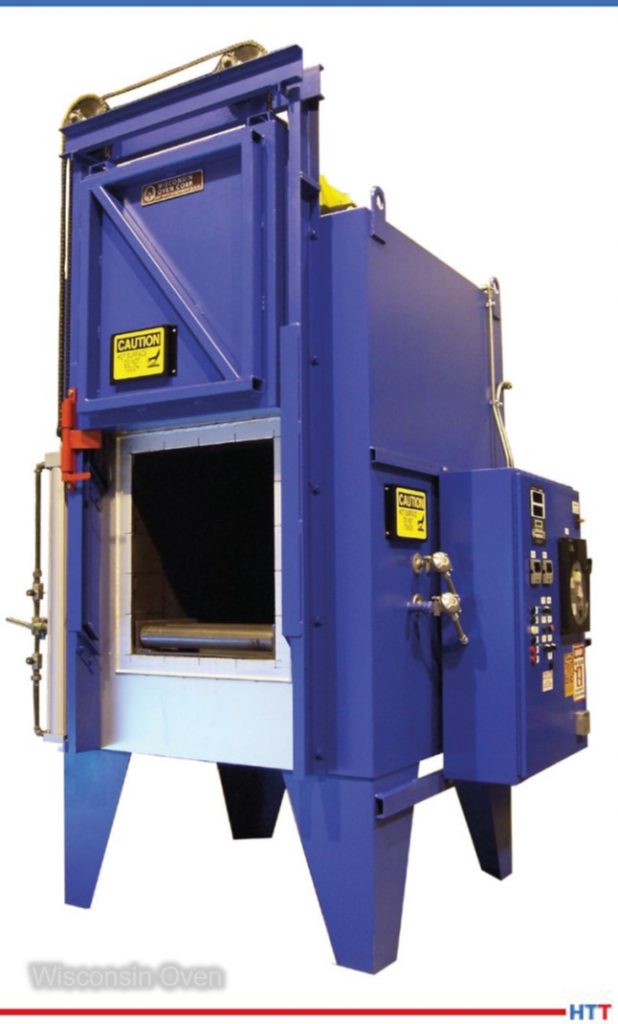
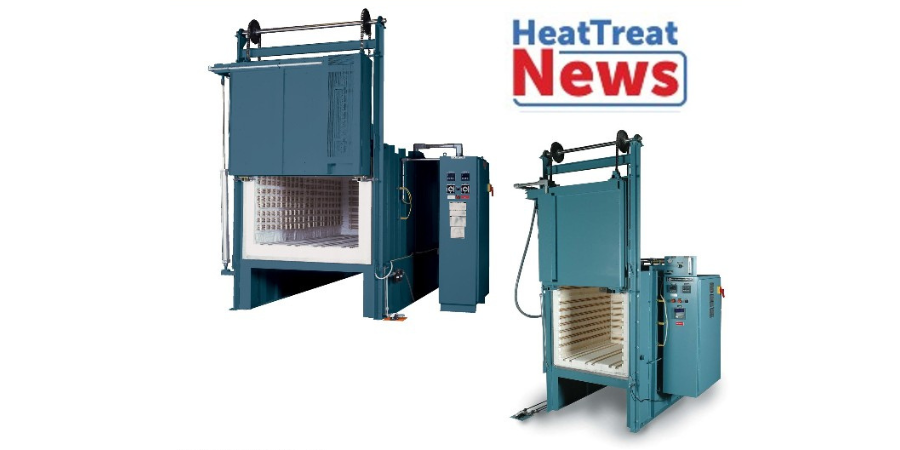
L&L Special Furnace Co., Inc. will deliver the model XLE3648 furnace with an electric vertical door, an alloy hearth, and a complete control system. This model has an effective work zone of 34" x 34" x 44" and will be used for heat treating various tool steels for saw blades. The model FB336, with an effective work zone of 36" x 36" x 72", is fiber-lined and will be used to temper and stress relieve steel castings.


Find heat treating products and services when you search on Heat Treat Buyers Guide.com


Tool Steel Manufacturer Amps Up With 2 Box Furnaces Read More »

Heat Treat Radio #74: Water in Your Quench with Greg Steiger, Idemitsu

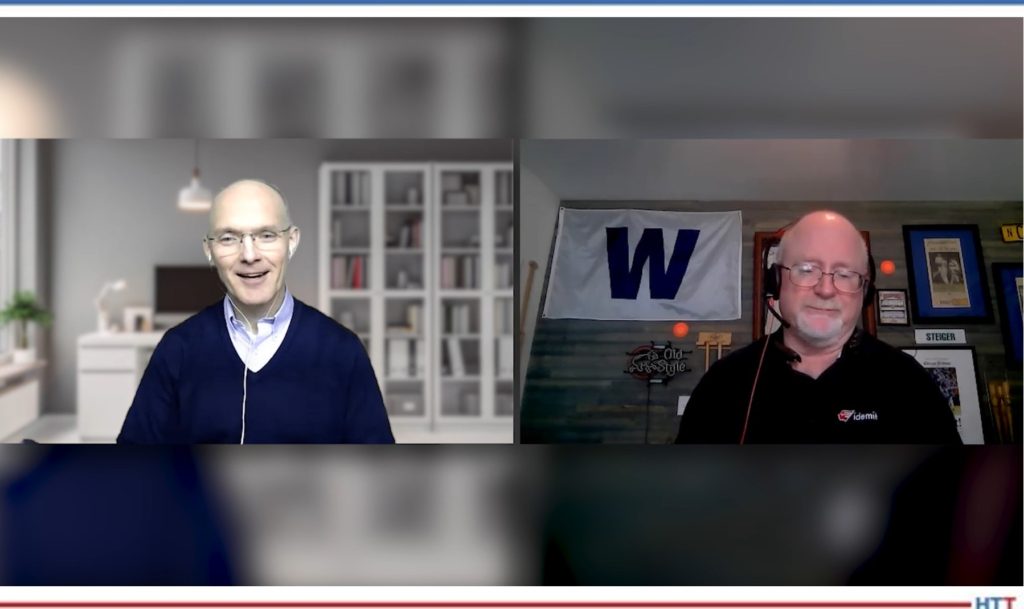
Heat Treat Radio host, Doug Glenn, talks with Greg Steiger of Idemitsu Lubricants America Corp. about the causes and dangers of water in your quench tank, how to know if you have too much, and what to do about it if you do. This highly-informative episode is a must watch/listen for those who oil quench.

Below, you can watch the video, listen to the podcast by clicking on the audio play button, or read an edited transcript.


The following transcript has been edited for your reading enjoyment.

Doug Glenn (DG):  Greg, welcome to Heat Treat Radio. This is the first time you’ve been on, and I know we’ve talked about doing this for quite a while, so, welcome!

Greg Steiger (GS):  Thank you, it’s my pleasure.

DG: I asked the question, before we hit the record button, but I think we need to ask the question again:  The big white flag in the background with the W, you need to tell us about that.

GS:  That’s the flag that they fly outside of Wrigley Field every time the Cubs win. They’ve been doing this for almost a century so that way when they were only playing day baseball and you could come home on the L, you could see if the Cubs won or lost without looking at a box score.

DG:  That’s great! Now, you are not in the Chicago area, are you?

GS:  No, I’m in the Columbia, SC area, but I was born and raised in the Chicago area.

DG:  So, you’re a Cubby fan.

GS:  I am.

DG:  Being from Pittsburgh, I forgive you for that.

So, Greg, first thing, can you give our listeners and viewers a brief background about yourself and then we’ll jump into the water topic, so to speak?

GS:  Sure. I got into this industry when I graduated from college in 1984 as a formulating chemist. I eventually worked my way into, what we call, customer service or tech service, where I’d go out and visit customers, run product trials if customers had problems. I worked my way into laboratory management and eventually sales and marketing. I’ve been at Idemitsu for the past 9 years. Since I’ve been at Idemitsu, I’ve earned a master’s degree in materials engineering, and I’ve learned a lot about heat treat and it’s really become my passion. I am currently the market segment leader for heat treat products for Idemitsu.

DG:  I should congratulate you on that degree, by the way. I know a year or so ago, you were still working on that, so that’s great!

GS:  May 6th I graduate.

DG:  Tell us, just briefly, for those who might not know about Idemitsu. We can see it on your shirt but tell us about them a little bit, so people have a sense.

GS:  Idemitsu is a very well-kept secret here in the U.S. They are actually the 8th largest oil company in the world. We are a Japanese owned company. There is about an 85-90% chance that no matter what vehicle you drive, you’ve got some of our fluids in it. The largest market share is the automotive air conditioning compressor market, but basically, if you drive a Honda, Mazda, Subaru, or Toyota, it left the plant with our engine oils, our transmission fluids in it at the factory.

When it comes to quench oils on the industrial side, Idemitsu is actually the 2nd largest quench oil provider in the world. Even though we’re Japanese, all of our heat products, in general, are made and blended here in the U.S.; we don’t import anything from Japan for our heat treat products.

DG:  Very interesting. So, a big company — somebody worth paying attention to, I think is the point. You’re right — it’s the best kept secret. We’re trying to work to not make it so secret.

GS:  We’re doing what we can, Doug.

DG:  This next question I’m going to ask you is very, very basic and most people listening I’m sure will know this but there may be some who don’t: Why is water in quench oil a problem?

GS:  A little bit of water is not a problem because it will happen naturally through condensation, but when you start to get too much water in there, a couple of things happen. Our research has shown that basically about 200-250 ppm water, you start to get uneven cooling.

A quench oil is not a completely homogenous fluid; it’s possible to have water in one area of the tank and no water in the other so you can get different cooling speeds in different areas of the tank. When you start getting up to large amounts of water, somewhere around 750 ppm to over 1000 ppm, it becomes a safety issue. What happens is — when water turns into steam, it actually expands. Most things when they get warmer, they contract, but water is the opposite — it expands. It expands 1600 times at boiling and the hotter the steam gets, the more it expands.

"A little bit of water is not a problem because it will happen naturally through condensation, but when you start to get too much water in there, a couple of things happen. Our research has shown that basically about 200-250 ppm water, you start to get uneven cooling."

Think of it: If you have a gallon of water in a 3,000-gallon quench tank, when you boil that water, it turns into 1600 gallons of steam, and it’s got nowhere to go but up and out of the quench oil and it’s going to carry the quench oil with it onto flame curtains, other hotspots on the furnace, and that’s why it becomes so dangerous.

DG:  It’s really the risk of explosion, in a sense. That’s basically what we’re talking about. I could be wrong, but my gut feeling is that a vast majority of quench fires are started because of water that happened or simply the product not getting down into the quench fast enough. But a lot of it is caused by carrying water in with the part.

GS:  Not necessarily on the part but being in the oil itself through various means. As I said, it happens naturally every time you heat an oil up and you cool it down, you get condensation, but that’s usually only a few parts per million, and every time you drop a load in, you’re driving that water off.

DG:  Right. Raising up the temperature and therefore boiling off the water.

GS:  Right.

DG:  This is a follow-up question into what we were just talking about, and maybe we’ve answered it:  Where does the water come from? Is it typically just condensation or what are the top ways water gets into the tank?

GS:  Condensation is something we can’t prevent because we live in a hot, humid environment. But what we can prevent is human error, and that’s where most of the water comes from. For instance, if a heat treater has their quench oil stored outside, perhaps in totes — it’s particularly important to make sure that the caps and lids on these totes or drums are very tight and secure because otherwise they’ll get condensation in there and rainwater in there.

We’ve seen instances where people are working on a furnace, and they will hit the sprinkles and the sprinklers will set off and put water into the quench oil. Heat treat furnace doors and, not so much anymore but, heat exchanges where water cooled. Anything that is under pressure is eventually going to leak and that’s why you see companies going to air-cooled heat exchangers. It’s still more difficult to get that air-cooled door and there is still some water in those doors. Like I say, anything under pressure is eventually going to leak and that’s where you see some of the water infiltration, as well.

DG:  Typically speaking, how warm or how cool is the oil in a quench tank? You mentioned about condensation being caused by when it cools down, you’re going to have some condensation in there. Where do we run those tanks?

GS:  It depends on if you’re using a hot oil or a cold oil. A cold oil is basically an oil that you add some heat to get it around 130-160 F, then you use your heat exchangers to keep taking the heat away when you quench the load in there. A hot oil you add heat to constantly because you want to keep that typically 250-300 F. In a hot oil, you really don’t have a lot of issues with water, unless the furnace goes down and then you get a lot more condensation than anything else. Now, cold oil, you have issues with water because you’re not above the evaporation point of the water.

DG:  The bottom line is: If you’ve got too much water in the quench tank, it’s an issue.

Tell us about the measurement. How do we know if we’ve got water in there, and how do we know how much we have?

GS:  Well, there are some portable test kits out there. The ones I’m familiar with are made by the Hach Company. You can purchase these from industrial supply houses like McMaster-Carr or places like that. They will give you ppm’s of water.

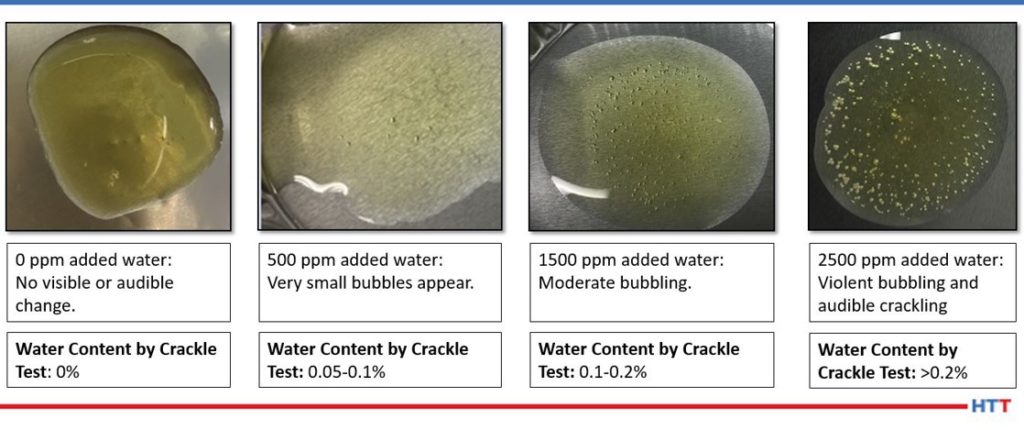
You heard a lot of old-timers always talk about crackle tests. That is not an effective way to determine how much water is in there. Our studies have shown that you can get as much as 1000-1500 ppm of water before that oil starts to crackle. The way you run a crackle test is — you take a hot panel, (that’s hotter than the boiling point of water), put a couple of drops of oil on it and if it crackles, there is water in there. Sometimes, the oil is so thick, it doesn’t really crackle, and you can’t see it until you get too much water in there.

The way all quench oil providers do it in their lab is something called a Karl Fischer titration. This is not something that the typical heat treater would have in their lab — it’s a relatively expensive piece of equipment. We use automated ones because we do so many at a time, but you can buy manual ones, if you’d like, and those are a little bit less expensive, but again, you’re talking about laboratory equipment and you’re talking about thousands of dollars instead of hundreds of dollars.

Another way to determine if you have water in your quench oil, especially on lighter colored quench oils, is to take a flashlight, put it in a clear beaker, and take a flashlight and put that flashlight at the bottom of the beaker. If nothing in that beaker is hazy and everything is very clear and amber and you can see through it, chances are there is no water in it. But if it’s a dark quench oil, like a lot of cold oils are where it’s almost jet black, the flashlight won’t do you any good.

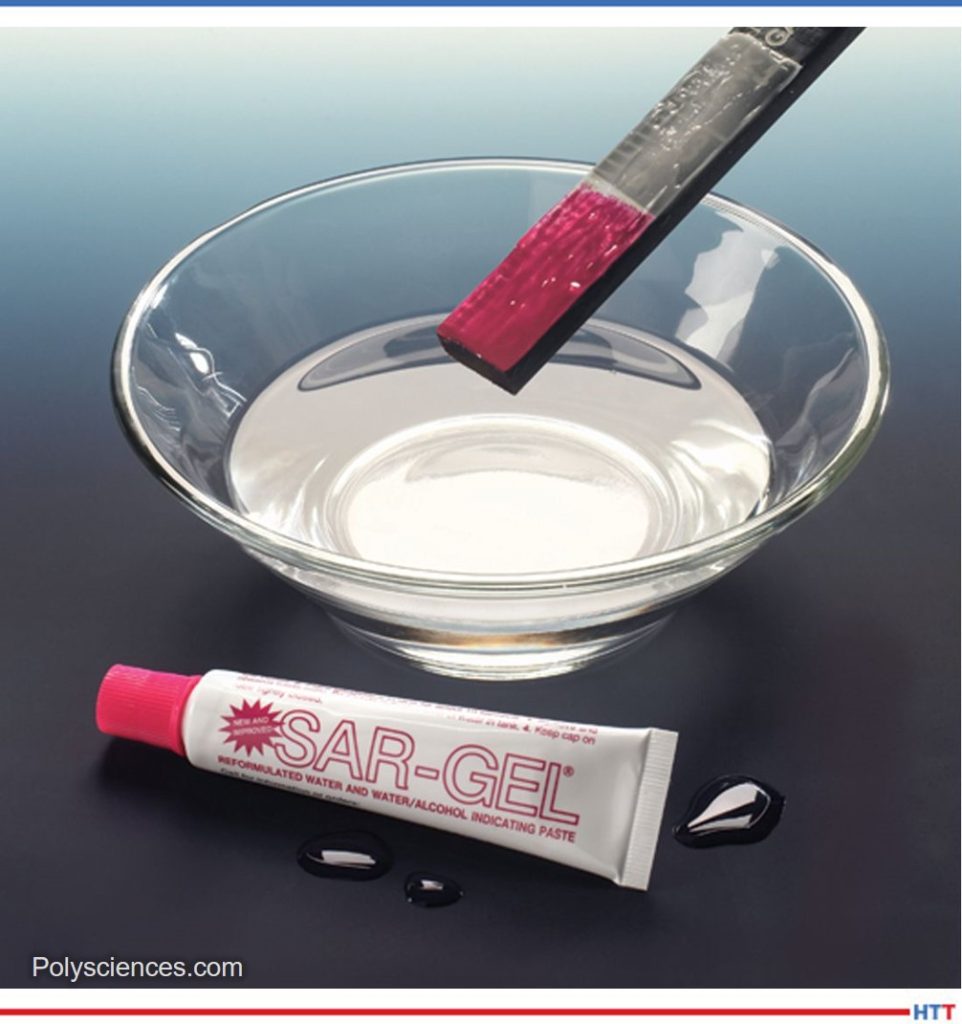
One of our customers has talked about using a paste. Unfortunately, I don’t know the manufacturer of it, but what he did is he took a paste and put it on a wooden stick and stirred it all throughout its tank. The paste didn’t turn colors, so he knew there was no water in it. To prove that the paste was still good, he actually licked a finger and put it onto the paste and the past turned pink.

DG:  This paste that you put on the stick, it doesn’t dissolve into the liquid — it’s just testing whether there is water there. And if it changes color, then you’ve got water. We’ll have to find out what that is and maybe we can put a note about that on the screen.

DG:  Probably the best, most reasonable method that doesn’t cost so much, is maybe getting one of those testing kits. Do you have suggestions, Greg, on how frequently a heat treater ought to be checking his or her tank for water?

GS:  I would say weekly. I don’t think it needs to be tested any more unless you think there’s a problem. If there’s a problem, obviously, test as often as you need to. But weekly is good enough.

Again, when you’re dropping a load into quench oil, you’re anywhere from 1300-1800 F, so when you drop that load in, you’re driving almost all of the water off that would be in the quench oil from condensation. It’s just if you’re worried about some sort of a human error, that’s when you want to take more frequent testing.

DG:  So, it’s going to be somewhat dependent on your process.

How about the material that you are quenching? Are some materials more sensitive to water than others, or is not really an issue?

GS:  Not really. It’s more of an issue of part geometry. And that goes really for distortion and cracking along with the water. A little bit of water can crack a very thin part, but on a very thick part, it may not have much effect at all.

DG:  How about cosmetics? I know that some people are very concerned with cosmetics. Is water in the quench oil going to cause any issue with cosmetics, such as spotting?

GS:  Short-term no, long-term yes. What causes a lot of stains is oxidation. Water, when it heats up, will actually dissociate into hydrogen and oxygen. The hydrogen won’t oxidize the oil, but the oxygen does. That’s one of the reasons why heat treaters use flame curtains — not to allow the oxygen from the atmosphere into the furnace. At the temperatures that you heat treat at, it doesn’t take much oxygen presence to oxidize not only the parts, but also the oil.

DG:  We talked briefly about why water is a problem. We talked about measuring it and trying to determine if you have an issue. Let’s move on to this: Ok, we’ve got water in the quench and it’s at an unacceptable level. What do we do?

GS:  There are a few ways to do it. It really depends on what level of water you’re at, how safe you feel, and how soon do you need that furnace. Many furnaces have a bottom drain. If you turn the agitation off in the quench oil, the water is going to be heavier and denser than the oil and it will sink to the bottom. This is going to take a couple of days, at least. If you’re looking at 1000 ppm or so, this is probably the best way to do it, because then you can drain from the bottom of the tank until you no longer see water coming off and you see oil.

Let’s say you’ve got 500 ppm or 400. We recommend an upper limit of 200. For that you can run some scrap through your furnace. Again, you have to be incredibly careful because you’re not really at what would be an explosive level, but you don’t want to run good parts through there because you may get some strange hardness results — they may be higher in hardness than what you’re expecting.

Another way, (again, this will take some time), is to actually bring the temperature of your oil above the boiling point of water. If you brought it up to about 220 degrees or so, as the oil starts to evaporate, you will see bubbles and a froth (almost like a head you would see on a beer) come to the top of the oil tank. Once that’s gone, chances are your water is gone.

The last thing you can do is do a complete dump, drain, and recharge. But I would caution anybody who suspects that they have water in their quench oil, and you want to do any of this testing — before you run any loads through that furnace (with good parts), make sure you send a sample overnight to your quench oil provider and they can test it for you. That’s the biggest issue.

DG:  I want to back up because you said something that I didn’t catch the fullness of, I don’t think. You said one of the solutions was to simply run scrap parts through your furnace?

GS:  Yes.

DG:  Now, how does that help you eliminate the water?

GS:  Again, you’re taking these scrap parts and they come through your furnace and the furnace may be 1800-2200 degrees. When you dump that load into the quench, if you’ve got just a small amount of excess water, it will evaporate off.

DG:  Gotcha. You’re basically bringing up the temperature of the oil so that the water evaporates.

GS:  Exactly. You’re almost flashing it off.

DG:  We talked about the draining and the replacing. I know of some companies recycle their oil. Any thoughts or comments about that that heat treaters ought to be aware?

GS:  Yes, because that’s also a potential source of contamination for water because they skim the oil off of their cleaner tanks. I’ve been at a lot of heat treaters where they have these reclamation systems — they heat the oil up, theoretically they drive all the water off, but not always. Again, this is part of that human error. As a quench oil company, we understand that our customers are doing this, especially with oil continuing to go up. But, again, working with your quench oil supplier here is key because we’ll analyze the samples for our customers and tell them if they’re getting all that water off. Obviously, it’s in the quench oil supplier’s best interest, and the customer’s best interest, to make sure everybody is safe. If a plant burns down, nobody wins.

DG:  We’ve discussed why water is a problem, how we measure it to make sure we know it, and then what to do with it. Being a quench expert, do you have any other resources, if someone was interested in learning more, whether it be specifically about water in quench oil or just other quench resources — is there anything that you can recommend for further reading?

GS:  I wrote a series of articles on quench oil and how to get water out of the quench oil for your publication Heat Treat Today. Also, how to use your analysis from your quench oil supplier to operate your furnace. You should always let the data tell you how to operate a furnace and not do something just because we’ve always done it this way.

Others, such as Scott Mackenzie, have presented papers. I know back in 2018, there was a conference Thermal Processing in Motion by ASM, and he presented a paper there on how to get rid of water out of quench oil.

DG:  Any other resources you’d like to recommend to people?

GS:  Use your quench oil supplier. They are the experts. They’re the ones that have all of the testing equipment you need and use them as a resource. Quite frankly, if you don’t get the service from your current quench oil supplier, there are a bunch of us out there, and that’s how we distinguish ourselves — through our service — so find somebody with better service.

DG:  There are a number of quench oil suppliers out there. I know some of them are not specifically targeting the heat treat market, but people still use them because they’re a local distributor or something like that.

I want to recommend to people that if you’re having trouble with the processing of parts, whether it be the mechanical properties and things of that sort, and you have a hint that it might be quench-related, it’s probably best to get ahold of people like Greg, who are actually focused in more on the heat treat market. They may have some good recommendations. This is just an encouragement to people that if you’re not using a heat treat specific quench company, there are a couple of them out there and, obviously, Greg at Idemitsu, we appreciate you giving us a little bit of expertise today.

Thanks very much, Greg. Appreciate it very much and appreciate you being with us.

GS:  Thanks for your time, Doug. I appreciate the opportunity.

For more information:

Greg's phone: 919-935-9910.

Greg's email: gsteiger.9910@idemitsu.com

Doug Glenn <br> Publisher <br> Heat Treat Today

Doug Glenn
Publisher
Heat Treat Today


To find other Heat Treat Radio episodes, go to www.heattreattoday.com/radio and look in the list of Heat Treat Radio episodes listed.


Find heat treating products and services when you search on Heat Treat Buyers Guide.com


Heat Treat Radio #74: Water in Your Quench with Greg Steiger, Idemitsu Read More »

7th Heat Treat System for Automotive OEM

Peter Zawistowski
Managing Director
SECO/VACUUM TECHNOLOGIES, USA
Source: secowarwick.com

A global automotive components manufacturer is expecting a high pressure quench horizontal vacuum furnace from a North American-based vacuum furnace supplier for annealing fuel injector components.

With a chamber size of 36" x 36" x 48" and a load capacity of 3,300 lbs., the SECO/VACUUM Vector® vacuum furnace will be the seventh vacuum heat treating system delivered to the automotive OEM. The furnace includes a battery-operated electric loader and SECO/VACUUM's SCADA system. "Once again," Peter Zawistowski, managing director of SECO/VACUUM, says, "we have been rewarded for a good track record of performance and service support by this international automotive and machine tools components manufacturer."


Find heat treating products and services when you search on Heat Treat Buyers Guide.com


7th Heat Treat System for Automotive OEM Read More »

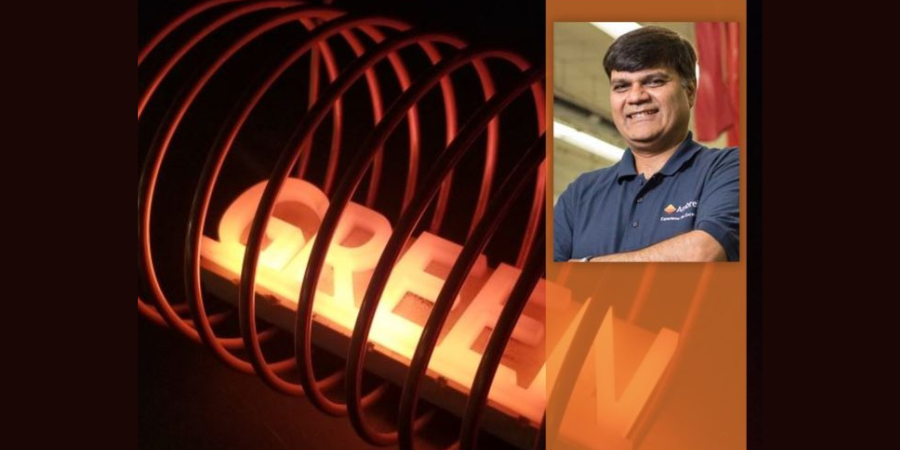
Why Induction Heating Is a Green Technology

OCIt seems like the world is going green! Induction heating is in the game with its green technology. It does not consume fossil fuels, nor does it produce any hazardous emissions or carbon dioxide (CO2). When compared to gas heating, induction offers a safer, cleaner, and more comfortable work environment. In this comprehensive article by Girish Dahake, Ph.D., senior vice president of Global Applications at Ambrell Corporation, discover more green benefits of induction heating that could make a difference for your business.

This Technical Tuesday article first appeared in Heat Treat Today’s May 2022 Induction Heating print edition.


Girish Dahake, Ph.D.
Senior Vice President, Global Applications
Ambrell Corporation

What Is Induction Heating?

Induction heating is a fast, efficient, precise, repeatable, non-contact method for heating metals or other electrically conductive materials.

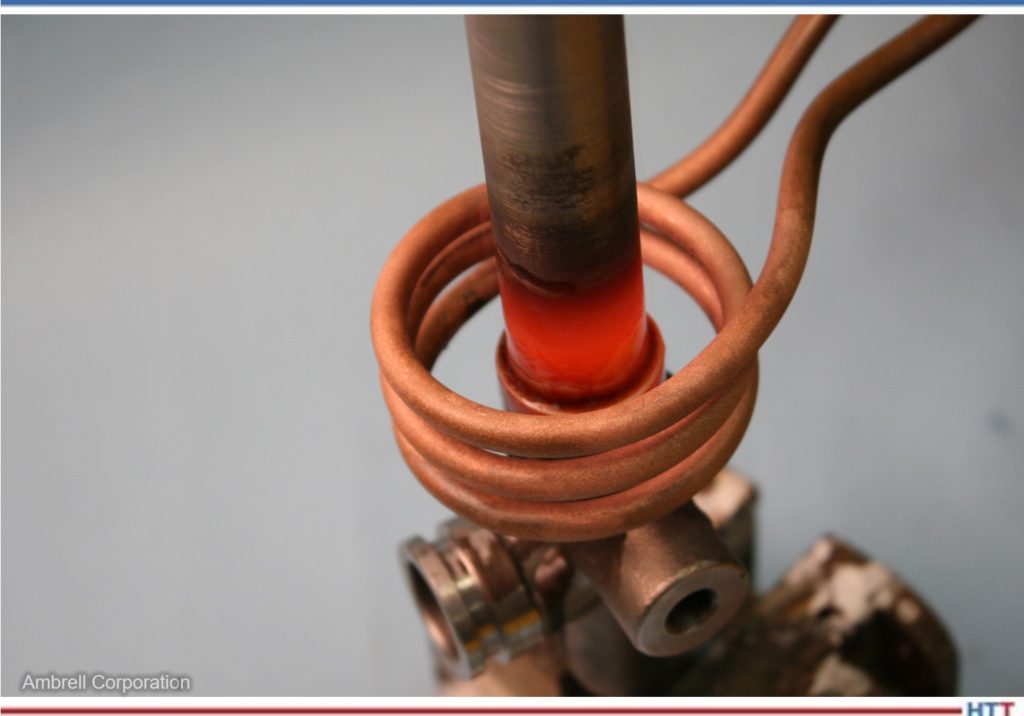
An induction heating system includes a power supply which converts line power to an alternating current. This current is delivered to a workhead and work coil creating an electromagnetic field within the coil. The workpiece is placed in the coil where this field induces a current, generating heat in the workpiece. The water-cooled coil is cool to the touch and is placed around or adjacent to the work piece. It does not touch the workpiece and heat is generated by the induced current flowing in the workpiece.

The workpiece can be a metal such as steel, copper, aluminum or brass, or a semiconductor such as carbon, graphite, or silicon carbide. Nonconductive materials such as plastics or glass are inductively heated using an electrically conductive susceptor, typically graphite.

Steel tube assembly
Photo Source: Ambrell Corporation

What Makes Induction Heating Green?

Along with the many environmental benefits, induction heating offers numerous benefits to employees and the organization using the technology. It eliminates smoke, waste heat, noxious emissions, and loud noise.

Many processes that produce emissions can be converted to induction heating including:

  • Flame preheating
  • Flame brazing
  • Flame melting
  • Flame hardening
  • Flame shrink fitting
  • Gas fired oven heating
  • Welding torches (for joining)

Along with improved air quality, there are several other safety benefits. They include:

  • Reduction in risk of contact burns: Since induction heats only a zone of the workpiece, there are limited hot areas which lessens the risk of employee contact. This significantly reduces the risk of contact burns when compared to the outside of gas-heated ovens or exhaust systems.
  • Zero explosive gases: Induction uses electricity for the energy source. This eliminates the handling of high-pressure explosive gases. Often these gases are transported in a hot crowded environment which increases the risk of catastrophic failure
  • No ultraviolet (UV) exposure: Unlike flame heating, induction releases no UV into the environment. This eliminates the risk of UV damage that can occur to the skin and eyes of employees from flame heating sources.

Of course, with induction heating there are safety considerations. Proper installation, signage, employee training, personal protective equipment, and lockout procedures can help mitigate risk.

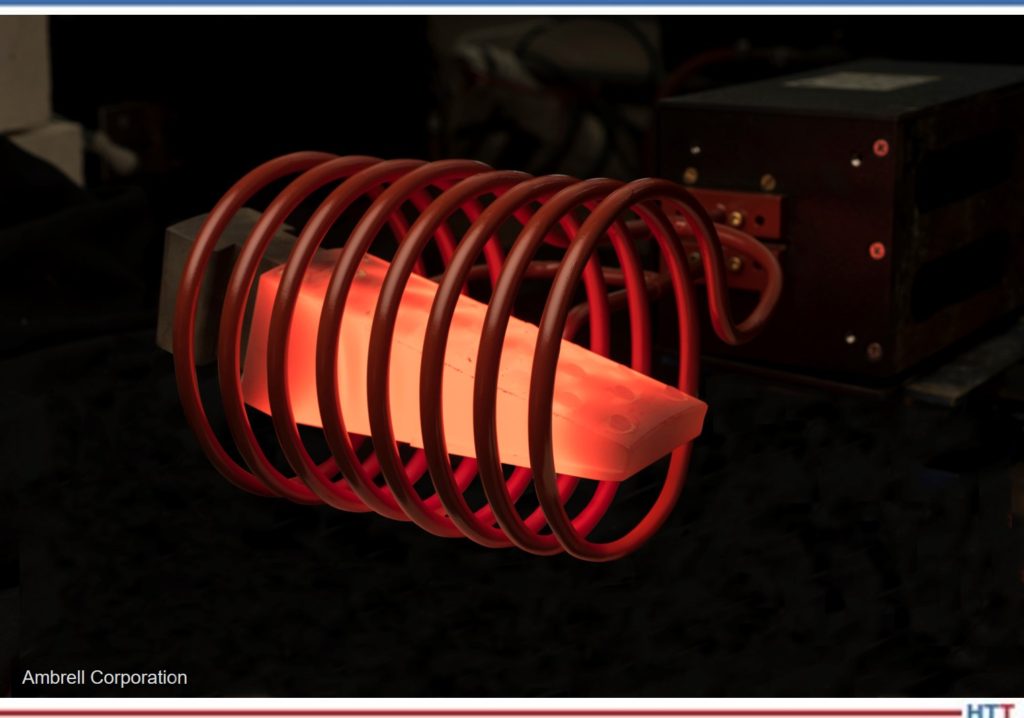
Eliminate smoke, waste heat, noxious emissions, and loud noises.
Photo Source: Ambrell Corporation

Induction Heating Is More Efficient

Induction is a uniquely energy-efficient heating process that converts 70–90% of the energy consumed into useful heat. When compared to electrical ovens, which are generally only 45% energy efficient, induction heating has two times the overall efficiency. Gas oven efficiency is typically only 25–30% energy efficient, indicating induction can be up to three times as efficient. Since induction requires no warm-up or cooldown cycle, startup and shutdown heat losses are eliminated. The repeatability and consistency of the induction heating process make it highly synergistic with energy-efficient automated systems.

Induction Supplies More Consistent Output Than Oven Heating

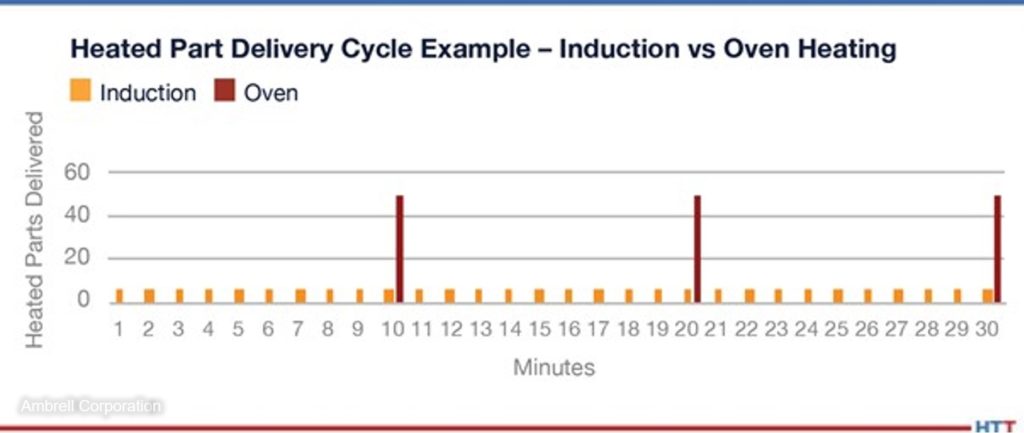
The use of constant flow induction heating results in significantly higher efficiency than batch oven heating. Losses in both energy and time due to oven loading and unloading are eliminated with induction heating. Induction enables a consistent flow of parts which is even more critical if onward steps in the manufacturing process require heated parts. This reduces the heat loss from the part when it reaches the next step, thus increasing the overall efficiency of the cycle. This overall savings is not only realized in production efficiency but also results in the better use of heating energy.

Induction Can Be More Cost Effective Than an Oven

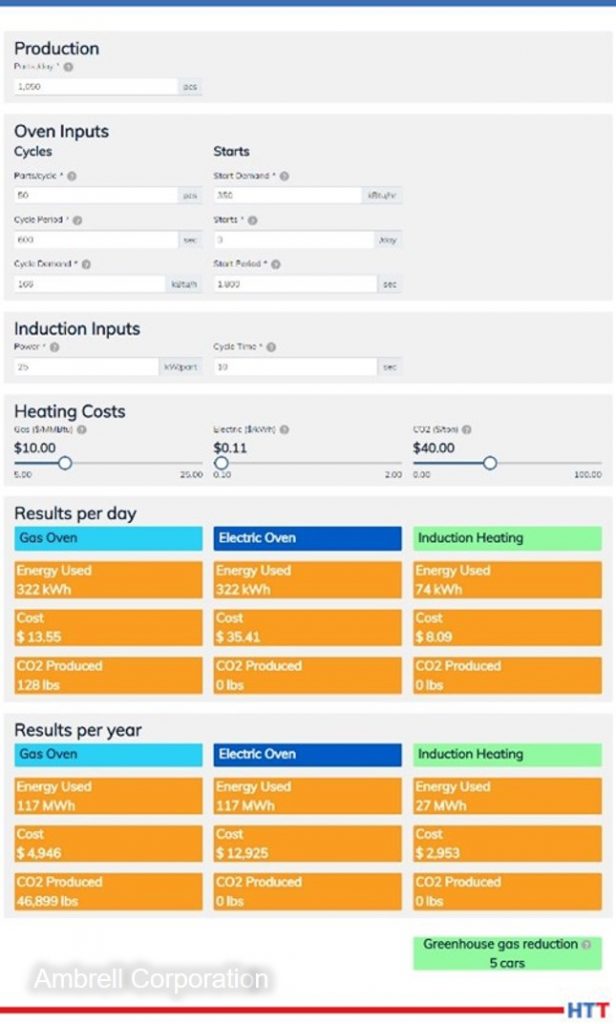
Figure 1
Photo Source: Ambrell Corporation

In this scenario (Figure 1), a client using an oven switches to induction. The environmental benefits are considerable. Given the inputs you see in the image, induction heating saves 128 lbs. of CO2 per day and over 46,899 lbs. per year. This is the equivalent of removing five internal combustion engine cars from the road.

The cost savings of induction heating compared to a gas oven are often considerable too, and the difference compared to an electric oven is typically even more significant. The cost variables depend on local rates, so we recommend using an energy calculator to apply your current rates. We have created one that is available at http://green-energy.ambrell.com.

Induction heating wastes little heat due to the direct transfer of energy to the workpiece, resulting in significant energy savings.

Is Induction Right for My Process?

Now that you have learned about the environmental benefits of induction heating that can result in utility savings, the question becomes: is induction right for your process? Induction is particularly ideal when you have a high-volume process that requires consistent part quality. That said, there are many scenarios where induction can be optimal. Induction manufacturers often offer complimentary feasibility testing. That is a great place to begin when determining if induction is the right fit for your process.

About the Author: Dr. Girish Dahake, senior vice president, Global Applications for Ambrell Corporation, has over 25 years of induction experience and leads a worldwide team of induction application experts. He holds multiple industry-related patents, has authored numerous papers, and frequently presents at professional conferences on topics such as induction heating, nanoparticle heating, and heat staking. He holds a Ph.D., in Mechanical and Aerospace Engineering from the University of Rochester.


Find heat treating products and services when you search on Heat Treat Buyers Guide.com



Why Induction Heating Is a Green Technology Read More »

Natural Gas Revisited

OCNatural gas is the dominant energy source used by heat treaters and its price and availability is critical to all U.S. industry, so let’s look at the data and nail down some simple quantitative facts and maybe answer this pressing question: How will the war in Ukraine impact natural gas production and consumption?

This column is a Combustion Corner feature written by John Clarke, technical director at Helios Electric Corporation, and appeared in Heat Treat Today’s May 2022 Induction Heating print edition.

If you have suggestions for savings opportunities you’d like John to explore for future columns, please email Karen@heattreattoday.com.


John B. Clarke
Technical Director
Helios Electric Corporation
Source: Helios Electrical Corporation

As political pundits seek to explain the cause and impact of the war in Ukraine, I am struck by the lack of quantitative information they use to support their opinions and analyses. Given the complexity of the U.S. energy market, with a myriad of imports and exports between countries (especially Canada and Mexico), it is no wonder that people can support any preconception they have by simply omitting this import or that export. As always, we will focus exclusively on natural gas.

Let’s start with some basic facts. FACT: 40% of our electricity in the U.S. in 2021 was generated using natural gas1 and 20% of electricity generated in Europe is from natural gas2 — so even a vacuum furnace runs on a substantial quantity of this fuel.

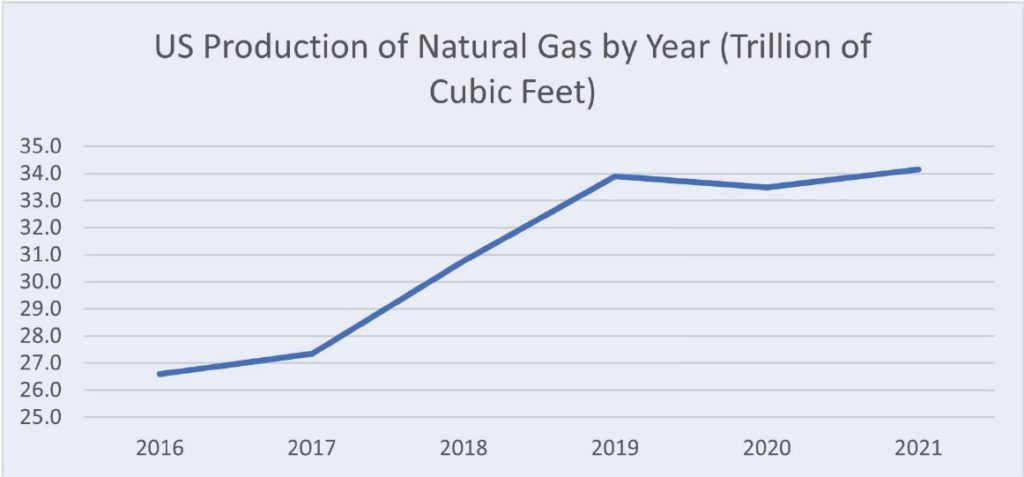
One of the challenges when discussing energy markets is the many different units of measure people use to describe production, consumption, and costs. Our preferred unit of measure for natural gas production and consumption will be trillion cubic feet or 1 quadrillion British Thermal Units (BTU)* per year (one cubic foot of natural gas contains 1000 BTU (HHV)). To put this in perspective, if we pay $4.70 per mmBTU** — one trillion cubic feet is valued at 4.7 billion dollars. In 2021, the United States produced 34.1 trillion cubic feet or roughly 161 billion dollars of dry natural gas.


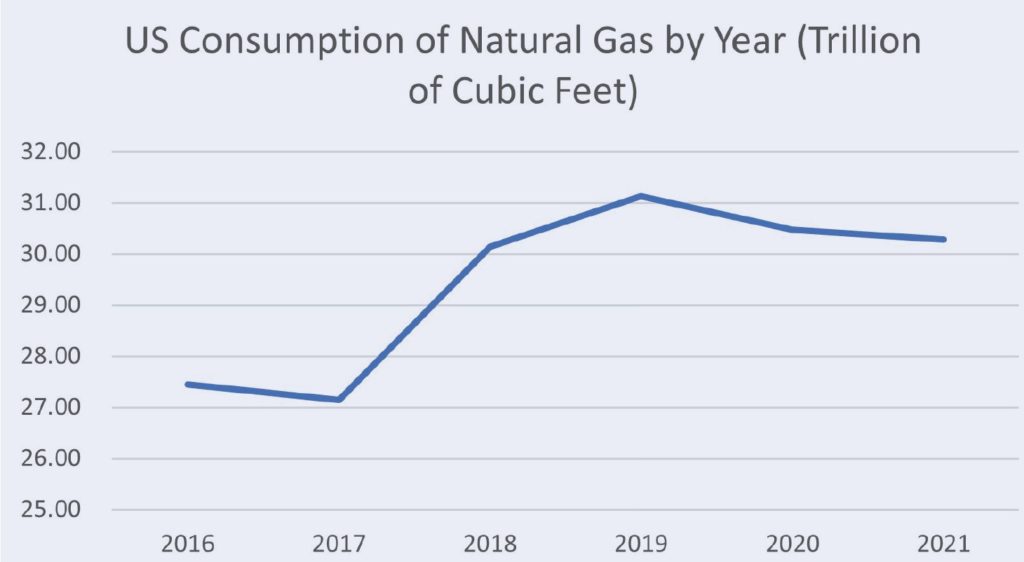
FACT: U.S. production of natural gas was at an all-time high in 2021 and is rising.3, 4 The U.S. is the largest producer of natural gas in the world by a significant margin. U.S. consumption has fallen over the last two years because of our COVID recession — but it is projected to rise in 2022.


Liquified Natural Gas (LNG) Exports

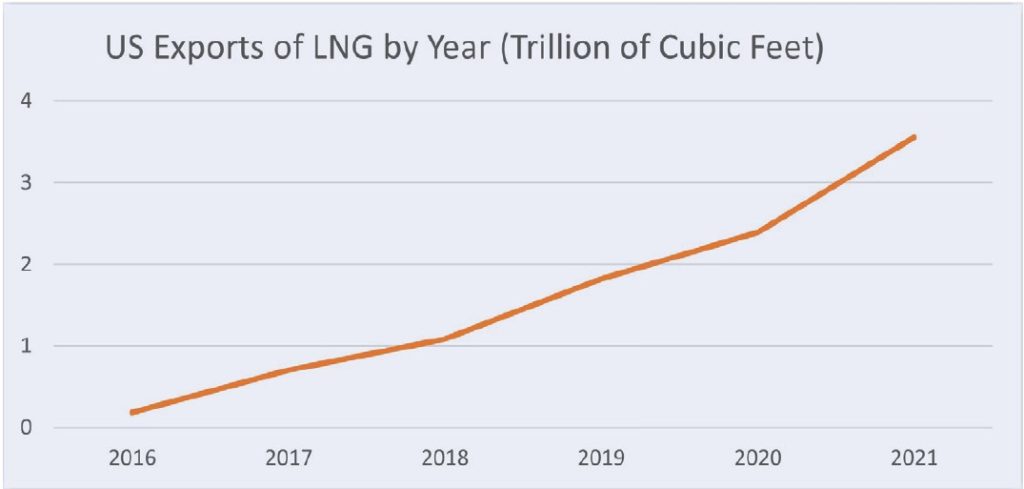
Natural gas can be exported via ship in its liquified state. The following graph shows the U.S. exports of LNG in recent years.5 Our ability to export LNG is limited by facilities that compress and cool the gas to its liquid state and the availability of tankers to move the gas across the ocean. Both ports and ships require significant capital investments and take time to construct — so there is a limit to the rate we can expand exports. Even as we export LNG, we continue to import some natural gas from Canada — but we are obviously a net exporter of natural gas by a considerable margin.

FACT: In 2021, the U.S. exported roughly 10% of the natural gas it produced as LNG. The U.S. is currently the largest exporter of LNG6 while Russia is the largest exporter of gaseous natural gas. Australia and Qatar are also major players in the LNG export market, and we may see these three countries vying for the top spot in the coming decade. The big advantage enjoyed by LNG is once liquified, it is a fungible source of energy — it can be exported to anywhere with a suitable port. Gaseous natural gas must travel through a pipe.

In 2021, the European countries in the Organization for Economic Co-operation and Development (OECD) together imported about 80% of the natural gas they use. Of this number, roughly 6.6 trillion cubic feet per year is imported from Russia, the largest importers of Russian gas include Germany — 1.70, Turkey — 0.95, Italy — 0.92, and France — 0.62 trillion cubic feet per year.

The U.S. has significantly expanded its LNG supplies to Europe in 2019—20217 to an annual rate of 1.86 trillion cubic feet in January of 2022,8 but LNG import capacity is still limited — with additional import facilities coming online in the next few years. Prior to 2019, Europe had little volume of LNG imports, so all the movement of natural gas was by pipeline.

While our price for natural gas in the U.S. has gone up considerably in the last year (approaching a mean of about $5.00 per mmBTU on the spot market), the price in Europe is running about six times as much — $30.00, with recent spikes as high as $60.00 per mmBTU. So, we load a typical LNG tanker with $15 million in natural gas in the U.S., and in 20 days, we lose 4% of the load to vapor, which we burn to power the ship, and offload $86 million at a port in Germany. Of course — this is an oversimplification, but the point is obvious. This price differential will continue to drive the market to invest in new production, LNG ports and ships — and apply upward pressure to our domestic price.

With or without the instability caused by the Russian invasion of Ukraine, we can expect a reliable supply of natural gas to fuel our furnaces and generate our electricity in the United States, but we can also expect higher prices to remain with us for the foreseeable future. Can the U.S. supplant Russia’s natural gas imports? The data indicates the answer is yes — but it will take time and investment. No matter what the outcome of the current war, the West will question the reliability of Russia as an energy supplier and explore all options to lessen their dependency on Russia’s oil and natural gas exports.


*1 BTU is the energy required to heat 1 pound of water, 1 degree Fahrenheit.

**Rough Henry Hub Price per mmBTU of natural gas at time of publication

References

[1] “Electricity explained: Electricity in the United States,” EIA.gov, March 18, 2021, https://www.eia.gov/energyexplained/electricity/electricity-in-the-us.php#:~:text=Natural%20gas%20was%20the%20largest,power%20plants%20use%20steam%20turbines.

[2] Statistical Review of World Energy — 2021. PDF File, 2021, https://www.bp.com/content/dam/bp/business-sites/en/global/corporate/pdfs/energy-economics/statistical-review/bp-stats-review-2021-eu-insights.pdf.

[3] Kirby Lawrence and Troy Cook, “EIA forecasts U.S. natural gas production will establish a new monthly record high in 2022,” EIA.gov, December 16, 2021, https://www.eia.gov/todayinenergy/detail.php?id=50678.

[4] “Natural Gas Summary,” EIA.gov, February 28, 2022, https://www.eia.gov/dnav/ng/ng_sum_lsum_a_EPG0_FPD_mmcf_a.htm.

[5] “Liquefied U.S. Natural Gas Exports,” EIA.gov, February 28, 2022, https://www.eia.gov/dnav/ng/hist/n9133us2A.htm.

[6] Mundahl, Erin. “We’re #1! U.S. Ends 2021 as World’s Largest LNG Exporter,” energyindepth.org, January 5, 2022, https://www.energyindepth.org/were-1-u-s-ends-2021-as-worlds-largest-lng-exporter/.

[7] Victoria Zaretskaya and Warren Wilczewski, “Europe relies primarily on imports to meet its natural gas needs,” EIA.gov, February 11, 2022. https://www.eia.gov/todayinenergy/detail.php?id=51258.

[8] EU-US LNG Trade: US liquefied natural gas (LNG) has the potential to help match EU gas needs, PDF File, March 2022, https://energy.ec.europa.eu/system/fi les/2022-02/EU-US_LNG_2022_2.pdf.

About the Author:

John Clarke, with over 30 years in the heat processing area, is currently the technical director of Helios Corporation. John’s work includes system efficiency analysis, burner design as well as burner management systems. John was a former president of the Industrial Heating Equipment Association and vice president at Maxon Corporation.


Find heat treating products and services when you search on Heat Treat Buyers Guide.com


Natural Gas Revisited Read More »

12 Quick Heat Treat News Chatter Items to Keep You Current

Heat Treat Today offers News Chatter, a feature highlighting representative moves, transactions, and kudos from around the industry. Enjoy these 12 news bites that will help you stay up to date on all things heat treat. 


Equipment Chatter

  1. Following a record year for new equipment orders in 2021, Ipsen’s Vacuum Technology Excellence Center continued that trend by booking 22 new vacuum furnace orders in the first quarter of 2022.
  2. Tenova will supply a second Electric Arc Furnace (EAF) to Tosyali Algeria.


Personnel/Company Chatter

  1. Tenova announced their new corporate website which is designed as a digital hub, targeting specific needs through dedicated portals and customized paths to serve their stakeholders.
  2. Nitrex, a global provider of fully integrated surface treatment solutions, has announced the completion of its Poland plant expansion.
  3. Salzgitter AG and Tenova have concluded an important agreement for the realization of SALCOS® – Low CO2-Steelmaking.
  4. thyssenkrupp Steel will join ResponsibleSteel, a non-profit organization, that ensures, through a global standard and certification program, that steel is responsibly sourced and manufactured at every stage.


Personnel/Kudos Chatter

  1. Graduate engineering students at Clemson University collaborating with Aalberts surface technologies – accurate brazing presented their final projects on topics ranging from sustainability to shipping and a lot of interesting topics in between.
  2. Kamila Baran is a new quality engineer at Bodycote’s Romulus plant.
  3. Tony Olszewski is the new vice president of Sales at Plibrico Company, LLC, a supplier of monolithic refractories and installation services.
  4. Advanced Heat Treat Corp. (AHT) announced that Chris Molencupp joined the company as its new regional sales manager. Molencupp will be responsible for driving sales from Michigan, Indiana, Ohio, and Canada.
  5. Werner Ponikwar will be thyssenkrupp nucera’s new chief executive officer and will assume this position on this year. As deputy CEO, Denis Krude will assume the newly created function of chief operating officer.
  6. Pelican Wire, a Wire Experts Group company, welcomes three new management team members. Joining the company are Mike Dunn as the new plant manager, Bob Soares as quality manager, and Doug Wanser as maintenance manager to the Naples, FL manufacturing facility.


Heat Treat Today is pleased to join in the announcements of growth and achievement throughout the industry by highlighting them here on our News Chatter page. Please send any information you feel may be of interest to manufacturers with in-house heat treat departments especially in the aerospace, automotive, medical, and energy sectors to bethany@heattreattoday.com.


Find heat treating products and services when you search on Heat Treat Buyers Guide.com


12 Quick Heat Treat News Chatter Items to Keep You Current Read More »

Heat Treat Radio Snapshots

OC

Twice a month, Heat Treat Today publishes an episode of Heat Treat Radio, a unique-to-the-industry podcast. Hear some good news about the future of the energy industry, learn about the benefits of salt quenching, and discover some surprising ways to increase cost to part ratio in this snapshot of three episodes. Enjoy this original content, and happy listening!


Heat Treat Radio: The Greenness and Goodness of Salt Quenching with Bill Disler

Bill Disler
President, CEO
AFC-Holcroft
Source: AFC-Holcroft

What comes to mind when you think of salt quenching? Do the words "green technology" or "environmentally friendly"? Bill Disler, president and CEO of AFC-Holcroft, thinks they should. Quenching is a critical step in most heat treating processes, and, as most heat treaters know, boiling oil on part surfaces and contaminated washers can make quenching a nasty business.

Quenching with sodium nitrate/sodium nitrite salts gets rid of all the "nasties." It is green and it is good, because salt does not boil at temperatures used for quenching, and heat treaters can recycle 99% of quenching salt. No more rinsing oil down the drain.

To learn more about how salt quenching compares to gas quenching, oil quenching, and polymer water quenching, listen to this episode of Heat Treat Radio.

Heat Treat Radio: Energy’s Bright Future with Mark Mills, Senior Fellow at the Manhattan Institute

Mark Mills
Senior Fellow
Manhattan Institute
Source: Manhattan Institute

After the COVID-19 pandemic and the outbreak of the war in the Ukraine, the world is badly in need of some good news. In this episode of Heat Treat Radio, Mark Mills, host of the podcast The Last Optimist and author of the book The Cloud Revolution: How the Convergence of New Technologies Will Unleash the New Economic Boom and A Roaring 2020s, provides some much-needed good news. According to Mark, energy's future is bright. "There is essentially," Mark says, "an infinite supply of energy. Energy is all around us in all kinds of forms. It is always a question of what technologies are available to tap into nature's energy forms[. . .]."

In this optimistic episode, Doug Glenn and Mark Mills discuss how new technologies emerge at just the right time throughout history to solve the energy crisis of the day.

Interested? To hear Mark's thoughts on energy's future, Russia's role in the natural gas industry, and renewables' feasibility in the heat treating industry, listen to this episode of Heat Treat Radio.

Heat Treat Radio: High-Temperature Material Selection with Marc Glasser, Rolled Alloys

Marc Glasser
Director of Metallurgical Services
Rolled Alloys
Source: Rolled Alloys

"Expensive is cheaper." Not convinced? In this episode of Heat Treat RadioMarc Glasser of Rolled Alloys sits down with Doug Glenn to change the way the heat treat industry thinks about increasing profit per part. Selecting the cheapest part or component does not make economic sense in the long-run. And when it comes to cost savings, the long-run is what really matters.

Glasser asks crucial questions like: Will the weight of a fixture create a heat sink when a lighter (and possibly more expensive) fixture would solve this problem? How many times will the cheaper part need to be replaced compared to the more expensive part? How much will downtime for multiple replacements cost?

To hear the discussion of these questions, as well as practical tips on logging the lifetime of components, listen to this episode of Heat Treat Radio.


.

Search for heat treat solution providers and suppliers on Heat Treat Buyers Guide.com


Heat Treat Radio Snapshots Read More »

U.S. Firearm Manufacturer Orders Vacuum Heat Treat Furnace

HTD Size-PR LogoA firearms manufacturer based in the U.S. has ordered a vacuum heat treating furnace from a Pennsylvania manufacturer.

Solar Manufacturing Inc. announced the receipt of the heat treat furnace, a model HFL-5748-2IQ, which has a hot zone of 36” x 36” x 48” deep with a weight capacity of 5,000 lbs. Its maximum operating temperature is 2400°F and it heats to 2500°F for hot zone bake out. The furnace design also has a temperature uniformity of ±10°F and is AMS2750 compliant with vacuum levels in the low micron range.

For rapid turnaround for work cooling, a 100 HP gas blower is provided for operating at 15 PSIG (2-bar) in nitrogen gas. The furnace is complete with a SolarVac® Polaris fully automated and programmable industrial controls package, and a Eurotherm digital chart recorder.

The system also includes a Magnetic Specialties, Inc. SCR-based dry power supply rated at 225 kVa.

Firearm Image Photo Source: Jay Rembert at unsplash.com

Find heat treating products and services when you search on Heat Treat Buyers Guide.com


U.S. Firearm Manufacturer Orders Vacuum Heat Treat Furnace Read More »

Message From the Editor: Engagements

Social media has become an ubiquitous part of daily life for many of us. Karen Gantzer, managing editor of Heat Treat Today, shares how the editorial team is leveraging this tool to help heat treaters across North America.

This article first appeared in Heat Treat Today's March 2022 Aerospace Heat Treat print edition. Feel free to contact Karen Gantzer at karen@heattreattoday.com if you have a question, comment, or any editorial contribution you’d like to submit.


Karen Gantzer
Managing Editor
Heat Treat Today

I like Instagram. I don’t post, but I do like to read other people’s posts. I get creative ideas for entertaining and decorating, as well as incredibly delicious recipes, innovative garden designs, and challenging fitness options. One of the influencers I follow shared that a video she posted a few weeks ago had received 9 million views. She was thrilled at its viral status because it also brought many new followers to her account.

Why does the increase in followers bring such joy? Well, it shows that people are certainly interested in what is being shared and perhaps has some relevance to the viewer — maybe he/she can resonate with it in some way. Or, at the very least, wants to find out why all the attention because, let’s be honest, who wants to suffer from FOMO?!

For the last year or so, it has been a goal of Heat Treat Today to “up our game” in the social media realm because, for us, we see it as a vehicle to help people become better informed. The articles chosen for posts and the way in which they are promoted have been intentional by design. I think there may be a science to this whole social media thing!

Who knew?!

The team, led by Social Media Editor Alyssa Bootsma, has been working diligently to discover that secret sauce to growing social media presence and helpfulness. In 2021, we celebrated the fruits of their labor because the data is showing that people are seeing value and relevance in the Heat Treat Today posts on LinkedIn, Facebook, and Twitter.

Of course, there is a learning curve to all new endeavors and this one is no different. Holding fast to our mantra of “The beginning of wisdom is the definition of terms,” we’ve learned about “post impressions”, “engagements”, “number of followers”, and “page likes.” And, just to be clear, the majority of the stellar Heat Treat Today team are young rising stars who probably already knew this, but the more seasoned among us, i.e., Doug and me, were on a steeper learning trajectory!!

The Heat Treat Today team is passionate about sharing incredibly helpful information that will assist you in your heat treat decisions and add to your own knowledge bank. It looks like the word is spreading through social media and we are thrilled. In these graphs, see the increases we’ve enjoyed. We are thankful for each of you who are following us and if you haven’t had the opportunity yet, please take a look at the Heat Treat Today content and consider following us. If there are topics you’d like to see or suggestions you’d like to make, please email Alyssa at Alyssa@heattreattoday.com. We’ve only just begun!


Find heat treating products and services when you search on Heat Treat Buyers Guide.com


Message From the Editor: Engagements Read More »

Sintering and Binder Jetting With Vacuum Furnaces

Source: TAV Vacuum Furnaces

Ever heard of binder jetting (BJT)? It's an evolving technology that is quickly catching up to metal injection molding (MIM). Compared to MIM, BJT has a lower cost per part rate, produces larger parts, and, because BJT is a cold process, it does not introduce residual stress inside the part.

Even though BJT is a cold process, sintering is a key step in BJT. Read this best of the web article to learn the ins-and-outs of sintering with binder jetting.

An excerpt:

"Vacuum sintering furnaces are usually the go-to choice for sintering of [binder jetting] parts, thanks to the ability to provide bright and shiny sintered parts, the tight process parameters control and the possibility to work with different debinding and sintering atmospheres."

Read more at "Binder Jetting and Vacuum Furnaces: Everything You Need To Know"


Find heat treating products and services when you search on Heat Treat Buyers Guide.com


Sintering and Binder Jetting With Vacuum Furnaces Read More »

Skip to content