


EDITOR

Message from the Editor: Decisive Actions

Heat Treat Today publishes twelve print magazines a year and included in each is a letter from the editor. This letter is from the March 2026 Annual Aerospace Heat Treating print edition. In today’s letter, Bethany Leone, managing editor at Heat Treat Today, shares her insights on the tension between a surging editorial workload and the need for thoughtful, deliberate decision-making — and why choosing clarity over the rush may be the most important discipline we can practice in the busiest of seasons.


The holidays are past; the fervent rush of “let’s get things done!” has arrived. I’ve sensed the pressure build as the editorial team faces limited time, increased volume of articles, and competing priorities. Navigating the excitement to publish technical articles and make public news statements becomes the work of editing.

Influx of Activity

This past month brought an increased editorial interest from industry suppliers and partners. Industry experts writing about new technologies often are busy with developing those products and refining the processes. So when these individuals take the pen (the keyboard), we seize the opportunity to bring their thoughts to you. This ensures the wider North American heat treat community is benefitting from the treasure trove of instruction, guides, and practical warnings to best operate equipment and maintain processes in a timely way.

You’ve likely heard murmurs of events and in-person engagements. Case in point: Heat Treat Today’s Helium Leak Detection Seminars launches this month. These also have occupied our time as the editorial team prepares content and carves out time to follow up with new people, meet remotely with folks, and even attend webinars ourselves. All of this means processing editorial content sooner than usual and anticipating industry trends that come out of these forums.

This increase in editorial volume necessitates more focus and less time to reflect. As a curious and systems-oriented person, these times of focus, while invigorating, leave me wishing for time to reflect, research, and develop better processes. This is not order for the sake of order, but to ensure that articles truly capture and deliver the value that authors intend, and that they do so at the right time for readers.

All Movement, No Time to Think

It is now that I feel the first inclinations of the dreadful “r” word: rush.

There is no allure to rushing. In American culture, we do find ourselves busy, but rushing is never appealing — it is all activity without the direction of a thoughtful decision. The “r” word in the editing world means a missed opportunity to define an unclear metallurgical term or printing a graph too small that causes readers to squint. Bring that word up in an audit and everyone becomes uncomfortable. Hurriedly chip off February ice from your windshield to get to work and drive off dreading if your wallet was left behind in the rush.

More ideas, asks, input, and even adjacent activity by colleagues can often bring less margin. If only I could have time to think and execute everything all the time in a day, then I’d be happy! But instead of wishful thinking, I find the best first step is to stop yearning for an unchanging balance of priorities and readjust the expectations for output (or thought life) that I once held, even as recently as the day before. External demands pushing us into action require decisive thinking. The goal is clarity under constraint, not just endurance in the excitement.

Marching Orders

In all of this, remember: on the opposite side of my editorial conundrum is a slew of experts seeking to connect with you, our readers. In their own way, they too are in “execution” mode. Take advantage of their efforts and send us your feedback (editor@heattreattoday.com) whenever a question or idea strikes, or if you have more to add than that which was covered in the scope of an article.

And of course, here I am: send me your technical articles! You may find me joyfully drowning in grammatical questions, image requests, or word count conundrums.


Bethany Leone
Managing Editor
Heat Treat Today
Contact: Bethany Leone at bethany@heattreattoday.com

Message from the Editor: Decisive Actions Read More »

Message from the Editor: Restless

Heat Treat Today publishes twelve print magazines a year and included in each is a letter from the editor. This letter is from the February 2026 Annual Air & Atmosphere Heat Treating print edition. In today’s letter, Bethany Leone, managing editor at Heat Treat Today, shares her insights on the restlessness stirred by recent shifts in the heat treat industry — and why sitting with uncertainty, rather than rushing to diagnose it, may be the most intentional form of leadership we can practice right now.


Recently, we have observed the shift in industry brain trust. In fact, if you follow the Heat Treat Daily, there have been a lot of significant acquisitions, announcements of growth, and refocusing of efforts. Yet no singular statement emerges to define what this moment is for the heat treat industry. This constant movement and reorienting is exciting, but what does it mean?

To recap some highlights, a brazing icon retired — Dan Kay, our tribute to him later in this publication (p. 49). Innovator and furnace expert Mark Hemsath joined forces with WINGENS CONSULTANTS as an executive expert. Major industry suppliers continued to consolidate under more international leadership, and we wait to see how priorities at these organizations will be recalibrated.

While all of these changes are decisive moves, there is hardly a definitive direction to describe where the heat treat industry is going. With the world at our fingertips, digital projections and instantaneous AI analysis feed the desire to know what to expect, what to avoid, what to get excited about. Data is the bread and butter of informed decisions, though tempered with discernment. A lack of satisfying answers, however, exposes how easily we can overuse data to create a safety net from uncertainty or seek a quick diagnosis for a discomfort whose true nature may be far more complex.

And so, we find ourselves without clear answers about what these industry shifts ultimately mean. Perhaps some are already making projections, but for me, I’m sitting in a restless state about what we should expect for the rest of the year. Still, restlessness isn’t something to “seek and destroy,” as my immediate inclination often is. Sitting with it can make space for true stewardship.

Stewardship

Stewardship takes the present form. The emphasis is simple: What is in my control now to change, cultivate, care for? Lots of garden terms with this word! This idea of stewardship shows up for me in small ways. The closest I am to gardening is the peace lily who stares at me while my one-year-old takes another swat at her leaves, brown and crinkled from the drafty air. Here’s the thing — stewardship, at least in this season, is not the one-plant garden. It’s knowing to cultivate joy in the one-year-old… and waiting to see if the peace lily survives.

Another key aspect of stewardship is listening. Stewardship happens after the pause that listens to the unsettled state. This attitude allows uncertainty, complexity, and even contradictory messaging. As leaders of wherever life finds us, listening to the noise and waiting through the discomfort of not having an answer is what precedes intentional action.

Waiting for the Meaning

If you have been observing the changes in industry with bated breath, continue the waiting. No need to diagnose. Dedicate yourself this year not to the novel goals of January, but the essential approach of not balking at the restlessness that you may find yourself in. It is enough to tend to what is immediately entrusted to you.


Bethany Leone
Managing Editor
Heat Treat Today
Contact: Bethany Leone at bethany@heattreattoday.com

Message from the Editor: Restless Read More »

Message from the Editor: Matching Materials

Heat Treat Today publishes twelve print magazines a year and included in each is a letter from the editor. This letter is from the January 2026 Annual Technologies To Watch print edition. In today’s letter, Bethany Leone, managing editor at Heat Treat Today, shares her insights on the widening gap between material science and industrial engineering in heat treatment — and what leaders can do to make smarter material decisions.


I recently spoke with an industry educator who is also a metallurgist and an engineer. She stressed the need for heat treat leaders to make informed decisions, blending industrial engineering and materials science expertise — just one is only half of the conversation. Our current era is reckoning with the fruit of underprioritized materials science education.

This concern arose several times at industry trade shows last year, both in lectures and conversations with attendees. While academic institutions have been pivoting to close this materials gap, the difficulty remains: Are the components that we design and for which we curate heat treat processes around making use of the best materials?

Barriers to Material Matching

The question of performance is prevalent: Are we designing with the right material in mind? Additionally, this age of advanced manufacturing and additive manufacturing challenges what we know to be the best material for an application; a new superalloy on the market may offer unforeseen abilities as well as risks. There is also the practical concern of time and supply chain; the tariffs of 2025 have brought this concern close to home, no pun intended.

There are other practical concerns when it comes to materials, as I was informed by Malur Narayan. As the CEO of Xtrium, an AI-powered materials matching and intelligence platform that connects materials to real-world applications, he is attuned to the specific challenges around this question. According to Narayan, there are missed revenue opportunities by failure to consider materials that are common in industries outside of one’s own.

Moreover, even if the desire to innovate or examine new materials and processing methods is fostered, the typical months of discovery handicaps time and action steps. This makes sense because, as Narayan summarized, just because an alloy manufacturer developed an extremely useful alloy for applications in one industry doesn’t mean they are reaching clients in other industries. From that supply side, it takes market research to prove the use case in those alternative sectors.

Furthermore, there has not been an effective single-source of truth for users to navigate and compare properties against.

What Can You Do?

Talk with your materials supplier. A number of alloy suppliers can be accessed on HeatTreatBuyersGuide.com and searching www.heatreattoday.com for their published articles can yield helpful insights as to what other applications and treatments are within reach. Additionally, Xtrium is releasing an AI-native online search and discovery engine which is designed to match materials to real-world applications in minutes, cutting down the traditional months of manual research.

Xtrium tool screenshot | Image Credit: Xtrium

Look across industries for new applications. We will explore more about innovative materials applications and the benefit they have in alleviating the heat treat process in future editions of the magazine. If you have your own use case, please reach out to share your story.

Brace yourself. There are heat treat processing modifications that allow users to take advantage of less expensive alloys. We will be excited to share more on one of these innovative solutions in an upcoming magazine.

References

Karlsruher Institut für Technologie (KIT). 2025. “Scientists Forge New ‘Superalloy’ That Could Revolutionize Jet Engines and Power Plants.” SciTechDaily. https://scitechdaily.com/scientists-forge-new-superalloy-that-could-revolutionize-jet-engines-and-power-plants/.


Bethany Leone
Managing Editor
Heat Treat Today
Contact: Bethany Leone at bethany@heattreattoday.com

Message from the Editor: Matching Materials Read More »

Message from the Editor: Elbowing a Captive Audience

Heat Treat Today publishes twelve print magazines a year and included in each is a letter from the editor. This letter is from the November 2025 Annual Vacuum Heat Treating print edition. In today’s letter, Bethany Leone, managing editor at Heat Treat Today, shares her insights on the value of in-person visits to captive heat treat facilities and announces a new editorial series aimed at spotlighting North America’s best in-house operations.


There is nothing like walking your shop floor. I’m talking for me, not for you. But perhaps you agree!

When I leave my neighborhood, I often pass a steel operation with atmosphere heat treat furnaces sitting snugly by the door. In the winter, the building’s windows are flung open. In the summer, workers head out of the building toward the parking lot (seemingly) every hour. And I want in.

Regrettably, I have yet to elbow my way into that fine establishment to see what’s going on, but hopefully one day I will.

This Editor’s Page is very self-interested: I want to see your heat treat operations.

At Heat Treat Today, we’re on a mission to spotlight North America’s best captive heat treat facilities — the quiet powerhouses who are making gears harder, shafts straighter, and production lines hum with thermal precision. And we’re willing to travel to do it.

Whether you’re in Ontario or Ohio, Monterrey or Michigan, we want to be on your shop floor, taking notes, asking questions, and celebrating the know-how that keeps your operation running strong. In-person site visits give us an unmatched opportunity to understand your process flow, your constraints, and what really makes your team tick. It’s the difference between writing about heat treating and actually getting into it.

A New Editorial Series: “An Inside Look at In-House”

We’re calling this editorial series “An Inside Look at In-House.” Our aim is to profile exceptional in-house heat treat operations to hear their stories: Why they changed a process, added automation, doubled down on legacy equipment, or resisted the pressure to outsource. Even when change isn’t the story, stability might be. If you haven’t altered your heat treat process in twenty years, that might be the very reason we want to feature you.

Why Open Your Doors?

I am not naive, though. Your work home is not an open-door environment. So why let us in?

We respect your time and value your trust. Our editorial team works with every contributor closely to ensure accuracy and clarity with absolutely no trade secrets exposed and no photos published without your consent. In return, you get visibility for your team, credibility for your investment in captive heat treating, and a chance to shape the conversation in your industry. Dare I ask you to envision the front magazine cover of Heat Treat Today splashed with a picture of you and your team?

Whether you have a story to tell or you’re simply proud of what your people do, we want to talk with you. Maybe even walk, too.

Get in Touch

Reach out to me directly at bethany@heattreattoday.com. If you’re lucky, Doug Glenn might even come with me — or instead of me! (You can request either one of us, but no guarantees.)

Let’s open the doors and shine a light on the hidden heroes of heat treat. We’re ready when you are.


Bethany Leone
Managing Editor
Heat Treat Today
Contact: Bethany Leone at bethany@heattreattoday.com

Message from the Editor: Elbowing a Captive Audience Read More »

Message from the Editor: AI, Where Are You?

Heat Treat Today publishes twelve print magazines a year and included in each is a letter from the editor. This letter is from the October 2025 Ferrous & Nonferrous Heat Treatments/Mill Processing print edition. In today’s letter, Bethany Leone, managing editor at Heat Treat Today, shares her insights on where artificial intelligence stands in the heat treating industry nine months into 2025.


In January 2025, the heat treat industry was envisioning operational improvements thanks to leaps in artificial intelligence (AI) developments. Now, nine months later, are we still searching for AI?

Managed by AI

Daniel Llaguno, President of NUTEC Bickley

For many industry players, AI has started in the office before the furnace. This can look like creating manuals, writing emails, and reading contracts to interpret legal language.

Daniel Llaguno, president of NUTEC Bickley, calls this the early stages of AI adoption. His company has leveraged AI for onboarding and training new employees — a low-risk, high-value application.

Like many suppliers, they are exploring how AI could eventually reshape furnace development, likely on an open-loop system first (versus a closed-loop where AI receives furnace information and immediately sends back direction to the furnace controls on how to respond).

The Furnace Floor

Jason Orosz, President of Global Heat Treating Services

The next step is already visible: integrate AI into existing IIoT platforms that manage floor operations. Platforms that you may already have considered are QMULUS by NITREX, PdMetrics by Ipsen, and Edge Process Management (EPM Data) by Eurotherm, a Watlow company. These are just a sampling of advanced management systems on the marketplace, and ones that are at different stages of incorporating AI and machine learning for process optimization.

QMULUS has already deployed across all North American Heat Treating Services locations, according to Jason Orosz, president of Global Heat Treating Services. He says AI has been useful in “helping with analysis, troubleshooting, and quality control” — themes you will hear repeatedly in early AI applications.

Evolving To Meet Expectations

Michael Mouilleseaux, General Manager of Erie Steel, Ltd

What should AI integration into furnace operations look like? Michael Mouilleseaux, general manager at Erie Steel, has commented that heat treat AI should help the industry shed its “black magic” reputation. He envisions advanced analysis that could, for example, “correlate intergranular oxidation (IGO) results with furnace integrity checks (i.e., leaks), eventually establishing hard limits for allowable leak rates.”

Still, obstacles remain. “I think it’s going to be a while before commercial heat treaters can relinquish furnace control over to an AI,” Orosz added, specifically commenting on maintaining furnace parameters. This makes sense due to the need for commercial heat treaters to conform to client specifications. Rather, he says in-house heat treat operations “are likely going to be the first movers in that area since they can make their own rules.” For readers of this publication — who primarily are coming from these types of operations — that should be an encouragement: you have a key role to innovate.

Lee Rothleutner, Manager of Materials R&D, The Timken Company

One other key factor for this integration to occur within operations comes with acknowledging the heavy digital capacity that AI requires. Lee Rothleutner, manager of Materials R&D at The Timken Company, commented on this very point, writing to me that for high-quality digital data, the heat treat industry needs to commit not just to the investment but to maintaining a robust data collection and storage infrastructure. He also foresees one pathway of AI integration beyond preventative maintenance, noting, “AI applications can extend to process optimization, quality control, and energy efficiency improvements.”

What To Do Now

For successful integration of AI technology, the common denominator is that management teams are being encouraged to constantly try new ways to innovate with AI.

The first thing you need to do is open an email and send me your AI integration story. Just kidding. (Not really.)

After that, you need to read Peter Sherwin‘s article on page 34 of this issue where he discusses a new development in standardization that should accelerate AI’s role in industry.

Finally, if you are attending ASM Heat Treat 2025 this month, bring your AI to the table … literally, if you have a booth. Showcase what you’ve been doing at your location or become a part of the conversation. Lee Rothleutner, quoted above, will be participating in a panel discussion on this very topic in the afternoon of Tuesday, October 21.

The Heat Treat Today booth is #944. Not everyone is accustomed to the rapid pace of tech adoption; we want to help one another understand the risks and potential that AI brings, and your stories are critical. I look forward to talking with you.

References

Glenn, Doug, and Llaguno, Daniel. 2025. Interview by Heat Treat Today. Private recording, February.

Loepke, Mike. 2025. “Digitalization Propels Heat Treating to Industry of the Future.” Heat Treat Today 7 (8).


Bethany Leone
Managing Editor
Heat Treat Today
Contact: Bethany Leone at bethany@heattreattoday.com

Message from the Editor: AI, Where Are You? Read More »

Message from the Editor: ASM Executive Leadership Forum

Heat Treat Today publishes twelve print magazines a year and included in each is a letter from the editor. This letter is a pre-release from the December 2025 Annual Medical and Energy Heat Treat print edition. In today’s letter, Bethany Leone, managing editor at Heat Treat Today, shares about the ASM Heat Treat show of 2025.


Attending the bi-annual Heat Treat show is always a thrill. The ASM Heat Treat Society did not disappoint, bringing a full line up of technical sessions and engaging panels to attend between walking the busy show floor, itself packed with cutting edge research presentations and informative booths of key players. I had the opportunity to attend more sessions than usual this year to hear what concerns in industry were being raised at this event. 

On Monday, October 20, ASM President Dr. Navin Manjooran, chaired the first ever Executive Leadership Forum, bridging the concerns and forecasts of industry leaders with the bold training methods of frontline academic leaders. The event was specifically hosted for the IMAT conference attendees at the collocated 33rd Heat Treating Society Conference and Exhibition. 

Dr. Manjooran underlined the intent of creating stronger collaborations between these two groups, with the first moderator, Renee Parente, director of Technology and Product Engineering at Advanced Micro Devices (AMD), further emphasizing the goal of accelerating innovation through open discussions like these. 

Industry Panel 

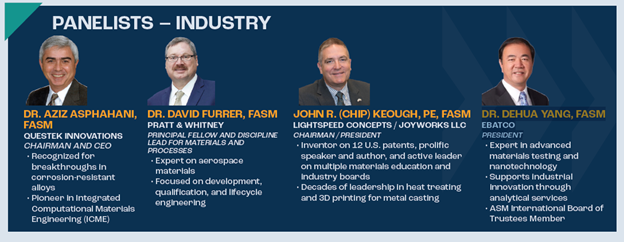
At this forum, the first panel included a Q&A portion moderated by Renee Parente with the following four industry panelists: 

  • Dr. Aziz Asphahani, FASM, chairman and CEO of Questek Innovations 
  • Dr. David Furrer, FASM, principal fellow and discipline lead for materials and processes at Pratt & Whitney 
  • John R. (Chip) Keough, PE, FASM, chairman and president at Lightspeed Concepts/Joyworks LLC 
  • Dr. Dehua Yang, FASM, president at Ebatco 
ASM Executive Leadership Panel Industry Panelists
Source: ASM International

From this panel came key thoughts on how research in the business world was being developed to further commercial efforts. First, there was a consensus that corporations were investing in research internally but were instead looking to start-ups to absorb the energies of research and development needs. While academic-industry partnerships were valuable, the concern over IPs was reviewed with Dr. Furrer adding that it is commitment to collaborative internal research efforts and external research industry partnerships that is most meaningful. He also added that the new generation of engineers are entering the workforce with new tools of industry at the ready to implement, and this shift needs to be welcomed to keep pace with the speed of innovation.  

Another important thread of discussion in this panel was the need to both accelerate the development of higher performance materials (Dr. Asphahani), as well as implement this development in a connected manner across engineering counterparts, like the quality, manufacturing, and design departments (Dr. Furrer) for effective product development.  

Academic Panel 

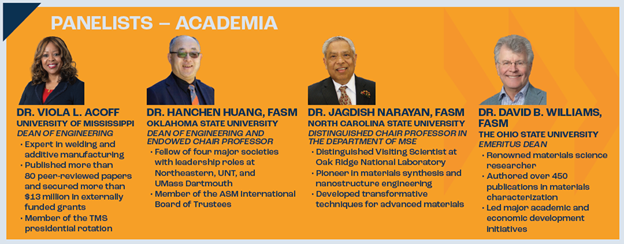
The academic panel revealed specifics on exciting current and developing efforts to train the rising workforce. Dr. Viola L. Acoff, the dean of engineering at the University of Mississippi, passionately shared the success of her breakthrough course design to retain freshmen metallurgy students through a hands one MTE 101 course, which includes access to a fully functioning foundry and efforts to grow already present real-world industry experience through industry-sponsored programs. 

ASM Executive Leadership Panel Academia Panelists
Source: ASM International

While the panel acknowledged the ongoing efforts to prepare students to use AI and other technologies of Industry 4.0 (and 5.0), there was a mixture of other emphases, including: 

  • the “plug-and-play” graduate who does not need remediation training at their first job (especially emphasized by Dr. Christopher Berndt, distinguished professor, Surface Science and Engineering at Swinburne University of Technology
  • a focus on developing materials engineers who think critically 
  • a close look at the publication system, with some specifically advocating the need to rethink this system as the barometer for engaged students and commercially focused research 

The four-person academic panel was completed by Dr. Hanchen Huang, FASM, dean of Engineering and endowed chair professor at Oklahoma State University, and Dr. David B. Williams, FASM, dean emeritus at The Ohio State University. The moderator was Dr. Zi-Kui Liu, FASM, Dorothy Plate Enright Professor in MSE at The Pennsylvania State University

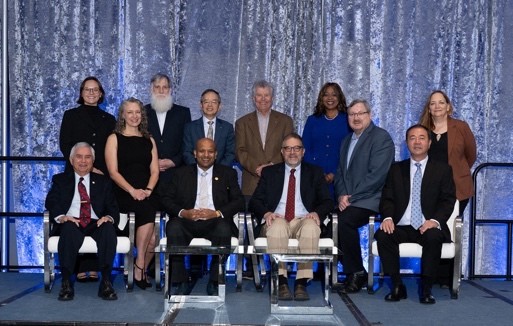
Panelists pose with Dr. Navin Manjooran (front, center right) and Master of Ceremonies Nicole Hudak Nicole Hudak (back left).

Audience 

I sat in a room amidst several dozen heat treat decision makers from both the commercial and teaching ground of heat treat, ranging from student and early career to research veteran and recently retired. Audience members asked their questions after both of the panels and mingled after the session to share a few words amongst ourselves and the generous speakers.  

Clearly, concern for the next generation of materials experts to meet industry needs — both in training and in availability of personnel — was of primary importance. Be it the question of how industry was investing in secondary and primary education interventions or a side discussion questioning how the leaders of both panels were driving young people toward entrepreneurial competition, the room buzzed with interest. 

Summary 

One comment Dr. Furrer shared outside of the panel session was his interest in how the focus of academia was shaping the opportunities available to upcoming industry leaders and engineers. 

Despite the government panel being unable to participate in the forum due to the ongoing government shutdown, this forum proved to be emblematic of Dr. Manjooran’s summary of ASM’s most important attribute: the ability through connections — memberships, partnerships, etc. — to advance materials worldwide.  


Bethany Leone
Managing Editor
Heat Treat Today
Contact: Bethany Leone at bethany@heattreattoday.com


Message from the Editor: ASM Executive Leadership Forum Read More »

Message from the Editor: An Editorial Eye on AI

Heat Treat Today publishes twelve print magazines a year and included in each is a letter from the editor. This letter is from the August 2025 Annual Automotive Heat Treating print edition. In today’s letter, Bethany Leone, managing editor at Heat Treat Today, describes the parameters, limitations, and benefits of using artificial intelligence in our heat treatment publication.


You have questions; AI has answers. But we have expert editorials.

Heat Treat Today delivers practical, accurate, and trustworthy information to a very niche and critical industry in North American manufacturing. With AI tools becoming more accessible and powerful, we want to be transparent about how we leverage them to maintain high editorial standards.

First, “The Don’ts”

Simply put, we don’t let AI replace our direct access to expert technical advice or content. Your heat treat efforts are too important for us to give you articles that have not been reviewed and cross-examined by our team, which is trained to review heat treat industry content.

Compose Technical Articles

We don’t use AI to generate technical articles for direct publication. Authenticity is at the heart of our editorial process, and our readers rely on us to deliver information straight from credible sources — directly from operators, engineers, and experts.

In our editorial department, technical content undergoes rigorous editorial review; we don’t rely on AI here. Our editors’ eyes are trained to catch and improve areas of technical confusion, so our readers receive help from the best practical heat treat information.

Learn Technical Concepts

I do not want to overstate this idea, because AI does generate helpful answers to common queries; you will note below that we appreciate this handy, interactive research assistant! But when it comes to learning a concept thoroughly, and especially for the first time, we prioritize validated sources:

  • Our in-house technical advisors
  • Reputable books and resources
  • Trusted websites from industry authorities

We do this to ensure accurate interpretation and traceability of knowledge.

Let me give an example: If I ask public AI for the most relevant quenching issues operators face, the answers it will give me will be based on material — often marketing material — that it can access online. While not incorrect, we always draw our material from resources with direct, on-the-floor experience to give you the benefit of more robust research and proven, hands-on expertise. (Furthermore, you can ask AI that question, too! We want to give you the benefit of more robust research and proven, hands-on expertise.)

And “The Dos”

AI can be an incredibly effective tool for supporting aspects of our editorial and communication processes. The following examples show how AI pushes us to actualize our creative juices, helps us think more clearly, and gives us time to hone more compelling and relevant content.

Hyperdrive the Early Draft

AI helps us create early drafts of editorials based on structured outlines. This accelerates the writing process, teasing out rough thoughts into a foundation that our editors will refine and often rewrite to enrich with targeted insights. Ever heard of writer’s block? Sometimes, AI is just what we need to get the ball moving!

Find Technical Gaps

Although we are not content experts, we often have a hunch when some technical aspect is missing or incorrect. AI can be helpful to scan sections where we have questions and provide suggested context for such sections — or simply tell us that we are being delusional. Once identified, our team collaborates with experts to address knowledge gaps or inconsistencies.

Research Tech Qs and News

AI helps us cut to the chase. Serving as a dialogue partner, AI conversations help editors refine research questions before consulting our technical experts and authors. This allows us to approach consultations with greater clarity, maximizing the value of expert input.

Additionally, AI scans our online lineup of industry news sources to find relevant stories, offering a more curated alternative to traditional RSS tools.

Refine Headlines & Article Summaries

Critical reader engagement calls for compelling and technically correct phrasing. For a niche trade publication, you might see how AI can help stimulate the creative iteration process to help us avoid the same wording. The headlines and introductions to articles in this magazine probably had an AI-hand help!

Revisit Technical Concepts

I’ll be frank: editors are not content experts! But as editors in this industry, we train ourselves on common concepts (and sometimes very marginal topics) enough to ensure we best assist expert authors and contributors. Therefore, we use AI to revisit technical concepts to refresh our understanding.

Since this is a “refresh,” we can discern when AI wants to do its own thing or emphasizes a concept a bit too much.

To summarize, AI is not an author nor an expert; it’s an editorial tool that spurs us on. We will continue to value people and their contributions in the ever-developing world of manufacturing.


Bethany Leone
Managing Editor
Heat Treat Today
Contact: Bethany Leone at bethany@heattreattoday.com


Message from the Editor: An Editorial Eye on AI Read More »

Message from the Editor: Lifelong Learner

Heat Treat Today publishes twelve print magazines a year and included in each is a letter from the editor. This letter is from the June 2025 Buyers Guide print edition. In today’s letter, Karen Gantzer, editor-in-chief/associate publisher at Heat Treat Today extols the virtue of continuous learning in the heat treatment industry.


May was a busy month. Much travel was part of the schedule — both business and pleasure. Our business trips, however, were filled with enjoyment in being with others and enrichment experienced through team building competitions and challenges to habits and disciplines. Upon reflection, it’s encouraging and empowering to be a lifelong learner.

As you know, heat treating involves heating and cooling metals under controlled conditions to enhance their strength, durability, and adaptability. Much like this process, learning as we age transforms our minds and perspectives, making us more resilient and capable of facing life’s challenges. Just as a metal alloy becomes tougher through repeated cycles of heating and cooling, our continued pursuit of knowledge — whether through new skills, experiences, or ideas — sharpens our minds and enriches our lives.

One of the opportunities to learn was through attending the Metal Treating Institute (MTI) Spring Meeting in San Juan, Puerto Rico. What a destination for a meeting — sunshine, ocean breezes, warm sand — someone had to go!

It’s always a joy to catch up with friends from the industry and meet new folks as we listened to heat treaters share insights from their part of the thermal processing world. We were encouraged by coaches who shared tools to become better leaders and our competitive hunger was satisfied through Beach Olympics. All providing helpful takeaways to employ when we returned to the real world.

More Heat Treat Today staff attended the OX8 Conference in Chicago, hosted by Omeda, an audience engagement platform company that we work with. This event welcomed those in the publishing world. What a treat to meet others who work with words and whose goal is to increase audience engagement.

At Heat Treat Today, we believe people are happier and make better decisions when they are well informed. This conference focused on AI and how to responsibly use it along with other software tools to increase engagement for those with in-house heat treat operations. What a fun team building time! AI is a beast, but learning just a fraction of its capabilities with others was a blast.

How can you be a lifelong learner?

One learning opportunity is this month’s Heat Treat Today June issue — our annual Heat Treat Buyers Guide. Once a year we print the latest information about where you can find and learn more about heat treat equipment, products, services, and providers. It is a treasure trove of all things heat treat.

Additionally, you can continue to learn from the monthly installments of The Heat Treat Doctor (p.12), Controls Corner (p.117), and Combustion Corner (p.118), plus explore how to save money with ceramic fiber insulation by reading the conversation between Doug Glenn and Mark Rhoa of Chiz Bros (p.108).

Like heat treated materials that withstand stress, a mind that continues to learn grows more adaptable and robust, enabling us to contribute meaningfully to others. Learn all you can and enjoy the journey!


Karen Gantzer
Editor in Chief/Associate Publisher
Heat Treat Today

For more information
Contact Karen Gantzer at: Karen@heattreattoday.com


Message from the Editor: Lifelong Learner Read More »

Integrity in the Industry

Heat Treat Today publishes twelve print magazines a year and included in each is a letter from the editor. This letter is from the May 2025 Sustainable Heat Treat Technologies print edition, and serves as the final message from Jayna McGowan, a dear member of the Heat Treat Today team.

Jayna McGowan
40 Under 40 Coordinator
Heat Treat Today

Recognizing a job well done, an individual striving for excellence in their work, and someone who demonstrates leadership potential for years to come is not only a form of integrity in the workplace, but an opportunity to encourage a company and an industry to be the best it can be. A work environment that does not recognize excellence risks undermining it, leaving employees demoralized as they tackle the daily challenges inherent to their work. Those who have worked in both environments — the one that pursues and recognizes excellence and the one that does not — know the value of the former. The individual and the company both benefit from recognizing excellence. 

This is why it has been an absolute privilege to coordinate Heat Treat Today’s 40 Under 40 initiative. Getting to learn about the accomplishments of rising stars in the heat treat industry and then to share those with our readers speaks to the overall integrity of the people and companies in the industry. My favorite part about communicating with individuals who have been nominated is their tendency to be surprised by their nomination — in their minds, they are simply doing their job the way they know how to do it, which makes it all the more encouraging to hear that someone noticed their effort and wants them to be honored for it. 

Another aspect I have enjoyed about supervising 40 Under 40 is seeing how the individuals recognized are contributing to the heat treat industry as a whole. Here at Heat Treat Today, we see firsthand how individuals honored in past years are willing to share their experiences and expertise by authoring articles or being interviewed for a Heat Treat Radio episode. Several highlights of these alumni contributions from the past year include: 

The example set by these individuals and so many others has the potential to inspire and inform the entire heat treat industry.  

Finally, how can you 1) model the integrity of recognizing a job well done in the industry and 2) encourage young leaders like these to continue pursuing excellence? One way is to nominate a North American heat treater you know for the 40 Under 40 Class of 2025. Nominations officially open May 19 and close June 27.  

While I will be stepping away from coordinating this initiative to raise my twin girls due in a couple months (future heat treaters?), please reach out to incoming coordinator, Kelsha Wells (kelsha@heattreatoday.com), with any questions about the nomination process.

Contact the Editorial Team at editor@heattreattoday.com


Integrity in the Industry Read More »

Message from the Editor: Big Ideas

Evelyn Thompson
Assistant Editor
Heat Treat Today

Heat Treat Today publishes twelve print magazines a year and included in each is a letter from the editor. This letter is from the April 2025 Annual Induction Heating & Melting print edition, and serves as a farewell from Evelyn Thompson, a dear member of the Heat Treat Today team.


In 2015, my dad came home with yet another big idea. As the last remaining Glenn kid at home — a bit of an angsty 16-year-old living in the attic above my dad’s home office — I had plenty of experience with my dad’s big ideas, enough to know, “This isn’t going to work out.” To give you some examples, here are a few of my dad’s other big ideas:

  • “Cappuccino eggs.” Exactly what it sounds like — a gas station cappuccino poured over scrambled eggs.”
  • “I’m thinking about selling vegetables at the local farmer’s market.” He is in no way a farmer.
  • “Let’s invite a few complete strangers to intimate family gatherings!” This made for some pretty awkward family dinners.
Source: Evelyn Thompson
The infamy of Dad’s big cappuccino egg idea lives on in the minds of all three Glenn kids.

The track record was not looking good for the big idea of 2015. And that big idea was: “I’m thinking of making a career change in my early 50s while paying for three student loans. I’m going to start my own thermal processing magazine!” Sounded like cappuccino eggs to me. Needless to say, I did not believe in him.

Much to my surprise, though, this big idea stuck.

Throughout my last few years of high school, my dad would come home every day, walk up to his office, put his backpack down, boot up his computer, and get comfortable at his standing desk. From my attic perch, I could hear him tippety-type away. When I ventured down, he’d say, “Ev, come take a look at this!” “This” was a mid-sized email list he’d compiled from his phone contacts.

“I’m putting together news items to send out on a semi-regular basis. I call it ‘Chatter.’” And that Chatter will go straight into everyone’s junk folder, I thought.

But I was wrong about Chatter, and I was wrong about my dad’s big idea.

Today, the Heat Treat Daily e-newsletter (what Chatter became), has a circulation of more than 4,000 industry members. My dad employs over ten people, and Heat Treat Today is the number one thermal processing magazine in the North American heat treating industry. Making a drastic career change in his 50s wasn’t such a bad idea. He was right after all.

Doug and Evelyn at Evelyn’s wedding in 2020

As I wrap up my time as assistant editor at Heat Treat Today to have my second kiddo, I am beginning to realize my dad was right after all on a few other things, too.

Here they are, for posterity’s sake:

  • “Don’t worry about money, just do what you love.”
  • “Always do the right thing.”
  • “Sleep is underrated.”
  • And lastly (most importantly to me): “God does not make junk.”

Contact the Editorial Team at editor@heattreattoday.com.


Message from the Editor: Big Ideas Read More »

Skip to content