Heat Treat Today publishes eight print magazines a year and included in each is a letter from the publisher, Doug Glenn. This letter first appeared in Heat Treat Today’s December 2022 Medical and Energy Heat Treat Issue print edition.
Doug Glenn Publisher and Founder Heat Treat Today
It’s roughly noon on November 8, 2022, and I’m sitting outside Starbucks in downtown Beaver, Pennsylvania, about 40 minutes from downtown Pittsburgh, enjoying an unseasonably mid-70s, pure blue sky day. I live another 40 minutes away near New Castle, PA, but I’m here in Beaver to see the newest Glenn grandchild and stopped at Starbucks to buy a triple-shot decaf espresso – the mid-afternoon drink of choice for my wife — which the barista’s have affectionately dubbed “Why Bother.” (Think about it . . . three shots of DECAF espresso. Why bother?)
Contact us with your Reader Feedback!
There’s plenty of human activity here in downtown Beaver. People walking and talking. Many conversations and warm greetings — handholding, smiling, kids with parents, cars passing, movement and activity everywhere.
This moment in Beaver reminds me of the Altstadt in Dusseldorf, Germany in June of any given year. Aldstadt, which means “old town,” is the hub of activity in the evening after each of the five days of Thermprocess, the world’s largest heat treating trade show held every four years at the Messe (fairgrounds) in Dusseldorf, Germany. In fact, walking and eating dinner in the Aldstadt is one of the highlights of participating in Thermprocess.
If you’ve never heard of Thermprocess and you’re involved in the heat treating industry, you need to know about it. It is one of four co-located metals trade shows held in mid-June every four years in Dusseldorf. It is an event to behold, and one highly recommended by the author of this column. In addition to Thermprocess, there is GIFA (a foundry event), NEWCAST (a casting event), and METEC (a metallurgical event). All-in-all, over 70,000 visitors and over 2,000 exhibitors flood the Messe every four years.
Düsseldorf, Germany Source: Unsplash.com
In 2023, Thermprocess is being held from June 12-16, and I would like to personally invite you to join me in Dusseldorf. As the largest heat treat event in the Western world (and arguably, the ENTIRE world), Thermprocess offers North American participants an opportunity to expand their view of what is happening in the heat treating/thermal processing world. And a broader perspective is exactly what we need. For those of you who have ever attended one of the larger manufacturing events here in North America, IMTS for example, Thermprocess and her three sister shows are MUCH bigger and better.
The Messe, where the event is located, is easily twice to three times the size of McCormick Place in Chicago, where IMTS is located. It would easily take you 20 minutes to walk from one end of the Messe to the other. During the full week it is open, the Messe is packed with metals-related exhibits and activities. It is not humanly possible to see all that is available to be seen.
Heat Treat Today is encouraging North American heat treat suppliers who market internationally to exhibit. We are putting together a group of like-minded North American exhibitors to join us. Assuming we get enough companies to join us, we will exhibit close to one another and share resources to make it more affordable for all concerned. We’ll share things like food & beverage, interpreters (if needed), and meeting rooms. By the way, unlike many North American shows, it is not unusual for people to actually strike deals and sign contracts at Thermprocess.
If you’re not a heat treat industry supplier, we encourage you, as a consumer of heat treat products, services, or supplies, to attend the event. The technology that you will see will be eye-opening. Please let us know if we can be helpful getting you to Dusseldorf in June 2023.
Find heat treating products and services when you search on Heat Treat Buyers Guide.com
Heat treating solutions are important for more than keeping an airplane flying in the sky or a bridge suspended above the water. These two examples are high profile, but what about the heat treating solutions that do not zoom through the air or mark the skyline above rivers? In the medical industry, heat treating solutions are often unseen unless something goes wrong.
When it comes to medical implant and device heat treating, what options are available to manufacturers that will benefit patients? What should we know about the heat treating processes that make metal parts functional as knees, hips, and elbows? Find out in this expert analysis from Quintus Technologies and ECM USA, Inc.
This Technical Tuesday article was first published in Heat Treat Today's December 2022 Medical and Energy print edition.
Introduction
Dan McCurdy, former president at Bodycote, Automotive and General Industrial Heat Treatment for North America and Asia, knows full well just how much time, energy, and pain the right medical heat treating practice and alloy composition can save a patient. Dan’s wife suffered from complications due to a nickel allergy in a traditionally thermally-processed ASTM F75 knee implant. She dealt with constant inflammation, swelling, and pain. Physical therapy and a second procedure did nothing to ease the discomfort. The best medicine for Dan’s wife? A specially heat treated medical implant (more of Dan's story can be found at the end of this article).
Contact us with your Reader Feedback!
To understand the stories behind final medical products, Heat Treat Today asked Quintus Technologies and ECM USA, Inc. to share two different approaches on medical implant and device heat treatment. These two companies at the forefront of the medical heat treating industry shared about hot isostatic pressing (HIP) with additive manufacturing, and vacuum heat treating. Read their answers to our questions and learn how, when it comes to implantable medical devices, heat treating can be the best medicine.
How do you ensure your equipment maintains the precise specifications required in the medical industry? What specifically is necessary to maintain compliance when it comes to medical implants?
Quintus Technologies
Chad Beamer Applications Engineer Quintus Technologies
Quintus Technologies has observed a trend in bringing Nadcap to the medical industry. Historically the medical industry has focused on the standards and regulations for the quality management system of their approved supplier, but a consistent transition to technical aspects of critical processes (including HIPing) is becoming the norm. Quintus Technologies’ background is one of delivering HIP equipment in line with Nadcap and AMS2750 specifications. The medical industry requires best-in-class temperature uniformity and accuracy; systems designed with production driven flexibility (such as thermocouple quick-connectors for T/C sensor installation
to minimize downtime); HIP furnaces equipped with uniform rapid cooling (URC®) for optimized cycle productivity; active involvement in standards committees; and working directly with the industry.
Requirements are increasing in terms of productivity and the introduction of more complex surface requirements. It is crucial to work closely with the industry to reduce oxidation of orthopedic implants during the HIP and heat treatment processes.
Steering of the HIP cycle is key, along with in-HIP heat treatments to achieve the desired microstructure for the application, which is a standard offering for High Pressure Heat Treatment™ (HPHT™) equipment.
ECM USA, Inc.
Dennis Beauchesne General Manager ECM USA, Inc.
Some of the features that are most important are leak rate at deep vacuum along with a chamber and furnace design that does not contribute to any contamination. In our systems, these features, along with others, are of the utmost importance when supplying equipment for the medical implant market.
What are the top 3–5 key requirements or compliance/quality issues needed to heat treat medical implants?
Quintus Technologies
There are several industry standards that have been released to establish key requirements for the HIP process that are often leveraged for medical applications demanding performance and reliability. For example, Nadcap has released AC 7102/6 which details the audit criteria for HIP. This document was developed with significant input from the industry and the government to define operational requirements for quality assurance. It offers a checklist for the HIP processing of metal products and includes requirements for:
managing the equipment per pyrometry standard AMS2750
qualifying technical instructions and personnel training
handling product during the loading and unloading operations
complying with gas purity requirements of the pressure medium
controlling temperature, including uniformity and accuracy evaluations and management
These aspects are critical to ensure product quality meeting medical customer requirements and expectations. Recent additions beyond conventional requirements highlighted above include high speed cooling in the HIP process (>200 K/min) for some materials which is important for metallurgical results.
ECM USA, Inc.
Key requirements include thermal performance (both uniformity and ramp control); real-time vacuum and gas management; traceability and production lot follow up through human machine interface (HMI); quality procedures for all sensor calibrations; and remote access for control and troubleshooting.
Can you share an example of how your equipment could be used to heat treat a medical implant/device from start to finish?
Quintus Technologies
Many medical implants — whether fabricated using conventional processing techniques such as casting, or more novel approaches such as additive manufacturing — require HIP to eliminate process related material defects. Defects include shrinkage porosity for castings and lack-of-fusion and keyhole defects for fusion based additive manufacturing techniques. These defects can have a negative impact on product quality, impacting performance and reliability. Once HIP has been applied to a material, post processing is often not complete, with additional thermal treatments required to achieve the optimum microstructure leading to the desired material properties and performance. Such thermal treatments are material and process dependent, but could include a stress relief, solution anneal, rapid cooling or quenching, and aging and are often applied in separate heat treat equipment.
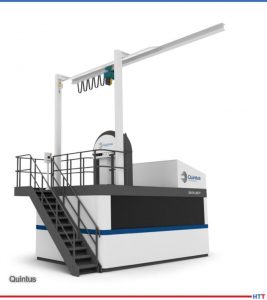
Hot Isostatic Press QIH 60 offering our most advanced Uniform Rapid Cooling (URC®) furnace technology with industry leading temperature control and accuracy
Quintus Technologies has introduced HIP systems providing capabilities beyond conventional densification. Decades’ worth of work in equipment design, system functionality, and control now offers an opportunity to perform HIP and heat treatment in a combined cycle, referred to as HPHT. Combined HIP and heat treatment for castings and AM implants can mitigate the risk of thermally induced porosity, as well as grain growth, which can offer advantages for mechanical and chemical properties in implants. This methodology provides a more sustainable processing route with improved productivity and energy efficiency. A joint HIP and heat treatment offers significant advantages with lead time, and this improvement in lead time couples well with the demands placed on the personalized medical implants. It also offers opportunities to further optimize microstructures for improvement in material properties coupled with ease of manufacturability. HPHT and modern HIP equipment may allow for a higher performing material system, which produces an implant with improved reliability and life.
Within the medical industry, fine grain AM microstructure, repeatability, and low porosity are key concerns. There are many reported benefits by applying the combined HPHT route such as reduced number of process steps, reduced cycle time and lead time, and improved process and quality control. Other advantages include spending less time at elevated temperatures helping to preserve the fine grain AM microstructure by minimizing grain growth. Tight control and steering of the cooling rates during the different steps of the HPHT cycle ensures repeatability of the properties. Manufacturability can be improved through HPHT as this approach reduces the cooling or quench severity during cooling segments which can often lead to part distortion or cracking. Improved functionality and
control go hand-in-hand with the high quality and reliability demanded in the medical industry.
ECM USA, Inc.
We have several customers making titanium alloy prothesis for various applications: shoulders, hips. Our furnaces are used for post printing processes, such as stress relieving and solution annealing.
Given concerns of metal poisoning, do you know of any changes in alloy composition of medical devices over the last decade?
Quintus Technologies
There are some metals that are becoming more common for implants, including tantalum, magnesium, CP Titanium, etc., and there have been major steps in improving ceramic materials to compete with metals for many applications.
ECM USA, Inc.
As a vacuum furnace equipment supplier, we are not deeply involved in the entire process of material selection. In the early stages of 3D printing joint replacements, from 2013 to 2014, we saw cobalt being part of some alloys. Lately it seems, indeed, that there is a trend in removing that element from the finished parts.
A Happy Ending
Dan McCurdy Former president, Bodycote, Automotive and General Industrial Heat Treatment for North America and Asia
(The rest of Dan's story from the beginning of the article....) The effects of metal poisoning and metal allergies post-surgery can be devastating. In the narrative below, Dan McCurdy shares the story of his wife’s struggle with an allergic reaction to a knee implant, and the heat treating solution that proved to be the best medicine for her.
My wife, an avid runner up and down the hills of Cincinnati, was diagnosed with osteoarthritis in both knees at the age of 53. Her orthopedist suggested a knee replacement for the most degraded one. The replacement was a well-known brand, made from investment-cast ASTM F75 (nominally a Co-Cr-Mo alloy) with full FDA-approval. After a successful surgery and diligent physical therapy, her recovery plateaued, and she experienced chronic inflammation, swelling, and pain.
A blood test, designed to detect allergies to materials used in orthopedic implants, showed a reaction to nickel that was nearly off the charts. We were surprised, as she had previously tested negative for nickel allergies through skin patch testing. The ASTM F75 specification allows for up to 0.5% bulk nickel as a tramp element in implantable devices; however, depending on foundry practices, the concentration of tramp alloys at any point on the surface of a casting can vary significantly. Titanium implants may be the solution to this, but FDA-approved titanium alloys can still contain up to 0.1% Ni.
The solution for my wife, as it turned out, was a different material, originally developed for the nuclear industry, along with an innovative heat treatment process. Created with an alloy of zirconium and niobium (with a maximum nickel content of 0.0035%), her new knee was heat treated at a high temperature in an oxidizing environment, which converts the soft zirconium surface into hard ceramic zirconia, increasing hardness and wear resistance. With this specially heat treated implant in place, my wife is back to nearly 10K steps a day.
References
[1] Magnus Ahlfors and Chad Beamer. “Hot Isostatic Pressing for Orthopedic Implants.” quintustechnologies.com/knowledge-center/hot-isostatic-pressing-for-orthopedic-implants. Quintus Technologies. 2020.
[2] Chad Beamer and Derek Denlinger. “Hot Isostatic Pressing: A Seasoned Player with New Technologies in Heat Treatment — Expert Analysis.” www.heattreattoday.com/processes/hot-isostatic-pressing/hot-isostatic-pressing-technical-content/hot-isostatic-pressing-a-seasoned-player-with-new-technologies-in-heat-treatment-expert-analysis/. Heat Treat Today. 2020.
We will be celebrating the holidays with family, so look for your next Heat Treat Daily e-newsletteron January 3rd.
2022 has been a year of many new things, as we ventured out into post-pandemic life. We are thankful to have seen many of you in-person. The heat treat community is one that is warm (pun intended) and vibrant.
We are looking to 2023 with much anticipation and hope for even more opportunities to work together and challenge ourselves and others with new ideas in the North American heat treat industry.
Thank you for the opportunities every day to serve and encourage you in our heat treat corner of the world. From the entire Heat Treat Todayteam, we wish you a very joyous and restful Christmas celebrating the birth of Jesus Christ!
Welcome to Heat TreatToday's This Week in Heat TreatSocial Media: ChristmasEdition. So much content is available on the web, and it’s next to impossible to sift through all of the articles and posts that flood our inboxes and notifications on a daily basis. Heat TreatToday can help you filter the flood to bring you a peak at holiday happenings for heat treaters. Find some gift ideas and ways to relax over the Christmas break; Heat TreatToday is thankful for you!
Don't underestimate heat treaters' creativity. A handmade knife or a piece of jewelry with heat treated sapphires will be a welcome addition under the tree.
2. Holiday Experiences
This time of year, spending time together is a great way to share the joy.
Heat treaters know that spending time with each other means good food and fellowship and ways to help others!
3. Christmas Vacation Relaxation
How fitting that there is a recording artist with the name Heat Treat (of particular interest are tunes "Heat", "Condensers", and "Refinery Surveillance")? Kick back and relax over the break while listening to some tunes. Add some TV (ahem, Heat Treat TV) watching in the mix too, and you'll never have to go out!
4. A Few More Snippets To Extend the Christmas Cheer
"Tempering" and "Brazing" can be used at any time of year, but they seem to hold special places at Christmas! Enjoy some experiments and repairs to make the holidays bright.
"It's not Christmas until we use the brazing torch!" Need we say more?
Have a great Christmas!
Find heat treating products and services when you search on Heat Treat Buyers Guide.com
The monthly Industrial Heating Equipment Association (IHEA) Executive Economic Summary released in December gives forecasts for Q4 results and takes a look into the start of 2023. The 3.9% growth from Q3 is not expected to be matched in Q4, but the spending power of the consumer holds out hope for battling recession.
The 3.9% growth from Q3 is not expected to be matched in Q4 and beyond, but the spending power of the consumer holds out hope for battling recession. The thought is that inflation highs have peaked, and interest rates could lower about halfway into 2023. Heat treaters should note that applicable indices are remaining steady while still dealing with supply chain problems and work force shortages. Of the 10 economic indices in this report, 6 sectors are steady or seeing growth; while 4 are on a downturn.
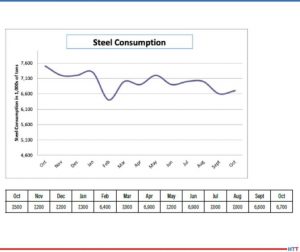
Holding steady with biggest strength found in automotive. Source: IHEA
The categories included in seeing maintenance and growth are: New Auto & Light Truck Sales, Steel Consumption, Industrial Capacity Utilization, Metal Pricing, Durable Goods, and Factory Orders. Automotive sales are strong; people are wanting and needing to replace vehicles they've maintained for a long time. "People want new and they are confident enough in their job security to buy a new vehicle."
Automobiles are still in heavy demand due to supply chain issues and need to replace older vehicles. Source: IHEA
There are no surprises from the Steel Consumption reports, as the "big three sectors are all performing about as expected – vehicle manufacturing, construction and the oil and gas arena." Metal Pricing is seeing a A Tale of Two Cities because copper is affected by political tensions around the world, but aluminum is seeing strong demand, particularly for the aerospace industry.
Interest rates are prohibitive for single-family home purchases. Source: IHEA
Those indices that are in decline or experiencing drops are: New Home Starts, Purchasing Managers Index (PMI), Capital Expenditures, and Transportation Activity. New home purchases are difficult for those buyers because the interest rates are high. There is a bit of a bright spot for heat treaters since multi-family home sales are still strong; this means metal products are needed - appliances, window frames, and construction components.
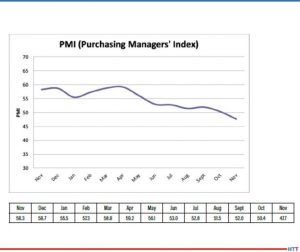
Manufacturers are showing caution in purchases. Source: IHEA
The PMI "is always a good indicator of overall industrial activity as the purchasing manager will be doing what they do at the start of any industrial process." In the report it's down to 47.7; not an emergency, but very uncomfortable level.
Anne Goyer, Executive Director of IHEA
The report on these indices takes a middle-of-the-road approach. There are no alarmingly sharp drop-offs in the reports, neither is there any drastic growth into the positive numbers; it all comes down to inflation. Economic markers are such that the interest rates are as high as they will get indicate a drop about halfway through the new year. The report looks for some lowering of the numbers to "between 4.25% and 4.50%" while the Fed members think the rate "may top out at 5.1%."
Check out the full report to see specific index growth and analysis which is available to IHEA member companies. For membership information, and a full copy of the 11-page report, contact Anne Goyer, executive director of the Industrial Heating Equipment Association (IHEA). Email Anne by clicking here.
As the next installment in this series on cybersecurity, this third article will give you a better understanding of the Department of Defense’s DFARS interim rule and its requirements.
Today's read is a Cybersecurity Desk feature written by Joe Coleman, cybersecurity officer at Bluestreak Consulting™. This column is in Heat Treat Today'sNovember 2022 Vacuumprint edition. Refresh with part 1 and part 2 in earlier editions.
Joe Coleman Cybersecurity Officer Bluestreak Consulting™ Source: Bluestreak Consulting™
DFARS Interim Rule
On September 29, 2020, the Department of Defense (DoD) published the DFARS (Defense Federal Acquisition Regulation Supplement) interim rule 2019-D041, Assessing Contractor Implementation of Cybersecurity Requirements, with an effective date of November 30, 2020. These new clauses are an extension of the original DFARS 252.204-7012 clause that has been required in DoD contracts since 2018.
The interim rule implements the NIST SP 800-171 DoD Assessment Methodology and the CMMC (Cybersecurity Maturity Model Certification) framework. The interim rule requires contracting officers to take specific action prior to awarding contracts, giving task or delivery orders, or extending an optional period of performance on existing contracts on or after November 30, 2020.
DFARS 252.204-7019 Clause: Notice of NIST SP 800-171 DoD Assessment Requirements
All DoD contractors in the Defense Industrial Base (DIB) must complete a self-assessment using the DoD’s NIST 800-171 Assessment Methodology and generate a points-based score. If the self assessment score falls below 110, contractors are required to create a POAM (Plan of Action and Milestones) and indicate by what date the security gaps will be remediated and a score of 110 will be achieved as part of the Supplier Performance Risk System (SPRS). At the time of a DoD contract award containing the new 7019 clause, a DoD contracting officer will verify that a score has been uploaded to the SPRS.
DFARS 252.204-7020 Clause: NIST 800-171 DoD Assessment Requirements
Along with the 252.204-7012 and 7019 clauses, the 7020 clause is approved for use in all DoD contracts. This new clause requires that contractors provide the government with access to its facilities, systems, and personnel when it is necessary for the DoD to conduct or renew a higher-level Assessment. The higher level Assessments are the Medium and High Assessments. The self assessment conducted as part of the 7019 clause is called a Basic Assessment.
Photo Source: Bluestreak Consulting™
A Medium Assessment is conducted by DoD personnel and will include a review of your System Security Plan (SSP) and how each of the requirements are met and to identify any language that may not adequately address the security requirements.
A High Assessment is conducted by DoD personnel onsite at the contractor’s location and will leverage the full NIST SP 800-171A (Assessing Security Requirements for Controlled Unclassified Information) to determine if the implementation meets the requirements by reviewing evidence and/or demonstration such as recent scanning results, system inventories, baseline configurations and demonstration of multi-factor authentication and/or two-factor authentication.
Along with that, this rule also requires that contractors flow down their requirements from 7019 to their subcontractors and suppliers. Just as the DoD may choose not to award a contract due to noncompliance, you may not be able to use a subcontractor or supplier due to their noncompliance.
DFARS 252.204-7021 Clause: Cybersecurity Maturity Model Certification (CMMC) Requirements
Heat treaters willing to move forward with these cybersecurity initiatives by the DoD will have an overwhelming impact on the DoD supply chain and your business. If many heat treaters in the U.S. choose to not embrace the mandatory requirements, the DoD and DoD contractors will award contracts solely to the few heat treaters who do choose to become compliant. Poor cybersecurity practices can result in hacking, loss of company data and critical customer data, and attacks by malware, viruses, and ransomware. All of this can result in major damage to the business and loss of customers, not to mention being liable for all losses and paying significant fines.
Complying with DFARS 7012 and NIST 800-171 is a requirement for all DoD contractors, subcontractors, vendors, and suppliers. The DoD has now begun confirming that contractors and subcontractors are compliant before awarding additional contracts. Navigating NIST 800-171 and DFARS is a complex and challenging — but necessary — step in this process.
This DFARS clause establishes CMMC into the federal regulatory framework. This requires that CMMC is to be included in all contracts, tasks or orders, and solicitations, with very few exceptions. The level of CMMC that is required will be determined by the DoD and added into the Request for Proposal. Contractors must maintain the appropriate CMMC level for the duration of any contract and the requirements must be trickled down to your subcontractors and suppliers. The CMMC certification is required at the time of contract award.
Watch For the Next Cybersecurity Desk Installment
My next article, number four in the series, will be: “General Cybersecurity Best Practices and What You Should and Should Not Do.
About the Author:
Joe Coleman is the cybersecurity officer at Bluestreak Consulting™, which is a division of Bluestreak | Bright AM™. Joe has over 35 years of diverse manufacturing and engineering experience. His background includes extensive training in cybersecurity, a career as a machinist, machining manager, and an early additive manufacturing (AM) pioneer.'; Contact Joe at joe.coleman@go-throughput.com.
Find heat treating products and services when you search on Heat Treat Buyers Guide.com
Watching the calendar phase from one year to the next has us all thinking about change. Karen Gantzer, senior editor and associate publisher of Heat Treat Today, gives insight to a change happening within the Heat Treat Today team. The team is thankful for the work of both Karen Gantzer and Bethany Leone and look forward to the new year and their new roles!
This article first appeared inHeat Treat Today'sDecember 2022 Medical and Energyprint edition. Feel free to contact Bethany Leone at bethany@heattreattoday.com if you have a question, comment, or any editorial contribution you’d like to submit.
Transitions. How appropriate as we look at 2023 approaching without hesitation. We have no choice but to welcome this new year, preferably with joy and perhaps a child like anticipation of the new adventures to come.
Contact us with your Reader Feedback!
One of the transitions taking place now, albeit an intentionally slow and steady one, is the move of all the print responsibilities at Heat Treat Today from my plate to Bethany Leone’s as she continues to assume the managing editor role.
I’ve been leading the editorial team for the past several years as we’ve expanded to eight annual print magazines. I have loved helping to produce them each quarter, and honestly, it’s been difficult passing the baton of this responsibility. Not because I don’t think Bethany can do it — I know she will do a phenomenal job in leading the team. I’m seeing it now and am so stoked!
No, it’s because I kind of see the magazine as my “baby.” It’s hard to give it up! Can anyone relate? When you work on a project and see it grow, how exciting and rewarding. To build our team and watch them pivot when necessary and contribute creative and thoughtful ideas to help better serve has truly been energizing and exciting. I think it’s because I love experiencing the process and seeing that magazine in print.
However, the time has come for Bethany to receive the complete baton hand off. (If you ever ran on a relay team and practiced those hand offs, do you remember running with your hand outstretched behind you and adjusting your speed so that you could achieve the perfect transition of the baton from your teammate’s hand to yours without dropping the baton?!) Bethany has her hand in perfect position to receive the baton and I’m looking forward to passing it to her smoothly and completely so that she can run with confidence and vigor.
I’m not leaving Heat Treat Today, just transitioning into new responsibilities — that of associate publisher and senior editor. I’ll still be able to be part of the print publication from 20,000 feet, just not up close and personal (for which Bethany will be incredibly thankful)! I’m looking forward to working on special projects and learning other facets of the publishing world.
So, in February 2023’s Air and AtmosphereHeat Treat magazine, you’ll see Bethany’s picture on this page and enjoy her column in each issue, and you’ll know then that hand off went down without a hitch!
Find heat treating products and services when you search on Heat Treat Buyers Guide.com
In this article, explore the importance of alternative advanced manufacturing processes and the effects of post-process heat treating of DMLS titanium alloy parts. In a recent study, a team at Worcester Polytechnic Institute (WPI) evaluated the effects of these processes. Read along to see what they found.
This Technical Tuesday article was first published in Heat Treat Today's December 2022 Medical and Energy print edition.
Contact us with your Reader Feedback!
Jianyu Liang Professor of Mechanical and Materials Engineering at Worchester Polytechnic Institute Source: WPI
According to Markets and Markets reports, the metal implants and medical alloys market 1 will reach $17.64 billion by 2024, at a CAGR of 9.4%, with titanium metal implants and medical alloys accounting for the largest share of the market. Since it was first reported in the 1940s that titanium had excellent compatibility with human bones, titanium has been used in a wide range of biomedical applications, including arthroplasty and bone replacement, prostheses, craniofacial, maxillofacial, and dental implants, as well as surgical instruments and healthcare goods. 2,3
Although Ti-6Al-4V alloy was originally developed for aerospace applications, its many attractive properties — such as high strength-to-weight ratio, satisfactory biocompatibility, and good corrosion resistance — resulted in it being one of the most widely used biomedical alloys. 4
However, Ti-6Al-4V alloy is very difficult to machine. Traditional Ti-6Al-4V manufacturing processes include casting, wrought (forging/milling from ingots), and powder metallurgy (P/M), with wrought products accounting for 70% of the titanium and titanium alloy market. 5
In recent decades, additive manufacturing (AM) processes have been rigorously
Richard Sisson Key Heat Treat Researcher and Lecturer at Worchester Polytechnic Institute Source: WPI
developed as an alternative advanced manufacturing process for Ti-6Al-4V, especially in personalized biomedical applications. Alternate processes, including powder-bed fusion (PBF), directed energy deposition (DED), and sheet lamination (SL) have been applied in AM processing of titanium and its alloys. 6 Direct metal laser sintering (DMLS), a PBF technology, was the first commercial rapid prototyping method to produce metal parts in a single process and is one of the most widely used AM technologies to manufacture Ti-6Al-4V parts. 7 However, even with the protective oxide film (mainly TiO2), titanium alloys still suffer from pitting and crevice corrosion. Localized breakdown of the protective film leads to the formation of pits. These pits can grow and propagate into macroscopic cracks, which lead to catastrophic failure in orthopedic applications. 8,9
It was reported that post-heat treatment of Ti-6Al-4V parts fabricated by AM techniques could improve its mechanical properties, especially increasing ductility and fatigue strength.
Yangzi Xu Yield & Module Process Engineer at Intel Corporation Source: WPI
However, the changes in corrosion behavior with various post-heat treatments of Ti-6Al- 4V parts fabricated by AM techniques have not been fully understood. In a recent study, a team at Worcester Polytechnic Institute (WPI) evaluated the effects of various post-process heat treatments (including solution treatment and aging, annealing, stress relief, and hot isostatic pressing (HIP)), on the corrosion behavior of Ti-6Al-4V parts manufactured by DMLS. The researchers then proposed a desirable posttreatment procedure that can obtain a good combination of mechanical properties and corrosion behavior of as-printed parts in a simulated body environment. 10,11,12
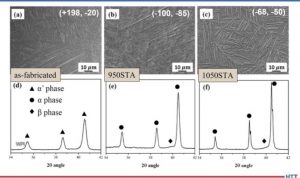
Ti-6Al-4V dumbbell-shaped tensile testing bars were fabricated by DMLS, according to ASTM standards. The microstructure, phase fraction, porosity, and residual stress of as-printed parts were examined and compared to those of the commercial Grade 5 alloy. It was found that the as-printed samples, mainly composed of acicular α’ martensite phase with a small amount of nano-scaled β precipitates, dispersed in the α’ matrix due to rapid cooling during laser processing, whereas the Grade 5 alloy has an α + β two phase with an equiaxed microstructure. The β phase fractions in the as-printed and Grade 5 alloy were 1.6% and 20%, respectively, based on the results of x-ray diffraction refinement. Furthermore, porosity and defects due to lack of fusion or entrapped gas were observed in the DMLS samples. The rapid cooling rate also resulted in residual tensile stress in the as-printed parts.
The microstructure and phase changes due to different heat-treatment processes were examined and compared to those of the commercial Grade 5 alloy. The corrosion behavior of the heat-treated DMLS parts was studied in simulated body fluid by well-established electrochemical methods.
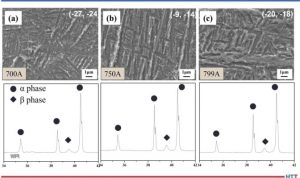
Microstructure: coarsening of the α lath thickness, more spherical β precipitates. Phase identification: narrowed α characteristic peaks (reduced compressive residual stress) Source: WPI
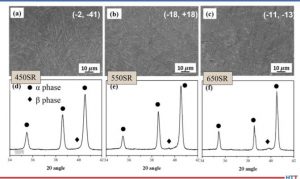
Transformation from α’ to α phase, coarsening of the α lath microstructure, and the development of β phase were observed in samples after heat treatments. The greatest fraction of β phase was obtained in the high temperature annealed sample. Enhanced corrosion resistance was found in all heat-treated samples. The reasons for improved corrosion resistance after heat treatments include: 1) a passive layer that was developed on the sample surface after heat-treatments; 2) increased β phase fraction and size after heat treatments that led to the reduction of the corrosion susceptible sites. Furthermore, only a single passive layer has been observed in the as-printed sample, whereas double passive layers have been observed in samples after heat treatments at temperature higher than 550°C. However, this second layer, which was largely composed of Al2O3 and V2O5, had very low corrosion resistance compared to that of the primary passive layer that was primarily TiO2.
Microstructure: coarsening of the α lath, and grain boundary can be observed Phase identification: narrowing of α characteristic peaks (reduced microstrain, increased grain size) and evolution of β phase Source: WPI
It was also found that the surface roughness had an exponential effect on the corrosion current density and calculated corrosion rate. A rough surface led to a higher corrosion rate, but a rough surface is known to enhance osteointegration. Therefore, surface roughness needs to be adjusted, based on specific applications.
Microstructure: no significant change in the α lath thickness Phase identification: narrowing of α characteristic peaks (reduced microstrain), evolution of β phase Source: WPI
The effect of porosity was analyzed by using a crevice corrosion test. After a one-month immersion in Ringer’s solution at body temperature, pits were found on the Ti-6Al-4V sample surface near the pores in the as-printed samples, which was due to the formation of localized O2 concentration cells near the pore. Porosity in the as-printed parts was confirmed to impair crevice corrosion resistance. To reduce porosity, HIP was applied at three different temperatures. Based on polarization tests and electrochemical impedance spectroscopy tests, different degrees of reduction in porosity and corrosion-current density were observed in samples after HIP; this reduction was most significant after high-temperature HIP at 799°C (1470°F).
In summary, it was found that high temperature heat-treatment enhanced the corrosion resistance of DMLS Ti-6Al-4V parts. HIP was effective in reducing porosity and improving corrosion resistance. HIP below the annealing temperature (799°C, 1470°F) was recommended as a post-treatment for DMLSprintedTi-6Al-4V, to achieve a good corrosion resistance.
References
[1] “Metal Implants and Medical Alloys Market – Global Forecast to 2024,” 2019. https://www.marketsandmarkets.com/Market- Reports/metal-implant-medical-alloy-market-256117768.html.
[2] R. Bothe, et al., “Reaction of bone to multiple metallic implants.” Surgery, Gynecology and Obstetrics, 1940, 71:598–602.
[3] M. Sarraf, E. Rezvani Ghomi, S. Alipour, et al., “A state-of-the-art review of the fabrication and characteristics of titanium and its alloys for biomedical applications,” Bio-des. Manuf., 2022, 5, 371–395. https://doi.org/10.1007/s42242-021-00170-3.
[4] L.-C. Zhang and L.-Y. Chen, “A Review on Biomedical Titanium Alloys: Recent Progress and Prospect,” Adv. Eng. Mater., 2019, 21: 1801215. https://doi.org/10.1002/adem.201801215.
[5] L. E. Murr, S. A. Quinones, et al., “Microstructure and mechanical behavior of Ti–6Al–4V produced by rapid-layer manufacturing, for biomedical applications,” Journal of the mechanical behavior of biomedical materials, 2009, 2(1), 20-32. https://doi. org/10.1016/j.jmbbm.2008.05.004.
[6] A. Hung Dang Nguyen, A. K. Pramanik, Y. Basak, C. Dong, S. Prakash, S. Debnath, I. S. Shankar, Saurav Dixit Jawahir, and Budhi Dharam, “A critical review on additive manufacturing of Ti-6Al- 4V alloy: microstructure and mechanical properties,” Journal of Materials Research and Technology, 2022, 18: 4641-4661. https://doi.org/10.1016/j.jmrt.2022.04.055.
[7] “Direct Metal Laser Sintering (DMLS) Technology,” Additive News. https://additivenews.com/direct-metal-laser-sintering-dmlstechnology/.
[8] O. Cissé, O. Savadogo, M. Wu, and L’H Yahia, “Effect of surface treatment of NiTi alloy on its corrosion behavior in Hanks’ solution.” Journal of Biomedical Materials Research, 2002, 61/ 3 :
339-345. https://doi.org/10.1002/jbm.10114
[9] Sara A. Atwood, Eli W. Patten, Kevin J. Bozic, Lisa A. Pruitt, and Michael D. Ries,”Corrosion-induced fracture of a double-modular hip prosthesis,” The Journal of Bone & Joint Surgery, 2010, 92/ 6: 1522-1525.
[10] Y. Xu, Y. Lu, K.L. Sundberg, et al., “Eff ect of Annealing Treatments on the Microstructure, Mechanical Properties and Corrosion Behavior of Direct Metal Laser Sintered Ti-6Al-4V,” J. of Material Eng and Perform, 2017, 26: 2572–2582. https://doi.org/10.1007/ s11665-017-2710-y
[11] Ibid.
[12] Z. Yang, Y. Xu, R. D. Sisson, & J. Liang, “Factors Influencing the Corrosion Behavior of Direct Metal Laser Sintered Ti-6Al-4V for Biomedical Applications,” Journal of Materials Engineering and Performance, 2020, 29/6: 3831-3839.
About the Authors
Professor Richard Sisson is a key heat treat researcher and lecturer at Worchester Polytechnic Institute. His main research interest is the application of diffusion and thermodynamics to the solution of materials problems. Currently, he is working on modeling the surface treatment of steels and the postprocessing of AM ceramics and metals. His research endeavors have resulted in over 300 publications and over 300 technical presentations.
Dr. Yangzi Xu is currently working at Intel Corporation as a Yield & Module Process Engineer. She received her PhD at Worcester Polytechnic Institute (WPI) and focuses her research on understanding the mechanical and electrochemical properties of AM Ti alloys with different types of heat treatments, and their corrosion performance in biofluid for potential orthopedic applications. Her background includes research in polymer and food science and engineering.
Professor Jianyu Liang is a Professor of Mechanical and Materials Engineering at Worchester Polytechnic Institute, with affiliated appointments in the departments of Civil and Environmental Engineering, Chemical Engineering, and Fire Protection Engineering. Her research work on nanomaterials, AM, agile manufacturing, machine learning for materials science and manufacturing engineering, and sustainability has been funded by NSF, NASA, DoD, ED, and industry. Her work has resulted in over 300 research papers and technical presentations. As an educator, Liang strives to equip students with the confidence, enthusiasm, knowledge, and skills to allow them to enjoy learning throughout their lives.
For more information
Department of Mechanical and Materials Engineering Worcester Polytechnic Institute, 100 Institute Road, Worcester, MA 01609 Or email jianyul@wpi.edu and sisson@wpi.edu
Find heat treating products and services when you search on Heat Treat Buyers Guide.com
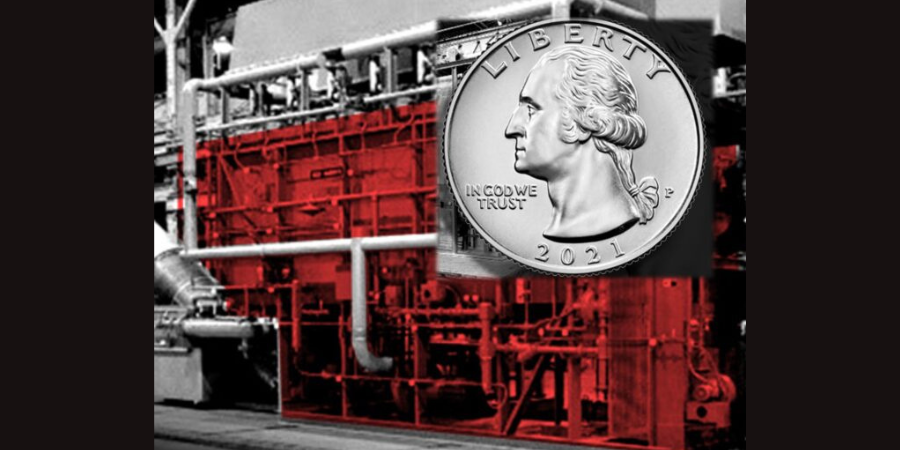
The Philadelphia Mint recently began a round of upgrades for its heat treat furnaces. Their function in the minting process is to anneal, clean, and dry the coin blanks to soften the metal prior to striking into coins, extending the service life of the striking dies.
SECO/WARWICK Group’s American subsidiary, located in Meadville, PA, recently began upgrades, a refurbishment of all five of the Philadelphia Mint’s heat-treating furnaces, one furnace per year. The heat-treating furnaces were originally installed there by SECO/WARWICK USA from 1994 through 2000.
All five furnaces are 4000 pound per hour rotary retort furnaces outfitted with a quench system, as well as a hopper feeder, a batch burnish barrel, and a batch/continuous drum drier. The furnaces are showing their age after a quartercentury, so rather than nickel and dime the maintenance, the mint opted for a comprehensive refurbishment.
“Our Partner has plenty of coin to heat-treat, but they don’t have any to burn," commented Marcus Lord, managing director at SECO/WARWICK USA. "These waste-heat recovery and combustion efficiency upgrades are going to save them a mint while cutting carbon and NOx emissions nearly in half."
The small letter at the nape of Washington’s neck in the coin image above is a mint mark. The “P” indicates that the coin was struck at the Philadelphia Mint. Source: SECO/WARWICK Group
To reduce energy consumption, the Mint is replacing insulation, roof panels, and radiant tubes as well as upgrading the loading systems. More energy efficient burners are being installed, along with recuperators to preheat the combustion air, to improve energy efficiency and use less natural gas. Mechanical improvements include replacing drive motors and two-speed gear boxes. The retort can over-heat and warp if the rotary retort unexpectedly stops before the cool-down cycle. As a failsafe, SECO/WARWICK added a pneumatic backup motor that can run the gear box off the Mint’s compressed air reservoir during a power outage.
The mint was established by the Coinage Act of 1792, when Philadelphia was the nation’s capital. It was the first public building constructed under the direction of the recently formed United States government. The machinery was powered by a horse walking circles in the basement.
Find heat treating products and services when you search on Heat Treat Buyers Guide.com
Last Friday Stellantis announced it will indefinitely halt operations at an Illinois assembly plant in February, citing the rising costs of electric vehicle production.
The automaker, which employs about 1,350 workers at the Belvidere, Illinois plant that builds the Jeep Cherokee SUV, said the action will result in indefinite layoffs and added it may not resume operations as it considers other options. Stellantis said the industry "has been adversely affected by a multitude of factors like the ongoing COVID-19 pandemic and the global microchip shortage, but the most impactful challenge is the increasing cost related to the electrification of the automotive market." The company had said it will invest over 30 billion euros ($31.6 billion) through 2025 on electrifying its vehicle lineup, and also expected EVs to make up 100% of its sales in Europe and 50% in the United States by 2030.
The company shared it is working to identify other opportunities to repurpose the Belvidere facility and has no additional details to share at this time. Sam Fiorani, head of production at AutoForecast Solutions said the UAW and Stellantis could reach a deal in contract talks next year for a new vehicle for the plant "but any new product redirected its way will take investment and time to retool the plant, leaving Belvidere empty for a year or more."




 Heat Treat Today publishes eight print magazines a year and included in each is a letter from the publisher, Doug Glenn. This letter first appeared in Heat Treat Today’s December 2022 Medical and Energy Heat Treat Issue print edition.


 If you’re not a heat treat industry supplier, we encourage you, as a consumer of heat treat products, services, or supplies, to attend the event. The technology that you will see will be eye-opening. Please let us know if we can be helpful getting you to Dusseldorf in June 2023.
 Find heat treating products and services when you search on Heat Treat Buyers Guide.com
 Heat treating solutions are important for more than keeping an airplane flying in the sky or a bridge suspended above the water. These two examples are high profile, but what about the heat treating solutions that do not zoom through the air or mark the skyline above rivers? In the medical industry, heat treating solutions are often unseen unless something goes wrong.











 As the next installment in this series on cybersecurity, this third article will give you a better understanding of the Department of Defense’s DFARS interim rule and its requirements.









 The Philadelphia Mint recently began a round of upgrades for its heat treat furnaces. Their function in the minting process is to anneal, clean, and dry the coin blanks to soften the metal prior to striking into coins, extending the service life of the striking dies.