


Tiffany@heattreattoday.com

Heat Treat Radio #122: Lessons Learned from the Nadcap Certification Journey for Multi-Cell Furnaces 

In this Heat Treat Radio episode, Doug Glenn talks with Andrew Chan, sales and applications engineer, ALD Vacuum Technologies North America Inc, Kelly Peters, vice president of operations, and David Dillon, maintenance manager for ALD Thermal Treatment Inc. 

Listen as guests share their experiences navigating the complex requirements, challenges, and organizational changes needed for Nadcap certification. Their journey discovering how multi-cell heat treatment furnaces can come into Nadcap compliance underscores the importance of technology, training, and continuous improvement.

Listeners will learn practical insights into achieving and maintaining Nadcap accreditation for advanced heat treatment processes. 

Below, you can watch the video, listen to the podcast by clicking on the audio play button, or read an edited transcript.


Introduction (01:13)  

Doug Glenn: In preparation for this episode, we discussed the situation that sparked our desire to engage in this conversation, which involved both ALD and some of your customers. We wanted to discuss people not knowing that a multi-cell heat treatment furnace could be Nadcap-certified. Can you tell us a little bit about that? 

Andrew Chan: ALD participates in all the major heat treatment trade shows, including the last two Furnaces North America events, and we noticed a lack of awareness that multi-cell heat treatment furnaces can be Nadcap certified. We found through interactions with visitors at our booth and conversations during the social hours that people really had it engraved in their minds that only single cell heat treatment equipment could be Nadcap certified. 

This was true until about five years ago with the newest revision of AMS2769D. Therefore, the real impetus is just to bring awareness to the industry that you’re now able to certify and use multi-cell heat treatment equipment for aerospace applications. With that, you get volume capacity, which historically has been associated with the automotive industry, both the OEMs and their suppliers, but we can bring that benefit to the aerospace market and lower heat treatment costs. 

Understanding Multi-Cell Furnace Systems (05:15)

Doug Glenn: What are multi-cell heat treatment furnaces, how are they designed, and how do they work? 

Andrew Chan: An example of a multi-cell furnace is our ModulTherm® or our SyncroTherm® furnace. As you can see in this image, these are individual vacuum chambers, which we call a treatment cell, and you can line up about fourteen of these in a row. Each one is dedicated to heat treating a single load.  
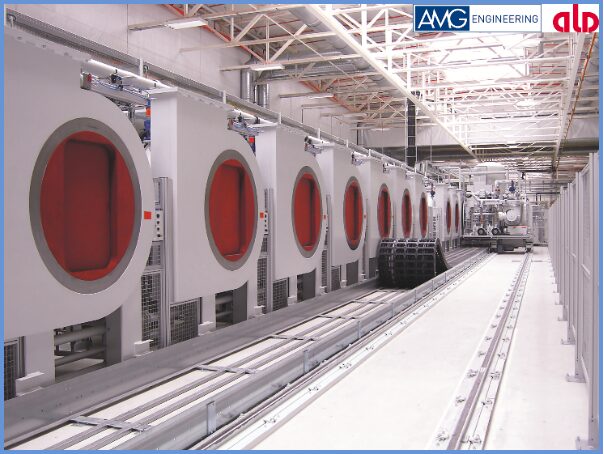
ALD’s ModulTherm® system, an example of multi-cell furnaces

The treatment cell has its own insulation, heating elements, process, and gas; all of these are serviced by a single transfer car that you can see down at the end of the rail with the track. Then, our quenching cell is attached to that transfer car. We have this movable transfer car that loads and unloads the parts, and then we quench them immediately after pulling them out of each treatment cell. We can also do oil quenching, but the oil quench would just be a fixed tank — it would not be on this movable transfer car. 

Doug Glenn: Are you talking about a high pressure gas quench? 

Andrew Chan: Yes, this is a high pressure gas quench. Historically it’s been helium, but we can also do nitrogen, since helium costs have started to increase over the last couple decades.  

Doug Glenn: Is that transfer car under vacuum during the transfer? 

Andrew Chan: Yes, everything is done under vacuum. We transfer between the red doors, which are basically like isolation doors. When we pull the load out to quench it, it’s done very quickly, also under vacuum, we quench up to 20 bar. 

Doug Glenn: Is this your ModulTherm model? 

Andrew Chan: Yes, this image is of our ModulTherm. This second image is of our SyncroTherm model, which is like a mini ModulTherm.  
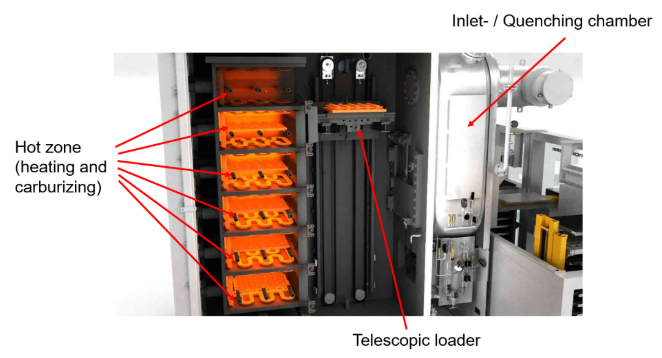
Nadcap certification is possible for multi-cell furnace systems, like the SyncroTherm®

We describe this model like a pizza oven. We have multiple hot zones stacked on top of each other, and the footprint for the hot zone is approximately 500 x 600 millimeters. It is a smaller footprint than the ModulTherm model. Everything is under the same vacuum environment, and then similarly, we have a transfer — a telescopic loader that moves the load between the hot zone and the quench — and then a single quenching chamber, which also functions as the inlet and outlet for the load. 

What is Nadcap Certification? (8:25)

Doug Glenn: What is Nadcap certification? 

Kelly Peters: Nadcap certification is a comprehensive approach to aerospace and specifications. It covers maintenance, pyrometry, heat treater training, quality control, and even contract review. It focuses more on the process, not so much on the product, and it is audited by a third-party organization called PRI (Performance Review Institute).  

PRI will review your processes, supporting data, and entire management system. The accreditation process involves an internal audit completed by the organization with some corrective actions. Then, you can complete your initial audit with PRI.  

You must complete that internal audit first, and then once you go through the initial audit, you’ll be assigned a staff engineer. This person will review the findings from that initial audit, as well as your corrective actions and supporting data.  

If the staff engineer approves, you’ll move on to the next stage, which is actually going in front of an engineering team where they vote on whether you’ll be accredited.  

When it comes to heat treatment specifically for Nadcap, however, the audit really covers all of your AMS specifications, processes, relevant instrumentation, pyrometry, etc. 

Doug Glenn: Is the team of engineers that you mentioned internal or through PRI? 

Kelly Peters: They are through PRI. 

Doug Glenn: Is this certification and audit exclusively for the aerospace industry or is it applied to other industries? 

Kelly Peters: Nadcap is primarily for aerospace and defense. 

Process of ALD’s Nadcap Journey: Challenges and Timeline (10:25) 

Doug Glenn: Once you realized that you could Nadcap certify your equipment that Andrew and his team build, how did your Nadcap process go? Can you tell us how you got started and the timeline? 

Kelly Peters: The process was definitely very intimidating at first. In general, I would say the average time period in the industry is about 18 months of preparation before you find yourself going through the actual PRI audit.  

In our case, it took us about a year. We had a lot to do within that year. There were four months that it was all initial procedure revision. This step involves reviewing maintenance, production, and quality control processes and procedures to ensure they meet Nadcap requirements.  

You also have to go through commercial compliance. Therefore, you want to ensure that you’re meeting those specifications from the commercial side, specifically during contract review and processes.  

The largest portion of preparing was data collection and organizational changes, which took us about six to seven months to accomplish because you have to gather all the data necessary, implement changes, and then make those changes daily to ensure you’re actually in compliance.  
By the time you do your self-audit, you’re already zoning in on those items and initiating corrective actions to prepare for accreditation. About two months later, we scheduled our actual PRI audit and had them on-site. 

Doug Glenn: What do you mean by “organizational changes”?  

Kelly Peters: I’m implying changes to operational organization, for example, your management system.  

Overcoming Doubts and Technical Hurdles (14:28)

Doug Glenn: Dave, I assume you were involved with this process from the beginning.  

Dave Dillon: Yes, I was involved quite a bit. 

Doug Glenn: Were there any major potholes that occurred where you had to change a flat tire after you hit it? 

Dave Dillon: The biggest issue initially was how new the process was to us, which felt overwhelming — we didn’t know what to expect. As such, we had self-doubt. When we overcame that and started getting into the nuts and bolts of the process, the biggest challenge was reviewing our existing requirements from customers and our controlling standards, ensuring they met the Nadcap requirements. If they didn’t, we had to bring them up to that standard. 
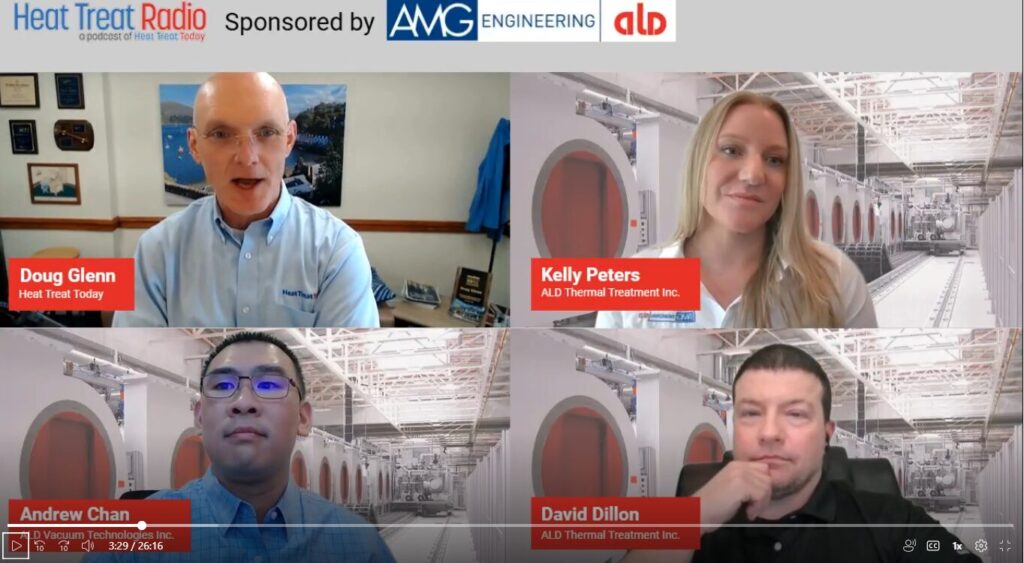
Heat Treat Radio Episode #122 Andrew Chan, Kelly Peters, and David Dillon sharing their Nadcap experience

Doug Glenn: What was the most intimidating piece of the process or that stood out as a really difficult step?  

Kelly Peters: From my perspective, this goes right back to what Andrew said at the beginning of our discussion where there was a time when you didn’t believe you could get this accreditation for these ModulTherm systems. Because we were so ingrained in that thought process — that this was going to be such a hard, difficult challenge to get through — that we had to break through the barrier and realize that most of the challenge is in you, not so much in the system. The specifications are out there. Your job is to follow them. Your job is to implement them. It can be done. 

Dave Dillon: The biggest challenge for me was all the pyrometry requirements from AMS2750. We were doing it all on the fly, and we didn’t hire any additional staffing, so it was very challenging at first. Then eventually we determined that we needed to have our own pyrometry technician to make sure the testing was completed within the time allotted. 

Doug Glenn: When we discussed this before, you mentioned that you guys had engaged C3 Data to help you along the process. Can you tell us about that?  

Dave Dillon: Our pyrometry technician is an internal guy, but we started out by doing everything by hand — all of the paperwork, documentation, etc. Someone had recommended C3 Data to us, and after we reviewed their software, we realized it was a perfect process for us. The software allows us to eliminate human error. It gives you automatic checks, and then it provides a digital record for the auditors — great software. 

Doug Glenn: Kelly, what was your experience with C3 Data?  

Kelly Peters: Dave is definitely the one taking care of the groundwork, so I don’t have personal experience with C3 Data. However, I did notice that our internal findings were less driven by human error, as Dave was saying, because we were no longer using manual Excel spreadsheets and so didn’t have the ability to accidentally hit the wrong number. The data became more reliable. 

Doug Glenn: When it finally came time to do the actual PRI audit, how intimidating was that and how did it go? 

Dave Dillon: To be honest, it was terrifying. We were all nervous because it was all so new to us — it seemed very overwhelming. But the auditors, to their credit, are very good, and they help you through it. The most surprising part of the audit was that we were able to get accredited on our initial audit. 

Doug Glenn: I also understand you earned Nadcap merit. Can you tell us what that is? 

Kelly Peters: A unique aspect of the Nadcap accreditation is that once a company meets a certain criteria, that company can enter a merit program, which means you can go up to 24 months between your audits. Currently, Port Huron is at our 18-month mark, and that happened just after our last audit, so we’re very proud of that. 

Lessons Learned and Ongoing Improvements (19:46)

Doug Glenn: What are some lessons learned from this experience? 

“When it comes to lessons learned, ensuring that your new hires and your current staff are continually getting training, which is true with any type of process in manufacturing and business.”
Source: Canva Pro

Kelly Peters: When it comes to lessons learned, ensuring that your new hires and your current staff are continually getting training, which is true with any type of process in manufacturing and business. For pyrometry, we need to make sure we have a contingency. Dave knows it all, but if Dave wins the lottery tomorrow, we need someone to be able to step in and take over that process. Therefore, continual improvement, training, and reinforcing are critical because it’s all about maintaining a system, just like any other system that you have in place. I certainly would say that is not necessarily a challenge, but something to keep an eye on. 

Doug Glenn: Andrew, were you involved with the Nadcap approval process on the equipment side? 

Andrew Chan: I was not involved with the process for their specific equipment at Port Huron. However, from an equipment supplier perspective, it’s been challenging to help people understand that it’s possible to certify this equipment in the first place. 

We’re starting to see more interest in this now. Since we have this long history with our specific design, it doesn’t require many changes to make the equipment Nadcap certified. We have a comprehensive control system that does everything automatically, including data recording and being able to interrogate the data historically. With a couple tweaks to the equipment, like making sure the gas is dry and clean, and adjustments on the pyrometry side, it’s possible to be certification-ready. You just have to find someone that’s willing to take the equipment and go through the process that the equipment at Port Huron went through. 

Uses of Multi-Cell Furnaces (22:34)

Doug Glenn: What would the ideal company profile be that could benefit from knowing about this certification and having this equipment?  

Andrew Chan: This is dependent upon the parts that a company is producing. The ModulTherm is geared more towards larger pieces. The SyncroTherm is more of a competitive product and we have seen it used for aerospace before. The SyncroTherm is probably the right solution for most of our customers looking to get into this process.  

The ModulTherm is for high throughput, component heat treating. The automotive industry was one of the first industries to adopt it. In a way, they are more advanced than the aerospace industry, as they were able to adopt multi-cellular heat treatment into their industry. This is one of innovations that the aerospace industry is catching up on. 

We haven’t quite seen the demand on the ModulTherm side yet, but the SyncroTherm is probably the right furnace — something small that heat treats aerospace components with a small footprint and a very rapid turnaround time. 

Doug Glenn: Well, that’s great guys. Thanks very much. Kelly, Andrew, Dave, thanks for being with us. Hopefully it’s going to be helpful to some of our listeners, so appreciate you being here. 

About the Guests

Andrew Chan
sales and applications engineer
ALD Vacuum Technologies North America Inc

Andrew Chan has a background in Materials Science & Engineering and has been with ALD Vacuum Technologies North America Inc since 2020.  Andrew supports ALD’s vacuum heat treatment customers to specify new equipment builds and heat treatment process troubleshooting.  In addition, Andrew is responsible for EB-PVD technologies and assists with the vacuum metallurgy portfolio. 

Kelly Peters
vice president of operations
ALD Thermal Treatment Inc

Kelly Peters has been with ALD Thermal Treatment Inc since 2007, throughout her career at ALD she has held different job responsibilities primarily within R&D and Quality. Kelly Peters is a Heat Treat Today 40 under 40 Class of 2020 nominee.

David Dillon
maintenance manager
ALD Thermal Treatment Inc.

David Dillon has been with ALD Thermal Treatment Inc since 2006, working on equipment installations and maintenance locally in Port Huon. Dave now not only manages local maintenance activities but assists the parent company in equipment installations and services when needed




Heat Treat Radio #122: Lessons Learned from the Nadcap Certification Journey for Multi-Cell Furnaces  Read More »

Tariffs, Supply Chains, & Heat Treating 

Heat Treat Today publishes twelve print magazines annually and included in each is a letter from the publisher, Doug Glenn. This letter is from the June 2025 Buyers Guide print edition.

Feel free to contact Doug at doug@heattreattoday.com if you have a question or comment. 


The Age of Tariffs 

In 2025, procuring nearly anything has become a bit more “interesting,” shall we say, with the complete and total shake up of the world’s economy with hasty and heavy tariffs imposed by the U.S. on the rest of the world. 

For posterity, let me record a few basic facts about what is happening. On April 2, 2025, newly re-elected U.S. President, Donald J. Trump, imposed what was described as “reciprocal tariffs” on nearly every country in the world. April 2 was chosen because President Trump did not want people to think that he was just kidding by imposing the tariffs on April 1, April Fools’ Day. All previous trade agreements were instantly and unilaterally eliminated. 

The tariffs were, in fact, not truly reciprocal as one might simply understand that word. Instead, each nation’s actual tariffs were combined with their trade deficit and currency manipulation and then divided in half to arrive at what President Trump called “U.S.A. Discounted Reciprocal Tariffs.” No country escaped. Everyone had at least a 10% tariff. China was hit with a 34% reciprocal tariff – their calculated tariff was 67%. India received a 26% reciprocal tariff – their calculated tariff was 52%. 

Roughly a week later, while the world was still reeling, all tariffs were reduced to 10% assuming the country did not retaliate. Only one country retaliated – China. China’s tariffs have ranged as high as 145% and as low as 30% as the two countries struggle to come to an agreement. It is safe to describe the relationship between the two countries as very tense. 

Understanding Tariffs 

Before exploring how these tariffs might impact the North America heat treating and thermal processing markets, let me first make two recommendations for anyone wanting to learn more about tariffs and good, sound economics. 

  1. The best book I’ve ever read about tariffs is an old classic book written by Frederic Bastiat entitled, Economic Sophisms. The book is spot on and simple and shows how tariffs are not generally helpful from an economic perspective. Bastiat was also the author of another great, short book called The Law. I recommend both. 
  2. Another excellent book that discusses tariffs is Henry Hazlitt’s Economics in One Lesson, especially chapter eleven, “Who’s ‘Protected’ by Tariffs.” 

Of course, economics aren’t the only reason a country imposes tariffs. Preserving industries critical to national defense is one such non-economic reason often cited for imposing tariffs. 

The Upside of Tariffs 

So, what are the potential impacts of tariffs on the North American thermal processing industry? Given that tariffs are, in essence, a tax, there are few true economic gains to be made. However, it is very possible that our commercial heat treater brothers and sisters may benefit significantly from tariffs, especially if more and more manufacturing returns to the U.S. This return of manufacturing would also potentially benefit many oven, furnace, and induction equipment manufacturers, as well as component suppliers. Any increase in manufacturing State-side will bode well for industry suppliers. 

The Downside of Tariffs 

The potential downsides are legion. The most notable? Instead of stimulating manufacturing in the U.S., it is possible that tariffs will start to significantly impact exports. If that happens, manufacturing will take it on the chin due to artificially restricted demand. Not only would this hurt many of the companies that read this publication and perform their own in-house thermal processing, but it will have the trickle-down effect of drying up demand for new furnaces, ovens, and components. 

Tariffs also could be a real boon for furnace and oven manufacturers located within the borders of the U.S. Assuming the tariffs persist (which is doubtful), companies building furnaces in the U.S. will have a significant competitive advantage. However, the opposite is true for furnace manufacturers who build internationally and ship their equipment into the U.S. Currently, there are a significant number of international furnace manufacturers doing business in the U.S. These companies are at risk. 

The Real Goal of Trump’s Tariffs 

If the real goal of Trump’s tariffs is to lower all tariffs everywhere, this whole tariff chapter should end well, ultimately. If, however, President Trump really does “loooove tariffs” as he has claimed, the new Golden Age will not be as golden as it might have been. 

Doug Glenn
Publisher
Heat Treat Today

For more information: Contact Doug at doug@heattreattoday.com


Tariffs, Supply Chains, & Heat Treating  Read More »

Smarter Furnace Systems: Engineering Energy for Sustainability from the Ground Up 

There are many avenues for achieving new feats in sustainability. One foundational method of pursuing sustainability is efficient furnace design. In this Control’s Corner installment of Technical Tuesday, Stanley Rutkowski III, senior applications engineer, RoMan Manufacturing, Inc., explores ways to design furnace electrical power systems for efficiency.

This informative piece was first released in Heat Treat Today’s June 2025 Buyers Guide print edition.


In the world of industrial heat treating, sustainability isn’t just a buzzword; it’s a measurable outcome of engineering decisions. While discussions around energy usage often focus on renewable sources or carbon offsets, the path to sustainability begins much earlier — with the design of the furnace’s electrical power system. 

From transformers and load configurations to modern control technologies, every part of the furnace power pathway affects how efficiently energy is used — and how much of it is wasted. A well-designed system doesn’t just heat effectively; it does so with less resistance, fewer losses, and minimal disruption to the power grid. 

The Power Triangle: Real, Reactive, and Apparent 

Understanding sustainability starts with understanding how energy is consumed. Utility companies bill based on more than just energy (kWh). They measure and potentially build via: 

  • Real power (kW): the usable energy 
  • Reactive power (kVAR): the energy lost due to inductance and system inefficiencies 
  • Apparent power (kVA): the total power delivered, including losses 
  • Power factor: the ratio of real power to apparent power, indicating system efficiency 
  • Peak demand: the highest level of power drawn during a billing period 

Furnace systems with poor power factor or high reactive power incur more cost, even if their real energy usage is low. That’s why electrical design is so critical. 

Control Systems: The Shift to Digital 

Legacy systems, such as tubes or saturable reactor-based VRTs, have largely given way to more efficient SCR- (silicon controlled rectifier) and IGBT- (insulated-gate bipolar transistor) based controls. IGBT technology, in particular, offers high-frequency switching, reduced losses, and excellent power factor performance. These systems also provide communication protocols — giving real-time insight into power draw, voltage stability, control temperatures, and even predictive maintenance alerts. 

Digital communication allows users to evaluate trends over time. For example, changes in DC bus voltage or output current may signal a degrading heating element, enabling early intervention. Smart controls also help avoid peak demand charges by shifting high-load operations to off-peak hours or adjusting recipes to consume less total power. 

Load Configurations and Layout

Load configuration is equally as important: single-phase, Scott-T two-phase, or balanced three-phase arrangements. Poorly balanced systems place stress on utility infrastructure and reduce power factor. Balanced loads, especially when combined with IGBT control, lower disturbances to the grid and increase efficiency. 

Physical layout also plays a key role. Long conductor runs increase resistance and inductive reactance, which raises energy consumption and heat loss. “Close coupling” the transformer and conductors near the furnace feedthrough reduces losses and improves power delivery, which is important for sustainability and cost savings. 

AC vs. Rectified DC Power

Finally, consider how power is delivered. While AC remains common and easy to install, rectified DC systems eliminate voltage zero-crossings, resulting in more stable heating and reduced thermal stress on elements. For high-precision applications like carburizing or annealing, DC systems can extend equipment life and improve thermal uniformity. 

Conclusion 

Energy sustainability in heat treating isn’t just about switching to greener sources — it starts with how power is delivered, controlled, and consumed. Getting a power conversion expert involved early in the planning and system design process ensures that every component is optimized for efficiency, reliability, and long-term performance. This early collaboration helps manufacturers reduce energy costs, extend equipment life, and achieve more sustainable operations without compromising results. 

About The Author:

Stanley F. Rutkowski III
Senior Applications Engineer
RoMan Manufacturing, Inc.

Stanley F. Rutkowski III is the senior applications engineer at RoMan Manufacturing, Inc., working on electrical energy savings in resistance heating applications. Stanley has experience in welding, glass and furnace industries from R&D, design, and application standpoints. For more than 15 years, his focus has been on energy savings applications in industrial heating applications.

For more information: Contact Stanley at srutkowski@romanmfg.com.


Smarter Furnace Systems: Engineering Energy for Sustainability from the Ground Up  Read More »

Heat Treat Economic Indicators for June: A Positive Jump

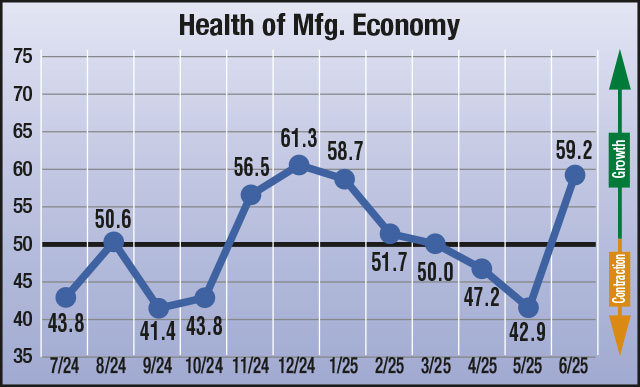
Heat Treat Today has gathered the four heat treat industry-specific economic indicators for June 2025. While May showed a gentle upswing of growth despite one area of contraction, the June industry-specific economic indicators anticipate growth for all four categories.

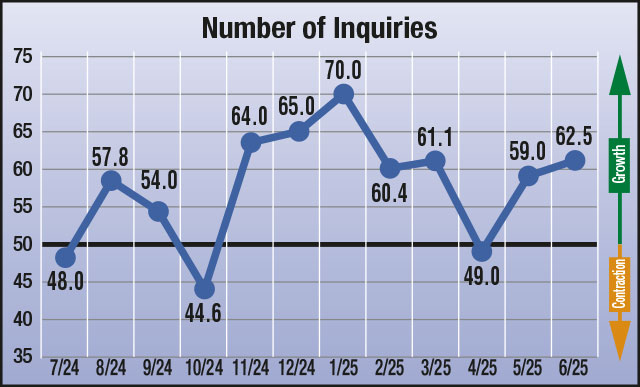
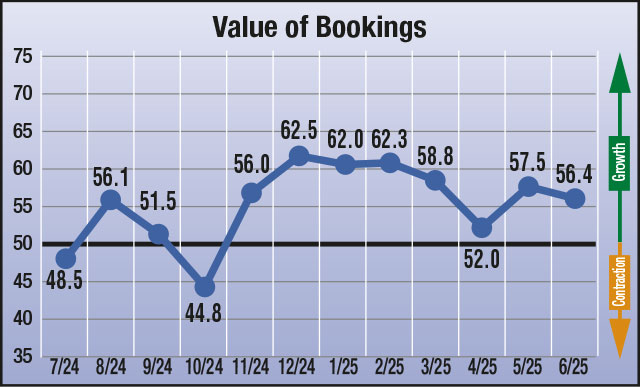
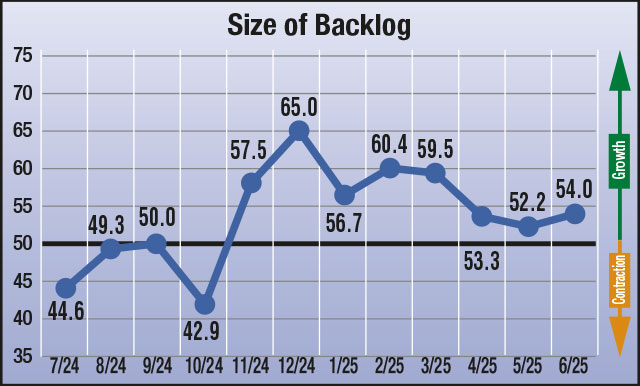
June’s industry-specific economic indicators showed growth in all four indices, including one which had previously slipped into contraction. The Inquiries and Bookings indices show continued growth with Inquires rising to 62.5 (from 59 in May) and Bookings holding steady at 56.4 (from 57.7 in May), while the Backlog index moves upward to 54 (from 52.2 in May).

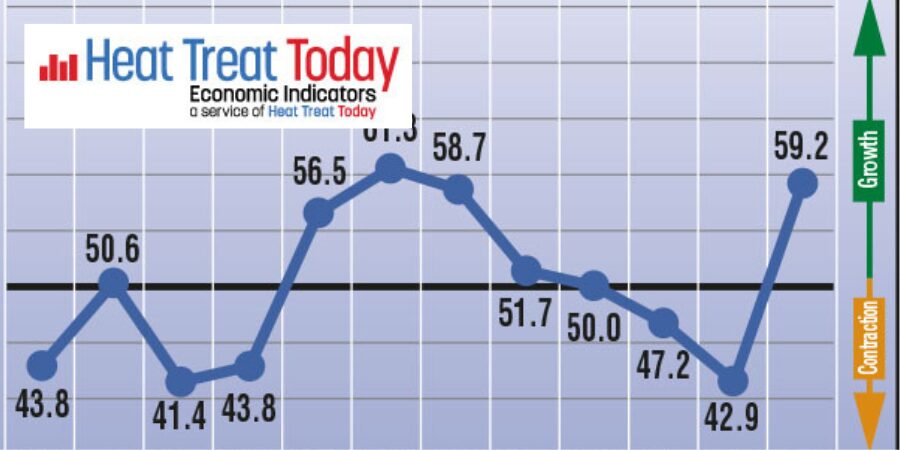
The Health of the Manufacturing Economy index entered contraction in April and declined further in May, however June has seen a positive jump up to 59.2 (from 42.9 in May), taking it out of contraction.

The graphs overall suggest that the four-month slowdown for the North American thermal processing industry, which began in roughly December 2024, has come to an end. The numbers indicate a positive turn toward industry growth.

The results from this month’s survey (June) are as follows; numbers above 50 indicate growth, numbers below 50 indicate contraction, and the number 50 indicates no change:

  • Anticipated change in Number of Inquiries from May to June: 62.5
  • Anticipated change in Value of Bookings from May to June: 56.4
  • Anticipated change in Size of Backlog from May to June: 54.0
  • Anticipated change in Health of the Manufacturing Economy from May to June: 59.2

Data for June 2025

The four index numbers are reported monthly by Heat Treat Today and made available on the website. 

Heat Treat Today’s Economic Indicators measure and report on four heat treat industry indices. Each month, approximately 800 individuals who classify themselves as suppliers to the North American heat treat industry receive the survey. Above are the results. Data started being collected in June 2023. If you would like to participate in the monthly survey, please click here to subscribe.


Heat Treat Economic Indicators for June: A Positive Jump Read More »

10 News Chatter to Keep You Current

Heat Treat Today offers News Chatter, a feature highlighting representative moves, transactions, and kudos from around the industry. Enjoy these 10 news items, featuring a new steel mill in Alabama, a 46% carbon emissions reduction validation, a sweet farewell to an industry leader, and more!


Equipment

1. Solar Atmospheres of Michigan expanded with new air tempering and cryogenic equipment including a 6’6” wide × 4’ high × 14’ long car-bottom air furnace, with a robust weight capacity of 30,000 pounds and temperature uniformity within ±10°F from 300°F to 1400°F

2. Alleima’s Kanthal division and Danieli is slated to supply the first electric process gas heater for commercial use at Emsteel’s Direct Reduced Iron (DRI) plant in Abu Dhabi, UAE.

3. SMS group supplied open-die forging press to Jiuli Yongxing in China, creating a fully integrated forging line to increase production capacity. The press utilized an open-die forging process that improves the microstructural quality of materials through grain refinement, with forging accuracy of approximately ±1 millimeter.

4. Dynavac designed a thermal vacuum system for validating spacecraft performance and reliability. The system operates under high vacuum conditions while providing temperature control from -185°C (-301°F) to 150°C (302°F).

Company & Personnel

5. Hydro signed a long-term agreement with power cable solutions provider NKT, under which Hydro will supply NKT with low-carbon aluminum for the production of wire rod.

6. SSAB received a $4.3 million in tax incentives to support its $74 million expansion project: a steel plant in Alabama.

7. Nitrex announced two new company leadership promotions: Kurt Willms as sales director of Americas and Asia, and Marcin Stoklosa as sales director of Europe and Middle East.

8. ECM USA announced the retirement of William (Bill) Gornicki following 35 years of distinguished service in the heat treat industry.

Kudos

9. Bodycote achieved Science Based Targets initiative (SBTi) validation for an enhanced carbon reduction target of 46% in Scope 1 and 2 emissions by 2030 – compared to a 2019 baseline.

10. SECO/WARWICK celebrated 15 years of operations in China, after beginning in 2010.


10 News Chatter to Keep You Current Read More »

Aviation Manufacturer Expands In-House Vacuum Heat Treat

An in-house heat treat manufacturer of highly specialized aviation parts will be increasing their vacuum heat treat abilities with a horizontal furnace.

SECO/WARWICK will be providing the Chinese aviation manufacturer with the Vector vacuum furnace, which will include a graphite chamber and gas cooling system.

Source: SECO/WARWICK
Maciej Korecki
Vice President of Business of the Vacuum Furnace Segment
SECO/WARWICK

“The partner who ordered the Vector vacuum furnace is just starting their operation…In the case of aviation, these values are of significant importance. The quality of the parts produced can determine the safety of many people, so precision is our foundation and the highest value,” summarized Maciej Korecki, vice president of the vacuum furnaces segment at the SECO/WARWICK Group.

The furnace dimensions are 900x600x900 mm with a maximum load capacity is 800 kg.

Press release is available in its original form here.


Aviation Manufacturer Expands In-House Vacuum Heat Treat Read More »

New Strip Casting Furnace Commissioned in U.S. Collaboration

A vacuum induction melting strip casting furnace (VIM-SC) was commissioned for a manufacturer in North Carolina.

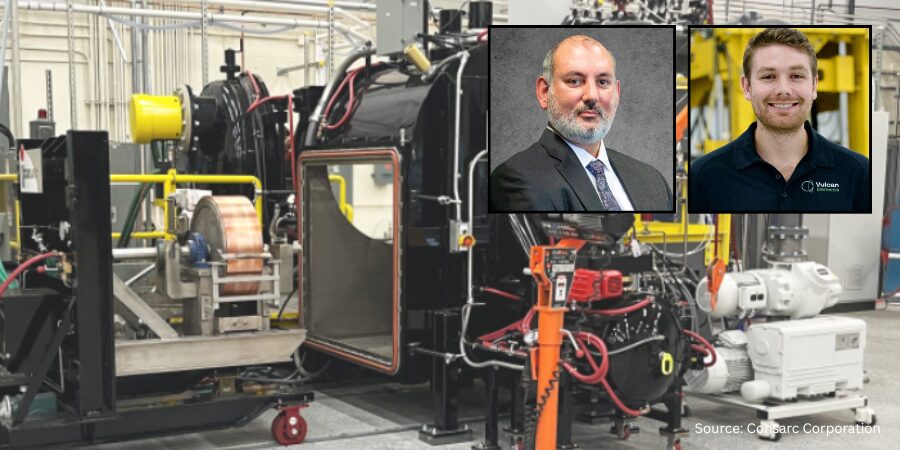
Consarc Corporation and Vulcan Elements announced the commissioning and delivery of the furnace at Vulcan Elements’ new facility in North Carolina’s Research Triangle Park. The collaboration marks a significant milestone in the effort to re-shore rare earth magnet production and strengthen supply chain resilience.

Source: Consarc

This furnace enables the rapid solidification of Neodymium Iron Boron (NdFeB) alloys—critical materials for high-performance magnets used in electric vehicles, defense systems, wind turbines, and advanced electronics.

Jai Narayan
President
Consarc Corporation
Source: Linkedin

“Consarc is proud to play a vital role in reestablishing America’s rare-earth magnet manufacturing base,” said Jai Narayan, president of Consarc Corporation.

John Maslin, chief executive officer of Vulcan Elements said, “Vulcan Elements’ mission is to onshore a secure, traceable, and transparent rare earth magnet supply chain…As demonstrated by this newly-commissioned strip casting furnace, Consarc is a core part of that ecosystem, and Vulcan Elements is committed to developing and galvanizing domestic equipment production.”

John Maslin
CEO
Vulcan Elements
Source: Vulcan Elements

Press release is available in its original form here.


New Strip Casting Furnace Commissioned in U.S. Collaboration Read More »

Ask the Heat Treat Doctor®: Post Weld Heat Treating — Why Is It Necessary and How Do We Perform It?

The Heat Treat Doctor® has returned to offer expert advice to Heat Treat Today readers and to answer your questions about heat treating, brazing, sintering, and other types of thermal treatments as well as questions on metallurgy, equipment, and process-related issues.

This informative piece was first released in Heat Treat Today’s June 2025 Buyers Guide print edition.


As we talked about last month, stress relief is a controlled thermal process in which fabricated material (e.g., machined or welded) is reheated to a temperature below its lower critical temperature and then held at that temperature for a specified amount of time before being slowly cooled. Post weld heat treating (PWHT) is a good example. Let’s learn more. 

Why PWHT After Welding? 

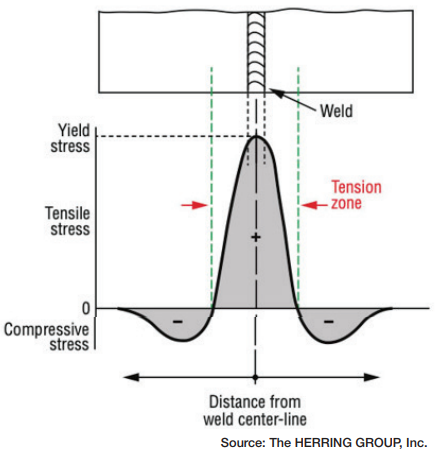
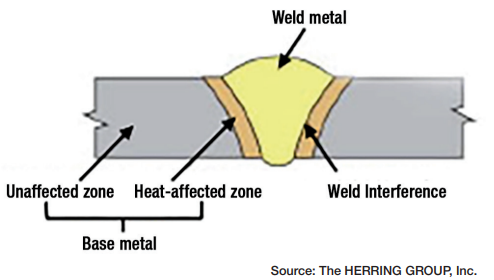
Thermally induced stresses are produced in the weld itself — in the heat-affected zone (HAZ) and in the adjacent base metal (Figure 1) — during welding and need to be relieved to avoid cracking and other modes of failures during final fabrication or service.  

Figure 1. Areas of a typical weld

Purpose of PWHT 

The primary purpose of PWHT is to help prevent welds in fabrications from cracking (i.e., becoming brittle). It also increases the resistance to stress corrosion cracking (SCC) and lowers the risk of hydrogen-assisted cracking (HAC) (i.e., hydrogen embrittlement) caused by high levels of hydrogen released during the welding process. PWHT can also act as a method of hardness control and enhance material strength. 

Figure 2. Typical residual stress profile in the weld and heat-affected zone
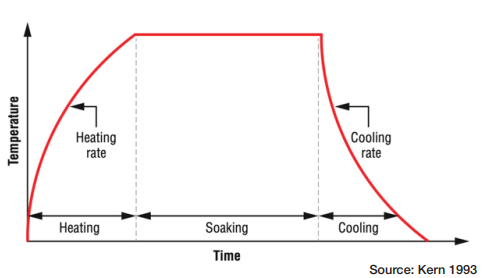
Figure 3. Typical PWHT thermal cycle

Residual stress present from welding may occur because of the high thermal gradients that develop during heating and cooling of the material. This is especially true during welding due to expansion of the material in some areas and localized contraction in other areas, resulting in the presence of surface tensile and compressive stresses (Figure 2).  

These thermal changes produce undesirable residual stresses. PWHT reduces the intensity of these changes by heating the material (uniformly) to a specific temperature, holding at that temperature, and then bringing back to room temperature at a specific cooling rate (Figure 3).  

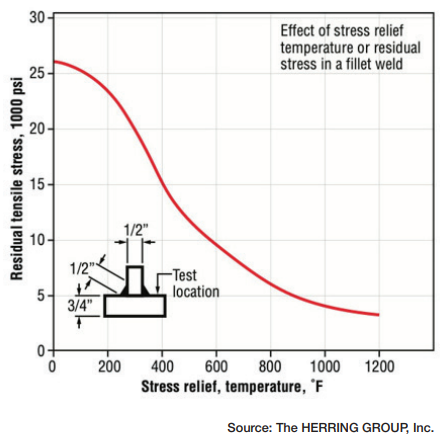
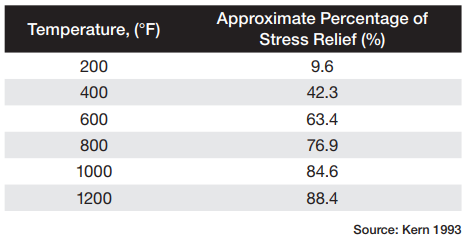
PWHT can be performed over a variety of temperature ranges: low temperatures (300 – 400°F), intermediate temperatures (900 – 1000ºF), or high temperatures (1110 – 1250°F). The temperature, time at temperature, and total cycle time determine the amount of stress that can be removed (Figure 4, Table 1). 

Figure 4. Typical residual stress reduction as a function of PWHT temperature – graphical representation
Table 1. Residual stress reduction as a function of PWHT temperature – tabular representation

Key PWHT Process Parameters 

Key process parameters include adequate part support (remember, steels have lower yield strength at high temperature) and control of: 

• Heating rate to avoid uneven thermal expansion 

• Soak time to equalize temperature 

• Temperature gradients to avoid hot spots from developing 

• Cooling rate to avoid formation of brittle structures 

What Steps Are Involved in PWHT? 

Step 1: Heating 

The rate of heating is typically based on the component’s thickness and often specified by the customer or company doing the work (internal standards). If the rate of heating is not performed properly (i.e., if heating is too quick or uneven), temperature gradients can form within the component and introduce undesirable thermal stress. As a result, stress cracks may occur, and residual stresses not previously present can develop when the component is cooled to ambient temperatures. 

Step 2: Holding at Temperature (Soak Temperature and Time) 

Soak time is governed by material thickness and part thickness. Longer holding times are needed for thicker materials to allow the material to reach a stable condition where the distribution and levels of stresses become more uniform and decrease. The specified holding temperature is one that is high enough to relieve the high residual stress state yet still below the lower critical temperature (Ac1). 
Step 3: Cooling 

The cooling rate must be controlled to avoid any detrimental temperature gradients that could cause cracking or introduce new residual stresses in the material during cooling. Rapid cooling rates can increase hardness, which may increase the susceptibility of a brittle fracture. 

Additional Benefits of PWHT 

Contact us with your Reader Feedback!

PWHT can result in other benefits, such as softening (tempering) of the component part. Tempering the part and the weld heat-affected zone provides protection against brittle fracture failures during service.  

PWHT can also improve part machinability (for subsequent manufacturing operations). PWHT tends to (slightly) reduce the degree of hardness, so components can easily be machined to required dimensional tolerances. Softening parts allow for easy grinding, machining, and other surface treatments. 

PWHT Tips  

If necessary, PWHT can be performed multiple times without changing or diminishing the benefits of the process. PWHT may be repeated for power failures, loss of workload thermocouples, burner malfunctions, control instrument glitches, or furnace component failures. 

More than one part can be subjected to PWHT at any one time. PWHT can be performed in different types of ovens and furnaces, with box or pit styles and carbottom styles being predominant choices due to the size of many weldments.  

Process monitoring can be performed using workload thermocouples attached to the parts undergoing PWHT to check and ensure that heating rates, hold temperatures, and cooling rates meet specification requirements.  

Summing Up 

PWHT can be applied to both ferrous and non-ferrous alloys and is intended primarily to remove internal residual stresses generated by prior manufacturing processes. Without it, subsequent processing may give rise to unacceptable distortion and/or the parts can suffer from a variety of service-related problems. The treatment is not intended to produce significant dimensional changes (although this can occur) or alter the material’s microstructure or mechanical properties. 


References

Ahmed, Khaleel, and J Krishan. “Post-Weld Heat Treatment – Case Studies,” BARC Newsletter, pp. 111-115. 2002.

“An Overview of Stress Relief & Heat Treatment Processes.” DBI, Inc. https://www.dbindt.com.

BorTec GmbH & Co. KG. https://www.bortec.de/en.

Olson, D. L., G. R. Edwards, S. Liu, and T. A. Siewart. ASM Handbook. 10th ed. Vol. 6: Welding, Brazing, and Soldering. ASM International, 1993.

Bryson, William E. Heat Treatment – Master Control Manual. Hanser, 2015.

Croft, D N. Heat Treatment of Welded Steel Structures. Woodhead Publishing Limited eBooks, 1996. https://doi.org/10.1533/9781845698812.

“Heat Treatment of Welded Joints – Parts 1–3.” TWI Global. https://www.twi-global.com.

Herring, Daniel H. Atmosphere Heat Treatment: Atmospheres, Quenching, Testing. Vol. 1. BNP Media, LLC, 2014.

Herring, Daniel H. Atmosphere Heat Treatment: Atmospheres, Quenching, Testing. Vol. 2. BNP Media, LLC, 2015.

Kern Roy., “Ask Roy”, Heat Treating, February 1993

Krauss, George. Steels: Processing, Structure, and Performance. ASM International, 2015. https://doi.org/10.31399/asm.tb.spsp2.9781627082655.

Lyman, Taylor, ed. Metals Handbook. 8th ed. Vol. 6, Welding and Brazing. American Society for Metals, 1971.

Thielsch, Helmut. Defects and Failures in Pressure Vessels and Piping. Malabar, FL: Krieger Publishing Company, 1977.

Oluyemi, O., et al. Process Variables and Post Weld Heat Treatment Effects on Steel Welds. Saarbrücken, Germany: LAP Lambert Academic Publishing, 2012.

“Overview of Post Weld Heat Treatment (PWHT).” Inspectioneering. Accessed June 10, 2025. https://www.inspectioneering.com.

Weld Geometry and Postweld Heat Treatment of a Medium Carbon Steel: Effect on Mechanical Properties. Saarbrücken, Germany: LAP Lambert Academic Publishing, 2013.

Welding Inspection. Miami, FL: American Welding Society, 1980.

WTIA. “Guidance Note 6: Post Weld Heat Treatment of Welded Structures,” 2003.

About the Author

Dan Herring
“The Heat Treat Doctor”
The HERRING GROUP, Inc.

Dan Herring has been in the industry for over 50 years and has gained vast experience in fields that include materials science, engineering, metallurgy, new product research, and many other areas. He is the author of six books and over 700 technical articles.

For more information: Contact Dan at dherring@heat-treat-doctor.com.

For more information about Dan’s books: see his page at the Heat Treat Store.


Find Heat Treating Products And Services When You Search On Heat Treat Buyers Guide.Com


Ask the Heat Treat Doctor®: Post Weld Heat Treating — Why Is It Necessary and How Do We Perform It? Read More »

News From Abroad: €13 Million Melting Furnace, Oxygen Enrichment, And Bell Annealer Facility

In today’s News from Abroad installment, we highlight a new €13 million (that’s $14.9 million US) melting furnace which can recycle 7,000 tons of aluminum waste annually, an oxygen enrichment system for a European steelmaker’s billet reheating furnace, and a new bell annealer facility for copper.

Heat Treat Today partners with two international publications to deliver the latest news, tech tips, and cutting-edge articles that will serve our audience – manufacturers with in-house heat treat. Furnaces International, a Quartz Business Media publication, primarily serves the English-speaking globe, and heat-processing, a Vulkan-Verlag GmbH publication, serves mostly the European and Asian heat treat markets.


A €13 Million Dollar Recycling Furnace For Aluminum

Aluminium Dunkerque’s €13 million furnace will enable it to recycle 7,000 tonnes of aluminium waste a year.
Source: Furnaces International

Aluminium Dunkerque has inaugurated a melting furnace dedicated to aluminium recycling. It said its furnace 8 will allow it to recycle 7,000 tonnes of aluminium waste each year and to produce an additional 20,000 tonnes of metal with a low carbon footprint. This represents a 10% reduction in CO₂ emissions per tonne of ingots produced, i.e. 25,000 tonnes of CO₂ avoided each year, and 96 GWh of electricity consumption avoided. The furnace also created an additional eight jobs. Furnace 8 is part of a broader approach to reindustrialisation and the reduction of imports of high-carbon aluminium. Guillaume de Goÿs, CEO of Aluminium Dunkerque, said: “Each year, France still exports nearly 500,000 tonnes of aluminium scrap that could be processed domestically. “By enabling on-site processing, Aluminium Dunkerque strengthens national sovereignty in critical metals while reducing greenhouse gas emissions.”

READ MORE: Aluminium Dunkerque inaugurates €13 million recycling furnace at furnaces-international.com

Oxygen Enrichment System For Billet Reheating Furnace

Fives installed an oxygen enrichment system at SN Maia Siderurgia’s furnace in Portugal.
Source: Furnaces International

“Fives has completed its first PREMIX oxygen enrichment project on an existing billet reheating furnace at SN Maia Siderurgia Nacional in Maia, Portugal. This marks a milestone in its efforts to optimise furnace performance and improve energy efficiency. SN Maia Siderurgia Nacional, the largest rebar production plant of the MEGASA Group – a European steelmaker, was looking to install a new oxygen system to reduce natural gas consumption, having the possibility to produce oxygen on site at a lower cost. The project was entrusted to Fives Steel Spain, which had previously modified the combustion system of the same furnace. The company developed a new technology called Premix, which injects additional oxygen into the combustion air duct upstream of the burners. Oxygen levels were increased to 25% with around 6% fuel savings, exceeding initial energy efficiency expectations.”

READ MORE: Steel group entrusts Fives with furnace oxygen system at furnaces-international.com

New Bell Annealer Facility For Copper Alloy

Poongsan Corporation order HICON/H2® bell annealer facility for capacity increase Source: Ebner

“Poongsan Corporation invests in an additional EBNER HICON/H2® bell annealer facility for bright annealing of copper and copper-alloy strip coils. The new facility comprises 2 heating bells, 4 HICON/H2® workbases and 2 cooling bells including necessary auxiliary equipment and a Visual Furnaces 6® Process Control System. With this facility the capacity will be increased, and it will be available for production in 2026. Poongsan Corporation is a world known quality producer and, among others, supplies their high-end products to the automotive, electronic and coin industry.”

READ MORE: Poongsan Corporation order HICON/H2® bell annealer facility for capacity increase at prozesswaerme.net


Find Heat Treating Products And Services When You Search On Heat Treat Buyers Guide.Com

News From Abroad: €13 Million Melting Furnace, Oxygen Enrichment, And Bell Annealer Facility Read More »

This Week in Heat Treat Social Media

Welcome to Heat Treat Today’s This Week in Heat Treat Social Media. We’re looking at a new metal training hub, Tesla AI robotics, MTI’s Spring meeting highlights, and more!

As you know, there is so much content available on the web that it’s next to impossible to sift through all of the articles and posts that flood our inboxes and notifications on a daily basis. So, Heat Treat Today is here to bring you the latest in compelling, inspiring, and entertaining heat treat news from the different social media venues that you’ve just got to see and read! If you have content that everyone has to see, please send the link to editor@heattreattoday.com.


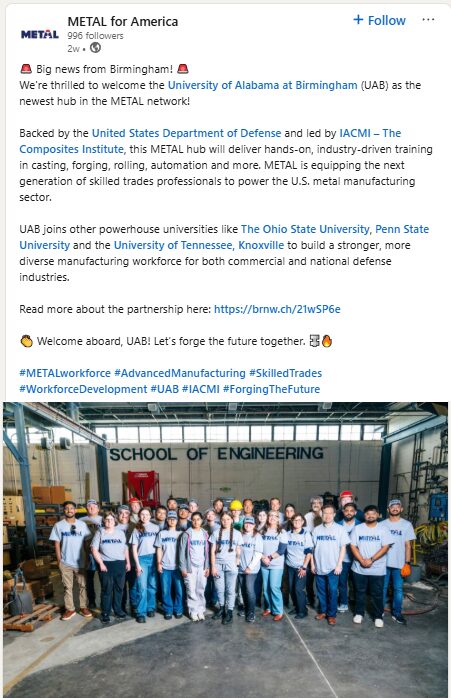
1. New Metal Hub at University of Alabama, Birmingham (UAB)

Check out UAB’s exciting new hub. This partnership with The Metallurgical Engineering Trades Apprenticeship & Learning will provide opportunities for metalworking and manufacturing professional training. Are we looking at the future of Heat Treat Today’s 40 under 40 Class of 2030? Time will tell.

New Metal Hub Launches at the University of Alabama, Birmingham

2. Dance Off With a Robot?

Dancing today, changing a tire tomorrow. Tesla is striving to advance its robotic humanoid AI to be of practical help to its human creators. However, dancing is not only easier, but more entertaining than practical tasks. Check out the moves on their Optimus robot below, and feel free to blast Mr. Roboto by Styx while you do.

Tesla showcasing a dancing Optimus robot.

3. A Visual on Cooling Rates

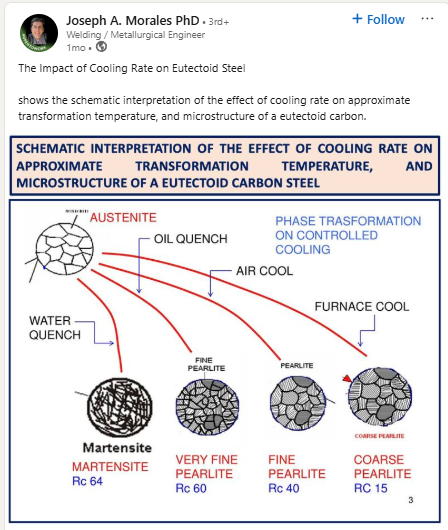
We in heat treatment love quality technical content. Check out this fabulous graph depicting the effect of cooling rate on the microstructure of eutectoid steel.

Graph showing the impact of cooling rate on eutectoid steel

4. Where Do Tan Lines and Pyometry Meet?

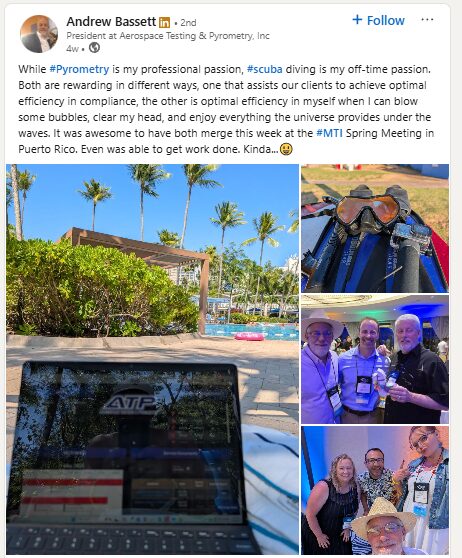
Many social media posts poured in about the MTI Spring Meeting in Puerto Rico. Something about those palm trees, salty air, and industry experts puts us in a good place.

Attendees share their about their MTI experience in Puerto Rico

5. Be Inspired With Heat Treat Radio #121

Tune in to Listen to Heat Treat Radio #121: Equipment And Process Insights From A Rising Metallurgical Engineer. This inspiring information shared by Katelyn Kirsch, one of Heat Treat Today’s 40 Under 40 Class of 2024, on Heat Treat Radio will keep you well informed! And if you know an up-and-coming leader in the heat treat industry who is 40 years of age or under, head over to the 40 Under 40 nomination page to nominate today!

Katelyn Kirsch discusses responsibilities in integrating new equipment and processes, managing thermal processing, and setting up a metallurgical lab in Heat Treat Radio #121


This Week in Heat Treat Social Media Read More »

Skip to content