

Karen Gantzer

Hot Isostatic Pressing: A Seasoned Player with New Technologies in Heat Treatment – Expert Analysis

OC

Hot isostatic pressing (HIP) has been a player in heat treating for 50 years, but recent advances in its technology are providing cutting edge opportunities for new applications in the thermal processing industry.

Heat Treat Today asked two experts in the HIPing world about the state of hot isostatic pressing: What are the latest technologies and where are its potential growth markets in the thermal processing industry?  They represent both sides of HIPing – one from a HIP equipment manufacturer and the other from a HIP process/service provider. Each gives a unique perspective on the HIP market and the industry itself. 

Our expert contributors are Chad Beamer, an applications engineer in Hot Isostatic Pressing, at Quintus Technologies, a high pressure technology company, and Derek Denlinger, a corporate lead metallurgist at Paulo, a thermal processes and metal finishing operations company. This Original Content Technical Tuesday article was taken from 2020 Q4 Heat Treat Today print magazine.


What is HIP?

Derek Denlinger
Corporate Lead Metallurgist
Paulo

Paulo’s Derek Denlinger says, “Hot isostatic pressing is fundamentally, when parts simultaneously see high temperature (in some cases as much as 2500oF) and very high pressure (up to 30,000psi) from all directions for a duration of time.”

Chad Beamer
Applications Engineer – Hot and Cold Isostatic Pressing
Quintus Technologies LLC

Chad Beamer of Quintus adds, “Pressure-based compaction processes can be used to establish density by applying a uniaxial pressure within rigid dies. Such mechanical or hydraulic approaches can produce non-complex parts or ‘green’ compacts.  Although a cost-effective and high-throughput technique, these conventional presses exhibit geometrical limitations and compressibility constraints, yielding product that is not uniform in density and microstructure.”

“Isostatic pressing was developed with the desire to improve upon these shortcomings,” continues Beamer.  “Such compaction techniques leverage Pascal’s law by using a fluid contained in a pressure vessel, either in the liquid or gas state, to transmit equal pressure in all directions on the surface of a workpiece.”

Beamer further explains, “Various isostatic pressing techniques exist today such as cold isostatic pressing (CIP), warm isostatic pressing (WIP), and hot isostatic pressing (HIP).  HIP is a heat treatment process that utilizes isostatic pressure via a gas at high temperatures.  It is commonly used to consolidate metal or ceramic powder and to reduce defects present in castings and additively manufactured parts.  The output is a product with improved mechanical properties, workability, and reliability.”
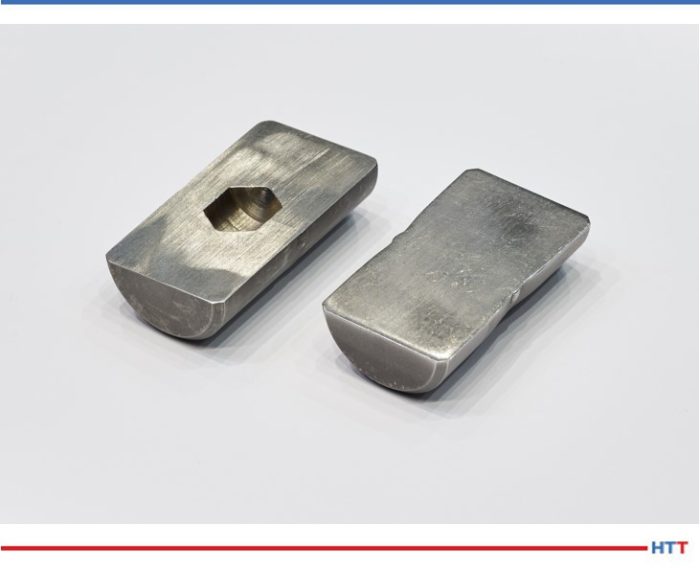
 

Pore eliminated before and after HIP process


What happens in the HIPing process?

Denlinger explains, “In the HIPing process, parts are heated to a temperature high enough to weaken material strength. High pressure, usually applied through a pressurized gas medium such as argon, applies a compressive stress onto the part from every direction.  Given a hold period of time, this compression effectively allows for internal voids or pores to close up due to a mixture of mechanical deformation, creep, and metallic diffusion. The part consolidation sets the stage for any other heat treatment that may follow in order to maximize material performance.”

Since the densification of the workpiece is achieved by the simultaneous application of pressure and elevated temperature during HIP, Beamer adds, “Temperatures are usually in the range of 900oF-3600oF (500o-2000oC) depending on the material being HIPed.  A good rule of thumb is a temperature targeting approximately 80% of the materials solidus temperature.  Pressures in the vessel can reach twice that of the pressure at the bottom of the Mariana Trench, generally in the range of 15,000-30,000 psi (100-200MPa). The combined temperature and pressure applied should be capable of exceeding the yield strength of the material.”

Latest HIP Technologies

Both Beamer and Denlinger share optimism about the new HIP advancements, especially the new high pressure heat treatment (HPHT).

Beamer states, “A recent development in HIP technology is the ability to perform rapid gas cooling and quenching in the HIP system. Originally developed to shorten cycle time, this advancement is now being leveraged to perform many of the standard heat treatments for metals in the HIP furnace.  Now a single piece of equipment can be used to apply both HIP and heat treatment, all carried out in one cycle. This approach is referred to as high pressure heat treatment (HPHT).  Benefits to this new treatment include:

  • the ability to remove an additional process step and piece(s) of equipment
  • more cost-effective manufacturing path
  • fewer times a component must be heated up
  • less time spent at elevated temperature
  • elimination of the risk of thermally induced porosity (blistering) in additively manufactured parts

“These modern systems are continuing to evolve with other promising advancements such as steered cooling. This controlled cooling approach within a HIP vessel allows cooling rates for a component to be optimized in order to achieve the desired microstructure. These advancements are quite exciting for many industries as they are expanding the design windows for material systems and creating new opportunities within a HIP system.”

“HIP has been around commercially for around 50 years,” Denlinger points out, “but more recent technology has been focused on better control of thermal aspects of the process. This is opening the doors for more fine-tuned ‘high pressure heat treatment’ processing that can offer speed and, in some cases, performance benefits that were previously not possible. These types of processes have often been coupled with the ever-growing additive manufacturing processes, though applications to more traditional manufacturing methods are gaining momentum. The influence of pressure on diffusion and transformation in materials has been identified, but not fully explored for many alloys, so new high pressure heat treatments are now being considered to compete with traditional HIP and heat treatment methods.”

What is HIP’s niche in the thermal processing industry? Who are its customers? Where do you see potential growth markets?
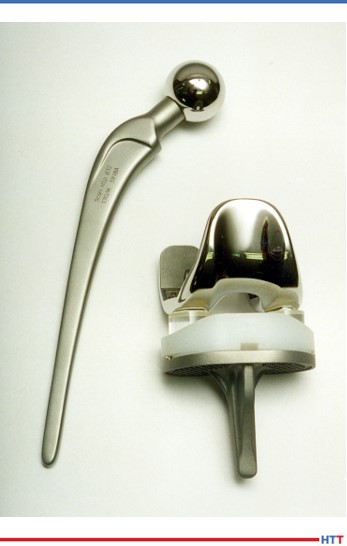
HIP implants

According to both men, the future is bright for HIPing.

Beamer explains why specific industries choose HIPing: “HIP is often desired where the risk of failure is not an option. Therefore, it is not surprising that HIP is commonplace in aerospace, energy, and medical industries. Applications within these industries include densification of products, consolidation of powder, diffusion bonding, as well as HPHT.  For the aerospace industry, HIP is used to remove porosity from nickel-base and titanium-base castings as well as defects present in additively manufactured parts. The medical industry applies HIP to improve the quality and durability for cobalt chrome and titanium implants.  HIPing of large and complex near-net-shape powder metal components to achieve fully densification is routine in the energy industry.”

Denlinger agrees, “HIP has most often been used for fatigue benefits, which is an important performance criterion in the aerospace industry. This remains in the scope, but applications in other sectors are growing due to the adoption of additive manufacturing. Oil and gas, medical, manufacturing equipment, space, firearms, and other industries are increasing their use of HIP and high-pressure heat treatment. Partnering with companies to explore additive manufacturing solutions with both HIP and traditional heat treatment in our arsenal has been very successful; challenging the status quo with the latest HIP technology and our expertise in heat treatment has been a great learning experience.


Regarding market expansion for HIP, Beamer shares, “Potential growth markets for HIP include medical, defense, space, automotive and the ongoing developments with additively manufactured applications. The medical industry is showing growth with an aging population coupled with a cultural shift to living a more active lifestyle. Another trend within the medical industry is to insource HIP versus going through a supplier, which can offer process optimization opportunities and increased quality control.”

The future of HIP technology is likely to include the automotive industry.

Beamer continues, “Growth for HIP in the defense industry can be attributed to strong government funding, such as the development work being done through America Makes. One of the most exciting growth markets here in the US is space, in which many high-profile companies are showing interest in HIP and HPHT technologies.

“Although the HIP process is not typically characterized as a high-volume process,” Beamer concludes, “the automotive industry is finding its benefits useful for cast engine blocks and emerging technology such as binder jet applications. Despite the present challenges due to the Covid-19 pandemic, specifically within the civil aerospace industry, there are many exciting growth opportunities for HIP.”


(All photos in this article provided by Quintus Technologies)


About the Authors:

Chad Beamer has a MS from the Ohio State University in Material Science and has worked as a material application engineer with GE Aviation for 7 years and as a technical services manager with Bodycote for 5 years. In February, Chad began working with Quintus Technologies as an application engineer for the Advanced Material Densification division focusing on hot isostatic pressing (HIP). As an applications engineer, he manages the HIP Application Center located in Columbus, Ohio, educates on the advancements of HIP technologies, and is involved in collaborative development efforts both within academia and industry.

For more information, contact Chad at chad.beamer@quintusteam.com or 614-404-3982

Derek Denlinger is the corporate lead metallurgist at Paulo.  Derek has a Bachelor of Science in Metallurgical Engineering from Missouri S&T in Rolla.  He started in the foundry industry before transitioning to heat treatment at Paulo where he has been for the past 5 years.  The past two years, Derek has been focused on additive manufacturing and hot isostatic pressing assisting with Paulo’s entry into the HIP market.

For more information, contact Derek at ddenlinger@paulo.com



Hot Isostatic Pressing: A Seasoned Player with New Technologies in Heat Treatment – Expert Analysis Read More »

IHEA Monthly Economic Report: “Who’s on First?”

pr logoDo you remember, or have you ever heard of the comedy duo of Abbot and Costello of the 1940s and early 1950s? One of their most popular skits is “Who’s on First?” which is hilarious, but its title, theme, and overall performance are apt reflections of the questions, frustrations, and confusing answers we are experiencing on a daily basis as we continue to navigate through uncharted waters.  September’s Industrial Heating Equipment Association’s (IHEA) Executive Economic Summary begins with questions we’d all like to know the answers to about the future of the economy/recovery and ends with continued hope. “There will soon be a debate as to what to call the period we are entering. Is this the post-pandemic recovery? Is it the second wave pandemic era? Is this the beginning of the ‘blue wave’ or the start of the purple revenge? Is this the end of the beginning or the beginning of the end? At this point a case could be made for any of these.”

(Photo Source: YouTube.com)

It’s always good to look at the data of the indices to get a pulse of what’s happening. Of the 11 indices, five are trending in the positive direction and six are trending negative, however, the report states that “the shifts have been subtle and it is hard to say whether the future trends will continue to follow the current pattern.”

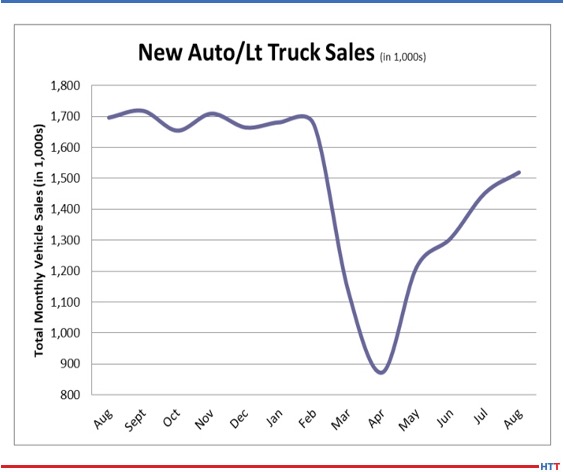
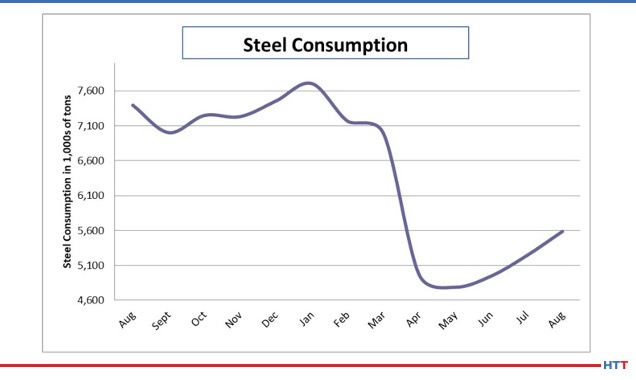
The report continues, “In many respects the economy now seems in better shape than it was just a few months ago and far better than many had expected at this point. That is reflected in the indicators that showed improvement this month.” The gains were in the new automobile/light truck sales, steel consumption, industrial capacity utilization, metal prices, and factory orders.

Vehicle sales are sensitive to the performance of the economy. Demand is slowly coming back.

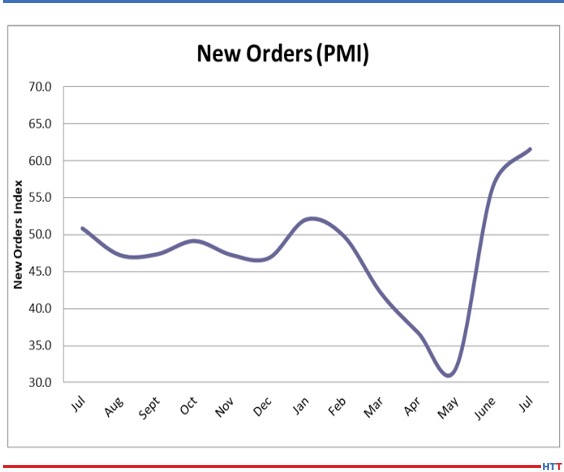
New home starts, capital expenditure, PMI new orders, credit, durable goods and transportation experienced a decline last month, however, in “many of these readings the changes from last month were minor and the numbers remain far stronger than they were even as recently as July and August. The economy is changing and that has meant decline for some and progress for others.”

The level of steel consumption has been rising steadily since falling into the doldrums.

While the upcoming election may bring changes, the summary states, “The reality is that the focus of the next year will be the same regardless of who wins the White House and/or Congress. The pandemic may dominate the economy as it has through 2020.” The projections for 2021 fall into two categories. The first scenario is one in which “the recovery will start picking up speed as this year ends and will continue to gain traction into the first half of next year before slowing down slightly.” The second scenario is the more cautious assumption based on an expected spread of the virus through the colder months. The good news is that in both scenarios the end of 2021 will see growth numbers that will look a lot like the numbers at the start of 2020.

Finally, given all the uncertainty, what should be on the watch list for business and manufacturers specifically? The summary concludes, “The key factors to watch will be those that reflect month to month changes and that will include the Purchasing Managers’ Index as well as the Credit Managers’ Index. Both look pretty solid right now but have shown some signs of concern as the growth spurt in the PMI has faded and the CMI is starting to show issues with the unfavorable factors. Two other indices to focus on will be capital expenditure and capacity utilization. If the manufacturers are worried about the future, they will be reducing their levels of capital investment (both in terms of machine purchasing as well as physical plant).” The only other early warning sign to look for is in transportation. Parcel activity is going to grow as the holiday spending season ramps up, which means paying closer attention to rail and truck volumes.

Check out the full report to see specific index growth and analysis which is available to IHEA member companies. For membership information, and a full copy of  the 12-page report, contact Anne Goyer, executive director of the Industrial Heating Equipment Association (IHEA). Email Anne by clicking here.

Anne Goyer, Executive Director of IHEA


IHEA Monthly Economic Report: “Who’s on First?” Read More »

CQI-9 (4th Edition) Expert Analysis

Despite the precariousness that has defined the majority of 2020 thus far, the aerospace and automotive industries have not let that uncertainty deter them from releasing two major revisions that directly affect the heat-treating industry. Both, the 4th Edition of CQI-9 and AMS2750F were released at the end of June (AMS2750F: Expert Analysis).

In this Technical Tuesday feature, Heat Treat Today reached out to the AIAG CQI-9 Heat Treat Technical Committee with questions about the newest edition and how it might affect the automotive heat treat industry. Specifically, we were interested in the significant changes within the 4th Edition and how organizations can best prepare to implement them.

Several CQI-9 Technical Committee members responded and provided us with some outstanding expert analysis in this Original Content article. Those CQI-9 committee members included: Rick Metcalf, Materials Engineering – Valvetrain PMT, General Motors Company; Medina Kaknjo, STA Global Core Technical Expert/Global Purchasing, Ford Motor Company;Ed Rahe, Heat Treatment Engineer – Metals Group, Fiat Chrysler Automobiles; Jake Sloan, Product Development Manager, AmeriTi Manufacturing [formerly of FCA]; James Hawthorne, current CQI-9 chairperson, Corporate Heat Treat Specialist, Acument Global Technologies; Bob Ferry, Vice President – Engineering & Quality, FPM Heat TreatingJohn Vander Woude, Metallurgist – Automotive Division, Benteler Automotive Group; and Justin Rydzewski, Director of Sales & Market Development, Controls Service, Inc.


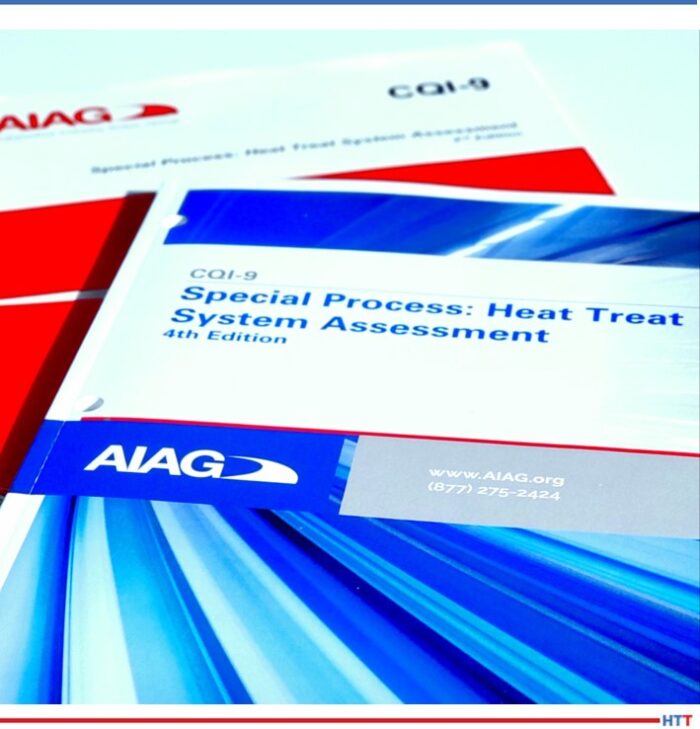
CQI-9 4th Edition vs. CQI-9 3rd edition (photo source: Control Services Inc.)

The Automotive Industry Action Group (AIAG), the organization responsible for the development of CQI-9, cites the Special Process: Heat Treat System Assessment 4th Edition (CQI-9) as a comprehensive assessment, “… covering the most common heat treat processes employed by the automotive industry, intended to provide a common approach to a heat treat management system for automotive production and service part organizations.” Authoring the 4th Edition of CQI-9 was a collaborative effort, supported by a diverse group of individuals from AIAG member companies representing Tier 1 suppliers, heat treaters (both captive and commercial), and critical service providers within the heat treat industry. However, the force driving CQI-9 forward are the OEM’s – Ford Motor Company, General Motors, and Fiat Chrysler Automobiles (FCA).

It’s been nine years since the 3rd edition was released. Justin Rydzewski explains the timing, “The 3rd Edition was a really good document. It was effective and it served its purpose very well. The prolonged life of the 3rdEdition allowed us to collect a tremendous amount of data and feedback about the document– strengths, weaknesses, etc. This data allowed us to identify, with greater accuracy, where updates and changes were truly needed. Lastly, because CQI-9 is an international document, we spent a great amount of effort ensuring the clarity we were adding to the 4th Edition was not going to be lost when translated to other languages. As a result of this development process, we feel confident that the 4th Edition will be an even more effective heat treat system assessment tool than its predecessor.”

What do you believe to be the most notable change in the 4th Edition of CQI-9?

Justin Rydzewski and his colleagues agree on the importance of the digital changes, “Requiring all instrumentation to be digital by June 2023 (3 years after release of the document) is a very notable change. For operations heavily invested in analog instruments and paper chart recorders, this change could potentially result in a significant interruption to operations; especially in the absence of proper planning. However, we are hopeful the change will be a welcomed one as the advantages associated with digital instrumentation are far too great and numerous to ignore any longer.”

Rick Metcalf
Materials Engineering – Valvetrain PMT
General Motors Company

Rick Metcalf concurs, “I agree with Justin’s comments on digitizing the process controls. This allows for better off-shift monitoring of the process and provides the OEM with a greater confidence in the supplier’s ability to control the process. This is one of the most notable improvements to the 4th edition.”

Medina Kaknjo, Ed Rahe, and Jake Sloan also cited digitization as an important notable change.

The Heat Treat System Assessment (HTSA) question formatting update is another feature that is encouraging to both Kaknjo and Sloan. Kaknjo shares, “The first notable change users will notice is the new format of the document which now requires the assessor to assess every single requirement and rate it.”

Sloan further explains, “I fall in line with Medina [Kaknjo]. The formatting update is great, especially coming from the OEM side that needs to rely heavily on self-surveys. I believe it makes communication between the heat treater and Customer much easier. Not only does it require each requirement to be evaluated by the assessor, but I think it gives them a much better opportunity to give a full response. Hopefully, this will cut-out a lot of the back-and-forth that can happen when the person reviewing the survey was not onsite for the assessment.”

Medina Kaknjo
STA Global Core Technical Expert/Global Purchasing
Ford Motor Company

Bob Ferry also cited the reformatting of the HTSA questions as a notable change adding, “This effort allowed us to review each question and break down the long question paragraphs of the 3rd Edition. Now, in the 4th Edition, the requirements for each question are listed separately. With this new approach, the Auditee will not miss important requirements which, in the previous edition, may have been buried in a lengthy paragraph.

The alternative temperature uniformity survey (TUS) testing method revisions were tops for James Hawthorne. “The expansion of the Alternative TUS Testing Methods (P3.4.8) is one of the most notable improvements. The requirements now account for proper procedures and reporting for both property surveys and site developed testing methods. These improvements will allow the heat treater to develop a structured, repeatable, and documented solution based on the requirements of this section.”

John Vander Woude sees the addition of Process Table I – Hot Stamping as one of the most notable changes to CQI-9. “I was involved in creating Process Table I a few years ago, but it was released between revisions and seemed like the stepchild Process Table.  So, personally, it is nice to see it incorporated in the 4th Edition.”

What change/update in the 4th Edition of CQI-9 do you think will be appreciated most?

James Hawthorne
Corporate Heat Treat Specialist,
Acument Global Technologies

Metcalf highlights the allowances for exceptions in the Process Tables: “I believe that the most appreciated change to the 4th Edition of CQI-9 is the increased allowance for exceptions to the requirements of Section 4 of the Process Tables. This will allow suppliers of large components to reduce the number of components required to be sectioned daily. However, this does require Customer approval and, ultimately, the OEM.  These exceptions offer the heat treater the ability to reduce some of their inspections, provided the supplier can show the process is statistically capable.”

Qualities of clarity, fluidity, and guidance were mentioned multiple times as “most appreciated.”

Hawthorne shares, “I personally appreciate how fluid the document is now. The effort that was put into ensuring the flow of the document works across the different sections is a great benefit to the heat treat community. As heat treaters read and implement the applicable changes to their organizations, these changes will be appreciated by them as well.”

“The 3rd Edition of the document was already very good. But, I think the most appreciated change will be the even greater amount of guidance and the improved clarity of requirements within the document,” says Rahe.

Ed Rahe
Heat Treatment Engineer – Metals Group
Fiat Chrysler Automobiles

Vander Woude writes, “I think the most appreciated change will be the guidance portion of the element questions.  This provides clarity, definition, and better understand to some questions that could be quite useful to many users.

Ferry’s appreciation lies in the pyrometry section, “The improved clarity of the requirements along with explanations, definitions of terms, and examples in the Pyrometry section.”

Kaknjo states, “I think the most appreciated change will be that document is now more user friendly as it is easier to use and follow due to the formatting changes that are done on this revision.

Rydzewski not only commends the formatting improvements for clarity and guidance, but also gives kudos to the reference illustrations. “I think the improvements to the formatting of the Heat Treat System Assessment Section 1-3 questions will be greatly appreciated. Question ‘Requirements’ and ‘Guidance’ are now cited separately.” He continues, noting that this change make it “much easier to effectively capture each requirement and to determine the expectations of each question specifically in terms of objective evidence. . . . [also] nearly every reference illustration in the document was updated/improved. Personally, I think they all look fantastic.”

What is something in the 4th Edition of CQI-9 that an organization should make sure they don’t overlook or misinterpret?

Rahe and Ferry both mentioned the importance of the Process Tables. Rahe states, “An organization should not overlook the specific requirements of the various Process Tables. They are an excellent “cookbook” type guide designed to produce best in class heat treated parts for OEM’s.”

Bob Ferry
Vice President
Engineering & Quality – FPM Heat Treating

“There was more attention put on the quenching section of the Process Tables with added requirements for quench media process controls including quench delay times, liquid quench controls, and gas quench controls. The intent is not only to control furnace temperatures but to also control cooling rates for consistency of quench and heat-treated product,” says Ferry.

Kaknjo advises, “An organization should not overlook that AIAG CQI-9 HTSA requirements are subordinate to Customer-specific requirements. This is not new for revision 4, but something that often gets overlooked.”

Jake Sloan
Product Development Manager
AmeriTi Manufacturing

Sloan cautions not to overlook the pyrometry section. “I would say do not overlook the new pyrometry section. The requirements have not only been improved, but it is also a great reference for when it comes to how to comply. Also, as Medina was saying, this document is subordinate to Customer requirements, which works both ways. This document allows exceptions to be given but, remember, there must be approval from up the supply chain.”

Socrates said, “The beginning of wisdom is the definition of terms.” Rydzewski shares this mindset as he highlights utilizing the glossary. “The ‘Glossary of Terms’ in CQI-9 is an outstanding resource that should NOT be overlooked or undervalued. In my opinion, the real key to mastering CQI-9 starts with ‘definition.’  When there is not a firm understanding of the terms being used, confusion and/or compliance issues are almost certain. So, for the 4th Edition, our team dedicated a significant amount of time and effort to enhancing the clarity and guidance provided by the ‘Glossary of Terms.’”

John Vander Woude, Metallurgist
Automotive Division
Benteler Automotive Group

Vander Woude concurs, saying, “Like previous edition, this edition not only focuses on heat treatment, but also on many areas that support heat treatment. Overlooking areas such as maintenance, training, document control, and testing (to name a few) may lead to difficulties ensuring compliance.”

“The examples in SAT section that are below the illustrations should not be overlooked. These examples provide guidance of what to measure and how to calculate. Use these examples and compare to your current reporting, it will help ensure compliance for your organization,” relays Hawthorne.

What advice would you offer an organization preparing to implement the 4th Edition of CQI-9?

What is the consensus of the experts when it comes to implementing this 4th edition?  Read it. Digest it. Use it. It’s a powerful tool that has been a game changer to the automotive industry. Here are the experts’ final recommendations.

Ed Rahe: “My advice would be to read the document thoroughly and take advantage of the many, many years of heat treatment experience that are captured as best practices in this document.  The knowledge base of those involved in the creation of this document is really quite impressive.”

Justin Rydzewski
Director of Sales & Market Development
Controls Service, Inc.

Justin Rydzewski: “Buy the document, read it carefully, and make notes. Big changes are going to standout, capturing those willbe easy. But, by and large, most changes made were minor or were merely intended to add clarity or guidance. Comparatively, these sorts of changes can be easily missed. And, invest in training where necessary. Now is a perfect time to do so. Invest in yourself and your team. If your organization outsources pyrometry services, lean on your service provider for guidance and expertise. Allow them to help. This is where the true value of a good partnership can be measured.”

[blocktext align=”left”]”The best advice I can give is to read the document. Several items were modified to make it easier to interpret and implement CQI-9.” – Rick Metcalf, Materials Engineering – Valvetrain PMT, General Motors Company [/blocktext]

Medina Kaknjo: “My advice would be to use the document as opportunity, as a tool of summary of best practices, lessons learned of many industry leaders to prevent heat treat process related issues that are often associated with significant cost.”

John Vander Woude: “Don’t underestimate the document. With the reformatting and “break out” of sub-requirements for many questions, I think organizations will find they are not compliant in areas they once thought they were compliant.  The 4th Edition forces added scrutiny to questions that were often overlooked.  Specifically, where many “shall” statements were once made within the same question in the 3rd Edition. In the 4th Edition, these “shall” statements are now separated and denoted individually. This approach makes it much easier to capture and provide appropriate objective evidence for each requirement.”

Rick Metcalf: The best advice I can give is to read the document. Several items were modified to make it easier to interpret and implement CQI-9. We also included more illustrations and a greater glossary in the 4thEdition to make it easier to interpret requirements and implement CQI-9.

Jake Sloan: “Like most people are saying, definitely read the document in its entirety so that your company has a full understanding of the requirements. Also, like Medina said, treat the document as a guide to improve on or maintain best practices. It is a great tool for doing internal reviews so that things don’t slip by the wayside between required assessments. Take advantage of the new format to give clear evidence of compliance instead of just treating it as a checkbox.”

Bob Ferry: “Read the Pyrometry section and make a list of the requirements that apply to your operation from thermocouples to instruments to periodic testing requirements. Set up your system for periodic testing and documented evidence, and then perform a complete CQI-9 HTSA Audit to identify and correct any shortcomings.”

James Hawthorne: “Use the Process Tables, Glossary, and the Job Audit as intended to ensure compliance while documenting your effective evidence in to the HTSA. Each section of this document is an invaluable tool that will help the heat treater remain compliant and effectively provide the objective evidence required.”


CQI-9 (4th Edition) Expert Analysis Read More »

IHEA Monthly Economic Report: Remarkable Recovery- Consumers Remain Cautiously Optimistic

Growth takes time, but celebrating the small steps and progress is good for the heart and soul– of people and country. “There has been a remarkable level of economic turnaround taking place in the last couple of months. Of the eleven indicators we watch there has been a recovery in every one of them,” so begins August’s Industrial Heating Equipment Association’s (IHEA) Executive Economic Summary.

Yes, the gains have come off record losses and numbers haven’t climbed back to where they were at the beginning of the year, however, as the report conveys, “Given the data that was showing up just a few months ago, the situation now could be far worse at this point and if there is a continuation of these recent trends there could be a recovery of that first quarter momentum by the beginning of the fourth quarter.

The report asks this question: With every index reading trending positive there is not much to contrast so the key issue is why. What is the prime motivation for the comeback and where might the weak points be?” Three factors are suggested for  the gains. The first is the elements of the lockdown have been lifted. “Where there has been a relaxation of the restrictions, there has been economic growth.” The second reason for the economic growth is a resumption of consumer demand. “It was hoped that consumers would be eager to resume their old habits but there was no guarantee, and there was some hesitation as far as consumption was concerned. That largely vanished by the middle of the summer.” The third growth factor was the producers’ willingness to meet the recovering demand. “Production levels have been increasing through the last few months and there has been little indication that activity was being slowed deliberately as a means by which to boost prices through manufactured shortages.”

What is a potential weak area that could adversely affect the economy? The short answer– the election. “Perhaps the most potent unknown surrounds the election. There is always a concern when the possibility exists for a change in leadership. That concern ramps up when there is more at stake than just the White House. The business community is affected more by [who] holds power in Congress as this is where those fiscal decisions are made.

To highlight just two indices, first, take a look at the New Home Starts where the housing market “is booming in almost every respect. The analysis states, “The surge has been seen primarily in the single-family home category as there has been an exodus of people from urban areas to the suburbs and exurbs.” Why? Because due to the lockdown restrictions, people are tired of cramped living conditions, and many are craving more space in the suburbs. “The majority of the factors that stimulate home buying are trending in a positive direction. Mortgage rates remain at very low levels and lenders are still willing to do these home loans.”

There have been people leaving cities they no longer feel safe living in and perhaps the most salient factor is the desire to end their long commutes. (Source: IHEA)

The second index that highlights a viable and healthy rebound is the Factory Order index. “The gearing up for the holiday season is well underway as the retailers have clearly signaled that they are expecting a very early buying season. They will be entering the period with an ‘inventory light’ strategy and will be turning the entire month into ‘Blackvember’ with early sales and discounts designed to capture the attention of the early shopper.”

The recovery of the factory order segment is perhaps better news than the rebound in durable goods and some of the other industrial indicators as it is coming at an ideal time. The gearing up for the holiday season is well underway… (Source: IHEA)

Resilient has often described Americans throughout our history, and this period in time is no different. Challenges make us stronger, and hopefully, wiser. Here’s looking to a continued growing economy and wisdom in decision-making.

Check out the full report to see specific index growth and analysis which is available to IHEA member companies. For membership information, and a full copy of  the 12-page report, contact Anne Goyer, Executive Director of the Industrial Heating Equipment Association (IHEA). Email Anne by clicking here.

Anne Goyer, Executive Director of IHEA


IHEA Monthly Economic Report: Remarkable Recovery- Consumers Remain Cautiously Optimistic Read More »

IHEA Monthly Economic Report: Continued Climb and Steady Improvement

"There is one positive aspect when it comes to a dramatic drop as experienced in March and April of this year. When one has fallen that far there is nowhere to go but up! Since then there has been a steady improvement in almost every category." When one considers the challenging year 2020 has been thus far, and the dramatic hit the U.S. economy has taken due to the pandemic, this encouraging opening from the Industrial Heating Equipment Association’s (IHEA) Executive Economic Summary for the month of July is the bolstering news we all need to hear.

The report states, "The progress that has been made thus far has been contingent on several factors. The first is that many businesses have engaged in rebuilding their inventories in anticipation of an eventual economic recovery...hopes lie in a rebound by the fourth quarter. The second major motivator for recovery has been the willingness of the consumer to return to old habits as far as consumption. This has been a mixed experience as there has been some return to those old habits, but there have also been many new habits formed and these have all had their impact on business."

An uptick is evidenced in all but one of the measures and "even this showed only a very slight decline from the month prior." The summary also reports that "Of the twelve index readings tracked, all but one trended positively and in some cases the numbers registered this month were better than they have been in over a year."

The numbers have not been this high in well over a year and suggests that there is considerable optimism for the future. (Photo source: IHEA)

The summary shared, "The more interesting data was found in those categories that seemed to have fully recovered and even exceeded levels seen earlier this year and at the end of 2019. The New Orders Index from the Purchasing Managers’ Index was back to the 60s and that is a level that has not been seen in over a year. Given that the new orders sub-index is the forward looking part of the overall PMI, it bodes well for the recovery at the end of the year." Other areas that showed a jump was in transportation that always "provides some confidence about the future," the parcel delivery sector (not those tied to imports or exports, however), and the metals market, especially copper and aluminum. Lastly, "The production indicators such as durable goods and factory orders have shown progress as business tries to rebuild inventory levels but there is ongoing concern regarding new demand."

The price of metal commodities have been rising. (Photo source: IHEA)

Of those indices that trended  positively, "the majority remain distant from the readings that dominated at the start of last year." However, the data shows "a solid recovery in many areas." Albeit, it will take time before you can describe it as robust.

Steel consumption was the only reading that did not trend upward, however, it still was stable and looked similar to the previous few months.

The summary concludes, "The bottom line is that there is resilience in the economy despite the trials of the last few months. It now all depends on whether the pandemic necessitates a wider crackdown and a resumption of the conditions that collapsed the economy in the first place."

The report is available to IHEA member companies. For membership information, and a full copy of  the 12-page report, contact Anne Goyer, Executive Director of the Industrial Heating Equipment Association (IHEA). Email Anne by clicking here.

Anne Goyer, Executive Director of IHEA


IHEA Monthly Economic Report: Continued Climb and Steady Improvement Read More »

40 Under 40: “Wait and See is not a Plan: What is Your Strategy?”

Kenneth W. Gronbach, President/CEO, KGC Direct LLC

The United States is about to experience a monumental cultural shift, and Gen Y Millennials are the catalyst,” says Kenneth W. Gronbach, expert in the field of demography and generational marketing. Read his encouragement to Heat Treat Today’s 40 Under 40 Class of 2020 as he highlights significant demographic trends and life realities to help them determine their strategy for embarking on this next wave of opportunity.


So, you are approaching forty, big deal. Most of you could easily live into your nineties, so you are not even halfway through this life. My advice to you? Make the most of it. How? Get a handle on what is next and prepare. Demographics is a wonderful common-sense forecasting tool that precipitates accurate revelations. Really. So, let’s have a look into the demographic crystal ball as it relates to you. For the sake of this writing, I am going to consider you all part of the 88 million Generation Y Millennials born 1985 to 2004. Gen Y is the largest generation ever born in the United States. A few of you are actually Generation X born 1965 to 1984, but hey, close enough.

 The United States is about to experience a monumental cultural shift, and Gen Y Millennials are the catalyst. Yeah, you. I have been warning my audiences and readers to stop living in a white bubble and to lose the bigotry. It is 2020. By 2045, white non-Latinos will be a minority in the U.S. How do we know? Simple, the young people who will shape the United States fifty years from now are already born. And they are very diverse. Much more diverse than the white non-Latino adults that dominate our demography today.

So why are you millennials the catalyst? You don’t see race, religion, or color. You see people. It’s how you were raised and taught in school. In addition, you take the anti-bullying issue very seriously. You marry outside your race, religion, and color routinely. As a result, the skin tone of the average American will be slightly darker 25 years from now and red heads will be almost extinct. (If you have redheads in your family, hang on to them because they could be worth serious money.) Black Lives Matter is an idea whose time has finally come. Don’t believe me? Take a look at the diversity of the BLM protesters and demonstrators. What do you see? They are complimented by young whites, Latinos, and Asians in significant proportions. Eighty-eight million diverse Millennials will lead America to the place we were meant to be: One Nation Under God.

Average American 2050 (Photo source: National Geographic)

Most of you 40 Under 40 are entrepreneurs: risk takers who enjoy a challenge. So, let me offer up a significant human resources challenge that you must address as you embark on your tenure as leaders. In Dr. Nicholas Eberstadt’s recent book, Men Without Work, he reveals that the United States currently has 20 million men between the ages of 25 to 55 who do not work because they are felons and cannot be bonded/insured. They are the product of the war on drugs in a nation that incarcerates more people than any other nation on earth. Did we solve the drug problem? No, we created a new one.

One-third of our labor force between 25 to 55 is idle. Let’s look at the numbers. There are about 60 million men in the United States between 25 to 55 years old. One third of them cannot work. Of the 20 million felons who cannot work, 5 million are white, 5 million are Latino, and 10 million are African American. How many African American men are there in the U.S. between 25 to 55 years old? About 10 million. No, that is not a misprint. We have crippled the African American culture by locking up their males. We have dealt with symptoms of racism rather than addressing the causes. I pray that the Black Lives Matter movement will be the beginning of the end of this gross injustice. So, what is the big challenge? We need, as a nation, to put felons back to work. You need to figure out how to hire them, to train them, to restore their dignity, and to return them to their role as contributing members of society. You can do it. You have to do it.

When the pandemic exits the United States, it will be a different place. Just look back at the changes that took place after 9/11 and 2008. Let me just give you a list of some of the sea changes we can expect in the next ten years:

  1. Manufacturing will return to the United States because China decimated its labor force with 37 years of the One-Child Policy. China will also fall out of favor with the world in general because of its role with COVID-19.
  2. High net worth Westerners from the European Union will immigrate to the Americas in force because of cultural issues with their principal immigrants: Muslims.
  3. Eighty million Baby Boomers, now 57 to 76 years old, will exit the labor force of the U.S. by the millions creating a talent vacuum that will suck in skilled, cyber, multi-tasking Millennials by the millions. This will cause the United States to flourish.
  4. The E.U., Eastern Europe, Russia, Japan, and South Korea will diminish in power and influence because of their extremely low fertility rate. No kids and eventually no adults/taxpayers.
  5. Mexico has perfect demographics but will be considered a failed state because of the absence of a working government replaced by criminal cartels. It could well be annexed by the United States.
  6. India could blossom economically if it could get a handle on its disastrous distribution of wealth.
  7. The population of the world is currently at about 7 billion and will increase to about 10 billion by 2060 before it begins to recede.
  8. The population of the continent of Africa could double to two billion because of Africa’s extremely high fertility rate and the introduction of modern healthcare, technology, and education by Africa’s new friend, China.
  9. So, my 40 Under 40 friends, it is a new world. There will be no lack of opportunity. Make the world a better place and remember, “Wait and see” is not a plan. What is your strategy?Be well,Kenneth W. Gronbach


About the Author: Kenneth W. Gronbach is a gifted keynote speaker and nationally recognized author, expert, and futurist in the field of Demography and Generational Marketing. He makes the science of shifting demography come alive with real life examples which make it relevant to today’s culture, business climate, and economy. With nearly three decades experience in retail advertising and marketing, Ken saw the direct results of shifting demographics in his clients’ profits. Eventually, his passion for the subject changed the direction of his career, to the benefit of readers of his books and attendees of his keynotes and other presentations.

40 Under 40: “Wait and See is not a Plan: What is Your Strategy?” Read More »

American Axle & Manufacturing’s Fred Hamizadeh on Industrial Heat Treating Equipment Maintenance

Discover how to keep your furnace in prime working order as Fred Hamizadeh, director of Global Manufacturing Services- Heat Treat & Facilities Equipment, of American Axle & Manufacturing and keynote speaker at Furnaces North America 2020 (Virtual) Trade Show, outlines the essential attributes of effective maintenance practices for industrial heat treating equipment.

This article will be featured in Heat Treat Today’s upcoming FNA Trade Show issue in early September.


Fred Hamizadeh,
Director of Global Manufacturing Services- Heat Treat & Facilities Equipment, American Axle & Manufacturing

I recall great advice from my first boss, Bob Williams, of Williams Industrial Service: He said to me early on that if the maintenance people are happy with your equipment, you’ve designed a good furnace. Combining many years of my OEM furnace manufacturing experience with my current position allows for a perspective that is useful to both American Axle & Manufacturing (AAM) and our OEM suppliers.

American Axle & Manufacturing can trace its history to the early 20th century and was comprised of the five General Motors plants, purchased by an investment team led by our co-founder, Richard E. Dauch, in 1994. Heat treating has been a core competency of the AAM manufacturing system since the inception of the company. AAM uses conventional gas carburizing and tempering as well as various induction processes in the manufacturing of all drive-train components. These components include: case hardening of gears and pinions; induction hardening of shafts, CV joint and balance shafts; and sintering of powder metal. Our metal-forming product business unit uses induction heating to forge and manufacture a large variety of automotive components. As one of the largest captive global heat treaters, AAM’s carburizing equipment varies in size and style, from batch to single and multirow pushers.  Induction equipment cells also vary from single spindle to multi spindle, fully automated hardening and tempering lines.

“While we remain open to all new developments and advances in technology, it does not provide suppliers with an open checkbook. We must maintain a balance between high technology, reasonable CPU, component performance improvement, and reliability. “

(Photo source: American Axle and Manufacturing)

An integral part of AAM’s quality process is the maintenance and reliability of production equipment including the heat treat equipment. To remain current with latest CQI-9 requirements, all maintenance intervals are scheduled, followed, and monitored by the company leadership. All AAM facilities have an advanced maintenance team that performs most of the day-to-day requirements and responds to all emergency cases.

Maintenance requirements must be considered early on during equipment selection, procurement, design, and manufacturing. AAM has specifications that heat treat manufacturers must follow to allow safe and fast maintenance to occur regularly without requiring equipment to be removed from production. As a minimum, sufficient access points within the equipment are essential. A preferred location would be to have access from the plant floor; otherwise, safe platforms must be provided. All hazards such as heat, electricity, and stored energy must be eliminated or locked out. A detailed LockOut TagOut (LOTO) system diagram allows maintenance to be performed safely. Use of our recommended parts list ensures that we have common components for speedy repairs within our stores.

(Photo source: American Axle and Manufacturing)

Today, we look for equipment that has the following features to allow extended mean time between failures (MTBF), provided regular scheduled maintenance is completed:

  • Equipment built to AAM’s specifications for heat treat equipment. These specifications are designed based on our needs and best practices as well as supplier capabilities and regional presence.
  • Use of common components within company provided parts list
  • Use of domestically available and reliable material and components for equipment built in various regions of the world for ease of replacement. Otherwise, the use of U.S. or European brands with global presence is preferred.
  • Use of standard equipment design to allow common spare parts that can be shared between plants. This standard design will also provide equipment interchangeability and allow maximized equipment utilization based on plant loading.
  • Use of common control equipment and sensors. We utilize two brands of process controls. Our electrical systems use AAM Controls Architecture specifications that allow all plant control engineers the ability to troubleshoot, repair, and place equipment back into production rapidly.
  • Use of highest-grade cast or wrought nickel-chromium grade components to insure long MTBF. This is one area that must be observed closely during the bidding process.
  • Use of brick lining for all carburizing zones. This eliminates the carbon burnout issues associated with ceramic fiber lining.
  • Use of reliable, dependable, and global suppliers. Our need to maintain interchangeability and versatility to maintain high utilization rates require suppliers to have presence in North and South America, Europe, and Asia. Same is true for component suppliers. Rapid response to issues is critical for our operations and most of our suppliers have met this requirement.
  • Enforcing a maintenance schedule that allows for maximized production while allowing time for burnouts and maintenance. Maintenance and burnout schedules are established a year in advance. These schedules are communicated and balanced with production requirements. This period is not only required for performing needed maintenance but should be used to plan the next maintenance activities.
  • Detailed LOTO tags to pinpoint all sources of energy that need to be locked out to perform safe maintenance.
  • Detailed inspection of equipment for safety, maintenance, and function prior to shipment from supplier.
  • Provide training for engineers, technicians, and operators in safety operation and maintenance of the equipment by the manufacturer.
  • For large and complex equipment, monitor force and cycle time historically as early indicators of maintenance requirement.

While there are some new developments and advancements in the maintainability of equipment using the latest digital technologies such as Mobile Maintenance Assistance by Aichelin, more development needs to occur to allow integrated maintenance, record keeping, spare parts ordering, and monitoring. Digital archives of system drawings and manuals must be available for a maintenance technician at point of use. Additionally, video recordings of training sessions can be maintained at the equipment for training new associates.

(Photo source: American Axle and Manufacturing)

The future of heat treat will include more advances in induction processing, austempering, and further development of liquid quench capable LPC equipment. Over the last 30 years, many new processes have been introduced into the market but were unable to justify eliminating conventional gas carburizing and induction hardening. While we remain open to all new developments and advances in technology, it does not provide suppliers with an open checkbook. We must maintain a balance between high technology, reasonable CPU, component performance improvement, and reliability.


About the Author: 

Fred Hamizadeh, a mechanical engineer and 32-year veteran of the heat treat industry, is the director of Global Manufacturing Services-Heat Treat & Facilities Equipment, at American Axle & Manufacturing. The majority of his experience has been focused on the OEM side of heat treating with Surface Combustion and Williams Industrial. For the last 14 years, Fred has worked on the consumer side of heat treating with AAM.

For more information, contact Fred at Fred.Hamizadeh@aam.com


American Axle & Manufacturing’s Fred Hamizadeh on Industrial Heat Treating Equipment Maintenance Read More »

Precision Parts Heat Treater Expands Operations

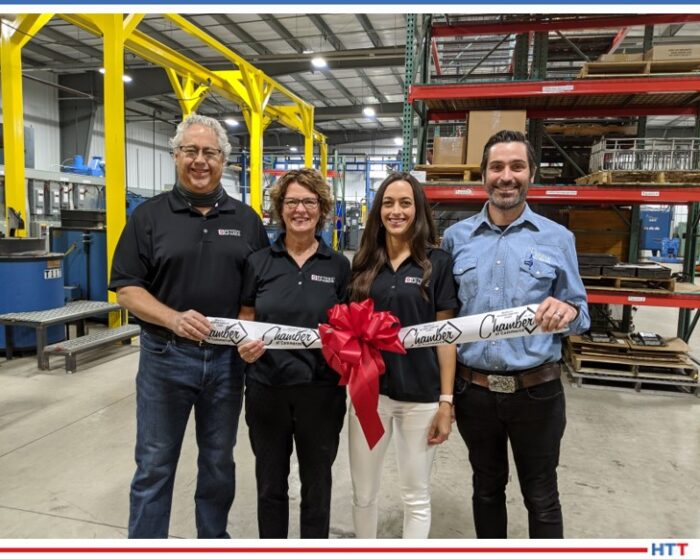
Peters’ Heat Treating, Inc., a 40-year-old heat treating company that specializes in a variety of high tech heat treating processes, moved its headquarters into a newly expanded Meadville, Pennsylvania facility located in the western part of the state.

Ribbon Cutting with the Owners: Doug and Jackie Peters (founders), Diana Wilkosz (VP), and Andy Wilkosz (President)
(photo source: Peters' Heat Treating, Inc.)

Additionally, Peters' Heat Treating also announced two new lines of business: aluminum alloy processing and stainless steel black oxide. Vice President Diana Wilkosz shared in a recent interview, "We added these two new lines because of the growing demands from the automotive, aerospace, energy, and defense industries. We are also working on Nadcap certifications."

The company specializes in vacuum processing, atmosphere heat treating/integral batch quench processing, laser heat treating, aluminum alloy processing, carburizing, scale free aging/stress relieving, cryogenics, black oxide coating, induction processing, nitriding/FNC and the proprietary Nitreg nitriding processes.

After being in their original facility for 40 years, this expansion, that covers 32,000 square foot of manufacturing space, has provided them the opportunity to expand and update their vacuum line, provide room to add new vacuum furnaces, as well as increase their product offerings and continue to grow the now 60-employee business.

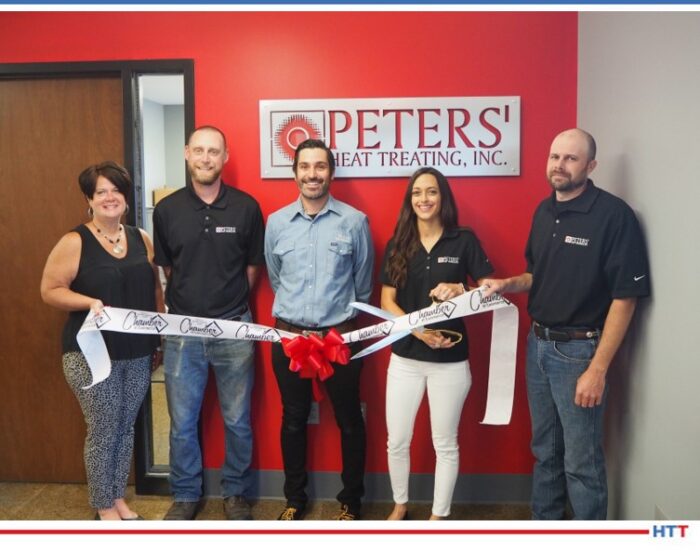
Ribbon Cutting with Meadville Managers (photo source: Peters' Heat Treating, Inc.)

“We are excited to consolidate our services and knowledge in a way that maintains our history and dedication to the local community and industry while providing us the runway for a successful future,” said Andy Wilkosz, newly named president in 2019 and son-in-law of founders Doug and Jackie Peters. “These current times are challenging, but we know our business and the country will persevere.”

In addition to Peters' Heat Treating, the family also co-owns Laser Hard, a robotic laser heat treating company.

“It’s been a pleasure to be a part of the local community and to help companies grow,” Doug Peters said. “Probably the thing I’m most proud of is the great people I’ve had the opportunity to work with. I’ve watched them buy houses and have children, and now their kids are having children.”

Plant Expansion (photo source: Peters' Heat Treating, Inc.)


To learn more about Laser Hard, listen to the Heat Treat Radio episode in which they are featured.


Precision Parts Heat Treater Expands Operations Read More »

Logan Aluminum Inc. Receives Furnace to Heat Treat Ingots

Logan Aluminum Inc., of Russellville, Kentucky, a manufacturer of flat rolled aluminum sheet that is primarily used in the beverage market, received a new furnace for heating and homogenizing aluminum ingots. 

The gas-fired furnace is dimensioned to simultaneously hold 32 ingots weighing up to 35 US tons (32 European tonnes) per piece, resulting in a charge weight of over 1102 tons US (1,000 tonnes European tonnes). This is OTTO JUNKER GmbH's largest furnace it has ever supplied. 

Apart from the furnace with an active cooling system, the scope of delivery also included machinery for charging and discharging the ingots, as well as a gantry crane and a mobile roller table as a connection to the existing rolling mill feed table.

Logan Aluminum Inc. Receives Furnace to Heat Treat Ingots Read More »

IHEA Monthly Economic Report: Robust Growth and Significant Gains

"It may not be time to start dancing in the streets, but the news this month is certainly a stark contrast from what it was last month." This note of encouragement begins the Industrial Heating Equipment Association’s (IHEA) Executive Economic Summary for the month of June 2020. The report continues, "Of the eleven indicators we watch, there were nine trending in a positive direction and not by a narrow margin. This was robust growth and significant gains."

The common theme among the nine indices reporting a positive trending was that "The lockdown was lifted and business was allowed to resume. The expectation was near universal and proved to be accurate. The vast majority of businesses promptly reopened to the degree they were able and that varied with the sector. The majority of the manufacturing community was able to resume operations with minimal adjustment."

The recovery in automobile sales is impressive, but it will take awhile to offset the decline of the last few months. The summary explains how vital the health of the auto sector is to the overall economy: "It is hard to overestimate the importance of the overall auto sector to the health of the greater economy. It is not just the thousands of jobs in the assembly plants but the tens of thousands of jobs in the companies that supply the parts and assemblies. Not to mention the jobs in the dealerships, the service operations, the people in the insurance and financing communities, the marketing people and the guys that work the car wash. It is a massive economic engine and that is what led to the old phrase 'What’s good for GM is good for the nation.'"

The recovery in vehicle sales has been impressive.

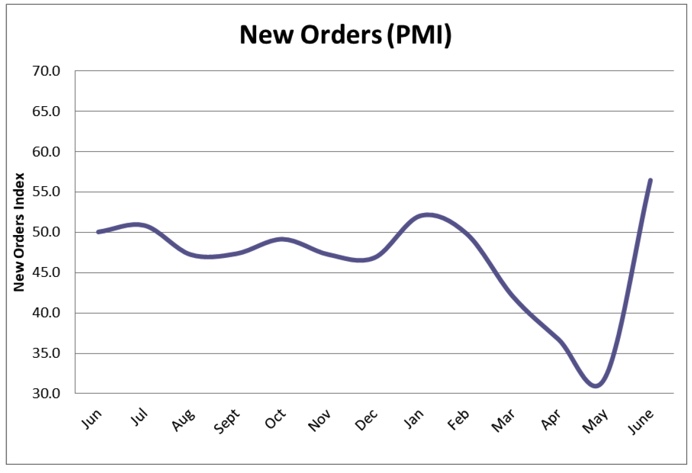
The Purchasing Managers' Index also reflected significant gains.  Last month it dropped to the 30s, which is the lowest it had been since its inception. The rebound was expected as the lockdown restrictions were loosened, however, it was much stronger than anticipated. The report explains, "The fact that this is coming from the more future oriented part of the index is also encouraging. This indicates there is more confidence in the future as the assumption is that there will be a further return to normal business operations. It is also an indication that new orders have been arriving in a variety of sectors as almost all of the measured categories saw an improvement. The notable exceptions have been aerospace and sectors tied to hospitality and travel in general."

The Purchasing Managers’ Index jumped back into positive territory in a big way.

The two negative readings were in capital investment and steel consumption.  The summary cites, "The desire to invest in either new machinery or expansion is still very low as the future of the rebound remains in question. Most companies have been working off their inventory and have not needed to add anything – there is still plenty of slack. The investment outlook remains cautious. Steel consumption remains down as there has been a collapse in public sector activity and the commercial construction sector has not figured out demand as [of] yet. The vehicle sector is growing again, but carmakers are still working off their old inventory."

Reminding readers that the readings are still worse than they were before the pandemic and lockdown caused the economy to tumble, the summary states, "But the fact that a reversal has begun promises some continued expansion." A caution is offered, however, because "the economy remains in uncharted territory" due to the fact that this hasn't been a "normal recession."

Bottom line: There is hope. We'll take it.

The report is available to IHEA member companies. For membership information, and a full copy of  the 12-page report, contact Anne Goyer, Executive Director of the Industrial Heating Equipment Association (IHEA). Email Anne by clicking here.

Anne Goyer, Executive Director of IHEA


IHEA Monthly Economic Report: Robust Growth and Significant Gains Read More »

Skip to content