

Vacuum Furnaces

A Heat Treater’s Primer on Getter Materials


Source: VAC AERO International


A common dilemma for operators of vacuum systems is to protect the integrity and maintain the life expectancy of components when the presence of unwanted gaseous contaminates threatens to destroy the sensitive materials in the processing environment. Getter materials are the MVPs that step up to the plate to protect work in a low-pressure vacuum environment.

Table 1 [1] Getter Capacity of Common Materials
The folks at VAC AERO International have provided a primer on getter materials which answers the heat treater’s questions, such as:

  • What is a getter?
  • What are the properties of getter materials?
  • What materials are best as getters for most heat-treating applications? What about for more sophisticated applications?
  • What are non-evaporative getters, and what role do they play?

“For heat treaters, getters are often considered a last resort to help keep parts ‘bright and clean’. In point of fact, they play an important role in successful vacuum processing of many highly sophisticated products and materials. As a result, we need to do a better job of understanding their role; how and where they can help.”


Photo Credit and caption: Titanium Discs used as a Getter Material in Brazing of Oxidation Sensitive Components – (Photograph Courtesy of California Brazing, Newark, CA)

A Heat Treater’s Primer on Getter Materials Read More »

Matching Gases with Vacuum Heat Treatment Operations


Source: VAC AERO International


Relative Gas Supply Cost Notes: [a] Based on a minimum usage of 2830 cubic meters (100,000 cubic feet) per month. [b] All gases compared to nitrogen whose relative cost is unity. [c] Based on liquid supply.
Heat treaters use a variety of gases with vacuum furnaces during the processing cycle in partial pressure operation, for backfilling to atmospheric pressure at the end of the processing cycle, and for cooling/quenching. In this article, VAC AERO describes the most common of these gases — (in order of frequency of use) nitrogen, argon, hydrogen and helium — as well as other common gases such as various hydrocarbons and ammonia (for vacuum carburizing/carbonitriding) and specialty gases such as neon (for certain electronics applications), and analyzes their uses and value in various vacuum heat treating processes. In addition, their relative cost per 100,000 cubic feet, the liquid properties and physical properties of common backfill gases, and the conversion between common pressure and vacuum units are explored.

Read more: “Types of Backfill, Partial Pressure, and Cooling Gases for Vacuum Heat Treatment”


Matching Gases with Vacuum Heat Treatment Operations Read More »

Twin Vacuum Furnaces for Energy-Optimized Heat Treating

The first set of twin furnaces working on a single pumping station have recently been developed and commissioned to a leading designer and manufacturer of vacuum furnaces for the heat treatment of metal parts.

BMI, a Tenova company, headquartered in Lyon, France, commissioned the B54R-TWIN – vacuum furnaces for tempering – to meet the customer’s specific request for equipment that optimizes energy consumption.

During a heat treatment cycle of the B54R-TWIN, the pumping phase lasts only 30 minutes. Therefore, it is more efficient to use only one pumping group for two furnaces, working alternatively on one furnace or the other. This not only reduces electricity consumption but also minimizes the maintenance costs of the pumps.

Earlier in this quarter, Tenova announced key contracts from Chinese steel producers for six electrical arc furnaces (EAF) Consteel® Evolution in response to Chinese steelmaking industries converting their steel shops plants with EAF technology. In order to improve the reduction rate of CO2 emissions promoted by Chinese government, Chinese steelmakers are starting to increase the share of electrical steel production in comparison to manufacturing using blast or basic oxygen furnaces.


Twin Vacuum Furnaces for Energy-Optimized Heat Treating Read More »

Aerospace, Medical, and Tooling Industries Benefit from Eight Vacuum Furnaces

Eight vacuum heat treating systems were shipped to customers in Costa Rica, India, Germany and the United States. Ipsen USA recently shipped this equipment and it will be used to support the additive manufacturing, aerospace, medical, MIM and tooling industries.

The vacuum furnaces shipped included a vertical MetalMaster® furnace with a 5,000-pound (2,268 kg) capacity; a custom-built furnace for debinding and sintering; horizontal MetalMaster and TurboTreater®furnaces; a TITAN® DS (debinding and sintering) furnace; and several H2- and H6-sized TITAN vacuum furnaces equipped with the PdMetrics® software platform for predictive maintenance. This software platform securely connects to a network of integrated sensors on the furnace to gather and analyze data, run algorithms and provide real-time diagnostic that improve the health and integrity of the equipment.

Aerospace, Medical, and Tooling Industries Benefit from Eight Vacuum Furnaces Read More »

Heat Treat TV: 48′ Vacuum Furnace Installed in Western Pennsylvania

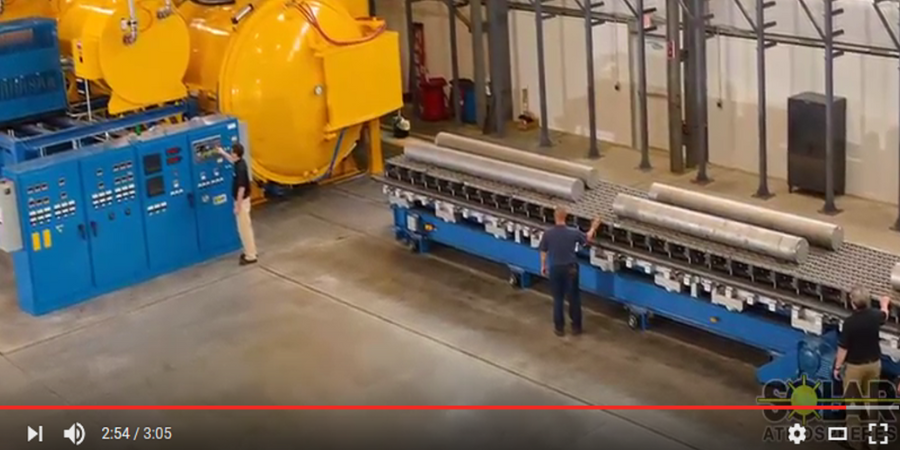
Take a look at this fascinating time-lapse video of a 48 foot vacuum furnace being installed at a leading commercial heat treat shop in western Pennsylvania. The furnace was manufactured by Solar Manufacturing and will be used for vacuum processing very large, long, and/or heavy aerospace, automotive and energy sector parts. Watch it now by clicking here or on the image below.

Solar Atmospheres' 48' Vacuum Furnace 2

Heat Treat TV: 48′ Vacuum Furnace Installed in Western Pennsylvania Read More »

Temperature Uniformity Surveying for Vacuum Furnaces

BOTW-50w Source:  Solar Atmosphere’s Vacuum Reference Series Number 2

A Temperature Uniformity Survey ( TUS ) for a vacuum furnace to satisfy AMS 2750D must be performed using established procedures and methods that fully meet the requirements of the specification and allows for consistent and more accurate results of actual furnace capabilities.

Read More: Optimizing Procedures for Temperature Uniformity Surveying of Vacuum Furnaces

Temperature Uniformity Surveying for Vacuum Furnaces Read More »

Skip to content