Alberto Cantu

High-Purity Alumina Calcining Processes Support Expansion

One of North America’s leading producers of ultra-high-purity alumina and associated products recently boosted its advanced manufacturing operations with a 50m-long electric tunnel kiln. This installation will support the company’s expansion into the production of a variety of high specification lines.

Alberto Cantú Br<> Vice President of Sales
NUTEC Bickley

The calcination kiln, which was broken down into modules and transported by NUTEC Bickley, has an operating temperature of 2190°F (1200°C) and maximum temperature of 2460°F (1350°C) and processes the material in saggars sitting in six-high stacks that are loaded on to 33 cars. With a firing cycle of 23.6 hours, approximately 5000kg of calcined material is processed each day. In addition, special provisions to prevent equipment wear due to chemical attack that follows degassing of hydrochloric acid during the alumina heating process has been designed by NUTEC Bickley.

“The nature of the material being processed means that tight tolerances and demanding specifications have had to be met,” said Alberto Cantú, vice-president of ceramics at NUTEC Bickley. “[This] demonstrates once again how, when all necessary design parameters are in place, electric heating in continuous kilns can deliver for a wide range of manufacturing processes.”

The use of electric heating is increasingly in demand. Extremely tight thermal control is necessary in the kiln chamber, operating under an oxidizing atmosphere, and this particular kiln has 14 automatic control zones for heating, plus two automatic zones for cooling. To ensure maximum flexibility and management of the temperature profile, the control systems are arranged so that the exhaust, heating zones, and cooling zones are all independently regulated.
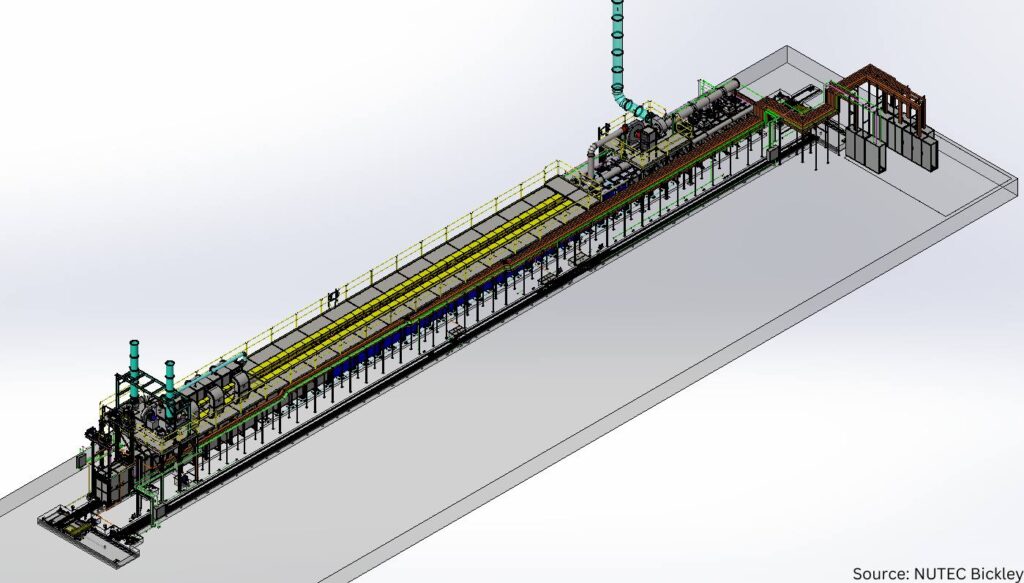
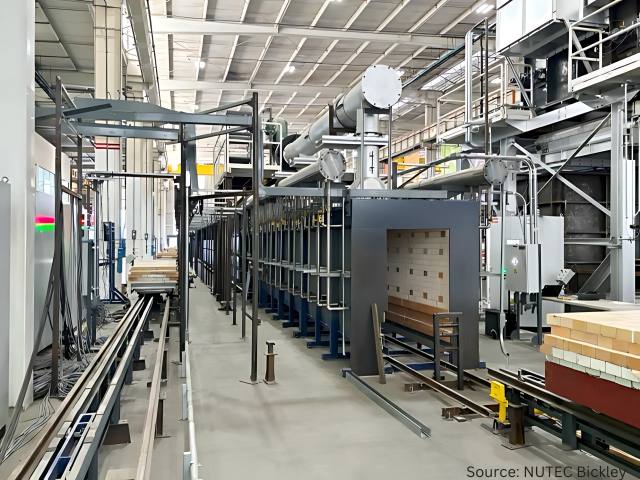
The heating system comprises a combination of silicon carbide and metal alloy elements. These hang down vertically through the roof and are sited on either side of the load, with distribution configured to deliver a well-balanced temperature uniformity throughout the kiln. The electrical connection design means that elements can be replaced while the furnace is at operating temperature.

Hot gases are drawn towards the kiln entrance and are evacuated from the tunnel through exhaust ports positioned in the kiln sidewalls, via the exhaust fan. Cooling is achieved by direct air movement in the cooling zones. The temperature set points from the cooling zones are controlled automatically with cooling nozzles positioned to blow a stream of cold air above and below the load setting. The kiln walls use lightweight insulation for rapid thermal response and fuel economy, with the lining rated for use up to 2350ºF (1290°C). The roof is lined with high thermal efficiency ceramic fiber system, and the roof insulation combines modules of polycrystalline fiber and zirconia grade fiber.

Kiln car operation is based on a semi-continuous feed electromechanical pusher with push speed adjustment. The push speed is configurable by selecting the appropriate firing schedule at the kiln control panel. A vestibule arrangement serves to reduce exchange of air and gases between the factory and the kiln. When a car is being introduced into the kiln, the door at the entry end opens, while the door at the kiln entrance is closed.

The vestibule has two sections: the first accommodates a single car and is separated by two vertical lift doors to separate the factory’s atmosphere from the kiln atmosphere. This is managed by installing an exhaust hood which is connected to the entry exhaust fan, thus ensuring a negative pressure in the vestibule to avoid any gases from the kiln from leaving the chamber. The second section functions as a transition from the vestibule door sections to the kiln’s pusher.

Press release is available in its original form here.


High-Purity Alumina Calcining Processes Support Expansion Read More »
Energy-Saving Solutions for Industrial Furnaces

Poor energy efficiency in industrial furnaces usually impacts companies’ production costs since more energy consumption is required to achieve the desired temperature. This, in turn, has a tangible impact on their carbon emission footprint. In this Technical Tuesday by Alberto Cantú, VP of Sales at NUTEC Bickley, learn energy-saving solutions for industrial furnaces.

This article was originally published in Heat Treat Today’s May 2024 Sustainable Heat Treat Technologies 2024 print edition.

To read the article in Spanish, click here.


According to the International Energy Agency, the industrial sector is one of the main culprits when it comes to global energy consumption. In many situations, industrial furnaces tend to be the pieces of equipment that consume the most energy.

In this article, we will share a series of solutions you can implement to improve energy efficiency, reduce production costs, and be socially and environmentally responsible.

Factors that May Be Affecting Your Energy Efficiency

There are a couple of obvious factors that may be harming your energy efficiency ratings.

Heat Losses in the Furnace Process

These may be due to structural damage to the insulation or incorrect gas flow distribution inside the furnace.

Inefficient Combustion Processes

Contact us with your Reader Feedback!
Industrial furnace flow check

Inefficiencies here are probably due to inadequate or excessive air/fuel ratios or poor mixture caused by internal damage to the burner.

Some tips we can pass on to help you improve furnace energy savings are:

  • Monitor the temperature on the cold side of the furnace, carefully checking that there are no hot spots.
  • Periodically analyze the composition of the furnace combustion gases, ensuring you are maintaining the expected levels of oxygen and CO.
  • Periodically check that the combustion air and fuel flows are in a stoichiometric ratio.
  • Check at least twice a year that the burners are in good condition and show no damage.
  • Avoid infiltration of cold air into the furnace that could affect the efficiency of the process.
  • Keep the temperature control loops tuned. If there is no temperature control loop, we recommend integrating one.
  • Periodically monitor consumption, either manually or automatically.
  • Ensure there is a program of predictive maintenance on the combustion system.

How Does Predictive Maintenance Work?

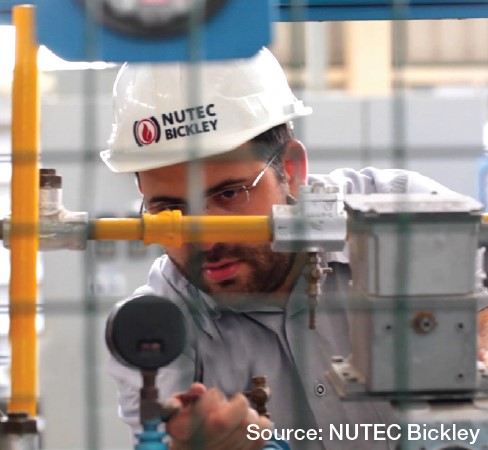
Attention to detail during predictive maintenance

This type of maintenance is based on the storage, monitoring, and analysis of data and quantifiable equipment variables in real time, such as temperature, vibration, and frequency.

It is necessary at the outset to understand the processes thoroughly and identify which aspects need to be analyzed, to make this approach work. These aspects include:

  • Temperature — monitoring the temperature may reveal abnormal changes, indicating possible overheating or component failure.
  • Vibration — unusual vibration may indicate machinery wear or imbalance, resulting in more severe damage if not addressed in time.
  • Frequency — analyzing particular patterns and behaviors during heat treat processing can provide insight into what may evolve into future potential problems.

Th ese actions will depend on appropriate measurement and detection control systems, the primary variable for these being sensors and algorithms. Firstly, sensors play a fundamental role in predictive maintenance, as they can detect subtle changes in the equipment’s performance, making it possible to identify potential failures before they occur. It is advisable to have access to an inventory of recognized sensor and spare parts brands, allowing you to measure your equipment’s variables.

Secondly, algorithms identify patterns and trends indicative of possible issues by processing large data amounts, allowing timely and planned interventions.

Factors Influencing Measurement Time

The time it can take to measure variables during a predictive maintenance process depends on many internal and external factors. Below we address some of them.

External Factors

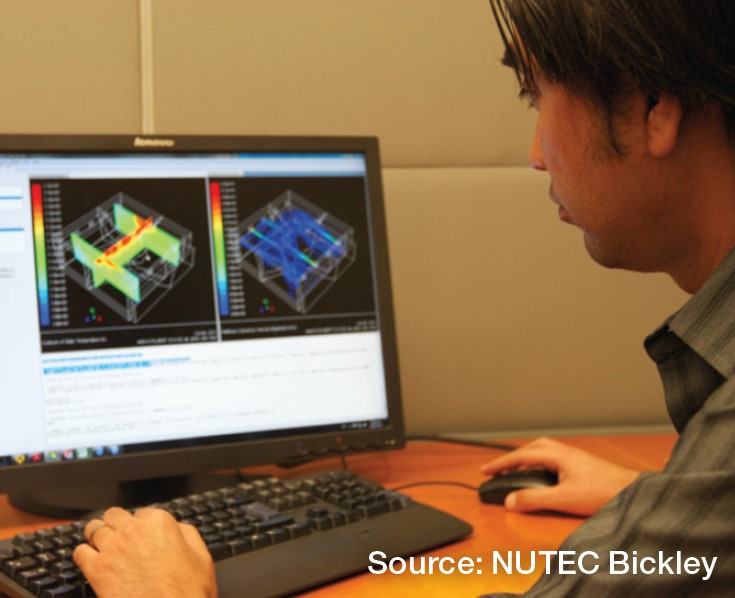
Data analysis is a key component for effective preventative maintenance
  • The process — each industrial procedure has its own characteristics and requirements. For example, constant and real-time monitoring might be required in a continuous process, while a specified intervals approach might be best in other situations.
  • The product — some products may require frequent or strict monitoring due to their nature and characteristics.
  • Customer philosophy — some customers may have stricter standards or request more frequent monitoring to ensure the quality and reliability of their products.

Internal Factors

  • Capacity — strategic planning and scheduling measurements may be necessary if the equipment is limited or employed for other processes.
  • Availability of qualified personnel — ensuring that qualified staff are available at the right time to interpret the data obtained is crucial.
  • Energy-saving solutions for industrial furnaces — this is where you need to be able to rely on your combustion expert partner to advise on the most up-to-date energy-efficiency solutions you can implement in order to improve furnace performance and to help you reduce production costs.

Systems To Improve Furnace Energy Efficiency

Today, some systems that can significantly assist in reducing energy consumption can be implemented in your furnaces, thus preventing losses and/or eliminating inefficient processes. Here are some systems that can be implemented:

Energy Recovery Systems

These can be added to your furnaces to recover the heat from the flue gases so that they can be used again, heating the combustion air. Some options for these systems are self-recuperative burners and regenerative burners.

Flue Gas Measurement Systems

These guarantee that your furnaces always have the correct proportion of air and gas in their system. With them, you can continuously monitor the status and thus make decisions based on these data to adjust any out-of-proportion levels.

Preventive Maintenance Services

Besides the tips and systems for energy saving already mentioned, there are other actions that save energy, reduce costs, prevent failures in your industrial furnaces, improve their operation, and more.

Two of these are:

  1. Audit and diagnosis service: The furnace input and output variables are measured in order to indicate current efficiency levels and to identify possible areas for improvement.
  2. Burner calibration service: The air/fuel ratio is checked to ensure burners operate in the correct range.

Conclusion

In summary, if you consider implementing any of the tips and systems presented here, you can improve energy efficiency in your industrial furnaces and significantly reduce your operating costs. Be sure to check out the International Energy Agency if you are looking for further information on this topic.

About the Author

Alberto Cantú, Vice President of Sales, NUTEC Bickley

Alberto Cantú is the vice president of Sales at NUTEC Bickley. Cantú has more than twenty years of professional experience and has written prolifically for a variety of journals. Cantú is an honoree from Heat Treat Today’s 40 Under 40 Class of 2020.

For more information: Contact Alberto at albertocantu@nutec.com.

Find Heat Treating Products And Services When You Search On Heat Treat Buyers Guide.Com

Energy-Saving Solutions for Industrial Furnaces Read More »

Ahorro de energíapara hornos industriales

La baja efi ciencia energética en los hornos industriales suele impactar los costos de producción de las empresas, ya que se requiere más consumo de energía para alcanzar la temperatura deseada. Esto, a su vez, tiene un impacto tangible en su huella de emisiones de carbono.

This article was originally published in Heat Treat Today’s May 2024 Sustainable Heat Treat Technologies 2024 print edition.

To read the article in English, click here.


De acuerdo a la Agencia Internacional de Energía, el sector industrial es uno de los principales culpables en lo que respecta al consumo global de energía. En muchas situaciones, los hornos industriales tienden a ser los equipos que más la consumen.

En este artículo, compartiremos una serie de soluciones que pueden implementarse para mejorar la efi ciencia energética, reducir los costos de producción y ser social y ambientalmente responsables.

Factores que pueden estar afectando tu efi ciencia energética

Existen un par de factores obvios que pueden estar perjudicando tus índices de eficiencia energética.

Pérdidas de calor en el proceso del horno

Estas pueden deberse a daños estructurales en el aislamiento o a una distribución incorrecta del fl ujo de gas dentro del horno.

Procesos de combustión inefi cientes

Contact us with your Reader Feedback!
Gran atención al detalle en el mantenimiento predictivo

Probablemente debido a relaciones aire/combustible inadecuadas o excesivas, o a una mala mezcla causada por daños internos en el quemador.

  • Algunos consejos que podemos brindarte para ayudarte a mejorar el ahorro de energía en el horno son: Monitorear la temperatura en el lado frío del horno, verifi cando cuidadosamente que no haya puntos calientes.
  • Analizar periódicamente la composición de los gases de combustión del horno, asegurándose de mantener los niveles esperados de oxígeno y CO.
  • Verifi car periódicamente que los fl ujos de aire de combustión y combustible estén en una relación estequiométrica.
  • Revisar al menos dos veces al año que los quemadores estén en buenas condiciones y no presenten daños.
  • Evitar la infi ltración de aire frío en el horno que pueda afectar la efi ciencia del proceso.
  • Mantener ajustados los lazos de control de temperatura. Si no hay un lazo de control de temperatura, recomendamos integrarlo.
  • Monitorear periódicamente el consumo, ya sea manual o automáticamente.
  • Garantizar un programa de mantenimiento predictivo en el sistema de combustión.

¿Cómo funciona el mantenimiento predictivo?

Revisión de fl ujos de hornos industriales

Este tipo de mantenimiento se basa en el almacenamiento, monitoreo y análisis de datos y variables cuantifi cables de los equipos en tiempo real, como temperatura, vibración y frecuencia.

Para que este enfoque funcione, es necesario comprender a fondo los procesos e identifi car qué aspectos necesitan ser analizados. Estos aspectos incluyen:

  • Temperatura: monitorear la temperatura puede revelar cambios anormales, indicando un posible sobrecalentamiento o falla de componentes.
  • Vibración: una vibración inusual puede indicar desgaste o desequilibrio de la maquinaria, lo que resultará en daños más severos si no se aborda a tiempo.
  • Frecuencia: analizar patrones y comportamientos particulares puede proporcionar una idea de lo que puede convertirse en futuros problemas potenciales.
  • Estas acciones dependerán de sistemas de control de medición y detección adecuados. Los sensores y algoritmos constituyen los principales sistemas de medición de variables y detección de problemas.

Por un lado, los sensores juegan un papel fundamental en el mantenimiento predictivo, ya que pueden detectar cambios sutiles en el desempeño del equipo, permitiendo identifi car posibles fallas antes de que ocurran. Es recomendable tener acceso a un inventario de marcas reconocidas de sensores y repuestos, lo que te permitirá medir las variables de tu equipo.

Por otro lado, los algoritmos identifi can patrones y tendencias indicativas de posibles problemas mediante el procesamiento de grandes cantidades de datos, lo que permite intervenciones oportunas y planifi cadas. Factores que infl uyen en el tiempo de medición.

El tiempo que puede llevar medir variables durante un proceso de mantenimiento predictivo depende de muchos f actores internos y externos. A continuación, abordamos algunos de ellos.

Factores externos

  • El proceso. Cada procedimiento industrial tiene sus propias características y requerimientos particulares. Por ejemplo, en un proceso continuo se podría requerir un monitoreo constante y en tiempo real, mientras que en otras situaciones un enfoque de intervalos específi cos podría ser el mejor.
  • El producto. Algunos productos pueden requerir un monitoreo frecuente o estricto debido a su naturaleza y características.
  • La fi losofía del cliente. Algunos clientes pueden tener estándares más estrictos o solicitar un monitoreo más frecuente para garantizar la calidad y confi abilidad de sus productos.

Factores internos

  • Capacidad. Puede ser necesaria una planifi cación estratégica y una programación de las mediciones si el equipo es limitado o se emplea para otros procesos.
  • La disponibilidad de personal califi cado. Es fundamental garantizar que haya personal califi cado disponible en el momento adecuado para interpretar los datos obtenidos.
  • Soluciones de ahorro de energía para hornos industriales. Aquí es donde necesitas poder confi ar en tu socio experto en combustión para que lo asesore sobre las soluciones de.

Sistemas de recuperación de energía

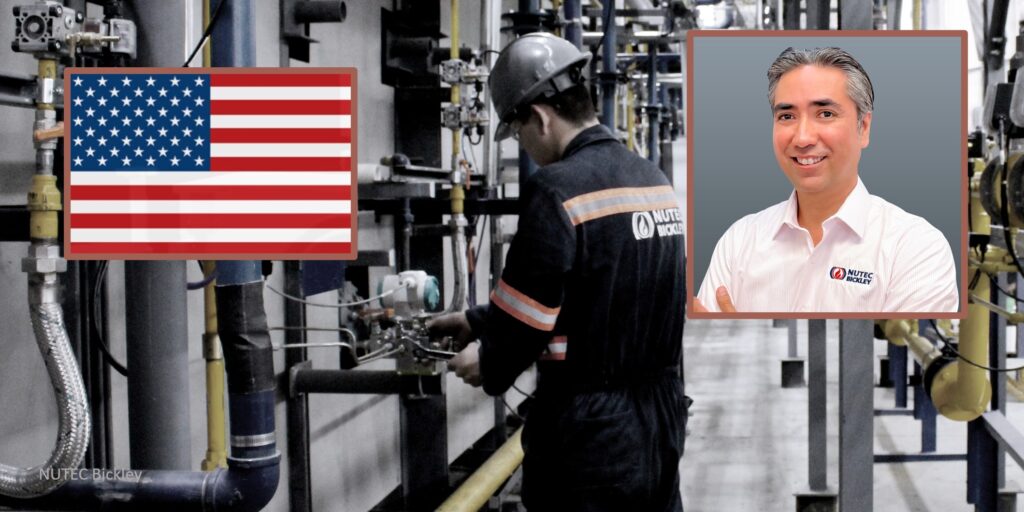
Personal altamente capacitado de NUTEC Bickley

Hoy por hoy, se pueden implementar algunos sistemas que pueden ayudar signifi cativamente a reducir el consumo de energía en hornos, previniendo así pérdidas y/o eliminando procesos inefi cientes. Estos son algunos de los que manejamos en NUTEC Bickley:

Sistemas de recuperación de energía

Se pueden agregar a los hornos para recuperar el calor de los gases de combustión y reutilizarlos calentando el aire de combustión. Algunas opciones para estos sistemas son quemadores autorrecuperativos y quemadores regenerativos.

Sistemas de medición de gases de combustión

Garantizan que los hornos siempre tengan la proporción correcta de aire y gas en su sistema. Con ellos, puede monitorear continuamente el estado y así tomar decisiones basadas en estos datos para luego ajustar cualquier nivel desproporcionado.

Servicios de mantenimiento preventive

Además de los consejos y sistemas de ahorro de energía ya mencionados, existen otras acciones que pueden ayudar a prevenir fallas en hornos industriales, mejorar su funcionamiento y más.

Servicio de auditoría y diagnóstico: Se miden las variables de entrada y salida del horno para indicar los niveles de eficiencia actuales e identifi car posibles áreas de mejora.

Servicio de calibración de quemadores: Se verifi a la relación aire/combustible para asegurar que los quemadores operen en el rango correcto.

Conclusión

En resumen, si deseas mejorar la efi ciencia energética en hornos industriales y reducir signifi cativamente tus costos operativos, recuerda seguir nuestras recomendaciones.

Acerca del autor

Alberto Cantú, Vice President of Sales, NUTEC Bickley

Alberto Cantú es vicepresidente de Ventas de NUTEC Bickley. Cantú tiene más de veinte años de experiencia profesional y ha escrito prolífi camente para una gran variedad de revistas y publicaciones. Cantú es uno de los galardonados por Heat Treat Today’s 40 Under 40 Class del 2020.

Para mayor información: Contactar a Alberto escribiendo a albertocantu@nutec.com.


Find Heat Treating Products And Services When You Search On Heat Treat Buyers Guide.Com

Ahorro de energíapara hornos industriales Read More »

Spotlight on 40 Under 40 Alumni

OCHeat Treat Today’s 40 Under 40 was created to bring recognition to young professionals in the industry, giving names, faces, and words to the rising generation of industry professionals. In this original content article, released on the final day to nominate someone to Heat Treat Today’s 40 Under 40 Class of 2022, we caught up with exemplary classmates from past years to hear where they are now and what comments they have about the industry.


Justin Powell

It has been 15 years since, "at the age of 19, I started working for a company that serviced high temperature furnaces and industrial combustion systems. I cut my teeth in the industry by doing burner retrofits and turnkey system installations."

Since being nominated to receive Heat Treat Today’s 40 Under 40 award, Justin says he has "started a company called MP Combustion with my very good friend, Ryan McClain. We literally started the company working out of our basements in 2019 and with the support of this wonderful industry have since grown to a team of six with hopes to expand to more employees soon. Our team works hard to support the heat treat community by supplying the best combustion equipment and technical support in the industry." Justin notes that starting MP Combustion is "easily the highlight of my career so far."

When asked what his favorite thing about the industry is, he commented, "The never-ending learning curve. I love to learn, and this industry has a seemingly endless supply of new skills to learn and hone. I also have a great admiration for the people in this industry, they are always willing to help teach and learn from one another. It's an amazing community to be a part of!"

As a final word of advice for the winners being selected to Heat Treat Today’s 40 Under 40 Class of 2022 this summer, Justin encourages them, saying, "My friends, this is only the beginning. I wish you all great success throughout your career and hope that our paths meet along the way!"

Read more about Justin here.

Jaime Sanchez

Jaime got involved in the world of heat treat seven years ago, seeking "a job opportunity in Engineering and Project Management and in automotive, power generator, or automation." Since receiving the award, Jaime has "received a promotion from Engineering Manager to Operations Manager in MATTSA FURNACE COMPANY, expanding my area of responsibilities to equipment manufacturing without [fully] leaving engineering and project management."

His aptitude to pivot is evident in what he finds most exciting about heat treating: "Every day is a new challenge for me, from receiving and managing new projects to helping our clients to solve issues or coordinate the activities of MATTSA plant with all the personnel involved. All these activities and the way I solve them make me excited every day when I arrive at my workplace."

"Receiving this nomination is an honor," Jaime shares, "it is a way of showing the world the talent you have, in addition to showing that being young is not synonymous with being inexperienced, but that our generation can do great things with a lot of dedication and effort. Never stop fighting for what you want and show that your talent is world class."

Read more about Jaime here.

Miguel Humberto Fajardo
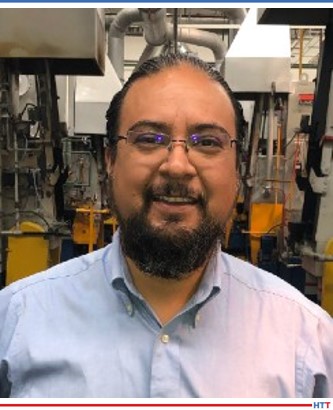
For Miguel, it has been six years of service in the heat treat industry. "I started in 2016," he commented, "with an internship program, in the John Deere materials laboratory. I had the opportunity to collaborate in the development of suppliers, certify the quality and mechanical properties of treated parts, participate in the design of new heat treat recipes and the introduction of new processes. Those were the first steps in the world of heat treat. After the internship and thanks to that experience, I was hired as the engineer in charge of John Deere's heat treatment lines."

Over the past few years since nomination, Miguel notes that his role in heat treatment "has changed a lot. My position evolved to a Sr. level with more responsibilities and challenges, including renewing the technology of our lines, implementing improvements to make processes more efficient and achieving cost and expense reductions. I was awarded trade secrets for these upgrades." He continues, saying, "I am currently working on fully exploiting the capacity of our equipment, focusing on cost reductions, reducing gas consumption, and improving emissions."

It's the science paired with experimentation in heat treat that continues to interest Miguel: "What I like the most is that it is a true science, it requires a lot of experimentation and generating hypotheses. My colleagues tell me that they are like occult arts or magic, since two parts that look the same can be completely different inside."

To the upcoming 40 Under 40 Class of 2022, Miguel offers a challenge: "Although the literature on HT is many years old, there is always an opportunity to innovate and create different things and different ways of doing things. Experiment and ask yourself many things. and this will become more than a job, a different experience day by day. Very challenging and fun."

Read more about Miguel here.

Heat Treat Today's 40 Under 40 Authors

Check out some of the technical content that 40 Under 40 award winners have published with Heat Treat Today over the years:

Alberto Cantú - 40 Under 40 profile

Ben Gasbarre - 40 Under 40 profile

Josh Hale - 40 Under 40 profile

Mike Harrison - 40 Under 40 profile

Kyle Hummel - 40 Under 40 profile

Trevor Jones - 40 Under 40 profile

Ellen Conway Merrill - 40 Under 40 profile

Shawn Orr - 40 Under 40 profile

Justin Sims - 40 Under 40 profile

Andy Wilkosz - 40 Under 40 profile


Find heat treating products and services when you search on Heat Treat Buyers Guide.com


Spotlight on 40 Under 40 Alumni Read More »

20 Quick Heat Treat News Chatter Items to Keep You Current

Heat Treat Today offers News Chatter, a feature highlighting representative moves, transactions, and kudos from around the industry. Enjoy these 20 news bites that will help you stay up-to-date on all thing heat treat. 

Equipment Chatter

  1. A leading Chinese aviation company began cooperating with SECO/WARWICK, placing an order for a Vector® vacuum furnace for carburizing and gas quenching. The furnace will be used for the manufacturer of hydraulic pump components and other machinery.
  2. Tenova Italimpianti, a technologies and equipment supplier for industrial furnace providers, recently received a contract from Metalloinvest for the reconstruction of the Heating Furnace 2 in the second rolling unit of Alexey Ugarov OEMK, in Russia.
  3. Tenova LOI Thermprocess has received an order from Wuhan Iron & Steel Co. Ltd. (WISCO) in Wuhan, China for the installation of a continuous quench for the efficient cooling of thin steel plates.

Personnel/Company Chatter

  1. Nitrex’s Aurora commercial heat treat facility is now in the hot testing phase of its newly installed low-pressure carburizing (LPC) and vacuum system, which is expected to start production in September.
  2. Can-Eng Furnaces International Ltd. welcomed Johan Vargas to its Mechanical Engineering team.
  3. Mike Stowe, senior energy engineer at Advanced Energy, recently won an ACEEE Champion of Energy Efficiency in Industry award in the industrial leadership category.
  4. Selas Heat Technology Co. announced that Burner Design and Controls (BDC) of Hazelwood, Mo. has joined their network of manufacturers’ representatives. BDC will be handling Selas burners, valves, mixers, and control components serving customers in Missouri, Kansas, Iowa, and Southern Illinois.
  5. The Industrial Heating Equipment Association (IHEA) recently gathered for its annual meeting in St. Pete Beach, FL, where the National Board of Directors and Executive Officers met in person. The leading Board of Directors consisted of both continuing and new members. Scott Bishop of Alabama Power – Southern Company serves as president; Jeff Valuck of Surface Combustion, Inc. as vice president; Brian Kelly of Honeywell Thermal Solutions as treasurer and Michael Stowe of Advanced Energy serves as past president. Jason Safarz returns to the IHEA Board of Directors as a regional sales manager at Karl Dungs, Inc. Jeff Rafter, vice president of sales and marketing with Selas Heat Technology Co., joins the IHEA Board of Directors this year. Continuing their service for 2021–2022: Gary Berwick, Dry Coolers; Alberto Cantu, Nutec Bickley; Bob Fincken, Super Systems, Inc.; Doug Glenn, ; Francis Liebens, SOLO Swiss Group; John Podach, Fostoria Infrared; and John Stanley, Karl Dungs, Inc.
  6. The Industrial Heating Equipment Association (IHEA) acknowledges their current committee chairpersons on the IHEA Committees and Divisions: Government Relations Committee led by Jeff Valuck, Surface Combustion, Inc.; Safety Standards and Codes Committee led by Kevin Carlisle, Karl Dungs, Inc.; Education Committee led by Brian Kelly, Honeywell Thermal Solutions; Marketing Communication & Membership Committee led by Erik Klingerman, Industrial Heating The Infrared Division is chaired by Scott Bishop, Alabama Power – Southern Company; and the Induction Division is chaired by Michael Stowe, Advanced Energy.
  7. Alvis Eimuss, head of Customer Support at CENOS, presented the company’s most recent software, CENOS Induction Heating simulation software’s version 3.0 at a webinar titled, “Webinar: CENOS 3.0 release”.

Kudos Chatter

  1. Braddock Metallurgical announced that they achieved the renewal of Nadcap accreditation at their Bridgewater, Boynton Beach, and Jacksonville locations. Additionally, Braddock Metallurgical earned the special Nadcap recognition of Merit.
  2. Solar Atmospheres – Souderton, PA announces that it has been awarded Nadcap 24-month Merit status for heat treating, brazing and carburizing.
  3. Metallurgical Processing, Inc. in New Britain, CT has achieved two-year Merit status with PRI/Nadcap with 10 checklists ranging from Aluminum, Ion Nitride, Vacuum Furnace Brazing and Carburize among others.
  4. The Bodycote team in Berlin, CT completed a three-day Nadcap audit for electron beam welding, maintaining their Merit status for a further two years.
  5.  Bodycote teams at Silao, Romulus, and Canton Haggerty were awarded the Supplier Quality Excellence Award from General Motors for their work in 2020.
  6. Isostatic Pressing Services, LLC successfully completed the PRI evaluation process, becoming Nadcap certified for various criteria including AC7102/6 and AC7102/8 Rev A among others.
  7. Thermal-Vac Technology has been nominated and asked to take part in the Orange County Business Journal’s celebration of the 22nd annual Family-Owned Business Award.
  8. Allied Mineral Products of Columbus, Ohio celebrates its 60th anniversary in August 2021.
  9. SECO/WARWICK, a Polish company with American roots, was awarded a prize at the USA-Central Eastern Europe Investment Summit & Awards, one of the key events summing up the economic partnership between the U.S. and the Central Eastern European region. The award for the Most Successful Expansion was accepted by Sławomir Wozniak, the president of SECO/WARWICK Group
  10. The European Steel Technology Platform (ESTEP) reconfirmed Roberto Pancaldi, Tenova CEO, as member of the Board of Directors in the position of vice president. Enrico Malfa, Tenova R&D Director, was appointed member of the Clean Steel Partnership’s Board at ESTEP

Heat Treat Today is pleased to join in the announcements of growth and achievement throughout the industry by highlighting them here on our News Chatter page. Please send any information you feel may be of interest to manufacturers with in-house heat treat departments especially in the aerospace, automotive, medical, and energy sectors to bethany@heattreattoday.com.


20 Quick Heat Treat News Chatter Items to Keep You Current Read More »

Four 40 Under 40 Alumni: Where Are They Now?

OCHeat Treat Today’s 40 Under 40 was created to bring recognition to young professionals in the industry, giving names, faces, and words to the rising generation of industry professionals. In this article, released in the final nomination period for Heat Treat Today’s 40 Under 40 Class of 2021, we caught up with exemplary classmates from 2020 to see what they have been up to since being recognized in September 2020.


Alberto Cantú
VP Combustion, Control and Services
Nutec Bickley

Alberto Cantú

"I’ve been working from home for the past year, which in my case means that I am saving 2 hours of commute time every day! That’s not only good for the environment but also for my pocket ?.

"With this 'extra time,' I decided I wanted to read more, so I subscribed to the Harvard Business Review magazine, which has been very helpful for work. But perhaps the most interesting thing I’ve read over the past year is a book by Dale Carnegie How to win friends and influence people. I know it’s a classic but I was very reluctant to read it because it felt like a cheesy self-help book (which I am not a fan of), but I have to say it has timeless advice."

Ellen Conway Merrill
Vice President
DELTA H TECHNOLOGIES, LLC

Ellen Conway Merrill

"The pandemic certainly presented its share of challenges, but it’s also been incredible to witness the strides being made across the industry in such a short matter of time.

"They say necessity is the mother of invention and many businesses across the globe, including DELTA H, have embraced the opportunity to think differently and creatively to give both our employees and clients some semblance of normality and connectiveness.

"DELTA H is grateful to have come out of 2020 with a record year in revenue which could not have been done if it weren’t for the dedication of our team to push forward through uncharted waters and embrace change."

Jeff Opitz
President and Owner
CeraMaterials

.

Jeff Opitz

"Since my induction into the Heat Treat Today’s 2020 “40 under 40” class, CeraMaterials has been fortunate to enjoy a surge in new business and product development, which has been especially rewarding considering the challenging business environment we’ve been navigating since the onset of Covid.

"A few noteworthy achievements include:

  • Developing a new resin treatment for our line of carbon-carbon modular fixturing which reduces open porosity and enhances performance in oil quench and fuel vane applications.
  • Collaborating with several large aerospace entities to switch out graphite and alloy fixtures for carbon-carbon fixtures, resulting in increased throughput and tooling longevity.
  • Conducting a national rollout of carbon composite and graphite insulation products with McMaster-Carr, achieving a 100% fulfillment rating.

"Additionally, we have a new production line up and running for our signature “tight weave” carbon cordage, available in 24K and 36K weave patters, outgassed to 2200C. We’re working with key players in the “hypersonic” space, and are in the process of obtaining full ITAR certification to help our business reach new heights! We’ve also invested in our team by hiring a new digital marketing manager and have added a new member to our shipping and receiving department to ensure our customers are receiving undamaged material in a timely manner.

"I’m beyond grateful to our loyal customers and suppliers, as well as our new business partners who allow us to continue growing and serving the global heat treat market."

Esau Zamorano
Manufacturing and Heat Treating Project Engineer
Eaton Hydraulics

Esau Zamorano

1. Just a few weeks ago, the certification for EATON Hydraulics was obtained as a plant under the ISO 9001: 2015 system.

2. Preparing for a conversion from EATON Hydraulics to the Danfoss culture and business system.

3. Developing new projects to minimize the risk of operation in batch-type furnaces with the add of safety devices in the furnaces.

Four 40 Under 40 Alumni: Where Are They Now? Read More »

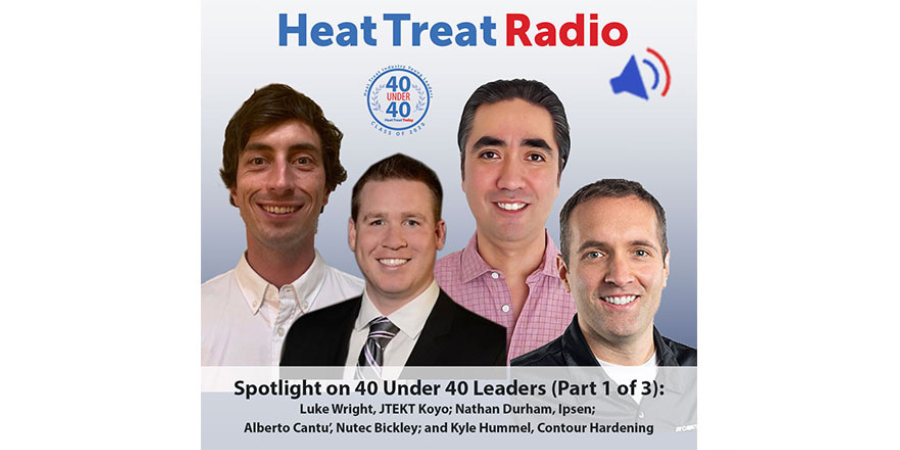
Heat Treat Radio #51: Spotlight on 40 Under 40 Leaders (Part 1 of 3)

In a special Heat Treat Radio series, 40 Under 40 winners from the class of 2020 respond with their stories and insights of their life and work in the heat treat industry. This episode features the stories of Luke Wright, Nathan Durham, and Alberto Cantú.

This episode in the series also features an update from a past alum; in this episode, Kyle Hummel of Contour Hardening  shares his journey over the last several years and how he has grown as a person in heat treat.

Below, you can listen to the podcast by clicking on the audio play button and read a few excerpts from this episode.


Luke Wright

Luke Wright
Senior Engineer
JTEKT North America Corporation / Koyo Bearings

“So, we had a void in the heat treating department. We had three new hires — 2 others including myself at the time. They kind of shuffled us around: one went to assembly and I got put in heat treat with one of the others. They figured heat treat was difficult enough for two green engineers. I kind of picked it up as I went along.

“I guess that’s kinda what I really like — sort of this black box science that everyone wants to talk about, and there’s so many things we have to just say, Well, I’m not really sure. We turn this knob and it tends to work better that way. But then, there’s also really detailed science and theory that kind of guides you and that gut feel, twist-that-knob practical application.”

“Something that I’ve been trying to do more lately in my job is to explain more about what I’m doing, what’s going on with the others around me — maintenance workers, furnace operators, or supervisors — instead of just keeping to myself or pushing them out of the way to just do the thing myself if they don’t understand: Doing a little more to work alongside people.”




Nathan Durham

Nathan Durham
Aftermarket Sales Manager
Ipsen

“As we near the end of 2020 and reflect on the many, many challenges that arose, I’m truly motivated by the diversity and resilience of our industry[…] We’ll persevere through this pandemic, and push forward into 2021.”

“During my tenure at Ipsen, I’ve realized how important it is to always remain flexible within a career and adapt to what your company and what your customer are asking you.”

“Thank you again, as I’m truly humbled to be a part, and associated with, such great company, and the future of our industry.”


Alberto Cantú

Alberto Cantú
VP Combustion, Control and Services
Nutec Bickley

“I started as an R&D manager. I had completed a PhD on the computation of fluid dynamics and used these tools to design new furnaces. But lately, I’ve been more involved in sales and business development.”

“On the one hand, the computation of power has been increasing — I’m going to say since the birth of computers, but lately more and more — but then the internet and the whole internet of things and Industry 4.0 coming together… You can do a lot of things with both the calculations and the ability to have the information in real time. I think many of these operating procedures that were mainly based on ‘rules of thumb’ and heuristics will change[…] to be based on machine learning…”

“I would suggest [for young heat treaters] to get involved in tradeshows, subscribe to newsletters, make sure you read all the news in the magazines available and in companies so that you get up-to-date in all things happening in the industry because, as I said, it’s vey exciting and I see a bright future.”


Kyle Hummel

Kyle Hummel
Chief Operating Officer
Contour Hardening

“Professionally, I’ve been honored to accept a promotion and am now responsible for overseeing our operations. And on top of that, I’m currently studying for my very last finals to get my MBA in which I’ll graduate May.”

“The heat treatment industry is such a broad field of processes and technologies that anyone can get really excited about. I also think that heat treating can offer the perfect balance of hands-on work experience as well as quality and process improvement that can keep you engaged for years as you continue to grow your career.”

“I’m personally excited to see how the heat treat industry adapts to the next five years as electric vehicles sales continue to rise in the US. I believe this will be an opportunity for heat treaters to start thinking about  how to broaden their service offerings and expanding into other industries as well.”


To find other Heat Treat Radio episodes, go to www.heattreattoday.com/radio so see all of the episodes.

Heat Treat Radio #51: Spotlight on 40 Under 40 Leaders (Part 1 of 3) Read More »

What a Heat Treater Loves Most…sort of

OCHeat Treat Today is grateful for your support and we love to make available information on the topics that you are most interested in. For this Valentine’s Day weekend, we are sharing a few thoughts on what professionals in the industry “love” or find intriguing and interesting in heat treat. Happy Valentine’s Day!

These messages are taken from two upcoming Heat Treat Radio episodes featuring the 40 Under 40 Class of 2020.


Alberto Cantú
VP Combustion, Control and Services
Nutec Bickley

Alberto Cantú, VP Combustion, Control and Services, Nutec Bickley

[blockquote author=”Alberto Cantú” style=”2″]One of the things I find most intriguing about the heat treating industry is that even though it is based on hard science…the industry still relies on many ‘rules of thumb’ for operations.[/blockquote]

This winner has also contributed to this publication. Read his article here.

Scott Cumming, Sales Manager, CAN-ENG

[blockquote author=”Scott Cumming” style=”1″]I cherish the relationships that I’ve made with the people who I have met; the heat treat community is full of amazing and knowledgeable people.[/blockquote]

Nathan Durham, Engineered Components Group Manager, Ipsen

[blockquote author=”Nathan Durham” style=”2″]I’m truly motivated by the diversity and resilience of our industry.[/blockquote]

Andy Muto, Operations Manager, Paulo

[blockquote author=”Andy Muto” style=”1″]What really intrigues me in the heat treat industry is how different applications require some form of heat treating in order for the parts to perform to the necessary level that they need to in the field.[/blockquote]

Kelly Peters
Vice President of Operations
ALD Heat Treat

Kelly Peters, Vice President of Operations, ALD Heat Treat

[blockquote author=”Kelly Peters” style=”2″]We resemble a family – both within ALD and within the industry… You can really see that at any trade conference, industry exhibit, or technical committee meeting.” [/blockquote]

[blockquote author=”Kelly Peters” style=”2″]Watching the technology evolve is fascinating.[/blockquote]

Bryan Stern, Advanced Development Engineer, Solar Atmospheres

[blockquote author=”Bryan Stern” style=”1″]My favorite thing about the heat treating industry is the equipment itself, especially when it comes to vacuum heat treating furnaces[/blockquote]

Luke Wright
Senior Engineer
JTEKT North America Corporation

Luke Wright, Senior Engineer, JTEKT North America Corporation

[blockquote author=”Luke Wright” style=”2″]The thing I find most interesting or intriguing… I didn’t really know much about it, and coming into it on the job, I was really pleasantly surprised that it was this interesting mix of chemistry and mechanical properties.[/blockquote]


(photo source: Joanna Kosinska at unsplash.com)


What a Heat Treater Loves Most…sort of Read More »

Achieving High Furnace Production

OCYour system is great, but is your furnace performing the best it can? In this Original Content article from Alberto Cantú, vice president of Combustion, Control and Services at Nutec Bickley, learn three key performance evaluation methods and five tips to increase productivity. Check out how implementing these changes applies in the brief case study at the end.


Alberto Cantú
VP Combustion, Control and Services
Nutec Bickley

Adjusting furnace burners not only saves fuel, but can increase the return on investment (ROI) of heat treating operations when confronted with:

  • Problems reaching the desired temperature
  • Longer than expected processing cycles

Every kilogram of product that we fail to create has a corresponding impact on the ROI that we are able to obtain.

Adjusting your equipment may be the solution to reaching your ideal temperature, make your parts heat faster, and increase production. Learn more in this article.

Performance Evaluation Methods

We recommend the following:

1. Establish a benchmark of standard values in your industry to evaluate your performance in each furnace/process and discover the opportunities for improvement.

Example: For a reverberatory aluminum furnace, consumption should be between 2,000-2,500 British Thermal Unit (BTU)/pound. On the other hand a stack melter is in the order of 1,000 BTU/pound. (See “A Melt Performance Comparison” for example.)

2. Measure the oxygen level inside the industrial furnace to determine the current air/gas ratio and whether there is any infiltration.

If oxygen levels are high, the furnace will consume more fuel, flames will be cooled, and you run the risk of oxidizing your product (in the case of metals). If you introduce the correct volume of air, there should be no oxygen in the furnace, since it is all consumed in the combustion process.

This measurement can be conducted extremely rapidly without being expensive or invasive and will allow you to evaluate the status of your processes. If you measure it in-situ, which is more expensive, you will get a consistent reading. Alternatively, you can measure it manually with an oxygen probe. Doing it manually should take no more than a couple of minutes.

3. Obtain a thermographic image in order to determine the furnace wall temperature, to confirm the state of the insulation, and to verify that there are no relevant heat leaks that represent a danger to the furnace or its instruments.

It is vital to check your entire system since sometimes the burners are correctly adjusted, but there are leaks in the doors or walls. The picture to the right shows leaks through the furnace door. If pressure is negative, this becomes an infiltration and you will see more oxygen in the furnace and, therefore, more fuel consumption.

Tips for Optimizing Operation of Your Furnaces

Some recommendations to increase furnace productivity are:

  • Modify the heating curve by adjusting the set point and increasing the initial temperature value to reach the required level faster.
  • Perform ramp-type reductions in temperature to increase production by shortening cycles.
  • Space out the individual parts in the load for greater heat transfer. Increasing the transfer area decreases the heating time and allows us to produce more.
  • Nutec Bickley’s IMPS system intersperses the use of burners to optimize heat transfer thanks to the principles of convection and radiation phenomena.
  • The use of regenerative and recuperative burners in radiant tubes makes it possible to improve the system’s energy efficiency by taking advantage of residual heat from the process.

Implementation

To conclude, here is an example of a customer with an aluminum homogenizing furnace where time was decreased 20% by modifying the temperature curve:

About the Author: Alberto Cantú is the vice president of Combustion, Control and Services at Nutec Bickley. Cantú has more than sixteen years of professional experience, including in the food industry, CFD software consultancy, heating and thermal treatment processes, and general manufacturing industry. He has written nine official publications in a variety of journals about residence time distribution and analyzing different designs. Cantú is also a well-recognized member of Heat Treat Today’s 40 Under 40 Class of 2020; read more about him here.

All images provided by the author.

Achieving High Furnace Production Read More »

New Additions to the 2020-2021 IHEA Board of Directors and Officers

Scott Bishop, incoming president of IHEA (source: IHEA)

Jeff Valuck, incoming VP of IHEA (source: IHEA)

The Industrial Heating Equipment Association (IHEA) recently announced its 2020 – 2021 Board of Directors and Executive Officers. The new executive officers are Scott Bishop of Alabama Power Company as president, Jeff Valuck of Surface Combustion as vice president, and Brian Kelly of Honeywell Thermal Solutions as treasurer. Outgoing president Michael Stowe of Advanced Energy assumes the role of president emeritus.

Brian Kelly, incoming treasurer for IHEA (source: IHEA)

IHEA also welcomes new board member Alberto Cantu of Nutec Bickley. Alberto has been involved with IHEA since 2011 and participates on the Safety Standards and Codes Committee.

Alberto Cantu, incoming board member of IHEA (source: IHEA)

IHEA President Scott Bishop, who is highly involved in IHEA’s Infrared Division, says, “It is an honor to serve as IHEA’s president for the 2020-2021 term.  I look forward to continuing the great work IHEA has done for more than 90 years.  Also, during this unprecedented time I would like to encourage our members to be proactive in finding ways to better serve our industry and make an impact.” Bishop has served as IRED chairman, presented at numerous workshops and seminars, and provided key support in the recent revision of the Infrared Process Heating Handbook for Industrial Applications. 

Michael Stowe, outgoing president of IHEA (source: IHEA)

“I am very excited about this new role,” Cantu states. “I think it will be a great opportunity to connect with colleagues in the industry and help move it forward,”


New Additions to the 2020-2021 IHEA Board of Directors and Officers Read More »

Skip to content