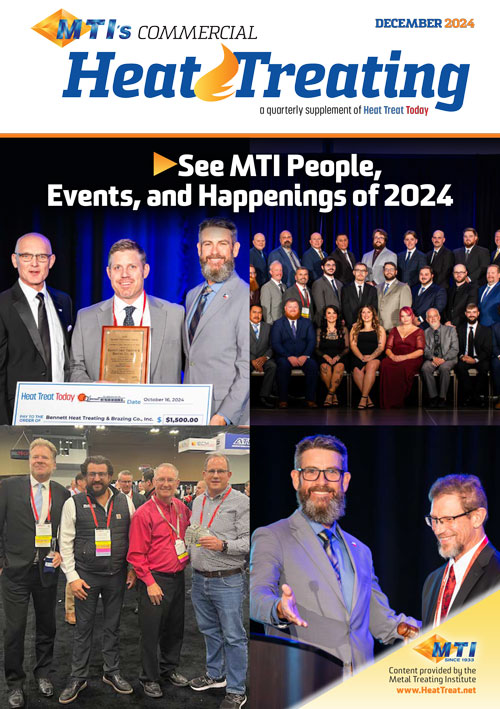
December 2024 MTI’s Commercial Heat Treating Supplement
December 2024 MTI’s Commercial Heat Treating Supplement Read More »

Aerospace
Automotive
Medical
Energy
Manufacturing





Taiwan Hodaka Technology, an aerospace and automotive manufacturer, extends its market reach by adding an aluminum aging furnace to its heat treatment capabilities. The furnace, which is designed for aging using T77 technology, will allow the company to meet the highest safety and strength standards.
This is the first transaction between Taiwan Hodaka Technology, which is involved in the design and processing of parts made of aluminum alloys, and SECO/WARWICK. The furnace operates in the temperature range from 176° to 428°F (80° to 220°C) with a temperature uniformity in the last heating phase, of ±47.4°F (3°C) in accordance with the AMS 2750 standard.
“The solution supplied by SECO/WARWICK will allow us to enter a new market segment. We are a partner for many key players in the aviation industry. The T77 aluminum aging furnace will enable us to serve customer requirements even better. At the same time, the new technology will support our commitment to reducing our impact on the environment,” said Dr. Sam Chiang, vice president for R&D at Taiwan Hodaka Technology Co. Ltd.

For heat treated alloys (2xxx, 6xxx and 7xxx series), the letter T and one or more digits are used after the alloy series symbol. The first digit is the most important, as it indicates the type of heat treatment applied to the alloy, while the remaining digits (if provided) indicate heat treatment variants or their modifications. The 7000 series of aluminum alloys have the highest strength of all other aluminum alloy series and are commonly used in aviation since they are held to the highest safety and strength standards.
“T7 denotes the process of solution heat treatment and artificial aging to an overaged state to obtain specific properties, e.g. increased corrosion resistance,” said Tomasz Kaczmarczyk, sales manager of the Aluminum Process and CAB Furnaces Team at SECO/WARWICK. “Sometimes, in addition to the digit denoting the standard heat treatment, an additional digit is used to denote modifications to the given treatment or stress relief procedures. For example, for 7xxx alloys, the symbol T77 denotes retrogression and re-aging. The use of this process improves the alloy’s corrosion resistance, which is so crucial in the production of aircraft parts. The applied technology will allow Taiwan Hodaka Technology to produce high-quality profiles used in the aviation industry in accordance with the AMS standard.”

“The furnace on order equipped with electric heating will process 1500 kg of aluminum profiles with a maximum length of 5500 mm. This is a two-zone solution with a total heating power of 420 kW. The solution for aluminum aging, powered by electric heaters, eliminates the problem of CO2 emissions and is in line with the ecological trend increasingly common in heavy industry,” said Piotr Skarbiński, vice president of the CAB and aluminum products segment at SECO/WARWICK.
The furnace will be used at the company’s newly built plant in Taiwan.
The project partner was PEERENERGY, which offers thermal process consulting, project management, and equipment supply for the aerospace, military equipment, and semiconductor industries.
The press release is available in its original form here.
Aero/Auto Aluminum Manufacturer Expands Heat Treatment Read More »

We’re celebrating getting to the “fringe” of the weekend with a Heat Treat Fringe Friday installment: a project that targets reducing the environmental impact of the bright annealing process. Learn more about this EU-funded initiative that is expected to impact industries using high-hydrogen-content atmospheric gas.
While not exactly heat treat, “Fringe Friday” deals with interesting developments in one of our key markets: aerospace, automotive, medical, energy, or general manufacturing.
Energy efficiency, specifically reducing the environmental impact of the bright annealing process in seamless stainless steel and nickel alloy tube production, is the goal of a new European Union-funded initiative. The recently launched LIFE H2Reuse Project seeks solutions for hydrogen recovery and reuse.
The project, coordinated by DMV (Cogne Group, formerly Mannesman Stainless Tubes) in partnership with Tenova, is expected to impact industries using high-hydrogen-content atmospheric gas, which could apply the project’s results to reduce their carbon footprint, optimize resource use, and lower operating costs.
In the bright annealing process, 100% hydrogen is used in high-temperature furnaces to produce high-performance tubes with superior surface quality, corrosion resistance, and durability. Currently, hydrogen is flared after each production cycle, leading to significant waste. The LIFE H2Reuse project aims to address this issue by developing two innovative technical solutions: recovering the wasted hydrogen from the annealing process and reusing it as fuel in radiant tubes working 100% of hydrogen. This approach represents a market-first innovation, as the recovery of atmospheric gas for reuse in industrial processes is not yet commercially available.
While hydrogen burners are already on the market, they remain in a developmental phase. The initiative will focus on enhancing their efficiency and effectiveness in real-world industrial environments. The project’s expected outcomes include significant reductions in carbon footprint, energy consumption, and resource waste, all of which will be rigorously tested to demonstrate their technical, environmental, and socio-economic benefits.
The press release is available in its original form here.
Main image: Technologies used by Tenova in the bright annealing process
Fringe Friday: Decarbonizing the Bright Annealing Process Read More »

A major North American aerospace manufacturer has placed an order for a seventh vacuum furnace to expand capacity. This furnace is specifically designed for the heat treatment of high-performance engine components and is built to support rigorous production schedules.

The vertical, large-precision vacuum furnace, built by G-M Enterprises, a Nitrex Vacuum company, is engineered to meet the aerospace company’s growing production needs and its demand for critical engine components. Six VVF series vacuum furnaces have previously been installed for the manufacturer to produce aircraft engine parts across a range of aerospace applications. The latest furnace order includes a 60” x 60” (1,524 mm x 1,524 mm) chamber with bottom loading, capable of handling loads up to 3,000 lbs (1,360 kg).
“The customer’s decision to expand with Nitrex reflects G-M Enterprises’ proven track record in furnace reliability,” said Mark Hemsath, president of Nitrex Turnkey Systems. “Our commitment to quality has anchored this partnership for over three decades.”

“Our long-standing relationship with this aerospace customer underscores Nitrex’s commitment to providing durable equipment backed by robust technical support,” said Jay Jefsen, regional sales manager for Nitrex Vacuum. “We are proud to contribute to their ongoing success and look forward to supporting their production goals with this latest addition.”
The furnace is scheduled for commissioning in April 2025.
The press release is available in its original form here.
Aerospace Manufacturer Expands with 7th Vacuum Furnace Read More »

Did you know that November 6 was National Stress Awareness Day? It seems an appropriate designation to cover the days and weeks that follow Election Day as well as those leading up to the holidays. For many who are well aware of the stress of the events of the season, Heat Treat Today wants to help with a different kind of stress relief.
Today we’re highlighting technical content that we’ve published over the last couple of years about stress relieving processes. Read an overview about stress relieving stainless steel components, listen to a Lunch & Learn dialogue about this underrated process, and explore a mechanical testing method for measuring material strength.

Stainless steel shines in our kitchens and is becoming more popular in auto showrooms, mostly because of the promise that it is corrosion resistant. What most people don’t realize is that stainless steel will rust in a lot of circumstances. Sarah Jordan explores how stainless steel can be compromised by improper heat treatment and the steps heat treaters can take to prevent corrosion:
“Improper heat treating can also contribute to stress corrosion cracking. When material is quenched, it can cause residual stresses that, if not relieved, can become an issue.
“Corrosion in stainless steel can often be traced to improper heat treatment. When stainless steel is heated between 842–1562°F (450–850°C), chromium carbides can form at the grain boundaries, depleting the surrounding areas of chromium and making them susceptible to corrosion.”
To read the article in full, click here.

In this Lunch & Learn episode from Heat Treat Radio, Dave Mouilleseaux discusses the three most underrated heat treat processes, including stress relieving manufactured components. If a comprehensive analysis of a heat treat operation needs to be performed on a manufactured component, such as a gear or a shaft, it is necessary to take into consideration any prior existing stresses in the part and what effect that has on the part.

“Many times during the course of my career, I’ve had a customer come to me and say, ‘The part I gave you was correct, and you’ve given it back to me and then fill-in-the-blank. It’s warped, it’s changed size, it’s shrunk, all of those things.’
“What have you done in your heat treating process?” asked Mouilleseaux. “You have to back up all the way to the beginning of how this part was manufactured and deal with all of those component steps in order to answer that question properly. Stress relieving is one of the answers. It’s not the answer. It’s not the only answer, but it is one of them that has to be considered.”
To listen to this episode of Lunch & Learn, click here.

Mechanical testing is a standard production step in heat treating operations, but conventional methods of testing don’t always yield stress values consistent with the testing calculations.
Indentation plastometry allows users to obtain material strength characteristics in a way that is faster, cheaper, and simpler than conventional mechanical testing procedures. James Dean explores this novel mechanical testing method developed to infuse efficiency and accuracy into the process.
“The testing process is fully automated and involves three simple steps. The first is the creation of an indent using the indentation plastometer which is a custom-built, macromechanical test machine. The second is measurement of the residual profile shape using an integrated stylus profilometer.
“The third is the analysis of the profile shape in a proprietary software package called SEMPID, which converts the indentation test data into stress-strain curves that are comparable to those that would be measured using conventional mechanical testing methods. The entire procedure takes just a few minutes, and the surface preparation requirements are minimal.”
To read this article in full, click here.
Under Pressure? Here’s a Stress Relief Round Up Read More »


The Heat Treat Doctor® has returned to offer sage advice to Heat Treat Today readers and to answer your questions about heat treating, brazing, sintering, and other types of thermal treatments as well as questions on metallurgy, equipment, and process-related issues.

Clients often want to know or specify that their component part surfaces are “bright” or “shiny” or “clean.” Other times they desire to have a surface condition that is “scale free” or “oxide free” after heat treatment. But how, if at all, can we quantify what these terms mean? Let’s learn more.
“Shiny” and “bright” are words that are highly subjective. This is often a source of confusion not only for the heat treater, but the manufacturer and, in some cases, even the end user of the products. Heretofore, the answer depended on one human being’s interpretation as opposed to another, and evaluations depend not only on the type of material but also the mill practices used, manufacturing methods employed, heat treatment processes, and the level and type of contamination introduced before and after processing.

Traditionally, we have relied on color charts (Figure 1) to tell the approximate temperature at which discoloration took place, that is, an oxide formed on the (steel, stainless steel, or tool steel) surface of a component part. This method is still in use today when cooling parts in a furnace
As mentioned, the perception and interpretation of color is different for different people. Lighting (natural light or plant illumination), the environment in which one views color, eye fatigue, the age of the observer, and a host of other factors influences color perception. But even without such physical considerations, each of us interprets color based on personal perception. Each person also verbally describes an object’s color differently. As a result, objectively communicating a particular color to another person without using some type of standard is difficult.
There also must be a way to compare one color to the next with accuracy.
Today, portable spectrophotometers (Figure 2) are available to measure color and help quantify brightness measurements. These types of devices are designed to meet various industry standards including:

In simplest terms, a spectrophotometer is a color measurement device used to capture and evaluate color. Every object has its own reflectance, or the amount of light it reflects, and transmittance, or the amount of light it absorbs. A reflectance spectrophotometer shines a beam of light and measures the amount of light reflected from different wavelengths of the visible spectrum, while a transmission spectrophotometer measures how much light passes through the sample. Spectrophotometers can measure and provide quantitative analysis for just about anything, including solids, liquids, plastics, paper, metal, fabric, and even painted samples to verify color and consistency.
Spectrophotometers provide the solution to the subjective problem of interpreting the color of the surface of a component part that has been heat treated, brazed, or sintered because they explicitly identify the colors being measured; that is, the instrument differentiates one color from another and assigns each a numeric value.
As an example, the brightness of steel tubes annealed in a rich Exothermic gas atmosphere was measured against tubes that had not been processed (Figure 3). Having this definite measurement of the surface changes allowed the heat treater to provide their client with a definitive statement on the change after processing.
The Commission Internationale de l’Eclairage (CIE) is an organization responsible for international recommendations for photometry and colorimetry. The CIE standardized color order systems include specifying the light source (illumination), the observer, and the methodology used to derive values for describing color, regardless of industry or use case.
Though spectrophotometers are the most common, for some applications colorimeters can also be used, but these are in general less accurate and less suitable for a heat treat environment.
There are three primary types of spectrophotometers on the market today used for print, packaging, and industrial applications: traditional 0°/45° (or 45°/0°) spectrophotometers, primarily used for the print industry; sphere (or diffuse/8°) spectrophotometers, primarily used in the packaging industry; and multi-angle (MA) spectrophotometers, for use in industrial environments. These instruments capture color information, and in some cases can capture appearance data (e.g., gloss).
Multi-angle (MA) spectrophotometers are best suited for measurements involving special surface effects, such as those found on metal surfaces and coatings and include those with surface contaminants and even can quantify cosmetic appearance. These are typically used on the shop floor, in the lab and in quality control, and even can be found in shipping areas.
MA spectrophotometers require users to verify five or more sets of L*a*b values or delta these terms). They typically have an aperture size of 12 mm, which is too large for measuring the fine detail that occurs in many small-scale industrial applications. Primary illumination is provided at a 45° angle. Some models have secondary illumination at a 15° angle.

An application example for an MA spec trophotometer lies in their use for collecting colorimetric data on special effects coatings in the automotive industry, capturing reliable color data in cases where special effect coatings are used.
In this writer’s opinion, a spectrophotometer should be in every heat treat shop! You will be doing both yourself and your customers a valuable service and take the guesswork out of one of the most commonly asked questions – is it bright?

Dan Herring has been in the industry for over 50 years and has gained vast experience in fields that include materials science, engineering, metallurgy, new product research, and many other areas. He is the author of six books and over 700 technical articles.
For more information: Contact Dan at dherring@heat-treat-doctor.com.
For more information about Dan’s books: see his page at the Heat Treat Store.
Ask the Heat Treat Doctor®: What Does “Bright and Shiny” Really Mean? Read More »

A provider of process technology for harsh and corrosive process streams has expanded its operations with an additional 13,000 square foot, state-of-the-art facility in Twinsburg Township, Ohio, to meet a growing demand for critical components in metal processing systems. This second location will include a crane-served production center with the capacity suitable for assembling large modular systems.

CG Thermal‘s new facility will be dedicated to assembling and testing pilot plants and turnkey modular systems and is designed to meet the growing demand for chemical processing systems and heat exchangers from the industry sectors it serves, which include chemical processing and emerging energy technology.
The company’s original building will continue to be a production center, handling the majority of heat exchangers and small systems manufacturing. Additionally, a larger office space will house a modern office environment for the team to engineer, design, and manage systems projects.
The press release is available in its original form here.
CG Thermal Adds Second Facility To Expand Production Capacity Read More »

Heat Treat Today publishes eight print magazines a year and included in each is a letter from the editor, Bethany Leone. In this letter, Bethany reports on her visit to the September meeting of Purdue Heat Treating Consortium where industry leaders presented key technical and operations decisions in heat treating. The academic partnership encourages research into topics such as sustainability and technology alternatives. Read more of what Bethany learned from her attendance at this dynamic and forward-looking consortium in this letter, which first appeared in the November 2024 Vacuum print edition.
Feel free to contact Bethany at bethany@heattreattoday.com if you have a question or comment.
What heat treat issue do you need fixed? At Purdue Heat Treating Consortium’s (PHTC’s) September meeting, I witnessed industrial manufacturers targeting key technical and operations decisions in heat treat through an academic partnership.
Since summer of 2022, the research driven School of Materials Engineering at Purdue has positioned itself as a partner to industrial leaders in the Midwest. Their main goal: advance research of precompetitive projects.
I spoke with one member who commented on the beginnings of PHTC: “Some of the Midwest, I’d say, user companies . . . wanted a Midwest school and more research-oriented university. To have Purdue be able to fill that was perfect; that’s some place that we recruit from, where we know has a lot of depth of professors that would be able to contribute, and which has facilities that would be able to be a part of. So, it was a really good partner to make that change with.”
At the recent quarterly meeting, I sat amongst several dozen representatives from Amsted Rail, Caterpillar, Cummins, Rolls Royce, ECM USA, and other member companies as we settled in for a day of research presentations. Foremost in members’ minds was feasibility in real world application.
Topics included developing sustainable quenchant alternatives and identifying a method for greenhouse footprint analysis that would meet standards. The presentations of ongoing research were each met with intent nods of satisfaction, questions scrutinizing the data, and proposals on what specific direction industry players wanted to see examined.
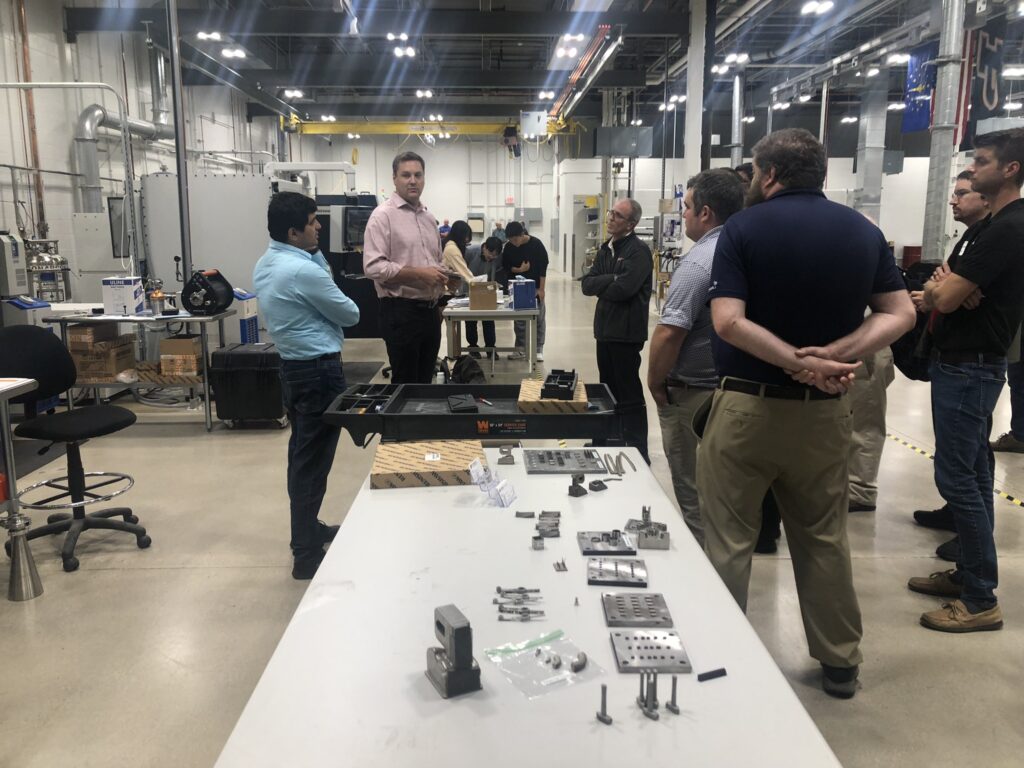
A mix of faculty and graduate students presented the five research topic findings. Guided by professors, the young people develop and execute research plans to address objectives determined by member voting at previous sessions. When I inquired what type of value this research held and the quality of the presenters, industry members were quick to speak highly of their abilities and the actionable research results.
Specifically, one member commented to me that the lifecycle work was proving to be helpful. Explorations like this give a “gauge of what we are able to meter on some of our own furnaces . . . and to have some common ways of describing emissions.” He continued, “that leads to either confirmation that we’re doing things right or to adjusting what we’re doing.”
Other topics that have been of interest address property variations when austempering certain materials and the quench oil work. Even when members may not apply all research results gained from the studies, ancillary work being done within a study — such as machine learning — offers additional value.
The group’s strength is collaborative action: as research objectives evolve, the academic contingent adapts. One paper was met with a peppering of cross-examination questions, the result being a large consensus as to the end value of this research. A plan to reconvene outside of regular sessions to provide industry testing data was determined, and industry members eagerly voiced their desire to contribute to this special moment.
Following presentations, the meeting came to a close. Voting members first determined which research to continue. Then, we toured the Manufacturing and Materials Research Laboratories at Purdue. The members witnessed various methods of metal 3D printing materials in action and handled printed parts of different alloy compositions.
Rounding out the day was an optional networking reception at a local pub and grill, Walt’s, where conversations around personal interests bled into reflections on research at PHTC.
My special thanks to Mark Gruninger, Managing Director for Industrial Consortia and Centers, and Mike Titus, Associate Professor of Materials Engineering and Technical Director of PHTC, for their invitation and warm welcome.
Contact Bethany at bethany@heattreattoday.com.
Purdue Heat Treating Consortium Read More »

Heat Treat Today is thankful for the role we have been blessed to play in this industry, for our partners who generously collaborate with us to bring outstanding content to our readers, and for the readers who make Heat Treat Today one of the first sites they open when their workday begins. Thanksgiving is inherent to a life of joy and happiness. As many of our readers know, our motto is “We believe that people are happier and make better decisions when they are well informed.”
With this in mind, the Heat Treat Today team wants to inform our readers about what makes us happy and thankful. Read below our thoughts and greetings, interspersed with favorite quotes about gratitude — our combined prayer of thanks for what our God and Savior has done for us this year.
For housekeeping purposes: our offices will be closed on November 28 and 29. Happy Thanksgiving!
I’m thankful for my husband who always reminds me to celebrate the little things in life, for incredible friends (both old and new), for supportive family, and for Christ’s sustaining and unending love. Happy Thanksgiving! ~ Aubrey Fort, Production Manager
I’m thankful for God’s provision of a home for our family. ~ Jayna McGowan, Proofer (who recently moved)
I’m thankful for my faith and church family, in addition to my husband, children, and extended family. Our oldest got engaged, our youngest started college, and we had some lovely opportunities to travel this year. I’m grateful for my job at Heat Treat Today, our talented team, and wonderful customers. ~ Michelle Ritenour, Sales
“I have found that, rather than dwelling on the negative, if we will take a step back and consider the blessings in our lives, including seemingly small, sometimes overlooked blessings, we can find greater happiness.”
Thomas S. Morrison
This year I am especially thankful for my family. Most specifically for my husband, David, who works tirelessly to provide for us while being a steady anchor for our family. (No small task!) I am also thankful for the opportunity to work for Heat Treat Today, be a stay-at-home mom, and work with good people in a good industry. I am thankful for a very fulfilling year! ~ Ellen Porter, Administration/Sales/HeatTreatBuyersGuide.com
This year, I’m grateful we took advantage of the salsa dancing and opera scene in Pittsburgh, filling the visual arts need in my soul. Better yet, family and friends both in town and out of town joined us on these excursions. I treasure our peaceful home. ~ Bethany Leone, Managing Editor/Heat Treat Radio Producer
At Heat Treat Today, one of our core values is “always kind.” This year, I am thankful for people who have been always kind, most notably, my boss, Bethany Leone. Bethany is a great example of someone who never hesitates to think of others before herself. I’m very thankful to work for her! ~ Evelyn Thompson, Editorial Assistant/Copy Editor
“The thankful receiver bears a plentiful harvest.”
William Blake
In gratitude for life, I echo Jesus’ promise of abundant life (John 10:10). This year, amid life’s peaks and valleys, I’ve truly embraced that promise through the love of family and the support of community. My heart is full, experiencing abundance every day. ~ Brandon Glenn, Webmaster/Art Director
I’m incredibly thankful to the Lord for my loving and supportive family, faithful friendships, and fabulous Heat Treat Today team. Thankful, too, for the adventure we get to live every day knowing that we’re not alone. Wishing you all a very Happy Thanksgiving. ~ Karen Gantzer, Senior Editor/Associate Publisher
“Don’t pray when it rains if you don’t pray when the sun shines.”
Leroy Satchel Paige
2024 has been a great and difficult year. I’m grateful for both. God has been so gracious to us, yet He’s not always placed His smiling face and smiling providence on us. Nonetheless, He deserves our thanks. Heat Treat Today has a tremendous staff. I am so thankful for them. And the number of relationships we’ve been developing with advertisers, suppliers, and consultants has been super enjoyable and encouraging. Wishing all of you a great Thanksgiving and Christmas. ~ Doug Glenn, Publisher/Advertising
It’s easy to mark losses and sorrows — this year has held plenty for me. The challenge comes in seeing mercy through the tears and trials. Goodness and mercy and hope, however, come from the Lord, not from within. I am grateful this Thanksgiving 2024 for all the ways that Jesus has shown me that His promises are for me. ~ Laura Miller, Associate Editor
When we were children we were grateful to those who filled our stockings at Christmas time. Why are we not grateful to God for filling our stockings with legs?”
G. K. Chesterton










“Let the peace of Christ rule in your hearts, to which indeed you were called in one body. And be thankful.”
Colossians 3:15 (ESV)
Thanksgiving Thoughts & Greetings from Heat Treat Today Read More »

Today’s News from Abroad installment is all about growth in the global heat treating market. A heat treater expands its contract machinery product line with brazing and sintering capabilities, a capital goods manufacturing group bolsters its vacuum heat treatment production capabilities, and a long-term technology alliance results in manufacturing growth of refractory products for glass melting plants in the glass industry. To round out our news from abroad, Japanese steel giants set their sights on government funding allocated to advance research and development in decarbonizing operations.
Heat Treat Today partners with two international publications to deliver the latest news, tech tips, and cutting-edge articles that will serve our audience — manufacturers with in-house heat treat. heat processing, a Vulkan-Verlag GmbHa publication, serves mostly the European and Asian heat treat markets, and Furnaces International, a Quartz Business Media publication, primarily serves the English-speaking globe.

“The ECM Group is reinforcing its capital goods manufacturing business by bringing together several legal entities under the company ECM Technologies. This merger between ECM Technologies, ECM Greentech, and ECM Technologies Villard Bonnot creates a division dedicated to the manufacturing of innovative heat treatment furnaces. The aim of this merger is to better serve its customers and respond more effectively to market changes. It will enable the ECM Group to build up a veritable hub of skills and knowledge around its core areas of thermal engineering, gas management and atmospheres. This marks a first step towards realizing its ambition of becoming the world leader in vacuum heat treatment equipment, all technologies combined.”
READ MORE: “ECM Technologies merges with ECM Greentech” – at heat-processing.com
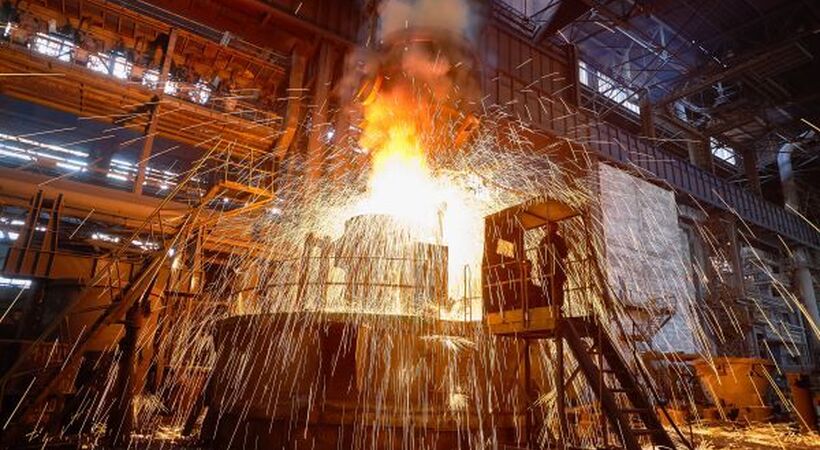
“Two of the largest integrated steel producers in Japan, Nippon Steel and JFE Steel, have applied for government funding allocated through the new Green Transformation Promotion Act (GX) to advance research and development in decarbonizing operations. JFE Steel is seeking funds to build a new large electric arc furnace (EAF) to replace blast furnace No. 2 at West Japan Works (Kurashiki). The company expects the EAF to be commissioned between 2027-2028. Blast Furnace No. 2 at the plant underwent a re-lining in 2003. JFE usually performs such maintenance after about 25 years of operation, so the next one is due in 2028. However, JFE Steel hopes that the new electric arc furnace will be operational by then, so the unit can be shut down. West Japan Works currently operates three blast furnaces with a steel output of about 8Mt/yr.”
READ MORE: “Japanese steel giants apply for government subsidy to go green” at furnaces-international.com
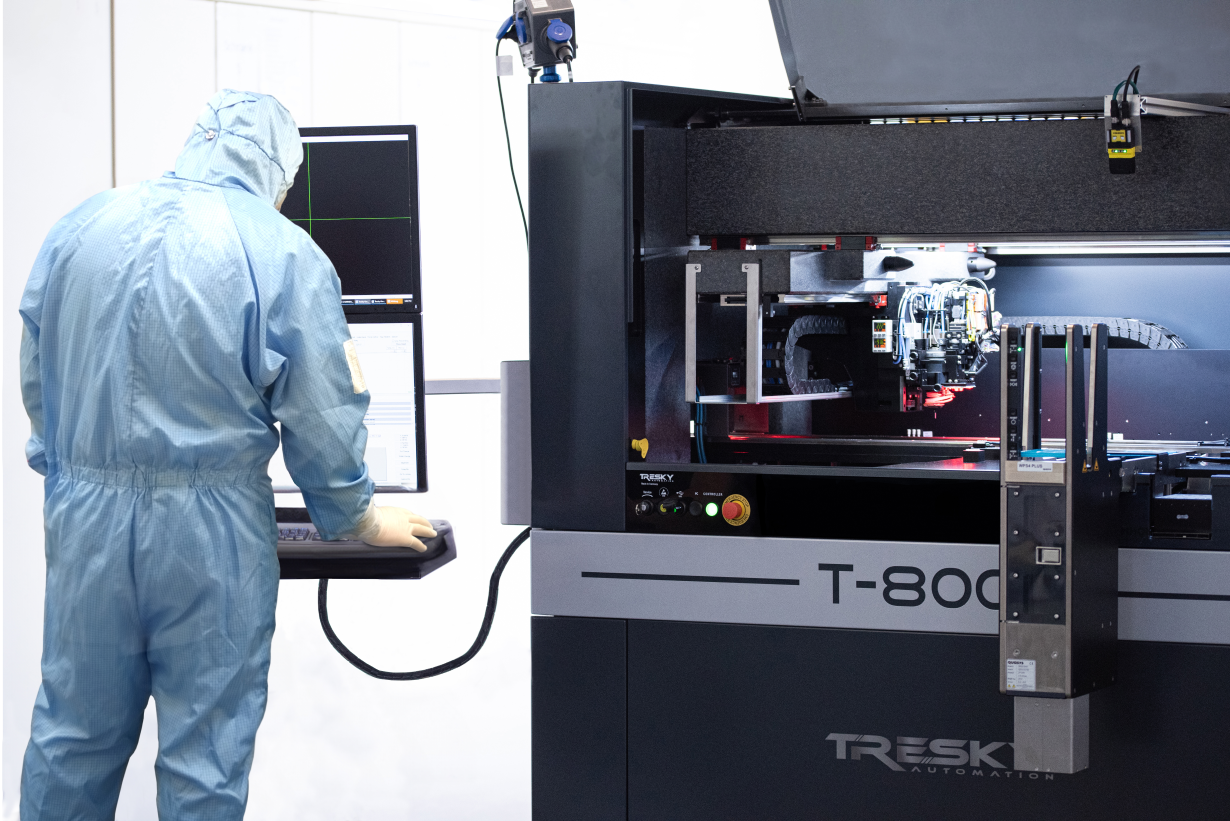
“Tresky Automation announces the latest addition to its contract manufacturing machinery. Customers will now benefit from a state-of-the-art vacuum brazing furnace and a powerful sintering press with a maximum pressing force of up to 15 kN. The new equipment enables Tresky to offer additional manufacturing technologies, which is particularly beneficial for demanding applications in the fields of photonics, optoelectronics, hybrid bonding, microelectronics and power electronics. The new vacuum brazing furnace offers the possibility to produce material bonding under controlled conditions with nitrogen (N2) or formic acid (HCOOH). This process effectively reduces voids, as the vacuum allows air or process residues to escape during the preheating and melting phase of the solder. The result is virtually void- and flux-free solder joints that are characterized by high reliability.”
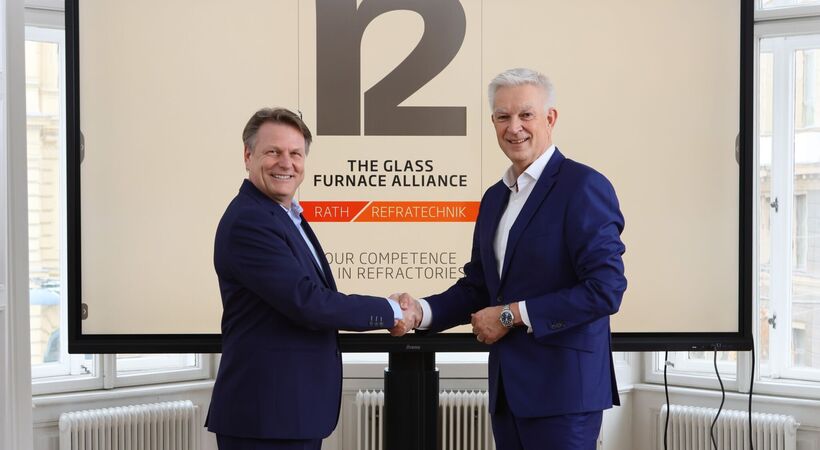
“RATH and REFRATECHNIK announced the launch of a long-term technology alliance. The goal of the ambitious partnership is close collaboration in the development and manufacture of refractory products for glass melting plants in the glass industry. As part of the technology alliance, both companies will contribute their respective know-how in glass manufacturing and refractory production to combine it into a unique technology solution. The two companies will be operating under the name ‘R² – THE GLASS FURNACE ALLIANCE.’ The alliance enables RATH to expand its technological expertise, as products manufactured by REFRATECHNIK will be developed in close collaboration with the research and development departments of both companies.”
READ MORE: “RATH and REFRATECHNIK form technology alliance” at furnaces-international.
News from Abroad: Growth from Mergers, Alliances, and Broadened Capabilities Read More »