Heat TreatToday, in cooperation with Nel Hydrogen, is pleased to offer the eBook "Hydrogen Generation and Its Benefits for Heat Treaters"—18 pages of useful information about generating your own hydrogen, a key reducing agent in thermal processing atmospheres. Hydrogen is typically used for brazing, annealing, and sintering of metals.
This booklet discusses the pros and cons of on-site generated hydrogen including costs, sourcing, furnace types, OSHA/EPA compliance, and much more.
Converting to generated hydrogen offers:
Superior atmosphere quality and flexibility
Stable and competitive atmosphere costs
Elimination of hydrogen and ammonia deliveries/storage
A company that manufactures custom magnetic shields, precision sheet metal fabrication, and Hydroforming recently commissioned its first-ever vacuum furnace to accommodate expansions to better serve the magnetic shielding industry by providing material designed to protect sensitive electronics from magnetic fields.
Jason Davidson, Solar Manufacturing’s northeast regional sales manager
MuShield Company of Londonderry, New Hampshire, commissioned Solar Manufacturing to design the furnace, built with a SolarVac® Polaris control system, fully compliant to AMS2750E pyrometric specification, operating at a vacuum level of 10-5 Torr with the capability of maximum temperatures up to 2400°F, and featuring an external quench system designed for pressures up to two bar.
“What this means for us is that we’ll be able to offer quicker turnaround times on heat-treated products, fit larger shields into our furnace, and eliminate outside vendor work,” notes MuShield’s website.
“MuShield was already aware of our excellent reputation in the industry, and they were impressed with our facility when they visited earlier this year,” said Jason Davidson, Solar Manufacturing’s northeast regional sales manager. “They were also impressed with results of testing performed for them by Solar Atmospheres, so we’re pleased they have placed confidence in Solar Manufacturing to provide their first vacuum furnace.”
The new vacuum furnace will also allow MuShield to perform stress relief annealing cycles on hydroformed parts made from non-shielding alloys, which is a manufacturing requirement on most materials that the company hydroforms.
Heat TreatToday is privileged to oversee the 40 Under 40 recognition awards, highlighting a group of young, up-and-coming talent in the North American heat treat industry every year. This year’s Class of 2019 is no disappointment, a group of industry elite, significant contributors to the heat treat market.
Every couple of weeks we highlight two of the current class of recipients. This week we introduce Sergio Gallegas Cantu of Quaker Houghton and Matt Clinite of Ipsen USA.
Name: Sergio Gallegas Cantu
Company: Quaker Houghton
Position: Technical Service Manager & Heat Treatment Specialist
Sergio graduated from Universidad Autonoma de Nuevo Leon with Bachelors and Masters Degrees in Materials Engineering. He is currently the heat treatment specialist and technical service manager for Quaker Houghton (formerly Houghton International) in Mexico. In his role, he interacts extensively with our local team and customer base. He previously worked as senior metallurgist in product development at FRISA in the design of forging process and heat treatments for superalloys, titanium alloys, and stainless steel. He has experience in material specifications for the aerospace industry including mechanical properties, failure analysis, microstructure, and grain size control for near shape forgings.
Nominated by: Quaker Houghton
Name: Matt Clinite
Company: Ipsen USA
Position: Ipsen Customer Service Sales Manager
Matt is very passionate about supporting his customers, being the first to dive in and help customers get their equipment running in peak performance. Even though he is in sales, he loves jumping in to help a customer with maintenance and repairs such as hot zone rebuilds. As customer service sales manager, Matt manages a team of 6 regional sales engineers and is a member of the leadership team at Ipsen. He is a 2018 YES graduate, active in MTI, and serves as an Ipsen U instructor in the company’s 3-day vacuum furnace training program. Matt has been involved in selling some of the most complex and technologically advanced furnace installations in North America, including what is believed to be the largest vacuum furnace in the world (over 10,000 cu.ft.).
Nominated by: Ipsen
Read more about the feature at Heat Treat Today’s 40 Under 40 resource page and find out more about each of this year’s winners by clicking on their image. To nominate someone for the Class of 2020 40 Under 40, please click here.
A medical device outsource manufacturer based in Clarence, New York, which offers heat treating capabilities, recently announced its purchase of certain assets of a manufacturer of complex braided biomedical structures for disposable and implantable medical devices.
Integer Holdings Corporation’s acquisition of US BioDesign, located in Quakertown, Pennsylvania, will add differentiated capability for complex braided and formed biomedical structures to Integer’s broad portfolio.
Integer president and CEO Joe Dziedzic
Founded in 2011, US BioDesign serves the cardiovascular, neurovascular, and general surgery markets with nitinol, stainless steel, polymer, and other braided structures that are enabling the next generation of structural heart, peripheral vascular, neurovascular and electrophysiology products. They also provide product development, material testing, and post-processing services, including electropolishing and packaging.
“The acquisition of US BioDesign assets will allow us to partner with our customers to enhance patient lives in new ways,” said Integer president and CEO Joe Dziedzic. “US BioDesign has demonstrated engineering prowess in the area of complex braided and formed biomedical structures, which will set us apart from the competition as we partner with customers to develop life-saving medical devices.”
Tom Molz, currently president and CEO of US BioDesign
“We are excited to bring our complex braided biomedical structures and capabilities to the leader in medical device outsource manufacturing,” said Tom Molz, currently president and CEO of US BioDesign. “Our combined capabilities, engineering and innovation will allow us to accelerate our growth while better serving our customers and their patients worldwide.” Molz will continue to cultivate the complex braiding business while reporting to Payman Khales, president of Integer’s cardio and vascular business.
Extensive wear or fatigue from friction and contact stress cause many engineering components made of ferrous or titanium alloys to fail. In this Best of the Web
Edward Rolinski,”Dr Glow”, Advanced Heat Treat
Technical Tuesday feature, Edward Rolinski, aka Dr. Glow, from Advanced Heat Treat Corp., compares “wear resistance between engineering components that were carburized vs nitrided,” originally published in his article, “Tribological Performance-Enhancing Surface Treatments for Improving Durability of Engineering Components” at AHT’s website.
An excerpt:
“The results of the tribological studies strongly suggest that for many engineering components, the application of nitriding may be more beneficial than carburizing since the nitrided layer had better wear properties than the carburized layer despite the fact that the layer was about four times as thick.”
Rolinski defines the uses, advantages, and tribological behavior of nitrided and carburized steel and provides illustrations of samples subjected to both treatments.
Main image photo credit/caption: Advanced Heat Treat Corp / Advanced Heat Treat’s Cullman, Alabama, location ion nitroding vessel, which the company says is one of the largest in the United States—”big enough for two small cars to fit inside.”
A cooperative research and development agreement (CRADA) has recently been reached that has as its objective improving the process reliability of electric beam melting technology (EBM) through the use of in-situ process monitoring and closed loop control, expanding the technology to new materials systems, specifically nickel-based superalloys, and validating microstructure and properties of titanium Ti-6Al-4V materials fabricated with increased deposition rate.
GE Additive announced that it entered into the five-year CRADA with the US Department of Energy’s Oak Ridge National Laboratory (ORNL). The agreement focuses on processes, materials, and software to drive industrialization and encourage the broader adoption of additive manufacturing technology.
The new CRADA, which covers all GE Additive equipment, materials and engineering services capabilities, focuses on developing and implementing novel additive technologies into commercial products including:
Building on existing research into process simulation methodologies and in-situ monitoring and quality control, on both EBM and direct metal laser melting (DMLM) systems
Materials modeling and development
Industrialization and commercialization of equipment and processes
Moe Khaleel, associate laboratory director for Energy and Environmental Sciences at ORNL
“Our pioneering research with GE Additive was essential to resolving scientific challenges in advanced metals manufacturing using new electron beam methods,” said Moe Khaleel, associate laboratory director for Energy and Environmental Sciences at ORNL. “We’re excited to again push the boundaries with GE and lower the barriers for widespread adoption of more efficient, low-cost manufacturing techniques.”
Daniel R. Simmons, assistant secretary for DOE’s Office of Energy Efficiency and Renewable Energy
“By collaborating with industry partners such as GE Additive, DOE’s Oak Ridge National Laboratory brings its multi-disciplinary expertise and capabilities to bear on real-world challenges and moves technologies into the marketplace where they will have the greatest economic impact,” said Daniel R. Simmons, assistant secretary for DOE’s Office of Energy Efficiency and Renewable Energy.
Josh Mook, innovation leader, GE Additive
“We’re really looking forward to applying the collective brainpower and expertise from both organizations to addressing the challenges around industrialization, but we also have an eye on the future,” said Josh Mook, innovation leader, GE Additive. “The next wave of additive technology is already upon us—whether that’s binder jet or rapid advances in software—so we’re excited to see where the next five years will take us.”
The agreement supersedes an existing CRADA in place since 2012 between ORNL and GE Additive Arcam EBM.
Main photo credit / caption: GE Additive / From left to right: Christine Furstoss, chief technology officer, GE Additive; Daniel Simmons, assistant secretary, US Department of Energy – Office of Energy Efficiency and Renewable Energy; Moe Khaleel, associate laboratory director for Energy and Environmental Sciences and Chris Schuppe, general manager, engineering, GE Additive.
New orders turned upwards following several months of downward motion.
What impact does the coming political election have on the 2020 economy? As this month’s IHEA Executive Economic Summary reports, “Election years tend to depress consumers, business people and investors alike. The two parties try to outdo one another with tales of gloom and doom unless you vote for them and the sense is that the world is teetering on the brink.”
That being said, the report also encourages optimism when it states, “It should be noted that many of the index readings that turned negative are only slightly down and many are still higher than they have been much of the year.”
Metal prices, new orders and recorded in the PMI, capital expenditures, and the transportation index all trended upward in October. According to the report, the fact that the PMI has started to trend upward, even though it is still below 50, is a good sign for the months ahead.
Regarding capital expenditures, the report states, “The capital expenditures numbers are better than expected given the data on capacity utilization, but it seems there is still a demand for replacement equipment even if there is less demand for new equipment to support growth.”
Industrial capacity utilization continued to slide in October adding to worries about a potential recession.
With regard to the seven downward trending indices, the report states that “they are not all that bad.” Indices in this group include new automobile and light truck sales, new home starts, steel consumption, and industrial capacity utilization to name a few.
Concluding the report is the following statement, “These have not been massive drops and there is no sense of an impending crisis, but this kind of weakness doesn’t leave much wiggle room should there be a real recessionary trend. The overall sense of trepidation in the industrial sector is driving most of the current level of angst.”
Anne Goyer, Executive Director of IHEA
For a full copy of the 12-page report, contact Anne Goyer, Executive Director of the Industrial Heating Equipment Association (IHEA). Email Anne by clicking here.
Heat Treat Today will not publish on Thursday, November 28, or Friday, November 29, 2019, in order to allow our team time off to celebrate the Thanksgiving holiday (U.S.) with family and friends.
We’ll be back with a new newsletter deposited into your in-boxes first thing Monday morning, December 2, 2019—so stay tuned!
In the meantime, allow us to express our thanks to our readers, our advertisers, our partners, and our staff for the part each of you plays in the continuance of this endeavor to make learning a pleasant experience. We believe that people are happier and make better decisions when they are well informed. Thanks to all who share the Heat Treat Today dream.
We also acknowledge that learning is an eternal endeavor and are thankful that God has given us this opportunity to start the process and to keep it going for this long and, we hope, Lord willing, longer into the future.
“The Pilgrims made seven times more graves than homes. No Americans have been more impoverished than these who, nevertheless, set aside a day of thanksgiving.” H.U. Westermayer
How a Custom Designed Fixture and Hardness Testing Unit Solved a Major Aerospace Engine Manufacturer’s Hardness Testing Dilemma
Situation: A major aerospace engine manufacturer wanted to ensure the appropriate hardness of a specific section of a heat-treated engine housing. They wanted to non-destructive test the actual housing and not test shims. They wanted to do the test in-house so as to not stall production by having to ship the part out for testing. Another reason they did not want to ship the parts out for testing was the size of the parts. Some of the parts had a diameter as large as 40 inches (102 cm), 20 inches (51 cm) high, and 900 lbs (400 kg). The aerospace company also wanted an automated, full-proof system that reduced the chance of human error.
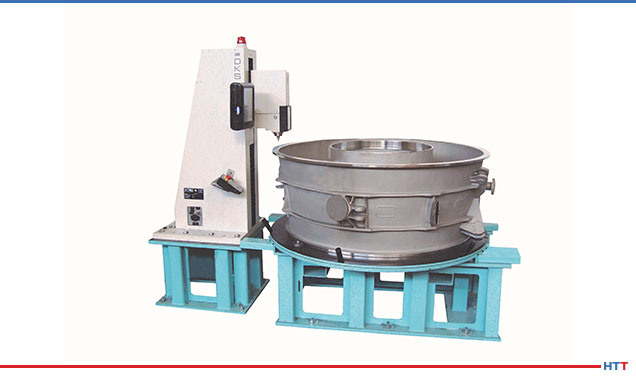
Figure 1
Solution: The solution came in the form of a custom-built hardness testing machine and an innovative fixture to hold the engine housing. As can be seen in Figure 1, AFFRI USA, located in Illinois, designed a fixture to hold both a custom-designed hardness testing machine as well as a fixture to hold the engine housing.
The Hardness Testing Machine
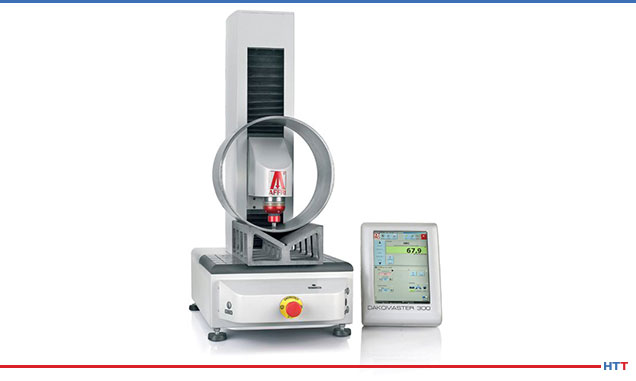
The specific hardness testing unit chosen for the job was DAKOMASTER 300. Typically, this unit is a tabletop unit as shown in Figure 2. For this specific aerospace application, the unit was modified so that it could be securely attached to the steel
Figure 2
construction holding fixture. Additionally, the custom-built unit was adapted so that the measuring head had a much greater vertical and horizontal range to accommodate varying height engine housings. The engine housings varied in size from as large as 110 inches (2.8m) in diameter and 39 inches (1m) high to the smallest being approximately 16 inches (400mm) in diameter and 9 inches (250mm) tall. The typical vertical working distance range on the tabletop unit is approximately 12 inches (300mm) while the custom unit has a vertical working distance range of 39 inches (100cm). The measuring and loading head of the unit was designed so that no misalignment would occur with the engine housing. If effective, the machine utilized what can be considered a self-clamping technology that structural deflection is absorbed ensuring an accurate and absolute reading in varying test conditions. Finally, to eliminate potential operator error, once in place, the test is initiated by a single button eliminating the need for operator engagement.
The Fixture Table
Since part and machine stability is critical for accurate hardness tests, providing a stable base for the large aerospace parts was a critical part of the solution. The company wished to execute multiple tests in multiple locations around the flange face of the engine housing. Some tests were to be conducted on the outer edge of the housing and some tests were to be conducted on the inner edge of the housing. To do this, the fixture holding the engine housing was designed so that the entire housing could move closer to or further away from the test machine. Additionally, the housing had to be rotated so that the machine could test completely around the perimeter of the housing flange face. To accomplish this, the part fixture was equipped with heavy-duty bearings so that the entire engine housing was able to be easily rotated. Once rotated to the desired location, the table would move closer to or further away from the test machine to pinpoint the exact spot for the test.
The Results
Simply stated, the results were excellent. Hundreds of tests have been run on a wide range of engine housing diameters, all with success – all well within the 1% tolerance. Being able to conduct in-house testing has helped smooth production. Having hardness testing equipment that is flexible enough to handily negotiate large or small engine housings saved the company money from needing to purchase several hardness testing machines and fixtures. Tests can be run quickly and simply by rotating the part fixture table and operator error has been virtually eliminated with the single push-button equipment. The hardness testing equipment provided for this aerospace company is capable of performing HRC, HRB, HRT, HRN measurements all in conformance with ASTM E-18. HTT
About the Author: AFFRI is an Italian-based international designer and manufacturer of state-of-the-art hardness testing systems for over 60 years. The company’s North American headquarters is located in Wood Dale, Illinois. This article originally appeared in Heat TreatToday’sMarch 2019 Aerospace print edition and is published here with the author’s permission.




 useful information about generating your own hydrogen, a key reducing agent in thermal processing atmospheres. Hydrogen is typically used for brazing, annealing, and sintering of metals.