Spirit AeroSystems Holdings Inc. recently announced it has entered into a definitive agreement to acquire select assets of Bombardier aerostructures and aftermarket services businesses in Belfast, Northern Ireland (known as Short Brothers); Casablanca, Morocco; and Dallas, Texas.
Spirit AeroSystems president and CEO Tom Gentile
The opportunity to expand its operations into Northern Ireland and Morocco and the addition of the entire work package for the A220 wing and its technology is critical for the future of next-generation aircraft, says Spirit. In aerostructures and fabrication, Bombardier supplies composite and metallic wing components, nacelles, fuselages, and tail assemblies, along with high-value mechanical assemblies made out of aluminum, titanium, and steel.
“The Bombardier operations bring world-class engineering expertise to Spirit and add to a strong track record of innovation, especially in advanced composites,” said Spirit AeroSystems president and CEO Tom Gentile. “Belfast has developed an impressive position in business jet fuselage production, in addition to the world-acclaimed fully integrated A220 composite wing. This acquisition is in line with our growth strategy of increasing Airbus content, developing low-cost country footprint, and growing our aftermarket business.”
A manufacturer of engineered response materials for the oil and gas industry expects to expand its heat treating capability with the recent installation of a new 3,500 MT extrusion press.
The installation of the state-of-the-art press at Terves Inc. in Euclid, Ohio, was completed by Extral Technology SRL, an aluminum extrusion manufacturer based in Italy. Housed within the company’s new 11,000 sq ft H3-classified magnesium metal processing facility, the press will also expand Terves’s magnesium molten metal processing, machining, and storage capabilities.
Extral Technology designed the press to accommodate Terves’s internal production of TervAlloy (a family of patented dissolvable magnesium alloys that provide reliable dissolution rate at a variety of temperatures), as well as for full-scale development services for new alloys.
Heat Treat 2019 was just a month ago, and one of the great benefits of gathering with a community of heat treaters is the opportunity to challenge old habits and look at new ways of doing things. Heat TreatToday’s101 Heat TreatTips is another opportunity to learn the tips, tricks, and hacks shared by some of the industry’s foremost experts.
Today’s Technical Tuesday features tips from Grammer Vacuum Technologies covering Vacuum Furnace and Cooilng.
If you have a heat treat-related tip that would benefit your industry colleagues, you can submit your tip(s) to doug@heattreattoday.com or editor@heattreattoday.com.
Heat TreatTip #59
Oxygen Contamination Sources
A common source of oxygen contamination to vacuum furnace systems is in the inert gas delivery system. After installation of the delivery lines, as a minimum, the lines should be pressurized and then soap-bubble tested for leaks. But even better for critical applications is to attach a vacuum pump and helium leak detector to these lines with all valves securely closed, pull a good vacuum, and helium leak check the delivery line system. Helium is a much smaller molecule than oxygen and a helium-tight line is an air-tight line. Also, NEVER use quick disconnect fittings on your inert gas delivery system to pull off inert gas for other applications unless you first install tight shut-off valves before the quick disconnect. When the quick disconnect is not in use, these valves should be kept closed at all times. (Though the line is under pressure, when you open a back-fill valve to a large chamber, the line can briefly go negative pressure and pull in air through a one-way sealing quick disconnect valve.)
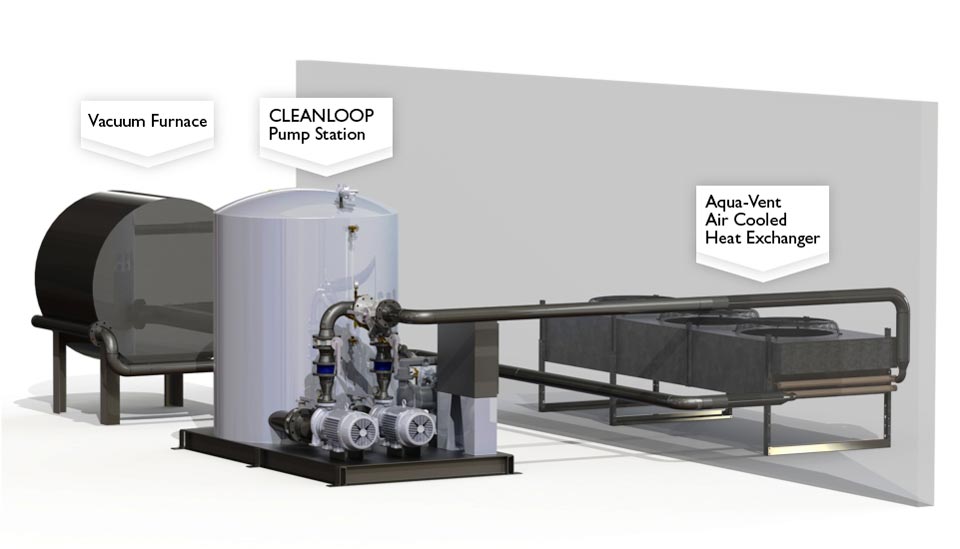
Air-cooled vacuum furnace cooling system (from Dry Coolers)
Heat TreatTip #80
Closed-Loop Water Cooling Systems
Modern water cooling systems for vacuum furnaces are typically closed-loop. (By this we mean that air never comes in contact with the water that goes through your vacuum furnace. The expansion tank would be pressurized with dry nitrogen, in this case, to prevent oxygen pick-up by the water.) Sometimes after maintenance work, the expansion tank or sump is left open to air. As a result, air/oxygen, dirt, and organic materials can get into the water system and eventually cause both corrosion and plugging of your chamber. A plugged chamber can overheat and explode or implode causing serious injury or death. Replacement chambers are very expensive. A recirculating water system that allows air to contact the water entering your furnace can dramatically decrease the life of your vacuum chamber.
Heat TreatTip #89
Lanthanated Moly Alloy Strip Increases Element Longevity
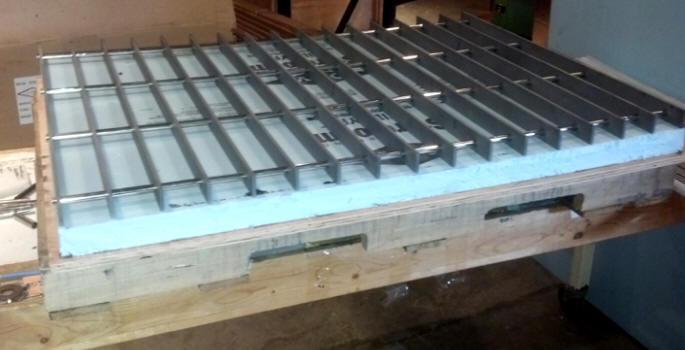
Moly and TZM moly grids can double or triple vacuum furnace throughput by using a two-tier or three-tier fixture to utilize unused work zone space.
Pure molybdenum vacuum furnace heating elements distort with time in service due to growth and contraction during thermal cycling. You can often see this distortion beginning just a month or two into service of new elements. Eventually, these will contact either the insulation/shield wall— or worse yet, your parts—and cause electrical arcing. So they need to be replaced before this happens. By making a direct replacement of these pure moly strips with a lanthanated moly alloy strip, the life of the elements can be significantly increased. We have seen a rough doubling of the element life by making this change. Many new OEM vacuum furnaces are now supplied with lanthanated elements at the start. OEM and aftermarket hot zone re-builders are frequently making this change as well to get longer life out of their hot zone elements.
Heat TreatTip #101
TZM Moly Alloy for Structural Vacuum Furnace Components
For over 30 years, there has been a molybdenum alloy called TZM (Moly-0.5%Ti-0.1%Zr) which is far superior to pure molybdenum in vacuum furnace structural applications. TZM is slightly more expensive than pure moly, so OEM furnace companies use pure moly to keep their costs down for competitive reasons. But they could be offering it as an option for their buyers. Pure molybdenum metal undergoes recrystallization at temperatures as low as 2000°F. The recrystallized structure is very brittle at the grain boundaries, resulting in a structural component that also is very brittle. If you have a vacuum furnace with moly components, you have undoubtedly seen this with older parts. TZM alloy, however, does not recrystallize until around 2500°F, and even then it does not exhibit the brittle behavior of pure moly, because the recrystallized grain size is still very fine. TZM is also stronger than pure moly, as much as 3 to 4 times the strength at temperatures above 2000°F. For a 10-15% premium in cost, you can dramatically extend the life of your moly structural components in your furnaces.
It wasn’t long ago that auto industry watchers were casting votes for either steel or aluminum in what was to be a big competition in what metals would be used in automotive lightweighting.
Would it be the heavy-weight champion steel which was ramping up its development of high-strength, lower-weight steels? Or would the new contender on the block, aluminum, gather more adherents to lightweighting in the wake of Ford Motor Company choosing aluminum for its F-150 and Super Duty pickup bodies?
An excerpt:
“A consensus has emerged. The future for the industry is a mix of materials, a mix that will vary from vehicle to vehicle. It’s also likely to be a more complex future, with composite materials making inroads in the long run.”
Jay Baron, retired president of the Center for Automotive Research (CAR), Ann Arbor, Michigan
“You have to take into account all sorts of factors,” said Jay Baron, retired president of the Center for Automotive Research (CAR), Ann Arbor, Michigan. Vibration and stiffness figure into the equation, he said. And there’s cost. “It’s much more than weight and strength.”
Designing and building vehicles with a patchwork quilt approach to materials is how some brands are tackling the lightweighting challenge. Most are also exploring advanced technological processes such as a combination of 3D printing and artificial intelligence, friction welding technology, and rethinking other automotive systems, e.g., braking.
Main image credit / caption: Manufacturing Technology Inc. (MTI) / The MTI-built LF35-75 at Lightweight Innovations for Tomorrow is ideal for unique part geometries, near-net shapes and full-size part development for all industries, according to MTI.
A global company that produces specialty metals and provides related vacuum heat treating equipment and services recently announced the acquisition of assets of a leading titanium producer based in western Pennsylvania that supplies the aerospace industry.
AMG Advanced Metallurgical Group N.V. finalized the acquisition of the assets of International Specialty Alloys (ISA) from Kennametal Inc. through its operating unit AMG Technologies, which, besides its production of titanium aluminides and titanium master alloys, also designs, engineers, and produces advanced vacuum furnace systems and operates vacuum heat treatment facilities under the ALD Vacuum Technologies brand name, primarily for the transportation and energy industries.
ISA, located in New Castle, Pennsylvania, is a leading U.S. producer of titanium master alloys and other binary alloys for the aerospace market.
“The acquisition of ISA provides an excellent opportunity for AMG Titanium Alloys and Coatings to increase its market position in these key products for the aerospace market in North America and Europe,” stated Guido Loeber, President of AMG Technologies.
A 3D equipment and materials supplier recently announced a collaboration agreement to develop advanced tungsten-based metal 3D printing using binder jetting that focuses on two metal matrix composites.
Deborah West, vice-president of Business Unit Refractory & Specialty Powders, GTP
Global Tungsten & Powders Corp, a global manufacturer of tungsten and metal powders, and The ExOne Company, which manufactures industrial sand and metal 3D printers using binder jetting technology, have entered into this collaborative partnership to focus on tungsten-copper (W-Cu), used in high-voltage electrical applications, and cemented carbide (WC-Co), used in cutting tools and wear-resistant parts.
GTP uses the ExOne® Innovent®, an advanced and compact binder jet 3D printer, to manufacture parts in tungsten carbide and other tungsten composites. Binder jetting is a 3D printing process that uses a digital file to inkjet a bonding agent into a bed of powder particles, creating a solid part one layer at a time. Compared to other 3D printing processes, binder jetting delivers precision parts at a high rate of speed, making it an ideal approach for serial production.
The new ExOne-GTP collaboration focuses on the development of two metal matrix composites:
cemented carbide (WC-Co), a material with very high hardness and toughness that is widely used for the production of cutting tools and wear-resistant parts
Tim Pierce, ExOne Vice President of Metal Commercial Products
copper-tungsten (CuW), which is used in applications where high heat resistance, high electrical and thermal conductivity, and low thermal expansion are needed
“Binder jetting is the 3D printing method of choice for serial production of hard metal parts,” said Deborah West, vice-president of Business Unit Refractory & Specialty Powders, GTP. “Traditionally, tungsten carbide powder is pressed into the desired shape and then sintered to give it strength and density. Instead of costly and timely mold construction, the parts now can be printed directly in the desired shape, still using sintering technology to achieve the final strength. As a market leader in the development and production of high-quality tungsten powders, GTP always stays on top of the latest technology. We are excited to work with ExOne in the development of cutting-edge technology for the additive manufacturing industry.”
“Metal 3D printing using our exclusive approach to binder jetting has exciting and significant consequences for a variety of manufacturers, including those who make parts with cemented carbide and other tungsten composites,” said Tim Pierce, ExOne Vice President of Metal Commercial Products. “Our latest development collaboration with GTP will help advance the materials necessary to deliver on the vision of producing these parts faster, with less waste and more geometric design freedom.”
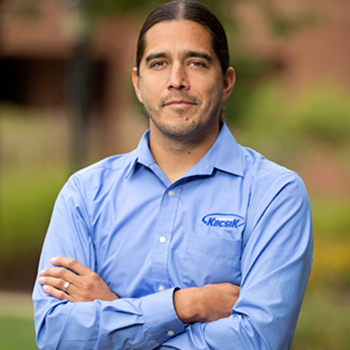
Heat TreatToday’s regular contributor Jason Schulze of Conrad Kacsik (“Jason Schulze on AMS2750E” series) interviewed Shaun Kim from Byington Heat Treating, located in Santa Clara, California, about the company’s experience preparing for and working through the Nadcap accreditation process. Shaun is the quality director at Byington Heat Treating.
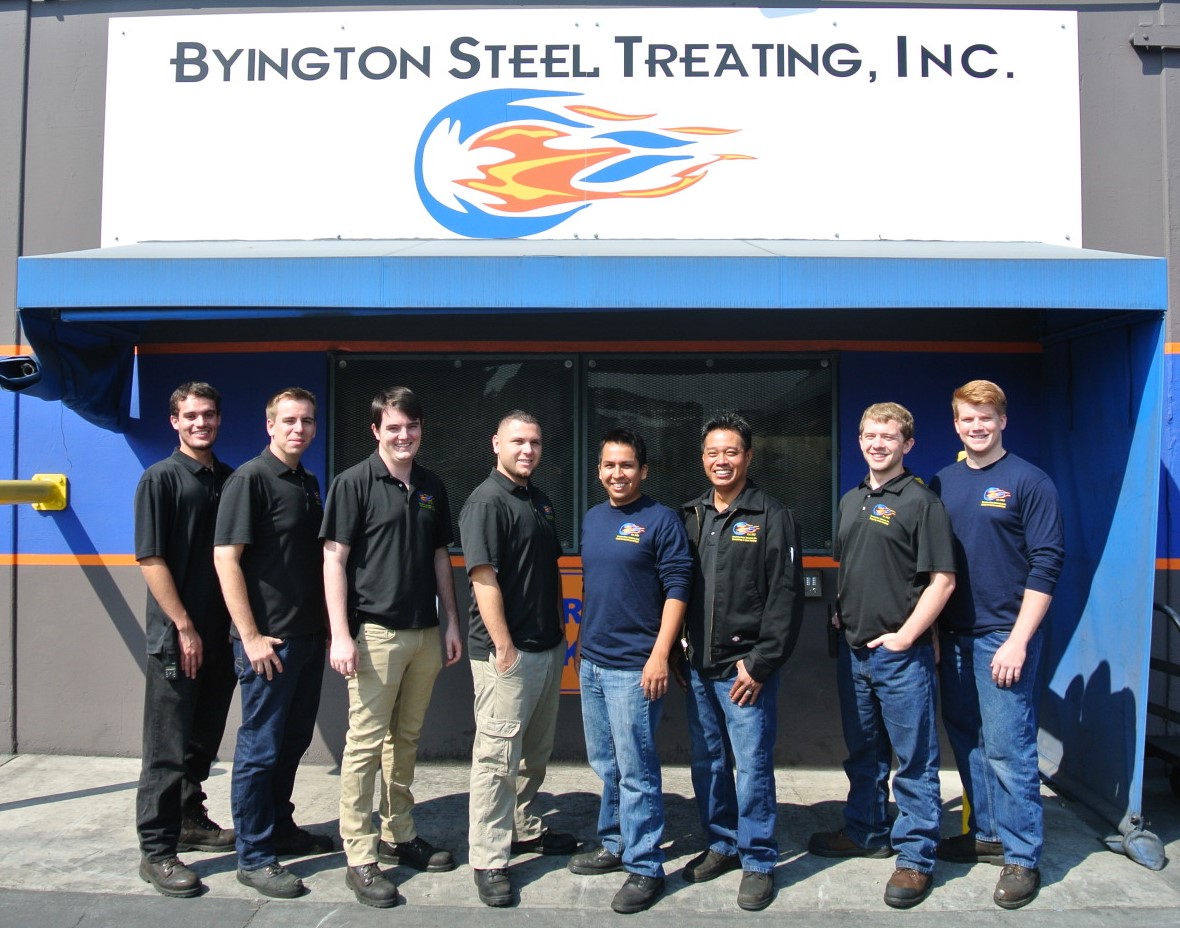
The Byington Steel Treating Inc team
As a quality director at a commercial heat treat facility, I’ve been presented with some challenging situations. I take each challenge and examine it in any way I can, or at least, in any way that I know how. I like to think I’m a detail-oriented, evidence-based thinker with the ability to, at the very least, recognize gaps even if I’m not sure how to fill them. In short, the challenges drive me to learn more, and in the end, that is what I’m after. That is what I got out of the Nadcap process: a learning experience that has since prepared me for the next round.
My name is Shaun Kim. I’m the Director of Quality at Byington Steel Treating located in the California Bay Area. In fact, we are now the only Nadcap-approved commercial heat treat facility in the area. Byington Steel Treating has been around since 1952, heat-treating materials from carbon steels to aluminum allows to superalloys. Our capabilities have grown through the years and include hardness and conductivity testing. As we heat treat to AMS2759 (and family), AMS2770, and AMS2771, as well as material specifications, Nadcap accreditation was inevitable.
Sean Byington, CEO, Byington Heat Treating
The vision of Nadcap accreditation in heat treat was initiated and fully supported by our CEO Sean Byington. I know that, for many in the field, management may not supply the full resources needed to achieve Nadcap approval, but for me, that was not the case. Our CEO offered all the necessary resources to achieve accreditation. My challenge, once I first gained access to the eAudit.net website, was the new requirements within the checklist. As I stated, I’m detail-oriented, so I examined the checklists closely and, in the process, realized that in order to achieve Nadcap accreditation, simply conforming to an AMS specification wouldn’t be enough.
My biggest challenge was pyrometry. At the time I didn’t understand AMS2750E very well, so I intently read the specification until it started to make sense. I must have read that specification 10-plus times. Our initial Nadcap audit did not go well. It wasn’t that we were not doing what was required; it was that we did not have those requirements documented. We ended up going through the risk-mitigation process, otherwise, we would have had to wait two years to re-apply for Nadcap heat treat accreditation—something our team and CEO was not willing to do. If I had to point out some things I would have done differently pre-risk mitigation, I would have a) given myself more time to prepare, b) hired an industry expert to perform a gap-analysis using the AC7102 checklists, and c) hired an industry expert to facilitate the audit.
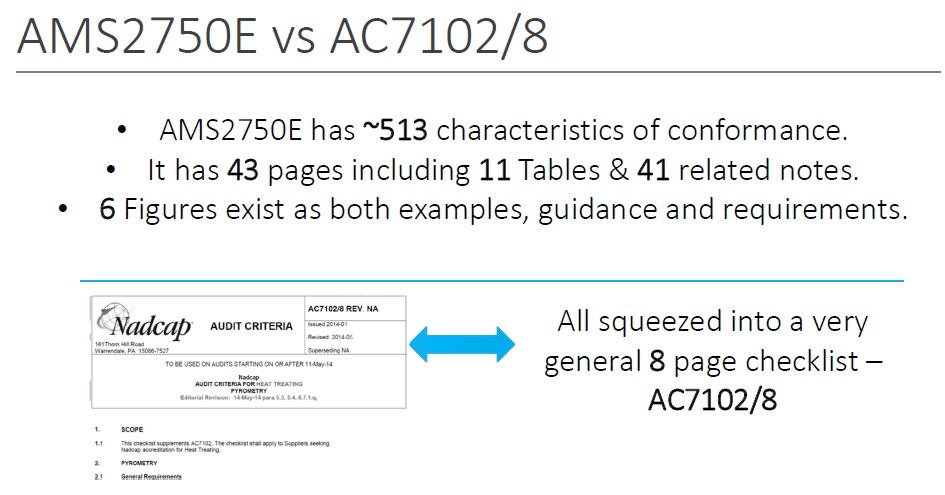
Slide from the Nadcap training Jason Schulze provides on behalf of Conrad Kacsik
Back to the risk mitigation process. The Nadcap risk mitigation process essentially consists of addressing all findings received from the eAudit.net system. PRI Staff Engineers will review root cause and corrective actions as they normally would during a reaccreditation audit. Prior to the risk mitigation process, we engaged an industry expert to help us review the findings to ensure that what we were capturing would improve our process and get the findings closed. Even though the risk mitigation process, we learned a lot about the response expectations and just how far we had to dive into our process to find the root cause and take corrective action. In the end, I must admit, I wouldn’t have changed anything. Going through the pains of risk mitigation prepared our company for the stringent requirements that come when processing aerospace parts to the requirements of Nadcap. Nadcap is a serious thing, and we wanted to learn as much as we could even if it meant putting a lot of time and effort into risk mitigation, which we did.
Internal audits gas analysis results can provide a learning opportunity.
Post-risk-mitigation, my experience was completely different and so was our approach. We retained our consultant who walked us through a gap analysis and supplied us with a close-out letter, laying out each gap for each checklist and how to close the gap. Once we had this information, and with an open line of communication to our consultant, we modified our procedures/forms and re-trained our staff in line with changes and requirements. At that point, my understanding of the Nadcap requirements, as well as AMS2750E, had improved greatly, which helped us through the process.
The time came for us to have our initial Nadcap heat treat audit. This process was tough. We had worked hard to close all the gaps we could think of. The auditor did not necessarily contribute to the tough process; it was more about the under-the-gun feeling. We had worked hard and invested the time and money to ensure a successful audit, and we were eager to experience the reward. Of course, there were several times we did not see eye-to-eye with the auditor, but in the end, we had a very successful audit. We passed with room to spare.
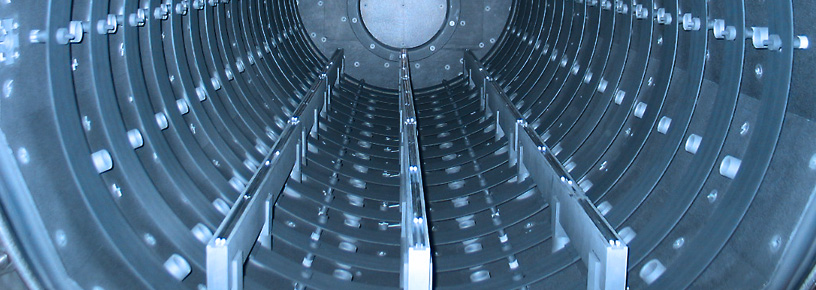
Interior of a vacuum furnace
In the end, I learned a lot through the process of Nadcap accreditation in heat treat. I’m a strong believer that you will never learn anything unless you make mistakes along the way and identify why it happened. There is no way for us to learn unless someone points it out or an event forces us to recognize the gap and we then address it.
Almost immediately, we began receiving RFQs which required Nadcap accreditation in heat treat. We have been processing quite a bit of work which requires Nadcap approval and aim to get more. If I could share any advice it would be the following:
Start from the beginning. Get the checklist and fill it out honestly—be honest with yourself about your capabilities.
It will not help you to ignore the gaps. Identify the gaps and start with those areas for improvement.
I recommend getting a consultant familiar with the Nadcap process of audits. The more you learn, the better off you will be.
If you would like to contact me for questions regarding my experience in our Nadcap heat treat accreditation process, please feel free to email me at skim@byingtonsteel.com. I look forward to sharing my experience and learning from yours.
Jason Schulze of Conrad Kacsik, regular contributor to Heat Treat Today (“Jason Schulze on AMS2750E” series)
Written by Jason Schulze from questions presented by Jason Schulze using responses submitted by Shaun Kim from Byington Heat Treating.
A Pennsylvania company that provides aluminum fabrication, extrusion, and casting products across a variety of industries recently celebrated the completion of the expansion of its facility in Leetonia, Ohio, where new equipment was installed aimed at increasing the company’s capabilities.
Pennex Aluminum, which was also marking the 40th anniversary of Pennex being purchased by the Metal Exchange Corporation, specializes in aluminum extrusions and fabricated components for the automotive, construction, HVAC, landscaping, and off-road vehicle markets at the Leetonia facility.
A new, highly advanced innovation center was recently opened in Orlando, Florida, pairing design with manufacturing, implementing robotics, rapid prototyping, scanning, digital tools, and on-site metal additive manufacturing.
Tim Holt, COO of Siemens Gas and Power
Siemens and Materials Solutions, a Siemens Business, have equipped the 17,000 sq. ft. center with the latest manufacturing and inspection technologies, enabling faster solutions for industry opportunities and encouraging innovation for the creation of advanced components and digital solutions, using automation tools such as robotic machines, 3D printer, and 3D scanners. The Siemens innovation center will focus on rapid problem solving supporting the company’s energy businesses, while Materials Solutions will offer additive services to support the innovation center and external customers. According to Siemens, this center is the first of its kind in the U.S.
“This center is unique, bringing together a multitude of our innovative processes under one roof,” said Tim Holt, COO of Siemens Gas and Power. “The combination of these competencies, with the 12 years of experience in metal additive that Materials Solutions brings, provides us with a distinctive capability to support the development of holistic additive solutions/services to our customers in our energy business, as well as in high-performance industries such as aerospace, automotive and others.”
Main Photo Credit / Caption: Siemens / Vinod Philip, CEO Service Power Generation for Siemens Gas & Power, officially opens the Siemens Innovation Center in Orlando, Florida.
A U.S. steel producer recently purchased key process equipment for the existing continuous galvanizing line (CGL) at its Columbus, Mississippi, plant.
Steel Dynamics Inc., based in Fort Wayne, Indiana, plans to modify its current CGL#1 to produce advanced high strength steels (AHSS) for the automotive industry.
ANDRITZ, an international technology group providing plants, systems, equipment, and services for various industries, will supply engineering and delivery of a new direct-fired furnace (DFF), new differential rapid jet cooling (DRJC), and after pot coolers (APC). The project will be implemented during the fourth quarter of 2020.
The ANDRITZ delivery also includes the supply of model-predictive advanced furnace control (AFC) for the complete furnace sections as well as automation and electrical equipment and supervision of erection and commissioning.