Heat Treat Today wishes a Happy Easter to our readers. We will be out of the office Friday, April 7, 2023, and will be back on Monday, April 10, 2023.
Good Friday is a time of reflection on the ultimate sacrifice from Jesus Christ, and Easter Sunday is a day to celebrate His resurrection from the dead. We rejoice in the hope He provides with His victory over sin and the grave. We hope you have a safe and blessed holiday.
Have a beautiful day as we reflect on this great love, Heat Treat Today.
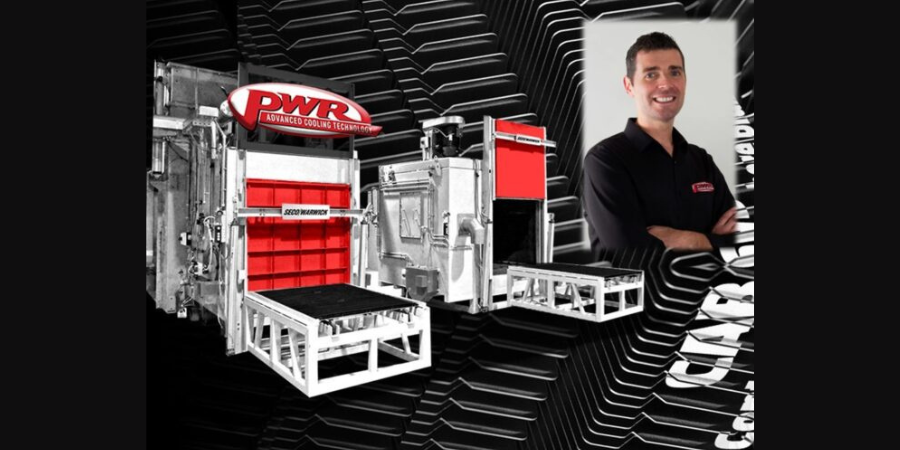
PWR Advanced Cooling Technology has ordered two universal batch CAB furnaces and a CAB continuous line. The furnaces will be used for brazing aluminum heat exchangers. The 3 solutions will go to 2 continents – Australia and North America.
PWR Advanced Cooling Technology specializes in the production of modern and efficient heat exchangers and has used SECO/WARWICK Group furnaces in the past. Two furnaces, the continuous CAB line and Universal Batch CAB Furnace, will be delivered to production plants in Australia. The second chamber furnace will be delivered at the same time to the American branch of PWR, C&R Racing Inc.
Andi Scott, general manager - advanced technology, PWR Australia Source: PWR Australia
The universal batch CAB furnace meets the requirements for protective atmosphere aluminum brazing technology (Nocolok®) and allows users to braze products in a horizontal or vertical position. The continuous CAB line performs brazing in a protective atmosphere for mass production of various heat exchangers.
“We have already ordered the company’s furnaces twice, and the current contract, although more than 25 years have passed since the first order, is the best proof that we are satisfied with the product quality, cooperation, and after-sales service.” said Andi Scott from PWR Advanced Cooling Technology.
“The current contract is special because we will deliver different solutions simultaneously to two continents but to the same customer,” commented Sławomir Woźniak, CEO of the SECO/WARWICK Group.
Find heat treating products and services when you search on Heat Treat Buyers Guide.com
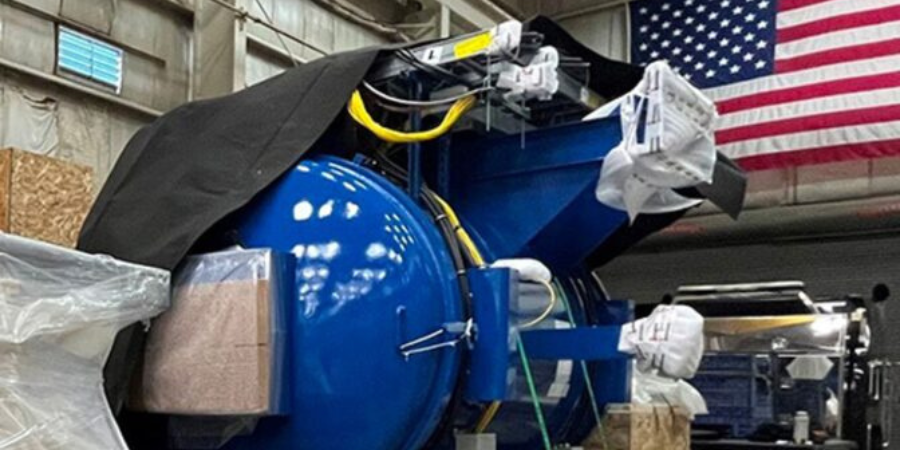
At the end of March, a vacuum aluminum brazing furnace was shipped to a manufacturer that serves the aerospace industry. The North America company produces complex heat exchangers, cold plates, and avionic enclosures.
The furnace, from PVT, Inc., has an AMS 2750 qualified work zone of 36” x 30” x 90” with type B instrumentation and Class 1 temperature uniformity. In addition to this furnace, PVT delivered two furnaces in Q4 and one furnace in Q3 2022 to companies manufacturing components for avionics, MRO (maintenance, repair, and overhaul), and electromechanical assemblies.
How clean is clean enough? Insufficient cleaning before heat treating can interfere with results; insufficient cleaning after heat treating can impact perception of the part. Discover four methods of measuring part cleanliness that can take place within your heat treat operations in this article provided by SAFECHEM Europe GmbH.
This Technical Tuesday article is drawn from Heat Treat Today's March Aerospace Heat Treatingprint edition. If you have any information of your own about cleaning after heat treating, our editors would be interested in sharing it online at www.heattreattoday.com. Email Bethany Leone at bethany@heattreattoday.com with your own ideas!
Previously we talked about the importance of cleaning for demanding heat treat applications — in particular gas nitriding, or ferritic nitrocarburizing (FNC), low pressure carburizing (LPC), and brazing. So, if cleaning is a nonnegotiable for certain heat treatment processes, one might ask: how clean is clean enough?
Contact us with your Reader Feedback!
The basic definition of clean is removing unwanted substances, particles, and contaminations. However, when applied to surface cleaning, “clean enough” is determined by what you want to do next in your processing. Parts are generally clean enough if satisfying outcomes can be achieved in the subsequent application.
First, Do You Know the Expectations?
Unlike measuring hardness, monitoring or determining part cleanliness is by no means a straightforward matter.
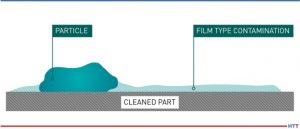
There are two different kinds of contaminations to consider:
Particle contaminations
Film-type contaminations
Types of contamination Source: SAFECHEM Europe GmbH
Whereas there are industry definitions or standards for particle contaminations (e.g., VDA-19 or ISO-16232 for the automotive industry), standards for film-type contaminations are not yet fully established.
This inadequacy also explains why many companies do not fully know what to expect when it comes to cleanliness, and they do not fully grasp the potential impact that insufficient cleaning could cause.
Especially when it comes to the heat treat industry, it is important to differentiate between the component cleanliness requirements before and after heat treatment.
Film-type contaminations are the primary factor which could negatively impact heat treat results. Requirements on particle contaminations (VDA-19) usually come from the automotive industry and need to be ensured/monitored after heat treatment.
Therefore, a distinction must be made between a) surface requirements for heat treatment and b) client cleanliness requirements on the final components.
What Is the Right Measurement Method?
The analysis of film-type contaminations and particle contaminations are two different subject matters. Measurement methods for one cannot replace the measurement methods for the other. Often, it is quite common for companies to have requirements on both film-type contaminations (e.g., surface energy in dyne/cm or mN/m) and particle contaminations (e.g., max. particle load) in their component drawings.
Some common measurement methods for determining contaminations include:
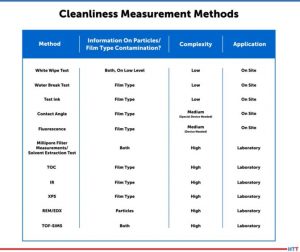
White wipe test: A simple visual inspection test using a clean and dry white wipe to wipe across the surface for the detection of colored residues. Because contaminations can negatively impact heat treat results, inspection should take place prior to heat treatment. The test is limited to colored particles whose size can be perceived by the eye.
Water break free test: An easy test to check if oil droplets might be present on the surface is when parts are rinsed with clean water at an angle. If there are contaminations, water will separate around those areas, showing a “break” in the water surface.
Dyne testing: This method is commonly used for measurements of film-type contaminations. Dyne inks and fluids are applied to a substrate for measurement of its surface energy. The surface energy (measured in dyne/cm or mN/m) can be identified as the highest dyne solution that wetted out the substrate surface. The higher the dyne level, the better the adhesion of the surface for painting, coating, or bonding. However, the test does not provide information on the types of contaminations present.
Millipore filter measurements/solvent extraction test: This measures surface contamination on parts as a weight per 0.1 m2. Samples are obtained by flushing the cleaned part with an organic solvent where particulates are collected on a filter disc (solvent will be evaporated off later). The test can determine the nature, number, sizes of particles, and if there are reflecting/ non-reflecting metallic particles. Moreover, oil film on parts can be measured after evaporation of the extraction solvent. For automotive, aerospace, or electrical, the level of cleanliness typically ranges between 0.01–0.001g per cm2.
In general, these methods differ in their complexity and informative value, and also if they can be carried out on site or off site (e.g., in a laboratory). The table below provides an overview of common measurement methods:
Cleanliness measurement methods Source: SAFECHEM Europe GmbH
Determining Cleanliness — An Art and a Science in Itself
As you now see, the variances and potential limitations of different measurement methods can add to the complexity of cleaning validation. Consider the following:
Should you measure a specific surface area, or the entire part? And how do you measure pre-assembled components with different parts molded together?
It might be easy enough to measure surface cleanliness, but what about blind holes and crevices?
Visual inspections have many shortcomings. It is subjective, time consuming, and does not cover total level of contamination. The quality of inspection will very much depend on the operator. While automated particle counting is efficient and objective, it does not offer insights on specific contaminants.
Extraction methods targeting nonvolatile residues (NVR) can help determine a total level of contamination, but not spot contamination. It does not account for inextricable contaminants either, which could impact part functionality.
Meaningful Measurement Begins with Understanding the Big Picture
This is why, in order to measure and monitor cleanliness in a meaningful and reliable way, you should consider:
What potential contaminations could come about in your process/facilities?
What contaminants are you looking to remove?
What are the next processing steps?
What are the risks involved in removing the contaminants?
What are the risks associated with the potential residue?
Since every test has its own limitations, you should be mindful of the test specifications, too — for example, how it is conducted, result variability and reproducibility, as well as biases.
Cleaning can be a crucial step in heat treat, but more cleaning does not always equal better. More cleaning also implies more costs, more time, more resource usage. What’s really key is understanding what you, or your clients, are trying to achieve.
As you see, cleaning and measurement require expertise and knowhow — context is everything. Reach out to a cleaning specialist or trusted cleaning solutions expert for advice. If insufficient component cleanliness seems to be affecting your heat treat results, our cleaning specialists, along with our partners, would be happy to advise.
For any heat treater interested in getting these high-security contracts, review the following steps that will help you successfully complete your basic and final self-assessment.
Today’s read is a Cybersecurity Desk feature written by Joe Coleman, cybersecurity officer at Bluestreak Consulting™. This column is in Heat Treat Today’sFebruary 2022 Air & Atmosphere Furnace Systems print edition.
Introduction
Joe Coleman Cybersecurity Officer Bluestreak Consulting™ Source: Bluestreak Consulting™
Do you have plans to perform your NIST SP 800-171 self-assessment, but need more clarity about what’s involved? DFARS 252.204-7012 and the DFARS Interim Rule, including DFARS 252.204-7019, state that all DoD contractors in the Defense Industrial Base (DIB) that process, store, and/or transmit CUI (Controlled Unclassified Information) and want to be eligible for any contract award must complete a self-assessment (or basic assessment) using the DoD’s NIST SP 800-171 Assessment Methodology and generate a points-based score. This score will then be uploaded into the Supplier Performance Risk System (SPRS). At the time of contract award for a DoD contract containing the new 7019 clause, a DoD contracting officer will verify that a score has been uploaded to the SPRS.
For any heat treater interested in getting these high-security contracts, review the following steps that will help you successfully complete your basic and final self-assessment.
Identifying and Defining Your Organization’s CUI
Your NIST 800-171 basic self-assessment should start by identifying CUI sources and flows and mapping them within your organization’s IT systems. Organizations need to understand that CUI is an information category that includes Covered Defense Information (CDI) and Controlled Technical Information (CTI).
Define the Scope of the Self-Assessment
When finished identifying all CUI, you’re ready to scope the environment. To scope the environment correctly, first, determine what systems, applications, and business procedures that process, store, or transmit CUI. Second, define details of how data moves through your network.
NIST 800-171 Self-Assessment Procedure
You can find the self-assessment procedure for all compliance requirements in NIST SP 800-171A. Basically, a self-assessment is performed evaluating all 320 assessment/control objectives. Assessment/control objectives include the determination statements related to a particular security requirement. The 320 assessment/control objectives are divided among 110 separate controls which are included in 14 different control families.
Self-assessment methods include:
Examining: reviewing, inspecting, observing, or analyzing assessment objects
Interviewing: discussing with individuals to facilitate understanding, clarification, or gather evidence
Testing: confirming that assessment objects under specified conditions are met
Organizations are not expected to use all assessment methods and objects in NIST 800-171A. Instead, they have the freedom to determine which methods and objects are best for them to get the desired results.
Must Have a System Security Plan (SSP)
One of the most important requirements for a successful self-assessment is having a System Security Plan (SSP). Not having an SSP is a definite obstacle.
The SSP describes the system boundaries, how the IT system operates, how the security requirements are implemented, and the relationships with, or connections to other systems. It also includes information on security requirements.
Plan of Action & Milestones (POA&M)
To best protect CUI, organizations need to implement the CUI security requirements to the fullest extent possible. But, when some of the requirements are not completely implemented, a POA&M must be generated. The POA&M includes the tasks needed to resolve deficiencies, along with the resources and timelines required.
The purpose of the POA&M is to identify, assess, prioritize, and monitor the progress of corrective actions, allowing the organization to achieve the desired assessment score.
Next month we will discuss: “Submitting Your Basic Self-Assessment Score(s) To The SPRS.”
About the Author:
Joe Coleman is the cybersecurity officer at Bluestreak Consulting™, which is a division of Bluestreak | Bright AM™. Joe has over 35 years of diverse manufacturing and engineering experience. His background includes extensive training in cybersecurity, a career as a machinist, machining manager, and an early additive manufacturing (AM) pioneer. Contact Joe at joe.coleman@go-throughput.com.
Find heat treating products and services when you search on Heat Treat Buyers Guide.com
This first message from Bethany Leone, managing editor of Heat Treat Today gives an introduction to who she is and some of her favorite reads. A lot can be learned about a person by knowing what is on their bookshelf, and Bethany's library snapshot gives readers an opportunity to know her better. She, and the rest of the Heat TreatToday team would love to hear what populates the bookshelves of our readers! Use the Reader Feedback button below to comment.
This article first appeared inHeat Treat Today's February Air & Atmosphere Furnace Systemsprint edition. Feel free to contact Bethany Leone at bethany@heattreattoday.com if you have a question, comment, or any editorial contribution you’d like to submit.
In December, Karen Gantzer dedicated this Message from the Editor column to reflect on “passing the baton” of managing print editorial content. So here we are, running with the baton while paging through the first edition of Heat TreatToday's 2023 print magazines.
First things first, let me share a summary about myself. My name is Bethany Leone, lover of art, puns, bonfires, and books. I believe the sweetest things in life originate from my dear niece or a hint of cocoa. It is good to learn new things, but more important is learning the wisdom to do those things well. You can bump into me in Pittsburgh, PA, though it is unlikely that you will see me in crowds of people (unless you are out partner dancing, too).
Now, before I run the managing editor baton to the “heat treat industry library” (i.e., The Heat Treat Doctor® series of books), let me share a few books in my library that have shaped who I am to give you better understanding of Bethany Leone.
The Holy Bible
Although it is a collection of books — and there are a few books in here that I haven’t read more than once — the words from these pages have guided me many days of my life. Impossible passages, stunning creativity, wild histories, and a message of the Truth that inspires me daily.
Forests: The Shadow of Civilization
How do humans across civilizations through time perceive the looming darkness of the manifold trees? In reading Robert Pogue Harrison’s book about how humans respond and are shaped by their conception of the sacred or treacherous or exploitable wood, you may also be stunned by how closely we define and are defined by our relationships with the environment around us.
The Body Keeps the Score
A book about how trauma effects the biology and neurology of the body, I began reading this book to better appreciate the effects of suffering. Sometimes hidden, sometimes manageable, the collection of anecdotes about how trauma alters our minds and bodies is a humbling and worthwhile read for anyone seeking to love their neighbor better.
The Past and Future City: How Historic Preservation Is Reviving America’s Communities
Why buy historic homes? Apparently, there are many secondary benefits to the enjoyment of life in “older, smaller” neighborhoods. A walkable area where the old and young mingle as well as those from different income levels often means that people enjoy a better quality of life. The questions (and answers) on how to encourage and maintain this direction of civil values are explored in this reading by Stephanie Meeks.
The Singing Bowl: Collected poems by Malcolm Guite
Finally, this collection of poetry by Malcolm Guite is a treasure trove for searching hearts. For years, I was only captivated by the first poem, “The Singing Bowl.” But if you care to wander the pages of “What if…” and “Lapis Lazuli,” you won’t regret the 60 seconds of introspection that Guite offers.
So that’s it! A brief introduction of the new managing editor. I’ll never fill the shoes of Karen Gantzer, but I am thrilled to see Heat Treat Today continuing to inform the heat treat industry from this new perspective.
Now, if we ever meet in-person, skip the introduction and answer me this: What’s in your library?
Find heat treating products and services when you search on Heat Treat Buyers Guide.com
Marcin Stokłosa Project Manager NITREX Poland LinkedIn.com
Arslan Aluminyum recently added three new extrusion presses to its production, increasing the demand for nitriding their dies and necessitating a large-capacity nitriding system for the biggest press. The system will nitride H11 and H13 dies that extrude aluminum profiles for the construction, renewables, joinery, furniture, and equipment sectors.
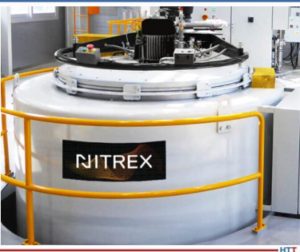
When the plant upgraded, the new nitriding system furnace was required to help double the production capacity. Arslan selected a NX-1015 pit furnace designed to treat workloads up to 4400 lbs that are 39″x59". The collaboration with Nitrex and Arslan Aluminyum started in 2011, when the family-run business purchased an NX-812 turnkey nitriding system.
Pit furnace Source: Nitrex
“The people of Arslan['s] high regard for our products and company has helped us tremendously in getting new contracts in Turkey.” commented Marcin Stokłosa, project manager at Nitrex.
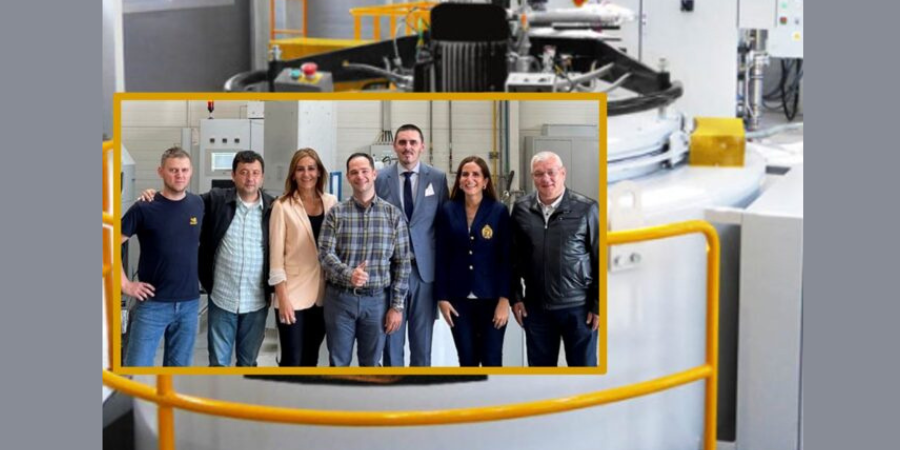
Pictured above: collaborators from Turkey. Photo Source: Nitrex.
Find heat treating products and services when you search on Heat Treat Buyers Guide.com
Peter Zawistowski Managing Director SECO/VACUUM TECHNOLOGIES, USA Source: SECO/WARWICK
A U.S.-based international manufacturer of dies will expand their operation with a high-pressure gas quench furnace. The equipment will accommodate increasing orders for the company’s largest dies.
The manufacturer’s equipment requires the use of precisely heat treated large dies. Currently the company utilizes a pair of vacuum furnaces that have some limits. The Vector® furnace they are about to receive from SECO/VACUUM, a SECO/WARWICKGroupcompany isbottom loading with 6 bar nitrogen gas quench, 60”x 72”, with a 3-ton capacity working zone. This is room enough to treat 3 of their largest dies at once compared to only 2 per cycle for the old furnace.
“With [the furnace’s] wide range of quenching features, [the manufacturer will] have room to grow, even enabling them to conduct low-pressure carburizing processes if they ever need to,”saidPeter Zawistowski, managing director of SECO/VACUUM.
Find heat treating products and services when you search on Heat Treat Buyers Guide.com
The monthly Industrial Heating Equipment Association (IHEA) Executive Economic Summary released in March came out a little later than usual in order to incorporate recent global banking events. Even with bank failures, heat treaters can see the economy being part of an overall forward, albeit slow, recovery from the big recession during the pandemic.
Some of the banks to collapse were Silicon Valley Bank along with others such as Signature Bank and Republic Bank as well as Credit Suisse in Europe. The continual raising of rates, by the Feds, to fight inflation exposed weaknesses in banks that were already struggling. In the aftermath of this collapse, the report states uncertainty in how the Fed will respond to inflation in the future.
While the following report shows current stability in the economic indices, there is uncertainty following the banking collapse about how the economic future will unfold. The report states, "the industrial sector is still expected to decline although the speed of that decline has slowed
a bit. The projected readings are far below the trend line . . . but has started to show some very slow recovery." Only time will tell how the banking collapse will affect the future trends.
As a first example of continuous supply chain improvement, new automobile and light truck sales are up. New cars are being produced more consistently, and people are attracted to new vehicle purchase over the high-priced used vehicle market.
"Now that the supply chain crisis has started to recede the new cars are available again." Source: IHEA
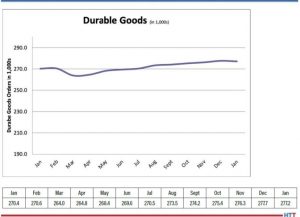
New home starts have about the same data as last month's report with the need still great for multi-family units are needed. The durable goods chart will be shown next since a good portion of that manufacturing is feeding into the new home builds.
"The good news for the manufacturer is that appliance demand is far higher with multi-family homes." Source: IHEA
"There have been major gains in sectors such as vehicle manufacturing and aerospace..." Source: IHEA
Another economic trend for heat treaters is the steel consumption sector. Construction is going strong, but know that this could drop when current projects get finished. There is hesitation in construction to embark on new projects because of financing concerns. As mentioned before, automotive is still doing well.
"Most of the big projects have started to get closer to completion and the economic environment is causing delays in starting new efforts." Source: IHEA
Similarities can be seen in the industrial capacity utilization and the factory orders scenes. When the panic due to supply chain problems hit, companies bought up as much as they could. Now, there is the opposite problem of overstock. Inventory is going to have to be sold before these numbers will start working their way up again.
"Until these excess inventories are dealt with there will be slack reports." Source: IHEA
"The dip in commodity pricing has already passed for the most part..." Source: IHEA
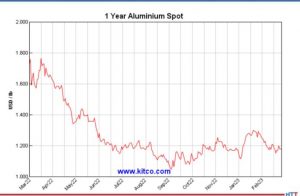
Raw metal pricing saw a huge dip with the bank failures, and the report shows this is due to investor panic. Already the numbers are leveling out.
Anne Goyer, Executive Director of IHEA
Overall, the report is showing on-trend charts and indices. Even with the bank scares recently, the economy is not radically dropping and changing. Things are straightening out - slowly, slowly - as the recession moves more and more into the rearview mirror.
Check out the full report to see specific index growth and analysis which is available to IHEA member companies. For membership information, and a full copy of the 11-page report, contact Anne Goyer, executive director of IHEA. Email Anne by clicking here.
Find heat treating products and services when you search on Heat Treat Buyers Guide.com
Let’s discover new tricks and old tips on how to best serve air and atmosphere furnace systems. In this series, Heat Treat Today compiles top tips from experts around the industry for optimal furnace maintenance, inspection, combustion, data recording, testing, and more. Part 4, today's tips, examines carbon probes and carbon control. Look back to Part 1 here for tips on seals and leaks, Part 2 here for burners and combustion tips, and Part 3 here for data and record keeping tips.
This Technical Tuesday article is compiled from tips in Heat Treat Today's February Air & Atmosphere Furnace Systems print edition. If you have any tips of your own about air and atmosphere furnaces, our editors would be interested in sharing them online at www.heattreattoday.com. Email Bethany Leone at bethany@heattreattoday.com with your own ideas!
1. Slight Positive Pressures Are Best
Contact us with your Reader Feedback!
Atmosphere furnace pressure should be only slightly above ambient. The range should be between 0.25-0.35 inches water column. Higher pressures in multiple zone pusher furnaces will cause carbon control issues. High pressures in batch furnaces will cause high swings when doors and elevators move.
If you’re having atmosphere problems with a furnace that has been operating normally for some time, avoid the temptation to remove the carbon probe. There are several tests you can run on nearly all carbon probes while the probe is still in the furnace, at temperature, in a reducing atmosphere. Super Systems Inc. provides an 11-step diagnostic procedure in a white paper on their website, in a paper titled, “Carbon Sensor Troubleshooting” by Stephen Thompson.
"Review process date for abnormalities." Source: Super Systems Inc.
Many factors can contribute to why parts are not meeting the correct hardness readings. According to Super Systems Inc., here is a quick checklist of how to start narrowing down the culprit:
Review process data for abnormalities. The first thing to do is make sure the parts were exposed to the right recipe. Check the recorders to make sure the temperature prof le and atmosphere composition were correct. Make sure all fans and baffes were working correctly. Determine if any zones were out of scope and that quench times were acceptable. If any red flags appear, hunt down the culprit to see if it may have contributed to soft parts.
Check the generator. Next, check the generator to make sure it is producing the gas composition desired for the process. If available, check the recorders to make sure the gas composition was on target. If not, check the generator inputs and then the internal workings of the generator.
Check the furnace atmosphere. If the generator appears to be working correctly, the next step would be to check the furnace itself for atmosphere leaks. Depending on what type of furnace you have, common leak points will vary; for continuous furnaces, common leak points are a door, fan, T/C, or atmosphere inlet seals. Other sources of atmosphere contamination may be leaking water cooling lines in water-cooled jackets or water-cooled bearings. More than likely, if the generator is providing the correct atmosphere but parts are still soft, there is a leak into the furnace. This will often be accompanied by discolored parts.
Check carbon controller to make sure it matches furnace atmosphere reading (verify probe accuracy and adjust carbon controller). This can be done using a number of different methods: dew point, shim stock, carbon bar, three gas analysis, coil (resistance), etc. Each of these methods provides a verification of the furnace atmosphere which can be compared to the reading on the carbon controller. If the atmosphere on the carbon controller is higher than the reading on the alternate atmosphere check, that would indicate the amount of carbon available to the parts is not as perceived. The COF/PF on the carbon controller should be modified to adjust the carbon controller reading to the appropriate carbon atmosphere. If the reading is way off, it may require the probe to be replaced.