

FEATURED NEWS

Aerojet Rocketdyne Auctions Heat Treat Equipment at California Facility, Sets Sights on Arkansas Expansion

Advanced large-capacity heat treating equipment and vacuum furnaces, as well as rare aerospace equipment, are listed among the items that were auctioned in December 2019, as part of the closure of an industrial facility belonging to a California-based rocket and missile propulsion manufacturer.

Paul Zimmer, CEO of Machinery Marketing International

Aerojet Rocketdyne began downsizing its operations and holdings in Rancho Cordova, California, in 2017 and expanding its manufacturing footprint in Arkansas. Machinery Marketing International (MMI), in collaboration with Hilco Industrial, was secured to partner with Aerojet in the downsizing of assets, and a large industrial auction of Aerojet Rocketdyne manufacturing equipment that occurred in December.

The auction of the 800,000-plus sq ft manufacturing facility features advanced large-capacity heat and vacuum treating, composite structure forming, CNC machining, quality assurance equipment, and more. Key assets falling under the auctioneer’s gavel include an Abar Ipsen HR-120x152VC 6-bar MetalMaster horizontal vacuum compression braze furnace and a Grieve HB-500 500°F electric oven.

“We are proud to have been selected as an asset disposition partner for this closure,” said Paul Zimmer, CEO of Machinery Marketing International. “This facility features rare aerospace equipment including vacuum furnaces and heat treatment machinery, composite manufacturing equipment, large scale turret lathes, and a wide selection of machine tools. The scale and quality of this equipment makes this auction a unique opportunity for buyers.”

Aerojet Rocketdyne’s Rancho Cordero facility // Photo credit: Jay Mather, Sacramento Bee file

The live auction will take place at 2001 Aerojet Road Rancho Cordova, California 95742 on Tuesday, December 10, at 10:00 AM (Pacific Time) with additional online webcast bidding hosted by Bidspotter. Lot preview and machinery inspection will occur Monday, December 9, 8:00 AM to 4:00 PM (Pacific Standard Time), or earlier by appointment.

Details, photo gallery, and bidding information are available at http://info.mmi-direct.com/aerojet-rocketdyne-auction-december-10


Main image credit/caption: MMI / Apar Ibsen Furnace: One of many rare and pristine machines available in this aerospace equipment auction


Aerojet Rocketdyne Auctions Heat Treat Equipment at California Facility, Sets Sights on Arkansas Expansion Read More »

20 Quick Heat Treat News Chatter Items to Keep You Current

Heat Treat Today offers News Chatter, a feature highlighting representative moves, transactions, and kudos from around the industry.

Personnel & Company Chatter

  • Tim Merryweather has joined U.K.-based heat treater, the Wallwork Group, as vacuum brazing technical sales engineer.
  • A manufacturer of monolithic refractories and precast refractory shapes has opened its second manufacturing facility in Tianjin, China. The newly constructed, 210,972 sq ft Allied Mineral Products plant will resolve production space needs as well as expand workspace.
  • In partnership with a manufacturer of robotics and automation equipment for the construction industry, a refractory supplier recently introduced a device that provides workers in the refractory industry with on the jobsite safety and productivity benefits. HarbisonWalker International (HWI) joined forces with Construction Robotics in production of the MULE-R (Material Unit Lift Enhancer – Refractory).
  • A new hot isostatic pressing (HIP) system was revealed at an open house in Cleveland, Ohio,  hosted by Paulo to unveil the company’s new HIP capabilities, available via its Quintus model QIH-122 Hot Isostatic Press, which can combine HIP with heat treating.
  • Gasbarre Products, Inc. has announced that at the end of 2019 all thermal processing systems will be manufactured in its 50,000 sq. ft. facility located in St. Mary’s, Pennsylvania. In 2011 Gasbarre acquired the JL Becker brand of industrial furnace equipment, and over the last eight years, Gasbarre has run parallel manufacturing facilities in Michigan and Pennsylvania for its furnace equipment. Consolidating the manufacturing of its common product lines allow for the most efficient use of its floor space, equipment, and manufacturing processes. Gasbarre will maintain its presence in the Detroit area with a sales, engineering and service facility.  Ben Gasbarre will maintain his leadership role within the Plymouth, Michigan location.  The sales and technical team will drive Gasbarre’s furnace systems into the future.  Gasbarre has plans to not only design and service its equipment but to eventually establish a technical center for process testing and demonstration purposes.  Ben Gasbarre stated, “The move will allow us to better utilize our highly-skilled personnel to accelerate advancements to our products, technology and services.”
  • In a move to realize approximately $6 million to $8 million of annual savings, TimkenSteel Corp., Canton, Ohio, announced plans to close its TimkenSteel Material Services facility in Houston, Texas, in the first quarter of 2020. The 100,000-square-foot operation currently employs approximately 100 people who provide precision value-added and finishing services, primarily to customers that service the energy market.
  • A supplier of nitrogen generators and related products to utilities, petrochemical producers, manufacturers, and energy providers announced a move into an existing 66,000-sq.-ft. building as part of an enhanced growth strategy that includes additional hiring and new products. South-Tek Systems LLC will remain in the Wilmington, North Carolina, area.
  • A global stainless steel manufacturer with headquarters in Spain has reached an agreement for the acquisition of VDM Metals Holding GmbH. Acerinox, S.A. purchased the Germany-based leader producer of specialty alloys from Lindsay Goldberg Vogel GmbH and Falcon Metals BV.
  • An aluminum giant recently broke ground on a $36 million investment to expand and upgrade the company’s capabilities in automotive closed-loop recycling, a process to take aluminum scrap created during stamping. Novelis Inc’s investment in new vehicle production at the Greensboro, Georgia, facility includes adding state-of-the-art equipment for aluminum scrap recycling, a new baghouse for improved dust mitigation and enhanced designs for safer and more efficient traffic flow.
  • A manufacturer of excavating equipment purchased a high-temperature car bottom furnace with an operating temperature of 1000°F (538°C) to 2282°F (1250°C) for stress relieving, normalizing, and other high-temperature processes. Gasbarre Thermal Processing Systems was commissioned to design and manufacture the system to meet customer’s strict NOx and CO requirements as well as AMS 2750 temperature uniformity requirements across a wide temperature operating range.
  • A company requiring annealing or normalizing process recently purchased No. 1049, a 1050°F (566°C) cabinet oven with two drawers from Grieve. In addition, a customer has received shipment of No. 1039, a 2,000°F (1,093°C) inert atmosphere, heavy-duty furnace used for heat treating turbine components.
  • A manufacturer in the technology industry has received shipment of an indirect gas-fired heavy-duty walk-in series oven from Wisconsin Oven Corporation. The walk-in oven will be used for heat treating materials used in the production of vehicle batteries.
  • A world-leading international supplier of parts to the automotive industry acquired a Sinac stationary induction heating system from EFD Induction to be used for preheating in a series production of steel pump housing.
  • A Vietnamese steel producer has issued the final acceptance certificate for the latest state-of-the-art acid regeneration plant (ARP) at their new plant in Binh Dinh, Vietnam, which will operate in accordance with stringent European environmental regulatory standards. Hoa Sen Group issued the
    certificate to Tenova.
  • German steel distributor Salzgitter Flachstahl GmbH (SZFG) has awarded the contract to build a 2.2 megawatt PEM electrolysis plant (PEM = proton exchange membrane) to Siemens Gas and Power, which will cover SZFG’s entire current demand for hydrogen. The necessary electrical power will be generated by seven wind turbines with a capacity of 30 megawatt.
  • A customer in the secondary smelting industry purchased a gas-fired aluminum stack melting and holding furnace from Lindberg/MPH. This stack-type central melting furnace will be utilized to produce aluminum ingot and sows. The furnace has a melt rate of 4,500 pounds per hour.
  • A world-leading steel producer has been commissioned to be the main supplier of steel plate to the first U.S.-flagged Great Lakes bulk carrier built in more than 35 years. Fincantieri Bay Shipbuilding contracted with ArcelorMittal Burns Harbor for the steel supply to build the carrier, which likely will help haul raw materials to the mill after its launch.
  • An aerospace company recently ordered four TITAN® H6 2 bar vacuum furnaces that will be used for heat treating additively manufactured parts in full-scale production. Ipsen USA shipped two of the furnaces in November and will ship the remaining two in January.
  • The Women in Finishing FORUM announces registration is open for the second annual program to be held at the Embassy Suites South Bend, Indiana, at Notre Dame from May 6-8, 2020. The FORUM features a variety of professional and personal development sessions, team-building exercises, and networking events geared towards women in industrial finishing. Women in Finishing is sponsored by the Chemical Coaters Association International (CCAI).
  • Muhammed Odeh, the General Motors (GM) supplier quality engineer, visited ALD Thermal Treatment Inc. (Port Huron, MI, USA) plant to officially present the GM Supplier Quality Excellence Award for 2018.  This is ALD’s 5th consecutive year for this prestigious award since 2014. In addition, ALD was again recognized as a Supplier of the Year for providing heat treatment services.

Heat Treat Today is pleased to join in the announcements of growth and achievement throughout the industry by highlighting them here on our News Chatter page. Please send any information you feel may be of interest to manufacturers with in-house heat treat departments especially in the aerospace, automotive, medical, and energy sectors to editor@heattreattoday.com

20 Quick Heat Treat News Chatter Items to Keep You Current Read More »

Carpenter Technology Corporation Opens Facility with Vacuum Heat Treating Capabilities

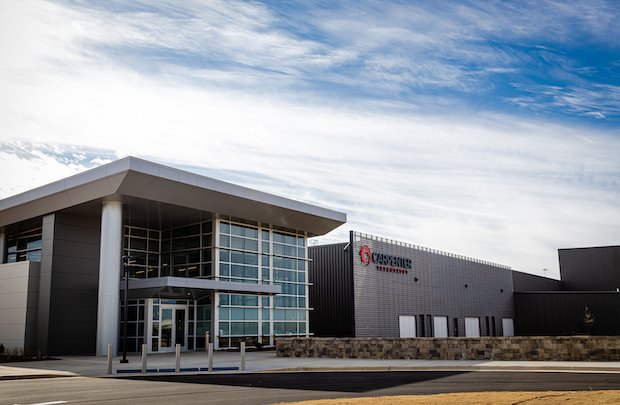
Carpenter Technology Corporation, a leader in high-performance specialty alloy-based materials and process solutions, recently announced the grand opening of its Emerging Technology Center (ETC) in Athens, Alabama, with capabilities for vacuum heat treating for multiple applications, including aerospace, automotive, energy, medical, defense, and other industries.

Carpenter Technology CEO Tony Thene

With a new, state-of-the-art quick cooling hot isostatic press (HIP) and vacuum heat treating system, Carpenter Technology’s 500,000-square-foot additive manufacturing (AM) facility provides the capability to atomize a range of specialty alloys into metal powder and manufacture the powder into finished parts using AM technology (3D metal printing).

"Our Emerging Technology Center is a critical component of Carpenter Technology’s future growth and development, and is aligned with our business strategy of evolving to an end-to-end solutions provider and influential leader in the AM area," said Carpenter Technology CEO Tony Thene. "We will also use it as a base to launch future investments as we expand our soft magnetics technology platform, scale up additional powder operations, and demonstrate a number of next-generation materials we have under development today."

The ETC investment complements Carpenter Technology’s 500,000-square-foot Alabama manufacturing facility, which began operations in 2014, and produces high-end specialty alloy products, primarily for the aerospace and energy markets.

"We have chosen to continue to invest in North Alabama because it offers three important advantages—a high-quality, tech-oriented workforce, a clear connection with the aerospace industry and a close working partnership with state and local government officials," said Thene.

"I have been looking forward to the opening of Carpenter Technology’s Emerging Technology Center since we joined with company leaders to announce plans for the facility at the Farnborough International Airshow in 2018," said Alabama Governor Kay Ivey. "I’m proud to see this world-class R&D center call Alabama home as we continue to strengthen the partnership with our friends at Carpenter Technology.


Main graphic photo credits: Carpenter Technology

Carpenter Technology Corporation Opens Facility with Vacuum Heat Treating Capabilities Read More »

Magnetic Shield Manufacturer Commissions First Vacuum Furnace

A company that manufactures custom magnetic shields, precision sheet metal fabrication, and Hydroforming recently commissioned its first-ever vacuum furnace to accommodate expansions to better serve the magnetic shielding industry by providing material designed to protect sensitive electronics from magnetic fields.

Jason Davidson, Solar Manufacturing’s northeast regional sales manager

MuShield Company of Londonderry, New Hampshire, commissioned Solar Manufacturing to design the furnace, built with a SolarVac® Polaris control system, fully compliant to AMS2750E pyrometric specification, operating at a vacuum level of 10-5 Torr with the capability of maximum temperatures up to 2400°F, and featuring an external quench system designed for pressures up to two bar.

“What this means for us is that we’ll be able to offer quicker turnaround times on heat-treated products, fit larger shields into our furnace, and eliminate outside vendor work,” notes MuShield’s website.

“MuShield was already aware of our excellent reputation in the industry, and they were impressed with our facility when they visited earlier this year,” said Jason Davidson, Solar Manufacturing’s northeast regional sales manager. “They were also impressed with results of testing performed for them by Solar Atmospheres, so we’re pleased they have placed confidence in Solar Manufacturing to provide their first vacuum furnace.”

The new vacuum furnace will also allow MuShield to perform stress relief annealing cycles on hydroformed parts made from non-shielding alloys, which is a manufacturing requirement on most materials that the company hydroforms.


Magnetic Shield Manufacturer Commissions First Vacuum Furnace Read More »

Carburizing vs Nitriding Engineering Components


Source: Advanced Heat Treat Corp.


Extensive wear or fatigue from friction and contact stress cause many engineering components made of ferrous or titanium alloys to fail. In this Best of the Web

Edward Rolinski,”Dr Glow”, Advanced Heat Treat

Technical Tuesday feature, Edward Rolinski, aka Dr. Glow, from Advanced Heat Treat Corp., compares “wear resistance between engineering components that were carburized vs nitrided,” originally published in his article, “Tribological Performance-Enhancing Surface Treatments for Improving Durability of Engineering Components” at AHT’s website.

An excerpt:

“The results of the tribological studies strongly suggest that for many engineering components, the application of nitriding may be more beneficial than carburizing since the nitrided layer had better wear properties than the carburized layer despite the fact that the layer was about four times as thick.”

Rolinski defines the uses, advantages, and tribological behavior of nitrided and carburized steel and provides illustrations of samples subjected to both treatments.


Read more: “Tribological Performance-Enhancing Surface Treatments for Improving Durability of Engineering Components”

Main image photo credit/caption: Advanced Heat Treat Corp / Advanced Heat Treat’s Cullman, Alabama, location ion nitroding vessel, which the company says is one of the largest in the United States—”big enough for two small cars to fit inside.”


Carburizing vs Nitriding Engineering Components Read More »

Cooperative Research and Development Agreement Targets Improving EBM Process Reliability, Expanding Technology to SuperAlloys

A cooperative research and development agreement (CRADA) has recently been reached that has as its objective improving the process reliability of electric beam melting technology (EBM) through the use of in-situ process monitoring and closed loop control, expanding the technology to new materials systems, specifically nickel-based superalloys, and validating microstructure and properties of titanium Ti-6Al-4V materials fabricated with increased deposition rate.

GE Additive announced that it entered into the five-year CRADA with the US Department of Energy’s Oak Ridge National Laboratory (ORNL). The agreement focuses on processes, materials, and software to drive industrialization and encourage the broader adoption of additive manufacturing technology.

The new CRADA, which covers all GE Additive equipment, materials and engineering services capabilities, focuses on developing and implementing novel additive technologies into commercial products including:

  • Building on existing research into process simulation methodologies and in-situ monitoring and quality control, on both EBM and direct metal laser melting (DMLM) systems
  • Materials modeling and development
  • Industrialization and commercialization of equipment and processes

    Moe Khaleel, associate laboratory director for Energy and Environmental Sciences at ORNL

“Our pioneering research with GE Additive was essential to resolving scientific challenges in advanced metals manufacturing using new electron beam methods,” said Moe Khaleel, associate laboratory director for Energy and Environmental Sciences at ORNL. “We’re excited to again push the boundaries with GE and lower the barriers for widespread adoption of more efficient, low-cost manufacturing techniques.”

Daniel R. Simmons, assistant secretary for DOE’s Office of Energy Efficiency and Renewable Energy

“By collaborating with industry partners such as GE Additive, DOE’s Oak Ridge National Laboratory brings its multi-disciplinary expertise and capabilities to bear on real-world challenges and moves technologies into the marketplace where they will have the greatest economic impact,” said Daniel R. Simmons, assistant secretary for DOE’s Office of Energy Efficiency and Renewable Energy.

Josh Mook, innovation leader, GE Additive

“We’re really looking forward to applying the collective brainpower and expertise from both organizations to addressing the challenges around industrialization, but we also have an eye on the future,” said Josh Mook, innovation leader, GE Additive. “The next wave of additive technology is already upon us—whether that’s binder jet or rapid advances in software—so we’re excited to see where the next five years will take us.”

The agreement supersedes an existing CRADA in place since 2012 between ORNL and GE Additive Arcam EBM.


Main photo credit / caption: GE Additive / From left to right: Christine Furstoss, chief technology officer, GE Additive; Daniel Simmons, assistant secretary, US Department of Energy – Office of Energy Efficiency and Renewable Energy; Moe Khaleel, associate laboratory director for Energy and Environmental Sciences and Chris Schuppe, general manager, engineering, GE Additive.

Cooperative Research and Development Agreement Targets Improving EBM Process Reliability, Expanding Technology to SuperAlloys Read More »

IHEA’s Monthly Report: Index Readings “Only Slightly Down”, Still Good Signs for Months Ahead

PMI turned upward in October.
New orders turned upwards following several months of downward motion.

What impact does the coming political election have on the 2020 economy? As this month’s IHEA Executive Economic Summary reports, “Election years tend to depress consumers, business people and investors alike. The two parties try to outdo one another with tales of gloom and doom unless you vote for them and the sense is that the world is teetering on the brink.”

That being said, the report also encourages optimism when it states, “It should be noted that many of the index readings that turned negative are only slightly down and many are still higher than they have been much of the year.”

Metal prices, new orders and recorded in the PMI, capital expenditures, and the transportation index all trended upward in October. According to the report, the fact that the PMI has started to trend upward, even though it is still below 50, is a good sign for the months ahead.

Regarding capital expenditures, the report states, “The capital expenditures numbers are better than expected given the data on capacity utilization, but it seems there is still a demand for replacement equipment even if there is less demand for new equipment to support growth.”

Industrial capacity utilization contined to slide in October.
Industrial capacity utilization continued to slide in October adding to worries about a potential recession.

With regard to the seven downward trending indices, the report states that “they are not all that bad.” Indices in this group include new automobile and light truck sales, new home starts, steel consumption, and industrial capacity utilization to name a few.

Concluding the report is the following statement, “These have not been massive drops and there is no sense of an impending crisis, but this kind of weakness doesn’t leave much wiggle room should there be a real recessionary trend. The overall sense of trepidation in the industrial sector is driving most of the current level of angst.”

Anne Goyer, Executive Director of IHEA

For a full copy of the 12-page report, contact Anne Goyer, Executive Director of the Industrial Heating Equipment Association (IHEA). Email Anne by clicking here.


IHEA’s Monthly Report: Index Readings “Only Slightly Down”, Still Good Signs for Months Ahead Read More »

In-Situ Hardness Testing of Large Aerospace Structures – A Case Study

This article originally appeared in Heat Treat Today’s March 2019 Aerospace print edition.


How a Custom Designed Fixture and Hardness Testing Unit Solved a Major Aerospace Engine Manufacturer’s Hardness Testing Dilemma

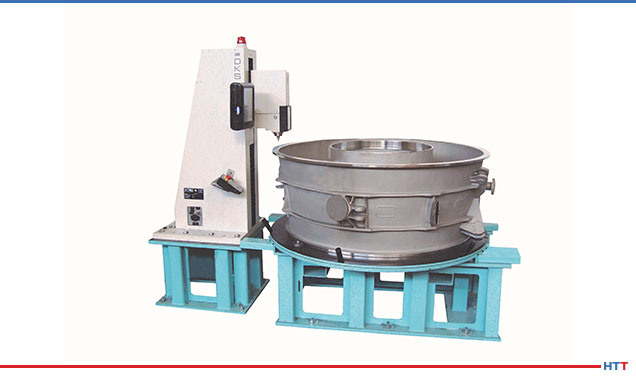
Situation: A major aerospace engine manufacturer wanted to ensure the appropriate hardness of a specific section of a heat-treated engine housing. They wanted to non-destructive test the actual housing and not test shims. They wanted to do the test in-house so as to not stall production by having to ship the part out for testing. Another reason they did not want to ship the parts out for testing was the size of the parts. Some of the parts had a diameter as large as 40 inches (102 cm), 20 inches (51 cm) high, and 900 lbs (400 kg). The aerospace company also wanted an automated, full-proof system that reduced the chance of human error.

Figure 1

Solution: The solution came in the form of a custom-built hardness testing machine and an innovative fixture to hold the engine housing. As can be seen in Figure 1, AFFRI USA, located in Illinois, designed a fixture to hold both a custom-designed hardness testing machine as well as a fixture to hold the engine housing.

The Hardness Testing Machine

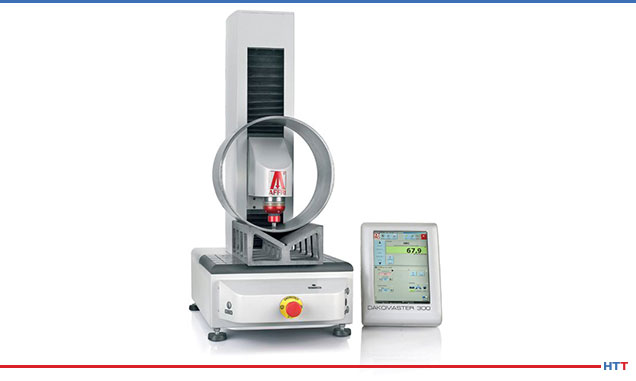
The specific hardness testing unit chosen for the job was DAKOMASTER 300. Typically, this unit is a tabletop unit as shown in Figure 2. For this specific aerospace application, the unit was modified so that it could be securely attached to the steel

Figure 2

construction holding fixture. Additionally, the custom-built unit was adapted so that the measuring head had a much greater vertical and horizontal range to accommodate varying height engine housings. The engine housings varied in size from as large as 110 inches (2.8m) in diameter and 39 inches (1m) high to the smallest being approximately 16 inches (400mm) in diameter and 9 inches (250mm) tall. The typical vertical working distance range on the tabletop unit is approximately 12 inches (300mm) while the custom unit has a vertical working distance range of 39 inches (100cm). The measuring and loading head of the unit was designed so that no misalignment would occur with the engine housing. If effective, the machine utilized what can be considered a self-clamping technology that structural deflection is absorbed ensuring an accurate and absolute reading in varying test conditions. Finally, to eliminate potential operator error, once in place, the test is initiated by a single button eliminating the need for operator engagement.

The Fixture Table

Since part and machine stability is critical for accurate hardness tests, providing a stable base for the large aerospace parts was a critical part of the solution. The company wished to execute multiple tests in multiple locations around the flange face of the engine housing. Some tests were to be conducted on the outer edge of the housing and some tests were to be conducted on the inner edge of the housing. To do this, the fixture holding the engine housing was designed so that the entire housing could move closer to or further away from the test machine. Additionally, the housing had to be rotated so that the machine could test completely around the perimeter of the housing flange face. To accomplish this, the part fixture was equipped with heavy-duty bearings so that the entire engine housing was able to be easily rotated. Once rotated to the desired location, the table would move closer to or further away from the test machine to pinpoint the exact spot for the test.

The Results

Simply stated, the results were excellent. Hundreds of tests have been run on a wide range of engine housing diameters, all with success – all well within the 1% tolerance. Being able to conduct in-house testing has helped smooth production. Having hardness testing equipment that is flexible enough to handily negotiate large or small engine housings saved the company money from needing to purchase several hardness testing machines and fixtures. Tests can be run quickly and simply by rotating the part fixture table and operator error has been virtually eliminated with the single push-button equipment. The hardness testing equipment provided for this aerospace company is capable of performing HRC, HRB, HRT, HRN measurements all in conformance with ASTM E-18. HTT

About the Author: AFFRI is an Italian-based international designer and manufacturer of state-of-the-art hardness testing systems for over 60 years. The company’s North American headquarters is located in Wood Dale, Illinois. This article originally appeared in Heat Treat Today’s March 2019 Aerospace print edition and is published here with the author’s permission.

In-Situ Hardness Testing of Large Aerospace Structures – A Case Study Read More »

Bombardier Offloads Aerostructures, Aftermarket Assets to Spirit AeroSystems

Spirit AeroSystems Holdings Inc. recently announced it has entered into a definitive agreement to acquire select assets of Bombardier aerostructures and aftermarket services businesses in Belfast, Northern Ireland (known as Short Brothers); Casablanca, Morocco; and DallasTexas.

Spirit AeroSystems president and CEO Tom Gentile

The opportunity to expand its operations into Northern Ireland and Morocco and the addition of the entire work package for the A220 wing and its technology is critical for the future of next-generation aircraft, says Spirit. In aerostructures and fabrication, Bombardier supplies composite and metallic wing components, nacelles, fuselages, and tail assemblies, along with high-value mechanical assemblies made out of aluminum, titanium, and steel.

“The Bombardier operations bring world-class engineering expertise to Spirit and add to a strong track record of innovation, especially in advanced composites,” said Spirit AeroSystems president and CEO Tom Gentile. “Belfast has developed an impressive position in business jet fuselage production, in addition to the world-acclaimed fully integrated A220 composite wing. This acquisition is in line with our growth strategy of increasing Airbus content, developing low-cost country footprint, and growing our aftermarket business.”


Bombardier Offloads Aerostructures, Aftermarket Assets to Spirit AeroSystems Read More »

Who’s Winning the Steel v. Aluminum Battle? Both, in the Form of Mixed Materials, per Auto Industry Watchers


Source: SME Media


It wasn’t long ago that auto industry watchers were casting votes for either steel or aluminum in what was to be a big competition in what metals would be used in automotive lightweighting.

Would it be the heavy-weight champion steel which was ramping up its development of high-strength, lower-weight steels? Or would the new contender on the block, aluminum, gather more adherents to lightweighting in the wake of Ford Motor Company choosing aluminum for its F-150 and Super Duty pickup bodies?

An excerpt:

“A consensus has emerged. The future for the industry is a mix of materials, a mix that will vary from vehicle to vehicle. It’s also likely to be a more complex future, with composite materials making inroads in the long run.”

Jay Baron, retired president of the Center for Automotive Research (CAR), Ann Arbor, Michigan

“You have to take into account all sorts of factors,” said Jay Baron, retired president of the Center for Automotive Research (CAR), Ann Arbor, Michigan. Vibration and stiffness figure into the equation, he said. And there’s cost. “It’s much more than weight and strength.”

Designing and building vehicles with a patchwork quilt approach to materials is how some brands are tackling the lightweighting challenge. Most are also exploring advanced technological processes such as a combination of 3D printing and artificial intelligence, friction welding technology, and rethinking other automotive systems, e.g., braking.

Read more: “Lightweighting’s New Phase


Main image credit / caption: Manufacturing Technology Inc. (MTI) / The MTI-built LF35-75 at Lightweight Innovations for Tomorrow is ideal for unique part geometries, near-net shapes and full-size part development for all industries, according to MTI. 


Who’s Winning the Steel v. Aluminum Battle? Both, in the Form of Mixed Materials, per Auto Industry Watchers Read More »