Karen Gantzer

AMS2750F: Expert Analysis

AMS2750F, a rewrite of the specification that covers pyrometric requirements for equipment used for the thermal processing of metallic materials, was released at the end of June. For this Technical Tuesday feature, Heat Treat Today asked a few experts in the aerospace industry to share their insights of this much anticipated revision that helps to better clarify issues with the previous revision. Specifically, Heat Treat Today wanted to know what they perceived to be the top 2-3 most important changes in revision F; what companies should do to prepare for these changes; and additional thoughts about the revision as it relates to aerospace heat treating.

Industry experts who contributed to this Original Content piece are Andrew Bassett, president, Aerospace Testing & Pyrometry, Inc., Jason Schulze, director of Technical Services; Special Process – Metallurgy, Conrad Kacsik Instrument Systems, Inc., Peter Sherwin, Global Business Development manager for Heat Treat, Eurotherm by Schneider Electric, Jim Oakes, president, Super Systems, Inc., and Doug Shuler, lead auditor, owner, Pyro Consulting LLC.


Andrew Bassett was on the subteam for AMS2750F as well as the previous revision AMS2750E and has been a member of AMEC and SAE Committee B since 2006. He shares some “inside baseball” background about this four year process, “The AMS2750F subteam utilized the Nadcap Pyrometry Reference Guide, the Nadcap Heat Treat Audit Advisories that pertained to Pyrometry, and the collective experience from the sub-team which dealt with the previous revision issues and problems. The AMS2750F sub-team had a broad range of backgrounds, with representatives from Boeing, Safran, Arconic, GeoCorp Inc, Nadcap-PRI, and Aerospace Testing & Pyrometry.”

What do you believe to be important changes in revision F?

Jason Schulze, Director of Technical Services; Special Process – Metallurgy, Conrad Kacsik Instrument Systems, Inc.

Jason Schulze comments on offsets saying, “Offsets have often been a confusing subject throughout the years. How they are applied, removed and documented has caused confusion and has been a source of Nadcap findings. With the changes to the offsets section of AMS2750 in the new revision, these issues will be greatly reduced. Offsets have now been split into two categories; correction offsets and modification offsets. It will be important for suppliers to understand and implement the new requirements as well as use the same verbiage as this will hopefully alleviate further confusion.”

Andrew Bassett, President, Aerospace Testing and Pyrometry

Andrew agrees this is an important change regarding the offsets and further clarifies, “A “Modification Offset” is when an instrument is purposely, either through electronic means or manual means, shifts the accuracy away from the nominal temperature. This is typically done to “center a temperature uniformity” that may be skewed in one direction or another. The modification offset, when used properly, will shift the temperature uniformity more towards the set point of the thermal processing equipment. A “Correction Offset” is used to bring the instrument back to the nominal temperature. As always, a well defined procedure will be required on how the “Correction Offset” and “Modification Offset” will be introduced into your system.”

One of the biggest changes that caused a lot of controversy was the restricted re-use of expendable test thermocouples,” Andrew notes. “The AMS2750F subteam provided studies and data that showed that there was considerable drift of certain types of base metals thermocouples, especially when it came to Type “K” thermocouples. The previous revision of AMS-2750 already had restrictions on these types, but after providing data of the drift of these thermocouples, the team felt further restrictions were required for Expendable Base Metal SAT & TUS Sensors. Section 3.1.7.3 describes the limitations of these type thermocouples. Types “M”, “T”, “K” & “E” shall be limited to 3 months or five uses, whichever occurs first between 500F and 1200F (260C and 650C) and is limited to single use above 1200F (650C). Types “J” and “N” shall be limited to 3 months or ten uses, whichever occurs first between 500F and 1200F (260C and 650C) and is limited to single use above 1200F (650C).”

Peter Sherwin, Global Business Development Manager for Heat Treat, Eurotherm by Schneider Electric

Peter Sherwin comments on instrumentation, “From an instrument perspective our no.1 focus is the instrument accuracy specification. This has not changed for Field Test or Control and Recording Instruments (now in Table 7), however the impact of the decimal place for digital recorders could cause some issues for less precise instrumentation. In 3.2.3.1 All control, recording and overtemp instruments shall be digital 2 years after release of AMS2750F – this was not a surprise, and today’s overall cost (paper, pens, storage etc.) of paper chart recorders cannot match their digital counterparts. Digital time synchronization (3.2.3.19) is also sensible to ensure you have an accurate time record across a number of Furnaces/Ovens and charts – we are used to this for other regulations (e.g. FDA 21 CFR Part 11) and offer a SNTP/Time Synchronization feature in our Recorders.”

Jim Oakes, President, Super Systems, Inc.

Jim Oakes shared his pleasure with section 3.2.3.12, “I was happy to see the document address integrated recording/controlling data.  It states in section 3.2.3.12 when the control and recording system is integrated such that the digitally displayed control value and digitally recorded value are generated from the same measurement circuit and cannot be different, it is only necessary to document a single displayed/recorded value for the control reading.  This is happening through direct communications, so what you see on the controller is what you are recording electronically.  This saves a step and eliminates the need for additional documentation.”

Doug Shuler, Lead Auditor, Owner, Pyro Consulting LLC

Doug Shuler cites the auditor advising piece, “The top of the list has to be the overall progress we made by incorporating auditor advisories and pyrometry reference guide FQS into the body of the specification so users don’t have to ask themselves “What did I miss.”

How should companies prepare for these changes?

Jason Schulze’s advice to companies focuses on training, “Companies should receive concise training regarding the revisions within AMS2750F, including administrative and technical. As with any training, continuous courses may be necessary to ensure comprehension. I recommend performing a characteristic accountability for each and every requirement stated within AMS2750F.”

Peter Sherwin encourages companies to ready instrumentation for the standards, “Recent feedback from the MTI indicated that 3rd party audits to the new standard would probably start next year. However, if you are in the market for a new instrument then it only makes sense to ensure this meets the requirements of the updated standard.”

Doug Shuler sees the benefit of analysis, “Users should prepare by performing an internal or perhaps an external gap analysis to establish where their pyrometry system is today, and what has to be changed going forward.  Users don’t have to wait until AMS2750F and AC7102/8 Rev A are released and in effect before making changes.  The key is that if a user has an audit before the revised Nadcap Checklist AC7102/8 Rev A becomes the law of the land, they will have to declare compliance to AMS2750E or AMS2750F in full and will be held to that revision’s requirements.  Once AC7102/8 Rev A takes effect (best guess after January 1, 2021)  all audits will be done to AMS2750F.”

Andrew Bassett recommends, “First and foremost, get a copy of AMS2750F and start the review process. Since the document was a complete re-write, there is no change summary or change bars to point the supplier in the direction of what has changed. Spend time creating a matrix of the previous requirements (AMS2750E) and comparing to the new requirements (AMS2750F). I would suggest breaking this matrix down into four main sections: Thermocouples, Calibrations, System Accuracy Testing, and Temperature Uniformity Surveys. This will allow suppliers to work on each section without getting overwhelmed by the entirety of the specification. Currently at the time of writing this, there is no formal implementation requirement for AMS2750F. Typically this will either be dictated by the suppliers’ customers, or in the case of Nadcap, they will issue a “Supplier Advisory” as to when their expectation for implementation will be.”

Final Thoughts

Planning for the future will serve companies well for the long term encourages Doug Shuler,  “With a number of significant changes, nearing a complete rewrite, now is a good time to take a look at your internal procedures that may have become fragmented over the years and streamline them to the new revision.  Auditing for Nadcap for over 10 years has shown me one thing for sure.  Those companies that have a thermocouple procedure, a calibration procedure, a SAT procedure, an alternate SAT procedure, a TUS procedure, and maybe even multiple TUS procedures for different kinds of furnaces (Air, Vacuum, Atmosphere, etc.)  usually have a more difficult time with audits because the SAT procedure also addresses thermocouples, but doesn’t address correction factors because that’s in the instrument calibration procedure… See where this is going?  Consider writing one pyrometry procedure with sections in it just like the specification.  Then, the SAT section can refer to the thermocouple section for test thermocouples and to the instrument section for test instruments, etc.  It’s like re-writing AMS2750, but customized for your facility, your equipment, and your practices.  In the end, remember that the pyrometry portion of your Nadcap audit follows my P.I.E. acronym.  Procedures that Include all requirements and Evidence to show compliance.”

Paying close attention to the right data solution will alleviate potential headaches when dealing with both the new AMS2750F revision and the CQI9 (V.4 update) says Peter Sherwin, “Many commercial heat treaters will also have to cope with the update to CQI9 Version 4 at the same time! According to the MTI, your ‘end’ customers may request you perform your self-audit to the new standard from this point forward. There is a bit more time allocated to move to digital (3 years), but my advice would be to take advantage of digital solutions sooner rather than later. The right data solution should save you money over time compared to the paper alternative.”

Finally, amidst all the new changes AMS 2750F has offered, Jim Oakes assures, “…the pyrometric requirements that most of us are used to will still be very familiar as this document becomes the new standard.”

 

(Photo source: pixabay.com)


AMS2750F: Expert Analysis Read More »

Vacuum Measurement Units: A Language Explained

Source: Vacaero.com


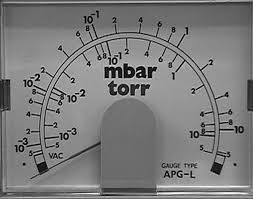
"Vacuum gauges all measure the pressure readings in the range from atmospheric pressure down to some lower pressure approaching absolute zero pressure, which is not attainable. Some gauges read the complete range and others can only read a portion of the range, usually used for very low pressures."

A typical vacuum furnace can have at least three electronic vacuum gauge heads to monitor the level of vacuum at various positions. These gauges send signals back to the control systems, and "the vacuum readings are used to ensure that the vacuum pumps are working correctly and that the process chamber is at the correct low pressure (vacuum) for the specific process."

In this Heat Treat Today Best of the Web feature, VAC AERO International shares how different vacuum measurement units are being used around the world today.

Read more: Understanding Vacuum Measurement Units

(Photo source: vacaero.com)

Vacuum Measurement Units: A Language Explained Read More »

China Exclusion Request Granted

Recently, the United States imposed a 25% tariff on thousands of products from China, but permitted U.S. companies to request an exclusion from paying tariffs. In this article, Omar Nashashibi, founding partner of  The Franklin Partnership, LLC, and a resource of Industrial Heating Equipment Association (IHEA), explains the latest news regarding the exclusion and its relevance to structural components for industrial furnaces.


Omar Nashashibi,
Founding Partner,
The Franklin Partnership, LLC

The United States Trade Representative (USTR) has extended an exclusion for importers from paying a 25% tariff on industrial furnace components from China. The exclusion to the China Section 301 tariffs for structural components for industrial furnaces was extended in the Federal Register notice published on July 9, 2020 (85 FR 41267). The exclusion to the 25% tariffs, originally granted in July 2019 and set to expire on June 9, 2020, is now extended through December 31, 2020. The extension of the exclusion to industrial furnace components is one of twelve announced by USTR. Nearly 100 other products, including furnace casings, will see their tariff exclusions expire.

In July 2018, the United States imposed 25% tariffs on $34 billion worth of products imported from China (List 1). Of importance to the industrial heating industry, included in List 1 were parts of industrial electric furnaces and ovens as well as industrial induction or dielectric heating equipment (HTS 8514.90.80).

With this extension, all products meeting the description of “structural components for industrial furnaces” and are classified under the HTS code 8514.90.8000, will continue to be excluded from the 25% tariff. To claim the extended exclusion, importers must report the regular HTS code for the product, as well as the exclusion HTS code: 9903.88.52.

(Photo source: Twitter)

China Exclusion Request Granted Read More »

Demonstrating Oil Quenching Effectiveness

In this article by Lee Gearhart, Principal Engineer, Materials and Processes, Moog, Inc., and Chair, Aerospace Metals Engineering Committee, read about a “real time” heat treat inquiry regarding the interpretation of changed oil quenching effectiveness testing in AMS 2759, and Lee’s desire to ensure that the heat treater’s system maintains its effectiveness.

This article article first appeared in the latest edition (June 2020) of Heat Treat Today’s Automotive Heat Treat magazine.

* Please see the bottom of the article to view the AMS2759 sections to which Lee refers.


The Query:

Lee Gearhart, Principal Engineer, Materials and Processes, Moog, Inc., Chair, Aerospace Metals Engineering Committee

A gentleman, to whom I’ll refer as Mr. XXXX, sent the following query to SAE, the publisher of Aerospace Materials Specifications. The subject line was as follows: “Clarification of AMS 2759G for Committee ‘E’.”

The letter read:

I would like to get some clarification about AMS 2759, Revision G, paragraphs 3.10.3 through 3.10.3.1.5.5. My issue, as an independent testing lab, is the terminology used in 3.10.3.1.5.1 and 3.10.3.1.5.3., and how

I am to determine the acceptance criteria for the hardness in the center diameter of the quench effectiveness samples supplied to us by heat treating companies. Let me walk through the steps that lead up to the determination of minimum hardness at the center of the diameter of the coupon prepared.

Paragraph 3.10.3.1.2 states specific size test bars to use for the quench effectiveness testing, based on the alloy, in sub-paragraphs a., b., c., and d. For 4130 (a.), use 1.5” long, 0.50” diameter bar and for 4330V (c.), use 7.5” long, 2.5” diameter bar. Then, we cut the test coupon from this specimen todetermine hardness at the center diameter, per 10.3.1.4.

Next, we have to determine whether this hardness result, taken at the center diameter, conforms to the spec, and here is where my issue is. Paragraphs 10.3.1.5.1 and 10.3.1.5.3 both state, “…shall not be less than the hardness on the end-quench hardenability curve corresponding to the diameter of the specimen…” So, if I am to use the diameter of the specimen as my guide from paragraph 3.10.3.1.2, a.and c., then the end-quench result on the mill cert corresponding to 8/16 would represent the 0.50”diameter, and 40/16 would represent the 2.5” diameter. ASTM A255 has you stop taking readings on the Jominy bar at 32/16 (2.0”), so there would not be a result on the Mill Cert for the 40/16 requirement.

I don’t believe this is the correct depth. I believe the end-quench result corresponding to one-half the diameter would be the appropriate depth to use as a minimum requirement, since we are taking the hardness reading at one-half the diameter; in the center of the diameter. So, the end-quench result on the mill cert corresponding to 4/16 would represent the 0.50” diameter and 20/16 would represent the 2.5” diameter bar. These requirements are more stringent and would better represent the effectiveness of the quench media to properly quench the specimens and correlate this back to the certified values of the material based on the mill cert reading for the corresponding J values.

Please review this and consult with the Committee to see if this would better represent the intent of these paragraphs for acceptance of quench effectiveness.

The Response:

Because of my position as chairperson of the Aerospace Metals Engineering Committee, the question eventually made its way to my desk. Here is my response:

When reading your question, it suddenly struck me – you’re missing the secret decoder ring! In other words, you cannot directly compare an oil quenched sample to a water quenched (Jominy) test coupon.

Allow me to give you a long-winded explanation that I wrote for Committee E on Steel for the Aerospace Materials Division, the committee that has jurisdiction of AMS2759 on Heat Treating of Steel. The committee had been asked for an explanation of what the 3.10.3 Quench System Monitoring is supposed to do; after the text in italics, I’ll directly answer you.

Let me start by noting the whole purpose of 3.10.3.1, which was to provide a means for a heat treater to demonstrate that their oil quenching system continues to work well. If they do the steps outlined in 3.10.3.1, they do not need to seek approval from their customers for this method. If they choose a different method for monitoring the quench system, they need approval by the cognizant engineering organization (CEO). Since a heat treat firm will probably have many customers with different CEO’s, it makes sense to have one test procedure on which all can agree.

The method starts with the heat treat quality function choosing one of the suggested alloys and bar size configurations noted in 3.10.3.1.2. The constraints of the choice are that the hardenability of the sample has to be enough that they will get full hardening in the center, but not so much that a bar 1.25 times the diameter chosen would get full hardening. (That prevents me from using an air hardening steel, which will not show any difference when my quench system degrades.) If the three choices in 3.10.3.1.2 (a-c) will not work, then (d) offers an out, using other materials and dimensions, established in pre-production testing.

Prior to initial production, and quarterly afterward, the heat treater runs one of the test bars in a typical or simulated production load. They then section out a half-inch slice from the middle of the length of the bar and test the hardness. If in the quarterly testing it remains above the acceptance criterion established by the pre-production testing, their quench system passes.

Figure 1. Cert 4130

Accept/reject criteria is that the hardness in the center meets the hardness of the end-quench hardenability curve done by the original mill, or someone else, per ASTM A255, on the material used for the test. AMEC wanted this because using the generic curves in ASTM A304 is too general, and the curves are routinely done by the steel mills. I’ve attached an example cert (Figure 1) for some 4130 we bought not long ago, and at the bottom of the page are the Jominy numbers! They range from 51 to 24; so, which should I use?

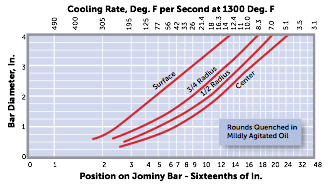
To find the correct accept/reject hardness, I go to a curve that shows what Jominy distance in sixteenths of an inch reflects the cooling at the center of the size of test bar I use. If I’m using 4130 steel from my certified lot of material, the specimen is half inch in diameter, and the attached Timken curves say that the center of a half inch bar cooled with an H of 5 (good agitation) corresponds to a Jominy distance of 3/16, so the hardness required is 49 HRC. If I use a different curve, like the other one attached from an old Copperweld brochure (Figure 2), I get a Jominy distance of 31⁄2, so my acceptance number is somewhere between 49 and 46, so I’ll use 48 HRC. This difference is small, and unimportant, since I’m only using it to show if there is degradation in the oil quench performance.

Figure 2. Jominy Cooling Rates (Copperweld Steel Brochure)

This “compare it with the Jominy curve done by the mill” is only for the 4130 and 4330V specimens noted in 3.10.3.1.5.1 and 3.10.3.1.5.3. For specimens made of 4140, we call out HRC 44 in the center and HRC 50 in the 3⁄4 radius position of the 11⁄2 inch diameter specimen.

So, the 8/16 position on the Jominy curve doesn’t mean it’s appropriate for a half inch diameter specimen – it’s just pointing to the spot on the Jominy bar that’s 8/16 inch from the end that gets sprayed with water. The “secret decoder ring” I mentioned are the “Jominy cooling rates” or the “Pages from Timkin” attachment (Figures 3). These translate the speed of quenching at any sixteenth- inch position of a Jominy bar to the equivalent rate of quenching of surface, mid-radius, and center of bars of different size quenched in various coolants. I tend to use the “Jominy cooling rates” attachment, which I got from an old Copperweld Steel brochure, but since the Timkin Practical Data Handbook for Metallurgists is on the web for free, it’s probably a more universal reference.

Hence for 0.50” diameter 4130 bar, the center hardness should be that corresponding to between 3 and 4 sixteenths of an inch. For the 2.5” diameter bar, quenched in mildly agitated oil, the cooling rate at the center would be represented by the 14/16” position on the Jominy bar. Maybe 15/16” – it’s kind of hard to read. Hence you read the data from the mill cert FOR THE STEEL FROM WHICH THE PIECES WERE MADE and use those numbers as accept/reject. HTT

About the author: Lee Gearhart, P.E., has worked for Moog, Inc. since 1982 and is currently Principal Engineer, Materials and Process Engineering.  In addition to being a worldwide resource for the company, Lee is the current chair of the Aerospace Metals Engineering Committee, where much of the discussion on heat treating specifications occurs. 

 For more information, contact Lee at lgearhart@moog.com or 716-687-4475 


*Section 3.10.3 from AMS2759 Heat Treatment of Steel Parts (This section is one of the big changes to AMS2759 revision F, April 2018, which was then tweaked to revision G in August 2019) 

 The sections to which the article discusses is 3.10.3.1, 3.10.3.1.2 (a-d)3.10.3.1.5.1 and 3.10.3.1.5.3 

 3.10.3 Quench System Monitoring 

The quench system includes the quench volume, type of fluid, recirculation velocity and uniformity, and heat exchange capacity. The consistency of the quench system shall be monitored quarterly, by processing test parts, as outlined below, which are capable of detecting changes in the cooling characteristics of the system. Testing of water quench systems is not required. Quench system monitoring test procedures other than those described in 3.10.3.1 shall be approved by the cognizant engineering authority. When destructive mechanical property testing is required for part acceptance, quench system monitoring is not required.  

3.10.3.1 Test Specimen Requirements  

3.10.3.1.1 Test Specimen Alloy/Configuration  

3.10.3.1.1.1 Round specimens of carbon or low alloy steel, of appropriate hardenability and dimensions shall be used. Selection of the specimen dimensions/hardenability combination shall be aimed at achieving full hardening (e.g., 95% martensite) at the center of the specimen. The specific combination of alloy/dimensions chosen shall be such that the specimen would not be capable of achieving full hardening at 1.25 times the diameter chosen for the test specimen. The length of the test specimen shall be at least three times the diameter.  

3.10.3.1.1.2 The test specimens used for the initial and subsequent evaluation of a particular quenchant shall be from the same alloy and preferably the same chemistry heat of material to eliminate material chemistry and hardenability differences from the alloy selection. Hardenability results shall not be lower than that represented by requirements in 3.10.3.1.5.  

3.10.3.1.2 Test specimen alloy/dimensions shall be one of the following:  

  1. 4130 round bar, minimum 1.50 inches (3.81 cm) long, 0.50 inch (1.27 cm) nominal diameter
  2. 4140 round bar, minimum 4.50 inches (11.43 cm) long, 1.50 inches (381 cm) nominal diameter. 
  3. 4330V round bar, minimum 7.50 inches (19.05 cm) long, 2.5 inches (6.35 cm) nominal diameter. 
  4. Other material and dimensional requirements established in pre-production testing or as specified by the cognizant engineering organization. See 8.5 for shape equivalent guidelines. 

3.10.3.1.3 Test Specimen Processing  

Quarterly quench system monitoring tests shall be run with a typical or simulated production load. Heat treat loads shall be processed in accordance with the appropriate AMS2759 slash specification requirements.  

3.10.3.1.4 Specimen Testing Requirements  

After quenching the test specimen, a 0.5-inch-thick specimen shall be cut from the center of the test specimen length and prepared for hardness testing in the untempered condition. Specimen shall be prepared to ensure it is free from overheating. The minimum hardness at the center of the diameter shall meet the hardness requirements of the approved procedure in 3.10.3.  

3.10.3.1.5 Test Specimen Hardenability  

3.10.3.1.5.1 Round Bar Specimen 4130  

After quenching, the center of the diameter shall not be less than the hardness on the end-quench hardenability curve corresponding to the diameter of the specimen when tested in accordance with ASTM E18. The end-quench hardenability curve shall be the actual hardenability curve determined in accordance with ASTM A255 on the material used for the test specimen.  

3.10.3.1.5.2 Round Bar Specimen 4140  

The hardness in the center of the diameter shall not be less than HRC 44 and the 3/4 radius shall not be less than HRC 50 when tested in accordance with ASTM E18.  

3.10.3.1.5.3 Round Bar Specimen 4330V  

The hardness in the center of the diameter shall not be less than the hardness on the end-quench hardenability curve corresponding to the diameter of the specimen when tested in accordance with ASTM E18. The end-quench hardenability curve shall be the actual hardenability curve determined in accordance with ASTM A255 on the material used for the test specimen.  

3.10.3.1.5.4 If other combinations are established, the accept/reject criteria shall be as specified in the ordering information.  

3.10.3.1.5.5 It is the responsibility of the heat treater to provide the material and hardenability data specified above.  

3.10.3.2 Any failures shall be documented by the heat treater’s corrective action system.  

3.10.3.2.1 As a minimum, if the test specified in 3.10.3 fails, the quench medium shall be analyzed as specified in 3.10.3.3.  

3.10.3.3 Quench Media Control  

3.10.3.3.1 Each new shipment of quenchant from a vendor shall meet the requirements for the particular quenchant listed in 3.10.3.3.1.1 through 3.10.3.3.1.3 as applicable. The vendor shall furnish a certificate of conformance stating that the quenchant meets the requirements including, in addition to the vendor designation, the cooling curve, the cooling rate curve, the maximum cooling rate, and:  

3.10.3.3.1.1 For mineral oil based quenchants, the certificate shall also include the viscosity, flash point, temperature at the maximum cooling rate.  

3.10.3.3.1.2 For vegetable or ester-based oil quenchants, the certificate shall also include the viscosity, flash point, temperature at the maximum cooling rate.  

3.10.3.3.1.3 For polymer quenchants, the certificate shall also include the undiluted pH and viscosity. The pH, viscosity, maximum cooling rate and the temperature at the maximum cooling rate shall be provided at 20% concentration by weight.  

3.10.3.3.2 Cooling curve tests shall be performed semi-annually, or when required by corrective action (3.10.3.2), in accordance with ASTM D6200, ISO 9950 or JIS K 2242, ASTM D6482, or ASTM D6549, as applicable to the specific quench medium. If no alternative limits have been established by pre-production tests or specified by the cognizant engineering authority, exceeding the following limits compared to the initial shipment of quenchant shall be cause for corrective action:  

  • For mineral oils: Temperature of the Maximum Cooling Rate: (±68 °F) (37.8 °C) Maximum Cooling Rate: (±25 °F/s) (13.9 °C/s) 
  • For vegetable or ester-based oils: Maximum Cooling Rate: (±25 °F/s) (13.9 °C/s) Temperature of the Maximum Cooling Rate: (±68 °F) (37.8 °C) 
  • For polymer quenchants: Maximum Cooling Rate: ±15% Temperature of the Maximum Cooling Rate: ±15% 

(Photo source: global.ihs.com)


Demonstrating Oil Quenching Effectiveness Read More »

IHEA Monthly Economic Report: Don’t Be Faint of Heart; Rebound Coming

The  latest Industrial Heating Equipment Association’s (IHEA) Executive Economic Summary begins, “The lockdown recession has been with us for over three months now, and there are few that have not experienced the impact.” How true are those words. But, be encouraged, “By most accounts this will be the bottom, and future reports will start to show slow improvement . . . there have been consistent assertions that economic growth will rebound by the third and fourth quarter.” Some may doubt the optimism, however, “there are some indications that such a forecast may be realistic.”

The indices share a consistent theme in that all show a decline “that are nearly a straight line down.” Yet, there is one notable exception: the data for the Credit Managers’ Index reveals the same severe decline, but with an upward trend at the end. The summary explains, “The index is divided into favorable and unfavorable categories from the perspective of a credit manager. The favorables include categories such as ‘sales,’ ‘applications for credit,’ ‘dollar collections’ and ‘amount of credit extended’. The unfavorables include ‘rejections of credit applications,’ ‘accounts out for collection,’ ‘disputes,’ ‘slow pays’ and ‘bankruptcies’.”

The decline that was evident in March and April was due “almost entirely to the collapse in the favorable data.” But in May, they improved substantially. Interestingly and optimistically, “Credit managers tend to think in the future as they are most concerned with what shape a debtor will be in when they are due to pay. If a company has 90 or 120 or 180 days to pay the credit manager is not going to worry about them until that time. The fact that they are getting a bit more confident now indicates that they are starting to see some positive developments down the road and not all that far away.”

The upward trend in the Credit Movement shows positive progression down the road in the not too distant future.

The other indices share a woeful tale with record setting declines. The report explains, “There is no mystery at all as to why this is the case as the lockdown was universal and sudden. There was no time at all for business or the consumer to prepare, and there have been very few options available since the declaration.” However, the U.S. Labor Department released the latest job numbers and there were expectations that the unemployment number would hit 20%, but in reality the number was 13.4%.

So, where does the economy go from here? The summary cites three factors that will come into play: First, the attitude of the consumer — “If there is to be a real rebound the consumer will have to want to resume their old behaviors and soon.” Second, the action of the government — “[This] has varied from state to state. Some have been eager to reopen and others have put off this resumption until into 2021.” Third, the course of the viral infection — this will drive the first two factors.

Buckle up, folks, the wild adventure continues!

The report is available to IHEA member companies. For membership information, and a full copy of  the 12-page report, contact Anne Goyer, Executive Director of the Industrial Heating Equipment Association (IHEA). Email Anne by clicking here.

Anne Goyer, Executive Director of IHEA


IHEA Monthly Economic Report: Don’t Be Faint of Heart; Rebound Coming Read More »

Process Innovation to Reduce Distortion During Gas Quenching

“High-pressure gas quenching (HPGQ) attempts to reduce temperature nonuniformities by reducing the cooling rate; however, this is generally not sufficient to eliminate shape change. Shape change can be predicted by heat treatment simulation software, but it is difficult to reproduce the exact same cooling conditions in the vessel for each batch. Therefore, the distortion of the components will not be consistent from batch to batch.”

Read the case study to see one response to this issue in this original content from Heat Treat Today by Justin Sims, lead engineer at DANTE Solutions.

This article first appeared in the latest edition (March 2020) of Heat Treat Today’s Aerospace Heat Treating magazine.


Distortion is generally described by a size change and a shape change. In heat treatment of steels, size change is unavoidable and is mainly due to the volumetric difference between the starting microstructural phase and the final microstructural phase. Shape change of steel parts from heat treatment is due to nonuniform thermal and nonuniform microstructural strains as a result of nonuniform cooling or heating, alloy segregation, poor support of the component while at high temperature, thermal expansion or contraction restrictions, or residual stresses from prior forming operations. Nonuniform cooling or heating can be as fundamental as the temperature gradient from the part surface to its core, or as complex as the flow of fluid around a component feature. Both can result in nonuniform strains, resulting in a shape change. If the stresses causing these strains exceed the yield strength of the material, then permanent shape change will occur. Size change can be anticipated and is predictable, while shape change, or distortion, is usually unanticipated and more difficult to predict.[1-2] 

Justin Sims,
Lead Engineer,
DANTE Solutions

Most thermal processes try to control these nonuniformities using methods of low complexity such as part orientation and rack design. Quenching systems, for example, are generally designed to remove as much thermal energy from the work pieces as possible and to do this as quickly as possible. High-pressure gas quenching (HPGQ) attempts to reduce temperature nonuniformities by reducing the cooling rate; however, this is generally not sufficient to eliminate shape change. Shape change can be predicted by heat treatment simulation software, but it is difficult to reproduce the exact same cooling conditions in the vessel for each batch. Therefore, the distortion of the components will not be consistent from batch to batch.

In response to this issue, a prototype gas quenching unit capable of controlling the temperature of the quench gas entering the quench chamber was devised. With the DANTE Controlled Gas Quench (DCGQ) unit, it is possible to have control of the thermal and transformation gradients in the component by controlling the temperature of the incoming quench gas, thereby significantly reducing, or eliminating entirely, the shape change caused by quenching. In doing so, the size change can easily be predicted by heat treatment simulation software, and post-hardening finishing operations can be reduced or eliminated. This process is ideal for thin parts or components with significant cross-sectional changes. Atmosphere Engineering (now part of United Process Controls) in Milwaukee, Wisconsin constructed the unit and provided the logic to control it. All experiments with the unit were conducted at Akron Steel Treating Company in Akron, Ohio. The project was funded by the U.S. Army Defense Directorate (ADD).

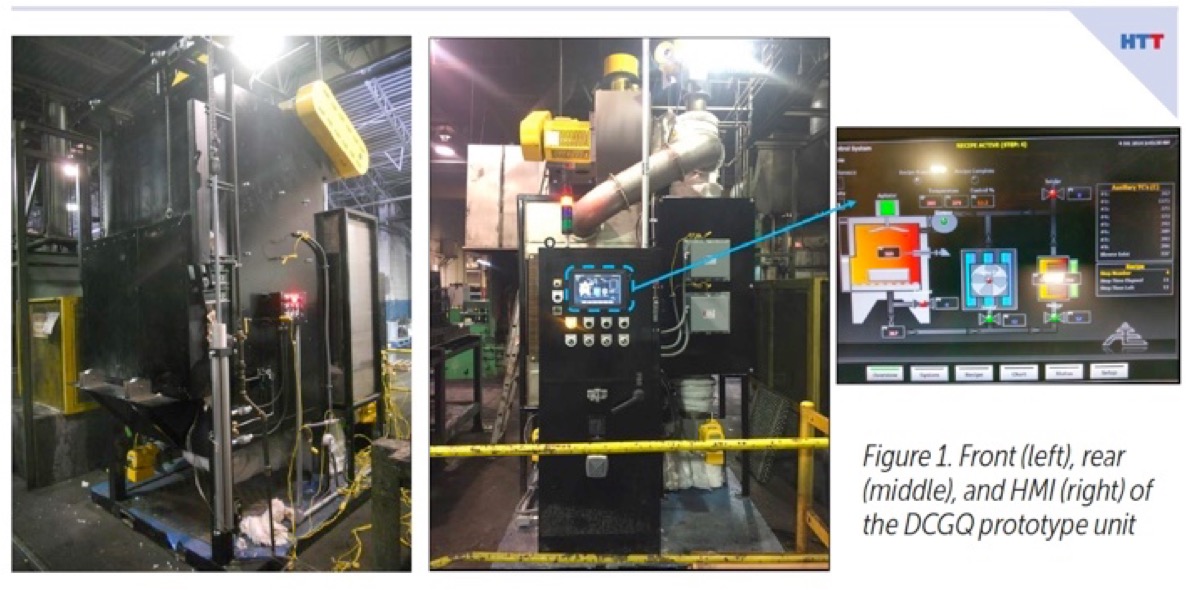
Figure 1 (left) shows the front of the unit, while Figure 1 (middle) shows the back of the unit. The back of the unit contains the human machine interface (HMI), shown in Figure 1 (right), where process parameters can be modified and DCGQ recipes entered. The prototype unit has a working zone of nine cubic ft. and is capable of quenching loads up to 100 lbs. at one atmosphere of pressure.

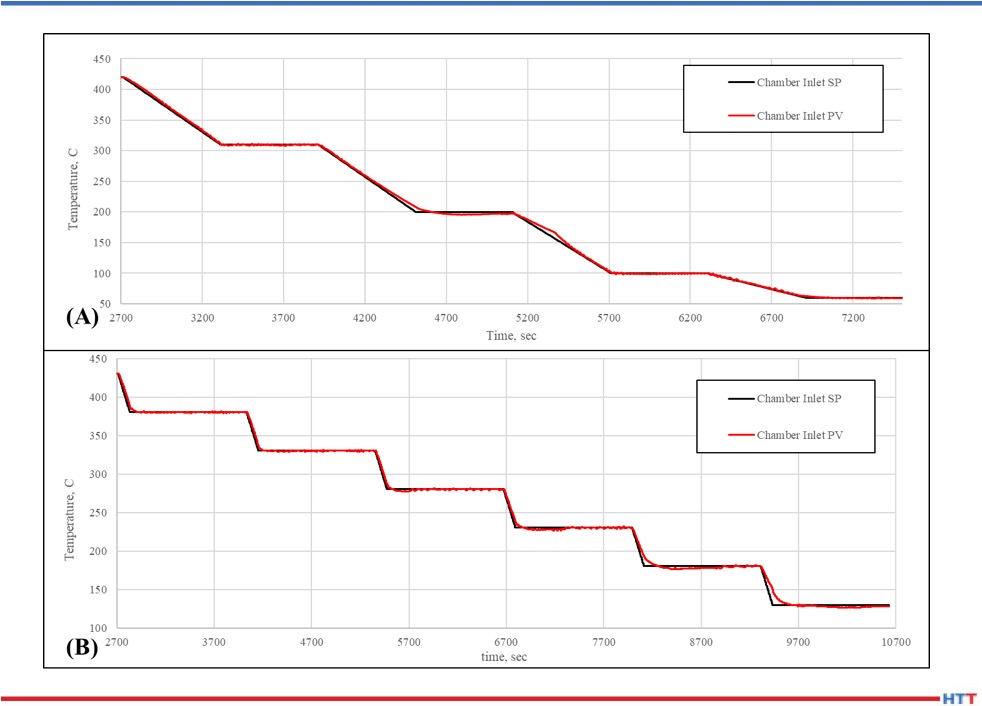
Figure 2. Comparison of quench gas temperature entering the
quench chamber versus the recipe setpoint temperature for
two different DCGQ process recipes

The ability of the unit to maintain continuity between the recipe setpoint temperature and the actual temperature entering the quench chamber is absolutely paramount. Figure 2 shows two schedules, one aggressive and one conservative, comparing the recipe setpoint (Chamber Inlet SP) to the actual quench gas temperature (Chamber Inlet PV). Figure 2 also shows that the prototype unit has good control of the quench gas temperature between 752°F (400°C) and room temperature, the martensite transformation range for most high hardenable steel alloys. There is some deviation between the two temperatures below 392°F (200°C) for the aggressive schedule as the setpoint reaches its set temperature, due to the relatively small temperature difference between the quench gas and the shop air. This small temperature difference makes it slightly difficult for the air-to-air heat exchanger used in the design to keep up with the rapid drop in temperature, but overall there is very good control of the quench gas temperature.

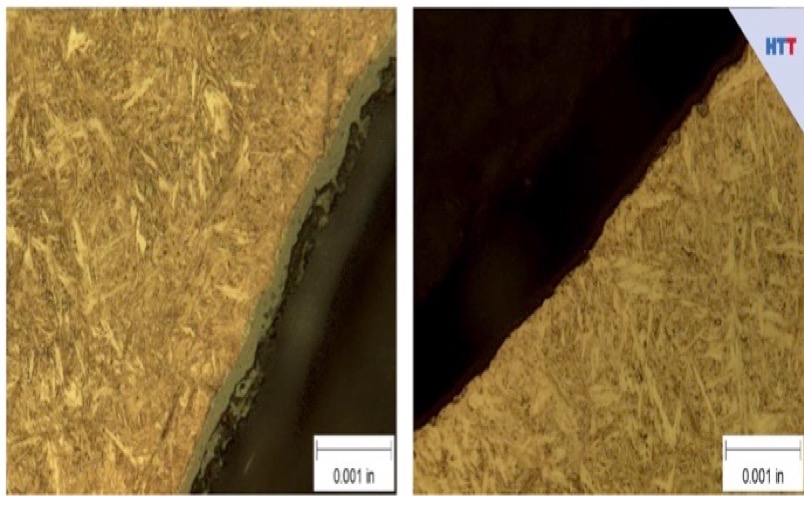
Figure 3. Micrograph of DCGQ (left) and HPGQ (right) processed coupons, mag. 1000X
There is a copper layer on the surface of the DCGQ processed coupon.

Microstructural examination was conducted on Ferrium C64 coupons processed using the DCGQ process and coupons processedusing a 2-bar HPGQ. C64 was chosen for this study due to its extremely high hardenability and its high tempering temperature. Figure 3 compares the microstructures of the two processes at a magnification of 1000X, and no significant difference is detected. The DCGQ coupons required two hours to complete the transformation, whereas the HPGQ coupons transformed in a few minutes. There is no indication that the slow rate of transformation damaged the microstructure or mechanical properties in any way. Tensile and Charpy properties were equivalent between the two processes.

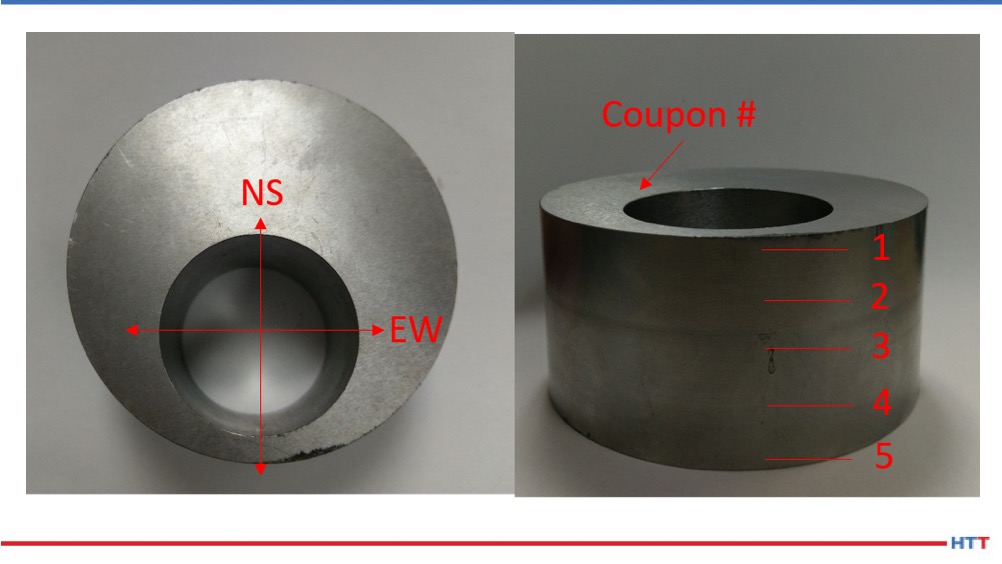
Distortion coupons, thick disks with eccentric bores, were designed and manufactured with the goal of evaluating the distortion response when subjected to a DCGQ process, and then compared to coupons subjected to a standard 2-bar HPGQ operation. All coupons were manufactured from the same Ferrium C64 bar stock. All coupons were cryogenically treated and tempered at 595°C for eight hours after quenching.

Figure 4. Nomenclature and locations used for out-of-round measurements on the distortion coupon

Figure 4 shows a distortion coupon with the nomenclature and locations used for measuring the out-of-round distortion of the eccentric bore. Due to the uneven mass distribution, the north-south direction will generally be larger than the east-west direction. Five measurements were then made along the axis of the coupon using a Fowler Bore Gauge.

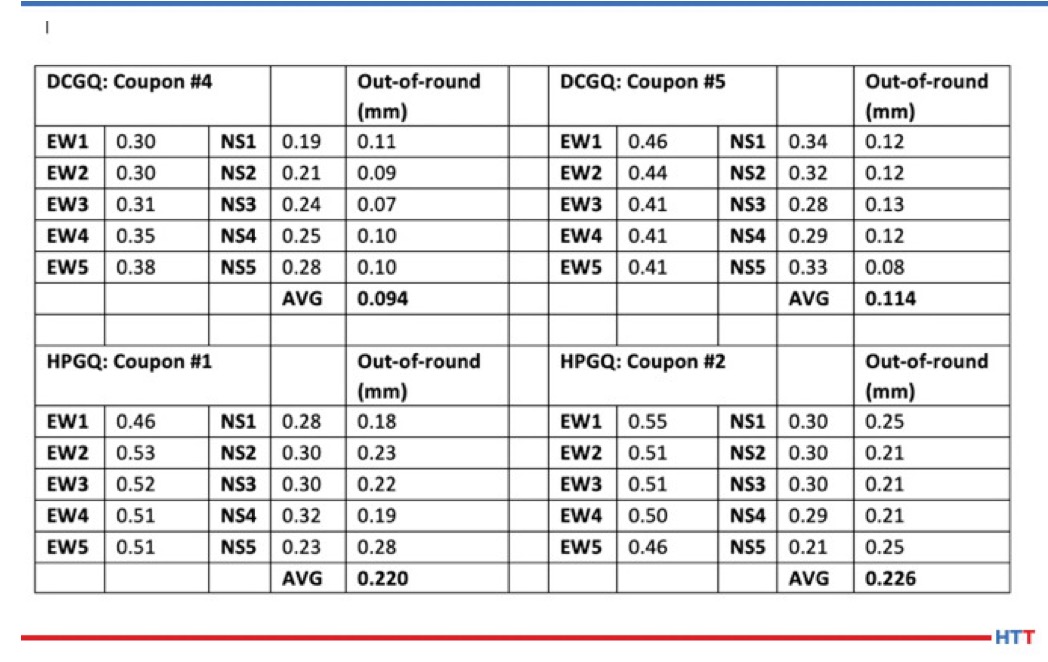
Table 1. Out-of-round distortion measurements of the distortion coupon for a DCGQ and HPGQ process

Table 1 shows the results from four coupons; two hardened using the DCGQ process and two processed using the standard 2 bar HPGQ for C64. The individual measurements (EW1, NS5, etc.) are relative and are dependent on the reference value used for the bore gauge. The individual measurements give an indication of the variation in distortion in the axial direction. The out-of-round measurements are actual values, as they are the difference between the actual measurements. The DCGQ process gave significantly less distortion than the HPGQ process.

While the values reported show a 50% reduction in out-of-round distortion for the DCGQ process, a larger gain could have been realized if two other conditions were addressed. First, the coupon for DCGQ was placed directly into a 1832°F (1000°C) preheated furnace since the prototype unit does not have austenitizing capabilities. Controlled heating, just like controlled cooling, should be utilized to realize the full potential of this process. Second, the DCGQ schedule was designed for another coupon geometry that was processed together with these distortion coupons. Therefore, the schedule was not optimum for this coupon geometry.

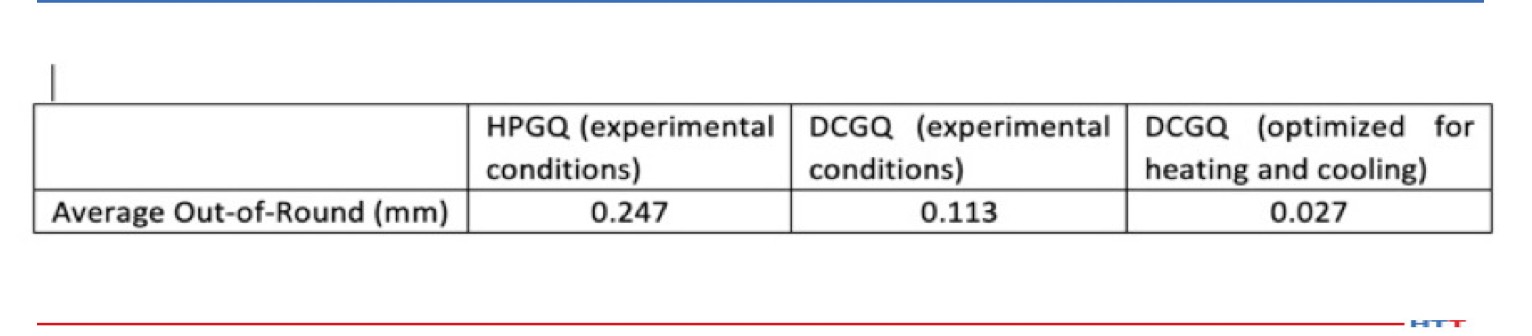
Table 2. DANTE simulation results comparing HPGQ and DCGQ using the experimental conditions and a DCGQ with optimized heating and cooling schedulesMARCH 2020

Table 2 compares the DCGQ simulation results in which the two processes executed on the experimental coupons were compared to an optimized process, including controlled heating and cooling schedules designed for this coupon. The optimized schedule predicts an order of magnitude reduction in out-of-round distortion. Comparison of the measurements from the HPGQ and DCGQ experiments in Table 1 to the model predictions in Table 2 shows that the model predictions agree closely with the experimental results.

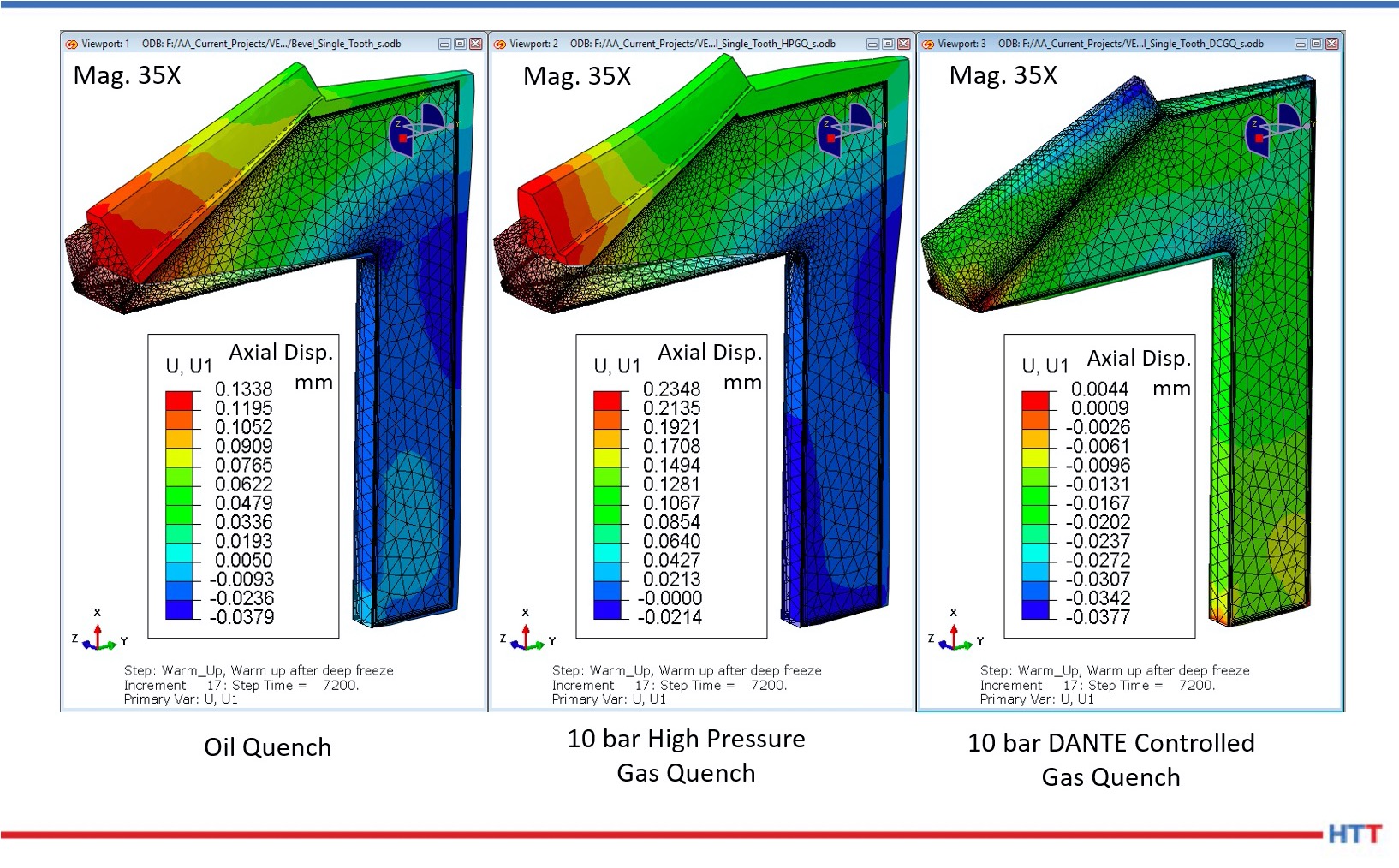
Simulating the application of the DCGQ process to a gear geometry, the predicted warpage of a bevel gear was examined. The simulation looked at the differences between an oil quench, 10 bar HPGQ, and a 10 bar DCGQ process. From Figure 5, it is clear that the HPGQ process is predicted to produce the most distortion. Even though the 10 bar gas quench has a slower cooling rate than the oil quench, less distortion is not guaranteed since a slower rate does not guarantee a more uniform phase transformation.[3] In this case, both heating and cooling were controlled for the DCGQ simulation.

Figure 5. Comparison of oil quench, HPGQ, and DCGQ processes for a bevel gear

In summary, a prototype gas quenching unit has been constructed with the ability to accurately control the temperature of the quench gas entering the quench chamber. Experimental results have shown that mechanical properties and microstructure are equivalent between the DCGQ process and a 2-bar HPGQ process for Ferrium C64. Thick disks with eccentric bores were machined and then heat treated using DCGQ and HPGQ. It was shown that the DCGQ process reduced distortion in these disks by 50%. Simulation using DANTE then showed that the distortion could be reduced further if controlled heating and cooling are used. Finally, a comparison was made between an oil quench, HPGQ, and DCGQ processes for a bevel gear. This comparison showed that the HPGQ process was predicted to cause the most distortion. HTT

References

[1] Prabhudev, K.H., Handbook of Heat Treatment of Steels, Tata McGraw-Hill Publishing, 1988, p.111-114

[2] Sinha, Anil Kumar, ASM Handbook, Vol. 4: Heat Treating, ASM International, 1991, p.601-619

[3] Sims, Justin, Li Zhichao (Charlie), Ferguson B. Lynn, Causes of Distortion during High Pressure Gas Quenching Process of Steel Parts, Proceedings of the 30th ASM Heat Treating Society Conference, ASM International, 2019, p.228-236


About the Author: As an analyst of steel heat treat processes and an expert modeler of quench hardening processes, Justin Sims was the lead engineer for designing and building the DANTE Controlled Gas Quenching (DCGQ) prototype unit. This system was developed to minimize distortion of quenched parts made of high hardenability steels, while still achieving the required properties and performance.

For more information, contact Justin at DANTE Solutions


Process Innovation to Reduce Distortion During Gas Quenching Read More »

Publisher’s Page: The Bright Side of COVID-19

Heat Treat Today publishes four print magazines a year, and included in each is a letter from the publisher, Doug Glenn. This letter first appeared in Heat Treat Today‘s Automotive Heat Treating magazine, June 2020.


Doug Glenn, Publisher, Heat Treat Today

For the record, the 2020 North American heat treat industry has been severely impacted by COVID-19. Everyone I’ve talked to agrees that the reality of 2020 will pale in comparison to the hopes and dreams for 2020 back in January and February of this year. March and April usually bring spring-like optimism, but this year those two months were marked by a grinding of the US economy to a nearly complete standstill, the heat treat industry included. As one of our Latvian foreign exchange visitors said in his broken English, “NOT GOOD.” Thus, it has been; and thus, it is even as of this writing.

Every situation, however, is 20% situation and 80% what you make of it, so let me suggest four positive things that will come out of this historic economic tragedy.

#1 “Sheltering at home” for 6-8 weeks might help us all slow down. For the vast majority, we’ve all been slowly heated in the waters of busyness to the point where we think it is normal. During my recent conversation with the executive director of an industry association, this person said, “I’m in favor of anything that will help us all slow down.” This person was fully convinced that our “normal” pace is not healthy. Perhaps this person was right. One other individual I spoke to was “forced” to ignore work for two weeks. His company furloughed individuals and sternly warned them NOT to check emails while furloughed because the company could be sued if furloughed workers were actually working. The national market manager that told me this story did so from his personal cell phone while preparing to paint a room in his house. No work for him. Like many of us, he had to slow down.

#2 Interacting face-to-face with other human beings is important. I know that many of you introverts are loving the forced isolation, but even you must admit that after a week or more seeing no one, it would be nice to be able to at least go somewhere where you can actually see and talk to other human beings besides those with whom you are confined to quarters. My favorite example of this are all of the technologically savvy young people who live on their phones. As long as they have their phones, they’re content. Come to find out, many of these now homebound young ones are now MISSING SCHOOL, not so much for the academics, but more for the interaction with their peers – even if it is sitting next to each other with their heads in their phones! People matter. COVID is helping us remember.

#3 COVID, or more accurately, the RESPONSE to COVID, is helping us all remember just how quickly we can lose our freedoms. For many of us, we lost the freedom to go to work, we lost the freedom to freely assemble, we lost the freedom to travel where and when we like, we lost the freedom to walk around without a mask, we lost the freedom to walk up a grocery store aisle in either direction, and we’ve even lost the freedom to worship where and when we like. Some even argue that we’ve lost our freedom of speech! Try asserting the opinion that the actual COVID virus is not significantly more dangerous than a normal flu. Try it once; you’ll not do it again! Of course, most of these freedoms will be lost only temporarily and for a good cause – our safety. But please remember what King Mongkut (Yul Brynner in The King and I) said about finding safety from others, “Might they not protect me out of all I own?” Or take it from Ben Franklin – “Those who would give up essential liberty, to purchase a little temporary safety, deserve neither liberty nor safety.” 

#4 And finally, COVID is helping us all see just how quickly life can change … and this is a good thing … because it is true. We think we are safe, we think we are secure, we think that life will always be this way, we think we are in control. We are wrong. There’s only One in control – assuming you believe in God – and we are not Him. This might be a scary thought for some – to not be in control. But, it is better to live in an unpleasant reality than a dangerous fantasy. COVID is helping us deal with reality.

So, there’s a lot of good coming from this pandemic. Here’s to a more modestly paced life, here’s to time with friends and family, here’s to liberty, here’s to remembering Who’s in charge … and here’s to your health and safety and a return to a more “normal” North American heat treat market.

Publisher’s Page: The Bright Side of COVID-19 Read More »

Predicting the Effects of Composition Variation for Heat Treatment of Aerospace Alloys

In the following original content from Heat Treat Today, Thermo-Calc Software's Adam Hope, PhD, materials scientist, and Paul Mason,  president, delve into how modeling and simulation tools can help heat treaters make well-informed decisions.

This article first appeared in the latest edition (March 2020) of Heat Treat Today’s Aerospace Heat Treating magazine.


Consistency in material properties and performance is critical to the aerospace industry, and small variations in material chemistry or process windows can have a large impact on the final parts performance. The ability to predict and adjust for these variations can reduce scrap and part re-work. Metallurgists and process engineers responsible for heat treatments must adapt their process when input variables change, such as material chemistry. They are routinely faced with questions such as:

Paul Mason
President
Thermo-Calc Software

*How will heat to heat variations affect the final part performance?

*What heat treatment should be given to a part that has been built via a novel approach such as additive manufacturing?

*How should one optimize a heat treatment schedule for a new alloy?

*When the data required to make these decisions does not exist, what are the options?

Experiments can generate this data, but this is costly and time-consuming. Handbooks might have data for known alloys, but this is often only for the nominal composition and may not be suitable for material processed under a novel route. Modeling and simulation tools can help fill this knowledge gap and help inform better decisions.


Integrated Computational Materials Engineering and CALPHAD

Adam Hope, PhD
Materials Scientist
Thermo-Calc Software

The publication by the National Academies in 2008 on Integrated Computational Materials Engineering (ICME)[1] outlined an approach to designing products, the materials they are comprised of, and their associated materials processing methods, by linking materials models at multiple length scales. The report highlighted the need for a better understanding of how processes produce material structures, how those structures give rise to material properties, and how to select materials for a given application, describing the need for using multiscale materials modeling to capture the process, structures, properties, and performance of a material.

Computational thermodynamics, and specifically CALPHAD (CALculation of PHase Diagrams)[2], enables the prediction of the thermodynamic properties and phase stability of an alloy under stable and metastable conditions. The CALPHAD approach captures the underlying composition and temperature dependence of properties and can also be extended to model atomic mobilities and diffusivities in a similar way. By combining thermodynamic and mobility data, kinetic reactions during solidification and subsequent heat treatment processes can be simulated. Computational thermodynamics and CALPHAD- based tools are an important component of an ICME framework because, through the use of such simulations, it is possible to vary alloy compositions and predict optimal solidification processes and solution heat treatment temperature ranges without performing many time-consuming and costly experiments.

Predicting Heat Treatments for Additively Manufactured Parts

Many additive manufacturing processes subject the material to rapid solidification with multiple subsequent reheat cycles. The effect of these thermal cycles on material properties is not always known and typically does not result in the properties that a similar cast or wrought metal would have. Additionally, many additively manufactured parts are built using conventional alloys which have been engineered for cast or wrought processes. In some cases these alloys are not suitable for additive processing, and problems such as deleterious phases forming during a post-build, stress-relief heat treatment, designed for conventionally treated alloys, may result.

Additive processes are typically associated with rapid cooling rates and large thermal gradients. This can give rise to the following:

  1. High levels of residual stress in the final part
  2. Microsegregation during solidification of each layer, which leads to local inhomogeneities in alloy composition

In the case of additive manufacturing, these separate heat treatments are often combined, and stress relief heat treatments designed for cast or wrought material may not be suitable for additively processed materials for two reasons:

  1. The chemical inhomogeneities arising from rapid cooling can influence precipitation behavior, and some deleterious precipitates may precipitate more quickly than expected.
  2. The multiple heating cycles of subsequent layers may have already started some precipitation reactions, making stress relief more difficult without first homogenizing these precipitates.

Zhang et al.[3] have studied laser powder bed builds of Alloy 625 and found that after applying an industry recommended stress relief heat treatment, delta phase can precipitate in the segregated regions much faster than in the wrought material. The formation of delta phase is extremely detrimental to material properties. They attributed this to increased Nb and Mo concentrations found in the interdendritic regions in the as-built microstructure.

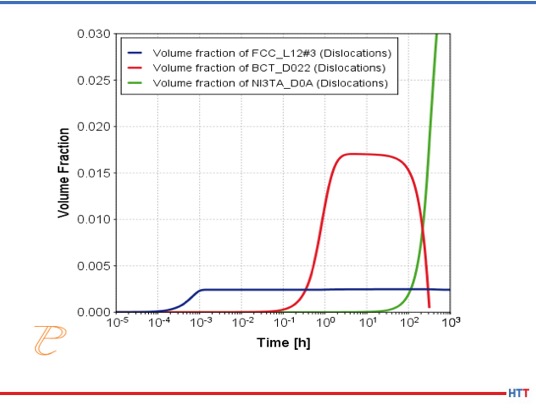
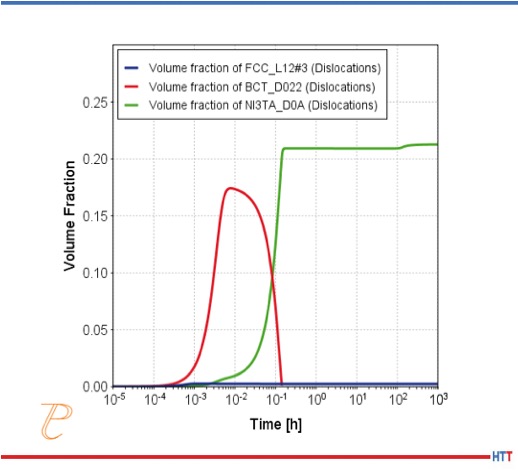
To understand this further, the authors first simulated the extent of this segregation using the Scheil-Gulliver model for solidification in Thermo-Calc[4] in conjunction with the diffusion module, DICTRA[4]. They then used the Precipitation module, TC-PRISMA to predict the precipitation kinetics of the deleterious delta phase for nominal feedstock compositions, as well as the compositions measured at dendrite boundaries. Both simulations, shown in Figures 1a and 1b, predict that a stable MC carbide forms, followed by some gamma double prime. Delta phase then forms at the expense of the gamma double prime. However the gamma double prime and delta phase both precipitate much more quickly in the segregated interdendritic region, due to the increased Nb and Mo. Delta phase is predicted to start forming around 1 hour, compared with 10 hours for the wrought material.

Figure 1. TC-PRISMA Precipitation simulations using nominal IN625 powder compositions (top) and segregated compositions (bottom) measured at the dendrite boundaries. Recalculated based on Reference 3.

While these calculations give insight to the reason why the conventional stress-relief heat treatment is not suitable, additional simulations can be made to identify a suitable temperature and time to both homogenize and stress-relieve the part, while avoiding deleterious phases. The authors of the study determined a post-build homogenization treatment was required to avoid deleterious delta phase precipitation.

Gas Carburizing Highly-Alloyed Steels

Highly-alloyed stainless steels can be gas carburized to increase the surface hardness, as well as improve the overall mechanical characteristics of the surface. However, an increase in chromium-rich carbides such as M23C6 or M7C3 can result in the decrease of chromium in the solid solution which leads to a reduction in corrosion resistance. Balancing these properties can be time consuming through trial and error experimentation, but CALPHAD-based tools can be used to identify suitable alloy compositions and heat treat windows, which are optimal for the application needs prior to testing in the laboratory.

Turpin et al. 5 made such a study, combining both experimental work and theoretical simulations to investigate carbon diffusion and phase transformations during gas carburization of high alloyed martensitic stainless steels. First, using thermodynamic calculations performed with Thermo-Calc 4 they determined the optimal balance between the carbide formation and chromium content of the alloy for corrosion resistance. They concluded:

  1. At 1750°F (955°C), which corresponds to the austenitization temperature of their alloy, M23C6 and then M7C3 will be the first carbides to precipitate in the austenite phase as the amount of carbon content in the alloy is increased.
  2. If the amount of carbon exceeds 3.8 wt% then M3C carbides are predicted to be stable. M3C carbides have a structure similar to cementite and preferentially precipitate at the grain boundaries which weaken the microstructure. Therefore, to avoid these phases, the overall content of carbon in the steel must be below this amount at the end of the carburizing process.
  3. Above 1.7 wt% C, the mole fraction (an indicator of the volume fraction) of M7C3 carbides exceeds 20%, and the chromium content of the alloy associated with these carbides is 65 wt%. Therefore, there is a correspondingly strong depletion of chromium from the matrix.
  4. To balance the desire for adding carbon into the matrix phase to obtain hardness with depleting the matrix of carbon, it was determined that the optimal amount of carbon in the matrix phase should not exceed 1 wt%. Thus, the thermodynamic calculations were used to establish a limit, without yet any consideration of the kinetics or time.

The second stage of the study then considered the diffusional reactions in the multi-component system during i) the carbon enrichment step and ii) the diffusion step of the gas carburizing process, and to determine how the composition and the amount of each phase vary with time and distance from the gas/solid interface and the carbon profile of the alloy as a function of time and distance. These calculations were made using the diffusion simulation software, DICTRA 4.

Consider the carbon enrichment step first. In DICTRA, several boundary conditions can be used for such a simulation, and in this work the carbon flux was determined experimentally using thermogravimetric measurements. During the diffusion step, the N2-CH4 mixture is replaced with pure N2, and the carbon flux at the surface of the samples is zero. To simulate this step using DICTRA, a zero carbon flux was applied as the boundary condition for two hours.

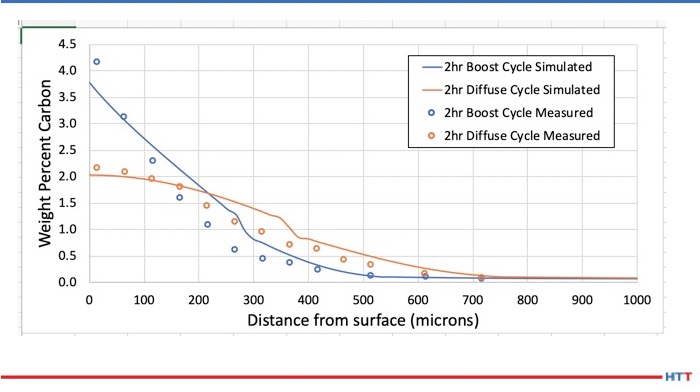
Figure 2 shows a simulated carbon profile for Fe-13Cr-5Co-3Ni-2Mo-0.07C, which is found to be in good agreement with the experimental values reported by Turpin et al. The authors concluded from this study that the carbon profile can be calculated and followed at any time if the boundary condition evolution at the gas-solid interface is known during the carburizing treatment.

Figure 2. DICTRA carbon diffusion profiles for Fe-13Cr-5Co-3Ni-2Mo-0.07C. Recalculated based on Reference 5.

Predicting β-transus Temperatures in Ti-Alloys

Many Titanium alloys respond well to heat treatments, through which the microstructure can be manipulated to optimize properties for a particular application. For example, some microstructures are better for high temperature creep, and some are better for fatigue strength. This is primarily achieved by controlling the nature and amount of α and β phases in the microstructure.

At high temperatures, titanium alloys are primarily β phase. At the β-transus temperature, the α phase becomes stable and can start to form. The β-transus temperature can change as a function of alloy chemistry. Knowing the β-transus temperature is critical to determining the nature and amount of α phase that will form during a heat treatment or thermal cycle.

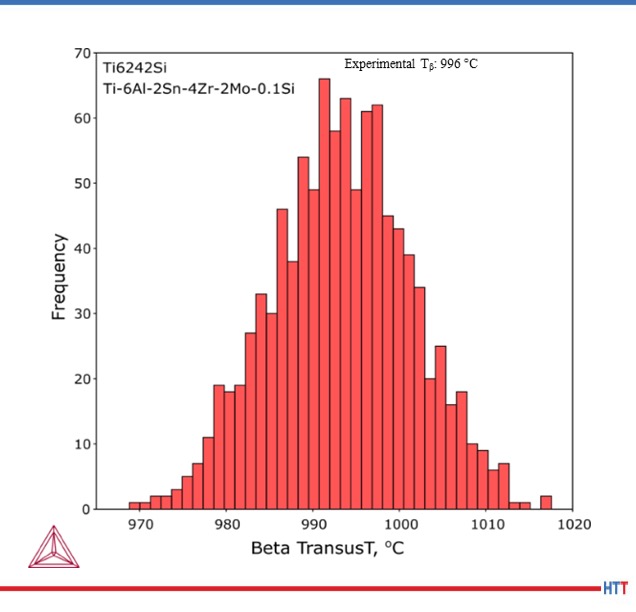
Many alloying elements in Ti alloys have a strong effect on β-transus temperature. Knowing the actual β-transus for a specific chemistry is critical to determining suitable heat treating windows to obtain a specific set of material properties. However, even within a particular alloy specification, there can still be small compositional variations that have a significant effect on the β-transus. Thermo-Calc [4] can be used to calculate this if the exact chemistry is known, or to determine the potential distribution of β-transus temperatures for a given chemistry range.

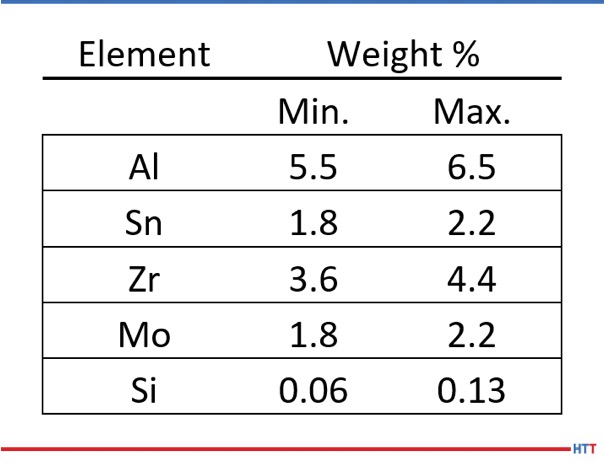
Table 1 -- Composition specification for major elements in Ti-6-2-4-2 Alloy

Table 1 shows the composition ranges for the major elements in Ti6-2-4-2Si (AMS 4919). Figure 3 shows the calculated distribution of β-transus temperatures in the composition specification of Ti6-2-4-2. Over 40 degrees variation is possible for compositions that lie within the specification and the calculations show good agreement with the experimentally measured values of 995°C ± 15°C (1823°F ± 27°F).[6]

Figure 3. Variation in Beta transus temperature for 1000 possible compositions within Ti-6-2-4-2 specification


Summary

In the 100th Column of the Heat Treat Doctor [7], Dan Herring, stated that heat treating can best be defined as “the controlled application of time, temperature and atmosphere to produce a predictable change in the internal structure (i.e. the microstructure) of a material.” However, variability arising from composition differences in materials can sometimes be challenging for heat treaters. The examples shown here have illustrated how modeling and simulation tools such as those based on the CALPHAD approach can be used to predict variability arising due to material composition. HTT

References

[1] National Research Council. 2008. “Integrated Computational Materials Engineering: A Transformational Discipline for Improved Competitiveness and National Security.” Washington, DC: The National Academies Press.

[2] Kaufman, L and Bernstein, H. Computer Calculation of Phase Diagram. New York: Academic Press Inc, 1970.

[3] Zhang, Fan, et al. “Effect of heat treatment on the microstructural evolution of a nickel-based superalloy additive-manufactured by laser powder bed fusion.” Acta Materialia 152 (2018) pp 200-214.

[4] Andersson, J O, et al. “Thermo-Calc and DICTRA, Computational tools for materials science.” Elsevier, CALPHAD, Vol. 26, (2002) pp. 273-312.

[5] Turpin, T, et al. “Carbon diffusion and phase transformations during gas carburizing of high-alloyed stainless steels: experimental study and theoretical modeling.” Met. Trans. A, Vol. 36A, (2005) pp 2751-2760.

[6] TIMET datasheet for TIMETAL® 6-2-4-2, TMC-0157 (2000).

[7] Herring, D “What is Heat Treating and Why Do We Do It?” Industrial Heating Magazine BNP Media (2011).


About the authors: Paul Mason is the president and Adam Hope, PhD is a materials scientist for Thermo-Calc Software, whose products assist academia, government, and industry to make calculations which predict or assist in the understanding of complex multicomponent alloys and non-metallic systems, as well as processes of industrial and scientific relevance.

For more information, contact Paul or Adam at info@thermocalc.com or (724) 731 0074


(Photo source: dayamay from pixabay.com)

Predicting the Effects of Composition Variation for Heat Treatment of Aerospace Alloys Read More »

Aerospace Fastener Manufacturer Receives Three Multipurpose Box Furnaces

An aerospace fastener manufacturer, located in Pennsylvania, received three multipurpose bench mounted box furnaces used to test high-temperature aerospace fasteners. 

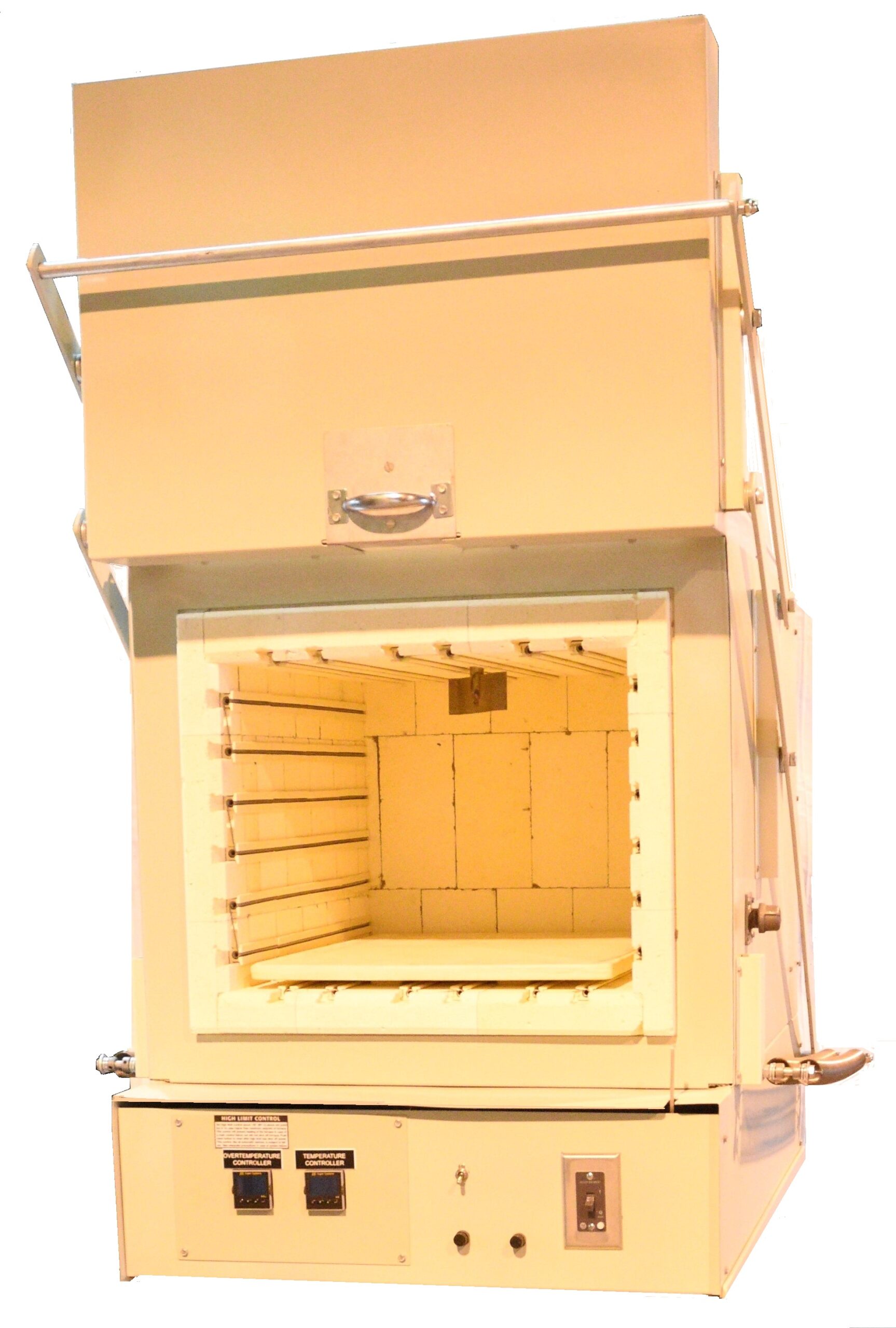
The new model GS2026, from L&L Special Furnace Co., Inc. includes a spring assist vertical lift door that allows for effortless loading and unloading even at high temperatures. The control is an industrial control system that includes a Eurotherm temperature control, overtemperature protection and a recirculation fan for uniformity.

L&L Special Furnace Model GS2026 bench mounted box furnace
(Photo source: L&L Special Furnace Co. Inc.)

The GS2026 has internal dimensions of 18” wide by 12” high by 24” deep. It has an operating voltage of 208, 220, 240 volts single phase, 60 or 50 hertz. The furnace is constructed from 3” lightweight IFB firebrick, backed up with 2” of board insulation. The elements are supported in hard ceramic element holders. These provide long element life and are easily replaced.

These additions now bring a total of five GS series furnaces at its facility.

(Photo source: spacex at unsplash.com)

Aerospace Fastener Manufacturer Receives Three Multipurpose Box Furnaces Read More »

IHEA Monthly Economic Report: Don’t Be Discouraged, Better Days Ahead, but Resilience Needed

The changes and current events occurring in our cities, states, country, and around the world are causing our heads to spin and our equilibriums to stagger. While information from the latest Industrial Heating Equipment Association’s (IHEA) Executive Economic Summary will come as no surprise for many, an unexpected, yet welcome projection will be sure to bring hope and encouragement to our weary spirits.

The report begins by explaining the incredible speed, fluidity, and “real time” fluctuations of information. “The data stream that informs the assessments we review each month has been affected right along with everything else in the economy. The changes have been taking place at a bewildering pace, outdated almost as soon as the data is collected.” Hence, because these numbers are so organic, “This set of numbers and graphs are only as accurate as they were a week or so [ago], and by now, they have all changed in significant ways.”

Despite the data pointing downward, almost universally, there are two of the twelve sectors assessed that have shown growth — steel consumption and capital investment. The summary states, “Steel consumption should be down given all the problems outlined in manufacturing and construction. There has been very little traditional demand for steel and that would lead one to expect deteriorating consumption. The slight uptick suggests that some users of steel are preparing for a return to higher prices down the road when there is an economic recovery and thus, they are trying to buy now while prices are low.”

Sectors buying steel now and storing it until they see their own demand start to recover.

The motivation behind the gain in the capital investment index has been similar to that of steel consumption.  “Now is the time to invest in new equipment or even expanded facilities as the prices are very low and there is some willingness to deal. This is a pattern that is nearly always seen during recessions . . .”

In a recession, acquisition of capital goods and physically expanding facilities occurs.

As to the rest of the numbers, the report says, “The first and most important is that this is an artificial recession imposed by a lockdown strategy intended to address another issue. In the simplest of terms, the economic crisis is collateral damage in the war on the COVID 19 outbreak.”

But, as we conclude, there is optimism as we get a glimpse of,  in the words of Paul Harvey, “the rest of the story.”

“There is a surprisingly level of confidence as far as the future is concerned. The analysts that have been looking at the expected progress of the economy, as well as the virus, still contend that we are in the midst of a “V” recession – one that falls very quickly but rebounds just as fast.  The assertion is that there is enough pent up demand to drive consumer behavior, and this will encourage business to respond quickly, and that will mean they will bring the majority of their workforce back from their “furlough,” and that will encourage even more consumer activity. . . It all becomes a matter of timing and the resilience of the consumer.”

The report is available to IHEA member companies. For membership information, and a full copy of  the 12-page report, contact Anne Goyer, Executive Director of the Industrial Heating Equipment Association (IHEA). Email Anne by clicking here.

Anne Goyer, Executive Director of IHEA

IHEA Monthly Economic Report: Don’t Be Discouraged, Better Days Ahead, but Resilience Needed Read More »

Skip to content