Leone

Heat Treat Radio #31: A Discussion with David Wolff, Nel Hydrogen, COVID-19 Update

Welcome to another episode of Heat Treat Radio, a periodic podcast where Heat Treat Radio host, Doug Glenn, discusses cutting-edge topics with industry-leading personalities. Below, you can either listen to the podcast by clicking on the audio play button, or you can read an edited version of the transcript. To see a complete list of other Heat Treat Radio episodes, click here.


In this conversation, Heat Treat Radio host, Doug Glenn, speaks with David Wolff of Nel Hydrogen about how the COVID-19 pandemic has affected supply chains, specifically those relating to hydrogen generation. Click below to learn more about what risks the supply chain for hydrogen is facing, how the ongoing crisis may affect supply and employee safety, and what the benefits of on-site hydrogen generation are during this unusual time.

Click the play button below to listen.


The following transcript has been edited for your reading enjoyment.

Doug Glenn (DG):  We’re here today with David Wolff from Nel Hydrogen. Dave is the eastern regional sales manager, and we’ve had a couple of previous Heat Treat Radio episodes with Dave talking about on-site hydrogen generation; but in light of COVID-19 and all that has happened there, we wanted to revisit this issue.

David Wolff, eastern regional sales manager, Nel Hydrogen

David Wolff (DW):  It’s been an amazing time, and I think we’re all shocked by the number of unexpected and wide-ranging effects of this COVID-19 event.  We talked about discussing supply chain interruptions, which have been unbelievable and sometimes counterintuitive.  You go to the grocery store these days and look at the shelves, the toilet paper, the rice, the meat, milk, and eggs, and they’re all empty.  People talk about going to Amazon, and even PC monitors are sold out, thermometers and jigsaw puzzles.  The most humorous is this world of zoom meetings.  Even dress shirts and blouses are selling, but not pants and skirts.  It is an interesting time.

I’ve been astounded by the wide-ranging effects on all businesses.  I’ve just recently reviewed my recent business charge card bill, and the total amount that I charged in March and April was zero.  That’s money that didn’t support restaurants, hotels, gasoline, airlines, and obviously their supply chain suffered. We’re seeing virtually every business running into raw material shortfall caused by shutdowns or logistics issues extreme in the supply chain: yeast for pizza, alcohol for chemicals and cleaners, metal parts for assembled machinery. Here in Connecticut, we have a small but healthy dairy industry, and it’s tragic to see logistics issues causing dairy farmers to dump milk [they] can’t sell, while bottled milk prices at the grocery store are surging upward.

DG:  It’s definite that the impact, as you said, and said it well, has been wide ranging, in many ways somewhat devastating and somewhat counterintuitive.  It’s hard to tell.  But we want to talk specifically today and revisit for a bit on-site hydrogen generation based on what has been happening in light of these changes.  What exactly are companies having to look at now that they weren’t having to look at before?

(source: Наркологическая Клиника on Pixabay)

DW:  What we hear from companies is that they’re focused on two priorities.  They’re focused on employee safety and the control of factors of production, their supply chain.  So they want to bring people back in a safe fashion, and that’s requiring an immense amount of accommodation.  And then they need to make sure that they have their raw material.  Hydrogen is required for most types of heat treating, sintering, as a carrier gas in fuel for analytical equipment, semiconductor processing for chemicals, and for operation of power plants.  Without hydrogen, these things do not happen.  We’ve lived this through at Nel before.

Ten years ago, just post [Hurricane] Katrina, when delivered hydrogen was limited due to plant outages, Nel Hydrogen, which was then Proton On-Site, was actually contacted by the federal government to prioritize hydrogen generator deliveries to power plants because without hydrogen, power plants can’t operate, and we were under orders to prioritize electrical supply.  So we’ve seen some aspects of this before.

DG:  Let’s talk briefly about what some of the risks are for delivered hydrogen.  What are we talking about here?

DW:  There are new supply chain risks to consider.  Most of us have seen this pretty personally.  We haven’t purchased any gasoline in weeks, that’s why the price is low.  In almost all cases, the hydrogen that is delivered to US customers is actually a co-product, or almost a byproduct, of the refinery processing of crude oil.  It is not the primary product for the plant, it is a co-product.  The excess hydrogen is then sold at relatively low prices to industrial gas providers for purification, packaging, and resale.

So if the gasoline is not in demand, the supply of hydrogen available for sale to the industrial gas suppliers will decline because it’s not being produced.  So you have that risk of the basic hydrogen supply.  You then have the fact that the hydrogen plant may be lower in business priority compared to other gases when it comes to staffing limitations.  Right now oxygen is the focus of all the industrial gas companies, and I’m going to talk about some of the implications of that.

The other thing is that the U.S. supply chain for hydrogen, particularly in cylinders, has multiple steps.  A failure in any step will result in shortfalls.  For example, because of the cost and challenges of storage, the entire industrial gas industry runs with very lean inventories.  You can’t just put industrial gases on the shelf; they need to be packaged or stored in tanks, and the amount of storage is very limited.  So logistic hiccups very quickly result in shortages.

Cylinder and tube trailer distribution chains might become frozen because empties are not being returned from customers who are closed.  Additionally, for cylinder hydrogen, cylinders have been taken out of hydrogen service and re-serviced into medical oxygen.  The suppliers are encountering delays for cleaning and disinfection around delivery of cylinder hydrogen.  And discussions about additional waves of COVID-19 and whether people have acquired resistance, and therefore can go back to work, are all delaying a return to a normal situation.

DG:  Is it possible that some of the customers might experience limitations, hydrogen supply limitations, different than other customers?

(source: Luisella Planeta Leoni on Pixabay)

DW:  It’s always tricky to guess, but my feeling is that the effect on the hydrogen supply is likely to be noticed by the smallest volume users first, and maybe most acutely.  That’s because the cylinder hydrogen logistics are the most complicated, whereas liquid hydrogen is the least.  Liquid hydrogen goes directly from the place of manufacture to the customer.  And you’re limited there primarily by driver availability and travel challenges, whereas tube trailer and tube bank users depend on an additional stage of trans-fill from liquid to gas.

Now those are the same locations that are struggling to fill oxygen orders for hospitals, and in the industrial gas industry, nothing is more important than a hospital oxygen delivery.  There it’s really a question of availability of staff and prioritization.  But cylinder filling and distribution is by far the most equipment and people-intensive form of delivery because you’ve got liquid trans-fill, cylinder management, filling, QC, and local delivery all under great pressure because of resources and priorities.  And then again, the issue of cylinder availability because every cylinder that can possibly be re-serviced is being re-serviced into oxygen service for hospitals.

Finally, for folks who are using forming gas in cylinder form in kind of low quantities, [there are] likely to be long delays because of the scarcity of the skilled people to do the blending and analysis required for performing gas blending.

DG:  You’ve laid out nicely, I think, the potential risks of what’s going on with COVID-19 and how it may impact supply and even employee safety.  Let’s do a quick review of the benefits of on-site generation as opposed to having it delivered in tubes or cylinders or whatever, and how does that impact our thinking as far as on-site hydrogen generation these days?

DW:  If hydrogen is a raw material for you, hydrogen generation can enable you to make all of your hydrogen at your site automatically with little personnel attention, so it becomes a utility.  The only raw material that you depend on to make that happen are electricity and water, which come into your facility in pipes and wires, and of all the logistics chains, electricity and water tend to be among the most reliable.  So no trucks, no people, and so forth.  And then hydrogen eliminates the space and compliance issues related to hydrogen deliveries and storage.

Finally, and this is not strictly related to COVID-19, but hydrogen generation will stabilize your hydrogen cost.  So in a time when force majeure charges tend to crop up during times of difficult logistics, you don’t see those.

Click on the image above if you’d like to get your own download of this 18-page e-book.

DG:  Dave, in addition to our two earlier podcasts together, and the eBook, Hydrogen Generation and its Benefits for Heat Treaters, which you can find on our website, where else would you direct people to find more information about on-site hydrogen generation?

DW:  I would direct them, if they wish, to go to the nelhydrogen.com website for more details on our equipment.

DG:  Any concluding thoughts?  Anything else you want to leave us with?

DW: On-site hydrogen can’t be implemented overnight, so it makes sense to plan ahead.  If this concept makes sense to you, we’d be happy to have a conversation.  The current thinking is, this COVID-19 issue may be with us for months, and there is even talk of waves lasting years.  So we will see this again. On-site hydrogen is a solution to many of the long-term problems we’ve identified that are associated with delivered and stored hydrogen. And if there is anything this strange COVID-19 experience has shown us, it’s the importance of supply chains for businesses, their employees, and their customers.

Whether the issue was [Hurricane] Katrina or COVID-19, supply and demand mismatches for hydrogen, or just the diminishing attractiveness of driving the trucks to deliver hydrogen, businesses may wish to control the factors of their own production.

Doug Glenn, Publisher, Heat Treat Today
Doug Glenn, Heat Treat Today publisher and Heat Treat Radio host.

To find other Heat Treat Radio episodes, go to www.heattreattoday.com/radio and look in the list of Heat Treat Radio episodes listed.

Heat Treat Radio #31: A Discussion with David Wolff, Nel Hydrogen, COVID-19 Update Read More »

U.S. Air Force Awards StandardAero Multi-Year MRO Contract

Scott Starrett, president of StandardAero’s military division.

The United States Air Force (USAF) has awarded a $237 million multi-year contract to provide engine maintenance, repair, and overhaul (MRO) services for General Electric J85 turbojet engines powering the USAF fleet of T-38 trainer aircraft. The multi-year contract with StandardAero will continue into 2028.

Under the new contract, StandardAero will provide the same service the USAF has received through other multi-year contracts, including support for the USAF MRO requirements for Rolls-Royce T56 engines that power C-130 aircraft as well as General Electric F110 MRO engine support, which power international F-15 and F-16 aircraft. All of these programs are performed at the company’s San Antonio facility.

T-38 Talon trainer jet (source: Master Sgt. Lance Cheung, U.S. Air Force)

“We are thrilled to continue expanding our successful partnership supporting USAF aircraft engine MRO and the J85 program is a very strategic and logical addition to our portfolio services,” said Scott Starrett, President of StandardAero’s military division. “Our employees take great pride in helping our nation’s airmen achieve the highest level of operational readiness and mission success.”

(source: StandardAero)

U.S. Air Force Awards StandardAero Multi-Year MRO Contract Read More »

Choosing the Right Cooling System

This week’s Technical Tuesday installment is a Heat Treat Today original from our upcoming Automotive magazine, which is scheduled to be released in June.

Deciding on a process cooling system for your automotive heat treat needs is an important process that needs intentional consideration. Check out this practical and valuable guidance from Bob Smith, director of product management at Thermal Care to help you make an informed decision. 


When considering which type of process fluid cooling system is best for your automotive heat treat application, it is important to determine the process fluid medium, desired temperature, and the significance of operating cost versus initial investment. There are often multiple solutions to a process cooling application, and the following is intended to provide a basic outline of the types of systems available and where they are best used.

Process cooling is moving heat from where it is not wanted (the process), and putting it into the air outside the manufacturing facility. Heat transfer usually involves the use of some sort of heat transfer media, usually a fluid like water or a glycol solution, to transport the heat from the process equipment to the cooling system.

The first step is to understand the required temperature for the process cooling fluid in order to properly remove heat from the process. This is typically specified by the process machine manufacturer and is based on the flow of fluid and the required temperatures of their heat exchangers. There are three basic types of process cooling systems to consider. 

Fluid Coolers

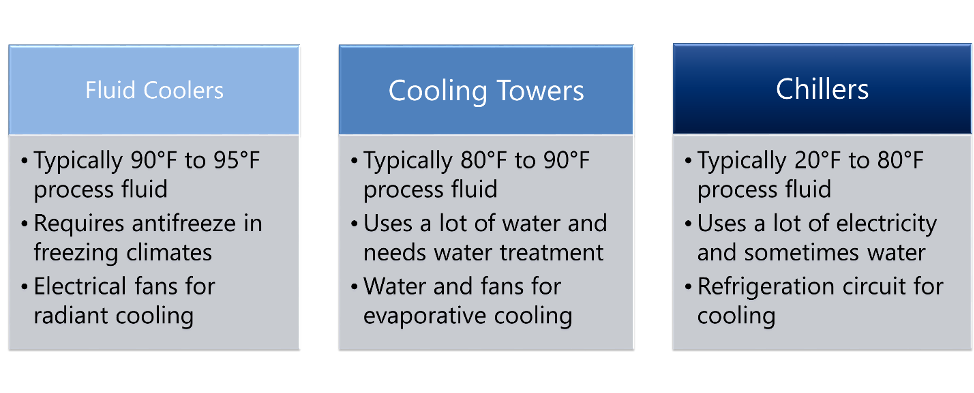
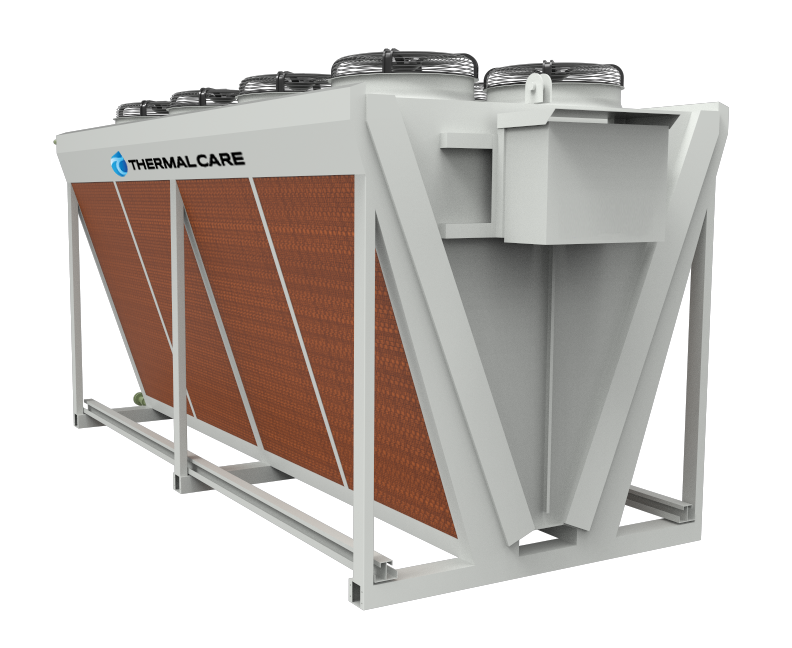
Fluid cooler systems are commonly used for applications with warmer temperatures. They consist of copper tubes with aluminum fins and fans that act like a radiator to cool the process fluid using ambient air. The coolest practical leaving fluid temperature is about 10°F warmer than the air entering the fluid cooler. Compared to cooling towers, fluid coolers are not as energy efficient, have a higher initial cost, and have a larger footprint; however, they have much lower maintenance requirements and use less water than cooling towers. Of the three types of process cooling systems, the operating cost and capital investment of fluid cooler systems typically fall somewhere between that of a cooling tower and chiller system.

Fluid coolers use less water but are limited by the temperature of ambient air

Cooling Towers 

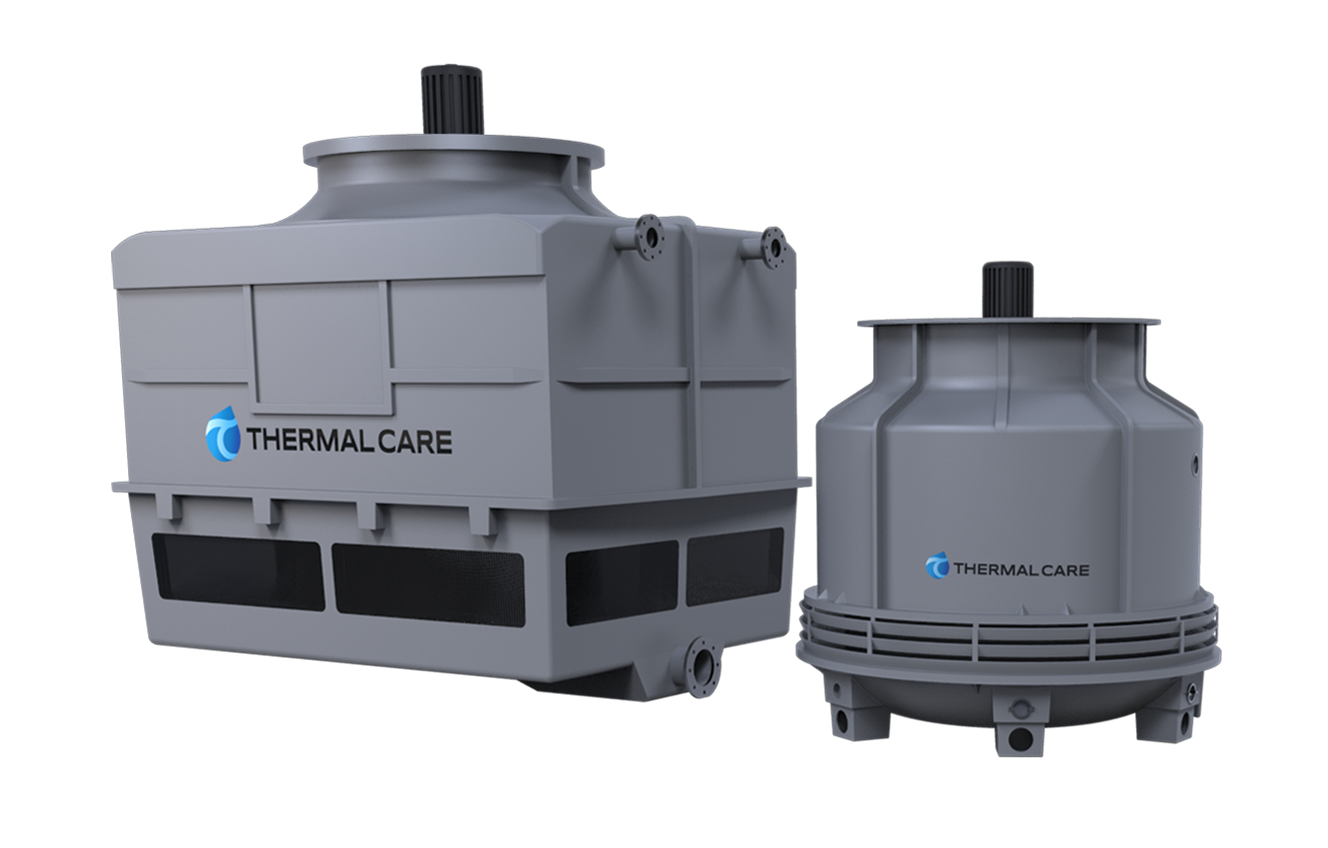
Cooling tower systems are used for applications where a fluid cooler is not able to get cold enough. A cooling tower system can provide a reliable source of cool water year-round in the 70°F to 100°F temperature range. Cooling towers work through the process of evaporation. Water is sprayed over plastic cooling tower fill, which creates a large surface for water to evaporate from. A fan moves air through the tower to induce evaporation, which in turn cools the water. The coolest practical leaving water temperature in summer is about 80°F due to air temperature and humidity. Cooling tower systems are typically the least expensive of the three types of systems to operate; however, the maintenance requirements for filtration and water treatment are the highest of the three.

Cooling towers use water to maximize evaporation for cooling

Chillers 

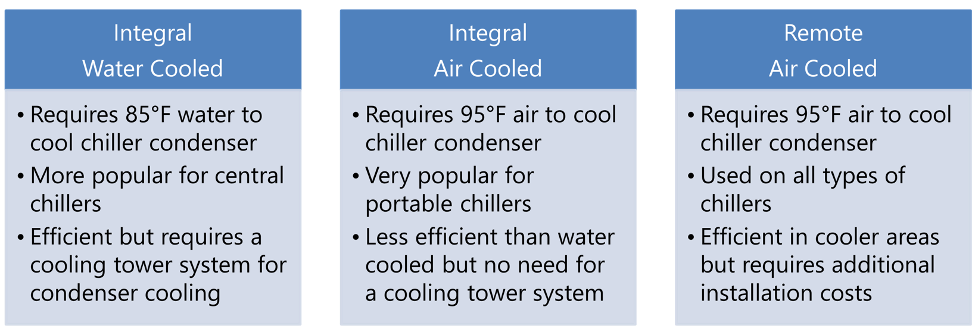
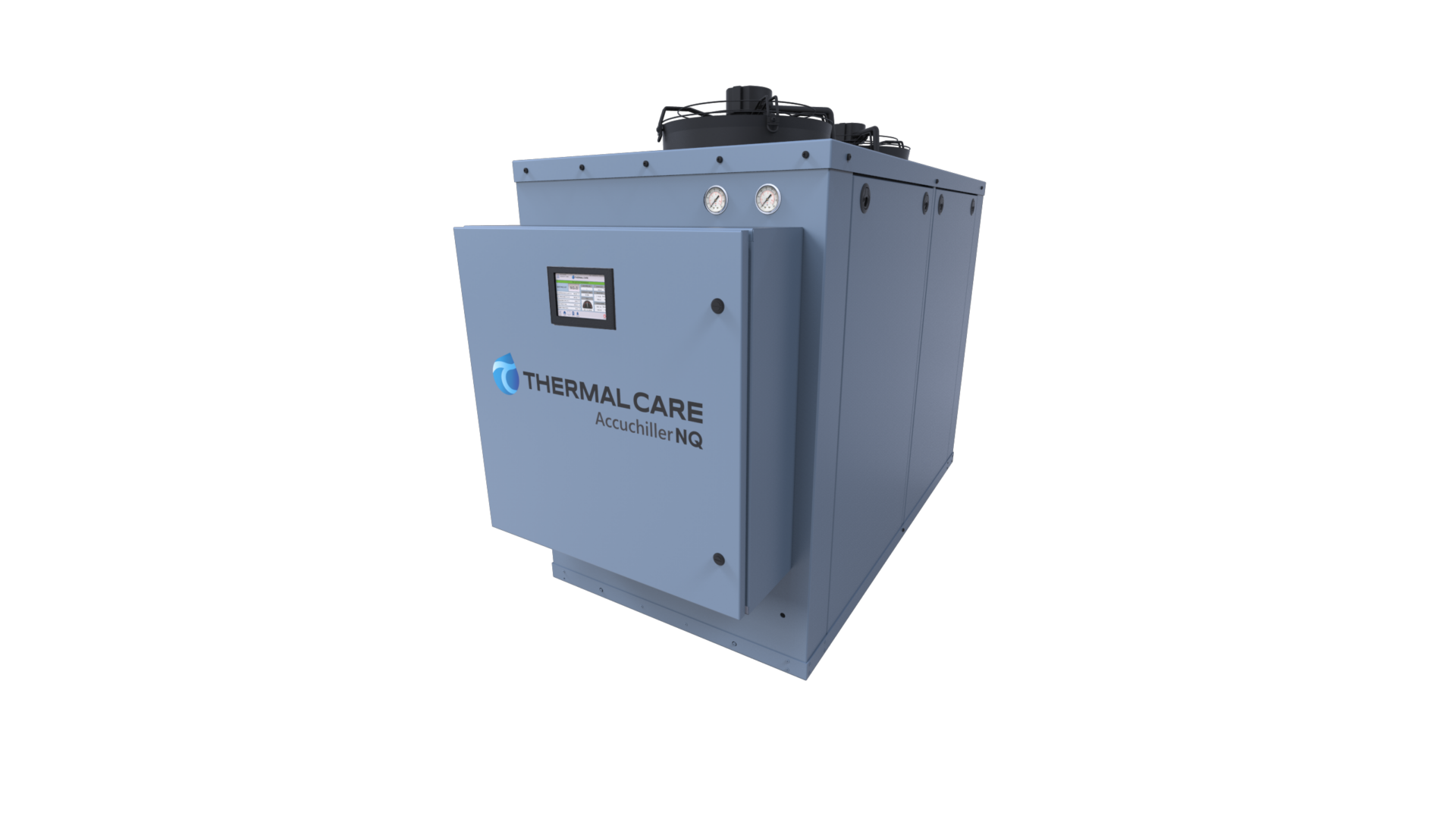
Chiller systems are used in applications where neither a fluid cooler, nor cooling tower system, can get cool enough to meet the requirements for the process. In a chiller, refrigerant is used to pull heat from the process fluid and transfer it to ambient air or cooling tower water. Most applications are for 50°F water, but most chillers have a practical process fluid set point range of 20°F to 80°F. Of the three types of cooling systems, chiller systems are the most expensive to purchase and operate. Chillers require some form of cooling to their condensers, which is where the refrigerant gas that was boiled using the process heat is condensed back to a liquid. The three types of chiller condensers are shown below.

Chillers that use air-cooled condensers have less maintenance and less installation costs than water-cooled condensers, because water-cooled condenser chillers require a fluid cooler or cooling tower system to generate 85°F to 90°F fluid to cool the condenser of the chiller.

Chillers use refrigerant to pull heat from the process fluid

With the above basics you will be able to choose which type of cooling system you should consider to cool your process. Once that is known it is best to work with a manufacturer who specializes in that type of process cooling equipment. They will have the expertise and knowledge to help you configure the best system solution and ensure you are able to meet your purchase and operating cost objectives.


Bob Smith, director of product management, Thermal Care

Bob Smith, director of Product Management, has over 30 years of experience at Thermal Care having begun as a sales engineer. He has grown with the company over the years serving in a number of different roles such as project manager, inside sales manager, OEM market manager, and director of Plastics Markets.

For more information, contact: www.thermalcare.com or (888)-828-7387

Choosing the Right Cooling System Read More »

Global Steel Manufacturer Develops Historic Hydrogen Heat Treat

For the first time ever, heat treaters have successfully used hydrogen to heat steel before rolling. This historic development is the result of a full-scale trial that was performed with good results in a pit furnace at the Hofors rolling mill in Sweden.

Göran Nyström, EVP Group Marketing & Technology

Linde Gas AB and its partner, Ovako conducted a trial in which steel was heated using hydrogen instead of LPG (liquefied petroleum gas) before rolling at the mill in Hofors. The trial was successful, and testing of the steel produced showed that heating with hydrogen does not affect the quality. Additionally, the use of hydrogen in combustion would have a great positive effect on the environment since the only emission generated is water vapor.

“It is the first time that hydrogen has been used to heat steel in an existing production environment. Thanks to the trial, we know that hydrogen can be used simply and flexibly, with no impact on steel quality, which would mean a very large reduction in the carbon footprint,” says Göran Nyström, EVP Group Marketing & Technology.

Anders Lugnet, Anders Lugnet, Group Technical Specialist Energy & Furnace Technology, Ovako

“We have been working on furnace modernization for a long time, to make our furnaces as productive and energy efficient as possible," says Anders Lugnet, Group technical specialist, Energy & Furnace Technology at Ovako. "It is very exciting that we now have proof that it is possible to use hydrogen in heating without affecting the quality of the steel. If we can make this investment, it would have a great positive impact on the environment. Our estimate is that an initial investment would save 20,000 t of carbon dioxide each year, and that is just the beginning. We performed this trial in such a way that it can be reproduced at full scale in Hofors and at our other rolling mills.”

(source: Ovako AB)

Global Steel Manufacturer Develops Historic Hydrogen Heat Treat Read More »

Happy Memorial Day from Heat Treat Today!

Heat Treat Today wants to wish everyone a happy Memorial Day! As restrictions across our country ease and we begin to start getting things back to normal, we’re all the more appreciative of the freedoms and safety that so many brave men and women have given their lives to secure. May we all take the opportunity to consider and give thanks for their sacrifice, and may you and your family have a blessed and safe holiday!

(source: Aaron Burden)


(source: Filip Dukanic)

Happy Memorial Day from Heat Treat Today! Read More »

Global Heat Treat Provider To Open New Facility in Illinois

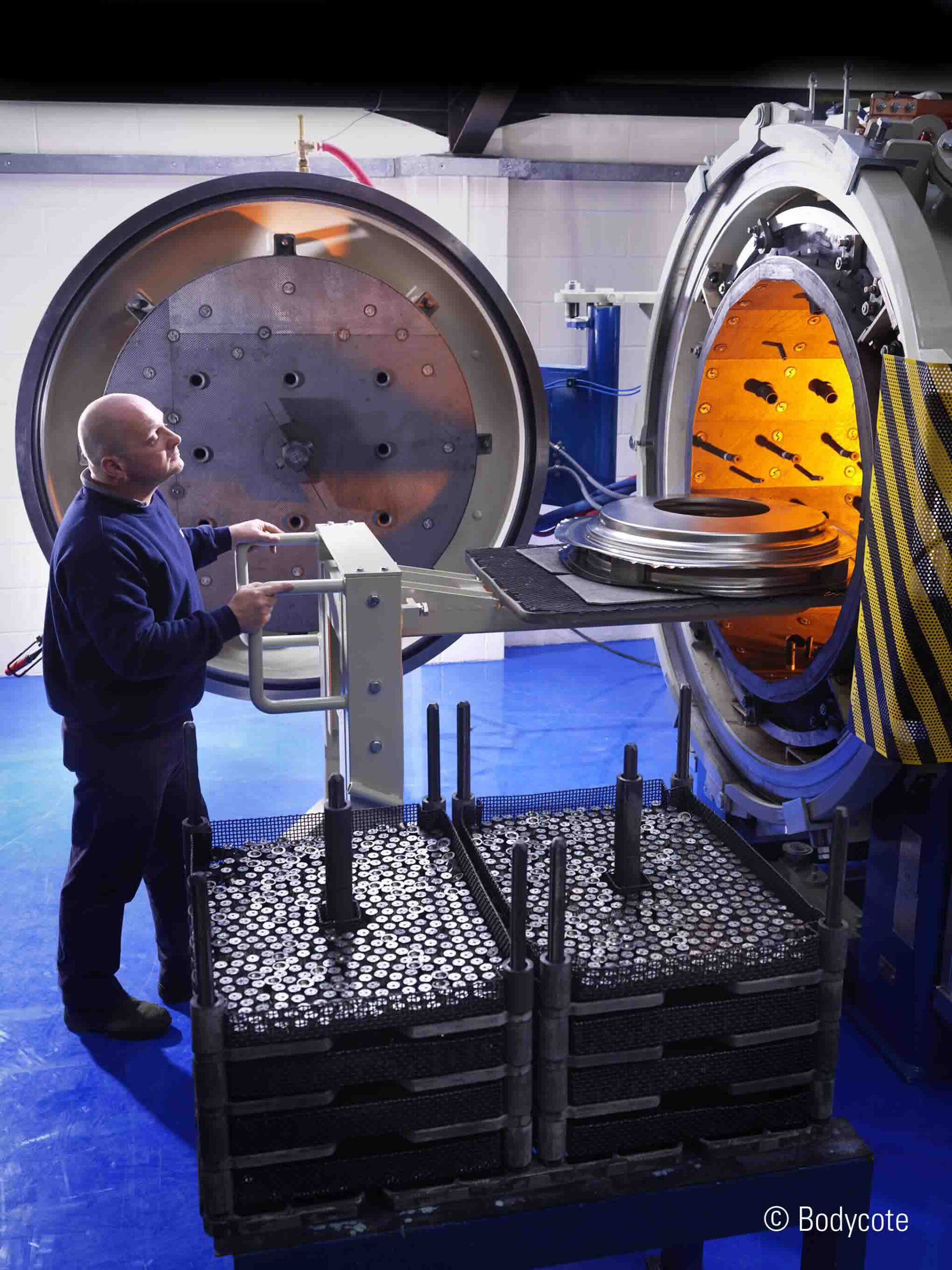
One of the world’s largest providers of heat treatments and specialist thermal processing services is opening a new location. Bodycote will soon unveil its state-of-the-art facility in Elgin, Illinois.

The new Bodycote location will support manufacturing supply chains in the Midwest (source: Bodycote)

The new purpose-built facility has been designed as a replacement for Bodycote’s ageing facility in Melrose Park, Illinois. The Elgin facility will support manufacturing supply chains in the Midwest region. The Melrose Park facility will be closed once the transfer of customers’ work has been completed.

Tom Gibbons, president of Aerospace, Defense & Energy, Heat Treat and Surface Technology at Bodycote

Bodycote continues to invest in acquiring, updating, and building new facilities with new capacity and more operationally efficient services. The new Elgin facility is part of this ongoing strategy to provide the best possible capabilities, mix, and geographical network to better serve customers.

Tom Gibbons, president of Aerospace, Defense & Energy, Heat Treat and Surface Technology at Bodycote, commented, “I am delighted to be able to announce the opening of our plant in Elgin, Illinois. Our investment in the new facility enables us to expand our capacity and improve our ability to deliver high-quality heat treatment capabilities to our customers.”

The new facility is scheduled to be operational in June 2020.

(source: Bodycote)

Global Heat Treat Provider To Open New Facility in Illinois Read More »

Kamyanka Machine Building Purchases 3-in-1 Furnace

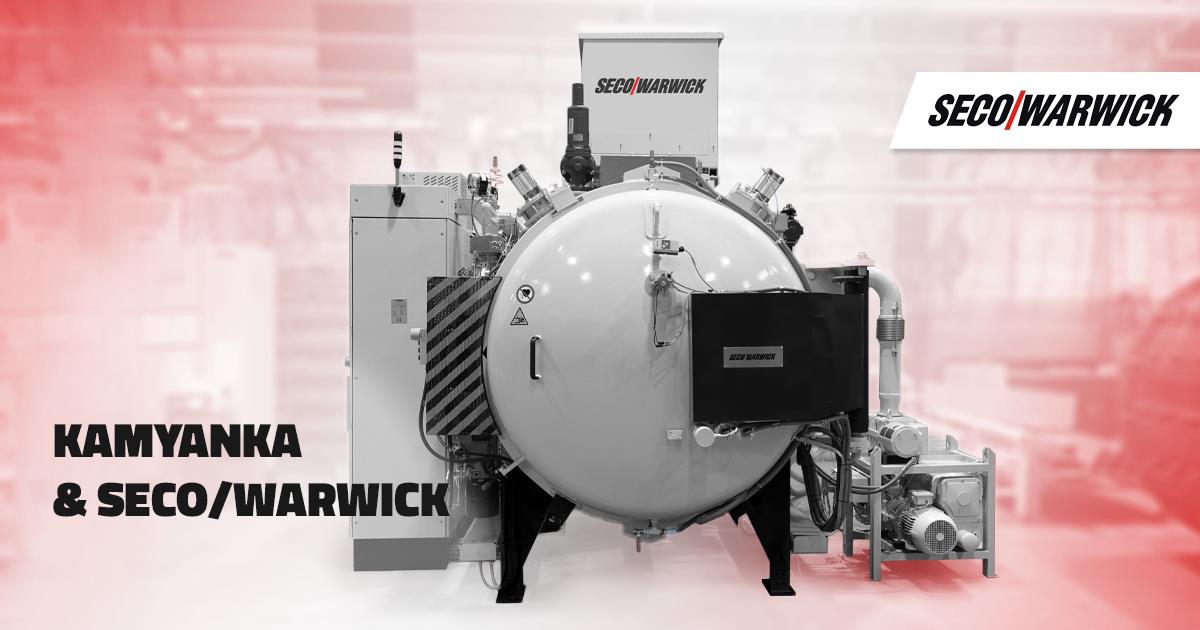
The parent company of a North American furnace manufacturer provided a furnace to Kamyanka Machine Building, an international leader in the production of pumps for manufacturing thread and chemical fibers, metallurgy and oil. The furnace will be equipped with a closed water system and gas installation so that the device can work independently.

Maciej Korecki, VP, Vacuum Furnace Segment at SECO/WARWICK (source: SECO/WARWICK)

Additional equipment from SECO/WARWICK in Meadville, Pennsylvania, will also include a vacuum carburizing option as well as quenching, heating in gas, and isothermal cooling. This will enable Kamyanka Machine Building Plant LLC, based in the Ukraine, to carry out full heat treatment processes in one device in accordance with their requirements. They will be able to perform three heat treatment processes in a single furnace instead of in separate operations.

(source: SECO/WARWICK)

"The solution we implement in Kamyonka Machine Building Plant is the result of many years of experience in the construction and service of the world's best heat treatment solutions," added Maciej Korecki, Vice President of the Vacuum Furnace Segment at SECO/WARWICK.

This is the first order from the Kamyanka Machine Building for SECO/WARWICK.

(source: Robin Sommer/SECO/WARWICK)


Kamyanka Machine Building Purchases 3-in-1 Furnace Read More »

Leading Automotive Tier 1 Supplier Orders Eight Custom Furnaces

A leading tier 1 automotive supplier recently placed a large order for eight (8) custom designed walk-in ovens for aluminum aging of automotive parts with furnace manufacturer DELTA H.

(source: DELTA H)

The ovens will be qualified at class 2 (+/-10°F) and feature all necessary performance requirements for compliance to CQI-9 and AMS2750E specifications. DELTA H collaborated with the customer for 6 months on the design and approval phase.

All 8 ovens will be commissioned in late summer 2020.


(source: Erik Mclean/DELTA H)

Leading Automotive Tier 1 Supplier Orders Eight Custom Furnaces Read More »

7 Tips for Restarting a Furnace

As society begins to slowly reopen in the wake of the COVID-19 pandemic, equipment that has been sitting idle will need to be brought back online.

In this Heat Treat Today Original Content feature, Abbott Furnace gives us a few important considerations to ensure a successful return to operation.


1) Reference the manufacturer supplied manual for specific information regarding the re-starting of the equipment.

2) Be sure that water is flowing to all of the cooling chambers of the furnace.

3) Check that the belt is on and moving smoothly through the furnace. Watch for jerking or jumping of the belt that would indicate an issue with the drive or pathway through the furnace.

4) Enable the ramp mode in your controls to limit the heating rate of each zone to 55C (100F) per hour or less. If the furnace does not have a ramp mode, be sure to manually adjust the set-points of each zone so as not to exceed the suggested ramp rate.

5) Once the furnace reaches 150C (300F) , purge the furnace with nitrogen and allow the nitrogen to flow as the furnace continues to heat up.

6) When the zones of the high heat section of the furnace are above 760C (1400F), combustibles may be introduced and the furnace can continue to be ramped to the final processing set-points, once the pilots are ignited.

7) Allow the furnace atmosphere to re-condition the furnace, clean the belt, and stabilize.

Loading scrap metal that is free of oils, grease, and rust will help the furnace to “clean-up” and stabilize.

(source: Abbott Furnace)

7 Tips for Restarting a Furnace Read More »

Global Heat Treat Supplier Group Rebrands

Nitrex, a Novacap portfolio company and global provider of fully integrated heat-treating solutions and technologies, unveiled its new corporate brand identity this week. This change comes as the company seeks to forge new paths, retool its product portfolio to align it even more closely with customer needs and preferences, and seeks to present a more consistent look and feel across all brands.

Jean-Francois Cloutier,
Nitrex CEO

“The new brand identity we are sharing with you today,” said Nitrex CEO Jean-François Cloutier, “reflects our evolution as a market leader poised for the future, while reaffirming our tradition of innovation, reliability and quality as well as our customer-focused culture. The new unifying logo will represent the company as a whole, with all its business units.”

The new symbol will be adopted by all the Nitrex business units. The symbol also plays a functional role as the letter “N” in the Nitrex wordmark used by all business units. For now, the names of the legal entities will not change. It is worth noting that different parts of the new logo represent the integration of United Process Controls and Marathon Monitors, as well as G-M Enterprises.

(source: Nitrex)


“The new tagline charts a bold course for Nitrex,” Cloutier added. “It underscores our commitment to science and technology. By harnessing the latest advances, we will be able to reinvent the methods of strengthening metals and applications, to the greater benefit of our customers. This marks the beginning of a new chapter for Nitrex and its affiliated companies, and we’re very excited to finally share it with you.”

(source: Nitrex)

Listen to a Heat Treat Radio interview with Jean-François Cloutier here: https://www.heattreattoday.com/heat-treat-radio/heat-treat-radio-jean-francois-cloutier-nitrex-ceo/ 

Global Heat Treat Supplier Group Rebrands Read More »

Skip to content