Maciej Korecki Vice President of the Vacuum Furnace Segment SECO/WARWICK (source: SECO/WARWICK)
An international arms and military equipment manufacturer in Brazil needed to quickly expand and was recently able to receive a new vacuum furnace to meet their manufacturing demands.
The solution was provided by the parent company to North American SECO/VACUUM, SECO/WARWICK. Their furnace, the VECTOR®, is a single-chamber vacuum furnace that uses gas quenching and can be used for multiple metal heat treatment applications and processes. In this configuration, equipped with a round graphite heating chamber, it may be used for most standard processes including hardening, tempering, annealing, solutionizing, brazing and sintering.
"A situation where we have a product almost ready to be collected is rare. This time, the customer was indeed looking for a standard solution," said Maciej Korecki, vice president of the Vacuum Furnace Segment at the SECO/WARWICK Group.
A North American heat treater is expanding their capabilities with a large pit gas nitriding furnace. The furnace will be designed by a North American based vacuum furnace manufacturer.
Piotr Zawistowski Managing Director SECO/VACUUM TECHNOLOGIES, USA
Source: secowarwick.com
The supplier, SECO/VACUUM Technologies (SVT), says their gas retort nitriding furnaces use uniform high convection heating, precision nitriding potential, and ammonia control along with vacuum purging to reduce operating costs and process a variety of metals. Processes possible with retort technology include gas nitriding, ferritic nitrocarburizing (FNC), post oxidation, tempering, age hardening, and stress relieving.
“I believe our team is one of the most adaptable and technically sound groups of experts in the thermal processing industry,” commented Piotr Zawistowski, managing director at SVT. He also notes that a consultative approach benefits both parties, especially in types of situations where an unfamiliar process is being adopted.
A commercial heat treating company located in the heart of the aerospace industry on the West Coast of the United States recently commissioned a custom built batch tempering furnace. With a working load size of 168” wide, 48” deep, and 48” tall, coupled with a max load weight of 10,000 pounds, the furnace from Gasbarre Thermal Processing Systems can accommodate a number of differently sized parts within its market.
The gas fired air furnace passes survey at +/- 10℉ over a temperature range of 850℉ to 1350℉ per AMS2750E. At the customer’s request, the electrical controls are UL approved and include the latest in Eurotherm brand temperature controlling instrumentation.
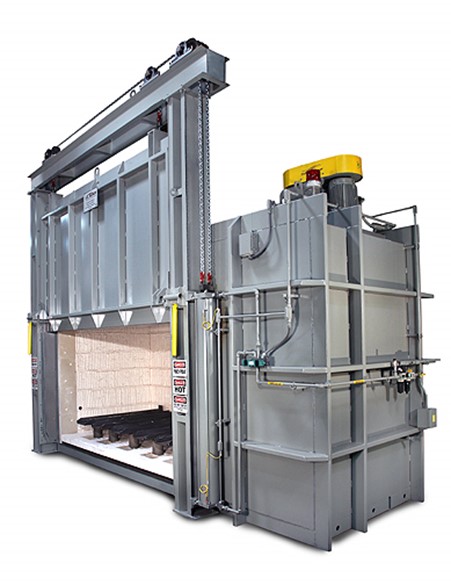
A global producer of highly engineered metal earth moving, construction, and mining wear equipment recently commissioned two large capacity heat treatment furnaces. As part of this turn-key contract, Can-Eng Furnaces International Ltd. designed and commissioned individual tempering and stress relieving furnaces. Both heat treatment systems were assembled and tested at Can-Eng’s Niagara Falls facility prior to shipment and commissioning at the customer’s facility.
The furnace systems were part of a major expansion by the customer to satisfy increased demand for large steel castings and weldments used as part of their equipment designs. Both furnaces are equipped with high efficiency, natural gas-fired heating and recirculation systems that have demonstrated to exceed the requirements of AMS-2750 temperature uniformity. Both systems integrated the company’s preferred PLC hardware, which was upgraded to include a more flexible safety rated PLC over conventional hardwired safety circuits.
During the day-to-day operation of heat treat departments, many habits are formed and procedures followed that sometimes are done simply because that’s the way they’ve always been done. One of the great benefits of having a community of heat treaters is to challenge those habits and look at new ways of doing things. Heat TreatToday’s101 Heat TreatTips, tips and tricks that come from some of the industry’s foremost experts, were initially published in the FNA 2018 Special Print Edition, as a way to make the benefits of that community available to as many people as possible. This special edition is available in a digital format here.
Today we continue an intermittent series of posts drawn from the 101 tips. The tips for this post can be found in the FNA edition under Hardness Testing, CQI-9 Compliance, and Hardening/Tempering.
Heat TreatTip #22
Properly preparing a hardness sample can save time and money.
Inspection Mistakes That Cost
Rockwell hardness testing requires adherence to strict procedures for accurate results. Try this exercise to prove the importance of proper test procedures.
A certified Rc 54.3 +/- 1 test block was tested three times and the average of the readings was Rc 54 utilizing a flat anvil. Water was put on the anvil under the test block and the next three readings averaged Rc 52.1.
Why is it so important that samples are clean, dry, and properly prepared?
If your process test samples are actually one point above the high spec limit but you are reading two points lower, you will ship hard parts that your customer can reject.
If your process test samples are one point above the low spec limit but you are reading two points lower, you may reprocess parts that are actually within specification.
It is imperative that your personnel are trained in proper sample preparation and hardness testing procedures to maximize your quality results and minimize reprocessing.
Whether you need to meet rigid CQI-9 standards or not, what are the top 3, nay 4 best practices that nearly every in-house heat treat department ought to follow to make sure their pyrometer stuff is together?
Daily furnace atmosphere checks. Use an alternative method to verify your controls and sensors are operating properly and that there are no issue with your furnace or furnace gases.
Daily endothermic generator checks. Using an alternate method to verify your control parameter (dew point typically) or the gas composition is accurate will alleviate furnace control issues caused by bad endothermic gas.
Verify/validate your heat treat process every 2 hours OR make sure process deviations are automatically alarmed. this is a solid practice to ensure your controls and processes are running properly. This practice can help ensure that parts are being heat treated to the proper specification intended.
Conduct periodic system accuracy tests (SATs) per pre-defined timelines in CQI-9. Good pyrometry practices are an essential part of heat treatment. Because of the importance of temperature in heat treatment, ensure timeliness of all pyrometry practices addressing thermocouple usages, system accuracy tests, calibrations, and temperature uniformity surveys.
Control of Back Tempering With Induction Heat Treating
Induction heat treating is a selective hardening process. When hardening an induction path close to an area that had previously hardened, the heat from the hardening the second path tempers back the area that was previously hardened. This is a particularly common issue when tooth by tooth hardening of small gear teeth. Back tempering will reduce the hardness on the adjacent area and this effect may range from a few to over 10 HRC points.
Factors to Minimize Back Tempering
Process Issue
Questions to ask
Correct & repeatable placement of quenches
Can quench position be verified and set up repeatedly in the same position?
Verification of quench flow
Is the quench flowing freely through the quench system? Are the quench holes blocked? Are the flowmeters reading accurately?
Integrity of the quench
Was the percentage polymer measured? Is the quench quality okay? Is the quench contaminated?
Inductor design
Is the inductor designed to minimize heat on the tip? Is the quench effectively cooling the part?
Retained heat
Is a skip tooth hardening pattern being used to minimize residual heat in the induction hardening zone? Is the scan speed appropriate?
The first set of twin furnaces working on a single pumping station have recently been developed and commissioned to a leading designer and manufacturer of vacuum furnaces for the heat treatment of metal parts.
BMI, a Tenova company, headquartered in Lyon, France, commissioned the B54R-TWIN – vacuum furnaces for tempering – to meet the customer’s specific request for equipment that optimizes energy consumption.
During a heat treatment cycle of the B54R-TWIN, the pumping phase lasts only 30 minutes. Therefore, it is more efficient to use only one pumping group for two furnaces, working alternatively on one furnace or the other. This not only reduces electricity consumption but also minimizes the maintenance costs of the pumps.
Earlier in this quarter, Tenova announced key contracts from Chinese steel producers for six electrical arc furnaces (EAF) Consteel® Evolution in response to Chinese steelmaking industries converting their steel shops plants with EAF technology. In order to improve the reduction rate of CO2 emissions promoted by Chinese government, Chinese steelmakers are starting to increase the share of electrical steel production in comparison to manufacturing using blast or basic oxygen furnaces.
Combining the ancient craft of blacksmithing with heat treating processes, artisan Robert (Mac) McPherson obtained the finish he wanted for a suit of armor designed after a late 15th-century statue of the patron saint of firefighters. The suit was fashioned with 125 hand-formed, then hardened and tempered metal plates.
Metlab has worked with a number of NASCAR and Indy Racing Car Teams and also companies that restore antique cars, sports and muscle cars and has a history of heat treating race car parts that must endure severe conditions. Big B Manufacturing is a specialty machine shop located in Klingerstown, PA which specializes in design and engineering as well as machining of small and large components. They also make and race off road cars. Big B brought a project to Metlab that required the heat treating of four (4) link arms. The arms are fabricated from 4130 steel and TIG welded with 4130 filler. The suspension parts are for Big B Manufacturing’s racing team.
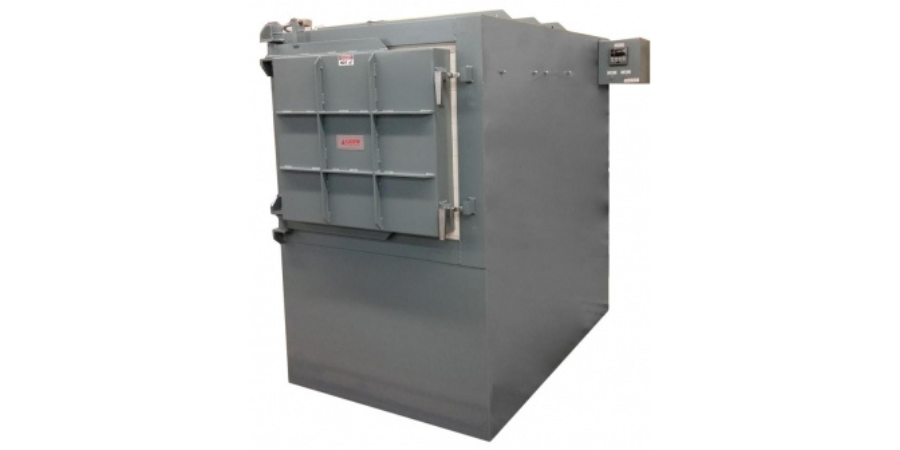
Vermont Custom Gage LLC. a subsidiary of Vermont Precision Tools Inc., Swanton VT, selected Lucifer Furnaces to create manufacturing capability with the addition of an air recirculating oven, a salt bath pot furnace and a quench tank. The new equipment will be used in the production of small steel component parts of their measuring (gage) equipment. The oven, a 4000 series, model 48-R36 with working dimensions of 24”Hx24”Wx36”L, heats to 800°F and will be used for Tempering. Insulated with 6.5” multi-layered lightweight firebrick and block insulation with a roof lined with ceramic fiber modules, the oven features a stainless steel liner which isolates the workload from the heating elements and directs airflow in a horizontal pattern. A high CFM fan assembly mounted through the oven rear wall circulates air over heating elements and back through the work chamber. The horizontal swing door is mounted with heavy duty hinges, 6” of insulation and two cam latches for a secure seal. After pre-heating, parts will be loaded into the salt pot furnace, model 2055-1624 and then oil quenched in a Lucifer Quench Tank, QT-2020, complete with air mixer, heater and soak timer. Next, the tools will be loaded into the 4000 series, model 48-R36 oven to be held at a constant temperature over a period of time to stabilize the structure of the steel. Vermont Precision Tools dba Vermont Gage manufactures a wide range of fixed limit gages including both threaded and cylindrical. Vermont Gage manufactures high quality gages with tolerances ranging from .00020” – .00002”. Vermont Precision Tools Inc. chose Lucifer Furnaces for the equipment based on its robustness and value.
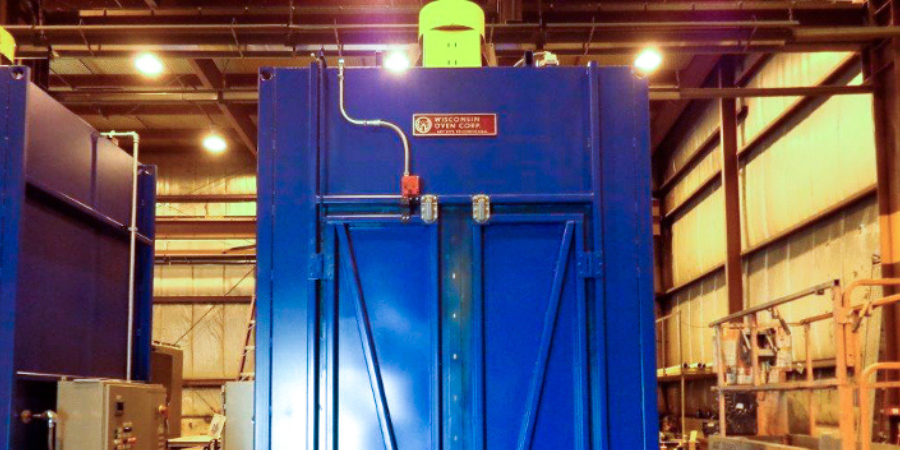
Wisconsin Oven Corporation announced the shipment of two (2) direct gas fired batch ovens to a leading automotive supplier for tempering tire molds. The tempering process of the molds results in a longer mold life. This industrial oven was designed with the load capacity of 6,000 pounds and provides easy access of loading and unloading of tire molds by fork truck.
Each tempering batch oven has a maximum operating temperature rating of 800°F, work chamber dimensions of 5’0”W x 5’0”L x 8’0”H, and a 6” reinforced insulated floor. The recirculation system utilizes combination airflow which provides both horizontal and vertical upward airflow to maximize heating rates and temperature uniformity of the product. The batch oven is equipped with a 10,850 CFM @ 15 HP belt-driven blower. Supply air is delivered through fully adjustable boxed ducts and side-mounted along the length on each side of the work chambers. The heating system features an industrial air heat burner rated at 850,000 BTU per hour.
“Designing a solution for our customers that improves their production process is always a top priority. Improved work flow and ease of loading/unloading was a focus for this project to increase production efficiencies.” Tom Trueman, Senior Application Engineer, Wisconsin Oven Corporation
Unique features of these tempering batch ovens include:
Load capacity to 6,000 pounds
575-volt electrical capacity
Operating temperatures to 800° F
3/16” plate construction for durability
High volume of air flow; 10,850 CFM
Motorized dampers for quick cool down
Natural gas fired
Programmable controller
Meets all Canadian requirements – CUL, CSA TSSA
Field inspection provided by a trained factory technician
Temperature triggered door locks with safety pull cord







 n international arms and military equipment manufacturer in Brazil needed to quickly expand and was recently able to receive a new vacuum furnace to meet their manufacturing demands.