

ECM USA

Heat Treat Radio #127: The Case for Modular Vacuum Heat Treating


In this episode of Heat Treat Radio, host Doug Glenn invites Dennis Beauchesne of ECM USA to explore the technology, benefits, scalability, and sustainability of modular heat treating systems. Together, they discuss how shared utilities, automated transfers, and adaptable heating cells can replace multiple standalone furnaces without compromising quality or precision. Learn how these systems streamline and simplify operations for future expansion — one cell at a time.

Below, you can watch the video, listen to the podcast by clicking on the audio play button, or read an edited transcript.



The following transcript has been edited for your reading enjoyment.

Introduction

Doug Glenn: I am very privileged to have with me today, Dennis Beauchesne from ECM USA. We’re going to be talking about modular heat treating systems, which is a growing category of equipment.

ECM Synergy Center (00:50)

Doug Glenn: Tell me about ECM’s Synergy Center, which is where you are at right now, on the shop floor.
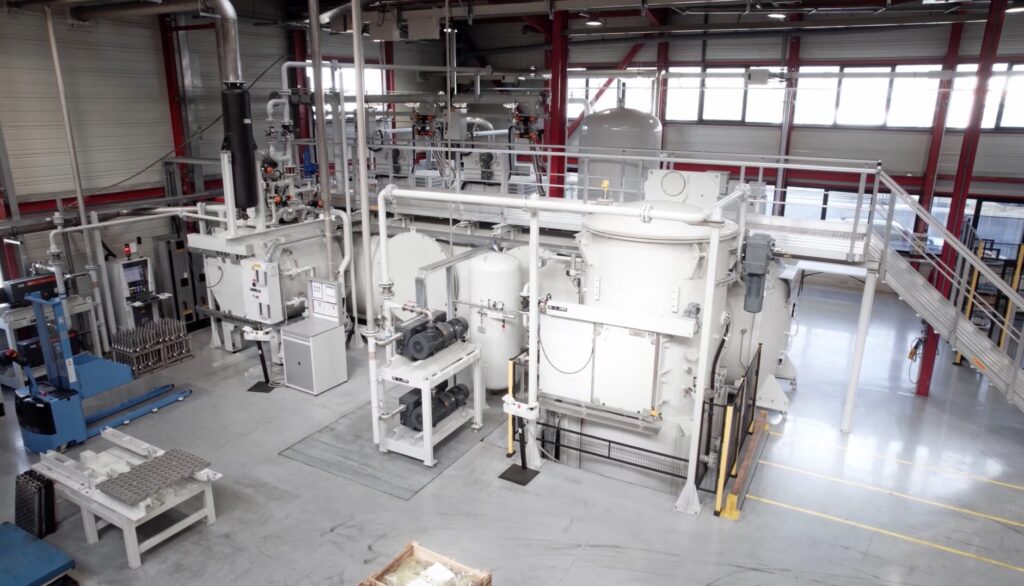
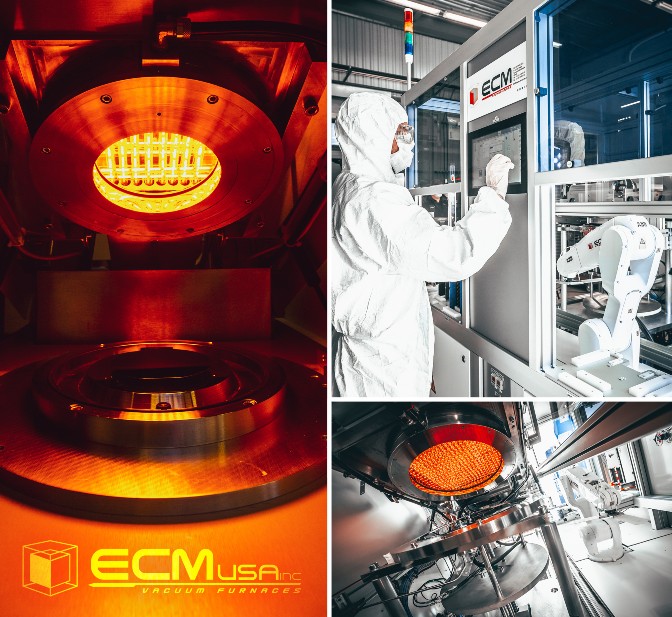
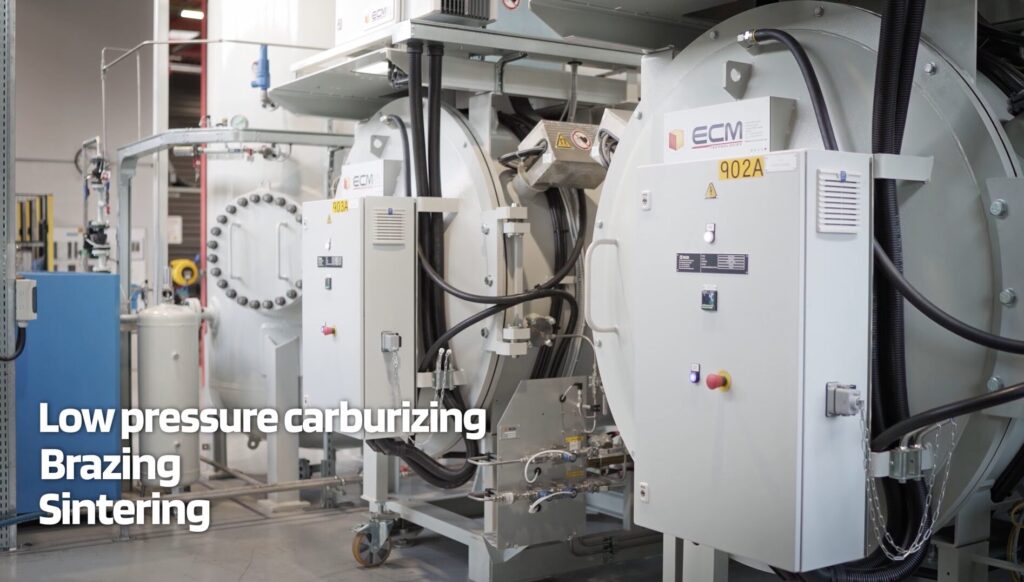
The ECM Flex 600TG vacuum furnace located in the ECM Synergy Center Source: ECM USA

Dennis Beauchesne: I’m standing here in the middle of our Synergy Center. It’s about a 5,000-square-foot facility that is dedicated to proving out client parts for testing various processes, mostly LPC, but we also do a number of other processes here. We have a full metallurgical lab, 3D microscope, a number of tools, including a CMM that we can do before and after heat treat distortion testing for clients that want to know how much their parts move.

It’s a dedicated center just for clients to use. We also use the center for pre-completion of installations, final testing, and training, such as training on maintenance, understanding the software, and how everything works together.

Doug Glenn: It’s proof of process plus much more — helping clients’ proof of process.

Dennis Beauchesne: Absolutely. That’s a big part of convincing people that this process is for them and that it works on their part. We can send them ten different reports of an exact same material and part, but they want to know what their part will do.

What is Modular Heat Treating? (02:50)

Doug Glenn: On a very basic, rudimentary level, what is modular heat treating and how does it differ from what might be considered standard or normal heat treating?

Dennis Beauchesne: A modular heat treat system is one that works together to have more than one furnace working in the same platform. You may have a shop that has five or six vacuum furnaces separated — they each have their own door, vacuum system, electrical supply, quench motors…those types of components. Or you may have a series of batch IQ furnaces for carburizing; those systems are one off, which means they are individual, independent systems.
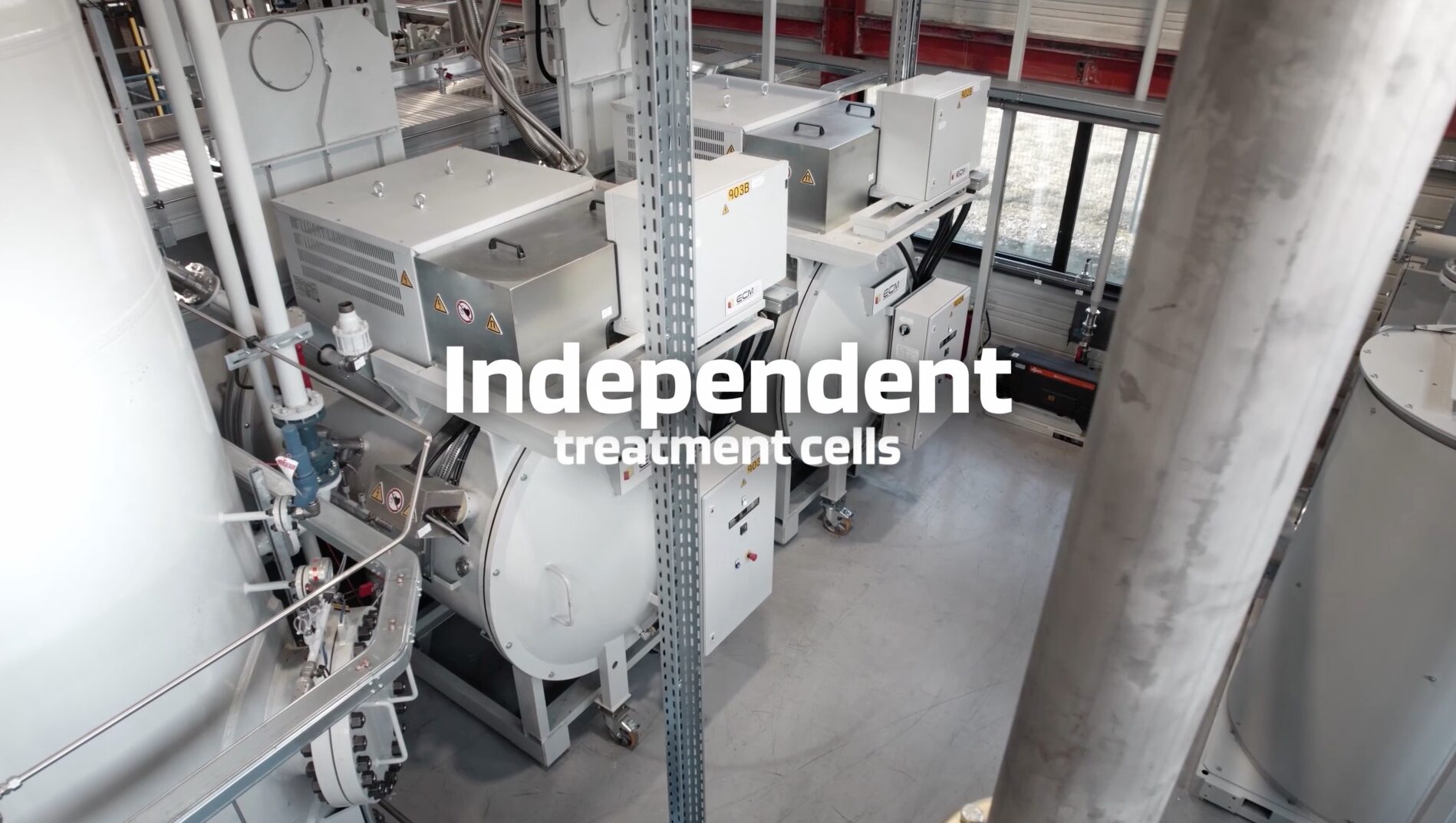
In a modular system, you try to utilize those facilities for the use of multiple heating chambers. Instead of having one vacuum furnace with one set of pumps and one gas quench motor, what we would do is have three to eight heating cells that would be utilizing one quench, depending on the process timing; that’s all done with an internal transfer car and we try to utilize one vacuum system. It’s much smaller than what you would have for three, four, or even eight cells.

If you had oil or high pressure gas quenching, which is what’s dominating right now in the modular heat treat business, you could supply basically six batch IQ hot zones to one oil quench.

The savings then are huge simply by removing five or six other quench tanks in front of this system, as well as leveraging the floor space (and the number of pits you have to dig). Other advantages including utility savings and utilizing equipment across a number of heating chambers.

Doug Glenn: This modular approach is basically separate chambers that are dedicated to doing whatever that chamber is doing, and they are all in some way interconnected. For standard units, you would heat up, pre-process, do the actual process itself, cool down, all in the same chamber. In a modular unit, you move from chamber to chamber to do each of those separate steps.

Dennis Beauchesne: Yes, I refer to it as a continuous batch.

Doug Glenn: Continuous batch. We were talking before we actually hit the record button with your colleague there, Allison DeAngelo, who just got done visiting the Heat Treat Boot Camp. We were talking about different types of furnaces, and we started talking about continuous vacuum, which of course, is almost a misnomer — a vacuum can’t be continuous because you have to open it up and break the vacuum to get stuff out. Anyhow, we talked about it basically being a batch, right? A batch furnace that’s continuous, a continuous batch furnace.

Benefits of Modular Heat Treating (06:35)

Now that we have a basic understanding of what these modular systems are, why would companies want to move from the standard type of heat treating system to a modular system?

Dennis Beauchesne: Manpower. If you are running five or six vacuum furnaces, you are going to need a number of people to open the doors, put new loads in, those kinds of tasks. With a modular system, you only have one entry or one exit area. Therefore, you are only going to load once every 15-20 minutes, and the system is going to take over and control that load going through the system.

In addition, especially in a carburizing atmosphere situation, you can have every load be a different case depth — a different process in each cell — and then the next load that goes in that same cell can be totally different from the one before. For instance, if you had a batch IQ, you typically use the same carbon potential, and you are typically going to run the next load almost identical to the one before. In contrast, with the modular system, each cell can run a different process every load.
It’s also easier to integrate automation if you are doing capacity increases.

Throughput Comparison (08:00)

Doug Glenn: What is the comparison of throughput between a standard unit and a modular unit?

Dennis Beauchesne: The throughput comparison is interesting because you typically can use a little higher temperature for a carburizing and a little higher carbon potential, and of course that’s what we specialize in here with the modular systems. You can achieve about a 30-40% gain in your cycle time. That furnace is operating very close to 100% occupancy, because when that load is done, you are moving it out right into the gas quench. Then, the next load comes and goes right into it.

Doug Glenn: You are able to increase your throughput because you have basically 100% utilization of the equipment or very close to that. Comparatively, you don’t necessarily have that in the standard equipment.

Product Quality Comparison (09:15)

Doug Glenn: Do modular systems produce higher quality products?

Dennis Beauchesne: The quality of the parts coming out of the system is improved. A vacuum environment is a very clean environment, especially if we are considering atmosphere and low pressure carburizing — it’s in a vacuum. We typically do everything in high pressure gas quenching. However, even in oil quenching under vacuum, you are going to have a much cleaner part.

Also in low pressure carburizing, the carburizing is much more uniform throughout the part because we heat it to temperature under nitrogen before the part gets to austenitizing temperature to start attracting carbon. We make sure that the full part, that’s the tooth, the root, every piece of the part, is at temperature before we start adding carbon to the load, which makes a more uniform case depth, and therefore makes a stronger part.

Doug Glenn: Since each module, each chamber, is dedicated to doing what it is supposed to do, it seems like the consistency and the reliability of the parts being processed in a modular system have a much better chance of being higher quality.

Dennis Beauchesne: You do not have six different variable chambers or six different variable systems. You just have to look at monitoring the connection between those and understanding that the vacuum levels are all the same across the levels and across the cells. Each cell can meet a different temperature and run a different process, but those are consistent across the board.

Typical Dedicated Cells/Chambers (11:10)

Doug Glenn: What would be the typical dedicated cells/chambers of a modular system?

Dennis Beauchesne: It is dependent on the processes. They are most widely used for vacuum carburizing. For pre-oxidation and preheating, we usually use an air oven outside of the system, and we connect that with an external loader. Before the load goes into the modular system, the load will go through a regular air oven, be heated to around 700°F (400°C), and then the load will be moved in.
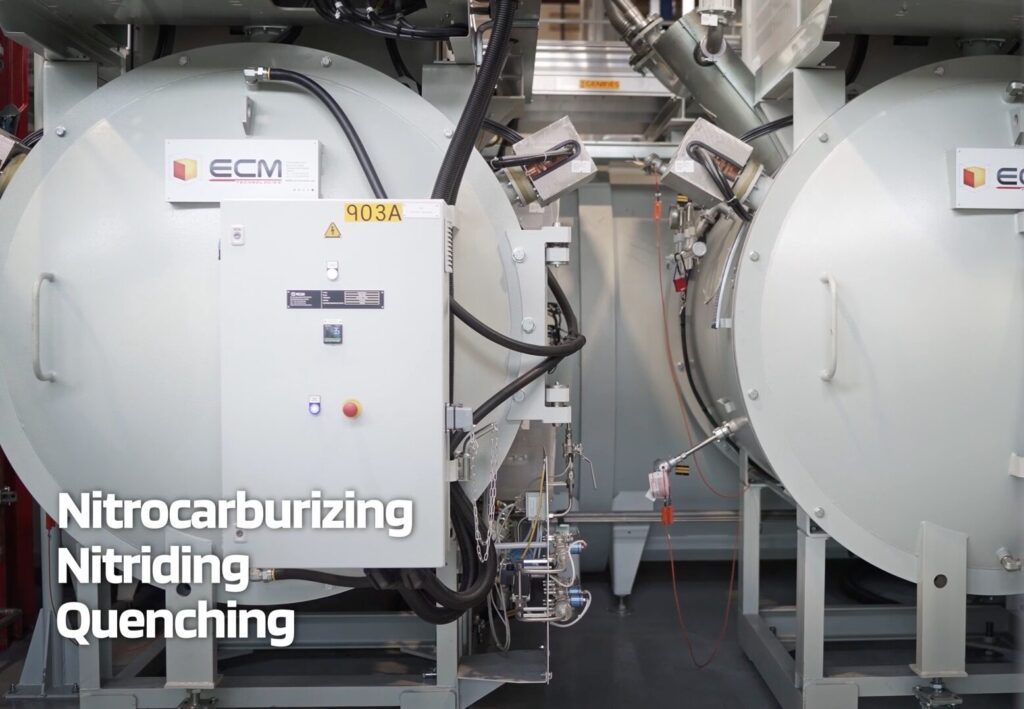
For sintering and those kinds of applications, there is a debind step or a preheat step that would be done in one cell. Some of the processes that can be done in a modular system include:

  • Low pressure carburizing
  • Low pressure carbon nitriding (LPC)
  • FNC (ferritic nitrocarburizing)
  • Nitriding
  • Debinding
  • Sintering
  • Neutral hardening

The most prominent process right now is LPC, and that is being used all over the world in these systems.

Advantages of a Modular Unit for Captive Heat Treaters (12:53)

Doug Glenn: Why would a modular unit be beneficial for a captive heat treater, someone who does their own in-house heat treating, which probably means they’ve got potentially high volume, low variability as far as their workloads?

Dennis Beauchesne: The modular unit has many different advantages. First of all, floor space. You are going to save a lot of floor space by not having multiple furnaces set up separately. You will also save utilities because you would not have as many vacuum pumps or electrical systems running these furnaces on their own. You will have some shared service and utilities in that fashion.

Doug Glenn: That would also likely lead to maintenance cost savings as well, correct?

Dennis Beauchesne: Yes, it all goes down the line. Anything that you have multiples of, you are going to have much less costs than on a joint system. The modular system might be a little larger than one singular unit, but there will be fewer of them.

For vacuum carburizing applications in a captive shop, the quality and cleanliness of the part is very, very important. Gas quenching lends itself to no oil in your plant, no washers necessary for a post-quench. Typically, there’s a washer before the process starts, but you do not have to have any wash to get the oil off of the parts with a modular unit — you do not have to reclaim the oil or the water from the washer. You would not have waste oil in your plant either or any oil on your plant floor. These are some of the reasons some of the larger captive shops have gone to the modular systems.

Also, safety: There are no open flames with a modular unit, no risks of fire on the systems. They are also easier to maintain. For a fully operational, let’s say, eight-cell system for high production, captive operation, it would only take about five hours to cool that whole system down if you had to go in and work on the whole system. In comparison, it’s going to take you three to four days sometimes to cool down a typical atmosphere, high-temperature furnace.

It also takes time to heat the system up again. In a modular system, it takes about an hour and a half to heat the system up again and then you are ready to start running. That means now you can schedule your downtime on weekends or holidays. You do not have to have staff present to run anything.

You also do not have to have a secondary equipment, like Endo generators running to feed the carburizing gas. The carburizing gas is using acetylene out of cylinders, it’s not a regenerative system. You do not need a separate piece of equipment to feed to the furnace.
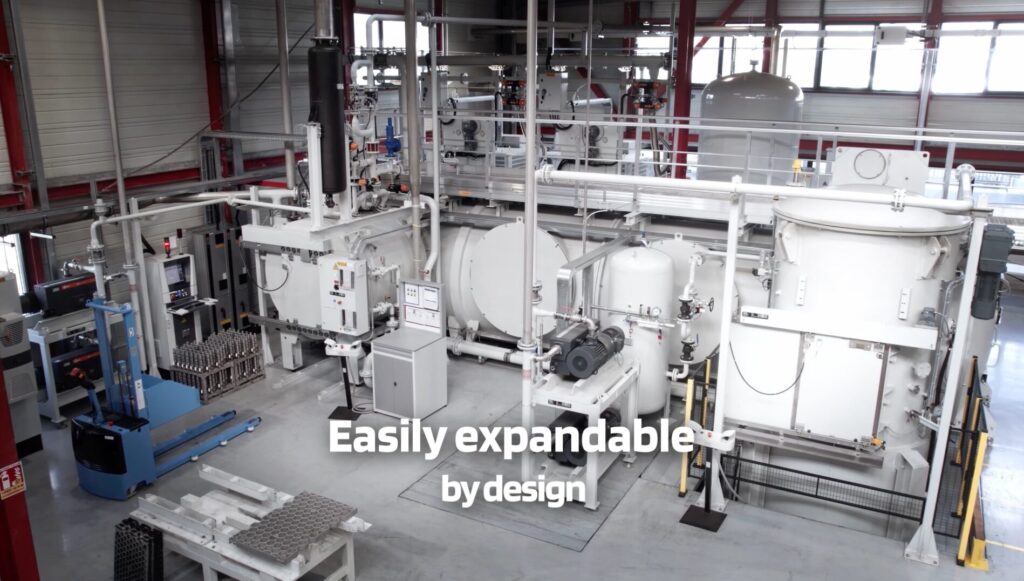
Another benefit is CapEx expansion. Typically, captive heat treaters do not want to buy everything upfront because their volumes are going to increase over time. In the beginning, they typically only need one or two cells ready to do a small amount of production so they can prove out the production and prove out the system. Then they can start building the system with more cells and more capacity later on. Generally, it’s two to three days of downtime to add a cell to a system. It’s very convenient to do that with a modular system. All of the utilities are typically alongside the modular system so that you can easily add those or add a cell to it over a short period of time, and those cells can be ordered a year or two down the road whenever you might need that.

You also can order peripheral equipment, like extra temper ovens or additional automation. You can add a robotics system to the layout as well. That’s why captive shops are very interested.

Finally, workforce: It’s a little bit easier to get someone to work on a modular system. These systems are completely clean and white. The one located in our Synergy Center has been there for eight years. We use it every single day, and it’s a very clean aesthetic environment for someone to work in. These systems are also water cooled, which means not a lot of extra heat in the building around you to work in.

Advantages of a Modular Unit for Commercial Heat Treaters (17:59)

Doug Glenn: What are some advantages of modular units for commercial heat treating?

Dennis Beauchesne: On the commercial heat treat side, modular units are typically useful because you can get multiple processes out of similar cells and you can have a system that has oil and a gas quench.

You can have a lot of flexibility in that one system that you have in the plant. I’ve visited hundreds of captive and commercial heat treaters. They generally have a number of furnaces in one area of the plant, and a number of furnaces in another area of the plant. A modular system gives you all the capability in one machine and one tool: oil quenching, gas quenching, FNC, nitriding low pressure, carburizing, carbonitriding, and neutral hardening all in one piece of equipment.
Automation and Robotics with Modular Heat Treating (18:57)

Doug Glenn: What automation and robotics advantages are there with modular systems?

Dennis Beauchesne: This is the new trend. People that have modular systems are now considering, “How do I automate the system to get more production out of it?” And what we’ve been doing the last five years especially is implementing systems that use CFC fixtures.

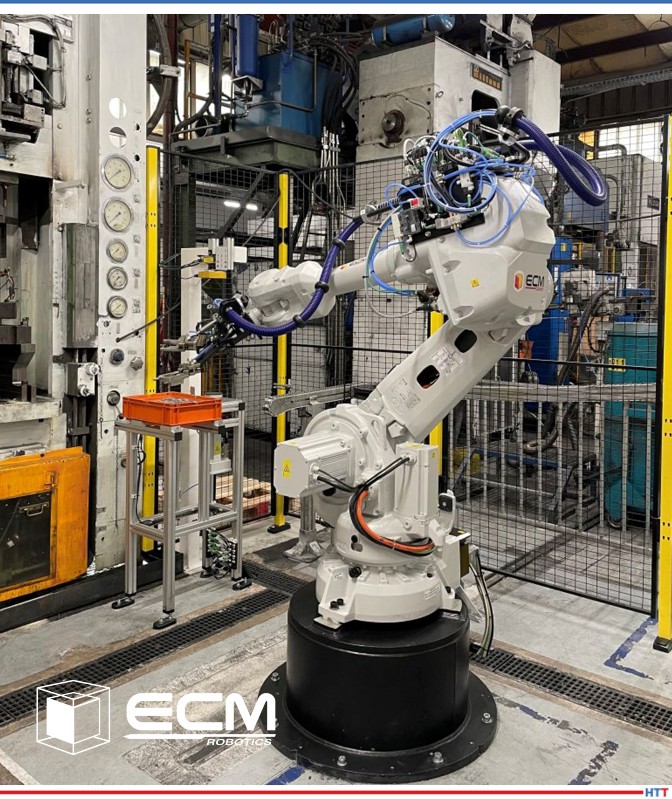
CFC fixtures are very robust in the furnace but sensitive to being controlled outside. Therefore, what we try to do is have the CFC fixtures be utilized in an automation that no humans have to interact with it. We usually use robots for external loaders and internal loaders to move the fixtures through the process.

This causes you to have a lighter load, which means less heating time, less energy being consumed. Also, the fixtures last three to four times longer if they’re not damaged. But of course, all of these systems can be using regular alloy steel as well, and we can fixture different parts. You can use baskets, we are now doing bulk loading where we have parts that are filled into baskets and then processed. We are doing that with vacuum carbonizing as well, not just neutral hardening.

So it’s really interesting to see how the limits are being pushed, as well as the different materials that we are gas quenching now. I know 20-25 years ago, we were quenching some simple materials that were very high hardenability, and today we’re quenching a lot of less hardenability steels.

Doug Glenn: Is that primarily due to increase of pressure in the quench?

Dennis Beauchesne: It’s pressure, it’s flow, it’s the intensity of the gas going through the parts. It’s also heat removal as well — heat exchangers, removing the heat out of the load faster. We also have reversing gas quench motors to reverse the flow inside from top to bottom, bottom to top, in the middle of the cycle.

Sustainability of Modular Heat Treating (22:24)

Doug Glenn: Do these systems promote sustainability and greenness?

Dennis Beauchesne: Absolutely, especially when it comes to carburizing. These systems have been compared against typical atmosphere carburizing cycles, and only about 4% of the carburizing time has gas injection, when we are actually injecting acetylene and having hydrocarbons being used in the process.

If you took the same cycle times, seven or eight hours of a carburizing cycle, you are flowing Endo gas or nitrogen methanol in the system for that full time. In contrast in a vacuum carburizing system, it’s 4-5% of the time of the cycle that you’re injecting into the furnace. Ultimately, you only have about 10% of the CO2 output that you would have in a typical atmosphere furnace.

As mentioned previously, there’s also no oil in your plant. You’re not reclaiming oil out of the water and the wash or off the floor or in your car when you leave your heat treat shop.

How Does the Modular Heat Treating System Work? (23:40)

Doug Glenn: Let’s talk through the process a little bit. You provided us with figures to aid in describing the process. We have included these. Describe how the system works.

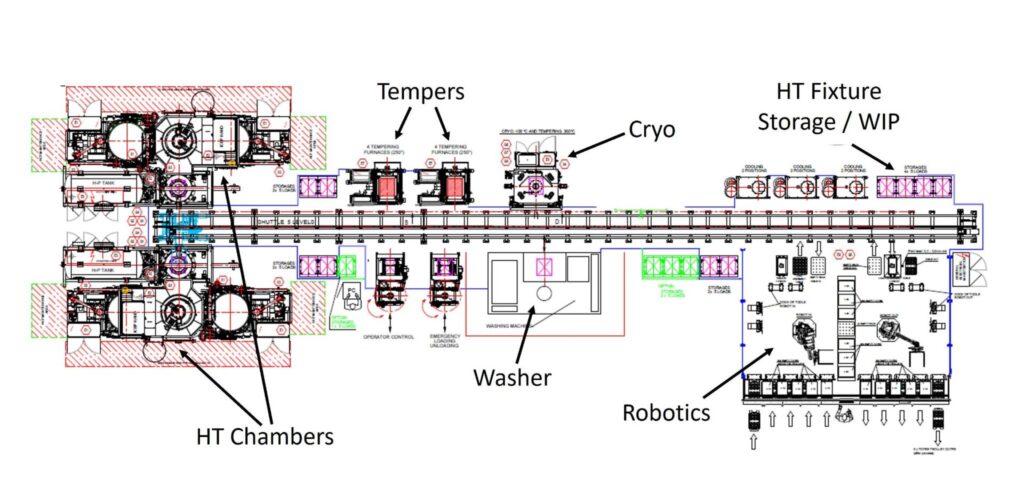
Dennis Beauchesne: This animation is a plan view of one of our Flex systems. In the center, going left to right, is a tunnel section. This tunnel section is about an 8-foot diameter. It has an automated loader that moves down left to right or horizontally, and it transfers loads from each cell to another, in and out.

On the bottom left is a loading/unloading chamber. In that loading/unloading chamber, we remove the air once the load is put in there, and then we balance the vacuum on that cell to the tunnel’s vacuum. Then we’re capable of moving that load to an available heating cell, and that would be on the right of the system — on the top right or the bottom right of the tunnel, those are heating cells. Then recipe for that particular load will be loaded into that cell. While that load is processing, another load will be moving into the tunnel and into the other heating cell as well.

On the top left is the gas quench cell, which could be in this orientation or instead have an exit on the back as well. In this system, you could do neutral hardening, carbon nitriding, LPC, a number of the processes. This is a very valuable tool, especially in a commercial heat treat heat treat shop.

Doug Glenn: Is this whole unit, including all four chambers under vacuum? I noted there are separation doors on the purge and the entry chamber. Can this area be vacuum sealed?

Dennis Beauchesne: Yes. There are vacuum seals on the loading/unloading chamber on the bottom left and then the top left. The gas quench also has a seal from a pressure standpoint. The two heating chambers have a graphite door — we call it the flap door, and it just flaps and it doesn’t really seal actually against another face of graphite. It’s graphite-to-graphite. We pull vacuum out of there through the tunnel to create the central vacuum pressure in the system. We also pull vacuum from the cell itself, and we could also have a separate door on the front of the unit if the process necessitates that or if we feel that a door is needed there by a client.

In a normal state or a standard unit, there are no hot seals on the door, only vacuum seals on the loading/unloading chamber and the gas quench.

Doug Glenn: In the animation, your vacuum pumps are down in the bottom right, correct?

Dennis Beauchesne: Exactly, that’s a process pump.

Doug Glenn: What is located in the top left?

Dennis Beauchesne: On the top left, we have a gas quench tank. We want to ensure we have enough gas pressure and volume there to quench the load quickly. It’s very important to get the gas through the gas quench quickly.
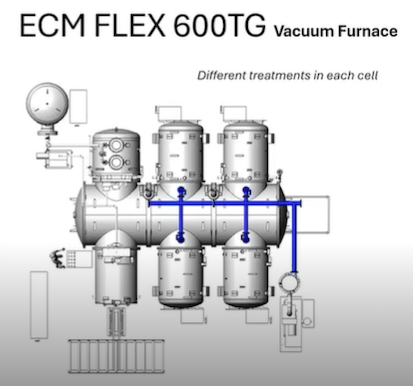
ECM Flex 600TG vacuum furnace with two added heating cells / Source: ECM USA

Now, we have added two more additional heating cells and a central tunnel section. In essence, you just doubled the space, doubled the capacity of the unit, where you only added 50% of the space of what you had for capacity before.

We are still utilizing the same gas quench and the same loading/unloading cell. We only added utilities for the two heating cells, not for a whole gas quench or oil quench capability there; this can be added in a very short time.

Doug Glenn: Now I’m gonna go let this video roll here for a minute. There we go.
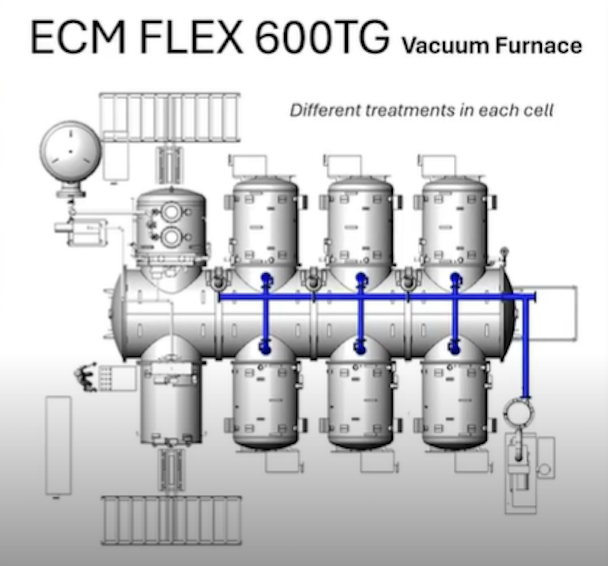
ECM Flex 600TG vacuum furnace with four added heating cells for six heating  cells total

Dennis Beauchesne: So now we added another 50% capacity with two more heating cells (six heating cells total) and a tunnel section. Typically, what you want to do is to have the tunnel sized for about five years out for your capacity and then buy the cells as you need them and have it grow so then the tunnel is ready to implement.

We have just tripled the capacity of this installation, and we are only still using the same gas quench and the same loading/unloading cell. Generally, this system could go to eight cells and have just one gas quench, that’s our typical orientation.

Doug Glenn: It looks like we also added a discharge side here. Whereas before we were going in and out.

Dennis Beauchesne: Yes, this adds to the efficiency of the system because the load is already in the gas quench when it’s finishing, so it just exits out the back, out the door.

Doug Glenn: Now what do we have here?
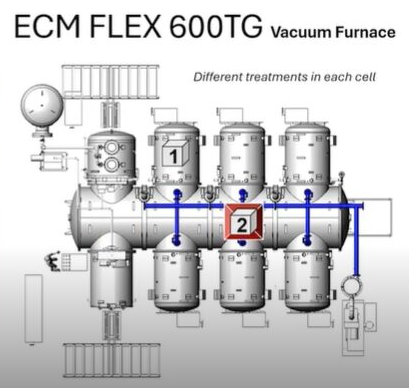
ECM Flex 600TG vacuum furnace processing different treatments in each cell. See animation above to watch the animation in motion.

Dennis Beauchesne: We have the loads entering, and the loads will go to the first cell that is available (empty). Then that recipe would be downloaded for that cell, and then the next load will go to the next available heating cell and download that recipe into that cell. These could be two different loads.

One load could be for neutral hardening; one could be for carburizing. One could be for carburizing in a low case depth. The other one could be carburizing at a deeper case. In this case, we just see the gas quench on here, but this tunnel could also be outfitted with an oil quench as well, and you could have one load go into gas, quench one load, go into oil quench or both going to either.

Doug Glenn: This gives people a sense of what the process looks like.

Processes and Materials for the Modular System (30:29)

Doug Glenn: Are there any processes or materials that do not make sense to process them through one of these systems?

Dennis Beauchesne: If you are doing a lot of annealing and normalizing, those are longer cycles. There is some regulated cooling that occurs. This is not really the type of equipment investment that you would want to make for those processes. If you were going to use it for a few loads in your plant where you received parts that weren’t annealed or you wanted to try to anneal a part for a particular process before you went to full production, you could certainly use a modular system for that, but it’s not a cost effective methodology. Neither would we recommend preheating in the cell. However, it is very flexible for a number of other processes that we have mentioned.

The size of the part is also important to note. These systems are typically 24 inches wide and about 39 inches long and about 28 inches high. However, we will soon have a new system, the Flex Max, a 12-9-9 system. It’s a 36×48 unit that comes with an oil quench and is modular, like this. We can either do an oil quench or a slow cool cell on that system. So, we will have that capability of 36×48 in that modular system.
Other than that, restrictions on material? Very few there. Like I said, you would not want to do annealing and normalizing on a lot of parts, but you could do it in these units.

Doug Glenn: It sounds like the sweet spot is surface modification type applications, and some sintering is possible with dedicated chambers.

Dennis Beauchesne: Yes, sintering and brazing is also possible.

Doug Glenn: Does that include aluminum brazing?

Dennis Beauchesne: Not aluminum brazing, but some brazing applications.

Expenses with Modular Heat Treating Systems (33:03)

Doug Glenn: What would be considered capital expenses for this modular system?

Dennis Beauchesne: As far as capital expenses, it’s not a furnace-to-furnace comparison. Clients always ask how much our furnace is. But companies need to first take two steps back and take a look at their incoming material, how they would like to be able to modify that incoming material in their heat treat process to make sure that their outgoing quality is higher than it is today. That’s the kind of benefit that this type of modular system gives you — a better quality part, safety in your plant, and a better quality work environment with being able to turn the system off and not need additional personnel around.

These are all factors that have to be considered when thinking about the CapEx expenditure and investment. When we consider these factors, a modular system investment is a much better situation than looking at a furnace-to-furnace replacement, and that’s really the thought process that clients need to go through to understand the actual investment and value of the system.

Doug Glenn: What about the operational expenses?
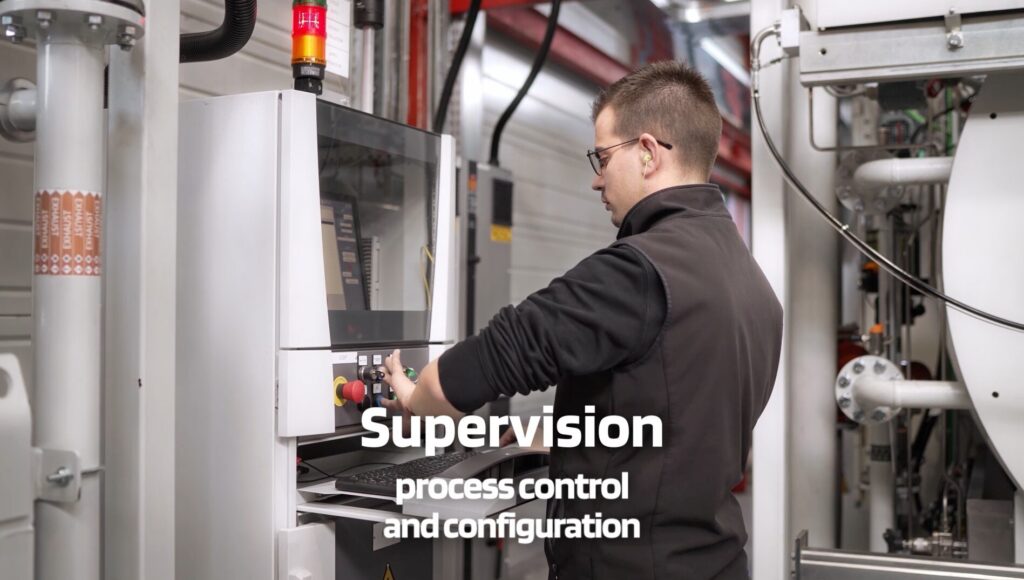
Dennis Beauchesne: For instances, if you had a batch IQ sitting there, you would typically keep it running whether it has a load in it or not. With a modular system, you just shut off that cell that you’re not using. It does not take any more energy. If you are not working five days a week, you do not use it on the weekends — you shut it off. You do not use it during Christmas shutdown or any holiday shutdown, vacation shutdown. You’re able to shut it off and that means saving a lot of energy and labor by having it off.

Also, in the opposite way, you could run it lights out if you wanted, as well. You could stock up a number of loads on the automation before you leave, have the system operate it, run it, and have the load come back out before the morning. You could have it time start as well, if you wanted to start it on Monday at 5 AM, but you will not be there till 8 AM. You would come in and the furnace would be hot and ready to run a process.

There are a number of operational advances over the typical operational heat treat that’s out there today.

Doug Glenn: How does maintenance work with these systems? Say your heating element goes bad in cell number three, do I have to shut the whole system down to fix or can I fix number three and leave the rest of the system up and running?

Dennis Beauchesne: In this situation if you had a tunnel like we showed, you would typically shut off that cell; that is, if you knew that heating element was out or it wasn’t heating properly, you could shut off that cell, de-validate is what we call it, and then keep running the rest of the system until you had a window in your production that you could shut the whole system to get into that heating element.

If you had a system with doors on the front, it could be possible to go in the back while the system is operating. Then, it would be all based on your safety requirements for your plant and those kinds of things.

To do that, we have another system called the Jumbo, and it is much more flexible in the maintenance world. It has a vacuum car that moves down on rails and docks and mates with every heating cell on the system. In that line, the heating cell can actually be isolated from the rest of the line. You would just slide it back (It’s on wheels, it slides back about three feet away from the line), you put in a new piece of safety fence, and you continue to run your line. You can completely lock out/tag out that cell and work on it completely.

Doug Glenn: How would you approach a vacuum leak since the whole system is connected, right? I believe you mentioned these are graphite-on-graphite doors.

Dennis Beauchesne: You would want to fix the leak before you move on. Especially if it’s a bad leak. If it’s something that’s causing you to not maintain your process pressure, you certainly don’t want to do that, and that’s true with every vacuum piece of equipment.

ECM Modular Systems (38:55)

Doug Glenn: How many of these modular type systems does ECM have out in the marketplace?

Dennis Beauchesne: The Flex is the most popular modular system, which we discussed with the animation. We also have a number of Jumbos systems, and the unit in our Synergy Center is called a Nano, which has become more and more popular these days. The Nano has three different size chambers, but they’re typically smaller, 20x24x10 inch high size chamber. I explained a little bit about the Flex and the Jumbo is the same.

Out of those three systems, we have more than 350 modular systems, not just the heating cells, but more than 350 systems that are out in the marketplace today operating, running parts every day, running millions and millions of parts every week. Those systems are comprised of about 2,000 heating cells. As much as people hear about this being a new technology, it has actually been around about 30 years, and many companies have been using these systems and have replaced a number of pusher furnaces and those style furnaces for high-capacity installations especially.

Doug Glenn: Okay, that sounds good. I really appreciate your time.


About the Guest

Dennis Beauchesne
General Manager
ECM USA

Dennis Beauchesne joined ECM over 25 years ago and has since amassed extensive vacuum furnace technology experience with over 200 vacuum carburizing cells installed on high pressure gas quenching and oil quenching installations. Within the last 10 years, his expertise has expanded to include robotics and advanced automation with the heat treat industry high-demand for complete furnace system solutions. As General Manager of ECM USA, Dennis oversees customer supply, operations and metallurgical support for Canada, U.S., and Mexico for ECM Technologies. He has worked in the thermal transfer equipment supply industry for over 30 years.

For more information: Contact Dennis at DennisBeauchesne@ECM-USA.com.


Heat Treat Radio #127: The Case for Modular Vacuum Heat Treating Read More »
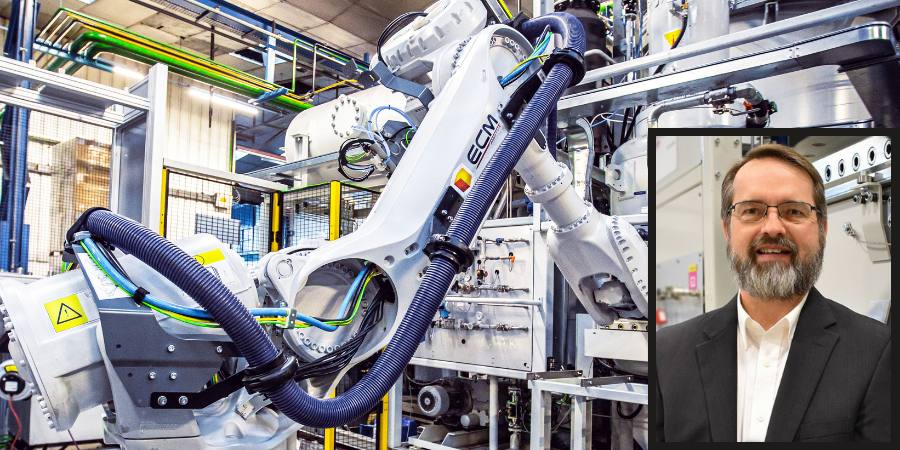
The Heat Treat Robotic Paradigm Shift

As Thomas Bauernhansl, professor of Production Technology & Factory Operations at the University of Stuttgart, aptly states, “We are going from more supply-oriented production to a demand-oriented one. In many cases, the customer determines which version he wants to have [of] a product — the manufacturer adapts to this and his processes accordingly.”

This shift is critical for the heat treat industry, where the need for advanced automation and robotics integration is paramount to achieve higher efficiency, consistent quality, and reduced costs. In this Technical Tuesday, Dennis Beauchesne, general manager at ECM USA, discusses the increase in use and installation of automation and robotics in manufacturing and specifically how companies within the heat treat industry have adapted to their implementation—and become innovators in their usage.

This informative piece was first released in Heat Treat Today’s January 2025 Technologies To Watch in Heat Treating print edition.


Industry Automation

In the last 10–15 years, an upward trend is consistent with the increased investment value of integrated automation within a heat treatment plant. At the beginning of the 2000s, it was common to have an automatic transport car transporting batches to different stations, but, in the last five years, far more complex automation solutions are in demand. In order to meet the requirements of future industry robotics and automation, our industry must adapt to the new and improved technology offerings and standards that are being used in other industries.

Figure 1. Annual robotics installation by industry 2021-2023

According to World Robotics, there has been a significant increase in robotics usage and installations since 2020 (Figure 1). For example, the automotive industry shows installations almost doubled from 2020 to 2022 with 83,000 installations in 2020, compared to 136,000 installations in 2022. The industrial robot market was expected to grow by 7% in 2023 to more than 590,000 units worldwide. Although it exceeded 500,000 installations, robotics were down 2% (possibly due to COVID-19) compared to the prior record year. Of interest to note for the automotive industry, the industry increased its robotics demand in 2023 to surpass electronics with a 25% share (electronics was close with 23%, down by 5% due to inventory levels stabilizing after supply chain bottlenecks mostly vanished).

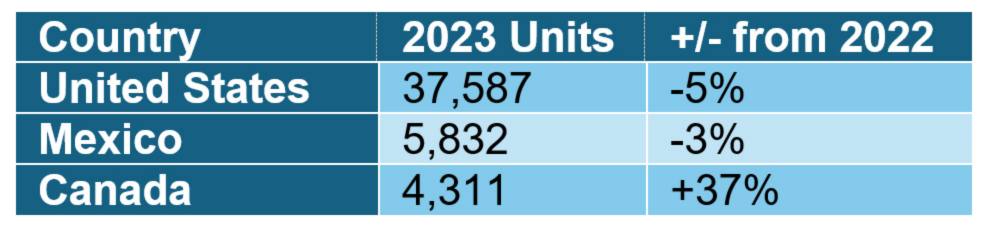
Table 1. North America’s robotics comparison 2022 to 2023
Source: World Robotics

Specifically for the United States and Mexico, peak robotics installation demand was documented in 2022, but demand has been consistent within +/-5% (Table 1). The future of robot installations is trending to grow and exceed 50,000 units in North America for 2024. Nearshoring of supply chains will create demand for automation technology in the years to come, according to Christopher Müller in his World Robotics 2024 – Industrial Robots presentation.

Manufacturing Concepts

The company SEW has previously published its ideas and concepts of autonomous transporters distributing the raw parts to the production cells, after the soft processing to the hardening plant, and finally the hard machining (Figure 2). All steps are configured within the component so the process steps can be well documented on a component basis.

Figure 2. SEW concept from Hiller, “The networked hardening shop,” 2019
Source: ECM GmbH

As can be seen in the SEW Figures, the original hardening plant is shown as a continuous furnace. However, this type of plant technology can be seen as contradictory to current production needs. To be compliant with this new philosophy, plant technology must be as modular, flexible, and automatable as the rest of the production layout and components. Heat treatment must also be controllable and unloadable with automatic transport units. Robots must be able to load batches and navigate the plant (according to CHD, steel, part numbers, etc.). The smaller the batch size, the larger the value of robotic component documentation. Furthermore, a reduction in batch size is advantageous for flexibility, costs, and heat treatment of many requirements for production runs.

Heat Treatment & Robotics

A heat treatment plant can implement
recommendations for the future of industry
automation by acquiring technology for:

  • Automatic loading/unloading
  • Component recognition systems
  • Automatically loaded/read recipe systems
  • Smaller batch sizes with a wide variety of variants
  • Heat treatment of different applications or steels in small quantities
  • Maintenance/repair detection

Benefits of automating part or all production line steps include:

  • Shorter process times
  • High CHD (Case Hardening Depth) uniformity and lower distortion
  • Lower operating costs and labor reduction

These technologies have existed and are being implemented in heat treat operations for a few years now. The results are clear and the benefits are proven through higher quality parts, highly efficient heat treat operations, and overall more efficient production facilities.

As many machining operations have been robotized, this allows the downstream heat treat operations to easily take advantage of part placement in dunnage and plant transport systems, whether manual or automated.

Figure 3. ECM Vision System
Source: ECM Robotics

Batch Loading with Robotics

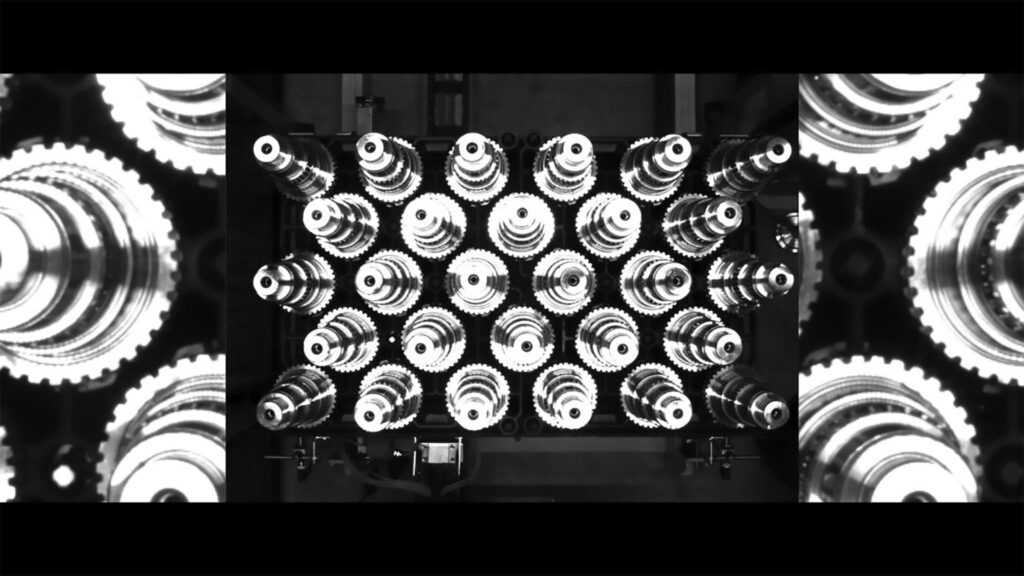
Bulk goods-loading (such as clips, links, and other small parts via weight detection) as well as loading and unloading of truck shafts in fixtures and in straightening machines are just a few examples of production areas that can benefit from robotics/automation. Visual recognition systems can identify gears/parts based on the diameter or by the number of teeth on the gear and can then sort them by these features (Figure 3).

Like the visual locating of the parts by cameras, they can also be used for tracking parts and loads within a heat treatment cell. A good amount of work has been done in this area for heat treating. This work covers part marking, tray/fixture encoding, and part weighing scenarios, and allows the heat treat system to accurately process all the different parts coming through the heat treat system with the correct process recipe.

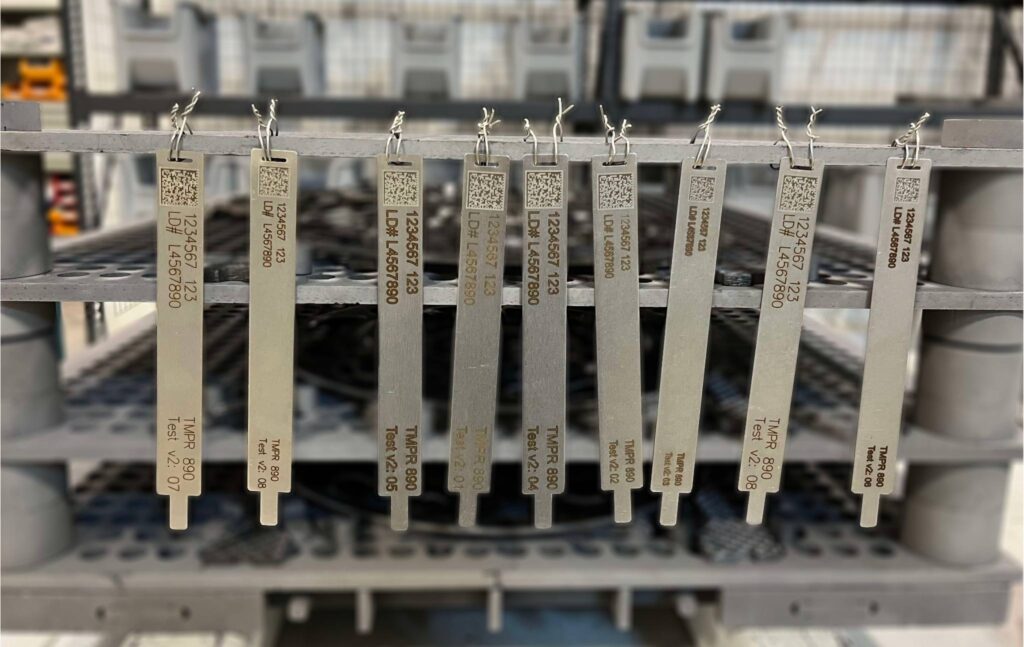
Some of the work being done has been implemented with a QR code marking system for each part before heat treatment. To ensure the correct recipe or heat treatment is performed on the proper part, this scanned code works with the heat treatment system controls to upload the correct recipe to the proper cell. This information can be further analyzed to indicate precise placement in the heat treat tray through virtual tracking.

Figure 4. QR code heat treat test picture
Source: ECM USA Synergy Center

In Figure 4, you can see in the details that this client has reviewed and tested to assure the code is visible before and after heat treating with a carburizing and hardening process.

These parts are tracked when entering the system and also noted as to which heat treat tray they are on by using a binary code with holes in a tray or on a strategically placed bar code plate on the tray. With this system, they can be scanned by a camera before entry and upon exit of the furnace (Figure 5). This tray scanning can also indicate how many cycles the trays have on them to ensure the trays stay in good condition and can be cycled efficiently.

Figure 5. Lohmann Steel barcode scan plate (Images courtesy of Lohmann Steel, heat resistant castings — grates, trays, baskets, fixtures and more)
Source: Lohmann Steel

Networked Hardening

Let’s look at the SEW production concept again and re-imagine it with a more efficient vacuum furnace technology with robotic integration. In this concept, the vacuum furnace system forms the “spatially distributed production reserve” which helps autonomous transport units as “situationally self-controlling” material is delivered.

The QR code on the component represents the “knowledge-based” running card. The robots recognize the components by means of the QR code and are loaded onto the appropriate heat treat trays. The heat treatment can then be carried out on a component-related, flexible, and documented basis. Traceability of production can also be ensured (Figure 6).

Figure 6. Robotics concept
Source: ECM Technologies

Loading of the parts can be done efficiently through a series of dunnage that hold the part in specific locations which assist the robot to locate, lift, and place the parts in the heat treat tray. This method doesn’t always need to be a perfect location for the incoming work as we now have 2D and 3D cameras that can work in tandem to locate parts, even in odd stacking or randomly loaded bins.

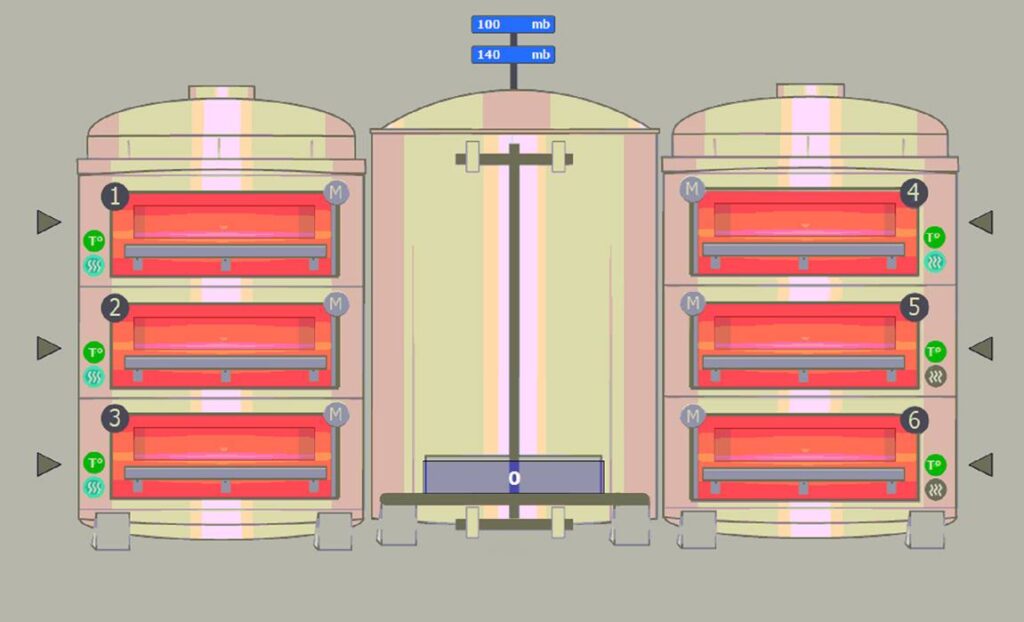
In a recent installation, a heat treater automated their gear cutting operation to prepare the dunnage before heat treat. Therefore, the heat treat robotics phase was simplified by storing each part in a specification location for the robot to “see” with its vision system. These parts are then scanned and automatically connected to the part’s recipe as stored in the system. In a modular system using low pressure carburizing, individual cells are utilized, and production is recipe driven. These recipes are pre-developed and stored to allow each cell to utilize the recipes for many different parts. In this case, after a part is scanned, the recipe is uploaded into the next available cell and the scanned parts and heat treat fixture is moved to the cell (Figure 7).

Figure 7. Modular vacuum furnace for low pressure carburizing
Source: ECM USA

Figure 8 was designed to use over 175 different parts with nine different heat treat processes which included carburizing and slow cooling, hardening, tempering, cooling after tempering and cryogenic treatment.

With further considerations for additional benefits of the automated system, fixtures were optimized by using CFC (carbon fiber composite) base trays. These trays are not only extremely stable and have non-existent growth/warpage, but they also help with robotic placement before and after heat treatment. CFC trays are flat, or can be machined to conform to part geometry, which helps to reduce or minimize distortion related to fixture warpage or creep.

Figure 8. LPC and robotics configuration
Source: ECM USA

Many system designs have been proposed to a variety of clients; however, the end goal is to design a system that is “standard.” This standard design needs to incorporate different forms of dunnage, bins, boxes, and pallets to allow a commercial heat treater to easily program the system whenever the next part comes in from their client, whatever it may be. This is a challenging task and needs to be broken out by weight category to design the robot’s reach and end tool design. In this case a robot cell offline of the heat treat furnace can be built and utilize, and ultimately use, an AMR (automated mobile robot) or AGV (automated guided vehicle) to bring the built loads to the furnaces (Figure 9).

Figure 9. AGV configurations
Source: ECM GmbH & ECM Technologies

Vacuum Advantages

Vacuum furnace systems have a clear advantage over traditional atmospheric systems with many features which lend themselves to integrate into the machining area with robotics and automation.

The fact that an LPC (low pressure vacuum) furnace system can process loads via a recipe input and each cell can be used to process a different case depth, or hardening cycle is highly advantageous when processing a wide variety of parts. In addition, the LPC process provides a more uniform case depth throughout the part to make a stronger part along with high quality processing. The vacuum furnace cells can be arranged in many ways to fit into existing facilities and to be able to use many methods of automation especially including robotics.

Quenching is also a key element in any hardening heat treat process. LPC furnace systems are usually associated with high pressure gas quenching (HPGQ) in a separate chamber to provide the best quenching performance. This gas quenching technique provides a clean process for each part and allows the use of CFC fixtures. There is also no requirement for post cleaning as is necessary with oil quenching.

Providing quality low pressure carburizing, clean and precise gas quenching, CFC trays for better uniformity and keeping the parts flat, and the automation benefits of robotics makes for a state-of-the-art heat treating production operation and thus completes the heat treat paradigm shift.

Figure 10. Robot loading
Source: ECM USA

Conclusion

The heat treat industry wants and needs automation and robotics integration to advance production, reduce costs, and improve the overall quality of production. With traditional technology, process data evaluation and self-configured recipe values are not possible. Therefore, component analysis should be automated to meet and achieve consistent and reliable recipe values (mass flow, time). With the increase in robotics demand, vacuum furnace technology meets the variable requirements of “demand-oriented” production. Due to the flexibility of this technology, small batch size systems can be automated with robots or as bulk material.

References

  • Hiller, Gerald. “The networked hardening shop – the challenge to the hardening plant in the world of Industry 4.0.” ECM GmbH. Paper presentation, 2019.
  • Müller, Christopher. “World Robotics 2024 – Industrial Robots.” IFR Statistical Department, VDMA Services GmbH, presentation in Frankfurt am Main, Germany, 2024.

About the Author:

Dennis Beauchesne
General Manager
ECM USA

Dennis Beauchesne brings experience of over 200 vacuum carburizing cells installed on high pressure gas quenching and oil quenching installations. He has worked in the thermal transfer equipment supply industry for over 30 years, 23 of which have been with ECM USA.

For more information: Contact Dennis at DB@ECM-USA.com.


The Heat Treat Robotic Paradigm Shift Read More »

PAI Industries Bolsters Capabilities With In-House Carburizing Vacuum System

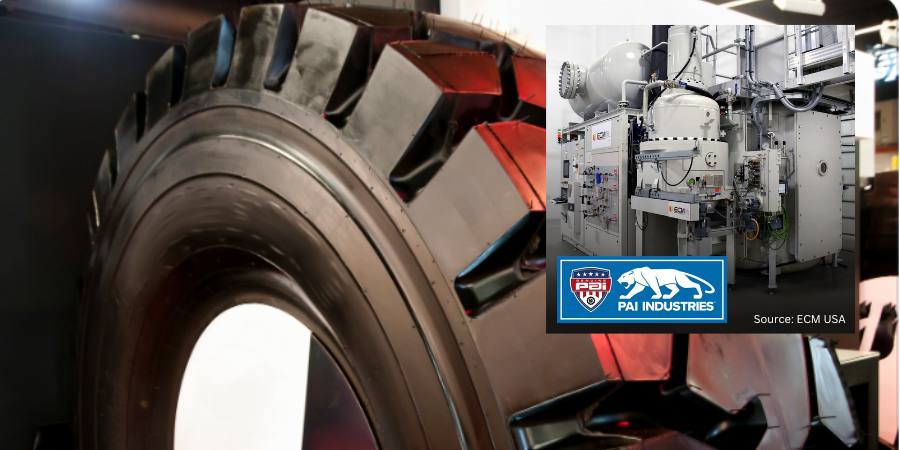
PAI Industries, a manufacturer of parts to the heavy-duty truck industry, has expanded its in-house heat treatment with a NANO vacuum furnace system.

The Georgia-based company partnered with vacuum furnace manufacturer ECM USA to transition its production line from out-sourced heat treatment to in-house vacuum technology in order to perform low pressure carburizing and through hardening around the clock.

The upgraded system will increase capacity and expedite production at PAI’s 112,000 square foot manufacturing facility. The NANO furnace system is comprised of one module with three stacked up heating cells (which can be extended to six heating cells, corresponding to two heating modules) and gas quenching cells to quench the parts. The carburizing cells are stacked up to reduce the footprint’s installation as much as possible. The furnace system integrates directly into the production line which allows it to reduce the cycle time while simplifying the flow between the machining and heat treatment.

The press release is available in its original form here.


PAI Industries Bolsters Capabilities With In-House Carburizing Vacuum System Read More »

Integrated Robotics Vacuum Furnace System for Increasing Heat Treat Automation Demands

HTD Size-PR Logo

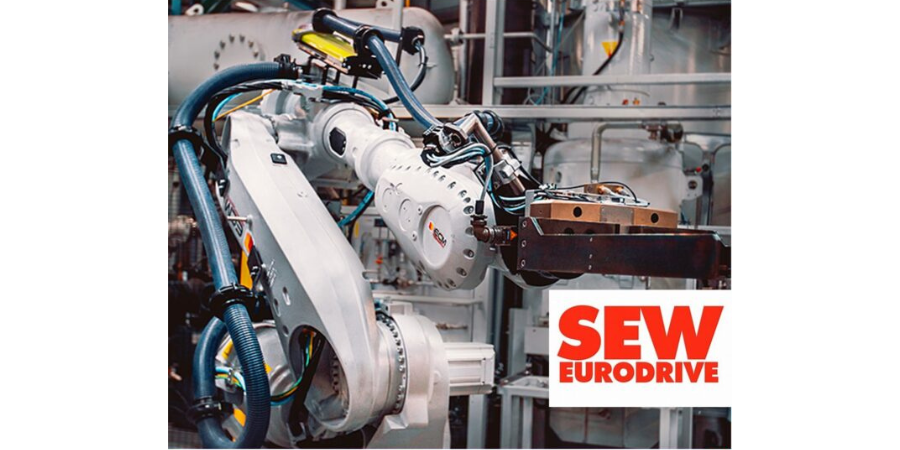
SEW-EURODRIVE has commissioned a modular NANO vacuum furnace system completely integrated with advanced automation for their Lyman, SC, facility.

It is the third NANO system with integrated robotics from ECM USA within the last two years. This 6 chamber, 20 bar quench NANO vacuum furnace system has 16 tempering positions, advanced solvent based washer (both oil and water based contaminants), and robotic workload assembly/disassembly.
Dunnage management is also provided and fully automated within the robotics configuration.

The system was specifically designed to run multiple materials (including carburized grades and tool steels) and will increase production for various load scenarios and processes. SEW-EURODRIVE MOVITRANS® (SEW-EURODRIVE’s patented inductive energy power transfer supply system) will also be incorporated within the vacuum furnace transfer system.


Find heat treating products and services when you search on Heat Treat Buyers Guide.com


Integrated Robotics Vacuum Furnace System for Increasing Heat Treat Automation Demands Read More »

MTI 2023 Spring Meeting Recap

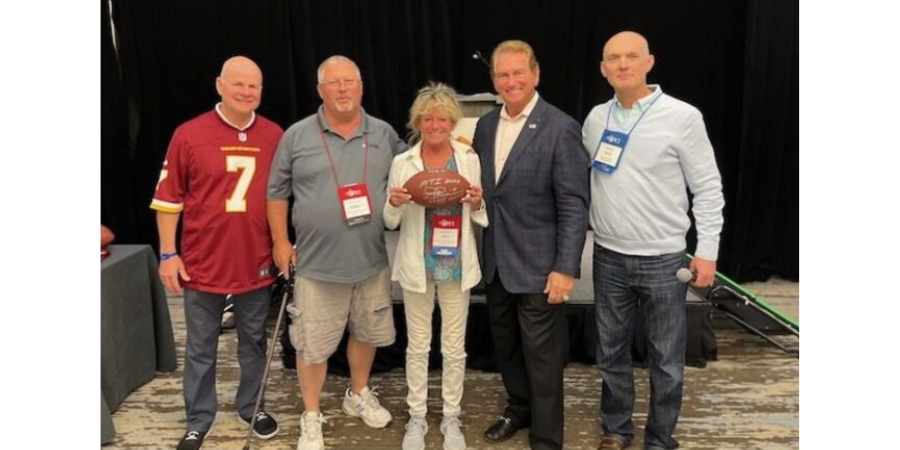
HTD Size-PR LogoThe Metal Treating Institute (MTI), recently held its 2023 Spring Meeting in Naples, FL. The three-day event included a mixture of business and fun with highlights including money raised for the scholarship fund, keynote speaker Joe Theismann, and educational/informative sessions for attendees.

MTI CEO Tom Morrison discussed the diversity of the events encapsulated in the three days of the meeting:

"What is great about MTI’s Spring Meeting is when you have the best minds in heat treating in one room, only great things can happen. Through key experts and round table discussions, MTI members worked through key issues like workforce development, lean manufacturing, predictive maintenance, and managing costs in inflationary times. MTI also raised $35,000 for the MTI Educational Foundation through raffling off a series of NFL jersey’s, footballs and helmets signed by MTI’s featured speaker, Super Bowl winning quarterback, Joe Theismann from the Washington Redskins."


Find heat treating products and services when you search on Heat Treat Buyers Guide.com


MTI 2023 Spring Meeting Recap Read More »

Heat Treating: The Best Medicine

OCHeat treating solutions are important for more than keeping an airplane flying in the sky or a bridge suspended above the water. These two examples are high profile, but what about the heat treating solutions that do not zoom through the air or mark the skyline above rivers? In the medical industry, heat treating solutions are often unseen unless something goes wrong.

When it comes to medical implant and device heat treating, what options are available to manufacturers that will benefit patients? What should we know about the heat treating processes that make metal parts functional as knees, hips, and elbows? Find out in this expert analysis from Quintus Technologies and ECM USA, Inc.

This Technical Tuesday article was first published in Heat Treat Today's December 2022 Medical and Energy print edition.


Introduction

Dan McCurdy, former president at Bodycote, Automotive and General Industrial Heat Treatment for North America and Asia, knows full well just how much time, energy, and pain the right medical heat treating practice and alloy composition can save a patient. Dan’s wife suffered from complications due to a nickel allergy in a traditionally thermally-processed ASTM F75 knee implant. She dealt with constant inflammation, swelling, and pain. Physical therapy and a second procedure did nothing to ease the discomfort. The best medicine for Dan’s wife? A specially heat treated medical implant (more of Dan's story can be found at the end of this article).

Contact us with your Reader Feedback!

To understand the stories behind final medical products, Heat Treat Today asked Quintus Technologies and ECM USA, Inc. to share two different approaches on medical implant and device heat treatment. These two companies at the forefront of the medical heat treating industry shared about hot isostatic pressing (HIP) with additive manufacturing, and vacuum heat treating. Read their answers to our questions and learn how, when it comes to implantable medical devices, heat treating can be the best medicine.


How do you ensure your equipment maintains the precise specifications required in the medical industry? What specifically is necessary to maintain compliance when it comes to medical implants?

Quintus Technologies

Chad Beamer
Applications Engineer
Quintus Technologies

Quintus Technologies has observed a trend in bringing Nadcap to the medical industry. Historically the medical industry has focused on the standards and regulations for the quality management system of their approved supplier, but a consistent transition to technical aspects of critical processes (including HIPing) is becoming the norm. Quintus Technologies’ background is one of delivering HIP equipment in line with Nadcap and AMS2750 specifications. The medical industry requires best-in-class temperature uniformity and accuracy; systems designed with production driven flexibility (such as thermocouple quick-connectors for T/C sensor installation
to minimize downtime); HIP furnaces equipped with uniform rapid cooling (URC®) for optimized cycle productivity; active involvement in standards committees; and working directly with the industry.

Requirements are increasing in terms of productivity and the introduction of more complex surface requirements. It is crucial to work closely with the industry to reduce oxidation of orthopedic implants during the HIP and heat treatment processes.

Steering of the HIP cycle is key, along with in-HIP heat treatments to achieve the desired microstructure for the application, which is a standard offering for High Pressure Heat Treatment™ (HPHT™) equipment.

ECM USA, Inc.

Dennis Beauchesne
General Manager
ECM USA, Inc.

Some of the features that are most important are leak rate at deep vacuum along with a chamber and furnace design that does not contribute to any contamination. In our systems, these features, along with others, are of the utmost importance when supplying equipment for the medical implant market.

What are the top 3–5 key requirements or compliance/quality issues needed to heat treat medical implants?

Quintus Technologies

There are several industry standards that have been released to establish key requirements for the HIP process that are often leveraged for medical applications demanding performance and reliability. For example, Nadcap has released AC 7102/6 which details the audit criteria for HIP. This document was developed with significant input from the industry and the government to define operational requirements for quality assurance. It offers a checklist for the HIP processing of metal products and includes requirements for:

  • managing the equipment per pyrometry standard AMS2750
  • qualifying technical instructions and personnel training
  • handling product during the loading and unloading operations
  • complying with gas purity requirements of the pressure medium
  • controlling temperature, including uniformity and accuracy evaluations and management

These aspects are critical to ensure product quality meeting medical customer requirements and expectations. Recent additions beyond conventional requirements highlighted above include high speed cooling in the HIP process (>200 K/min) for some materials which is important for metallurgical results.

ECM USA, Inc.

Key requirements include thermal performance (both uniformity and ramp control); real-time vacuum and gas management; traceability and production lot follow up through human machine interface (HMI); quality procedures for all sensor calibrations; and remote access for control and troubleshooting.

Can you share an example of how your equipment could be used to heat treat a medical implant/device from start to finish?

Quintus Technologies

Many medical implants — whether fabricated using conventional processing techniques such as casting, or more novel approaches such as additive manufacturing — require HIP to eliminate process related material defects. Defects include shrinkage porosity for castings and lack-of-fusion and keyhole defects for fusion based additive manufacturing techniques. These defects can have a negative impact on product quality, impacting performance and reliability. Once HIP has been applied to a material, post processing is often not complete, with additional thermal treatments required to achieve the optimum microstructure leading to the desired material properties and performance. Such thermal treatments are material and process dependent, but could include a stress relief, solution anneal, rapid cooling or quenching, and aging and are often applied in separate heat treat equipment.

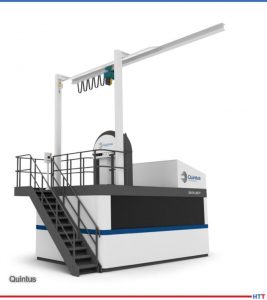
Hot Isostatic Press QIH 60 offering our most advanced Uniform Rapid Cooling (URC®) furnace technology with industry leading temperature control and accuracy

Quintus Technologies has introduced HIP systems providing capabilities beyond conventional densification. Decades’ worth of work in equipment design, system functionality, and control now offers an opportunity to perform HIP and heat treatment in a combined cycle, referred to as HPHT. Combined HIP and heat treatment for castings and AM implants can mitigate the risk of thermally induced porosity, as well as grain growth, which can offer advantages for mechanical and chemical properties in implants. This methodology provides a more sustainable processing route with improved productivity and energy efficiency. A joint HIP and heat treatment offers significant advantages with lead time, and this improvement in lead time couples well with the demands placed on the personalized medical implants. It also offers opportunities to further optimize microstructures for improvement in material properties coupled with ease of manufacturability. HPHT and modern HIP equipment may allow for a higher performing material system, which produces an implant with improved reliability and life.

Within the medical industry, fine grain AM microstructure, repeatability, and low porosity are key concerns. There are many reported benefits by applying the combined HPHT route such as reduced number of process steps, reduced cycle time and lead time, and improved process and quality control. Other advantages include spending less time at elevated temperatures helping to preserve the fine grain AM microstructure by minimizing grain growth. Tight control and steering of the cooling rates during the different steps of the HPHT cycle ensures repeatability of the properties. Manufacturability can be improved through HPHT as this approach reduces the cooling or quench severity during cooling segments which can often lead to part distortion or cracking. Improved functionality and
control go hand-in-hand with the high quality and reliability demanded in the medical industry.

ECM USA, Inc.

We have several customers making titanium alloy prothesis for various applications: shoulders, hips. Our furnaces are used for post printing processes, such as stress relieving and solution annealing.

Given concerns of metal poisoning, do you know of any changes in alloy composition of medical devices over the last decade?

Quintus Technologies

There are some metals that are becoming more common for implants, including tantalum, magnesium, CP Titanium, etc., and there have been major steps in improving ceramic materials to compete with metals for many applications.

ECM USA, Inc.

As a vacuum furnace equipment supplier, we are not deeply involved in the entire process of material selection. In the early stages of 3D printing joint replacements, from 2013 to 2014, we saw cobalt being part of some alloys. Lately it seems, indeed, that there is a trend in removing that element from the finished parts.

A Happy Ending

Dan McCurdy
Former president, Bodycote, Automotive and General Industrial Heat Treatment for North America and Asia

(The rest of Dan's story from the beginning of the article....) The effects of metal poisoning and metal allergies post-surgery can be
devastating. In the narrative below, Dan McCurdy shares the story of his wife’s struggle with an allergic reaction to a knee implant, and the heat treating solution that proved to be the best medicine for her.

My wife, an avid runner up and down the hills of Cincinnati, was diagnosed with osteoarthritis in both knees at the age of 53. Her orthopedist suggested a knee replacement for the most degraded one. The replacement was a well-known brand, made from investment-cast ASTM F75 (nominally a Co-Cr-Mo alloy) with full FDA-approval. After a successful surgery and diligent physical therapy, her recovery plateaued, and she experienced chronic inflammation, swelling, and pain.

A blood test, designed to detect allergies to materials used in orthopedic implants, showed a reaction to nickel that was nearly off the charts. We were surprised, as she had previously tested negative for nickel allergies through skin patch testing. The ASTM F75 specification allows for up to 0.5% bulk nickel as a tramp element in implantable devices; however, depending on foundry practices, the concentration of tramp alloys at any point on the surface of a casting can vary significantly. Titanium implants may be the solution to this, but FDA-approved titanium alloys can still contain up to 0.1% Ni.

The solution for my wife, as it turned out, was a different material, originally developed for the nuclear industry, along with an innovative heat treatment process. Created with an alloy of zirconium and niobium (with a maximum nickel content of 0.0035%), her new knee was heat treated at a high temperature in an oxidizing environment, which converts the soft zirconium surface into hard
ceramic zirconia, increasing hardness and wear resistance. With this specially heat treated implant in place, my wife is back to nearly 10K steps a day.


References

[1] Magnus Ahlfors and Chad Beamer. “Hot Isostatic Pressing for Orthopedic Implants.” quintustechnologies.com/knowledge-center/hot-isostatic-pressing-for-orthopedic-implants. Quintus Technologies. 2020.

[2] Chad Beamer and Derek Denlinger. “Hot Isostatic Pressing: A Seasoned Player with New Technologies in Heat Treatment — Expert Analysis.” www.heattreattoday.com/processes/hot-isostatic-pressing/hot-isostatic-pressing-technical-content/hot-isostatic-pressing-a-seasoned-player-with-new-technologies-in-heat-treatment-expert-analysis/. Heat Treat Today. 2020.

For more information

Contact Chad Beamer at chad.beamer@quintusstream.com

Contact Dennis Beauchesne at DennisBeauchesne@ECM-USA.COM


Find heat treating products and services when you search on Heat Treat Buyers Guide.com


Heat Treating: The Best Medicine Read More »

Heat Treat Future with AM and 3D Printing

OC

All the buzz in our industry seems to indicate that additive manufacturing (AM) and 3D printing are the next hot topics in heat treat, particularly in vacuum heat treat. Heat Treat Today decided to find out how these new technologies are shaping the industry. Read what five heat treat industry leaders had to say about how their companies are preparing for the next generation of AM and 3D printing.

This Technical Tuesday article bringing together the responses from these five companies was first published in Heat Treat Today‘s November 2022 Vacuum print edition.


What changes have you made to accommodate the AM/3D printing marketplace?

Dennis Beauchesne
General Manager
ECM USA, Inc.

The most important changes relate to the build plate size and how it connects to our standard size systems. Build plates are ever-changing, it seems, as customers have new applications and mostly larger build plates are being requested. In addition, the process parameters – such as temperature and time at temperature and quantity of material – are important. These two items have the most to do with reconfiguring equipment for the AM market. We have also been able to implement our wide range of automation and robotics skills into this equipment as the market scales up for high production.

How will your products and/or services change to accommodate this marketplace?

We are/will be introducing equipment that is in line with standard-build plate dimensions along with reducing operating costs.

Share how 3D printing or AM products/services help heat treaters.

Contact us with your Reader Feedback!

Recent debind and sinter applications have involved, as previously mentioned, complete robotics to handle parts after printing, to debind, to sinter, and then to process specialized by ECM, such as low-pressure carburizing. ECM has also provided equipment to provide all three processes in the same furnace without moving the load or requiring the furnace to cool and reheat. This reduces work processing time along with less handling and less utility cost.

What changes have you made to accommodate the AM/3D printing marketplace?

Mark Hemsath
Vice President
of Sales, Americas
Nitrex Heat
Treating Services

Nitrex Vacuum Furnaces, through its GM Enterprises acquisition, has moved heavily into additive manufacturing via large production MIM furnaces, which are able to both remove large amounts of powder binders and sinter the parts in the same process. We are in the process of installing and/or starting up five furnaces for these markets, and we have recently employed even more advanced concepts on high volume wax removal. A further trend is on higher value materials, like nickel and cobalt alloys and titanium, necessitating diffusion vacuum levels for processing. Nitrex Vacuum has had this experience already for many years, so moving to smaller scale 3D designs comes with years of experience.

How might your products and/or services change to accommodate this marketplace?

Smaller units are a trend to keep an eye on. We have over a decade of learning from the large units we offer, and this will allow us to compete in these lower volume markets (i.e., 3D) via our proven expertise. Several facts/ideas that we are keeping top of mind are:

  • Large potential in the future (whole new market starting to evolve)
  • Redesign the product to meet the new needs
  • Good for rapid prototyping and quick low volume parts

Furnaces need to be available with fast delivery 3D printing is finding a tremendous niche in fast part production, sourced internally or sourced quickly. These parts may cost more per piece, but having them fast is often more important, and 3D offers this ability to cut weeks or months off of supply chain sourcing.

Share how 3D printing or AM products/services help heat treaters.

The AM sector is still in growth mode. How we help is to give a full-service solution to those customers who want to really increase their volume yet use vacuum in the process. Vacuum helps to transport the binder vapors away from the parts and into the traps for removal. Full binder removal adds to the quality of the parts, as does vacuum sintering of the final parts. We have supplied a few systems over the years with higher, diffusion vacuum levels. As powder materials evolve to higher value materials, there is more interest in diffusion vacuum, and we recently supplied such a system.

What do readers need to know about AM/3D to make decisions today?

Vacuum is the proper way to debind and sinter. Additionally, 3D printing started slow and there were many technologies evolving. Now, it has started to really grow, and the need for smaller furnaces that can offer the same quality as MIM parts produced in high volumes will be a need for 3D part makers, in medium to low volume parts. This may involve furnaces for sinter only, debind and sinter, or even sinter and heat treat. We can see the need to both sinter 3D parts in a small furnace and also heat treat them with special added processes and surface treatments.

What changes have you made to accommodate the AM/3D printing marketplace?

Phil Harris
Marketing Manager
Paulo

Adding a hot isostatic press has been the most notable change Paulo has made to serve the growing AM market. It goes a step further than that though; heat treatment of AM parts has rapidly evolved, and the desire for custom cycles and more data has caused us to make instrumentation changes and do more R&D type work. Understanding the full production path of the parts and doing our part to reduce the time parts are spending in post-processing steps, including offering stress relief, HIP, EDM, and vacuum heat treatment in a one-stop-shop.

How might your products and/or services change to accommodate this marketplace?

As trials continue and boundaries are pushed for both additive and the accompanying thermal processing, we’re constantly keeping an eye on what’s next. Investing in equipment that’s capable while maintaining and instrumenting it to provide the data and reliability the market needs is the name of the game. Of course, open communication with additive manufacturers and printer designers makes this far easier. We value communication with printer manufacturers as it helps us understand demand for our services in terms of build plate size, since, as we all know, furnaces and HIP vessels aren’t one size fits all!

Share how 3D printing or AM products/services help heat treaters.

Additive parts have become commonplace and we’re now regularly providing HIP, stress relief, and solution treating for them. A more interesting example is for parts printed in Inconel 718; we’ve developed a combined HIP and heat treat (or High Pressure Heat Treat) cycle which was able meet material properties specifications when the traditional processing techniques were not. This is where we feel the real cutting edge is when it comes to heat treatment of additive parts; the slow cooling HIP cycles developed for casting decades ago aren’t always optimal for today’s additive parts.

What changes have you made to accommodate the AM/3D printing marketplace?

Trevor Jones
President
Solar Manufacturing, Inc.
Source: Solar Manufacturing, Inc.

There are several methods for 3D printing and we as heat treaters and vacuum furnace manufacturers generally classify those methods into two basic groups: those that use liquid binding polymers and those that do not.

For the group who does not use liquid binding polymers, there are no changes thus far to the design of the vacuum furnace that must be made. One significant caution is insuring there is no loose powder on the surface or cavities of the parts. Residual powder on or in the parts could have adverse effects on the parts themselves and to the vacuum furnace. The loose powder can liberate from the part during the heat treat or quench steps during the process and contaminate the vacuum furnace. The powder in the furnace is then considered FOD (foreign object debris) for subsequent heat treatments processed in that furnace. The powder could also accumulate over time and cause an electrical ground the heating elements or the quench motor, clog the heat exchanger, contaminate vacuum gauges and hot zone insulation, among other issues.

For the group that does contain liquid binding polymers, in addition to the comments about avoiding loose powder on or in the parts, care must also be taken to accommodate for the vaporization of the binder that occurs during heating of the parts. The binder, in its vapor form, will condense at cooler areas in the vacuum furnace. The condensed areas are potential contamination points and could have all the same issues and concerns of loose powder as described above. The binder collection locations, whether at intentional or non-intentional places, will also have to be routinely cleaned to maintain ideal binder collection, optimum vacuum pumping, and overall furnace performance.

How might your products and/or services change to accommodate this marketplace?

With the growth of 3D printing using liquid binder polymers, Solar Manufacturing has taken what was learned from the furnace modified at Solar Atmospheres of Western PA for MIM and AM processing and applied it to a new furnace product line specific for the debind and sinter applications. Solar Manufacturing collaborated with our affiliate company, Solar Atmospheres of Western PA, in modifying an existing vacuum furnace to accommodate the debind and sintering processes. A modified hot zone was installed, and a dedicated binder pumping port was added that helps minimize and target the condensation of detrimental binders evaporating out of parts containing binders. The modified Solar Atmospheres furnace is extremely valuable in gaining knowledge about various aspects of the process and learning what works, and what does not work, in furnace and recipe design. Combining the knowledge and experience of process development of Solar Atmospheres with the advanced Engineering Design Team at Solar Manufacturing, we believe we have a furnace design that modernizes and simplifies the debinding process while minimizing traditional maintenance issues.

Share how 3D printing or AM products/services help heat treaters.

We developed a process of debinding and sintering stainless steel parts with our affiliate company Solar Atmospheres in Souderton PA. The project started out with our Research and Development group to develop the process for the client’s parts. As the trials scaled up, test coupons became test parts, eventually full-size loads. There are always challenges to scaling up from test parts to production loads and we were able to provide the support the customer needed through that transition. The R&D eff orts were successful, and the client ended up purchasing multiple furnaces, which was the end goal for both parties.

Additionally, Solar Atmospheres is currently vacuum stress relieving a 3D component for a major U.S.-based aerospace company that is in use in aircraft today. Also, numerous large-scale components destined for deep space.

What do readers need to know about AM/3D to make decisions today?

Bob Hill, president of Solar Atmospheres of Western PA, reminded us to “realize and acknowledge that AM is still in its infancy stage. Therefore, many metallurgical uncertainties still exist for the multiple printing processes that exist. Understanding this new kind of metallurgy for each printing process, while developing standards and specifications unique to additive manufacturing, is still a huge obstacle. Until this is accomplished, AM will not be the ‘disruptive’ technology that all the experts predict it will be.” If your business is printing parts with liquid polymer binders, you should seriously consider how you plan on debinding and sintering the parts ahead of time. Printed parts in the “Green” or even “Brown” state are fragile and if you are going to ship the parts somewhere else for the debind and sinter steps, extreme care must be taken to prevent the parts from fracturing during transit. Although the shipping can be safely and successfully accomplished, ideally a furnace is available at the print shop to immediately perform the debind and sinter process to avoid those potential shipping difficulties. The other forms of 3D printing that do not contain liquid polymers generally do have this issue.

What changes have you made to accommodate the AM/3D printing marketplace?

Ben Gasbarre
Executive Vice President
Sales & Marketing
Gasbarre Thermal Processing Systems

From our inception, Gasbarre has had expertise in the powder metallurgy industry, which requires debind and sinter applications similar to that in the AM and 3D printing markets. Our ability to supply equipment for both powder and parts producers has set us up for quick adoption into this market. While considerations need to be made specific to AM, our focus has been on technical support and helping the market grow to higher volume applications.

How might your products and/or services change to accommodate this marketplace?

As adoption of these technologies grow, the volume at which parts need to be produced will grow. Our line of continuous processing equipment in both vacuum and atmosphere applications are well suited. Whether it be debind and sinter, annealing, or stress relieving, we have equipment and expertise that can grow from early production to high volumes.

Share how 3D printing or AM products/services help heat treaters.

Overall, Gasbarre is here to be a resource and support the growth of the additive market. Whether that be through new equipment, servicing existing equipment, or involvement in the industry organizations, we have the expertise to drive success today and into the future!

What do readers need to know about AM/3D to make decisions today?

Additive manufacturing is such a dynamic technology, it is difficult to state one specific item. There is the potential for significant growth opportunities for new applications, but also the potential replacement of traditional manufacturing methods. We also know there is substantial backing for the technology by both private industry and government entities. Like other emerging technologies in the automotive and energies sectors, additive manufacturing isn’t a matter of if, but when it’ll achieve wide scale adoption and high-volume applications.

It is amazing how the list of materials being utilized with this technology is growing. While metals and alloys have not been the majority of the market, it is rapidly growing. With that growth, there is a wide variety of applications and thermal processing requirements for those materials. As well, the different additive and 3D printing processing methods (i.e., binder jetting, powder bed fusion, etc.) leads to a similar diversity in thermal processing requirements.

For more information, contact the leaders:


Find heat treating products and services when you search on Heat Treat Buyers Guide.com


Heat Treat Future with AM and 3D Printing Read More »

AM Heat Treat Solutions Expected From New Partnership

HTD Size-PR Logo

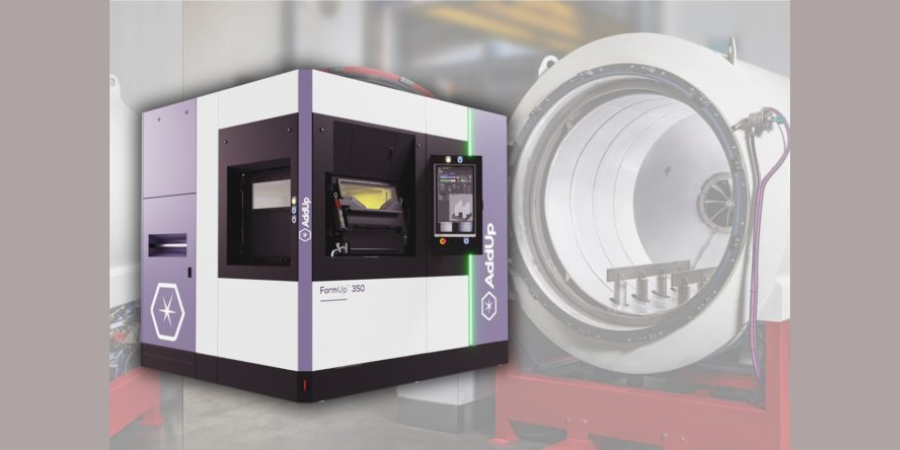
AddUp, a provider in the field of metal additive manufacturing (AM), and a creator of thermal solutions have signed a partnership to develop high value-added solutions for the thermal treatment of 3D printed metal parts.

The AM solution provider's expertise lies in two technologies: first, powder bed fusion (PBF), useful for the manufacture of metal parts with complex geometries and improved performance, and second, directed energy deposition (DED), which is ideal for the repair of parts and adding function. They manufacture 3D printing machines and produce AM industrial metal parts.

The ECM Group provides vacuum furnace expertise to the heat treat production needs of sectors such as: medical, aeronautics, e-mobility, and renewable energies. With experience in the control of atmospheres, gases, and thermal applications, the ECM Group is will play a critical role in the partnership to help AddUp meet the requirements of the aforementioned four sectors.

"At ECM, we are convinced of the potential of metal additive manufacturing, some applications of which will lead to mass production," says Yvan Trouillot, sales director for ECM. "Together, our ambition is to develop these technologies to help our customers progress by offering them the best solutions on the market."


Find heat treating products and services when you search on Heat Treat Buyers Guide.com


AM Heat Treat Solutions Expected From New Partnership Read More »
Heat Treat Radio #69: Robotics in Heat Treat, a Conversation With Dennis Beauchesne, ECM-USA

Heat Treat Radio host, Doug Glenn, discusses the current state of robotics in the North American (and European) heat treat markets with ECM-USA, Inc. managing director, Dennis Beauchesne. Find out where robotics is currently being used as well as some future applications.

Below, you can watch the video, listen to the podcast by clicking on the audio play button, or read an edited transcript.


The following transcript has been edited for your reading enjoyment.

Doug Glenn (DG):  Dennis, thanks for joining us. It’s been a long time since we’ve talked about finally getting together on Heat Treat Radio to have a conversation about some interesting things. Today, we’re going to talk to Dennis Beauchesne of ECM USA about robotics. Dennis, welcome. I appreciate you joining us.

Dennis Beauchesne (DB):  Well, Doug, thank you very much for having me on. We’ve been talking about it for quite a while and I’m really glad we could finally get our schedules together to make this happen.

Photo Credit: ECM-USA

DG:  We’re recording just after the holidays. Both of us are sobered up and back to be able to think clearly. We do want to talk about robotics, but just to give the listeners and/or viewers a sense of Dennis Beauchesne, your background, just briefly, tell us where you’ve come from and how long you’ve been working in the North American heat treat market.

DB:  My name is Dennis Beauchesne. I am the general manager of ECM USA which is the U.S. subsidiary of ECM Technologies working out of France. I’ve been with ECM Technologies for almost 21 years. About 10 years before that I also worked with other furnace companies and some in the heat treat business as well as selling alloy baskets, fans, and those kinds of things. I also had a rep organization for 3 years where I sold probes and a number of other heat treat-related items. I’ve had my share of crawling around furnace and heat treats and getting to know the applications, loading mechanisms and all or most of the processes. I’m certainly not an expert on a lot of the heat treat processes, but one, in particular (low pressure vacuum carburizing and especially with gas quenching) is something that I’ve been working with for over 20 years, but certainly hardening and other applications, as well, and vacuum furnaces is our forte.

DG:  Based on conversations you and I have had in the past, we started talking about robotics. It’s almost an element of Industry 4.0 to a certain extent- augmented reality, virtual reality, and things of that sort. Robotics definitely fits into that some, let’s talk about that a little bit.

From your perspective, what is ECM seeing as far as the use of robotics. I’m curious about industry in general, but if you want to narrow it down also and talk a little bit about where are you currently seeing robotics used in heat treat, that would be great.

DB:  Robotics, in general, and automation. Automation has always been a leading technology for ECM USA and ECM Technologies, worldwide. A lot of our vacuum furnaces, as you know, are large scale, high production equipment as well as single chamber systems. But automation usually plays a part in our offering, and that, before, was conveyers, walking beam tables, rolling tables and those kinds of things, where we automated the process so that you would have, obviously, time control over the process, when the parts went to temper, etc.

What we’re seeing more and more, and the reason that I’m here today, is that ECM is very much involved with the robotics handling of parts before and after heat treatment as well. We’ve come across quite a few applications in the industry where these are required. You and I were just at some recent fall meetings, and labor availability is the number one issue in the world today, as we know. I really feel that robotics can do a lot to help in that area. Where we’ve seen robotics work is loading/unloading alloy fixtures, loading/unloading CFC fixtures, taking parts out of bins and putting them in heat treat fixtures, and then you have either operators move them to the furnaces or load them automatically through the automation system (conveyers, walking beams, etc.). We’ve done those systems, especially in Europe, we’ve done a number of systems there.

We are installing a system here, this summer, in North America, and it will be fully robotic-integrated. So, the customer brings us parts that will be in particular totes and we would be loading them into CFC fixtures. The fixtures will be retained in the heat treat area and then the parts will be unloaded after heat treat and then loaded back into their bins, totes, or containers.

This is a fully, completely automated process. It’s not that it’s the same part every time; there are actually 175 different parts. I think that’s a really important piece of information. And they’re not all gears, they’re not all shafts; there is a mixture of a bunch of different parts. It’s a very challenging application but also one that, with today’s technology in robotic vision systems, is a doable situation. We’re looking forward to showing off more of that.

DG:  And that was one of my questions, especially when you mentioned 175 different types of parts. Is the system that you’re speaking about or are the systems that can be made by ECM or others, I assume they are going to use vision recognition, right? They’re not just going to say, “Well, I’m going to take my robotic arm and I’m going to this position where they tell me there is this type of part,” or is that arm actually going to be able to say, “That’s that type of part, therefore I treat it thusly.”

DB:  I would say in this application, if people saw the loading/unloading, they would say, “Well, of course, the part’s going to be in the same location, it’s going to be in the same tote, it’s going to be in the same plastic locking device that it’s going to be every time.” This is true and it is very true in this application.

I think that’s one of the things that’s a challenge in the heat treat business, especially for heat treaters, not the captive operations but even in captive operations, is that parts come in in different forms- they’re in bins, they’re in tins, they’re in bins with plywood covers or plywood covers with cardboard covers, with bubble wrap, and all the things that you see across the marketplace.


As you mentioned, vision is a big, big part of robotics. Actually has some eyes for the robot to know there’s no part there, I’m not going to go get it, I change my program, I go here, or I twist the wrist of the robot a different way to pick up that part, whether it’s flat or round or whatever. Vision plays a big part. The advancements in vision and the robotics are huge, and have been huge, as they have been in vacuum furnace technology, as well, and gas quenching. Those things, moving forward, are a lot of the part of research and development at ECM and ECM USA. Things are moving forward.

DG:  Before we get too deep into what, exactly, these robots are and how they work, I want to question you about the motivation for why people are using them. You mentioned about labor shortage being one of the main reasons. I’m assuming that there are some benefits there. Are these robots replacing people or are they assisting people? What do you see?

DB:  I think it’s across the board for both. You are replacing people but not really replacing people that aren’t present. That’s part of the labor shortage is you don’t have people to replace. That’s part of the situation. We’re really adding to the capability, or the versatility, of that heat treat shop or captive heat treat by adding a robot or adding a person, if you want to look at it that way. But they’re also working together with the people, on the line or in the heat treat, to assist them.

You could have a robot that merely lifts a bin and moves it to another location where you’re helping a person not having to pick up such a heavy load. You also have robots that are placing parts precisely in a fixture or placing parts precisely in a bin, whereas the quality of that part is not impaired: you’re not dropping it or you’re not scratching it along with another part, you’re moving it very carefully like a customer would want to handle that particular part with higher quality.

I think, what was best taken from one of our fall sessions was that one of the presenters, [who] indicated they were using robots, said that in their process they were using this robot to do some of the heat treat and they said that they really no longer can do that heat treat process any more with a human because the robot was so precise at getting them heat correctly on that part for what they were doing. In that way, you are increasing the quality and the value of your heat treat and the robot integration.

DG:  Right. The repeatability is the issue and the real advantage there: precise placement and processing of that item which even the best of us humans can’t do.

Realistically speaking, from ECM’s perspective, can you give us a sense of what the growth in interest in robotics has been? Let’s take a snapshot: 10 years ago, what was it like? What was it like 5 years ago? What is it today? What kind of growth are we seeing? What percentage of your RFPs/RFQs are actually asking for it?

DB:  That’s a great question. I would say that 10 years ago there were very few opportunities or very few discussions about robotics. We would have robotics discussions with, let’s say, large automotive companies that were doing thousands of parts a week or year, and they would, mostly, at that time talk to outside robotics companies and try to integrate robotics into a heat treat market, where a lot of robotics companies would say, “You mean this surface is going to be warped? It’s going to be changed the next time I go to put that same part in that same location?”

I can tell you that it caused a lot of havoc in the heat treat business. Also, with just handling parts in and out of the heat treat load, whether it was a new heat load that was green, or a heat treat load that was already hard — handling those parts differently, especially in a gas quench situation, knowing that they’ve been processed or not — that was also a new development in robotics.

So, 5 years ago, I would say, you started seeing more people where there were several robotic companies that were out there that were starting to say, “Hey, we can handle this.” Vision was coming along a lot faster and there was more presence of vision with the robotics.

Today, I would say in the last 18 months to 2 years, we’ve seen a real uptick in RFPs and RFQs coming in where they’re looking to a company like ECM where we have a lot of experience in automation to further that arm to get robotics involved with not only just processing a load of parts, but taking the parts single piece, building a load and then processing that, and then giving the piece part back to the operations. That’s been increasing quite a bit.

In an effort to take care of that, about 5 years ago we had purchased a company that was doing a lot of robotics internally with their furnace systems in the semiconductor industry. We had a lot of robotic technical expertise in that. If you know that industry, you’re handling a lot of thin parts and a lot of movement, very high volume, and also there is a lot of vision that’s being used in that and also vision in the quality control afterwards, as well.

So, we’re seeing requests for robots loading and unloading. We’re seeing requests for robots picking up parts, putting them in front of the camera, and actually measuring the part for distortion control. We’re also seeing parts that are being automatically hardness tested before they’re put into the finish part bins or totes, or wherever the next stage of processing is.

DG:  I assume, at that point in time, they’re able to separate the sheep from the goats, so to speak. Well hardened, not well hardened, and that type of thing.

DB:  Exactly. There are a lot more automated systems for process quality control, as well, as the parts come out of the furnace.

DG:  Let me ask you this question:  When some people think of robots, we start thinking of the Jetson’s or something like that, but I think most people with their feet on the ground and their head’s not in the clouds too much, when we think of robots, I tend to think of that robotic arm, that type of thing, right? Where it’s a stationary robot, if you will, with functions within its reach. Is this the type of robot we’re talking about now, is that what is most common, or do you anticipate that there’s going to be those, let’s say, “mobile” robots that are roaming around doing things, helping workers, or are they exoskeleton-type robots that are on the backs of people? I’m curious what your prognosticating is on that point.

DB:  A very good question, again. When we look at robotics moving parts around the plant, we usually call those AGVs, or automatic guided vehicles. We’re working on a number of projects with those types of facilities and that reduces a lot of traffic, internally, for people moving forklifts arounds and it becomes a much safer facility.

DG:  And these are not on tracks, right? They’re not on monorails or railroad tracks, it’s just free moving?

DB:  Tracks are a thing of the past, now, with AGVs. There are a number of different ways of doing it. I’m not an AGV specialist, or a robotics specialist for that matter, but they do have AGVs now that are controlled by cameras up in the plant so that the cameras know exactly where the AGV is and is located.

Photo Credit: ECM-USA

There are also ways of putting tape down or some other line in the concrete where the AGV can follow. Those methods are out there for AGVs. Usually, the AGVs are used in some of the situations we’re into right now. They’re used to promote the accurate takt time through the plant. Whether they need a part every 20 minutes or every 10 minutes, it’s well designed in that fashion. There are usually tracks or pallets that are on these AGVs that move from machining center to heat treat center to post-machining heat treat center. Those things are very much out there. AGVs have, also, grown leaps and bounds, as well, in their own right.

As far as the robot being stationary or, as you spoke about, working together with other operators in a collaborative fashion, both of these methods are being used, of course. But we still see that the larger, single-arm robot, let’s say, can be multifaceted.

In other words, we can have 3 or 4 handling devices or grippers, as we would say, on the end of this robot. It could be picking up a part, then picking up a tray, then picking up a full load, with the same gripper or same handset that’s on the gripper. These are multifaceted robots. You’re not really looking at every time you need to pick up a different part you need to have a different tool. That’s what’s being done with those, as well as trying to reduce the footprint and making a much safer robot system with the collaborative design where, if you touch it, it stops. In addition, robot programming, also, has become far less tedious, let’s say, or far less required from a specific person to do the programming.

"In other words, we can have 3 or 4 handling devices or grippers, as we would say, on the end of this robot. It could be picking up a part, then picking up a tray, then picking up a full load, with the same gripper or same handset that’s on the gripper. These are multifaceted robots."

DG:  And you mentioned the word I wanted to ask you about which is probably the hot topic, and we’ll have to make sure the lawyers get involved here. What about safety? It’s not just the mobile AGVs, I think you said, that are afraid of running somebody over or hitting somebody, but it’s also these stationary ones that have moving parts. Are there any safety concerns? What can you tell us about the safety and the advances in safety?

DB:  Well, of course, safety is always a very, very important part. We’re trying to eliminate workers by not having to pick these parts, but we still need to be safe in that environment. There are a number of ways. A lot of people are trying to get away from the full cages with light curtains and those kinds of things. Using the collaborative robots, where they’re touch-sensitive and can be shut off instantaneously, are probably the best way to go. With the AGVs running through the plant, there are a number of sensor systems on those AGVs that would stop them, as well as they move at a very slow pace, as well, throughout the plant.

There are a number of safety devices depending on the installation. Whether it’s a stand-alone system or it’s something working collaboratively with a person, safety is always important and can be working, l would say, much more advantageous these days with other workers.

DG:  In one sense, there are people who resist robotics because they may be afraid of it replacing people or hurting people and things of that sort, but in a sense, the whole advantage here is that ultimately it is better for the human worker to have these machines doing it. Typically, the robotics are taking away some of the redundant, tedious work. Would you agree with that?

DB:  I agree and that’s typically what we discuss with the customers. It’s where in your plan do you have difficulty hiring people to work? I would say 90% of those customers answer: I can’t hire anybody for a long period of time when they’re taking the part from a bin and putting it in a fixture or taking a part out of the fixture and replacing it in the bin properly. They say that those people last a few months, and they move on. The worst case is if you have someone that’s been there a long time and you put them in that position, it’s a negative for them. They finally feel like, “okay, they’ve got something on me and I have to go down and build loads.”

Like you said, people are thinking about robots and they’re a little bit hesitant, but I would say that, and maybe you’ll get to this question but, it’s more the possibilities and the way people think about robots. I would have to say the most that I’ve heard, especially from heat treaters, is, “Well, it’s not going to do what I need it to do.” “I can’t use a robot because I don’t have that many of the same part every year.” Really, that is changing. What we’re planning on doing is having a demo site here, hopefully before the end of this year, where we could have certain bins of parts and show how, with vision, we can pick up different parts and put them in heat treat loads and move them around.

DG:  Let’s go there because that actually was a question I wanted to ask: To a certain extent, we’re limited in our willingness to use robotics because we’re probably limited in our understanding of what they can do. I’m quite sure, as much as ECM has dedicated resources to developing current capabilities, there are some dreamers in your group that say, “You know, we could get robots to this if only someone would say ‘okay’.” Can you share with us maybe some of the things that you are currently doing that are a little "cutting edge" or at least useful to our captive heat treaters? And also, some of those things that could be done? I’m curious as to the extent of where we might be able to go in the next 10 years.

DB:  I am, even myself, learning as we go along, as well, of the technologies that are out there. What I’m impressed with robotics is they not only help once they’re installed, but before the concept is even put together. I’ve put on VR glasses and walked through a heat treat and you can understand exactly what the robot’s function is, what it sees, where it goes. We can actually also walk through a furnace installation and see what the height of everything is, what the level of everything is, how it moves around. Those are some of the applications even before you get the robot installed.

The other possibilities that people do think that “Oh, this is going to be expensive, first of all." They think it’s not going to work on my parts in my situation. There will be some concessions that everybody is going to need to make. For instance, the heat treat fixtures, maybe the ones that are really warped, you’re going to have to not use those as much anymore. Or, you may have to a more standard basket or a more standard fixture for all the parts. You may not get your million parts in one load (like everybody wants to get), but you would get them done more efficiently and faster.

Some of the applications we’ve done where we’ve taken very thin ceramic material and put it on setters and put them in some brazing furnaces and sintering furnaces, and then move the loads around, unstack the load, stack the load, restack the load, and done that all completely in a robotic cell, without touching the parts, ever. And then, as the parts come out, they’re electrically tested to make sure they’re good.

Like I said, in this other application or several other applications, we’ve also done bulk filling of CFC fixtures. You would have a CFC fixture that needed to be bulk loaded with small pieces, we actually have them go through a vibrating machine, fill the CFC fixture to a certain level, the robot comes over and puts a screen on top, moves the CFC fixture onto a heat treat load and does that continuously.

DG:  Is that done by weight or by vision?

DB:  Both. Because you can have the weight, but you may not have it even.

DG:  Right, the distribution -- it would vibrate it out until it’s acceptable and then the screen would come in.

DB:  Exactly. And, like I said, the possibilities of heat treat robotics is what it’s coming down to. Heat treat robotics, today, is to educate and have everybody understand that it is and could be capable of taking flat parts out of bins and putting them in fixtures properly and removing them and doing the reverse action. We need to educate people that these things are available out there. And it doesn’t have to be any particular type of furnace or any particular type of size of load of the furnace, it is a matter of setting up a station, maybe a loading/unloading station that you might have an area in your plant, to do the robotic handling of it, with our expertise in heat treating, understanding the facets of what happens to the parts and the fixtures during the heat treat process.

Those are the kinds of things that we see. Like I said, right from the design of the system and the layout, understanding how everything is going to work on a VR standpoint, all the way to implementation in a facility that takes in many different parts on a daily basis and processes them. I think that’s true to form in what’s moving forward in robotics today.

DG:  I want to throw this one at you and see what your input is on this:  Let’s think about robotics for the whole way through a process. I want to think, just for a minute, about a mesh belt furnace, let’s say. I know you guys do a lot in vacuum and things of that sort, but it could be the same type of thing.

Could we use, on the frontend, robotics to do, not only placement of the product, but product inspection, let’s say, making sure it’s a clean surface (with nitriding, for example), making sure impurities are off and things of that sort? I assume we could us robotics on that end to inspect the product, making sure it’s good to go in the basket, then we put it in the basket or in the fixture, goes through the furnace, comes out the other end, is picked up and inspected at that time for whether it be hardness or distortion or whatever, and then placed on where it needs to go. I assume all that’s possible, correct?

DB:  You assume and yes, it is possible. I, personally, haven’t seen anybody install that particular system, but I would love to be part of it. We have designed a system and quoted on a system that was using a mesh belt where the customer of the heat treat department felt that the parts (these were coin-shaped type parts) and it felt better that the parts were processed better vertically rather than just in a pile on the belt.

So, these parts were put in small fixtures on the belt (and this fixture was maybe 6" x 6" and took up a 4'-wide belt) and those were loaded in place very properly and then also on the outside on the outlet of the furnace belt were also unloaded. Then, of course, the design was for them to inspect them by coloration and then also by hardness. And I didn’t share that with you before this meeting, but that was one application that we quoted on and it’s something that is very doable.

DG:  A couple final questions for you: We talked earlier about the companies who, for example, if they high diversity of product and not high quantity of those products, I assume, and you’ve mentioned it, that robotics probably is not as likely to be helpful to them as to a company who has low variability of products but high volume of those products. Do you have any comments on that? For example, a commercial heat treater who does all kinds of crazy things and doesn’t have a lot of any one thing, is it safe to say robotics probably would not be as useful to them?

DB: I would have to say that that is the thought that we’re trying to change. We’re trying to change that thought because I’ve sat at a number of tables during the lunches and dinners at some of these presentations and that’s exactly what I hear from the heat treaters: “Robotics isn’t for me; I don’t do enough of the same part.” In reality, a lot of these robotics systems now are easily programmable by grabbing the gripper and moving it to where you want it to go. And if you have repeatable parts (maybe you don’t have a hundred million of these parts in the same month, but maybe you have ten thousand of them over 12 months) once that’s programmed in the robot, then you have that program for the next time. There may be some initial programming time that you have to apply to it. We don’t see that that is a big downside because the vision system will understand what the part looks like before the robot picks it up. The programming has become much easier and simpler for everybody so that you don’t have to have a big staff just to take care of the robots.

I think that’s the other misnomer that companies have is that if I get a robot, I not only have to pay for the robot, but I must have the five support-staff for that robot, when, in fact, that is not something that’s becoming a thing. In one of the cases, the same person that was talking about the quality of the robot was also talking about the excitement of his team to work with the robot and to be able to learn to program that robot, and that being their job rather than loading and unloading the fixtures. To them, that was more exciting and made them come to work, wanting to come to work every day, and was also a lead-in for them to hire more people, to say, “Hey, we’re implementing robotics in the plant and as an opportunity to work in that department eventually or eventually we’ll bring robotics into your department.” There are those incentives, as well, with some of the employees.

DG:  You may have hinted at this before: You’re saying that programming of the robots, sometimes, can be as easy as showing it what to do by moving it, saying, “Here’s what you do: Grab this, put this here, grab this, put this here." That’s as easy as it can be?

DB:  It’s becoming that way, yes. I’m not a programmer, but I’ve seen a lot of demos, as a lot of other people have, but yes, those things are possible. Get it in a general location and then you tweak it a little bit here and there- yes, those things are much easier to do.

DG:  Probably, to say to those who are "robotic doubters," let’s say, it would be good to not assume it’s as difficult as what you might think and to keep an open mind.

Let me ask you this:  You could be a commercial heat treater, but most of our audience or a lot of our audience are the manufacturers with their own in-house heat treat or what we call captive heat treaters. What questions should they be asking themselves about robotics, whether or not it makes sense for them? Is there a list of questions they ought to be asking or considering before they even consider robotics?

DB:  I think that when you’re doing repetitive operations in your facilities, whether it’s captive or heat treat shop, that’s where you get the most benefit from a robotic system, obviously. That’s one thing. The other one is: Are you doing similar operations in that repetitiveness? Are you always building the same type of fixture? Are you always building it for the same furnace load? Those things.

"The more similarities you can get that robot to work with, the more cost effective it becomes. But there are also a lot of benefits to having that robot be very versatile in working with a number of different size furnace loads as well as part dimensions."

The more similarities you can get that robot to work with, the more cost effective it becomes. But there are also a lot of benefits to having that robot be very versatile in working with a number of different size furnace loads as well as part dimensions. I can’t say that there’s a specific set of questions, but certainly would love to work with any customer that has even a thought that maybe they should look into this.

DG:  I think the high repeatability is critical. I would imagine, Dennis, that if they’re dealing with high-value parts, even if there’s not a huge number of them, and they’re looking to eliminate the potential for human error, even if it’s simply in the placement of that product or if they’re looking for single-part traceability, perhaps, robotic systems, definitely, it seems to me, would be also something that would be of interest.

DB:  Absolutely. In-process defects is something that it would be very good at eliminating. Also, as you said, if you were looking for traceability, I can tell you that we can build a robot system that can trace, even if you have 500 parts in a heat treat load, it can tell you exactly where that part came from in the load, where you put it in the load, where it came from and where it went after it came off of the heat treat rack.

Traceability is a good point that I didn’t bring up, thank you for that, Doug. Traceability is really important, as well- we can do that with the furnaces. And that’s for a single-piece part flow whereas a lot of people are going to that method. A single piece gets to the heat treat furnace, not a bin of parts. Then, you can trace every part through the heat treat load and back out of it.

DG:  The other thought I was having while you were talking was, and this may be only in a number of very minor cases, but a lot of times there are situations where a part has got to come out of a hot furnace, it’s got to cool off in order to be moved to the next process — it seems to me with any type of automation, robotics included, you could eliminate the amount of heat loss between furnace one and temper furnace or the next process.

DB:  I think another application is operating press quenches where you’re moving a hot part over the end of a furnace and moving it over to a quench, it’s an extremely hot part that you don’t want to touch. Obviously, there are gantry systems for that and there are a number of robot systems that can be installed to get those people out of those hazardous jobs. Also, in terms of quality because timing is very important, as well.

Photo Credit: ECM-USA

DG:  You mentioned about maintenance of these systems a little bit, or at least the programming of them. I’m assuming maintenance is somewhat of an issue. If there are moving parts and things of that sort, there is probably going to be some maintenance on it, whether it be hardware maintenance and/or software maintenance. Any comments on the amount of money or time that a person would spend maintaining these systems as opposed to maintaining a human being doing those systems?

DB:  That’s a very good question, again, and it should be something that’s part of your machine maintenance. It is a machine tool; it is going to need some maintenance, so it’s part of your maintenance requirements. If people use this same maintenance priority that they do for the heat treat furnaces, thank goodness robots work really well, as well, in hazardous environments. I would say that they hold up very well. Robots have been around a number of years and they’re very industrialized. Maintenance is not as critical as it used to be, but it is, obviously, still required.

DG:  And I’m sure they can handle the environments, too. Hopefully, the environments in the heat treat shops are getting better and not so smokey and oily and that type of thing. I’m assuming that any robots you put in would be able to handle whatever environment it’s in.

DB:  That would be part of the requirements, as well.

DG:  Any concluding thoughts? Anything I’ve missed that you want to hit on, Dennis?

DB:  When you think, “Robotics isn’t for me,” spend a little time and look into it. I’ve been blown away with the technology of today. Look at our cellphones — they aren’t even phones anymore. We use them for many, many more things than just a phone. Robotics have come to be that way, as well. There are so many more things that can be used in conjunction with the robotics to help you get your job done and service your customer appropriately and with good quality parts.

DG:  I’ve got one other question I just thought of: I perceive that a lot of times companies in Europe are a bit ahead of us on technology or at least the adoption of some of these technologies. With ECM, the mothership of which being in France, are you seeing that there is a wider acceptance of robotics from companies in Europe than here in the States?

DB:  I wouldn’t call it acceptance, but there are many more applications and customers looking into it in Europe than there are here, yes. I think that, maybe, we haven’t realized that the people aren’t there we’re not going to find them. Then, I think in Europe, where they realized, even just a few years ago, that they’re just not going to find these people and they need to automate. Or the operators that they can find are not going to get the job done the way they need it to get it done because technology has grown so fast with the quality of the parts necessary, especially with EV products today, dropping a part or having a part nicked by something, or even continuous productivity is important.

So, yes, we’ve seen more in Europe, and that’s another reason we’ve been on the leading edge of this technology and now bringing it to the U.S. in North America in a more simpler fashion with the same people having this inexperience as over in Europe.

DG:  Being somewhat facetious, the other things robots give you that humans don’t is they don’t have to pass drug tests. I’m pretty sure that the robots are okay.

DB:  They don’t have to pass drug tests and they don’t have to get COVID tests either!

DG:  And they don’t miss many days of work!

For more information, contact:

ECM-USA.com

DB@ECM-USA.com (Dennis' email)

336-210-5316 (Dennis' cell)


Doug Glenn <br> Publisher <br> Heat Treat Today

Doug Glenn
Publisher
Heat Treat Today


To find other Heat Treat Radio episodes, go to www.heattreattoday.com/radio .


.

See ECM-USA's listing on Heat Treat Buyers Guide.com


Heat Treat Radio #69: Robotics in Heat Treat, a Conversation With Dennis Beauchesne, ECM-USA Read More »

29 Quick Heat Treat News Chatter Items to Keep You Current

Heat Treat Today offers News Chatter, a feature highlighting representative moves, transactions, and kudos from around the industry. Enjoy these 29 news bites that will help you stay up to date on all things heat treat. 


Equipment Chatter

  1. Baowu Aluminum Technology Co., Ltd.’s continuous annealing and chemical pre-treatment line for processing strip coils for the aluminum market supplied by Tenova produced its first hot coil.
  2. A Midwest manufacturer of brass components is upgrading their heat treat capabilities with a new furnace from Gasbarre Thermal Processing Systems.
  3. Plastometrex, a materials science startup, is working with global testing and inspection provider Element Materials Technology.
  4. A global bearing manufacturer decided to furnish one of its Chinese plants with a vacuum furnace by SECO/WARWICK with gas quenching, carburizing (LPC), and carbonitriding (LCPN).
  5. To support R&D and additive manufacturing projects, Solar Atmospheres of California has added some small vacuum furnace capacity to their equipment offerings.
  6. An Indian manufacturer of feed machinery and contractor for “turnkey” agricultural engineering projects has placed an order with SECO/WARWICK for a Vector® vacuum furnace with vertical insertion of loads.
  7. Heat treatment specialist Bodycote provided solutions for the world’s first hydroformed architectural stainless-steel façade screen that was manufactured by German fabricator Edelstahl-Mechanik. This screen was installed in the newly constructed Science and Engineering Complex at the Harvard University campus in Boston, MA.
  8. SECO/WARWICK will install a continuous line for controlled atmosphere brazing (CAB) of large-dimension battery coolers at the plant of a European manufacturer of heat exchangers.
  9. Gasbarre Thermal Processing Systems integral quench furnace line was recently commissioned to a manufacturer of specialty nut and bolt assemblies in the eastern U.S.
  10. One of the largest Brazilian hardening plants has started to operate a SECO/WARWICK Vector® vacuum furnace.

Personnel/Company Chatter

  1. With increased interest in U.S. semiconductor research and manufacturing, ECM USA, Inc. recently announced a strong bi-monthly sales order pattern for 2021 related to their product expansion both in research & development and with laboratory furnace systems.
  2. Pfeiffer Vacuum introduced OmniControl® universal control unit for pumps and measurement instruments.
  3. Ipsen reported a surge in interest for standardized equipment and revealed a steady increase of orders for TITAN® vacuum furnaces this year, with five in July. Clients range from those in cutting tools and machinery to additive manufacturing and aerospace.
  4. Heating technology company Kanthal announced the agreement to divest its semiconductor capital equipment business to Yield Engineering Systems, Inc., headquartered in Fremont, CA.
  5. Bodycote increased hot isostatic pressing capacity in Greenville, SC.
  6. Nitrex, a global provider of fully integrated surface treatment solutions, has announced that G-M Enterprises has made its official market debut under the Nitrex banner as of January 2022.
  7. Nancy Easterbrook has joined HarbisonWalker International (HWI), a refractory products and services supplier in North America, as the director of Recycled Materials.
  8. HarbisonWalker International is building a manufacturing and service hub for its steel customers in North America.
  9. During the Metal Treating Institute’s (MTI) Fall Meeting, Ipsen, along with several other vested organizations, presented donations to support the MTI Educational Foundation, which provides scholarships for the next generation of heat treating industry professionals.
  10. GHI Smart Furnaces celebrated the 84th anniversary of their founding in December 1937.
  11. HeatTek announced the purchase of an additional facility in Ixonia, WI to serve primarily as a distribution center for the rapidly growing company’s components and spare parts inventory. This expansion follows another plant acquisition in West Allis, WI.
  12. Hubbard-Hall announced that they’ve made the Dow product line available on their eCommerce site.

Kudos Chatter

  1. Leading women at HarbisonWalker International (HWI) based at the company’s headquarters in Pittsburgh, PA have recently been recognized for their work: HWI has promoted Melissa Bihary to vice president of People and Organizational Effectiveness Also, the — the workforce development and education partner of the — has presented Bryn Snow, director of Application Technology-Nonferrous/Glass at HWI, with a STEP Ahead Award. Lastly, Jodi L. Allison, CAP,OM, has been promoted to chief executive assistant & administrative manager at HWI.
  2. At the recent Metal Treating Institute (MTI) 2021 Fall meeting held in San Antonio TX, Ed Engelhard, vice president of Corporate Quality, has been recognized with the MTI Award of Industry Merit. This award is given in recognition of current/ongoing commitment to the betterment of the commercial heat treating industry with one or more significant accomplishments.
  3. Tony Karadimas has been nominated as vice president of UPC-MARATHON Sales and NITREX.
  4. Bodycote in Syracuse, NY passed certification to AS9100 standard with zero findings.
  5. A group of 70 employees and management of SECO/WARWICK located in Świebodzin, Poland planted 3,000 beech seedlings on Lumberjack and Forester World Day.
  6. Nitrex Metal, Inc., global provider of fully integrated surface treatment solutions and technologies, was selected to be part of a “Global Thought Leaders” series broadcast on CBS News.
  7. Deep Cryogenics International trademarked the slogan “Infinitely Renewable, Infinitely Recyclable” for the use of liquid nitrogen in their deep cryogenic treatment process.

Heat Treat Today is pleased to join in the announcements of growth and achievement throughout the industry by highlighting them here on our News Chatter page. Please send any information you feel may be of interest to manufacturers with in-house heat treat departments especially in the aerospace, automotive, medical, and energy sectors to bethany@heattreattoday.com.


29 Quick Heat Treat News Chatter Items to Keep You Current Read More »

Skip to content