Heat Treat Today publishes eight print magazines a year, and included in each is a letter from the publisher, Doug Glenn. This letter first appeared in Heat Treat Today‘sMarch 2021 Aerospace print edition.
Last month, this magazine featured a heat treat IQ issue. The issue had everything you need to know about IQ (integral quench) furnaces – the most rugged and widely used furnaces in the heat treat world. The magazine wasn’t really dealing with a person’s IQ (intelligence quotient), but it did get me thinking about how our current and future readers learn about heat treat.
Reading something on the Internet about heat treat can be a risky venture. “I read it on the Internet; therefore, it must be true.” That statement sarcastically makes the point that “I read it on the Internet; therefore, it might very well might NOT be true.” The statement casts doubt on the veracity of anything you might read on the “Interweb.” How is it then that professionals in the heat treat industry learn heat treat stuff these days? Where are they getting their information and how can we be sure that it’s true, accurate and helpful?
Although it’s “cool” to think and say that “digital” is all the rage, multiple studies say otherwise. These studies confirm that material delivered in a hardcopy print format is more believable, trusted, and keeps the reader’s attention for longer than digital content.
Heat Treat Today’s 20-something year old podcast and daily e-newsletter editor, Bethany Funk, – who is also an excellent researcher – pulled together some interesting research regarding print and digital delivery of educational content. According to one study she found from MarketingSherpa, “. . . more people said that they trusted print ads than any other medium.”
Notice that the above research was conducted with UNIVERSITY STUDENTS (youngins as we like to call them) and that the study was performed in 2015 – not that long ago.
While digital learning is good, the evidence seems to point to hardcopy learning as being the preferred method – even for younger folks. Who’da guessed?
Undoubtedly, digital delivery of content is here to stay, and the cost to produce that content is sometimes exceptionally low. Low cost of production inexorably leads to an excess of supply and poor quality. That’s what we’re seeing today – a lot of information and a lot of question
Here’s the remedy. We’re here to help. Our editors will find, filter, and format heat treating content so that it is most applicable, useful, and helpful to you. If you search the internet for “heat treat,” you’re going to come up with a whole lot of stuff that has nothing to do with industrial heat treating – think wood, biomedical, dental, food processing, etc. – all of which have “heat treat” in their name but have very little to do with the type of heat treating in which you are interested.
If you’re interested in learning about heat treating, I suggest Heat Treat Today– hard copy magazine, website, e-newsletters, and Heat Treat Radio. We’re here to help you learn.
Heat Treat Radio host, Doug Glenn, interviews Greg Holland from eldec LLC on fluxless, inert atmosphere, induction brazing which could be a viable alternative to some flux-base furnace brazing applications.
Below, you can either listen to the podcast by clicking on the audio play button, or you can read an edited version of the transcript.
The following transcript has been edited for your reading enjoyment.
Doug Glenn (DG): We are here today with Greg Holland, a sales engineer at eldec LLC, in Auburn Hills, outside of Detroit, Michigan, and we’re going to talk today about a type of interesting induction technology. But first, tell us a little bit about you, your company, position, and how long you've been in the industry.
Greg Holland (GH): I'm a sales engineer at eldec. My main duties are inside sales, marketing activities, trade show coordinating, as well as being a coordinator and scheduler for our in-house coil shop.
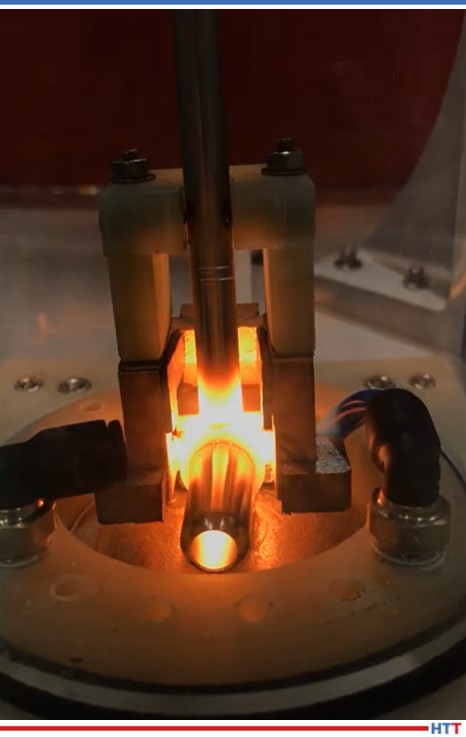
Inert gas brazing: set-up Source: eldec LLC
I've been in the induction industry here for about five years now. Prior to that, I spent time in both air filtration and the thin films industry. I feel that my experiences there have really given me a wide background. It's made me a well-rounded engineer, in my humble opinion, but it's also given me a lot of perspective and some background knowledge that some of my colleagues here don't necessarily have, which has been a good thing.
eldec was established in Germany in 1982 by a gentleman named Wolfgang Schwenk. In 1998, he packed his family up and moved here to Michigan. He established what was at the time eldec Induction USA in 1998. His goal was to better cover the North American market, and what better way to cover a market like that than to be in the market? He continued to have eldec in Europe, and then he started it here in the US.
In 2001, we moved into the building we're in now, and we've been here ever since. We've grown the facility a couple of times; in 2013, eldec, as a whole, was purchased by the EMAG Group from the machine tool industry, which I'm sure a lot of your listeners are familiar with. At that time, we changed our name to eldec LLC.
DG: Greg, is there an area of specialty that eldec focuses on, or is it “all things induction”?
GH: I would say all things induction. Our office, in particular, does not do a lot of the heat treating. That is handled by our sister company here in the US, EMAG. This is mainly because if they're selling the machine tools, they are typically the customers that are then looking to heat treat. So, it makes more sense for just one person to knock on the door. I'm not saying that we aren't versed in heat treating, we definitely are. Prior to 2013, all of that was sold out of our office in North America, and we have process development capabilities that, I would say, rival what our sister company EMAG has. They are also in the Detroit area.
DG: We're going to talk about something you and I have spoken a bit about, and that is induction, fluxless, inert atmosphere. Let's start at the very basics and work our way through. What is this thing we're talking about?
GH: When you're brazing in normal air, you end up with oxides on your parts. If you don't get the oxides off of your parts, then they end up in the joint between the metal layers and the alloy. A lot of times, people will use a flux. What we are looking to do here is to eliminate the need for that flux; so, we would use an inert atmosphere.
"We are looking to try to get rid of that flux because it adds steps in your process, meaning you have to apply the flux. Then afterward, you have to clean the flux off of the part. A lot of customers aren't afraid to do that, but it's cycle time, right? You have an extra step."
DG: Basically, we're talking about brazing in an atmosphere, using induction without flux, and the primary reason is to get rid of those oxides. You kind of answered this already, but why do we need it? Why do we need that type? What's wrong with using flux?
GH: A typical braze process would use that fluxing agent, so it's either an extra paste that you would put on, or in the event that you have your brazing copper, you would have maybe a silver alloy that would have phosphorous in there. That phosphorous acts as the flux. As the alloy melts the phosphorous, it interacts with the copper oxides and basically cleans the joint for you. It also allows the alloy to wet flow and fill the joint gaps.
We are looking to try to get rid of that flux because it adds steps in your process, meaning you have to apply the flux. Then afterward, you have to clean the flux off of the part. A lot of customers aren't afraid to do that, but it's cycle time, right? You have an extra step. So, it's time, or maybe it's an extra person, whatever the case may be. By eliminating that flux, you've eliminated those steps. You don't have to worry about cleaning the part afterwards, and if you're washing the parts to get the flux off, then you don't have to figure out what to do with that wastewater.
DG: Walk us through a typical braze process that uses flux. Let me try this and you tell me if I'm good. Basically, you've got to apply the flux, and then you also have to apply some sort of a braze paste, I would assume, correct? The actual filler material?
GH: Yes. You can use a paste. What we typically use is solid alloy. If you're brazing, say in tube brazing where your joints are round, a lot of the alloy will come as a ring. You can get it specially made from a supplier as a ring, so it slides right down over your tube. If you have plates that you're brazing together, you can get a foil. It's essentially a thin sheet that you can put between the plates. You can also use a stick form, almost like a welding stick or welding rod type. Or, if you have a trough that you're trying to braze, you can get it in pellet form--little solid pieces that will go down into that trough.
DG: So, if you were doing it with flux, you would apply a flux first, then those things, and then, of course, you'd have all of the cleanup of the flux afterwards, I assume.
GH: Correct. And typically, even before you put the flux on, you want to clean the parts and make sure that you don't have dirt and dust and other types of debris in there, too.
DG: It sounds like this brazing process, where it's fluxless, is replacing a standard flux-based brazing. We've already answered the question about the significance of fluxless; basically, you're not having to use that. The other part of the description is that it's in an inert atmosphere. I would imagine that everybody knows what an inert atmosphere is, but if you don't mind, explain what is inert atmosphere and why we need it for this process.
GH: By definition, an inert gas is essentially a gas that doesn't react with anything. You're looking at helium, argon, or nitrogen. Technically, an inert atmosphere could also be a vacuum. What the goal is here, amongst some other things, is to get the oxygen out and away from the joint. By using a vacuum, you have to essentially create a chamber that is airtight. Because, as you pull a vacuum, if it's not airtight, the oxygen in the normal atmosphere is going to be seeping into that chamber.
The advantage of an inert gas atmosphere is, by filling the chamber with a nitrogen or an argon, you essentially create a higher pressure in the chamber than you do in normal atmosphere, and so you don't have to be airtight. In all actuality, you don't want to be airtight because you want to be able to purge that space and allow the air that is in there to flow out.
DG: So, you're back filling. And, by the way, for those listening, we will put a link on the transcript of this podcast, to the video that you sent that actually shows that process. It's hard to see on radio!
GH: That's actually a process that we have as part of our trade show display. At various trade shows we'll have different displays, and that one in particular, is stainless steel brazing in an inert atmosphere.
Inert gas brazing: at braze temperature Source: eldec LLC
DG: I'll describe it here just for a bit. Basically, there is a cylinder and they've got two parts inside that need to be brazed together. The cylinder, let's say it's a foot in diameter and maybe 16 or so inches tall, is a clear glass cylinder that comes down over the parts. I assume that you back fill with an argon or a nitrogen, and flush all of the oxygen out, and then it goes through a certain heating cycle and certain different KW and whatnot, and then cools at the end. Then, the lid lifts and you're off and running. That's basically how it looks
DG: Describe to us, if you don't mind, some of the industries that would use this process. What are the applications here?
GH: What we see is more so with stainless steel tube brazing, like fluid lines, automotive fuel lines, and that kind of a thing, where the end product doesn't get painted. It could be in an area that is visible to people, though, so they want it to look aesthetically pleasing. Those are the industries and processes where this gets used, but, ultimately, it can be used in any brazing application where you're currently using flux and don't want to have that additional step.
DG: You mentioned the automotive industry. Are there any other industries that you've seen it used in?
GH: We've had some other customers with essentially fittings on the end of a tube type of an application. I don't know what type of industries they ended up putting those into, but things like that are typically where we see these. But, again, it can be anything where you're heating, and honestly, it doesn't even have to be just brazing. If you have to heat something like that, you don't want to have the oxide layers and the discoloration. If you are back filling and purging that chamber with the inert gas, then as the part cools, and you allow it to cool in that inert atmosphere below the oxidation temperature, then you end up with a part that essentially doesn't even look like it was heated.
DG: Could this inert, fluxless, induction brazing potentially replace belt furnace brazing? Perhaps in some batch processes or torch brazing? Are there any savings in the process as far as manpower? I'm assuming you've still got to have somebody loading up the fixture to be brazed, right?
GH: Sure. You still have to have the fixture loaded. Depending on how the cell is laid out, it could be loaded manually, and it could be loaded by robot. You have some manpower requirements there. Typically, the actual loading isn't that much different than what you would have to do to load those parts into a fixture going through a belt furnace or to load them into a fixture heating them with a torch.
The advantage of induction over those two is not necessarily capital investment, but operating costs in the long run. You don't have the high cost of your gas. Typically, induction is more efficient than a furnace. It is a lot more efficient than a torch. You've got a guy out there with a torch that is heating your part, and then all of a sudden, he takes the torch and points it away as he does something else. All the while, the is gas burning, doing nothing. Again, with the furnace, whether you have a part flowing through there or not, you're heating that furnace and keeping it hot.
DG: Exactly. Whereas with induction, you're applying the heat and being done with it. Describe in a little bit more detail the actual process for an inert brazing process, fluxless.
GH: The chamber that you saw in the video is a large glass cylinder. They're not typically built like that. That one is built so that you can show it off and allow people to see what's actually going on. A lot of times, the chambers are much smaller. The goal is to make the space that you have to purge as small as possible, but still contain all areas of the part where the heat is going, because all of the space in that chamber has to be purged. That's an expense, so you want to limit that.
Now, depending on how long that purge cycle takes, how large your parts are, how long it takes to get to the temperature where oxidation starts to occur, you can start heating before the purge cycle is even done as long as you make sure that by the time you hit that oxidation temperature, all of the oxygen is gone. Then, you heat your part up to whatever temperature you need for your specific process.
Inert gas shield braze process where the customer wanted to eliminate oxidation in the joint area but was not concerned with oxidation of any other area of the part. As you can see in Figure A, the braze area and pipe coupling are inside of an inert gas shield and are not oxidized, whereas the housing is clearly oxidized (Figure B) as the braze cycle finishes. Source: eldec LLC
In brazing, it depends on what type of alloy is being used and what your base metals are. And then, depending on how the coil design had to be designed for your process in your part shape, you might have to allow some additional soak time. Say you are putting a really weird-shaped fitting on the end of a part; you might not be able to get a full surround coil over the tube that's going into that fitting and realistically get that back out of the assembly. You might have a coil that only goes around 120 or 180 degrees, so to allow the heat to transfer around to the rest of that joint and come to a uniform temperature for the alloy to flow, a lot of times you have a little bit of a soak time. Which is what you see in that video, as well. After the soak time, the operator can typically see through a little window; or with our power supplies, we create a recipe with a set temperature, set power, whatever the case may be if you're using a pyrometer or not, and a specified length of time, and through a little bit of process development in the very beginning, we can create that recipe. So, from a push of a button, the operator doesn't even have to see, necessarily, whether the alloy is flowing or not.
We know for development you need this much power at this much time, maybe you need two or three steps at different powers and different times, and then, all of a sudden, you know that you're going to have a good joint, you shut the power off and allow the part to cool again in that inert atmosphere. If you're not worried about aesthetics, maybe you have a part that's going to get painted and the oxides are going to affect the adhesion of that paint, or you know that you're going to have to bead blast the part anyway, maybe you're not worried about it cooling in the atmosphere, in which case you don't have that cooling step, you can just open the chamber (but be careful because then you just have a hot part). You could essentially just open the chamber and pull that part out.
DG: Would you have to do it all in an inert atmosphere, if that were the case? If you weren't worried about the oxides, you could almost do it without, at all, right?
"What we typically see there, is we're up against a furnace brace and it boils down to not only capital investment, but operating costs in the long run, what the part volumes are."
GH: If you're just heating the part. But if you're looking to braze the part, you still either have to use the flux or the inert atmosphere to keep the oxide out of the joint area.
DG: It went through the cooling process, so now it's done.
GH: Yes, that's basically the process. Then, your chamber would open once the parts cool and your operator or your robot could unload the part and load the next one. Because of the purge and cool down time, a lot of customers will end up with a unit, a power supply, that has multiple outputs on it.
For example, we’ve built a unit with three outputs for a customer multiple times. So, in that particular case, there’s a part that has two or three different braze joint locations on it. However, what you are essentially looking at is the operator. Even if it's the exact same part in all three cases, the operator can load the part in one location, allow it to start purging, and then he can load the part in the next location. When the purge cycle is over, you can have that heat time automatically start with a self-controller.
So, the operator is literally just loading station after station, and when the first one is done, the second one is loaded, purged, and ready to heat; then the third one, and off you go. By the time the operator comes back to the first one, the part is cool, the chamber opens, and he takes it out.
Essentially, you just have an operator that is loading and unloading parts and you've saved all that cycle time by having a machine that is incrementally more capital investment but saves you so much in cycle time and process flow.
DG: Right. So, you're using that cooling time or soak time to do another function which keeps your production up. Can you tell us, without naming companies, any specific examples of where this was implemented and specifically what processes it might have replaced?
GH: The one that had the three outputs that I just talked about was for automotive fuel lines. Again, I can't say the customer’s name, and I can't say which OEM the parts actually went into, but I can tell you that it was automotive fuel lines. What we typically see there, is we're up against a furnace brace and it boils down to not only capital investment, but operating costs in the long run, what the part volumes are. If it's a car model that they don't sell a lot, then they may not be able to justify the capital cost of the induction, but if you're running typical automotive volumes, then the induction portion, split over however many hundreds of thousands of parts a year, is peanuts in the end.
DG: Do you have a sense of what the cost savings was per part or anything of that sort on that example you gave?
GH: Unfortunately, I don't. A lot of our customers don't share that kind of information.
DG: Wouldn't it be nice if they told you, because it would be a great selling point to be able to say, “Hey listen, they were furnace brazing these that cost them so much per part, now they're inert fluxless brazing with induction and it cost X minus whatever per part.” That would be a great marketing thing.
DG: I guess it's probably worth mentioning here that eldec does all different types of induction, not just inert, atmosphere, fluxless brazing, right? You're doing all kinds of different types of stuff. We were just focusing in on that specific process.
If people want to get in touch with you, Greg, or just to check out eldec, where do they want to go?
GH: We can be reached through our website. eldec actually has two different websites. We have a website that is essentially a worldwide website. I think there's eight different languages on it that you can choose from. That is www.eldec.net. On that website you'll see a lot of product lines and applications.
But here, specifically in North America, we have developed a site called www.inductionheatingexperts.com. That site is more tailored to our market here in North America. On that site, you won't necessarily see as much of the heat treating, because as I mentioned earlier, our sister company EMAG handles that. If you're interested in that, their website is www.emag.com. Here in our office, our main phone number is 248-364-4750 and our general email address is info@eldec-usa.com. Me personally, you can reach me at my desk at 248-630-7756 and my email address is gholland@emag.com.
DG: I did have one other question and that is what other resources are offered by eldec?
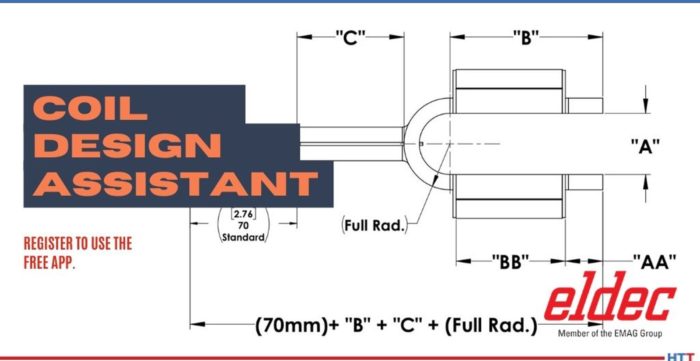
eldec’s new online app, the Coil Design Assistant Source: www.inductionheatingexperts.com
GH: I mentioned our websites. Both websites will show a list of our products. There is at least one product line that is on the North America site that is not on the other site, and that's one that we developed and specifically developed here in North America. That's called our MiniMICO .
But also on our North American site is a tool that we've developed this year called the Coil Design Assistant. That's our CDA. I believe you guys did a little feature on it not that long ago, but that is a feature where customers can go on our website and essentially find a variety of different coil types and they can put in what dimensions they think they want or need and then we get an email and we can essentially do an approval drawing and a quote for them right there off of the web.
DG: Basically, it's a web tool to help you design a coil.
Doug Glenn, Heat Treat Todaypublisher and Heat Treat Radio host.
Welcome back to the show. Heat Treat Radio host, Doug Glenn, wraps up a four-part series on CQI-9 Revision 4 changes with Acument Global Technologies’ James Hawthorne and Controls Service Inc. Justin Rydzewski. In this final episode, both of these experts give their advice on how to navigate and comply with Rev 4.
The following transcript has been edited for your reading enjoyment.
Doug Glenn (DG): We're here today with Justin Rydzewski who is the director of sales and marketing of Controls Service, Inc. in Livonia, Michigan and also with James Hawthorne, heat treat specialist at Acument Global Technologies. Both of these gentlemen have been with us for two or three of the last three episodes that we put together. James, was the committee chair, I believe that's the right title, for the Revision 4, and Justin, of course, was right alongside on the committee getting things done. Gentlemen, first off, welcome back to Heat Treat Radio.
Justin Rydzewski (JR): Glad to be here.
James Hawthorne (JH): Thank you, Doug. Glad to be here.
DG: We've covered a lot of the major changes, a lot of the main points that people ought to know, on the first three episodes. We want to wrap it up today by asking a couple of very practical questions, a couple of “opinion” questions, but, I think, also a couple of very practical questions on implementation, and things of that sort, of the new CQI-9 Rev 4.
Justin, if you don't mind, I'd like to start with you and address an issue that I think you and I touched on in the very first episode, and that was the difference between the CQI-9 standard and AM2750F, specifically, about the automotive industry. Why doesn't it just adopt AMS2750F as opposed to having this separate CQI-9 standard?
Episode 1 of 3 of AMS2750 series
JR: I think that both specifications are appropriate for their industries. But, there are some significant differences between the two. First and foremost, one is intended for aerospace and the other for automotive. AMS2750F, as we've mentioned in a previous episode, is a pyrometry standard, whereas CQI-9 is a system assessment; it is a process-based approach to things, whereas AMS2750 is more equipment based. You classify things by temperature tolerances, by the instrumentation type that you have, whereas requirements within CQI-9 are generally based on your type of process and specific to your process, in particular.
I would say that the most significant difference between the two documents is AMS2750 is part of the NADCAP program and requires accreditation and an auditing body, PRI, to come out and say, “Yep, you're good to go. Here's your certificate. We'll see you in a year”. CQI-9 is intended to be a self-assessment. It's intended for heat treaters to implement themselves to provide them with a process of managing their heat treat and that doesn't require somebody to come in and accredit them and hand them a certificate.
There is a big difference between the two; they are not equals. There are similarities, especially in the pyrometry section. At one point, AMS was heavily sited inside of CQI-9. Since its removal, however, we've had success, and that success has been measurable; it's been significant. I would image that the OEs have been rather happy with what it is that they have there in the document, especially in the 4th edition, and I think that the thought of going to an AMS2750 and abandoning CQI-9 is well outside the realm of plausible.
JH: One thing I would add here is, if you read the headers for each section of the HTSA, section one is “Management Responsibility and Quality Planning”, section two is “Floor and Material Handling Responsibilities”, and section three is the equipment. On the equipment side, you're going to get more into the pyrometry side of things- the metrology and the maintenance specifics to that equipment, as well. So, the all-encompassing HTSA is a system that is a management system, or at least a system that you can develop a management system based behind, and ensure compliance.
DG: For those who are just joining on this episode, HTSA, heat treat system assessment, is one of the main parts of the CQI standard. Justin, I think your point is good. James, I think, as well, the point is well taken. CQI-9 is meant to be an internal tool, a continuous improvement tool that helps a company that is involved with heat treating to continually improve their process. AMS2750F specifically, is pretty much exclusively a pyrometry certification program, where you've got to have somebody coming from the outside. I remember, back in the day, when they were first starting one of the QS standards, they said, no longer are you going to have to comply or get qualified by this OE, or this prime, or this prime, now you can have one standard. Has that been the case here? Has it been effective in the automotive industry, CQI-9?
JH: I think, 100%, Doug. It's like IATF – all of the automotive industry has to be compliant to that. Same thing with CQI-9. It provides that commonality for all heat treaters in all the different processes that are employed at their facilities, or the multiple facilities that they may have. For a company like ours, we have 8 companies in North America. For the North American side of things that have heat treat furnaces in them, we have induction furnaces, we have carbonitriding furnaces, and we have stress relief furnaces. So that commonality even helps us internally with our management system and how we take steps to provide that common approach and compliance to CQI-9.
[blockquote author="Justin Rydzewski" style="1"]The CQI-9 intent largely was that this is something that you can do yourself and implement yourself. We'll provide you with the guidance and put it in simple terms and give you all the research you need to support this on your own.[/blockquote]
JR: I think that also bodes well, up the ladder as well, for the OEs. The more commonality that exists in the industry, the wider that, for lack of a better term, talent pool is. The more people, the more sources that you can go to in order to have work done and have it what you expect it to be, from a quality standpoint.
I think one of the things that CQI-9 has done really well is they've made a concerted effort to make that document easier to understand and to simplify things down to just its bare bone necessities, whereas some of the other specifications that exist in industry can be lacking. There is a real good reason why a lot of the work of some of those other pyrometry specifications out there are outsourced, because the expertise to adhere to those things and be confident that you're adhering to those things is possessed by an in-house team; they have to go outside. The CQI-9 intent largely was that this is something that you can do yourself and implement yourself. We'll provide you with the guidance and put it in simple terms and give you all the research you need to support this on your own.
Justin Rydzewski, James Hawthorne, and Doug Glenn (clockwise from the left) sat around the virtual screen to hash out a few final expert opinions on CQI-9.
DG: I'm pretty sure, based on everything we've talked about, that you guys really like CQI-9.
JH: 100%! I embrace it and our company embraces it.
DG: So, I know you guys like it, you're the main cheerleaders. What is your perception about companies outside of yourself? Has it, in fact, been embraced, or has it kind of been “Heisman trophied”, the stiff arm – “We'll embrace you with one extended arm”.
JH: If I may, I will say that it's been embraced across the industry through all heat treaters. I think anywhere that anybody deemed it to be a burden, I think with the changes to the format, the added clarity, the improvements to the document, the knowledge base that's now been updated in the glossary, it is all going to help those guys cross any bridge that they were struggling with and make it better for them.
I believe we touched on a little bit in one of the past episodes, or maybe it was when Justin and I were talking about this offline, but one of our customers, who is a non-automotive customer, embraces CQI-9 and our systems and our approach to our heat treat. That is a huge step because that particular company has a lot of internal specification as it pertains to heat treat, but CQI-9 is either equal to or exceeds what their expectation is. It makes it easy for them to embrace it. That was one of the things that was brought up in the roll-out presentation we did through AIAT – one of the other industries had mentioned they were following it.
DG: It sounds like, overall, it has been fairly well embraced and this Rev 4 is going to make it even easier to cuddle up with a cup of hot cocoa and feel comfortable with it.
JR: Generally speaking, in my travels, I have two categories of people that I come across. You have the sort that is looking to embrace it. They recognize that it's a “have to do” and they just want to know what the rules are. They want to make sure that they understand what the rules are and that they make sense. Maybe there is a point or two that they take exception to about, not fully understanding what the intent is of it, but, for the most part, by and large, they want to adhere to the requirements. They recognize that they need to.
The other category includes those who fight anything that they're asked to do, no matter what it is. “No, I don't want to do that. We've been doing it this way forever. Convince me, show me, that I'm doing it wrong. I do some sort of subsequent testing and it always come out fine. I've never had any complaints. Why do I have to go do this?” While that group is definitely the minority, I can tell you that that group, almost 100% of those people are going to be those types that you find more issues with than any other. That's because they fight it and they try to find ways to circumvent things. That's a real slippery slope there.
I think CQI-9 does a real good job at trying to keep things in its lane and recognize that if there's something that we're asking the heat treater to do, that that requirement needs to provide value on some level, or it needs to mitigate risk on some level, and a meaningful one at that.
You asked, “Do I like CQI-9?” I like AMS2750 too. There are some things in AMS2750 I like better than what we did in CQI-9. Talking from experience of having to write some of the requirements in the document, and how difficult that can be to say what it is you want to say but in a manner that makes sense outside of your own brain, it's difficult. I think AMS states some things very, very well. I like their thermocouple calibration certificate requirements better than ours; I think they're more detailed. But I think both work really well, and embracing it sometimes just requires a bit of an education or an understanding of the intent side of things, the purpose side of things.
DG: When was CQI-9 Rev 4 released?
JR: The last week of June.
DG: It's been going on for months now. How about timing? I would imagine that a lot of people that are listening to this probably know that they need to comply with certain aspects of CQI-9. What is the timing for them? When do they need to have all their ducks in order?
JH: During the roll out presentation, the OEMs made a joint statement. We did that roll out presentation in September, and they essentially said that the time between the June release and that (roll-out) presentation was the grace period. When the 3rd edition expired, you have to do 4th edition assessment and they will no longer accept 3rd edition assessments at that point. So, whenever your expiration is, you shall do it to the 4th edition.
JR: The 3rd edition is officially obsolete.
DG: So if you're doing another assessment, it's going to be a Rev 4 assessment. Are there any other timing issues that people need to be aware of?
JR: That should pretty much cover everything. If you're outsourcing an element of your service or of a material, you should be specifying adherence or conformance to the 4th edition at this point.
DG: So, James, I want to address this next question to you, if you don't mind. I know you said in your organization, you've got how many North American locations?
JH: 8 plants in North America.
DG: OK, 8 plants. And you've, obviously, rolled out Rev 4. How did you handle the transition? How did it go? What was complicated and difficult, and how did you address it?
JH: For me, I think it's a little easier, because I was in the room while we were writing the 4th edition. The heat treat systems for all of our locations, I wrote. So, I have a very unfair advantage. But, that being said, even knowing and being as intimate as I am with our own system and the 4th edition of CQI-9, we have made a concerted effort to slow down the process of doing the heat treat system assessment and slow down the process of doing the job audit and doing the process tables to ensure that we are capturing everything.
We've made this statement many times, whether it was here with you or if it was through our roll-out presentation, it is essential to read this document. It is essential to understand what's happening in it. If it takes just a little bit of extra time to read a little bit further to do the checks and balances, pop into the glossary, just to make sure that you are answering the questions as compliant as you possibly can, is the most important thing.
A wise man told me once, Compliance is a circle and if you're just outside the circle, all I want you to do is get you just inside the circle. And next year I'm going to tighten the circle a little bit and if you're still sitting outside, we're going to move you inside. You don't have to hit a bullseye every time, but you have to be inside the compliance circle. So, if you understand that, and if you manage it that way, it's going to make it easy and more effective. Then, you can stick to the intent of the document, and the intent of the document is within the acronym itself of CQI-9: it's continuous quality improvement. Never take your foot off the pedal.
Source: Heat Treat Today
DG: Right. It never ends. Justin, how about you? Same question. I know you're going in through your company into a variety of other companies who are trying to comply. What are you seeing, from their perspective, as far as the difficulty? How are they handling it?
JR: I think the most difficult aspect of things, I guess, is probably one of the most obvious: implementation. You've been doing it one way for the last 8-9 years and now we're going to need to implement something new. And when do you want to implement something new? It's really nice when you work for an organization that has process specifications and certain test specifications very well defined, because then you can hold onto them and say, “Here are the things that we were doing,” and you can go through them and see where things need to be different.
Where they're less defined, or they're defined in some manner that is not on the forefront of things – like I define things in a quote or in a purchase order – those become difficult. There could be elements of implementing something too soon, and now, all of a sudden, I violate something that they've done internally, or sometimes if they had it stated internally for a requirement.
For us, the most difficult thing has been the implementation side of things. It's meant a lot of conversations and trying to determine what this is going to look like, what things we are going to need to do differently, what things we want to check on, and the finally to, for lack of a better word, “coach” my customer along. Here are things you need to consider, here are things you might need to do differently, here's how I would state it for the new edition for making revisions. But to the horse that has been thoroughly well beaten, you have to read the document.
The CQI-9 audio book, coming soon, we'll have that on tape for you. Whether you're driving to work or putting your kids to sleep, it will work either way.
DG: Last question for you guys. For a company who's wanting to become CQI-9 compliant, what are some of those must do's and what are some of the practical advice you've got for them as they start down that path?
JH: If, I may, I think the first and most important thing there is to evaluate the talent that you have on site. Who is your in-house expert? Who is the guy that most fits what you need to be the driver of those next steps? As long as you have that, and that guy understands your system, then the journey can begin and I think your process is more linear with less hills and valleys. You start to win, and you start to win with less drop-off, and that's what you want to do. First and foremost, have the right guy in place.
[blockquote author="James Hawthorne" style="1"]First and foremost, have the right guy in place. [/blockquote]
DG: So, in your estimation, James, you're saying it's a personnel issue. Right away, make sure you do a good assessment and get the right guy in the spot to oversee the process.
JH: Right. You don't want to be a commercial heat treater and you just hired a quality manager from a widget factory to come be the champion of your heat treat. You want him to be a heat treater. You want to have a heat treater in place that knows his stuff.
DG: Right. And who has an attention to detail, I'm sure.
JH: I think it's important to the extent of what Justin was just talking about is, when that person talks to his suppliers, his service providers, you want to have somebody that has some wherewithal and understanding in that field so when that communication does take place, and you have folks like Justin and others in his field, trying to help educate the heat treater on what it takes to be compliant with, whether it's reporting, whether it's through the process or whatever, having that understanding is going to make even the service provider’s job easier.
JR: I think that organizations that struggled with the 3rd edition are probably going to continue to struggle with the 4th edition. If you're comfortable with the 3rd edition and you're doing well with the 3rd edition, the 4th edition is going to be relatively easy to adapt to and to implement. Like with any math story problem, you've got to write down what it is you know. So you go through the document itself, you start making notes on things, you start citing where things might need to be different, you start red flagging things, you review what you have, may do a Ctrl + F for any mention of 3rd edition and replace with 4th edition, or something simple like that. It is what you have created and try to continue on with the successes you had for the 3rd edition into that 4th one. If you've struggled with the 3rd edition, the likelihood that you're going to struggle with the 4th is also pretty great. It is likely that the document isn't the issue, the issue is likely a lack of awareness.
It cannot go understated how valuable it is to invest in training, especially if you're bringing some new guy on to champion the effort, or if you've got a team that's eager and hungry and looking to prove their worth – get them trained. It's readily available. Our organization offers it, the AIG offers training on the HTSA side of things; there are plenty of organizations out there that will offer this training. The benefits to working with a high-end service provider in many of these regards, is that they'll help you through the process as part of their service offering. That's how the true value of a good service provider can be measured is in these sorts of situations. I'd lean on your experts. Invest in your staff. Get the training to get everyone up to speed.
Again, if you fought it in the 3rd, and your plan is to fight it on the 4th, it's going to be an unenjoyable road and you might need to figure out ways to embrace what it is you know and acknowledge what it is you don't, and then fill those gaps in so that you can get to where you need to go.
Doug Glenn,Heat Treat Today publisher and Heat Treat Radio host.
This brief original content column by Heat Treat Today’s publisher, Doug Glenn, is from the most recent print magazine,Air and Atmosphere 2021. Are standardization and innovation in competition with one another, or do they assist each other? Which one is better to have? Read this article weighing the economics, business, and cultural realities of both.
Doug Glenn Publisher and Founder Heat Treat Today
In the heat treat industry, I wonder what effect standardization has had on innovation. This is a somewhat loaded question given the number of companies in the North American heat treat industry that are invested in industry standards such as AMS2750, CQI-9, and a large alphabet soup bowl of other standards. I’d like to hear your specific stories about how standardization has been helpful or harmful. Maybe Heat Treat Today can do a future article on the topic if we get enough responses. But in lieu of those real-life anecdotes, let’s think for a moment about the relationship between innovation and standardization.
First, I think that nearly everyone would agree that innovation is a good thing and should be encouraged. Many of today’s conveniences are the result of yesterday’s innovations. Certainly, not EVERY innovation is good, but encouraging a company, economy, or culture of innovation is far and away preferred to the absence of innovation.
Second, we should also acknowledge the benefits of standardization. Repeatability is the hallmark of high production societies. Knowing that you’re always going to get the same burger at any McDonald’s across the country is a huge selling point for that fast food giant. And when it comes to mission-critical or life-critical goods or services, who would not want the assurance that “past performance is a good indicator of future results.” I prefer my heart surgeon to do the same thing every time!
Third, let’s be clear that standardization and innovation are, by nature, mortal enemies in the sense that each tends to destroy the other. An atmosphere of standardization, where everything is always done the same – over and over again – is antithetical to shaking things up and trying new and sometimes odd things. Likewise, an atmosphere of innovation, cuts directly across the same sameness of standardization. If you do it differently one time, standardization is destroyed.
There is wonderfully simple and brilliant book written by the towering mind of Ludwig von Mises called Bureaucracy which contrasts bureaucratic organizations with profit-driven organizations. I recommend it highly (search Bureaucracy, von Mises) and it has something to say about the differences between bureaucratic organizations, which are highly standardized by nature, as well as being profit-driven organizations that tend to be less standardized and more innovative. One of his points is that there is a place for both in the world. The military, for example, is not a good place for question-asking and innovation, especially in the midst of a battle. In a military setting, do what you’re told without question and don’t deviate/innovate. In a profit- driven business, however, this same mindset is not so healthy – take for example the postal system or another bureaucratic organization where responsiveness to customer needs is not highly valued.
Some may say that there is a standardized process for being innovative. Could be.
Where’s the balance and how do we know if/when we’ve gone too far in either direction?
I’d be interested to hear your heat treat stories of when and why standardization or innovation is good, and especially how these two live comfortably together.
The Metal Treating Institute (MTI) and Furnaces North America announced that they have signed a new media partnership with Heat Treat Today out of New Castle, Pa. Heat Treat Today is one of the heat treating industry’s leading publications, reaching heat treaters through their print, digital and social media platforms.
“2020 brought on many changes to many companies, and MTI,” says Tom Morrison, CEO of MTI, “was no different. After looking at the value proposition from numerous publications on who could provide the largest voice for commercial heat treaters, Heat Treat Today’s offerings matched up with the needs and future plans of MTI and FNA.”
Heat Treat Today founder and publisher, Doug Glenn, added, “We are excited about the media partnership with MTI and FNA. Our passion is the heat treating industry and we are looking forward to providing a strong voice for MTI members to the captive heat treaters throughout our readership.”
MTI will release MTI’s Commercial Heat Treating in Heat Treat Today’s printed magazine. This section will focus on sharing why outsourcing part or all of their heat treating to a MTI commercial heat treater could be beneficial. Content will also include articles on safety, Industry 4.0, digital business strategies, and automation.
Tom Morrison image provided by Metal Treating Institute. All other images provided by Heat Treat Today.
Heat TreatRadio host, Doug Glenn, conducts Part 2 of this 4-part series withJames Hawthorne of Acument Global Technologies and Justin Rydzewski of Controls Service, Inc. about Revision 4 of CQI-9. This time, the conversation focuses around heat treat system assessments and job audits.
You are about to listen to the 2nd episode in a 4-part series on CQI-9 Rev. 4. You can find the previous episodes at www.heattreattoday.com/radio.
Below, you can either listen to the podcast by clicking on the audio play button, or you can read an edited version of the transcript.
The following transcript has been edited for your reading enjoyment.
Doug Glenn (DG): Welcome to Heat Treat Radio. I am here today with Justin Rydzewski from Controls Service, and a new guest we’re going to introduce to you in just a moment, Mr. James Hawthorne from Acument Global Technologies. We are going to be talking about CQI-9. This is our second in a four podcast series on the new Revision 4 of CQI-9. We want to welcome our guests today. As I mentioned, Justin is from Controls Service, in Livonia, where he is the director of sales and marketing. Justin was actively involved on the committee that wrote Rev 4.
Justin Rydzewski (JR): That’s correct. I was an active participant in coauthoring the fourth edition. My most significant contributions were to the pyrometry section.
DG: Correct. And pyrometry was what we talked about last time. So, welcome back. We are also welcoming James Hawthorne. I want you to tell folks about yourself, but as I mentioned, you’re with Acument Global Technologies, a Fontana Groupo company, which I believe is an Italian based company, that is located in Michigan, with its headquarters located in Sterling Heights. My understanding is you are the heat treat specialist at that company. If you don’t mind, please tell us a little bit about the company and yourself as well as your involvement on the CQI-9 committee.
James Hawthorne (JH): I work for Acument Global Technologies. I am the heat treat specialist for our North American facilities. I handle the heat treat systems, the system’s compliance, and quality assurance for the heat treats within our organization. Acument has been around many, many years. We make fasteners – nuts, bolts, rivets, washers – for the auto industry. We make it for off-highway equipment, things like tractors and bulldozers and whatnot, and we also do building and construction fasteners, as well as things that are holding bridges together, and roller coasters — you name it, we probably have a fastener in it.
[blockquote author=”James Hawthorne, Acument Global Technologies” style=”1″]We’ve been working on this document for quite some time. Through a lot of expertise and many, many, many work hours, I believe we’ve put together a really good product for the industry.[/blockquote]
DG: We appreciate that! We were talking before we hit the record button how the world would be a worse place if fasteners weren’t holding stuff together. I do want to mention, before you go on, that according to the Acument website, the company is described as the world’s most innovative manufacturer of value-added screws, bolts, nuts and cold formed components.
Please continue. Tell us about you and your role on CQI-9.
JH: I’ve been in the heat treating industry for over 25 years. My formal education includes metallography and statistical process control. I’ve held positions in heat treat including maintenance, working in the laboratory, working in supervision, and now I work in the corporate capacity, which is what led me into AIAG. We are a member company, and I was brought in to add as much value and knowledge as I could, based on my experiences. Currently, I am the chairman of the technical committee. We’ve been working on this document for quite some time. Through a lot of expertise and many, many, many work hours, I believe we’ve put together a really good product for the industry.
DG: Basically, you’re the technical director of the committee?
James Hawthorne Corporate Heat Treat Specialist, Acument Global Technologies
JH: The committee chairman. The important part is to try to keep everybody on task; you’re more of a task manager at that point. You get a lot of smart people in a room, and trying to corral that intelligence is not difficult; it’s just making sure that we stay in the right lane, get to the bottom of what we’re trying to get to, and complete the specific task in the moment.
DG: I asked Justin this the last time, and I’d like to ask you, too, just to get your perspective. How would you explain CQI-9 to someone who has essentially zero understanding of what it is?
JH: First I’d start with the acronym itself. CQI-9 is Continuous Quality Improvement. The purpose behind it is to put together a system that will help you manage and control your process, and at the end of it, the product that you’re delivering to the end user. The intent is to give you those guidelines to help avoid potential spills or escapes or whatever else may come with that.
DG: Right, any of the hurdles in the process itself. It’s mostly heat treat related, yes? Or is there more than just heat treat there?
JH: It is the entire system of heat treat. If you look at the heat treat system assessment, the first portion of it is quality based. The second portion (section 2) is the floor responsibilities, things that are on task that are being completed. And third, you get into the maintenance and the pyrometry portion of it, very specific to the pyrometry and very specific to atmosphere control. At the end of it, there are some very specific induction questions, because when it comes to induction, there is no real furnace at that point, so you want to focus on those key elements of induction.
DG: Justin, the last time we talked about this, we tried to break this down to keep it simple – the CQI-9 and the four basic sections. Very briefly, let’s review those and then we’re going to jump into talking about heat treat system assessments and job audits. Can you give us the four categories?
JR: CQI-9 is broken down into a few sections and one of the reasons for that, per our conversation last time, it is not exactly like an AMS2750, which is a pyrometry standard. Instead, this is a system assessment. It is meant to assess an entire system of heat treat. It includes a multitude of sections that address the system as a whole. It starts with your heat treat system assessment, which often utilizes an acronym of HTSA, then you have a pyrometry section, then a job audit, and then your process tables and various different support elements, like a glossary of terms, instructions sheets, and whatnot. But the four are the HTSA, pyrometry, job audit and process tables.
Read/listen to the first episode. Click the image above.
DG: As we mentioned last time, Justin, you and I talked down through the pyrometry section which covered things like sensors, thermocouples, calibration, SATs and TUSs. If you, our audience, are interested in that information, you’d want to go back to the first episode.
James, we’d like to pick your brain a bit on this. Let’s jump into some questions on the HTSAs, as we’ll refer to them, heat treat system assessments, and job audits. Let me ask you this to start off. Let’s go right to the basics: What is an HTSA and what is its purpose?
JH: HTSA, heat treat system assessment, is a tool that has been developed to help you evaluate how you manage your heat treat system for effectiveness – effectiveness in quality management, effectiveness in the floor responsibilities. Like I mentioned earlier, understanding that through aspects of training and training effectiveness and into the final section of atmospheric control and atmosphere management and reaction to those. The purpose here is to have one system, one document that is the rules of engagement for doing heat treat in the automotive world. What this does is, it allows the automotive industry to give you one spec, one thing to follow. As opposed to having, say Ford, to give you ten questions where none of them are exactly the same as FCA or nine of them are the same as Ford motor company, where one of them have a specific question. This encompasses all of those wants and needs from the auto industry to protect themselves, to protect the end user out there in the field that may be using that heat treated component.
DG: How frequently does a heat treater need to conduct an HTSA?
JH: The rules of engagement are annually. On an annual basis you should be evaluating your system for compliance. The beautiful thing about the HTSA is that it is a living document. If you find any shortcomings in there, you have the ability to go back and update that and make it match what your reality is after you find the solution to the problem that may have come up while doing your assessment.
DG: For clarification, these HTSAs, are they conducted by the company, or do they need to have a third party come in and conduct the HTSA annually?
JH: That’s a great question. There are no rules to having an independent body come in to do this assessment. If you have the people that meet the criteria within your organization to do the HTSA, the system assessment along with the process table review and the job audit, you can do it within your own organization. You just have to meet the criteria that is listed in the book, and these kinds of things are having experience in heat treat, which is the number one thing you must have to be the lead auditor of a heat treat, the understanding of quality core tools and having that audit experience. Those are the things that you have to do to be able to successfully do an audit and it meet the intent of CQI9.
JR: I believe the intended purpose of the HTSA was initially for it to be supported internally by the organization. That was the intent of it. We commonly refer to the HTSA as a self assessment.
DG: That makes sense. I assume that when the auditor comes in, he may audit how you did your HTSA, to make sure that it was done well, and all that good stuff.
So the outcome of HTSA is going to be pass, fail, miserably fail; what are the possible outcomes? I know we’ve talked about “Not Satisfactory” and “Needs Immediate Action.” I want to deal with those differences, but what are the outcomes?
JH: “Not Satisfactory” is where you don’t meet the intent of the shall within the related HTSA question. Now, that could be a simple oversight where it’s very easily correctable- you put the proper things in place and you move on. If you have something that could jeopardize final product quality, now you’re looking at something that may be a “Needs Immediate Action” and that “Needs Immediate Action” will be evaluated by the assessor and the heat treat organization as to what needs to be done. CQI-9 does afford the heat treater with 90 days to correct any finding. If it’s a “Needs Immediate Action,” there should be action to correct that finding immediately up to 90 days. It’s also important to note that if it’s something that is going to jeopardize product quality, then there is a chance that it “Needs Immediate Action” will be extreme enough to where you have to stop processing – stop processing, fix the problem and then begin processing again. But that goes to the evaluator. You have to be able to evaluate that; and that’s one of the many reasons why we look at the assessor, or at least the lead assessor, being a heat treater, because he’s going to understand it, he’s going to know it. For a commercial house, it’s very easy to have those people available. In a captive house, maybe not so much, where you’ve got a lot of other things going on plus heat treat.
JR: I don’t know if you recall or not, James, from the roll-out we had a question that came through, and I don’t know if we were actually able to address it, but they posed a question of why the heat treater was given a greater amount of focus than was in the previous edition. Somehow, that was an element that required explaining because there was a question of a possibility for there to be issue with doing so.
JH: If we go back to the conversations that we had about this, I think this was one of the topics we talked at length about, and the rationale behind the lead assessor. Is it more important for that person to be a good auditor, or is it more important for that person to be a heat treater? We’re not diminishing the need to have audit experience, at all. The only difference is that we’re saying that the person that is going to be the lead auditor be a heat treater, because that heat treat experience is going to be much greater than somebody who has audit experience. Where if an auditor goes out and he looks at every day is cold forming, for example, and how they make the fastener itself, well, when he gets to the heat treat portion of it, is he going to know what atmosphere control is? Is he going to know what endothermic gas is? This is the rationale behind this change – that these people are going to understand the language, and that’s the importance.
JR: The key element is that it doesn’t mean that you don’t have to have the audit experience on that team. That person is still needed, it’s just the focus shifts a bit. It doesn’t mean that it is now absent.
DG: Let’s move on to job audit, James. It’s different than an HTSA, but what is a job audit and what is the purpose?
JH: The job audit is the supplemental portion of the assessment process. The job audit is where you would take apart and walk it through the system and then verify all of the evidence that you’ve put into the HTSA. You walk the process; you go look at each point specific item based on the job audit flow, and you check: Did the operator check the right amount of pieces? Does that match what you said in the HTSA? Did they document their efforts on, let’s say, production report A and process report B, and is that what is represented in the HTSA?
The first part is the “truss,” then you’re verified. Now, you’re doing some verifying in the HTSA, don’t get me wrong, but this is actually walking that part through the system and ensuring that every box was checked, every “T” crossed and every “I” dotted.
DG: It sounds like the HTSA is more like the blueprint and the job audit is running a part through and making sure that we match up to the standard, so to speak.
JH: Yes, sir. And it’s verification of your reality.
DG: Is there a requirement as far as frequency of job audits? How often do you have to do those?
JH: This is also annual. You are required to do an automotive part. I know that some customers might like to see their part in the job audit, but we don’t require it per customer. If it’s an automotive part, I would say 95 – 99% in the industry, what you’re doing for one customer, you’re doing for every customer, in a 101 kind of standpoint. There may be some special tests here or there, but overall, your system and your system’s management is going to be the same for one customer that it is for all customers. If it’s right for one, you’ll do it for all. And that’s the intent. Do it with the one automotive customer, and then the next year, do a different part.
DG: Do you find, in your practical experience, that people are doing more than one job audit a year? It seems to me, it would make sense to do more than one, but I don’t know.
JH: I guess it depends on the organization. I know, for our organization, we do a job audit annually for each process employed. I’ll give you an example of this. We have a facility that has belt furnaces and it is neutral hardening. So, we’ll do a job audit for the neutral hardening. Then, we have induction in that facility, as well, so we’ll do one for induction. And then there is stress relief post induction, and we’ll do one for that as well. For us, in our organization, that’s how we manage it to accommodate the processes employed at our facility.
James Hawthorne and Justin Rydzewski speak about how the heat treat system assessment (HTSA) in CQI-9 has changed.
DG: Let’s talk about the CQI-9 Rev 4. What were the major changes to the HTSA requirements?
JH: Right off the top, the big change was the format. In the 3rd edition, you had one question that required one answer. There were many shall statements inside that one question, so you were trying to answer a multifaceted question in one area. Now, the HTSA is slightly different where you have one kind of overall question and then each shall statement is individually broken out and now you have to show effective evidence inside each one of those shall statements. Talking through this, maybe it sounds a little odd, but I will tell you that it has cleaned up this document tremendously, where it makes it so much easier to walk the system and expose either your compliance or noncompliance to a shall statement.
DG: I do have a question here. You’ve mentioned it several times, but I just want to make sure our listeners understand this. I assume you’re saying “shall” statements, as in “thou shalt do this and thou shalt do that,” correct?
JH: That is absolutely correct. From an auditor’s standpoint, there is a difference between shall and should. Should is suggested, shall you will do.
DG: Right. Shall is a requirement, should is a strong suggestion, let’s say.
Any other changes in Rev 4 as far as the HTSA?
JH: I would say that there are subtle changes to all of the HTSA questions. Some of them are maybe not as significant as others, where it’s cleaning up the language or removing some wording just to make the question read clearer. That clarity to the end user was one of the high priority items for our group when we were doing the writing of this document.
The big thing I would say for anybody using this document, whether or not they’re a seasoned veteran with 20 years of heat treating experience, anything short of reading this document and you’re not doing yourself any favors. It’s important to walk the document. It’s important to traverse the document, whether you do it in phases – grab the HTSA and read through it, and then maybe a week later go through another portion of it, especially if you’re getting to the point where your assessment is coming up to be due. It provides a lot of information and a lot of guidance, and it will help you avoid any potential pitfalls.
[blocktext align=”right”]”DG: So does that mean less time, hopefully?” “JH: 100% yes.”[/blocktext]JR: I would also agree in terms of the changes. The most significant one is the formatting, far and away. I think even in the CQI-9 expert analysis article that we did with you guys, Bob Ferry even noted that as the most notable change in his mind was the improved formatting there and how much easier it is now to capture all of those requirements, whereas before you’d have some long drawn out paragraph. Before, you used to look at it and say that’s a requirement, but when you’d read it closer, you’d find five or six shall statements and multiple paragraphs and were given one box to provide an answer to. That makes things complicated. And there are several new requirements within the HTSA questions, but far and away, the changes are really to make it more clear, provide that additional guidance, and define more explicitly what the expectations are of those individual requirements. To capture all of those, it’s going to take a read-through. Some of them are minor, some of them are different, but there are new requirements. There have been a few questions that were added that weren’t in previous ones; they have been expanded on, I should say.
DG: It is a significant rewrite. If you’ve done Rev 3, don’t assume you can fudge it. Basically, start from scratch and go from there. I think that’s the point taken.
So we’ve covered some of the major changes in HTSA. How about in the job audit? What are the major changes on the job audit side, James?
JH: I would say that as far as major changes, there are not very significant changes. I think that there were some subtle changes and some removal of questions that in the 3rd edition didn’t quite fit the intent of the job audit. For example, it would ask you to go look at something like APQP process. What did that look like? In the HTSA, you’ve already covered that, and APQP information you may not find out on the floor. You’re going to have bin tickets, bin tags, part travelers, production records and things of that nature, so the APQP process you won’t find out on a floor. So, some of those things were dialed back to where that information wasn’t required to be looked at a second or third time.
DG: Is it your estimation that a job audit under the 4th edition is going to take more time or less time than under the 3rd? Does the documentation help us to do it more quickly?
JH: I think evaluating the system and utilizing the job audit is going to be significantly easier; it’s more streamlined and it’s set up to allow you to traverse the process better than it was before. In other words, more effectively and more efficiently.
DG: So does that mean less time, hopefully?
JH: 100% yes.
DG: I think that’s important. I think that will help those who maybe have some hesitation about looking at Rev 4 because there is the possibility of saving some time.
JH: I’ve had the luxury of performing six within our facilities, under Rev 4, and I will tell you that the job audit portion is certainly quicker and more efficient. The HTSA takes a little bit longer because it’s new and the format is new, so aligning everything with what your reality is takes a little bit of time. It certainly forces you not to assume, which I found to be a really amazing part of this process. Our company’s systems are very, very common and all of our heat treat processes have the same work instructions. That’s part of what my job is, is for that commonality across our plants.
Even though I am very intimate with all of our plants and very intimate with all of our processes, going through this process allowed me the opportunity to do it – and I feel do it very effectively – because at no point did I ever stop and assume that somebody was doing something. It was like, Alright, I’m going to put in what your reality is, I’m going to write down what we’re doing. And that was a great part of this process, for me.
DG: I have a final question for you on this. You know that you’re going to have some people that are going to be doing Rev 4, they’re going to be starting it and doing their initial assessment, if you will. James, you’ve already done six at least in your plant. What kind of guides would you give people to not overlook when they perform that initial assessment?
JH: First and foremost, read the question and make sure that your answer makes sense to you as a heat treater. I would say, even more importantly, if you come across any word in this document that you’re 70% sure you know the meaning of, go to the glossary and use it. It is a very intuitive tool in this document and those definitions are written as it pertains to this document. If you need that guidance, if you need that nudge over a small hurdle that you’re dealing with based on what does this mean or how do I interpret this, go to the glossary first. It is a GREAT tool.
JR: I think that due to the fact that the 3rd edition had such a prolonged life on the street of 9 years, that’s going to allow someone to get rather efficient at doing that process of going through that HTSA. You have a well-developed and worked-through system at that point, and when something comes along like the rewrite/4th edition and the HTSA, that is going to be very different; where the first few assessments that you perform to the 3rd edition may have taken X amount of time, I would compare that more so to how much time it’s going to take you for the 4th edition. As heat treaters became efficient doing their HTSAs and that time pared down, all of a sudden now they’re given this 4th edition, and it could seem like it’s a lot by comparison. But it’s just something new. You will get through it and you’ll start to gain speed overtime. And I think that the clarity and the ease of capturing these requirements within the 4th edition are going to outweigh the aspects of other things and it’s going to allow you a real good chance to turn over all those stones that perhaps have been assumptive, of sorts, over time.
DG: The point being – don’t be discouraged if the first several assessments under Rev 4 take you a good bit of time. It’s probably the same as when you were doing Rev 3: they took a lot of time but you get better and better and more efficient and ultimately, with the format you guys are providing in this Rev 4, it sounds like it’s going to be a much more beneficial outcome in the end.
JH: Absolutely. And to give you a time frame, 2–2 ½ days is what it was taking us to do an assessment at one of our facilities. Now, it’s about 3 ½ days. It’s not significantly longer, but to supplement the point that Justin was making, take your time. Read through it and take your time. It is important to make sure that we cross T’s and dot I’s, especially in our industry. It is no place to shortcut.
JR: It’s an interesting point that you made early on. As you go through the development process here, you don’t want to forget about trialing what it is you’re suggesting that we do, like to put it through the worst to make sure that it’s doing what we intended it to do. I thought it was a very interesting point that James had made in conversations with me through the development process about one element of the new formatting. That from a scoring aspect, your scoring is going to be a little different than it was in the 3rd where you had one box for an answer to five shall statements, you now have five boxes with five opportunities for scoring that differently. One question, in the previous edition, had one answer for satisfactory, not satisfactory, yada; in the new revision, you’re going to have five responses that are given. So, it’s going to change the way you would ‘score’ it. Is that how you would term it, James?
JH: Evaluate it, score it, yes. It’s important to understand that any heat treater doing this assessment for themselves should never get hung up on the number of findings, because the content could be so much worse. If I have findings at one of our facilities where they have ten findings because they had blank spaces on a log that weren’t accounted for, and I had one plant that had one finding, but they were running 10% extra water in their quench oil, I would say that that’s significantly damaging compared to not putting “not in use” in a box where they didn’t use a piece of equipment.
DG: One “Needs Immediate Action” is probably more important than a half dozen to dozen “Not Satisfactories,” so to speak.
JR: It’s a similar mentality that I conveyed to my customers when performing temperature uniformity surveys. I’m not performing a temperature uniformity survey to find passing results, I’m running the survey to find failing results. If the data ends up showing that it passes, that’s an easy one to handle; you’re good to go. But I’m running that so I can capture those things we can work on and fix and correct; that’s the purpose. To a certain extent, that’s the intent here too. I’m running this to find shortcomings, to find weaknesses, so that I can improve it, so that I can have a more effective system overall. If I’m going through this with the intent of just trying to pass everything or have “Satisfactories” for everything, sure that’s an easy thing to have if you find it that way, but I’m trying to find those things that I can improve or areas which need attention. That’s the intent of this thing.
DG: Gentlemen, that sounds great. Today we’ve covered heat treat system assessments and job audits, so that will probably put a wrap on this second one. Next time (episode #3), we’re going to delve into some process tables, the process tables that are in Rev 4 and some other supplemental support information, if you will, to help with the assessment process. In our final episode (#4), we’re going to pick the brains of these two guys and ask them about what are the practical helps as we’re moving through this assessment and job audit process.
Doug Glenn, Heat Treat Today publisher and Heat Treat Radio host.
To find other Heat Treat Radio episodes, go to www.heattreattoday.com/radio and look in the list of Heat Treat Radio episodes listed.
Home heating oil is going for $1.49 per gallon. 525.4 gallons was just pumped into the two, 275-gallon fuel oil tanks in the basement of my 1900’s-era farmhouse. Eleven months ago, when I last filled those tanks, fuel oil was selling for $2.35 per gallon. $1.49 is the lowest price I’ve paid in the 10 years I’ve lived in this drafty old house, and it represents a 36% drop in price.
Let’s put the blame on fracking for the price drop. We can’t really blame COVID – although we can and should blame COVID for nearly everything else that went wrong in 2020, but not the drop in fuel oil prices specifically, and energy prices in general.
My acquaintance and friend, Dr. Mark W. Hendrickson, retired adjunct faculty member, economist, and fellow for economics and social policy with the Institute for Faith and Freedom (www.faithandfreedom.com) at Grove City College (www.gcc.edu), my alma mater, in western Pennsylvania, recently published a short and thought-provoking article about fracking. You can read Dr. Hendrickson’s entire blog post by clicking here (if you’re reading this in digital format – which apparently only roughly 30% of you are), or if you’re reading this in the “old-fashioned” print edition (roughly 70% of you!), I’ll summarize a few of the more salient points below, or you can jump on your computer and Bing or Google “mark hendrickson faith freedom why fracking is a big issue.” It will pop up as one of the first search results. More on this article in just one moment. But first …
Since this issue covers heat treatments in the energy and medical industries, please notice the article in this issue that deals with heat treating a fracking pump valve seat. The article is an edited version of one of four Heat Treat Radio interviews conducted with Integrated Heat Treating Solutions CEO, Joe Powell. If you’re involved in the oil and gas industry or any other energy related industry, this fracking article will be of interest to you. Joe explains how his company more than doubles the life of a mission-critical valve seat in a down-hole fracking pump by introducing some very, very unique heat treating and quenching processes. (Spoiler: the secret is in the quenching!) Read and enjoy – or if you’d prefer to listen, click here.
Now, back to Dr. Mark Hendrickson’s blog post on fracking, Why Fracking is a Big Issue. Dr. Hendrickson points out “the strange tendency of many people who have benefited from economic advances to denounce and vilify the source of their prosperity, a sort of ‘bite-the-hand-that-feeds-you’ phenomenon.” The “denouncing and vilifying” of fracking is one good example of this strange psychosis.
Hendrickson continues, “The enormous boost that cheap natural gas gives to the American economy is reason enough to continue with fracking, but there are also important geopolitical, health, and environmental benefits to natural gas.” Geopolitically, fracking has made the US energy independent. In terms of human health and safety, natural gas is “far safer for workers to extract than coal, and burning it causes much less pollution than coal.”
Much more could be said; much more issaid in Hendrickson’s short article. I recommend his article to you.
I like paying $1.49 per gallon for my fuel oil, but I’m not in favor of that price if there is an obvious harm being done to a specific person. Dealing with legitimate environmental, health, and safety issues verifiably caused by fracking is reasonable and good; completely eliminating fracking seems extreme. Long live $1.49 (or less) fuel oil prices for all!
In this episode, Heat TreatRadio host Doug Glenn talks with Joe Powell of Integrated Heat Treating Solutions in this fourth and final episode about bringing heat treating into the 21st century. This episode covers Direct from Forge Intensive Quenching – forge shops, listen up!
You are about to listen to the 4th and final episode in a series on rethinking heat treatment, with Joe Powell, of Integrated Heat Treating Solutions. You can find the previous episodes at www.heattreattoday.com/radio.
Below, you can either listen to the podcast by clicking on the audio play button, or you can read an edited version of the transcript.
The following transcript has been edited for your reading enjoyment.
DG: Joe, if you don't mind, take us on a 30,000 foot overview of what you've been doing at Integrated Heat Treating Solutions.
JP: What we've been doing for the past 23 years at Integrated Heat Treating Solutions and the last 75 years at Akron Steel Treating is applying heat treatments to parts made by others. We had over 1200 customers on our customer list at Akron Steel Treating and they use various materials. We kind of grew up in the shadow of the Cleveland market, which is the largest market for heat treaters, and there is the largest number of commercial heat treaters in the Cleveland market. This was possibly outnumbered by Detroit at one time, but I still think that we're probably the number one market for heat treating in this part of the country.
What has happened over the last century, in the 20th century, is that heat treating has become very, very good. New equipment has been developed like controls, thermocouples, oxygen probes, vacuum furnaces, vacuum quenching, high pressure vacuum quenching, oil skimmers, new quenchants made with reverse solubility polymers - all of these things have come together and made heat treating very, very good. However, as part of that, there has been a commoditization of heat treatment. That means that heat treating became so good that parts rarely crack or distort unacceptably, and companies have devised methods for correcting the distortion through hard turning, grinding, straightening, flattening, you name it. And the part makers and the heat treaters got along, in a kind of peaceful coalition, to get the parts out the door to the end user.
However, in the 21st century, that is just not good enough. In lean manufacturing, you have to offer an integrated solution for what you're doing. The entire value chain for making a product has to be on the same page; they have to be in alignment. The processes have to be in the proper order. What we're trying to do with Integrated Heat Treating Solutions is bring the last dimension of part design, what we call the Z dimension, to the part makers, their designers, and their material suppliers, so that we present a solution that delivers the optimal amount of value and eliminates the waste from heat treatment, or forging, as we'll talk about today.
[1] Defense Logistics Agency, "About," https://www.dla.mil/AboutDLA/ [2] DFIQ FIA Technical Committee Presentation, "Evaluation of Intensive Quenching Hardening Process Immediately After Completion of Hot Forging Operations," 2018. [3] Forging Process Improvement Using Intensive Quench, 2019.DG: Right. In these four episodes we've been talking to people about bringing heat treating into the 21st century. On your website, integratedheattreatingsolutions.com, there is a good illustration table that shows what heat treating was like in the 20th century and what it is like in the 21st century. That's basically what we're talking about. Just a quick recap of the previous three podcasts we've done: It all revolves around a customized heating, but more importantly, a customized quenching of materials so that the distortion of those parts is predictable, and that the part design can be altered so that there is essentially no post heat treatment processing. In other words, you can pretty much eliminate grinding or any type of machining, straightening, and that type of thing. Once heat treated and quenched with the technologies that you're talking about, the part is essentially pack and go.
We've talked about several examples, but the two we talked about in the recent podcasts were an 18” bevel gear, which was quite interesting. Then we talked about a fracking pump valve seat, which was also quenched in this way. So today, you and I want to talk about, as you alluded to, the forging industry. We're going to talk about something called (direct from the) forge intensive quenching (DFIQ). If you don't mind, tell us what that is. For those people in the forging industry, what is direct from forge intensive quenching?
JP: It's the principle that the forging processes use a lot of BTUs of heat to heat up a billet, and then bang it into a shape and get the grain flow going in the direction that will be great for the part mechanical properties. Once that forged shape is attained and the grain flow is attained, the part is usually allowed to cool at the end of the forging trim die line, and those cooling forgings will all cool at different rates. Because they cool at different rates, you have some fast cooling on the surface, the corners and the thin sections; but you have some very slow cooling in the core. At the end of the day, the part needs to be heated a second time in a normalization process, which heats the part to a high temperature and then does a controlled cooling of the part to align the grains of the part and the size of the grains to remove the kind of mishmash of structure that is present in an as-forged part. Then, if the part is going to be hardened at some point, and usually there is a lot of rough machining that goes on to remove the scale from the forging process, machining is necessary to remove the scale from the steel mill that has basically been hammered into the surface of the forging. All of that rough machining is done to basically present a rough machine part that can then be heat treated. So, companies like Akron Steel Treating or the captive heat treats at the forging plants will then heat the part a third time to the austenitizing temperature. If the part is made out of a martensitic steel, they'll quench it, usually in oil or polymer, and then possibly temper it to stabilize the part, and present it to the part maker for final machining, grinding and whatever final processing needs to be done to turn that forging into a useful part with the desired mechanical properties.
Akron Steel Treating doesn't do a lot of forged heat treat. We do some aerospace parts for braking systems for airplanes, called torque tubes, which is basically the hub of the braking system. Those torque tubes are generally made out of forgings which we see after forging, and then see again after 50% of the material is removed. Then the part is heat treated. In those instances, direct from the forge intensive quenching is not going to work.
Direct from the Forge Intensive Quenching
This direct from the forge intensive quench (DFIQ) project came out of a desire by the Forging Industry Association (FIA), which incidentally Akron Steel Treating has been a member since 2012. We've always felt that we could create more streamlined processing as well as a better part with leaner material if we worked together with the forgers and integrated the heat treat process with the forging process. Companies like the TimkenSteel Company have come out with low alloy materials that are forged all the time, and then they do a controlled cooling where they'll actually air cool the forging. With the alloying elements that are in there, they are able to come up with mechanical properties directly from the forge after a controlled air cool. No normalization is needed and no further austenization, or third heating, is needed. Basically, the part is air quenched and tempered right there in a controlled manner from the hot forge.
Some folks in India and Japan have tried several times to do direct from the forge liquid quenching using oils directly from the forge. What they found is that the oil quench catches on fire, and if they can keep it from catching on fire by enclosing the quench under an inert atmosphere, they're still going to have the problem of the very high heat, like 2000°-2200° F, creating a steam blanket of hot oil, or in the case of polymer water, a steam blanket of polymer water mix around the outside of the part. This then produces an inability to uniformly quench the part because the thin sections will very quickly quench out, the thick sections will sit there under a blanket of gas and essentially those two mixes of nucleat boiling - very fast evaporative cooling in the thin sections and a full-blown gas blanket on the thick sections - create a nonuniform shell around the outside of the forging. As that part cools under that nonuniform shell, it is also going to thermally shrink in a nonuniform way. Also, when it cools to the martensite start temperature, it's going to start transformation and face change in a nonuniform way in that shell.
The successes of direct from the forge quenching didn't happen until this project we started in 2015 with the Defense Logistics Agency (DLA), which “manages the global supply chain – from raw materials to end user to disposition – for the Army, Marine Corps, Navy, Air Force, Space Force, Coast Guard, 11 combatant commands, other federal agencies, and partner and allied nations,”and the FIA tech committee members who sat down and asked: “Do you think we can do this in water?” If we can do it in water, we obviously eliminate the fire hazard, but how do we eliminate the boiling hazard, or the boiling issue in the nonuniformity? And that's where we had, at that time, 15 years of experience in applying the intensive quenching process or intensive quench process.
Luckily, John Tirpak, who was then working with the DLA and the FIA as a technical advisor, saw the benefit in giving it a try. We had done lots of parts that people had said, over the years both at Akron Steel Treating and Euclid Heat Treating, couldn’t be done. And we did it. We applied it in the case of the valve seat to ductile iron to replace an 8620 carburized seat. So, we have this great flexibility, we have this great new tool, we just need to use it, or at least try it, at the forge. And that's what the DLA funded. They basically gave us a budget for the building of a prototype unit which was built and is pictured in the final report It shows the test parts that were actually quenched directly from the forge at Bula Forge in Cleveland, and then we moved the prototype unit next to Welland Forge in Canada and finally to Clifford-Jacobs Forge in Illinois.
The upshot of all of this was that once we figured out that if we could remove the film boiling from the outside of the hot forging, we could basically set the shell, and once the shell is set, we get, on most parts and most geometries, a martensite shell that is formed. That martensite shell continues to form down into the layers of the onion below the surface as the martensite temperature is reached and that martensite transformation continues by conduction, very uniformly through the mass of the part. What you end up with is a part that comes out of the quench pretty much like it went through a normalization process and then a third reheating and an oil quench and a temper. We get some self-tempering as well because we interrupt the intensive water quench before the part is fully cooled. Nonetheless, we found in the first phase of testing that parts should be tempered in a tempering furnace to develop the full effects of the tempering process, so that process is still done after the parts come out of the quench. But you eliminate the normalization process and the third reheating for an oil quench and temper that would normally be required.
Examples of DFIQ equipment (Photo source: Joe Powell)
DG: Can you tell us what parts were actually run?
JP: Yes, there were a variety of parts, and they're all pictured in that report. They ranged from a link that weighed, I believe, close to 50 pounds all the way down to a tine that was on a tiller machine (ground engaging tool) that went into a piece of farming equipment. One of the parts in between was a pintle adapter that was basically a mounting post for a machine gun for the Army. This part went through several operations. It's documented in the report, but we basically saved $13 per part to the Army by eliminating the multiple steps that took place after forging and just incorporated it into an integrated heat treating solution right there at the trim die.
DG: How did that look? Let's take the tine, for example. It's stamped out on a forge press. You've got a hot piece of metal put on a forge press stamped out. Then, one at a time, these parts are taken off of the forge press and immediately put in a quench?
JP: After they come out of the trim die, they're still pretty hot - they're still austenitic, and range in temperature from like 1900°F all the way up to 2200°F - and then they go directly into the quench. 15-45 seconds later another one comes out of the trim die and goes down into the shoot and up the conveyor and into a box to await tempering. We time the conveyor so that the dwell time in the intensive water quench is properly timed so that the core still has enough heat to self-temper, but not too hot that it over tempers the part.
DG: I'm curious about the part. After the part comes off the trim die, is it manipulated? Is there a manipulating hand that comes in and grabs it, takes it off, puts in the quench tank?
JP: In the case of the prototype, the manipulating hand was the forger. He came with tongs and provided a very 19th century placement of that part. But, obviously, all of this stuff can be automated and integrated, and with the proper equipment can be done in a way that is seamless from the time the billet is heated all the way through.
DG: Tell me this, that tine again, when the guy took it off the trim die, did he just throw it in an intensive quench tank or was it fixtured?
JP: Picture an elevator platform. It was placed on an elevator and then the elevator went down between two panels that presented water at very high flow to the part and knocked off the film boiling. I should add, the tine was the thinnest part and the enthusiasm at Clifford-Jacobs was very, very high because once they figured out that this worked, the guys on the floor said, “Let's try this part, let's try that part, let's try this part.” And of course, in the first test at Bula Forge, we actually tested at least four different alloy materials and so all of those variables would have to be integrated into the design. I call it the Z dimension of the design. You pick the right material, you have the right forging temperature of the billet, and you don't overheat it. One of the lessons learned in the four-year study is that if you overheat the forging to “help with die life” - that overheating of the forging to 2400°F (almost to the melting point) - the grains blow up. No amount of intensive quenching is going to bring them back. So, you've got to keep the temperature around 2150°F; that's about the maximum in Fahrenheit.
All I can say is that if you maintain a forging temperature uniformly around 2150°F in the billet, we can devise a quenching system that will blow the film boiling off and set that shell in the part in all but the thinnest parts in the prototype. We did about 150 tines in a row with the protype, and then the water heated up because we only had so much chilling capacity in the water tank. But as the water heated up, the quench wasn't as effective, and the tines actually exhibited some cracks when we ran another 150 - that's because there was film boiling in the mounting holes. The lesson learned was you have to have a flow, but you also have to have some pressure in order to instantly impact that part. That instant impact is key in the proprietary processes that Integrated Heat Treating Solutions is developing to bring the next version of the DFIQ unit to make it able to do the thinner parts without cracking.
DG: DFIQ, of course, standing for direct from forge intensive quench.
You've referred to a study multiple times and that study is a 2019 study called,Forging Process Improvement Using Intensive Quench. It looks like that was, as you mentioned, funded by the DLA in either 2014 or 2015. We will make that report available and people can take a look at it. Anyone that is a forger in a forge shop, or a captive forge would certainly want to take a look at that. Would forge press companies be interested in this? Could they build quenches into the actual press itself so that this process could be, more or less, in line?
JP: Yes, absolutely. Again, it is a different paradigm for them. Just like I mentioned before, all the heat treating equipment makers call themselves furnace companies and all the forging equipment makers call themselves press makers or forging die makers. The reality is the process continues and the mechanical properties in the setting of those grain flows happen in the heat treating process; the refinement of those grains happens in the heat treating process which happens in the quenching process. So, again, we need to integrate that quench into the forming equipment. Again, I have no intention, as Integrated Heat Treating Solutions or Akron Steel Treating, of getting into the business of building systems- that's not my thing. My thing is to develop a robust process that can be applied and implemented using automation and new equipment with the proper pumps and material handling that is all integrated into a seamless process.
DG: Let's talk very briefly about the benefits. We've already alluded to quite a few of them, but let's try to enumerate them here. What are the benefits to a captive forge shop in considering a DFIQ type system- why do it? What's the commercial value?
JP: We can save up to 66% of the energy that's needed to heat treat that part. The part comes off the trim die and is cooled in a box or set aside somewhere. Next, it needs to be reheated and normalized. Then, it has to be reheated a third time and austenitized before quench and temper, and that's a lot of energy. And it's also not usually done at the forge plant. It's usually done either at a captive heat treat that is integrated with the forging company or it goes to a commercial heat treat where they use huge continuous furnaces to reheat the parts and quench and temper them. I'm not going to make a lot of friends in the areas that do this, but if we're going to compete in the world and make great parts, be lean, save energy, and also have safe carbon emissions, we've got to stop heating parts that don't need to be reheated if you can avoid it. I'm not going to claim that it works on each and every part and that it should be used for each and every part. I'm just saying that there's a lot of parts that could be made a lot more efficiently if we would quench them right at the trim die.
DG: So, one of the benefits you just mentioned is potentially saving 66%, basically two-thirds, because you don't have to do a second and third heat. What else do we have?
JP: What you can have is better uniformity of mechanical properties. You can also elicit more hardenability out of a particular alloy by having this higher ability to harden with a very, very fast quench. That intensity of quench locks in mechanical properties that are unattainable in a typical oil quench or polymer water quench. One example of that is a forging that we do for a company, in fact it was one of the companies in the study. It's a 44” gear rack- it's 44 inches long, about 5 inches wide and about 4 inches thick. This gear rack is used as a piece of mining equipment and actually 10 of them are used on each side of a tower. This gear rack allows the spinning, drilling rig to go up and down and spin as it is drilling holes in the earth. This part was traditionally made from 4330 material but the end use customer, the people using this piece of mining equipment, said they’d really like to be able to replace and repair these gear racks when they get worn or a tooth gets broken.
If we could do this in the field, that would be great; but with 4330 material, we can't because we have to pre- and post-heat the weld when we replace or repair a tooth in the field. That’s just not practical in some cases, especially if this piece of equipment is on the side of a mountain and it's pretty cold outside. So, is there a way to get field repairability? That's a topic the DLA is very interested in because equipment used by the Army is often times used in very cold environments, so is there a way to repair that piece of equipment without taking it offline or bringing back for repairs?
For this particular gear rack, after they forged it to a rough shape with the gear teeth in on one side and it looked pretty much like a gear rack that was ready for rough machining, they wanted to be able to still get the same mechanical properties from a leaner hardenability steel like 4130 to replace the 4330, so that they could weld it in the field without pre- and post-heating to avoid cracking the part for the weld. They came to us at Akron Steel Treating and they asked if we could this with our 6,000-gallon batch system. We didn’t know. I took a look at the jominy curve for 4330 and the jominy curve for 4130 and said it's going to be close. The thing is 4” inches thick by 5” wide, and I just didn’t know. But I was willing to try. That has always been my favorite answer, “Let's try it.” If it blows up or it doesn't work, I'm going to learn something. You might not be happy because I blew up your part, but I learned a lot and I'm happy and we're going to move on.
So, they gave us five actual parts made out of 4130 and we heat treated them in our 6,000- gallon system. Next, we sectioned them and found that they turned out very, very uniform. They had the right surface hardness all over the part and also had the right core hardness throughout the 44” length. Then they did some field trials, and everybody was happy.
DG: So, in that case, the benefit is potentially being able to replace higher alloy parts with lesser alloy parts, field repairability, lower cost to manufacture the part, and easier to machine. You also talked about the fact that you can do significant energy savings which also potentially shortens the lead time because you're not having to go through two or three processes, but only one. The one thing we haven't mentioned, which I think probably should be mentioned explicitly, although we've alluded to it, is the elimination of some environmentally unfriendly quench media.
JP: It's a water quench. You use just a little of restorentative salt and that's it. It's water.
DG: And obviously you've got better mechanical properties which you've also mentioned.
JP: There's one more chapter to this and it ties back to podcast #2. First of all, we do these parts 15 at a time on racks in our controlled atmosphere furnace and then transfer all of them to the handling cart and quench them in our 6,000-gallon system. We noticed that when they went into the quench, they were straight, but when they came out of the quench, they were all uniformly bowed about 1 inch at the middle of the 44” length. We mentioned to the customer, that when it's time to redo these forging dies, they should bow the forging so that it comes out of the trim die with a 1” bow in the opposite direction. Once it quenches, it will quench to fit and be relatively straight and will avoid the cold straightening operation that is done after heat treat and temper to get the part straight enough so it can be rough machined.
Again, time savings as well as monetary savings and we're not imparting cold strains into the part that has been hardened after heat treat, which is a no-no, because those cold strains can find a discontinuity in the material or an inclusion, and the two combined can, once in a great while, literally blow up as it is being straightened and fly across the room into two pieces. Cold straightening is something you want to avoid if at all possible.
DG: So, again, the benefit there is that you can go back to the part designer and the heat treater.
Let's back out again to 30,000 feet. We're not talking about the gear racks anymore, just talking generally. In your concluding thoughts, what is the main message we're trying to communicate here?
JP: The integration of lean and heat treating and forging. I think bringing all that together, all of that lean thinking and applying it to the part design at the front end, and the material selection at the front end, so that we deliver the most added value with the least amount of waste in the process to the end user.
DG: I would like to wrap up by saying this too, there are a large number of people who are in the Heat Treat Today audience that I think ought to be interested in this. Basically, anybody who is a captive heat treater, manufacturer with their own in-house heat treat who is doing oil quenching, or anything of that sort, and currently doing it in batch, ought to be thinking about contacting Joe to see if they can eliminate that batch process and put the heat treat directly in line. Those are manufacturers.
Also, as we just talked today- the forging shops ought also to be interested in this. Taking forge parts of the finish/trim forge and putting them directly into a quench. But there is one other group that also ought to be interested in this and ought to be talking to you Joe, and that is the heat treat equipment manufacturers who have a stake here. They have a stake here because their current batch processes, if we continue to move down this path into the 21st century, they could be on the cutting edge of providing the type of equipment that can be potentially more inline and more quench type equipment. For what it's worth, I think that's worth mentioning.
JP: Yes. The 21st century of heat treating is moving towards induction heating and individual part by part quenches. That is really the only way to control distortion consistently, and also to effectively get the most that an alloy hardenability has to offer for the end user, in terms of strength and ductility.
DG: If these people want to get in touch with you, Joe, what's the best way for them to do that?
JP: Through the website integratedheattreatingsolutions.com or ihtsakron.com. The other person who is working with me very closely in the FIA technical committee is Rick Brown. Rick Brown is a former executive at TimkenSteel here in Canton, OH. He helped develop a supply chain for making parts out of seamless tubing that Timken made and still makes, and that supply chain included not only cutting up tubing into rings and making parts out of those rings, but also heat treatment, and in some cases, forging. Rick has a wealth of experience. He's a great guy and is one of our Integrated Heat Treating Solutions consultants who helps people at the part makers, part designers and end users get the most value out of the heat treating and forging processes. We're all working towards that goal of moving heat treatment from the 20th century fully into the 21st century.
Heat Treat Radio host Doug Glenn continues his conversation with AMS2750F expert Andrew Bassett. This time the pair discusses Revision F changes to System Accuracy Tests (SATs).
Below, you can either listen to the podcast by clicking on the audio play button, or you can read an edited version of the transcript.
The following transcript has been edited for your reading enjoyment.
DG: We are back today for our second episode of a three-part series with Andrew Bassett. Andrew is the president and CEO of Aerospace Testing and Pyrometry, headquartered out of Bethlehem, PA, with offices across the county. They do a lot in pyrometry services and related things. Andrew also had a seat on the committee that was responsible for – that owned – the AMS2750 revision F, so he can speak with firsthand knowledge of some of these changes.
If you are interested, you can listen to the first part, which dealt with the major changes in thermocouples and sensors, major changes in instruments, major changes in calibration, and then we also spent a little bit of time right at the end of the last episode talking about offsets.
AB: Yes, and the offsets were one of major changes that we, as a team, did a very good job of spelling out the new requirements for the two different offsets: modification offsets and correction offsets. So that’s a valuable tool to go back and take a look at.
Episode 1 of 3 of AMS2750 series
DG: If you didn’t catch that first episode, you can certainly do that. You can go to www.heattreattoday.com, jump back into the radio section which is under heat treat media on our main navigation tab, and check that out. It would be very worthwhile.
Before we jump into the topic for today, which is the system accuracy tests (SATs), I wanted to ask you a question about this revision. Often, the AMS folks will come out with a minor modification, or not a huge modification, let’s say; other times, it’s pretty much a re-write, end to end. How would you classify this revision F? Where does it fall on that scale?
AB: It leans towards the side of a complete re-write. I think one of the big things that changed was obviously the number of pages of the document; it jumped from roughly 43 pages up to 54 pages. We expanded the number of tables that were from revision E, which had 11 tables, into 25. This was to do some more clarifications of the requirements, or to spell things out a little bit more. I would be leaning on the side of this as being more of a complete re-write. There’s going to be quite a bit in there that is the same old stuff from the previous revisions, but there is quite a bunch of new stuff.
I would lean towards saying that this was a complete re-write and that’s why there were no change bars associated with the spec. Typically, when these specs get revised, the change bars show you where the changes are, but since this was more of a re-write, we left out the change bars this time around.
DG: Instead of having someone go in and “cheat” and just look at the change bars, you’ve got to pretty much start from the beginning and go straight through.
Where do you see some of the major changes in rev F on the overall or the resident SAT?
(source: Andrew Bassett, ATP)
AB: Not a whole lot completely changed on the resident sensors. We still allowed for the same sensors as we did in the previous revisions, where you are limited to different types of sensors based on the temperature ranges, that they were going to be seeing. For instance, if you’re above 500 degrees Fahrenheit, then you’re going to be limited to type N, S, R or B thermocouples, and if you’re above 1,000 degrees, they would have to be what’s called a nonexpendable thermocouple, the metal sheathed type thermocouples. We left that stuff alone. But one of the things we did allow for with the new resident sensors, which I believe is a benefit to the supplies that are using the resident sensors, is that we’re going to allow for some things. Let’s say you have an over temperature sensor, and you also want to use that as your resident sensor. Now you’re allowed to do that as long as you follow the guidelines that say a resident sensor has to be replaced. If it’s a base metal thermocouple it has to be replaced every 90 days, or on a quarterly basis. If it is a noble metal, one of the type R, S, or Bs, it would have to be replaced or recalibrated every six months. We did allow for cases where you have an extra sensor that is being used in dual roles (that is, a resident sensor that also functions as a high limit protection), then you can go ahead and do that. I think that that is something that is beneficial to the suppliers, in that we don’t have to go out and put a third sensor into a furnace or drill a hole to put our resident sensor in.
The one thing that we really want to emphasize with these resident sensors is that their position is to be verified during the installation process and when it’s replaced. When a resident sensor is in a fixed position, we want to make sure it is not moving. Typically, you see a compression fitting that is going to tie the thermocouple down and lock it into place. We want to make sure it is not moving between tests. So, now when you replace these things, you must verify the positioning when you put it in on a replacement basis.
Also, it’s always been the requirement to put the thermocouple in for the 90 days or 180 days, and leave it in there. We’re going to allow you to take it out between the tests, but only as long as it is verified after every single time it’s replaced. I’m not a big believer in that; just because someone from Quality doesn’t come out and verify it doesn’t mean that it could be in the wrong position. But we are allowing you to independently move this thing in and out between the test if you want; that is acceptable. You still have the same replacement periods as quarterly and 180 days depending on the sensor type. We did give a little leeway on that from the resident sensor standpoint. Again, we didn’t make a whole lot of changes on it. We just wanted to spell out the little bit of differences allowing for other types of sensors to be used, or have a dual purpose, I should say.
DG: Let’s move on to the second issue, and that is the alternate SAT process, which I know has sparked a lot of questions with the articles we’ve had on our website. We’ve always had people asking about what they can do, what they can’t do. Let’s talk about that.
AB: Sure. The previous revision in rev E was kind of this dark black hole of what the alternate SAT process was all about. Finally, it was more spelled out in what’s called the “PyrometryReference Guide.” That’s the document that NADCAP puts out, the “pyrometry for dummies,” so to speak. This is basically their interpretation of AMS2750. And then kind of evolved that into what’s called a “heat treat audit advisory.” There were different interpretations of this alternate SAT which were too conflicting to the suppliers. We said, “Let’s make it more clear-cut of what the expectation of this alternate SAT process is.”
First off, the process applies to load sensors that are used once, or for any other type of sensor control or recording sensors that are replaced at the same, or less frequent than the normal, SAT intervals. One of the things that was in the previous version, which we kept, is that the calibration must be performed from where you connect the sensor. Then, once you do that calibration, one of the following three options have to be met. Option 1 is that we take the sum of the sensor calibration error. That’s when you first complete calibration from the point of connection and run through the whole system, including the connections, the lead wire, and the instruments. Then, you document those results and algebraically add that to the correction factors or the errors of the wire either being used or replaced more frequently, and if the sum of those two correction factors are within the allowable SAT tolerance of AMS2750, you would have to document that. And that’s the first option; it’s basically a math function; it’s sitting at your desk and taking the calibration report of your process instrumentation, typically from the recording, and adding it to the wire that’s being used. If you fall within that certain table of AMS2750 for SAT tolerances, you’re good to go. It’s kind of a “desk SAT,” as they call it.
The other way of doing this is to use the appropriate sensor and instrument calibration correction factors. You can either program them into the system or apply it manually as allowed by the limits in AMS2750. Basically, you’re taking the correction factors for the instrumentation that you have calibrated and the sensors that you have calibration “certs” on, and programming that into your system. Again, as long as that meets within the applicable table of AMS2750, that is the second option that is allowed. Because you’re basically using the correction values from the calibration reports for your instruments and your thermocouples, you will always be within your SAT requirements.
The third option allows you to do a couple of things. For one, you can limit your instrumentation calibration error. A company comes in and does your calibrations, and the supplier says they don’t want any of their channels to be more than one degree out of calibration, so, you adjust the instrument calibration to be within that limit. Or, you can specify when you purchase thermocouples wire that you won’t take any thermocouple wire that is no more than two degrees out throughout the whole range you need them calibrated. In that instance, you will always be compliant to the requirements of the SAT tolerances. So, if you restrict the calibrations and you restrict the error on the thermocouples, then you will always meet that requirement. All you would have to do is show, for documentation purposes, the instrument calibration reports that say it is all within 1 degree and all of the wire certifications are within two degrees, and that will always meet the most stringent requirement for SAT tolerances. As long as that documentation is there, you will be able to show compliance to the requirement.
[blockquote author=”Andrew Bassett” style=”2″]“Before, there was no requirement of how to document all this, so we actually put in some hard requirements down on how to document the alternate SAT requirements.”[/blockquote]
Those are the more defined options you have. Before, if you gave it to 100 different people to read, and they said, “I don’t know what to do with this information.” Well, now we’ve put out what we actually meant and defined it a little further now.
DG: Great, so that covers the first two that we wanted to talk about – the overall of the resident SAT and now the alternate SAT – so let’s wrap up with this SAT waiver, which is obviously of interest.
AB: First, I want to jump back real quick into the alternate SAT. We finally added some documentation requirements. Before, there was no requirement of how to document all this, so we actually put in some hard requirements down on how to document the alternate SAT requirements. You have to list out the thermal processing equipment (you have to identify which furnace you’re doing this on), what is the sensor system that’s being tested, and what sensor or roll of wire that’s being replaced. You also have to identify the reason why you’re doing the SAT; for example, because you replaced the thermocouple after every run, something simple like that. If you’re doing the full calculation method, then you’d have to show all your calculated methods. We did finally put some teeth in to help you document this well.
DG: Now, the SAT waiver. Tell us about it.
AB: In all my years out in the field of pyrometry, I rarely found many suppliers that did this SAT waiver correctly. We didn’t change a lot of the basics of the requirements, but we did change some new requirements regarding how to gather your data to make sure that you do this correctly. We still require that if you’re using noble metal load thermocouples, which are the platinum based thermocouples, you replace and recalibrate them on a quarterly basis. If you have base metal load thermocouples, if they are expendable, they should still be just a single use. If they’re nonexpendable, sheath type thermocouples, they shall meet the requirements of Table 6 in AMS2750F, and that gives you guidelines of how often those need to be replaced.
If you have any kind of observations that are made and recorded on at least a weekly basis and which reveal any unexplainable difference between observable readings and readings of two recording sensors, this is where the change really occurred on those two additional sensors. We spelled out that these weekly readings have to be conducted at one production setpoint and measured within the five minutes at the end of the production soak period. What this weekly log is supposed to be doing is to compare one sensor against another sensor that you’ve identified.
Some people have used the control sensor as the one sensor and, let’s say, the high limit thermocouple as the second sensor. These have to stay within a two-degree relationship from the last successful survey, and so people were wondering when they were to take the weekly reading. We decided to spell this out a little bit further: this weekly reading must be done at production setpoint and measured within the minutes of the production soak period. In other words, you can let your thermocouples soak out for a period of time, during which you can complete your comparison check. These have to be within two degrees of the relationship determined at the most recent TUS temperature and at the nearest temperature tested during the most recent TUS.
For example, let’s say we do a survey at 1600 degrees and the control is reading 1600 degrees and my over temp is reading 1602. Next week, we come along and we’re running a job here at 1500 degrees and my control is reading 1500 degrees and my over temp is reading 1501, you’re good. You’re within that two-degree relationship. That’s where this two-degree relationship needs to occur.
But the one thing that we’ve done now is we’ve asserted that the two sensors have to be different types. Before, you’d have, let say, two type S thermocouples in your furnace; you can’t have two type S thermocouples now. You have to make a different thermocouple type for the relationship. This is more to catch any drifting of your thermocouples over time. For instance, if you had a type S thermocouple in your furnace as your control, you’re going to have to be limited to either a type B or type N thermocouple as that secondary sensor that you’re doing your relationship check with.
That’s what a big change is. Before people just used the two same sensors. What we were concerned about is – and let’s say those two thermocouples were made from the same lot of material – that there is a good chance that when the thermocouples start to drift, they’re going to drift in the same direction.
Again, we did put some similar restrictions on resident thermocouples. For the example I used, if you had type S control thermocouple, you’d be limited to type B or N, but we also allow for R as that extra thermocouple. But R and S are very similar in the chemical composition makeup, so we don’t allow an S to go against an R and vice versa, in that case. If you had a control thermocouple that was K, then really any other thermocouple that is allowed once you’re above 500 degrees you’re limited to the B, R, S, and N. Actually, these requirements are exactly the resident sensor requirements as well.
DG: Anything else on that SAT waiver?
(source: Andrew Bassett, ATP)
AB: We do now have some documentation requirements, too. Again, before there were no requirements there. Now you have to list the equipment that you’re doing the waiver on, you have to identify the control sensor, what type of sensor it is, plus what the additional sensor is used for the sensor relationship test. You have to list out the date of when the control and the additional sensor to be used, when they were installed, and when they were replaced or recalibrated. You have to list out the run number and date, so that when you are completing the production cycle on a weekly, you have some kind of easy identifier to tell you that it was done on run #ABC123, and the date was 9/8/20, so we can go back to the records and verify it. Date and temperature of the recent TUS and the documentation, that weekly log, are necessary; we need to see that weekly log as well.
We finally put some teeth into the requirements of the SAT waiver. I don’t think it’s going to be a big change for a lot of the suppliers out there. They will have to change over that one sensor, but, for the most part, I think we tweaked it enough where we felt more comfortable, especially changing those two different sensors so that we didn’t have drift occurring at the same time. That was our biggest concern as a committee.
DG: So, you’re basically trying to ensure reliability and you’re going to actually test for what you’re testing for. That makes sense.
We talked briefly about the overall or resident SAT, the alternate SAT, and the waiver. If you, the listeners, have questions, be sure to email them into us and we can potentially get Andrew to respond to them. Send those to htt@heattreattoday.com. We’ll leave Andrew’s information at the end of each of these podcasts.
Andrew, I’ve got a final question for you, not dealing with any specific aspect of the revision, but just to give people a sense of the amount of time that folks in your shoes, people that have invested time or actually on the committee: How much time do you think you’ve invested in the rev F portion of AMS2750?
AB: It was a long process. To put it in perspective, we developed our sub team and had our first meeting back in October of 2017, during one of the NADCAP meetings. We were kind of on a fast-track to get this spec revised and put out there. It wasn’t actually released until June of 2020; so three year plus is a fast-track in the eyes of the AMS world. We did meet at least six or seven times a year, either during an AMEC meeting or during one of the NADCAP meetings, and we had numerous Webex calls. When we actually met face to face, they were good 8 – 10 hour sessions of hammering out the spec. Then, we would take it back to our own groups and muddle through what we discussed. It was a long period of time. I would hate to put an hour on it. I wish we’d gotten paid for that! Taking into account what our company is and what we do, we have to live, breathe and eat this spec, day in and day out, for our customers. I just wanted to be a part of the process of getting this documentation, so the world can understand the issues in pyrometry.
DG: I actually have one other question for you. You told us in the first episode how you got onto the committee. Are they always looking for people to participate on the committee, or do they carefully fence that and only invite in certain types?
AB: Anybody can be a member of AMEC. So anybody that wants to get involved with the revisions of any of these specifications, including the AMS2750, they’re more than welcome to show up at an AMEC meeting, get involved, and volunteer to get involved with the specifications. I remember my first meeting where the chairman said, “You’ve got to get on this 2750 team. And, oh by the way, we’re thinking about writing some other specs that we’re going to throw you under the bus for.” They’re looking for young blood to get involved with these specifications and be a part of it, so yes, anybody can get involved with these specifications.
DG: If you are listening and you’re one of those people that might be interested in participating in that, you can certainly get a hold of Andrew.
This was our second part in a three part series. Our last episode will be on temperature uniformity surveys, the issue of rounding, and quality assurance provisions. If you’d like to learn more or reach out to Andrew, you can go to www.atp-cal.com and look at their ‘about our team’ section in the main navigation bar. I’d also be happy to receive emails on behalf of Andrew. My email is doug@heattreattoday.com. Thanks for listening.
Doug Glenn,Heat Treat Today publisher and Heat Treat Radio host.
To find other Heat Treat Radio episodes, go to www.heattreattoday.com/radio and look in the list of Heat Treat Radio episodes listed.
In this 4-part series, Heat Treat Radio host, Doug Glenn, talks with Joe Powell of Integrated Heat Treating Solutions about bringing heat treating into the 21st century.
According to Joe, the real focus should be on the quenching portion of the process where distortion often happens. In many instances, distortion is able to be eliminated. Find out how in this episode.
Below, you can either listen to the podcast by clicking on the audio play button, or you can read an edited version of the transcript.
The following transcript has been edited for your reading enjoyment.
Doug Glenn (DG): On today’s episode, I sit down with Joe Powell, president of Akron Steel Treating Company to hear what he and his team are doing to combat heat treat distortion. Joe Powell is a veteran in the industry and carries a wealth of knowledge with him. Joe, your company has 75 years of experience working with different part makers, and after a very brief conversation with you, pretty much anyone would conclude that you’re a man on a mission to bring heat treating into the 21st century. Before we turn you loose on that topic, first tell us a little bit about Akron Steel Treating and how it got started.
Joe Powell (JP): It was founded by my father in our garage in 1943 at the behest of the Department of the Army who wanted him to heat treat some parts, and it grew along with all the tool and dye makers in Akron, OH by making machinery for making various rubber products like tires, belts and hoses . . . you name it.
DG: You’ve also spearheaded another company: Integrated Heat Treating Solutions. What are you doing with that company?
It should be “quench treating” not “heat treating.” That’s the way I look at it.
JP: Integrated Heat Treating Solutions is the culmination of 75 years of commercial heat treating experience with literally over a 1000 different part makers. What we’ve learned that if we can integrate our heat treating solutions with the part-making design and the optimal material selection, we can produce better parts. And what I mean by “better parts” is they could be lighter, they could have longer fatigue life, and they could have less distortion after heat treating. All of these benefits are brought to the table to part makers so that heat treating becomes a fully integrated part of lean manufacturing.
Once heat treating becomes a lean, integrated part of manufacturing, everybody wins. It enables the use of leaner alloy materials; it eliminates oil quenching; it eliminates long carburizing cycles and batch carburizing cycles; and we now are able to literally do the heat treating in the manufacturing cell where the parts are made.
DG: What do those two companies look like now?
JP: We have about 50,000 square feet and are currently in the process of acquiring another building to our east. We have 48 employees and there are three shifts; and again, we do salt heat treatment, vacuum heat treatment and controlled atmosphere heat treatment. Also, we are currently getting into induction heat treating with our friends at Induction Tooling.
For the last 23 years, we have been concentrating on finding the best way to quench parts and to drive the distortion out of the part-making process. The heat treat distortion has been a problem for centuries. Parts crack, they distort, they come out of the heat treat process unpredictably with size change that is absolutely necessary to get the mechanical properties, but also, if it’s nonuniform, that size change can cause major problems down the line that have to be corrected by hard turning, grinding, flattening, straightening, you name it.
Dynamics of uniform and Uniform Intensive Quenching model (Source: integratedheattreatingsolutions.com)
We’ve also delved into the science of computer modeling, finite element modeling as well as computation of fluid dynamic modeling with our friends at DANTE Solutions. What has happened from that modeling is seeing this concept: the surface of the part contains a bunch of grains, and those finite elements – if they are not quenched uniformly – will transform nonuniform, leading to nonuniform thermal shrinkage upon beginning quenched. Then they will also transform to martensite nonuniformly, which means that the thin and thick sections of a part will have different amounts of distortion and size change. In order to control that, we’ve developed what we call “quench to fit” technologies where we literally build a shell on the outside of the part, using a gas quench or a uniform salt quench or uniform water quench. Once you’ve built that shell in the first few seconds of the quench on the outside of the part, that martensite shell acts like a custom-made quench dye, and that custom-made quench dye allows the part core to cool by conduction through that shell. So, if that cooling by conduction happens by very uniform conduction through the geometry and the mass of a given part, you will have a predictable size change after heat treat. And, you will enable the part designer to go back to the initial part design and adjust it accordingly so that it quenches to fit during the quench process.
When a commercial heat treater receives the part, 99 times out of 100, that part is using a material that was selected many, many years ago, because that is what they’ve always used. Additionally, it’s going to be heat treated in legacy equipment that has always been used. For instance, case carburized 8620 steel valve seats have been used for decades now, and they last about 40-70 hours in the fracking pump, but a ductile iron valve seat can be made to last many times longer; it’s cheaper to buy the material and our heat treating equipment can heat treat it in 5 minutes instead of a 20 hour case carburizing cycle in batches. That single part flow of that new induction heat treating equipment and quenching equipment that is built into it can be built in right at the end of the CNC machines.
I am a commercial heat treater who believes that part design should be integrated for heat treating by the part-maker. It’s a nuance, but what it really boils down to is that sometimes commercial heat treaters do it best, but sometimes the part-maker can do it better. [Side bar quote: I am a commercial heat treater who believes that part design should be integrated for heat treating by the part-maker. It’s a nuance, but what it really boils down to is that sometimes commercial heat treaters do it best, but sometimes the part-maker can do it better.]
I am a commercial heat treater who believes that part design should be integrated for heat treating by the part-maker. It’s a nuance, but what it really boils down to is that sometimes commercial heat treaters do it best, but sometimes the part-maker can do it better.
DG: So, the importance in the part design process of including the heat treater is that you can more consistently predict what the distortion will be, because if I understand it correctly, you can actually predict distortion in the part and therefore design the part with the distortion that will come consistently every time you design that part, yes?
JP: Yes. And it doesn’t matter if it’s an air quench or a hot salt quench or a uniform water quench, it just has to be very, very uniform from the initiation of the quench. In other words, you can’t take it out of the furnace and air cool it for 45 seconds and then begin a water quench, it doesn’t work that way. That shell is starting to form instantaneously when the heat is turned off. An air quench is very slow compared to an intensive water quench and so you have to introduce that quench all over the part surface shell as instantaneously, and with as much uniform impact, as possible. That’s what we do in terms of designing equipment to do the quench process.
DG: Right now, there are a lot of companies, a contractor or commercial heat treater, that send you parts to heat treat. Is it not possible that if the part designer and the heat treater talk in advance as they design the part, that some of these parts could be, in fact, heat treated in-house and not be sent out to a commercial heat treater? Is that possible?
JP: They could actually be heat treated not only in-house, but directly after the CNC machine, right in the manufacturing cell, right after the forge. It takes the proper selection of the optimal hardened ability material. In other words, part of that part design with the heat treater has to be considerations like, “Is it going to get too hard in the core? Is it going to swell up too much in the core? Is it going to be unable to build that shell on the surface without blowing it off, because the core starts to harden up?” So again, the optimal material selection and the design of the mass and the geometry of the part need to be considerations that the heat treater gets a chance to look at.
A “textbook” example of the bell curve. (Source: integratedheattreatingsolutions.com)
DG: So, if the part designer and the heat treater get together and talk about the part design before the part is finalized, or if they’ve got a legacy part, they can sit down and talk with a heat treater that understands what you’re doing over at Akron Steel and Integrated Heat Treating Solutions. If they can understand that, and if they can talk with you about how that part might be redesigned, it’s very possible that you could use lower cost materials to get the same thing, minimize the amount of time to actually heat treat, and you may be able to put that part in a single piece or at least possibly a small batch flow so that there’s not a bottleneck at heat treat, yes?
JP: Yes.
Sponsorship for this episode is Furnaces North America the Virtual Show.
DG: Joe, let’s talk about the quenching bell curve as it relates to distortion.
JP: There are many, many metallurgists and many metallurgical textbooks that indicate that the faster the quench cooling rate, the higher the probability of distortion. There is a curve that is generated that basically says that if you quench very slowly in gas, or if you increase that quench rate and go to a hot salt or a martemper bath or an austemper bath or you increase it even further with warm oil or highly agitated oil, or you go to a brine quench where you do a polymer or a polymer water quench where you increase the rate of quench cooling, there is a point at which most of the parts are going to crack and you’re going to have major distortion. It is not because of the quench speed being faster, it is because the uniformity tends to be less the faster your quenchant. In other words, you need to keep the water from film-boiling and creating a situation where the initial quench is actually done under a steam blanket, or gas, very slowly. Once the thin sections of the part quench-out under gas, then you have the thick sections that are still under that gas blanket, and you have very rapid cooling and very rapid martensite transformations that cause a shift in the size of the part where the shell now cannot contain the core swelling that’s happening underneath the surface.
Whereas 21st century heat treating practice is, what I call, a “uniform quench renewal rate” and an instant impact. In other words, you instantly impact the shell, create that shell, and once it’s created with uniform cooling, then the rest of the cooling happens by conduction through that shell. Whatever the geometry and the mass of the part is will determine that uniform conduction cooling which ends up being very predictable. Once it’s predictable, then you can morph the green size of the part before heat treating so that it predictably quenches to fit during the quench process.
(source: integratedheattreatingsolutions.com)
DANTE Solutions has a method where they use their model to model the finite elements in the part so that the thin and thick sections of the part quench uniformly. IQ Technologies Inc. and my company, Integrated Heat Treating Solutions, have gone on the other side and shown that it is really a bell-shaped curve, and that the probability of distortion goes back down if you can create that shell on the outside of the part instantaneously, and then provide a uniform quench renewal rate to the part surface so that the core can cool by uniform conduction through that shell.
DG: Let’s just put in our listener’s minds the standard bell curve. Most of the quenching and most of the textbooks that we see these days is done on the left hand side of that bell curve, and as you approach the peak of that bell curve, the probability of distortion and/or cracking occurs. People are saying – don’t quench too fast because you’ll get cracking. You’re kind of switching the whole paradigm to say that it’s not the speed at which you quench, but more so: Can you create, almost instantaneously, a hard shell because of exceptionally rapid cooling on the whole part so that that shell basically holds the part in place? If you can get that, then you can cool the rest of the part, however slow or fast, in a sense, you want, because it’s not going to distort because it’s already locked in.
JP: Right, and this is cooling by conduction which is the physics of the material. How fast will it give up the heat through its mass? It’s the difference between 100 degrees or 50 degrees or 10 degrees per second of cooling and 400 to 600 degrees centigrade cooling per second, so it’s very, very intensive. The middle of the bell curve, where most parts are cracking, is because there is not a uniform quench renewal rate. You start off with a gas quench, then you end up with a very intensive evaporative cooling quench with nucleate boiling. You then end up with water quenching without boiling, and so you have three different phases of cooling happening on different parts of the part. This is exacerbated by different parts in different sections of the batch which will have different cooling rates.
It’s almost impossible to get the full benefits of very, very intensive quenching or even very, very uniform gas quenching in a vacuum furnace unless you have staged the cooling in such a way that you create that uniform shell at the beginning of the quench, and you hit that martensite start temperature and cool to that martensite start temperature all over the shell of the part uniformly. That’s the key.
DG: There are several things that jump into my mind like questions that might arise from people. You’ve already hit on the differences in part thickness – you may have thick sections, you may have thin sections. It’s very possible to maybe get down to the martensite start temperature on the thin section right away, but the thick section may not be, and therefore you’re going to distort because you haven’t created that “frozen shell” uniformly around the entire part. Let’s talk about, not just part thickness, but part geometry in the sense of the awkward curves and turns or lips and things of that sort on parts. How would we deal with that?
JP: That’s where new 21st century heat treating equipment needs to be designed. Every furnace company that is selling furnaces to either captive heat treaters or commercial heat treaters calls itself a furnace company. The reality is, yes, heating is important and it is the precursor to getting the mechanical properties, but the heat treatment is actually done, and the mechanical properties are actually obtained, in the quenching process. It should be “quench treating” not “heat treating.” That’s the way I look at it.
Image from Smarter Everyday YoutTube video on Prince Rupert’s Drop (source: https://www.youtube.com/watch?v=xe-f4gokRBs&ab_channel=SmarterEveryDay)
For the last 23 years that’s what has been more apparent to me. My dad taught me how to quench stamps that were used for marking the inside of tire molds, and these steel stamps would uniformly blow up if you just quenched them. But if you were able to uniformly quench the marking end, you could get it hard as hell and it would last a long, long time, but you had to kind of bifurcate the quench. You had to make sure that you created that shell in the marking area of the stamp and let the rest of the stamp kind of cool much more slowly. In other words, create the shell in the face of the stamp where the lettering is, and set those letters. Then the rest of the stamp can basically cool much slower because you don’t need the hardness there; it’s not the working part of the part.
Also, the designers of the stamps had to integrate the right radius in the face of the stamp. If they had sharp corners, those sharp corners would blow off during the heat treat. So, over time, we said, “If you don’t want us to crack this stamp, you’re going to have to put a radius over here and change the design slightly.” It didn’t take much change, but it did take a recognition of the fact that this was not going to work. There’s no way to eliminate the nonuniform cooling in the shell if you’ve got a corner. Steam collects in that corner and it doesn’t quench, so you can’t create the hardened shell.
DG: Let’s take a little deviation and talk about something non-metal. Let’s talk about the Prince Rupert’s drop to illustrate residual compressive stresses.
JP: The mystery of the Prince Rupert’s drop of glass is that glass makers noticed that if they dropped a drop of molten glass into a bucket of cold water it would form a drop that has a head and then a tail – it almost looks like a tadpole. If you hit the head of that glass drop with a hammer or try to break it with a pair of pliers, you can’t do it. It is literally unbreakable at the head. However, if you snap the tail off, it instantaneously explodes. This is because there are counterbalancing tensile stresses that are below the surface in the tail that once you break the compressive stresses off, it’s like taking the hoop off a barrel and the barrel staves explode; the elements on the surface just explode. The reason they don’t explode on the drop of glass at the other end is because there are sufficiently high compressive stresses on that surface that hold the drop of glass and keep it from fracturing.
DG: This is a fascinating video where you take a Prince Rupert’s drop, actually hang this Prince Rupert’s drop and shoot it with a .38 or a .45 or a 9 mm, hitting the head of that tadpole, if you will, and it shatters the bullet while the glass remains untouched. However, if a guy just simply takes his finger, or whatever, and snaps the tail, not just the tail shatters, but the whole tadpole blows up.
JP: What we’ve been able to do with all of the research that we’ve done is to harness those compressive stresses and make them available to the part-marker for making their parts more robust, making them lighter, and making them basically carbide hard and hammer tough. They don’t chip when hit with a hammer.
DG: Let’s jump back to some of the projects you’ve done at Integrated Heat Treating Solutions. Do you have any current projects that you’re working on where this integrated solution – where you were involved with part design or improvement of part design – worked well?
JP: Yes. There are several case studies. The first case study was a punch that lasts 2 – 9 times longer than an oil quench punch.
DG: A punch for what?
JP: Punching holes in metal plates. And the other thing that has happened is that since we’ve begun working with Induction Tooling, we’re able to then bring this down to the level of thinner parts and more complex geometry parts. We’re able to get more hardenability out of lean hardenability alloy such as ductile iron. Plain ductile irons are now acting as carbides. Even the people that make the material said it couldn’t be done, but we’re doing it.
DG: Can you give an example of that?
Watch more resources at Integrated Solutions website. Click the image above to access these resources.
JP: Yes, that would be a fracking pump valve seat made out of ductile iron and heat treated with our special heating and quenching technologies.
DG: What was the performance prior to the treatment and afterwards?
JP: 40 to 60 hours and our initial testing we got 166 hours, so 2 ½ times longer.
DG: So 2 ½ times better performance on this fracking valve seat, and you were using the same material?
JP: No. Rather, we replaced an 8620 carburized steel that needed to be carburized for 20 hours in the furnace, and we did it with a 5 minute induction heating process.
DG: Of what type of material?
JP: Ductile iron.
DG: So we’ve got a punch, a valve seat in the fracking industry. What else?
JP: We have bevel gears that we do. We have worked with the part manufacturer and they’ve adjusted their CNC program so that it actually quenches to fit and doesn’t require a final grind.
DG: Expensive hard machining or hard grinding after heat treat.
JP: Right. And it saves them about $750 per gear in final grind costs. And, the gear lasts longer because it has high residual compressive surface stresses versus a standard carburization process and quenching in oil that does not have as high of a residual compressive surface stress. Especially after you grind it all off to get the final dimensions you want.
DG: Right. So you put all these nice hard stresses in, then you grind them off.
JP: Exactly.
DG: Any other examples?
JP: We have a company that wanted to have a weldable gear rack that could be welded on in the field on mining equipment that’s out on the side of a mountain. Because it might be cold up there, and they didn’t want to have to pre- and post-heat in order to weld on the gear rack, or repair a tooth on the gear rack, they wanted to have a material that had less hardenability but still wanted to have all of the mechanical properties. We were able to get the mechanical properties of 4330 from a 4130 material that doesn’t need to be pre- and post-heated to prevent it from cracking when welding it onto the machinery. They call that “field repairability.” So, we were able to enable field repairability and still maintain the mechanical properties’ requirements.
DG: In future episodes, we’ll go into some depth on some of those applications you just described, but before we wrap up things for this episode, is there a last impression you’d like to leave with us?
JP: Professor Jack Wallace* did not believe that there was a right half of the bell-curve, he did not believe that intensive quenching would work, but, again, he became a believer. It is all key to understanding the dynamics and uniformity of quenching over time. If you get the uniformity, you’re in good shape and eliminate a lot of heat treating problems.
DG: Thanks, Joe. Looking forward to you joining us for future episodes.
JP: Thanks so much.
*Professor Jack Wallace was the “Dean of the College of Metallurgical Engineering at Case Western Reserve University in Cleveland Ohio – who said in 1997, ‘Intensive water quenching would not work! – The parts will blow up in the quench!’ He became a convert once he figured out how compressive surface stresses worked during uniform quenching.” Information provided by Joe Powell.
Doug Glenn, Heat Treat Today publisher and Heat Treat Radio host.
To find other Heat Treat Radio episodes, go to www.heattreattoday.com/radio and look in the list of Heat Treat Radio episodes listed.





 Heat Treat Today publishes eight print magazines a year, and included in each is a letter from the publisher, Doug Glenn. This letter first appeared in Heat Treat Today‘s March 2021 Aerospace print edition.
 Last month, this magazine featured a heat treat IQ issue. The issue had everything you need to know about IQ (integral quench) furnaces – the most rugged and widely used furnaces in the heat treat world. The magazine wasn’t really dealing with a person’s IQ (intelligence quotient), but it did get me thinking about how our current and future readers learn about heat treat.
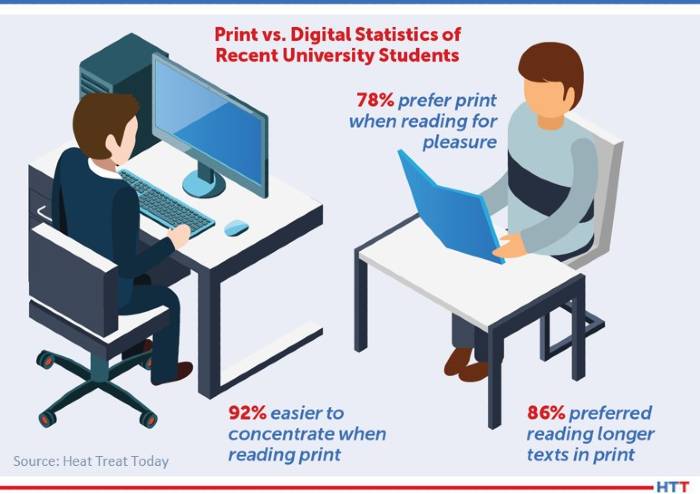 Although it’s “cool” to think and say that “digital” is all the rage, multiple studies say otherwise. These studies confirm that material delivered in a hardcopy print format is more believable, trusted, and keeps the reader’s attention for longer than digital content.
 Here’s the remedy. We’re here to help. Our editors will find, filter, and format heat treating content so that it is most applicable, useful, and helpful to you. If you search the internet for “heat treat,” you’re going to come up with a whole lot of stuff that has nothing to do with industrial heat treating – think wood, biomedical, dental, food processing, etc. – all of which have “heat treat” in their name but have very little to do with the type of heat treating in which you are interested.
 Heat Treat