Dutch aluminum producer Constellium NV, formerly Alcan, explores technological and manufacturing shifts in the electric vehicle industry as part of its rapidly forming network in North America.
“For vehicles to carry electric batteries,” says CEO Jean-Mark Germain, “they will be designed with aluminum structures to hold them. And those structures must do more than traditional metal body structures. They must provide thermal transfer capabilities to keep the battery cool or keep it warm in cold weather. So the structure actually becomes part of the power source.”
Read more here, “EV Bodies: ‘Part of the power source'”, about plans for Constellium’s new Georgia plant to supply engineered aluminum body structures to several automakers in the Southeast.
Alloy Heat Treatment (AHT), a specialist in the heat treatment of aluminum alloy, has developed and is set to launch an innovative mobile heat treatment service.
The Dudley-based (UK) firm, a member of the manufacturing alliance Made in the Midlands, is targeting the new service in support of the additive layer manufacturing market in the UK and Europe, especially in the aerospace and motorsport (F1 and MotoGP) sectors.
“The proposed service is currently being designed to be transported on the back of a fix-bed lorry,” said sales director Ian Perks. “We aim to fill a gap in the AM market, as we feel that this innovation will provide a great benefit to aerospace, F1 and Moto GP organisations; and with the global AM market predicted to be worth more than $6.6 billion by 2026, we are hopeful that the service will attract plenty of interest.”
AHT would load the service onto a truck and then drive to a customer’s designated location to enable them to offer rapid heat treatment processes within tight schedules.
In a throwback to the 1960s, Volkswagen has announced plans to bring back a version of their iconic micro bus retrofitted as an I.D. electric van. In 2022, the I.D. Buzz concept vehicle will go into production, looking a bit like the ’60s vehicle favored by hippies and surfers, it will be built off of the same platform as the I.D. electric car, a four-door compact vehicle. The last time a VW van was on the market was in 2003.
Swedish specialty steel producer SSAB will modernize its continuous hot-dip galvanizing line No. 3 in Hämeenlinna, Finland. The upgrade essentially involves switching the old air-knife into a new air knife system from Duma-Bandzink with strip stabilization and the integration of an inductive booster in the furnace. The conversion measures will be implemented in cooperation with SMS group, Drever International and EMGAutomation. The measures will be realized at the end of this year (2017).
The installation of a new Duma-Bandzink Jet-Pro air knife system with EMG eMASS® strip stabilization – in the so-called “Integrated Solution” – will help to save zinc and improve the quality of the coating. The line will be designed for strips between 0.4 to 3.0 millimeters thick and 650 to 1,550 millimeters wide. In the process section, the strips will be zinc-coated at speeds of up to 160 meters per minute. Inductive strip pre-heating to about 350 degrees Celsius will increase the capacity of the furnace.
Two major Italian manufacturers have ordered bell annealer furnaces to expand their existing lines.
Leading bolt manufacturer, Fontana Luigi S.p.A., based in Veduggio, has commissioned an expansion to an existing HICON/N2® bell annealer facility for heat treatment of non-pickled steel wire coils. Both phases will be nearly identical in design to ensure flexibility between the facility components to achieve maximum throughput capacity. The start of production is scheduled for July 2018 for the new phase.
Ori Martin S.p.A., an electric furnace steel mill facility in Brescia, purchased the supply and installation of an additional gas-fired HICON/N2® bell annealer facility to heat treat unpickled steel wire coils in a controlled nitrogen process atmosphere. The clear inside diameter of the new facility, which will go into operation May 2018, is 4,050 mm, with a stack height of 2,500 mm.
Austrian heat treatment supplier Ebner provided and installed the equipment for both companies.
Last week, we ran a news release about ThermoFusion in California expanding their heat treat capabilities to include marquenching and austempering (click here to see that release). In that short article, some comments were made about the aggressiveness of various quench methods and their effect on distortion and cracking.
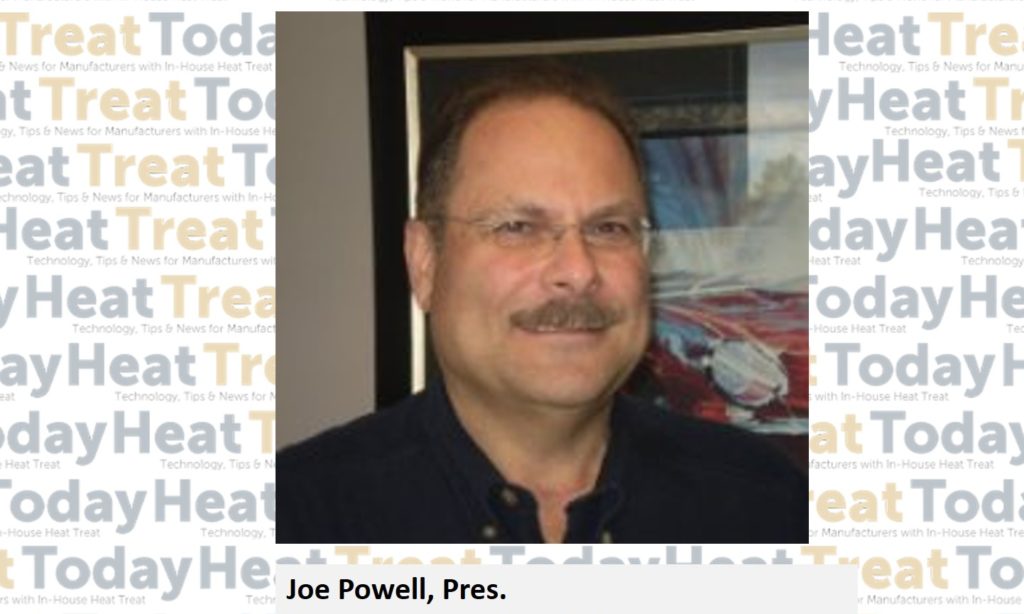
Joe Powell, of Akron Steel Treating Company, Integrated Heat Treating Solutions, LLC, IQDI Products, LTD., and IQ Technologies Inc, one of the heat treat industry’s foremost experts on quenching, wrote in to help educate all of us a bit more on the finer points of quenching. Below are his comments. Joe can be reached at JoePowell@akronsteeltreating.com.
Doug,
In your recent article, you stated that Marquenching and Austempering use a “less aggressive” quench cooling rate, “and reduce distortion caused by rapid temperature change (thermal shock)” which is only half true. The main mechanism that allow a molten salt quench to reduce distortion is the elimination of mixed phase cooling – there is no slow film boiling (gas) phase cooling mixed with the high-evaporative cooing phase of nucleate boiling, but only a single phase of all liquid convection cooling. It’s the non-uniformity of cooling at the surface of the part that will distort or crack the part not so much the rate of cooling.
Joe
Joseph A. Powell, President Akron Steel Treating Company
A monthly report issued to member companies of the Industrial Heating Equipment Association (IHEA) reported recently that there “are some important trends that point to a better end to the year.” The report states that one of the main contributing factors is the fact that “exports are surging again.”
Compiled and published monthly by IHEA, this report covers market developments with specific impacts on the thermal processing industry. The report, prepared in cooperation with Armada Corporate Intelligence, analyzes:
automotive and light truck markets,
new home starts,
steel consumption,
industrial capacity utilization,
metal prices,
new orders from PMI,
capital expenditures,
durable goods,
factory orders,
and others.
While seven of the eleven indices tracked were trending positive in this month’s report, for the steel market the IHEA report states, “The latest trends as far as steel consumption is concerned are not all that favorable and there will be considerable disruption politically as the details of the steel tariff are developed. The two largest components of steel consumption have always been construction (mostly commercial and public sector) as well as the automotive sector. The news is not all that inspiring on either front. The commercial side of construction has been holding its own, especially as far as medical projects are concerned, but office space has been dwindling as there has not been the demand there used to be. The number of people telecommuting has affected the need for big offices. The public sector is still in the doldrums as there is simply no money for the kinds of projects that once drove steel demand. The auto sector had been booming but that has also shown signs of reversal. The demand for new cars is off from the peaks of a few years ago and the only thing that has saved steel demand is that the vehicles that people are buying are larger (trucks and SUVs).
“On top of this, there is the issue of steel tariffs. It is obvious at this point that a blanket 40% tariff will not be imposed as many of the countries that supply steel to the US are close allies (Canada, South Korea, Japan etc.). The end of June deadline came and went and so did the end of July and now the thinking is that a decision may not come until late this year. The fact is that steel users are deeply concerned about price hikes and there are far more of them than there are domestic steel producers. The end result is unclear as China is the target but they only account for about 6% of the steel imported into the US (Canada alone accounts for about 17%).”
A U.S.-based axle gears manufacturer recently commissioned hardware and software enhancements to add to their existing heat treat cell and automation.
Migration of legacy controls was not economically feasible, and after investigating options to boost equipment functionality, the customer opted to integrate a new PLC that bridges the gap between the heat treat cell and new robotic loading cell. The new control system installed by United Process Controls, Inc., (UPC) provides operators with a quick display of the furnace status, functions, and operational data of three AFC Holcroft carburizing pusher furnaces. Furnaces were similarly adjusted to liaise with the new robotic loader. In addition, material handling data from the registers of the old PLCs was transferred to the new robot cell to help increase the factory information system. UPC was also retained to program and connect the updated furnace controls, including the new conveyor line, and charge cars to the factory information system.
Fine Tubes technical team with 4th Nadcap Certificate: Valerie Hart, Technical Manager; Dr. Abdul Saeid, Process Engineer; Wayne Taylor-Vicary, Deputy Cell Leader; David Killoran, Welding Process Engineer; Rob Eatwell, Quality Manager
A precision tubing manufacturer has been awarded a Nadcap accreditation for chemical processing. This is the fourth Nadcap approval awarded to Fine Tubes; its first accreditation was for heat treating in 2004, followed by nondestructive testing (ultrasonic testing) in 2005 and fusion welding in 2013. In addition, the Plymouth (UK)-based manufacturer anticipates receiving another accreditation for fluid distribution systems shortly.
Nadcap is an internationally recognised accreditation system that covers the key manufacturing and production processes used within the aerospace industry.
Very few companies hold four Nadcap accreditations simultaneously.
Chemical processing is a critical part of the Fine Tubes production process. Tubes must be chemically milled after the cold-working and heat-treating manufacturing processes, by being etched to ensure they meet the customer specification requirements.
“The tubing we manufacture is designed to withstand in-process fatigue loading, and failure is not an option. When aircraft manufacturers need tubing, they inevitably look for suppliers who can demonstrate the most-stringent quality standards. Nadcap accreditation is widely viewed as confirmation of that, and, so with every Nadcap accreditation that we earn, we further enhance our ability to win new contracts,” comments David Killoran, representing the Fine Tubes’ technical team.
To achieve its latest accreditation, Fine Tubes undertook an intensive on-site inspection and investigation by a Nadcap auditor. This audit covers all aspects of the process – the machinery, consumables, and methods employed, as well as the qualifications and experience of the staff involved in the process.
“The auditor found no failures to comply with the Nadcap criteria, and that is a major credit to the Fine Tubes production team involved in the audit,” said Dr. Abdul Saeid, Process Engineer at Fine Tubes.
Fine Tubes and its US-based sister company, Superior Tube, are units of AMETEK Specialty Metal Products and both have supplied the aerospace industry with high-performance tubes for more than fifty years. Their precision tubes are used in airframes, aircraft engines and aerospace instrumentation, where they are relied upon to withstand the most-critical operating conditions.
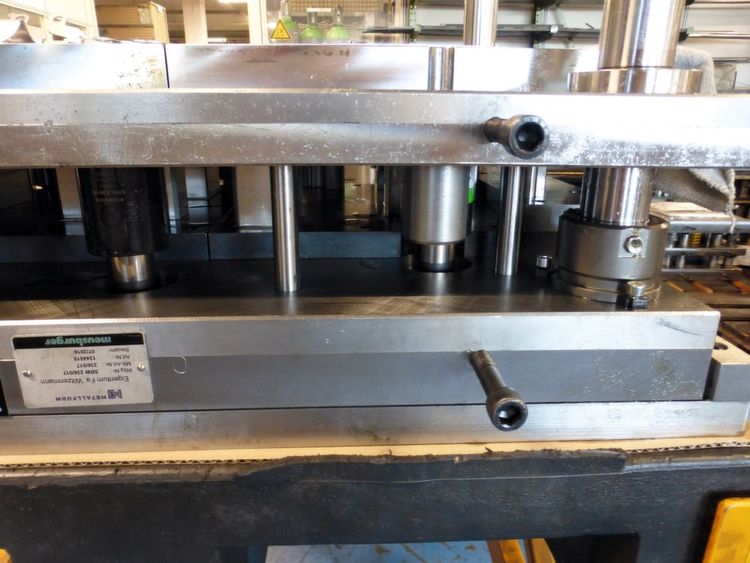
Heat treatment of standard parts allows a Bamberg-based contract manufacturer to provide in-house die and tool making that keeps costs low for customers. Metallform Bamberg GmbH, which specializes in the production of stamping and bending parts from the coil, dies, and welded and mounted assemblies, turns to Austrian stamping and machine company Meusburger for customized parts.
“[O]ur standard parts are heat treated for stress relief by default, which results in low warping and good subsequent machining properties,” notes Sebastian König, area sales manager for the central Germany sales region at Meusburger.