Canadian and Russian medical science technology researchers have been collaborating on a project to develop an industrial technology for the production of metal rod stocks used for creating modern bone implants, particularly for implants to treat spinal problems such as scoliosis. They recently published the success of their work — which includes a form of heat treating.
Vadim Sheremetyev, one of the research authors and a senior research associate at NUST MISIS. (Photo supplied by NUST MISIS)
Scientists at the National University of Science and Technology (NUST) MISIS (Moscow, Russia) along with colleagues from the Ecole de Technologie Superiore (Montreal, Canada), announced the development of a new combination of alloy processing that produces solid and durable implants that are fully compatible with the human body. The research article is published in the Journal of Alloys and Compounds.
“The working material of this new generation of alloys is based on Ti-Zr-Nb (titanium-zirconium-niobium), which possesses so-called superelasticity, meaning it can restore its original shape against large and repeated deformation. Ti-Zr-Nb is also noted for its high mechanical strength and resistance to corrosion.”
“Our method of combined thermomechanical processing of alloys — in particular, radial-displacement rolling and rotary forging — allows researchers to get the highest quality blanks for biocompatible implants by controlling their structure and properties. Such processing of blanks gives them an outstanding resistance to fatigue and overall functional stability,” said Vadim Sheremetyev, one of the research authors and a senior research associate at NUST MISIS.
A metalworking fluids and services company based in Valley Forge, Pennsylvania, recently developed an advanced cleaner designed to replace highly volatile solvents in precision cleaning applications where flammability, health, safety and environmental factors are concerns.
Tony Pavesich, Houghton Surface Finishing Industry Leader
Houghton International introduced Houghto-Rinse RTD™, a water-based, non-flammable, ready-to-use cleaner that delivers process performance and surface appearance in a wide range of surface finishing applications, particularly for its industry markets of automotive, aerospace, metals, mining, machinery, offshore and beverage industries. The product is designed to remove surface residues such as spray paint, marker pen, ink, glue, grease, and production soil prior to final inspection, assembly or packaging and is safe for use on all surfaces including aluminum, steel, magnesium, plastics, painted surfaces, and fiberglass.
“Extensive field testing has demonstrated that Houghto-Rinse RTD delivers outstanding cleaning performance on a broad range of applications,” said Tony Pavesich, Houghton Surface Finishing Industry Leader. “It dries quickly, leaves no residue, and is ready-to-use, so it improves product quality and process efficiency.” The product is also economical, low-odor, and contains rust prevention properties, which may be important when used to clean steel components in critical applications.
The emails below from Dr. George Totten and Dr. Nik Kobasko below announce the passing of Dr. Hans Tensi. These emails also declare why scientists such as Dr. Tensi, Dr. Totten, and Dr. Kobasko are the founders [and] fathers of modern heat treating metallurgy – what I call the 3rd Generation of Heat Treating. Dr. Kobasko, nd his Ukrainian and Russian associates worked with scientists such as Dr. Totten [and] Dr. Tensi as well as many other heat treating metallurgists and part makers from the USA, Germany and [other] European countries before the fall of the Soviet Union’s Iron Curtain. They all tried to understand the many mechanisms at work in heat treating and especially quenching distortion.
Dr. George Totten and Dr. Kobasko worked with the late Dr. Hans Tensi to try to quantify the modern quench cooling processes using various quenchants and agitation rates; their early work to characterize the many polymer, water-salts and oil quenchants is still in use today. Dr. Tensi was the creator of the Tensi Quench Probe, a probe used for gathering thermocouple data for quench cooling curves for characterizing various quenchants in the lab for constructing better quench cooling curves. The Tensi probe helped to identify and to quantify the three phases of quench cooling – “film” boiling, “nucleate” boiling and “no boiling” – uniform convection cooling and the relationship of agitation rates to part distortion caused by non-uniform quench cooling.
Early 20th-century heat treaters like my father, Prosper Powell, and Dr. Kobasko, Dr. Tensi and Dr. Totten developed heat treating methods from a First Generation of “Blacksmithing Arts” (with a bucket of quench water and horse urine salts at a forge) to 2nd Generation Heat Treating Sciences with modern quench oils and polymer/water quenchants. 2nd Generation heat treaters also introduced thermocouple temperature controls and oxygen probe atmosphere controls as well as traditional forms of “uniform” controlled quenching with various liquid quenchants, molten salts (Martemper and Austemper) and high pressure gas quenching; all to avoid “The faster the quench rate, the more likely you will blow up the part!”
This generation of heat treaters all began a process of trying to measure, quantify and ultimately to control “uniformity and intensity” of both heating and quenching during heat treating. Their 2nd Generation Heat Treating methods and equipment led to a full understand of the relationships between both the “Left Side” and the “Right Side” of Dr. Kobasko’s “Quench Cooling Rate versus Probability of Part Cracking” – the Bell-Shaped Curve that Dr. Kobasko and his IQ Technologies’ colleagues, Dr. Michael Aronov and I, introduced to the USA at Akron Steel Treating Company in 1999 with the first IQ-2 batch quenching unit. (Unfortunately, we still do not have a reliable, in situ quench uniformity probe or a way to capture a part’s “quench cooling signature” in real time. . . but IHTS Consultants are working on it!)
Our last Generation of 2nd Heat Treaters also paved the way for a 3rd Generation of heat treat process modeling; we created the fundamentals of FEA and CFD modeling for both a heat treating process and equipment design that is linked to heating and cooling on a “Grainular” level of part metallurgy. 3rd Generation Heat Treating is what Integrated Heat Treating Solutions’ Consultants, and our many other Teaming Partners, are trying to bring to everyday heat treating practice for Industry 4.0. Joe Powell, Akron Steel Treating. Photo credit: ASM International
We are sorry to see the passing of Dr. Tensi, but will always remember the groundbreaking work that he and his colleagues did in the last century for heat treating in the 21st Century.
With a recent contract to produce its lightweight High Mobility Artillery Rocket System (HIMARS) launchers and associated hardware, a global security and aerospace company headquartered in Bethesda, Maryland, now has the equipment in the inventories of four international partners.
The U.S. Army awarded Lockheed Martin a $218 million contract to deliver 18 HIMARS launchers to an unnamed international customer by December 2020. The HIMARS vehicles will be produced from the ground up at Lockheed Martin’s award-winning Camden, Arkansas, Precision Fires Center of Excellence.
HIMARS is a lightweight mobile launcher, transportable via C-130 and larger aircraft for rapid deployment, that fires Guided Multiple Launch Rocket System (GMLRS) rockets and Army Tactical Missile System (ATACMS) missiles. HIMARS consists of a launcher loader module and fire control system mounted on a five-ton truck chassis. A specialized armored cab provides additional protection to the three crew members that operate the system.
A Cleveland-based heat treatment software and engineering firm, specializing in metallurgical process engineering and thermal/stress analysis of metal parts, recently announced that mechanical and fatigue testing is underway on an innovative gas quenching unit designed to minimize component distortion during the hardening process.
The DANTE Controlled Gas Quenching (DCGQ) unit is capable of quenching single components following a time-temperature schedule designed for a specific component and steel alloy using the DANTE software.
DANTE Solutions proposed the concept of the process and the DANTE Controlled Gas Quench (DCGQ) unit and collaborated with Milwaukee-based Atmosphere Engineering (now part of United Process Controls), which built the unit, and Akron Steel Treating. The project is funded by the US Army Defense Directorate (ADD), and the aim market is aerospace, where high hardenability steels are used for gears, bearings, and shafts.
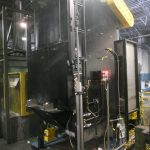
Front view of DANTE Controlled Gas Quench (DCGQ) unit
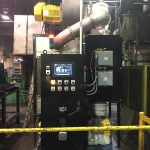
Back view of DANTE Controlled Gas Quench (DCGQ) unit, showing the HMI in process
Test coupons in the unit after the run.
Justin Sims, mechanical engineer, DANTE Solutions
According to Justin Sims, a mechanical engineer with DANTE Solutions, the project began with Phase 1, wherein the team had to “make sure that a relatively slow cooling rate through the martensite transformation did not degrade material properties.”
“Phase 1 showed that we had comparable results for hardness, tensile properties, Charpy impact properties, and bending fatigue to the standard quenching practice for Ferrium C64,” said Sims. “We then initiated Phase 2 and had a unit built that was capable of controlling the temperature of the incoming quench gas to within +/- 5°C.” Phase 2 will end December 2018 after two years. The Phase 1 process currently has a patent pending.
Mechanical & Fatigue testing is currently underway at Akron Steel Treating Company where the unit is installed, and samples have been processed to compare the DCGQ process to standard HPGQ of high alloy steels. The current steel under investigation is Ferrium C64. Sims noted that DANTE is overseeing the processing of the test materials, and commercial metallurgical testing companies are performing the tests.
Tensile Testing Metallurgical Laboratory completed the hardness, tensile and Charpy impact testing, and the results are similar for conventionally hardened C64 samples and DCGQ processed samples. IMR Test Labs is conducting the bending fatigue tests. The US Army at Fort Eustis will conduct the rolling contact fatigue tests.
“We have hardness, tensile, and Charpy impact results from the unit we can share with anyone who is interested,” said Sims. “Distortion, bending fatigue, and rolling contact fatigue are currently being evaluated and the results will be available before the end of 2018.”
“We believe that the DANTE Controlled Gas Quench (DCGQ) process, patent pending, has the potential to change the way heat treating is performed on high hardenability steels,” added Sims. “By controlling the temperature of the incoming quench gas, components experience a near uniform transformation to martensite. This near-uniform transformation has the potential to eliminate post-heat treatment correction operations by minimizing part distortion and allowing designers to account for the size change distortion in the initial design of a component. To date, mechanical and dynamic properties for Ferrium C64 processed using the standard hardening process and the DCGQ process has been identical. Bend fatigue and rolling contact fatigue are currently being evaluated.”
This is the sixth in a series of articles by AMS2750 expert, Jason Schulze (Conrad Kacsik). Click here to see a listing of all of Jason’s articles on Heat Treat Today. In this article, Jason advances the discussion of TUSs with an examination of requirements that apply to TUS thermocouples. Please submit your AMS2750 questions for Jason to editor@heattreattoday.com.
Introduction
Any technician who has performed a temperature uniformity survey understands that the assembly, use, and placement of thermocouples are imperative to the success of the TUS.
As we move through the requirements of Temperature Uniformity Surveys, in this installment we examine the requirements which apply to TUS thermocouples.
TUS Thermocouples Re-Use, Quantity, and Arrangement Requirements
TUS Thermocouple Re-Use Requirements
AMS2750E, paragraph 3.1.3, can be difficult to understand at times. To start, it’s important to understand the difference between expendable and nonexpendable thermocouples.
Expendable Thermocouples:
“Thermocouples made of fabric or plastic covered wire. The wire is provided in coils or on spools. Insulation usually consists of glass braid or ceramic fiber cloth on each conductor plus glass braid overall.”
Nonexpendable Thermocouples:
“Thermocouples that are not covered with fabric or plastic insulations. One type consists of ceramic insulators over bare thermocouple wire, sometimes inserted in a tube for stability and protection. A second type consists of a combination of thermocouple wires, mineral insulation, and a protecting metal sheath compacted into a small diameter. The thermocouple thus constructed is protected, flexible and, within the temperature limits of the sheath material, may be used many times without insulation breakdown. This type of thermocouple, conforming to ASTM E 608, is available under many trade names.”
Once these definitions are understood, we focus on paragraphs 3.1.3.3, 3.1.3.4, and 3.1.3.5 carefully to ensure you apply the correct usage allowance to the correct thermocouples.
Paragraph 3.1.3.3:
“Expendable test sensors may be reused if ‘U’ in the following formula does not exceed 30. A ‘use’ for test thermocouples is defined as one cycle of heating and cooling the thermocouple (2.2.77). U = Number of uses below 1200 °F (650 °C) + 2 times number of uses from 1200 °F (650 °C) to 1800 °F (980 °C). Expendable base metal test thermocouples shall be limited to a single use above 1800 °F (980 °C).”
Notice the paragraph begins with the term “expendable test sensors.” This prohibits the U-formula from governing the replacement frequency of nonexpendable test sensors as well as expendable sensors which are not used as a test sensor.
Paragraph 3.1.3.4:
“Any base metal TUS thermocouple that is (1) used exclusively under 1200 °F (650 °C), (2) identified, and (3) preserved/protected from damage (i.e., crimping, excessive moisture contact, corrosion, etc.) between tests or remains installed on a rack that is protected between tests,) shall be limited to no more than 90 uses or 3 years, whichever comes first and may be reused subject only to the limitations of 3.1.3.1 to 3.1.3.2.”
This paragraph begins with “Any base metal TUS thermocouple.” This would apply to any base metal thermocouple (i.e. Type K, Type N, etc.) used for a TUS, whether expendable or nonexpendable.
Paragraph 3.1.3.5:
“Nonexpendable base metal TUS thermocouples reinstalled for each TUS through ports in the furnace, used in the same location and depth of insertion for each TUS and used exclusively under 1200 °F (650 °C) shall be limited to no more than 90 uses or 3 years, whichever comes first and may be reused subject only to the limitations of 3.1.3.1 to 3.1.3.2.”
This paragraph is very specific regarding its application. For this paragraph to apply, the supplier would need to be using a) nonexpendable thermocouples that are b) base metal, which are c) reinstalled through ports in the furnace and used (non-resident) d) at the same location and e) depth of insertion.
Suppliers interpreting the usage requirements of test thermocouples should pay close attention to Figure #1 in AMS2750E. Figure #1 lays out the usage requirements of AMS2750E in an easy-to-read format that can be used as a quick reference.
Figure 1, AMS2750E
TUS Thermocouple Quantity Requirement
AMS2750E, page 27, paragraph 3.5.13.1, states that the number of TUS thermocouples shall be in accordance with Table 11. The top 2 lines reflect the most widely used. (See Figure 2.)
Figure 2
The amount of test sensors is based on the cubic foot of the qualified work zone. This should not be mistaken for the cubic foot of the heating area in the furnace, or control zone, as the full heating area is not always the size of the qualified work zone.
Table 11 begins by categorizing the options as “Workspace Volume Less Than.” Once your qualified work zone is established, you will need to apply that to the table to determine how many TUS thermocouples will be needed. As an example, if your qualified work zone is 562 cubic feet, you would need a minimum of 19 test thermocouples distributed throughout the qualified work zone during the TUS.
TUS Thermocouple Placement Requirement
Thermocouple placement is described in AMS2750E paragraphs 3.5.13.2.1 and 3.5.13.2.2. Paragraph 3.5.13.2.1 relates to the thermocouple placement for qualified work zone volumes that are less than 3 cubic feet. Typically, this would apply to small air furnaces or laboratory furnaces used for testing, although could very well apply to smaller atmosphere or vacuum furnaces. Each paragraph describes the requirements for a rectangular qualified work zone and cylindrical qualified work zones.
Paragraph 3.5.13.2.1
“For furnace work zone volumes less than 3 cubic feet (0.085 m3), four TUS sensors shall be located at the four corners and one at the center. If the furnace work zone volume is cylindrically shaped, four TUS sensors shall be located 90 degrees apart at the periphery and one shall be located at the center. In both cases, all TUS sensors shall be located to best represent the qualified work zone.”
To better describe the requirement within this section, I’ve included a diagram of the requirement for both rectangular and cylindrical qualified work zones.
The location is a requirement, although the numbering sequence identified in these diagrams is optional and the supplier has the freedom to number the locations as they see fit.
Paragraph 3.5.13.2.2
“For furnace work zone volumes greater than 3 cubic feet (0.085 m3), eight TUS sensors shall be located at the corners and one shall be located in the center. If the work zone volume is cylindrically shaped, three TUS sensors shall be located on the periphery of each end, 120 degrees apart. One of the remaining TUS sensors shall be located at the center; the other two shall be located to best represent the qualified work zone. For furnace work zone volumes greater than 225 cubic feet (6.4 m3), the additional TUS sensors required by Table 11 shall be uniformly distributed to best represent the qualified work zone. When radiant heat from the periphery of the work zone is used to heat the product, the additional sensors shall be uniformly distributed at the periphery of the work zone.”
Again, the diagrams to the right better describe the requirements within paragraph 3.5.13.2.2.
Conclusion
Now that the TUS thermocouple requirements have been established, we will move on to the requirements of initial and periodic TUS requirements in the next article.
Submit Your Questions
Please feel free to submit your questions, and I will answer appropriately in future articles. Send your questions to editor@heattreattoday.com.
A steel fabricator based in Lansing, Illinois, recently announced plans to launch a new manufacturing plant in Lancaster County, South Carolina, to provide light gauge steel products to the construction industry in the area.
Synergy Steel Structures will manufacture steel studs, engineered floor and roof trusses and wall panels at the 32,000 sq ft facility.
An Irish engineering group specializing in the design, manufacture, and servicing of hard-rock drilling consumables has added two separate state-of-the-art heat-treatment lines as part of the group’s global expansion, both from a Michigan-based manufacturer of industrial furnace equipment for ferrous and non-ferrous metals.
Mike Jones, Benton Plant Manager, Mincon USA
Mincon Group plc purchased a complete batch style integral quench heat treatment line for its U.S. plant in Benton, Illinois, from AFC-Holcraft. The furnace, with an effective load size of 36″ x 72″ x 56″, tempering furnaces, washing and conveying equipment, controls system and accessory equipment, will be utilized for the heat treatment of components such as those used in heavy industries like mining and drilling.
In-house heat treatment processes were pioneered and have been perfected at Mincon’s headquarters in Shannon, Ireland, and now this new facility at the Benton plant will ensure consistency in the quality of drill bits it produces. The $2.5-million project was completed in April 2018 after 18 months, and Mincon Group expects it to help the company double its production volumes.
“We are excited by the possibilities presented by the addition of this key piece of equipment,” said Mike Jones, Benton Plant Manager, Mincon USA. “In addition to ensuring our USA plant produces superior quality drill bits, running our own facilities also shortens manufacturing cycle times and introduces flexibility when compared to using an outsourced heat-treatment solution.”
Tracy Dougherty, Sales Manager at AFC-Holcroft
Another smaller size line with an effective load size of 36″ x 48″ x 36″ will be delivered to Perth, Australia. Both batch furnace lines have features designed to reduce distortion of the products being processed.
“We’ve seen tremendous demand for on the part of manufacturers to continually improve control, quality, consistency and reduce distortion,” stated Tracy Dougherty, Sales Manager at AFC-Holcroft. “The addition of these batch furnace lines will allow Mincon to increase production using brand-new equipment that meets their need for high quality and productivity. We’re excited to be a part of their continued growth in the market.”
David C. Dauch, AAM Chairman and Chief Executive Officer
A global leader in the design, engineering, and manufacturing of automotive driveline and powertrain components will expand operations in the industrial area of Viladecans, Spain, with a 160,000 square ft facility.
American Axle & Manufacturing, Inc. (AAM), headquartered in Detriot, plans to open the plant south of Barcelona in January 2019, consolidating two smaller facilities in nearby Gavà. AAM Barcelona will produce, among others, damped gears for Ford, BMW, and PSA, PV bonded dampers for Audi, Mercedes, and FCA, isolation pulleys for Renault and in-mould bonded dampers for Mercedes, Ford, and Porsche.
“As AAM continues to diversify and expand our global customer base and product mix, our new Barcelona facility will be an integral part of our European manufacturing footprint,” said David C. Dauch, AAM Chairman and Chief Executive Officer. “The new facility will help AAM meet customer demand for products that help reduce noise and vibrations from downsized engines.”
Greg Deveson, President, AAM Powertrain
“As automakers continue to downsize engines, especially with the increased number of hybrid applications, demand for products like damped gears and isolation pulleys will increase,” said Greg Deveson, President, AAM Powertrain. “This new facility will help AAM continue to meet and exceed our customers’ performance and quality expectations.”
If there’s one thing that can be determined by reading through the reasons given for nominations to Heat Treat Today‘s 40 Under 40 feature, it’s this: there are in the industry many young metallurgical and heat treating professionals with drive, intelligence, work ethics, and skill that will land them a multitude of awards, promotions, and public acknowledgements.
But as to whether any of them will match the achievements of “titanium savant” Russell Gordon Sherman remains to be seen.
“Sherman’s claim to fame is his research and development concerning alloys and heat-treating protocols for the titanium industry, expanding upon the usability of the metal during the formative years of the titanium industry.”
Dr. Frauke Hogue, a Fellow of ASM International
Recently, Dr. Sherman, 92, who is a member of ASM International, was announced as the recipient of the 2018 Lifetime Achievement Award from the International Titanium Association for “his work in developing titanium alloys, pioneering the high-volume production of titanium aerospace fasteners, and designing heat treating protocols for the titanium industry.”
The Santa Monica Daily Press noted that Sherman made possible the high-volume production of titanium aerospace fasteners during the years when the U.S. and the Soviet Union were vying for aerospace supremacy. Sherman will be presented with the award at the Titanium USA 2018 Conference and Exhibition, October 7-10, 2018, in Las Vegas.
“The entire titanium industry has benefited from his research into developing a higher-strength titanium (the workhorse Ti-6Al-4V alloy) through the heat treatment of solution treating and aging,” wrote Dr. Frauke Hogue, a Fellow of ASM International.
Sherman’s research, presented first in a paper at ASM’s convention in Philadelphia in October 1955, titled, “The Heat Treatability of Ti-6Al-4V”, went on to impact multiple industries but particularly the industrial fastener industry as it intersected with aerospace.
Still providing consulting services in the titanium industry, Sherman, though retired, is not resting on his laurels.
“. . . . If you’re lucky, you might spot the Titanium Man out in Santa Monica, relaxing after a much-accomplished life.”