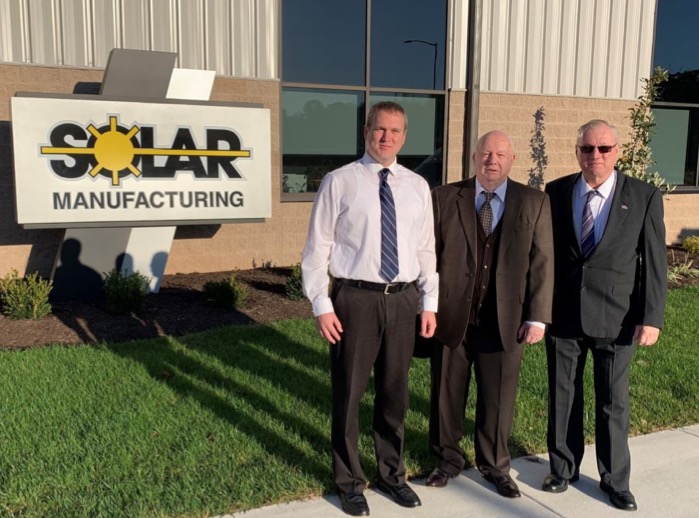
Three generations of the Jones family. This picture taken just moments before the Ribbon Cutting Ceremony shows (l-r) Trevor Jones, CEO of Solar Manufacturing; Trevor’s grandfather, William R. Jones, CEO of the Solar Group of Companies; and Trevor’s father, Roger A. Jones, President of Solar Atmospheres (retired).
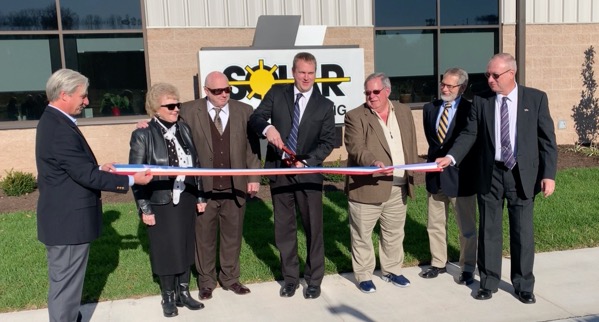
William and Myrtle Jones were recently joined by a group of key Solar Manufacturing employees including Roger Jones and Trevor Jones at a ribbon-cutting ceremony for the company’s new manufacturing site in Sellersville, Bucks County, Pennsylvania.
Speaking at the ceremony in addition to William Jones was Sellersville Borough mayor Thomas C. Hufnagle, Gorski Construction president Jerry Gorski, Bucks County Industrial Development Authority chairwoman Mary Smithson, and Bucks County Board of Commissioners chairman Robert Loughery. Employees moved into the newly constructed 59,000 square foot facility in early October on land vacated by AMETEK in 2008.
Gorski Construction president Jerry Gorski; Myrtle Jones; CEO of Solar Group William Jones, Solar Manufacturing CEO Trevor Jones; Sellersville mayor Thomas C. Hufnagle; Solar Manufacturing president Jim Nagy; and retired president of Solar Atmospheres Roger Jones.
"It is important that we invest in our communities,” explained CEO William Jones. “When AMETEK left, they left more than a couple of vacant lots. It’s our goal to grow and support the local economy.”
Jim Nagy, president of Solar Manufacturing, gave the local dignitaries a tour of the facility including a shop floor filling up with equipment being transferred in from the company’s previous manufacturing locations.
The company plans to hold an open house event in the first or second quarter of 2020 once the dust has settled on the new construction and employees have had a chance to acclimate to their new surroundings.
In the video below, Gorski Construction president Jerry Gorski presents a shovel to William Jones, representing the groundbreaking of the new location.
Heat treating is the unsung hero of the commercial and military aviation industries. Much like the support staff behind any good play or movie, or the mom behind the Olympic athlete, heat treating of critical aerospace parts is relegated to the background, to the fine print of the credits—if at all. But if it were not for heat treating, planes would not fly, ships would not sail, submarines would not dive, and cars would not drive. Bob Hill’s article, which first appeared in the 2014 edition of the SME Aerospace and Defense Yearbook, and then in Heat Treat Today’sMarch 2019 Aerospace print edition, introduces you to the technical world of vacuum heat treating and why vacuum thermal processing is vital to the aerospace and defense industries.
First, let’s nail down what we mean by “heat treating.” In simple terms, heat treating is cooking metal much like you would cook food – with a predetermined recipe and desired outcome in mind. Metal is placed into an oven, or more accurately a furnace (ovens typically operate at temperatures less than 1,000°F), and precisely held at a specified temperature for a pre-determined period. The metal is then cooled either slowly or quickly depending on what properties are desired. Thermal processing can make the metal harder, softer, stronger, more flexible, more rigid, more wear-resistant, chemically altered, or a host of other desirable metallurgical properties.
In aerospace and defense, the majority of metals must be heat treated in a special type of furnace that is void of air. These furnaces are called vacuum furnaces. Vacuum furnaces keep detrimental elements such as water molecules and oxygen from coming into contact with the metal. A vacuum furnace does this by sealing the critical metal components inside an airtight vessel, pumping out all the air from within the vessel to a deep vacuum level, and then performing the heat treatment recipe before returning the load to room temperature and breaking the vacuum. Many titanium, stainless steel, and nickel alloys are extremely reactive at elevated temperatures and will become contaminated if exposed to any air or water molecules. Vacuum furnaces help eliminate these detrimental metallurgical reactions.
Secondly, let’s look at which flight-critical airplane parts are vacuum heat treated. Critical parts are found in jet engines where turbines, stators, vanes and other engine parts are exposed to extremely high operating temperatures for sustained periods of time. Most of these parts are made of titanium and nickel alloys, and they require vacuum heat treating in order to give them the strength and wear resistance necessary to be reliably installed in jet engines. GE, Pratt & Whitney, and Rolls Royce are among the leading supplier of jet engines, and the heat treatment of these parts is critical and carefully controlled.
Today’s commercial aerospace engineers are making greater use of composite technology in airframes and primary structures. This approach offers a weight savings on average of 20% when compared to conventional aluminum designs. Carbon fiber reinforced plastic, or composites, are inferior when handling compressive loads but are excellent with tensional loads. When aerospace engineers needed another material to support the major structural and flight-critical components within the new aircraft and searched for the optimum material to address strength, weight, and resistance to galvanic corrosion, it was quickly decided that aluminum was a poor choice. Titanium, however, can withstand comparable loads better than aluminum, has minimal fatigue concerns, and is highly resistant to corrosion. Since titanium is stronger than aluminum and their weights are equivalent, less titanium by weight than aluminum can be used to achieve the same part strength. Since weight reduction drives down fuel consumption, titanium in both military and commercial aerospace is king!
Titanium
Because titanium plays such a critical role in today’s aerospace arena, let’s take a more thorough look at why titanium needs to be heat treated, and more specifically, why it needs to be vacuum heat treated. Titanium is both chemically and thermodynamically very reactive. At elevated temperatures, titanium will absorb hydrogen if present. Hydrogen, unfortunately, once diffused into titanium causes the metal to become brittle and reduces the appealing properties of titanium. When titanium is pickled or heated in an air furnace (not in a vacuum furnace), hydrogen will impregnate the titanium. The process of removing this hydrogen from titanium is called vacuum degassing. Currently, most aerospace material specifications require that all titanium have no more than 30 parts per million (ppm) of hydrogen.
Because titanium is a relatively expensive metal, more people are looking at recycling. In the titanium scrap world, there are times when infusing hydrogen into titanium is beneficial. For example, when a titanium reclaimer wants to pulverize titanium into a powder for further processing, it is much easier to do when the metal is brittle. Super-saturating hydrogen into titanium – hydriding – can only be done inside a vacuum furnace and is always followed by a dihydride once the titanium is in final powder form.
Vacuum Heat Treating—In-House or Outsource
The expertise necessary to operate a vacuum heat treating furnace is notable. Vacuum technology has immensely improved over the years and operating a vacuum furnace today is truly a science. Some manufacturers buy and operate their own vacuum furnaces. These furnaces typically run the same product day in and day out. Maintaining and troubleshooting vacuum furnaces can be a very time-consuming distraction. The true hidden costs of running and maintaining a vacuum furnace are not very well known.
That is why some companies choose to outsource their heat treating to commercial heat treaters who vacuum heat treat 24/7/365. These heat treat companies relieve their customers of the headaches of owning and operating a vacuum furnace. They benefit by allowing the vacuum heat treat experts to take care of compliance to stringent specifications that are necessary within any manufacturing scope of work.
Current Market Conditions
The aerospace industry, especially commercial aerospace, is experiencing significant growth currently. With commercial aircraft sales at an all-time high, vacuum heat treatment is extremely strong today and well into the future. Airbus’ decision to locate an assembly plant in Mobile, Alabama, is just one additional sign that the commercial aerospace industry is experiencing aggressive growth and looking to expand its supply base.
New Processes and Materials
One process that could significantly impact the aerospace community is additive manufacturing—3D printing parts utilizing various methods. Some parts are produced by laying down atomized powdered metals or laying down wire layer after layer until the entire part is fully printed or constructed. Unlike “subtractive” manufacturing which takes a bar of metal and shaves off the unneeded excess, additive manufacturing adds only that metal which is needed, so there is essentially no scrap. With subtractive manufacturing, frequently 80% of the original metal stock ends up as scrap and needs to be recycled.
Exactly how additive manufacturing will impact the aerospace world remains to be seen. There are multiple metallurgical hurdles to overcome before any flight-critical part is placed in an aircraft. Even parts additively manufactured need vacuum heat treating, most notably vacuum stress relieving or vacuum sintering. Nonetheless, additive manufacturing is a disruptive technology that machinists and vacuum heat treaters alike will be watching.
Nadcap
Any heat treater of aerospace parts must comply with the critical processing criteria enforced by Nadcap, an organization established years ago to ensure that aerospace suppliers were meeting and maintaining high-quality standards. Heat treaters also have to be AS9100D-certified before they can process aerospace parts. In addition to Nadcap, many aerospace companies have their own quality standards audited by their individual customers. These are called “prime certifications”, and these standards meet and often surpass requirements from Nadcap and AS9100D.
Conclusion
Although heat treating plays a relatively hid-den part in the aerospace and defense supply chain, it remains a critical link. Working with your local vacuum heat treater early in the development process will prove to be a good investment. Aerospace heat treating will continue to be an important link in the aerospace supply chain for many years to come.
About the Author: Bob Hill, FASM, is President, of Solar Atmospheres of Western PA. This paper originally appeared in the 2014 edition of the SME Aerospace and Defense Yearbook and then in Heat Treat Today’sMarch 2019 Aerospace print edition. It is published here with permission from the author.
The world’s largest heat treat provider recently marked the opening of its new heat treatment plant in the Czech Republic.
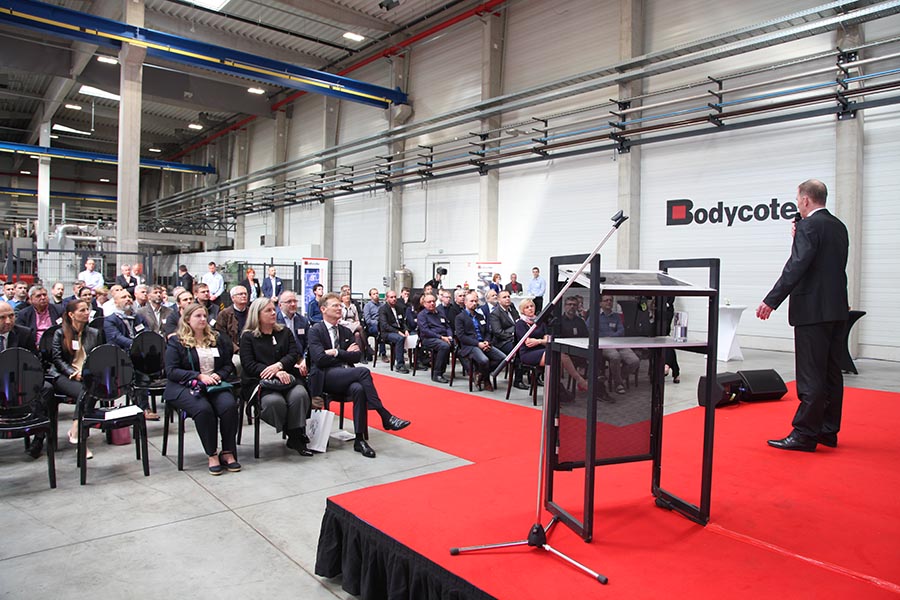
Roman Poslusny welcomes guests to the official opening ceremony.
Bodycote held an official opening ceremony at the new facility in central Prague which has expanded space for broader heat treatment capabilities for the automotive and general manufacturing industries.
“Bodycote is proud to be opening our newest facility in Prague, where we can be close to our customers and grow to meet their future demand,” said Paul Clough, president of Bodycote’s classical heat treatment division for Northern Europe & Asia.
“The Czech Republic is an excellent place for Bodycote to invest in order to support our customers’ supply chains locally,” said Roman Poslusny, vice president of operations of Central Eastern Europe for Bodycote’s classical heat treatment division. “This expansion helps to demonstrate our commitment to our Eastern European customers by providing the best possible service.”
The VIP ceremony was attended by the local mayor of Hostivice (Prague-West district), arch. Klára Čápová, and the British ambassador to the Czech Republic, Nick Archer.
Main image credit/caption: Bodycote / Left to right: Paul Clough, President of Northern & Eastern Europe (Bodycote); Klara Capova, Mayor of Hostivice; Nick Archer, British Ambassador; Baris Telseren, Senior Vice President Eastern Europe (Bodycote); Roman Poslusny, Vice President Central Eastern Europe (Bodycote).
An industrial gases company recently announced an investment to build a new, large-scale air separation unit (ASU) in Indianapolis, Indiana, a state of the art plant that will produce essential raw materials for metal fabrication facilities and heat treating operations, as well as other manufacturers in the Midwest. The ASU is slated for completion Q1, 2021.
“This investment underscores Messer’s commitment to strategic U.S. expansion to meet growing market demand,” said Jens Luehring, president & CEO, Messer Americas. “We chose to invest in Indianapolis, Indiana, due to its strong pro-business climate and optimal proximity to customers. Messer aims to become the premier supplier of choice for industrial, medical and specialty products in the Americas, providing innovative solutions for our customers with excellent speed to market and reliability. This investment directly supports that mission and strengthens our presence in the Midwest.”
The new air separation plant will produce medical and industrial gases for several industries, including metal fabrication, chemical, welding, glass, healthcare, and food processing.
Mayor Joe Hogsett with the City of Indianapolis
Messer, which acquired most of the North American gases business of Linde plc, as well as certain Linde business activities in South America, is one of the leading industrial gas companies in North and South America.
“We’re excited to keep building a city with a competitive business climate and a vibrant quality of life that appeal to world-class companies like Messer,” said Mayor Joe Hogsett with the City of Indianapolis. “We proudly welcome Messer and the dozens permanent and temporary good-paying jobs that it brings, to the economic landscape of our city.”
Heat TreatTodayoffers News Chatter, a feature highlighting representative moves, transactions, and kudos from around the industry.
Personnel & Company Chatter
A long-term agreement to supply materials used in the manufacture of naval nuclear reactor components has been signed between BWX Technologies, Inc., and Allegheny Technologies Incorporated.
Kennametal Inc. announced that it has formed a 3D printing materials and production business unit, Kennametal Additive Manufacturing, as part of its infrastructure segment. The new business unit combines the company’s longstanding expertise in materials science and wear-resistant solutions with additive manufacturing capabilities to supply high-performance metal additive powders and fully finished 3D printed parts for wear, erosion, corrosion, and high-temperature applications.
StandardAero Component Services celebrated the grand opening of the company’s 30,000 sq. ft. expansion of its Hillsboro, Ohio, engine component manufacturing and engine component repair facility. The additional working space and capital improvements included the building and additional equipment to support aerospace engine low-pressure turbine vane manufacturing. The Hillsboro location expansion completes StandardAero’s current plans for new building and expansion investments, which have also occurred at its Cincinnati, Miami and Kansas City locations over the last 18 months.
Equipment Chatter
A 30-ton tilting rotary furnace for aluminum recycling was installed by GHI at the new facility of Latem Aluminium in Villadangos, Spain.
No. 965, a 1350ºF (~733ºC) electrically-heated cabinet oven from Grieve, has been purchased for heat treating titanium at the customer’s facility.
Tangshan Zhengfeng Iron & Steel Co., LTD, in Hebei Province, China, recently commissioned three iRecovery® (intelligent waste heat recovery systems) from Tenova, a Techint Group company. Tenova iRecovery® systems will be applied downstream of the new Consteel® Evolution to recover the waste heat and to use it for the production of steam, which will then be available for the existing power plant.
A vacuum drying oven has been shipped to the aerospace industry by Tenney Environmental, a division of Thermal Product Solutions. This vacuum drying oven is designed to remove moisture from a large spacecraft engine after it goes through a washing process. The previous conventional method of drying took over 12 hours due to the intricacy of small diameter tubing, fine screen meshes, and other hard to get to areas. The vacuum drying oven will reduce that time to 4 hours. This vacuum drying oven utilizes radiant heat wrapped around the pressure walls to heat the product to approximately 100°F.
An electrically heated two-zone bottom flow conveyor oven was shipped to the consumer goods industry by Wisconsin Oven. This belt conveyor oven will be used to cure a latex barrier coating onto maple syrup bottles.
Exlabesa, an aluminum extrusion provider for the construction industry in Europe, recently ordered a multi-chamber PR130 melting furnace (complete with charging unit) for its Hertwich continuous homogenizing plant at its Padron (Spain) based facility. This furnace will increase its capacity to 60,000 tons from its Padron casthouse. The new furnace with a capacity of 130 tons per day is designed for a relatively wide range of scrap. The temperature level in the main chamber from which the melt is tapped for casting is about 1800°F (1000°C).
Walsin Yantai Stainless Steel Co. Ltd. has contracted with Primetals Technologies to design and manufacture a new stainless steel combination mill to convert billets from an existing plant into finished products with precision tolerance and surface quality. Located in Yantai, Shandong Province, China, the new mill project with Primetals Technologies will be completed in consortium with CERI Long Product Co. Ltd., including all electrics and automation to approach Industry 4.0. The combination mill will have a straight bar outlet, a bar-in-coil outlet, and a wire rod outlet.
A leading industrial engineering and manufacturing group recently completed several furnace projects for global clients. Fives was contracted by Habaş, a leading conglomerate in Turkey which operates in the field of industrial gases, steel, LPG, and heavy machine manufacturing, to design and supply a new generation slab reheating furnace, the Stein Digit@l Furnace®, for its hot strip mill, located in Izmir, Turkey. In addition, Shijiazhuang Iron & Steel Company within China’s HBIS Group ordered two Stein Digit@l Furnaces® from Fives to reheat blooms and billets. The walking beam furnace will have a production capacity of 130 tons per hour and will operate on natural gas. Fives was also selected by Yantai Walsin Stainless Steel to design and supply an ultra-low NOx emission furnace to reheat long products. Yantai Walsin Stainless Steel is a subsidiary of Walsin Lihwa, a world-leading manufacturer of stainless steel, power cables, and wires.
A 500°F (260°C) enhanced-duty walk-in oven was delivered by Lewco Inc., of Sandusky, Ohio, that will be used to dry various parts during a manufacturing process.
Kudos Chatter
Kaydon Ring & Steel, Inc. recently passed its Non-Destructive Testing Nadcap Audit, achieving 24-month merit, granting Aerospace NDT process accreditation. (Heather Szymanski Sr. Quality Engineer)
Flash Steelworks, located in Washington, Michigan, provides a patented process for heat-treating steel that leads to mass reduction, performance improvement, and cost savings. This distinction gained them a position among 24 semi-finalists for the 10th annual Accelerate Michigan Innovation Competition, where the top prize is $350,000.
Materials Solutions, a Siemens company specialized in additive manufacturing (AM), has achieved Nadcap accreditation for AM in the aerospace industry. The accreditation is reportedly the first by a UK company. Materials Solutions, which has its headquarters in Worcester, has provided AM parts and components to the aerospace industry since its founding in 2006. The business is a pioneer in the use of selective laser melting (SLM) technology for the manufacture of high-performance metal parts. SLM applications in the Materials Solutions factory range from high-temperature components found in gas turbines and jet engines, to tooling applications as well as lightweight structural components and hydraulic applications.
Heat TreatTodayis pleased to join in the announcements of growth and achievement throughout the industry by highlighting them here on our News Chatter page. Please send any information you feel may be of interest to manufacturers with in-house heat treat departments especially in the aerospace, automotive, medical, and energy sectors to the editor at editor@heattreattoday.com
Earlier this year, four 100-pound drums filled with palladium—which is comparable in value to gold—were stolen from a chemical plant in Georgetown, South Carolina, by thieves who accessed the facility by cruising up the Sampit River, which is known to be home to alligators.
3V Sigma USA, which manufactures specialty chemicals from synthetic polymers to organic chemistry molecules, was housing the palladium, which is mined domestically in Montana but primarily sourced from Russia and South Africa. The masked bandits, who were seen on surveillance videos, knew how to navigate the river, quickly loaded their vessel, and absconded with the precious metal.
According to an article in The Post and Courier, the value of palladium has risen in recent years and with it an increase in the theft of catalytic converters, which contain the metal for this purpose.
“Its value has invited the interest of thieves, as reports of stolen catalytic converters regularly make headlines in news outlets across the globe.
This month, a Philadelphia television station reported that one person’s van was stripped of the palladium-laden device by a group of thieves. It was the second time the person’s car was vandalized for the converter, according to the report.
Also this month, in Oxford, England, thieves targeted vehicles at park-and-rides. And in Berkeley, Calif., converters from dozens of vehicles were stolen in recent weeks.”
3V didn’t report the theft until 5 days after the heist, and the crime remains unsolved.
Main Image Credit/Caption: Brad Nettles (The Post & Courier) / 3V chemical plant located in Georgetown, South Carolina, the site of palladium heist.
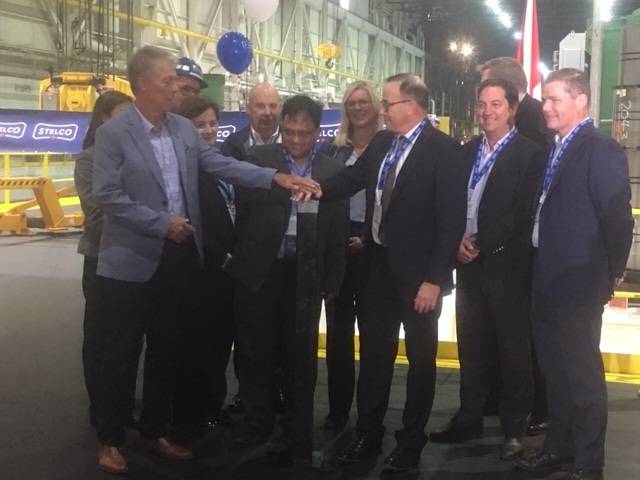
Hamilton, Ontario, mayor Mayor Fred Eisenberger greets Stelco officials at the ribbon cutting ceremony for the company’s new $30 million batch annealing facility. (Photo credit: Ken Mann, GlobalNews.ca)
An integrated and independent steelmaker based in Ontario, Canada, recently celebrated the opening of its new $30 million dollar batch annealing facility with a ribbon-cutting ceremony.
Stelco opened the plant in Hamilton, Ontario, earlier in the summer as a part of the company’s focus on investment in new technology and expansion of its production of flat-rolled value-added steels, including premium-quality coated, cold-rolled and hot-rolled steel products for the automotive, construction, and appliance industries. The restart of a modernized and upgraded temper mill, along with the installation of new annealing furnaces, will allow Stelco to add a full range of up to 200,000 net tons of fully processed cold-rolled steel to its product mix.
Main photo credit and caption: The Spec.com video (Youtube) / Alan Kestenbaum, Stelco executive chairman, at the ribbon-cutting
A Pennsylvania vacuum furnace manufacturing company has recently relocated its operations to provide more space for building furnaces and furnace equipment.
Solar Manufacturing Inc. has moved from Souderton to Sellersville, Pennsylvania, where the new facility is located on a combined 8.5 acres just three miles from the previous location. The newly-constructed building houses 40,000 square feet of manufacturing space and 17,500 square feet designated office space, with an option for an extra 22,500 square foot addition to the manufacturing building in the future. The move was achieved in several phases, taking place over several weeks in September and October. Despite the scope of the project, Solar Manufacturing experienced only a few minor interruptions.
William Jones, owner of Solar Manufacturing, Inc.
“Solar Manufacturing has expanded throughout the many years since our inception, resulting in our employees working from several different buildings,” said Jim Nagy, President of Solar Manufacturing. “With this move, we are finally united under one roof. Not only is the new space very handsome, but it is also a well-thought-out facility. It is equipped with and geared up for efficient production, with enough capacity to serve our customers well into the future, especially those who need very large vacuum furnaces.”
“This new facility provides us the space we need to grow and consolidate all our staff in one facility,” said William Jones, who along with his wife, Myrtle Jones, owns Solar Manufacturing, Inc. “Now that we’re officially settled, we’re eager to use the new building to its fullest potential.”
Pratt & Whitney, a division of United Technologies Corp., recently announced that it has been awarded a production contract for the 12th and 13th lots of F135 propulsion systems, powering all three variants of the F-35 Lightning II aircraft.
Matthew Bromberg, president of Pratt & Whitney Military Engines
This award represents the largest-ever F135 production contract, funding more than 332 engines for the U.S. armed services and international customers, and includes program management, engineering support, production support, and tooling. The total contract value for Lot 12-14 is approximately $5.7 billion and it covers all Lot 12 and Lot 13 engines, with priced options for Lot 14.
“This is a significant milestone for the program and underscores the hard work of our joint government and industry team,” said Matthew Bromberg, president of Pratt & Whitney Military Engines. “We’re proud to be delivering 5th-generation propulsion capability at a great value for the warfighter. With more than 500 F135 engines delivered to date, we’re at an exciting inflection point for the program. We are laser-focused on standing up an effective global sustainment network that will support the F135 throughout its lifecycle.”
The combat-proven F135 is the most advanced fighter engine ever produced, delivering more than 40,000 lbs. of thrust and unmatched advances in safety, design, performance, and reliability.
Heat TreatToday recently released the latest round of 101 Heat TreatTips in the fall 2019 issue of Heat TreatToday (click here for the digital edition). One of the great benefits of gathering with a community of heat treaters is the opportunity to challenge old habits and look at new ways of doing things. The Heat TreatTips is another opportunity to learn the tips, tricks, and hacks shared by some of the industry’s foremost experts.
Ryan Neiss of Taylor Winfield Technologies
Today’s Technical Tuesday features a tip on Induction Heating that missed inclusion in the magazine, but it’s significant enough to get its own headline. From Ryan Neiss of Taylor Winfield Technologies, we bring you “Seasonal Cooling Water Adjustments for Induction Power Supplies”.
If you have a heat treat-related tip that would benefit your industry colleagues, you can submit your tip(s) to doug@heattreattoday.com or editor@heattreattoday.com.
Heat TreatTip: Induction Heat Treating
Seasonal Cooling Water Adjustments for Induction Power Supplies
A proper preventative maintenance plan is critical to the performance of induction heating power supplies. One of the main culprits of downtime is reduced water flow and water quality. While water quality is a very important topic that must be maintained within the OEM specifications, this tip is going to address the importance of seasonal water adjustments.
Water flows through the inside of the power supply cooling critical devices, like power semiconductors, capacitors, transformers, buss, etc. If the temperature is not adjusted for seasonal climate changes, many users may experience water condensation inside the power supply cabinet. This is not a good situation, because the uncontained water can drip into places where water should not be and potentially cause severe damage to the power supply. Depending on how much water damage there is will determine the amount of production loss and costs of this easily preventable mistake.
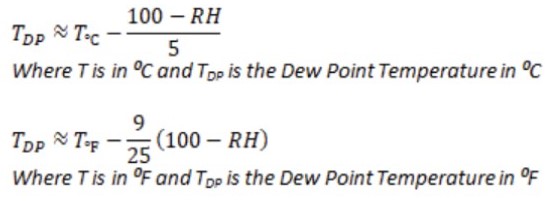
The temperature setpoints for your cooled water source must always be above the temperature dew point in order to prevent condensation. Most weather apps have current dew points, relative humidity, and temperature. Additional climatic resources for predictive planning include noaa.gov and ashrae.org.
Here’s a simple approximation of the dew point temperature from temperature and relative humidity (only apply if relative humidity is above 50%).