Welcome toHeat Treat Today'sThis Week in Heat TreatSocial Media. As you know, there is so much content available on the web that it’s next to impossible to sift through all of the articles and posts that flood our inboxes and notifications on a daily basis. So, Heat Treat Todayis here to bring you the latest in compelling, inspiring, and entertaining heat treat news from the different social media venues that you’ve just got to see and read!
This week, we are looking at where rockets are flying next and exploring the heat treat conversations that people are having through social media. A few graphs, charts, and interview resources are further down.
"Under the new Rocket Cargo Vanguard, the DAF will seek to leverage these commercial advances and position the DoD to be an early adopter of the new commercial capability." Read the entire article at "USAF wants to deliver cargo around the world with reusable rockets."
The US Air Force has announced the development of a new type of rocket-powered transporter to deliver cargo around the world https://t.co/0SOBd3gqTE
— Aerospace Manufacturing (@AerospaceTweets) June 7, 2021
2. Join the Conversation
A few quick tours around your heat treat shops: what have heat treaters accomplished this past year? Have you done anything similar? Let us know and tag @HeatTreatToday on your next post!
An Aerospace Question to the Heat Treaters
.
Breaking it Down: Annealing, Hardening, Tempering
.
The Ladies With Elbow Grease
3. A Little Heat Treat Kudos
Social media is a great place to celebrate your advances with your coworkers and clients. Check out some of the kudos that has been circulating around the inter-web.
A New Measurement System
It's Always Hot in Houston
Click Image to see gallery of images on LinkedIn
Structural Integrity of an Open Die
4. Reading and Podcast
Tune into these interviews and fun conversations this weekend, or check out the reading snippets from around the industry.
Internet Security in the Industry World
Learn how Oldcastle uses SecureLink to manage vendor privileged access for multiple users across 85 locations and how they were able to resolve pain points associated with using VPNs for vendor access. You have to submit your contact information, and then you can read more here: "Oldcastle Infrastructure, Inc. Strengthens Security and Centralizes Remote Access"
So, Then, Can I Really Trust IoT Security
You desire to implement and maintain the best manufacturing practices in your workplace. With technological solutions pressing a connected work system, you may very well be hesitant to adopt them as they come with a different set of security concerns. Read about the "Top 10 Best Practices for Zero Trust IoT Manufacturing."
A Selection from Heat Treat Radio
Click the selections to hear what's new from Heat TreatRadio!
5. What Do You Get When An Automobile Renovates a Restaurant?
If you are going out to eat this weekend, would you prefer your waiter to act like this? I mean, who doesn't love a little dinner theatre?
Penna Flame Industries (PFI) was founded in 1968 by Garrett D. Orr, Sr. and his wife Mary Patricia (Pat) Orr to provide flame hardening services to the growing steel industry. Orr chose the Zelienople, PA site because it was centrally located between Pittsburgh, PA, and Cleveland, Ohio, which was then heavily into steel manufacturing. Garrett was employed as a sales representative for a foundry and was involved in other steel-related industries. Through this experience, he recognized the need for flame hardening in the steel industry. In 1968, at the age of 39, he founded Pennsylvania Flame Hardening. The groundbreaking took place on April 1, 1968.
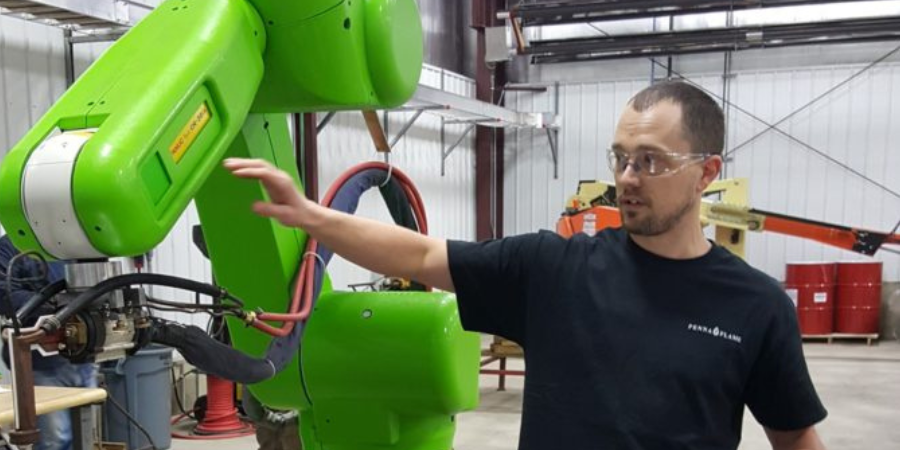
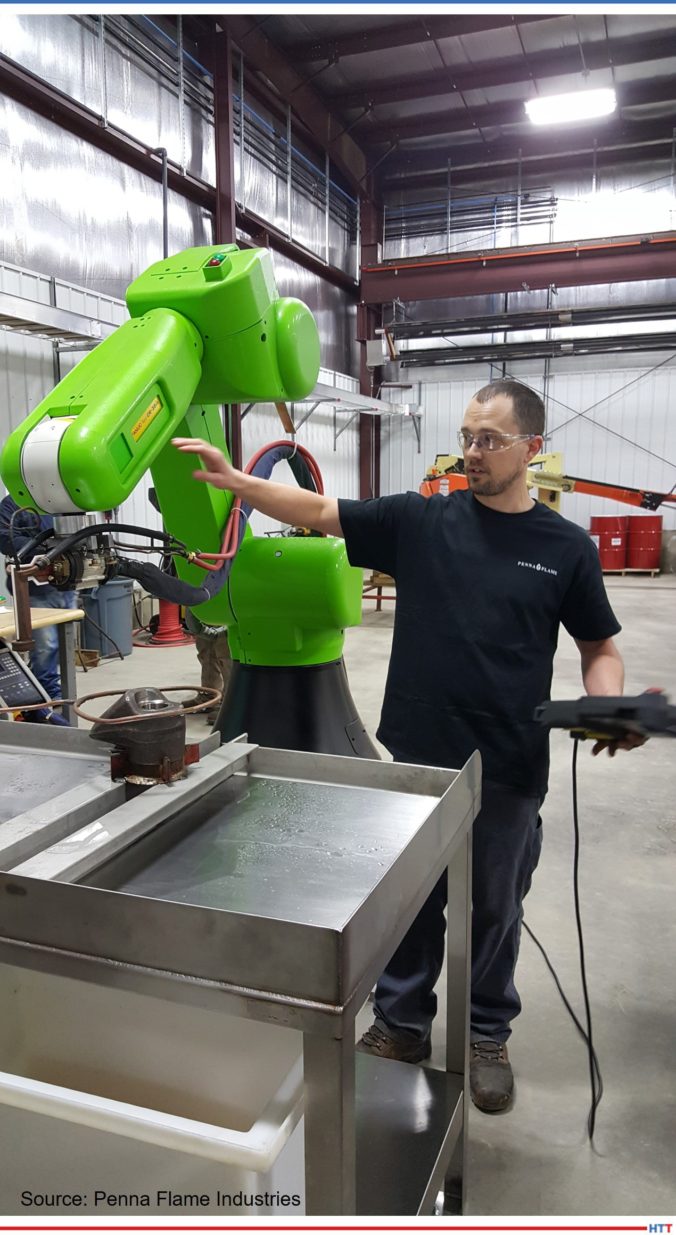
Bert demonstrates the benefits of working with a collaborative robot to induction harden steel parts. The robot gives the operator the ability to work directly next to it, as opposed to conventional robot arms where fencing and distance is required.
In 1990, James P. Orr was named president of the company, continuing his father’s commitment to the industry by adding new technology and innovations in surface hardening and roll manufacturing.
In 1995 the company added a roll manufacturing and machining facility to meet the needs of customers who wanted highly polished rolls used in the automotive and other industries. Today, PFI also serves the military, mining, and agriculture (heavy equipment) sectors.
In 2008, the company added the industry’s first robotic cell that replaced manual scanning and reduced the amount of setup required for tooling, thereby increasing precision and repeatability. The company has since added three additional robotic cells.
The computerized robotic surface hardening systems have revolutionized the surface hardening industry. These advanced robots, coupled with programmable index tables, provide an automation system that helps decrease production time while maintaining the highest quality in precision surface hardening.
A few benefits of this service are:
Increased wear resistance
Higher hardness and longer life
Less processing time
Higher efficiency and productivity
Maintain tensile strength
Quick turnaround of the project
Consistent, repeatable process
Less distortion when compared to furnace treatment
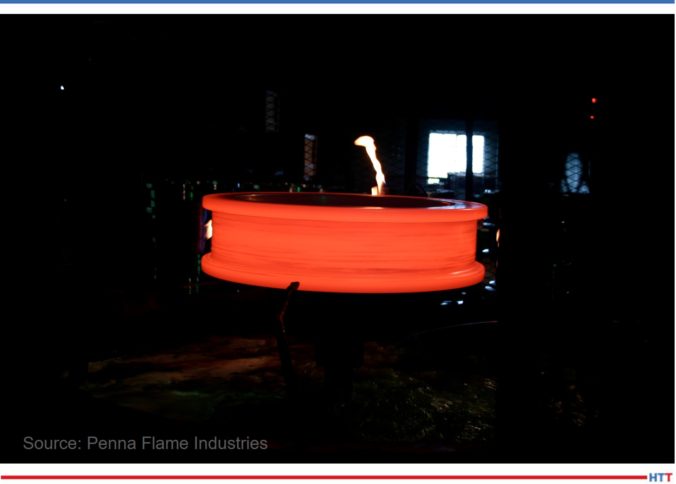
A crane wheel, in the process of being flame hardened, glowing red hot about to submerged in a quench bath.
Additional services include flame hardening, robotic flame hardening, robotic induction hardening, roll hardening, roll manufacturing, roll straightening, hardness testing, wheel and axle assembly, deep cryogenics, stress relieving, and tempering.
In 2017, the company expanded its facility to incorporate the world’s largest spin flame hardening tank (80-inch diameter) and added a collaborative robotic cell that induction hardens and allows the operator to work right next to the robot without having safety fences.
Here’s a fun fact: while PFI doesn’t know the final destination of many of the parts they heat treat, they have flame hardened wheels that are in the roofs of professional sports stadiums and fields that roll out.
As they look to the future, James P. Orr, together with his sons Michael (Vice President) and Andrew (Vice President) are poised to lead the 28 employee-strong company into the next generation of products and services.
That's not an existential question, but what do you want from Heat Treat Today? Heat Treat TV is a quick source that gives you access to helpful information that will help you make better decisions in the industry. This brief article spotlights the visual media that this resource has to offer and includes a poll of which video you think deserves the most applause.
With a slew of responsibilities as a general manager, an after market sales representative, or perhaps as a furnace operator, it can be difficult to keep new -- and old -- information in line. Quick Heat Treat TVvideos are meant to do a variety of things to make sure you stay informed in the heat treat industry.
Heat Treat Basics
Watch this video on Heat Treat TV!
These videos are typically pretty brief, and they can be great to refresh and teach heat treating principles to new hires, green engineers, or operators who are changing responsibilities in their company.
For example, Derek Denlinger, metallurgist at Paulo, shares “what makes stainless steel stainless?” You may anticipate the corrosive resistant abilities, but this brief video walks through exactly how that happens. There is also a video on "Steelmaking 101" provided by MetallurgyData. In the video, the process of creating steel is clearly illustrated with helpful graphics and more. Again, a great educational tool for those who are training/teaching others or being taught.
“This is probably the best explanation of the stress/strain curve,” one commenter noted about a video about hardening and tempering below.
The Novel and Enlightening
Every once in a while, our editors come across an interesting video about mechanical processes that are simply fascinating. This could be an in-depth look at sintering, or an investigation into a mechanical phenomenon that is apparent when a heat treater quenches a part.
These are more focused videos to bring fringe information into focus and hit on items that are easy to understand, but not often used, or specialty topics that only come up for someone who is concentrating on that field of information.
The mystery of Prince Rupert's Drop is a well-known phenomenon. Somehow, the glass will not break under direct, significant pressure. In this video, you can see tests of why this structure withstands such stress, when it doesn’t, and the mysteries of quenching.
Company Highlights and Site Tours
Lastly, get to know different suppliers and commercial heat treaters in the industry as they share their work ethic, their site layout, and their future goals. This segment is meant to keep you informed with what key players in heat treat are doing and how they accomplish their goals. If they align with yours, there may be a future partnership there.
These company highlights and site tours can also give you a quick look at how you might want to change your operations on a micro or macro level. In this video, International Thermal Systems shows how their furnace support looks like at a shop and worker level.
So, what are you here for? The basics, the specialty items, the company highlights/site tours? Let us know in the poll below, and we'll feature the winner on LinkedIn!
Heat Treat Today's goal is to make learning a pleasant experience. Combining a variety of technologies along with varying proficiency levels of information, Heat Treat Today will be a modern and informative place to learn about the heat treat industry – technologies, markets, and news. If there is a way we can improve your learning experience, please send your suggestions to us at HTT@HeatTreatToday.com.
A leader in the “Tool & Dies” sector — voestalpine High Performance Metals Polska -- placed an order for a retort tempering furnace with vacuum purging. The furnace will be used for tempering tool steel after the gas quenching process.
While this is the first opportunity for the company and SECO/WARWICK to cooperate after the global-pandemic-caused crisis, the contract is the result of long-term cooperation between the supplier and voestalpine High Performance Metals Polska Sp. z o.o. (formerly Bohler Uddeholm Polska). A retort tempering furnace with vacuum purging will complete the production line installed in Łomianki near Warsaw. The facility is currently operating the equipment delivered previously from the supplier, including a hardening furnace and a tempering furnace. Another furnace will significantly increase the capacity of the hardening plant.
Cezary Żurada President of the Management Board voestalpine High Performance Metals Polska
“Voestalpine High Performance Metals Polska is a partner whom we’ve known for many years," said Maciej Korecki, VP of the Vacuum Business Segment, SECO/WARWICK Group. "We know their needs, we are able to provide advice and most importantly, customize the equipment to their specific needs. Our relationship is not just superficial — we learn from each other, and thus we know the challenges they face in their day-to-day production."
Vacuum furnaces are perfect for hardening and tempering. They are characterized by the high-quality of processed parts, much lower number of hardening deformations and the absence of batch oxidation which directly translates into significant money savings.
“Our main goal was to increase the capacity. Our machinery park has already included a SECO/WARWICK tempering furnace, which has proved itself perfectly," summarized Cezary Żurada, president of the Management Board of voestalpine High Performance Metals Polska. He continued, "It is worth noting that despite being less demanding, the tempering process usually takes more time than the hardening process. Therefore, in order to be able to make full use of the hardening furnace, for tooling steel we needed two tempering furnaces. Now we will be able to make production more dynamic and conquer new markets."
Why is parts cleaning an important step in heat treat? While a nice surface finish reflects quality, the importance of cleaning goes far beyond the aesthetic aspect. Parts cleaning can ensure against quality issues, especially when it comes to nitriding or brazing where high surface cleanliness is a prerequisite. Learn what questions you should be asking to achieve optimal parts cleaning.
This Technical Tuesday feature written by Michael Onken, market development manager at SAFECHEM, will be published in Heat TreatToday's August 2021 Automotive print edition.
Michael Onken Market Development Manager SAFECHEM SAFECHEM
There are two types of cleaning in heat treat. One is cleaning prior to hardening where residual metal working fluids on parts must be removed. Then there is cleaning after quenching. Residue oils left on parts after quenching may cause challenges in the next process steps, such as tempering.
Inadequate cleaning not only affects subsequent processes, but also parts quality. Contaminations on parts can also get into furnaces and fixtures, and thereby impact their functionalities.
Quality cleaning is costly, but necessary, if the goal is to achieve quality components. The important questions are: What cleaning solution should I choose? Is water-based cleaning better, or rather solvent cleaning? The answer is that it depends. We have briefly outlined 4 key questions you should consider.
What are your cleaning quality requirements?
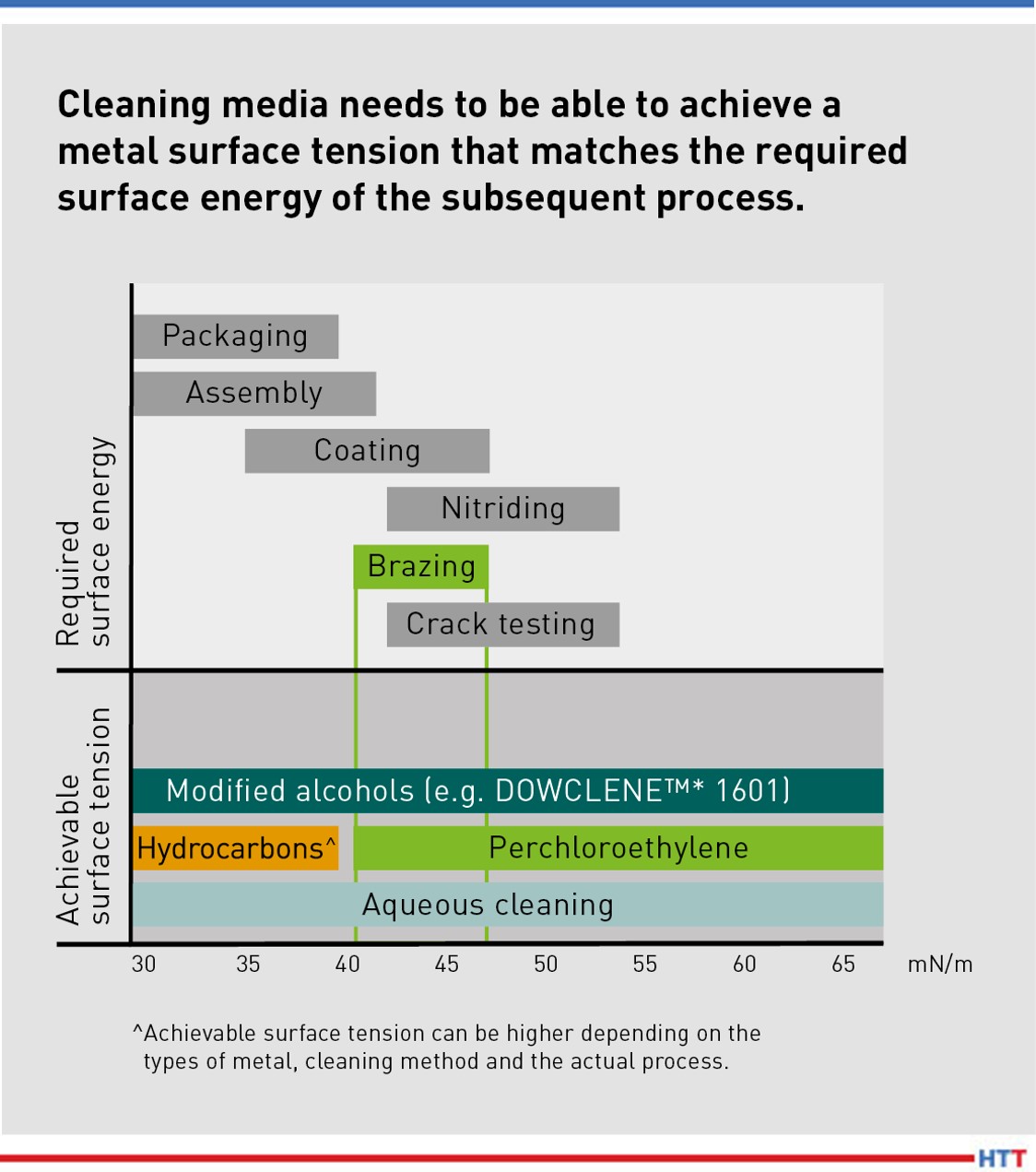
Different industrial applications require varying degrees of surface energy of the metal surface, which is influenced by filmy contaminations. With nitriding, for example, a higher surface energy is required than with standard coating or assembling. The ability of the cleaning agent to remove the contamination should therefore match the required surface energy.
SAFECHEM
What is the affinity of the cleaning agent to the soils?
Effective cleaning is based on the principle “Equal dissolves equal.” For water-based types of contaminations, such as coolant and lubricant emulsions, aqueous cleaning agents are typically the first choice.
When removing mineral oil-based, non-polar contaminations, such as machining oils, greases, and waxes, solvent will commonly be the preferred cleaning agent.
The above contaminations can be classified as filmy contaminations that can be dissolved in a suitable cleaning agent. Another important category of contaminations is particles like chips, dust, and residues of polishing pastes. These contaminations cannot be dissolved in a cleaning agent. To remove these, sufficient mechanics are required in the cleaning machine to flush off particle contaminations.
What metal types are being cleaned and how are they configured?
In water-based processes, cleaning agents, which can be acidic, neutral, or alkaline, are usually matched to specific metal types. Simultaneous cleaning of different metals can therefore be problematic, and this can result in compatibility issues and in the worst case—corrosion. Solvents, in comparison, have universal compatibility with metals.
If the component parts are tiny or have complex geometry or small crevices, solvent is often recommended due to its lower surface tension and viscosity, which makes it easy to seep into and evaporate out of tight spaces.
What is the environmental impact?
The energy consumption in a water-based process can be significant, due to the energy requirement to operate high-pressure pumps, heat the cleaning water, dry the metal parts, as well as treat and purify used water for reuse or disposal. Depending on the cleaning agents, dirt and soil are emulsified and the contaminations are diluted in the water. As a result, aqueous baths that are not treated must be replaced frequently.
Solvent in a closed vacuum vapor degreaser can be recycled again and again via the built-in distillation unit. This can significantly increase solvent lifespan and cut down on waste volume. While energy is required to keep the closed cleaning machine under vacuum, this also lowers the boiling points of solvents, hence accelerating their evaporation and enabling quick drying of metal parts within a shorter cycle time.
The questions listed above are by no means exhaustive and there are many more key aspects to consider. The optimal cleaning decision should balance technical, economic, and environmental needs. Given the potential of parts cleaning to make or break heat treat processes, when done properly, it can deliver much more value than the mere technical function it fulfills.
Read more about parts cleaning in heat treat here.
About the Author: Michael Onken is a market development manager at SAFECHEM Europe Gmbh. For more information, contact Michael at m.onken@safechem.com or Phone: +49 211 4389-300
Heat TreatTodaypublishes eight print magazines a year, and included in each is a letter from the publisher, Doug Glenn. This letter first appeared in Heat TreatToday'sMay 2021 Induction print edition.
Doug Glenn Publisher and Founder Heat TreatToday
I’m not positive, but it seems to me that it was back in 1992 or 1994 when my former employer launched the heat treating industry’s very first PRINT Buyers Guide. I remember with certainty that it was a HUGE undertaking every July. The excellent team at Industrial Heating in those days (many of whom are still there) did yeoman’s work to get this helpful resource into the industry every year. It was always a great relief when the issue finally hit the street.
Nearly 30 years later, Industrial Heating announced last year that they were no longer going to print a monthly magazine which, I believe, includes their big July Buyers Guide.
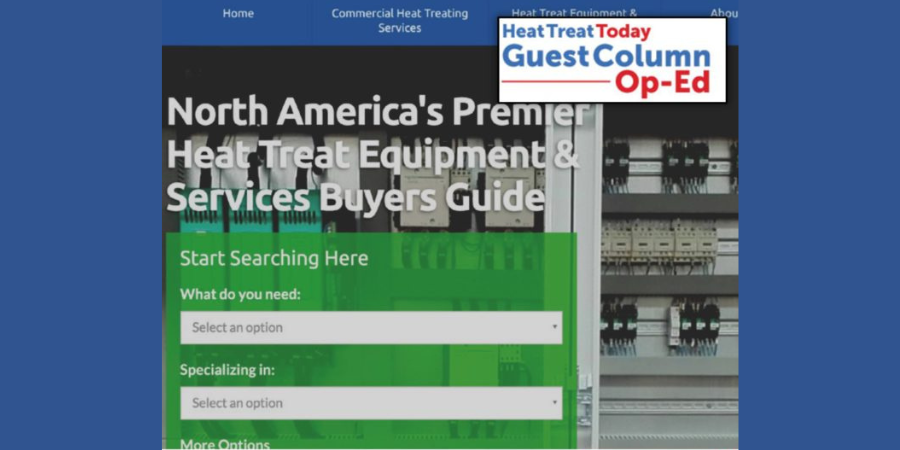
In steps Heat Treat Today. We’re big believers in print, and we’re big believers in online and print buyers guides. So, this June (next month), Heat Treat Today will officially launch its very first print and online North American heat treat industry Buyers Guide. Woo hoo!! Let the fun begin.You can preview the online Buyers Guide at www.HeatTreatBuyersGuide.com (super cool URL, eh?), although we’re not officially launching it until mid- to late- June. But go ahead, take a quick look. The big print edition will come out in late June as well.
We’re really excited about both the online and print versions of this Buyers Guide.
The online version is super-sleek. While we’ll undoubtedly make improvements as we go on, the initial look and functionality is uniquely simple and modern. It is also the very first Buyers Guide that combines both heat treat equipment and related services and commercial heat treating services. If you’re looking for either, you’ll find it at www.HeatTreatBuyersGuide.com.
If you’re an industry supplier, you should search the site for your company. If you’re not there, you should create a listing. If you are there and your listing is “unclaimed,” claim it.
We’re also very excited about the print version. There’s been a lot of talk about the death of print magazines and print directories. In fact, it was the belief that print’s days are limited that prompted the aforementioned thermal processing publication to essentially abandon print. As Mark Twain is reported to have asserted, “The rumors of my death have been vastly exaggerated.” So it is with the rumors of print’s death – vastly exaggerated.
Heat Treat Today's research arm recently conducted two broad based studies – one on batch integral quench furnace systems and another on induction heating technologies and usage – and both returned very similar results to an identical question we asked in each. The question was, “When reading through an industrial trade magazine, which do you prefer?” Here are the combined answers:
Said another way, if you drop print, you’ve lost nearly 40% of your audience. That doesn’t make sense. So, we’re not going to go that route. We’re committed to keeping print a priority and June’s Buyers Guide is no exception.
Watch for it in June, Heat Treat Buyers Guide. Or get a sneak preview now at www.HeatTreatBuyersGuide.com.
Are you someone who is satisfied with the same services and equipment that you've used for years, regardless of how mediocre the results are? Would you like to use a new guide to find better heat treat solutions?
This original content article was written by Karen Gantzer, editor ofHeat Treat Today, forHeat Treat Today's June 2021 Heat TreatBuyers Guideprint edition. Feel free to contact Karen Gantzer at karen@heattreattoday.com if you have a question, comment, or any editorial contribution you’d like to submit.
80%-90% of you tell us that you prefer to have a print, hard-copy magazine – and the Heat Treat Buyers Guide is no exception. While it is the “hip,” “cool,” or “in” thing to “go digital,” the facts say otherwise. So, slap this hard-copy, bad boy down on your desk or table and let it sit around until you’re ready to buy something in the North American heat treat market. Then pick it up and enjoy all of the resources it has to offer.
Here’s how you can get the most out of this resource:
The Buyers Guide is divided into three major sections.
1. The first section, from pages 17-27, contains an alphabetic listing of all the suppliers of heat treating equipment and related services in the North American heat treat marketplace. You’ll notice that some of the companies listed in this section have a red star before their name. These are the advertisers who make this print version possible. Please lend your support to these industry-leading companies when it comes to purchasing.
Other companies have a boldface listing along with their company logo, but no red star. These are our Gold level suppliers who have paid extra to be in the online version. These companies are also worthy of your serious consideration.
There are still other companies who have not yet completed their online listing and therefore have relatively little information in this print edition. You’ll be able to recognize these companies because they have a blue asterisk (*) next to their name. More and more of these companies are signing up daily, so our suggestion is to check our website (www.heattreatbuyersguide.com) for the latest information about these companies OR go directly to these companies’ websites, which are listed along with their company names in this first section.
Those companies without a red star, no logo, and no blue asterisk are what we call our Basic Level companies. They’ve also contributed a nominal yearly amount to be listed in the online and print versions of this Buyers Guide. These companies are also very much worthy of your consideration.
2. The second major section of this Buyers Guide is an exhaustive listing of heat treat equipment and related services. There is a comprehensive index of these services listed between pages 28 and 32. This is a good place to start your search.
Immediately after the Index of Equipment & Related Services are six sub-categories with hundreds of products and companies who provide them. The six sub-categories are: 1) Heat Treat Furnaces, Ovens & Induction Equipment, 2) Heat Treat Components, Supplies & Materials, 3) Heat Treat Controls, Instrumentation & Sensors, 4) Heat Treat Auxiliary, Subs-System, Ancillary Equipment & Services, 5) Heat Treat Lab, Testing, & Materials Characterization Equipment, and 6) Heat Treat Gases & Atmosphere Generation Equipment. There are too many products and services to reproduce here, but you can see them all on pages 34-78.
3. The third and final section of this Buyers Guide runs from pages 79 to 83 and is a state-by-state listing of commercial heat treaters. If you’re looking for a company to perform heat treating on a product your company makes, this is a good place to start. There wasn’t room in this print edition to list the processes that these commercial heat treating companies perform, but if you go to the website, www.heattreatbuyersguide.com, you’ll be able to search for a commercial heat treater by the processes they perform AND their proximity to you.
A final thought. If you are a supplier of heat treating equipment or related services OR if you are a commercial heat treater and you are NOT listed in this directory, there is a quick and easy remedy. All you have to do is go to www.heattreatbuyersguide.com and search for your company’s name. If you are there, all you need to do is “claim” your listing. If you are not there, you can easily create a listing for your company in less than 15 minutes. If you have any trouble, please feel free to contact us at buyers_guide@heattreattoday.com with any questions. We’ll respond as quickly as possible.
How do sintering parameters, especially the sintering atmosphere, affect the quality achievable from parts? Do you know what your three gas options are? Find out this and more, including an evaluation of some interesting solutions for your heat treating needs.
An excerpt:
"However vacuum furnaces operating with hydrogen require additional safety measures. For this reason, specific design solutions (such as double seals on all the furnace flanges) and software safeties are adopted. Despite the increased degree of complexity of the equipment and the higher process costs, vacuum furnaces operating with hydrogen over-pressure bring several advantages. . ."
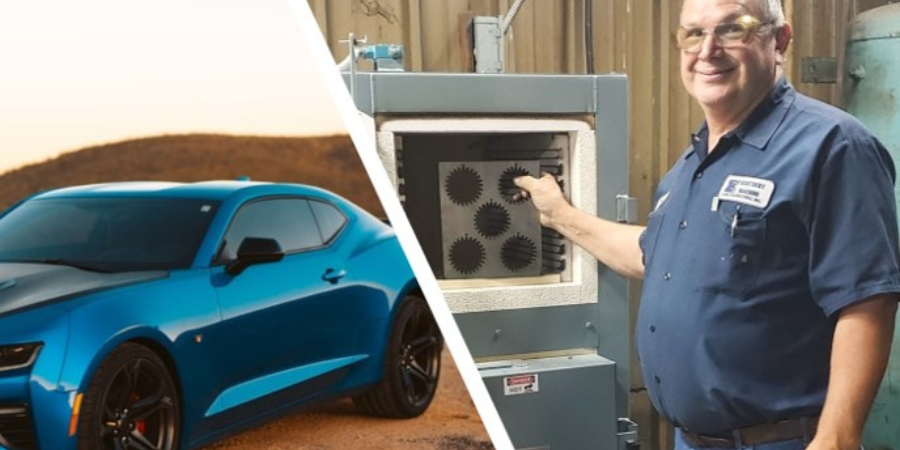
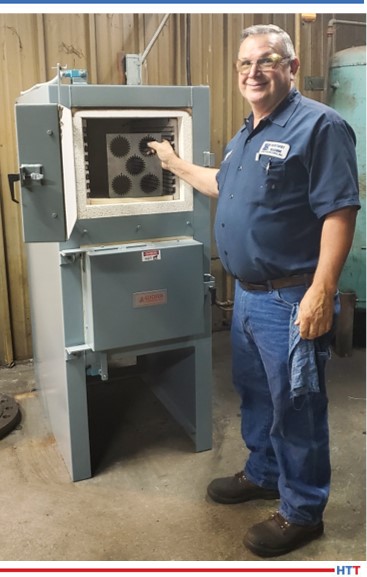
Kentucky Machine & Engineering, a machine repair business in Cadiz, Kentucky, upgrades their old gas fired furnace with a dual chamber furnace-over-oven unit. They will use the furnace to shorten their lead times on parts fabricated for their customers.
Kentucky Machine and Engineering Representative Standing Next to Lucifer Furnaces Unit Source: Lucifer Furnaces
Both chambers of the Lucifer Furnaces Red Devil Dual Chamber furnace-over-oven are 12”H x 14″W x 24″L; the upper chamber is programmed to heat to 2200°F while the lower oven reaches 1200°F. Dual Chamber furnaces allow a user to harden in the upper chamber then temper/draw in the lower convection oven. Both chambers are lined with 4.5″ multilayer lightweight firebrick insulation and mineral wool backup precision dry-fit to allow for thermal expansion while minimizing heat loss. Easy to replace heating elements simplify maintenance.
“By not having to outsource this piece of the process,” said AmyKuberski, CFO at Kentucky Machine & Engineering, “the increased size capability and the addition of the draw oven feature saves us a lot of extra time without having to be at the mercy of someone else’s schedule.” She added, “We were so pleased with the ease of installation to first use! Furnace was ready to go.”
Kentucky Machine & Engineering, Inc. have specialized in serving the steel, aluminum, automotive, and heavy equipment industries since 1971. From large machine repair or building new to quality fixtures, they strive to make their customer’s downtime as minimal as possible.