


Heat Treat Radio #60: High-Temperature Material Selection with Marc Glasser, Rolled Alloys

Heat Treat Today publisher Doug Glenn and Marc Glasser of Rolled Alloys on why choosing the cheapest material is not always the best way to go. Listen to some of the practical tips Mr. Glasser gives for choosing the right alloy for your application.

Below, you can either listen to the podcast by clicking on the audio play button, or you can read an edited transcript.


The following transcript has been edited for your reading enjoyment.

Doug Glenn (DG):  We're going to talk today about something that Marc and I had talked about that kind of caught my attention that I thought might be of interest to our listeners, and that's this whole idea that sometimes buying the cheapest material isn't always the best option.  So, that's the topic, but, before we do that, Marc, I want you to tell our listeners and/or viewers a little bit about yourself, your background, and what you're currently doing.

Marc Glasser (MG):  I have been a metallurgist or material scientist for forty years.  Next month will be exactly forty years since I graduated from Rensselaer Polytechnic Institute with a bachelor's degree in materials engineering.  After ten years of working, I went, simultaneously, to a job and to night school for five years and I obtained my Master of Science in material science from, then, Polytechnic University which is now known as the NYU School of Engineering.  I've been working in all areas of metallurgy and material science.  I've worked in rolling, I've worked in forging, I've worked in powder metallurgy, and I've worked in heat treating laboratories.  I'm currently working in metallurgy of heat resistant materials and applications of these alloys in industry.

School of Engineering at NYU

DG:  Let's jump in then, Marc.  I want to talk to you a little bit about this contention that you and I talked about that sometimes, but not all the time, expensive is better and buying the cheapest isn't always the best.  In a nutshell, what are you trying to say on that?

MG:  I'll take it even one step further:  Expensive is cheaper.   Let me expand on that.  You have a part and it's a certain price and you know you have a life of two years. . . so that's cost X.  You have alloy #2 that's going to cost 60% more.  It's going to have a life of eight years.  Again, you're going to pay 60% more for this part than you would for the first part of the less expensive alloy.  But, over the operating life of that less expensive alloy, you're going to have to replace it three times.  You're going to use four separate components.  So, 60% of the cost times four, you're spending 240% more than you would spend on one component that's a little more.

It's cheaper up front, but over the entire life cycle of the part, buying four more parts of the cheaper one is a lot more expensive.

DG:  Let's talk about some of those hidden factors that come into play when you're analyzing the true cost of selecting those materials.  Do you have a couple of examples?

MG:  Absolutely.  The most stark example, that we made our first case history on, is radiant tubes.  For years, the alloy of choice on radiant tubes was a wrought 601 thin wall and you get about two years on it in a typical furnace.  Then the casting industry came in and, because of limitations of the machinery, they had to go with a heavier wall that was three times as thick and that cost 30% more, but it got four years of life.  Now, there's newer technology and they can cast it a lot thinner, but thinner doesn't last as long.  So, for the wrought tube, you're talking about 1/8 of an inch wall thickness.  With cast, for the four-year version, is about 3/8 of an inch and if you go down to 1/4 inch or less, you get maybe two or two-and-a-half years and if you go to the more expense wrought alloy, (again, you're talking about 1/8 inch wall), it's 60% more than the original one, 30% more than the cast, and you get eight years out of it.

Now, again, these numbers are based just on the cost of the material.  But, you've got to dig a little deeper because you're not capturing the true savings of using the more expensive material because, think of this:  If you've been in a heat treating shop and you know your carburizing furnaces, you have to turn it off, cool it down, let it air out because you've got a carbonaceous gas in there and any residual carbon monoxide, if you go in there, you're going to asphyxiate.

The bottom line is, the turnaround can take up to a week.  Each time you have to go down for a week, what everybody doesn't even think about is how much revenue in sales and/or in profits are you losing from that week down?  And, if you're going from cast to the better wrought alloy, you're talking about one week.  If you're still going with the original less alloyed, thinner wrought tube, that's three times.  Those savings can be much larger, depending on the facility, than just the material cost; it's just a few thousand dollars.  I don't know how to evaluate how many tens of thousands or hundreds of thousands of dollars of lost production would be, but each shop has to consider that.  They know the numbers; those are proprietary numbers that need to be considered.

With muffles, it's the same kind of analysis because you have the same alloys except muffles are not typically cast.  But, let me give you an example.  A lot of muffles operate at 2125 and, again, you use a 601 muffle.  They're going to stay perfectly straight and flat at that temp for about six months.  At that point, the typical shop will start seeing a little bit of roof sag and it will sag more and more and more.  But there's plenty of room, so you can get a lot of sag before it starts interfering with the parts being conveyed.  So, my general rule from the shops that I've seen, is that it can sag for about three times as long as it stays straight before the sagging is too great and has to be removed.  Typically, it's about two years.  With the better alloy, again, the case that I've seen was two years without any sagging and that was a higher temperature.

What we've done is we've actually gone to good customers who understand the concept and we work with them on developing case history.  They log in when they put it in and the log in when they take it out.  They have good records, number one.

Now, I'm talking predicted metal temperature based off the process temperature which could be more or less because it's estimated.  But I know that the one that we looked at was at least 2200 on the metal temperature.  And this was one of the really crazy ones because it was replacing a cast material of much higher quality cast material and the cast material was dead straight for a year-and-a-half, it would start to just creep a little, but if you're familiar with casting, there's not a lot of ductility in casting when it starts creeping maybe 3 or 4%, you don't have to worry about more creep; it ruptures!  Then, the gas starts escaping and that's no good so they take it down.  In this case, when you switch from the cast, the best wrought material was actually cheaper and it lasted longer and the particular customer would just change them every two years because they were still in cost savings mode.  Based on my experience, I've predicted that they should be able to get at least six years on it.  But, they're not willing to take that chance.

DG:  The examples that you gave were the radiant tube and the muffles.  I assume the same thing would be true, though, in retorts, for baskets or even fixturing systems, and things like that.

MG:  Absolutely.  I bring those two up because I have more good case histories.

DG:  I assume the same would be somewhat true for fans, and things of that sort, if necessary, although you wouldn't be worrying so, so much about sagging and stuff like that.  But anything, basically, I assume, metal.

MG:  That's correct.

DG:  How about measuring the life cycle of materials components?  Any tips or tricks you've got for people on how exactly to do that and to get an accurate estimate?

MG:  What we've done is we've actually gone to good customers who understand the concept and we work with them on developing case history.  They log in when they put it in and the log in when they take it out.  They have good records, number one.  We've worked with others who've wanted it to work but they didn't do so good of a job tracking it.  In one case, it was a much larger furnace where they had many radiant tubes and they were just working with a few of them.  Personnel changed – one person didn't let the next person know about the trial and the identity got lost.  So, we spent a lot of time for nothing.  But, what we learned on that one is something real simple:  You take a welder and you weld the alloy name somewhere on the tube and that's not going to wear away.  Assuming you choose the right consumable, that weld is not going to go away.

DG:  You already gave a couple of examples, but let me ask you this:  How about a few concrete examples of where a more expensive material produced an overall more cost effective part?  You already kind of gave us those back with the radiant tube, but are there any others that you've got along that line?

MG:  The radiant tube is a great example.  Muffles and retorts.  We've been trying to work with some people on larger heat treating trays, but, again, there the task people have done a pretty good job, so we're trying to find a few people willing to go out on a limb and try something better.

Here, the concept is the idea of something lighter so that we don't look as much about the cost of the component.  If you go with a lighter fixture, your furnace has a weight capacity and if you cut your weight 20-30%, you can put more parts on it and have more of your furnace BTUs going to heat treat parts instead of fixturing.  When you're putting BTUs into parts, you're talking more profit per part.

DG:  Right.  You're not spending as much time, basically, using a basket as a heat sink, or something like that.

MG:  Exactly.  And, that's a concept that I introduced at one of the conferences about a year and a half ago.  These things take time to percolate before they're accepted by people.

DG:  Speaking of acceptance, let me ask you this question:  Are these concepts that we've been talking about, the idea that sometimes less expensive is not better, is it widely accepted, do you think?  I mean, do you think people understand it, generally speaking?

MG:  Some people do.  Not as much as I'd like to see!  The other obstacle you're looking at is when you're looking at four years versus eight years and you look at some of the larger companies, you may have personnel turnover and one person doesn't want his 'replacement' to get all the credit.  These are things that were learned the hard way.  You have to get the right people to try it.  A family-owned business is a perfect place.

I can give you another real good example on heat treating baskets where it made a difference.  I'm going to give the name because I have done papers with him at a conference on this subject so I don't think it's taboo.  I work with Solar Atmospheres on a basket for an extremely high temperature heat treating process that was slightly under 2300 degrees Fahrenheit.  (We can say that because it's in the case history.)  The first baskets that he used were your traditional Inconel 600 601 and they were supporting heavy parts.  After five cycles, they had to cut all the sides off, hand straighten them (each of the sides) and  weld it back together.  That's timely.  So, he went to another alloy, a better alloy, a competitor's alloy (HR120), and got ten cycles on it.  He was very happy.  Then, one of the people at their headquarters heard me give a talk on this new alloy that we had, our 602CA, which we trademark as RA602CA, and he got excited.  He started asking me questions after the presentation and we eventually got kicked out of the room because it went well beyond the break; so we continued out in the hall as we walked to our company's booth and we talked.  It took about ten to twelve months before they were ready to try it.  We worked with their fabricator to get the material.  They were up to forty-five cycles before they straightened it and there's a catch, though, to that.  At forty-five cycles, they probably could've continued, but during the pandemic in 2020, when things were slow, they made a smart business decision that this would be a great time to do the straightening.  I can't fault them, but it would have been nice to know just how many more.  But, at forty-five versus ten, it is probably a similar cost at the time of manufacture.  That's a no-brainer.

DG:  So, we've covered some of the basics.  We understand that it's not necessarily widely accepted so people should pay attention to some of these things that you've said.  Are there any other economic factors that you think people aren't necessarily taking into consideration when they're doing material selection, besides the things we've talked about.  Initial cost, life cycle, cost of replacement, and those types of things.  Is there anything else that they ought to be thinking about?

As I mentioned in one of the cases, when there is significant down time to replace a part, you've got to consider how much money you're not bringing in because you're down for a week, or however long it is.  This is often overlooked, as well.

MG:  As I mentioned in one of the cases, when there is significant down time to replace a part, you've got to consider how much money you're not bringing in because you're down for a week, or however long it is.  This is often overlooked, as well.

DG:  To me, that's cost of replacement, because that's not just a hard replacement cost, but the downtime replacement, right?

MG:  It's a little less obvious, though.

DG:  Those are all good thoughts, Marc.  When people go to do material selection, keep some of these things in mind.  It's not just a matter of what the buyer, the purchaser guy, sees coming across his desk and comparing those two costs, let's talk about the material properties and longevity of the product and things of that sort.

I know that you, being with Rolled Alloys, you guys help customers, I imagine, pretty much continually on things like this.  If people want to get in touch with you or Rolled Alloys, how is it best to do that?

MG:  There are a couple of ways. The first way is my email: mglasser@rolledalloys.com.  You can always ask me a question.  On our website, there is a link to ask a metallurgist a question.  I believe, you can also go www.metallurgical-help@rolledalloys.com and that will bring you to one of the metallurgists in my department and somebody will get an answer to you .

DG:  Thank you very much, Marc.  I appreciate your expertise.  We'll hope it's helpful to the heat treat world.

MG:  Doug, I thank you for having me as your guest and I look forward to more conversations with you.

Doug Glenn <br> Publisher <br> Heat Treat Today

Doug Glenn
Publisher
Heat Treat Today


To find other Heat Treat Radio episodes, go to www.heattreattoday.com/radio and look in the list of Heat Treat Radio episodes listed.


Heat Treat Radio #60: High-Temperature Material Selection with Marc Glasser, Rolled Alloys Read More »

Measuring Furnace Temperatures in Oxidizing Atmospheres

Source: AZO Materials

Measuring temperatures inside a furnace can present a number of challenges: temperature cycling, high temperatures and hostile atmospheres exceeding the limits of several measurement devices while others have significantly reduced lifetimes and poor accuracy. This article discusses some of the challenges associated with temperature measurement in furnaces where oxidizing and reducing atmospheres are employed in microelectronics fabrication.

An excerpt:

"The Type K is low-priced and can be used across a temperature range from -200 to 1250 °C (-328 to 2282 °F). However, metallurgical changes at temperatures more than 1000 °C (1832 °F) decrease accuracy, and cycling via this temperature induces hysteresis effects, further reducing accuracy. Type K thermocouples are also vulnerable to corrosion in an oxidizing atmosphere."

Read more at "Measuring Furnace Temperatures in Oxidizing Atmospheres"

best of the web

Measuring Furnace Temperatures in Oxidizing Atmospheres Read More »

Nitriding vs. FNC

OCHow well do you know hardness processing? Can you draw the line where nitriding and ferritic nitrocarburizing (FNC) differ? In this Technical Tuesday feature, skim this straight forward data that has been assembled from information provided by four heat treat experts: Jason Orosz and Mark Hemsath at NitrexThomas Wingens at WINGENS LLC – International Industry Consultancy, and Dan Herring, The Heat Treat Doctor at The HERRING GROUP, Inc.


Let us know what you think! What is the next comparison you'd like to see? What facts were you surprised by? Email Heat Treat Daily editor Bethany Leone at bethany@heattreattoday.com.

Nitriding Descriptor Ferritic Nitrocarburizing
480º-590C (896º-1094ºF) typical Temperature Range 565º-590ºC (1049ºF-1094ºF) typical
Wrought and powder metallurgy materials including alloy steels (e.g., 4140), stainless steel (e.g., 304L, 420), tool steels (e.g., H11, H13) and special nitriding steels (e.g,, Nitralloy 135M, Nitralloy EZ) are typical examples. Many other steel grades are possible. Materials Commonly Processed Plain and medium carbon steels (e.g., 1015, 1018, 1045), alloy steels (e.g., 4140, 4340) and tool steels (e.g., H11, H13) are typical examples. Many other steels grades are possible.
Wear (as in abrasion resistance), bending, torsional and rolling contact, fatigue resistance, lubricity, and adhesive strength improvements. Materials Commonly Processed: Why to Process Them with These Methods Wear resistance, lubricity, fatigue, and corrosion resistance are primary benefits with improved fatigue strength and adhesive strength possible.
3-48 hours at temperature. May be up to 72 hours. Relative Cycle Times 2-6 hours at temperature.
Pit retort furnaces and front load retort furnaces for gas nitriding, although bell retort furnaces have also been used. Equipment Types Used for the Process Pit retort furnaces and front load retort furnaces for gaseous ferritic nitrocarburizing. Bell retort furnaces have also been used.
Ammonia and nitrogen or ammonia and dissociated ammonia. Atmospheres Used/Required Ammonia and nitrogen and carbon-bearing gas such as CO2, CO, or endothermic gas.
Dies, gears, pump bodies, springs, gun barrels, shafts and pinions, pins, brake rotors and may other types of component parts produced from bar, plate, rod, forgings and castings formed by stampings, machining, rolling, forging, casting, etc. Typical Parts Processed Wear plates, washers, clutch plates, gas pistons, brake pistons, brake rotors, barrels, slides, differential cases and other types of component parts produced from bar, plate, rod, etc., and formed by stampings, rolling, machining, casting, etc.
Automotive, aerospace, oil & gas, industrial machinery (e.g., pumps), and tool & die. Typical Industries Served Automotive and industrial machinery hydraulics.
Cost is often higher for gas nitriding as opposed to other case hardening processes (including FNC) based on the type of component parts run. In many cases, cost is a function of the longer cycle time and/or more labor involved. Relative Cost Per Unit Cost is often lower than many other case hardening processes (including gas nitriding) based on the type(s) of component parts run. In many cases, cost is a function of a shorter cycle time and/or less labor involved.
Basic specifications are easily achieved with good equipment and/or controls; difficulty increases when attempting to produce specialized layer compositions/phases. Ease of Use/Control Basic specifications are easily achieved with good equipment and/or controls; difficulty increases when attempting to produce specialized layer compositions/phases. Hardware/control requirements are more complicated than for nitriding when controlling for carbon potential.
It can range from very simple to medium-high depending on application. Relative Expertise Necessary to Perform Medium-high depending on the application. The user will want to look for clean parts, a good loading system, and PLC controlled cycle.
Aqueous (clean chemistry) including rinse/dry, vapor degreasing (clean chemistry). Cleaning Requirements Aqueous (clean chemistry) including rinse/dry, vapor degreasing (clean chemistry).
White glove Handling Requirements White glove
Pre- and post-oxidation Process Options Pre- and post-oxidation
AMS 2759, AMS 2759/10, (latest revisions) Applicable Specifications AMS 2757, AMS 2759/12, AMS 2759/13 (latest revisions)
Time, temperature, gas flow, nitriding potential (Kn) and/or percent dissociation, hydrogen sensors. Controls Time, temperature, gas flow, nitriding potential (Kn), carbon potential (Kc) and oxygen potential (Ko). Hydrogen sensor and oxygen (carburizing) sensor may be used.
electric and gas-fired equipment Fuel Source electric and gas-fired equipment
Hardness (surface, core), case depth determination (via microhardness – typically core hardness + 50 HV), microstructure (compound and diffusion zone depths), composition, core structure, presence of absence of nitride networking (aka nitride needles), and the presence or absence of cracking or spalling of the case. Testing Required Hardness (surface, core), case depth determination (via microhardness – typically core hardness + 50 HV), microstructure (compound and diffusion zone depths), composition, core structure, porosity (type and depth), and the presence or absence of cracking or spalling of the case.
Warm wall plasma nitriding, as well as advances in controls, sensors, temperature uniformity, and reduced gas volumes. Latest Advances Black oxide, hydrogen sensors, and fast cooling techniques as well as advances in controls, sensors, and temperature uniformity.
(1) simple equipment, (2) can offer beneficial tribological changes part/metal, (3) performed after part machining, (4) little-to-no distortion. Pros (Strengths) (1) fast, cheap, repeatable results, (2) excellent corrosion resistance, especially with (black) oxide, (3) performed after part machining, (4) minimal distortion/almost distortion free
(1) long cycle time, sometimes a multi-day process if deep case is required, (2) effective pre-cleaning required, (3) weldability becomes reduced, (4) ammonia is used, (5) embrittlement with too much white layer. Cons (Weaknesses) (1) Focused on part surface, mainly with inexpensive materials, (2) effective pre-cleaning required, (3) weldability becomes reduced, (4) ammonia is sometimes a concern.


original content

Nitriding vs. FNC Read More »

Auto Supplier Expands Heat Treating Capabilities with New Oven

HTD Size-PR LogoA leading automotive supplier in the U.S. recently received a large oven for its operations. This furnace was customized with a heavy duty cast work tray which sits on the floor of the chamber inside the liner area to support the workload and protect the floor brick.
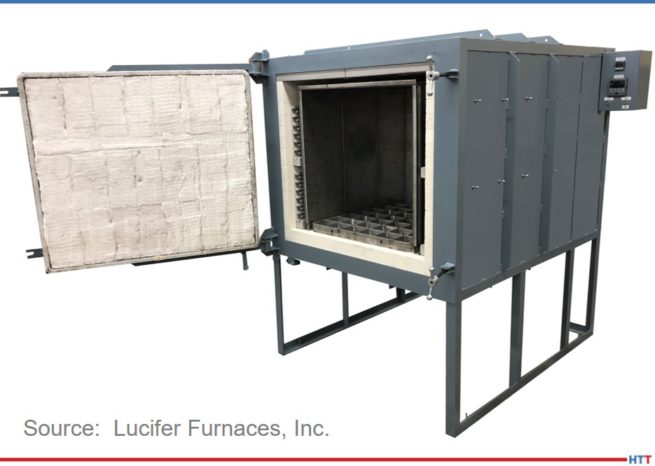
4000 Series Oven from Lucifer Furnaces

The 4000 series oven from Lucifer Furnaces is a Model 42-T36 and has a chamber size of 30″H x 30″W x 36″L, heating to 1200°F with 35 KW of power.

This model is complete with a high CFM rear mounted fan assembly to recirculate the heated air uniformly throughout the chamber. A stainless-steel liner isolates the heating elements from the work area and directs air forward over the heating elements and back through the chamber in a horizontal pattern for uniform heating.

The horizontal swing door is lined with lightweight pyroblock insulation with a ceramic fiber gasket to reduce heat loss around the chamber opening. A safety microswitch automatically shuts off power to heating elements and fan when door is opened, eliminating electric shock and heat blast hazards to oven operator. Controls include a Honeywell digital time proportioning temperature controller accessorized with a high limit controller for safety in the event of a high temp excursion.

Auto Supplier Expands Heat Treating Capabilities with New Oven Read More »

45′ Long Seamless Nickel Alloy Tubes Vacuum Heat Treated Successfully

Michael Johnson
Sales Manager
Solar Atmospheres of Western PA

HTD Size-PR LogoSolar Atmospheres of Western PA successfully vacuum heat treated what is reported to be the largest and longest load of nickel alloy tubing ever in a commercial vacuum furnace. The mission was to preserve the crucial elements of brightness and cleanliness of the 45-foot-long seamless tubing while meeting extremely stringent mechanical properties.

“We spent countless hours reviewing critical systems such as triplicate pumping systems and redundant hot zone controls for any unforeseeable event that might arise during the 100+ hour run,” stated Michael Johnson, sales director at Solar Atmospheres of Western PA. “We are also fortunate that we can rely on our furnace manufacturing division, Solar Manufacturing, for guidance should any issue arise. This successful run will ignite a production campaign for the next 5 years, once again boosting confidence that this 48 foot vacuum furnace will surpass our customers’ expectations.”


Editor’s Note:

We suspected that this is a significant heat treating accomplishment, so we asked industry consultant and expert Dan Herring for perspective.  Here are the questions and his responses. The following is provided by Heat Treat Today and not Solar Atmospheres of Western PA.

HTT: In what industries might these tubes be used?

DH:  Typical examples would include steam generator tubing in nuclear power plants, high temperature aircraft systems, the oil and gas extraction industry, and anywhere applications call for corrosion/pressure/temperature resistant tubes/pipe.

HTT: Is there anything special about processing nickel alloy tubing?

DH: Yes. In order to maximize corrosion resistance, one must keep the surfaces of the tubes as oxide-free as possible. Hence, the use of vacuum. Also, the long lengths of the pipe means fewer welded joints (fewer joints means a stronger pipe, and likely more resistant to corrosion).

HTT: Is this release noteworthy?

DH: It is absolutely noteworthy. This demonstrates size capability available in only a handful (if that many) heat treat shops IN THE WORLD.

45′ Long Seamless Nickel Alloy Tubes Vacuum Heat Treated Successfully Read More »

Heat Treater Expands Operations in Pesqueria, Mexico

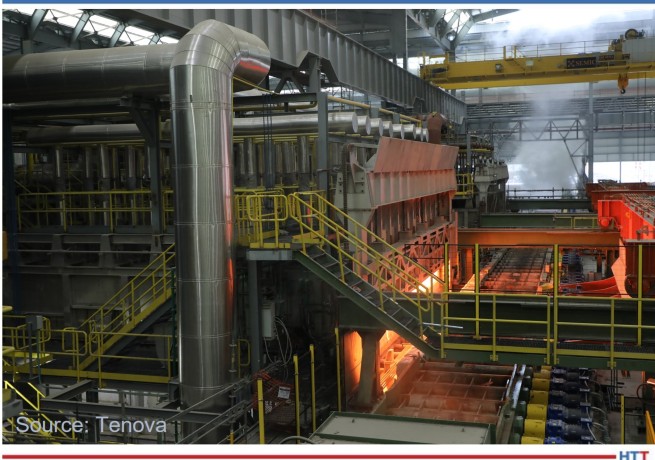
HTD Size-PR LogoTernium, a high quality steel manufacturer in the Americas, recently had two new 400 t/h walking beam furnaces (WBF) started at their hot strip mill facility in Pesqueria, Mexico.

Walking Beam Furnace at Ternium new hot strip mill facility

Features of the WBFs will reduce emissions and provide energy savings. The Tenova furnaces are designed to heat steel slabs up to 39 t at 2282°F (1250°C), with a specific consumption of 1.16 MJ/Kg, while keeping NOx emissions lower than 60 ppm. This emissions level is well below the required limit.

The furnaces features include a SmartBurner Monitoring System (SBMS), which enables the monitoring and optimizing of the burner’s performance, operation and maintenance. The SBMS is a network of embedded sensors connected to the Tenova digital infrastructure through secure connection protocols and intrinsic system reliability. The collected data is post-processed locally on an edge computing unit as well as remotely on the Tenova cloud. By constantly monitoring the status of the burner, the SBMS offers breakthrough approaches to inspection, maintenance and tuning, as well as reducing safety risks related to on-site operations.

Paulo Lopez
Pesquería Plant Director
Ternium

“The Ternium Industrial Center started its first phase in 2013 focused on downstream products as cold rolled and galvanized for the industrial market. Now, we have started up the main production line of the 2nd phase, a new hot rolling mill with a capacity of 4.4 million tons," said Paulo Lopez, Pesquería plant director at Ternium. "The two new WBFs are part of the plant’s new lines and will produce coils to be used in the automotive market in the USMCA area [. . .]."

"This new Tenova equipment joins the previous walking beam furnaces built for Ternium at its plants in San Nicolas, Argentina and in Monterrey, Mexico [. . .]," stated Nicola Cavero, senior vice president of Tenova Italimpianti. "This represents an important new reference for Tenova in the reheating furnaces market."

Heat Treater Expands Operations in Pesqueria, Mexico Read More »

How Heat Treatment Helped a Hydroplane

HTD Size-PR LogoA hydroplane racing team located in Cinnaminson, NJ had three propeller blades heat treated to ensure parts were free of scale and keep the blades from shearing apart. The propellers will now withstand the RPM and torque conditions of racing without failing. Also, the hardening will protect the blades from impact with potential debris in the water.

This case study/press release from the heat treater, Metlab, goes into detail to describe the propellers and how heat treatment changed the material.


A modern unlimited hydroplane is the world’s fastest racing boat, capable of speeds greater than 200 mph. These boats represent the product of over 100 years of evolution in race boat design and materials with the most powerful engines, most advanced construction techniques, and the best safety systems available in boat racing today. A typical unlimited hydroplane can weigh a minimum of 6,750 pounds.

All unlimited hydroplanes are a “three-point” design, meaning they are designed only to touch the water at three points when racing – at the rear of the two front sponsons (the projections of the hull in front of the driver cockpit) and the propeller at the rear of the boat. Most of the unlimited class boats are powered by Chinook helicopter Lycoming T55 L7 turboprop engines, generating up to 3,000 HP.

Metlab, which is known for offering a wide variety of thermal processing solutions, had the opportunity to heat treat a series of propellers for a hydroplane racing team located in Cinnaminson, NJ.

The propellers must meet strict design criteria imposed by the Union Internationale Motonautique (or “UIM,” headquartered in Europe), not only for propellers but for the entire boat design. The propellers are typically 16″ in diameter and have three blades. Different pitch propellers are chosen for use based on course length, conditions, and starting position. It is not uncommon for a racing propeller to cost more than $15,000.

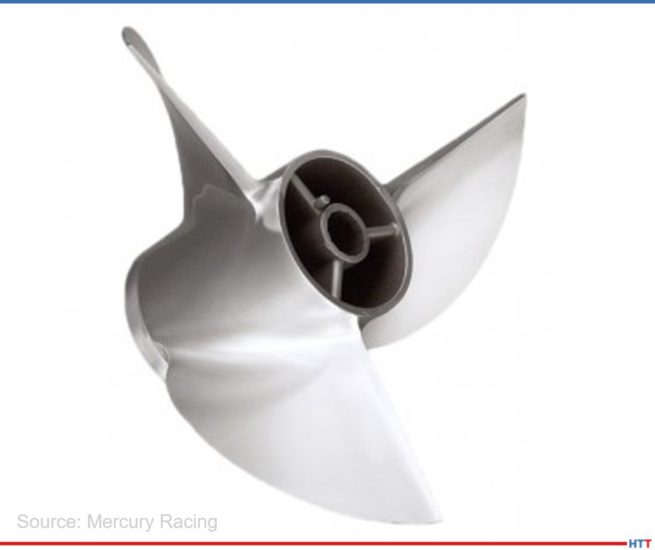
Propeller: Mercury Racing – T.E. Clever model

The propeller creates the distinctive “rooster tail” behind the boat, raising literally tons of water into the air for up to 300 feet behind the boat. They are made from several different materials, but the steel of choice is 17-4 PH stainless steel chosen for its mechanical properties and corrosion resistance. The propeller must support a significant portion of the boat’s weight while rotating up to 14,000 RPM.

Three propeller blades were heat treated for the client to the H-900 condition (900°F/ hours at heat). They were age hardened in a vacuum furnace to ensure parts were free of scale. The high tensile strength (200 KSI) produced by the heat treatment keeps the blades from shearing apart; the excellent ductility associated with the heat-treated material allows the propellers to withstand the RPM and torque conditions without failing. And a hardness of HRC 40 protects the blades from impact with potential debris in the water. 17-4 PH stainless steel properly heat treated also benefits from increasing torsional fatigue strength, a common cause of propeller failure.

Metlab provides heat treating solutions for highly technical parts and components. Consult with a metallurgical specialist at Metlab about your specifications and heat treating requirements.

How Heat Treatment Helped a Hydroplane Read More »

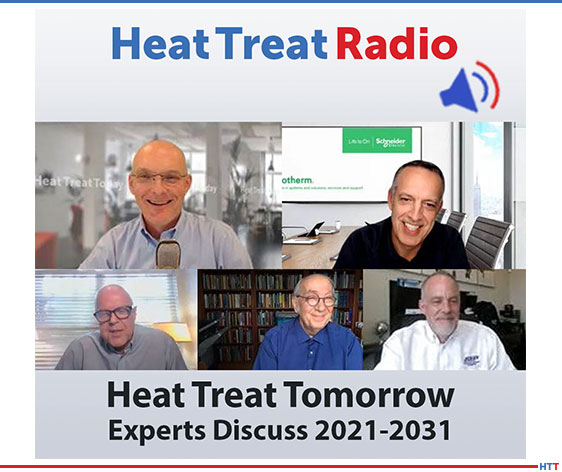
Heat Treat Radio (Special Video Edition): Heat Treat Tomorrow – Experts Look Forward 10 Years

Doug Glenn, publisher of Heat Treat Today, moderates a panel of 5 experts who address questions about the next 5-10 years in the heat treat industry. What are the trends and what should you prepare for. Experts include Peter Sherwin, Eurotherm by Schneider Electric; Janusz Kowaleski, Ipsen Group; Andrew Bassett, Aerospace Testing & Pyrometry; and Dan Herring, the Heat Treat Doctor from The HERRING GROUP, Inc.

You can view this special video edition of Heat Treat Radio by clicking the button below.

Heat Treat Radio (Special Video Edition): Heat Treat Tomorrow – Experts Look Forward 10 Years Read More »

CO and CO₂ Control Considerations

Source: Edinburgh Sensors

Heat treaters know the essential role they play in making high quality -- and, sometimes, just simply useable -- metals. In today's feature article, read about how furnace atmospheres provide protection and controlled material modification; why endothermic process of gas composition must be carefully controlled; and how the endothermic process of gas composition is measured in furnaces.

An excerpt:

"The main objective of a protective furnace atmosphere is to prevent undesired decarburization, hydrogen embrittlement, oxidation, surface bluing, and soot formation. For the desired metal treatment to be successful, the gas composition must be carefully monitored and strictly controlled. Measuring the concentrations of CO, CO₂, H₂, H₂O, N₂ and CH₄ in the generated endothermic gas atmosphere can help ensure that both the endogas generator and the furnace are operating correctly and prevent any undesired reactions."

Read more at "Endothermic Process and Heat Treatment Furnaces – CO and CO₂ Control Considerations"

CO and CO₂ Control Considerations Read More »